Correlation between SNP rs604723 in GRAF3 and hypertension
By: Noopur Doshi
Senior Honors Thesis Department of Biology
University of North Carolina at Chapel Hill
March 24, 2016
Approved:
_________________________ Dr. Joan Taylor, Thesis Advisor Todd Vision, Reader
Abstract:
Patients with hypertension (high blood pressure) have increased risk for cardiovascular diseases, stroke, myocardial infarction, diabetes, and kidney failure. Only 51.8% of hypertensive patients have their blood pressure (BP) under control, and control is difficult to achieve since so little is known about the molecular and genetic regulation of BP. A thorough understanding of the pathways that regulate BP can lead to more effective and personalized antihypertensive therapies. We previously established that a protein called GTPase Regulator Associated with Focal adhesion kinase 3 (GRAF3) helps maintain normal BP by inhibiting RhoA in smooth muscle cells (SMCs). This in turn reduces the SMC contractility and BP. Two previous genome wide association studies for BP and cardiovascular disease identified two single nucleotide
polymorphisms (SNPs) within the first intron of the GRAF3 gene, rs633185 and
rs604723, which are associated with a 2 mm Hg increase in BP in humans. I performed an allelic discrimination assay on rs604723 and found that this SNP is more prevalent in non-hypertensive individuals. Additionally, the population homozygous for this SNP has the lowest average systolic blood pressure (126.29 mm Hg) and diastolic blood
pressure (76.87 mm Hg). It is also known that risk associated with hypertension varies in different race groups. Our study shows that the minor allele frequency of SNP rs604723 is higher in Caucasians (26.74%) than in African Americans (4.84%). These results provide support for the hypothesis that SNP rs604723 plays a protective role in BP regulation. Future analysis will be aimed at studying SNP rs604723 and other SNPs in the RhoA pathway in more detail, in hopes of someday developing better
Introduction:
Blood pressure (BP) is a very complex trait that is not regulated by one specific organ system or one signaling pathway. It is under the control of multiple organ systems such as the endocrine, nervous, cardiovascular, and urinary systems. Patients with high BP, which is known as hypertension (HTN), have a higher risk for cardiovascular
diseases, stroke, myocardial infarction, diabetes, and kidney failure. Even though 1 of 3 US adults has HTN and only 51.8% have their BP under control1, very little is known about its regulation at the molecular level and what genes and mechanisms are involved. Therefore, a thorough understanding of the molecular and genetic pathways that regulate blood pressure can lead to more effective and personalized
antihypertensive therapies.
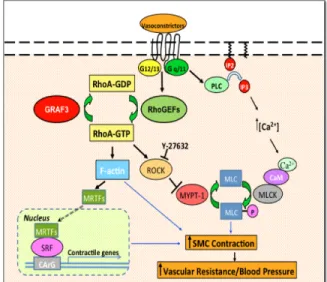
A common characteristic of HTN is increased peripheral vascular resistance due to decreased arteriolar vessel diameter. This is a result of increased smooth muscle cell (SMC) contractions within resistance arterioles whose internal diameter is less than 200 microns 2-6. Figure 1 shows a schematic representation of the Ca2+- calmodulin pathway and RhoA pathway that regulate SMC contractions and blood pressure. When an
extracellular vasoconstrictor signal such as angiotensin II, endothelin-1, or
nucleotide exchange factors (GEFs) to activate RhoA, a GTP-binding protein, in the SMCs. This activated RhoA activates
Rho-kinase (ROCK) whose function is to inhibit myosin phosphatase from dephosphorylating MLC 9-12. Consequently, MLC remains
phosphorylated and activated which results in more SMC contraction. Indeed, increased ROCK activity has been observed in hypertensive rats and some hypertensive patient populations 9,13 while ROCK inhibitors have led to reduced blood pressure in
hypertensive animal models and patients 14. Therefore, RhoA has been implicated in vasoconstrictor-induced hypertension.
Once activated, RhoA has intrinsic GTP-hydrolyzing (GTPase) activity, and it becomes inactivated by hydrolyzing its bound GTP to GDP. The GTPase-activating proteins (GAPs) promote the GTP hydrolysis. Therefore, proper activity of the RhoA-specific GAPs is required to keep RhoA and ROCK activity in control, which in turn can keep SMC contraction and blood pressure in control. Our lab has identified GTPase regulator associated with focal adhesion kinase 3 (GRAF3) to be a RhoA-specific GAP. Immunohistochemical analysis of mouse and human tissues with a GRAF3 antibody showed that GRAF3 gene is selectively expressed in the SMCs15. Thus, the lab
reasoned that GRAF3 might play an important role in regulating SMC contractions and BP.
In order to test the association between GRAF3 gene and blood pressure, the lab had knocked down the GRAF3 gene via a gene-trap in mice. In a gene-trap mouse, a gene-trap cassette is genetically engineered in the gene of interest, which results in alternative splicing of the mRNA and translation of a dysfunctional, truncated protein. When GRAF3 is knocked down in this manner, a significant increase in BP is observed in the mice 15. Specifically, homozygous gene-trap mice showed higher BP than
heterozygous gene-trap mice. This indicates the dose dependent phenotype of GRAF3. Furthermore, GRAF3-deficient SMCs have increased levels of MLC phosphorylation and RhoA activity. The GRAF3 gene can be returned to its original state by using Cre-Lox recombination. Cre-recombinase removes the gene trap cassette, which has been flanked by Lox P sites. When GRAF3 gene is reintroduced only in SMC, by crossing GRAF3 gene trap mice in SMMHC-Cre ERT2 mice, BP returns back to normal. Hence, all these results indicate that GRAF3 helps maintain normal BP by inhibiting RhoA activity in SMC, which in turn reduces the SMC contractility and BP 15.
After establishing the fact that GRAF3 gene plays a role in controlling SMC contraction and thus BP, the next step is to identify how the function of GRAF3 can be compromised. Two previous genome wide association studies have identified a novel BP associated locus containing two single nucleotide polymorphisms (SNPs) in perfect linkage disequilibrium (rs633185 and rs604723) within the first intron of GRAF3
“open” chromatin, active transcription takes place at these sites. These SNPs are also associated with a significant reduction in BP with each copy of the minor allele. Thus, the lab has hypothesized that these SNPs play a protective role in regulation of BP. However, when the lab cloned both the SNP containing segments into luciferase vectors and tested protein expression, the differing alleles of rs604723 showed differences in expression, whereas the differing alleles of rs633185 showed no
differences. Therefore, the SNP rs604723 was chosen for further research. Specifically, my research project focused on determining whether the SNP rs604273 is correlative with HTN and whether it is more frequent in people of a particular race since it is known that risk associated with hypertension varies in different races.
Methods:
Allelic Discrimination Assay
The Applied Biosystems 7500 Fast Reverse Transcription Polymerase Chain Reaction (RT PCR) machine was used to perform a Taqman Allelic Discrimination Assay for the SNP rs604723 on 510 human gDNA samples, obtained from the Heart Healthy Lenoir Study. Allelic Discrimination Assay is a PCR-based assay that genotypes the two possible variants at the SNP site in the target template sequence by measuring
fluorescence signals and using two SNP variant specific probes. For SNP rs604273, the major allele is the nucleotide C at the SNP site, and the minor allele is the nucleotide T at the SNP site. Furthermore, the SNP probe for the nucleotide C is attached to a fluorescent FAM dye, and the SNP probe for the nucleotide T is attached to a
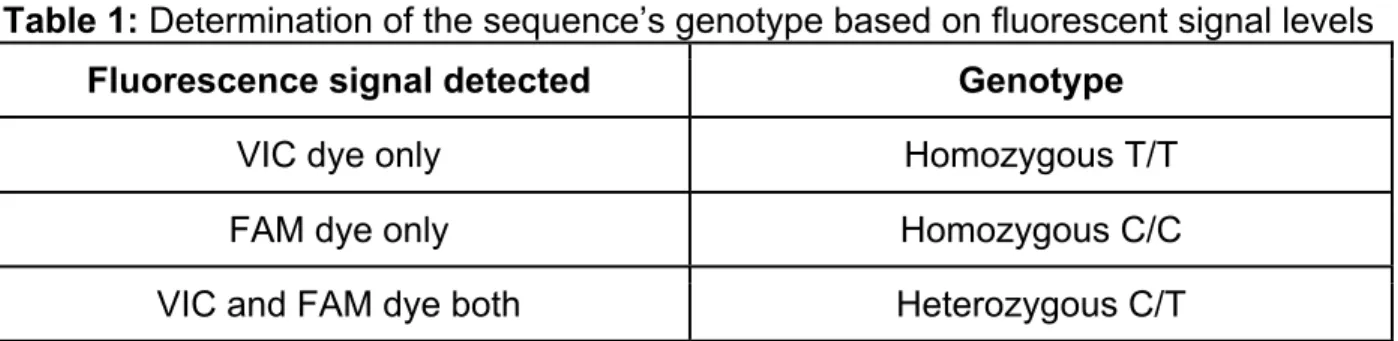
shows the association between the fluorescence signal levels and the corresponding genotype of SNP rs604723 in the 510 human gDNA samples.
Table 1: Determination of the sequence’s genotype based on fluorescent signal levels Fluorescence signal detected Genotype
VIC dye only Homozygous T/T
FAM dye only Homozygous C/C
VIC and FAM dye both Heterozygous C/T
The positive controls for this experiment were pGL3-DHS2T and pGL3-DHS2C, which were previously made by the lab. The positive control, pGL3-DHS2T, was made by isolating DHS2T from human DNA and putting it into the vector pGL3. DHS2T is the DHS where the SNP rs604723 is found with the minor allele T. The second positive control, DHS2C, was made by performing site-directed mutagenesis on pGL3-DHS2T. The negative control was water.
The samples were prepared on 96-well plates, where each reaction well was prepared by following the protocol described in Table 2.
Table 2: Sample Preparation for Allelic Discrimination Assay
Reagent Quantity
Taqman Genotyping MasterMix (20X) 5 𝜇𝐿
SNP Probe (40X) 0.5 𝜇𝐿
Wet DNA/control (10 ng/µL) 1 𝜇𝐿
Minor Allele Frequency Calculation
After genotyping all the samples obtained from the Heart Healthy Lenoir Study, the data was combined with the genotype data from two other hypertensive studies: UNC Family Medicine Study, a longitudinal study directed by co-PI Dr. Anthony Viera, and CAD, Dr. George Stouffer and Dr. Craig Lee’s study. The SNP genotyping assays for rs604723 were previously performed by the lab for these two studies, and I used the genotype data to calculate the Minor Allele Frequency (MAF) of hypertensive vs.
non-hypertensive populations and populations of different races.
MAF, which is the frequency of the least common allele in a given population, is calculated as follows:
𝑀𝐴𝐹 = # 𝑜𝑓 𝑠𝑎𝑚𝑝𝑙𝑒𝑠 𝑤𝑖𝑡ℎ 𝑔𝑒𝑛𝑜𝑡𝑦𝑝𝑒 𝑇/𝑇 + 0.5∗#𝑜𝑓 𝑠𝑎𝑚𝑝𝑙𝑒𝑠 𝑤𝑖𝑡ℎ 𝑔𝑒𝑛𝑜𝑡𝑦𝑝𝑒 𝐶/𝑇 𝑇𝑜𝑡𝑎𝑙 # 𝑜𝑓 𝑠𝑎𝑚𝑝𝑙𝑒𝑠
The statistical analysis on the results obtained was done by a post-doc student’s t-test, and the p-values < 0.05 were considered statistically significant.
Results:
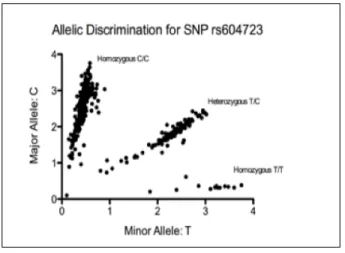
To evaluate the presence of the SNP rs604723, 510 patient gDNA samples, obtained from the Heart Healthy Lenoir Study, were genotyped through an allelic discrimination assay. The allelic
discrimination plot for SNP rs604723 of GRAF3 gene shows that there were 13 patients with the genotype T/T, 112 with the genotype T/C, and 385 patients with the genotype C/C (Figure 2).
Previously, the lab had performed an allelic discrimination assay for SNP
rs604723 on the samples obtained from UNC Family Medicine Study and CAD Study. In UNC Family Medicine Study, the blood pressure data for each patient was collected during two visits, and the patients were not on any antihypertensive therapy before taking part in the study. The patients with systolic blood pressure (SBP) of 140 mm Hg and higher in both visits were considered hypertensive. The MAF for the hypertensive population was 22.08%, which is lower than the MAF for the non-hypertensive
population, which was 26.09% (Table 3). However, this dataset does not reach statistical significance.
Furthermore, for the patients of UNC Family Medicine Study, the average SBP and diastolic blood pressure (DBP) was compared between patients with different genotypes. The patients homozygous for minor allele T had the lowest average SBP, 126.29 mm Hg versus 129.58 mm Hg in patients homozygous for the major allele C, but this difference is not statistically significant (p = 0.199). A more pronounced and
statistically significant effect was observed when comparing DBP, which averaged 76.87 mm Hg in patients homozygous for the minor allele T and 81.79 mm Hg in patients homozygous for the major allele C (p = 0.028; Table 4).
Lastly, the genotyping data obtained for the patients of Heart Healthy Lenoir Study was combined with the data from UNC Family Medicine Study and CAD Study in order to see if MAF of the SNP rs604723 varies between different races. The proportion of homozygous subjects in each race group (Caucasian, African American, and Other) is significantly different (p < 0.001). The Other race group included patients who
of these patients were of Hispanic descent. Notably, there is a significant decrease in the percentage of African Americans that contain the minor T allele (Table 5).
Table 3: Minor Allele Frequency (MAF) for SNP rs604723 is higher in hypertensive vs. non-hypertensive patients in the UNC Family Medicine Study. gDNA was
isolated from patient’s blood and then genotyped using a Taqman SNP genotyping assay for rs604723 (n=346). MAF between hypertensive and non-hypertensive patients was calculated. Patients were considered hypertensive if the systolic BP was greater than 140 for 2 clinic visits. T corresponds to the minor allele and C corresponds to the major allele. No statistical significance reached.
Genotype frequency Sum Minor Allele Frequency T/T T/C C/C
Hypertensive 12 78 141 231 22.08%
Non-hypertensive 8 44 63 115 26.09%
Table 4: There is correlation between blood pressure and genotype of GRAF3 SNP rs604723 in patients in the UNC Family Medicine Study. gDNA was isolated from patient’s blood and then genotyped using a Taqman SNP genotyping assay for rs604723 (n = 348 patients). The average SBP and DBP for each of the three
genotypes were calculated. T corresponds to the minor allele and C corresponds to the major allele. The difference in the average SBP between T/T patients and C/C patients is not statistically significant (p=0.199), but the difference in the average DBP between T/T patients and C/C patients is statistically significant (p=0.028).
Genotype Frequency
T/T T/C C/C
Average Systolic Blood Pressure (mm Hg) 126.29 129.03 129.58 Average Diastolic Blood Pressure (mm Hg) 76.87 81.14 81.79
Number of Patients 19 123 206
Table 5: Minor Allele Frequency (MAF) is greater in Caucasian patients than African American patients in the Heart Healthy Lenoir Study, UNC Family Medicine Study, and CAD Study. gDNA was isolated from patient’s blood and then genotyped using a Taqman SNP genotyping assay for rs604723 (n=505 in the Heart Healthy Lenoir Study, n=350 in the UNC Family Medicine Study, n=369 in the CAD Study). MAF between patients of different races was calculated. Other race group consists of Hispanic patients, and non-Caucasian, non-African American patients. T corresponds to the minor allele and C corresponds to the major allele. The proportion of homozygous subjects in each race group is significantly different (p<0.001).
Race Genotype Frequency Sum Minor Allele Frequency T/T T/C C/C
Caucasian 47 302 392 741 26.72%
African American 0 40 390 430 4.65%
Other 6 21 26 53 31.13%
Discussion:
The original goal was to combine the genotyping data obtained for the Heart Healthy Lenoir Study with data from UNC Family Medicine Study and CAD Study, compare the MAF of the SNP rs604723 in hypertensive vs. non-hypertensive population, and conclude whether this SNP is more frequent in non-hypertensive population. However, as nearly all of the patients in the Heart Healthy Lenoir Study were treated with anti-hypertensive medicines prior to our assessment, we are not able to use Heart Healthy Lenoir Study’s data to draw conclusions regarding the association between the SNP rs604723 and hypertension.
the non-hypertensive population maintain their BP by protecting GRAF3 gene’s function. Furthermore, patients homozygous for the minor allele T had the lowest average SBP and DBP among the three genotypic subgroups (Table 4). A statistically significant difference in the DBP between patients homozygous for the T allele and patients homozygous for the C allele (p=0.028) provided evidence for the hypothetical protective role of SNP rs604723 in BP regulation. Next, the prevalence of SNP
rs604723 in different race populations was analyzed. One significant difference
observed in the data collected from all the studies – Heart Healthy Lenoir Study, UNC Family Medicine Study, and CAD Study – was that the SNP rs604723 is more frequent in the Caucasian population than in the African American population (Table 5). If the SNP rs604723 does in fact has a protective role of reducing blood pressure by increasing more expression of GRAF3, it can help explain why the African American population is more prone to have salt sensitivity and HTN 18.
Another interesting aspect is that the MAF was highest in the Other race group (Table 5). This race group included patients who identified themselves as
hypertensive studies that have patients who are un-treated at the time of data collection are needed before making a conclusion.
Given that BP is a highly variable trait, it is possible that there are numerous SNPs along the RhoA pathway that correlate with different levels of hypertensive risk and drug responses. Although screening for a single SNP such as rs604723 indicated very slight reduction in BP, it is likely that screening for multiple SNPs in the RhoA pathway could lead to a more accurate indication of the combination of SNPs along the RhoA pathway that may alter BP. Future experiments include: (1) analyzing the
presence of a combination of SNPs occurring in the genes that regulate RhoA pathway in human populations (2) analyzing whether a combination of SNPs affect BP.
Since blood pressure is regulated by multiple organ systems, a universal anti-hypertensive treatment suitable for all patients is almost impossible to synthesize. The goal of our lab is to find out which SNPs in GRAF3 and other molecules involved in the RhoA pathway alter the regulatory function of the pathway, how regulation is achieved, and which population subgroups are susceptible to having elevated BP due to elevated RhoA activity. Consequently, each population subgroup can be treated in a more
personalized fashion with an anti-hypertensive treatment that targets RhoA signaling in that sub-population, instead of using a more general treatment that might not be very effective for every patient.
Acknowledgements:
would also like to thank her for guiding me through the paper writing process when I first took BIOL 395 and also editing this thesis, for helping me interpret the data analysis results, and for being my go-to person for any question/doubt.
I would like to thank my PI, Dr. Joan Taylor, for giving me the amazing opportunity of doing research for credit with her lab, for helping me interpret the data analysis results, for proofreading and editing my BIOL 395 paper and thesis, along with Rachel, and for providing me with Figure 1.
I would also like to thank Dr. Anthony Viera, the co-PI of UNC Family Medicine Study, and Dr. George Stouffer and Dr. Craig Lee, the people behind CAD Study, for sharing their studies’ samples with my lab, which allowed me to use the genotyping data from these studies in my data analysis.
References:
1) Wall HK, Hannan JA, Wright JS. Patients With Undiagnosed Hypertension: Hiding in Plain Sight. JAMA. 2014;312(19):1973-1974.
2) Cowley, Jr A. W. The genetic dissection of essential hypertension. Nat. Rev. Genet. 7, 829–840 (2006).
3) Davis, M. J. et al. Integrins and mechanotransduction of the vascular myogenic response. Am. J. Physiol. Heart. Circ. Physiol. 280, H1427–H1433 (2001). 4) Davis, M. J. & Hill, M. A. Signaling mechanisms underlying the vascular myogenic response. Physiol. Rev. 79, 387–423 (1999).
5) Hall, J. E. The kidney, hypertension, and obesity. Hypertension 41, 625–633 (2003).
6) Lifton, R. P., Gharavi, A. G. & Geller, D. S. Molecular mechanisms of human hypertension. Cell 104, 545–556 (2001)
7) Etienne-Manneville, S. & Hall, A. Rho GTPases in cell biology. Nature 420, 629–635 (2002).
8) Budzyn, K., Marley, P. D. & Sobey, C. G. Targeting Rho and Rho-kinase in the treatment of cardiovascular disease. Trends Pharmacol. Sci. 27, 97–104 (2006). 9) Loirand, G. & Pacaud, P. The role of Rho protein signaling in hypertension. Nat. Rev. Cardiol. 7, 637–647 (2010).
10) Amano, M. et al. Phosphorylation and activation of myosin by Rho-associated kinase (Rho-kinase). J. Biol. Chem. 271, 20246–20249 (1996).
11) Kimura, K. et al. Regulation of myosin phosphatase by Rho and Rho-associated kinase (Rho- kinase). Science 273, 245–248 (1996).
12) Mueller, B. K., Mack, H. & Teusch, N. Rho kinase, a promising drug target for neurological disorders. Nat. Rev. Drug Discov. 4, 387–398 (2005).
13) Wirth, A. et al. G12-G13-LARG-mediated signaling in vascular smooth muscle is required for salt-induced hypertension. Nat. Med. 14, 64–68 (2008).
14) Masumoto, A. et al. Possible involvement of Rho-kinase in the pathogenesis of hypertension in humans. Hypertension 38, 1307–1310 (2001).
of vascular tone and hypertension. Nat Commun. 2013;4:2910.
16) Wain, L. V. et al. Genome-wide association study identifies six new loci influencing pulse pressure and mean arterial pressure. Nat. Genet. 43, 1005–1011 (2011)
17) International Consortium for Blood Pressure Genome Wide Association Studies. Genetic variants in novel pathways influence blood pressure and cardiovascular disease risk. Nature 478, 103–109 (2011).