Hepatitis C Continuum of Care
Among Four Screening Populations in Durham County, North Carolina
By
Michael Kovasala
Senior Honors Thesis Health Policy and Management
The University of North Carolina at Chapel Hill
May 2, 2019
Approved: April 10, 2019
____________________________________ Dr. Karl Umble, Thesis Advisor
Dr. Asher Schranz, Reader
Introduction
Hepatitis C (HCV) is the most common blood-borne viral infection in the United States.1 In 2010, the CDC estimates there were 3.5 million people in the US living with chronic HCV, and new cases of acute HCV have tripled from 2010 to 2015.2
The burden of HCV is high among vulnerable populations, such as racial minorities, people who inject drugs (PWID), and incarcerated persons.3,4 Among persons born between 1945 and 1965 (the “birth cohort), which accounts for 74% of all chronic HCV cases, non-Hispanic blacks, and income below the poverty line have been shown to be significant predictors of chronic HCV infection.5 In a study of PWID in Baltimore, non-Hispanic black individuals were found to be at higher risk for HCV infection.6 HCV infection is also extremely prevalent in incarcerated populations. One study estimated that between 29% and 43% of those infected with HCV during that year passed through a correctional facility.7 Another study examining male inmates in Rhode Island prisons estimated a prevalence of 23.1% among those incarcerated 12 months or more.8 Yet, many individuals with HCV are either not diagnosed or unaware of their infection not aware of being infected.9 Persons who are younger, uninsured, never been tested for HIV, or who use drugs but who are not engaged in substance use disorder treatment are less likely to be diagnosed.9,10
by the CDC and the US Preventive Services Task Force,15,16 is becoming more common, there remains a large gap between a positive screening result and beginning treatment.17 One study of persons living with HCV in Long Island, New York noted that of 155 HCV-positive individuals, only 110 (71%) had a follow-up HCV RNA test, and only 54 (35%) were successfully linked to care.11 In one nationally representative systematic review, it was estimated that only 9% of persons with chronic HCV in the US had progressed through the continuum of care to achieve SVR.18
The continuum may be worse for vulnerable populations. One study found that of 187 Chronic HCV-infected patients meeting inclusion criteria, only 107 (57%) completed treatment.19 In this study population, across univariate and multivariate analyses, patients with Medicaid insurance were less likely to complete an evaluation and less likely to be approved for treatment, pointing to a need for improved targeted interventions to close these and other gaps. A nationally representative 2016 study by Bourgi et al. confirmed that Medicaid beneficiaries who screened positive for HCV had significantly lower odds of treatment.20
Problem Statement
The continuum model presents an opportunity to examine how patients in diverse settings progress through the HCV treatment milestones, and can help identify opportunities for intervention to ensure patients achieve SVR.
Research Questions
This study examines outcomes for populations screened for HCV in four different care settings: a county jail, a local Federally Qualified Health Center (FQHC), the county health department, and its various non-jail outreach programs. The study was designed to address the following questions:
• Where do drop-offs occur in the continuums, and how do these differ between screening settings?
• What are factors associated with patients being prescribed treatment?
Methods
Study Design
We conducted a retrospective cohort study of patients enrolled in a pilot program implemented by the Durham County Health Department (DCHD) to enhance linkage to care for Hepatitis C virus infection (HCV). The pilot program utilized bridge counselor services to screen at-risk patients for HCV, provide pre- and post-test counseling, and link HCV-infected patients to care through partnerships with treating providers in and around Durham County. Data for patients in that process was routinely abstracted for program monitoring purposes. While the DCHD linkage-to-care program only extends to linking patients to their first appointment, patients were monitored through their HCV care through the end of treatment via collaboration and data-sharing with partner sites.
Settings and Populations
The program conducted HCV testing in four sites: the sexual health clinic of the DCHD, the Durham County jail, the Lincoln Community Health Center (an FQHC in Durham County), and a community outreach screening program which operated at several sites, including a residential substance abuse recovery program. These care settings serve populations who may be distinct in demographics, HCV risk factors and clinical comorbidities. Therefore, we chose to investigate differences in the data between these care settings.
Program Testing and Linkage to Care Process
birth between 1945 – 1965 (“birth cohort”), history of incarceration, long-term sexual exposure to an HCV-infected person, history of multiple sexual partners, or male-to-male sexual contact. The Durham County jail offered opt-out HCV testing to all inmates; two health educators each visited the jail at least two times per week, and conducted testing in different pods. Other locations selectively screened based on aforementioned risk-factors.
Risk factors were assessed at the DCHD and through their non-jail outreach programs using a standardized self-report form. At Lincoln, risk factors were assessed using a similar form, also based on accepted evidence-based HCV guidelines. The Durham County Jail collected risk factor data but offered HCV testing to all inmates on an opt-out basis.
Testing was typically conducted on-site via existing phlebotomy services, or in a mobile testing unit. HCV antibody testing was conducted in all settings with automatic reflex to HCV RNA testing upon positive results.
Linkage-to-Care Intervention: The program’s linkage-to-care intervention aimed to ensure persons had a first visit with an HCV-treating provider. There was approximately 6-8 weeks from the initial screening to the first appointment. A bridge counselor assisted with post-test counseling and met with patients (in-person at the DCHD, at home visits, or via telephone) to assist in scheduling appointments, address transportation barriers and send appointment reminders. Bridge counseling services concluded once a patient attended their first appointment with a treating provider.
Hepatitis C Continuum of Care
post-test counseling, (3) of those notified and counseled, referral to HCV care, (4) of those referred to care, attendance at first appointment with a treating provider (“linkage”), (5) of those linked to care, prescription of antiviral to treat HCV, (6) of those prescribed HCV treatment, receipt and start of antivirals, (7) of those starting antivirals, completion of medication course and, (8) of those completing medication, confirmation of undetectable HCV RNA level at least twelve weeks later (sustained viral response, SVR-12).21 From initial screening to achieving SVR-12, the entire process lasts approximately nine to twelve months. Therefore, we selected patients who began the process prior to October 31, 2017 (twelve months before the most recent data), to ensure they had sufficient time to move through the full continuum of care.
Data Analysis
Continuum Analysis: An overall continuum of all patients was constructed. We assessed the total number of patients meeting each milestone, as well as the proportion of HCV-infected patients. The continuum was also stratified by the setting in which a patient was screened for HCV. We then compared each milestone between settings to determine if specific settings of diagnosis were associated with drop-off from the continuum. We employed an ANOVA test to compare differences in patient drop-off between settings.
Results
Demographics
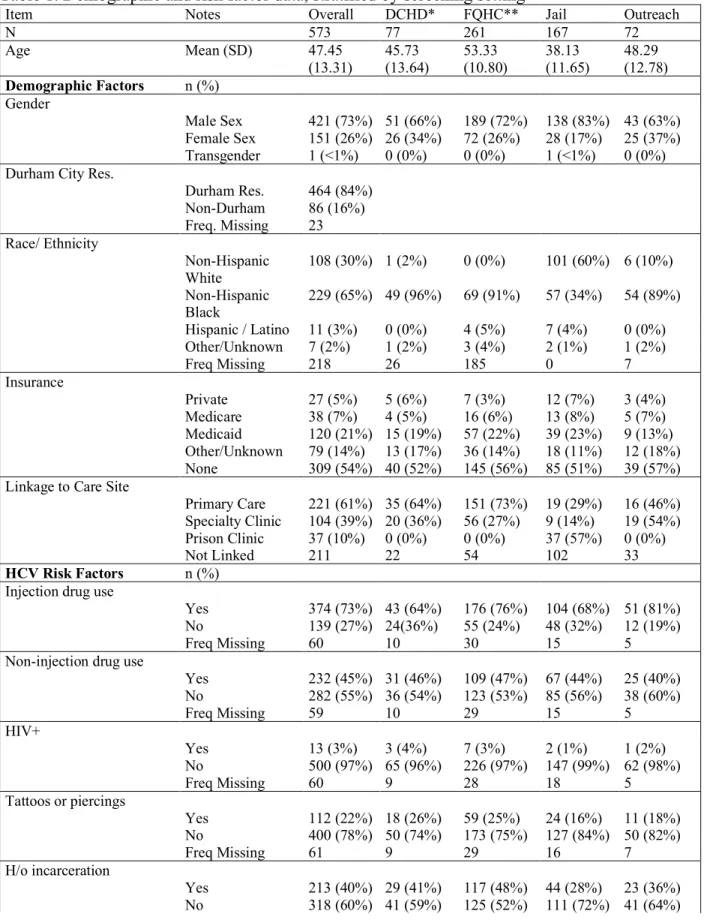
Overall, 573 persons received a positive HCV antibody screening test with a subsequent confirmatory positive HCV RNA. The largest proportion of persons (46%) were diagnosed at the FQHC. Patients had a mean age of 47 (SD 13), were primarily black (65%) male (73%) residents of the city of Durham (84%) who were either uninsured (54%) or insured by Medicaid (21%) (Table 1). Persons diagnosed in the jail were younger (mean age 38, SD 12) and more commonly Non-Hispanic White (60%), compared with other sites. Race/ethnicity data was missing on 71% of FQHC patients, as this data is not routinely collected at the site.
The majority of patients (61%) were linked to a primary care provider (PCP) treating HCV, while others were linked to either a specialty clinic (39%) or a prison clinic (10%). Linkage to a PCP was most common for individuals screened in the county health department (64%) and at the FQHC (73%), while the most common referral for those screened through non-jail outreach was a specialty clinic (54%). The proportion of persons linked to care was lowest among those diagnosed at the jail (61%).
between 1945 and 1965. Prevalence of birth cohort members was lowest in the jail (19%) and highest in the FQHC (66%).
Continua of Care
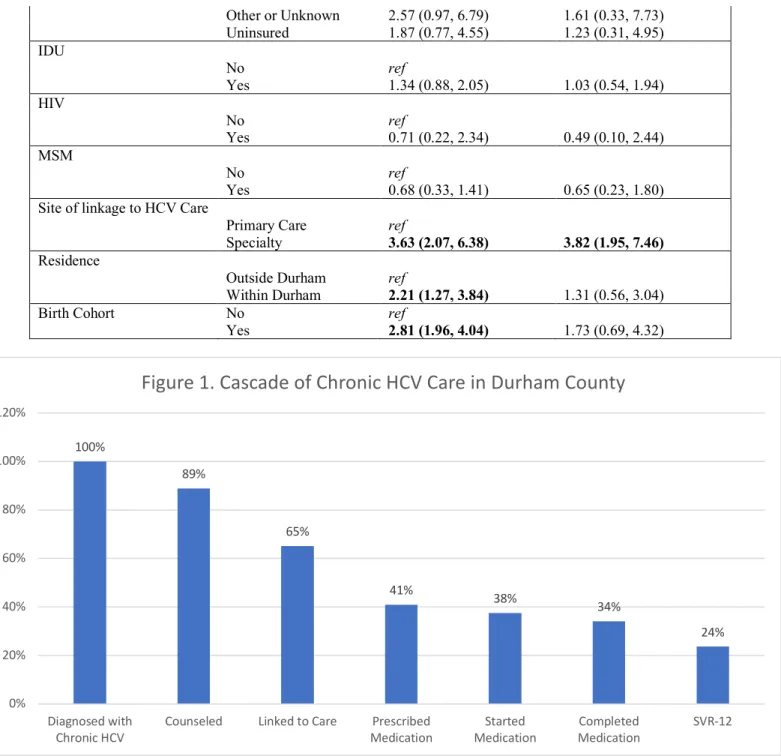
In the overall continuum, 89% (449 patients) of those with chronic HCV were counseled on their diagnosis (Figure 1). 65% of all diagnosed (329 patients) were linked to care with an HCV-treating provider, representing a drop-off of 24% between counseling and linkage to care (Figure 3). Of eligible patients, 41% (192 patients) were prescribed treatment, representing a patient drop-off of 24% between linkage to care and prescription of treatment. Subsequently, 38% of patients (176) began treatment, and 34% (160) completed therapy. Of all eligible patients with chronic HCV, 24% (111) successfully achieved SVR-12.
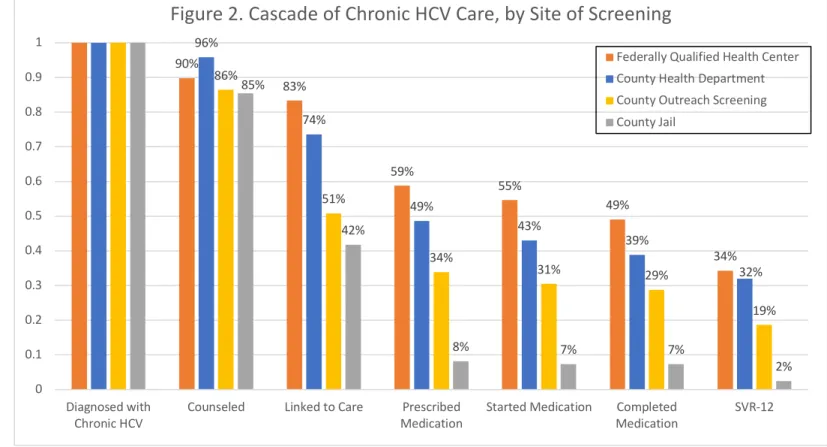
For those diagnosed at the FQHC, the most substantial drop-off occurred from the proportion of eligible patients linked to care (83%) to those who were prescribed medication (59%) (Figure 2). For the county health department, the most prominent gap was between the same two milestones, decreasing from 74% of patients linked to care to 49% who were prescribed medication.
For non-jail outreach, there was a 35% drop-off from counseling to linkage to care (86% counseled and 51% linked to care). For those diagnosed at the jail, under half of those who were counseled on their diagnoses (85% of all persons diagnosed) were linked to care (42%). Among the 122 persons diagnosed in jail and not linked at a prison clinic, where subsequent treatment information was not available, 10 patients (8%) were prescribed medication.
Logistic Regression
diagnosed through non-jail outreach (OR: 0.42, 95%CI: 0.24, 0.74) had significantly lower odds of being prescribed HCV treatment compared to the FQHC, while there was no significant difference between the county health department and the FQHC. Age was significantly associated with patient receipt of HCV prescription; a one-year increase in age was associated with 5% greater odds of being prescribed HCV treatment. In the unadjusted model, race was also found to be a determinant of treatment, with non-Hispanic blacks (OR: 10.87, 95%CI: 4.55, 25.99), individuals of Hispanic ethnicity or other nonwhite race (OR: 6.06, 95%CI: 1.58, 23.23), and individuals of unknown race (OR: 11.09, 95%CI: 4.64, 26.51) more likely to be prescribed HCV treatment compared to non-Hispanic whites. Other significant mediating factors of receiving a prescription were residence within the city of Durham (OR: 2.21, 95%CI: 1.27, 3.84), being a member of the birth cohort (OR: 2.81, 95%CI: 1.96, 4.04), and being linked to a specialty clinic as opposed to a primary care provider (OR: 3.63, 95%CI: 2.07, 6.38).
After adjusting for sociodemographic and risk factors, variables significantly associated with prescription of HCV treatment were diagnosis through non-jail outreach (OR: 0.33, 95%CI: 0.12, 0.89) as well as linkage to a specialty clinic (OR: 3.82, 95%CI: 1.95, 7.46). The Odds Ratio for the patients diagnosed in jail became nonsignificant in our adjusted model.
Discussion
There is extensive literature examining HCV screening in different of settings. However, there is little data on how these screening sites compare to one another within the same community, resulting in inadequate knowledge of where interventions should be targeted in a given region.
We found that less than two-thirds of persons diagnosed with HCV (65%) were linked to care with an HCV-treating provider. Our experience in Durham County is consistent with reports from other sites and is not limited to the Southeastern US. In a comparable community outreach screening program conducted in New Haven, CT, 63% of individuals receiving a positive HCV screen were successfully linked to care, compared to 51% of individuals in our study.22 A community outreach screening program in Philadelphia, which also included on-site phlebotomy testing and immediate automatic reflex to RNA testing, linked 64% of their patients to care.23 Another study conducted in Philadelphia examined HCV screening conducted in five FQHCs, and found similar rates of success in linkage to care; across all five FQHCs, 78% of individuals with a current HCV infection were linked to care, which is generally similar to the 83% linkage rate observed in the FQHC in our study.24 However, individuals in that report were all linked to HCV-specialty clinics, while individuals screened at Lincoln were variably linked to either a Primary Care Provider (PCP) or a Specialty Clinic. Our study found that receipt of a prescription for HCV treatment significantly predicted by whether patients were linked to care at a specialty clinic compared to a primary care clinic or prison clinic. Understanding the barriers to prescription of HCV treatment in primary care settings may help spur improvements along the latter steps of the cascade.
department were only slightly less frequently linked to care than those diagnosed at the FQHC site (74% of patients to linked, compared with 83%). This success carried over to ensuring patients were actually prescribed treatment: 49%, compared with the FQHC’s 59%. Bridge counseling services can be an important tool in helping individuals navigate the milestones of HCV care, especially in the setting of otherwise limited access to care, noninsurance or low health literacy.
Our study focused on the proportion of persons living with HCV who are prescribed treatment. Many evaluations of linkage-to-care programs cease to follow patients at the point of linkage to care.27 For example, in one study of a community-based linkage to care model, of 512 patients with a current HCV infection, 435 (85%) were linked to care. The study concluded that its community-based model successfully had linked a large proportion of persons living with HCV to care; however, the study noted that only 14 of these patients actually initiated treatment, and of those, only 6 achieved functional cure. Given that a small proportion (2.7%) actually received care, and an even smaller proportion (1.2%) actually achieved functional cure, one may argue whether linkage to care is an adequate surrogate outcome for meaningful HCV care8,28,29 Our study also found a substantial drop-off the cascade after linkage to care. Providing resources to safety-net settings to enhance patient navigation services in the latter steps of the cascade would likely improve community-level SVR-12 rates and thereby improve population-level clinical outcomes and decrease ongoing transmission.
targeted towards post-release individuals show promise in linking these individuals to care, but large gaps remain; in a linkage-to-care intervention implemented in a North Carolina jail, just 18 of 66 individuals with a current HCV infection were referred to medical care, and of these, only 10 attended their first medical appointment.33 Our intervention saw a higher proportion of individuals linked to care (42% vs. 27%), but only 10% were confirmed to have been prescribed treatment, suggesting that substantial improvements in care are needed further down the cascade. Importantly, our study found that insurance status was not a significant predictor of being prescribed HCV treatment. This contradicts a nationally representative study of nearly 30,000 persons living with chronic HCV conducted by Wong et al. in 2018, which found that Medicaid beneficiaries and uninsured individuals had significantly lower odds of receiving treatment compared to individuals with private insurance (ORs 0.21 and 0.19, respectively).34 We hypothesize that the lack of a significant difference in our study may be attributable to the success of the bridge counselor intervention in linking Medicaid beneficiaries and uninsured individuals to care. Additionally, we suspect that treatment over this study period was facilitated by the loosening of restrictions for treatment paid by Medicaid and expansion of Prescription Drug Assistance Programs by pharmaceutical companies for uninsured patients.
Application to Future Public Health Interventions
examining the experiences of persons accessing HCV care following jail release will be an important first step in identifying challenges and designing interventions.
Understanding and overcoming barriers to antiviral prescription in primary care settings is also a critical step in improving community-wide outcomes. In our regression model, we found that linkage to a specialty clinic was the strongest predictor of being prescribed treatment (Adjusted Odds Ratio: 3.82, 95% CI: 1.95, 7.46). Given the burden of chronic HCV nationwide, streamlining referral pathways to specialty providers is unlikely to represent a sustainable and generalizable solution. Rather, educational initiatives in HCV care should target primary care clinicians, while primary care practices should develop pathways for integrating HCV treatment into routine practice. One initiative implemented by the University of New Mexico, the Extension for Community Healthcare Outcomes (ECHO) model, aimed to train PCPs in HCV management. A program evaluation found that prior to this training, 93% of enrolled clinicians had no prior experience in the care and treatment of HCV.35 Similarly, a study of primary care settings in Baltimore found that only 10% of PCPs enrolled in the study had treated 1 or more HCV patient in the past year. Nonetheless, shifting HCV treatment to a primary care setting appears feasible and even ideal, given that HCV therapy can be provided over the course of only several visits, requires minimal lab monitoring and typically utilizes medications with few potential side effects. North Carolina, in partnership with two academic medical centers, has developed the Carolina Hepatitis Academic Mentorship Program (CHAMP) which conducts trainings and mentorship to equip the primary care workforce statewide with the tools and experience to treat HCV.36 Enhancing the reach of these programs, combined with expanded patient navigation services, may be the most promising initial steps to addressing HCV in underserved populations.
Strengths of this study include the comparison of progression through the HCV continuum of care across four different screening settings which serve demographically unique, largely uninsured patient populations across a single large and diverse county. While there is a significant body of literature examining the HCV continuum of care in a variety of treatment settings, there is a dearth of studies comparing HCV continuums based on the setting in which patients are initially diagnosed, prior to linkage to care.
Although our findings on one county may limit generalizability, the focus on one urban county in the Southeastern US highlights the state of HCV care in one of the most HCV-prevalent regions in the US.35 North Carolina is also in the minority of states who have not expanded Medicaid under the Affordable Care Act, and as such there may be a greater number of uninsured individuals in our study than similar studies in Medicaid expansion states, which may limit comparisons of our data. Additionally, our study collected data on the last four steps of the continuum from chart review, which lacks information on patient comorbidities, preferences and medical decision-making. Data on HCV treatment of persons in prison was missing in our study, limiting interpretation of the latter steps of the cascade for persons diagnosed in jail. Finally, the FQHC does not routinely collect data on race (71% missing), and for this reason a relatively large proportion (38%) of our data was missing this information, limiting our assessment of race as a mediating factor in receiving HCV treatment. Additionally, as mentioned in the Methods section, the 37 patients who were screened in the jail and referred to a prison clinic were considered lost to follow-up, and were censored from further analysis.
Conclusions
Individuals screened at the FQHC were most likely to be prescribed treatment and eventually achieve functional cure, while individuals screened in community outreach settings were the least likely. Prescription of HCV treatment was significantly more likely for individuals who were linked to specialty clinics than those linked to primary care, indicating an opportunity for improvement of HCV care delivery in primary care settings. Additional research is needed to better understand the specific barriers that limit progression through the steps of the cascade and to design novel interventions to help improve HCV outcomes for the whole community.
Acknowledgements
Appendix
Table 1. Demographic and risk factor data, stratified by screening setting
Item Notes Overall DCHD* FQHC** Jail Outreach
N 573 77 261 167 72
Age Mean (SD) 47.45
(13.31) 45.73 (13.64) 53.33 (10.80) 38.13 (11.65) 48.29 (12.78)
Demographic Factors n (%) Gender
Male Sex 421 (73%) 51 (66%) 189 (72%) 138 (83%) 43 (63%) Female Sex 151 (26%) 26 (34%) 72 (26%) 28 (17%) 25 (37%) Transgender 1 (<1%) 0 (0%) 0 (0%) 1 (<1%) 0 (0%) Durham City Res.
Durham Res. 464 (84%) Non-Durham 86 (16%) Freq. Missing 23 Race/ Ethnicity
Non-Hispanic White
108 (30%) 1 (2%) 0 (0%) 101 (60%) 6 (10%)
Non-Hispanic
Black 229 (65%) 49 (96%) 69 (91%) 57 (34%) 54 (89%) Hispanic / Latino 11 (3%) 0 (0%) 4 (5%) 7 (4%) 0 (0%) Other/Unknown 7 (2%) 1 (2%) 3 (4%) 2 (1%) 1 (2%)
Freq Missing 218 26 185 0 7
Insurance
Private 27 (5%) 5 (6%) 7 (3%) 12 (7%) 3 (4%)
Medicare 38 (7%) 4 (5%) 16 (6%) 13 (8%) 5 (7%) Medicaid 120 (21%) 15 (19%) 57 (22%) 39 (23%) 9 (13%) Other/Unknown 79 (14%) 13 (17%) 36 (14%) 18 (11%) 12 (18%) None 309 (54%) 40 (52%) 145 (56%) 85 (51%) 39 (57%) Linkage to Care Site
Primary Care 221 (61%) 35 (64%) 151 (73%) 19 (29%) 16 (46%) Specialty Clinic 104 (39%) 20 (36%) 56 (27%) 9 (14%) 19 (54%) Prison Clinic 37 (10%) 0 (0%) 0 (0%) 37 (57%) 0 (0%)
Not Linked 211 22 54 102 33
HCV Risk Factors n (%)
Injection drug use
Yes 374 (73%) 43 (64%) 176 (76%) 104 (68%) 51 (81%)
No 139 (27%) 24(36%) 55 (24%) 48 (32%) 12 (19%)
Freq Missing 60 10 30 15 5
Non-injection drug use
Yes 232 (45%) 31 (46%) 109 (47%) 67 (44%) 25 (40%) No 282 (55%) 36 (54%) 123 (53%) 85 (56%) 38 (60%)
Freq Missing 59 10 29 15 5
HIV+
Yes 13 (3%) 3 (4%) 7 (3%) 2 (1%) 1 (2%)
No 500 (97%) 65 (96%) 226 (97%) 147 (99%) 62 (98%)
Freq Missing 60 9 28 18 5
Tattoos or piercings
Yes 112 (22%) 18 (26%) 59 (25%) 24 (16%) 11 (18%) No 400 (78%) 50 (74%) 173 (75%) 127 (84%) 50 (82%)
Freq Missing 61 9 29 16 7
H/o incarceration
Freq Missing 42 7 19 12 4 MSM
Yes 40 (8%) 10 (15%) 19 (8%) 10 (7%) 1 (2%)
No 474 (92%) 58 (85%) 215 (92%) 139 (93%) 62 (98%)
Freq Missing 59 9 27 18 5
STI+
Yes 30 (6%) 3 (4%) 14 (6%) 9 (6%) 4 (6%)
No 482 (94%) 64 (96%) 218 (94%) 141 (94%) 59 (94%)
Freq Missing 61 10 29 17 5
Sex with PWID
Yes 68 (13%) 6 (9%) 41 (18%) 13 (9%) 8 (13%)
No 454 (89%) 60 (91%) 191 (82%) 137 (91%) 55 (87%)
Freq Missing 62 11 29 17 5
Sex with HCV+ person
Yes 58 (11%) 15 (22%) 20 (9%) 18 (12%) 5 (8%)
No 454 (89%) 52 (78%) 212 (91%) 132 (88%) 58 (92%)
Freq Missing 61 10 29 17 5
Sex w multiple partners
Yes 55 (11%) 8 (12%) 31 (13%) 10 (7%) 6 (10%)
No 449 (89%) 56 (88%) 199 (87%) 138 (93%) 56 (90%)
Freq Missing 69 13 31 19 6
Sex for drugs/money
Yes 30 (6%) 5 (7%) 15 (6%) 7 (5%) 3 (5%)
No 482 (94%) 62 (93%) 217 (94%) 143 (95%) 60 (95%)
Freq Missing 61 10 29 17 5
BT before 1992
Yes 26 (5%) 7 (11%) 5 (2%) 10 (7%) 4 (6%)
No 479 (95%) 57 (89%) 226 (98%) 138 (93%) 58 (94%)
Freq Missing 68 13 30 19 6
Birth Cohort member
Yes 276 (48%) 33 (43%) 173 (66%) 32 (19%) 38 (56%) No 297 (52%) 44 (57%) 88 (34%) 135 (81%) 30 (44%)
Freq Missing 0 0 0 0 0
*Durham County Health Department. **Federally Qualified Health Center (Lincoln).
Table 2. Univariate and Adjusted Odds Ratios of Receiving HCV Prescription
Variable Category Univariate OR (95%CI) Adjusted OR (95% CI)
Screening Site
Lincoln FQHC ref
DCHD 0.77 (0.46, 1.28) 0.61 (0.27, 1.37)
DC Jail 0.07 (0.04, 0.15) 0.29 (0.08, 1.07)
Non-Jail Outreach 0.42 (0.24, 0.74) 0.33 (0.12, 0.89)
Age age 1.05 (1.04, 1.07) 1.00 (0.96, 1.04)
Sex
Female ref
Male 0.77 (0.52, 1.13) 0.70 (0.38, 1.28)
Race/Ethnicity
Non-Hispanic White ref
Non-Hispanic Black 10.87 (4.55, 25.99) 2.03 (0.43, 9.60) Hispanic/Other 6.06 (1.58, 23.23) 1.74 (0.18, 16.65) Unknown 11.09 (4.64, 26.51) 1.06 (0.21, 5.37) Insurance Status
Private Insurance ref
Medicare 1.43 (0.47, 4.31) 0.73 (0.14, 3.85)
Other or Unknown 2.57 (0.97, 6.79) 1.61 (0.33, 7.73) Uninsured 1.87 (0.77, 4.55) 1.23 (0.31, 4.95) IDU
No ref
Yes 1.34 (0.88, 2.05) 1.03 (0.54, 1.94)
HIV
No ref
Yes 0.71 (0.22, 2.34) 0.49 (0.10, 2.44)
MSM
No ref
Yes 0.68 (0.33, 1.41) 0.65 (0.23, 1.80)
Site of linkage to HCV Care
Primary Care ref
Specialty 3.63 (2.07, 6.38) 3.82 (1.95, 7.46)
Residence
Outside Durham ref
Within Durham 2.21 (1.27, 3.84) 1.31 (0.56, 3.04)
Birth Cohort No ref
Yes 2.81 (1.96, 4.04) 1.73 (0.69, 4.32)
100%
89%
65%
41% 38%
34%
24%
0% 20% 40% 60% 80% 100% 120%
Diagnosed with
Chronic HCV Counseled Linked to Care MedicationPrescribed MedicationStarted MedicationCompleted SVR-12
90% 83% 59% 55% 49% 34% 96% 74% 49% 43% 39% 32% 86% 51% 34% 31% 29% 19% 85% 42%
8% 7% 7%
2% 0 0.1 0.2 0.3 0.4 0.5 0.6 0.7 0.8 0.9 1 Diagnosed with
Chronic HCV Counseled Linked to Care MedicationPrescribed Started Medication MedicationCompleted SVR-12
Figure 2. Cascade of Chronic HCV Care, by Site of Screening
Federally Qualified Health Center County Health Department County Outreach Screening County Jail 4% 22% 25% 6% 4% 7% 10% 6% 25% 4% 6% 15% 14% 36% 17% 3% 2% 10% 15% 44% 34% 1% 0% 5% 11% 24% 24% 3% 3% 10% 0% 5% 10% 15% 20% 25% 30% 35% 40% 45% 50%
Dx > Counseled Counseled > Linked Linked > Prescribed Prescribed > Started Started > Completed Completed > SVR-12
Figure 3. Percent of Patient Dropoff by Milestone
County Health Department Federally Qualified Health Center County Outreach Screening County Jail
Bibliography
1. Hall EW, Rosenberg ES, Sullivan PS. Estimates of state-level chronic hepatitis C virus infection, stratified by race and sex, United States, 2010. BMC Infect. Dis. 2018;18(1):224. doi:10.1186/s12879-018-3133-6.
2. Centers for Disease Control and Prevention (CDC). U.S. 2015 Surveillance Data for Viral Hepatitis. Division of Viral Hepatitis: Statistics and Surveillance 2017. Available at: https://www.cdc.gov/hepatitis/statistics/2015surveillance/commentary.htm. Accessed October 22, 2018.
3. Armstrong GL, Wasley A, Simard EP, McQuillan GM, Kuhnert WL, Alter MJ. The prevalence of hepatitis C virus infection in the United States, 1999 through 2002. Ann. Intern. Med. 2006;144(10):705-714. doi:10.7326/0003-4819-144-10-200605160-00004. 4. Akiyama MJ, Kaba F, Rosner Z, Alper H, Holzman RS, MacDonald R. Hepatitis C
Screening of the “Birth Cohort” (Born 1945-1965) and Younger Inmates of New York City Jails. Am. J. Public Health 2016;106(7):1276-1277. doi:10.2105/AJPH.2016.303163. 5. Moore KJ, Gauri A, Koru-Sengul T. Prevalence and sociodemographic disparities of
Hepatitis C in Baby Boomers and the US adult population. J. Infect. Public Health 2019;12(1):32-36. doi:10.1016/j.jiph.2018.08.003.
6. Thomas DL, Vlahov D, Solomon L, et al. Correlates of hepatitis C virus infections among injection drug users. Medicine 1995;74(4):212-220.
7. Hammett TM, Harmon MP, Rhodes W. The burden of infectious disease among inmates of and releasees from US correctional facilities, 1997. Am. J. Public Health
2002;92(11):1789-1794. doi:10.2105/AJPH.92.11.1789.
8. Macalino GE, Vlahov D, Sanford-Colby S, et al. Prevalence and incidence of HIV, hepatitis B virus, and hepatitis C virus infections among males in Rhode Island prisons. Am. J. Public Health 2004;94(7):1218-1223. doi:10.2105/AJPH.94.7.1218.
9. Collier MG, Bhaurla SK, Cuevas-Mota J, Armenta RF, Teshale EH, Garfein RS. Awareness of HCV infection among persons who inject drugs in San Diego, California. Am. J. Public Health 2015;105(2):302-303. doi:10.2105/AJPH.2014.302245.
10. Kuniholm MH, Jung M, Del Amo J, et al. Awareness of hepatitis C virus seropositivity and chronic infection in the hispanic community health study/study of latinos (HCHS/SOL). J. Immigr. Minor. Health 2016;18(6):1257-1265. doi:10.1007/s10903-016-0350-1.
11. Yehia BR, Schranz AJ, Umscheid CA, Lo Re V. The treatment cascade for chronic hepatitis C virus infection in the United States: a systematic review and meta-analysis. PLoS One 2014;9(7):e101554. doi:10.1371/journal.pone.0101554.
12. Teriaky A, Reau N. Evaluation of Hepatitis C Patients in the Direct-Acting Antiviral Era. Clin. Liver Dis. 2015;19(4):591-604, v. doi:10.1016/j.cld.2015.06.001.
13. Conteduca V, Sansonno D, Russi S, Pavone F, Dammacco F. Therapy of chronic hepatitis C virus infection in the era of direct-acting and host-targeting antiviral agents. J. Infect. 2014;68(1):1-20. doi:10.1016/j.jinf.2013.08.019.
14. Shiffman ML. Hepatitis C virus therapy in the direct acting antiviral era. Curr. Opin. Gastroenterol. 2014;30(3):217-222. doi:10.1097/MOG.0000000000000062.
15. US Preventive Services Task Force. Final Update Summary: Hepatitis C: Screening. US Preventive Services Task Force: Hepatitis C: Screening 2013. Available at:
16. Centers for Disease Control and Prevention (CDC). Testing Recommendations for Hepatitis C Virus Infection. HCV: Division of Viral Hepatitis 2015. Available at: https://www.cdc.gov/hepatitis/hcv/guidelinesc.htm. Accessed October 17, 2018.
17. Brady JE, Vellozzi C, Hariri S, et al. Hepatitis C care cascade among persons born 1945-1965: 3 medical centers. Am. J. Manag. Care 2018;24(9):421-427.
18. Zuckerman A, Douglas A, Nwosu S, Choi L, Chastain C. Increasing success and evolving barriers in the hepatitis C cascade of care during the direct acting antiviral era. PLoS One 2018;13(6):e0199174. doi:10.1371/journal.pone.0199174.
19. Bourgi K, Brar I, Baker-Genaw K. Health disparities in hepatitis C screening and linkage to care at an integrated health system in southeast michigan. PLoS One
2016;11(8):e0161241. doi:10.1371/journal.pone.0161241.
20. HCV Guidance. HCV Guidance: Recommendations for Testing, Managing, and Treating Hepatitis C. Infectious Disease Society of America - American Association for the Study of Liver Diseases 2018. Available at: https://www.hcvguidelines.org/evaluate/testing-and-linkage. Accessed November 28, 2018.
21. Morano JP, Zelenev A, Lombard A, Marcus R, Gibson BA, Altice FL. Strategies for Hepatitis C Testing and Linkage to Care for Vulnerable Populations: Point-of-Care and Standard HCV Testing in a Mobile Medical Clinic. J Community Health 2014;39(5):922-934. doi:10.1007/s10900-014-9932-9.
22. Trooskin SB, Poceta J, Towey CM, et al. Results from a Geographically Focused,
Community-Based HCV Screening, Linkage-to-Care and Patient Navigation Program. J. Gen. Intern. Med. 2015;30(7):950-957. doi:10.1007/s11606-015-3209-6.
23. Coyle C, Viner K, Hughes E, et al. Identification and Linkage to Care of HCV-Infected Persons in Five Health Centers - Philadelphia, Pennsylvania, 2012-2014. MMWR Morb. Mortal. Wkly. Rep. 2015;64(17):459-463.
24. Rhea S, Seña AC, Hilton A, Hurt CB, Wohl D, Fleischauer A. Integrated hepatitis C testing and linkage to care at a local health department sexually transmitted disease clinic: determining essential resources and evaluating outcomes. Sex. Transm. Dis.
2018;45(4):229-232. doi:10.1097/OLQ.0000000000000748.
25. Perumalswami PV, Factor SH, Kapelusznik L, et al. Hepatitis Outreach Network: a practical strategy for hepatitis screening with linkage to care in foreign-born communities. J. Hepatol. 2013;58(5):890-897. doi:10.1016/j.jhep.2013.01.004.
26. Bajis S, Dore GJ, Hajarizadeh B, Cunningham EB, Maher L, Grebely J. Interventions to enhance testing, linkage to care and treatment uptake for hepatitis C virus infection among people who inject drugs: A systematic review. Int. J. Drug Policy 2017;47:34-46.
doi:10.1016/j.drugpo.2017.07.002.
27. Ford MM, Jordan AE, Johnson N, et al. Check Hep C: A Community-Based Approach to Hepatitis C Diagnosis and Linkage to Care in High-Risk Populations. J. Public Health Manag. Pract. 2018;24(1):41-48. doi:10.1097/PHH.0000000000000519.
28. Hennessey KA, Kim AA, Griffin V, Collins NT, Weinbaum CM, Sabin K. Prevalence of infection with hepatitis B and C viruses and co-infection with HIV in three jails: a case for viral hepatitis prevention in jails in the United States. J Urban Health 2009;86(1):93-105. doi:10.1007/s11524-008-9305-8.
30. Hochstatter KR, Stockman LJ, Holzmacher R, et al. The continuum of hepatitis C care for criminal justice involved adults in the DAA era: a retrospective cohort study demonstrating limited treatment uptake and inconsistent linkage to community-based care. Health Justice 2017;5(1):10. doi:10.1186/s40352-017-0055-0.
31. Freudenberg N, Daniels J, Crum M, Perkins T, Richie BE. Coming home from jail: the social and health consequences of community reentry for women, male adolescents, and their families and communities. Am. J. Public Health 2005;95(10):1725-1736.
doi:10.2105/AJPH.2004.056325.
32. Schoenbachler BT, Smith BD, Seña AC, et al. Hepatitis C Virus Testing and Linkage to Care in North Carolina and South Carolina Jails, 2012-2014. Public Health Rep. 2016;131 Suppl 2:98-104. doi:10.1177/00333549161310S215.
33. Wong RJ, Jain MK, Therapondos G, et al. Race/ethnicity and insurance status disparities in access to direct acting antivirals for hepatitis C virus treatment. Am. J. Gastroenterol. 2018;113(9):1329-1338. doi:10.1038/s41395-018-0033-8.
34. Mitruka K, Thornton K, Cusick S, et al. Expanding primary care capacity to treat hepatitis C virus infection through an evidence-based care model--Arizona and Utah, 2012-2014. MMWR Morb. Mortal. Wkly. Rep. 2014;63(18):393-398.
35. Carolina Hepatitis C Academic Mentorship Program (CHAMP). Welcome to CHAMP. UNC School of Medicine: Liver Center 2018. Available at:
https://www.med.unc.edu/champ. Accessed March 31, 2019.