CONCUSSION-RELATED KNOWLEDGE, ATTITUDES, NORMS, AND EXPECTATIONS AMONG STUDENTS AT A LARGE PUBLIC UNIVERSITY
Reagan E. Page
An undergraduate thesis proposal submitted to the faculty of the University of North Carolina at Chapel Hill in partial fulfillment of the requirements for graduation with honors in the
Department of Exercise and Sport Science in the College of Arts & Sciences.
Chapel Hill 2019
Approved by:
Johna K. Register-Mihalik, PhD, LAT, ATC
Zachary Y. Kerr, PhD, MPH
ABSTRACT
REAGAN PAGE: Concussion-Related Knowledge, Attitudes, Norms, and Expectations among Students at a Large Public University
(Under the direction of Melissa C. Kay and Johna K. Register-Mihalik)
Many factors influence student-athletes’ decision to disclose concussion symptoms. Understanding concussion-related culture that can affect disclosure behavior, specifically at the university level, is novel. This study investigated factors at a large, public university associated with concussion knowledge, attitudes, and norms among stakeholders and determined factors that influence these stakeholders’ expectations of student-athletes and fans regarding concussion.
ACKNOWLEDGEMENTS
TABLE OF CONTENTS
CHAPTER 1………...…. 1.1Reliance on Concussion Disclosure for Diagnosis………... 1.2Concussion Disclosure and the Socio-Ecological Model………....…..
1.3Hypothesis Rationale………....
1.4Statement of the Problem………...
1.5Aims ……….……
1.6Research Hypotheses……….
1.7Independent Variables……….………...…....
1.8Dependent Variables……….………
1.9Operational Definitions………..……...
1.10Assumptions………...
1.11Limitations………..…...…..
1.12Significance of the Proposed Study………...……….…. CHAPTER 2………...……
2.1 Concussion Epidemiology………...…. 2.2 Concussion Protocol and Management………..….. 2.3 Socioecological Model……….…... 2.4 Aspects of the University Culture………..….… 2.5 Aspects of the University Setting………..…..…
2.6 Summary for Rationale………...….…. CHAPTER 3………. Participants………...…. Instrumentation……….… Procedures………...…..… Data Analyses………..……...… Table 3.1 Data Analyses by Aim……….….. CHAPTER 4………...…..
Manuscript………...…… CHAPTER 5……….
5.1 Summary Aim 1….……….………….... 5.2 Summary Aim 2….……….……. 5.3 Lessons Learned…..………..………….. 5.4 Future Research………..…………. APPENDIX 1: VARIABLES AND CONSTRUCTS BY AIM ………..…... APPENDIX 2: SURVEY……….. APPENDIX 3: DISTRIBUTION MATIERALS……….. APPENDIX 4: FLOW CHART OF RECRUITMENT PROCESS………... REFERENCES………..
CHAPTER 1
1.1 Reliance on Concussion Disclosure for Diagnosis
Upwards of 50% of all concussions may go undisclosed.1 This is of particular concern due to the reliance on symptomatic presentation for concussion diagnosis. Signs and symptoms make patient self-reporting a priority as they are often not visible to an external source. They typically include headaches, dizziness, nausea, and fatigue among many others which are not always obvious to healthcare professionals.2 Consequently, diagnoses heavily rely on patients to recognize and disclose their symptoms. There are many factors that may drive disclosure versus non-disclosure that are both internal and external to the student-athlete. It is necessary to better understand what factors affect overall concussion-related culture in order to encourage athletes to self-report, for an organization to implement necessary concussion protocol(s), and for the
general culture to focus on student-athlete well-being and safety. 1.2 Concussion Disclosure and the Socio-Ecological Model
The socio-ecological model3 is proposed as one way to better understand concussion-related culture. This model provides a framework of influence over behavior including four levels: intrapersonal (knowledge, attitudes, beliefs), interpersonal (stakeholder dynamics), community/organization (relationships among groups), and societal (cultural norms). Ultimately, the behavior of concussion self-reporting is influenced by a combination of these levels;
identified elements that might impact an athlete’s willingness to self-report, including both intrapersonal4, 5, 6, 7 and interpersonal factors.8 Intrapersonal factors include knowledge, attitudes, behaviors, and norms. Interpersonal factors include pressure from external sources, such as coaches, teammates, fans, and parents. One study4 found that intrapersonal factors, such as a person’s knowledge about head injury symptoms, do not necessarily affect an athlete’s willingness to report a possible concussion. However, one study6 suggested that athletes who had received concussion symptom training (knowledge - intrapersonal factor) were more likely to report their symptoms to a coach compared to those without this type of education. In addition to these intrapersonal pressures affecting nondisclosure, it has also been noted that athletes who experienced pressure from coaches, teammates, parents, and fans were less likely to self-report a concussion.8 These sources of pressure and the pressure itself create an environment, or culture, surrounding concussion. For example, negative parental pressure could create negative
household attitudes toward concussion disclosure.
Depending on directionality of pressure (good-encouraging disclosure behaviors/best practices versus bad-discouraging disclosure behaviors/not using best practices), culture could help create a safer environment for student-athletes or, conversely, discourage student-athletes from self-reporting concussion-like symptoms. This culture surrounding concussion exists at every level of the socioecological model; however, the role that university concussion culture plays in influencing student-athletes’ disclosure behavior has not been heavily studied. 1.3 Hypotheses Rationale
income levels with increased knowledge and attitudes scores.10 One study12 found that parents’ and/or athletes’ competitiveness could be a barrier for concussion management. Although a previous study13 found that among high school athletes, greater numbers of previous concussions were associated negatively with attitudes and disclosure behaviors and that concussion history did not affect concussion knowledge score, this may not be true for a different population. This was also true for another study14, but could have been due to other variables. Therefore, in our hypotheses, we are predicting a positive relationship between concussion history and concussion knowledge, attitudes, and norm scores. The same study found that concussion knowledge
accuracy scores for participants who participated in recreational, high school, non-applicable, or college-level or above (semi-professional and/or professional) were 64%, 63%, 65%, and 54%, respectively. In addition to sport history, favorite sport (contact collision versus non-contact collision) will be assessed. This relationship between nature of sport and concussion constructs could be related in the same way to aggression associated with such sports.
1.4 Statement of the Problem
Despite these findings, most of the concussion-related culture data to date has been about athlete-specific factors, especially knowledge and attitudes at the interpersonal level. There is a need for greater understanding of factors across the SEM, particularly institutional or
organizational norms and the impact on concussion-related culture in the university setting. This is important because of the role that university environments play in creating a culture around sports, safety, and the health of student-athletes. As mentioned, student-athletes report feeling pressure from external sources such as fans, and these fans play a role in creating university culture. More information about the university culture surrounding concussion is needed. Such findings may aid in development of better awareness, education, and training tools across the university setting to improve concussion culture and overall care in the university environment.
In April 2010, The National Collegiate Athletic Association (NCAA) passed the Concussion Policy and Legislation, which set out to warrant university concussion compliance and plans consistent with their guidelines. In 2015, a study18 reported that most of its respondents have a concussion management plan, but that some of the specific categories outlined by the NCAA were not necessarily being implemented or included within the management plan. Each university is ultimately responsible for the concussion education of their athletes19 and associated concussion management plan; however, this education can vary with regards to content and quality from institution to institution creating diverse concussion knowledge in collegiate sports. This range in knowledge could potentially translate into extremely varied concussion disclosure behavior from college athletes. These athletes also reported that most of the concussion
such as coaches and physicians, to be included in their education.19 This variation in concussion education and background creates a unique university environment.
The university environment may play a large role in concussion-related behaviors, especially disclosure. In addition, fan perceptions of concussions and disclosure, which are an aspect of this university environment, are not well understood. By understanding student, faculty,
and staff concussion-related perceptions, we will have a better understanding of how the surrounding university culture may influence concussion-related decisions and outcomes in collegiate sports. A comprehensive profile of these factors is needed to design and implement future interventions poised to improve concussion disclosure.
1.5 Aims
The aims of this project are to:
1. Aim 1: Determine factors that are associated with sport-related concussion-related knowledge, attitudes, and norms among students at a large, public university.
2. Aim 2: Determine factors that influence student expectations of student-athletes’ and fans’ concussion-related behaviors at a large, public university.
1.6 Research Hypotheses 1. Aim 1: HR:
a. Female, Caucasian, non-Hispanic students will be positively associated with knowledge, attitudes, and norm scores.
b. Previous concussion history and sport history will be positively associated with knowledge, attitudes, and norm scores.
d. Competitiveness will be negatively associated with knowledge, attitudes, and norm scores.
3. Aim 2: HR:
a. Female, Caucasian, non-Hispanic individuals will be positively correlated with expectation scores.
b. Previous concession history and sport history will be positively associated with expectation scores.
c. Higher fan identity will be negatively correlated with expectation scores. d. Competitiveness will be negatively associated with expectation scores. e. Higher concussion-related knowledge, attitudes, and norm scores will be
positively correlated with expectation scores. 1.7 Independent Variables
RA 1: gender, race/ethnicity, previous concussion history, previous sport history, fan identity, and competitiveness.
RA 2: gender, race/ethnicity, previous concussion history, previous sport history, fan identity, competitiveness, knowledge, attitudes, and norm scores.
1.8 Dependent Variables
RA 1: Knowledge, attitudes, and norm scores. RA 2: Expectations scores.
1.9 Operational Definitions
3. External factors: Interpersonal influences from stakeholders (coaches, teammates, parents, fans) on athletes to disclose concussion-like symptoms
4. Fan Identity: Student, faculty, and staff self-identification of how strongly they identify with sports teams and consider themselves fans
5. Internal factors: Intrapersonal influences (knowledge, attitudes, beliefs, norms) that influence athletes to disclose their concussion-like symptoms
6. Knowledge: Facts and information students, faculty, and staff have learned through previous concussion education or exposure
7. Norms: Typical thoughts or behaviors of students, faculty, and staff surrounding the notion of concussion
8. Fan expectations: Student, faculty, and staff expectations for how fans should behave concerning concussion-related events
9. Student-athlete expectations: Student, faculty, and staff expectations for how student-athletes should behave concerning concussion-related events
1.10 Assumptions
1. The faculty, staff, and students answered survey questions honestly. 2. The survey was reliable and valid.
3. Each participant completed the survey according to directions provided. 1.11 Limitations
1. Participants were all affiliated with the University of North Carolina at Chapel Hill.
2. Participants may have only selected to participate due to pre-existing interest in the topic of study.
4. The sample size was small in terms of response rate. 5. There was a lack of diversity in participants.
1.12 Significance of the Proposed Study
This study had two primary aims that included determining factors that are associated with sport-related concussion-related knowledge, attitudes, and norms among students at a large, public university and determining factors that influence expectations of student-athletes and fans regarding concussion-related behaviors at a large, public university. There is limited research regarding concussion-related factors among faculty, staff, and students at the university level and particularly self-identified fans’ expectations for student-athletes and fans with respect to
CHAPTER 2 2.1 Concussion Epidemiology
Concussions are a type of traumatic brain injury that occur when injuries to the head or body cause the brain to forcefully hit the inside walls of the skull.20 This type of contact often results in structural damage (tearing, pulling, swelling and bruising of brain tissue) and chemical damage. The symptoms often associated with concussions are due to the chemical imbalances, which are not detectable with neuroimaging techniques. Typical symptoms include confusion, headache, drowsiness, vision and balance issues, nausea/vomiting, difficulty concentrating, slurred speech, sensitivity to light and noise, and sleep disturbances, among others.20 Symptoms may not necessarily be felt immediately after an injury and can develop over the first 24 to 48 hours. In order to make a diagnosis, a healthcare professional will conduct a series of
multifaceted examinations including physical and neurological components, that include balance, cognition, and visual testing.
prevent further damage is to remove the individual from play/activity once their concussion-like symptoms have been recognized in accordance with typical signs and symptoms as described by both guidelines for best practices.21,22 Athletes should be re-evaluated by a medical professional once removed from event site (practice, game, training, etc.) and initially evaluated by an athletic trainer. Treatment for concussions includes rest until symptom free, sub-symptom-threshold, submaximal exercises, psychological, cervical, and vestibular rehabilitation.21 Clinical recovery, defined as a “return to normal activities, including school, work, and sport, after injury”21 is expected for most athletes within 10 days. Return to sport is a 6-step process with aims,
activities, and goals that allows the athlete to gradually get back into practice/play/training after an initial rest period.21 This allows for submaximal rehabilitation and a reintroduction to normal athletic activities and becoming asymptomatic.
Concussions are common in sports at all levels, from middle school to professional sports settings. Many studies have assessed concussion rates at the high school level. From 2005-2006 to 2011-2012, data from an injury surveillance system, High School Reporting Information Online (RIO), showed that across 9 high school sports, 4,024 concussions occurred.24 Girls were said to have a higher concussion rate than boys when analyzing comparable sports (i.e. girls’ soccer and boys’ soccer) and boys’ football had the highest injury rate. Another study25 found similar results after analyzing injury data from 27 sports at 147 U.S. high schools in the National Athletic Treatment, Injury and Outcomes Network (NATION). The results showed that a total of 2,004 sport related concussions were sustained from 2011-2012 to 2013-2014. Football had the highest rates, followed by boys’ lacrosse and girls’ soccer. Girls were also found in this study to have a higher concussion rate than boys when analyzing comparable sports.
A study26 that included 2009-2010 to 2013-2014 National Collegiate Athletic Association (NCAA) data, with 37,000 U.S. student-athletes from 21 universities and 25 sports, reported that 1,670 sport-related concussions occurred in the study time frame. The highest concussion rates occurred in men’s wrestling, followed by men’s ice hockey, women’s ice hockey, and men’s football. Also, most of the concussions recorded (68.0%) resulted from player contact.
According to National Football League (NFL) data,27 291 concussions occurred in 2017 and 250 occurred in 2016. There were more concussions in 2017 and 2016 than number of medial
collateral ligament (MCL) and anterior collateral ligament (ACL) tears combined.27 2.2 Concussion Protocol and Management
Throughout all participation levels, there are recommendations available for standards of care, removal protocols, and return-to-play protocols.21,22,28,29 Return-to-learn protocol is
students, but is still not well-implemented. These serve as outlines for procedures,
recommendations, and timelines for the treatment, management, and diagnosis of concussions, although each individual organization should have their own respective policies. They are all based upon similar best practice guidelines and expert statements, such as the NATA Position Statement22 and the Berlin Consensus Statement.21 All participation levels include removal from play immediately after presenting with concussion-like symptoms and include a stepwise return to play progression, as outlined by best practice guidelines. All policies also require that a healthcare professional clear the athlete before complete return-to-play, but this can change based on circumstances, state protocols, or organizations.
In high school athletics, the National Federation of State High School Associations (NFHS) has a guideline for treatment and recovery steps. The standard of care includes removal from play and immediate evaluation from a health care professional. At this level, concussion education is mandatory. This policy also provides a Return to Learn protocol which states that concussed athletes often have difficulty with academics and recommends that school staff work with the student for deadline extensions and accommodations. For Return to Play, the NFHS also has a five-step recommendation for an athlete to gradually begin to participate again after
medical clearance, which begins with light aerobic exercise and ends with full game play.28 It is outlined in the document that under no circumstances should a concussed athlete return to play on the same day they received the concussion and should not begin participation until symptom free and medical clearance has been granted.
For collegiate athletics, the NCAA offers a protocol checklist which is made available for member institutions in order for the institutions to check they are following the protocols
implementation of their own protocols and procedures, but it is outlined and guided by the NCAA. There is a mandatory educational component during preseason for players, coaches, team physicians, athletic trainers, and director of athletics. A baseline concussion assessment for student athletes is also included. A “recognition and diagnosis of concussion management plan”29 is outlined and states that there should be a concussion trained/educated medical
professional immediately accessible (either by being present or readily available via other means of quick communication) at all contact/collision sport practices. Any athlete that presents with concussion like signs/symptoms/behaviors must immediately be removed from play, evaluated by a medical professional, and if diagnosed, must not return to play until cleared by a physician. The return to play protocol begins with physician clearance and light aerobic exercise, then gradual progression to more strenuous exercise and training, and finally with complete return to competition. NCAA Return-to-Learn protocol describes the process student athletes and
academic personnel should follow post-concussion. This includes forming an individualized plan for the student athlete with accommodations for their cognitive activity and deadlines.
At the professional level, specifically for the NFL, there is a Return to Participation protocol which outlines treatment and recovery for a concussed player in five steps30, beginning with immediate rest and recovery and concluding with clearance. When compared to other participation levels, the NFL has a more lenient policy on same day return-to-play procedures.
There still remains a challenging issue regarding student athlete non-disclosure of
headache, dizziness, and nausea, are largely internal and not visible to others, especially when juxtaposed to other sports injuries, such as a broken arm. Because of the nature of concussion injury and concussion symptoms, disclosure of concussion-like symptoms is crucial for proper management.
2.3 Socioecological Model
Many factors can play a role in an athlete’s behavior of self-reporting. Previous research has identified various sources of pressure that influence athlete disclosure and non-disclosure.4- 8 These influencers can be grouped into internal and external factors. Internal factors encompass intrapersonal aspects, such as personal knowledge and internal pressure.31 Internal pressures that student-athletes reported in the Register-Mihalik et al4 study included losing playing time, missing out on activities, concerns for their overall health, and their performance in school. External factors include interpersonal aspects, such as stakeholder knowledge and external pressure (what stakeholders think4), specifically from coaches, parents, teammates, and fans to continue playing despite injury.8 In addition, other external influencers of athlete disclosure behavior can be found at the environmental/community level, such as factors from group settings (i.e. athletic events) and overarching societal policies that impact concussion culture that may facilitate or hinder an individual’s ability to disclose. This suggests that a combination of factors play a role in creating a culture at the community level.
interpersonal and community/organization levels play, specifically from stakeholders in the university environment is novel.
As previously mentioned in 1.3 Hypotheses Rationale, these intrapersonal
factors/concussion constructs (higher knowledge, more positive attitudes and beliefs) have been positively associated with white, female, older, non-Hispanic individuals with higher income levels and educational attainments. Intrapersonal factors are hypothesized in this study to be positively correlated with the some of the same demographics (race, gender, ethnicity, sex, age, educational attainment-faculty vs. staff vs. student). These intrapersonal factors (higher
knowledge, more positive attitudes and norms) are also hypothesized in this study to be positively correlated with expectations for concussion behavior.
Interpersonal, or external factors, include pressures from stakeholders, such as coaches, parents, teammates, and fans. In a study by Chrisman et al5 coaches were mentioned as a probable source of influence over an athlete’s willingness to report symptoms. An athlete in the study also stated that they would not want to “[let] the team down” by reporting their symptoms, hence a feeling of external pressure from teammates and coaches. A similar statementwas made in which student-athletes said they did not want to disappoint coaches (23%) and teammates
Hypotheses Rationale). As mentioned, competitiveness has been attributed to barriers regarding concussion management.12
Concussion culture at the community/organizational level, specifically at the university level, is novel. It is largely unclear how factors at the university level affect pressures on athletes, hence the purpose and need of the study. There are policies at that are required at this level for concussion management and education; however, that does not necessarily mean that it will influence athletes’ willingness to disclose. There are also many other aspects of the university environment that could play a role in athlete disclosure, such as the influence of both the athletic and non-athletic communities that are not within the athlete’s close network, like the fan base, including faculty, staff, and students, which ties back into interpersonal factors. These two focus areas (community-university and interpersonal-fans) when combined enable the study to narrow down the target population as a result of identifying research gaps. In Register-Mihalik et al33, it is stated that, “these linked social ties [policy and interpersonal considerations] commonly form key components in the perceptions of the culture of sport, as community perceptions may drive team behaviors.” These factors, as mentioned, help create a culture surrounding concussion and influence team behaviors at the organizational level. Studies focusing on culture at the university level, through the lens of the fan base, is new. This study aims to fill this gap by looking into how the stakeholders (measure of fan base-faculty, staff, students), who play a role in creating university culture, view concussion constructs and what their expectations are for behavior surrounding concussion. This will help further understand concussion culture at the university level.
(intrapersonal-knowledge) and expectations regarding concussion-related behavior. Fans are a major stakeholder in creating the university culture, and, consequently, fan identity will be used as a predictor for concussion-related knowledge, attitudes, norms, and expectations. Although fan identity has not been heavily studied in the context of concussions, there is literature, to show a positive relationship between fan identity and lack of self-control15 and higher aggression levels.16, 17 These behaviors could translate into a harsher, more negative outlook on sport safety measurements and, consequently, less positive construct and expectation scores.
At the larger scale, society and the overarching governing bodies can affect concussion disclosure behaviors. Overarching policies at the professional and collegiate levels affect protocol and expectations for disclosure. These policies begin at the top (governing body for league/school), such as the National Football League (NFL), National Basketball Association (NBA) and National Collegiate Athletic Association (NCAA), and influence the
organizations/teams that they encompass. These larger associations each determine how concussions are managed for their respective sport. For example, in the NBA, procedures and expectations for concussion education, baseline testing, evaluation, management, and return to participation are outlined in the NBA Concussion Policy Summary.34 This outlines how the organization as a whole should approach concussions and how they are defined by the body. The NCAA has a similar policy35 which describes the same elements as the NBA policy, but also provides return-to-learn guidelines. As concussion awareness increases in sports and sports coverage, concussion knowledge and discussion will become a more routine occurrence in daily life.
Factors from all levels of the socioecological model affect concussion disclosure
pressures (interpersonal factors) on athletes, such as pressure from coaches, teammates, parents, and fans, or a combination thereof, impact self-reporting behavior after a head injury. This study provided insight into who may affect these decisions but did not explore details about why or how they have an influence. The internal factors have been studied in detail while examining external factors, especially regarding stakeholders at the university level and the concussion-related university culture, are still relatively new. A critical first step to understanding the relationship of fan perspective on athlete behavior is to describe fan perspective on concussions in general including their knowledge, attitudes, norms, and expectations. Additionally,
information needs to be gathered on how fans perceive to influence these athletes. 2.4 Aspects of the University Culture
Concussion-related culture at the university level can be created by a multitude of factors. Previous literature has suggested that stakeholders play a role in influencing how student-athletes feel and how they act regarding concussion disclosure 8, hence creating a culture dependent on external factors. There are many references to concussion-related culture at various sport levels, including university levels in previous literature.5,18,36,37,38
In a study37 examining collegiate student-athletes, it was found that they understood signs, symptoms, and consequences of concussion, but this knowledge did not necessarily correlate with disclosure. This study also concluded that the student-athletes “may be
conditioned by athletic culture to fight through pain as an indication of resolution and strength.” This is similar to the findings in Chrisman et al5, which found that student-athletes often do not want to “look weak.” Another study38 states that a “culture of resistance” can influence
stakeholders could play a role in establishing this culture. Torres et al36 discussed that,
“perceptions and attitudes regarding concussion reporting among athletic trainers, coaches, and parents are likewise important for shaping the culture surrounding concussions among collegiate athlete.” Kroshus et al19 also stated that no matter who the stakeholder was that educated student-athletes on concussions, they serve a vital function in “establishing a team’s culture of safety.”
All of these findings coalesce to show that a culture exists surrounding concussions and that the culture that does not exactly encourage best practices. It is largely unknown what factors create and influence this culture; however, it is known that the approach to fostering a healthier culture that encourages student-athlete disclosure is multifaceted and should encompass all aspects of the socioecological model. It is also known that policy, interpersonal, and community perceptions play a role in creating a culture surrounding concussion. The concussion-related culture profile at the university level has not been thoroughly examined and represents a gap in knowledge. This study sets out to fill this gap by surveying faculty, staff, and students at a large, public institution. These findings could help create and foster a safer sport and competitive environment for student-athletes.
2.5 Aspects of the University Setting
UNC, the ability to capture many aspects of university culture and fan base exists because of the emphasis on a wide range of Carolina athletics programs, especially men’s basketball and football and the heavy presence of a very diverse self-identified fan base. For example, there are student run organizations, such as Carolina Fever, that attend all Carolina athletics events,
including 28 university sponsored varsity programs (15 women’s, 13 men’s). 40After establishing the understanding and perceptions of concussion by faculty, staff, and students, who are fans, future research can determine the level of influence these fans have over an athletes’ willingness to report a concussive injury.
2.6 Summary for Rationale
Concussion diagnoses and consequently proper management and treatment rely heavily on the disclosure of concussion-like symptoms. Previous literature has found elements that might
influence an athlete’s willingness to self-report, including both intrapersonal4, 5, 6, 7 and
interpersonal factors.8 Policy, interpersonal factors, and community perceptions combine to play a role in creating a culture regarding concussion. Expectations, intrapersonal factors (knowledge, attitudes, behaviors, norms), and culture related to concussion have not been heavily studied at the university level. This study attempts to address this gap via surveying faculty, staff, and students at a large, public university to determine factors associated with sport-related concussion-related knowledge, attitudes, norms, and expectations to better understand the
CHAPTER 3
A cross-sectional survey design was used in order to gather participants’ self-reported concussion knowledge, attitudes, norms and expectations for student-athlete and fan concussion-related behaviors. This survey was adapted from previously validated concussion-concussion-related
questionnaires31 and the Team Identification Index (TII).41,42 We examined factors associated with concussion constructs (knowledge, attitudes, and norms), fan identity, and expectations for concussion-related behaviors.
Participants
Data was collected from 22 faculty, 107 staff, and 130 students at the University of North Carolina at Chapel Hill. The participants were recruited from 18,862 undergraduates, 11,049
graduate and professional students, 8,765 staff, and 3,887 faculty43 via email, social media, and fliers. The listserv system that was used for the mass email required opt-in, therefore, the email was only sent to 1,981 students and 6,954 employees. The inclusion criteria included being a student, faculty, or staff member at UNC-Chapel Hill. There were no additional exclusion
criteria. However, due to low response, results and discussion throughout this Honors Thesis will primarily focus on the student sample.
Instrumentation
which was approximated to take 15 minutes. The questionnaire was pilot tested with a student, faculty member, and a staff member for content validity.
A fact sheet was included before the survey describing the purpose of the project and the voluntary nature of the survey. Contact information was provided if questions about the survey or rights as a research participant arise. By selecting “agree” at the end of the fact sheet,
respondent indicated that they had read the information, voluntarily agreed to participate, and were at least 18 years of age. A screening question ensuring that the participant was a UNC student, faculty, or staff member was included. If they selected “no,” the survey was terminated. Basic demographics, student year, age, race, ethnicity, gender, role at university, concussion history, sport interests and history, among other constructs, were gathered using a previously validated questionnaire33 with survey questions that assessed knowledge, attitudes, norms, and expectations of student-athletes and fans.
Fan identity was gauged using a Team Identification Index (TII)26,32, a previously
validated survey. The respondents answered four33 items, including “The Tar Heels are my team, I consider myself a loyal fan of the Tar Heels” on a 5-point Likert scale, from “strongly agree” to “strongly disagree.” The resulting scale ranged from 4-20. Two questions were also included regarding membership in UNC fan/support clubs (Carolina Fever and The Rams’ Club). Higher scores indicated more fan identification.
Knowledge questions included 25 yes/no/maybe questions regarding common concussion symptoms which assessed the participants’ recognition of symptoms. The resulting scale ranged from 0-50. Higher scores indicated greater knowledge.
Attitude questions included 5 attitudes rated through a 7-point scale on how the
respondents feel about seeking medical care for themselves or student-athletes when they may have a concussion. Some of the attitudes included irresponsible/responsible, harmful/beneficial, and unimportant/important. The resulting scale ranged from 5-35. Higher scores indicated more positive (responsible, beneficial, important) answers.
Norms questions included 6 situations using a 5-point Likert scale, from “strongly approve” to “strongly disapprove.” The resulting scale ranged from 6-30. Some of these items were reverse coded to indicate higher scores, where higher scores indicated safer perceived norms.
Procedures
The participants were recruited via campus wide email, social media, and fliers (see appendix). The Qualtrics link, which included the close-ended questionnaire, was distributed via these instruments. Recruitment began on February 13, 2019 and ended on March 20, 2019. The survey was open five weeks and reminders were sent via campus email every 2 weeks for a total of 3 email contacts (see appendix). An initial mass email, social media blast, and fliers were posted on February 13, 2019. Social media blasts were sent via Twitter, Instagram, and Facebook on February 13, 2019, February 27, 2019, and March 4, 2019. There was also snowball
sampling. The link was able to be shared and further distributed on social media.
Before beginning the survey, participants were made aware via the survey introduction of the voluntary nature of the survey and that they were allowed to withdraw from the survey or terminate the survey whenever they desired. Consent and age were obtained through participants acknowledging their participation by a preliminary survey item.
Data Analyses
Data Reduction and Screening
and expectations. In addition, in preparation for running multivariable logistic regression model, we applied a median split for outcomes of interest (knowledge, attitudes, norms, student-athlete expectations, and fan expectations). For some variables, such as competitiveness and fan identity, a 10% increase in these scores were utilized to model our ORs.
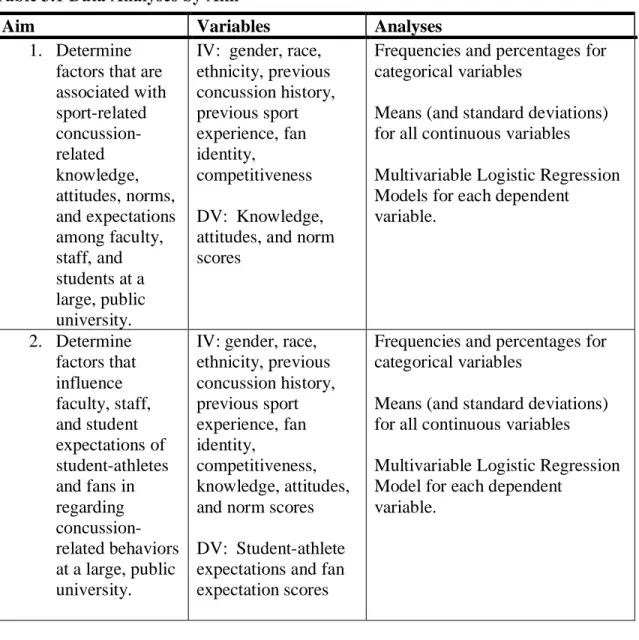
Multivariable logistic regression models were utilized for SA 1 to determine factors associated with sport-related concussion-related knowledge, attitudes, and norms among faculty, staff, and students a large, public university. Additionally, multivariable logistic regression models were utilized for SA 2 to determine factors that influence student expectations of student-athletes and fans regarding concussion-related behaviors. (Table 3.1, data analysis table).
UNC enrollment consisted of 18,862 undergraduates, 11,049 graduate and professional students, 8,765 staff, and 3,887 faculty, as of July 2018.37 We estimated a 5-7% response rate and therefore expected 900-1,300 undergraduate student surveys and 550-770 graduate and
professional student surveys. Given that we anticipated a maximum number of 12 predictors,
with 15 subjects per predictor, we needed approximately 200 participants to achieve adequate
power.
Table 3.1 Data Analyses by Aim
Aim Variables Analyses
1. Determine factors that are associated with sport-related concussion-related knowledge, attitudes, norms, and expectations among faculty, staff, and students at a large, public university.
IV: gender, race, ethnicity, previous concussion history, previous sport experience, fan identity, competitiveness DV: Knowledge, attitudes, and norm scores
Frequencies and percentages for categorical variables
Means (and standard deviations) for all continuous variables Multivariable Logistic Regression Models for each dependent
variable. 2. Determine factors that influence faculty, staff, and student expectations of student-athletes and fans in regarding concussion-related behaviors at a large, public university.
IV: gender, race, ethnicity, previous concussion history, previous sport experience, fan identity, competitiveness, knowledge, attitudes, and norm scores DV: Student-athlete expectations and fan expectation scores
Frequencies and percentages for categorical variables
Means (and standard deviations) for all continuous variables Multivariable Logistic Regression Model for each dependent
CHAPTER 4
Concussion-Related Knowledge, Attitudes, Perceived Norms, and Expectations among
Students at a Large Public University
Reagan E. Pagea; Melissa C. Kay, MS, LAT, ATCa,c; Zachary Y. Kerr, PhD, MPHa,b; Johna K. Register-Mihalik, PhD, LAT, ATCa,b
a. Matthew Gfeller Sport-Related Traumatic Brain Injury Research Center, Department of Exercise and Sport Science, University of North Carolina at Chapel Hill, Chapel Hill, NC, USA
b. Injury Prevention Research Center, University of North Carolina at Chapel Hill, Chapel Hill, NC, USA
c. Curriculum in Human Movement Science, University of North Carolina at Chapel Hill, Chapel Hill, NC, USA
Corresponding Author: Johna K. Register-Mihalik, PhD, LAT, ATC 125 Fetzer Hall, CB# 8700, Chapel Hill, NC 27599
Phone: 919-962-2702 | Fax: 919-962-7060 | Email: [email protected]
Abstract
Introduction: Factors at many levels of the socioecological model can influence student-athletes’ decisions regarding concussion disclosure. University culture at the
community/organizational level has not been heavily studied, but may play a role in student-athletes’ decisions to disclose their symptoms. A better understanding of the university culture may aid in creating a safer environment for student-athletes to report their concussion-like symptoms and enable them to seek care more expediently. This study described university students’ knowledge, attitudes, perceived norms, and expectations of student-athletes and fans surrounding concussion constructs and behavior.
Methods: Students from a large, public university in this cross-sectional survey study completed a single online questionnaire that addressed their concussion knowledge, attitudes, perceived norms, and student-athlete and fan expectations regarding concussion-related behavior in game situations. Higher scores indicated greater knowledge, more positive attitudes, safer norms, and more positive student-athlete and fan expectations, respectively, regarding concussions.
range: 6-30) scores, high expectations of student-athletes (mean: 31, possible range: 7-49), and high expectations of fans (mean: 33, possible range: 7-49).
Conclusion: Gender, race/ethnicity, fan identity, competitiveness, and concussion and sport history did not signify a difference in concussion-related constructs. While there were largely no statistically significant relationships between predictors and outcomes, concussion history, attitudes, and perceived norms were statistically significant with expectations for student-athletes. These relationships represent potential aspects for educational intervention.
Practical Application: Universities may consider broad concussion awareness campaigns across campus as data suggest a statistically significant association between attitudes and perceived norms and expectations of student-athletes. Future research should attempt to further describe the university culture surrounding concussion.
INTRODUCTION
Upwards of 50% of all concussions may go undisclosed.1 This is of particular concern due to the reliance on symptomatic presentation for concussion diagnosis. Signs and symptoms make patient self-reporting a priority, as they are often not visible to an external source. There are many factors that may drive disclosure versus non-disclosure that are both internal and external to the athlete, many of which include the social environment in which student-athletes participate.
The socioecological model2,3 (SEM) offers a way to categorize influences on concussion disclosure based on four levels: intrapersonal (knowledge, attitudes, beliefs), interpersonal (stakeholder dynamics), community/organization (relationships among groups), and societal (cultural norms). The SEM4 illustrates various layers of society which interact among one another. The model begins with the intrapersonal aspect, then it expands to include interpersonal interactions (relationships), community, and then society and policy. Previous research supports the notion that concussion disclosure behavior is influenced by a combination of these levels;5 however, the roles that the factors at the interpersonal and community/organization levels play, specifically from stakeholders in the university environment, is novel. At the university level, fans play an important role in the social and community environment. Only one study to date examined perceived pressure by fans and the association of this pressure to concussion related outcomes.6 In this study, many student-athletes reported experiencing pressure from fans at a rate of 8.12%. These extant data indicate the pressures in the social environment and community that influence continued participation while symptomatic versus disclosing those symptoms in order to receive appropriate medical care.
prevention and management.4 Other external influencers of athlete disclosure behavior may be the group settings (i.e. athletic events) of participation and overarching societal policies that impact concussion culture that may facilitate or hinder an individual’s ability to disclose. This suggests that a combination of factors play a role in creating a culture at the community and societal level.
Expectations of student-athletes and fans, as well as factors in the student-based
university community such as knowledge, attitudes, and perceived norms have not been heavily studied at the university level. Therefore, the purpose of this study was to address this gap via surveying students at a large, public university to determine factors associated with sport-related concussion-related knowledge, attitudes, perceived norms (Aim 1) and student-athlete and fan expectations (Aim 2) to better understand the university culture at the interpersonal and
community levels as it relates to concussion disclosure and overall concussion safety measures. The hypotheses for Aim 1 were as follows:
• Female, Caucasian, non-Hispanic students would be positively associated with
knowledge, attitudes, and norm scores.
• Previous concussion history and sport history would be positively associated with
knowledge, attitudes, and norm scores.
• Fan identity would be negatively associated with knowledge, attitudes, and norm
scores.
• Competitiveness would be negatively associated with knowledge, attitudes, and
norm scores.
• Female, Caucasian, non-Hispanic individuals would be positively correlated
with expectation scores.
• Previous concussion history and sport history would be positively associated
with expectation scores.
• Higher fan identity would be negatively correlated with expectation scores. • Competitiveness would be negatively associated with expectation scores. • Higher concussion-related knowledge, attitudes, and norm scores would be
positively correlated with expectation scores.
METHODS
Participants, Design, and Instrumentation
This cross-sectional survey study included a convenience sample of public university students (n=130) who completed a pre-tested online questionnaire regarding concussion-related variables related to concussion overall and athlete behaviors concerning concussion disclosure using pre-validated measurements adapted from previous studies.3,4
The online questionnaire included a short demographic and concussion history section, as well as the key concussion-related constructs. Fan identity was gauged using a Team
Identification Index (TII)7,8, a previously validated survey. The respondents answered four8 items, including “The XX are my team, I consider myself a loyal fan of the XX” on a 5-point Likert scale, from “strongly agree” to “strongly disagree.” The resulting scale ranged from 4-20. Two questions were also included regarding membership in XX fan/support clubs. Higher scores indicated more fan identification.
Competitiveness included 20 items using a 5-point Likert scale from a previously validated survey,4 regarding self-identification and personal beliefs of competition. These statements were answered as “strongly agree” to “strongly disagree.” The resulting scale ranged from 20-100. Some of these items were reverse coded to indicate higher scores, where higher scores indicated a higher degree of competitiveness. Knowledge questions included 25 yes/no/maybe questions regarding common concussion symptoms which assessed the participants’ recognition of symptoms. The resulting scale ranged from 0-50. Higher scores indicated greater knowledge.
Attitude questions included 5 attitudes rated through a 7-point scale on how the
and unimportant/important. The resulting scale ranged from 5-35. Higher scores indicated more positive (responsible, beneficial, important) answers.
Perceived norms questions included 6 situations using a 5-point Likert scale, from “strongly approve” to “strongly disapprove.” The resulting scale ranged from 6-30. Some of these items were reverse coded to indicate higher scores, where higher scores indicated safer perceived norms.
Because exploring expectations of student-athletes and fans for this context was novel, we developed a questionnaire to address this aim. There were 7 items for expectations of student-athletes and 7 items for expectations of fans, which were grouped separately, each on a 5-point Likert scale. The resulting ranges for each were 7-49. Some of the expectations for student-athletes included “student-student-athletes should play through pain regardless of the game situation” and “student-athletes should only report signs/symptoms when they feel the injury is serious.” Some of the fan expectations items included “Sports fans should expect student-athletes to report all concussion-like symptoms.” As necessary, items were reverse coded to indicate higher scores, where higher scores indicated safer athlete and fan expectations.
Procedures
able to be shared and further distributed on social media. As such, there was an additional
verification question included on the survey to ensure the participant was eligible (affiliated with the target institution). In the event the interested person did not meet this criterion, they were prevented from continuing the survey.
Outcomes and Statistical Analyses
All data were analyzed in SAS 9.4 (Cary, NC). Calculations for key constructs were completed prior to any normality checks or analyses. Medians and interquartile ranges (IQRs) provided descriptives on all variables of interest. Some items (norms, competitiveness,
expectations) had to be reverse coded to indicate higher scores. Thus, higher scores indicated more positive results for knowledge, attitudes, norms, fan identity, competitiveness, and expectations.
Multivariable logistic regression models were utilized to address each outcome for each aim. These models yielded odds ratios (OR) with 95% confidence intervals (CI). Due to
skewness of outcomes, a median split was applied in order to use multivariable logistic regression models for Aims 1 and 2. Aim 1 was to determine factors associated with sport-related concussion-sport-related knowledge, attitudes, perceived norms among students at a large, public university. Independent variables for Aim 1 of analysis included race, ethnicity, gender, concussion history, sport history, fan identity, and competitiveness. Dependent variables included knowledge, attitudes, and perceived norms scores. Aim 2 was to determine factors associated with expectations of student-athletes and fans among students at a large, public
RESULTS
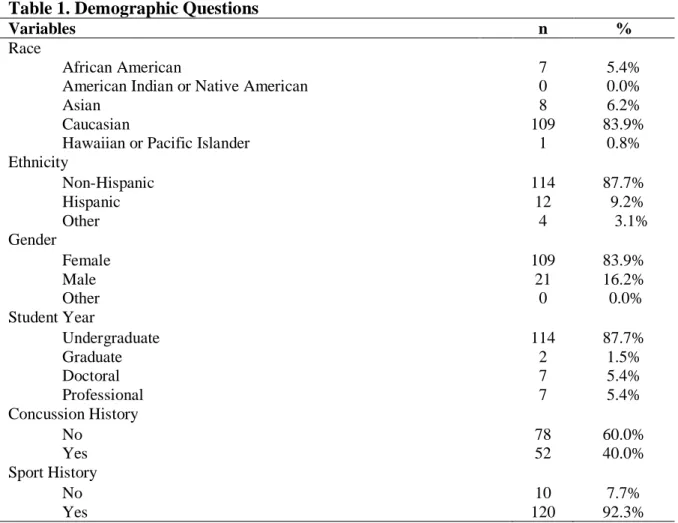
A total of 130 students at a large, public university completed the survey (6.6% response rate). The majority of our participants were Caucasian (83.9%), were undergraduates (87.7%), and had never had a concussion (60%). (Table 1)
Table 1. Demographic Questions
Variables n %
Race
African American 7 5.4%
American Indian or Native American 0 0.0%
Asian 8 6.2%
Caucasian 109 83.9%
Hawaiian or Pacific Islander 1 0.8%
Ethnicity
Non-Hispanic 114 87.7%
Hispanic 12 9.2%
Other 4 3.1%
Gender
Female 109 83.9%
Male 21 16.2%
Other 0 0.0%
Student Year
Undergraduate 114 87.7%
Graduate 2 1.5%
Doctoral 7 5.4%
Professional 7 5.4%
Concussion History
No 78 60.0%
Yes 52 40.0%
Sport History
No 10 7.7%
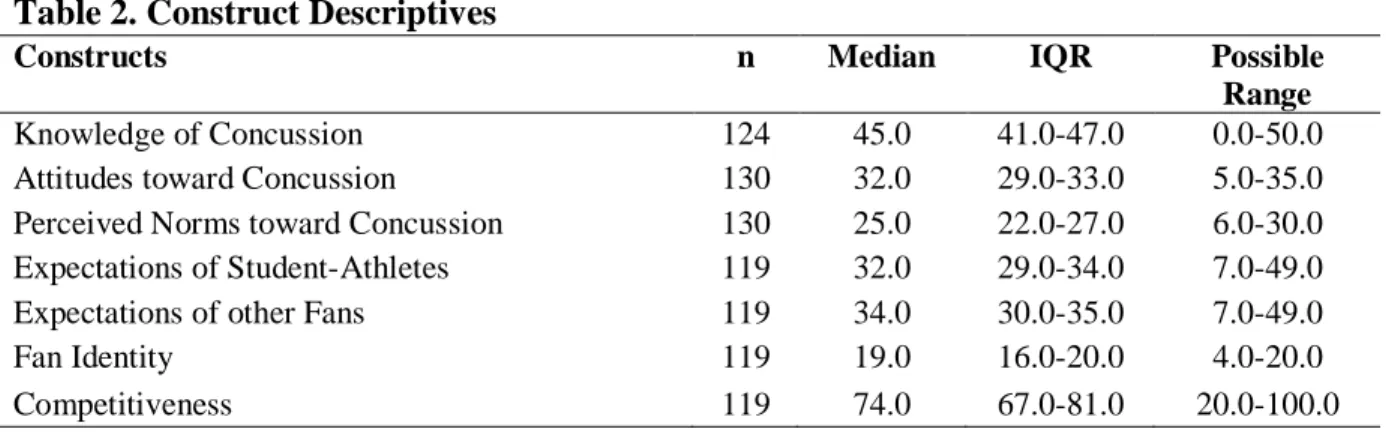
Of a possible range from 0.0-50.0, most respondents had high (Median=45.0) knowledge of concussion symptoms. On average, students indicated positive attitudes toward concussion (such as reporting a possible concussion is important and that they are responsible if they report a concussion). Students reported safer perceived norms toward concussions, with a median score of 25.0 of a possible 30.0. The respondents also reported more responsible/higher expectations of fan (Median=34.0) and student-athlete (Median=32.0) behavior in an athletic setting (i.e. not berating student-athletes if they are injured). As a whole, students indicated very high fan identification, with the most common identity being a 20 out of 20 score. Also, the students self-reported that they were largely competitive individuals (Median=74.0 out of 100.0).
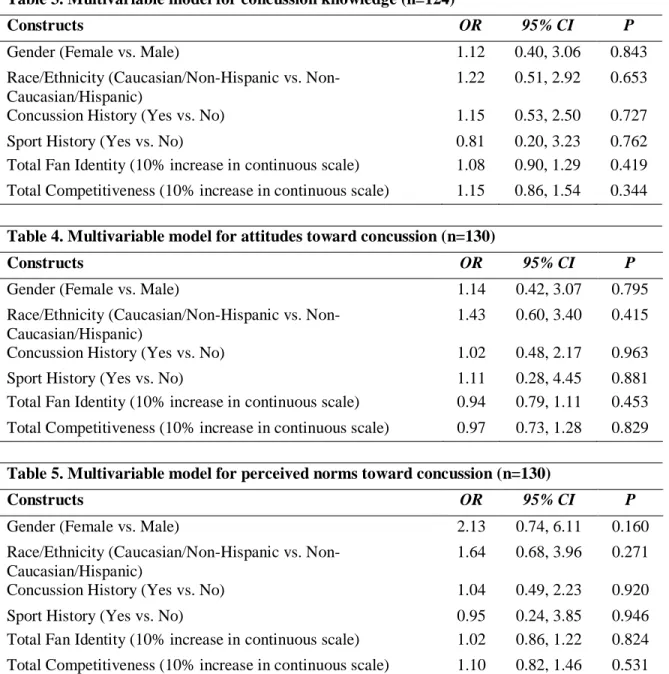
In the multivariable analyses for concussion knowledge (Table 3), attitudes towards concussion (Table 4), and perceived norms toward concussion (Table 5), there were no statistically significant associations between the categorical predictors (gender, race/ethnicity, concussion history, sport history, fan identity, competitiveness) and outcomes (knowledge, attitudes, perceived norms).
Table 2. Construct Descriptives
Constructs n Median IQR Possible
Range
Knowledge of Concussion 124 45.0 41.0-47.0 0.0-50.0
Attitudes toward Concussion 130 32.0 29.0-33.0 5.0-35.0 Perceived Norms toward Concussion 130 25.0 22.0-27.0 6.0-30.0 Expectations of Student-Athletes 119 32.0 29.0-34.0 7.0-49.0
Expectations of other Fans 119 34.0 30.0-35.0 7.0-49.0
Fan Identity 119 19.0 16.0-20.0 4.0-20.0
Table 3. Multivariable model for concussion knowledge (n=124)
Constructs OR 95% CI P
Gender (Female vs. Male) 1.12 0.40, 3.06 0.843
Race/Ethnicity (Caucasian/Hispanic vs. Non-Caucasian/Hispanic)
1.22 0.51, 2.92 0.653
Concussion History (Yes vs. No) 1.15 0.53, 2.50 0.727
Sport History (Yes vs. No) 0.81 0.20, 3.23 0.762
Total Fan Identity (10% increase in continuous scale) 1.08 0.90, 1.29 0.419 Total Competitiveness (10% increase in continuous scale) 1.15 0.86, 1.54 0.344
Table 4. Multivariable model for attitudes toward concussion (n=130)
Constructs OR 95% CI P
Gender (Female vs. Male) 1.14 0.42, 3.07 0.795
Race/Ethnicity (Caucasian/Hispanic vs. Non-Caucasian/Hispanic)
1.43 0.60, 3.40 0.415
Concussion History (Yes vs. No) 1.02 0.48, 2.17 0.963
Sport History (Yes vs. No) 1.11 0.28, 4.45 0.881
Total Fan Identity (10% increase in continuous scale) 0.94 0.79, 1.11 0.453 Total Competitiveness (10% increase in continuous scale) 0.97 0.73, 1.28 0.829
Table 5. Multivariable model for perceived norms toward concussion (n=130)
Constructs OR 95% CI P
Gender (Female vs. Male) 2.13 0.74, 6.11 0.160
Race/Ethnicity (Caucasian/Hispanic vs. Non-Caucasian/Hispanic)
1.64 0.68, 3.96 0.271
Concussion History (Yes vs. No) 1.04 0.49, 2.23 0.920
Sport History (Yes vs. No) 0.95 0.24, 3.85 0.946
In multivariable analysis for expectations of student-athletes (outcome) based on 9 predictors (gender, race/ethnicity, concussion history, sport history, fan identity,
competitiveness, knowledge, attitudes, perceived norms), there were three statistically significant associations (Aim 2, Table 6). These associations suggest those with concussion history
(p=0.013, p<0.05) had more risky expectations of student-athletes. However, those with safer attitudes (p=0.027, p<0.05), and more positive perceived norms (p=0.022, p<0.05) had safer/more positive expectations for student-athletes.
Table 6. Multivariable model for expectations of student-athletes following concussion (n=119)
Constructs OR 95% CI P
Gender (Female vs. Male) 3.13 0.94, 10.37 0.063
Race/Ethnicity (Caucasian/Hispanic vs. Non-Caucasian/Hispanic)
0.92 0.34, 2.45 0.863
Concussion History (Yes vs. No) 0.31 0.13, 0.78 0.013
Sport History (Yes vs. No) 0.29 0.06, 1.49 0.137
Total Fan Identity (10% increase in continuous scale) 0.93 0.76, 1.13 0.455
Total Competitiveness (10% increase in continuous scale) 1.22 0.88, 1.71 0.236
Knowledge (High vs. Low) 1.53 0.68, 3.48 0.306
Attitudes (Safe vs. Risky) 2.59 1.12, 6.00 0.027
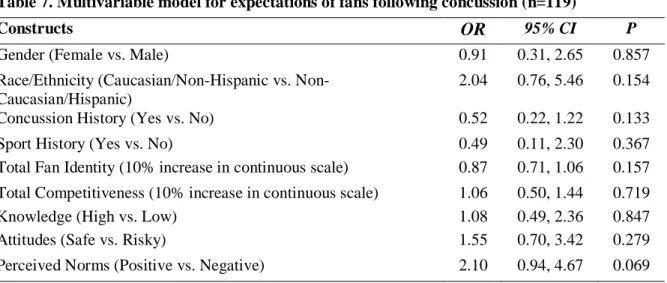
In multivariable analysis for expectations of fans (outcome) based on 9 predictors (gender, race/ethnicity, concussion history, sport history, fan identity, competitiveness,
knowledge, attitudes, perceived norms), there were no statistically significant associations (Aim 2, Table 7).
Table 7. Multivariable model for expectations of fans following concussion (n=119)
Constructs OR 95% CI P
Gender (Female vs. Male) 0.91 0.31, 2.65 0.857
Race/Ethnicity (Caucasian/Hispanic vs. Non-Caucasian/Hispanic)
2.04 0.76, 5.46 0.154
Concussion History (Yes vs. No) 0.52 0.22, 1.22 0.133
Sport History (Yes vs. No) 0.49 0.11, 2.30 0.367
Total Fan Identity (10% increase in continuous scale) 0.87 0.71, 1.06 0.157 Total Competitiveness (10% increase in continuous scale) 1.06 0.50, 1.44 0.719
Knowledge (High vs. Low) 1.08 0.49, 2.36 0.847
Attitudes (Safe vs. Risky) 1.55 0.70, 3.42 0.279
DISCUSSION
There were no statistical associations for factors examined between demographics and concussion-related knowledge, attitudes, and perceived norms. There were also no statistically significant associations between those measured factors and fan expectations. However, concussion history, attitudes, and perceived norms were each associated with student-athlete expectations. These key findings indicate that promoting an educational environment to improve overall student attitudes and norms may improve expectations of student-athletes. Our findings may reflect the relatively high level of health and physical education of the participants at this particular university. Also, many of the participants were involved/are currently involved in organized sport(s) and are likely to have been exposed to concussion training and education in order to participate in said sport(s). This previous exposure could have also swayed most of their attitudes in a positive way and their norms to be safer. For those with a history of concussion, they were less likely to be in the higher student-athlete expectations group. This could have been due to the fact that because of their previous concussions, they knew the implications of having a diagnosed concussion (i.e. losing playing time), therefore their athlete expectations could have been affected in a negative way.
Previous studies9,10 observed that greater numbers of previous concussions were
play). Those with concussion history, however, were found to have more negative expectations of student-athletes than those without a previous concussion history. This could have been due to the fact that with a previous concussion, they knew the implications of disclosing their
concussion (i.e. being removed from play, losing practice time), so they had lower expectations for other student-athletes in that situation. In previous literature5, these reasons have been mentioned as part of the pressure athletes feel from coaches to not disclose their symptoms.
Further supporting this concept is that a previous study10 also found that concussion knowledge scores for participants who participated in recreational, high school, non-applicable, or college-level or above (semi-professional and/or professional) were 64%, 63%, 65%, and 54% accurate, respectively. However, we did not observe differences in our sample, as our sample scored higher and thus indicated improved knowledge over these previous studies. This could be explained by various exposure to concussion education via media, personal health instruments, or general health knowledge.
Fan identity in the context of concussion constructs has not heavily been studied;
however, studies suggest a relationship between fan identity and perceived lack of self-control at sporting events.11 Two studies12,13 attributed higher fan identification with higher aggression levels. This aggression could translate into a negative mentality towards concussion constructs, potentially due to the desire to win regardless of the consequences (i.e. competitiveness). However, significance was not found in our sample for these relationships. This could be because the participants, as highly self-identified fans (median=19.0, possible range: 4.0-20.0), could genuinely want the best health outcomes and implications for all student-athletes
Expectations (as an outcome) for student-athletes and fans regarding concussion disclosure behavior has not been previously examined. These data again were not statistically significant for fan expectations, and therefore we could conclude that there were no true differences in the expectations of fans based on the examined predictors. Although most associations between predictors and outcomes were not significant, there were three significant associations between concussion history, attitudes, and perceived norms (predictors) and expectations of student-athletes (outcome). These findings suggest that universities could
implement concussion awareness and educational programs for those who attend athletic events, which could help steer expectations of student-athletes in a more positive direction. For example, the university could make regular announcements during the game or event announcing the university’s expectations for fans and student-athletes regarding concussion-related behaviors.
Another idea for influencing student-athlete expectations could be making the participants aware of what student-athletes expect in terms of sportsmanship and behavior, thereby narrowing the gap of expectations. This could create a safer, more encouraging environment for student-athletes to disclose their concussion-like symptoms.
surrounding concussions and attempt to understand more about the stakeholders in this
environment (faculty, staff, students, fans, student-athletes, medical personnel, coaches, etc.).
PRACTICAL APPLICATION
MANUSCRIPT REFERENCES
1. Harmon KG, Drezner JA, Gammons M, Guskiewicz KM, Halstead M, Herring SA, Kutcher JS, Pana A, Putukian M, Roberts Wo. American Medical Society for Sports Medicine position statement: concussion in sport. J Sports Med. 2013;47(1):15-26.
doi:10.1136/bjsports-2012-091941
2. Bartholomew LK, Markham C, Mullen P, Fernandez ME. Planning Models for Theory-
Based Health Promotion Interventions. In: Glanz K, Rimer BK, Viswanath K, eds. Health Behavior: Theory, Research and Practice. Fifth. San Francisco, CA: Jossey- Bass;
2015:359-387.
3. Register-Mihalik J, Baugh C, Kroshus E, Y Kerr Z, Valovich McLeod TC. A Multifactorial
Approach to Sport-Related Concussion Prevention and Education: Application of the
Socioecological Framework. J Athl Train. 2017;52(3):195-205.
4. Register-Mihalik JK, Cameron KL, Linnan LA, Kay MC, Houston MN, Peck KY, Hennink-Kaminski HJ, Svoboda SJ, Gildner P, Kerr ZY, Guskiewicz KM, Marshall SW. (2018). Factors Associated with Intention to Disclose Concussive Symptoms Among Service Academy Cadets: The BANK Study doi: 10.1249/01.mss.0000538723.96055.a4
5. Kroshus E, Garnett B, Hawrilenko M, Baugh CM, Calzo JP. Concussion under-reporting and pressure from coaches, teammates, fans, and parents. Soc Sci Med 1982. 2015;134:66-75. doi:10.1016/j.socscimed.2015.04.011
7. Trail, G. T., Robinson, M. J., Dick, R. J., & Gillentine, A. J. (2003). Motives and points of
attachment: Fans versus spectators in intercollegiate athletics. Sport Marketing Quarterly, 12, 217–227.
8. Warren, Clinton J.. (2011). Understanding the impact of core product quality on customer satisfaction, team identification, and service quality. Retrieved from the University of Minnesota Digital Conservancy, http://hdl.handle.net/11299/116537.)
9. Register-Mihalik, Johna & Valovich McLeod, Tamara & A. Linnan, Laura & Guskiewicz, Kevin & W. Marshall, Stephen. (2016). Relationship Between Concussion History and Concussion Knowledge, Attitudes, and Disclosure Behavior in High School Athletes. Clinical Journal of Sport Medicine. 27. 1. 10.1097/JSM.0000000000000349.
10.Zachary C. Merz, Ryan Van Patten, John Lace; Current Public Knowledge Pertaining to
Traumatic Brain Injury: Influence of Demographic Factors, Social Trends, and Sport
Concussion Experience on the Understanding of Traumatic Brain Injury Sequelae, Archives
of Clinical Neuropsychology, Volume 32, Issue 2, 1 March 2017, Pages 155–
167, https://doi.org/10.1093/arclin/acw092
11.James A. Dimmock & J. Robert Grove (2005) Relationship of Fan Identification to Determinants of Aggression, Journal of Applied Sport Psychology, 17:1,
37-47, DOI: 10.1080/10413200590907559
CHAPTER 5
The purpose of this study was to determine factors associated with sport-related
concussion knowledge, attitudes, and norms, among students at a large, public university and to determine factors that influence these stakeholders’ expectations of student-athletes and fans with respect to concussion-related behaviors at a large, public university.
We collected data on faculty, staff, and students, but we only analyzed data for students,
as we did not have adequate power for faculty and staff due to limited sample size. The email
was sent to a listserv requiring opt-in, so the entire student body, faculty and staff base did not
receive the email. As such, other group sample size was too small and a committee decision was
made to focus on the student sample for the final analysis set.
5.1 Summary Aim 1
Aim 1: Determine factors that are associated with sport-related concussion-related knowledge,
attitudes, norms, and expectations among students at a large, public university.
Hypotheses: a) Female, Caucasian, non-Hispanic students will be positively associated with knowledge, attitudes, and norm scores. b) Previous concussion history and sport history will be positively associated with knowledge, attitudes, and norm scores. c) Fan identity will be
negatively associated with knowledge, attitudes, and norm scores. d) Competitiveness will be negatively associated with knowledge, attitudes, and norm scores.
The results from Aim 1 did not indicate any statistically significant relationships between predictors and outcomes. This means that there were no true differences in the outcomes based
female, Caucasian, and non-Hispanic students and non-female, non-Caucasian, Hispanic students). Although not significant, this could have practical applications for those interested in concussion education. Based on these results, educators could aim at providing all of the demographics above with generalized concussion education, exposure, and awareness. 5.2 Summary Aim 2
Aim 2: Determine factors that influence student expectations of student-athletes concussion-related behaviors at a large, public university.
Hypotheses: a) Female, Caucasian, non-Hispanic individuals will be positively correlated with expectation scores. b) Previous concession history and sport history will be positively associated with expectation scores. c) Higher fan identity will be negatively correlated with expectation scores. d) Competitiveness will be negatively associated with expectation scores. e) Higher concussion-related knowledge, attitudes, and norm scores will be positively correlated with expectation scores.
5.3 Lessons Learned
I learned so much from this process. I never realized how much planning, foresight, editing, and communication among many other things contribute to the creation of an Honors Thesis. I learned that I have much more to learn about the research process, from reviewing literature to statistical analyses to interpretation of results. I am thankful for this journey and for the people who have helped me along the way.
5.4 Future Research