* PhD, Associate Professor, Department of Medical-Surgical Nursing, and physiology Research Center, Kerman University of Medical Sciences, International Bam Center, Kerman, Iran.
** MSc, Department of Medical-Surgical Nursing, International Bam Center, Kerman University of Medical Sciences, Kerman, Iran.
*** PhD, Assistant Professor, Department of Medical-Surgical Nursing, Razi School of Nursing and Midwifery, International Bam Center, Kerman University of Medical Sciences, Kerman, Iran.
**** PhD, Assistant Professor, Department of Medical-Surgical Nursing, School of Nursing and Midwifery, Mashhad University of Medical Sciences, Mashhad, Iran.
Correspondence to: Abbas Heydari, PhD. Email: [email protected]
Original Article
A comparative study on effect of e-learning versus instructor-led method
on nurses’ documentation competency
Abbas Abbaszadeh*, Hakimeh Sabeghi**, Fariba Borhani***, Abbas Heydari
****
Abstract
BACKGROUND: Accurate recordingof the nursing care indicates the care performance and its quality. It is so that any fail-ure in documentation can be a reason for inadequate patient care. Therefore, improving nurses’ skills in this field with help of effective educational methods is of high importance. Since traditional teaching methods are not suitable for communities with rapid knowledge expansion and constant changes, e-learning methods can be a viable alternative. To show the impor-tance of e-learning methods on nurses’ care reporting skills, this study was performed to compare the e-learning methods with the traditional instructor-led methods.
METHODS:This was a quasi-experimental study aimed to compare the effect of two teaching methods (e-learning versus lecture) on nursing documentation and to examine the differences in acquiring competency on documentation between nurses who participated in the e-learning (n = 30) and nurses in a lecture group (n = 31).
RESULTS: The results of the present study indicated that statistically there was no significant difference between the two groups. The findings also revealed that statistically there was no significant correlation between the two groups concerning demographic variables. However, we believe that due to benefits of e-learning compared to traditional instructor-led me-thod, and according to their equal effect on nurses’ documentation competency, e-learning can be a qualified substitute for traditional instructor-led method.
CONCLUSIONS:E-learning as a student-centered method can promote competency of the nurses on documentation similar to the lecture method. Therefore, e-learning can be used to facilitate the implementation of nursing educational programs. KEY WORDS: Knowledge, attitude, practice, nursing documentation, lectures, e-learning.
IJNMR 2011; 16(3): 235-243
oday, there are emphasizes on resource management, cost control, effectiveness of the patient care, quality improvement and accountability, appropriate documentation and reporting also is emphasized like other ap-propriate measures.1 Recording nursing docu-mentation is considered as one of the most im-portant nursing profession tasks which have very high influence on quality of nursing care and interaction of the nurse with other health team members.2 Since, nurse usually is the first
health caregiver, the information he/she records will be so important for informing other caregivers from patient’s status, behavior, and the responses, so it should be quite clear, accu-rate and complete.3 Furthermore, registered nursing documentation is the only memorable legal document that indicates the full descrip-tion of measures and acdescrip-tions done by the nurse for the patients; besides it is the best advocate and defender for the nurse where the patient would compliant about nurse’s negligence in
providing nursing care.4 Except two communi-cational and legal roles, nursing documentation has other important roles such as educational, research, auditing and evaluating roles.5 There-fore, nursing reports should be quite perfect, accurate and timely; any mistake in document-ing the items or deletdocument-ing them would be prob-lematic. 6
Poor documentation results may be harmful and detrimental not only for the patients but also for the nurses themselves.1 Studied re-searches have shown that incomplete reports constantly cause suspicion and charging in the legal authorities, because legally medical team performance is provable and verifiable by do-cumentation and only the case would be ac-cepted which is fully recorded.7 Studies about nursing documentation have shown that ap-proximately 38 percent of the total working shift time of the nurses is spent for writing the report 8 while, results of a study in 2004 in Iran showed that only 17.09 percent of the nurses had good reporting and 35.81 percent of them provided incomplete nursing documentation.6 Considering the above mentioned subjects, correct and principled registering of the nurs-ing documentation is one of the most impor-tant responsibilities of nursing carrier and continuous improvement of the nurses to im-prove quality of nursing documentation is of high importance.1
One of the most important causes in how to write nursing report is the nursing knowledge; so that the study results of Ghamari showed that one of the poor documentation reasons is lack of knowledge and awareness of nurses in how to register them correctly.1 These contents clearly confirm the role of education in promot-ing capabilities of the nurses in documentation. It should be noted that in implementing educa-tional programs, choosing an appropriate edu-cational approach is one of the major measures in the instructional design process9; because an effective learning, first of all is the result of a good teaching.10 And on the other hand, one of the important and effective causes in quality of the education is educational approaches.11 In nursing education, increasing medical
know-ledge and its outcomes also brought about many problems and on the other hand, attitude changes from teacher centered to learner-centered learning in the higher education caused a new responsibility for the planners, instructors and students which one of the main axes is to choose the most appropriate learning and teaching method related to the profession.12 Currently, the most common method in medical science education is lecture which of course has lots of advantages such as cost-effectiveness for high populations.13 Lecture is one of the tradi-tional methods that despite providing new and modern teaching methods such as problem solving based method and also accessibility of computer and internet and etc, still is one of the conventional methods of providing informa-tion; and the evidences indicated that using content and a skilled lecturer, a reasonable, pos-itive and appropriate future would be achieva-ble.10 Yet, many experts believe that such a me-thod, provided in an appropriate meme-thod, would be effective14 Learning by lecture is in-evitable for everyone in a period of time; be-cause it is a mean for providing basic informa-tion and even is the most suitable teaching me-thod in some certain circumstances. But, this method does not give any opportunity to the learner to think that is an essential thing. Stu-dies have shown that almost 80% of the pro-vided educations contents through this method would be forgotten during 8 weeks.15 According to the theories of upbringing psychologists, learning would be better and its effects would be more permanent when it is associated with activation and more pervasive in the learning method. Therefore, emphasize of the educa-tional experts is on using modern, active and learner-centered approaches today.12 Noles in 1980s believed that learning of the adults would be good when they become self-directed.10 Sev-eral consequences of approaches on teaching and learning theory have been suggested; one of which is e-learning that the learner would be able to achieve their own capabilities and tal-ents for educational goals and in fact, they would learn how to learn which itself is one of the educational objectives.16
E-learning, which includes self-learning computerize activities, is a new educational ap-proach use in many universities and education-al institutions and is helpful in achieving one of the main objective of the formal education i.e., preparing the learner for an active and inde-pendent learning. Besides, it is an appropriate method for permanent and continuing educa-tion which is so essential in today's world.17,18 In fact, this approach has created a new paradigm in teaching and learning field and has provided the possibility of learning in anything, for eve-ryone, any time and everywhere permanently.19 It, especially in nursing profession, is of high importance regarding to the necessity of being updated the information and knowledge of the nurses about diseases, medications and new skills. On the other hand, since learning re-quires spending lots of time and energy and one of the advantages of electronic teaching and learning is saving time in comparison with tra-ditional methods (so that the study results of Chang et al. showed that e-learning saved 25-60% of the time in comparison with conven-tional classes 20); therefore, the time shortage of the nurses with excess number of the patients in Iran’s hospitals can highlight the importance of using e-learning method among the nurses. Thus, according to the above contents, appli-cation of e-learning method in nursing educa-tion can be beneficial. However, the measures have already been done in this field are not suf-ficient and it has been less welcomed due to some reasons such as limitation in titles, quality of the electronic contents and low number of the websites that consider this issue.
Therefore, it seems considering the wide-spread presence of the computers in today’s life and increasing need of the nurses to scientific knowledge and information -that are easily ac-cessible always and at any time- implementa-tion of e-learning for the nurses particularly in continued education domain is one of the most essential measures at the present era.
Now, the question is that, considering the importance of nursing documentations and re-ports in various aspects, particularly the major communicational role of report writing in one
hand and low-quality of the nursing reports in Iran on the other hand, can a more appropriate and more effective educational method be sug-gested in deep and thorough learning that in addition to accurate and complete nursing re-porting can be used as an information source by the nurses at any time? To answer `this ques-tion, this study aimed to compare and evaluate the effect of e-learning and lecture (instructor-led education) on know(instructor-ledge, attitude and per-formance of the nursing report writing.
Methods
This was a two-group quasi-experimental de-sign with posttest-pretest assessment. The study environment included the educational hospitals affiliated to Kerman University of Medical Sciences. The study population included 61 employed nurses in these hospitals who were selected using available sampling method. First, after obtaining the permission of holding report writing training courses, all the volunteers were enrolled and the nurses who had inclusion cri-teria entered the study and divided into e-learning and lecture groups using table of ran-dom numbers. By nurses’ documentation com-petency, we meant knowledge rate, attitude and performance in report writing each of which separately was evaluated by a questionnaire and mean score of these three questionnaires was considered as the competency score of the nurses in report writing or documentation. The nurses in the lecture method received two training sessions of report writing classes by lecture method. Educational contents in-cluded objectives and importance of nursing documentation, features of registering a proper nursing report, different nursing documenta-tions systems, correcting the mistakes of the do-cumented cases and how to record pharmaco-logical information and symptoms and general-ly all the conducted cares and treatments for the patient as well as patient’s responses to them. Knowledge rate, attitude and performance of the lecture group subjects were compared to each other before and after the intervention. In the e-learning group, each one of the study
subjects were given a special username and password to use electronic database of nursing documentation education at www.gozareshnevisi.com that had been de-signed by the relevant expert of this filed. This website had pretest, training, posttest, FAQ, dif-ferent links to other universities and also the patient teaching section. After teaching how to use this site, the nurses of this group were re-quested to obtain the required information through searching and studying it. Electronic educational content of the website (nursing do-cumentation education) was similar to the edu-cational content of lecture classes, except that the same contents were in the form of text files, movies and flash and also the possibility of question and answer of the users to each other and administrator of the website. Username and password of the study subjects were active for two weeks and during this period they could achieve the educational content at any time and any place through the internet connec-tion. To use this website, first of all the users should have completed the pretest question-naire so that the users could access the educa-tion content when they had answered the entire pretest questionnaire and saved it. Thereafter, they could access the content of the educational section; then, they should have answered the posttest questions. The possibility of download-ing the educational files also was provided only for the users who completed the posttest fully and saved it.
Data collection tools in this study included a researcher-made questionnaire consisted of four parts including demographic and personnel information, assessment of the knowledge (in-cluding 14 questions regarding the principles of nursing documentation), assessment of the atti-tude (including 13 questions regarding the im-portance, necessity and applications of nursing report writing based on the scale of “I agree”, “I have no idea” and “I disagree”) and checklist of the performance (including 45 cases based on scale of “it was done” and “it was not done”) and their validity and reliability were assessed
before collecting the data. To assess the validity of the questionnaire, content validity index was used using comments of 10 faculty members of School of Nursing and Midwifery of Mashhad. Moreover, to assess the face validity, in addition to comments of the experts, some of the nurses were asked to express their comments about questions of the questionnaire.
To assess the reliability of assessment of knowledge and attitude questionnaires, Cron-bach’s alpha method was used that the obtained coefficient respectively were 88 and 96 percent. Reliability coefficient of the performance check-list obtained 92% using inter-observer reliability method.
To assess performance of the nurses about report writing, a health history of a hypothetical patient with recorded administration and de-scription of the physician for the patients was given to the study subjects and they were asked to register their nursing report for the men-tioned hypothetical patient in nursing report sheet.
The obtained data were analyzed using software SPSS14 after registration.
Results
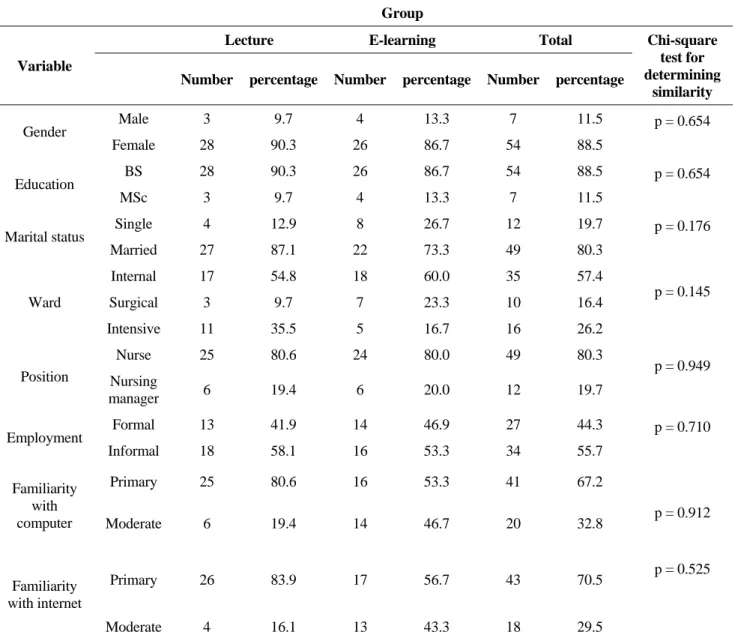
The results of this study indicated that the study subjects in lecture and e-learning groups had no significant difference to each other in terms of age, gender, marital status, occupation, education, work experience, position and level of familiarity with computer and internet based on assimilation tests. Mean age and work expe-rience of the study subjects, respectively, were 32.9 (5.7) and 8.8 (5.4) years and the majority of them (88.5%) were females and married (80.3%). The level of familiarity with computer of more than half of them was at the primary level and 67.2% of them also had primary level of fami-liarity with internet (Table 1). Using the facili-ties of the website (nursing report writing) indi-cated that none of the nurses in the e-learning group used question and answer part and only one of them contacted the site’s administrator through e-mail.
Table 1. Frequency distribution of the study subjects in terms of demographic characteristics in both groups
Group
Variable
Lecture E-learning Total Chi-square
test for determining
similarity Number percentage Number percentage Number percentage
Gender Male 3 9.7 4 13.3 7 11.5 p = 0.654
Female 28 90.3 26 86.7 54 88.5
Education BS 28 90.3 26 86.7 54 88.5 p = 0.654
MSc 3 9.7 4 13.3 7 11.5
Marital status Single 4 12.9 8 26.7 12 19.7 p = 0.176
Married 27 87.1 22 73.3 49 80.3
Ward
Internal 17 54.8 18 60.0 35 57.4
p = 0.145
Surgical 3 9.7 7 23.3 10 16.4
Intensive 11 35.5 5 16.7 16 26.2
Position
Nurse 25 80.6 24 80.0 49 80.3
p = 0.949 Nursing
manager 6 19.4 6 20.0 12 19.7
Employment Formal 13 41.9 14 46.9 27 44.3 p = 0.710
Informal 18 58.1 16 53.3 34 55.7
Familiarity with computer
Primary 25 80.6 16 53.3 41 67.2
Moderate 6 19.4 14 46.7 20 32.8 p = 0.912
Familiarity with internet
Primary 26 83.9 17 56.7 43 70.5 p = 0.525
Moderate 4 16.1 13 43.3 18 29.5
According to the study results, comparison of the mean score of knowledge (p = 0.983), atti-tude (p = 0.986) and performance (p = 0.595) of the study subjects before the intervention showed no significant difference between the lecture and the e-learning groups.
The results of the present study indicated that although both groups had a significant progression in scores of posttest in knowledge, attitude and performance in comparison with pretest ones, independent t-test showed no sig-nificant difference between the two groups after the intervention in every three domains of
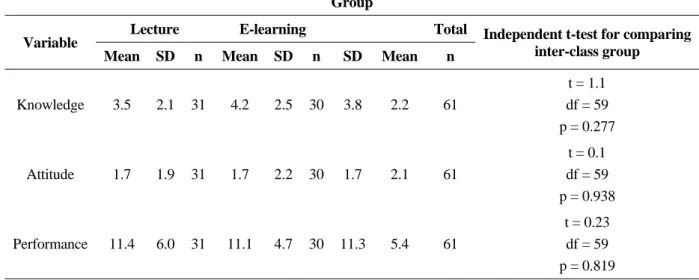
knowledge (p = 0.140), attitude (p = 0.870) and performance (p = 0.134) (Table 2). Increase in mean score of knowledge, attitude and perfor-mance after the intervention also showed no significant difference in the lecture and the e-learning groups (Table 3). Ultimately, it was indicated that despite increase in nurses’ docu-mentation competency in each of the two groups after the education compared to before that, there was no significant difference be-tween these two increases after the intervention in the two groups (p = 0.559).
Table 2. Comparison mean (SD) of knowledge, attitude and performance of the nurses’ documen-tation before and immediately after the education in the both groups
Table 3. Comparison of the increased rate of mean knowledge, attitude and performance score of the nursing documentation in both groups after the intervention
Group
Independent t-test for comparing inter-class group Total E-learning Lecture Variable n Mean SD n SD Mean n SD Mean
t = 1.1 df = 59 p = 0.277 61 2.2 3.8 30 2.5 4.2 31 2.1 3.5 Knowledge
t = 0.1 df = 59 p = 0.938 61 2.1 1.7 30 2.2 1.7 31 1.9 1.7 Attitude
t = 0.23 df = 59 p = 0.819 61 5.4 11.3 30 4.7 11.1 31 6.0 11.4 Performance
difference in knowledge, attitude and perfor-mance of the nurses’ documentation based on demographic variables.
Discussion
The findings of the study showed that e-learning like lecture method could affect the knowledge, attitude and performance of the report writing and consequently, the nurses’ documentation competency and statistically there was no significant difference in increase of knowledge, attitude and performance between the e-learning and lecture methods. This finding was in accordance with the studies that re-ported the similarity of e-learning with
conven-tional method.16,21-24 Study results of Zolfaghari et al. in 2007 showed no significant difference in learning rate of Mother and Child Health Course between conventional (traditional) and electronic education methods.16 Nathalie et al. in Netherland in a study which was similar to the present study in terms of program showed that both lecture and electronic educational methods equally increased knowledge of the general practitioners about mental health.21
However, study results of Ghezelghash et al. was not in accordance with ours; based on that, every three educational methods, i.e., lecture, problem-solving and self-study learning by computer could have positive effects on
learn-Paired t-test for comparison of inter-class group Immediately after education
Mean(SD) Before the education
Mean(SD) Performance Attitude Knowledge Performance Attitude Knowledge Performance Attitude Knowledge Group p=0.000 p=0.000 p=0.000 30.8(11.7) 12.4(1.1) 10.9(1.9) 11.9(19.7) 2.6(10.7) 7.4(2.2) Lecture p=0.000 p=0.000 p=0.000 26.9(8.0) 12.3(1.4) 11.6(1.5) 10.2(21.2) 3.0(10.6) 7.4(2.7) E-learning t=0.16 df=59 p=0.870 t=-0.53 df=59 p=0.595 t=0.02 df=59 p=0.983 Independent –test for inter-class group
ing of the nursing students in reading the elec-trocardiogram and this increase was lower in the self-study learning by computer group than that in other groups.25
Thiele (2003) believed that online learners accessed more information and in this method that self-direct is discussed, the learners are re-sponsible for their own learning and at anytime they want, they would access the educational content.26 This theory was in accordance with the study results of Farokhifar that showed nurses were successful with self-direct method and it confirmed the hypothesis of adults’ edu-cation of Noles in which adult learners often are self-directed.27 Zeinaloo also believed that new educational methods should focus on adults’ learning principles, their individual needs and self-study.28 Accordingly, the importance of us-ing e-learnus-ing as an educational and self-directed method is clearly obvious.
In nursing, the association between nursing education and nursing services is constantly growing and nursing education would main-tain its dynamism if removed time and space and moved forward towards innovations and developed them and used new teaching and learning methods.29 On the other hand, with constant increasing of the medical sciences, education and training during the academic courses and also educational degree no longer can be a justification for providing clinical ser-vices through the entire life. Medical knowledge is constantly evolving, so that averagely every 4-5 years, 50 percent and during 8-10 years, 75 percent of the medical knowledge is getting outdated and obsolete.19 That is why the em-ployees of the health-care services should regu-larly be in touch with new medical advances during their entire life and update their know-ledge.30 Hence, implementing continuous edu-cation programs is necessary for the nurses; however, in-service education of the nurses in one hand and also increasing number of the ap-plicants for participating in retraining programs and the current courses cannot meet this grow-ing need; and on the other hand, a large part of the applicants are working at the remote and underserved areas and have wide social and
familial responsibilities so that they would not be able to participate in face to face courses. Therefore, answering these needs with an ac-ceptable quality education is one of the main challenges of the nursing education system. One of the best strategies to overcome these ob-stacles in in-service training of the nurses is to use e-learning method; because, when in a sta-ble condition there are many applicants who need education, electronic education would be the best solution.31
One of the advantages constantly is men-tioned for the electronic education method is that it is useful for different individuals with different learning styles 31; on the contrary, lec-ture method does not consider such an issue. In this study, in order to achieve this objective of e-learning, educational content in the mentioned website were designed in different forms such as text file, films, flash and slides. Increased rate of the mean knowledge score of the e-learning group was 4.2 ± 2.5 while it was 3.5 ± 2.1 for the lecture group; despite non-significant difference between them, yet this minute difference can indicate the outcome of attention to these fea-tures in e-learning method.
Entertainment has been mentioned as one of the motivating factors for more staying in the network environment for learning and also in-crease in willingness and strength of the ers for wider and higher objectives and learn-ing.32 In designing this website also, it was tried to have an attractive and nice appearance; in a way that verbal comments and views of some of the faculty members of Mashhad University of Medical Sciences confirmed its attractiveness. One of the other important causes in success of e-learning is group interactions. One of the conventional interactions in the electronic edu-cation environment is the interaction of the learner with learner and interaction of the learners with educators.33 This also was consi-dered in designing the website of the present study and FAQ part was applied in it through which each user could contact with other users, website’s administrator and also educational professors of this course or raise their own questions. In addition, the users were able to
contact website’s administrator through e-mail. But, in this study, none of the users used FAQ and only one of them contacted website’s ad-ministrator via e-mail. This could be due to low skill level of the study subjects about how to use computer and internet; for example, the results of this study indicated that familiarity rate of more than half of the nurses about studying with computer and internet was at the primary level. Results of other studies also showed that one of the major effective dimensions on using e-programs is computer and internet skills.32 Considering the above mentioned and re-sults of the similar studies based on similarity of education via lecture and e-learning methods and with regarding to the high advantages of e-learning compared to lecture method such as saving time and money, self-directed and flex-ibility, more use of this method in nursing edu-cation is recommended.
Low sample size in both groups was the li-mitation of the study; because in matching the groups in terms of familiarity with computer and internet, some of the nurses were excluded from the study. Besides, e-learning was done for two weeks; future studies are recommend-ed to increase this period. The other limitation was lack of familiarity of the nurses with e-learning and how to use it; therefore, holding internet course and how to use it seems neces-sary for them.
After finishing this study, for observing the ethical considerations, the mentioned website
was given to the Continuing Education Center of Kerman Medical Society so that they can present it to all the nurses who like to use it.
Conclusion
Results of the present study showed that e-learning method as a wide learner-centered educational method could increase the compe-tency of the nurses in documentation as equal as lecture method. Therefore, electronic tion can be used for facilitating nursing educa-tional programs. To complete this study, it is suggested that more researches be done to de-termine durability rate of the information in this method compared to other methods as well as determining its effect on other nursing courses. The authors declare no conflict of interest in this study.
Acknowledgments
Hereby, thanks go to Continuing Education Center of Kerman Medical Society, honored nurses who participated in the study, Mr. Man-sour Arab and Mrs. Hakimeh Hossein Rezai, Faculty Members of Razi School of Nursing and Midwifery of Kerman for teaching educational content, Faculty Members of Mashhad School of Nursing and Midwifery for assessing the study tool and also Mr. Mohammad Reza Sabeghi and Mr. Mostafa Sabeghi for designing the educa-tional website of repot writing (www.gozareshnecvisi.com).
References
1. Ghamari Z, Anoosheh M, Vanaki Z, Hajizadeh E. Effects of peer review process on quality of nursing records. Journal of Faculty of Nursing & Midwifery, Shaheed Beheshti University/ Medical Sciences 2008; 18(61).
2. Martin A, Hinds C, Felix M. Documentation practices of nurses in long-term care. J Clin Nurs 1999; 8(4): 345-52.
3. Rosdahl CB, Kowalski MT. Textbook of Basic Nursing. 9th ed. Philadelphia: Lippincott Williams & Wilkins, 2007.
4. Taylor CR, Lillis C, LeMone P. Fundamentals of Nursing: The Art and Science of Nursing Care. 5th ed. Philadelphia: Lippincott Williams & Wilkins, 2004.
5. Wilkinson JM, Leuven V. Fundamentals of Nursing: Theory, Concepts & Applications. Philadelphia: F.A. Davis Company, 2006.
6. Hanifi N, Mohamadi I. Causes of lack of proper nursing report writing. Nursing Journal of Medical Sciences and Health Services Tehran 2004; 10(21): 39-46.
7. Harkreader H, Hogan MA. Fundamentals of Nursing -- Caring and Clinical Judgement. 2nd ed. Philadelphia: Saunders, 2003.
8. Ghazanfari Z, Sheykhpour-khani M, Haghdoost AA. Nurse's Knowledge and Practice of the Principles of Nursing Do-cumentation at Hospitals of Kerman University of Medical Sciences. Iran Journal of Nursing 2009; 22(59).
9. Shabani H. Skills Education: (methods and teaching techniques). 5th ed. Tehran: Organization of study and compile books Humanities Universities, 1995.
10.Baghaie M, Atrkar Roushan Z. A Comparision of Two Teaching Strategies: Lecture and PBL, on Learning and Retain-ing in NursRetain-ing Students. Journal of Guilan University of Medical Sciences 2003; 12(47): 86-94.
11.Momeni A, Malekzadeh JM. Comparative study of the effect of teaching method of lecture and pamphlet on know-ledge of nutritional health volunteers Yasuj, 1379. Bring knowknow-ledge, Journal of Medical Sciences Yasuj 2000; 5(19,20): 49-53.
12.Aeen F, Nurian K. Learning or lecture-based problem solving: Experience a new approach to pediatric nursing educa-tion of nursing students. Journal of Shahrekord University of Medical Sciences 2006; 8(2): 16-20.
13.Safavi A. General methods and teaching techniques. 8th ed. Tehran: Moaser, 2000.
14.Salimi T, Shahbazi L, Mojahed S, Ahmadieh MH, Dehghanpour MH. Comparing the Effects of Lecture and Work in Small Groups on Nursing Students' Skills in Calculating Medication Dosage. Iranian Journal of Medical Education 2007; 7(1): 79-84.
15.Abdolahian M. Methods of teaching and learning in nursing and midwifery education. 1st ed. Babol: Babol University of Medical Sciences, 2000.
16.Zolfaghari M, Mehrdad N, Parsa Yekta Z, Salmani Barugh N, Bahrani N. The Effect of Lecture and E-learning Me-thods on Learning Mother and Child Health Course in Nursing Students. Iranian Journal of Medical Education 2007; 7(1): 31-9.
17.Thede LQ. Informatics & Nursing Opportunities & Challenges. 2nd ed. Philadelphia: Lippincott Raven Publishers, 2003.
18.Sharma RC, Mishra S. Cases on Global E-learning Practices: Successes and Pitfalls. 1st ed. Hershey: IGI Global, 2006.
19.Emami H, Aghdasi m, Asousheh A. Electronic learning in medical education. Journal of Research in Medical Sciences 2009; 33(2): 102-11.
20.Chang WY, Hsiao Sheen ST, Chang PC, Lee PH. Developing an E-learning education programme for staff nurses: processes and outcomes. Nurse Educ Today 2008; 28(7): 822-8.
21.Hugenholtz NI, de Croon EM, Smits PB, van Dijk FJ, Nieuwenhuijsen K. Effectiveness of e-learning in continuing medical education for occupational physicians. Occup Med (Lond) 2008; 58(5): 370-2.
22.Hosseininasab D, Abdullahzadeh F, Feizullahzadeh H. The Effect of Computer Assisted Instruction and Demonstration on Learning Vital Signs Measurement in Nursing Students. Iranian Journal of Medical Education 2007; 7(1): 23-30.
23.Potts MJ, Messimer SR. Successful teaching of pediatric fluid management using computer methods. Arch Pediatr Adolesc Med 1999; 153(2): 195-8.
24.Shomaker TS, Ricks DJ, Hale DC. A prospective, randomized controlled study of computer-assisted learning in parasi-tology. Acad Med 2002; 77(5): 446-9.
25.Ghezelghash A, Atashzadeh Shurideh F, Alavi Majd H, Yaghmaii F. Comparing methods of lecturing, problem solving and self-learning via internet to learn proper interpretation of electrocardiogram among nursing student. Nursing Re-search 2008; 3(10,11): 7-14.
26.Thiele JE. Learning patterns of online students. J Nurs Educ 2003; 42(8): 364-6.
27.Farokhifar M, Forudnia F, Razavi Parizi SA. Comparison of attitudes of nurses towards their continuing education in two ways Governance Governance and other hospitals in Kerman University. Bring knowledge, Journal of Medical Sciences Yasuj 2002; 7(26).
28.Zeinaloo A, Shirazi M, Alaeddini F, Tofighi H, Pajoumand A, Seyrafi H, et al. Determining the Topics and Content of CME Programs in Five Selected Subjects: Comparing the View Points of Experts and Target Group a Tehran Universi-ty of Medical Sciences Experience. Iranian Journal of Medical Education 2009; 8(2): 255-62.
29.Heravi M, Jadid Milani M, Rejeh N. The effect of Lecture and Focus Group Teaching Methods on Nursing Students Learning in Community Health Course. Iranian Journal of Medical Education 2004; 4(1): 55-60.
30.Shakibi MR, Nouhi E, Hagh Doost AA, Momenaei Kermani Sh. Evaluation of the efficacy of (The best prescription workshops) held for general physicians liable to continuous education in Kerman Medical Sciences University. Strides in Development of Medical Education 2004; 1(1): 3-7.
31.Alavi SS, Ebrahim-Zadeh I, Karimzadgan-Moghaddam D, Attaran M, Mehrdad R, Golestan b. The Comparison of Rapid E-Learning Approach and Traditional E-Learning in Staff In-Service Training in Tehran University of Medical Sciences. Knowledge & Health 2009; 4(1): 16-23.
32.Ebrahimabadi H. The pattern of Internet use and social learning environment and cultural context. Cultural Research Journal 2009; 2(2): 97-118.
33.Yaghubi J, Malekmohamadi I, Iravani H, Ataran M. Desirable characteristics of students and faculty members in Iran, E-learning in higher education: students view virtual. Journal of Research and Planning in Higher Education 2008; 14(1): 159-73.