1 | P a g e
Strategies to Spur the Residential Energy Efficiency Retrofit Market
A Market Survey of the Philadelphia Metropolitan Area
By: Michael Chasnow
A Master’s Project submitted to the faculty of the University of North Carolina at Chapel Hill in partial fulfillment of the requirement for the degree of Master of Regional Planning in the
2 | P a g e
Table of Contents
Introduction . . . 3
Literature Review . . . 7
- Behavioral Research and Energy Efficiency. . . 7
- Case Studies of Energy Efficiency Retrofit Programs . . . 10
Survey Findings. . . 14
- Methodology. . . 14
- Results. . . 17
Conclusion. . . 24
Appendix. . . 26
References. . . 30
Survey. . . 31
3 | P a g e
Introduction:
Why does energy efficiency matter?
Energy costs are steadily rising, increasingly burdening the lower and middle classes in the United States, and the risk of climate change and its effects on our food and water systems can be found in the newspapers every week. For the average person, domestic and international energy debates and crises seem too big to tackle. What can individual residents do to combat climate change on the micro-level, and also reduce their own energy cost burden?
Energy efficiency is one of the simplest, fastest and most cost-effective ways to meet the growing energy demands of urban and rural environments in the United States. The retrofitting industry is one of the key low hanging fruits that can make a significant impact on the energy and
environmental challenges faced by people in urban settings through the improvement of energy efficiencies of existing buildings while bringing financial savings to the end-user. In addition,
retrofitting is also one of the lowest cost solutions to achieving large-scale greenhouse gas reduction. With regards to financial and energy savings, McKinsey & Company’s 2009 study Unlocking Energy Efficiency in the U.S. Economy estimated that the U.S., with an upfront investment of $520 billion through 2020 in energy efficiency measures could generate gross energy savings of more than $1.2 trillion. Moreover, this comprehensive energy efficiency program could reduce end-use energy consumption in 2020 by 9.1 quadrillion British Thermal Units (BTUs) – about 23% of US demand – and eliminate up to 1.1 gigatons of greenhouse gases annually.
By 2020, the residential sector will consume 29% of the baseline energy in the U.S (and more than 40% of energy consumed within the U.S. building stock), but with effective energy efficiency measures, there could be significant dollar and energy savings. Holistic energy efficiency initiatives could reduce energy consumption by 28%, which would save the U.S. economy close to $41 billion in annual energy costs and eliminate 360 million tons of CO2 emissions (Choi Granade et. al, 2009). Bringing benefits down to the household level
When taking these benefits down to the more granular level, there are significant household level and job creation benefits. According to a 2010 Institute for Market Transformation study, the typical U.S. household spends about $2,300 in annual energy costs, more than the average cost of property taxes or homeowners insurance. By incorporating relatively
inexpensive improvements (i.e., insulation, sealing air ducts, weatherstripping and caulking), and undertaking more capital intensive improvements such as a new heat pump or HVAC system when appropriate, 20% energy efficiency improvements would be
4 | P a g e
an additional $470 per year of savings for the average U.S. family, which would positively impact the average U.S. household.
Beyond the financial returns of retrofitting projects are the additional benefits in comfort and health. Common energy efficiency upgrades can reduce energy usage as well as improve the quality of indoor air. This improvement in indoor air reduces recurrences of allergies, asthma, and sick building syndrome (SBS), which is associated with poor indoor quality and can lead to irritation of the eyes, nose, throat, or skin. Improvements in residential, or commercial buildings, can also enhance worker productivity, with benefits such as reducing the number of worker sick leave days. It is estimated that SBS costs the US close to $60 billion in annual sick days, medical costs, and reduced productivity (Choi Granade, 2009).
Additionally, energy efficiency retrofits at scale creates jobs in the recently maligned construction and home improvement industry. For instance, if 40% of the residential and commercial building stock in the U.S. was retrofitted across the next decade, 625,000 full-time sustained jobs would be created (Hendricks, 2011). Already, in part through the 2009 American Recovery and Reinvestment Act (ARRA) and the Obama administration’s Better Buildings initiative, thousands of full-time jobs have been created across the United States. Specifically, through ARRA, the Weatherization
Assistance Program and the Energy Efficiency Block Grant Programs, 530,000 buildings have undergone energy efficiency retrofits and almost 25,000 Americans have been employed to implement these retrofits through June 2011 (Hendricks, 2011).
These jobs are also very cost effective, with every $1 million invested in energy efficiency retrofits creating 17.36 jobs. When compared to the 6.86 or 5.18 jobs created by investment in the coal or oil & gas industries respectively, energy efficiency retrofits impact job creation by a factor of three (Hendricks, 2011). Moreover, 91% of the firms involved in retrofits are small businesses, according to research conducted by the Energy Future Coalition. For example, insulation is installed by more than 22,000 firms across the U.S., 85% of which employ fewer than 20 people ((Hendricks, 2011).
Significant barriers to scaling residential energy efficiency retrofits
While the benefits of retrofitting are well-recognized – significant job growth, household dollar savings and elimination of greenhouse gases – several barriers have impeded widespread adoption. These barriers include the following, several of which McKinsey & Company identified in its 2009 report:
Retrofitting projects require relatively large upfront capital cost for residential homeowners, typically from $4,000 – $25,000.
5 | P a g e
Stakeholders—energy auditors, contractors, banks, customers—of retrofit projects are fragmented, making the process complex and difficult for potential residential customers to navigate.
Lack of customer understanding regarding benefits of retrofitting and own energy consumption behavior necessitates education as a precursor to adoption.
Benefits of energy efficiency accrue in the long-term, with paybacks often in the 5 to 7 year range, which makes it more difficult to convince people to make these investments.
Time running out on federally and state funded programs
Additionally, current momentum in the U.S. energy efficiency retrofit market has been supported by significant federal and state stimulus. When ARRA’s Department of Energy funded programs end in mid-2013, there will need to be strategies in place to continue energy efficiency retrofit market customer adoption that do not rely on public subsidy. Interest-rate buydown programs will reduce in size or conclude, and concerted energy efficiency programs such as Portland Clean Energy Works and Philadelphia’s EnergyWorks will lose a key source of subsidized financing. To successfully continue to scale the retrofit market, new regulations should help continue to incentivize such energy efficiency retrofits, and at the same time, private sector players including banks, credit unions, utilities, and energy service companies (ESCOs) will need to take a more assertive role.
A key question will be, in this post-subsidy world, how will residential (and commercial customers) be induced to undertake energy efficiency retrofits? Currently, many practitioners and policy advisers make the assumption that low-interest financing to help pay the upfront costs and additional
education are the keys to increasing customer adoption. However, as money, time and research have been poured into the retrofit market the past few years, this assumption seems to be off the mark. There has been a wide range of success across programs, with little understanding of why certain programs fail and others succeed. Moreover, there has been fairly extensive review of financial mechanisms for energy efficiency and renewable energy (EERE) lending programs, and also case studies that focus on relatively successful EERE lending programs, but there has been little written about why potential customers do or do not undertake these retrofits. In addition, the customer and potential customer perspective rarely enter the conversation. Little customer feedback has been researched or integrated into EERE retrofit program development. Are there certain marketing strategies or outreach approaches that resonate most with potential customers, or program processes that are particularly important to increasing adoption?
The Puzzle: What are the key reasons homeowners undertake EERE retrofits, and how should this affect program structure?
6 | P a g e
within a given city or focused regional area, what messages with regards to energy efficiency best translate into action, and critical components to a successful retrofit program – such as ease of application process or necessary marketing tools for contractors – will directly influence retrofit program success across different markets in the U.S.
Through an original survey within the broader Philadelphia metropolitan area, this study will analyze key factors that increase residential homeowner retrofit adoption. This new primary research for the Philadelphia residential retrofit market will delve into the process and structure of EnergyWorks – the program administrator for Philadelphia’s $25 million Better Buildings Grant - to learn more about why prospective consumers who have heard of the program did or did not conduct retrofits, and also to survey other Philadelphia homeowners that have not heard of the program to better understand the key drivers behind their potential participation. The original survey conducted for this study includes responses across the five counties EnergyWorks serves; Bucks, Chester, Delaware, Montgomery and Philadelphia.
Philadelphia represents an interesting city to focus on given the metropolitan region’s increasing focus on holistic commercial and residential energy efficiency, and the city’s relatively old building stock. On the commercial building side, the Greater Philadelphia Innovation Cluster (GPIC)
received a $129 multi-federal agency funding opportunity to support an Energy Regional Innovation Cluster. Key goals of this program include transforming the building retrofit environment from a fragmented method to an integrated systems approach and creating methods that can be
implemented in the marketplace over the next 10 years to improve energy efficiency by 50% (GPIC, 2011). With 47% of the commercial and institutional building stock built before 1960 in the
Philadelphia metro region, compared to 25% nationally, the building stock is ripe for retrofits with quicker paybacks. The same holds on the residential market side, as 74% of the 486 residential homeowner survey participants reported their home being built before 1970.
To address this market need, the Philadelphia area possesses strong experience and new resources to increase the scale of residential energy efficiency. AFC First, an Allentown PA-based financial institution, has specialized in residential energy efficiency financing for over 15 years. Since 2005, in a Pennsylvania-focused effort called Keystone HELP, AFC First provided financing to more than 5,500 PA homeowners for a total of more than $40 million total (Fuller et. al, 2010). Now, with support from a $25 million Dept. of Energy Better Buildings Grant, the broader Philadelphia area has created a holistic energy efficiency retrofit program coordinating organization, called
7 | P a g e
homeowner attention and increase retrofit adoption. Ultimately, this research will demonstrate that the following underappreciated factors positively contribute to program participation:
Trust in home contractor that may conduct energy efficiency retrofit Importance of messaging to increasing motivation for participation
Higher contractor engagement in marketing translate into higher adoption rates The impact of low-cost financing on retrofit adoption
The importance of structuring retrofit program to create urgency
Across the remainder of this study, the following steps will be taken to further hone into why residential homeowners do or do not conduct energy efficiency retrofits. The literature review will begin by reviewing behavioral economics research to frame how residential homeowners make retrofit adoption decisions. Next, the literature review will transition into analyzing case studies of individual EERE retrofit programs to identify tangible insights and examples into program strategies that increase retrofit adoption. Then, the study will discuss the methodology for primary survey research used. This will include a discussion of the online survey structure, and survey dissemination strategies, which included working with Philadelphia practitioner partners EnergyWorks and AFC First. After reviewing survey methodology, the study will provide and discuss primary survey results, which come from 440 survey responses by Philadelphia area residential homeowners. Some
respondents have conducted energy efficiency retrofits, others have heard of the Philadelphia EnergyWorks program but have not conducted a retrofit, and then about 25% of survey
respondents had not heard of the EnergyWorks program and had not conducted a retrofit. Lastly, the study will conclude by detailing key insights from the literature review and primary research to inform future program rollout and marketing strategies.
Literature Review:
With the flurry of recent EERE retrofit programs, there has been a substantial amount of relatively new research conducted that focuses on these programs. Additionally, longer standing behavioral economics research complements this newer EERE retrofit-specific research, by providing a strategic lense for critically analyzing program results. Accordingly, the literature review begins by analyzing relevant behavioral research that reviews the relationship between messaging and behavior change. Then, the review transitions to a focus on recent EERE research, and focuses on pulling key takeaways from successful EERE retrofit programs, particularly with regards to marketing efforts and financing.
Behavioral Research and its Insights for Energy Efficiency Retrofit Programs
8 | P a g e
effect upon sustainable behavior. For example, a study conducted in the Netherlands demonstrated that providing households with information about energy conservation did not reduce energy use (McKenzie-Mohr, 1999). Additionally, households in the U.S. that volunteered to participate in a ten-week study of water and energy use, in which they received a very well written handbook on water efficiency, had no discernible change in their water consumption patterns. Even though the handbook described the relationship between water use and energy consumption, and detailed methods for conserving water in the home, households did not alter their behavior. Ultimately, dozens of studies demonstrate that information campaigns that emphasize knowledge or altering attitudes, in of themselves, often have little or no effect on behavior. The fact that a person who is strongly supportive of energy conservation is no more likely than the average person to actually reduce energy usage is often called the “attitude-behavior gap” (Fuller et. al, 2010).
Additionally, research shows that access to low-cost capital for home energy improvements does not necessarily increase adoption. By primarily focusing on the economic potential of energy efficiency, even at the individual level (e.g., dollar savings from lower energy bills will pay for itself in relatively short time period), energy efficiency programs may be over-allocating marketing campaign budgets (Fuller et. al, 2010). Instead, it is necessary to better understand how individuals make decisions, and how program administrators can structure their EERE programs and marketing campaigns to better align with this reality (Lutzenhiser, 2009).
Reduce choice to increase adoption
Accordingly, it is important to identify different strategies that do increase behavior change, specifically with energy usage and retrofit adoption in mind. Often, with EERE retrofit programs, participants can be inundated with choices, including a long list of potential contractors or potential energy efficiency measures that would qualify within a given program. Commonly, program
administrators think that giving individuals multiple options will help with adoption, but instead research shows that a plethora of choices may actually reduce the likelihood of an individual adopting any of the options (Schwartz, 2004). Accordingly, EERE retrofit programs can help increase adoption by offering fewer choices rather than more. For instance, the Twin Cities’ One Stop Program provides only three options for “high impact” energy efficiency improvements (Fuller, 2010).
Use social norms to impact individual decision-making
9 | P a g e
To use the power of social norm influence, Fuller identifies three types of social norms that EERE program administrators could use; modeling success, engaging community leaders and using normative messaging. With modeling success, stories told by or about early adopters who have completed an energy efficiency retrofit can be used for marketing purposes. For instance, the Jasper Energy Efficiency Program highlighted the experiences of homeowners who already participated in its advertising campaign (Fuller, 2010). Additionally, involving community leaders to promote a program takes advantage of these leaders’ existing relationships and networks (Dietz & Stern, 2002). Long Island Green Homes (LIGH) has found that testimonials from local opinion leaders are often the best way to sell the program (Fuller, 2010). Normative messaging, which appeals directly to social norms can also have a significant impact on people’s actions. For instance, researchers found that people staying in hotels were more likely to re-use their towels when provided a message focusing on the fact that other guests re-used their towels than any other type of message, including a message about the environmental benefits and information about the importance of water
conservation. (Cuddy & Doherty, 2010). Residential homeowners and other individuals are greatly impacted by the actions of their friends, neighbors and people they respect, whether or not they realize it.
Frame programs to highlight losses averted rather than gains
Additionally, framing of an energy efficiency program or its benefits can also influence individual homeowners. People are loss averse, so it can be useful to highlight potential losses more than gains. For example, in general individuals are more influenced by the statement “do an energy efficiency retrofit and save $10 per month” than “do an energy efficiency retrofit and gain $10 per month” (Boomgard, 2011). Moreover, when dollar or energy savings are relatively small over a shorter time period, such as one month, it may be beneficial to aggregate savings. With the above example of $10 savings per month it could be better to frame dollar savings benefits as “do an energy efficiency retrofit and save $120 per year” (Boomgard, 2011).
There is also a significant amount of literature and research on using the customer voice to improve outreach and marketing strategies. Burchhill and Brodie’s Voices into Choices: Acting on the Voice of the Customer is one of the seminal works within this field. Berkeley Labs created an energy specific version for program administrators. Key tips include, 1) Ask customers/prospective customers open-ended questions, 2) Add structure to the process (code responses, find patterns), and 3) Use key patterns to help improve your program (Burchill & Brody, 1997). For example, if customer statements generally were either about needing convenient access to reliable information or wanting to know how “my” actions will benefit the broader community, the program improvement theme could be
10 | P a g e
Case Studies of Individual EERE Retrofit and Lending Programs
Driving Demand for Home Energy Improvements by Merrian Fuller at Berkeley Labs highlights 14 EERE lending programs across the United States. Some of these EERE programs have been partially funded via the American Recovery and Reinvestment Act (ARRA) stimulus money, while others pre-date the stimulus program. The study provides in-depth analysis of individual lending programs, such as the Keystone Home Energy Loan Program (HELP) and Long Island Green Homes. For instance, Keystone HELP, which started in 2005 and is one of this study’s survey partners, has originated 5,500 loans totaling almost $40 million in total funding as of mid-2010 (Fuller et. al, 2010). The default rate for this unsecured lending program has been approximately 1.5%, even during the overarching housing crisis.
Marketing strategies taken by leading energy retrofit programs
The New York State Energy and Research Development Authority (NYSERDA) has also run a relatively successful EERE loan program, with 32,000 households making energy efficiency upgrades through their Energy $mart program since 2001 (Fuller et. al & New York’s System Benefit Charge Programs Evaluation and Status Report). From a marketing standpoint, NYSERDA not only promotes the Energy $mart program on its own, but also subsidizes marketing efforts of contractors who specifically advertise the program. Through this strategy, NYSERDA has used $3.5 million of its own money to back $10 million in contractor advertising for the Energy $mart
program. This strategy increases buy-in from partner contractors, and their knowledge about the Energy $mart program, while also helping drive potential customer interest (Fuller et. al, 2011).
NYSERDA also offers a range of incentives to encourage contractors to participate in the Energy $mart program, linking these to underlying performance. In addition to the co-operative advertising reimbursements mentioned above, incentives include discounts on BPI certification, subsidies for diagnostic equipment and referrals/leads from NYSERDA’s public awareness campaigns. The better a contractor does in converting Energy $mart customers, the greater the number of incentives offered, which enables NYSERDA to encourage scale, reward performance and efficiently use its resources (New York’s System Benefit Charge Program Evaluation, 2010).
Additionally, the U.S. Department of Energy created a solutions center for state and local
governments working to implement EERE lending programs. Much of the site’s research focuses on financing program structure, but in the section focused on key components of successful
programs, several insights relate to outreach, and of those, many focus on contractors. The solutions center highlights the fact that the programs with the highest volume of loans possess strong
contractor networks and regularly communicate with these contractors. Manitoba Hydro has 1,100 contractors in their program, Viewtech has 600 contractors in Southern California, Pennsylvania’s Keystone HELP has 700 approved contractors, and New York State Energy and Research
11 | P a g e
comfortable with the program, as these contractors interface directly with customers and help them fill out loan application forms (Characteristics of Strong Programs, 2012).
The Clean Energy Works Portland program has attempted several outreach methods, and has found partnering with energy utilities to be a cheap and effective way to inform potential customers. The program has marketed extensively through radio and print media, which did help garner attention and recognition for the program. Additionally, Clean Energy Works employed a direct marketing strategy, reaching out to over 18,000 households via postal mail and email (Clean Energy Works Portland, 2010). However, these early 2010 efforts did not seem to generate a significant uptick in program applications. Instead, program staff report that most applicants state they heard about the program through emails from their utility companies. For example, a mid-2010 Portland General Electric e-newsletter with a link to the program generated a significant spike in visits to the program’s website, from an average of about 100 per day to 600 per day for the first few days following the newsletter (Clean Energy Works Portland, 2010). Marketing through utilities makes sense, it is low-cost (or no cost) and utilities possess tremendous reach in a given community because nearly all homeowners possess a relationship with electric utilities. Moreover, customers are more likely to think about taking action to reduce energy bills if a energy retrofit program message comes at the same time as a high summer or winter electric bill.
Fuller’s Driving Demand for Home Energy Improvements study also pulls out general lessons for
practitioners to use. These general lessons were essentially “best practices” gleaned from researching the fourteen different EERE retrofit and lending programs across the country. With regards to program outreach and increasing adoption, key lessons included (Fuller et. al, 2010):
It is not enough to provide information; programs must sell something people want. Messages about energy savings, home comfort, health and community pride may be effective in engaging potential customers. Also, if a program possesses incentive funds, they should be used creatively to best grab the target audience’s attention.
Time spent studying the target population is important – find and target early adopters. Use focus groups and market segmentation research to identify the program target audience. Understand the specific barriers for your target early adopter group, and craft effective messages to reach this audience. In the beginning stages of the program focus on these early adopters, and then branch focus outwards towards other target customers. Contractors can be key program ambassadors. Contractors are often the primary sales
force for home energy improvements. Working with contractors to deliver program messages can be a cost-effective way to increase demand for comprehensive energy efficiency retrofits.
One touch with a potential customer is not enough. Outreach campaigns should
12 | P a g e
program messengers should coordinate to ensure consistency and reduce confusion about program participation and costs.
Financing and process strategies taken by leading energy retrofit programs
Streamlining the financing and retrofit process can also help increase adoption. Intuitively, the fewer steps in the home energy improvement process and the clearer the process, the easier it would be for residential homeowners to take part in EERE retrofit programs. Striving to implement these
principles, several of the retrofit programs with the highest adoption numbers have created easy to follow retrofit sign-up and financing processes.
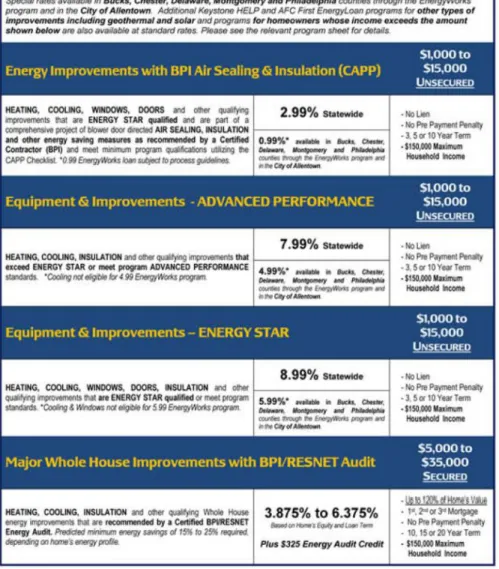
For example, through 2009 the Austin Energy Residential Power Saver Program has helped over 40,000 individuals make home energy improvements with simple loan and rebate programs. First of all, to qualify for a loan or rebate, residential homeowners can only make home energy improvement measures specified by Austin Energy, which limits the potential retrofit options and measures. Moreover, the rebate program’s structure is straightforward: Austin Energy will cover up to 20% of costs up to a maximum of $1,575 (Austin Energy, 2010). With loans, Austin Energy offers two options with its financing partner Velocity Credit Union. Loan terms are clear, as are the types of home energy improvements that qualify, as seen below (Austin Energy, 2010):
Loan Option 1, Energy Improvement/Air Conditioning Replacement: Up to $11,000 for single-family homes or duplexes
0% APR for three years, 3.5% APR for five years, 4.5% APR for seven years or 6% APR for 10 years
Must be used to make all recommended weatherization improvements, improve duct systems, perform required duct system training, install up to two new high-efficiency AC or heat pump systems and/or convert window unit(s) to high-efficiency central AC or heat pump system.
Loan Option 2: Residential Optional Measures:
Up to $8,500 for single-home homes and up to $11,000 for duplexes and two-HVAC replacement or window-unit to central AC conversion
1.9% APR for three years, 3.5% APR for five years, 5% APR for seven years or 6% APR for 10 years
Can be used to install a high-efficiency central AC or heat pump system and perform required duct system testing, improve duct systems, install attic insulation up to R-38, install solar screens or window film, and/or install radiant barrier to roof underside
13 | P a g e
see Figure 1). Also, Michigan’s statewide EERE retrofit program, Michigan Saves, clearly outlines the specific improvements that pre-qualify for a loan. Moreover, the program strives for its loan term to be straightforward and digestible for the typical residential homeowner.
Taken together, Keystone HELP, Austin Energy and Michigan Saves demonstrate the importance of simplifying the retrofit and financing process for residential homeowners. The number of Austin Energy (40,000+ since 1982) and Keystone HELP (7,000+ since 2005) participants stand out amongst different city and state programs, and their clear retrofit and financing processes are likely key contributors to these results.
What drives consumer borrowing for energy efficiency?
Peter Krajsa, CEO of AFC First, wrote a presentation for the U.S. Department of Energy that drills down into what drives customer adoption. In this piece, Krajsa identifies two types of energy efficiency customers, the reactive and proactive consumer. Based on 10+ years of experience running EERE lending programs across the U.S., Krajsa believes there are two types of EERE residential customers, the reactive and proactive consumer. Reactive customers make up approximately 90% of the market. These customers do not want a lien on their home, are time sensitive (i.e., need work done ASAP), and reaching this market is essentially contractor-driven. Moreover, these customers are usually making improvements because of broken equipment in the home, such as a heat pump or HVAC system. Proactive customers want to drive down energy costs and generally help the environment, and are typically more interested in whole-house improvements. With these types of customers, comprehensive energy audits and a more holistic retrofit package often better address customer needs (Krajsa, 2010).
14 | P a g e
Survey Findings:
Methodology
To answer questions about why residential homeowners do or do not conduct energy efficiency retrofits, a quantitative method was employed. Specifically, an online survey was conducted in the Philadelphia metropolitan region. The survey possessed 27 questions, but the typical survey respondent was required to only answer 8-12 questions. The reason for this was specific questions were targeted to different types of residential homeowners. We wanted to understand the
differences between different types of respondents, specifically with regards to how financing options and program messaging affected their energy efficiency retrofit adoption. Accordingly, several questions targeted the following specific homeowner groups:
1) Heard of EnergyWorks/Keystone HELP and had conducted an energy efficiency retrofit; 2) Heard of EnergyWorks/Keystone HELP, but had not conducted an energy efficiency
retrofit;
3) Have not heard of EnergyWorks/Keystone HELP, and had not conducted an energy efficiency retrofit; and
4) Have not heard of EnergyWorks/Keystone HELP, but had conducted an energy efficiency retrofit.
To reach these target residential homeowner groups in the Philadelphia metropolitan area, the online survey was sent out by EnergyWorks and AFC First, on-the-ground partners with strong
Philadelphia-area networks. AFC First sent an email mid-February 2012 to the 1,900 Delaware Valley homeowners that had qualified for a Keystone HELP/EnergyWorks loan, but may or may not have actually conducted a retrofit or utilized the financing option (see Figure 2 for survey invite email). EnergyWorks sent a similar email to 1,500 Philadelphia metro area homeowner customers or applicants (see Figure 3 for survey invite email). There was also a raffle to incentivize homeowner participation, in which four people could win $50 gift certificates to Reading Terminal Market in Philadelphia. Providing email addresses to be included in the raffle was voluntary for survey respondents.
The survey stayed open for 20 days total, and through these two outreach emails, a total of 440 people completed the entire survey. 486 people began the survey, with 46 not completing the entire survey. Altogether, of the approximately 3,400 people who were sent the survey, 440 completed it, meaning there was a 12.94% survey uptake rate. Only completed surveys are being used for the majority of the data analysis found in this report.
15 | P a g e
likelihood of reaching homeowners that were more interested in energy efficiency than the average individual. Homeowners in their databases had made concerted efforts to learn more about energy efficiency retrofits, which may not be representative of the broader population. Moreover, although about 25% of survey participants reported never hearing of EnergyWorks or Keystone HELP, since these individuals were likely either in one of the program’s database – unless the email invite was forwarded to the respondent – the participant may have had some prior type of interaction with these Philadelphia area retrofit programs.
To frame this analysis, below is some general background information on the 440 Philadelphia metro area residential homeowners that completed the entire survey. 74% of the homes were built 1970 or earlier, which is a little higher than the average home age for the Philadelphia metro area of 70.2%. Homeowners often have owned their homes for a short time (26% for 3 years or less) or an extended time period (33% for 14+ years). 77% of respondent homeowners are between the ages 30-59, and the median household income is within the $90,000 to $110,000 income range. The income level is a little higher in our respondent survey than average, as the median income for the Philadelphia metro area is $74,506 for families according to the 2010 American Community Survey.
Respondent Background Information
Age of Home: Respondents and Metropolitan Area
Year Responses % Phil. Metro Area %
1950 or earlier 213 49% 31.5%
1950 - 1970 107 25% 28.7%
1970 - 1980 45 10% 12.3%
1980 - 1990 36 8% 9.8%
1990 - 2000 27 6% 9.2%
2000 or later 12 3% 8.4%
Home Square Footage
Square Feet Responses %
1000 square feet or less 15 3%
1000 - 1500 square feet 92 21%
1500 - 2000 square feet 124 29%
2000 - 2500 square feet 85 20%
2500 - 3000 square feet 65 15%
3000+ square feet 57 13%
n = 436 Source: U.S. Census Bureau, 2010
16 | P a g e
Years Family has Lived in Home
Years Responses %
0 - 3 years 114 26%
4 - 6 years 67 15%
6 - 9 years 56 13%
10 - 13 years 56 13%
14 years+ 145 33%
Homeowner Age
Age Responses %
20 - 29 years 10 2%
30 - 39 years 116 27%
40 - 49 years 101 23%
50 - 59 years 118 27%
60 - 69 years 78 18%
70 years+ 15 3%
Annual Household Income: Respondents and Metropolitan Area
Annual Income Responses % Phil. Metro
Area %
$30,000 or less 16 4% 17.4%
$30,000 - $50,000 35 9% 15.1%
$50,000 - $70,000 45 12% 14.3%
$70,000 - $90,000 62 17% 12.3%
$90,000 - $110,000 63 17% 9.6%
$110,000 - $130,000 43 12% 7.5%
$130,000 - $150,000 46 12% 7.5%
$150,000+ 68 18% 16.3%
n = 434
n = 433
n = 370 Source: American Community Survey
17 | P a g e
Results:
To distill results from this study’s 27-question survey, we highlight important takeaways in the following section, using both aggregate data and statistical analysis. Accordingly, below are the top nine takeaways from survey results that help tell the story of how residential homeowners decide whether or not to conduct energy efficiency retrofits. Some of the takeaways include, or are solely, results from statistical tests to determine whether the differences in group responses are statistically valid (e.g., whether age impacts likelihood to conduct retrofit).
#1: Perceived Degree of Energy Cost Burden
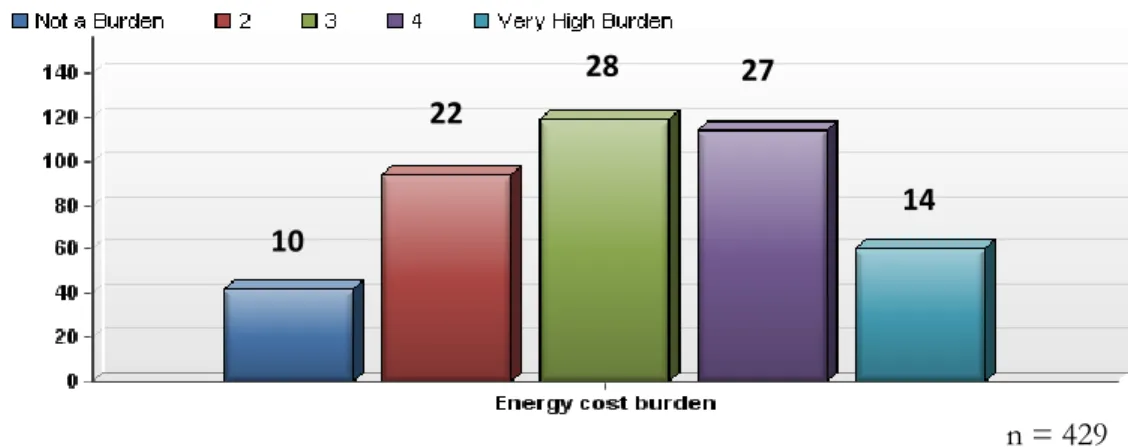
41% of respondents perceived energy cost burden as “high” or “very high”. Generally, respondents seem to be strongly impacted by energy costs.
Figure 1: Perceived Energy Cost Burden
#2: Energy and Dollar Savings Key Motivators for Conducting Energy Efficiency Retrofits A question our survey outreach partner EnergyWorks had was whether “energy savings” or “home comfort” is a greater motivator for conducting energy efficiency retrofits. 63% of survey
respondents stated that saving energy would be (or was) the primary motivator for conducting an energy efficiency retrofit, while 25% selected home comfort and 12% chose “Other”. Some of the comments left in the “Other” field provide greater depth to answering this question as many people noted the dollar savings within their comments. Accordingly, “Energy savings & dollar savings” may be more accurate, when rated against other factors.
Question: Are you (or would you be) primarily motivated to conduct an energy efficiency retrofit for your home to:
Motivator Responses %
Save energy 275 63%
Increase home comfort 110 25%
Other 54 12%
Total 439 100%
14 27
28 22
10
18 | P a g e
Representative “Other” Comments: - Save energy & dollars
- Both of the above
- Save money
Additionally, when the survey asked this question among several other possible factors, “Dollar savings through lower energy bill” and “Home comfort/drafts” ranked in the top two in importance for those who have conducted a retrofit and those who have not yet conducted a retrofit.
Interestingly, “Trust in a specific contractor” ranks more important for those who have not yet conducted a retrofit.
Question: How much would (or did) the following factors affect your decision to conduct an energy efficiency retrofit for your home?
Factor (Rank from 1 to 5, 5 “very important”) No Retrofit, No EnergyWorks EnergyWorks & Conducted Retrofit
Dollar savings through lower energy bill 4.67 (1) 4.39 (1)
Trust in a specific contractor 4.35 (3) 2.95
Neighbor or friend influence 2.82 1.89
Availability of lending product 3.56 3.18
Lending product features 3.61 3.05
Environmental benefits 4.14 4.12 (3)
Home comfort/drafts 4.57 (2) 4.36 (2)
Planning to do other work on house at same time 3.12 2.61
Just bought the property 1.90 1.83
To determine whether the “No Retrofit, No EnergyWorks” group answered this question in a statistically different or distinct manner than the “EnergyWorks & Conducted Retrofit” group, a few chi-squared tests of independence were conducted for the highest ranked factors and factors with the largest difference in rankings (e.g., trust in a specific contractor). Both “Trust in a specific contractor” and “Home comfort/drafts” possess strongly statistically significant differences of .000, meaning that the “No Retrofit, No EnergyWorks” and “EnergyWorks & Conducted Retrofit” groups are independent of one another. Takeaways from this analysis include that the group that had not conducted retrofits more highly values trust in their contractor and the attractiveness of lending product features than those that have heard of EnergyWorks and already conducted a retrofit.
19 | P a g e
Factors Affecting Retrofit Decision: Chi-Square Tests of Independence
Factor Pearson Chi
Square Value Significance Value
Dollar savings through lower energy bill 6.78 .148
Trust in a specific contractor 62.499 .000
Lending product features 23.648 .000
Home comfort/drafts 4.809 .307
#3: Lack of upfront money and delaying retrofit key stated reasons for not making energy efficiency improvements. For respondents that stated not knowing about EnergyWorks and then also had not conducted a retrofit, 72% planned to conduct retrofits within the next year. For respondents that heard of EnergyWorks and had not conducted a retrofit, lack of upfront money, and once again planning to conduct a retrofit, ranked as key reasons for not yet conducting an energy efficiency retrofits. Taken together, these results demonstrate the importance of identifying strategies that create urgency and move people from planning to executing retrofits.
Question: Do you plan on making energy efficiency improvements to your home in the following time periods (asked to those who had not heard of EnergyWorks & had not conducted a retrofit)?
Amount of Time Responses %
The next 3 months 19 22%
The next 6 months 15 17%
The next year 29 33%
I do not plan on making energy efficiency improvements to my home in the near future
24 28%
20 | P a g e
Question: What factors have influenced your decision to NOT improve the energy efficiency of your home to this point (1 to 5 scale)? (Question asked to respondents who knew of EnergyWorks & had not conducted a retrofit)
Factor Responses Mean
Planning to conduct retrofit in the future 117 3.03 (2)
Uncertainty about energy savings/dollar payoff 116 2.59 (3)
Hassle of construction/renovation 116 2.47
Lack of upfront money for retrofit/too expensive 115 3.44 (1) Unsure of how long will keep home, and whether
retrofit will payoff before selling
114 2.39
Uncertainty about the economy 112 2.30
Uncertainty about personal and/or family economic stability
113 2.45
#4: About 40% of Respondents who conducted retrofits used AFC First’s low-interest loan 321 of the 440 respondents heard about the EnergyWorks/Keystone HELP retrofit program. Of that group 184, or 57%, conducted energy efficiency retrofits through EnergyWorks. As seen below of that 75 of that 184 used the low-interest loan from AFC First (.99% through EnergyWorks) to finance their energy efficiency retrofit.
Did you use an EnergyWorks loan product to help pay for your energy efficiency retrofit?
EnergyWorks Loan Response %
Yes 75 41%
No 109 59%
Total 184 100%
#5: Without EnergyWorks loan, 80% would not have conducted retrofit:
80% of the 75 survey respondents that used an EnergyWorks loan product stated that without the low-interest loan, they would not have been able to conduct an energy efficiency retrofit. This may indicate that financing is a critical last step for some individuals to undergoing retrofits, although it is hard to test this definitively. Respondent comments summarize this sentiment, as seen below:
- “Too costly and too complicated to find financing otherwise”.
21 | P a g e
- “The loan was the only way I could afford to do an extensive energy efficiency retrofit”.
- “I didn’t have the upfront cash to afford the retrofit”.
Question: Without the EnergyWorks loan product, would you have done an energy efficiency retrofit?
Answer Responses %
Yes 15 20%
No 60 80%
Total 75 100%
#6: Those that conducted retrofits rate experience with program higher
Across three of the four areas respondents that knew about EnergyWorks (n=321), those that conducted retrofits rated their experience more highly than those that did not conduct retrofits. The exception was interaction with the “EnergyWork/Keystone HELP loan representative”; this may be because some loan applicants that conducted retrofits were denied loans through the screening process. Conducting a Spearman’s rho test for comparison of ordinal data shows that the difference between ratings according to whether a person did or did not conduct a retrofit was significant for all four of the key EnergyWorks’ professionals that individuals interacted with during the retrofit process.
How would you rate your overall experience with the following EnergyWorks professionals? Rate on a “1=not very good” to a “5 = very good” scale.
Contact Person No
Retrofit Retrofit Spearman Rho Test
EnergyWorks Customer Service
Representative 3.52 4.05
Independent at significance of .000. Yes to “Retrofit” has a .3383
correlation with increase in rating.
EnergyWorks Home Audit Analyst 2.65 4.03
Independent at significance of .000. Yes to “Retrofit” has a .5151 correlation with increase in rating.
EnergyWorks Contractor 2.30 3.28
Independent at significance of .000. Yes to “Retrofit” has a .4372 correlation with increase in rating.
EnergyWorks/Keystone HELP loan
representative 2.90 2.50
Independent at significance of .0124. Yes to “Retrofit” has a .1415
correlation with a decrease in rating.
22 | P a g e
#7: EnergyWorks Reps and Home Contractors Top Retrofit Influences
Respondents that conducted retrofits ranked EnergyWorks representatives and home contractors as the two most important influences on deciding to undertake an energy efficiency retrofit. This finding highlights the importance of equipping home contractors with program and financing information, as they are often the individuals that meet directly with homeowners considering energy efficiency retrofits.
Who/what were the most important influences on deciding to undertake an energy efficiency retrofit? Rate from 1 to 7 with “1” being most important and “7” being least important.
1 2 3 4 5 6 7 Avg. Rank
Home Contractor 26 25 17 17 12 17 4 3.26 (2)
Neighbor 11 14 14 11 15 27 12 4.29
Advertisement 12 18 16 15 18 19 7 3.90
Local government 6 6 18 19 17 26 9 4.48
EnergyWorks representative
18 34 29 16 11 17 2 3.21 (1)
EnergyWorks event 21 18 10 9 11 30 10 3.92
#8: Age Slightly Impacts Likelihood to Conduct EERE Retrofit
With age, although most of the people who responded to the survey were in the 30-59 age range, adoption rates were higher in the 60-69 and 70+ age range. With the 70+ age range, 14 of the 19 respondents (73.7%) conducted retrofits through EnergyWorks. To determine whether the “Conducted Retrofit” group was statistically independent from the “No Retrofit” group that had also heard about EnergyWorks, a chi-squared test of independence was conducted. Using age groups (e.g., 20-29, 30-39) as the categories for evaluation, there was not a statistically significance difference, meaning that age does not necessarily predict independence between the “Conducted Retrofit” and “No Retrofit” groups.
23 | P a g e
Analysis of Retrofit Adoption by Age Categories
Age Respondents Conducted Retrofit
Through EnergyWorks (%) No Retrofit (%)*
20-29 13 30.8% 38.5%
30-39 133 42.1% 33.8%
40-49 116 34.5% 31.9%
50-59 138 37.0% 30.4%
60-69 93 45.2% 24.7%
70+ 19 73.7% 10.5%
#9: Income Has No Impact on Likelihood to Conduct EERE Retrofit
There does not seem to be a distinct difference in retrofit rate due to income as most retrofit percentages by annual income hovered between 40-50%. The only outliers were respondents with annuals incomes of $30k or less, which had the lowest retrofit adoption rate at 37.5%, and
individuals with annual incomes of $130-$150k, which conducted retrofits 54.3%.
To determine whether the “Conducted Retrofit” group was statistically independent from the “No Retrofit” group that had also heard about EnergyWorks, a chi-squared test of independence was conducted. Using annual incomes categories (e.g., $30,000 or less, $30,000 – $50,000 etc.) for evaluation, there was not a statistically significance difference, meaning that age does not necessarily predict independence between the “Conducted Retrofit” and “No Retrofit” groups. Not only that, but the two groups seemed very similar, with an abnormally high significance value of .956. The regression, confirms how little variation there was been the “Conducted Retrofit” and “No Retrofit” group, with a significance level of .5273 and an R2 value of .0012. These two numbers mean, there is a more than 52% chance that these the two groups are essentially the same and that the income categories only explain less than .01% of whether a person that knew about EnergyWorks conducted a retrofit or not.
24 | P a g e
Analysis of Retrofit Adoption by Annual Income
Annual Income Respondents Conducted Retrofit
Through EnergyWorks (%) No Retrofit (%)*
$30,000 or less 16 38% 25%
$30,000 – 50,000 37 41% 27%
$50,000 - $70,000 47 47% 36%
$70,000 - $90,000 65 45% 43%
$90,000 - $110,000 63 49% 35%
$110,000 - $130,000 45 44% 33%
$130,000 - $150,000 46 54.3% 30%
$150,000+ 68 44.1% 35%
Conclusion:
For energy efficiency program administrators and policymakers, there are several key takeaways from this Philadelphia metro area survey and literature review that can help guide energy efficiency retrofit program messaging and structure. With regards to messaging, quantitative data and
respondent comments show that “dollar and energy savings” is the top motivator for respondents that conducted retrofits through EnergyWorks and also for survey respondents that have not yet conducted retrofits. Home comfort is also very important, but seems to be a distant second. Moreover, although respondents state that neighbors and friends do not influence their decision to conduct an energy efficiency retrofit, research shows that respondents likely understate the
importance of peer influence and instead are very influenced by others’ actions. Accordingly, highlighting specific instances of neighborhood retrofits and highlighting the increasing pace with which residential retrofits are occurring in a given city or metropolitan area could also increase messaging effectiveness. Taken together, stressing “Dollar and energy savings” and highlighting the number of residential retrofits or percentage retrofit increase, and possibly highlight individual “success stories” could help improve messaging effectiveness.
Regarding EERE outreach strategies, survey results confirm the literature review regarding the importance of contractors to the retrofit process. Home contractors are the individuals most likely
25 | P a g e
to directly interact with homeowners that will potentially conduct retrofits, as Keystone HELP and NYSERDA discovered when running their EERE retrofit programs. With this Philadelphia metro area survey, home contractors were the most common outlet through which residential homeowners learned about the EnergyWorks program, and respondents that conducted retrofits stated
contractors were the 2nd most important influence in deciding to conduct a retrofit (with
EnergyWorks representatives being the most influential). EERE program administrators should actively engage their contractor networks, equipping them with marketing and loan information, and training about these materials, to enable these home contractors to more effectively communicate program features with potential homeowner retrofit participants.
26 | P a g e
Appendix:
Figure 1: Keystone HELP Loan and Program Improvement Structure
Keystone HELP Loan Webpage
27 | P a g e
28 | P a g e
Figure 3: EnergyWorks Survey Participant Outreach Email
Greetings from EnergyWorks!
Please take this short, 5 minute survey to help us better understand why Philadelphia area homeowners conduct energy efficiency retrofits. Your input will help improve our energy efficiency retrofit program. Survey participants can enter a raffle to receive one of four $50 gift certificates to Reading Terminal Market!
Energy Retrofit Survey
29 | P a g e
References:
Best Practices for Energy Retrofit Program Design: Austin Energy Residential Power Saver Program, 2010. HomePerformance Resource Center. Available at:www.hprcenter.org/best-practices
Best Practices for Energy Retrofit Program Design: Clean Energy Works Portland, 2010. Home Performance Resource Center. Available at:
www.hprcenter.org/best-practices
Best Practices for Energy Retrofit Program Design: Marketing Recommendations, 2010. Home Performance Resource Center. Available at:
www.hprcenter.org/best-practices
Boyle, Christine and Michael Chasnow, 2010. CharlestonSaves Market Assessment. UNC Environmental Finance Center. Available at:
http://efc.unc.edu/projects/MarketAssessments.htm
Boomgard, Elizabeth and Jennifer Snook, 2011. Leveraging Behavioral Economics to Minimize Household Energy Consumption. Duke University, Nicholas School of the Environment.
http://dukespace.lib.duke.edu/dspace/bitstream/handle/10161/3605/MP_SnookBoomgar d_FINAL.pdf?sequence=1
Burchill, Gary and Christina Brodie, 1997. Voices into Choices: Acting on the Voice of the Customer. Center for Quality of Management.
Characteristics of Strong Programs, 2012. U.S. DOE Energy Efficiency & Renewable Energy Solution Center. Available at:
http://www1.eere.energy.gov/wip/solutioncenter/financialproducts/strongprograms.html
Cialdini, Robert, 2005. Basic Social Influence is Underestimated. Psychological Inquiry, Vol. 16.
Cuddy, Amy and Kyle Doherty, 2010. OPOWER: Increasing Energy Efficiency through Normative Influence. Harvard Business School.
Dietz, Thomas and Paul Stern, 2002. New Tools for Environmental Protection. National Research Council and National Academy Press. Available at:
http://www.nap.edu/openbook.php?isbn=0309084229
Fuller, Merrian et. al, 2010. Driving Demand for Home Energy Improvements. Lawrence Berkeley National Labs, 3960. Available at:
30 | P a g e
Goldman, Charles et. al, 2010. Benefits and Costs of Aggressive Energy Efficiency programs and the Impacts of Alternative Sources of Funding. Lawrence Berkeley National Labs, 3833E.
Available at: http://eetd.lbl.gov/ea/ems/reports/lbnl-3833e.pdf
Greater Philadelphia Innovation Cluster (GPIC) for Energy-Efficient Buildings, 2011. GPICHUB.
Available at: gpichub.org.
Hannah Choi Granade, et. al, 2010. Unlocking Energy Efficiency in the U.S. Economy. McKinsey & Company. Available at:
http://www.mckinsey.com/Client_Service/Electric_Power_and_Natural_Gas/Latest_think ing/Unlocking_energy_efficiency_in_the_US_economy
Hendricks, Bracken and Jorge Madrid, 2011. A Star Turn for Energy Efficiency Jobs. Center for American Progress. Available at:
http://www.americanprogress.org/issues/2011/09/energy_efficiency_jobs.html
Krajsa, Peter, 2010. What Drives Consumer Borrowing for Energy Efficiency? U.S.Department of Energy. Available at:
www1.eere.energy.gov/wip/solutioncenter/.../afc_presentation_120309.pdf
Lutzehniser, Loren et. al, 2009. Behavioral Assumptions Underlying California Residential Sector Energy Efficiency Programs. California Institute for Energy and Environment. Available at:
http://uc-ciee.org/downloads/ba_ee_res_wp.pdf
McKenzie-Mohr, Doug and William Smith, 1999. Fostering Sustainable Behavior. New Society Publishers Available at:
http://www.cbsm.com/public/images/FosteringSustainableBehavior.pdf
Listening to the Voice of the Participant: Modified for the Busy Energy Efficiency Program Administrator, 2011. Lawrence Berkeley National Labs. Available at: http://drivingdemand.lbl.gov/
New York’s System Benefit Charge Program Evaluation and Status Report, 2010. New York State Energy and Research Development Authority. Available at:
http://www.nyserda.org/pdfs/sbc_annualprogramsevaluation_statusreport_end2009.pdf
Schwartz, Barry, 2004. The Paradox of Choice. Harper Collins.
The Save Act: Factoring Expected Energy Costing Savings into Loan Underwriting, 2010. Institute for Market Transformation. Available at: http://files.eesi.org/save_act.pdf
Walking the Social Equity Talk: Portland’s Community Workforce Agreement for New Retrofitting Jobs, 2010. Climate Leadership Academy Network. Available at:
31 | P a g e
Figure 4; Philadelphia Energy Efficiency Retrofit Survey
First block of questions – every respondent answers these
Thanks in advance for taking this survey on residential energy efficiency in the Philadelphia metro area. This survey is part of a
research project at UNC-Chapel Hill led by primary investigator ([email protected]) to better understand why
residential homeowners do or do not conduct energy efficiency retrofits.
Your input will help improve the EnergyWorks residential energy efficiency retrofit process in the Philadelphia metro area and possibly inform other similar programs in the US. All responses will only be analyzed in the aggregate, meaning your response and the approximately 200 other individual survey responses will be anonymous. Results from this study will be publicly available.
The survey takes only 5-10 minutes, and we really appreciate your time.
How old is your home?
1950 or earlier
1950 - 1960
1970 - 1980
1980 - 1990
1990 - 2000
2000 or later
Other
How many square feet is your home?
1000 square feet or less
1000 - 1500 square feet
1500 - 2000 square feet
2000 - 2500 square feet
2500 - 3000 square feet
3000+ square feet
How many years have you/your family lived in this home?
0 - 3 years
4 - 6 years
6 - 9 years
10 - 13 years
32 | P a g e
How old are you?
20 - 29 years
30 - 39 years
40 - 49 years
50 - 59 years
60 - 69 years
70 years+
What zip code in the Philadelphia metro area do you live?
How much of a burden are energy costs for you?
Please study the list carefully and then rate each thing on how important it was to decision, where 1 = not a burden and 9 = very high burden.
Energy cost burden
33 | P a g e
Are you (or would you be) primarily motivated to conduct an energy efficiency retrofit for your home to:
Save energy
Increase home comfort
Other
Have you heard about or interacted with the EnergyWorks or Keystone HELP programs for energy efficiency retrofits?
Yes
No
Set of Questions for those who “Haven't Heard About EnergyWorks”
Have you done an energy efficiency retrofit for your home in the last few years?
Yes
No
How much would the following factors affect your decision to conduct an energy efficiency retrofit for your home?
Please study the list carefully and then rate each thing on how important it would be to decision to conduct an energy efficiency retrofit, where 1 = "very unimportant" and 5 = "very important".
Very Unimportant 2 3 4 Very Important
Dollar savings through lower energy bill
Trust in a specific contractor
Neighbor or friend influence
Availability of lending product
Lending product features
Environmental benefits
Home comfort/drafts
Planning to do other work on house at same time
Just bought the property
What components of a loan program would be most important to your potential interest/use of the loan program?
Please study the list carefully and then rate each thing on how important it would be to your decision, where 1 = "very unimportant" and 5 = "very important".
Interest rate
Ease of application process (e.g., time spent, # of steps)
Extended loan term (e.g., 5 years instead of 2 years, lowers monthly repayment)
Energy dollar savings greater than monthly interest payments Collateral required vs. collateral not required *(Collateral refers to assets that a borrower would need to put up to secure credit. For example, the house is typically collateral for a home mortgage.)
34 | P a g e
Do you plan on making energy efficiency improvements to your home in the following time periods? Feel free to explain your answer.
The next 3 months
The next 6 months
The next year
I do not plan on making energy efficiency improvements to my home in the near future
If you do not plan on making energy efficiency improvements to your home in the near future is it because you are:
Concerned about the financial state of the economy
Concerned about your own financial stability
More inclined to continue paying higher utility bills, than to take on any additional debt to pay for energy efficiency home improvements
Not interested in energy efficiency
Other
Set of Questions for People Who Knew of EnergyWorks
Did you conduct an energy efficiency retrofit for your home through EnergyWorks?
Yes
No
Set of Questions for People Who Knew of EnergyWorks but did not Conduct a Retrofit
How did you hear about the EnergyWorks or Keystone HELP energy efficiency and loan program?
Mark all the answers that apply (i.e., ways in which you heard about the EnergyWorks program).
Home Contractor
Neighbor
Advertisement
Local government
AFC First representative
EnergyWorks event
35 | P a g e
How would you rate your overall experience with the following EnergyWorks professionals (select "Not Applicable" if did not interact with one of these professionals)?
Rate on a "1 = not very good" to a "5 = very good" scale.
Not Applicable Not Very Good 2 3 4 Very Good
EnergyWorks Customer Service Representative
EnergyWorks Home Audit Analyst
EnergyWorks Contractor
EnergyWorks/Keystone HELP loan representative
When you first learned about the EnergyWorks program, how well did you understand the different components of the program?
Please study the list carefully and then rate each thing on how well you understood a given component, where 1 = "not very well" and 5 = "very well".
Paperwork required Contractor selection process Financing options
36 | P a g e
What factors have influenced your decision to NOT improve the energy efficiency of your home to this point?
Please study the list carefully and then rate each thing on how much it has influenced your decision to NOT improve energy efficiency of your home, where 1 = "not very influential" and 5 = "very influential".
Not Very Influential 2 3 4 Very Influential
Planning to conduct retrofit in the future
Uncertainty about energy savings/dollar payoff
Hassle of construction/renovation
Lack of upfront money for retrofit/too expensive
Unsure of how long will keep home,
and whether retrofit will payoff
before selling
Uncertainty about the economy
Uncertainty about personal and/or family economic stability
Set of Questions for People Who Knew of EnergyWorks and Did Conduct a Retrofit
Who/what were the most important influences on you deciding to undertake an energy efficiency retrofit?
Rank from 1-6, with "1" being most important "6" being least important. Rank from 1-7 if you used the "Other" category.
Home Contractor Neighbor Advertisement Local government EnergyWorks representative EnergyWorks event Other
Why did you decide to undertake a home energy efficiency retrofit?
Please study the list carefully and then rate each thing on how important it was to decision, where 1 = very unimportant and 5 = very important.
Dollar savings through lower energy bill
Trust in a specific contractor Neighbor or friend influence Availability of lending product Lending product features Environmental benefits Home comfort/drafts
Planning to do other work on house at same time
Just bought the property To increase value of your home Improve health and safety
37 | P a g e
When you first learned about the EnergyWorks program, how well did you understand the different components of the program?
Please study the list carefully and then rate each thing on how well you understood a given component, where 1 = "not very well" and 5 = "very well".
Paperwork required Contractor selection process Financing options
Not Very Well 2 3 4 Very Well
Did your contractor who did the energy efficiency retrofit explain the EnergyWorks/AFC First loan program well?
Rate on a "1 = not very well" to a "5 = very well" scale.
Not Very Well 2 3 4 Very Well
Explanation of Keystone HELP loan program
Ease of application process (e.g., time spent, # of steps)
Collateral required vs. collateral not required *(Collateral refers to assets that a borrower would need to put up to secure credit. For example, the house is typically collateral for a home mortgage.)
How would you rate your overall experience with the following EnergyWorks professionals (select "Not Applicable" if did not interact with one of these professionals)?
Rate on a "1 = not very good" to a "5 = very good" scale.
Not Applicable Not Very Good 2 3 4 Very Good
EnergyWorks Customer Service Representative
EnergyWorks Home Audit Analyst
EnergyWorks Contractor
EnergyWorks/Keystone HELP loan representative
Did you use a EnergyWorks loan product to help pay for your energy efficiency retrofit? If you would like to explain why or why not, please do so in the open space provided below.
Yes
38 | P a g e
Without the EnergyWorks loan product, would you have done an energy efficiency retrofit? If you would like to explain your answer, please do so in the open space provided below.
Yes
No
Only People Who Did not Conduct a Retrofit Through EnergyWorks Receive Below Question
Would you be interested in being contacted by an EnergyWorks representative to learn more about the EnergyWorks/Keystone HELP energy efficiency retrofit and loan program?
Yes
No
All Respondents – End of Survey Questions
What range is your household income within?
$30,000 or less
$30,000 - $50,000
$50,000 - $70,000
$70,000 - $90,000
$90,000 - $110,000
$110,000 - $130,000
$130,000 - $150,000
$150,000+