1 ALL THE EVIL OF GOOD:
PORTRAYALS OF POLICE AND CRIME IN JAPANESE ANIME AND MANGA
By Katelyn Mitchell
Honors Thesis
Department of Asian Studies
University of North Carolina at Chapel Hill April 23, 2015
Approved:
2 “All the Evil of Good”:
Portrayals of Police and Crime in Japanese Anime and Manga By Katelyn Mitchell
“Probity, sincerity, candor, conviction, the idea of duty, are things that, when in error, can turn hideous, but – even though hideous, remain great; their majesty, peculiar to the human conscience, persists in horror…Nothing could be more poignant and terrible than
[Javert’s] face, which revealed what might be called all the evil of good”
-Victor Hugo, Les Misérables Volume I, Book VIII, Chapter III: “Javert Satisfied”
Abstract
This thesis examines and categorizes the distinct, primarily negative, portrayals of law enforcement in Japanese literature and media, beginning with its roots in kabuki drama, courtroom narratives and samurai codes and tracing it through modern anime and manga. Portrayals of police characters are divided into three distinct categories: incompetents used as a source of comedy; bland and consistently unsuccessful nemeses to charismatic criminals, used to encourage the audience to support and favor these criminals; or cold antagonists fanatically devoted to their personal definition of ‘justice’, who cause audiences to question the system that created them. This paper also examines Western influences, such as Arthur Conan Doyle’s Sherlock Holmes and Victor Hugo’s Inspector Javert, on these modern media portrayals. It also examines the contradictions between these negative, antagonistic
3 Table of Contents
Introduction: Portraying the Police 4
Chapter 1: Laughing at the Law 21
Chapter 2: Feeling for the Felon 38
Chapter 3: Judging Javert 58
Conclusion: Fearing for the Future 104
Bibliography 108
Appendix A: Appearance and Categorization of Police in Anime and Manga 111
4 Introduction: Portraying the Police
Identifying the Role of the Law Enforcement in Japanese Fiction
On paper, Japan boasts one of the world’s lowest crime rates. Civilians enjoy positive interaction with local police on a daily basis, visiting bright pink kōban or police boxes for directions, lost pet searches, and even restaurant recommendations. Meanwhile, Japan’s detectives continually maintain a case clearance rate that ranks among the world’s highest, and its courts maintain a conviction rate that is the world’s highest – 99%. On paper, the Japanese police system is competent, effective, and maintains a positive relationship with the civilians it is tasked to protect. In Japanese literature, film, anime and manga, however, the police are significantly different. They are corrupt villains, bumbling incompetents, heartless justice-seekers, and hapless failures outwitted by the criminals they oppose. This image clearly has little-to-no basis in actual fact. Whence, then, did the overwhelmingly negative portrayal of the police in fictional media arise? The answer lies in Japan’s legal and criminal history, in its traditional kabuki theater, and in cultural borrowing. Trends begun in kabuki and under the influence of Western authors, such as Sir Arthur Conan Doyle and Victor Hugo, have combined with select elements of the actual workings of the law enforcement and justice system to create the unique types of policeman seen in modern Japanese anime and manga.
Analysis of various anime and manga in which members of the law enforcement appear, beginning in 1967 and continuing to the present, reveals four distinct types of
5 vilest of illegal and immoral acts for the right price. They are also trigger-happy, carrying multiple guns and unloading bullet after bullet into their victim of the episode. This portrayal has appeared the least frequently and has not continued into the present.
6 and 1990s before being replaced by darker, less comedic character types towards the end of the latter decade.
Secondly, and also drawing inspiration from the traditions of kabuki, are the
policemen who display some level of competence – until they are matched up with a certain criminal, usually a master thief or a serial killer. They become this criminal’s nemesis, chasing him or her down through crime after crime and scheme after scheme, always one step behind. This police officer is usually quite intelligent – but only for the purpose of providing a worthy opponent for their genius criminal adversary, yet the criminal is always just a little bit cleverer and faster on his or her feet. A unique feature of these stories is that the criminals, who are often dashing, fashionable and popular, are presented as protagonists, receiving support and positive reaction from readers and viewers, while the detective or inspector who seeks to put an end to their lives of crime will fill the antagonist’s role. One ‘parent’ of these criminals is the dashing rōnin (master-less samurai) hero of the Tokugawa-era plays, such as Yuranosuke, leader of the 47 ronin who fight to avenge their dishonored master in the kabuki classic Kanadehon Chūshingura. This roguish hero template is
7 The last type of policeman that can be seen in anime and manga does not originate in kabuki or classic Japanese literature, but is instead more directly a re-interpretation of the creations of European novelists. This character is a heartless justice-seeker, who will do anything to uphold his (or, rarely, her) own personal sense of justice. He does not care whether the criminals he chases are truly innocent or guilty; he cares only about bringing his quarry to justice. This cold-hearted officer of the law only began appearing in anime and manga as recently as the mid-1990s. He originates from a singular figure: Inspector Javert, the antagonist of Victor Hugo’s 1862 French classic Les Misérables. Les Misérables was first introduced to Japan in the early 20th century and achieved great popularity and influence, receiving multiple adaptations on a regular basis. Javert has made many appearances in film and television and onstage, and has served as a template for many characters in manga and anime. This character type, which continues to be prevalent in Japanese media today, is used for philosophical, and not comedic or emotional, purposes. His narrow views and extreme actions cause readers and viewers to question the nature of the justice system in which he operates.
Of the sources that contributed to the modern portrayal of police in anime and manga, kabuki theater is the most influential. The Tokugawa period’s most widespread popular entertainment, kabuki was in itself illegal, its actors officially outcasts according to the strictly defined Tokugawa social pyramid. This outsider status was the result of their work’s being seen as having no value; in a society which placed heavy weight on the production of material goods and deference to social superiors, the kabuki players’ impermanent, irreverent products were considered criminal. Despite this, kabuki remained a popular form of
8 world”), or pleasure quarters, of every major city. The bafuku, the Shogun’s enforcers and the Tokugawa equivalent of police, attempted to shut down the troupes via force and to limit the actors’ extravagant lifestyle via a series of sumptuary laws. The Shogun’s government restricted everything from what types of cloth the actors were allowed to wear, to what gifts they were allowed to receive, to what sort of characters they were allowed to portray on stage.
Actors were forbidden from creating any representations of the Emperor, the Shōgun, or a number of high-level aristocrats. As a result, the bafuku and other low-level government officials became popular targets. Actors portrayed them as incompetent fools, constantly being tricked by dashing heroes, and ending up dead or disgraced. Any trick, trap or disguise created by the hero was enough to fool the hapless authorities. The onstage bafuku were not only bumbling failures who could never hope to outwit the dashing hero, but were also self-indulgent and enjoyed various vices more than Tokugawa society’s Confucian morality allowed. Authority figures were often shown gluttonously eating; imbibing wine or sake (and always becoming drunk and clumsy afterwards); or visiting the pleasure quarters, either to purchase a young woman or man to serve as a companion or – worst of all – to enjoy a kabuki play. The bumbling authorities seen in modern Japanese anime and manga have their roots in these comical, irreverent, gluttonous, foolish kabuki characters.
9 witty commoners who dared to rise above their government-mandated social status, coming into conflict with the authorities as the result. Examples of these heroes include the story of the 47 rōnin, adapted as Chūshingura, the most widely performed kabuki play of all time. Though the actual historical event on which the story was based occurred in the early 18th century, to avoid censorship, Chūshingura not only renamed all historical figures appearing in the story, but also relocated the action to the early Muromachi period (the mid-1300s). It is the story of the lord Enya Hangan, who attacks a senior lord, Moronō, after the latter insults his family. He is forced to commit seppuku for raising a sword against his superior. His former retainers, all made rōnin by their lord’s death, swear an oath of eternal loyalty. Led by former chief retainer Ōboshi Yuranosuke, the forty-seven rōnin concoct a clever plan to infiltrate Moronō’s house and kill him. They deliver Moronō’s head to their lord’s grave before committing mass seppuku, joining Hangan in death. Yuranosuke and his comrades were seen by audiences as the embodiment of loyalty, courage, and other positive
characteristics, while the highly ranked official Morono was seen as a scheming, cowardly villain.
10 popular Agemaki, becomes his exclusive mistress. Their law-enforcing opponents were no match for such heroes in either contests of the sword or battles of wits. However humble their upbringing, these protagonists were master strategists capable of coming up with clever ruses at the drop of a hat. Tokugawa audiences adored these roguish heroes and scorned the bumbling bafuku they defeated.
It was not only the fictional criminals who received the fans’ adoration. The actors themselves were in many ways as much ‘dashing criminals’ as the characters they portrayed on stage. They lived their lives in flagrant disobedience of the sumptuary laws imposed upon them by the Shogun’s government, plying their illegal trade day by day to sold-out audience
houses. Kabuki actors, like their heroes, were flamboyant, fashionable, clever and witty, and enjoyed massive popularity among males and females alike. Many of their most ardent admirers were the very aristocrats who were mocked onstage, who would sneak into the ukiyo pleasure quarters (often in disguise) to enjoy the performances – and the pleasures – of their favorite actor or troupe. Another popular art form of the time, woodblock prints known as ukiyo-e (meaning “record of the floating world”) often featured the dashing visages and fashionable costumes of the most popular actors of the time – souvenirs which, of course, were purchased in bulk by their adoring fans. The deeply entrenched culture of adoring criminals and mocking authority figures which kabuki created continues to endure decades and even centuries after the rōnin and bafuku themselves ceased to exist.
11 access to Western works did not begin until several centuries after the establishment of kabuki, Western characters and themes have also made a strong and lasting influence on Japanese literature and media.
During Japan’s rush to modernize and Westernize during the Meiji period, the
government naturally turned first to Britain, Japan’s first (and, for a time, only) formal military ally. This “Britain-mania” which seized Japan lasted for the entirety of the Meiji and Taisho periods. Although Japan did not formally ally with France and America until World War I, trade relations allowed their literature, culture and tradition to permeate Japan as well. France’s Napoleonic Code even served as influence for Japan’s first official legal code, the
Penal Code of 1880, which established a criminal justice system in Japan for the first time. Though the government made an attempt to expunge Western influences from Japanese culture in the 1930s and 1940s, when a series of arguments set Japan against Britain, France and the United States, it was ultimately unsuccessful, especially in regards to literature and media. The government could ban Western clothing, but it could not prevent authors from publishing books or creating films utilizing European or American stories, characters, and ideas.
12 the application of science, usually forensic or medical. “The Japanese justice system,”
however, “had, before the reforms of the Meiji period…relied far more heavily on torture and forced confession than on physical evidence or forensic medicine” (Silver 3). The stories of Sir Arthur Conan Doyle, Maurice Leblanc, Edgar Allan Poe and other crime fiction authors, translated during the 1890s and 1900s, introduced the Japanese reading public to a new, less violent method of crime-solving. And within a few short decades, Japanese crime-novel fans were not just reading these Western imports, but crafting stories inspired by the characters they had come to love.
Early Japanese mystery and crime fiction starred main characters who borrowed appearance, personality quirks, and methods of reasoning from Conan Doyle’s Sherlock Holmes. For example, Hanshichi, star of the first ever Japanese ‘master detective’ novel in 1917, was an Edo-period police detective who chose to forgo the torture and forced
confession in favor of introducing Holmes’s signature deductive reasoning to his
13 unique Western-Japanese fusion which would, several decades later, enter the world of Japanese new media as well.
The Sherlock-like detective figure survived the purge of Western influence during World War II; though mystery authors were “banned from writing freely” during that time, less than a year after the war’s end in 1945, novelist Seishi Yokomizo revived the detective story with the exploits of sleuth Kosuke Kindaichi. Though Kindaichi was always “clad in kimono and hakama” he, like Kogoro and Zenigata before him, utilized Holmes-inspired reasoning and evidence-gathering techniques (Hirohiso 55). With the rise of television, film, and eventually anime, characters of this type continued to appear, especially in television programming, where detective dramas quickly became one of the most popular genres not just in Japan, but worldwide. Television was a perfect match for the detective story, allowing for a mystery-a-week format similar to the magazine serials in which Holmes himself first appeared. The Japanese fascination with the detective story in general, and Holmes in particular, is still present and evident. Though it is rare for Western programs to be dubbed into Japanese and broadcast in Japan, the Granada Sherlock Holmes series aired in Japan for over a decade to rave reviews. A study taken in the late 1990s indicated that the United Kingdom was among the most popular destinations for Japanese tourists traveling abroad, and that an interest in the Holmes stories or TV program was one of the top three reasons given for wanting to travel there.
14 the law to oppose. There would be no Sherlock Holmes without Charles Milverton, Sebastian Moran, Irene Adler, Professor James Moriarty, and the numerous other criminals he has chased down and apprehended over the course of four novels and many short stories. The villains that Japan’s anime and manga police face and chase are equally compelling and
fascinating, not only because they are well-rounded, well-written characters, but because they represent a unique fusion of Japanese and Western storytelling which resulted in a
memorable and now iconic figure: the dashing, gentleman criminal who outwits his police nemesis at every turn.
This character borrows a great deal from both dashing kabuki heroes which have already been discussed earlier in this paper and the yakuza, or members of organized crime. In the 1950s, following the scarcity of the war years, a subculture known as kasutori
emerged. Kasutori emphasized material possessions and the glorification of anything that was the opposite of the ‘wartime culture’ created and promoted by the government. The Japanese people turned from patriotism and devotion to one’s country to a glorification of the black market, the criminal underbelly, and salacious entertainment. The romanticizing of the yakuza, who were portrayed as elegantly dressed, intelligent, witty, and cultured, began during this period.
Like the kabuki rōnin and the kasutori yakuza, fictional criminals are educated,
15 primary characteristic, however, is almost always their genius – they are consistently smarter than their nemesis, even if said opponent is also considered a prodigy. Like their kabuki predecessors, they are capable of devising schemes at the drop of a hat, and are often masters of disguise as well.
While Ranpo, Kodo and their contemporaries pitted their creations against fairly non-memorable Japanese criminals, authors and directors of anime and manga took it a step further, applying the template originating in kabuki to existing Western characters, creating a criminal with a European origin and Western tastes but a very Japanese attitude towards crime and the authorities. For example, Maurice Leblanc’s famous gentleman thief, Arsene
Lupin, gained a Japan-dwelling yakuza-connected grandson in the classic anime and manga series Lupin III. Sherlock Holmes’s most well-known nemesis, Professor Moriarty, has also been a target for Japanese reinterpretation, despite only appearing in two of the original Holmes stories. In the hands of director Hayao Miyazaki, Moriarty became a gentleman inventor of steam-based technology and the head of a massive criminal network. Manga-ka Gosho Aoyama, on the other hand, imagined Moriarty as the lord over a massive,
frighteningly realistic digital realm.
The last character type examined in this paper came entirely from the West, and, despite growing popularity and frequently adaptation in Japan, has not deviated much from its original, entirely Western, form. The cold-hearted “Javert archetype” sees law as his entire life, eclipsing relationships and personal happiness in terms of importance. He will do
16 chasing him across France for over twenty years. When Javert is forced to confront the truth, that Valjean is a good and noble man who has redeemed himself many times over and has dedicated his life to doing good work, he is unable to overcome this shade of gray introduced into his black-and-white justice-and-crime worldview. Realizing that he cannot bring himself to arrest Valjean, he resigns from the police force in the only way he knows how: by
committing suicide. In addition to numerous adaptations of the original story, characters who share Javert’s beliefs and follow his story arc have become increasingly present in anime and manga.
17 Javert embraces what he believes to be the only choice remaining to him: he commits his own version of seppuku, throwing himself into the River Seine. Japan, a country already familiar with characters (both historical and literary) devoted to honor, could easily accept a character equally devoted to justice, and therefore the Javert-type character also became a fixture in Japanese anime and manga.
While it is clear that literature and fiction of both Japan and the West played a large role in the development of the modern portrayal of the police, did the actual workings of the Japanese police force contribute anything at all? The answer is yes, but to a significantly lesser degree than the contributions made by kabuki and European literature. Specifically, the negative traits and actions associated with the police force have sometimes been assigned to fictional police. In order to maintain their high case clearance rate, Japanese police,
18 exaggerated in anime, where police wield not only guns, but sometimes bombs,
high-powered cars, tanks, and even giant robots. These over-the-top weapons leave swaths of destruction in their wake, overturning cars and destroying roads and buildings as the police chase their prey.
The positive characteristics of the Japanese police are for the most part ignored in fictional portrayals of the police. Detectives who constantly chase the same criminal for years on end certainly cannot boast any sort of high case-clearance rate. The proliferation of series with criminal protagonists and crime-an-episode mystery series are not at all compatible with Japan’s low crime rate. While the police are often shown accidentally destroying cars and
homes and interrogating civilians as they track down their prey, there is no indication of the friendly day-to-day interactions between ordinary police officers, who work close to the civilians in numerous kōban, and the population of Japan. The police are generally seen as competent and satisfactory, and yet their negative aspects make their way onto the page or screen.
19 the long-lasting ‘Sherlock-mania,’ which still persists in Japan to this day. Lastly, I utilized several texts in order to better understand the role of kabuki in influencing the bumbling portrayal of the authorities and the dashing, glamorous portrayal of criminals. These discussed the antagonistic relationship between the bafuku government enforcers and the kabuki troupes, as well as some of the specific examples of laws passed with the purpose of regulating actors’ lives and what they could and could not portray on stage. Since most of the existing secondary sources were published in the 1990s or earlier; they fail to extend the trends they analyze into the modern day. This paper focuses specifically on cultural
borrowing and kabuki influences in modern media: anime and manga. This paper is unique in that it draws together a number of sources – Western literature, kabuki, and the real life police force – and analyzes the manner in which they create three distinct portrayals of the police, as incompetent, as nemesis to the successful criminal, and as seeker of justice.
This paper also analyzes several primary sources in the form of anime and manga. The manga analyzed in detail for the purposes of this paper are Naoki Urasawa’s Monster, Gosho Aoyama’s Detective Conan, and Tsugumi Ohba and Takeshi Obata’s Death Note. The anime primary sources are Monkey Punch and Hayao Miyazaki’s Lupin III, Hayao
Miyazaki’s Sherlock Hound, Aoyama’s Detective Conan (specifically the film Phantom of Baker Street), Nippon Animation’s Les Misérables: Shōjo Cosette, Gen Urobochi’s Psycho Pass, and Shinichiro Watanabe’s Zankyou no Terror/Terror in Resonance. Secondary
sources include studies of the real-life workings of the Japanese police system, analyses of cultural borrowing from the West and its influence on Japanese literature, and texts
20 This paper will present the three types of police character chronologically based on their first appearance in either anime or manga and the years during which they appeared frequently in media. The bumbling incompetent arose the earliest, first appearing in Lupin III in the late 1960s manga and early 1970s anime. This portrayal enjoyed massive popularity until the late 1980s, at which point it began to die out in favor of other, more serious portrayals; however, it still appears sporadically. The idea of the detective or inspector as nemesis to a glamorous, charismatic criminal also originated in Lupin III, but became most prevalent in the 1980s and early 1990s. This portrayal is not as popular today as it was in earlier decades, but has not died out permanently. While Javert himself appeared in a one-hour animated special in 1979, the Javert-type character did not really make a serious
appearance until the publication of the manga Monster in 1994. This portrayal gained further popularity in the 2000s and 2010s and is the most prevalent today, appearing in two anime within the past two years, Psycho-Pass and Terror in Resonance.
This paper provides a unique contribution to the growing field of Japanese cultural studies. It examines what factors combine to create the police as seen in books and on
television – an image which is both affected by and in turn affects how ordinary civilians see the police. In a time when relations between the police and the people are undergoing
21 Chapter 1: Laughing at the Law
The Incompetent Policeman in Early Anime and Manga
22 Detective Conan is far from the only example of incompetent authority figures in Japanese new media; in fact, characters of this type have become a constant, enduring presence over several decades of anime and manga. While the earliest chronological example, Inspector Koichi Zenigata of the long-running Lupin III franchise, hails from a series aimed at older viewers, many other series are aimed at children and young adults. A notable example is Hayao Miyazaki and Tokyo Movie Shinsha’s 1985 anime Sherlock Hound, which transforms the Great Detective, his assistant Dr. Watson, and the entirety of the familiar cast into furry, lovable canines. Other examples include the long-running manga Kochikame, which revolves around a group of policemen and women goofing off,
participating in get-rich-quick schemes, and in general not doing any police work at all. The manga has been consistently serialized in Weekly Shounen Jump, Japan’s most popular magazine among young male readers, since 1976. The popularity of stories featuring
incompetent policemen continues, and competent policemen in anime and manga remain few and far between even to this day.
The portrayal of authorities in the new media certainly affects its readers’ and viewers’ perceptions of the justice system, especially young viewers, who are taught to face villains themselves rather than relying on their parents or the police. The trend visible in Lupin III, Detective Conan and others existed centuries before the rise of anime and manga. In order to understand the complex relationship between viewers/readers, the media, and authorities, the history of this trend must be examined, beginning with its origins in the Tokugawa period.
23 who were not merely intelligent, but infallible. During the seventeenth-century Tokugawa period, one of the most popular literary genres in Japan was known as the ‘courtroom narrative’. The courtroom narrative, originally an import from China, was not a ‘whodunit’ mystery in the traditional sense. A crime was presented to the reader, with its perpetrator already identified. The story revolved around a judge or magistrate correctly naming the guilty party, handing down the correct verdict, and assigning a sentence he deemed just, usually death or lifetime imprisonment. In Purloined Letters, a study of the development of crime literature in Japan, author Mark Silver explains that stories of this type flourished in the Tokugawa period’s “climate of authoritarian legal thought” and were used to “glorif[y] the state’s authority as it was embodied in the wise judges at these stories’ center” (Silver 16).
The most famous example of the courtroom narrative, Ihara Saikaku’s Honcho-oin-hiji or Trials in the Shade of a Cherry Tree, is a collection of forty-four stories. In every single one of them the magistrate, who has no name and is called simply “His Lordship,”
24 Silver contrasts the courtroom narrative with the Western detective story’s
prioritization of physical evidence above all. Unlike in the West, the Tokugawa government saw the suspect’s confession of guilt as “remov[ing] the necessity of constructing a narrative of guilt based on potentially ambiguous evidence” and “lend[ing] an air of certainty to the
judgment rendered” (Silver 25). To ensure that he gained the confession from the suspect he had chosen as the guilty party, the judge or magistrate relied on a variety of methods of torture. While His Lordship in Trials in the Shade of a Cherry Tree never makes an error, it is highly likely that the brutal methods of the Tokugawa judges resulted in a number of innocent victims making false confessions to crimes they did not commit under the influence of whipping, leg-crushing, and other popular torture techniques.
25 Alexandre Dumas’s The Count of Monte Cristo and Victor Hugo’s Les Misérables, both translated in the early 1900s. Ruiko’s readers were thus exposed to the modern French and English legal systems, to mysteries solved with physical proof rather than torture-based confessions, and – most importantly – to situations where the government-created systems of law and justice were not infallible.
Ruiko’s translations, and translations of other Western novels that followed (including the entirety of Sir Arthur Conan Doyle’s Sherlock Holmes stories and novels) introduced Japanese authors not only to the methods of forensic science and evidence-gathering, but also to duplicitous criminals capable of disguise, witty wordplay, and various forms of trickery. Unlike the infallible His Lordship, the characters who populated the first Japanese detective novels – such as Hanshichi and Heiji Zenigata – had to struggle and chase and fight in order to catch the right man. They made mistakes, they fell for traps and
disguises, and they chased false leads; however, like their Western counterparts, they usually found the correct culprit in the end. Like Sherlock Holmes, who was duped in only a single instance throughout his illustrious career (detailed in the short story A Scandal in Bohemia), Hanshichi and his contemporaries were heroic figures who were nearly always victorious. Their methods were based in science and were significantly more humane, but these Meiji-era litMeiji-erary detectives still had much in common with the magistrates and judges who had preceded them. While his work may have permanently changed the crime fiction genre in Japan, Ruiko’s translations were not themselves enough to give birth to the bumbling policemen who would later come to populate anime and manga.
26 Tokugawa government. When Toyotomi Hideyoshi established a class system based on Confucian principles, known as shinokosho (an acronym formed using the first kanji
character of each class) social classes were ranked based on their contribution to society. The samurai, who fought wars and protected the government and lords, were at the top, followed by farmers and artisans, who produced food and necessary material goods respectively. Merchants, who produced nothing of value themselves and merely handled and traded the items created by others, were at the very bottom. Actors, who not only did not create anything seen as valuable, but satirically mocked those that did, were left out of the system entirely. While traditional noh theater was still considered to have some cultural value, and a limited number of noh actors were allowed to retain status and perform for the courts of the shogun and the Emperor, troupes practicing the popular forms of kabuki drama and bunraku puppet theater were made outcasts, holding no position within the shinokosho system.
Though they had no official societal status, kabuki troupes were still under the rule of the shogun and his bafuku government officials, who passed a number of sumptuary laws restricting the lives of the actors even further. Kabuki actors were limited in what types of fabric and clothing they were allowed to wear, what kind of gifts and funding they were allowed to receive from patrons, and, most damaging to their lifestyles, which figures and events they were allowed to depict in their performances. Portraying any Emperor or Shōgun was expressly forbidden, and plays depicting current or recent events could be forcibly closed or, at worst, lead to the actors’ arrest for treason.
27 targets. Many of the popular kabuki plays of the Tokugawa period featured antagonistic bafuku officials (or their thinly veiled equivalents, as plays were re-written to be set in the past to avoid censorship) who were foolish, lustful, and easily tricked.
Bumbling, fallible authority figures were a central staple of both comedic and dramatic kabuki. The comedic Sukeroku has as its antagonist a high-ranking samurai, Ikyu, who is repeatedly taunted and tricked by the titular hero, a mere commoner. Sukeroku ends the play in a relationship with the courtesan whom Ikyu spent most of the story attempting to pursue. In the dramatic Kanjinchō (or The Subscription List), an official is set to guard a gate and prevent any warriors of the defeated Minamoto clan from passing. He is easily fooled, however, by the former lord Minamoto-no-Yoshitsune and his retainer Benkei’s disguise as priests. Benkei successfully tricks the official into believing that the blank scroll he holds is a kanjinchō, or a list of those who have donated to his temple, and the official allows them to
pass.
28 These enduringly popular kabuki dramas, crime literature, and film have served as an influence on modern-day manga and anime. Like Sukeroku and Minamoto-no-Yoshitsune, many characters in detective manga and anime utilize a myriad of disguises, wordplay, and clever plans seemingly thought up on the spur of the moment. The very first example of this is the Lupin III franchise, which premiered in 1971, less than a decade after the birth of anime. The titular character of Lupin III and his nemesis, Inspector Kouichi Zenigata, are in many ways not only the grandsons of French literary thief Arsène Lupin and descendents of Japanese detective Heiji Zenigata, but also a modern day reimagining of Sukeroku and Ikyu. Zenigata, like Ikyu, is constantly taunted and teased by Lupin during his attempts to catch the titular thief. He not only fails in his attempts to capture Lupin, but also is subjected to
constant mockery while doing so.
Both men are also interested in the same woman, Fujiko Mine, Lupin’s fellow criminal, who shares his intelligence, talent for disguise, and taunting nature, but adds to it her considerable sex appeal. Zenigata is often distracted from the chase by exhibiting lust for Fujiko, but is no more successful in wooing her than he is in catching her partner in crime. The extent to which Zenigata is distracted by his lust is so great that, at times, he is even distracted from the chase by the wiles of a woman who turns out to be not Fujiko at all, but Lupin himself in disguise.
Inspector Zenigata possesses a number of character traits which serve as the template for future bumbling policemen in anime and manga. As previously mentioned, despite being introduced as a supposedly genius policeman, he easily falls for simple tricks or basic
29 method. He discovers Lupin usually after the thief has already obtained whatever item he wished to steal (ranging from gold, jewels, and rare artifacts to the Statue of Liberty itself). The result is a chase scene, sometimes on foot but more often in cars, boats, planes,
helicopters, hot air balloons, or other even more bizarre modes of transportation. These chase scenes tend to involve high amounts of collateral damage – cars being flipped over, innocent bystanders knocked into each other, buildings being damaged or even knocked over entirely. Of course, Lupin eventually escapes, leaving Zenigata not only empty-handed but forced to shoulder the entire responsibility for the resulting damages.
While it may seem that this character is only ‘bumbling’ because his opponent is so highly intelligent and crafty, this is not the case. Zenigata, and those that follow in his mold, are portrayed as hot-blooded and impulsive. Zenigata will assume that any crime was committed by Lupin, even if obvious evidence points otherwise. He will not think things through and will act impulsively during his attempts to catch the criminal as well – he will chase after anything that looks remotely like Lupin, even if it is an obvious body double or an inflatable doll wearing his trademark jacket. He is spared from complete incompetence only by the surprising savviness and skill which reasserts itself in one unique situation: when Zenigata and Lupin are forced to team up to take on criminals who pose a larger threat to the world than Lupin does.
In one of Lupin’s best-known film outings, Hayao Miyazaki’s The Castle of Cagliostro,1 the government of the fictional Grand Duchy of Cagliostro is revealed to be corrupt. The country’s regent, Count Cagliostro, has been funneling large amounts of
counterfeit money to the casinos of nearby Monte Carlo, as well as keeping the country’s true
30 ruler, Princess Clarisse, imprisoned in the castle. Zenigata tracks Lupin to Cagliostro,
initially believing that he intends to kidnap the Princess and steal the counterfeiting plates. When Lupin finally succeeds in convincing Zenigata that he is working against the Count, who is the true villain, the pair hatch a convoluted plan to expose the Count as a fraud at his own wedding. When Interpol demands he withdraw to avoid causing a political scandal, Zenigata chooses to pursue the truth, disobeys orders, and assists Lupin. In the end, they are successful; the Count is killed and the Princess is restored to her rightful throne. Throughout the movie, Zenigata is given a rare chance to be heroic and competent – but the status quo is ultimately restored as Lupin and Fujiko run off with the counterfeiting plates, leaving Zenigata to chase them hopelessly once more. His ultimate status of ‘the bumbling cop’ is never permanently revoked, only temporarily lifted during the few instances in which he works as Lupin’s ally.
While the series is still ongoing to this day, original author Monkey Punch stated in an interview in The Rough Guide to Manga that, were he ever to write an ending, it would be a stalemate; Lupin’s constant escapes and Zenigata’s constant chasing would end only when they “both get very old” (Monkey Punch). For now, audiences are still entertained by Lupin’s constant escapes and Zenigata’s constant failed apprehensions. Movies and movie-length Lupin television specials are released annually in Japan, with The Gravestone of Daisuke Jigen, released in 2014, as the most recent.
31 “Great Detective Holmes” but translated into English as Sherlock Hound,2 aired in 1984 and 1985. It was produced by Tokyo Movie Shinsha and directed by Hayao Miyazaki, who also directed The Castle of Cagliostro and several episodes of the first season of Lupin III. Sherlock Hound combined adaptations of famous Conan Doyle short stories with original plots created by Miyazaki, with the central theme of the story being Sherlock Holmes and constant companion Dr. Watson’s attempts to defeat the genius inventor and intellectual Moriarty.
Sherlock Hound differs from Western adaptations of the Holmes stories by casting the characters as different breeds of dog. Replacing the main cast with cute, funny, talking
animals clearly marks Sherlock Hound as being intended for a young audience; some episodes were even shown in theaters as openers to Miyazaki’s feature films. But his transformation into a Pembroke Corgi is not the only change made to the beloved consulting detective. Conan Doyle’s Holmes “occasionally does experiments” involving bizarrely smelling and sometimes volatile chemicals, and, in his own words, “get[s] in the dumps at times and d[oesn’t] open [his] mouth for days on end,” but, these quirks aside, he is fundamentally intelligent, observant, and competent (Conan Doyle 1). Sherlock Hound’s ‘experiments’ more often than not explode in his face, utterly trashing the Baker Street flat which he shares with the Scottish terrier version of Dr. Watson – who himself loses much of his original characterization as an intelligent professional. This Watson is an overweight, slow-witted foil to Hound. Hound and Watson, however, still show a modicum of
competence utterly lacking in Inspector Lestrade and the organized police force, which consists almost entirely of hot-tempered idiots. Lestrade himself is a bulldog, a breed
32 associated with stubbornness and short temper, both of which he possesses. His
impulsiveness and short attention span inevitably result in his and his group of officers’ failure to capture Moriarty, often meaning that Hound and Watson have to take up the chase themselves.
While Hound still possesses Holmes’s brilliant observational skills, he is a much more human (ironically, given his re-imagining as a canine) and fallible character. He is inclined to attribute any given crime to Moriarty regardless of the actual perpetrator, and their relationship is much closer to that of Lupin and Zenigata than the actual Holmes and Moriarty. Rather than a cold warfare of intellectual games from afar culminating in a single, physical altercation which killed Moriarty and initially (until Conan Doyle’s decision to resurrect the character) killed Holmes, Hound actively pursues Moriarty and his henchmen. Miyazaki uses his love of transportation technology – especially flight - to create a distinctly steampunk atmosphere for the show, which features several chase scenes between Hound and Moriarty, who utilize planes, blimps, ships, cars and even horses. While Hound usually successfully reclaims the items Moriarty steals, he never succeeds in apprehending the criminal mastermind, transforming Moriarty from a one-off character appearing in a single story to a recurring nemesis. This version of the great detective combines Holmes as Conan Doyle wrote him with the Japanese trope of the incompetent policeman, creating a character who always solves the crime, but doesn’t always succeed in bringing the ones responsible to justice.
The original Sherlock Holmes was essentially asexual, possessing a “cold, precise but admirably balanced mind” that Watson describes as “the most perfect reasoning and
33 respect for Irene Adler, one of the few people to beat him in a battle of wits, and whom he referred to “under the honorable title of the woman” (Conan Doyle 100). In contrast, Hound has obvious romantic interest in his landlady, Mrs. Hudson. Mrs. Hudson, who appears in most adaptations as an older woman, is in this adaptation an attractive young golden retriever named Marie. One episode, aptly titled “The Mrs. Hudson Kidnapping Case,” Moriarty kidnaps Mrs. Hudson, identifying her as “Hound’s only weakness” (Miyazaki 5). Holmes’s interest in Mrs. Hudson never develops into a full relationship; his crush on her is
consistently portrayed and characterized as a weakness exploited by Moriarty. Mrs. Hudson serving as Hound’s Achilles’ heel, a weakness that detracts from his effectiveness at his job,
is yet another example of the clear differences between Sherlock Holmes as written by Miyazaki and Conan Doyle’s “perfect reasoning machine.”
The differences between Holmes and Hound, and Hound’s status as an example of the incompetent authority figure, are best revealed by comparing the first novel in which
34 down his hands to assist. At that instant, there was a sharp click, the jangling of metal, and Sherlock Holmes sprang to his feet again. ‘Gentlemen,’ he cried… ‘let me introduce you to Mr. Jefferson Hope, the murderer of Enoch Drebber and of Joseph Stangerson’” (Conan Doyle 65). There is no chase or action scene, the arrest goes smoothly, and Holmes proceeds to explain at length how he arrived at his conclusion and why the murder happened in the first place.
In contrast, “He’s the Famous Detective!” takes place at sea. Hound and Watson, both returning to England from various travels, are crossing the English Channel on a boat that is suddenly attacked by vicious pirates. Hound is forced to not only figure out why the pirates chose their ship to attack and which passenger they want to take prisoner, but also to drive the pirates off of the ship. With Watson’s help, he narrowly saves the day and brings the ship into harbor safely, but the pirate crew escapes before he can have them arrested. The episode is action-packed and tense, introducing the audience to Hound as a physical character who gains a partial victory in the nick of time rather than an intellectual who solves every detail of the case well in advance. It is also more appealing to a younger audience than the slow, sedate climax and denouement of A Study and Scarlet. Hound and Watson’s lesser
35 Sherlock Hound not only differs from the original Conan Doyle novels, but from British-produced new media adaptations of the series. The ongoing BBC series Sherlock, which features Holmes and Watson solving familiar cases in a 21st-century setting, establishes Holmes as a figure whom both characters and audience can trust. In The
Reichenbach Fall, the final episode of the second season, Moriarty (cast, as he is in Sherlock Hound, as a recurring nemesis to Holmes) attempts to discredit Holmes by calling him a fake, insisting that the ‘crimes’ he ‘solved’ were actually committed by hired actors. The rallying cry of Holmes supporters in the show, I Believe in Sherlock Holmes, gained
popularity on the other side of the TV screen as well. It became the mantra of Sherlock fans and the show’s major advertising slogan leading up to the release of the third season, which shows Moriarty exposed as a fraud and all doubts about Sherlock’s sincerity vanquished. In the two years between the second and third season, I Believe in Sherlock Holmes adorned T-shirts, phone cases, jewelry and posters and was graffitied on walls throughout the United Kingdom and United States. In direct contrast to Japan’s Holmes, who is introduced failing
to capture pirates and continues displaying this fallible, untrustworthy image, contemporary Britain’s Holmes is associated with this powerful statement of hope and trust both in-universe and out.
36 numerous – food, women, sleep, and money being only a few – and affect his performance greatly. The other most commonly appearing police characters, Inspector Megure and his subordinates Assistant Inspector Shiratori, Officer Takagi, and Officer Sato, are likewise portrayed as comic relief. Chapters focusing on them center on the development of Takagi and Sato’s office romance, and usually culminate in one of the two being kidnapped, threatened or otherwise inconvenienced, and the other forced to call on Conan for a rescue.
Children reading or watching Detective Conan3 are encouraged to identify not with the authorities but with the super-intelligent Conan and his scrappy, vigilante-like sidekicks, the Junior Detective League. While Conan and his assistant Haibara are in reality teenagers trapped within children’s bodies by a criminal organization, the members of the Junior Detective League – Genta, Mitsuhiko, and Ayumi – are genuine elementary school children. Despite being aimed at a young age bracket, Conan’s crimes tend to be darker and scarier than those featured in Lupin III and Sherlock Hound. Lupin is a thief, and his plots primarily focus around stealing some sort of rare artifact. The crimes Sherlock Hound is called upon to solve are also almost entirely theft or kidnapping – another major deviation from the Holmes novels, which frequently feature murder. Conan, on the other hand, has taken down serial killers, bombers, organized crime, and international terrorists throughout 20 years of
publication. His message is a dangerous one – the police are unreliable and cannot help you, and it is up to you, children, to solve the crime and take down the perpetrator yourself.
The appearance of incompetent police in manga and anime is still a common
phenomenon today, not only in adult-oriented works but also children’s shows and series. As a result, children are raised not to trust the authorities, and seduced by positive portrayals of
37 vigilante justice, often carried out by young children or adorable talking animals. This raises the very important question – does a distrust of media policemen lead to a distrust of the police in the real world? Stories about bumbling cops are certainly both comedic and cathartic – Zenigata’s accidentally knocking over yet another building or Hound’s
38 Chapter 2: Feeling for the Felon
Glorification of Genius Criminals and Degradation of their Detective Nemeses
“Theft. It is an especially sweet vice – more elegant than vandalism and more
complex than simple robbery, a beautiful blend of secrets and crime and mischief and fear” (Yamamoto 1). This artsy paean to theft (here meaning elaborate, planned-out heists, and contrasted with small-scale ‘robbery’) forms the opening sequence to the 2012 anime The Woman Called Fujiko Mine,4 one of the latest entries in the Lupin III mega-franchise. Set against a background of classical music, twining roses and naked female bodies, Fujiko Mine’s opening compares theft to both great art and great sex, while the narrator, Fujiko herself, repeatedly implores the viewer to “gaze upon [her]” (Yamamoto 1). And her command will be fulfilled – for both the character Fujiko and the creators of Fujiko know that people love watching crime.
Author Mark Silver describes a successful work of crime fiction as “two interlocking
stories: the story of the investigation and the story of the crime that comes to light through that investigation” (Silver 2). This is certainly correct: without criminals, what mysteries would detectives have to solve? Without a Moriarty or an Irene Adler to oppose him,
Sherlock Holmes is nothing more than an intelligent, rather antisocial man with odd habits – he is not the sort of person anyone would want to read about on his own. And it is not merely the detective genre which would be lost without its darker figures – what would a general be without an opposing army, or a superhero without a supervillain? Entire genres, such as the
39 enduringly popular ‘heist movie’ have been constructed around the central conceit of
watching a crime unfold.
In 2014, American TV viewers tuned in to shows about covering up a murder (How to Get Away with Murder), the daily lives of criminals in prison (Orange is the New Black), and many other dark topics. Similarly, thousands of Japanese viewers watched Magic Kaito 1412, the story of a magician who uses his tricks to steal valuable artifacts, or Zankyou no Terror/Terror in Resonance, a show about teenaged terrorists planning to launch a brand new, super-powerful atomic bomb. While traditional detective series with heroic
protagonists, such as America’s Castle and NCIS or Japan’s Kindaichi Case Files and
SMOKING GUN, retain popularity, recent years have seen a definitive increase of media focused on criminals and villains – not that such media is a new invention, as Lupin III’s long-running popularity shows5.
As discussed in the previous chapter, Japanese media features bumbling policemen and detectives seemingly incapable of solving a single case. These characters do not exist solely as comic relief, though this is a role that they often serve. The policemen bumble so that their opponents – the well-dressed, highly attractive, suavely mannered, elegantly spoken thieves and killers – can shine all the more brightly. The criminals of Japan’s literature, theater, film, anime and manga are hyper-competent, intelligent, and talented, capable of carrying out the most seemingly impossible of plots and heists. They are geniuses, with their stories not in the format of whodunit but rather howdunit – how did Lupin manage to make the Statue of Liberty itself disappear – or whydunit – why have these youths formed a terrorist organization, and why do they want to release a bomb capable of killing millions?
40 The opposite of ‘incompetent law enforcement’ is ‘super-competent criminal element’ and, together, these two character types are used to create both comedic romps and dark, tense stories that ask important questions about the nature of society and justice.
Just as these detectives and criminals oppose one another in modern film and television, so too did two genres oppose one another in the collections of early Japanese literature fans. The courtroom narrative, discussed in Chapter 1, starred infallible magistrates somehow able to determine every detail of a crime from minimal testimony and successfully to extract a confession from every arrested criminal. Its dark foil, equally popular during the early Meiji period as the courtroom narrative had been in the early Tokugawa period, was the dokufu-mono, also known as the “poison woman story.” Dokufu (毒婦) means “poisonous wife,” and comes from the cultural belief that physically weaker but more devious women would use poison as a murder weapon, rather than the swords and bows preferred by their male counterparts.
Dokufu-mono, stories of the exploits of female criminals, were a popular pulp-fiction genre which comprised nearly the entirety of early Meiji crime literature. The women
discussed therein were portrayed as both dangerous and desirable. Mark Silver describes the dokufu as “silver-tongued, alluring, cunning, defiant, usually oversexed, and quick to steal or kill or both” (Silver 30). Dokufu-mono were often at least loosely based on the exploits of real life women, most famously Takahashi Oden, arguably the most well-known example of a minor criminal whose crimes were glorified in fiction. Takahashi, a somewhat notorious prostitute, thief, and gambler, was arrested in 1876 for the murder of a clothing merchant named Goto. She became the last woman executed via beheading in Japan, when her
41 blood” for several minutes (Schreiber 115). Many books and stories were written about her exploits, as well as a short play created by the Kikugoro family of kabuki actors.
Takahashi’s story is only a footnote in a much longer list of Meiji ne’er-do-wells in Mark Schreiber’s The Dark Side: Infamous Japanese Crimes and Criminals. Confined to a
sub-section entitled “The Woeful Fate of a Poisonous Wife,” Oden’s crimes are briefly listed: gambling, prostitution, theft, and, finally, a single murder, for which she was arrested and executed. The bulk of the section discusses her botched execution and the subsequent
implementation of hanging rather than beheading for female criminals. The sub-section ends with an offhand mention of the fact that “to this day, her name remains a household word among educated Japanese” (Schreiber 116). In a scholarly text about the real-life crimes of real-life criminals, there is very little to be said about Takahashi Oden. This is very unlike her appearance in fiction, where more focus is placed on her exploits rather than her death, and where she is the founder of an entire genre of criminal-protagonist stories.
In contrast to Schreiber’s The Dark Side, Silver’s Purloined Letters, which examines
crime literature and fiction in Japan, has an entire lengthy chapter dedicated to Takahashi and the dokufu-mono genre. He discusses the various books and plays which were written about her, most famously Kanagaki Robun’s 1879 Takahashi Oden yasha monogatari / The Tale of Takahashi Oden the She-Devil. Robun’s story not only covers her actual crime, arrest, and
42 Oden as Robun and his fellow fiction authors portrayed her was not merely a criminal guilty of a few thefts and a single murder. She was the ultimate femme fatale, escaping from her humble origins and utilizing a variety of disguises and false identities to obtain the only two things she cared about: love and money. Her murder of the clothing merchant Goto Kichizō was not an isolated incident, but the final mistake that ultimately brings her to justice after a long career of crime and seduction. She was “an evil doppelgänger” of “the self-made man…she gambles, steals, cons and murders for selfish and personal gain” (Silver 55). Though Robun repeatedly refers to Takahashi as ‘evil’ and portrays the courts positively, incorporating excerpts from actual legal documents and transcripts of Takahashi’s trial, it is
the dokufu herself, not the magistrates who convicted her, who captured the public eye. The magistrates who arrest Takahashi in Takahashi Oden yasha monogatari are figures pulled directly from a Tokugawa period courtroom narrative. They are infallible, correctly accusing Takahashi of all of her numerous crimes and selecting the correct, just punishment for her misdeeds: death. However, the courtroom narrative was abolished almost completely during the late Meiji period with the influx of translated Western crime novels to Japan, and Japanese authors’ subsequent adaptation of Western (especially Conan Doyle-inspired) styles and characters in their writing. Despite this, the dokufu-mono continued to be a popular genre, making the transition from literature into film (and eventually television) during the Taisho and Showa periods. These modern dokufu, however, were not opposed by infallible courtroom narrative magistrates as Robun’s Takahashi had been.
43 interrogation, which was later published, Sada noted that “the paper compared [her] to
Takahashi Oden” (Johnston 205). “Sada mania” was even more widespread than Takahashi’s popularity had been, spawning books, short stories, poems, plays, and a number of films. Like the stories about Takahashi, these adaptations focused more on the dual sensual-but-cruel nature of Sada rather than the actual details of her crime and arrest. One of these films, the 1976 In the Realm of the Senses, was banned in multiple countries for its portrayal of explicit sexual activities. In his account of the case, titled Geisha, Harlot, Strangler, Star: A Woman, Sex, and Morality in Modern Japan, author William Johnston posits that “Abe Sada
has never faded from memory since May 1936” (Johnston 2). Even the title of Johnston’s text reflects the glorification of Sada: she is neither just a criminal nor just a woman, but somehow a geisha, a harlot, a strangler and a star, a rather long list of titles for a single person to bear.
44 From Takahashi’s execution via beheading to Abe’s shortened sentence, to Fujiko Mine’s constant escapes from the bumbling Zenigata, the effectiveness of the justice system in detaining and punishing the ‘poison women’ has experienced a clear and marked decrease. The ‘poison woman’ is still an important and popular figure in modern Japanese media, and
is still portrayed as beautiful, clever, skilled, and sexually desirable, but she is no longer a criminal to be apprehended, but rather a protagonist or ally to be cheered on, audiences watching with baited breath as she commits her latest heinous act or seduces her latest hapless lover. The poison woman is far from the only influence present in the modern day glorification of criminals, but she is a crucial one.
If Fujiko can be seen as the spiritual descendent of Takahashi and Abe, then her sometimes-ally sometimes-rival sometimes-lover Lupin is the spiritual descendent of a different but equally clever type of criminal. Lupin is roguish, charming, capable of winning the heart of any woman he desires, a master of disguise, and, most importantly, always successful. His thefts over the past decades have included valuable artifacts, staggeringly huge amounts of money and jewels, lost treasures from the Titanic, and even the Statue of Liberty. His popularity endures. Like Fujiko, Lupin’s origins are decidedly pre-modern – dashing, charismatic rogues such as he frequently served as the main characters of kabuki plays. Lupin is one of the latest example of a centuries-long tradition in Japan of placing the suave criminal in the role of protagonist, earning him or her sympathy, support and even attraction from the audience.
45 was illegal by order of the Tokugawa shōgunate, which granted legality only to the
traditional noh theater popular in the Emperor’s court. However, kabuki actors were difficult to arrest, due to their troupes’ massive popularity and the high-ranking kabuki patrons (often themselves nobles or members of the Shogun’s government) who would be implicated in
such an attempt.
46 audiences both got to see Ichikawa Danjuro or Nakamura Kanzaburō play rōnin avenging their master or servants tricking government officials on stage and feel the thrill of knowing that they, sitting in the audience at these illegal performances, were in some ways
collaborating with the criminal heroes the actors both portrayed and embodied.
Early anime and manga featuring these skilled criminal protagonists are primarily light-hearted, and have much of the glitz and theatricality of the dokufu-mono and the kabuki plays. The premise of the already-discussed Lupin III reads like some sort of joke – a kabuki rogue, a poison woman, a gunman and a samurai walk into a museum, steal everything of value, and escape with the hapless police on their heels. Though the series contains its dark moments and does not shy away from gunfights, the shady criminal underworld, or sexual content, its comedic nature is foremost. Viewers experience the thrilling rush of Lupin & Co. pulling off another successful heist, ultimately knowing that it’s just theft, and there are much worse crimes to commit and criminals to commit them out there, personified by the villains that Lupin and Zenigata will occasionally team up to defeat. Other criminals in the series are murderers, rapists, and mob bosses – consistently portrayed as worse than the “just a wildly successful master thief” Lupin.
Other criminal-focused series of the 1970s and 1980s are similarly light-hearted comedies. They feature ridiculous unrealistic premises and constant reminder via
47 sympathetic character despite his frequent crimes, and the use of magic tricks requiring years of study makes him a genius. Cat’s Eye, an anime airing for one season in 1983, starred a trio of cat burglar sisters clad in brightly colored spandex, who steal works of art and seduce various men in the process. The series is comedic and its main characters also rendered sympathetic by the revelation that they are only forced into a life of crime due to blackmail by an evil relative. Shows such as Lupin, Kaito and Cat’s Eye allow audiences to watch suave, savvy, attractive criminals pull off thrilling heists and beat the incompetent police without questioning the morality or justice of what they were witnessing.
The audience’s emotional reaction to these early stories was a mix of sympathy (he/she’s only a criminal because of his/her sad backstory) and catharsis (it’s okay to enjoy watching these criminals do bad things, because worse criminals exist and are the real bad guys). In recent years, criminal protagonists have become darker and more inclined to commit murder or large-scale acts of violence rather than ‘merely’ theft. The focus switches from these protagonists as ‘better than other criminals’ to ‘dangerously competent,
charismatic geniuses who are successful and alluring despite how horrible they are’. They still elicit an emotional reaction from the audience, but this reaction is fascination and
attraction rather than sympathy. While Lupin III still gets a new movie every year and Magic Kaito was rebooted in 2014, they now exist alongside psychological thrillers such as
Urasawa Naoki’s Monster6 and Ohba Tsugumi’s Death Note,7 featuring heartless characters who team up with neo-Nazis or literal gods of death to commit strings of murders which are never justified via a sympathetic backstory.
48 While Monster contained the first major example of this criminal type, in Japan – namely, the cruel murderer and master of disguise Johan Liebert, Death Note is notable for having this new criminal as the central protagonist. Monster at least had the charismatic-but-sadistic Johan opposed by the moral and kind doctor, Tenma, who was a compelling
character in his own right. Death Note, which originated as a manga in 2003 and later received a complete animated adaptation as well as a series of live-action movies, has no moral antidote to its main character, handsome-but cruel Yagami Light, aka ‘Kira.’ After a death god grants Light the ability to kill anyone whose name he knows, Light uses this power to rid the world of those he considers evil and unworthy of living. His victims range from criminals on death row to detectives that get in his way. He frequently refers to himself as “Justice” or “God,” and slowly his goals metamorphose from punishing the wicked to creating a new world where he can be the ultimate ruler.
Light is one of the best examples of the genius criminal, amassing not only fans but a massive cult of personality including those who literally worship his ‘Kira’ persona. As
49 handful of characters even begin to suspect that he is the one responsible. He successfully defeats and outfoxes all of the world’s greatest detectives, and, though he is finally brought to justice and killed, it is not by any human hand, but by his death god associate, who has become bored with him. He is a criminal so skilled that he is literally beyond the reach of human justice, and killable only by something divine.
While Light does have a character who opposes him (a private detective named L), L is neither attractive nor sympathetic. Odd-looking, dirty and antisocial, L exhibits more villainous appearance and behavior. Readers also have difficulty getting to know him, as little is ever learned about his history – even his real name remains a secret until the release of a companion volume several years after the manga’s completion. Readers and viewers do not have a positive emotional reaction to L in quite the same way they do to the evil but alluring Light.
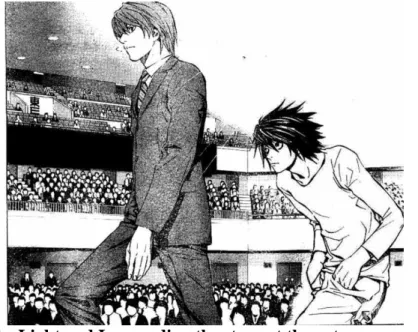
The first encounter between Light and L occurs in a surprisingly mundane setting: on a university’s campus. L, already suspecting Light’s true identity as Kira, enrolls in the same
university as him, utilizing the alias “Ryuuga Hideki.” Even L’s choice of alias reflects their status as nemeses; Ryuuga (流河) means “flowing river” while Hideki (旱樹) means “dry timber.” The name invokes water and wood, providing an elemental contrast with “Light.” At the university’s opening ceremonies, Light and “Hideki” are identified as the class
50
Figure 1 - Light and L ascending the stage at the entrance ceremony.
Figure 2 – Students comment on the differences between Light and L
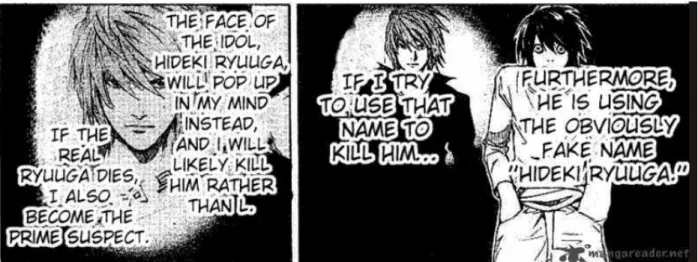
51 successfully to conclude whether or not Light is Kira, despite his gut instinct and strong suspicions. On the other hand, Light perfectly figures out L’s motives and identifies every detail of his plan. He realizes that “Hideki Ryuuga” is a fake name, and that if he tries to use that name, someone else named “Hideki Ryuuga” will die, and he will become the prime suspect (See Figure 3). He is able to remain composed and nonchalant throughout the entire ordeal, not giving L any hints as to his identity. He emerges victorious in this first encounter, as he knows L’s true identity but L does not know his.
Figure 3 - Light’s internal monologue successfully identifying the details of L’s plan
In another attempt to get Light to slip up and give up some clue as to his identity, L pretends to be Light’s friend and challenges him to a “friendly” game of tennis. Figure 4
52 Though the tennis game is a seemingly minor event in the 108-chapter,
several-hundred-page manga, it is in actuality the first of many victories which Light will win over L, and a clear example of how Light is glorified and portrayed as suave, skilled, and always one step ahead in comparison to L. Light realizes L’s true motive for instigating the match. “At the end of this match, this asshole will approach Yagami Light,” Light thinks, “expecting the supposed amateur…to let loose a few tasty morsels of information. Stuff that only Kira would
know” (Ohba 20). Surrounded by a mob of cheering female fans, Light both handily wins the match and foils L’s plan. Instead of spilling any information, he asks to join L’s task force investigating the Kira case. He reasons: “Should Yagami Light be part of the investigation, Kira gains an edge against L. Knowledge of L’s progress also covers the leakage of
information identifiable only by Kira” (Ohba 20). Rather than leaking information as L had hoped, Light maneuvers himself into a position where he can learn more about L’s identity, as well as keep tabs on the knowledge the police has on the Kira case. As a member of the task force, he has access to the police’s entire store of knowledge on Kira, so he can avoid letting any information spill that might incriminate himself.
Though L tells Light at the end of the match that he believes Light to be Kira and that their interactions have only strengthened his suspicions, in truth he has gained no new
53 calculated by author Tsugumi Ohba to encourage the audience to feel positive emotions toward and root for Light rather than L.
In their first interaction as in their entire nemesis relationship, L’s only consistent advantage over Light is the various aliases he uses: Ryuuga Hideki, Ryuugazaki, Eraldo Coil, Deneuve, and, of course, L. Light requires L’s true name in order to kill him; this is
54
Figure 4 - Light and L on the tennis court.
In short, the gradual shift over the past three decades from sympathetic, comedic master thieves to complex, attractive murderers and terrorists has necessitated the creation of a new form of antagonist. Lupin and Zenigata and Kaito and Inspector Nakamori’s police squad are equal but opposite foils to one another in that both possess comedic potential: the former in the sheer audacious scale of their heists, the latter in their utter inability to capture their nemeses. But a bumbling, always-incorrect, property-destroying police set against Light or Johan would not be funny – it would be dull, with the criminals allowed complete free rein without ever being chased or truly opposed. The result has been the character type best embodied by L: the ‘Genius’ Detective. This character often has no connection to the