James T. McLees. Examining the Cultural Accuracy of Masculine Performances Displayed By Diverse Comic Book Superheroes. A Master’s Paper for the M.S. in L.S degree. March, 2017. 63 pages. Advisor: Brian Sturm
Superheroes are a huge commercial tent pole in today’s pop cultural landscape. Their representations are part of the fabric of our culture, and the superhero concept comes with a history of hyper-masculinity and extreme gender expression. This paper explores three superheroes’ recent comic iterations – Hawkeye, Black Lightning, and King Tiger – to evaluate the cultural accuracy of the hero’s performance of masculine identity. The comics were coded by the researcher, and each was intercoded by a member of the race of the hero in question. While culturally accurate masculine elements were present in all character’s performances, culture is not central to their masculinities and the hegemonic ideal is still a heavy influence on all.
Headings:
Comic Books, strips, etc.
Comic book characters
Masculinity
Masculinity in literature
EXAMINING THE CULTURAL ACCURACY OF MASCULINE PERFORMANCES DISPLAYED BY DIVERSE COMIC BOOK SUPERHEROES
by
James T. McLees
A Master’s paper submitted to the faculty of the School of Information and Library Science of the University of North Carolina at Chapel Hill
in partial fulfillment of the requirements for the degree of Master of Science in
Library Science.
Chapel Hill, North Carolina
April 2017
Approved by
Table of Contents
Table of Contents ... 1
1: Introduction ... 2
2: Literature Review ... 4
2.1 The History of Comics in American Culture ... 4
2.2 Low Status Literature and the “Stigma” of Comics ... 5
2.3 Comics and Gender ... 8
2.4 Masculinity ... 11
2.5 White Masculinity ... 13
2.6 Black Masculinity ... 14
2.7 Asian Masculinity ... 17
2.8 Research Direction ... 18
3: Research Question ... 19
4: Methods ... 20
5: Results ... 24
5.1 King Tiger: An Ambiguous “Asian” ... 27
5.2 Hawkeye: Unifying the Duality of Superheroic Masculinity ... 36
5.3 Black Lightning: Frustration for a Superhero ... 43
6: Limitations ... 52
7: Conclusion ... 55
Appendices ... 58
Appendix A: Definitions of Tags ... 58
1: Introduction
A recent Huffington Post article explores the ways in which comics have begun
expanding the amount of racial, sexual, and gender diversity they include in their
narratives. The article concludes with a quote from Neal Adams, the writer who created
the character John Stewart, the first Black man to be portrayed as a Green Lantern:
“Times have changed… And as the audience changes, so do the superheroes” (Ostroff,
2016). This increase in diversity has been noted by many popular publications; however,
there has not been much study on whether these modern, diverse heroes provide an
accurate portrayal of life as an individual from an underrepresented population. Many
now famous Black heroes have their roots in the 1970’s, in the wake of the Black Power
and Civil Rights movements: Luke Cage/Power Man, Black Panther, and Black
Lightning. As noted by the work of Rob Lendrum (2005), these heroes were from an
underrepresented race, but found the source material for their representation of Black
masculinity not in Black American voices, but in the Black Macho attitude of
“Blaxploitation” cinema. The creators behind these products, in both the films and the
comics, were most often white men, such as Stan Lee, John Romita Sr., Neal Adams,
George Goodwin.
One current comics creator, Marjorie Liu, is not convinced that this modern
increase in representation is being described accurately. She is quoted in a recent
interview, stating: "But those are just optics, it's optics of change... Unless you have the
(Mcnally, 2015). Is the shift in comics representation merely visual, or are the
representations of diverse, male heroes also accurate representations of these two
intersectional identities? The goal of my proposed research is to assess the cultural
accuracy of superheroes of different races, particularly as it pertains to their performance
2: Literature Review
This research exists at the intersection of several fields and theories, including
literary analysis, sociology, gender studies, and feminist criticism. As such, this literature
review will provide a brief overview of the current state of research in these fields,
focusing first on the development and rise of comics in popular culture, then briefly
exploring their cultural impact and relationship to gender. From here, the review will
explore “masculinity” and extend from the hegemonic masculine ideal to provide an
understanding of masculinity as it is perceived by different races and how that impacts
that race's representation in comics in the past. All of this leads up to the researcher’s
focus on masculinity and race as intersectional identities in comics.
2.1
The History of Comics in American Culture
The first immediately relevant development for a discussion of comics came in
the early- to mid-1920’s, when comic strips began to be published in news publications
and magazines to increasing popularity. Popeye first appeared in a comic strip called
Thimble Theater in 1919, and Floyd Gottfredson’s illustrations of Mickey Mouse and his
Novels, 2006). The Mickey Mouse strip, serialized in the 1930’s, is important for its
emphasis on narrative. Mickey would set out on adventures that could span many
consecutive installments of the comic strip, such as the first story arc where Mickey races
his nemesis Pegleg Pete to a goldmine in Death Valley (Gottfredson, 2011). This
narrative continuity serves as a precursor for the next step in comics’ evolution: comic
books.
In the year 1938, Action Comics #1 was published, bearing on its cover the red and blue clad figure of Superman, lifting a car above his head and cementing his place as
the alpha and omega of superheroes. The success and popularity of Superman, and other
comics of the time, is often linked to the nexus of historical events into which they began
being published: the tail end of The Great Depression and the beginning of World War II
(Kelley, 2009). While the modern connotation of comics is “superheroes,” in the “Golden
Age” of comics from the 1930’s through the 40’s, comics ran the gamut of genres. Cheap
to print, with deceivingly simple stories, comics quickly became a booming industry. The
peak of this phase in comics history came between 1950-1954, during which time
Americans spent forty-billion dollars on comics and 40% of households had at least one
comics reader within them (Comic Books; Kelley, 2009). The ease of access and pop
cultural nature of comic books, as compared to more “academic” classic novels, placed
comics in the echelon of low-status literature (Lopes, 2006).
2.2
Low Status Literature and the “Stigma” of Comics
While comics are often categorized as low-status literature, this concept is
sometimes colluded with the stigma associated with comics. “Low-status” is
media that is not credited in mainstream media coverage or academic criticism. It differs
from stigmatization in that stigma is a social construction which either actively discredits
a person’s identity or places them in peril of such discrediting (Lopes, 2006). Stigma is
defined by Lopes as the disenfranchising of a people who subscribe to or support a
particular object or lifestyle. Fans of comics and other forms of popular culture “often
have their social identities discredited and their behaviors dubbed pathological” (Lopes,
2006). This stigmatization of comics is linked to the ways in which comics have been
researched, and the ways consumers relate to them.
Beginning with the publication of Frederic Wertham’s indictment of comics,
Seduction of the Innocent, in 1954, comics were formally marginalized in American culture, commonly considered as potentially harmful and inevitably juvenile publications.
The comics publishing industry, in an attempt to stave off this stigma and stop it from
totally eliminating their business, created a self-regulating body called the Comics Code
Authority. This body regulated the content of comics, with gradually decreasing levels of
intensity, all the way until 2011, when Marvel and DC (the two largest comics
publishers) finally stopped placing its seal of approval on their publications (Weldon,
2011).
One of the dominant ways comics appear in American culture today is through
their cinematic adaptations. Most critics mark the release of Bryan Singer’s X-Men in 2000 as the beginning of the modern comic cinema boom, though Tim Burton’s Batman,
released in 1989, is also evidence of the blockbuster potential of these properties. In part
due to the blockbuster success of these films, which grossed $157 million and $251
comic book sales have been steadily rising since the early 2000’s. Between 2000 and
2013, comic book sales saw a domestic growth of over $600 million (Lubin, 2014). As
comics have grown as an industry, they have also begun to receive greater critical
attention and respect, moving away from their place as “low-status” media and the
associated stigma. Beginning in earnest in the 1990’s, critical scholarship into the impact
and value of comics in American culture began. This was closely preceded by the
publication of landmark graphic novels such as Art Spiegelman’s Maus (1980-1991) and
Alan Moore’s Watchmen (1986-1987), and the popularity of these titles as well as the merit bestowed upon them by the literary elite likely played a role in the new play of
comics in American culture as objects of study and literary consideration.
The extent to which comics impact our national economy is not limited
exclusively by the actual physical media that constitute the “comics canon.” The
influence of this media pervades people’s daily lives and activities, leading to large scale
conventions that feature cosplaying, panel sessions, and sometimes even Live Action
Role-Playing events set in universes built by comics and other “nerd” literature and
media. One of the largest of these conventions, that has lent its name to many smaller
events in colloquial conversation, is Comic-Con, held annually in San Diego. The
sold-out 2010 Comic-Con event led to an economic impact on San Diego county in excess of
$160 million, which was over 100 million more than projected estimates (Hirsh, 2010).
Cities in California were bidding over the right to host this massive and lucrative event,
illustrating the extent to which the popularity of comics has grown and expanded into
With this increasing financial power and cultural significance has come a renewed
academic interest. Comics have been used as points of reference for historical criticism,
analyzing how they reflect social mores and cultural concerns at various points in
American history (Johnson, 2010; Kelley, 2009). There has been significant literary
criticism of comics, and some scholars have even posited that comics form a uniquely
American form of modern mythology (Przywalny, 2014).
2.3
Comics and Gender
Much research has been conducted on gender in comics, though most of it
revolves around women in comics and their representation. The hypersexualization of
female bodies has been a regular point of criticism for comics. A recent study revealed
that female characters in modern comics are consistently illustrated in costuming and
clothing that reveals significantly greater amounts of skin than their male counterparts,
which the researchers concluded was evidence of the sexualization of female characters
in the comic book medium (Jossy, 2015). Other researchers have levied criticism against
the way women are portrayed in comic art, not only based on the merit of the overt
sexualization, but also the voyeuristic way in which this sexualization is executed,
creating “Good Girl Art” where the women are sensual but their sexuality is not driven
by or delivering unto them independent power (Hayton, 2014).
In addition to the ways women are portrayed, both in terms of their clothing and
relative power, criticism has extended to the ways in which comic book narratives
position their male and female characters. Research has indicated that comic books
convey common “rape culture” myths (Garland, Branch, & Grimes, 2015). Rape myths
as the environments in which rape occurs, that are usually false and serve to subliminally
justify or validate male violence against women. The previous mentioned study found
that certain rape myths are perpetuated in comic narratives through a content analysis of
comics featuring sequences of rape. For example, their study revealed that 30% of the
narratives featured situations that portrayed the victim in a “victim blaming” light,
casting doubt on the legitimacy of the rape as a rape based upon the victim’s lack of
physical resistance (Garland, Branch, & Grimes, 2015). While these are important areas
of study, and feminist criticism is key to the field of gender studies and the exploration of
masculinity, the area of masculine representation in comics has been studied far less
extensively in isolation of a discussion of masculine/feminine relations, through the
feminine lens.
There has been some interesting scholarship done on masculinity in comics,
usually as it pertains to race and most often as it pertains to representations of
African-American and Black heroes. This is still a new area of comics study, and a few notably
discussions of this content will be explored later in this review. Another relevant
perspective to consider is the ways in which these representations may impact the reader.
The physical depictions of superheroes of both genders are often unrealistic at best,
unattainable at worst. The phenomenon of hyper-musculature and over-exaggerated
physical forms has grown significantly since the “Golden Age” of comics; a study of
visual representations of six DC characters over time, including Wonder Woman and
Superman, found that masculine presentation of male characters and
hyper-fetishized presentation of female characters has increased over time (Avery-Natale,
Scholarship on the roles the media we read and consume, and specifically comics,
plays in our lives and cultures has taken multiple forms. One interesting exploration of
how the negotiation of literacy can play into the construction of gender comes from
Wayne Martino, publishing in the Australian Journal of Language and Literacy. In his
article, Martino explores current research pertaining to boys’ literacy behaviors. Trends
in one of these qualitative studies, which interviewed a group of boys’ about their literacy
behaviors and masculinities, noted that the boys did not intrinsically tie being literate or
illiterate to masculinity. When one boy chose to pursue more “academic” pursuits like
book reading and library use, instead of traditionally masculine coded activities like
sports and video games, he was applauded for his independence while being slightly
marked for his lack of socialization (2003, p. 21-22). What is interesting about this
research, and Martino’s further claims, is the hierarchy this seems to place on what is and
is not acceptably masculine. The boy in question evaded threat to his masculine identity
by maintaining self-reliance and performed heterosexuality, which it could be argued
were more valued by the boys as parts of masculinity than more traditional social
behaviors. It also indicated a trend that boys are not inclined to stigmatize the act of being
literate as it relates to being masculine, but rather are very likely to pursue non-traditional
literacies as compared to traditional print literacies (2003, p. 23). These non-traditional
literacies could range from web videos to interest magazines to comic books.
The link between media consumption and body image, especially as it relates to
female body image, has been well-established (Grabe, Ward, & Hyde, 2008).
Specifically, in the case of the male body in comics, researchers claim the dimensions of
research that suggests these relationships may not always be damaging, as images can be
aspirational rather than isolating. In their research on “para-social relationships” with
comic characters, Young et. al. found that young men with a strong affinity for a given
superhero were protected from the potential negative impact of unrealistic superhero
body portrayals on their own self-image (2013). This protection revealed itself in the
form of self-identification; that is, if a reader had a strong para-social relationship with
the character they were often able to see good qualities and aspects of the character
reflected within themselves, and were more likely to look at themselves as “similar” to
that character, even if their body was not similarly proportioned (Young et. al, 2013).
Within this framework of the place of comics in culture and their current study, I plan to
link criticism of gender in comics with racial analysis. As such, it will be important to
understand the concept of masculinity and the ways in which the races to be studied
construct and define masculinity.
2.4
Masculinity
Gender is a social construction, historically formulated in our culture as a binary
opposition, assigned to individuals based on their bodies as either “male” or “female.”
Judith Kegan Gardiner claims that perhaps the most important accomplishment of
modern feminist research is the establishment of this notion, which conceptualizes
masculinity and femininity as “loosely defined, historically variable, and interrelated
social ascriptions” (2005). Defining what those variable and social ascriptions coalesce
into is a difficult process, and there is not a particular consensus on what true
Two dominant conceptions on what masculinity is and the role it plays in our
society have emerged. The first is defined by the concept of “Patriarchy” - a structural
equality-inequality view of masculinity (Holter, 2005). The concept of patriarchy
involves the utilization of the concept of masculinity to systematically disempower and
oppress women and non-privileged males (Holter, 2005). The definition of what
constitutes ‘non privileged’ men is bounded by differing rules depending on cultural
context, both within a singular cultural community and the larger, more diverse culture of
a nation. For example, within white masculine cultural groups, physical strength and
heterosexuality provide a degree of privilege. When the scope of the considered
community is expanded to the American nation, it could be said that a portion of this
privilege extends to all white males, regardless of their male privilege within their own
racial group.
The second social theory of masculinity is the concept of “Male Dominance.”
This perspective describes a gender hierarchy of masculinity; this view links the ideal of
masculinity with the concept of an innate, rather than a structural, predisposition to direct
male dominance. This perspective is bounded by the ideal that masculinity, in essence,
equals power (Holter, 2005).
Despite the difficulties of creating a set universal definition of masculinity,
similar features amongst frameworks for masculinity and what is typically present in
most understandings of masculine identity exist. Masculine norms are communicated
through social interactions, family instruction, media representation, and other exposures
that all begin at a young age. The meaning of conformity and nonconformity changes, as
within (Mahalik et. al, 2003). Researchers have attempted to create metrics by which to
measure masculine conformity, such as an inventory created by Mahalik et. al. which
catalogues the following masculine norms: Winning, Emotional Control, Self-Reliance,
Dominance, Risk-Taking, Violence, Playboy, Primacy of Work, Power over Women,
Disdain for Homosexuals, and Pursuit of Status (Mahalik et. al, 2003). Some of these
norms remain pronounced in many races’ and cultures’ perceptions of masculinity, and
some take precedence over others or are removed altogether. Two are common to all
conceptions of masculinity researched for this review: “Disdain for Homosexuals” and
“Power Over Women,” or more generally, the definition of masculinity as something in
direct opposition to femininity.
2.5
White Masculinity
One of the key features of masculinity in white culture is its direct opposition to
femininity. Comic researchers have expanded on this principle, applying it to analyses of
famous characters like Superman. Superman is the antithesis of his alter-ego, Clark Kent,
and Clark’s behaviors as well as Superman’s are compared to the feminine model of Lois
Lane, against whom Clark is shown to be lacking while Superman is impressively suave,
macho, and self-assured (Lendrum, 2005). This structure of effeminate alter-egos is key
to our understanding of the masculinity of white superheroes in Lendrum’s view.
Much of the above section can be considered to extend to “white masculinity,” as
any study of hegemonic masculinity will typically rely on the empowered, hegemonic
race as its data source. Indeed, in formulating the Masculine Norms inventory, Mahalik’s
sample was almost exclusively college-aged Caucasian males (Mahalik et. al, 2003).
thereby the white man, may be departing from these norms in terms of valid
representations of masculinity.
Robert Bly, a leading voice in the modern “expressive men’s movement” notes in
his book Iron John the rise in the “soft male” beginning in the 1960’s - a version of
manhood defined by the removal of the aggression and abject chauvinism that defined his
predecessors, but lacking the self-confidence and presence to challenge or be challenged
by others with the use of strength (Bly, 2004). Additionally, as times have turned and
geek culture has begun to be destigmatized, including comic books, it has been proposed
that a new style of man has emerged, defined by the general “geek aesthetic.” This
version of masculinity gives preferential value to “wit, humor, physical awkwardness, an
awareness of personal limitations, and sexual submissiveness” over the dominance and
aggression of previous visions of masculinity. In defining this version of “geeky white
masculinity,” Mark Hill cites Yorick, the protagonist of the modern comic series Y: The
Last Man (2002)by Brian K. Vaughan as a prime example (Hill, 2010).
2.6
Black Masculinity
Similar to hegemonic masculinity, black masculinity is often defined in
opposition to femininity. Michele Wallace criticizes boiling down all masculinity to this
broad conception, because though it may be true that masculinity is often defined in
opposition to femininity and through the lens of male-to-female/female-to-male
relationships, Black male to female relationships are fundamentally different from White
male to female relationships (Wallace, 2015). For example, Lendrum posits that the
emasculating force acting on Black superheroes is often not a comparison to a feminine
they are emasculated by power dynamics and the inability to fill the “patriarchal” role
(Lendrum, 2005).
This “patriarchal” role is what bell hooks defines as the dominant vision of black
masculinity, a version of masculinity defined by these norms: authoritarianism, stoicism,
muscularity, subjugation of emotions, and, in sum, the general idea of “toughness”
(hooks, 1992). hooks also, like Lendrum, highlights the structural imbalance of power in
American culture and how it serves to emasculate Black men by impeding their success
in pursuit of the “patriarchal” ideal. Sourcing this imbalance of power to hegemonic
masculinity and the ideology of Capitalism, hooks links realization of the “patriarchal”
ideal to capital, both social and economic. When Black men are blocked from achieving
this ideal by racism and their community circumstances, the frustration of the inability to
achieve this vision of masculinity leads to increased violence, frustration, and sensations
of inadequacy. The perpetuations of this vision of “patriarchal masculinity” and its
frustrating influence on Black men in media, such as Blaxploitation cinema and early
Luke Cage comics, contribute to this pattern being internalized and played out by Black
men (hooks, 1992).
Another interpretation of the performance of Black masculinity that has been very
influential in discussions of the topic is the one presented in Cool Pose: The Dilemmas of Black Manhood in America by Richard Majors and Janet Mancini Billson (1992). They define this construct of “cool pose” in the following quote: “Cool pose is a ritualized
form of masculinity that entails behaviors, scripts, physical posturing, impression
management, and carefully crafted performances that deliver a single critical message:
point to some of the same sorts of causes for the necessity of “cool pose” as hooks –
namely, the systemic patterns of oppression that deny Black men the same opportunities
as White men. These patterns of oppression make it easier for White men to achieve
masculine ideals, even though the research cited by Cool Pose indicates that Black men value as important facets of manhood many of the same expressions of masculinity
conveyed by “typical” masculinity, such as aggressiveness, success at work, and
self-reliance. Research they cite by Noel Cazenave also indicated that Black men were more
likely to value protection of family, warmth, and gentleness – traits that appear to be
incompatible with “cool pose.” Thus, the pressures that make “cool pose” a viable
masculine identity and safety mechanism for Black males in a society that does not allow
other efforts at masculine success to commonly succeed (such as self-advancement
through work) may have negative repercussions on the actualization of more progressive,
diverse, and varied masculine identities for Black men.
A notable comic book example, as mentioned above, is Luke Cage. Created by a
white man for Marvel Comics, Luke Cage was originally Power Man, and his costume
consisted of a tiara and gauntlets similar to Wonder Woman’s and a chest-baring,
deep-cut, canary yellow shirt. Lendrum cites the effeminate nature of this initial costume
choice as emblematic of the way Black masculinity has been defined in comics. The
character of Luke Cage remained defined by “toughness” and an association with
symbolism representing the stereotyped vision of urban, drug-abusing, criminal
environments within which Black males are presumed to live, with the update of his
costume that eventually came not being a more nuanced and symbolic costume but rather
2.7
Asian Masculinity
An attempt to create an overarching definition of “Asian masculinity” is hindered
at the start by the wide variation amongst ethnic groups that could be categorized as
“Asian.” However, there are some common values amongst Asian males, particularly
among those that are of East Asian ethnic groups. These common values include: a
preference for a collective worldview, attaining family recognition through achievement,
maintaining rigid control over emotions, prioritization of filial piety, placing value on
humility, and subscription to hierarchical relationships. Several of these are also
masculine identifiers at the hegemonic level in American masculine conceptions, which
may increase their reinforcement amongst Asian males; specifically, the importance of
controlling emotions and acquiring recognition are common links between hegemonic
masculinity and Asian concepts of masculinity (Kim, Atkinson, & Yang, 1999).
In the case of Asian males, research has shown that some of these guidelines for
masculinity are protective rather than restrictive. Much of the preceding research has
highlighted the ways in which masculine expectations can be difficult to meet, and
representations in comics can be impossible images, at least in terms of their physical
dimensions. The more culturally reinforced elements of masculine identity have positive
outcomes for the mental health of Asian American men, such as the emotional control
and the idea of self-reliance. Other elements are more strongly linked to detrimental
mental effects, such as avoidance and Winning and Dominance (Iwamoto, Liao, & Liu,
2010).
Stereotypes of what Asian men look like and act like abound in comics, but often
dragon Fin-Fang-Foom, and the manipulative Asian mystic The Mandarin. There are
even Asian mentor characters who have extreme power, most often in the martial arts or
mysticism, but they are not the protagonists of their stories. Instead, they mentor white
characters to take over the mantle of their Asian cultural skills, such as Lei Kung to
Danny Rand’s “Iron Fist” and the Ancient One to Dr. Stephen Strange.
2.8
Research Direction
In light of these varying perceptions of masculinity amidst races, it becomes
important to evaluate how the messages of masculinity are reinforced in media. The
negative potential impact of culturally inaccurate and exclusively hegemonic
representations has been displayed by critics like bell hooks and Michele Wallace
analyzing the outcomes for Black communities. Comics do have outcomes for
individuals’ self-perceptions and identity formation. Gaining an understanding of the
current cultural accuracy of diverse characters can inform future directions for research,
and identify places the industry can improve the portrayal of these characters in authentic
3: Research Question
Is the representation of “masculinity” in the narratives of diverse male heroes in
4: Methods
The purpose of this research was to establish the cultural accuracy of the
representation of masculinity in superhero comics fronted by racially diverse characters
published by Marvel, DC, and Dark Horse.
Sources for data were purposively convenience sampled from available
collections, accessible to the principal investigator via interlibrary loan. As noted in the
National Science Foundations overview of research methodologies, document studies
have a major hurdle in terms of accessing resources. The convenience sample is one way
of accounting for this. The principal investigator also created criterion to focus the search
for sources, and to allow for a preliminary scan to ensure that a reasonable sample will be
available (Westat, 2002). Five main criterion were used to select the comics selected for
analysis.
1) The main protagonist (most often recognizable by being the titular hero) of
the series must be a male superhero.
2) The title must have been published within the past fifteen years.
3) The character must have been originally conceived as being the race and
gender the comics used for analysis present them as.
4) The titles analyzed must not all be from the same publishing company.
5) The title must have enough material to constitute publication in a trade
The reasons for these criteria were manifold, but can primarily be described as
assuring the results are not biased due to inherent biases in a single publishing company,
and to ensure that the character’s representation is impacted primarily by the story being
told about that character, and not filtered through the lens of a legacy the character’s title
carries. Point number three is particularly important, as recent attempts at diversification
in the comics industry have often been realized through the recasting of a legacy hero as a
character of a different race. For example, this criteria would remove a character like Sam
Wilson from Marvel comics, who is an African-American man often bearing the identity
of the hero Falcon, who at one point takes up the mantle of Captain America (Spencer,
2015). The mantle of Captain America carries with it a narrative legacy and cultural
associations that may influence a writer’s presentation of the man who wears that
costume in such a way as to obstruct their ability to be representative.
Possible sources were identified through catalog searching in library collections,
publisher websites, titles used in similar research, and publishing records. The titles
selected were Hawkeye: My Life as a Weapon by Matt Fraction (2013), Black Lightning: Year One by Jen Van Meter (2009), and King Tiger: Son of the Dragon by Randy Stradley (2016).
The titles were analyzed for their representation of masculine identities in both the
language characters use and the images used to represent the characters and the
characters’ actions. Data points were limited to the character’s themselves, rather than
interpreting how other secondary characters in the title performed masculinity as well.
This was to maintain a manageable scope for the research, as well as to make sure that
The research was conducted using content analysis. Quantitative analysis would
not sufficiently process the synthesis of visual and prose information presented in comics,
and attempting to analyze the appearance of certain words and their synonyms would not
respond to the nuances of the intersectional ideas being researched: masculinity and racial
culture. In order to account for an understanding of what masculinity looks like in the
culture of each race being studied, current research in sociology, literary criticism,
psychology, feminist/gender studies and anthropology was studied to establish current
trends and understandings. The vocabulary for coding data points was created based on
current research in masculinity and gender studies (as described in the literature review),
and was iteratively designed to most accurately capture what occurred in the comics
being analyzed. The vocabulary used became a twenty-three term list, provided in Table
1 (See Appendix 1 for a table that includes definitions for how the primary investigator
conceived of these terms).
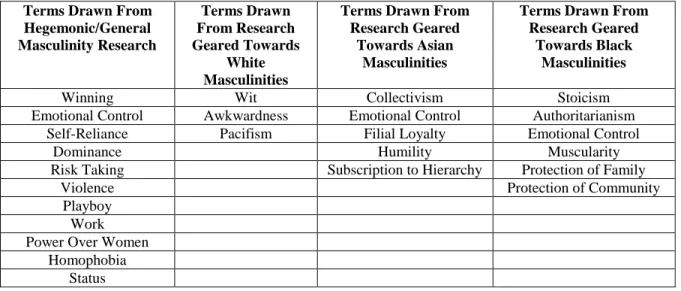
Table 1: Coding Vocabulary
Terms Drawn From Hegemonic/General Masculinity Research Terms Drawn From Research Geared Towards White Masculinities
Terms Drawn From Research Geared
Towards Asian Masculinities
Terms Drawn From Research Geared
Towards Black Masculinities
Winning Wit Collectivism Stoicism
Emotional Control Awkwardness Emotional Control Authoritarianism Self-Reliance Pacifism Filial Loyalty Emotional Control
Dominance Humility Muscularity
Risk Taking Subscription to Hierarchy Protection of Family
Violence Protection of Community
Playboy Work Power Over Women
The sources were intercoded by other individuals, all male. Each intercoder was a
male of the same race as the protagonist of the comic they were intercoding for; they
were not necessarily of the same cultural background as the protagonist, sometimes due
to this being unclear in the source material. This intercoding is in order to account for a
weakness of the content analysis methodology; namely, that the findings inherently entail
interpretation by the principal investigator (Marshall & Rossman, 2011). These
intercoders were provided with the vocabulary, but were not told whether certain terms
were derived from certain cultural research bases in order to not bias their categorization
based on terms they felt they “should” use to categorize data points with a character of a
particular race. Inter-coders were asked to look at the data points identified by the
principal investigator and assign them between zero and three tags from the vocabulary
based on how they saw masculinity being performed by the protagonist character in the
given panels. The final analysis of coded data points was conducted by the principal
investigator. Identified trends in the data were linked to and compared with the current
research, in order to analyze the masculine performance of the characters in question and
5: Results
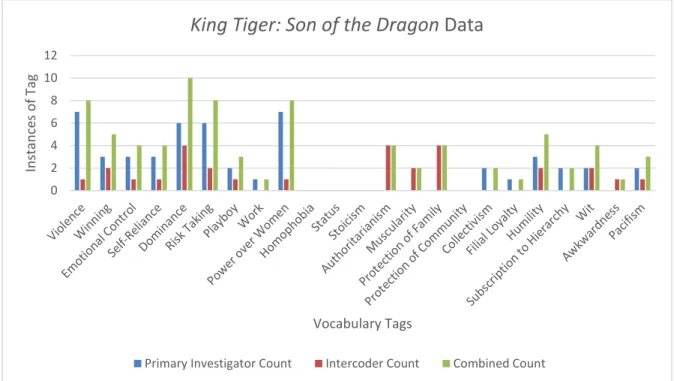
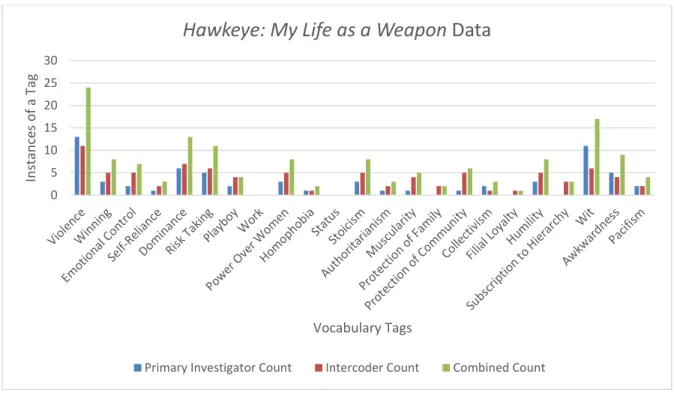
Tables 1, 2, and 3 display the data from the analysis of each comic. Each comic
shared one major feature in common: “Violence” was the most frequently applied tag.
This is not entirely unexpected, as the narrative form of comics traditionally centers
narratives that rely heavily on violence as a plot device and mode of conflict resolution
(McLees, 2016). When your opponent is a supervillain who eats people’s fear and cannot
be killed, or a massive dragon demon that is destroying a city, hegemonic ideas of
masculinity point towards strength and violence as the ways to assert the authority of the
hero as good and defeat these threats.
While there was one shared term in the vocabulary that could be found in all the
different cultural research sources – the idea of “emotional control” – there was
surprisingly little overlap amongst the other terms: i.e., terms drawn from research on
Asian Masculinity were not frequently found in the performances of masculinity seen in
Hawkeye or Black Lightning, if at all. The flip side of this is that, in the case of each character, the terms affiliated with the research on their racial/cultural identity were often
some of the most used tags. This was most dramatic in the case of Black Lightning, where three of the five tags that broke double digits were terms drawn from the research on
Black masculinity.
Looking exclusively at the numbers, then, it would seem that the depictions of
have been researched. What becomes more important, then, is exploring this conclusion
by examining the ways in which these behaviors are realized and the images, narratives,
and surroundings that contextualize them. In the next section of this paper, I will explore
each comic in turn, pulling on particular examples to give greater insight into how these
masculinities are performed and what messages they might be conveying.
Table 2
0 2 4 6 8 10 12
In
sta
n
ce
s
o
f Tag
Vocabulary Tags
King Tiger: Son of the Dragon Data
Table 3 Table 4 0 5 10 15 20 25 30 In sta n ce s o f a Tag Vocabulary Tags
Hawkeye: My Life as a Weapon Data
Primary Investigator Count Intercoder Count Combined Count
0 5 10 15 20 25 30 35 In sta n ce s o f Tag Vocabulary Tags
Black Lightning: Year One Data
5.1 King Tiger: An Ambiguous “Asian”
King Tiger: Son of the Dragon, by Randy Stradley, with art by Doug Wheatley, presents an adventure revolving around the titular hero’s lineage and budding association
with a new assistant named Milo. The story arc follows King Tiger, described by the
book as a “warrior mystic,” as he helps save Milo from a demon and is subsequently
drawn into a plot on the part of his father and demonic siblings to release his mother, a
powerful demon named Canthastius. Originally published by Dark Horse Comics, and
collected in a trade paperback in 2016, the story features magic, swords, sorcery, and
most important for the purposes of this paper, a protagonist who is Asian but who almost
purposefully never fully discloses his particular place of origin. While the trends in the
recorded observations of the performance of masculinity indicate a clear preference for
some features of Asian masculinity, there are contradictions in the modes of hegemonic
masculinity simultaneously deployed by the character.
First, it is important to explore what is meant by the idea of King Tiger being an
“ambiguous” Asian. More recent research has pointed to the issues presented by our
research categorization of Asian Americans as a single racial identity, one that
encompasses a huge spectrum of identities and experiences. Someone who fits under the
racial identity umbrella encompassed by the label “Asian Americans and Pacific
Islanders (AAPI)” could be Indian, Polynesian, Japanese, Chinese, Cambodian,
Bangladeshi, or one of a multitude of other, more granular racial identities. These
cultures come from geographically diverse places and have vastly different values,
traditions, challenges, and privileges.
When evaluating research data about the AAPI experience, it can be easy to label
predisposed to academic and economic opportunity, skilled and prosperous. Over 49% of
Asian-Americans over the age of 25 have a Bachelor’s degree or higher, the average
household income of Americans is $66,000 a year, and 82% of surveyed
Asian-Americans reported to a Pew social trends study that they were overall satisfied with their
life (Piccorossi, 2012). However, this is not necessarily an accurate picture for all people
who could be identified as Asian-American.
While Japanese, Filipino, and Indian communities in America have lower poverty
rates than the national average, Hmong and Polynesian peoples have poverty rates that
are greater than the national average, at 27% and 22% respectively (Le, 2016). This kind
of obstruction of reality is perpetuated when AAPI are perceived as a monolith, rather
than as a group of various races and cultures with different situations. Interestingly, most
individuals who could describe themselves as Asian-American do not, choosing most
often to identify as being from their country of origin or using their country of origin as
the prefix to –American (Piccorossi, 2012). When trying to create an accurate
understanding of the masculinity performed by King Tiger in King Tiger: Son of the Dragon, it would be ideal to use a set of cultural norms and understandings established by research of the culture that King Tiger is a part of. However, King Tiger himself
perpetuates the myth of AAPI as a singular identity, as he consistently evades identifying
with a more specific culture and pulls instead from an amalgamation of cultures to
present his “Asian-ness.”
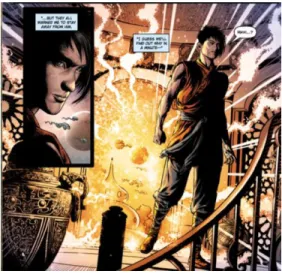
When we first meet King Tiger, he is emerging from an explosive looking
dimensional portal, clad in bound boots and a solid orange “gi,” the type of shirt worn by
by Chinese and Japanese martial arts. His features are East Asian. He has a stoic look of
self-control and authority about him. His strength is clearly implied by the defined lines
of his biceps and triceps on his arms, though his body is not put on display through an
especially revealing costume. Its structure is more focused on lithe slimness than
muscularity and bulk. In this one panel, his design leans heavily into Americanized
conceptions of the lean, muscular “fighter,” especially prominent in discourses about
fighting sports (Holthuysen, 2011). It remains unclear, however, what culture we are
meant to read King Tiger identifying as: his outfit could link to several traditions,
especially those of Japan or Tibet; the name King Tiger seems to imply a link to Chinese
tradition; finally, it would be a fallacy to categorize him based on physical features alone.
Figure 1: King Tiger's Introduction (p. 9)
This ambiguity is almost intentionally perpetuated throughout the narrative of
King Tiger: Son of the Dragon. When King Tiger is training his new assistant Milo, he shares the swords he uses in his quest to combat demons with him, identifying them as
“Tadehiro” and “suketaka” blades crafted by “Hizen Omi Daijo Tadahiro” and “Ozaki
Minamoto Gen Goemon Ozaki Suketaka” respectively (Stradley, 2016, p. 37). These
weapons in the next panel, they are accompanied by American handguns, Japanese
shurikens, and small daggers that appear to be most similar to kirtan (ceremonial blades from the Sikh tradition), among other weapons.
Figure 2: King Tiger teaches Milo about his weapons (p. 37)
There are other instances of this pulling from various Asian cultures to inform
King Tiger’s identity and work, some more significant than others – Rikki – King Tiger’s
girlfriend - serves Milo and Tiger Thai food for dinner; King Tiger’s father is illustrated
as a stereotypical Americanized version of a Chinese villain, owing a strong aesthetic
debt to Dr. Fu Manchu; and his father exclaims “kyapka” when King Tiger escapes, a
Tibetan colloquialism that is often translated as “shit.” Perhaps the most telling moment
where the writers evade giving the reader a clear image of King Tiger’s racial and
cultural identity come when Rikki, Milo, and King Tiger are sharing a meal and
reflecting on King Tiger’s less-than-heroic past, before he met Rikki. King Tiger
mentions having only been in America for a short time, and when Milo asks him “So you
had just come to the States? From where?” his phone rings and King Tiger excuses
himself (Stradley, 2016, p. 41). While it is not fair to read this panel as the character
presumably – it is a moment where the writer’s utilized the audience surrogate of Milo to
ask King Tiger for clarity on this part of his identity and then denied both Milo and the
audience that answer.
This complicates the interpretation of our results by making it impossible to
impose a more specified set of criteria for masculinity on to the interpretation of this
comic character. While the research cited in the literature review points to a few common
threads in Asian/AAPI conceptions of masculinity, there is also great diversity within the
category of AAPI. When coding King Tiger’s performance of masculinity, the
conclusions drawn can only be extended in so far as King Tiger is a character that fits the
Asian American identity. These conclusions cannot be made to extend to every member
of that group, or to have the granularity to reflect the experiences of a more particular
group within those represented by the label “AAPI.”
There are possible narrative explanations for King Tiger’s reticence to name his
cultural background, as well as the need for him to pull parts of his work from various
cultures. As a superhero who specializes in fighting demons, King Tiger could not only
be prepared to fight demons from one culture, and if one accepts that demons exist then
perhaps not all demons can be fought with a single culture’s weapons and rituals.
Demons are creatures of the supernatural, and are often exempt from the ramifications of
physical assault, or at least experience less severe consequences from things like gunshot
wounds. In some traditions, Christian rites are required to exorcise a demon, if demon is
understood to be a servant of Satan. This paper does not intend to explore the other
iterations of demons, but it is worth noting that it would seem as if this mode of combat
correlated to demons). The origin of the yokai is not necessarily the Christian faith and they likely have no special relationship one way or another towards Christ and
Christianity, so why would recited psalms disturb a yokai? This may be read as a valuing of the necessity of cultural knowledge – King Tiger cannot adequately combat demons
from various origins without knowledge of the culture from which they spring.
However, such an acknowledgement seems to run contrary to the dearth of
acknowledged and developed cultural identity for Tiger himself. We learn in the narrative
that King Tiger has a complicated relationship with his heritage, as he is the son of a
mortal man and an immortal demon. His reluctance to talk about his lineage may have
something to do with the nefarious nature of its roots. Despite these possible narrative
explanations, the impact of this intentional ambiguity on the accuracy and power of King
Tiger’s portrayal of masculinity is strong.
Since there is arguably no core tradition of masculinity that King Tiger is pulling
his performance of the identity from, there are several instances where King Tiger lapses
into a hegemonic masculine performance that stands in almost mutually exclusive
contrast with the more traditionally “Asian” masculine traits he embodies. One of the
most interesting dynamics that King Tiger plays out is how he negotiates his past, and it
seems that a prior version of King Tiger was more enamored with hegemonic
masculinities, while the empowered and self-reliant “hero” we see in the narrative proper
is more in line with a more traditional, Asian American masculine identity.
The three most frequently applied terms for King Tiger’s masculine performance
in the combined intercoder and primary investigator data are “Dominance,” “Power Over
masculine identities (mostly as voiced by American and Western writers), and King Tiger
performs them most often in an effort to protect Rikki. The act of being prototypically
masculine becomes a self-aware performance for King Tiger. A key example of how
King Tiger adopts, rebukes, and reassumes hegemonic masculinity comes in the latter
half of the book, when King Tiger’s demonic family have invaded his home and taken
Rikki and King Tiger captive. Once his sister smacks Rikki, King Tiger pulls out a
handgun and shoots his siblings, shown in Figure 3.
Previously in the book, King Tiger and Rikki described to Milo how they met,
when King Tiger had just arrived in America and was using his magic to attain the
pleasures of the world and win at a casino – a time in his life during which King Tiger
says he “was not a good man” (Stradley, 2016). However, it is also a time in his life when
he was winning, sleeping with many women, achieving status and wealth…all associated
with being a successful man in hegemonic masculine terms. This is the period of his life
where King Tiger is adopting these hegemonic masculine ideas – when he arrives in
America, he seeks identity by conforming to masculine expectations. However, his
attitudes towards these are clearly acknowledged when he explicitly states that he was not
a “good man” at the time – this version of masculinity is not one that comes naturally to
him. It is therefore significant that he takes a violent stance utilizing a weapon deeply
rooted in American vigilante culture when Rikki is endangered. This moment is also the
only moment that the intercoder, a young man from Korea, identified with the tag
“Violence,” which perhaps further illustrates its jarring nature. This can be read as an
intentional and self-aware modulation of King Tiger’s own masculinity, and extends
further in to the scene.
As the scene progresses, King Tiger turns to Rikki, bound in captivity, and tells
her that she brought this on herself because “women like bad boys,” which both the
intercoder and primary investigator coded as an instance of King Tiger emphasizing the
“Playboy” aspect of his masculinity and the primary investigator also coded as an
instance of King Tiger asserting his “Power Over Women,” illustrating how his
“badness” was attractive to all women and he is not to blame for Rikki’s own weakness
have known better – which both the primary investigator and intercoder identified as
another instance of King Tiger performing his “Power Over Women.” King Tiger shifts
the blame for Rikki’s predicament from himself on to her, avoiding acknowledging the
ways he has run from his past and failed to inform and protect Rikki form this
eventuality.
King Tiger is put into a narrative situation that is the stuff of hegemonic, violent
action comics, as the woman in his life is taken and turned into a “damsel in distress.” He
adapts to this context and resumes the performance of “hegemonic masculinity” to
resolve the conflict. King Tiger’s cultural ambiguity here serves as an asset to the writer,
who has not established a clear masculine affiliation for King Tiger to affiliate with and
can therefore modulate his behavior from humble and pacifist to dominating and violent
as the narrative they place him in requires. King Tiger’s culture is not as important to the
character’s performance of masculinity as his context – a superhero action comic. The
cultural details that signify King Tiger as Asian are reduced to window dressing that
recolor the traditional superhero narrative without significantly altering it to update the
5.2 Hawkeye: Unifying the Duality of Superheroic Masculinity
Clint Barton, otherwise known as Hawkeye, is at least a somewhat unique
member of the Avengers as he is one of a small number of heroes to join the team despite
not having any supernatural/inhuman powers – his abilities are the result of intense
training, natural athleticism, and a long career as a special agent and masked hero.
When his character was rebooted after Marvel announced the launch of their Marvel
Now! Initiative, these aspects of his character came to the forefront. In the entirety of My Life as a Weapon, Hawkeye’s costuming is almost exclusively street-clothing except for
the very first pages of the book, where Hawkeye is tumbling from a window during a
nondescript encounter, and one other notable sequence, which shows the reader a panel
of a tape recording being played, showing Hawkeye in costume assassinating a world
leader by firing two arrows into his eyes (Fraction, 2013, p. 65).
This change from norms in comic narratives illustrates Hawkeye’s unified sense
of self – he remains much the same person both when he is functioning as a hero and
when he is simply living his life as Clint Barton in New York City. It is common in the
superhero genre to use the act of costume switching to indicate a switch between two
identities for a character, and often the identities in question are not simply those of
“mild-mannered alter-ego” and “superhero,” but also those of “masculine” and
“not-masculine.” In his article “Masque-ulinities: Changing Dress as a Display of Masculinity
in the Superhero genre,” Friedrich Weltzien notes the significance of costuming on the
presentation of masculinity for superheroes, drawing connections between Superman,
Batman, and Spider-Man’s famous costumes and the ways they relate to ideals of
masculinity through pronounced musculatures, similarities to military garb, and bright
and proud contrasts with the more traditional garb of their alter egos – all, he claims,
using the costume to point to the “classic domain of heroic manhood.”
Looking at this dichotomy, the costume functions as symbolic visual cue to
indicate a shift in overall identity. Peter Parker is able to move from being a shy, soft,
insecure intellectual to acting as a strong, indomitable, willful and comedic hero. Even
more striking is the shift undergone by Clark Kent, who is such a forgettable and passive
figure that simply adding glasses and a beige suit makes those around him incapable of
identifying him as the hyper-masculine, charming, strong, controlled and successful
Superman. Without these costume changes, Hawkeye does not provide us visual cues to
indicate that his identity shifts – that Hawkeye is in some way more or less masculine
who must seek the privacy of phone booths or Bat Caves to don their masculinities as
costumes covering their alter egos (Weltzien, 2005, p.234).
Critics in the past have noted how costuming and characterization in superhero
comics creates a clear choice for readers – they can be the mild-mannered alter ego or
they can be the strong hero; it is impossible to be both at once. As Norma Pecora puts it:
“Superman is the quintessential male role model… Kent is easily dismissed, but
Superman is to be emulated” (Pecora, 1992, p. 3). Societal pressures overvalue the
hypermasculine hero half of this dichotomy and thereby underemphasize the fact that
Clark Kent is Superman and the inclusion of both feminine and masculine coded identites in this body is part of his strength (Klein, 1993, 267-268).
It is significant, then, that the one moment of costumed Hawkeye we see in these
issues is so at odds with the Hawkeye that we have grown acclimated to throughout the
course of the comics so far. In the panel pictured in Fig. 3, the victim of Hawkeye’s
attack is falling backwards, his fatal wounds gushing blood as Hawkeye coldly kneels
outside the door, his eyes covered by his mask, his face expressionless. This extreme,
uncharacteristic, dominating violence can only occur in costume – it is not the same
masculinity that Clint himself would want to be associated with, but is instead a more
violent and dominant version that shows a coldness beyond the pale. The dissonance for
readers between the version of Clint/Hawkeye they have become familiar with and the
one we see in this panel is emphasized by the costuming, and plays into the later reveal
that this is actually footage from a staged tape and not the footage of the “real” Hawkeye.
When looking at both the intercoder data and the primary investigator’s data from
that there is a broad spectrum of terms noted in terms of Hawkeye’s masculine
performance – only two of the terms were never applied by either coder: “Work” and
“Status.” The breadth of coverage can possibly be attributed to several factors. The most
important of these is the identity of Hawkeye as a white male, meaning there are more
terms in the vocabulary that are culturally accurate for him since hegemonic masculinity
is usually constructed with the white male experience in mind.
The other notable trend is the way that terms associated with “soft masculinity”
and the “geek male” appear almost as frequently as those associated with the
hyper-masculine hegemonic norm. After “Violence,” the most represented term for Hawkeye is
“Wit,” and after two more from the hegemonic edge of the spectrum (“Risk Taking” and
“Dominance”) the fifth most represented term is “Awkwardness.” This codes Hawkeye’s
masculinity as simultaneously influenced by a “geeky” masculine identity and a
prototypical “masculine” identity. Not only are these the most frequently cited terms, but
there are many moments where the intercoder and/or the primary investigator coded a
scene as being both demonstrative of hegemonic masculinity and of “geek” masculinity.
Without the severing agent of costuming, Hawkeye is free to behave similarly when he is
engaging in heroics and when he is not – he appears to always be both “nerd” and
“alpha;” “superhero” and “man;” “Kent” and “Superman” at once.
We see how Hawkeye can use some of the aspects of geek masculinity to
reinforce his whole image as man, given the appropriate context, in an early panel of the
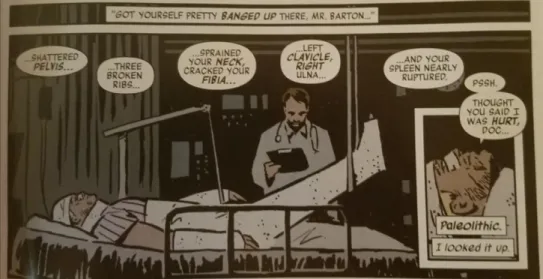
book. After falling from a window and crashing onto a car, we see Hawkeye talking to
his doctor, who is reeling off a list of his injuries. Hawkeye responds simply “Pssh. I
coded this moment as illustrating Hawkeye’s “Wit” as well as his “Emotional Control” -
rather than showing emotional fragility or becoming overwhelmed at his proximity to
death, Hawkeye puts forward a front of hegemonic masculine emotional control by
utilizing his quick wit and humor. The intercoder ascribed similar tags to the scene,
although he chose the similar term “Stoicism” rather than “Emotional Control.”
There is a distinction between this moment of humor and emotional control and
other similar, hyper-masculine representations that adopt this singular aspect of “geek”
masculinity. Hawkeye does not simply adopt this comedy to put forward a colleceted
pose. Indeed, he utilizes this comedy throughout the book – it is part of who he is both
when he needs to put on airs and when he is at ease. More significantly, we can see these
aspects of “geek” masculinity incoporated into Hawkeye’s hegemonic masculine
performance even when they are not being used to project an appearance. In these
which Hawkeye can simultaneously fulfill aspects of hegemonic masculinity and geek
masculinity – deconstructing the idea that these are mutually exclusive identities.
Figure 6: Hawkeye remains awkward in the midst of superheroics (p. 59)
In the panels shown in Figure 6, Hawkeye is taking risks, engaging in a
high-octane car chase and swinging his body from an arrow onto the roof of an antagonist’s
car. However, he is also still preoccupied with anxiety over the awkward slip of the
tongue he makes when he tells Kate he will be “back in a sex” (Fraction, 2013, p. 59).
Hawkeye is not an infallible hero with extreme strength, agility, and muscles – he is those
things with an added layer of social ineptitude, awkwardness around women, and a quick
comedic wit. And in panels like the one above, where he remains uncostumed and
performing both simultaneously, readers are shown that they do not have to choose one
set of masculine ideals to build their version of manhood – they can be both.
This does not, however, fully deconstruct the dominating power of hegemonic
masculinity and its influence on male identity formation; Hawkeye still uses violence to
incapacitating them with gimmicky exploding or putty arrows. It is also important to note
that the other characters explored are not afforded quite the same flexibility of masculine
performance – King Tiger’s portrayal is only given enough instances of culturally
accurate masculinity to allow readers to see him as a vision of a non-descript “Asian”
before he is written back into the hegemonic masculine hero, and Black Lightning is
limited to acceptable versions of masculinity for Black males as created by hegemonic
5.3 Black Lightning: Frustration for a Superhero
Black Lightning is a challenging character to write about. In many ways, the
masculinity he performs is demonstrative of traits that appear in Black masculinity
scholarship, such as being competitive, being protective of his community and family,
and being self-assured (Majors and Billson, 1992, p. 33). However, the mere presence of
these traits does not make his representation culturally accurate, and the context in which
they are situated seems to play on a common script for Black masculinities in American
popular media, as noted by Ronald L. Jackson III in his book Scripting the Black Masculine Body: “implicit in… the projections and corporeal inscriptions discussed in
this chapter is the idea that that Black masculine body is viewed as a threat much like the
minstrel brute… who is dangerous not because he did anything, but because his blackness
is a signifier of abnormality” (2006, p. 99).
The central conflict of Black Lightning is that Jefferson Pierce, the man who becomes Black Lightning, is returning to his childhood community to work as a
principal, but the community has fallen into disrepair and is generally regarded by both
the characters who reside in it and who live around it as a dangerous ghetto. As he
returns, he must contend with the stress of trying to work in such a violent and broken
community while keeping his lethal superpowers in check (Van Meter, 2009). It is later
revealed that the cause of the community’s problems is primarily the work of an
organized crime syndicate known as “The 100.” This group, “The 100,” antagonizes
several characters in the DC universe. The two figureheads of the group in this story are
Tobias Whale, a man who grew up in “Suicide Slum” like Jefferson and is also
The way the character of Jefferson interacts with the challenges this environment
presents serves as an example of the kind of “scripting” that is central to Jackson’s
critical work. In his book, Jackson puts forward the idea that the act of scripting
someone’s body – scripting, as opposed to reading and interpreting – “presumes that
there are social vectors that determine how bodies are inscribed and how scripted roles
for foreign bodies are enacted” (Jackson, 2003, p. 53). This is given added significance
when Jackson describes how the act of scripting someone else’s body usually requires the
dislocation of whatever self was there to accommodate the imposed script – creating a
definition for the scripted body out of the comparison between the script and the
displaced “Other” identity. The body can be an individualized body, or a “composite
body,” an idea akin to the concept of “body politic” where the idea of a body is used to
represent a collective or community (Kantoriwicz, 1981). The script imposed on
Jefferson Pierce’s narrative in Black Lightning: Year One is emblematic of the
ideological function of scripting that Jackson posits – namely, that the scripting of Black
male bodies has created a culture wherein all behaviors of the Black body “are to be read
as alien, unless those bodies are complicit in almost every sense with dominant cultural
norms” (2003, p. 55).
Beginning by looking simply at the data for the intercoder and primary
investigator’s tagging of Black Lighting’s performance of masculinity (Shown in Table 4
on page 27), there is an obvious trend toward the terminology associated with hegemonic
masculinity. “Violence” is the most cited term, appearing over 30 times in the shared
data, and “Dominance” also appears frequently, with 25 total tags. These are not only key
masculinity that scholars have noted remain attainable for Black men (Cazenave, 1981;
Majors and Billson, 1992). The barriers to traditional masculinity that systemic racism
and oppression create for Black men create environments where violence can be seen as a
valid option, an alternative path to achieving some of the elements of traditional
masculinity that remain out of reach via alternate channels (Majors and Billson, 1992;
hooks, 1992).
There are also a significant number of instances where the primary investigator
tagged some of the terms that are drawn from Black masculinity – especially the ideas of
the value and responsibility of protecting family and community. “Protection of Family”
appeared fifteen times in the combined data, while “Protection of Community” was the
second highest appearing term with twenty-six tags. It is important to note, however, that
these numbers are skewed heavily by the primary investigator’s analysis. The intercoder,
a Black male in his late twenties, only identified “Protection of Family” five times as
compared to the primary investigator’s ten, and “Protection of Community” ten times to
There are some panels where the primary investigator and intercoder shared an
interpretation, such as the one pictured in Figure 7. Here, Black Lightning (as his alter
ego, Principal Jefferson Pierce) explains to a young student who had previously tried to
steal from Black Lightning’s family why he is being punished with cleaning the fountain
outside the school. The explanation Black Lightning provides is that the student’s
behavior “polluted the waters” (Van Meter, 2013, p. 36). This can be read as positioning
the fountain and its waters as a metaphor for the community, and Black Lightning
explaining how the student’s behavior had negative ramifications for that community and
serving as the leader who punishes the student for it thereby positions Black
Lightning/Jefferson Pierce as the protector of the community.
Perhaps more interesting are the panels where the primary investigator interpreted
the behavior of Black Lightning as one of protection, while the intercoder did not. One of
Black Lightning’s relatives, his brother-in-law Frank, has been working with “The 100” Figure 7: Black Lightning, as Principal Pierce,