Master’s Paper for the M.S. in L.S. degree. April, 2012. 48 pages. Advisor: Beth L. Rowe
Many librarians have noticed an increase in the past decade of the number of citation-related reference questions that they answer. At the same time, research studies show that undergraduates are not particularly savvy at using sources and citing them correctly. There is also ambiguity in the academic community about who should teach citation use and what aspects of citation use should be taught. This study uses a combination of an online survey and semi-structured follow-up interviews to: a) shed light on the attitudes of instruction librarians towards teaching undergraduates how to correctly use citations, b) reveal the ways these librarians think citation use should be taught and who should be teaching it, and c) discover some of the best instructional practices that librarians use to teach attribution to undergraduates and to share these effectively with the library
community in order to improve student understanding of citation use.
Headings:
Bibliographical citations Plagiarism
Scholarly communication
by Diana L. Shull
A Master’s paper submitted to the faculty of the School of Information and Library Science of the University of North Carolina at Chapel Hill
in partial fulfillment of the requirements for the degree of Master of Science in
Library Science.
Chapel Hill, North Carolina April 2012
Approved by
Acknowledgements
I could not have written this master’s paper without the support and advice of
many different people over the past semesters. Although many people helped with this paper any mistakes remain my own. My advisor, Beth L. Rowe, provided me with crucial feedback at all the right moments. Her keen editing made the final product a better
reflection of my thoughts. Her mentoring at the Davis Library Reference Desk provided some of the inspiration for this topic and has made me a better librarian. I would also like to thank other librarians with whom I have shared the desk: Angela Bardeen, Robert Dalton, Michele Hayslett, Tommy Nixon, and Michael Van Fossen. They graciously listened to my talk about citation styles and provided insights throughout this process.
I shared many lovely conversations with Tammi Owens, Ben Knowles, and Mike and Kara Saddoris. Our discussions ranged from humanistic and social science research in general to pedagogical techniques for the undergraduate, scholarly communication practices, and academic writing. Mike helped me review my raw data and explained ways to visualize those data in graphic form—his efforts saved me from the dreaded pie chart.
My parents, Richard and Lila Shull, provided many great discussions on the art of research and writing and have been tirelessly supportive of all my academic endeavors. Thank you for helping shape who I am today.
Table of Contents
Acknowledgements ... 1
1. Introduction ... 3
2. Literature Review ... 5
2.1 Need for Citation Instruction ... 5
2.2 Approaches to Citation Instruction ... 7
3. Research Questions ...12
4. Methodology ...13
5. Results and Discussion ...16
5.1 Questionnaire ... 16
5.2 Open-Ended Survey Questions ... 21
5.3 Interviews ... 27
6. Conclusion ...30
Works Cited ...34
Appendix A ...40
1. Introduction
One of the core missions of most academic libraries is to guide users towards acquiring information literacy skills such as those outlined by the American Library Association (2006):
1) The information literate student determines the nature and extent of the information needed. 2) The information literate student accesses needed information effectively and efficiently. 3) The information literate student evaluates information and its sources critically and incorporates selected
information into his or her knowledge base and value system. 4) The information literate student, individually or as a member of a group, uses information
effectively to accomplish a specific purpose. 5) The information literate student understands many of the economic, legal, and social issues surrounding the use of information and accesses and uses information ethically and legally.
Academic libraries have historically used instructional sessions taught by a librarian as the primary way to teach students how to use the library and to help them gain these information literacy skills. Such sessions have often taken the form of a library tour/orientation followed by a short “one-shot” instruction session where a librarian
shows students how to begin academic research (Angeley & Purdue, 2000). Recent trends in library instruction have focused on more fully integrating instructional sessions into the regular courses taught by members of the faculty, either by designing the instructional sessions around particular assignments or by having the librarian(s) teach a unit on
information literacy as a graded component of these courses.
at all levels of higher education even after going through information literacy instruction. Clarke and Oppenheim (2006) in their review of undergraduate papers found that over 80% of the works cited lists contained errors.
Librarians are divided not only over the best ways to teach citation styles and ethics but also over who should be responsible for teaching this content (Park, Mardis, & Ury, 2011). Some librarians believe that teaching students how to use citations is the responsibility of introductory writing classes, the campus writing center, or individual faculty members who require research assignments (Hutchins, Fister, & MacPherson, 2002). Other librarians believe that teaching citation use and ethics is an integral part of teaching information literacy (Harris, 2005).
2. Literature Review
2.1Need for Citation Instruction
Undergraduate students have a hard time understanding how, when, and why to use citations in their work. Almost 41% of undergraduates responding to a 2010 survey developed by Project Information Literacy reported having trouble using citations and had trouble identifying when they should use citations (Head & Eisenberg, 2010). Understandably, 35% of the students also reported that they had difficulty discerning whether they had plagiarized.
The internet has strongly increased demand for citation help and instruction. This is starkly illustrated by Park et al. (2011) who note a 100% increase in the number of citation questions fielded by reference librarians at the Northwest Missouri State University Library from 2006 to 2010. Ury & Wyatt (2009) performed a survey of 232 academic undergraduate libraries in the Midwest and found that “nearly two-thirds of all
librarians... teach students to cite sources during library instruction” (p. 142). Additionally, 70% of academic libraries were found to provide online citation style guides.
Higher education researchers, faculty, and librarians have noticed a marked
sources and away from journal articles was documented by Oppenheim & Smith (2001) who noticed a 15% increase in internet citations between 1997 and 1999 among UK undergrads. As a result, many instructors began actively pushing students away from internet sources, and consequently, by 2002 the rate had fallen back down to 7.2% (Leiding 2005). Brunvand & Pashkova-Balkenhol (2008) suggest that an unintended consequence of this backlash against online sources was a decrease in the use of legitimate scholarly sources that are increasingly available electronically, such as government documents. This illustrates the unique difficulties inherent in reconciling citation instruction with best scholarly practices.
Jake Carlson (2006) investigated the effect of class year, discipline and course level on student citation use by analyzing 583 student research paper bibliographies. Perhaps unsurprisingly, he found that first-year students cited fewer journal articles total, and fewer relative to the total number of citations, compared to higher class years, and that students in 100-level courses cited fewer books and journal articles than those in more advanced courses. He also found that books and journals were still the most-cited sources (though not necessarily the most-used sources), belying the perception that the internet had already widely supplanted traditional sources.
paraphrased, and another 4% was simply copied directly without quotations. Only 6% of citations were properly summarized by the student. Just as problematic was the fact that 46% of citations were to the first page of the cited source, and 70% were to the first two pages, suggesting that students are simply citing sources out of perceived necessity and failing to engage with the text as a whole. Furthermore, 26% of citations pointed to sources less than two pages in length, and many sources did not themselves contain cited sources (Jamieson & Howard, 2011).
These statistics point to a distressing lack of comprehension of basic research practices, and suggest that while students do seem concerned with using citations “correctly”—in terms of formatting and avoiding plagiarism—they are not able to
understand basic issues of scholarly communication and the ethos of research. Partly this can be blamed on their instructors: “Correct citation is what one teaches when one is
focused on plagiarism prevention” (paragraph 25), according to Jamieson & Howard (2011). To counter these trends, they suggest a shifting of emphasis away from teaching the mechanics and plagiarism-avoidance aspects of citation use and towards a focus on source selection and evaluation, careful reading of sources, proper summarization of extended passages, and the broader ethical obligations of scholarly research.
2.2 Approaches to Citation Instruction
Atwood & Crosetto (2009) and Park et al. (2011) argue that while students usually collect sources at the beginning of the writing process, citation is often left to the end of the writing process. These students then tend to see the process of citation as an unnecessary hoop to jump through before the paper is finished. This disconnect is echoed in students' earliest attempts at scholarly essay-writing in high school English classes, in which students read a work, and then are told to create a thesis statement which they must back up with argumentation. The fundamental flaw in both approaches is the artificial
separation of research and writing, processes which should be performed concurrently so that they may inform one another. This dichotomy persists into college. As Isbell (1995, p. 61) puts it:
The traditional approach to research is that it is done early in the semester until one has collected enough sources... a process one completes before writing or separately from writing; [where] the processes have little influence on each other. This is especially the case when most library instruction is of the one-shot variety so common (and unavoidable) in academic libraries.
To combat these trends, Atwood & Crosetto recommend that writing instructors teach students to understand and develop personal voice, and its role in the academic
conversation. They suggest that librarians move away from one-shot instruction sessions and towards “tiered” instruction methods that are implemented throughout the semester
and follow student through their college careers.
reference tool, 2) systematic literature searching, 3) form of publication, 4) primary vs. secondary sources, 5) publication sequence (the systematic flow of information from primary to secondary to reference sources), 6) citation patterns (starting with a single work and reference list and tracing references across time and subject matter as a means to understanding how research is conducted in practice), and 7) indexing theory (a more sophisticated approach that looks at how indices are organized, e.g. by standardized subject or keyword).
Although teaching faculty and librarians agree that students need to understand the process of and reasons for citation, there is ambiguity surrounding whose job it is to teach proper citation use. Some librarians feel that students should learn how to properly cite sources and the reasons for citation use from the professors within their respective disciplines—not from librarians. Alternatively, these skills could be taught in
introductory English or Composition courses, or in the campus writing or tutoring center (Park et al., 2011). Barbara Fister argues that writing centers and writing courses are the most appropriate locations for citation instruction. Writing to the ALA’s Information
Literacy Instruction Discussion List she asked:
While I help students at our reference desk figure out how to cite things and we have a citation guide page on our website, why has interpreting citation rules and teaching them become a library function? It's a writing issue, and if students need help out of class, writing centers generally include it in their brief. (Fister, 2012)
available handouts or tutorials on citation styles. In other words, libraries should provide reference information about citations but should not provide instruction about citation.
On the other hand, Harris (2005) believes that instructors should return to
teaching more general academic research and writing practices, and that instruction about source attribution should occur within libraries as part of the overall push towards more robust information literacy instruction. He argues that, as information literacy initiatives have grown, so has librarian responsibility for teaching ethical and effective use of citations. Furthermore, too much emphasis by professors on policing correct formatting and plagiarism can foster an unhealthy environment of “control and fear” (Harris, 2005,
p. 6) in the classroom; shifting some of these responsibilities to librarians frees the course instructor to focus on more fundamental research and writing methods.
One of the primary ways undergraduates become confused in dealing with the process of citation is in determining how to navigate formal citation styles. Mages and Garson (2010) detail an online citation tutorial for the APA citation style created by the Harvard Graduate School of Education. This study determined whether the tutorial was useful, whether academic background had an effect on the users’ experiences with the
tool, and whether prior familiarity with APA style had a similar effect. The tutorial was popular and received excellent reviews from students, librarians, and faculty. The authors concluded that there is a need for more online tutorials and similarly accessible
sources may initially contribute to citation and plagiarism problems, the internet can also be effectively harnessed to combat these problems.
Librarians should make an attempt to bring students' attention to variations between citation styles rather than focusing on just one style requested by the course instructor for the assignment in question. According to Harris (2005, p. 7):
Different citation styles are in place because they fulfill the needs of certain academic disciplines and topics in the academy... Helping researching writers understand that these stipulative rules for citation are directly related to the goals and needs for the communities that create the citation style can help them
understanding [sic] that the 'how' of citation is not a creative endeavor.
3. Research Questions
This study will attempt to address the following questions:
What are librarians’ impressions of freshman and senior aptitude and
ability for various aspects of citation use?
How does this mesh with their attitudes about what is most important in
citation use?
How does this mesh with actual time spent teaching these aspects of
4. Methodology
The present study seeks to identify the attitudes of librarians towards teaching citations, the best ways to teach all aspects of citation use and librarians’ perceptions of
the potential capabilities and actual abilities of freshmen and senior undergraduates to fully understand citation use. For the purposes of this study, a librarian is a person who holds an MLS degree from an ALA-accredited institution and who currently works in an academic library.
The six Likert-scale questions asked the librarians about their attitudes concerning the relative importance of different aspects of citation use and what aspects they
emphasize when they actually teach. The Likert-scale questions also asked librarians to rate the potential ability of a typical freshman and a typical senior at their institution to fully understand the different aspects of citation use. Next, the respondents were asked to rate the actual ability of a typical freshman and a typical senior to fully understand citation use.
At the end of the survey, the respondents answered a few open-ended
demographic questions about the size of the freshman class at their institution and the percentage of the freshman class that their library typically serves. They also indicated the year that they received their MLS and the number of years they have worked in academic libraries. Since librarianship is often a second career and many librarians move between positions in different types of libraries, these data are not detailed enough to identify individual respondents. These data are also only reported in the aggregate.
A link to an online survey was distributed through an email to librarians who perform instruction duties and who work in academic libraries at all non-profit
institutions of higher education in North Carolina that grant bachelor’s degrees or higher.
A list of 53 non-profit colleges, universities, or seminaries in North Carolina that grant bachelor’s degrees were derived from the University of Texas at Austin’s website on U.S.
instruction, information literacy, learning, teaching, eLearning). If the job title was not sufficient to determine whether or not the librarian performed instruction duties, then a description of his or her role at the library from the staff directory or the librarian’s home page, if available, was perused. Email addresses for all the librarians that met these qualifications were found with the exception of one institution that did not provide email addresses for its librarians—consequently they were not included in the survey.
At the end of the survey, respondents had the opportunity to provide their contact information for a follow-up phone interview. Five respondents were interviewed over the phone using the methodology of a semi-structured interview. The interviews took
5. Results and Discussion
5.1 Questionnaire
Of the 74 respondents to the survey, all but one had taught bibliographic instruction sessions before. The number of instruction sessions taught per semester by each respondent varied widely and was fairly evenly distributed across the range of responses, with 38% reporting having taught ten or fewer sessions, 33% having taught 11-20 sessions, and 29% having taught over 20 sessions in the past (or typical) semester. Respondents tended to be fairly seasoned librarians, with an average of 12 years of experience working in an academic library setting since receiving a library degree. Similarly, survey respondents represented a range of institutions with varied enrollment sizes. Almost 29% worked in institutions with a freshman enrollment of less than 1000, 32% worked in moderate-sized institutions with freshman enrollment between 1000 and 2000, and 38% worked in institutions with 2000 or more freshmen. When asked what fraction of the freshman class is typically served through library instruction, the responses ranged from a minimum of 10% to a maximum of 100%, with a median answer of 75%.
According to the survey responses, the majority of all bibliographic instruction sessions taught (51%) were of the “one-shot” variety. Another 32% were instruction
respondents indicated having taught both one-shot sessions and course-embedded instruction sessions.
Teaching the rationale behind citation use appears to be typical but not universal. A sizable majority of respondents, 85%, reported having taught reasons to use citations as part of their instruction sessions. In terms of specific styles taught, APA and MLA styles were the most common, together accounting for 67% of responses. Chicago and Turabian styles accounted for another 23%, with the remaining 10% spread over a diverse group of mainly discipline-specific styles.
A primary goal of this survey was to break down librarian attitudes towards citation instruction in terms of three main elements: 1) avoiding plagiarism, 2) scholarly communication practices, and 3) correct formatting. Additionally, respondents were given the option to contribute additional elements related to citation usage if thought to be of comparable significance. Upon inspection, many of these user-created categories were subcategories of the three main categories – for instance, both “accuracy” and “consistency” can be considered subsets of “correctly formatting the citation” - and so
those results could be integrated into the larger categories.
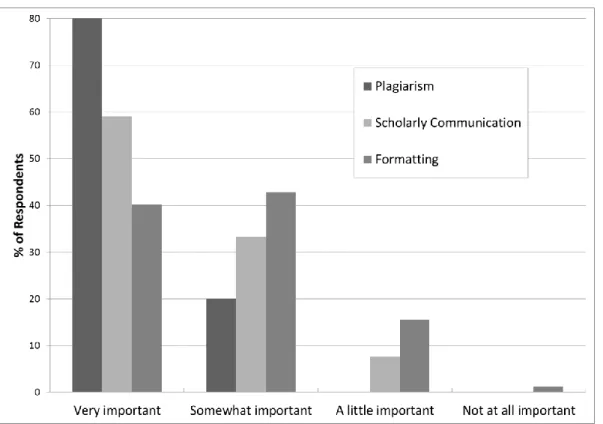
Figure 1 gives the relative importance of the three main elements of citation use according to those surveyed. Avoiding plagiarism was ranked the most important element, with 100% of respondents answering “very” or “somewhat important.”
Scholarly communication practices were the next most important element, followed by formatting of the citation, which was still considered “very” or “somewhat” important by
Figure 1: Relative importance of various elements of citation use according to surveyed
librarians.
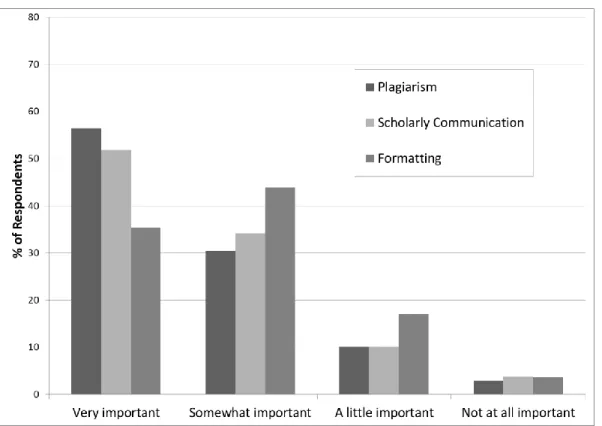
Figure 2: Teaching emphasis placed on various elements of citation use according to
surveyed librarians.
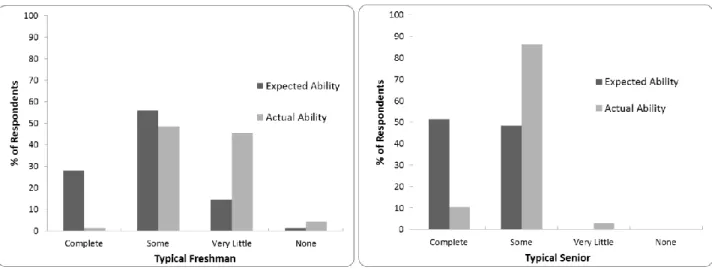
Figures 3, 4 and 5 convey instructor attitudes towards student understanding of citations, specifically the students' expected and actual ability to grasp the various elements of citation use as both freshmen and seniors. A few conclusions can be drawn from these plots. For one, actual student ability falls short of instructor expectations in all categories, and for all students regardless of academic level. Unsurprisingly, the
Figure 3: Expected and actual ability of freshmen and seniors to understand the
plagiarism aspects of citation use, according to librarians surveyed.
Figure 4: Expected and actual ability of freshmen and seniors to understand the
Figure 5: Expected and actual ability of freshmen and seniors to understand the
formatting aspects of citation use, according to librarians surveyed.
It is clear that, while instructors find that nearly all undergraduates exhibit “complete” or “some” understanding of both citation formatting and
plagiarism-avoidance by their senior year, they also see less improvement when it comes to scholarly communication aspects of citation use. This result suggests that the teaching of proper scholarly communication practices to undergraduates is a more difficult and ambitious goal than teaching citation formatting or discouraging plagiarism, and that an increased focus in this area could be beneficial.
5.2 Open-Ended Survey Questions
experiences in the library or other experiences like taking upper-level courses in a major) as well as from the instructor’s perspective in terms of what specifically should be taught.
It was also important to know if there were any agreements or discrepancies between what instruction librarians report teaching in the classroom versus what experiences or instruction methods they thought would best help students learn what they need to know about citations. Follow-up interviews were conducted with several respondents as a means to gain additional insight.
The first open-ended question was “In your opinion what instruction and/or experiences does a typical student need in order to fully understand citation use?” Overall, 55 respondents answered the question, and their answers could be grouped into several general categories that illuminate different areas of emphasis. Respondents were allowed to provide multiple answers, in which case they were split into separate
categories. The largest group of responses (27%) emphasized that students needed to have more exposure to the basic principles of citations, the “how and the why.” One respondent wrote that students should participate in a “discussion of the principles involved in why to cite, when to cite, what to cite, and how to cite.” Another said
students should also understand the “components of a citation” as well as “how and why sources must be cited.” One librarian wrote that students need to:
understand the importance of acknowledging the sources they use in papers, presentations, etc. Students should understand how they can build a literature review by paying attention to the citations they find in sources. Students should understand that writing and research is like a conversation—that they are a part of—and that providing proper citations helps their professors and/or future readers of their work understand how to track down the ideas they’ve referenced in their work.
students need to understand the role of citation in scholarly practice so they get the gist of it and what attribution means (versus scaring them with threats of plagiarism). They need to understand the principle that a citation helps the reader get their hands on the publication if they want it. They need to be aware of websites such as OWL (Purdue University’s Online Writing Lab’s website on citation formatting) that show them examples. They need to understand the kinds of important information to include in a citation if they don’t see an exact way to cite what’s in front of them.
For this group of respondents it was much more important for students to understand the underlying principles of citation use rather than the mechanics of formatting the citations. In fact, only 3 respondents (5%) mentioned that students needed to have more practice correctly formatting citations.
The next largest category of respondents (20%) mentioned the importance of faculty responsibility for providing students with the experiences that they need to fully understand citation use. Some of the librarians also discussed that collaboration between librarians and faculty would help students learn more about the topic. One librarian said that although an “emphasis by librarian and course instructor” was important, ultimately the “instructor’s comments mean more to students.” Another respondent echoed this sentiment and argued that “turning in rough drafts with citations included for specific feedback from the instructor” was the type of experience students needed to fully
understand using citations.
Others were more direct in the need for faculty intervention. One librarian pointed out that:
Another large group of responses (20%) suggested that students needed more hands-on experience researching and writing, while 16% emphasized practice using citations to find scholarly sources. In this way, the students would both understand why to use citations, how to find appropriate citations, and also understand all the component parts of a citation. Another 5% of respondents suggested specific instruction exercises; for example using a scholarly article as a starting point to a discussion of how the author used one of the sources in that article. In this way, the students would be able to better connect the author’s arguments with the sources he or she cited.
These responses are quite varied which supports the contention that there is little consensus on best practices for citation instruction. One area that did have some
consensus is that librarians on the whole do not find the formatting of citations to be an important pedagogical topic. There was some awareness of the importance of
collaboration between faculty and librarians but also a hesitation about whether or not that collaboration could ever be prevalent and consistent enough to make a difference in student understanding.
The second open-ended question asked “In your opinion what are the best ways to teach citation use to a typical student?” Fifty-four librarians responded to this question.
spend more time on what constitutes a credible (‘scholarly’) source than on citation formatting.” Another librarian lamented that “it’s always more helpful to be able to work
one-on-one with a student and particular examples from their paper, but it’s not possible given time and staff constraints.”
Librarians did not always suggest using labor-intensive active learning techniques. Many (19%) mentioned that they referred students to style guides, online resources such as the Purdue OWL website, or to bibliographic management tools like RefWorks, Endnote, or Zotero. Librarians who discussed sending students to style guides or other tools often commented that teaching students how to format citations, or even teaching students the larger scholarly communication issues surrounding the use of citations, took up too much time or fell outside of their responsibilities. One commented that, “I don’t really have time to teach them how to create citations in a one-shot session.
I only have time to identify relevant resources, e.g. style guides, online citation assistance.” Another respondent was even more blunt: “Show them the resources,
connect it to the language in their assignment. Teaching citation formatting is not part of what we do.”
Another category of respondents agreed that librarians should not be responsible for teaching the nuts and bolts of citation formatting. Nine respondents (17%) called upon the faculty or another campus unit (like the writing center) to bear more responsibility for teaching students proper citation use. These respondents all thought that students would better learn the concepts if more faculty taught and reinforced the broader concepts and scholarly research practices. One respondent commented that:
use one particular citation style because they wind up having to use Chicago for a History paper, MLA for an English paper, and CSE for a Biology paper. I think they would be better off having generic instruction on scholarly communication, plagiarism, and documenting sources in their work, but to have nitty gritty
requirements for citation styles in ever course is not ideal. This I see as something [that] would need to come from a consensus among faculty, rather than librarians. Another said it was the “primary responsibility of the faculty.” “Librarians can point out resources” but should not have to teach citation formatting or the larger issues
surrounding citation use.
These responses demonstrate that librarians understand the importance of students’ learning about citation use in general, but are conflicted about from whom
students should receive basic instruction on this material and even what concepts should constitute a basic understanding of citation use. Some librarians are happy to teaching aspects of citation use whereas others would prefer to do no more than direct students to the location of the style guides behind the reference desk or online.
Although 20% of respondents discussed using active learning techniques to help students understand citation use, the answers to the survey questions regarding student understanding at the freshman and senior levels demonstrate that these techniques might not be enough to affect student learning outcomes. One surprising aspect of the answers to this question is the relatively infrequent mention of plagiarism instruction. In fact, one respondent stated, “DON’T make plagiarism the central focus” of citation instruction.
Finally, one response was particularly illuminating of librarians’ own
understanding of citation styles and their importance. The respondent wrote, “I hear that
represents a missed teaching opportunity, and suggests that librarians would in fact be willing to focus more on the nuts and bolts of citation formatting if they had a better way to connect that information to broader scholarly communication practices. If even
librarians find citation styles arbitrary, it can hardly be surprising that students would come to feel the same.
5.3 Interviews
In the end, only five follow-up interviews were completed in time for this study; however, the librarians interviewed all taught a variety of different types of instruction sessions and almost always coordinated the content of their sessions with the faculty member of the course, so in these aspects reflected similar experiences to the survey respondents as a whole.
The interviewees all expressed strong opinions about whether librarians should teach the mechanics of citation styles. One librarian stated that he “mentioned citation styles but did not go into details of mechanics” and that if students needed more help crafting citations he “showed them where to go” to find the print or online style guides.
Another librarian echoed this same sentiment when she said that although she did not teach students how to assemble the citations themselves, she was “very willing to tell the students to look things up in the style book.” One librarian was even more adamant that she “never” teaches the mechanics of citations but does always show her students
bibliographic management software like RefWorks. In fact, she called teaching students how to format citations “scut work.” These comments reinforced the overall sentiments
When asked whose responsibility it was to teach citation styles to undergraduates, all of the interviewees said that individual faculty members or the writing center had the responsibility to teach the citation styles—especially if the faculty members cared deeply whether or not their students knew how to correctly format a citation. One librarian referred to the idea that librarians should incorporate teaching citation styles into
information literacy instruction as “mission creep,” deliberately echoing Barbara Fister’s language in Fister’s message to the Information Literacy Instruction Discussion List. She wondered aloud why writing centers and faculty had stopped teaching these skills and had off-loaded the responsibility to the library and librarians, a sentiment that was expressed by one of the other interviewees as well. She also called for more higher-level discussions between librarians and faculty about why we cite, though ultimately she felt it was the library’s responsibility only to show students how to use reference management
systems and to help students interpret citations so that they can find library resources. She cautioned that librarians should not get stuck with the role of helping students format perfect citations because then the librarians would “get a lot of flack and push-back” from
students and faculty if they helped create a citation that “wasn’t perfect.”
All of the librarians interviewed expressed a willingness to collaborate with faculty and writing centers on helping to educate students about the reasons to use citations. Librarians wanted to join “in conjunction with faculty, in a higher-level discussion” about scholarly communication and plagiarism. So even though these
6. Conclusion
With the rise of the Internet and the explosion of online, multi-media, and other new and unique resources, students need to be able to easily use and understand citations and be able to adapt their knowledge to new formats and situations. As students come to rely more and more on electronic resources many studies have indicated an associated rise in plagiarism and other problems with citation and attribution, underscoring the need for continued attention to this issue on the part of faculty and academic staff in higher education. Although faculty and librarians acknowledge their students’ lack of
understanding in this area, there is general disagreement in the scholarly community about whose role it is to teach the various aspects of citation use. As information literacy initiatives have become more widely adopted, librarians’ responsibility for citation
instruction has grown; while some librarians have embraced this role, others think of it as an example of “mission creep.”
general writing and research skills. A faculty member would certainly have an easier time grading student citations based on formatting rather than looking up each individual citation to make sure the students interpreted the source correctly and used it
appropriately in their work.
Unsurprisingly, then, this study shows that librarians in general consider formatting citations to be the least important aspect of understanding citation use, and that they regularly rely on library resources like style guides, online tutorials, and bibliographic management systems to handle this aspect of citation instruction. They believe that it is more important for students to understand the plagiarism prevention and scholarly communication aspects of citation use. As formatting citations is of least concern to librarians and a job many feel is not their responsibility, it makes sense that they would feel resentment towards having to teach citation formatting.
Librarians believe the scholarly communication aspects are the hardest to grasp for students entering college and they see that students show the least improvement in this area by the time they are seniors. This is unsurprising given that an understanding of general scholarly communication practices in higher education is a significantly more complex subject than learning how to avoid plagiarism or format a citation correctly, especially for students without research experience, typically most freshmen.
and can spark discussions about what types of information each discipline finds most important to share during the course of scholarly conversations in the literature. While some librarians might feel unprepared to discuss citation styles in this manner or not have enough time to add this discussion into “one-shot” instruction sessions, this type of
discussion could provide much needed background for students who might feel that the use of different citation styles in different courses is an arbitrary and torturously detailed exercise in frustration.
The open-ended survey questions and interviews confirm that librarians largely focus their instruction efforts on teaching the practical aspects citations use, i.e. how to locate sources using a citation and how to identify new sources from the bibliography or notes of an existing source, and do not spend too much of their limited time on detailed formatting instruction or on the complicated aspects of citation use in scholarly
communication. Again, many feel that it is the faculty's responsibility to cover reasons for citation use, particularly the scholarly communication aspects, as each discipline has different requirements and methods. Although many librarians feel that teaching the mechanics and formatting is best left to style guides and writing centers, they do show a willingness to collaborate with faculty and other units on campus and to try out new instructional methods for teaching citation use.
The results of this preliminary study suggest several ways that librarians can help students more fully understand the reasons to use citations. Librarians can encourage more discussions of the scholarly communication aspects of citation use when appropriate for the level of class or individual student. Librarians can also work to
target those collaborations towards explaining the more difficult scholarly
communication aspects of citation use. To the extent that they can be a part of this conversation, librarians can also suggest to teaching faculty that students need more instruction on basic research and writing methods and practices. Librarians should place more focus on explaining the principles, the “why,” of citation use when working with
students. For example, librarians who never talk about how to correctly format a citation might actually be missing an instruction opportunity to explain the differences between citation styles and how those differences are helpful in understanding the goals and research practices of different scholarly disciplines.
Librarians should also continue to use active learning and hands-on techniques in teaching citation use as there is much evidence in the library instruction literature that these methods are particularly effective in introducing students to new concepts and skills. The literature also suggests that internet tutorials and online instruction can play a helpful role if used correctly (Mages & Garson, 2010).
This study reveals areas that would benefit from future research. A separate survey on faculty attitudes towards teaching citations would provide a useful point of comparison between librarian and faculty approaches. It would also be useful for
Works Cited
Association of College and Research Libraries. (2009). Information Literacy Competency
Standards for Higher Education. American Library Association, ACRL.
Available from http://www.ala.org/acrl/standards/informationliteracycompetency Angeley, R., & Purdue, J. (2000, May). Information Literacy: An Overview. Office of
Institutional Assessment and Testing at Western Washington College. Available from http://pandora.cii.wwu.edu/dialogue/issue6.html
Atwood, T. A., & Crosetto, A. (2009). How to address “I’ve already written my paper, now I just need to find some sources”: Teaching personal voice through library
instruction. College & Undergraduate Libraries, 16(4), 322-328.
Bennett, E., & Brothen, E. (2010). Citation analyses as a prioritization tool for instruction program development. Journal of Library Administration, 50(5-6), 425-442. Bodi, S. (1988). Critical thinking and bibliographic instruction. Journal of Academic
Librarianship, 14(3), 150.
Boisvert, R. F., & Irwin, M. J. (2006). Plagiarism on the rise. Communications of the
ACM, 49(6), 23-24.
Brunvand, A., & Pashkova-Balkenhol, T. (2008). Undergraduate use of government information: What citation studies tell us about instruction strategies. portal:
Libraries and the Academy, 8(2), 197-209.
Carlson, J. (2006). An examination of undergraduate student citation behavior. The
Caspers, J., & Bernhisel, S. M. (2005). What do freshmen really know about research? Assess before you teach. Research Strategies, 20(4), 458-468.
Clarke, M. E., & Oppenheim, C. (2006). Citation behaviour of information science students II: Postgraduate students. Education for Information, 24(1), 1-30. Davis, P. M. (2002). The effect of the web on undergraduate citation behavior: A 2000
update. College & Research Libraries, 63(1), 53 -60.
D’Angelo, B. J. (2001). Using source analysis to promote critical thinking. Research
Strategies, 18(4), 303-309.
Ellis, E. L., & Whatley, K. M. (2008). The evolution of critical thinking skills in library instruction, 1986–2006: A selected and annotated bibliography and review of selected programs. College & Undergraduate Libraries, 15(1-2), 5-20. Fister, B. Citation instruction and mission creep. Information Literacy Instruction
Discussion List. [email protected] (10 February 2012).
Geertz, C. (1973). The interpretation of cultures: Selected essays (3rd ed.). New York: Basic Books.
Gross, M., & Latham, D. (2009). Undergraduate perceptions of information literacy: Defining, attaining, and self-assessing skills. College & Research Libraries, 70(4), 336 -350.
Hank, C., Jordan, M. W., & Wildemuth, B. M. (2009). Survey research. In B. Wildemuth (Ed.), Applications of social research methods to questions in information and
library science (256–269). Westport, Conn.: Libraries Unlimited.
Head, A. J., & Eisenberg, M. B. (2010). How college students evaluate and use
information in the digital age. Seattle, WA: The Information School. Available
from http://projectinfolit.org/pdfs/PIL_Fall2010_Survey_FullReport1.pdf Hepworth, M. (1999). A study of undergraduate information literacy and skills: The
inclusion of information literacy and skills in the undergraduate curriculum. 65th
IFLA Council and General Conference: Conference Proceedings. Available from
http://www.ifla.org/IV/ifla65/papers/107-124e.htm
Hollister, C. V., & Coe, J. (2003). Current trends vs. Traditional models. College &
Undergraduate Libraries, 10(2), 49-63.
Hovde, K. (2000). Check the citation: library instruction and student paper bibliographies. Research Strategies, 17(1), 3-9.
Howard, R. M., Serviss, T., & Rodrigue, T. K. (2010). Writing from sources, writing from sentences. Writing & Pedagogy, 2(2), 177-192.
Hutchins, E. O., Fister, B., & MacPherson, K. (Huber). (2002). Changing landscapes, enduring values. Journal of Library Administration, 36(1-2), 3-19.
doi:10.1300/J111v36n01_02
Isbell, D., & Broaddus, D. (1995). Teaching writing and research as inseparable: A faculty-librarian teaching team. Reference Services Review 23(4), 51-62.
Jackson, P. A. (2006). Plagiarism instruction online: Assessing undergraduate students’ ability to avoid plagiarism. College & Research Libraries, 67(5), 418 -428. Jamieson, S. & Howard, R. M. (2011). Unraveling the citation trail. Project Information
Kobelski, P., & Reichel, M. (1981). Conceptual frameworks for bibliographic instruction.
Journal of Academic Librarianship, 7(2), 73.
Lampert, L. D. (2004). Integrating discipline-based anti-plagiarism instruction into the information literacy curriculum. Reference Services Review, 32(4), 347-355. Leckie, G. J. (1996). Desperately seeking citations: Uncovering faculty assumptions
about the undergraduate research process. The Journal of Academic
Librarianship, 22(3), 201-208.
Leiding, R. (2005). Using citation checking of undergraduate honors thesis bibliographies to evaluate library collections. College & Research Libraries, 66(5), 417–429. Mages, W. K., & Garson, D. S. (2010). Get the cite right: Design and evaluation of a
high-quality online citation tutorial. Library & Information Science Research, 32(2), 138-146.
Martin, J. L. (2009). Course instructor perceptions of computer-generated bibliographic citations. Reference Services Review, 37(3), 304-312.
Miller, C., & Gagne, R. M. (1982). Scientific literature as hierarchy: Library instruction and Robert M. Gagne. College & Research Libraries, 43(5).
Nash, S., & Wilson, M. C. (1991). Value-added bibliographic instruction: Teaching students to find the right citations. Reference Services Review, 19(1), 87-92. Oberman-Soroka, C. (1980). Petals around a rose: Abstract reasoning and bibliographic
instruction. Chicago, Illinois: Association of College and Research Libraries.
Available from http://www.eric.ed.gov/ERICWebPortal/detail?accno=ED229013 Oppenheim, C., & Smith, R. (2001). Student citation practices in an Information Science
Park, S., Mardis, L. A., & Ury, C. J. (2011). I’ve lost my identity – oh, there it is … in a
style manual: Teaching citation styles and academic honesty. Reference Services
Review, 39(1), 42-57.
Parry, M. (2011, November 6). Software catches (and also helps) young plagiarists. The
Chronicle of Higher Education. Available from
http://chronicle.com/article/Escalation-in-Digital/129652/
Robinson, A. M., & Schlegl, K. (2004). Student bibliographies improve when professors provide enforceable guidelines for citations. portal: Libraries and the Academy, 4(2), 275-290.
Rowlands, I., Nicholas, D., Williams, P., Huntington, P., Fieldhouse, M., Gunter, B., Withey, R., et al. (2008). The Google generation: The information behaviour of the researcher of the future. Aslib Proceedings, 60(4), 290-310.
doi:10.1108/00012530810887953
Sharkey, J. R., & Culp, F. B. (2005). Cyberplagiarism and the library. The Reference
Librarian, 44(91-92), 103–116.
Ury, C. J., & Wyatt, P. (2009). What we do for the sake of correct citations. Brick and
Click Libraries: Proceedings of an Academic Library Symposium (126–44). Brick
and Click Symposium. Available from http://d-scholarship.pitt.edu/5838/1/ED507380.pdf
Wildemuth, B. M. (2009). Applications of social research methods to questions in
Zhang, Y., & Wildemuth, B. M. (2009). Qualitative analysis of content. In B. M. Wildemuth (Ed.), Applications of social research methods to questions in
information and library science (pp. 308–319). Westport, CT: Libraries
Appendix A
Survey Questionnaire
Instruction Librarians’ Attitudes Towards Teaching Citations, PI Diana Shull Survey Questions:
IRBIS ORIS
Consent to Participate in a Research Study
Title of Study: Academic Librarians' Attitudes Towards Teaching Citations IRB #: 12-0478
Principal Investigator: Diana Shull
Principal Investigator's phone number: 303-847-2549 Principal Investigator's email: [email protected] Faculty Advisor: Beth L. Rowe
Faculty Advisor's email: [email protected]
What are some general things you should know about research studies? You are being asked to take part in a research study. To join the study is voluntary. You may refuse to join, or you may withdraw your consent to be in the study, for any reason, without penalty. Details about this study are discussed below. It is important that you understand this information so that you can make an informed choice about being in this research study.
What is the purpose of this study? The purpose of this research study is to collect data about academic librarians’ attitudes towards teaching undergraduates how to use
citations.
How many people will take part in this study? If you decide to be in this study, you will be one of approximately 50-60 people in this research study.
What will happen if you take part in the study? Your part in this study will last approximately 20 to 30 minutes or less. During this study, you will complete an online questionnaire. The questionnaire will ask you to describe your attitudes towards teaching citation use. With your permission you may be recontacted to complete a telephone interview.
What are the possible benefits from being in this study? Research is designed to benefit society by gaining new knowledge. You may not benefit personally from being in this research study.
What are the possible risks or discomforts involved from being in this study? We anticipate few risks in this study.
anonymously. This means that there will be no way for anybody to ever link your data or the results of the study to your identity.
What if you want to stop before your part in the study is complete? You can withdraw from this study at any time, without penalty and skip any question for any reason. The investigators also have the right to stop your participation if you have an unexpected reaction, have failed to follow instructions, etc.
Will you receive anything for being in this study? Will it cost anything? You will receive no monetary reward for participating in this study. There are no costs associated with being in the study.
What if you have questions about this study? You have the right to ask, and have answered, any questions you may have about this research. Contact the principal investigator listed above with any questions, complaints, or concerns you may have.
What if you have questions about your rights as a research participant? All research on human volunteers is reviewed by a committee that works to protect your rights and welfare. If you have questions or concerns, or if you would like to obtain information or offer input, please contact the Institutional Review Board at 919-966-3113 or by email to [email protected].
1) Do you consent to be in this research study? Yes
No
2) Have you ever taught bibliographic instruction sessions?
3) Last semester, how many sessions did you teach? If you did not teach any last semester, how many sessions do you teach in a typical semester?
1-5 6-10 11-15 16-20 over 20
4) What types of bibliographic instruction sessions have you ever taught? (check all that apply)
“One-shot” instruction sessions
Instruction sessions embedded in a course (more than one session per course) Instruction sessions as part of a for-credit information literacy course
Other ________________
6) What citation styles did you teach last semester? If you did not teach any citation styles last semester, what citation styles have you taught in a typical semester?
7) Please rate how important the following are to a complete understanding of the reasons to use citations. If you believe that there are other factors that contribute to a complete understanding of the reasons to use citations, please specify those reasons in the blanks.
Very Important Somewhat Important
Only a little Important
Not at all Important Avoiding plagiarism Scholarly communication practices Correctly formatting the citation Other (specify) ______________
8) When you teach the reasons to use citations you place the following amounts of emphasis on these ideas:
High emphasis Some emphasis Very little emphasis No emphasis Avoiding plagiarism Scholarly communication practices Correctly formatting the citation Other (specify) ______________
understand all aspects of citation use. The following questions will ask you about a typical freshman and a typical senior at your institution.
9) In general, how much ability does a typical freshmen have to understand the reasons to use citations?
Complete ability
Some ability Very little ability No ability Avoiding plagiarism Scholarly communication practices Correctly formatting the citation Other (specify) ______________
10) Now tell us about current levels of understand among your freshmen students. Please rate the level of understanding that a typical freshmen at your institution has of the following reasons to use citations:
11) Please rate the ability of a typical senior at your institution to understand the reasons to use citations.
Complete ability
Some ability Very little ability No ability Avoiding plagiarism Scholarly communication practices Correctly formatting the citation Other (specify) ______________
12) Now please rate the level of understanding that a typical senior at your institution has of the reasons to use citations:
Deep understanding Some understanding Very little understanding No understanding Avoiding plagiarism Scholarly communication practices Correctly formatting the citation Other (specify) ______________
13) In your opinion what instruction and/or experiences does a typical student need in order to learn the reasons to use citations?
14) In your opinion what are the best ways for a typical student to learn the reasons to use citations?
15) What was your institution’s total freshman enrollment in the academic year 2010-2011?
0-499 500-999 1,000-
16) What percentage of the freshman class does your library typically serve through instruction?
17) What year did you receive your library science degree?
18) How many years have you been working in an academic library setting?
19) Thank you for participating in this research study. Would you potentially be willing to take part in a follow-up phone interview? The phone interview would take 30 minutes or less.
Appendix B
Follow-up, Semi-Structured Interview Questions
1) What types of instruction sessions have you taught this academic year?
2) Do you ever choose the content of your instruction sessions? If you do not, then who does?
3) Have you taught citation styles in your instruction sessions this academic year? Do you have a preference for teaching a particular style? If so, why?
4) What is important for students to understand about citation use?
5) When you provide instruction on citation use, given restraints like time, what about citation use do you emphasize?
6) Do you vary the content of your instruction on citation use depending on the level of students in the instruction session?
7) Do you teach the reasons to use citations even if not explicitly asked to by the course instructor?
8) Whose responsibility is it to provide instruction on citation use?