the M.S. in L.S. degree. May, 2001. 46 pages. Advisor: Helen R. Tibbo.
This study explores the current methods for deploying EAD finding aids to identify the most promising practices being used, examines how much and what type of evaluation archivists are gathering from end-users regarding deployment methods, identifies archivists’ perceptions regarding the use of EAD encoded finding aids, and in general, looks to further the study of electronic access to archival collections. The focus of the paper is to explore the current state of deployment methods for EAD, including how long and what types of deployment methods are being used, why they are selected, what
changes, if any, are being planned, and what types of challenges are associated with them. The paper also focuses on archivists’ perception of end-user utilization of EAD and explores the evaluation upon which this perception is based, including how archivists formulate their perceptions and upon what type of information archivists base these perceptions.
Headings:
Archives -- Technological innovations.
SERVING UP EAD:
AN EXPLORATORY STUDY ON THE DEPLOYMENT AND UTILIZATION OF ENCODED ARCHIVAL DESCRIPTION (EAD) FINDING AIDS
by James M. Roth
A Master’s paper submitted to the faculty of the School of Information and Library Science of the University of North Carolina at Chapel Hill
in partial fulfillment of the requirements for the degree of Master of Science in
Library Science.
Chapel Hill, North Carolina May, 2001
Approved by:
Table of Contents
Introduction... 3
Problem Statement... 4
Goals... 5
EAD: Concept and History... 6
EAD: Implementation... 10
EAD: Deployment... 11
EAD: Evaluation... 14
Methodology... 16
Findings: Deployment... 18
Findings: Utilization... 27
Conclusion... 33
Notes... 36
Appendix A... 38
Appendix B... 40
Appendix C... 41
Appendix D... 43
Introduction
In the past eight years, several archival repositories have begun using the Encoded Archival Description (EAD) Document Type Definition (DTD), to prepare electronic finding aids for presentation on the World Wide Web. While the technology is relatively new, many archival institutions have embraced EAD because of its appeal as a Standard Generalized Markup Language (SGML) standard (ISO 8879) for structuring and
automating finding aids, the archivist’s traditional access tool (Dooley, Summer 1997, 264). Finding aids can be any descriptive document used by archival repositories that provides information about the content and nature of materials, e.g., registers, inventories, calendars, series descriptions, card catalogs, and institutional guides. As the first data structure standard to “facilitate distribution via the Internet of detailed information about archival collections,” EAD enables remote researchers to search archival collections with “effectiveness and thoroughness” (EAD Working Group, 1999, v).
listed forty-seven institutions and twelve cooperative projects that have used the EAD standard to encode finding aids and have delivered these documents to the Internet through several deployment methods (http://www.loc.gov/ead/eadsites.html).1
Problem Statement
While coding finding aids under the EAD DTD has become much easier with tools such as the Berkeley Template (http://sunsite.berkeley.edu/FindingAids/uc-ead/templates/uctemp.html), PERL programs, the text editor Emacs
(http://www.gnu.org/software/emacs/), PSGML (SGML add-on to Emacs), James Clark’s SGML parser+ toolkit (http://www.jclark.com/sp/), and various Word Macros, the implementation of deployment methods has not. For the purposes of this paper, the term “deployment method” will be defined as and used for any electronic delivery system bringing EAD encoded finding aids via the Internet to end-users. The delivery of SGML documents on the Web has been a “serious obstacle,” because of the “limited options” for deployment methods (Pitti, Summer 1997, 278). Institutions have been experimenting with several different deployment methods, which have had various amounts of success displaying EAD encoded finding aids. Approaches used included the HyperText Markup Language (HTML), proprietary SGML EAD, which require specialized search software, and more recently, Extensible Markup Language (XML) and other “X*L” standards that are simplified subsets of SGML for use on the Web (Pitti, Summer 1997, 277). While software developers are presently devising new deployment methods to improve delivery of EAD finding aids, institutions currently deploying EAD finding aids have been
1998, 155). Indeed, the archival profession has been criticized for a general lack of end-user evaluation.
Goals
At this time the success of EAD is unclear. Early implementing institutions have spent a good deal of time and expense encoding finding aids and mounting them on the Web. There are, however, few if any evaluation studies, making it difficult to assess the efficacy of all this activity. The present survey of EAD deployment and evaluation activities that repositories have undertaken aims to lay the foundation for meaningful assessment. Specifically, the goals of this exploratory study are to gain insight into current methods for deploying EAD finding aids, identify the most promising practices, and, in general, to further the study of electronic access to archival collections. This study begins the process of examining how much and what type of evaluation archivists are conducting regarding deployment methods for EAD encoded finding aids. It also explores the perceptions archivists have regarding end use of EAD encoded finding aids.
The focus of the paper is first, to explore the current state of deployment methods for EAD. Questions in this area include:
1. what types of deployment methods are implementors employing; 2. how long have implementors delivered EAD encoded finding aids; 3. why have implementors selected deployment methods;
4. are implementors planning changes in deployment methods; and
Secondly, this paper focuses on implementing archivists’ perceived utilization of EAD by end-users and explores the evaluation upon which this perception is based. Questions to be addressed include:
1. whether professionals are developing any standards or policies for the evaluation of deployment methods for EAD finding aids;
2. whether implementors are collecting feedback from users;
3. how implementors are formulating their perceptions towards utilization of EAD encoded finding aids by end-users; and
4. upon what type of information implementors are basing their perceptions.
EAD: Concept and History
EAD is part of a succession of technologies that archivists have been developing to improve description and access of their holdings. Drawing on the traditions of European rare book libraries and manuscript repositories, early American libraries and historical societies with document collections developed catalog card systems and published document-level catalog lists (Schellenberg, 1965, 20-31). Control of archival materials changed with the establishment of the National Archives in 1934. The massive amount of materials twentieth-century bureaucracies generated precluded the arrangement approaches early archivists had taken. Item level cataloging and calendaring was clearly inappropriate for the large amount of records held by the National Archives, and a new descriptive system was needed.
“a pamphlet-like descriptive inventory of each Record Group, containing introductory information about the records as a whole and a list of all the constituent series” (Miller, 1990, 22). In 1950, the Library of Congress endorsed the National Archives’ method of collection level description. While provenance and original order promoted the
individuality of archival repositories’ holdings, their diversity created problems for a library, such as the Library of Congress, that wished to describe its manuscript and library holdings in the same catalog. Responding to this situation, the Library of Congress developed the National Union Catalog of Manuscript Collections (NUCMC), which combined cataloging and subject indexing with the principles of provenance and original order in a print tool that provided integrated national access to archival materials.2 In 1959, archivists began sending records to the Library of Congress to be included in NUCMC, however, not all archival institutions sent in records. During the 1960s and 1970s, many archivists eschewed library practices, maintaining that the uniqueness of each collection did not fit within a NUCMC record (Miller, 1990, 22).
Before 1977, there was very little common descriptive practice among archivists. The release of David Gracy’s manual, Archives and Manuscripts: Arrangement and Description (1977), however, led to more standardized finding aids. The development of
automated library systems and the standardization of finding aids directed the union of archival and library techniques. From 1981 to 1984, the National Information Systems Task Force (NISTF), formed by the Society of American Archivists, developed the “Data Elements Dictionary,” which identified common information found in various
Manuscripts Control) format, which was completed in 1983.3 MARC AMC, one of many cataloging formats, allowed archivists to incorporate brief archival holdings records in online bibliographic catalogs along with library materials, and provided national access to materials in utilities such as OCLC and RLIN.4
Similar to their distrust of NUCMC, many archivists in the United States were “deeply suspicious” of MARC AMC because of its origins in the library community and its “essentially ‘bibliographic’ structure” (Hensen, Summer 1997, 290). Furthermore, while some archivists accepted MARC AMC, many felt that however well suited it was to the needs of archival description, it was “simply an empty vessel—a ‘data structure standard,’” that required “a companion ‘data content standard’” such as Library of Congress Subject Headings, to make it useful (Hensen, Summer 1997, 290). An earlier incident also contributed to archivist’s distrust of library practices. In 1978, the release of the Anglo-American Cataloging Rules, Second Edition (AACR2) had caused concern among archivists who used it for NUCMC records. Many felt AACR2 discarded
essential archival descriptive principals. In response, the Library of Congress drafted an alternative set of rules in 1984, entitled Archives, Personal Papers, and Manuscripts (APPM), which was to “replace chapter 4 of AACR2” (Hensen, 1989, 3). APPM became a de facto standard to facilitate all archival cataloging.
remembered that MARC is used for cataloging records, while EAD is used for describing the full text of finding aids. Nevertheless, MARC’s development as a non-proprietary, publicly-owned descriptive markup standard “strongly influenced the developers of EAD and determined the nature of EAD’s design to a large extent” (Pitti, Summer 1997, 275). While the design concepts of MARC helped to guide EAD’s evolution, developers decided that MARC was not the best available scheme for structuring archival surrogates in an electronic environment. They viewed MARC as unsuitable for three primary reasons: it was limited in length (OCLC restricts the total number of characters per record), it didn’t accommodate hierarchical structure (while a finding aid does), and MARC AMC’s user community was seen as too small and under-funded to support state-of-the-art hardware and software development (Pitti, Summer 1997, 275-276).
Looking for a means by which to encode full text finding aids to meet the needs of the archival community, developers began investigating the feasibility of Standard
developed” (EAD Working Group, 1998, vii). Developers were able to design the EAD DTD to identify and name elements that “reflected both the content and structure of traditional archival finding aids” (Ruth, Summer 1997, 312).
EAD: Implementation
Because of the relatively short history of the EAD standard, very little literature has evaluated or even explored the utilization of deployment methods for EAD encoded finding aids. A search of library and archival journals since 1993 reveals a dearth of information about deployment of EAD encoded finding aids. Those works that discuss EAD concentrate more on theory and implementation of the EAD structure, or present various implementation case studies at archival institutions, rather than the delivery of EAD encoded finding aids to general remote users. The Society of American Archivists, in association with the Network Development and MARC Standards Office of the Library of Congress, has released the EAD Tag Library, which “conveys information about the three principal tasks” achieved by the EAD DTD: the breakdown of elements; the identification of attributes; and the expression of the relationship between elements (1998, vii). Two special issues of the American Archivist, Volume 60, Numbers 3 and 4, focus on the context and theory of the EAD DTD and report on the several case studies where institutions have implemented EAD.
Roundtable introduced the EAD Cookbook5 as an extension of the EAD Application Guidelines, as a “simple model encoding protocol” for authoring and publishing EAD
finding aids (Fox, 2000, 1). Similar to the EAD Tag Library and the American Archivist volumes, The EAD Application Guidelines and EAD Cookbook are written for the archivist. None of these articles or monographs discusses the effectiveness and usefulness of EAD deployment methods from the standpoint of the end-user.
EAD: Deployment
Most of the EAD literature concerns the implementation of the DTD written from the perspective of the archivist looking to establish EAD at his or her institution, rather than as a critical analysis of the standard and its success. Thus far, only Jill Tatem, in her article about the diffusion of EAD as an innovation (1998), has addressed archivists’ positive and negative perceptions of EAD to suggest why EAD holds appeal for
professionals. She states that, while many institutions have adopted EAD, the widespread adoption of EAD depends on changing some of the negative perceptions held by some archivists surrounding the implementation of EAD. Using Everett Roger’s theory of diffusion of innovation, Tatem focuses on the perceptions of EAD “held by target
adopters—archivists” (1998, 156) and analyzes those perceptions for the five motivations of relative advantage, compatibility, complexity, trialability, and observability6 (Rogers, 1995).
would be helpful to view EAD’s benefits as immediate and tangible, such as showing that users require “less mediation or assistance” when using EAD finding aids for structural purposes (1998, 159). Tatem goes on to identify a perception held by most proponents that EAD is compatible with traditional paper registers and is seen as the successor to MARC AMC. The perceived disadvantage is SGML’s reliance on a single hierarchical structure, which is at odds with the uniqueness of traditional archival holdings, and that finding aids upon which EAD is based are not useful for unmediated end-user access. Tatem concludes that it is counterproductive to position “EAD as useful in only one service model when its potential utility is much broader” (1998, 161).
Tatem argues that improving EAD’s ease of use depends “on advances in authoring and browsing software” (1998, 155). Full-text search software is considered “the most sophisticated and technically complex delivery method” because it permits end users to simultaneously search the contents of several finding aids (SAA, 1999, 147). Currently, there are several software delivery systems available for deploying finding aids electronically. Software used by implementing institutions include RLG’s Archival Resources, InQuery, DynaText, Internet Explorer 5.0, OmniMark, Isite, MultiDoc Pro, Panorama, Internet Archivist – EAD, Cheshire II, and Livelink, as well as languages such
as MySQL, Perl,, and Verity Query Language.7
Although there are multiple methods for delivering EAD encoded finding aids, most delivery systems conform to one of three general types: server-side technology, such as DynaText; client-side technology, such as Panorama; and index databases such as Livelink. To provide access to collections, an archive can install software that indexes the
files and formats them to display on a Web-accessible server. This server-side software allows archival repositories that maintain documents in the SGML format to deliver and present them in HTML, which is compatible with browser software for the World Wide Web. The DynaText publishing system, which includes DynaWeb, is considered a server-side software package because it maintains documents in SGML format then converts files to HTML, which then can be presented on the Web. However, the DynaText publishing system is cost prohibitive and is no longer being supported. Another system considered server-side software is Internet Archivist-EAD, which exports documents from the native format to HTML and XML, but does not produce the stylesheets that are
Interface, has suspended sales of the system until there is an assessment of XML’s impact on deployment technologies.
An archive can also rely on client-side software that requires users to load software that configures their browser to read EAD-encoded finding aids and accompanying stylesheets mounted on a Web-accessible server. SoftQuad, Inc.'s
Panorama software system, considered an end-user tool, “can display documents
marked-up in SGML, given an associated SGML document type definition (DTD) and a
specification that maps each SGML element and entity in the DTD to a rule for displaying that element or entity, generally referred to as a style sheet” (Watson, 1995). Like
DynaText, Panorama is no longer supported because few users have downloaded the
proprietary software.
Archives may also choose to employ a SGML search engine to interface with a database. OpenText’s LiveLink is an index that has no special browser requirements; all finding aids are stored in SGML but delivered in HTML format. The LiveLink program provides a web-accessible interface to finding aids with phrase and keyword search capabilities in a variety of indexes.
EAD: Evaluation
The EAD Application Guidelines lists the great disadvantage of delivering EAD encoded finding aids through full text search software as being the high cost associated with acquiring search engines and that even if affordable most require “advanced
results set” still have not been clearly developed. In order for archivists to refine these applications “more experience with retrieval issues” is needed to “clarify user
understanding of and requirements for both the search interface and the display of results” (EAD Working Group, 1999, 148). The current dilemma is how archivists are getting this experience.
Even if and when archivists are able to develop and widely use new technologies, Tatem has criticized the archival profession for their failure to include end-users in the planning and evaluation activities associated with the development of EAD (1998, 163). Citing literature of human-interface design, Tatum has recognized that end-users should not be viewed as a homogenous group, that different cognitive styles, domain knowledge, system knowledge, and information needs require “different functionality and interfaces” in order for end-users to successfully employ digital tools (1998, 156). For purposes of this study “end-user” will be used when describing those general users of the finding aid that are not professional archivists. This group includes, academic scholars, researchers, students, and the general public. Tatem notes the lack of empirical research in the archival literature about the general effectiveness of finding aids, and has concluded that the profession’s ability to evaluate the contributions of EAD is limited (1998, 165).
improved access, deployment methods should be viewed by archivists as the most important key to improved delivery and searchability of EAD-encoded finding aids. Without an understanding of the effectiveness of such deployment methods, archivists cannot improve access to their holdings. Implementors of the EAD must begin the formal process of evaluating the utilization of EAD delivery systems by end-users.
Methodology
This study explores the current delivery systems used to deploy EAD encoded finding aids at the forty-seven institutions listed as current implementors of the EAD DTD on the EAD homepage. It also intends to explore how much and what type of evaluation early implementors are conducting regarding deployment methods for EAD encoded finding aids, including the perceptions archivists have regarding use of EAD encoded finding aids.
The data set of forty-seven implementing institutions was chosen based on information provided on the official EAD web site.8 The Library of Congress Network Development and MARC Standards Office (NDMSO) maintain the web site to fulfill the mission of the EAD Roundtable to encourage the development of the EAD DTD through the distribution of information. Institution information was provided “as part of that maintenance support.”9 While other institutions may be implementing EAD, it was assumed that current archivists listed on the EAD homepage would have the same
EAD. In effect, the current implementors have become information sources for others looking to adopt the EAD standard.
Potential respondents were professional archivists at the forty-seven institutions listed as deploying EAD encoded finding aids through electronic sources (see Appendix A). On March 28-29, 2001, these professionals were sent an introductory e-mail request for participation in the study (see Appendix B). This letter informed them who was conducting the study and the reasons for the study. The letter briefly described the scope and intention of the study and why they were being asked to participate. Information was given regarding the procedure for participating, the contact information for the primary researcher, the advisor, and the URL for the questionnaire (see Appendix C). Of the forty-seven institutions listed as current implementors, only forty-six were contacted. One institution was a part of a consortium and that group was listed separately as a
participating institution.
Data was derived from a series of questions administered through an online survey. These questions were straightforward queries designed to be open-ended enough for respondents to expand upon in detail (see Appendix C). All questions addressed the deployment methods for EAD encoded finding aids and the presumed effectiveness of these methods. The findings should give insight into current and “best practices” for deploying EAD encoded finding aids, what challenges with deployment institutions have encountered, and how archivists perceive whether or not end-users fully utilize the capabilities of deployment methods (such as subject searching in SGML). It also will aid the further study of user access to archive collections.
Findings: Deployment
In the first section of the survey, entitled Deployment, questions focused on the current state of deployment methods for EAD, including what types of delivery methods archivists are employing, how many finding aids they have deployed through each method, how long have they deployed EAD encoded finding aids, why they selected certain deployment methods over others, whether changes in deployment methods are being planned, and what types of challenges faced archivists when they began
Question 1.1. asked respondents to identify the deployment method(s) currently being used at their institution in order to find out how each institution was delivering EAD encoded finding aids electronically. This data not only provides a picture of EAD practice, it also is informative as to retrieval possibilities. Currently, web search engines can’t identify SGML or HTML generated on the fly, therefore, those institutions relying solely on SGML or HTML on the fly as a delivery method are precluding their finding aids being retrieved by web search engines, such as Alta Vista or Google.
Most institutions applied several types of deployment methods, with the most common delivery system cited by respondents being the client-server software system Panorama. Of the twenty-eight surveys received, nine institutions listed Panorama as
their deployment method, seven listed Inso’s (formerly EBT) DynaText, six used other delivery software (direct HTML links, Perl, etc.), four chose to use OpenText’s LiveLink, two opted for Verity Query Language, two employed Internet Archivist-EAD, and one each used Internet Explorer 5.0, OmniMark, Isite, or MultiDoc Pro. Because it is difficult to fully assess the effectiveness of a deployment method if only one institution that uses the system responds, only those responses regarding Panorama, DynaText, HTML, LiveLink, and Internet Archivist-EAD will be specifically cited. Other responses submitted will be used to make general points about deployment methods.
archivists had been delivering EAD documents through the deployment method in order to compare the length of time the deployment method had been used versus the number of finding aids delivered by that deployment method.
Of the twenty-eight institutions that responded to the survey, eleven began using EAD before 1998 and seventeen began using EAD in 1998 or later. The range of time for implementation was from 1994 to December of 2000. Since 1995, archivists have
employed Panorama and two institutions have applied it as late as 1999. Four of the earliest implementors (1994-1996) of EAD chose DynaText. Six institutions (mostly new implementors) responded that they only deliver HTML versions of their finding aids, and two institutions have been using Internet Archivist-EAD since 1998. All the archivists using Panorama also deliver finding aids in other formats, one giving the reason that “we didn’t like the idea of users downloading dedicated software,” and the six institutions that only deliver HTML finding aids felt HTML was advantageous because there is no
“software, browsers, or database with which to offer SGML/XML documents, either static or dynamically with stylesheets.”
and deployment. The institution that has deployed twelve finding aids began using EAD in January 2000 while the newest implementor (December 2000) has already deployed 110 EAD encoded finding aids in both HTML and SGML/XML. All but one of the implementors that used the beta version had more than three hundred EAD encoded finding aids deployed through various methods. Those implementors that began using version 1.0 had far fewer finding aids in electronic formats. A respondent currently using two deployment methods (HTML and Panorama) to deliver EAD encoded finding aids stated that they were “still experimenting” with their deployment method.
Question 1.4. asked why archivists chose their current deployment method. Most responses show that the current deployment method was selected because of cost (funding from grants), relative ease-of-use, and accessibility. The perception was that the selected method was affordable, easy to implement, and easy to use.
A common reason respondents gave for choosing their deployment method was ease of use. Most of the institutions using Panorama employ HTML as their other deployment method because it is “easier to markup and deliver” and “it seemed like the easiest and safest bet.” Two archivists based their decision on delivering finding aids through Internet Archivist-EAD because of ease of use, with one answering that “participating in [a consortium project already using Internet Archivist-EAD] was the easiest way our institution could get finding aids on the web.”
Cost was also a factor in choosing deployment methods. Many archivists chose Panorama based on limited funding, suggesting that making end-users pay for browsing
EBT offered grants to make it affordable, with five archivists replying that their institution received grants or funding to purchase the software system. Archivists also chose HTML based on cost. These respondents believe that until archivists can develop a “cost-effective server-side XML delivery system,” HTML will be their “preferred choice” for delivering finding aids.
Reflecting just how new this technology is, the earliest implementor stated their reason for choosing DynaText was that “it was the only one available at the time.” Four institutions adopted LiveLink because it was “readily available” and “already in use” at another department in the institution. One HTML implementor stated that they use XSLT stylesheets to generate static HTML pages because of ease of deployment, cost
effectiveness, and availability of technology (it is interesting to note that these finding aids are searchable on the World Wide Web even if they are not searchable in-house). This archivist felt the benefits of searchable finding aids were overrated: “making EAD searchable would have given us very little benefit for much cost, knowing our staff and user searching patterns.” As mentioned above, the archivists delivering finding aids through Internet Archivist-EAD chose a system that had already been purchased.
management, and how end-users that didn’t have client side search engines could access their collections. Nineteen participants responded that they had plans for changing their deployment methods, while nine did not have any plans for change. The types of plans being investigated include moving to new technologies that are more sophisticated, with most respondents looking into XML. Reasons for decisions to change include planning for better access to the finding aids, ease of use for end-users, better navigability, and new technologies that offer more “sophisticated” capabilities than currently offered by
deployment methods.
Changes being planned by archivists using Panorama included changing from SGML to XML, delivering finding aids in PDF files, and developing a “cooperative effort to standardize delivery for several [repositories].” Most are still developing their plans, and two have begun the processes of changing. Only one of the nine institutions had not made any plans for changing from Panorama. One institution has begun converting finding aids from Panorama to delivering static HTML created through XSL
Transformations because “our search engine is horrible, and we have zero control over how and when we index files.” The other implementor is converting existing finding aids to XML and HTML formats because “it will provide better access to our finding aids, which are currently only available through SGML browsers.” These findings suggest that implementors perceive this client-side server as an inadequate tool for delivery of future finding aids.
Although most archivists using DynaText responded that they were planning to change their delivery system, most are still in the development stages. Only one
into XML, however, they were not going to replace the SGML guides but were creating XML guides in addition to the SGML. The other five institutions had no definite plans for changing the delivery of their finding aids, but were investigating other methods for delivery, mentioning XML and PDF files as possible replacements.
Two of the institutions using LiveLink had no plans for changing their deployment method, while the other two have begun making plans to convert SGML files to XML files. One said that while they are converting to XML files, the indexing will remain the same, but that conversion to XML will “present a much easier to understand results screen and navigational procedure for the files.” Two of the six archivists delivering HTML finding aids had no plans for changing the deployment method. The other four either listed converting files to XML or storing finding aids in a service database. The hope of one archivist, which is most likely shared by all, is to have a “cost-effective server-side system for delivering formatted documents” that will permit “searching across all XML documents.” Neither institution delivering through Internet Archivist-EAD has made plans for changing deployment methods, with one responding that management “has not made any new decisions” about the deployment of online finding aids.
and asked the question “why not have one universal server that serves the needs of the users AND the archivists?” Others used question 1.7. to bring up points about EAD in the context of the archives as a whole. One respondent strongly supported processing collections over encoding, because she argued processing “is still the essential activity of an archive upon which EAD depends, although the point is often lost on those who make the decisions.” Finally, one archivist summed up what many probably feel as true:
Given our other needs, I don't think a “perfect” EAD implementation ranks very high on the list. Digital projects in general can become a bottomless pit for money. The true question should be, “How much financial and human resource support should be given to EAD?” The answer is “it depends.” Given our current situation, I have much more pressing processing and basic preservation needs. Much of the work in guiding researchers to the most appropriate material in that collection has always been, and always will be, done by a reference archivist or staff member who knows the collection well and can work with the patron in using the finding aid. The on-line environment has not yet changed that, since patrons still contact the archives personally using a telephone call or e-mail. Now EAD has a role to play in helping people find things before contacting the archives, but even if every finding aid were marked up with perfect and deep metadata, and fully searchable on those metadata fields, you still would need a reference archivist to help the researcher get to what they need. Now, let's keep in mind that most of the EAD markup done at this institution, and others as well, consists of pretty good collection level markup, and horrible folder level markup. In order to really markup the folder level properly to make it searchable, one would have to employ controlled vocabularies, standardized tag usage, use of the attributes in the <date> tag, etc. In other words, you would need the equivalent of a library cataloger who would read each piece of paper in the folder and then make agonizing decisions about how to classify. Is this a wise use of institutional resources? Hardly.
Question 1.8. asked respondents what had been the biggest challenges for
implementors who used DynaText said that “convincing colleagues of the value of implementing EAD” was one of the biggest challenges. Most stated finding technically competent staff and time to develop encoding routines were great challenges: “we have no full-time EAD encoders, only two staff [members] who can encode, and neither of us can spend more than ten percent of our time encoding.” One archivist summed up the challenges as:
the misperception of EAD as a derivative “web” format, rather than as a “source” format. This seriously limits what can be done with EAD. Education and training has been a problem, even for those properly “evangelized.” There is still a fairly steep learning curve. The lack of good tools for creation, use, and delivery of EAD leave much of it's potential unrealized.
Other challenges respondents mentioned regularly were the “lack of easy-to-use programs aimed at SGML development” and the effects associated with this challenge. Institutions using LiveLink commented upon the lack of staffing to do all the encoding and the time it took to convince administrators to support EAD, viewing staff training as a problem because “the learning curve for EAD markup is very steep.” Another response mentioned the challenge of developing programs for automatic conversion from old databases to EAD. Both institutions that use Internet Archivist-EAD responded that challenges were finding the time and staff to create finding aids, convincing
administration of the “worth and potential of EAD,” and becoming efficient and
Findings: Utilization
The second part of the survey, entitled Utilization, focused on archivists’ perceptions regarding end-user utilization of EAD and explored the evaluation upon which these perceptions are based. Questions addressed whether professionals are developing any standards or policies for the evaluation of deployment methods for EAD finding aids, whether archivists are collecting feedback from users, and if they are not developing any formal standards for evaluation, how are they formulating their
perceptions of end-user utilization of EAD encoded finding aids and on what information are they basing these perceptions. Questions 2.1., 2.2., 2.3.a, 2.3.b, 2.4., and 2.5. were objective multiple-choice or fill-in-the-blank queries. Questions 2.2.a and 2.3.c were open-ended queries designed to allow respondents to explain what type of feedback they were receiving and how their deployment method could be better utilized if it was not being used to the fullest extent of its capabilities. Among the various deployment methods used by respondents, there does not appear to be a significant difference associated with the delivery system regarding respondents’ perceptions on end-user utilization. Therefore, only generalized comments can be made regarding deployment methods.
have received. This is evident in the responses, where one respondent noted that their figure of 2,000 hits was “derived from relevant text pages downloaded via DynaWeb” with the total number of hits being “nearly 10 times this when gif files and frames are taken into consideration.” Regardless of the accuracy of tracking, the assumption was that most institutions would track hits just to say they do it. The findings, however, produced a different picture. Eleven (39%) archivists responded that their institution tracked hits, while seventeen (61%) replied that they do not track hits.
Question 2.2. asked respondents if they had identified some sort of information from end-users that could be considered feedback regarding EAD finding aids. Eighteen (64%) archivists responded that their institution received feedback from end-users while ten (36%) replied that they have not received any feedback from end-users. From the responses, it cannot be determined whether respondents are basing their perceptions of EAD use on one instance or a hundred, or even what archivists label as feedback.
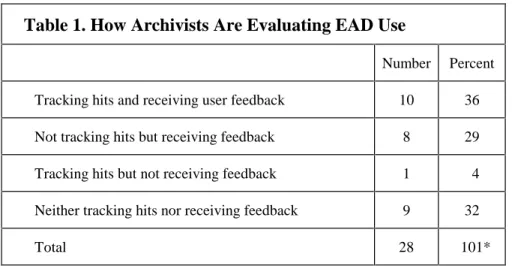
By comparing respondents’ answers to question 2.1. and 2.2. it can be seen that only ten institutions currently track hits and have received some sort of end-user feedback on EAD.
Table 1. How Archivists Are Evaluating EAD Use
Number Percent
Tracking hits and receiving user feedback 10 36
Not tracking hits but receiving feedback 8 29
Tracking hits but not receiving feedback 1 4
Neither tracking hits nor receiving feedback 9 32
Total 28 101*
Eight responses indicated that archivists were receiving feedback but not tracking hits, while one response indicated the opposite, the respondent was tracking hits, but had not received any end-user feedback. The nine remaining institutions neither track hits nor receive end-user feedback, and it is unclear upon what information these archivists are basing their perception of user traffic.
Question 2.2a asked respondents to elaborate on the type of feedback received to see if archivists are drawing on end-user feedback as a basis for their perceptions, what type of feedback they are receiving, how they are gathering it, and what are their perceptions. Most participants identified end-user feedback to be anecdotal and impressionistic data, gleaned through email, written feedback, and personal interaction with researchers. Ten responses specifically mentioned email messages as feedback, while six responded that one-on-one reference question-and-answer sessions or
unsolicited comments from end-users were the informal means for gathering feedback. Only three respondents indicated they have instituted formal processes for user feedback. One institution has an online feedback page connected to its site, however, the response stated that only one end-user has offered any evaluation of the site. Another institution has had a user survey administered for a study but has not yet received the resulting data. This indicates that most respondents are not basing their perceptions about end-users utilization on any formal system of evaluation.
printouts of our finding aids.” This, some archivists felt, contributed to the overall satisfaction patrons have with EAD encoded finding aids because the process “saves time and expense of mailing finding aids, [and] saves time of reference staff when asked questions that can be immediately referred to [in] the finding aid.” However, several archivists were skeptical of end-users’ knowledge of and ability to distinguish between EAD, HTML, and other types of electronic finding aids. Several respondents suggest that end-users do not “distinguish between EAD and non-EAD” and suspect that end-users “use the HTML versions” because they believe “hardly anyone goes to the trouble of getting an SGML browser when an HTML version” is available, and one archivist’s response indicated that end-users “give equally good feedback for the PDF finding aids.” Even without formal standards for end-user evaluation of EAD encoded finding aids, archivists find that the informal anecdotal and impressionistic feedback they receive from their end-users is “sufficient to keep us moving forward.”
Question 2.3.a asked respondents if they perceived user traffic of EAD encoded finding aids through their deployment methods to be high, medium, or low. With the exception of one response, all archivists perceived user traffic to be either medium, (seventeen—61%) or low (ten—35%). The one archivist who perceived there to be a high use of user traffic does not track hits and has not received any end-user feedback. It would seem from this data, archivists base their perception of use on informal user feedback.
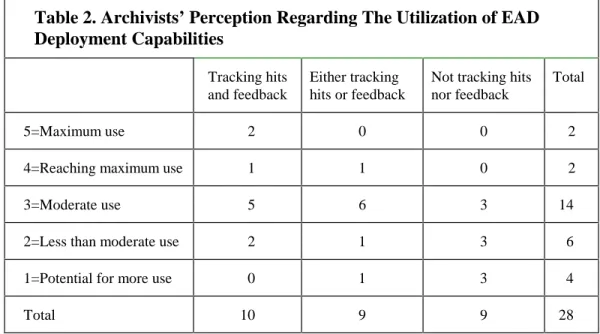
indicated that they perceived their deployment’s capabilities were being used either to “maximum use” or “reaching maximum use,” while ten perceived use to be “less than moderate” or having “potential for more use.” Most of these responses followed consistently with whether respondents answered yes to tracking hits and receiving feedback, or no to tracking hits and receiving no feedback. Those archivists who track
Table 2. Archivists’ Perception Regarding The Utilization of EAD Deployment Capabilities
Tracking hits
and feedback
Either tracking hits or feedback
Not tracking hits nor feedback
Total
5=Maximum use 2 0 0 2
4=Reaching maximum use 1 1 0 2
3=Moderate use 5 6 3 14
2=Less than moderate use 2 1 3 6
1=Potential for more use 0 1 3 4
Total 10 9 9 28
answered either that there was potential for more use (1) or there was less than moderate use (2).
Question 2.3.c asked archivists to elaborate on areas in which their deployment method could be improved. Ten archivists commented that increased visibility and improved access and searching capabilities would allow end-users to better utilize their EAD finding aids. Three felt they could improve the utilization of their sites if their institution linked finding aids to the local OPAC. One commented “it would be nice if there was a way that our material could be pooled with other…archives. People doing research with us, are often doing research with other…archives [with similar holdings].” Others believe deployment capabilities depend heavily on the quality of the content, and admit their deployment method could “support much more sophisticated intellectual access than we have provided for.” One admitted that the poor quality of their older finding aids “limits what we can do on the deployment end.” Most advocate improving upon current stylesheets, tagging and indexing at a finer level (or at least standardizing spelling across finding aids to make name searching more precise), and searching across finding aids and other metadata. Finally, one suggests that “better explanations of how to search and how to interpret results,” would lead to better utilization of deployment
methods.
Questions 2.4 and 2.5 asked respondents what their perception of user satisfaction was regarding their deployment method’s access and the overall satisfaction of the
end-users’ satisfaction with the overall deployment method, only two (7%) thought end-users were “very satisfied,” nine (32%) felt users were “satisfied,” eleven (39%) believe end-users to be “moderately satisfied,” and six (22%) perceived end-end-users to be “moderately unsatisfied” with deployment methods.
Conclusion
Initially, archivists selected their deployment methods for EAD finding aids based on relative ease of use, accessibility, availability, and affordability. After a few years of implementing the EAD structure and delivering EAD finding aids though various deployment methods, archivists find that several problems or challenges remain. These include a steep learning curve for the entire EAD process, not having enough resources in the form of time and staff, and most especially, difficulty with deployment software. While archivists are currently employing a variety of deployment methods, there has yet to be developed a single ideal deployment method. Archivists have also found that finding aids in general must be improved even before considering EAD. Many
institutions have legacy finding aids that have a variety of problems, such as being poorly structured and difficult to understand.
finding aids because some of the current deployment methods, such as Dynaweb and Panorama, are no longer being supported, while others, such as Internet Archivist, have
suspended sales pending a review of new technologies. Most current implementers of EAD are engaged in processes that will change the deployment methods delivering EAD finding aids. Institutions, looking to improve access to their EAD finding aids, are contemplating new, more sophisticated technologies, such as XML, to allow for better navigability, improved user interface, and more control over what information is retrieved.
Perhaps most troublesome is that few institutions are developing formal evaluations for monitoring the effectiveness of EAD, and in fact there is very little evaluation being conducted. Thus, archivists are basing their perceptions regarding end-user utilization of EAD finding aids on very little quantitative or systematic qualitative data. Many archivists don’t rely on tracking hits as an evaluation tool, preferring instead to use feedback from end-users to evaluate the effectiveness of their online finding aids. One of the problems with this process is that remote users who do not physically visit archives are being underrepresented in the evaluation. User studies are needed, of both real users and focus groups for archivist to fully develop an understanding of how end-users make use of finding aids.
The little information that is gathered for evaluation, suggests that end-users don’t seem to care about the structure or format of the finding aids, just the content. A
policies and procedures is less than desirable because the public is unfamiliar with researching in an archive. But whose fault is this? Visiting the web sites of EAD
implementers reveals that most lack basic information for end-users regarding EAD, such as a description or definition of EAD. Only twenty-six web sites describe or define EAD, and seventeen sites make no mention of EAD, or if mentioned, never explain how it works or the benefits associated with it. Archivists are failing to educate their end-users regarding EAD specifically, and institutional procedures, generally.
Archival repositories must make a commitment to educate their remote users about the advantages of EAD before they can assume to receive better responses from their users when asked for feedback. The public may not be willing to get involved with evaluating the effectiveness of electronic finding aids, however, archivists can draw on scholars, such as historians, whom archivists consider a traditional user group, because they are familiar with research techniques and archival policies and procedures. This group may be more willing to participate in evaluation of delivery system if archivists educate them on the benefits of EAD.
Notes
1
When the author gathered research for the paper (2001: January-February), the Official EAD Web Site (http://www.loc.gov/ead) maintained by the Library of Congress Network Development and MARC Standards Office (NDMSO) was current only up to October 2000. Returning to view the EAD site upon completion of this paper, the author found the latest update for the EAD web site listed as 23 March 2001. Currently, the link to “EAD Sites on the World Wide Web” is linked to the University of Virginia’s web site (http://jefferson.village.virginia.edu/ead/sitesann.html). The information found at Virginia’s web site is listed as being “parallel to that at the Library of Congress.”
2
For the development of NUCMC, see: David C. Mearns, “To be Enduring: The National Union Catalog of Manuscript Collections,” College and Research Libraries 20 (1959), 341-346; Lester K. Born, “The National Union Catalog of Manuscript Collections:
Progress,” The American Archivist 23 (July 1960), 311-314; Arline Custer, “The National Union Catalog of Manuscript Collections,” Library Resources and Technical Services 8 (1964), 188-220; Frank G. Burke, “Manuscripts and Archives,” Library Trends 15 (January 1967), 430-445, and “Automation in Bibliographical Control of Archives and Manuscript Collections,” in Bibliography and the Historian (Santa Barbara: Clio Press, 1968), 96-102; and Terry Abraham, “NUCMC and the Local Repository,” The American Archivist 40 (January 1977), 31-42.
3
For discussions about MARC AMC see Steven L. Hensen, “The Use of Standards in the Application of the AMC (Archival and Manuscripts Control) Format,” The American Archivist 49 (Winter 1986), 31-40; Nancy Ann Sahli, “Interpretation and Application of the AMC (Archival and Manuscripts Control) Format,” The American Archivist 49 (Winter 1986), 9-20; and Smiraglia, Richard P., ed., Describing Archival Materials: The Use of the MARC AMC Format, New York: Haworth Press, 1990.
4
For a discussion on the difficulties archivists face in searching database environments, see Helen R. Tibbo, “The Epic Struggle: Subject Retrieval from Large Bibliographic Databases,” American Archivist 57 (Spring 1994), 310-326.
5
A link to the EAD Cookbook can be found at:
(http://jefferson.village.virginia.edu/ead/cookbookhelp.html)
6
Relative advantage is “the degree to which an innovation is perceived as better than the idea it supercedes;” compatibility is “the degree to which an innovation is perceived as being consistent with the existing values, past experiences, and needs of potential adopters;” complexity is “the degree to which an innovation is perceived as difficult to understand and use;” trialability is “the degree to which an innovation may be
7
Information regarding the deployment methods can be found at the following URLs: RLG’s Archival Resources (http://www.rlg.org/arr/index.html), InQuery
(http://www.sovereignhill.com), DynaText (http://www.ebt.com/index2.htm), Internet Explorer 5.0 (http://www.microsoft.com/windows/IE/), OmniMark
(http://www.omnimark.com/home/home.html), Isite (http://www.cnidr.org/ir/ir.html), MultiDoc Pro (http://www.citec.fi/company/it/mdp/), Panorama
(http://www.interleaf.com/Panorama/page3.html), Internet Archivist – EAD (), Cheshire II (http://cheshire.lib.berkeley.edu/), Livelink
(http://www.opentext.com/livelink/index.html), as well as languages such as MySQL (http://www.mysql.com/), Perl (http://www.perl.com/pub), and Verity’s Query Language (http://www.verity.com/products/index.html).
8
(http://www.loc.gov/ead) Note that this page was updated March 2001, two months after the initial visit of the author. Some information may have changed.
9
Appendix A
Institutions Listed as Current Implementors of the EAD DTD
Found on the EAD Web page
American Institute of Physics, Niels Bohr Library Berkeley Art Museum/Pacific Film Archive
Bodleian Library, Department of Special Collections and Western Manuscripts Brandeis University Libraries
California State University, Dominguez Hills
Columbia University, Rare Book and Manuscript Library Cornell University
Duke University, Rare Book, Manuscript, and Special Collections Library Durham University Library
Emory University Special Collections Harvard University/Radcliffe College Historic Pittsburgh Finding Aids project International Institute of Social History
Iowa Women’s Archives, University of Iowa Libraries
Johns Hopkins Medical Institutions, Chesney Medical Archives Library of Congress Finding Aids Project
Louisiana State University Libraries Minnesota Historical Society
National Library of Medicine, History of Medicine Division New York Public Library
North Carolina State University Libraries Old Dominion University
Public Record Office (United Kingdom)
Rutgers University / Center for Electronic Texts in the Humanities (CETH) Santa Clara University Archives
Appendix A (continued)
South Texas Archives, Texas A&M University
State Historical Society of Wisconsin, Archives Division Syracuse University Library
United Methodist Church Archives – GCAH
University of California, Berkeley (incorporating the Online Archive of California) University of California, San Diego, Mandeville Special Collections Library University of Chicago Library, Department of Special Collections
University of Glasgow, Glasgow University Archives & Business Records Centre University of Illinois
University of Liverpool Special Collections University of Notre Dame Archives
University of Michigan, Bentley Historical Library
University of North Carolina at Chapel Hill, Manuscripts Department University of Pennsylvania, Annerberg Rare Book & Manuscript Library University of Sydney Libraries (SETIS)
University of Vermont Special Collections
University of Virginia Library, Special Collections Department University of Warwick, Modern Records Centre
Utah State Archives
Appendix B
Email Recruitment Letter
Subject Heading: Request for participation in EAD study Dear _________:
I am a graduate student writing to request your participation in a study regarding
deployment methods for EAD finding aids because your institution is one of forty-seven sites currently linked to the official EAD homepage (http://www.loc.gov/ead/) as an EAD implementor and your experience and opinions will be extremely valuable to this study. This study is being carried out under the supervision of Dr. Helen R. Tibbo to fulfill the master’s paper requirement for a Master of Science in Library Science degree from the University of North Carolina at Chapel Hill (UNC).
The research for the study will be in the form of a brief questionnaire that asks a variety of questions about the current state of deployment and attitudes of participants toward their institution’s deployment method for EAD finding aids. If you choose to participate, please fill out the survey located at <http://www.ils.unc.edu/~rothj/mp/survey.html>. It should take no more than 30 minutes of your time.
Participation in this study is completely voluntary, and no risks are anticipated to respondents. You may refuse to answer any question, and all information you provide will be confidential. The Academic Affairs Institutional Review Board (AA-IRB) of the University of North Carolina at Chapel Hill has approved this study.
Please contact Dr. Tibbo or me if you have any questions about the study or the survey itself, and contact the UNC-CH AA-IRB if you have any questions or concerns about your rights as a participant in this research. Contact information for each of us is available below.
Sincerely, James M. Roth
601 Jones Ferry Rd., Apt F1 Carrboro, NC 27510
(919) 942-5142
[email protected] Academic Affairs Institutional Review Board
Dr. Barbara D. Goldman, Chair
Advisor: CB# 4100, 201 Bynum Hall
Dr. Helen R. Tibbo Univ. of North Carolina at Chapel Hill
(919) 962-8063 Chapel Hill, North Carolina 27599-4100
Appendix C Online Survey
Your Institution: ____________________ I. Deployment
1.1. How is your institution deploying EAD finding aids? (check all that apply)
_____ HTML on the fly
_____ (SGML or XML) server side (such as DynaWeb) _____ (SGML or XML) client side server (such as Panorama) _____ Plans for search engine
_____ No web presence
_____ Both HTML and (SGML or XML)
1.2. At your institution, approximately how many finding aids have you deployed in:
_____ Electronic formats (total of all format types) _____ HTML not encoded by EAD mark-up _____ HTML encoded by EAD mark-up _____ SGML/XML
_____ Other (such as ASCII or a database)
1.3. At your institution, how long have you been deploying finding aids using EAD? Since (month, year):_____________
1.4. Why did you select your current deployment method?
1.5. Do you have plans for changing your deployment method? _____ yes
_____ no
1.6. Please elaborate on your plans (how would this change your current deployment method?)
1.7. Suppose you were given unlimited financial and human resource support, how would you like to implement EAD at your institution?
II. Utilization
2.1. Are you currently tracking your SGML/XML finding aid hits? _____ yes
_____ no
If your institution does not track electronic finding aids in any format, please continue to question 2.2. If your institution only uses HTML, please continue to question 2.2.
If your institution only uses SGML and tracks hits, please answer question 2.1.a, and continue to question 2.2.
If your institution uses SGML/XML and HTML and tracks hits, please answer questions 2.1.a and 2.1.b.
2.1.a How many hits do your SGML/XML finding aids receive? (average per week)
2.1.b How many hits do your HTML finding aids receive? (average per week)
2.2. Have you received any feedback from users regarding the use of SGML encoded finding aids?
_____ yes (please answer question 2.2.a.) _____ no (please continue to question 2.3)
2.2.a Please elaborate on the type of feedback you have received.
(example: user survey, informal question and answer session, email responses, etc.) 2.3.a What is your perception of the user traffic of EAD?
____ High traffic ____ Moderate traffic ____ Low traffic
2.3.b Do you think your deployment method is being used to the fullest extent of its capabilities?
Potential for more use 1 2 3 4 5 Achieving maximum potential 2.3.c How could it be better utilized?
2.4. How satisfied do you think your patrons are with your current deployment’s access? Unsatisfied 1 2 3 4 5 Very satisfied
2.5. On a scale of 1 to 5, how do you perceive user satisfaction regarding EAD deployment methods at your institution?
Appendix D
Second Email Recruitment Letter
Subject Heading: Reminder: Request for participation in EAD study
Dear _________:
On Thursday, March 28, 2001, an email letter was sent to you requesting you participation in a study regarding deployment methods for EAD finding aids because your institution is one of forty-seven sites currently linked to the official EAD homepage (http://www.loc.gov/ead/) as an EAD implementor. As of this email posting, I have not received your completed questionnaire.
I have undertaken this exploratory study regarding the current state of deployment and attitudes of participants toward their institution’s deployment method for EAD finding aids to gain insight into the best methods for deploying EAD generated finding aids and to further the study of electronic access to archival and manuscript collections.
Because the request for participation was sent to only forty-seven institutions, it is extremely important that your responses are included in this study if the results are to accurately reflect the current state of deployment for EAD generated finding aids at leading implementor institutions. If you have already completed and returned the questionnaire please accept my sincere thanks. If not, please fill out the survey located at <http://www.ils.unc.edu/~rothj/mp/survey.html>. It should take no more than 30 minutes of your time.
Your participation in this study is completely voluntary, and no risks are anticipated to respondents. You may refuse to answer any question, and all information you provide will be confidential. The Academic Affairs Institutional Review Board (AA-IRB) of the University of North Carolina at Chapel Hill has approved this study.
This study is being carried out under the supervision of Dr. Helen R. Tibbo to fulfill the master's paper requirement for a Master of Science in Library Science degree from the University of North Carolina at Chapel Hill (UNC). Please contact Dr. Tibbo or me if you have any questions about the study or the survey itself, and contact the UNC-CH AA-IRB if you have any questions or concerns about your rights as a participant in this research. Contact information for each of us is available below.
Sincerely,
James M. Roth
601 Jones Ferry Rd., Apt F1 Carrboro, NC 27510
(919) 942-5142 Academic Affairs Institutional Review Board
[email protected] Dr. Barbara D. Goldman, Chair
CB# 4100, 201 Bynum Hall
Advisor: Dr. Helen R. Tibbo The Univ. of North Carolina at Chapel Hill
(919) 962-8063 Chapel Hill, North Carolina 27599-4100
Bibliography
Abraham, Terry. “NUCMC and the Local Repository.” The American Archivist 40 (January 1977) : 31-42.
Bearman, David. Towards National Information Systems for Archives and Manuscript Repositories: The National Information Systems Task Force (NISTF) Papers, 1981-1984. Chicago: The Society of American Archivists, 1987.
Born, Lester K. “The National Union Catalog of Manuscript Collections: Progress.” The American Archivist 23 (July 1960) : 311-314.
Burke, Frank G. “Automation in Bibliographical Control of Archives and Manuscript Collections.” In Bibliography and the Historian, 96-102. Santa Barbara : Clio Press, 1968.
---. “Manuscripts and Archives.” Library Trends 15 (January 1967) : 430-445. Custer, Arline. “The National Union Catalog of Manuscript Collections.” Library
Resource and Technical Services 8 (1964) : 188-220.
Dooley, Jackie M. “Introduction—Encoded Archival Description: Context and Theory.” The American Archivist 60 (Summer 1997) : 264-265.
Dooley, Jackie M., ed. “Special Issue on Encoded Archival Description: Part 1—Context and Theory.” The American Archivist 60 (Summer 1997) : 262-366.
---. “Special Issue on Encoded Archival Description: Part 2—Case Studies.” The American Archivist 60 (Fall 1997) : 367-498.
Fox, Michael J., ed. EAD Cookbook.
(http://jefferson.village.virginia.edu/ead/cookbookhelp.html) : 2000.
Hensen, Steven L., ed. Archives, Personal Papers, and Manuscripts: A Cataloging Manual for Archival Repositories, Historical Societies, and Manuscript Libraries, 2nd ed. Chicago : The Society of American Archivists, 1989.
---. “‘NISTF II’ and EAD: The Evolution of Archival Description.” The American Archivist 60 (Summer 1997) : 284-296.
---. “The Use of Standards in the Application of the AMC (Archival and Manuscripts Control) Format.” The American Archivist 49 (Winter 1986) : 31-40.
Kiesling, Kris. “EAD as an Archival Descriptive Standard.” The American Archivist 60 (Summer 1997) : 344-354.
Mearns, David C. “To be Enduring: The National Union Catalog of Manuscript Collections.” College and Research Libraries 20 (1959) : 341-346.
Miller, Fredric M. Arranging and Describing Archives and Manuscripts. Chicago : The Society of American Archivists, 1990.
Rogers, Everett M. Diffusion of Innovations, 4th ed. New York : Free Press, 1995. Pitti, Daniel V. “Encoded Archival Description: The Development of an Encoding
Standard for Archival Finding Aids.” The American Archivist 60 (Summer 1997) : 268-283.
Ruth, Janice E. “Encoded Archival Description: A Structural Overview.” The American Archivist 60 (Summer 1997) : 310-329.
Sahli, Nancy Ann. “Interpretation and Application of the AMC (Archival and
Manuscripts Control) Format.” The American Archivist 49 (Winter 1986) : 9-20. Schellenberg, T. R. The Management of Archives. New York : Columbia University
Press, 1965.
Smiraglia, Richard P., ed. Describing Archival Materials: The Use of the MARC AMC Format. New York : Haworth Press, 1990.
Society of American Archivists Encoded Archival Description Working Group. Encoded Archival Description Application Guidelines, Version 1.0. Chicago : The Society of American Archivists, 1999.
Society of American Archivists Encoded Archival Description Working Group. Encoded Archival Description Tag Library, Version 1.0. Chicago : The Society of
Tatem, Jill. “EAD: Obstacles to Implementation, Opportunities for Understanding.” Archival Issues 23, no 2 (1998) : 155-169.
Tibbo, Helen R. “The Epic Struggle: Subject Retrieval from Large Bibliographic Databases.” The American Archivist 57 (Spring 1994) : 310-326.
Watson, Bradley C. “Arbitrary SGML Viewers and Their Role in Online Text Delivery Systems.” Annual Review of OCLC Research.