GLOBAL
PUBLIC
HEALTH
LEADERSHIP:
ADAPTATION
OF
THE
MATERNAL
AND
CHILD
HEALTH
PUBLIC
HEALTH
LEADERSHIP
INSTITUTE
CURRICULUM
FOR
INDIA
By
Sarah K. Bradford
A paper presented to the faculty of The University of North Carolina at Chapel Hill in partial fulfillment of the requirements for the degree of Master of Public Health in the
Department of Maternal and Child Health. Chapel Hill, N.C.
Submitted: April 3, 2014 Approved by:
Table of Contents
Abbreviations ... i
Map of India ... iii
Abstract ... iv
Research Aims ... 1
Public Health Leadership ... 2
History ... 2
Leadership vs. Management ... 3
Maternal and Child Health Public Health Leadership Institute ... 4
Background ... 4
Program Structure ... 6
Curriculum Components ... 8
Global Leadership Development ... 15
Existing Research ... 15
India Leadership Programs ... 17
Center for Creative Leadership ... 18
Leadership Development for Mobilizing Reproductive Health ... 19
National Institute of Health and Family Welfare ... 21
Public Health Foundation of India ... 22
India Leadership Initiative ... 23
Methods ... 24
Results ... 27
Demographic Characteristics ... 27
Content Analysis ... 29
Conclusions ... 37
Recommendations ... 38
Policy Implications ... 40
References ... 41
Acknowledgements ... 44
Appendices ... 45
Appendix I: Definition of MCH PHLI Leadership Skills ... 45
Appendix II: Just-in-Time (JiT) Training Modules ... 47
Appendix III: Informant Interview Field Guide ... 50
Abbreviations
AIDS Acquired immune deficiency syndrome
AMCHP Association of Maternal and Child Health Programs
BEI Behavioral Event Interview
CCL Center for Creative Leadership
CDC Centers for Disease Control and Prevention
CLS Continuous Learning System
ELP Effective Leadership Program
HIV Human immunodeficiency virus
HR Human resources
IDP Individual Development Plan
IIE Institute of International Education
IIE WCC Institute of International Education West Coast Center
IIPH Indian Institute of Public Health
ILI Indian Leadership Initiative
IOM Institute of Medicine
JiT Just-in-TimeTraining Modules
LBB Leadership Beyond Boundaries
LDM Leadership Development for Mobilizing Reproductive Health
LDP Leadership Development Programme
LMIC Low and middle-income countries
MCH LC Maternal and Child Health Leadership Competencies
MCH PHLI Maternal and Child Health Public Health Leadership Institute
MMR Maternal Mortality Ratio
NCCC National Center for Cultural Competence
NGO Non-governmental organization
PHFI Public Health Foundation of India
PHLI Public Health Leadership Institute
PI Private Investigator
PLP Personal Leadership Project
UNC University of North Carolina at Chapel Hill
US United States
USAID United States Agency for International Development
Abstract
Objectives: This study addresses the adaptation of the Maternal and Child Health Public Health Leadership Institute (MCH PHLI) curriculum in an international setting within the context of India.
Methods: A qualitative study design was used consisting of an electronic survey, exploratory and semi-structured interviews with Indian MCH professionals. Field notes were manually coded to look for emerging themes and topics related to the study objectives.
Results:Analysis revealed four emerged themes: leadership attributes; perceived need for MCH leadership training; culturally relevant leadership competencies; and perceived barriers to MCH PHLI adaptation.
Conclusions:There is a perceived need for MCH leadership training in India. The MCH PHLI curriculum will need to be adapted to address program and cultural barriers
identified in study analysis.
Research Aims
Although the field of Maternal and Child Health (MCH) in the United States (US) has focused significantly on leadership development, an online search, including
variations of the terms maternal and child health, leadership development programs, trainings, and developing, low or middle-income countries revealed there are no existing MCH leadership training curriculums implemented in low and middle-income country (LMIC) settings. However, since the World Health Organization (WHO) defined
leadership and governance as one of six key building blocks of any health system, there is an emerging shift towards leadership development in LMICs. 1 In the context of India, this project seeks to answer the following research questions: 1) Is there a perceived need for MCH leadership development? and 2) Can the Maternal and Child Health Public Health Leadership Institute (MCH PHLI) curriculum be adapted for MCH professionals in India? The objectives of this project are:
• To identify the need for leadership training for MCH professionals in India • To distinguish leadership competencies important to MCH public health
professionals in India
• To identify perceived barriers for implementation of the MCH PHLI
Public Health Leadership
History
Since the 1980s, developing public health leaders has been a priority in the US. 2 In 1988, the director of the Centers for Disease Control and Prevention (CDC), Dr. William Roper, made an official call for implementing leadership development training for all components of governmental public health. 2 Shortly after, the CDC funded an individual model of public health leadership development by establishing the National Public Health Leadership Institutes (PHLI) in 1992 and the National Public Health Training Network in 1993. 3 Since that time, the field of public health has made significant investments in workforce leadership training, with up to 27 PHLIs in more than 45 states. 4
Since 1988 when the Institute of Medicine (IOM) released the report, The Future of Public Health, outlining the need for increased leadership development training, many categorical leadership institutes have developed at the national level. 2,5 Discipline
specific programs have emerged for environmental professionals, state health officials, and those in health education. 2 In April 2004, the Maternal and Child Health Bureau (MCHB) assembled a national working group to develop a framework to guide integrated leadership development. 4,6 This led to the formation of the MCH Competencies Working Group composed of individuals representing MCH training programs, the Association of Maternal and Child Health Programs (AMCHP), and CityMatCH. 6 As a result of this working group, the MCHB released the Maternal and Child Health Leadership
“An MCH leader is one who understands and supports MCH values, mission and goals with a sense of purpose and moral commitment. S/he values
interdisciplinary collaboration and diversity, and brings the capacity to think critically about MCH issues at both the population and individual levels, to
communicate and work with others, and to utilize self-reflection. The MCH leader demonstrates professionalism in attitudes and working habits, and possesses core knowledge of MCH populations and their needs. S/he continually seeks new knowledge and improvement of abilities and skills central to effective, evidence-based leadership. The MCH leader is also committed to sustaining an
infrastructure to recruit, train and mentor future MCH leaders to assure the health and well-being of tomorrow’s children and families. Finally, the MCH leader is responsive to the changing political, social, scientific and demographic context, and demonstrates the ability to change quickly and adapt in the face of emerging challenges and opportunities. The MCH leader uses these skills and abilities to maintain and improve the health and well-being of MCH populations.”7
Leadership vs. Management
Before taking a closer look at the role for public health leadership in the field of MCH, it is important to address what constitutes leadership and what does not.
leader enables others to approach challenges and overcome obstacles while working together with a shared mission and vision. 9 Good leadership is particularly important in emergency situations as it can empower and align people to move forward in difficult circumstances. 9
In contrast, management focuses more on the present and on assuring that operations, processes, and procedures needed to accomplish a goal run efficiently and effectively. 2,8 It involves strategic planning and allocating resources efficiently to produce intended results. 9 Neither function takes precedence over the other, but rather it is important for public health leaders to implement both functions on a regular basis. 2
Maternal and Child Health Public Health Leadership Institute
Background
MCH PHLI is a yearlong leadership program targeted to mid-to-senior level leaders in government based Title V or family advocacy positions. The program is based at UNC, and was created by the MCH PHLI leadership team in collaboration with
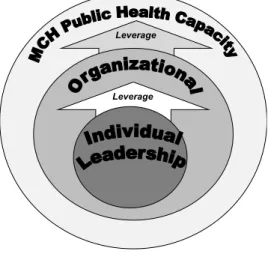
representatives from four partner organizations: AMCHP, CityMatCH, Family Voices National, and the National Center for Cultural Competence. 10 The program is based on a conceptual training model that focuses on three cores of skills: individual leadership, organizational leadership, and system level leadership to build MCH public health capacity. (Figure 1)
Figure 1: The progressive and concentric MCH PHLI conceptual model for leadership
development
Additionally, MCH PHLI is composed of five goals that address educational and capacity building objectives. Goals 1-3 provide the foundation for the program’s focus on
individual leadership development. 4 Goals 4-5 are centered on building collaboration with MCH key partners and improving leadership capacity.
!
Leverage
The Concentric Model of Leveraging Leadership Development Impact
Leverage
Goal 1: Develop sophisticated individual leadership skills in an annual cadre of up to 30 professionals in mid-to-senior leadership positions in the field of maternal and child health and public health.
Goal 2: Foster the ability of these leaders to leverage those skills to impact the organizational systems of their home programs.
Goal 3: Enhance the ability of these leaders to leverage their organizations to create impact in their community and political systems.
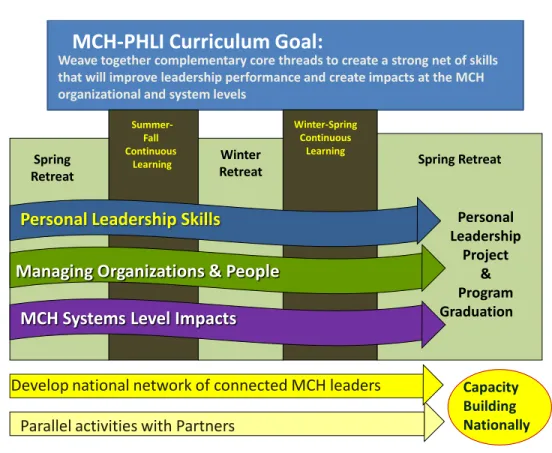
Goal 4: Develop a strong network of MCH public health workforce professionals nationally through the creation of an MCH PHLI Community of Learners. Goal 5: Build the capacity of MCH Title V and MCH public health and community
focused-leadership nationally through a parallel set of activities to address
national organizational leadership capacity development in collaboration with key stakeholder groups representing the MCH workforce at the city, county and state level and consumers of MCH services.
Program Structure
The MCH PHLI curriculum utilizes both retreat-based and distance-based phases with the goals of addressing educational and capacity building objectives. 4 Three
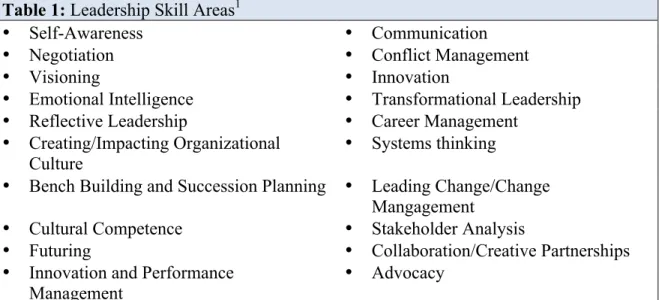
Table 1: Leadership Skill Areas1
• Self-Awareness • Communication
• Negotiation • Conflict Management
• Visioning • Innovation
• Emotional Intelligence • Transformational Leadership
• Reflective Leadership • Career Management
• Creating/Impacting Organizational
Culture • Systems thinking
• Bench Building and Succession Planning • Leading Change/Change
Mangagement
• Cultural Competence • Stakeholder Analysis
• Futuring • Collaboration/Creative Partnerships
• Innovation and Performance
Management •
Advocacy 1 Definitions of Leadership Skills provided in Appendix I
Figure 2: MCH PHLI Program Structure4
Curriculum Components
The residential retreat experience
MCH PHLI Fellows complete 3-5 day residential retreats at UNC during the spring when they matriculate into the program, mid-way through the program at a winter retreat, and again in the spring at the conclusion of the program, which overlaps with the subsequent cohort. 11 Collectively, this provides a total of 13 days of experiential-based learning. During the retreat, Fellows stay onsite and have an opportunity to learn from a multidisciplinary team of faculty and guest speakers. Fellows also complete four
simulation-based exercises and practice sessions at the retreats. 4,10
specifically for public health leaders. 4 The 360-degreeassessment involves a multi-level evaluation focusing on an individual’s leadership style and how it relates to the
achievement of the mission and goals of an organization. 8 These assessments provide a foundational understanding of personality structures, human motivation, change
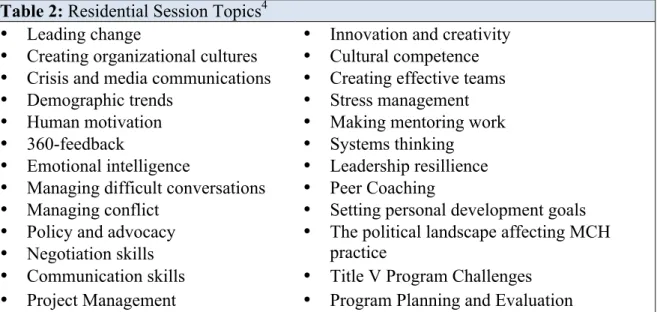
management, conflict, emotional intelligence, innovation, and organizational behavior. 10 Leadership and MCH topics addressed in the residential retreat component are listed in Table 2.
Table 2: Residential Session Topics4
• Leading change • Innovation and creativity • Creating organizational cultures • Cultural competence • Crisis and media communications • Creating effective teams • Demographic trends • Stress management
• Human motivation • Making mentoring work
• 360-feedback • Systems thinking
• Emotional intelligence • Leadership resillience • Managing difficult conversations • Peer Coaching
• Managing conflict • Setting personal development goals • Policy and advocacy
• Negotiation skills
• The political landscape affecting MCH
practice
• Communication skills • Title V Program Challenges • Project Management • Program Planning and Evaluation
The distance based program: the CLS experience
1.) Executive Coaching: In the program, Fellows experience two sets of executive coaching. During the first residential retreat, Fellows meet with a professional executive coach who is not a faculty member of the program. Throughout the remainder of the year, Fellows receive ongoing executive coaching from an individually assigned yearlong coach who is a member of the MCH PHLI faculty. All yearlong coaches are experts in the field of leadership and in public health, and certified in MCH PHLI assessments. 4 Ideally, Fellows are matched with a MCH PHLI yearlong (or faculty) coach that shares common interests in their professional discipline. 4 Fellows are required to complete a minimum of four, and up to 10, private confidential sessions with their individual executive coach. 11 With the exception of the first residential retreat, executive coaching occurs via the phone. The purpose of these sessions is for Fellows to gain an
understanding and interpretation of leadership assessments and topics of personal interest. 11
2.) Peer Coaching: During the initial residential retreat, Fellows are trained in peer coaching methodology. After the retreat, Fellows participate in monthly, phone-based peer coaching sessions composed of three to four individuals grouped together based on the topic of their PLPs. 11 The purpose of this component is to provide Fellows with peer support for their PLPs and opportunities to network and bond with other cohort
members.4,10
feedback they receive from their first three assessment tools, including the public health 360-degree assessment. There are no restrictions placed upon this requirement; however they are guided to set goals for personal development, managing teams and organization skills, and addressing a systems-level perspective relevant to their area of expertise. 4 The development of strong leadership goals is important as these goals guide the Fellows’ executive coaching sessions and peer coaching sessions. 11
4.)Ongoing Leadership Skills Assessment: During the first month of the program, Fellows complete an online self-assessment of 20 leadership skills (See Figure 1). The 20 skills targeted in this assessment are based on current leadership theory, research, and the MCH Leadership Competencies 3.0. 4 This assessment guides their ongoing executive coaching experience as coaches utilize assessment feedback to direct Fellows to program resources and to areas they may be interested in strengthening. At the conclusion of the program, Fellows complete this assessment again as a pre- and post-test analysis of learning and development through the program.4
5.)Online Leadership Diary: Through their own private space at the MCH PHLI
website (www.mchphli.org), Fellows practice leadership skills in a written format. This component follows the Behavioral Event Interview (BEI) method, which is a skill for both hiring appropriately and managing individual career progression. 11 Material
composed in this space is accessible only to the Fellow and the coaching team, including the MCH PHLI yearlong coaches and peer coach. 4 The peer coach is a member of the MCH PHLI faculty that manages and teaches the peer coaching groups during the fellowship year. All MCH PHLI yearlong coaches are doctoral public health
executive coach for each Fellow. This component allows Fellows to receive feedback from their executive coach on the 20 leadership skills related to senior positions in the field, and prepares each individual to interview competitively. 4
6.)Conference Calls and Webinars: Throughout the program year, Fellows are able to
individually select from a diverse series of conference calls and webinars with the disciplines of leadership and MCH. Approximately 24 sessions are offered during the year, and all sessions are recorded and posted to the secure interface of the MCH PHLI website for interested Fellows who are not able to attend the call. Once a Fellow has listened or attended a session, they develop and submit a learning review to receive credit for their participation. 4 Successful Fellows attend at least four conference calls and three webinars during the year.11
7.)Just-in-Time (JiT) Training Modules: During the year, Fellows are required to complete at least four JiT training modules to graduate from the program. 11 A library of 22 web-based programs, ranging in duration from 30-60 minutes, is offered that provide tutorials on practical leadership, management, and other useful topics (Appendix II). 4,11 Fellows have access to all materials during the year, and may review all the modules as often as they choose.
Coaching component. 4 Fellows are required to complete their projects in a 15-18 month time frame following the start of the program.11
9.)MCH PHLI Book Clubs: Fellows are provided four books on current leadership
topics. Three conference calls are offered, in the form of a “book club” experience, so Fellows may receive support in understanding the material. Fellows have the option of participating in each call, where they may select to listen to all or a section of the call.
10.) Mentoring: Incoming Fellows are matched with a graduating Fellow who serves as
a mentor to them, enabling Fellows to serve both as a mentor and a mentee during the program. In addition, incoming Fellows are required to find a mentor who is not a part of the program. Fellows receive guidance on finding a mentor and developing this
relationship through a small group session at the first residential retreat and an available JiT module on mentoring. Individuals who have been identified as mentors receive a written orientation to the program and direction from the institute director on their mentee’s program experience. 4
Table 3: Distance-Based Session Topics
• Advocacy in the face of power
differentials
• Moving from Direct Services to
Infrastructure Building in Public Health: Implications for Leadership and Accountability
• Stress management and staying alive
in leadership
• Working with boards and advisory
councils
• Special issues in women’s
leadership
• Communication Strategies: team and
project management
• Creating constructive work cultures • Practical steps for workforce
development
• Cultural competence
• Critical thinking: applications to the
field
• Social marketing theory and
application for public health
• Understanding and applying
evidence
• Building employee engagement • Strategies for hiring for fit and skill • Creating emotionally intelligent
workplaces
•What You Need to Know About Social
Media
•Understanding the impacts of
demographic shifts on the future of the field
•Innovation and design thinking as
applied to public health
•Impact of Health Reforms on the field •Understanding MCH Systems
•Stakeholder analysis and successfully
managing external stakeholders
•Applying adaptive leadership •Creating innovative cultures •Creating an evaluation plan, logic
models
•Leadership theory
•Understanding the basics of MCH
systems
•Effective communication & advocacy •Building a learning organization •Managing difficult conversations •Mentoring vs. coaching and making
each work
•Leadership success and derailment •Developing program goals and
objectives
Global Leadership Development
Developing leaders across the field of public health has been a priority in the US for over thirty years, and in recent years there has been an increased interest in
strengthening health systems and building capacity in developing countries as well. 2,12 As previously mentioned, the WHO identified six building blocks for a well-functioning health system, including leadership and governance. 1 However, at this time there is little empirical evidence for its impact on service delivery and health outcomes as leadership is often difficult to measure. 12 Currently, there have been two studies that have shown an association of leadership development and practices with improved health service delivery outcomes.
Existing Research
A Case Study from Egypt
In 2002, the Egypt Ministry of Health introduced a Leadership Development Programme (LDP) in the Aswan Governorate with funding from the United States Agency for International Development (USAID) and Management Sciences for Health. 13 The program was initially introduced to help reduce the gap in access and quality of maternal and reproductive health services between underdeveloped governorates in Upper Egypt and urban Egypt [Maternal Mortality Ratio (MMR) averaged 89 per 100,000 live births in 2000 vs. 46 per 100,000 live births, respectively]. 13 The LDP was piloted in three districts with ten teams of doctors, nurses, and midwives participating, representing five primary health units.
workshops over approximately six months. 12,13 Within the program, teams designed their own projects to increase access to family planning services and prenatal and postpartum visits. Through the program, participants learned how to work together for a common goal; manage their resources; mobilize their teams and stakeholders; and inspire each other.13
After participating in the LDP for one year, the teams from the districts of Aswan, Daraw, and Kom Ombo increased the number of new family planning visits by 36%, 68%, and 20% respectively. 12,13 From 2005 to 2007, LDP participants in Aswan Governorate decided to focus their annual goal on reducing the MMR, and they succeeded with an observed reduction from 85.0 per 100,000 live births to 35.5 per 100,000 live births.13After US funding ended, the program was scaled up to 184 healthcare facilities, with the program transferring to other Egypt governorates and 35 other developing countries. 13
LDP Research in Kenya
six months after the program ended for follow-up. 12 Qualitative data was also collected from each LDP team leader through in-person and telephone interviews.
Results from this study showed significant increases in health-service coverage at the district level (p <0.05) in the intervention teams compared to the comparison teams. This study also found significant increases in the number of client visits at the facility level in the intervention group compared to the comparison group (p<0.05). 12 Qualitative interviews with LDP team leaders revealed that for teams able to sustain coverage after the end of the program (approximately two thirds of the teams) contributing factors included an improved work climate due to renovated staff quarters, training, or supervision.12
These results must be interpreted carefully with acknowledgement of several study limitations. First, LDP teams selected their own projects to work on, and therefore measurable indicators varied from team to team. 12 This influenced study results because data analysis could only focus on average coverage or service as opposed to specific indicators across all teams. Despite these limitations, this study supports the use of leadership training programs in developing countries by providing evidence that such interventions positively impact health-service delivery outcomes and can be sustained for at least six months.
India Leadership Programs
organizations with a leadership development focus that are providing training for diverse professionals across India. This section provides an overview of existing leadership programs working in India.
Center for Creative Leadership
The Center for Creative Leadership (CCL) was founded in North Carolina (NC) in 1970, and is considered to be the birthplace of the field of leadership development. 14 CCL is also known for the development of the 360-degree assessment tools specifically for leadership development, and the corporate-focus leadership training format upon which the MCH PHLI program was developed. 14 In 2009, CCL officially opened an office in Pune, India, although research efforts to understand the leadership needs of this region initially began in 2006. 15 CCL India currently offers mid- to senior-level
managers the opportunity to attend a three-day leadership-training program, the Effective Leader Program (ELP), which is available in various regions of India throughout the year. 16 The program provides participants the opportunity to learn practical leadership strategies and assess their personal leadership style through in-class education, group coaching, peer coaching, and feedback from a 360-degree assessment 16 Comparable to the MCH PHLI curriculum, participants also have the opportunity to access e-courses and publications after the in-class component to learn more about specific topics.16
empowerment. 17 Through this initiative, and the ELP, CCL India is working to provide leadership development training for various sectors of the workforce, but there is not a component dedicated to health professionals at this time.
Leadership Development for Mobilizing Reproductive Health
In 2000, the Leadership Development for Mobilizing Reproductive Health (LDM) was founded to support the establishment of leaders who share a vision and commitment to improve family planning and reproductive health services. 18 From 2001 to 2011, the Institute of International Education West Coast Center (IIE WCC) implemented the LDM program in five developing countries, including India. Although this program is focused on improving services within the MCH field, fellows include public health professionals, journalists, Islamic scholars, academics, lawyers, community health workers, medical providers, and government employees. 18 Primary elements of the program include vision building, values, self-knowledge, understanding leadership within the reproductive health context, and skill building. Key leadership skills addressed in the program include communication, teamwork, management, conflict resolution, critical and analytical thinking, and negotiation.
From 2006 to 2011, the program focused on the achievement of three main outcomes: networking, capacity building for individuals and Fellows’ teams in
organizations, and institutionalization of leadership and reproductive health programs. 19 During the fellowship year, the program centers around three key activities. Fellows are offered leadership trainings throughout the year, networking opportunities, and mini-grants are provided as an incentive to foster collaboration and support in implementing
included Fellows hosting seminars and workshops for their community, conducting research for health policy, and disseminating information about reproductive health. 19 Networking opportunities throughout the year provided Fellows time to reconnect, share experiences, and provide updates to help support one another in achieving their goals. Additionally, in 2006 when the program shifted to a more country-based approach, LDM country managers were responsible for mentoring and offered context tailored trainings in leadership skills for Fellows.19
The LDM program in India decided to work specifically within the states of Bihar and Jharkhand because these states are among the poorest in India, with 85% of the population living in villages. 18 In particular, Bihar has the lowest female literacy rate (31%) and the lowest ratio of girls in school. 20 Throughout the LDM India program, from 2001-2011, Fellows designed collective action plans at the state level and established three Regional Information Resource and Advocacy Centers to facilitate capacity building activities. 18 Additionally, through a partnership with Bihar State Women’s Development Corporation, the program was able to implement leadership development training for female community leaders. 18
program. 21 The evaluation report revealed Fellows had mixed feelings on the process of selection; with some feeling an application process open to all would be more
appropriate. 21 Secondly, the evaluation revealed some participants were frustrated with the lack of tools to ensure equal participation and commitment from Fellows. Unlike the MCH PHLI curriculum, the LDM program did not require a minimum level of
participation or attendance for any of the program components. Lastly, LDM meetings and trainings were only offered in classroom settings. The program evaluation revealed this was often a challenge for Fellows’ participation as some locations for trainings were difficult to travel to. 19
National Institute of Health and Family Welfare
The Department of Management Sciences at the National Institute of Health and Family Welfare (NIHFW), funded by the Ministry of Health and Family Welfare, offered a five-day training course on “Leadership Development in the Health Sector” in
November 2013. The Institute is located in South Delhi, India, and originally decided to offer this training with the mission to create a vision for health sector leadership in India.22
stress, and time. 22 Participants engage in active learning through self-analysis of their leadership styles and behavior, case studies, exercises, group discussions, role-play, and presentations.
Public Health Foundation of India
The Public Health Foundation of India (PHFI) is a public-private initiative in New Delhi that was originally founded by the Prime Minister of India, Dr. Manmohan Singh.23 While PHFI does not currently offer an on-going formal leadership development
program, the organization does provide trainings during the year for public health
professionals though the Indian Institute of Public Health (IIPH). PHFI established IIPH, with four institutes currently in Gujarat, Andhra Pradesh, Orissa, and Delhi. These institutes offer academic programs and trainings across a diverse spectrum of public health topics for Indian public health professionals.24
India Leadership Initiative
The India Leadership Initiative (ILI) was founded in 2006 and is a program implemented by the Aspen Institute India. The program is composed of an 18-month curriculum, including four seminars and leadership development activities. Much like the MCH PHLI curriculum, ILI requires a commitment from each Fellow to participate in approximately 23 days of seminar meetings, an individual leadership project, and
informal gatherings throughout the fellowship year. Three of the seminars are held residentially in India, and the fourth may be held in India, the US, or another region of the world. 27
However, unlike MCH PHLI, Fellows are selected from nominations received by recognized business and community leaders in their region. The program targets
Methods
Study Design
A qualitative study design was used to conduct exploratory inductive research to identify a perceived need for leadership training among MCH professionals in India; perceived barriers for the adaptation of the MCH PHLI curriculum in the Indian context; and leadership skills relevant to MCH professionals in India. The investigator utilized a qualitative survey, exploratory and semi-structured interviews to gather data and identify key themes in analysis.
Data collection and analysis
This study consisted of three phases. First, an exploratory interview phase took place in January 2014. A semi-structured interview phase followed in February 2014, and a qualitative survey phase took place from January - February 2014. The investigator, a white American female in her twenties, collected the data through handwritten notes during interviews. She identified herself as a UNC public health graduate student exploring the adaptation of the MCH PHLI model for the Indian context. Any
identifying information of informants has been changed to protect their confidentiality. Participants were not offered compensation for their participation in this study.
mentorship components. The principal investigator recruited the informant. The interview was conducted by phone and lasted approximately one hour. The exploratory interview consisted of unstructured discussions focusing on the theme of what the informant felt the investigator should know about attainment of leadership positions in the Indian context. The investigator asked open-ended cultural questions regarding the context of decision-making, interpersonal values, and general structure of a working day. This interview was recorded in written field notes immediately after the session.
Phase II: Semi-structured interviews. Two semi-structured interviews were conducted in February 2014 with informants recommended by two UNC public health students who had previously worked in India in public health. Selection of informants was based upon criteria that the candidate must be in a current mid-to-senior level leadership position in India, capable of reading and speaking English, and works in a current position dedicated to serving MCH populations at the time of the study. UNC students that provided the investigator with their recommendations, based upon
previously communicated selection criteria, recruited both informants. Each session in this phase was conducted by Skype™ and lasted one to one and half-hours.
were recorded in written field notes immediately following the session, and then coded in weekly analytic sessions. The interview guide is included in Appendix III.
Phase III: Survey. An electronic survey was distributed to 33 participants in January 2014. Survey participants were selected from a convenience sample of
candidates recommended by two UNC public health faculty members and three graduate students who had previously worked in India as a native or foreign resident. Selection of participants was based upon criteria that the candidate must be in a current mid-to-senior level leadership position, English literate, presently or previously worked in a MCH position with at least one-year duration in the field, and currently resides and works in India. UNC recommender recruited participants, and introduced candidates to
investigator via email. The investigator then sent a summary of the MCH PHLI curriculum to each candidate and remained in communication with participants throughout the data collection period.
gender-based topic areas. The survey was disseminated via email from the investigator, and was open to receive responses from January through February 2014.
Data analysis. Concepts in field notes from interviews and survey responses were identified and coded manually. A content analysis was performed to identify
emerging themes and topics. Similar concepts were then grouped into categories based on quasi-statistical analysis used to observe counts of mentioned key themes. Analysis was performed using Atlas.ti statistical software.
Results
Demographic Characteristics
Overall, 36 individuals were recruited for this study. An exploratory interview was conducted with one male presently based in the District of Columbia, US. Two females based in Delhi were recruited for the semi-structured interview phase. There were 33 public health professionals recruited for the survey phase. Among those eligible to participate, 15 completed the survey, yielding a 45% response rate. Descriptive statistics for the survey population are presented in Table 4.
1 Includes participants with Master of Public Health (MPH), Master of Science (MS), and Master of Philosophy (MPhil) 2 Includes participants with doctor of philosophy (PhD).
3 Central region includes participants in Uttar Pradesh; North region includes participants in Delhi; South region includes participants in Andhra Pradesh, Tamil Nadu, Karnataka; West region includes participants in Maharashtra.
4 MCH, maternal and child health: defined as individuals working in positions that serve maternal, infant, child, and adolescent health populations in diverse areas, including breastfeeding, family planning, health disparities, and gender-based topic areas.
5 NGO, non-governmental organization.
Table 4: Characteristics of Survey Participants (n=15)
Population
n %
Gender
Male 8 53%
Female 7 47%
Age (years)
20-29 1 7%
30-39 8 53%
40-49 5 33%
50-59 1 7%
Highest Educational Attainment
Master’s degree1 8 53%
Medical degree 2 13%
Earned doctorate2 5 33%
Region of Occupation3
Central 3 20%
North 6 40%
South 5 33%
West 1 7%
MCH4 Professional
No 1 7%
Yes 14 93%
Position Title
Academic Instructor 2 13%
Consultant 3 20%
Director 1 7%
Medical Officer 1 7%
Program Manager 2 13% Research and Training Assistant 1 7%
Senior Advisor 2 13%
Senior Research Associate 1 7% Senior Scientist 1 7% Technical Assistance Team Leader 1 7%
Organizational Setting
Public 1 7%
Private 2 13%
NGO5 11 73%
Content Analysis
Four main themes emerged in an analysis of responses from interview and survey phases: leadership attributes; perceived need for MCH leadership training; culturally relevant leadership competencies; and perceived barriers to MCH PHLI adaptation. Leadership Attributes
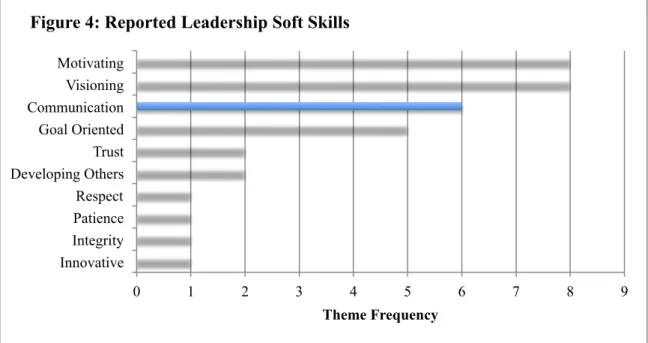
In the survey and semi-structured interview phases, participants were asked to describe characteristics of a good leader. Skills reported in participants’ responses were coded by topic and then categorized as either a hard skill or soft skill. These categories were selected based on supporting evidence that generally healthcare leaders need both hard and soft skills to succeed. 28 Hard skills include technical skills traditionally taught in educational training, while soft skills include interpersonal, communication, and professionalism skills. 28 Reported attributes of a model leader included a person with both soft and hard skills, as described by two participants:
A good leader is someone who can motivate individuals to believe in and come together and work towards a common goal, while inspiring them to achieve high quality outputs. (Survey respondent, male research and training associate) A good leader is able to understand the soft and hard issues related to his organisation. The soft issues related to people and their relationships and dynamics within and between teams, while the hard issues deal with the infrastructure, HR, the processes and the outputs. (Survey respondent, male professor)
0 1 2 3 4 5 6 7 8 9 Innovative
Integrity Patience Respect Developing Others Trust Goal Oriented Communication Visioning Motivating
Theme Frequency
Figure 4: Reported Leadership Soft Skills
0 1 2 3 4 5 6 7
Corporate Social Responsibility Human Resources Operations Team Management Technical Knowledge
Theme Frequency
Perceived Need for Leadership Training
During the study, participants were asked to report their experience with leadership development training, either formal or informal. Formal leadership training was defined as leadership skills taught by an educational institution or by a formal instructor. Participants with informal training included individuals with experience in delivering instruction on leadership development, but had not received formal training prior to the study. Among survey and interview participants (n=16; 1 non-response), only 31% reported having ever received formal leadership training. Among those who had not received any formal leadership training, 31% reported receiving informal training through personal instruction of leadership skills in their past or current occupation. (Figure 6)
Participants unanimously reported that there is a present need for leadership training for MCH professionals in India, with 38% of respondents specifying a need at all levels of public health, including national, state, district, block and village levels. One
31%
31% 38%
Figure 6: Participant Leadership Training Experience
Formal Informal
reported reason there is a current need for MCH leadership training in India is because the country’s health sector is growing, and with a decreasing reliance on foreign aid funding, there is a need to strengthen India public health leaders (2 participants report).
Given the growth of the health sector in India and the diversity of issues that exist in MCH, there is a dire need for good leaders at each and every level, i.e., policy and planning, implementation, monitoring and evaluation. (Survey respondent, female program manager)
Additional explanations for this need include a present capacity deficit in this area (2 participants), with others reporting that individuals who are technical experts or specialize in management are often placed in authoritative or high official positions without leadership training. Often participants elaborated on how leadership training in MCH could positively affect strengthening health programs or systems (44%), as one participant describes:
Good leadership can make a big difference to how programs are envisioned, designed, implemented and monitored. A leadership training can lead to more effective, productive and efficient programs. (Survey respondent, male senior maternal and newborn health advisor)
Leadership Competencies
In the survey phase, participants were asked to select their sense of importance for the 20 leadership skills addressed in the MCH PHLI curriculum for MCH professionals in India. Respondents ranked each skill as either unimportant, moderately important, important, or very important in order to identify those skills that are culturally relevant to the Indian context. Survey results are provided in Table 5.
with 100% of respondents reporting these as either important or very important. Other skills reported as important include collaboration and creative partnerships, creating organizational culture, and systems thinking. These skills were reported by 100% of participants as moderately to very important, and higher percentages reflecting very important level (80%, 60%, and 60%, respectively). Leadership skills that were ranked with lower importance levels include transformational and reflective leadership, career and change management, and innovation and performance management. 80% or fewer participants reported these leadership skills as important or very important.
Table 5: Percentage of perceived level of importance of 20 MCH PHLI1 leadership skills for Maternal and Child Health professionals in India (n=15)
Unimportant (%) Moderately Important (%) Important (%) Very Important (%) Self-awareness 0.0 0.0 66.7 33.3 Communication 0.0 0.0 0.0 100.0 Negotiation 0.0 13.3 33.3 53.3 Conflict management 0.0 6.7 46.7 46.7 Creating a compelling vision 6.7 6.7 26.7 60.0 Innovation 0.0 6.7 53.3 40.0 Emotional intelligence 0.0 6.7 46.7 46.7 Transformational leadership 0.0 20.0 26.7 53.3 Reflective leadership 6.7 13.3 26.7 53.3 Career management 6.7 13.3 53.3 26.7 Creating organizational culture 0.0 6.7 33.3 60.0 Systems thinking 0.0 6.7 33.3 60.0 Building team skills and succession
planning
0.0 6.7 46.7 46.7 Change management 0.0 20.0 40.0 40.0 Cultural competence 0.0 6.7 53.3 40.0 Stakeholder analysis 0.0 6.7 53.3 40.0 Understanding the impacts of
future trends and changes
6.7 6.7 26.7 60.0 Collaboration and creative
partnerships
0.0 6.7 13.3 80.0 Innovation and performance
management
0.0 20.0 40.0 40.0 Advocacy 0.0 0.0 33.3 66.7
Identified Perceived Barriers
In the survey phase, participants were asked to rank the potential degree of difficulty to complete the components of the MCH PHLI distance-based curriculum. Available responses included a serious problem, a moderate problem, a small problem, and not a problem (Table 6). The most significant problem identified was attending on-site retreats, with only 20% of participants reporting this as not a problem. Another potential barrier identified was finding a mentor in public health that is not a part of the program, as this component had the highest ranking of a serious problem (20%). Curriculum components, which involved application of technology, either the phone or the Internet, were also reported as potential problems in India. Attending 1 hour web-based training sessions, completing 30-minute web-web-based tutorials, and engaging in phone based executive coaching sessions were reported by 26.7% of participants as serious or moderate problems.
Program barriers included topics related to technological barriers, as seen similarly in the survey results, particularly at the village level and in resource-poor settings.
Most of the people are not that well versed in managing conference calls or Internet as a medium of training. The country is still in the habit of in class personal training or on site training. (Survey respondent, male professor) Cultural barriers included responses that referred to existence of a hierarchical culture within India as described by two participants:
Many of the materials I have seen do not take into account the specifics of the professional work culture here. This a very hierarchical culture that does not encourage horizontal problem solving, or inputs from a broad range of people. (Survey respondent, female consultant)
Training programs to build leadership need to take into account poor decision- spaces [decision-making] and an organisational culture that prevents emergence of leaders at these levels. (Survey respondent, male professor)
Other identified cultural barriers include the lack of a felt need for leadership skills in public health, particularly within the field of MCH, and a preference for face-to-face interaction.
Leadership courses though very much required in India, may not be a need understood or perceived by the Indian MCH community. This is especially true for individuals working for many years since they usually feel that they know everything and don't require further development. (Survey respondent, female program manager)
1 MCH PHLI, Maternal and Child Health Public Health Leadership Institute
Table 6: Percentage of perceived potential degree of difficulty in completing MCH PHLI1 components in India(n=15)
A serious problem (%)
A moderate problem (%)
A small problem (%)
Not a problem (%) Attending on-site retreats 0.0 46.7 33.3 20.0 Creating individual leadership
development goals
0.0 20.0 26.7 53.3 Completing a Personal Leadership Project
to impact an organization or community
6.7 26.7 33.3 33.3 Engaging in phone based executive
coaching sessions
13.3 13.3 33.3 33.3 Completing 30 minute web-based
tutorials
6.7 20.0 20.0 53.3 Working with an in-program mentor 0.0 0.0 33.3 66.7 Finding a mentor in public health who is
not a part of the program
20.0 6.7 33.3 40.0 Attending 1 hour web-based training
sessions (Webinars)
0.0 26.7 20.0 53.3 Attending 1 hour conference calls on
public health or leadership topics
0.0 20.0 26.7 53.3 Completing an online leadership diary 6.7 0.0 40.0 53.3 Engaging in phone based “peer coaching”
with small teams to solve problems and share best practices
Conclusions
This study shows there is an existing need for leadership development training for public health professionals, and particularly MCH professionals, in India based on
consistent acknowledgement of this need from all participants. Identification of both soft and hard skills as model leadership attributes verifies the cross-cultural application of leadership skills from prior studies, and supports the adaptation of culturally relevant leadership competencies included in the MCH PHLI curriculum. 13,29 Leadership skills identified as important for MCH professionals in India include communication,
advocacy, self-awareness, systems thinking, creating organizational culture, collaboration and creative partnerships.
There are several limitations to this study. The use of a small, convenience sample size limits the power of the study findings and presents the possibility of potential selection bias. If the study is to continue, participants without a connection to UNC should be randomly recruited to alleviate possible presence of this bias. An added limitation is that all participants worked in one of the wealthiest states of India, which limits the study’s generalizability to professionals in lower-income states. 30 This study also relied heavily on survey data rather than observation or in-person interviews. Further data collection should include additional interviews and other methods, such as focus groups.
Recommendations
Based on study findings, there is a need to provide educational materials and increase awareness of the impact strong leadership can have on improving organizational and health outcomes at all levels. Prior to program implementation, all content in the MCH PHLI curriculum components would need to be adapted for Indian culture and offered in Hindi, the native language. Furthermore, because there is a cultural preference for interpersonal communication, more components of the program may need to facilitate this form of interaction as opposed to online or phone-based communications. A
Initially, the investigator recommends that the program target stakeholders in the public sector within state governments by establishing partnerships with organizations that are currently implementing leadership trainings, such as PHFI. Working with a reputable public health organization that values leadership development will assist in generating buy-in from government leaders, identifying local instructors for the program, establishing infrastructure to facilitate the program, and recruiting Fellows within partner organizations.
In order to maintain program fidelity, MCH PHLI in India would be targeted for mid-to-senior level MCH professionals for whom the curriculum is developed. Also, MCH PHLI will continue to provide transportation and training costs for Fellows by securing grant funding through global health donor procurement systems prior to program implementation. The India program will be evaluated using methodology consistent with the US program based on data collected on Fellows’ knowledge of
Policy Implications
This study highlights the need for public health policies at the national and state level that require individuals in leadership positions to receive formal leadership training prior to assuming their appointed positions. Participants from this study reported there is a capacity deficit in leadership skills among public health officials, and the
References
1. World Health Organization. Everybody's business--strengthening health systems to improve health outcomes: WHO's framework for action. Available at:
http://www.who.int/healthsystems/strategy/everybodys_business.pdf. Updated 2007. Accessed February 8, 2013.
2. Fernandez CSP, Steffen DP. Leadership for public health. In: Shi, Leiyu and Johnson, James A (Eds). Novick and Morrow’s Public Health Administration: Principles for Population Based Management. 3rd ed. Sudbury, MA: Jones and Bartlett; 2013: p. 241-265.
3. Institute of Medicine. The Future of the Public's Health in the 21st Century. Washington, DC: The National Academies Press; 2003: 536.
4. Fernandez, CSP. Building Leaders, Life-Long Learners, Organizations and Systems: The Maternal and Child Health Public Health Leadership Institute. Chapel Hill, NC: University of North Carolina at Chapel Hill; 2014. (Unpublished).
5. Institute of Medicine. The Future of Public Health. Washington, DC: The National Academies Press;1988: 240.
6. MCH Leadership Competencies Workgroup. Maternal and child health leadership competencies: version 3.0. Available at:
http://devleadership.mchtraining.net/mchlc_docs/mch_leadership_comp_3-0.pdf. Published June 2009. Accessed February 10, 2014.
7. Mouradian WE, Huebner CE. Future directions in leadership training of MCH professionals: Cross-cutting MCH leadership competencies. Matern Child Health J. 2007;11(3):211-218.
8. Rowitz L. Public health leadership: Putting principles into practice. Second ed. Gaithersburg, Maryland: Aspen Publishers, Inc.; 2001:419
9. Galer JB, Vriesendorp S, Ellis A. Managers who lead: A handbook for improving health services. Cambridge, MA: Management Sciences for Health; 2005. Available at: https://www.msh.org/sites/msh.org/files/mwl-2008-edition.pdf. Accessed March 19, 2014.
11. Maternal and Child Health Public Health Leadership Institute. What is MCH PHLI: How do we develop leaders? Available at: http://mchphli.org/?page=how_develop. Updated 2013. Accessed February 8, 2014.
12. Seims LR, Alegre JC, Murei L, et al. Strengthening management and leadership practices to increase health-service delivery in Kenya: An evidence-based approach. Hum Resour Health. 2012;10(1):25-4491-10-25. doi: 10.1186/1478-4491-10-25;
10.1186/1478-4491-10-25.
13. Mansour et al. Scaling up proven public health interventions through a locally owned and sustained leadership development programme in rural Upper Egypt. Human
Resources for Health 2010; 8:1.
14. Glover S, Wilson M. Unconventional wisdom: A brief history of CCL's pioneering research and innovation. Center for Creative Leadership; 2006. Available at:
http://www.ccl.org/leadership/pdf/research/UnconventionalWisdom.pdf. Accessed February 8, 2014.
15. Center for Creative Leadership. CCL impact in India. Available at:
http://www.ccl.org/leadership/capabilities/india/about/index.aspx. Updated 2014. Accessed February 12, 2014.
16. Center for Creative Leadership. The effective leader program. Available at: http://www.ccl.org/leadership/pdf/programs/ELP.pdf. Accessed February 12, 2014. 17. Center for Creative Leadership. Leadership beyond boundaries. Available at: http://www.ccl.org/Leadership/capabilities/india/lbb.aspx. Updated 2014. Accessed February 12, 2014.
18. Institute of International Education. Leadership development for mobilizing reproductive health (LDM). Available at: http://www.iie.org/Programs/LDM. Updated 2014. Accessed February 12, 2014.
19. Hofmann-Pinilla A, Russell JK. Final report executive summary: Evaluation of the leadership development for mobilizing reproductive health program. Institute of International Education West Coast Center 2006-2011. Available at:
http://wagner.nyu.edu/files/leadership/rcla_iie.pdf. Accessed: March 19, 2014.
20. Anand A. LDM India Program. Institute of International Education. New York, NY; 2011.
22. Department of Management Sciences, National Institute of Health and Family Welfare. Training course on leadership development in the health sector. Available at: http://www.nihfw.org/pdf/final%20leadership%20brochure%202013.pdf. Updated 2013. Accessed February 12, 2014.
23. Public Health Foundation of India. About PHFI. Available at: www.phfi.org/about-us. Updated 2014. Accessed February 12, 2014.
24. Indian Institute of Public Health. IIPH-Delhi progress report: April 2012 - March 2013; 2013:1-40. Available at: http://www.phfi.org/images/home/iiphd_final_report.pdf. Accessed February 12, 2014.
25. Public Health Foundation of India. Workshop on leadership in health and development sectors. Available at:
http://phfi.org/images/events/flyer_leadership_in_health_sector_workshop.pdf. Updated 2014. Accessed February 11, 2014.
26. Public Health Foundation of India. Short term courses. Available at:
http://www.phfi.org/index.php?option=com_content&view=article&id=391&Itemid=323 . Updated 2012. Accessed February 13, 2014.
27. Aspen Institute India. India leadership initiative. Available at:
http://www.anantaaspencentre.in/intro_leadership.aspx. Updated 2013. Accessed February 11, 2014.
28. Fernandez CSP, Peterson HB, Holmstrőm SW, Connolly AM. Developing emotional intelligence for healthcare leaders. In: Di Fabio A, (Ed.). Emotional intelligence – new perspectives and applications. InTech; 2012. p.239-260. ISBN: 978-953-307-838-0. Available at:
http://www.intechopen.com/books/emotional-intelligence-new-perspectives-and-applications/developing-emotional-intelligence-for-healthcare-leaders. Accessed March 19, 2014.
29. House RJ, Hanges PJ, Javidan M, Dorfman PW, Gupta V. Culture, leadership, and organizations: The GLOBE study of 62 societies. Thousand Oaks, CA: Sage; 2004: 848. 30. Ministry of Statistics and Program Implementation, Government of India. Gross state domestic product at current prices. Available at:
Acknowledgements
I would like to thank the following individuals for their time and valuable input into the research and development of this paper.
Dr. Jonathan B. Kotch, MD, MPH
Research Professor, Department of Maternal and Child Health Dr. Claudia S.P. Fernandez, DrPH
Clinical Assistant Professor, Department of Maternal and Child Health Dr. Rohit Ramaswamy, PhD
Appendices
Appendix I: Definition of MCH PHLI Leadership Skills
Leadership Skill Definition
Self-Awareness Assessing and understanding your personal leadership strengths and development areas (weaknesses), being aware of how your preferences and leadership style differ from others; understanding what you still need to learn, the ability to "own" mistakes.
Communication Effectively communicate to individuals and groups representing diverse stakeholders both within and without the organization, able to speak in a clear and concise manner.
Negotiation Engage in productive dialogue to resolve disputes between either people or organizations, represent/defend the interests of your organization/self when crafting agreements with other parties while creating new opportunities for partnerships and collaboration.
Conflict Management Use dialogue to solve critical problems, implement alternative dispute resolution strategies, successfully manage conflict between people or groups.
Visioning Create a compelling, engaging vision that embraces a holistic perspective of MCH systems and integrates it with the mission of the larger organization; inspire others to work towards achieving that vision as well.
Innovation Create an environment that promotes the development of new ideas, processes, programs, and creative partnerships which enrich the organization's ability to plan an integral role in the MCH systems of the future.
Emotional Intelligence Ability to assess and understand the emotions of one's self, others and groups, the ability to relate to others beyond technical concerns, the ability to implement soft skills in interpersonal or organizational settings.
Transformational Leadership
Implement processes to facilitate the transformation of your
organization's mission/vision, culture, technology, thus positioning it to play an important role in MCH systems now and in the future. Reflective Leadership Use self-examination and reflection to create a life-long leadership
learning plan, orient self to continuous personal learning and
interpersonal growth, ability to learn from past experiences and apply those insights to current and future situations.
Career Management Align career aspirations with personal life vision and mission, create a viable plan to achieve career goals by focusing on development areas, capitalizing on personal strengths, and implementing successful networking strategies.
Creating/Impacting Organizational Culture
Systems Thinking Analyze your organization for the impact of systemic relationships on innovation, culture, partnerships, and ability to achieve vision and mission and to create sustainable programs; implement systems theories to address organizational change and transformation; build organizational capacity to envision and select strategies to address acute problems.
Bench Building & Succession Planning
Empower others; Develop and mentor others to create a strong team with diverse skills and perspectives; align team to achieve broad and holistic MCH systems goals; strengthen the overall organization by promoting the development and skills of team members.
Leading Change/Change Management
Identify the need for organizational change, implement processes to bring necessary changes about in order to achieve organizational sustainability, new strategic partnerships, technology development, etc.
Cultural Competence Assess organization and strengthen its ability to sustain cultural and linguistic competence in order to impact health disparities in MCH public health.
Stakeholder Analysis Assess and analyze important players/factors that contribute to or impede individual, team, or organizational success; develop and implement strategies to align stakeholders to organizational mission and vision.
Futuring Assess current trends for potential future developments in MCH systems programs, concerns, political agendas, or concepts; contribute to creating the MCH systems of the future through
technology, innovation, partnerships, and political influence; embrace a holistic, family/community-based concept of future MCH systems. Collaboration/Creative
Partnerships
Recognize and reconcile emotional and rational elements in
collaboration-building and strategic planning, create opportunities for individual, team, and organizational success through the development of creative partnerships internal to and external to the organization. Link partnership development with positive revenue streams. Innovation and
Performance Management
Implement systems to promote innovation, develop and/or implement performance standards and measures of performance improvements; use performance measures and standards (accountability) to facilitate innovation and entrepreneurship at your home organization; link performance measures and standards to a potential strategic plan for your organization.
Appendix II: Just-in-Time (JiT) Training Modules
Module Description
The Behavioral Event Interview
This session addresses interviewing done right - and wrong - in organizations. This program discusses how to use Behavioral Event Interviewing when you are hiring a new employee and helps you prepare for your success when you are the candidate answering the questions.
Developing Others Great leaders build great organizations by building a great team. They develop people. They build competency in an organization by building a deep bench of talented people who are skilled, resilient, innovative, and capable of assuming leadership on projects, with teams, and with external stakeholders. All these things promote the Concepts, or ideas, the Competence, or the people, and Connections, or the relationships that make for competitive advantage.
Employee Engagement What is employee engagement? Is it the same as employee satisfaction? How does it relate to productivity, retention, and loyalty? Find out what the data say you can do as a leader to engage those on your team in this short session.
Emotional Intelligence in
the Workplace Traditional public health training does a very good job at preparing professionals with the requisite "hard" technical skills they need to have in order to protect the public's health. But most traditional training programs don't excel at teaching that other critical ingredient, the soft skills. Yet problems with soft skills are one of the major factors behind career derailment today. These include an array of emotional and social capabilities,
competencies and skills that influence one's ability to succeed in coping with the demands and pressures of life. This session addresses the most commonly identified soft skills and explores those most closely related to success at work.
Maximizing Leadership Success while Avoiding Derailment
This session discusses several factors that impact a leader's success - or the 7 factors that can derail either their success or their careers. It explores competitive advantage as well as the critical success factors that underlie organizational change. The module presents the select skills in which great leaders shine - and relates these to life long learning and your leadership
development. Group Think and How to
Create Thought Diversity in Organizations
Groupthink is a crippling organizational phenomena that occurs when one or two people or personality styles dominate a group's culture so completely that there is no room for those with other styles, perspectives, needs, or beliefs to get their ideas on the table. It has strong links to cultural incompetence as well. This program identifies the characteristics of group think and presents several tools for inculcating thought diversity into organizations. Managing Difficult
Conversations: Strategies and Tools to Influence Others in High Tension
As a leader, it is crucial that you have the skills to artfully manage difficult conversations and bring about the best outcomes possible. This session presents eleven of the most powerful tools to