RURAL AND NON-RURAL DIFFERENCES IN THE SYSTEM OF CARE FOR CHILDREN WITH COMPLEX CHRONIC CONDITIONS
by Kelly Murphy
A paper presented to the faculty of The University of North Carolina at Chapel Hill in partial fulfillment of the requirements for the
degree of Master of Public Health
in the Department of Maternal and Child Health.
Chapel Hill, N.C.
October 2011
Abstract
Objectives: To describe the differences between primary care providers in rural and
non-rural locations regarding their perceptions about the level of difficulty and barriers to care for children with complex chronic conditions (CCC).
Methods: We conducted a cross-sectional survey of primary care providers (N=132)
including physicians, nurse practitioners and physician assistants in community settings in six counties in northwest North Carolina in 2010. The variable of interest was practice location: rural vs. non-rural. We preformed univariate and bivariate analyses. We
calculated odds ratios to demonstrate the strength of association between providers in rural and non-rural locations in practice characteristics and barriers to care.
Results: Pediatric practices in this sample were significantly less likely to be located in
rural areas. Practices in rural areas were more likely to be small, with fewer staff
members [Odds Ratio (OR 7)] and providers (OR 15) compared to practices in non-rural areas. Additionally, practices in non-rural practices were three times as likely as rural practices to have a larger clientele of children with CCC. A majority of primary care providers (77%) reported difficulty caring for children with CCC.
Conclusion: Children with CCC who live in rural areas may have less access to care
Introduction
Almost 14 percent of all children in the US have special health care needs (1,2). More than one-fifth of US households have at least one child with a special health care need (1). Children with complex chronic conditions (CCC) are a subgroup of children with special health care needs (CSHCN) with more complex needs or severe health
conditions. Children with CCC are also described as children who are medically fragile, technology dependent or medically complex. Children with CCC are living longer (3) and their medical needs are increasing (4). Today, children with CCC account for a larger proportion of hospitalizations, hospital days and hospital charges compared to a decade ago (4). Children with CCC are more likely to be readmitted to hospitals compared to children without CCC (5). Caring for children with special needs has been reported to generate substantial stress for their families (6).
Improving the health-care system to provide family-centered, comprehensive and coordinated care to all CSHCN is one of the nation’s health objectives (Healthy People 2020: Objective 31) (7). The medical home model was developed by the American Academy of Pediatrics to improve the system of care for all children (8). One of the performance measures of the Maternal and Child Health Bureau is that children and youth with special needs receive coordinated care within a medical home (1). Although the medical home model of care has been found to benefit children with CCC in rural communities (9), such care is not available to all children with CCC in rural communities. In order to improve the system of care for children with CCC, it is important to
Prior research has shown that it is more difficult for children and families to access necessary health care (i.e., lack of providers, transportation and other resources for families) in rural areas (10,11,12). A recent study reported that even Critical Access Hospitals (CAHs) – hospitals established specifically to increase access to services for rural populations – had worse outcomes than non-CAHs (13). While most investigations of rural-urban differences in the care of CSHCN are based on parent/ caregiver
perceptions, provider perceptions about caring for children with CCC are limited. We describe a study of community-based providers’ perceptions of the system of care, including barriers to care, for children with CCC in rural and non-rural locations.
Methods
Survey:
We conducted a cross-sectional survey of community-based primary care providers (physicians, nurse practitioners and physician assistants) in pediatric and family-medicine practices in six counties in northwest North Carolina between April and October 2010.
barriers to care. In addition, we inquired whether they thought a care coordinator would help them care for children with CCC and to describe how.
Survey Administration:
An online survey (SurveyMonkey.com, LLC, Palo Alto, California, USA) was pilot tested with 14 health-care providers and revised based on their comments. Pediatric and family-medicine practices were identified through the practice database of the Northwest Community Care Network (NCCN) of North Carolina. The NCCN is a Medicaid Managed Care Network of more than 100 primary care practices in six North Carolina counties (Davie, Forsyth, Stokes, Surry, Wilkes and Yadkin). All but Forsyth are rural counties (14). Approximately 80% of all primary care practices in this six-county area are members of NCCN (15).
The link to the online survey was emailed to practice managers of all pediatric and family medicine practices, and health departments. The practice managers forwarded the survey to all physicians, nurse practitioners and physician assistants in their practices. One pediatric practice, in which pediatric residents of the sponsoring institution
practiced, was excluded because the communication module of the survey was not applicable to this practice. Two e-mail reminders about the survey were sent in April and a third round of reminder phone calls were made to practice managers in May. In July and September 2010, printed copies of the survey were mailed with self-addressed envelopes directly to providers who had not completed the online survey.
The variable of interest, practice location, was collapsed into rural and non-rural – from three original categories: rural, urban and suburban. Other practice-level variables were categorized as follows: provider type [physician vs. mid-level (physician assistants and nurse practitioners)]; number of providers in practice [8 or less (1; 2-4; 5-8) vs. 9 or more]; number of staff [less than 20 (less than 5; 5-10; 11-20) vs. 21 or more]; and percent children with CCC [less than 1% vs. more than 1% (1-10%; 11-20%; 21-30%; more than 30%)]. Respondents were asked to select one of four options regarding their perceived level of difficulty caring for children with CCC (very difficult, somewhat difficult, not difficult and does not apply). These responses were categorized into “very/
somewhat difficult” and “not difficult/ does not apply”. Providers’ perceptions about the ease of caring for children with CCC if a care coordinator were to be assigned was categorized into ‘yes’ and ‘no’/ ‘don’t know’. A variable, practice type was created from the names of the practices and categorized into pediatric and family medicine/ other (which included health departments and two practices that could not be classified as pediatric practices).
Missing and Duplicate Data:
We combined duplicate responses for four respondents. There were no discrepancies between the duplicate responses except for one participant. For one participant the location of the practice (rural, urban, and suburban) was recorded as rural in one and suburban in the other – this was coded as suburban based on the geographic location of the practice.
Data Analysis:
association between rural and non-rural locations in practice characteristics and provider perceptions. P values of <.05 were considered statistically significant. All quantitative analyses are performed using Stata Intercooled Version10 (StataCorp LP, College Station, Texas). Two investigators (KM and SG) independently reviewed the aggregate open-ended items and organized them into themes. Approval was obtained from the Wake Forest Health Sciences Institutional Review Board.
Results
The survey was sent to 72 practices; at least one provider in 52 practices responded (72%). Of the 316 primary care providers who were sent the survey, 132 responded with a 42% response rate. Sixty-five percent practiced in non-rural locations.
Practice Characteristics
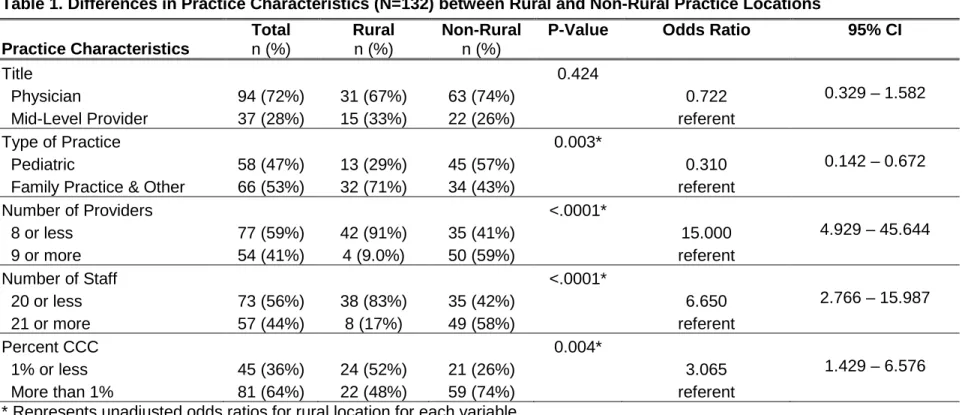
The characteristics of the practices are presented in Table 1. Most of the providers who responded to the survey were physicians (71%), with a nearly even split between respondents in pediatric practices (47%) and family/other (53%) practices. Rural providers were more likely to work in practices that had fewer providers and staff, and served <1% CCC.
Rural vs. Non-rural Differences in Practice Characteristics
CCC than practices in non-rural locations (52% vs. 26%; p=0.004). There was no significant difference between rural and non-rural practices in the types of providers.
Perceptions about Caring for Children with CCC
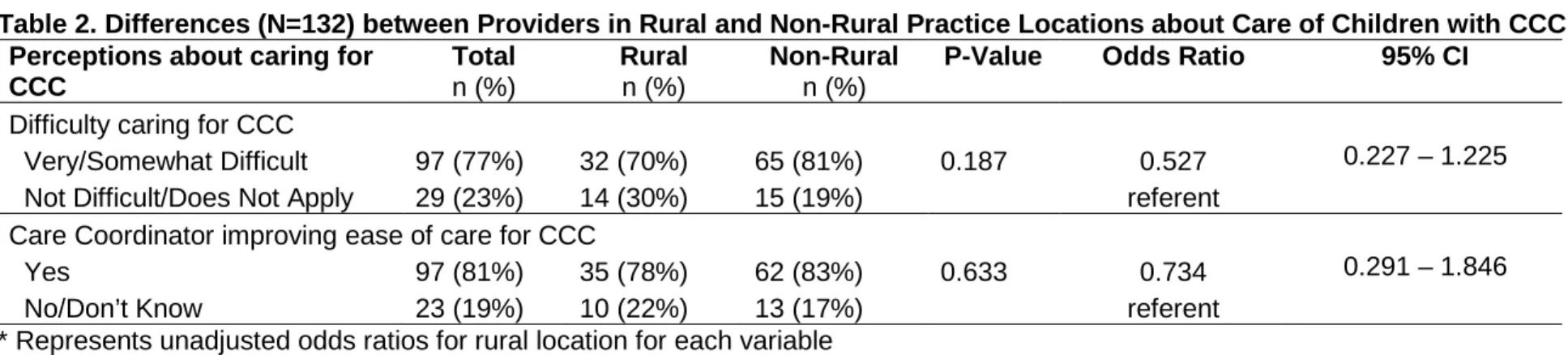
When asked about the level of difficulty in caring for children with CCC, most participants reported that it was “somewhat difficult” (62%) or “very difficult” (15%) to care for children with CCC. This difficulty did not vary by practice location (Table 2). When primary care providers were asked to describe the difficulties they face in providing care for children with CCC (Figure 1), the following themes emerged: (1) poor communication between providers (specialists and other agencies); (2) delay or difficulty obtaining referrals to specialists; (3) difficulty coordinating care with multiple providers; (4) lack of services or resources in the community for CCC; and (5) lack of knowledge about issues related to CCC and resources in the community for children with CCC. Rural providers uniquely commented on lack of local resources.
Most providers (81%) responded that a care coordinator could make it easier to provide care for children with CCC. A few respondents (2%) didn’t think a care coordinator would make it easier and some “didn’t know” (17%). This perception did not vary by practice location. When asked to describe how a care coordinator could help make it easier for providers, several themes emerged (Figure 1): (1) help to coordinate care between multiple specialists and agencies; (2) help to make access to specialists easier; (3) help families with logistics (e.g. making appointments, transportation etc.); and (4) improve communication between multiple specialists.
This study begins to illuminate the system of care for children with CCC from a provider perspective. Practices in rural communities reported that they are less equipped to provide care for children with CCC than providers in non-rural areas. We also found that primary care providers face considerable difficulties in caring for children with CCC regardless of practice location. The strength of our study is that we analyzed both physicians’ (pediatricians and family physicians) and mid-level providers’ (nurse
practitioners and physician assistants) perspectives on barriers to care for children with CCC.
Residents of rural areas face considerable challenges in accessing medical care (13). Children living in rural areas have greater unmet medical and dental care needs than those living in non-rural locations (10). Skinner et al. reported that CSHCN living in rural communities face additional barriers to care such as the lack of access to providers and greater financial difficulties (10). The lack of adequate staff and providers in rural
practices, reported in our study, may be a contributing factor to poor access to care for children with CCC in rural communities. Geographic location is an important factor related to unmet medical need; on average nearly 1 in 3 children must travel 40 miles or more to access specific pediatric specialty care (16). Our study documents a lack of pediatricians in rural areas, which may compound the already complex problems of access to primary care for children with CCC (10) We found that rural practices are three times as likely to have a smaller CCC clientele, which suggests that families of children with CCC are likely using non-rural practices for primary care.
primary care providers experience many barriers when providing care for children with CCC which may limit their ability to serve as a medical home for this population. A combination of practice-level and system-level interventions are necessary to address the difficulties faced by primary care providers in caring for children with CCC. Prior studies have used practice-level approaches such as standardizing care to increase efficiency and decrease costs (17); and having designated care coordinators on staff (9). Policy-level approaches such as increasing reimbursement mechanisms for providers caring for children with CCC are also warranted.
One element of the medical home model is coordinated care, which is essential for monitoring and ensuring collaboration among the multiple providers caring for children with special health care needs (18). In our study, lack of coordinated care emerged as a consistent theme among both rural and non-rural providers when asked about difficulties caring for children with CCC. In a survey of pediatricians, Gupta et al. found that less than half of the pediatricians surveyed provided specific care coordination activities such as integrating a child’s medical plan (19). Lack of time and staff were cited as the most frequent barriers for providing care coordination services to children with special needs. An overwhelming majority (81%) of primary care providers in our study thought that it would be helpful to have a care coordinator. One approach to coordinating care for children with CCC is to have a designated staff member specifically to coordinate care. Future research should evaluate specific areas in which care coordinators make easier contribution for primary care providers to care for children with CCC.
There are several limitations to our study. The term “complex chronic conditions,” can be interpreted in several ways. We included a definition of CCC in the survey in an attempt to ensure common understanding across respondents. A low overall response rate from providers could have resulted in selection bias; however we did have a high response at the practice level (72%). The small sample size precluded conducting multivariate analyses to evaluate the independent associations of the variables to rural location. Because of the cross-sectional nature of the study, we are unable to assess causality of the associations. Finally, since this study is limited to one geographic area in North Carolina, it may not be generalizable to other areas with different systems of care.
Conclusions
References
(1) U.S. Department of Health and Human Services, Health Resources and Services Administration, Maternal and Child Health Bureau. National Survey of Children with Special Health Care Needs 2005-2006. Rockville, Maryland: U.S. Department of Health and Human Services, 2008; Available at:
http://mchb.hrsa.gov.libproxy.lib.unc.edu/cshcn05/. Accessed 6/15/2011, 2011.
(2) Davidson EJ, et al. The doctor's dilemma: challenges for the primary care physician caring for the child with special health care needs. Ambulatory Pediatrics 2002;2(3):218-223.
(3) Feudtner C, et al. Deaths attributed to pediatric complex chronic conditions: National trends and implications for supportive care services. Pediatrics (Evanston)
2001;107(6):e99-e99.
(4) Simon TD, et al. Children with complex chronic conditions in inpatient hospital settings in the United States. Pediatrics 2010;126(4):647.
(5) Berry JG, et al. Hospital utilization and characteristics of patients experiencing recurrent readmissions within children's hospitals. JAMA: The Journal of the American Medical Association 2011;305(7):682.
(6) Nageswaran SS. Respite care for children with special health care needs. Arch.Pediatr.Adolesc.Med. 2009 -01;163(1):49-54.
(7) Healthy People 2020 Objectives. 2011; Available at:
http://healthypeople.gov.libproxy.lib.unc.edu/2020/topicsobjectives2020/default.aspx.
(8) National Center for Medical Home Implementation. What is a family-centered medical home? Available at: http://www.medicalhomeinfo.org/. Accessed 7/18/2011, 2011.
(9) Farmer JE, et al. Comprehensive primary care for children with special health care needs in rural areas. Pediatrics 2005;116(3):649.
(10) Skinner AC, Slifkin RT. Rural/urban differences in barriers to and burden of care for children with special health care needs. The Journal of Rural Health 2007;23(2):150-157.
(11) Baldwin LM, et al. Quality of care for acute myocardial infarction in rural and urban US hospitals. The Journal of Rural health 2004;20(2):99-108.
(12) Mayer ML, et al. Unmet need for routine and specialty care: data from the National Survey of Children With Special Health Care Needs. Pediatrics 2004;113(2):e109.
(13) Joynt KE, et al. Quality of care and patient outcomes in critical access rural hospitals. JAMA: The Journal of the American Medical Association 2011;306(1):45.
(14) N.C. Rural Economic Development Center Inc. Rural/urban counties in North Carolina. 2010; Available at: http://www.ncruralcenter.org/rural-county-ma.html. Accessed 8/15, 2011.
(15) Community Care of North Carolina: Northwest Community Care Network. About us. 2011; Available at:
http://www.nwcommunitycare.com/index.php?option=com_content&task=view&id=14&It
(16) Mayer ML. Are we there yet? Distance to care and relative supply among pediatric medical subspecialties. Pediatrics 2006;118(6):2313.
(17) Antonelli RC, Antonelli DM. Providing a medical home: the cost of care coordination services in a community-based, general pediatric practice. Pediatrics
2004;113(Supplement 4):1522.
(18) Turchi RM, et al. Care coordination for CSHCN: associations with family-provider relations and family/child outcomes. Pediatrics 2009;124(Supplement):S428.
Table 1. Differences in Practice Characteristics (N=132) between Rural and Non-Rural Practice Locations
* Represents unadjusted odds ratios for rural location for each variable Practice Characteristics
Total n (%)
Rural n (%)
Non-Rural n (%)
P-Value Odds Ratio 95% CI
Title 0.424
Physician 94 (72%) 31 (67%) 63 (74%) 0.722 0.329 – 1.582
Mid-Level Provider 37 (28%) 15 (33%) 22 (26%) referent
Type of Practice 0.003*
Pediatric 58 (47%) 13 (29%) 45 (57%) 0.310 0.142 – 0.672
Family Practice & Other 66 (53%) 32 (71%) 34 (43%) referent
Number of Providers <.0001*
8 or less 77 (59%) 42 (91%) 35 (41%) 15.000 4.929 – 45.644
9 or more 54 (41%) 4 (9.0%) 50 (59%) referent
Number of Staff <.0001*
20 or less 73 (56%) 38 (83%) 35 (42%) 6.650 2.766 – 15.987
21 or more 57 (44%) 8 (17%) 49 (58%) referent
Percent CCC 0.004*
1% or less 45 (36%) 24 (52%) 21 (26%) 3.065 1.429 – 6.576
Table 2. Differences (N=132) between Providers in Rural and Non-Rural Practice Locations about Care of Children with CCC Perceptions about caring for
CCC
Total n (%)
Rural n (%)
Non-Rural n (%)
P-Value Odds Ratio 95% CI
Difficulty caring for CCC
Very/Somewhat Difficult 97 (77%) 32 (70%) 65 (81%) 0.187 0.527 0.227 – 1.225
Not Difficult/Does Not Apply 29 (23%) 14 (30%) 15 (19%) referent
Care Coordinator improving ease of care for CCC
Yes 97 (81%) 35 (78%) 62 (83%) 0.633 0.734 0.291 – 1.846
No/Don’t Know 23 (19%) 10 (22%) 13 (17%) referent
Figure 1. Themes and Selected Supporting Comments from Open-Ended Responses
Rural and Non-Rural Provider Difficulties in Treating Children with CCC Theme 1: Poor communication between providers (specialists and other agencies).
• Trouble communicating with specialists.
• Communication with multiple providers (physicians, home health agencies, providers of durable medical equipment).
Theme 2: Delay or difficulty obtaining referrals to specialists. • Trouble with referrals being seen/ done in a timely fashion. • Don’t receive notes from follow-up visits.
Theme 3: Difficulty coordinating care with multiple providers. • Organizing/arranging consultations.
• Coordinating all of the subspecialists – obtaining records from everyone. Theme 4: Lack of services or resources in the community for CCC.
• No resources in our small town.
• Lack of services that can be accessed in a timely and affordable manner. Theme 5: Lack of knowledge about issues related to CCC.
• Difficulty keeping up with new trends in treatment for optimal care. • Lack of overall knowledge.
Rural and Non-Rural Perceptions of How a Care Coordinator Could Help with Difficulties Theme 1: Help in coordinating care between multiple specialists and agencies.
• Help coordinate primary and specialist care.
• Single person to call to organize care especially with exacerbations in illness. Theme 2: Increase access to specialists.
• Might improve access to referrals. • Better follow-up.
Theme 3: Help families with logistics of accessing care. • Help families navigate the system.
• Make sure all financial and transportation issues are coordinated and social services needs are being met.
Theme 4: Improve communication between multiple specialists. • Reduce redundancy.