ABSTRACT
SUSAN KAY MITSUYE BUCHANAN. Respirable Dust Levels During Relinlng of Foundry Induction Furnaces. (Under the direction of Dr. Robert L. Harris, Jr.)
Industrial hygiene surveys were conducted to assess employee exposures to respirable silica during induction furnace relining. The operation is performed once every 6 to 12 weeks and takes between 8 to 16 hours to complete. Survey results showed that exposures ranged between 0.87 - 19.90 mg/m during the process and samples contained between 40 - 65% free silica as determined by colorimetric method of analysis. The exposures which occur during the initial lining removal stage include exposures to cristobalite which is formed during furnace use. The health implications of these short-term, high exposures has not been evaluated, however, good industrial hygiene work practices suggest that exposure levels be kept to a minimum and recommendations for dust reduction have been made.
Other potential hazards identified were noise created by pneumatic tools and asbestos present in the preliner fabric. Both require further evaluation to determine the extent of the exposures.
ACKNOWLEDGEMENTS
I would like to thank Dr. Robert L. Harris and Dr. David Leith of my committee for their advise and comments throughout the project, especially during the writing of the
technical report.
Special thanks are due the Occupational Health Branch group who provided not only technical and financial assistance, but also help with sampling and moral support.
I am also grateful to Dr. David Fraser who managed to find funding for some of the project's expenses.
CONTENTS
INTRODUCTION... 1
-The disease-... 1
-Dusty Trades-... 1
-Introduction to the project-... 1
-The literature-... 2
-The process-... 3
THE OBJECTIVE... 3
STUDY DESIGN... 4
-Choice of foundry-... 4
-The decision to reline-... 4
-Details of the process-... 5
-The tasks identified-... 6
-The forms of silica-... 7
-Noise and asbestos-... 7
METHODS... 8
-Personal samples-... 8
-Area samples-... 8
-Bulk samples: lining-... 8
-Analytical methods-... 9
-Noise readings-... 9
-Bulk samples: asbestos-... 9
RESULTS AND DATA ANALYSIS... 10
-Respirable dust-... 10
-Percent free silica-... 11
-Cristobalite and tridymite-... 12
-Noise-... 13
-Asbestos-... 13
-Assessment of error in personal samples-... 14
-Exposure calculations-... 15
CONCLUSIONS AND RECOMMENDATIONS... 19
-Respirable dust-... 19
Percent free silica... 19
Exposures... 19
Recommendations... 21
-Noise and asbestos-... 24
-Further work-... 24
REFERENCES... 25
-Cited-... 25
-Background-... 26
APPENDICES...28
I. Respirable Dust Concentrations for Each Filter...28
-1
INTRODUCTION
-The
disease-Silica exposure has long been known to cause silicosis, a pneumoconiosis
resulting from the inhalation of excessive amounts of free silica, most commonly
quartz. Development of the disease usually occurs over 20 - 40 years moderate
exposure, with symptoms appearing only later in the disease progression (12, 13).
Silicosis is preventable by controlling dust levels and exposures, yet it continues to be
found throughout those occupationally exposed in industries such as foundries.
-Dusty
Trades-In the foundry industry, silica sand is used in making the molds to cast metal
parts. The resulting silica dust exposures during routine operations have been
relatively well characterized throughout the years (12, 13). In North Carolina, the
Dusty Trades Act was enacted as a part of the Workman's Compensation Act under
the Industrial Commission in 1935. This Act recognized silicosis and asbestosis as
compensable diseases, and provided for the identification of workplaces with high
risk for these diseases (7).
The Division of Health Services' industrial hygiene consultants have had the
responsibility to inspect workplaces such as foundries, and have created a data base
describing exposures specific to this state's foundry industry.
-Introduction to the
project-One exposure to silica appears to have escaped assessment, possibly due to the
-2
furnaces, which is done only when the lining has been worn beyond repair. Previous
sampling (16, 18, colleague experience) indicates that significant silica exposures
result from the process but detailed evaluation has not been made.
-The
literature-In a recent study by J. Oudiz, silica exposure data from OSHA inspection
records were used to evaluate current silica exposures in foundries. He observed that
high levels in the melting areas were a result of ladle and furnace repair (7, 16).
Correspondence with Mr. Oudiz indicated the broad and generalized scope to his
study, which integrated available data, but did not deal with details of the processes
(15). . .
Another study of foundry exposures was performed in Finland during 1972
-1975, in response to a condition agreed upon to resolve a labor strike. Although the
relining process was again identified as an operation that generates high
concentrations of silica (see table), levels corresponding to the individual tasks were
not reported (18).
Results of the Finnish Study
mean median
total dust
respirable dust (< S/zm)
34 mg/m'
2.25 mg/m'
16 mg/m^ 1.13 mg/m^
Reports by NIOSH (National Institute for Occupational Safety and Health)
comment on the relining operation, but only general remarks on the associated dust
levels appear (12, 13).
-The
process-EvEiluation of silica dust levels generated during induction furnace relining is the
topic of this report. The project was limited to evaluating small to mid-sized
foundries in North Carolina that manufacture grey iron and ductile castings. The
operation, described later, is a two part process; the old lining is first removed, then
a new one is built in. This may be done in one day, over two days, or more gradually
depending on the available personnel and the pouring demand. The identified
occupational health hazards include not only the silica dust exposures, but also
exposures to noise caused by the pneumatic tools and to asbestos, often contained in
a fabric used in the lining. This process presents not only the potential for quartz
exposures, but also for tridymite and cristobalite exposures (18).
THE OBJECTIVE
From the literature and colleague experience, the dust levels associated with
furnace relinings appear to be high, and few measures are being taken to minimize
employees' exposures during this process. To address the issue, this operation must
be observed and evaluated. The purpose of this project is to identify the tasks in
furnace relining and to characterize their associated respirable dust exposures. Once
the process is understood, a decision on the necessity for controls can be made. In
-4
data will be added to the Dusty Trades records. Further, should a need to control
dust levels be found, this information could be applied to foundries state-wide,
through the Division.
Two additional areas may be of concern: noise and asbestos. As previously
mentioned, pneumatic tools create high noise levels, and the fabric used in the
process has contained asbestos; therefore, a potential for exposure exists if this fabric
is still used. These topics will be examined, but not thoroughly evaluated in this
report.
STUDY DESIGN
-Choice of
foundry-Two decisions made at the outset of the project limit its scope. The first sets
criteria for the foundries sampled. The second restricts the type of samples taken.
The foundries selected were small to medium in size, and have from 25 to 100
employees. They manufacture grey and ductile iron castings and use coreless
induction furnaces to melt the metal.
The sampling strategy focused on assessing the respirable dust exposures.
Laboratory costs and the time required for sample analyses were important. To keep
these to a minimum, a few representative samples were selected from each foundry
for free silica analysis and total dust samples were not collected.
-The decision to
the pounds of iron poured. As the quantity of iron poured approaches the limit
characteristic of the furnace, the extent of the wear is determined more accurately
with visual inspections and physical measurements. Usually the furnace tender is
responsible for these checks and decides whether the lining is still functional, or
whether a patch would be adequate to protect the induction coils for a few more
weeks.
-Details of the
process-Depending on the foundry £md the furnace size, from two to six men perform
the relining operation. They tear out the old lining with jack hammers and chisels,
and periodically tilt the furnace to empty the debris. After complete removal of the
old lining and a final sweep-out, a fabric may be laid in (one foundry still used an
asbestos-containing material, one foundry used no fabric at all), covering all the
surfaces, and taped with masking tape around the rim (one foundry uses a glue on the
seams instead). Once the furnace preparation is complete, relining begins. First,
100-lb bags of silica ramming mix, a 99% free silica powder, are poured into the
bottom. An employee stands in the furnace and packs the powder into place with a
pneumatic packer and a fork-like tool which minimizes layering. When the bottom is
complete, the employees lower a carefully rolled metal form onto the bottom and
center it in place. Pouring the powdered silica resumes, a few bags at a time, around
the form to make the new wall. Two employees circle the furnace and manually pack
the powder in place. Once the silica level has reached the furnace rim, a pneumatic
vibrator set inside the form settles the silica further. After completing the walls, an
silica-alumina material. A hand-held pneumatic tamper presses this into place, to obtain
the desired shape. Once metal starter blocks are loaded into the furnace, the curing
process begins. This final step involves slowly bringing the furnace up to normal
operating temperature. During this time the metal form and starter blocks melt and
become a part of the first pour, and the outer powdered silica layer fuses.
-The tasks
identified-In each of the two parts of the process, tearout and reline, distinct tasks correspond to different exposures. Meeting the project objective requires that these
tasks and their associated exposures be identified.
During tearout, the exposure varies as the employee removes the lining from the furnace rim and works towards the bottom where the space becomes more confined.
There are also variations as the different layers of the 4" wall are removed. These
layers are a result of three distinct sections - the 'sintered zone', the 'fritted' zone,
and the final zone - formed during the curing (23). The outermost layer, or the
'sintered zone', is directly in contact with the molten metal and consists of bonded cristobalite. The 'fritted zone' appears next, in which fused quartz predominates. The final zone is closest to the coils, and is made up of unbonded quartz. Although each of these phases is initially present in a newly packed lining, the sintered layer widens with wear of the furnace walls, as the final zone narrows (see the diagram of
the induction furnace). A second exposure results when the furnace is tilted and the
employee crawls and/or reaches into the furnace to rake out the loose material.
DlA6RAt^ 6F A TYPICAUCOtf2GLE55 INDUCT!oM fvfiM^CB ro SHOW the layer^m^ cp the wall
potRtci2ieo 2osie
fnvrtto w»je
reline by inserting a fabric preliner, grouting cracks around the induction coils and inserting grounding wires, (2) laying the bottom, and (3) building the sides.
In the two tasks associated with lining tearout and during the furnace
preparation, the exposure comes from the dust generated during the removal. The
bottom and side replacement, however, involves exposures to the new silica powder
and may have a different free silica content. Higher exposures are expected while
replacing the bottom than during building the sides, because the employee works in a
more confined space.
- The forms of silica •
The importance of determining the presence of cristobalite and tridymite lies in their ability to evoke different physiologic responses than quartz. The ACGIH TLVs
(American Conference of Governmental Industrial Hygienists Threshold Limit
Values) for cristobalite and tridymite recommend limiting exposures to one half the
threshold limit value calculated for quartz. These structural changes in silica may be induced by heating, such as during the metal melting process (melting point of pure
iron at 1535° C (22), with quartz converted to tridymite at 860° C, and tridymite to
cristobalite at 1470° C (5, 17).
-Noise and
asbestos-A general evaluation of noise and asbestos as potential hazards was done, but only to the extent of determining whether further, more detailed assessment is necessary. Particular attention will be paid to the use of pneumatic tools as the
insertion where it is used as a preliner.
METHODS
-Personal
samples-The industrial hygiene sampling strategy and procedures used were in
accordance with OSHA compliance training as described in the Federal Industrial
Hygiene Field Operations Manual (IHFOM) (26, 27, 28). Sampled employees wore
MSA personal sampling pumps (Model G) with 10mm nylon cyclones in line for
collection of the respirable dust fraction. Each pump was pre- and post-calibrated at
1.7 liters per minute (1pm) using a calibrated 2 liter per minute rotameter.
Consecutive sampling continued throughout the process, with the flowrates checked
periodically.
-Area
samples-Pre- and post-calibrated high volume (9 1pm) Bendix pumps with steel cyclones
in line were used to collect area samples for free silica analysis. Such sampling
provided filters with sufficient weight for analysis where personal samples contained
inadequate dust loads. Separate groups of samples represented the tearout and the
relining and their different free silica contents. When employees relined during
routine foundry operation, additional area samples were taken using the MSA pumps
to determine the background contribution.
-Bulk samples:
phenomenon in the lining which occurs during the heating process. With this
knowledge, bulk samples of the walls were taken in this and subsequent foundries to
determine whether cristobalite and tridymite were present.
-Analytical
methods-Three common NIOSH-approved methods for silica analysis are colorimetric
analysis, X-ray diffraction (XRD), and infra red (IR) analysis. With analytical
support provided by the Division of Health Services, the most feasible method was
the colormetric procedure done by the AIHA certified State laboratory (6).
Determination of the presence of cristobalite and tridymite in the bulk samples,
however, required sending the samples out of state for the XRD technique. To
minimize costs, all samples were weighed, but were not analyzed for their free silica
content. A few of those with adequate weight which were determined to be
representative of the two tasks were then selected for free silica analysis.
-Noise
readings-Sound level meter readings were taken throughout the shift to evaluate the levels
and identify sources. -Bulk samples:
asbestos-Bulk samples of the fabric, both old and new, were taken and submitted for
asbestos analysis. In one case where employees stated that the material contained
asbestos, one wore a personal sampling pump to assess the exposure while working
10-RESULTS AND DATA ANALYSIS
-Respirable
dust-Ideally, each task is represented by either a single sample or consecutive
samples, depending on the duration of the task. Conditions in the field are not always
conducive to this sampling regimen, and samples may overlap two of the tasks.
Restrictions on the number of samples to be taken in this study also demanded a
conservative strategy. Despite these limitations, estimates of the dust exposures
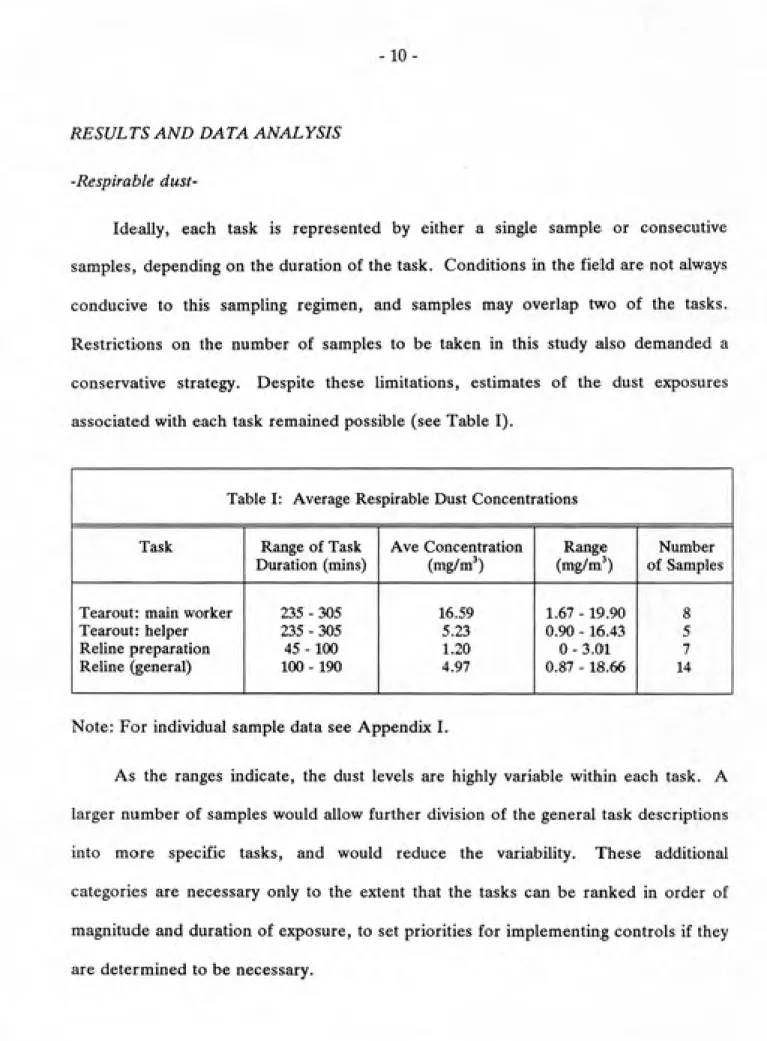
associated with each task remained possible (see Table I).
Table I: Average Respirable Dust Concentrations
-...— -. .. ,
Task Range of Task
Duration (mins) Ave Concentration (mg/m') Range (mg/m') Number of Samples Tearout: main worker
Tearout: helper Reline preparation Reline (general)
235 - 305 235 - 305 45-100 100 - 190
16.59 5.23 1.20 4.97
1.67 - 19.90 0.90 - 16.43
0 - 3.01 0.87 - 18.66
8 5 7 14
Note: For individual sample data see Appendix I.
As the ranges indicate, the dust levels are highly variable within each task. A
larger number of samples would allow further division of the general task descriptions
into more specific tasks, and would reduce the variability. These additional
categories are necessary only to the extent that the tasks can be ranked in order of
magnitude and duration of exposure, to set priorities for implementing controls if they
11
Two such modifications to the groupings are adding a furnace cleanout category
and having separate categories for relining the bottom and the sides, since the bottom
approximates a confined space. The furnace cleanout is visibly a dusty task which
lasts 15 - 25 minutes and is performed at least three times during the process,
depending on the furnace size. The sample results (n = 2) did not support the
presence of high dust levels and further sampling is recommended to identify the
exposures, primarily to ensure that if respirators are selected, they provide adequate
protection. A few samples were specific to relining the bottom and relining the sides.
The levels measured during the work in the furnace, 7.30 and 18.66 mg/m (n = 2),
appear to be higher than working around the rim, which ranged from 0.87 - 3.14
mg/m (n = 3). The sample size is too small, however, to determine whether there
are two different dust concentration distributions associated with these tasks.
-Percent free
silica-Three to five samples were selected from each foundry to represent the free
silica content of the respirable dust. Separate samples were submitted to the
laboratory from tearout and reline, to test the assumption that two different
compositions exist in the old and new linings. The ranges and averages for each
foundry are listed in Table II. The test of the hypothesis that the percent silica in the
old and new linings were different was inconclusive (// of tearout, 47.80%, = /z of
12
Table II Percent Free Silica Associated with the Old and New Linings
Foundry Task Range (%) Average (%) No. of samples
1 2 4 1 2 3 4 Tearout Tearout Tearout Reline Reline Reline Reline
24.92 - 61.32
48.66
55.07 - 61.07
55.54 - 57.57
54.09 - 61.29 63.89 - 66.47
42.89 - 58.18
40.67 48.66 58.07 56.56 57.65 65.18 50.54 3 1 2 2 2 2 2
-Cristobalite and
tridymite-X-ray diffraction analysis of pieces of the old lining from each foundry was
requested to determine the presence of cristobalite and tridymite. No tridymite was
detected, however, cristobalite was found in all the samples, ranging in content from
1.7 - 35%. Because the samples were in a bulk form, no direct correlation to the
percent cristobalite in the personal samples can be made. By virtue of the presence
of cristobalite however, the ACGIH recommends a TLV of one half the value if the exposure was to pure quartz (1, 14).
TLV for cristobalite = JO mg/m^
2 (% quartz + 2)
The OSHA Office of Technical Support recommends calculating a standard
that incorporates the percent cristobalite (2, 9):
PEL, quartz and cristobalite are present = — 10 mg/m^
13
If the percent cristobalite is determined on the basis of one sample, this
Permissible Exposure Limit (PEL) applies only under the conditions which this
sample represents. This is important when evaluating the exposures during tearout
because different layers contain different percents cristobalite (23), and the PEL will
therefore vary over the period of removal.
-Noise-Sound level meter measurements indicate that periods of high noise exposure
occur, particularly during the use of pneumatic tools. There are periods of exposure
below the OSHA action level (the level at which the standard applies) of 85 dBA,
however, which may result in an eight-hour time-weighted average below the PEL. In
order to accommodate these and other variables, such as extended work shifts, and
determine employee exposures, a more comprehensive noise survey is necessary.
Some examples of the levels measured in the four foundries are as follows:
• Background - no other foundry operations: less than 70 - 80 dBA.
• Background - other foundry operations such as shakeout: 88 - 89 dBA.
• Jack hammer used during chip out: 94 - 102 dBA.
• Observing vibrating, approximately four feet away: 93 - 94 dBA.
• Adding sand during vibrating: 102 - 104 dBA.
-Asbestos-Of the four foundries sampled, only one continues to use an asbestos-containing
-14
fiberglass substitute. Bulk samples of the asbestos-containing material had 30 - 40%
chrysotile in the new lining and 20 - 30% chrysotile in the old lining. One employee's
exposure during cutting and inserting the fabric was 3.5 fibers/cc for the 45 minutes
sampled.
-Assessment of error in personal
samples-. i
NIOSH has published a coefficient of variation (CV ) of 0.09 for the field
sampling and weighing of respirable dust samples collected according to procedures
described in the Federal IHFOM. This figure was calculated by combining
coefficient of variations for the field error, primarily that of the pump, and for the
filter weighing (10). Although sampling was performed according to the federal
protocol, a separate calculation of the precision yielded higher CV values, ranging
from 0.173 - 0.202 (see Appendix II for the calculations). Since this CV is derived
from the actual techniques used, it is considered to be more accurate for the data collected. The equation used was taken from (21)
Cm" ^ (M-B)2 ^ V2
where: M = weight of sample
B = weight of blank
V = volume
C = concentration
Sources of error included in the calculation were:
(1) Field sampling:
15
flowrate = 0.3 1pm
(2) Lab weighing = 0.005 mg
The total coefficient of variation represents the quantifiable error associated
with the sampling and weighing of each filter, and is an approximation of the inherent
error, at best. Some of the less easily estimated sources of error include flowrate
variations over time, individual cyclone efficiencies, and filter loading.
In addition to the error associated with field sampling and weighing, error is
introduced during the analytical procedure. The published value for the NIOSH
Analytical Method for percent free silica, colorimetric analysis P&CAM 106, is a relative standard deviation, or coefficient of variation, of 9.25% (0.0925).
Other nonquantifiable variables that influence determining the employee's true exposure are the changes in percent free silica with time and space, and the presence
of cristobalite. The percent respirable free silica collected on a filter depends on the
time and spatial changes in the particle concentration and size distribution, as well as
on the nature of the task being performed (e.g. which layer of the old lining is being
removed). The percent cristobalite, as a component of the percent free silica, is
affected in the manner described for percent free silica, above. It is also a quantity
that is difficult to determine accurately due to the detection technique precision of ±
25 (reported with the results by the laboratory). This precludes its use in calculating
exposures or TLVs precisely. -Exposure
16
percent respirable free silica present.
TLV - 8 hour = 10 "^^/'"^
% quartz + 2
OSHA has adopted this recommmendation from the 1968 TLVs as their
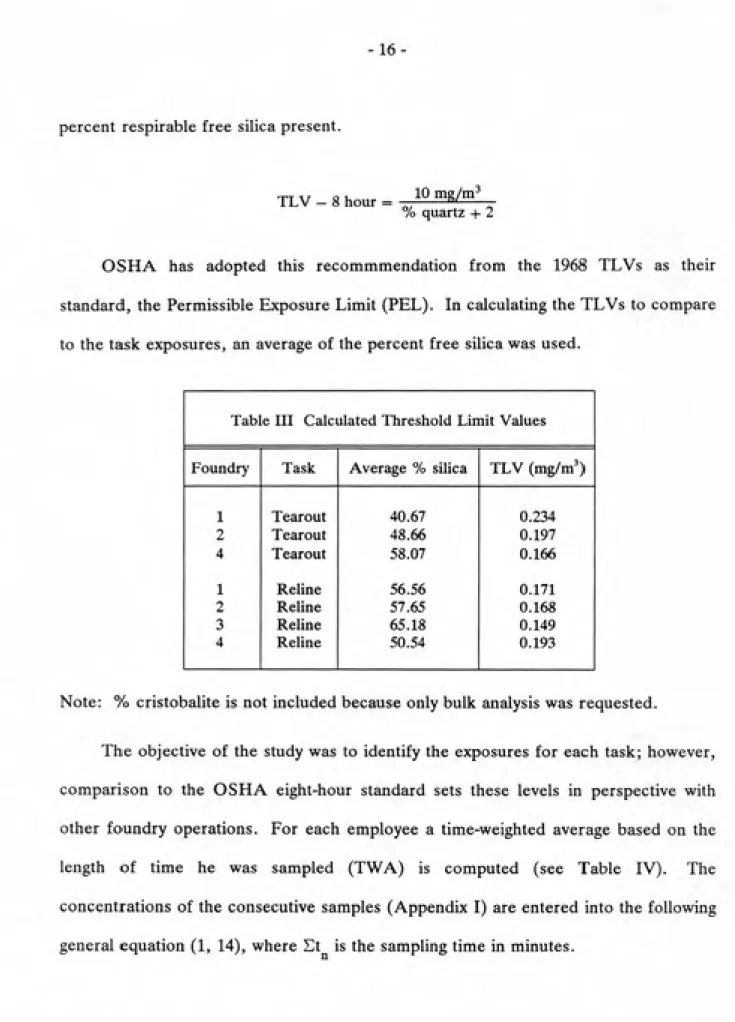
standard, the Permissible Exposure Limit (PEL). In calculating the TLVs to compare
to the task exposures, an average of the percent free silica was used.
Table III Calculated Threshold Limit Values Foundry Task Average % silica TLV (mg/m')
1 2 4 1 2 3 4 Tearout Tearout Tearout Reline Reline Reline Reline 40.67 48.66 58.07 56.56 57.65 65.18 50.54 0.234 0.197 0.166 0.171 0.168 0.149 0.193
Note: % cristobalite is not included because only bulk analysis was requested.
The objective of the study was to identify the exposures for each task; however,
comparison to the OSHA eight-hour standard sets these levels in perspective with
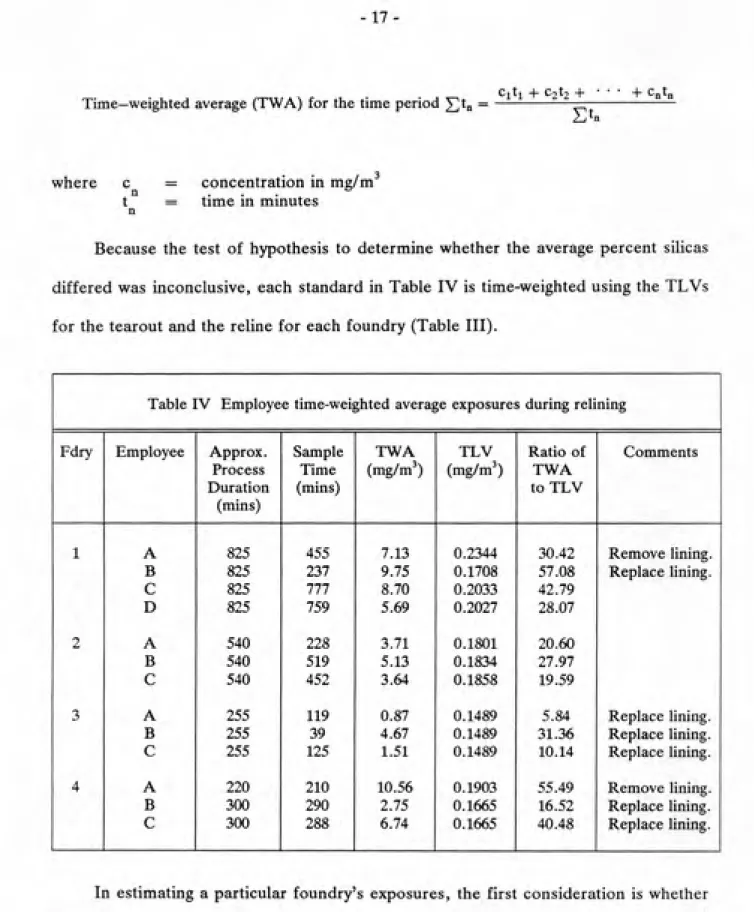
other foundry operations. For each employee a time-weighted average based on the
length of time he was sampled (TWA) is computed (see Table IV). The
concentrations of the consecutive samples (Appendix I) are entered into the following
-17-Time-weighted average (TWA) for the time period S^n = Clti + C2t2 + + c„t„ Etn
where c = concentration in mg/m t = time in minutes
n
Because the test of hypothesis to determine whether the average percent silicas
differed was inconclusive, each standard in Table IV is time-weighted using the TLVs
for the tearout and the reline for each foundry (Table III).
Table IV Employee time-weighted average exposure5 during relining
Fdry Employee Approx. Sample TWA TLV Ratio of Comments
Process Time (mg/m') (mg/m') TWA
Duration (mins) to TLV
(mins)
1 A 825 455 7.13 0.2344 30.42 Remove lining.
B 825 237 9.75 0.1708 57.08 Replace lining.
C 825 777 8.70 0.2033 42.79
D 825 759 5.69 0.2027 28.07
2 A 540 228 3.71 0.1801 20.60
B 540 519 5.13 0.1834 27.97
C 540 452 3.64 0.1858 19.59
3 A 255 119 0.87 0.1489 5.84 Replace lining.
B 255 39 4.67 0.1489 31.36 Replace lining.
C 255 125 1.51 0.1489 10.14 Replace lining.
4 A 220 210 10.56 0.1903 55.49 Remove lining.
B 300 290 2.75 0.1665 16.52 Replace lining.
C 300 288 6.74 0.1665 40.48 Replace lining.
In estimating a particular foundry's exposures, the first consideration is whether
the relining is done as a part of the regular shift, as with small furnaces (4,000 - 5,000
18-(18,000 lbs.). If the relining occurs during the daily workshift, exposures from
routine duties in addition to relining tasks must be included in the estimate. If the
relining occurs over a weekend where tearout and reline last between 9-15 hours on
Saturday, the TLVs must be adjusted for the extended workshift (greater that eight
hours). The modifier applied is based on a simplified model for silica removal from
the lung, which assumes a long retention time for silica (8, 11, 19) and is proportional
to the number of hours of exposure (11, 29). For the single-day extended workshift,
this modifier is the ratio of the time for a standard workshift, 480 minutes, to the
time for the workshift, and is multiplied by the TLV to give an adjusted TLV value.
Adjusted TLV = 480 minutes
Work shift duration (minutes)
xTLV
The TLVs used are weighted TLVs for this study (Table IV).
Table V Relining Exposures with TLVs Adjustec for Extended Workshifts
Foundry Employee Time Sampled (minutes) TWA (mg/m^) Weighted TLV Ratio of
TWA to TLV
1 2 C D B 777 759 519 8.70 5.69 5.13 0.1183 0.1179 0.1630 69.27 44.42 30.25
Other sampling conditions must be recognized before the exposure levels
identified in this project are applied industry-wide. A list of some of the more
important conditions that affect dust levels follows.
19-• The number of employees on the job.
• The use of patch material to gain a longer lining life.
• Furnace size.
• The temperature of the furnace during relining (convection currents keep the
small particulate airborne).
• Background levels of dust produced by other operations.
The reported values modified according to the presence or absence of similar and
additional variables during the operation will provide the best estimates.
CONCL USIONS AND RECOMMENDA TIONS
-Respirable
dust-Percent free silica
The range of percent free silicas for the four foundries was 24.92 - 61.32%, an
average of 47.80% during tearout, and 42.89 - 66.47%, an average of 57.40% during
reline. A test of hypothesis to determine whether the percent silicas of the two tasks
was different was inconclusive, primarily as a result of too small a sample size (n of
tearout = 6, n of reline = 8).
Exposures
Despite the differences in environments in the four foundries sampled, the
pooled results demonstrate that high dust concentrations are generated during each
task. One measure of the degree of exposure is the ratio of the eight-hour
20-IV may be summarized as follows:
Small furnaces:
-Employee removing the lining = TWA is 55 times the TLV
-Employees replacing the lining = TWA range is 6 - 40 times the TLV
Large furnaces:
-Employee removing the lining = TWA is 30 times the TLV
-Employee replacing the lining = TWA is 57 times the TLV
-Combined tasks = TWA range is 19 - 43 times the TLV
Alternatively, an example using the average respirable dust concentrations and
the shortest task durations from Table I shows a similar degree of exposure.
Estimated TWA - main worker on tearout = 11.80 mg/m Estimated TWA - helper during tearout = 4.78 mg/m TLV using average percent silicas for = 0.1911 mg/m
tearout, 47.80%, and reline, 57.40%
Ratio of TWA to TLV:
-Main worker on tearout = 62 times the TLV
-Helper on tearout = 25 times the TLV
The significance of the relining exposures in developing silicosis is not easily
determined, and was not addressed in this study. This operation is only one source of
exposure during a foundryman's working lifetime and further literature review and
research are necessary before any hypotheses are proposed. One effect, however,
may be postulated.
The likelihood of developing silicosis depends on both the frequency and
21
chronic silicosis in a shorter time increases with increasing daily dose, and acute
silicosis is associated with exposure to high dust levels such as those found in
sandblasting and abrasive soap manufacturing (a silica powder is used as the abrasive)
industries (4, 20, 25, 26). Relining represents a combination of both these conditions.
Employees involved in relining experience both moderate exposures during daily
duties as well as high periodic exposures during relining; therefore, this process may
increase their risk of developing the disease. Recommendations
This study has not quantitatively identified the contribution of the exposures to
the development of silicosis; therefore, without further assessment of the significance
of the exposures, the process cannot be considered to constitute a health hazard that
requires immediate measures to reduce the dust levels. If one accepts the reasoning
above, however, then good industrial hygiene practice encourages voluntary
abatement, and it is for this reason the following recommendations are presented.
The first steps in reducing employee exposures are to establish a respirator
program, in accordance with the OSHA standard 1910.134, and a program of medical
monitoring. Respirators are a temporary solution, used only while engineering
controls are being installed, unless state-of-the-art technology fails to reduce the levels
to safe exposures. Medical monitoring such as annual chest x-rays and work histories
are already provided in North Carolina under the Dusty Trades Program.
Listing the tasks in order of increasing dust level concentration, the employee in
-22-3
by those replacing the lining, average = 5.32 mg/m , and those helping with the
tearout, average = 5.23 mg/m . The lowest exposures occur during the preparation
for relining, average = 1.20 mg/m .
Tearout, as the highest source of exposure, should be considered for controls
first. The recommendations presented are two variations of local exhaust. The first
would be designed to provide capture at the point of dust generation with flexible duct
during chip-out. The second involves a small diameter hose (duct) run along the
pneumatic hose on the jack hammer which provides exhaust in the immediate area of
dust generation, at a velocity to capture the respirable dust fraction. In both cases,
the volume of air removed should be such that makeup air is required and flows from
the furnace rim towards the bottom, helping to keep the dust below the breathing
zone, down in the capture region. Any systems, however, must be designed to
maintain sufficient visibility to avoid damaging the coils with the jack hammer.
A different lining removal method that has been developed in the past two years
is a process known as the Quick Lining Removal, patented by BBC Brown Boveri,
Inc.. The process takes advantage of the lining's shrinkage as the furnace cools, the
presence of the third layer ('final zone') in the lining which remains unfused and in a
powder form, and the special characteristic of their furnace walls which have a
smooth formica-composite surface. The properties of the lining and the furnace
create a slip plane and the lining can be pushed out from the bottom. According to
the representative (3), retrofitting both Brown Boveri and Lindberg furnaces is
23
Currently, the common engineering controls for dust, local exhaust systems,
apply only to tearout. Other means of reducing the dust levels require individual
foundry evaluation of the process. For example, in the foundries surveyed,
employees helping with the tearout are often unnecessarily exposed, between 0.90
mg/m , 100 minutes and 2.39 mg/m , 157 minutes (see Appendix I). Although lining
removal in the large furnaces (9 ton) requires more than one employee, anyone not
needed immediately as a relief person should not stay in the immediate area. The
fatigue element may be used instead to the employee's advantage. Through a
schedule of rotations out of the furnace (an administrative control) fatigue may be
avoided or delayed and the exposure to any one worker may be minimized. Again,
the decision must be on a case by case basis; some foundries feel there is a degree of
skill required to help in the operation, while others do not have extra personnel
available.
Two potential dust control methods are the use of water and of local exhaust
while replacing the lining. In this study, all the foundries were hesitant to use water,
and very rarely did so. The problem arises when dampness persists beyond the curing
stage. Water collecting on the outside of the induction coils must be avoided because
any drops that form and fall to a lower coil create a potential for short circuiting of
the current and a possible sparking or overheating of that area of the furnace.
Before designing a local exhaust system for the powder-packing task, the
importance of the particle size distribution in the sand mixture must be understood.
The porosity of the lining once the silica is fused depends on the ratio of large and
-24-composition. Any local exhaust must be designed so that the smaller particles are not
removed by the system before they have time to settle onto the layer being packed.
•Noise and asbestos- f.
The screening measurements for noise and the bulk samples for asbestos
document exposure to these potential hazards. Both require further evaluation to
determine the extent of the exposures. Immediate measures should be taken in the
case of asbestos, in view of its carcinogenic properties (1).
-Further
work-The project leaves several additional areas open for study. Both asbestos and
noise require additional assessment; the effect of implementing dust controls needs
evaluation; the development of new controls demands exploration. Further, as
indicated, the significance of the relining exposures has not been determined. A first
approach may be to look at the incidence of silicosis in furnace operators who reline
and have been in the same job category for more than ten to fifteen years, using the
25
REFERENCES
-Cited-1. American Conference of Governmental Industrial Hygienists, Documentation of
Threshold Limit Values and Biological Exposure Indices, 5th ed., ACGIH Inc.,
Cincinnati, pp. 522-526 (1986).
2. BNA Occupational Safety and Health Reporter, "Reference File: Industrial
Hygiene Technical Manual," Bureau of National Affairs, Inc., 1970 - current
affairs weekly, Washington, DC, pp. 77:8153-8155 (1984).
3. Burks, D., BBC Brown Boveri, Inc., Personal communication, 17 August 1986.
4. Chapman, E. M., "Acute Silicosis," Journal of the American Medical
Association, Vol. 98, No. 17, pp. 1439-1441 (Apr. 1932).
5. Clayton, G.D., Clayton, F.E., Patty's Industrial Hygiene and Toxicology,
Volume 2B: Toxicology, 3rd revised ed., J. Wiley & Sons, Inc., New York, pp.
3015-3021 (1981).
6. Eller, P. M., editor, "NIOSH Manual of Analytical Methods, Method Number:
7601 (P&CAM 106)," issued Feb. 15, 1984, 3rd ed., U. S. Dept. of Health and
Human Services, Vol. 2, pp. 7601/1-7601/5 (1984).
7. Goldsmith, D. F., Winn, D. M., and Shy, C. M., Silica, Silicosis, and Cancer,
St ed., Praeger Publishers, New York, 1986.
8. Hatch, T.F., and Gross, P., Pulmonary Deposition and Retention of Inhaled
Aerosols, Academic Press Inc., New York (1964).
9. Hearn, J., OSHA Office of Technical Support, Personal communication, 8
August 1986.10. Heitbrink, W., NIOSH, Personal communication, 22 July 1986.
11. Hickey, J. S. L., and Reist, P. C, "Application of Occupational Exposure
Limits to Unusual Work Schedules," American Industrial Hygiene Association
Journal, Vol. 38, pp. 613-621 (Nov. 1977).
12. NIOSH, "Recommendations for Control of Occupational Safety and Health
Hazards... Foundries," DHHS (NIOSH) Publication No. 85-116, U. S. Dept.
of Health, Education, and Welfare, Washington, D. C. (Sept. 1985).
13. NIOSH Technical Report, "An Evaluation of Occupational Health Hazard
Control Technology for the Foundry Industry," contract no. 210-77-0009, U.S.
Dept. of Health Education, and Welfare, Cincinnati, OH (Oct. 1978).
14. OSHA safety and health standards (29 CFR 1910.1000): General Industry,
revised Nov. 7, 1984, U.S. Government Printing Office, Washington, DC.
15. Oudiz, J., Personal correspondence, April 1986.
-26
Vol. 44(5), pp. 374-376 (May 1983).
17. Sax, N. I., Dangerous Properties of Industrial Materials, 6th ed., Van Nostran
Reinhold Co., pp. 2395-2397 (1984).
18. Siltanen, E., Kopenen, M., Kokko, A., Engstrom, B., and Reponen, J., "Dust
Exposure in Finnish Foundries." Scandanavian Journal of Work, Environment
and Health, Vol. 2, Supplement 1, pp. 19-31 (1976).
19. Smith, T.J., "Development and Application of a Model for Estimating Alveolar
and Interstitial Dust Levels," Annals of Occupational Hygiene, Vol. 29, No. 4,
pp. 495-516 (Oct.-Dec. 1985).
20. Suratt, P. M., Winn, W. C, Brody, A. R., Bolton, W. K., and Giles, R. D.,
"Acute Sihcosis in Tombstone Sandblasters," American Review of Respiratory
Disease, Vol. 115, pp. 521-529 (Jan.-Mar. 1977).
21. Watson, J. G., Lioy, P. J., and Mueller, P. K., 'The Measurement Process:
Precision, Accuracy and Validity," Air Sampling Instruments for Evaluation of
Atmospheric Contaminants, 6th ed., ACGIH, Cincinnati, pp. hl-U (1983).
22. Weast, R.C., editor, "CRC Handbook of Chemistry and Physics," 61st ed.,
CRC Press, Inc., Boca Raton, p. B-143 (1980).
23. The Working Party on Refractories for Electric Furnaces, "Manual on
Refractories for Coreless Induction Furnaces for Iron Foundries," American
Foundrymen's Society, Des Plaines, IL (c.l979).
24. Ziskind, M. M., Weill, H., Bailey, W. C, Buechner, H. A., Brown, M.,
Waggenspack, C, and Samimi, B., "Accelerated Silicosis in Sandblasters,"
C/ies/, Vol. 64, No. 3, p. 411 (Sept. 1973).
25. Ziskind, M. M., Weill, H., Anderson, A., E., Nielson, S., Samimi, B., and
Waggenspack, C, "Silicosis in Shipyard Sandblasters," Environmental Research,
Vol. 11, pp. 237-243 (Apr. 1976).
26. Chapter II, "Determination of Compliance and Classification of Violations for
Air Contaminants," Federal Industrial Hygiene Operations Manual (IHFOM),
issued by OSHA Instruction CPL 2-2.20A, March 30, 1984.
27. Chapter VIII, 'Technical Equipment Operations, Maintenance and Calibration,"
Federal IHFOM, issued by OSHA Instruction CPL 2-2.20A, March 30, 1984.
28. Chapter IX, "Analytical Laboratory Policies and Procedures," Federal IHFOM,
issued by OSHA Instruction CPL 2-2.0A, March 30, 1984.29. Chapter XIII, "Modification of PELs for Prolonged Exposure Periods," Federal
IHFOM, issued by OSHA Instruction CPL 2-2.20A, March 30, 1984.
-Background-1. Aerosol Technology Committee, American Industrial Hygiene Association,
"Guide for Respirable Mass Sampling," American Industrial Hygiene Association
27
2. American Conference of Governmental Industrial Hygienists, 'Threshold Limit
Values for Chemical Substances in the Work Environment Adopted by ACGIH
with Intended Changes for 1985-86," ACGIH, Cincinnati, OH (1985).
3. American Foundrymen's Society Current Information Report, "Coreless
Induction Furnace Types," American Foundrymen's Society, Des Plaines, IL
(c.1978).
4. Criteria for a Recommended Standard...Exposure to Crystalline Silica, U. S.
Dept. of Health, Education, and Welfare, HEW Publication No. (NIOSH)
75-120 (1974).
5. Leidel, N. A., Busch, K. A., and Lynch, J. R., Appendix D "Coefficients of
Variation and Accuracy Requirements for Industrial Hygiene Sampling and
Analytical Methods," Occupational Exposures Sampling Strategy Manual,
NIOSH contract CDC-99-74-75, National Institute for Occupational Safety and
Health, Cincinnati, OH, pp. 78-81 (Jan. 1977).
6. Leidel, N. A., Busch, K. A., and Lynch, J. R., Appendix I "Lognormal
Probability Plots of Exposure Measurement Data and Exposure Averages,"
Occupational Exposure Sampling Strategy Manual, NIOSH contract
CDC-99-74-75, National Institute for Occupational Safety and Health, Cincinnati, OH,
pp. 97-105 (Jan. 1977).
7. Leidel, N. A., Busch, K. A., and Lynch, J. R., Appendix M "Normal and
Lognormal Frequency Distributions," Occupational Exposures Sampling
Strategy Manual, NIOSH contract CDC-99-74-75, National Institute for
Occupational Safety and Health, Cincinnati, OH, pp.122-127 (Jan. 1977).
8. Lippman, M., ""Respirable" Dust Sampling," American Industrial Hygiene
Association Journal, Vol. 31, pp. 138-159 (Mar.-Apr. 1970).
9. Task Group on Lung Dynamics, "Deposition and Retention Models for Internal
Dosimetry of the Human Respiratory Tract," Health Physics, Vol. 12, pp.
28-APPENDICES
I. Respirable Dust Concentrations for Each Filter
Tearout
Filter # Cone. Sample Time to % Free silica Calc PEL Comments (mg/m^) Time
(mins)
Complete Task (mins)
(mg/m')
31286-49* 14.68 103 103 58.07±3.0 0.1665
Primary, 46.6% of sample time.
31286^5* 6.27 107 app 115 " **
Primary, 29.0% of sample time.
32086-146* 10.63 85 app340 40.67±18.69 0.2344
Primary, 41.2% of sample time.
Use of patch material.
32086-141 1.67 82 n •* "
Primary, 24.4% of sample time.
32086-148 19.90 134 ** " "
Primary, 73.9% of sample time.
32086-164* 15.95 159 " " "
Primary, 67.9% of sample time.
42886-38 4.96 295 app 300 48.66 0.1974 Primary, 4.41% of sample time.
42886-35* 7.12 294 H " "
Primary, 19.3% of sample time.
32086-150* 1.52 124 app 340 40.67±18.69 0.2344
Only helping.
32086-161 0.90 100 •* n "
Only helping. 32086-158 2.39 157 " " **
Only helping. 32086-165 1.20 80
Helping and cleanout once (17 min) using supplied air.
32086-153 16.43 169
Helping and cleanout twice (34 min) using supplied air. Blow out furnace with compressed
air the last time.
32086-139 0.41 15 app 20
Sample represents cleanout once,
using supplied air. 42886-13 0.60 41 n
48.66 0.1974
-29-Furnace Preparation
Filter # Cone. Sample Time to % Free silica
Calc PEL Comments (mg/m^) Time
(mins)
Complete Task (mins)
(mg/m^)
31286-54' 0.85 42 app 60 58.07±3.0 0.1665
Prepare and lay fabric. 32086-144 0.52 49 app 50 40.67±18.69 0.2344 **
32086-140 0.32 38 •* n •* "
32086-155 0 41 " •* ** **
31286-35* 3.01 55 app 60 58.07±3.0 0.1665
Hand sweep furnace,
repair trough, and lay fabric.
32086-145* 1.57 96 app 96 40.67±18.69 0.2344
Grounding wires put in, grout cracks and lay fabric.
42886-16 2.14 43 43 n
0.1974 Grounding wires put in.
Reline
Filter # Cone. Sample Time to % Free silica Calc PEL Comments (mg/m^) Time
(mins)
Complete
Task (mins)
(mg/m^)
31286.44* 7.30 19 app 27 65.18±1.28 0.1489
Reline the bottom.
31286-147* 18.66 128 app 60 S6.56±1.02 " "
31286-16* 0.87 121 app 120 65.18±1.28 0.1489
Reline sides.
31286-59* 1.51 126 n " " "
32086^7* 3.14 105 app 100 56.56±1.02 0.1708 "
42886-23* 2.51 225 app 120
•
57.65±3.64 0.1675 Reline sides and bottom:
app 30 min - bottom, 40 min - sides,
vibrating at the end. 42886-31* 3.71 228 " •* " "
31286-53 4.76 196 app 100 56.56±1.02
0.1708 123 min - bottom,
93 min - sides pouring.
31286-17 6.21 127
43 min - bottom,
84 min - sides packing. 31286-48* 7.74 286 app 120 50.54±7.65
0.1903 55 min - bottom. 31286-37* 2.69 235
Smoothing bottom w/ trowel,
app 15 min. 31286-13* 3.31 80 app 80 56.56±1.02
0.1708 Vibrating and final cleanup.
31286-39 3.35 118
Sides - 37 min, vibrating,
filling w/ starter blocks. 31286-31 3.84 110
Sides - 28 min, vibrating, filling w/ starter blocks. 31286-25* 2.18 20 20 65.18±1.28 0.1489
Trough buildup as the final
job after lunch.
-30-//. Relative Precision of the Sample Concentration
General equation:
(M-B)2 ^ V2
where M = sample weight
B = blank weight
C = sample concentration V = volume
Relative precision of the volume, V, is based on the flowrate, F, and the sampling
time, T, and will vary from sample to sample. The formula becomes:
Cm V (M_B)2 + f2 "^ T2
An approximation can be made by maximizing each of the terms under the
square-root sign. Substituting in the error associated with the weighing, flowrate and
time, and the smallest values for weight, flowrate and time used in this study, where
the values for precision are as follows:
*^M' '^B ~ 0-005 mg
cr„ =0.3 liters
F
(T_, = 0.5 minutes
<^M ^ A / 0.005^ + 0.005^ 0.3^ 0.5^
31-= Vo.056 + 0.041 + 0.001
= 0.313
The term for relative precision of the sample time is negligible and therefore
may be dropped from the equation. To estimate the range of precision associated
with the samples in this study, values for the lowest weight and flowrate and for the
highest weight and flowrate are substituted into the equation to obtain the upper and
lower limits. These are 0.03 mg, 1.48 1pm and 4.48 mg, 1.92 Ipm, and yield a range of
0.155 - 0.313.
For conditions recommended by the Federal IHFOM of 2 mg maximum dust
load, 499 - 800 liters maximum volume (equal to 294 - 470 minutes at 1.7 1pm):
^M_ ^ A / 0.005-+ 0.005^ 0.32^ oF
Cm V 22 '*' 1.72 "^ 2942
Cm ^ 22 1.72 2942
= Vi.25xl0-5 + 0.031 + 2.89x10-*
= 0.176