Open Access
Research
Variables associated with physical fighting among US high-school
students
Emmanuel Rudatsikira
1, Adamson S Muula*
2and Seter Siziya
3Address: 1Departments of Global Health, Epidemiology and Biostatistics, School of Public Health, Loma Linda University, Loma Linda, California, USA, 2Department of Community Health, University of Malawi, College of Medicine, Blantyre, Malawi and 3Department of Community Medicine, University of Zambia, School of Medicine, Lusaka, Zambia
Email: Emmanuel Rudatsikira - [email protected]; Adamson S Muula* - [email protected]; Seter Siziya - [email protected] * Corresponding author
Abstract
Background: Violence among adolescents is an important public health problem in the United States. This study was conducted to estimate the prevalence of having been engaged in physical fighting on school property and associated factors of the behavior among school-going adolescents in the United States.
Methods: This study was based on secondary analysis of the United States Youth Risk Behavior Survey (YRBS) conducted in 2005. The sampling frame included all private and public school in the country, stratified by region and urbanicity based on the US census bureau data. Frequencies and proportions were obtained for the outcome and explanatory variables. Logistic regression analysis was used to estimate the level of association between explanatory variables and the outcome (having been involved in a physical fight).
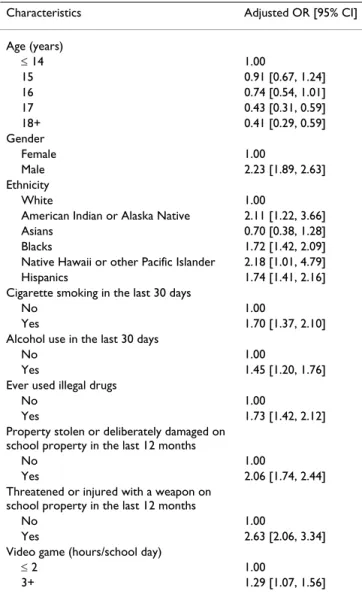
Results: Of the 13,857 respondents, 13.5% (18.2% for males and 8.8% for females) reported physical fighting onschool property in the last 12 months to the survey. Males were more likely to have been in a physical fight than females (OR = 2.23; 95% CI [1.89, 2.63]). Respondents aged 17 years or older were less likely to report physical fighting than those who were 14 years or younger. Compared to Whites, American Indians or Alaska Natives, Blacks, Native Hawaii or other Pacific Islanders, and Hispanics were more likely to report physical fighting on school property (OR = 2.11; 95% CI [1.22, 3.66], OR = 1.72; 95% CI [1.42, 2.0], OR = 2.18; 95% CI [1.01, 4.79], and OR = 1.74; 95% CI [1.41, 2.16] respectively). Physical fighting on school property was also positively associated with cigarette smoking (OR = 1.70; 95% CI [1.37, 2.10]), drinking alcohol (OR = 1.45; 95% CI [1.20, 1.76]), use of illegal drugs (OR = 1.73; 95% CI [1.42, 2.12]), having had property stolen or deliberately damaged on school property (OR = 2.06; 95% CI [1.74, 2.44]), having been threatened or injured with a weapon on school property (OR = 2.63; 95% CI [2.06, 3.34]), and playing videogame three or more hours a day (OR = 1.29; 95% CI [1.07, 1.56]).
Conclusion: These findings suggest that physical fighting among US High School students is widespread and positively associated with victimization (having been threatened or injured with a weapon on school property) and other risky behaviors such as smoking, alcohol and drugs use. Intervention programs to prevent/control those risky behaviors as well as further attention on the association between physical fighting and victimization at school through longitudinal research are warranted.
Published: 29 May 2008
Clinical Practice and Epidemiology in Mental Health 2008, 4:16 doi:10.1186/1745-0179-4-16
Received: 4 March 2008 Accepted: 29 May 2008
This article is available from: http://www.cpementalhealth.com/content/4/1/16 © 2008 Rudatsikira et al; licensee BioMed Central Ltd.
Background
Interpersonal violence is a major cause of morbidity and mortality among adolescents and young adults in the United States [1,2]. Violent deaths in schools are one severe consequence of school-based interpersonal vio-lence. Kachur et al have estimated a rate of 0.09 school-associated violent deaths per 100 000 student-years between the period 1992 to 1994 in the United States [3]. Pickett et al, have reported that involvement in adolescent fighting in North America and Europe varied across coun-tries, ranging from 37% to 69% for boys and 13% to 32% of the girls [4]. In many of these circumstances, adoles-cents most often reported fighting with friends or rela-tives. Recent studies from the developing countries have also shown that physical fighting among school going adolescents is prevalent. Rudatsikira et al have reported that 50.6% of adolescents had engaged in a physical fight-ing within the past 12 months prior to the survey in Namibia, southern Africa [5].
While deaths are the most severe consequences of inter-personal violence, the effects of school violence include: interference with the normal learning activities of stu-dents; weapon carrying for defensive purposes on school grounds; serious injury and attendant medical costs and absenteeism from school [6-8]. The Centers for Disease Control and Prevention (CDC) have reported that adoles-cents who felt unsafe at school were likely to be absent [9].
Previous studies have reported on factors that are associ-ated with having engaged in a physical fight among in-school adolescents. Kodjo et al, using data from the United States National Longitudinal Study of Adolescent Health (Add Health) of 1994–1995, a school-based, nationally representative survey of 6504 7th to 12th grad-ers have studied the association of being involved in a fight and drug use [10]. The aim of this study was to esti-mate the prevalence of having engaged in physical fight-ing on school property and associated factors of the behavior among school-going adolescents in the United States.
Methods
The primary sampling United States Youth Risk Behavior Survey (YRBS) of 2005 comprised all schools (public and private) with students in at least one of grades 9–12 in the 50 states and the District of Columbia. The sampling frame was obtained from the Quality Education Data (QED), Inc. database [11]. This database is one of the most comprehensive on the status of all schools in the United States. It includes information on both public and private schools and the most recent data from the Com-mon Core of Data from the National Center for Education Statistics [12].
A three-stage cluster sample design was used to obtain a nationally representative sample of students in grades 9– 12. In the first-stage of sampling, 1,261 primary sampling units (PSUs), consisting of counties, subareas of large counties, or groups of smaller, adjacent counties were obtained. The 1,261 PSUs were categorized into 16 strata according to their metropolitan statistical area (MSA) sta-tus. From these 1,261 PSUs, 57 were selected with proba-bility proportional to overall school enrollment size for the PSU. In the second stage of sampling, a total of 203 schools with any of grades 9–12 were selected with prob-ability proportional to school enrollment size. The third stage of sampling consisted of randomly selecting, in each chosen school and in each of grades 9–12, one or two classrooms from either a required subject or a required period (e.g., homeroom or second period).
All students in selected classes were eligible to participate. There was no replacement of schools, classes, or students that refused to participate. Black and Hispanic students were oversampled in order to allow for stratified analysis of these groups. The sampling of these groups provided that: 1) larger sampling rates were used to select PSUs that are in high-black and high-Hispanic strata; 2) a modified measure of size was used that increased the probability of selecting schools with a disproportionately high minority enrollment; and 3) two classes per grade, rather than one, were selected in schools with a high minority enrollment. A weight based on student sex, race/ethnicity, and grade level was applied to each record to adjust for school and student non-response and oversampling of black and His-panic students. The overall weights were scaled so that the weighted count of students equals the total sample size, and the weighted proportions of students in each grade match the national population proportions. For the 2005 national YRBS, 13,953 questionnaires were completed in 159 schools. The school response rate was 78%, and the student response rate was 86%. The school response rate multiplied by the student response rate produced an over-all response rate of 67%. CDC's Institutional Review Board granted clearance for the national YRBS.
Data Collection and Questionnaire design
Study participants completed the questionnaires anony-mously within a class period. Student completed the ques-tionnaires on computer scannable booklet or answer sheet.
Local parental permission procedures were followed before questionnaire administration. These procedures differed from state to state and from school district to school district.
rea-sons. Information about the reliability of the core ques-tionnaire is published elsewhere [13].
To assess physical fighting, participants were asked the fol-lowing question: "During the past 12 months, how many times were you in a physical fight on school property? (0 times, 1 time, 2 or 3 times, 4 or 5 times, 6 or 7 times, 8 or 9 times, 10 or 11 times, 12 or more times). During the analysis, in both Univariate and Multivariate, we recorded "0 times" as "no" and "1 or more times" as "yes". Current cigarette smoking meant having smoked cigarettes one or more days in the last 30 days. Alcohol use was defined as having had at least one drink of alcohol one day or more in the last 30 days while illicit drug use meant having ever used any of the following: marijuana, any form of cocaine, glue, heroin, methamphetamines, ecstasy, and steroid pills or shots.
Data analysis
Data analysis was only conducted for complete question-naires. Our analysis is restricted to students in high school (elementary school excluded). As per requirement of the Office of Management and Budget of the US government, race/ethnicity categorization followed from the following questions and responses:
from two question: 1) "Are you Hispanic or Latino?" (options were "yes" or "no"), and 2) "What is your race?" (options were "American Indian or Alaska Native," "Asian," "Black or African American," "Native Hawaiian or Other Pacific Islander," or "White"). For the second question, students could select more than one response option. For this report, students were classified as "His-panic" if they answered "yes" to the first question, regard-less of how they answered the second question. Students were classified as "Black" if they answered "no" to the first question and selected only "Black or African American" to the second question. Students were classified as "White" if they answered "no" to the first question and selected only "White" to the second question. Students were classified as "other" if they answered "no" to the first question and selected "American Indian or Alaska Native," "Asian," and/or "Native Hawaiian or Other Pacific Islander" or selected more than one response to the second question.
For the 2005 state and local YRBS, race/ethnicity was com-puted from one question: "How do you describe your-self?" (response options were "American Indian or Alaska Native," "Asian," "Black or African American," "Hispanic or Latino," "Native Hawaiian or Other Pacific Islander," or "White"). Students could select more than one response option. For this report, students were classified as "Hispanic" if they selected "Hispanic or Latino" only or if they selected "Hispanic or Latino" plus any other response option. Students were classified as "Black" if they
selected "Black or African-American" only. Students were classified as "White" if they selected "White" only. Stu-dents were classified as "other" in the recoding if they selected "American Indian or Alaska Native" only, "Asian" only, and/or "Native Hawaiian or Other Pacific Islander" only or multiple response options except "Hispanic or Latino."
Data were analyzed using SAS software version 9.0.3 (SAS, Cary, North Carolina, United States). We obtained fre-quencies and proportions of relevant variables. We also assess associations using multivariate logistic regression analysis with having engaging in a physical fight as the outcome. The variables assessed for association were those that have previously been reported in previous stud-ies [14,15]. Bivariate analysis results report unadjusted effect estimates while multivariate analysis reports effect estimates following control of co-variates.
Results
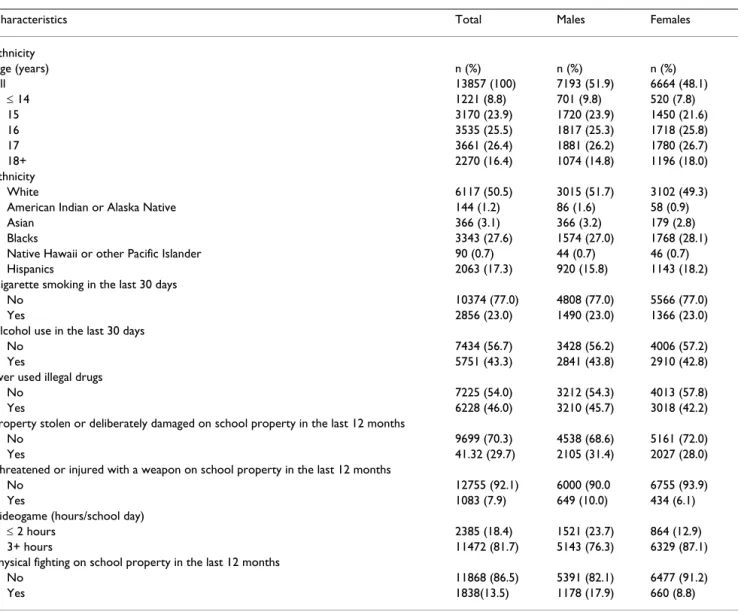
Table 1 presents selected characteristics of the study pop-ulation of 13,857 US High School students (median age 15 years). Most of the sample was male (51.9%), White (67.8%), non cigarette smokers and non alcohol users. Overall 13.5% (18.2% males and 8.8% females) of the respondents reported having been in a physical fight on school property in the last 12 months to the survey.
Discussion
Using data from the United States Youth Risk Behavior Survey 2005, we have estimated the 12 months prevalence of having engaged in a physical fight on school property among US adolescents in high school at 13.5%. Males were more likely to be involved in physical fighting than females (18.2% versus 8.8%). The prevalence of other rel-evant behavioral experiences were as follows: current smoking (23%); alcohol (43.3%); lifetime illicit drug use (44%); property damaged or stolen on school grounds (29.7%) and having been threatened or injured with a weapon (7.9%). All these prevalence estimates suggest that US adolescent experience unhealthy lifestyles includ-ing beinclud-ing stressed from external sources to a great degree.
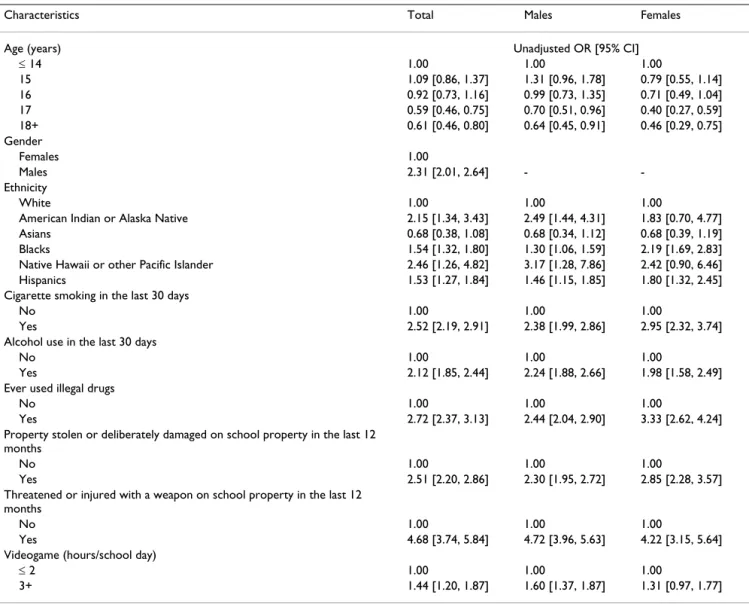
In both bivariate and multivariate analysis the following were positively associated with having engaged in a phys-ical fight on school property: male gender; non-white race
(except Asians); substance use (alcohol, cigarette, and illicit drugs); having had property stolen or damaged; hav-ing ever been threatened or injured with weapon and exposure to video games.
The higher male prevalence compared to females is per-haps not surprising. Males top females in almost all unhealthy behaviors such as homicides, alcohol, cigarette smoking, not presenting for health care when ill and hav-ing multiple and concurrent sex partners [16-21]. Cultural perceptions of masculinity are likely to be the reasons that males predominate in many unhealthy behaviors [22,23]. Society is likely to be tolerant to male violence behaviors than it is to female violent behaviors. As male adolescents may feel violence among males is acceptable, there may be no strong disincentives to prevent them from violent behaviors.
Table 1: Characteristics of the study population of United States High School students in the Youth Risk Behavior Survey 2005
Characteristics Total Males Females
Ethnicity
Age (years) n (%) n (%) n (%)
All 13857 (100) 7193 (51.9) 6664 (48.1)
≤ 14 1221 (8.8) 701 (9.8) 520 (7.8)
15 3170 (23.9) 1720 (23.9) 1450 (21.6)
16 3535 (25.5) 1817 (25.3) 1718 (25.8)
17 3661 (26.4) 1881 (26.2) 1780 (26.7)
18+ 2270 (16.4) 1074 (14.8) 1196 (18.0)
Ethnicity
White 6117 (50.5) 3015 (51.7) 3102 (49.3)
American Indian or Alaska Native 144 (1.2) 86 (1.6) 58 (0.9)
Asian 366 (3.1) 366 (3.2) 179 (2.8)
Blacks 3343 (27.6) 1574 (27.0) 1768 (28.1)
Native Hawaii or other Pacific Islander 90 (0.7) 44 (0.7) 46 (0.7)
Hispanics 2063 (17.3) 920 (15.8) 1143 (18.2)
Cigarette smoking in the last 30 days
No 10374 (77.0) 4808 (77.0) 5566 (77.0)
Yes 2856 (23.0) 1490 (23.0) 1366 (23.0)
Alcohol use in the last 30 days
No 7434 (56.7) 3428 (56.2) 4006 (57.2)
Yes 5751 (43.3) 2841 (43.8) 2910 (42.8)
Ever used illegal drugs
No 7225 (54.0) 3212 (54.3) 4013 (57.8)
Yes 6228 (46.0) 3210 (45.7) 3018 (42.2)
Property stolen or deliberately damaged on school property in the last 12 months
No 9699 (70.3) 4538 (68.6) 5161 (72.0)
Yes 41.32 (29.7) 2105 (31.4) 2027 (28.0)
Threatened or injured with a weapon on school property in the last 12 months
No 12755 (92.1) 6000 (90.0 6755 (93.9)
Yes 1083 (7.9) 649 (10.0) 434 (6.1)
Videogame (hours/school day)
≤ 2 hours 2385 (18.4) 1521 (23.7) 864 (12.9)
3+ hours 11472 (81.7) 5143 (76.3) 6329 (87.1)
Physical fighting on school property in the last 12 months
No 11868 (86.5) 5391 (82.1) 6477 (91.2)
We have observed the race-ethnicity differences that are associated with physical fighting among high school stu-dents in this study. Compared to Whites, American Indian or Alaska Native, Blacks and Hispanics were more likely to report physical fighting while Asians were less likely to engage in physical fighting. We do not believe these differ-ences are due to any genetic differdiffer-ences but rather as a result of different socio-economic environments that ado-lescents live in. Previous studies have reported that with the exception of Asians, members of all other ethnic minority groups were more socioeconomically disadvan-taged than White and that low socioeconomic status (SES) was a determinant of poor health outcomes [24-26]. Racial difference in health indices such as cardiovascular, perinatal and breast cancer mortality have consistently been observed [27-29], largely as a result of differences in access to health care. Furthermore almost always, with
regarding to violence and incarcerations, Blacks and His-panics are more likely to experience these than white. Eth-nic minority youth live in unsafe environments, and so are exposed to violence and crime more than whites. As a result of this influence, they are also likely to engage in violent behaviors.
Adolescents who reported having had property damaged or stolen at school and those who reported having been threatened or injured with a weapon were more likely to have engaged in a fight. This may suggest that previous victimization may trigger adolescents to engage in a fight rather than solve interpersonal differences in a different way. Rudatsikira et al have reported that weapon carrying by California adolescents was associated with previous victimization [30]. These authors suggested that adoles-cents might have carried weapons in self-defense for any
Table 2: Results of bivariate stratified analysis on the association between physical fighting on school property and selected characteristics among US High School students, 2005
Characteristics Total Males Females
Age (years) Unadjusted OR [95% CI]
≤ 14 1.00 1.00 1.00
15 1.09 [0.86, 1.37] 1.31 [0.96, 1.78] 0.79 [0.55, 1.14] 16 0.92 [0.73, 1.16] 0.99 [0.73, 1.35] 0.71 [0.49, 1.04] 17 0.59 [0.46, 0.75] 0.70 [0.51, 0.96] 0.40 [0.27, 0.59] 18+ 0.61 [0.46, 0.80] 0.64 [0.45, 0.91] 0.46 [0.29, 0.75] Gender
Females 1.00
Males 2.31 [2.01, 2.64] -
-Ethnicity
White 1.00 1.00 1.00
American Indian or Alaska Native 2.15 [1.34, 3.43] 2.49 [1.44, 4.31] 1.83 [0.70, 4.77] Asians 0.68 [0.38, 1.08] 0.68 [0.34, 1.12] 0.68 [0.39, 1.19] Blacks 1.54 [1.32, 1.80] 1.30 [1.06, 1.59] 2.19 [1.69, 2.83] Native Hawaii or other Pacific Islander 2.46 [1.26, 4.82] 3.17 [1.28, 7.86] 2.42 [0.90, 6.46] Hispanics 1.53 [1.27, 1.84] 1.46 [1.15, 1.85] 1.80 [1.32, 2.45] Cigarette smoking in the last 30 days
No 1.00 1.00 1.00
Yes 2.52 [2.19, 2.91] 2.38 [1.99, 2.86] 2.95 [2.32, 3.74] Alcohol use in the last 30 days
No 1.00 1.00 1.00
Yes 2.12 [1.85, 2.44] 2.24 [1.88, 2.66] 1.98 [1.58, 2.49] Ever used illegal drugs
No 1.00 1.00 1.00
Yes 2.72 [2.37, 3.13] 2.44 [2.04, 2.90] 3.33 [2.62, 4.24] Property stolen or deliberately damaged on school property in the last 12
months
No 1.00 1.00 1.00
Yes 2.51 [2.20, 2.86] 2.30 [1.95, 2.72] 2.85 [2.28, 3.57] Threatened or injured with a weapon on school property in the last 12
months
No 1.00 1.00 1.00
Yes 4.68 [3.74, 5.84] 4.72 [3.96, 5.63] 4.22 [3.15, 5.64] Videogame (hours/school day)
≤ 2 1.00 1.00 1.00
potential victimization. Glew et al have reported that vic-tims of bullying in a school district in the United States felt it was "not wrong" to carry weapons to schools [31]. Among this group of 5391 school adolescents, 26% had been involved in bullying either as victims or as perpetra-tors.
We found that adolescents less than 14 years were more likely to report having engaged in a fight than older study participants. We believe this may be due to the fact that younger adolescents may not have gotten non-violent conflict resolution skills compared to older adolescents. Furthermore, younger adolescents are less likely to severely injured others such that the consequences of their actions attract parental or school authorities attention. Finally, parents are likely to neglect young adolescents fighting than if fighting occurs among older adolescents.
All these reasons may discourage fighting among older adolescents while younger adolescents may not have as much disincentive. Johnson et al [32] have reported a qualitative study in which via focus group discussions, youth reported that fighting may be a necessary outcome of a disagreement. Although it would obviously be desir-able that no physical fighting occurred, the youths inter-viewed suggested that physical fighting had potential to prevent more serious violence.
The association between self reported history of having 3 or more hours of video-game play and physical fighting is interesting. Ez-Elarab et al [33] have reported that elemen-tary school children who had preference of violent video games were more likely to exhibit violent behaviors than those who did not have that preference. Previous reports have suggested that short-term effects of exposure to media violence are mostly due to the following: i) prim-ing processes, ii) arousal processes, and ii) immediate mimicking of specific behaviors [34-36]. In brief, the priming process is when watching violent media makes the individual to associate similar situation seen in the video but now in real life to violence. Arousal is the proc-ess where having viewed violent media makes one excited and may engage in violence when provoked. Mimicry occurs when imitation occurs as part of observational learning [37-39].
The association between the numbers of hours adoles-cents play video games and having been engaged in a physical fight may also be just a marker of unsupervised time that the adolescent has at his or her disposal. Adoles-cents who are alone at home or elsewhere may be more likely to play video games than those that are supervised. Unsupervised adolescents are more likely to engage in a diversity of anti-social and unhealthy life styles such as sexual intercourse, cigarette smoking, violence and illicit drug use [40-43].
Limitations of the study
This study has several limitations. This is a cross-sectional study so the results cannot be used to assume causality. The study participants may have underreported or over-reported on any of risk behaviors. The study methodology however has demonstrated good test-retest reliability [13]. Ethno-racial categories were based on self-catego-rized status. Mixed race adolescents may not have known that official racial categorization may be different from their own perceptions. An example is an mixed race ado-lescent with one parent black and the other white. The official categorization of such an individual is black despite the fact that some adolescents in that category may classify themselves as white. Intrinsically of course, there is no reason as to why such an adolescent should be clas-sified as one and not the other.
Table 3: Multivariate analysis results on the association between physical fighting on school property and selected characteristics among US High School students, 2005
Characteristics Adjusted OR [95% CI]
Age (years)
≤ 14 1.00
15 0.91 [0.67, 1.24]
16 0.74 [0.54, 1.01]
17 0.43 [0.31, 0.59]
18+ 0.41 [0.29, 0.59] Gender
Female 1.00
Male 2.23 [1.89, 2.63] Ethnicity
White 1.00
American Indian or Alaska Native 2.11 [1.22, 3.66] Asians 0.70 [0.38, 1.28] Blacks 1.72 [1.42, 2.09] Native Hawaii or other Pacific Islander 2.18 [1.01, 4.79] Hispanics 1.74 [1.41, 2.16] Cigarette smoking in the last 30 days
No 1.00
Yes 1.70 [1.37, 2.10] Alcohol use in the last 30 days
No 1.00
Yes 1.45 [1.20, 1.76] Ever used illegal drugs
No 1.00
Yes 1.73 [1.42, 2.12] Property stolen or deliberately damaged on
school property in the last 12 months
No 1.00
Yes 2.06 [1.74, 2.44] Threatened or injured with a weapon on
school property in the last 12 months
No 1.00
Yes 2.63 [2.06, 3.34] Video game (hours/school day)
≤ 2 1.00
The study recruited adolescents in school. These findings may therefore not be representative of out of school ado-lescents. In 2001, approximately 5% of persons aged 16 – 17 years in the United States were not enrolled in a high school program and had not completed high school [12]. We believe the proportion of out of school but age eligible adolescents to be relatively small.
Furthermore, the study did not categories the gravity or seriousness of the fighting. This therefore has meant that students who were involved in minor incidents have been categorized together with those where significant fighting may have occurred, such as those leading to hospitaliza-tion.
Conclusion
These findings suggest that physical fighting among US High School students is widespread and positively associ-ated with victimization (having been threatened or injured with a weapon on school property) and other risky behaviors such as smoking, alcohol and drugs use. Intervention programs to prevent/control those risky behaviors as well as further attention on the association between physical fighting and victimization at school through longitudinal research are warranted.
Competing interests
The authors declare that they have no competing interests.
Authors' contributions
ER conceived data analysis plan, conducted data analysis, and participated in the drafting of the manuscript.
ASM participated in the interpretation of the results and drafting of the manuscript.
SS participated in the interpretation of the results and drafting of the manuscript.
All authors read and approved the manuscript.
Acknowledgements
Data used in this study were obtained from the Centers for Disease Con-trol and Prevention, Office on Smoking and Health National Center for Chronic Disease Prevention and Health Promotion to which we are immensely grateful. We also thank the students, parents and school admin-istrators for making the data collection exercise possible.
References
1. Centers for Disease Control and Prevention: School-associated homicides – United States, 1992–2006. MMWR Morb Mortal Wkly Rep 2008, 57(2):33-36.
2. Centers for Disease Control and Prevention (CDC): Source of fire-arms used by students in school-associated violent deaths – United States, 1992–1999. MMWR Morb Mortal Wkly Rep 2003,
52(9):169-172.
3. Kachur SP, Stennies GM, Powell KE, Modzeleski W, Stephens R, Mur-phy R, Kresnow M, Sleet D, Lowry R: School-associated violent
deaths in the United States, 1992 to 1994. JAMA 1996,
275:1729-1733.
4. Pickett W, Craig W, Harel Y, Cunningham J, Simpson K, Molcho M, Mazur J, Dostaler S, Overpeck MD, Currie CE: HBSC Violence and Injuries Writing Group. Cross-national study of fighting and weapon carrying as determinants of adolescent injury. Pedi-atrics 2005, 116:e855-863.
5. Rudatsikira E, Siziya S, Kazembe LN, Muula AS: Prevalence and associated factors of physical fighting among school-going adolescents in Namibia. Ann Gen Psychiatry 2007, 6:18.
6. Moskowitz H, Griffith JL, DiScala C, Sege RD: Serious injuries and deaths of adolescent girls resulting from interpersonal vio-lence: characteristics and trends from the United States, 1989–1998. Arch Pediatr Adolesc Med 2001, 155:903-908. 7. Miller TR, Pindus N, Douglass J, Rossman S: Databook on Nonfatal
Injury – Incidence, Costs, and Consequences Washington, DC: Urban Institute; 1995.
8. Moskowitz H, Griffith JL, DiScala C, Sege RD: Serious injuries and deaths of adolescent girls resulting from interpersonal vio-lence: characteristics and trends from the United States, 1989–1998. Arch Pediatr Adolesc Med 2001, 155:903-908. 9. Centers for Disease Control and Prevention (CDC):
Violence-related behaviors among high school students – United States, 1991–2003. MMWR Morb Mortal Wkly Rep 2004,
53(29):651-655.
10. Kodjo CM, Auinger P, Ryan SA: Prevalence of, and factors asso-ciated with, adolescent physical fighting while under the influence of alcohol or drugs. J Adolesc Health 2004, 35:e11-6. 11. Quality Education Data: Products and services Denver, CO: Quality.
Education Data, Inc; 2004.
12. US Department of Education, National Center for Educa-tion Statistics. Common Core of Data Public Elementary/ Secondary School Universe Survey: School Year 2002–03
2004 [http://nces.ed.gov/ccd]. Washington, DC: US Department of Education, National Center for Education Statistics Retrieved on 5 January 2008
13. Brener ND, Kann L, McManus T, Kinchen SA, Sundberg EC, Ross JG:
Reliability of the 1999 Youth Risk Behavior Survey question-naire. J Adolesc Health 2002, 31:336-342.
14. Hill SC, Drolet JC: School-related violence among high school students in the United States, 1993–1995. J Sch Health 1999,
69:264-272.
15. Orpinas PK, Basen-Engquist K, Grunbaum JA, Parcel GS: The co-morbidity of violence-related behaviors with health-risk behaviors in a population of high school students. J Adolesc Health 1995, 16:216-225.
16. Dobson R: Danish men consult GPs less than women but attend hospital more and have greater mortality. BMJ 2007,
335:1010-1011.
17. Siziya S, Muula AS, Kazembe LN, Rudatsikira E: Harmful lifestyles' clustering among sexually active in-school adolescents in Zambia. BMC Pediatr 2008, 8:6.
18. Rudatsikira E, Ogwell AE, Siziya S, Muula AS: Prevalence of sexual intercourse among school-going adolescents in Coast Prov-ince, Kenya. Tanzan Health Res Bull 2007, 9:159-163.
19. Smith DJ: Modern marriage, men's extramarital sex, and HIV risk in southeastern Nigeria. Am J Public Health 2007,
97:997-1000.
20. Mahalik JR, Burns SM, Syzdek M: Masculinity and perceived nor-mative health behaviors as predictors of men's health behav-iors. Soc Sci Med 2007, 64:2201-2209.
21. Courtenay WH: Constructions of masculinity and their influ-ence on men's well-being: a theory of gender and health. Soc Sci Med 2000, 50:1385-1401.
22. Ng N, Weinehall L, Ohman A: 'If I don't smoke, I'm not a real man' Indonesian teenage boys' views about smoking. Health Educ Res 2007, 22:794-804.
23. Hunt K, Hannah MK, West P: Contextualizing smoking: mascu-linity, femininity and class differences in smoking in men and women from three generations in the west of Scotland.
Health Educ Res 2004, 19:239-249.
Publish with BioMed Central and every scientist can read your work free of charge "BioMed Central will be the most significant development for disseminating the results of biomedical researc h in our lifetime."
Sir Paul Nurse, Cancer Research UK
Your research papers will be:
available free of charge to the entire biomedical community
peer reviewed and published immediately upon acceptance
cited in PubMed and archived on PubMed Central
yours — you keep the copyright
Submit your manuscript here:
http://www.biomedcentral.com/info/publishing_adv.asp
BioMedcentral
25. Mendes de Leon , Glass CF: The role of social and personal resources in ethnic disparities in late-life health. In Critical per-spectives on racial and ethnic differences in health in late life Edited by: Anderson NB, Bulatao RA, Cohen B. The National Academies Press, Washington, DC; 2004:353-405.
26. Williams DR, Collins C: Racial residential segregation: a funda-mental cause of racial disparities in health. Public Health Rep
2001, 116:404-416.
27. Polednak AP: Racial differences in mortality from obesity-related chronic diseases in US women diagnosed with breast cancer. Ethn Dis 2004, 14:463-468.
28. Curtis E, Quale C, Haggstrom D, Smith-Bindman R: Racial and eth-nic differences in breast cancer survival: how much is explained by screening, tumor severity, biology, treatment, comorbidities, and demographics? Cancer 2008, 112:171-180. 29. Wingate MS, Alexander GR: Racial and ethnic differences in
perinatal mortality: the role of fetal death. Ann Epidemiol 2006,
16:485-491.
30. Rudatsikira E, Singh P, Job J, Knutsen S: Variables associated with weapon-carrying among young adolescents in southern Cal-ifornia. J Adolesc Health 2007, 40:470-473.
31. Glew GM, Fan MY, Katon W, Rivara FP: Bullying and school safety. J Pediatr 2008, 152:123-128.
32. Johnson SB, Frattaroli S, Wright JL, Pearson-Fields CB, Cheng TL:
Urban youths' perspectives on violence and the necessity of fighting. Inj Prev 2004, 10:287-291.
33. Ez-Elarab HS, Sabbour SM, Gadallah MA, Asaad TA: Prevalence and risk factors of violence among elementary school children in Cairo. J Egypt Public Health Assoc 2007, 82:127-146.
34. Huesmann LR, Kirwil L: Why observing violence increases the risk of violent behavior in the observer. In The Cambridge Hand-book of Violent Behavior and Aggression Edited by: Flannery D. Cam-bridge: Cambridge University Press; 2007.
35. Berkowitz L, LePage A: Weapons as aggression-eliciting stimuli.
J Pers Soc Psychol 1967, 7:202-207.
36. Bryant J, Zillmann D: Effect of intensification of annoyance through unrelated residual excitation on substantially delayed hostile behavior. J Exp Soc Psychol 1979, 15:470-480. 37. Geen RG, O'Neal EC: Activation of cue-elicited aggression by
general arousal. J Pers Soc Psychol 1969, 11:289-292.
38. Huesmann LR: Imitation and the effects of observing media violence on behavior. In Perspectives on Imitation: From Neuroscience to Social Science: Imitation, Human Development, and CultureVolume 2. Edited by: Hurley S, Chater N. Cambridge, Massachusetts: MIT Press; 2005.
39. Meltzoff AN, Moore MK: Imitation of facial and manual ges-tures by human neonates: Resolving the debate about early imitation. In Infant Development: The Essential Readings Edited by: Muir D, Slater A. Malden, Massachusetts: Blackwell Publishers; 2000. 40. Mulhall PF, Stone D, Stone B: Home alone: is it a risk factor for middle school youth and drug use? J Drug Educ 1996, 26:39-48. 41. Richardson JL, Radziszewska B, Dent CW, Flay BR: Relationship between after-school care of adolescents and substance use, risk taking, depressed mood, and academic achievement.
Pediatrics 1993, 92:32-38.
42. Coley RL, Morris JE, Hernandez D: Out-of-school care and prob-lem behavior trajectories among low-income adolescents: individual, family, and neighborhood characteristics as added risks. Child Dev 2004, 75:948-965.