Indexed on: December, 2014
All Rights Reserved with International Library for Thesis
UBN
:
015-A94510112009
Doctorate Research Award-2014
in
Education
5-6 Year Old Children Visual Efficiency Development in
the Period of School Loading Adaptation by Means of
Visual Exercises
BY
Bondarenko S.*
International Library for Thesis
The Journal of Education. Photon 106 (2014) 149-156
https://sites.google.com/site/photonfoundationorganization/home/the-journal-of-education Original Research Article. ISJN: 5726-1839: Impact Index: 3.68
The Journal of Education
Ph ton
5-6 Year Old Children Visual Efficiency Development in the Period of
School Loading Adaptation by Means of Visual Exercises
Bondarenko S.*
Olympic and Professional Sport Theory and Methodology Department, Serhii Bondarenko Kirovohrad Volodymyr Vynnychenko State Pedagogical University, Ukraine
Authors receive Thomas Edison Award-2014 in the domain of Education for Inspiration and Knowledge Distribution among young research scholars.
Article history:
Received: 30 December, 2013 Accepted: 05 January, 2014 Available online: 15 May, 2014
Keywords:
Visual load, refractive genesis, visual adaptation, visual training
Abbreviation:
РР1 near point (punctum proximum), РР2 – near point of clear vision, VEM - Visual efficiency marker, VPI - Visual performance index
Corresponding Author:
Bondarenko S. Associate Professor
Email: [email protected]
Abstract
Modern school load burdened by a primary school child have a disastrous influence both on vision current state and visual analyzer development implicitly. The 5-6 year old children visual load specificity is connected with the school work
peculiarities determined by near visual zone burden. Reading, writing, calculation training are the activities performed in this zone. 5-6 year old schoolchildren age peculiarities aggravate a myopia problem expansion. Visual load high level together with natural refractive genesis encourages children nearsightedness. School work intensification as a result of modern society computerization leads to the wholesale nearsightedness that is viewed as a vision forced adaptation to the school load. Age visual peculiarities of 6-year-old alumni aggravate the myopia problem among pupils. Visual load increases and becomes more specific. Natural refractive genesis is being layered on the
mentioned factors encouraging children
nearsightedness. The educational load sanitation can be achieved by visual training course at the initial stage of school education.
Citation:
Bondarenko S., 2014. 5-6 Year Old Children Visual Efficiency Development in the Period of School Loading Adaptation by Means of Visual Exercises. The Journal of Education. Photon 106, 149-156.
All Rights Reserved with Photon.
Photon Ignitor: ISJN57261839D638915052014
1. Introduction
1.1 Visual load dynamics
School education initial stage is characterized by the visual load increasing up to 5-6 hours
per day. Educational visual load is
characterized not only by volume increasing (two- or three-fold in comparison with pre-school period) but also by its intensity (eye accommodative apparatus tension). Reading, writing and arithmetic schooling that are concentrated in the near visual zone seem to be main factors for the mentioned problems. 1.2 Visual load peculiarities
The visual work at reading schooling analysis evidences that visual system requires 2-9 main vertical and horizontal hairlines and some voids per each letter (Klyuka, 1987). Visual analyzer oculomotor muscles work
irregularly and discontinuously. The text is understood mainly at a pause – reading recording. The pauses quantity and thus- visual load – depends primarily on the reading skills level. Visual load is being increased due to multiple reverse eyes motion to unidentified letter, obscure word, missed line (Glushkova, 1987).
TV viewing on a day-to day basis together with computer games makes negative impact on children visual analyzer that is still being formed (Akhmadeev et al., 2001). The above mentioned factors are characterized by a recurrent screen illumination in a wide diapason, flicker frequency impose a visual load in addition to an educational one.
So the elementary schooling problem seems to be as follows: the visual load volume and specificity distort significantly visual analyzer refractive genesis of the 6-year-old pupils.
2. Literature Review
2.1 Children vision age peculiarities
It is known that preschool-elementary school age (3-10 years old) is a period of hyperopia decline and emmetropia and myopia increase (Avetisov et al., 1986). Refraction variants quantity is inconsistent, yet, as E.S. Avetisov says, age-related refractive genesis regularity seems to be generally agreed (Avetisov, 1999).
It signifies that the child visual analyzer functional age-related changes are determined by the necessity to form a vague hypermotropic and emmetropic refraction (Mamatkhuzhaeva, 2002).
Besides preschool-elementary school age is characterized by eye refringence lability. Visual analyzer muscular apparatus is bent on spastic state and inadequate reaction to visual load. Dynamic refraction vision zone is instable and is easily shifted to myopia (Borodina et al., 2012). Older preschool age
evidences almost completely developed
chromatopsia, but the complete development is registered at the age of 8-9 years old.
Binocular vision is based on
monocular visual structures dismaturity
(Arciniegas et al., 1986).
Visibility pick-up range borders are narrower as compared with that of older pupils (Onufriychuk et al., 2007).
The object shape perception and vision acuteness is fully developed in schooling period. The engagement tempo of the shape vision may vary since it is determined by 6-year-old children biological maturation specificity (Dolzhich et al., 2008).
Thus the distinctive feature of
elementary school pupils’ refractive genesis is a continuous and geterochronous vision transition into emmetropic sphere due to immature visual functions used for increased visual educational load. This period is often thought of as a critical period that determines the vision level in the future life. Since visual analyzer is an optic system that facilitates visual orientation, its development should be
analyzed together with an organism vital activity (initial elementary schooling visual load specificities predominant for a 6-year-old child) (Tarutta, 2006).
2.2 Children refractive genesis regularities under school load
A factor that is determinant to visual
mechanisms adaptation to visual work
specificity is a correlation between age determined unstable anatomic eye static refraction and an optic component which is almost constant after 5 years old. The correlation is as follows: more powerful refractivity goes with a shorter anterior-posterior axis; weaker refractivity goes with a longer anterior-posterior axis. It proves that anatomic component is fundamental for static refraction harmonizing (Sato, 1986).
Dynamic refraction is a functional system aiming at eye adjustment to a finite distance. Its functioning is determined by three components correlation: visual axis length
(anatomic component), refractivity within
debilitated accommodation (optic component) and accommodative capability (Rozenblum et al., 2007).
E.S. Avetisov, the three-factor myopia theory underlines the near distance vision prevailing role in schooling. It can be
presumed that the mentioned factors
development and correlation are aimed to maintain the near distance activity (Avetisov, 1999).
2.3 School load adaptation types
Educational visual work maintenance which actually signifies eye adaptation to new vital activity is explained by William Horatio Bates theory. The theory states that refraction deviations are connected with oculomotor muscles inefficiency and consequently – perispheric eye shape changes. To reduce tension resulted from continuous near vision load visual analyzer modifies the optical system to ease the near distance visual work. It is achieved by the refraction anatomic component modification. Thus if the optical axis is lengthened within 1 mm it release the tension but leads to myopia refraction (Bates, 1987).
By this means myopia may be interpreted as child vision adaptation to schooling visual load. It is proved by school age adjusted myopia incidence rate.
3. Objective of Research
The aim of the research is to justify the therapeutic and developing training possibility and necessity at the period of children adaptation to the near zone visual work. The annual pedagogical experiment involving visual games complexes (after Avetisov, Bates) systematic applying gave definite results. Ergographic visual indexes (after Avetisov classification) increased according to the statistics as well as the visual efficiency
markers. It helped to reduce the
accommodative (school) myopia risk. The search results offer the challenge for primary education health saving technologies. It conforms to the modern schooling valeological paradigm: “Teach without health ruining”.
4. Materials and Methods
The following methods were applied to study 6-year-old primary school pupils’ visual analyzer functions. The near distance eye functioning was tested.
Oculomotor muscles ergography that shows time-series identification of the nearest point (РР1) and near point of clear vision (РР2).
Ergogram has been taken uniocularly with the help of a proximotor with a kymograph for 3 minutes. The test object (amid steady illumination) was an adjustable ground glass screen with an optotype – Landolt ring relevant to vision sharp 0.7 for the distance of 33 centimeters.
The ergogram data was analyzed according to Avetisov classification (Avetisov et al., 1987).
58 ergograms of 6-year-old children had been obtained and analyzed.
General visual test was based on
correction task methodology. 6-year-old
children vision study was accomplished with the help of correction task table fragment (Tagayeva, 1976).
Character structure, size and spacing served as a model of a visual work at literacy
schooling. Visual efficiency (testees’
performance ability) evaluation was done according to Weston H. methodology.
The tables were completed before, during and after measured schooling load. The
load contemplated visual analyzer substantive tension while working within the nearest zone (reading, writing schooling). Correction task table work was carried out at pupils working places at a permanent illumination. 56 6-year-old pupils were tested. 174 answers were received and analyzed.
All the testees on thorough medical evidence demonstrated vague hypermotropic and emmetropic refraction and a vision sharp of 0,9 which corresponds to the visual analyzer normal state at this period.
An experimentative factor was as
follows. During the academic year
(September-May) the everyday visual
exercises (special games and tasks) were suggested to exercise the eye muscular system. They aimed at eye adaptation to vision load at near distance (myopia type of refraction). The visual analyzer exercises complexes aimed at visual analyzer straining and laxity were suggested. They are based on Avetisov, Bates methodology adapted for 6-year-old children.
5. Justification of Research
Every year millions of pupils start learning. Millions of people graduate from the schools and colleges with accommodative (school) myopia resulting from school load. Due to the visual load increase the myopia problem will only be escalating. The above mentioned stands for the necessity to new visual methodology implementation aimed at visual analyzer sanitation. In reliance on visual age peculiarities, refraction genesis development, visual load influence, proper theoretical studies and experimental results the author suggests ways for primary school children visual efficiency developing and control.
6. Results
Ergometry-based visual efficiency study was based on one-year experiment of the everyday
supportive-evolutive visual exercise in
experimental group and traditional recreational physical exercises in a control group. The exercises volume and duration were equal. The study proved the following.
Ph ton 152
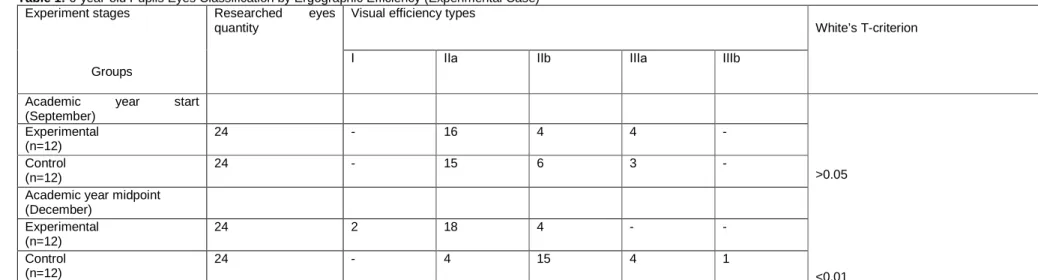
Table 1: 6-year-old Pupils Eyes Classification by Ergographic Efficiency (Experimental Case)
Experiment stages
Groups
Researched eyes quantity
Visual efficiency types
White’s T-criterion
І ІІа ІІb ІІІа ІІІb
Academic year start (September)
>0.05
<0.01 Experimental
(n=12)
24 - 16 4 4 -
Control (n=12)
24 - 15 6 3 -
Academic year midpoint (December)
Experimental (n=12)
24 2 18 4 - -
Control (n=12)
24 - 4 15 4 1
To characterize sufficiently the visual analyzer (complex functional system) adaptation to schooling load, the visual efficiency was studied by a general correction task test, processed by Weston H.
Table 2: 6-year-old Pupils Visual Efficiency at the Experiment Initial Stage
(September)
Table 3: 6-year-old Pupils Visual Efficiency at the Experiment Final Stage (May)
Groups Statistical Measures
Visual efficiency dynamics Before
Education al Visual Load
At the Process of Education al Visual Load
After Educational Visual Load
Experimental (n=38) Control (n=24)
x m p x m
0.193 0.013 <0.05 0.155 0.009
0.199 0.008 >0.05 0.191 0.009
0.149 0.0059 >0.05 0.148 0.12 Groups Statistical
Measures
Accuracy Measures
Velocity Measures
Visual Efficiency Integral Measures Experimental
(n=38) Control (n=24)
x m p x m
0.91 0.026 >0.05 0.90 0.024
0.122 0.0054 >0.05 0.119 0,0064
0.111 0.006 >0.05 0.107 0.0073
7. Discussion
Visual schooling load adaptation difficulties of 6 year old pupils at the initial level are reflected at Table 1. Eye muscular apparatus is not able to provide a stable response reaction within three-minute standard visual load in the nearest (РР1) and the near (РР2) clear vision points.
As a result none of the normal age-determined visual function ergograms can be classified as the І etalon type. At the same time the ergograms of the ІІа type (Avetisov
methodology) demonstrate certain
characteristics with a tendency to be
developed up to the І type. Reasonably
sinuous amplitude characterizes the
experiment final stage as well as relative
regularity of РР1 and РР2 at ergograms
extended fragments. Both groups amplitude value resembled accommodation reflex. The data received stands for the homogeneous visual efficiency within both groups.
Intermediate test conducted after 3.5
months’visual training program showed
competed results in the groups tested (Table 1). Experimental group is illustrated mainly by
ІІа type ergograms which is a result of ІІb
и
ІІІа types deviations. The middle phase of the
experiment demonstrates the ІІІ type
ergorgrams absence and І type ergorgrams
instance (2 cases). It results in visual efficiency increase which comes out of the schooling load visual component excessive exposure. The experimental group data is concentrated mostly within ІІа type ergograms. It proves the intense schooling saturation
importance while adapting to school
education.
As a result none of the normal age-determined visual function ergograms can be classified as the І etalon type. At the same time the ergograms of the ІІа type (Avetisov
methodology) demonstrate certain
characteristics with a tendency to be
developed up to the І type.
The control group data is indicative of visual efficiency decrease: most ergograms
belong to ІІb type and witness accommodative
function weakness. The ІІІ type ergograms
emerge (5 cases) which is a result of visual efficiency feebleness. The changes came together with asthenopia symptoms (smarting eyes and caligation) that prevented from experiment continuation under predertemined condition.
ІІІ type ergograms analyses shows
specific arcs as РР1 and РР2 points’ eye withdraw. The amplitude changes are not significant still distinctly graded. The РР1 and
РР2 distance module at the ergogram final fraction equals to 30 %.
Visual efficiency correction task
investigation (Table 2) testifies both groups statistical homogeneity at the beginning of the academic year. The test accuracy measured 1.1 % (р > 0.05) difference between two groups, velocity – 2.5 % (р > 0.05). Visual efficiency integral data spread measured to 3-4 % (р > 0.05).
The final three-stage VEM test
showed the marker changes and VEM dynamics specificity under the conditions of visual tense schooling load (reading, writing, mathematics, foreign languages classes). To avoid the “training effect” the optotype suggested for the search in the correction task test varied.
VEM increase was recorded in both groups. The experimental group gained 73.9 % (р < 0.001), the control one – 44.9 % (р < 0.001). The visual work intellectualization predetermined by intensity of elementary schooling requires visual system maturity sufficient for complex images recognition - letters and figures (Hubel, 1990; Dolezanova et al., 1995). Consequently the higher VEM level of the experimental group correlates more to the increased demand for 6-year-old pupils schooling visual component.
Experimental group VEM development disparity stood for its higher level at the final phase with the differential of 24.5 % (р < 0.05). The 6-year-old pupils increasing exhaustion by the end of the academic year should be considered. It is accumulated notwithstanding
school organization and management
regulatory compliance.
VEM dynamics differed within the
experimental and the control group
accomplishing the same schooling visual load. Experimental group VEM demonstrated higher initial level and its level maintenance under the schooling visual load. The studied factor slightly increased to 3.1 % (р > 005).
Control group VEM demonstrated lower initial level and its sharp rise under the schooling visual load up to 23.2 % (р < 0.05) in the middle phase yielding slightly to the
experimental group VEM load (differential of 4.2 % р > 0.05). The schooling visual load ended in the VEM reduction to the previous period within the limits of 22.5 – 25.1 % (р < 0.01 ÷ 0.001).
Thus the control group VEM dinamics is characterized by significant dormant and visual work period delta. It testifies that the load had been accomplished by functional system mobilization and correspondingly to visual analyzer overtension leading to myopia refraction. The experimental group VEM dinamics is characterized by the data stability before, during and after the schooling visual load that proves the load lower “price” for the whole functional system. VEM reduction after the shooloing load is a fatigue result and is a natural process.
Research Highlights
1. The research deals with primary school visual load problems. It explains the near zone visual load harmful influence on the primary school children refraction genesis process. 2. The investigation is focused on an accommodative myopia pathogenic case manifested by the test group ergographic indexes reduction.
3. The study shows the visual efficiency markers complex. It reflexes the different level of near zone school load visual adaptation tested experimentally.
4. The study proves the necessity of applying eye muscular system visual training for 5-6
year old children to prevent from
accommodative (school) myopia type.
Limitations
The experiment results were obtained at a period of 1-year study. The same methodology cannot be applied to the 2-nd year-of study pupils as it may lack predictive validity. Another restriction deals with impossibility of visual regime monitoring in out-of-class activity (watching TV, surfing Internet) that may influence the experiment results.
Recommendations
Near zone visual load adaptation types of primary school children are analyzed in the research. The study results (in particular – visual exercises complexes) are expected to be implemented to the school organization and management (school lessons content). The aim is to reduce overload and to train eye muscular apparatus as prevention from
accommodative form of myopia development. The visual efficiency level control is exercised by eye ergography markers with the following analysis of PP1 and PP2 position change.
Funding and Policy Aspects
The research results may influence Ministry of Education of Ukraine and other countries policy towards the primary schools programs
health improving orientation. The
recommendations implementation will
minimize the school load negative influence. It can be done on the basis of new estimation criterion of primary school teacher efficiency. The health improving training innovative program for the first year of schooling developed by the author requires state financing.
Justification of Research
The research proved that primary school children visual analyzer age peculiarities collide with the near zone visual load
adaptation necessity. It may lead to
accommodative type of myopia. Thus the demand arises to develop a technique that could preserve the children vision under the conditions of intensive and longtime eye accommodative apparatus work while reading, writing, calculating and working at the computer. The demand for the health-saving methodology will increase with the academic visual load increment.
Conclusion
The schooling intensification require specific adaptation of 5-6 year old children to visual component of school load peculiarities. The visual efficiency reduction in eye ergogram of II-b type during the period of reading, writing and calculating acquirement makes the child sensitive to eye functional dysfunction or accommodative myopia at worse.
The research done gives a definite answer to the principal possibility of visual efficiency development during the first year of study. Visual efficiency increment up to II-a type in ergograms together with visual efficiency integral data according to correction task test influence positively (73.9 % (р < 0.001) eye stability towards school load visual component.
Thus everyday sanitary-developing visual training exercises complex (after Bates, Avetisov) is essential to establish a base for
emmetropic eye formation under the conditions of intensive influence of 5-6 year old pupils schooling visual component.
The further research may be directed on 5-10 year old children refraction genesis
resulting from sanitary-developing visual
training under the conditions of long-term experiment in the primary school.
Visual training therapeutic potential may predict the school myopia problem substantial decrease.
Author’s Contribution and Competing Interests
The author resides in the idea of visual training appliance to 5-6 year old schoolchildren visual analyzer efficiency improvement. The idea was actualized and justified during the sanitary-developing visual training of 5-6 year old schoolchildren.
Concluding Remarks
The 6-year-old children visual analyzer is the least human organ among those qualified for shooling education. The 6-year-old pupils schooling intensification demands education load visual component specific adaptation that leads to the eye myopia refraction. The experiment definitely justifies appropriateness of the visual efficiency special exercises provided for the elementary schooling.
Acknowledgement
The author acknowledges to Tykhanska T.I.
and Zosim V.M. – Kirovograd school № 31
Headmaster and a teacher respectively for the study organization and management.
References
Akhmadeev R.R., Aznabaev M.T., Surkova V.K., et al. [Visual functions in personal computer users: ophthalmoergonomie aspects ]. Vestnik oftalmologii [Annals of ophtalmology]. 2001; (4): 52-53. (In Russ).
Arciniegas A., Amaya L.E., Hernander I.M. 1986 Myopia: bioengineering approach. Proccedings of the 3rd International conference on myopia. Rome. 114 – 168.
Avetisov S.E., Blizorukost [Myopia] Moscow, Meditsina Publ., 1999: 16-26.
Avetisov S.E., Kovalevskiy E.I., Hvatova A.B. Rukovodstvo po detskoy oftalmologii. [Guidelines
for Pediatric Ophthalmology]. Moscow, Meditsina Publ., 1987: 61-69.
Bates W.H. Better eyesight without glasses. Orient paperbacks, New Delhi,1987: 47-83.
Borodina N.V., Karapetyan A.T. [Anatomie and
function ocular characteristics and myopia
development]. Vestnik oftalmologii [Annals of ophtalmology]. 2012; (6): 65-67. (In Russ).
Dolezanova V., Mottlava D., 1995 Relation between myopia and intelligence. Ceská a slovenská
oftalmologie: casopis Ceské oftalmologické
spolecnosti a Slovenské oftalmologické
spolecnosti.; (4): 235-239.
Dolzhich C.L., Pyltsina N.Yu. [To a relationship of the clinical course of myopia to the specific features
of physical development of children and
adolescents]. Vestnik oftalmologii [Annals of ophtalmology]. 2008; (5): 50-52 (In Russ).
Glushkova E.K. Beregi zrenie. [Take vision]. Moscow, Meditsina Publ., 1987: 14-37.
Hubel D. Eye, brain, vision. W.H. Freeman Publ., 1995: 231-250. (Russ. Ed.: KhJubel D. Glaz, mozg, zrenie, Moscow, Mir Publ., 1990.).
Klyuka I.V. Beregite zrenie u detey. [Protect eyesight in children]. Kiev, Zdorovia Publ., 1987:21-29.
Mamatkhuzhaeva G.N. [Prevalence of refraction
abnonormalities in schoolchildren]. Vesthnik
oftalmologii [Annals of ophtalmology].2002; (1): 47-49. (In Russ).
Onufriychuk O.N., Rozenblyum Yu.Z. [Regularities of the refractory genesis of school myopathy and criteria for its prediction]. Vestnik oftalmologii [Annals of ophtalmology].2007; (1): 22-24. (In Russ).
Rozenblum Vu.Z., Onufriychuk O.N. A one–year study of refraction, accommodation and axial length of schoolchildren in the Far North region. Proceedings of the 10th International Myopia Conference. Cambriadge. 2004;(24):240-242. Sato T. 1986. Relationship between the growth of the ocular axis and crystalline lens in case of school myopia. Proceedings of the 3rd International conference on myopia. Rome. 56-76.
Tagaeva N.I. Primenenie korreturnoy probi dlia opredelenia zritelnoy rabotosposobnosti u lish zaniatuh na preshizionih trudovih operashiah. [Application proofreading tests to determine visual efficiency at persons engaged in labor precision
operations]. Vestnik oftalmologii [Annal of
ophtalmology]. 1976; (4): 79 – 82.
Tarutta E.P. [Potentialities of preventing progressive and complicated myopia in the light of present-day
khowledge]. Vestnik oftalmologii [Annals of ophtalmology].2012; (1): 43-46 (In Russ).