R E S E A R C H
Open Access
Investigating the sequential patterns of
methamphetamine use initiation in Iran
Ebrahim Moghimi Sarani
1, Jamshid Ahmadi
2, Bahare Oji
3, Motahareh Mahi-Birjand
4,5, Nader Bagheri
6,
Amir Bazrafshan
2, Marie Dehghan Manshadi
7, Sajad Yaghoubi
8, Asiyeh Dezhkam
9, Mehrdad Khatami
10and
Meghdad Abdollahpour-Alitappeh
11*Abstract
Background:Methamphetamine (MA) remains one of the most commonly used amphetamine-type stimulants,
accounting for the second most widely-used substance after marijuana. Due to increased use of MA, a wide variety of research has focused on the patterns of MA use initiation among adolescents. Nevertheless, there are few data available for people who use MA. The present study set out to assess the sequential patterns of substance use initiation in patients with MA use disorders in Iran.
Materials and methods:This cross-sectional study described substance initiation patterns for 302 patients who used MA admitted to hospitals and psychiatric centers of Shiraz University of Medical Sciences. The study was conducted between April 2015 and June 2016. After obtaining informed consents, participants were interviewed by trained interviewers using face-to-face, semi-structured interviews. The collecting data were analyzed using the chi square tests and one-way analysis of variance (ANOVA) tests to compare the relationship between qualitative and quantitative variables, respectively.
Results:Out of 302 participants enrolled in the study, 16 (5.3%) and 286 (94.7%) were female and male, respectively. The mean age of participants in the study was 37.29 years. The mean age of onset of MA use was found to be 15.9 years. 46.1% of the patients started MA use before 15 years. 77.2% of the patients who used MA had family members with a history of substance use. 93.71% of the patients who used MA started substance use with tobacco, alcohol, or opium, as the most frequent substances. Tobacco, as the first substance or starting substance, exhibited the most widely-used substance (69.53% of the cases). Tobacco-alcohol-cannabis-opium-heroin-MA sequencing was significantly related to the early onset of the substance use. Early-onset substance use was significantly higher in those with lower income, primary education, and family history of substance use. No significant relationship was found between employment status with the age of onset of substance use, and different substance use with marital status.
(Continued on next page)
© The Author(s). 2020Open AccessThis article is licensed under a Creative Commons Attribution 4.0 International License, which permits use, sharing, adaptation, distribution and reproduction in any medium or format, as long as you give appropriate credit to the original author(s) and the source, provide a link to the Creative Commons licence, and indicate if changes were made. The images or other third party material in this article are included in the article's Creative Commons licence, unless indicated otherwise in a credit line to the material. If material is not included in the article's Creative Commons licence and your intended use is not permitted by statutory regulation or exceeds the permitted use, you will need to obtain permission directly from the copyright holder. To view a copy of this licence, visithttp://creativecommons.org/licenses/by/4.0/. The Creative Commons Public Domain Dedication waiver (http://creativecommons.org/publicdomain/zero/1.0/) applies to the data made available in this article, unless otherwise stated in a credit line to the data.
* Correspondence:[email protected]
11Cellular and Molecular Biology Research Center, Larestan University of
Medical Sciences, Larestan 7431989335, Iran
(Continued from previous page)
Conclusion:Tobacco, alcohol and opium can be considered as the main sequencing substances for initiation to
MA use. Standardized measures to decrease and control access to main starting and sequencing substances, including tobacco, alcohol, and opium, can greatly help decrease the early onset of the MA use, develop suitable prevention, and establish early intervention strategies.
Keywords:Methamphetamine (MA), Methamphetamine use patterns, Methamphetamine use initiation, Substance
sequences
Introduction
Amphetamines, as sympathomimetics and psychostimu-lants, are the most commonly-used drugs after cannabis in the UK, Australia, and several Western European countries. Methamphetamine (MA), a potent form of amphetamine first made in 1893 by Japanese researcher Nagai Nagayoshi 6 years after the discovery of amphet-amine, has been one of the most commonly used amphetamine-like drugs in recent years [1]. MA is a highly addictive and euphoric stimulant, representing one of the largest illegal drugs in the world which has become more prevalent than other amphetamine deriva-tives [2,3]. Generally, the use of amphetamine-like stim-ulants, including MA, is a major concern, representing the second most commonly used substance after marijuana according to the United Nations Office on Drugs and Crime [2]. In the United States, the number of patients who use MA increased from 353,000 in 2010 to 569,000 in 2014 [4].
MA is used through a variety of routes, including inhal-ation, smoking, intravenous injection, and oral intake [4]. This white crystalline drug is absorbed quickly from the mouth and its effects usually appear within an hour after in-gestion [2]. MA releases and inhibits the reabsorption of serotonin, norepinephrine, and dopamine. The high levels of such neurotransmitters in synapses lead to euphoria, insom-nia, increased libido as well as increased energy for a longer time. Short-term adverse effects include increased blood pressure, heart rate and respiratory rate, chest pain, de-creased appetite, anorexia, restlessness, confusion, tremor, seizure, anxiety, aggression, and symptoms of psychosis, in-cluding delusions and paranoia. Because of its ready avail-ability, inexpensiveness and reinforcing properties, the chronic use of MA can have serious and potentially danger-ous consequences [5].
MA is a heavily-abused substance with an estimated 24 million users worldwide, indicating a serious and growing public health issue in a variety of countries [6]. Although decreasing significantly from ∼ 35 million in 2005, the prevalence of MA use has increased in Europe and Asia, in countries such as the Netherlands, China, India, and Iran [6–8]. Of note, Iran faces with a higher rate of substance use as compared with many countries in the world, so that the rate of substance use has tripled
in Iran in recent years as compared with the rate of population growth [9–13]. Although opium and canna-bis are considered as traditional drugs of abuse in Iran, the use of heroin, crystal, ecstasy, and MA has increased in recent years [14]. In 2010, the Persian police reported a 50% decrease and 54% increase in seizing opiates and MA, respectively, as compared with 2009 [15]. It is esti-mated that there are 1.2–2 million users who are dependent on illicit drugs mainly opiates and MA. Epi-demiological studies revealed the prevalence of MA use in 7, 73.9 and 13.3% of the adults in the general popula-tion of Tehran [16], truck drivers across the country [17] and male bodybuilders in Tehran [18], respectively. In-creased physical energy, wakefulness, pleasure-seeking and professional performance were found to be the main reasons for MA use [15]. Analyses of substance use initi-ation and sequencing patterns may help find risk factors for other behaviors.
Considering the increased prevalence of the stimulant use such as MA in Iran, there is an urgent need to study the sequence and profile of substance use before MA use in Iran. Therefore, the present study was tailored to evaluate the sequential patterns of substance use initi-ation in patients with MA use disorders in Iran.
Materials and methods Ethics statement
This study was carried out in accordance with the recom-mendations of ethical guidelines, IR.SUMS.REC.1394.S1206. The research protocol was approved by Shiraz University of Medical Sciences. All subjects were given written informed consent in accordance with the Declaration of Helsinki.
Design
Participants
In the centers that the samples were collected, all the people used substances and almost all the patients used MA. Interviews were conducted by a psychologist or as-sistant psychologist. The participants were evaluated at one-time point by face-to-face, semi-structured inter-views for approximately 20–30 min. Those patients who met DSM5 diagnostic criteria for MA use disorders were included in the study. Only a small number of the pa-tients who did not meet these criteria were excluded from the study (such as those who did not sign the con-sent form or lacked a good memory). In total, 302 pa-tients (95% confidence coefficient and 5% error and alpha = 0.05) were participated in this study. The study followed the Strengthening the Reporting of Observa-tional Studies in Epidemiology (STROBE) guidelines [19] to strengthen the methodology and report of the findings.
Inclusion criteria
Potential participants were eligible for the study if they met the following inclusion criteria:
Age between 18 and 65 years old
MA use over the past year based on DSM5 criteria
DSM5 criteria for MA use disorders
Exclusion criteria
Patients were excluded from the study if they met one of the following exclusion criteria:
People with cognitive impairment, severe aggression, and psychosis who were unable to cooperate in the interview and whose information was not sufficiently reliable at the time of the interview
Discontent to participate in the study
Procedure
After obtaining written informed consent, qualified pa-tients were interviewed and the required information was collected on the basis of a pre-prepared checklist. In-person interview checklist included:
Demographic information including age, sex, marital status, occupation, income, and education
The history of different types of substance use in the past year
The age of the first substance use
The first substance used
Sequential use of substances from beginning up to now (to find sequential patterns)
The history of substance uses in the family, the number of family members with substance use, and the type of substances used
Previous history of admission to Psychiatric Hospital
Substances used were classified according to substance use and drug classification as follows:
The tobacco group: including hookah and cigarettes
The alcohol group: only including alcohol
The cannabis group: including marijuana and cannabis
The opium group: including opium and opium sap
The heroin group: including heroin and crack
The cocaine group: only including cocaine
The Ritalin group: only including Ritalin
The MA group: only including MA
Sequential profiling
The sequential patterns for MA use were determined based on the order of substance use in patients who used MA. In the questionnaire, we asked participants specifically about the order of the substances that they used before MA use.
Statistical analysis
The data were evaluated by SPSS software version 20. The results were analyzed by descriptive statistics, in-cluding mean ± standard deviation for quantitative vari-ables and frequency tvari-ables for qualitative varivari-ables. In addition, chi-square and one-way analysis of variance (ANOVA) tests were used to compare the relationship between qualitative and quantitative variables, respect-ively. If the result of the ANOVA test was significant, a least significant difference test was applied to locate which of the means differed. P values < 0.05 were con-sidered to be statistically significant.
Results
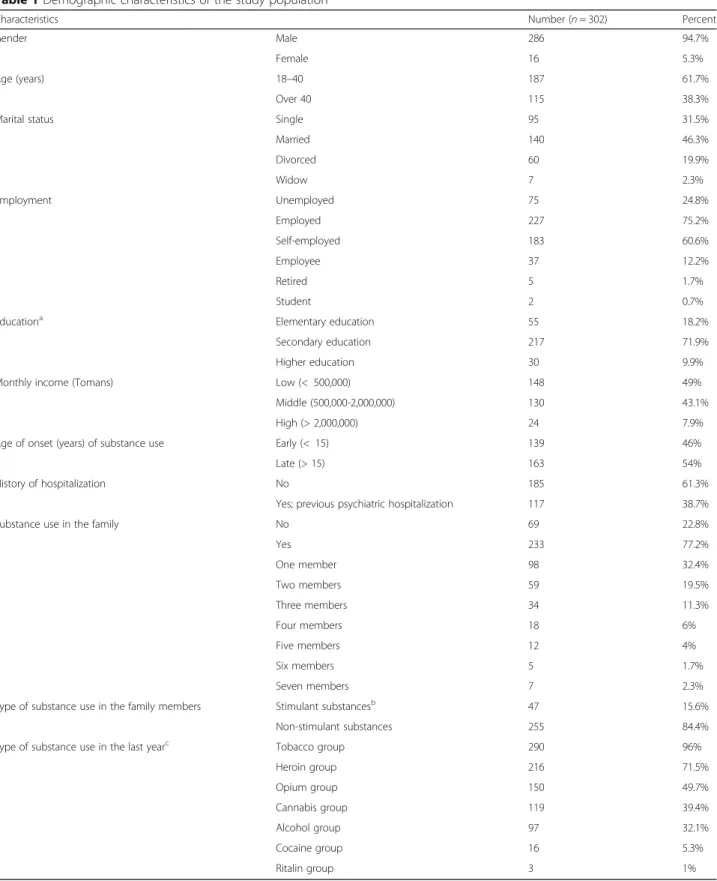
A total of 302 participants were enrolled in the study. Table 1 indicates demographic characteristics of the sample, including gender, age, education, monthly in-come, age of onset of substance use, history of hospitalization, the rate of substance use in the family, type of substances used in the family member, and type of substances used in the last year. The mean age of par-ticipants in the study was 37.29 years and the mean age of onset of substance use was found to be 15.9 years.
Table 1Demographic characteristics of the study population
Characteristics Number (n= 302) Percent
Gender Male 286 94.7%
Female 16 5.3%
Age (years) 18–40 187 61.7%
Over 40 115 38.3%
Marital status Single 95 31.5%
Married 140 46.3%
Divorced 60 19.9%
Widow 7 2.3%
Employment Unemployed 75 24.8%
Employed 227 75.2%
Self-employed 183 60.6%
Employee 37 12.2%
Retired 5 1.7%
Student 2 0.7%
Educationa Elementary education 55 18.2%
Secondary education 217 71.9%
Higher education 30 9.9%
Monthly income (Tomans) Low (< 500,000) 148 49%
Middle (500,000-2,000,000) 130 43.1%
High (> 2,000,000) 24 7.9%
Age of onset (years) of substance use Early (< 15) 139 46%
Late (> 15) 163 54%
History of hospitalization No 185 61.3%
Yes; previous psychiatric hospitalization 117 38.7%
Substance use in the family No 69 22.8%
Yes 233 77.2%
One member 98 32.4%
Two members 59 19.5%
Three members 34 11.3%
Four members 18 6%
Five members 12 4%
Six members 5 1.7%
Seven members 7 2.3%
Type of substance use in the family members Stimulant substancesb 47 15.6%
Non-stimulant substances 255 84.4%
Type of substance use in the last yearc Tobacco group 290 96%
Heroin group 216 71.5%
Opium group 150 49.7%
Cannabis group 119 39.4%
Alcohol group 97 32.1%
Cocaine group 16 5.3%
Ritalin group 3 1%
a
Elementary education including illiterate and elementary education; Secondary education including high school education; and Higher education including diploma and higher education
bStimulant substances including Ritalin, amphetamines and cocaine c
substance use in the family (including two groups, those with family members who used substances and did not use substances); type of substances used in the family members (including two groups, the family members who used stimulant substances including Ritalin, amphet-amines and cocaine, and the family members who used non-stimulant substances); the substance type in the last year (the tobacco group including hookah and cigarette, heroin group including heroin and crack, opium group in-cluding opium and sap, cannabis group inin-cluding marijuana and cannabis, alcohol group only including al-cohol, cocaine group only including cocaine, and Ritalin group only including Ritalin (methylphenidate)).
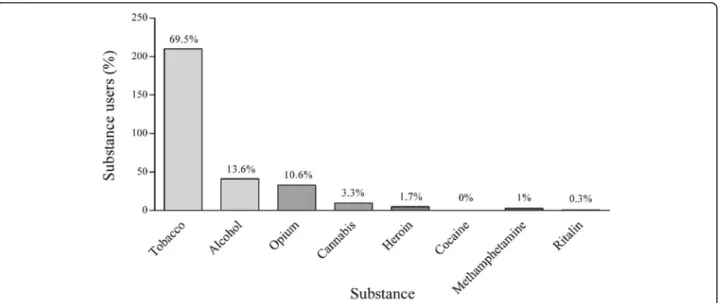
As shown in Fig. 1, tobacco, as the first substance or starting substance, exhibited the most widely-used sub-stance (69.5% of the cases), showing statistically signifi-cant differences (p≤0.0001). After tobacco, 13.6 and 10.6% of the patients who used MA started substance use with alcohol and opium, respectively, showing statis-tically significant differences (p≤0.0001). Other sub-stances used included cannabis (3.3%), heroin (1.7%), and MA (1%), respectively. Only one case (0.3%) men-tioned Ritalin as the first substance and no one (0%) started substance use with cocaine; in total, 93.71% of the patients who used MA started substance use with to-bacco, alcohol, or opium.
The comparison between heroin and MA use showed that 41 of the patients who used MA started with MA earlier than heroin (13.58% of all the patients who used MA and 17.7% of the patients who used both heroin and MA). In contrast, 190 of the patients who used MA started with heroin earlier than MA (62.91% of all the patients who used MA and 82% of the patients who used both heroin and MA).
The comparison between cannabis and opium use dem-onstrated that 92 of the patients who used MA started with cannabis earlier than opium (30.46% of all the pa-tients who used MA and 56.72% of the papa-tients who used both cannabis and opium). In contrast, 70 of the patients who used MA started with opium earlier than cannabis (23.18% of all the patients who used MA and 43.2% of the patients who used both cannabis and opium).
The comparison between cannabis and tobacco use re-vealed that 167 of the patients who used MA started with tobacco earlier than cannabis (55.30% of all the pa-tients who used MA and 93.29% of the papa-tients who used both cannabis and tobacco). In contrast, 12 of the patients who used MA started with cannabis earlier than tobacco (3.97% of all the patients who used MA and 6.07% of the patients who used both cannabis and tobacco).
The comparison between alcohol and tobacco use in-dicated that 154 of the patients who used MA started with tobacco earlier than alcohol (50.99% of all the pa-tients who used MA and 80.2% of the papa-tients who used both alcohol and tobacco). In contrast, 38 of the patients who used MA started with alcohol earlier than tobacco (12.58% of all the patients who used MA and 19.79% of the patients who used both alcohol and tobacco).
The comparison between alcohol and opium use showed that 136 of the patients who used MA started with alcohol earlier than opium (45.03% of all the pa-tients who used MA and 73.91% of the papa-tients who used both alcohol and opium). In contrast, 48 of the patients who used MA started with opium earlier than alcohol (15.89% of all the patients who used MA and 26.08% of the patients who used both alcohol and opium).
The comparison between alcohol and cannabis use showed that 100 of the patients who used MA started with alcohol earlier than cannabis (33.11% of all the pa-tients who used MA and 72.99% of the papa-tients who used both alcohol and cannabis). In contrast, 37 of the patients who used MA started with cannabis earlier than alcohol (12.25% of all the patients who used MA and 27% of patients who used both alcohol and cannabis).
A variety of sequencing patterns was obtained in this study, the most common of which included:
Sequencing D: tobacco-opium-heroin-MA (n= 24). Sequencing F: tobacco-alcohol-cannabis-opium-her-oin-MA (n= 20).
Sequencing C: tobacco-opium-MA (n= 19).
Sequencing E: tobacco-alcohol-opium-heroin-MA (n= 17). Sequencing A: MA (n= 3).
Sequencing B: tobacco-MA (n= 2).
Based on the age of onset of substance use, as men-tioned above, patients were divided into two groups, in-cluding early onset and late onset; the comparison between sequencing patterns and the age of onset of substance use showed that sequencing F was signifi-cantly lower than sequencings C, D, and E (Table2).
The comparison between the age of onset of substance use and current monthly income showed the number of patients who used MA with early onset of substance use was significantly higher in the low-income group (P -value = 0.006) (Table3).
The comparison between the age of onset of substance use and education level showed that the number of pa-tients who used MA with high education was lower in the early-onset group, while the number of patients who used MA with primary education was higher in the early-onset group. These findings were statistically sig-nificant (P-value = 0.04).
The comparison between the age of onset of substance use and the starting substance type showed no signifi-cant relationship. Table4 indicates the mean age of pa-tients who used MA in starting groups with different substances. The highest and lowest mean age was associ-ated with MA (30 years) and tobacco (15.25 years) start-ing groups, respectively.
The comparison between substance use in the family and different sequences of substance use showed a higher rate of odds ratio (OR) for sequencing C, as a re-sult of which early onset of substance use was correlated
with family member uses. In other words, patients who used MA with family history of substance use started MA use earlier than others.
The comparison between different sequences of sub-stance use and the number of family members who used substances showed that only sequencing F were statisti-cally significant (P value = 0.03) (Table 5). The family history of substance use was found to be a risk factor for sequencing F (OR = 0.8).
The relationship between the use of stimulants in the family, including cocaine, MA, and Ritalin, showed no significant difference between sequences and use of stimulants in the family. No significant relationship was found between employment status and the age of onset of substance use as well as between different substance use and marital status.
Discussion
A number of studies have investigated the sequence of substance use initiation [20–23], suggesting that initi-ation of a substance and the sequence patterns of the substance use may be a risk factor for other behaviors. Fewer studies have investigated the sequence of sub-stance use initiation for MA. The present study evalu-ated the sequential patterns of substance use before MA use disorders in Iran.
Our findings showed early onset of MA use in Iran. This early-onset MA use was significantly higher in those with lower income, primary education, no history of hospitalization, and family history of substance use. Tobacco followed by alcohol and opium, as starting sub-stances, was found to be an important risk factor for MA use disorders. Sequencing D (tobacco-opium-her-oin-MA) was the most common sequencing pattern in patients who used MA. Sequencing F (tobacco-alcohol-cannabis-opium-heroin-MA) was significantly related to the early onset of MA use.
The abuse of substances, including MA, is associated with substantial costs and limited treatment options. Re-searches on the patterns and sequences of substance ini-tiation provide a far more comprehensive portrait to develop suitable prevention and early intervention strategies.
In the present study, tobacco, followed by alcohol and opium, was found to be the first substance or starting substance used in patients with MA use, serving as a
Table 2Relationship between different sequencing patterns and age of onset of substance use
Sequence C (n= 19)a D (n= 24)a E (N= 17)a F (N= 20)b *P-value
Age started (mean ± SD) 16.15 ± 4.34 17.04 ± 4.92 17 ± 3.77 12.05 ± 3.94 < 0.0001
C (sequencing C): tobacco-opium-MA; D (sequencing D), tobacco-opium-heroin-MA; E (sequencing E): tobacco-alcohol-opium-heroin-MA; and F (sequencing F), tobacco-alcohol-cannabis-opium-heroin-MA.
MAmethamphetamine
starting substance for initiation to MA use. Tobacco, alco-hol and opium accounted for 93.71% of the first sub-stances used by patients who used MA participated in this study. In a study carried out by Yen et al. in Taiwan, cigarette was found to be the most commonly used sub-stance, and most adolescents had used cigarette, alcohol, areca quid, and glue before MA use [24]. No differences were found between cigarette smoking and alcohol use in their study with the present study; however, glue and areca quid are not used in Iran. In a study performed by Brechtet al. in California, tobacco, alcohol, and marijuana were found as a sequencing pattern for MA use in 95% cases [9]. The difference between marijuana and opium use seems to be due to the prevalence of opium use in Iran. Only 3 patients who used MA started with MA use (0.99%) in this study, which was consistent with the study conducted byBrechtet al. in California [9].
Prevalence of substance use in the last year was as follows:
1. The tobacco group, including hookah and cigarettes: 96% of the patients who used MA 2. The heroin group, including heroin and crack:
71.6% of the patients who used MA
3. The opium group, including opium and opium sap: 49.7% of the patients who used MA
4. The cannabis group, including marijuana and cannabis: 39.3% of the patients who used MA 5. The alcohol group, only including alcohol: 32.1% of
the patients who used MA
6. The cocaine group, only including cocaine: 5.3% of the patients who used MA
7. The Ritalin group, only including Ritalin
(methylphenidate): 1% of the patients who used MA
The prevalence of substance use in the past year was similar to that found in the study carried out by Darke et al.in 2012 [10].
In this study, 46.1% of the people who used MA started before 15 years, while 53.9% of them started MA use after 15 years; the mean age of onset of the first sub-stance use was 15.9 years. In the study carried out in Taiwan, 71% of the patients who used MA used sub-stances after 15 years of age [24]; the reason for this dif-ference can be attributed to the cohort effect, because the study ofYenet al. in Taiwan was carried out in 2005 while our study was performed in 2016, and the age of onset of substance use decreases over time. In a study conducted byDarkeet al.in Australia [10], the mean age of the onset of substance use was 14 years, which was consistent with our findings.
Commonly-used sequencing patterns obtained in this study included D (tobacco-opium-heroin-MA; n= 24), F (tobacco-alcohol-cannabis-opium-heroin-MA; n= 20), C (tobacco-opium-MA;n= 19), E (tobacco-alcohol-opium-heroin-MA; n= 17), A (MA;n= 3), and B (tobacco-MA; n = 2), respectively. Common sequencing patterns ob-tained in the study carried out by Yenet al. in Taiwan [24] included MA as an initiator (n= 12), cigarette-MA (n= 86), cigarette-areca quid-MA (n= 41), cigarette-alcohol-MA (n= 39), alcohol-cigarette-MA (n = 12), cigarette-areca quid-alcohol-MA (n = 39), cigarette-alcohol-areca quid-MA (n = 39), and alcohol-cigarette-areca quid-MA (n= 9). The difference between the se-quence patterns can be attributed to the high prevalence of opioid use in Iran and the high prevalence of other substances such as Areca quid in Taiwan. However, the first 4 sequencing patterns showing high prevalence started with cigarettes both in the present study and in the study conducted in Taiwan [24].
Most patients who used MA participated in this study used heroin before MA (82%), but in the study carried out in Taiwan [24], none of the patients who used MA used heroin before MA, which could be due to the difference in the age of patients who used MA. In the study carried out in Taiwan [24], patients who used MA participated in that study were adolescents with 19 years or younger. In addition, previous studies showed that heroin is generally used in older adults [25]. Importantly, there are studies showing that the tendency to use different substances changes at different times and in different societies.
The comparison between the sequencing patterns of tobacco and cannabis use indicated that most patients
Table 3Relationship between the age of onset of substance use and monthly income
Monthly income Low-income Middle-income High-income Chi-square Df *P-value
Early onset 76 44 19 10.146 2 0.006
Late onset 67 81 15
* The chi-square test was used for the statistical differences
Table 4The mean age of patients who used MA in starting groups
First Substance Mean ± SD
Opium 18.06 ± 7.41
Methamphetamine 30 ± 14.93
Cannabis 16.54 ± 4.03
Heroin 19.83 ± 9.78
Alcohol 15.79 ± 4.92
who used MA (93.29%) used tobacco earlier than canna-bis, which was consistent with the study conducted by Darke et al. in Australia [10]. Inconsistent with these findings, the study conducted with Brecht et al. in Cali-fornia [9] showed that tobacco, marijuana, and alcohol acted as a sequential substance to MA use, in which al-cohol was the most frequent substance to be used. This can be attributed to the frequency of alcohol availability and use as well as the increasing prevalence of marijuana use in recent years [26].
The comparison between the sequencing patterns and the age of onset of substance use showed that sequencing F (to-bacco-alcohol-cannabis-opium-heroin-MA) was significantly related to early onset of substance use. This means that pa-tients who used MA with lower age of onset used more sub-stances before starting MA use. This finding was consistent with the studies carried out in Taiwan [24] and Australia [10], demonstrating that early onset of substance use has been associated with poly-drug abuse in the future.
In this study, there was a significant relationship be-tween early onset of substance use and education; early onset of substance use was found in the patients who used MA with low educational levels while late onset of substance use was found in those with higher educa-tional levels. In a study performed byRussellet al., a sig-nificant relationship was found between MA use and lower education, showing that patients who used MA generally had a lower education level [5]. The highest and lowest mean ages of onset of substance use were found to be 30 and 15.25 years in patients who used MA and tobacco, respectively; the mean ages of onset of opium, cannabis, alcohol, and heroin use were 18.68, 16.44, 15.59, and 19.83 years old, respectively. The mean ages of onset found in this study were lower as com-pared with the study conducted in California [9], in which patients who used alcohol had the lowest mean age, and patients who used heroin, followed by MA, had the highest mean age. The reason for the higher mean age of patients who used alcohol in our country and the present study can be attributed to religious beliefs about alcohol use.
In the present study, early onset of MA use was associ-ated with a family history of substance use; in other words, patients who used MA with a family history of MA use started MA use earlier than other substances. In addition, sequencing F was also significantly associated with the greater number of family members with a his-tory of substance use. In the studies carried out by Rus-sell et al. [5] and Svingen et al. in Nebraska [27], a significant relationship was found between the family history of substance use and substance use in patients who used substances. The relationship between a family history of substance use and the age of onset of sub-stance use showed that patients who used MA with a family history of substance use started to use substances 3.8 years earlier [28]; the results from these two studies were consistent with the results from this study.
The early age of onset of substance use was signifi-cantly associated with low monthly income. In most similar studies, the role of income levels was not investi-gated because those studies have chosen their samples from adolescents and only one study was presented de-scriptive income sources. In the study carried out by Darke et al. in Australia [10], 88, 21, and 7% of the pa-tients who used MA derived their primary income from the government, criminal activity, and wages, respect-ively. In collection, the early age of substance use leads to less education, in turn resulting in lower-paid jobs.
To the best of our knowledge, this is the first study to examine the sequencing patterns of MA use, which can be the basis for future studies. However, the present study had some potential limitations, including the use of self-reporting, social desirability, selection bias and the low num-ber of participants, especially female gender; the latter limita-tion led to no gender comparisons for variables. Therefore, the results may limit the generalizability of the results to some extent.
Conclusions
The present study is the first study to examine the se-quential patterns of substance use for MA disorders in Iran. In this study, the early-onset MA use was
Table 5Relationship between drug sequences and family history of substance use
Sequencing patterns Family members with substance use Family members with no substance use chi-square
*P -value
OR
N (%) N (%) N (%)
C 13 (68.42) 6 (31.58) 0.92 0.24 1.14
D 17 (70.83) 7 (29.17) 0.75 0.26 1.109
E 14 (82.35) 3 (17.65) 0.22 0.45 0.94
F 19 (95) 1 (5) 3.81 0.03 0.8
C (sequencing C): tobacco-opium-MA; D (sequencing D), tobacco-opium-heroin-MA; E (sequencing E): tobacco-alcohol-opium-heroin-MA; and F (sequencing F), tobacco-alcohol-cannabis-opium-heroin-MA.
MAmethamphetamine
ORodds ratio
significantly higher in patients who had lower income, primary education, no history of hospitalization, and family history of substance use. Tobacco, alcohol and opium were found to be as a sequential pattern for initi-ation to MA use.
Tobacco-alcohol-cannabis-opium-heroin-MA sequen-cing was significantly related to the early onset of the MA use.
Findings from this study may support targeted preven-tion efforts and development of more effective interven-tions. Standardized measures to decrease and control access to main starting and sequencing substances, in-cluding tobacco, alcohol, and opium, can not only greatly help decrease the early onset of the MA use, but also lead to development of suitable prevention and early intervention strategies. In addition, programs focusing on increasing knowledge and changing the attitudes of adolescents toward drug abuse can assist to prevent MA use through decreased use of these substances in the so-ciety. However, because of gender limitations, it is rec-ommended to include more women users in future studies in order to make gender comparisons possible.
Abbreviation
MA:Methamphetamine
Acknowledgements
The authors would like to announce their appreciation to all patients participated in this study. We also wish to thank Dr. Somaye Yosaee and Mr. Mohammadreza Rajabalipour for their help in statistical analysis.
Declarations
This study was carried out in accordance with the recommendations of ethical guidelines, IR.SUMS.REC.1394.S1206. The research protocol was approved by Shiraz University of Medical Sciences. All subjects were given written informed consent in accordance with the Declaration of Helsinki.
Authors’contributions
EMS, M A-A, and MM-B conceptualized the study. BO, AB, ERY, and MDM contributed to data collection. MM-B executed the analysis. JA and MK wrote the draft manuscripts with the help of MM-B, BO, NB, and AD. All authors commented on these drafts. All authors approved the final manuscript. EMS, M M-A, and SY reviewed, and edited the manuscript, and provided detailed feedback. All authors read and approved the final manuscript.
Funding
This research was supported by Shiraz University of Medical Sciences (IR.SUMS.REC.1394.S1206).
Availability of data and materials
The datasets used and/or analyzed during the current study are available from the Shiraz University of Medical Sciences on reasonable request.
Ethics approval and consent to participate
The oresent study was conducted in accordance with the recommendations of ethical guidelines, IR.SUMS.REC.1394.S1206. The research protocol was approved by Shiraz University of Medical Sciences. All subjects were given written informed consent in accordance with the Declaration of Helsinki. The data used in this study are public and as such this study is exempt from human subject’s review.
Consent for publication
Not applicable.
Competing interests
The authors declare that they have no competing interests.
Author details
1Research Center for Psychiatry and Behavior Science, Shiraz university of
Medical Sciences, Shiraz, Iran.2Substance Abuse Research Center, Dual Diagnosis Ward, Shiraz University of Medical Sciences, Shiraz, Iran. 3
Department of Psychiatry, Psychosomatic Medicine Research Center, Tehran University of Medical Sciences, Tehran, Iran.4Infectious Disease Research Center, Birjand University of Medical Sciences, Birjand, Iran.5Department of Clinical Pharmacy, Faculty of Pharmacy, Birjand University of Medical Sciences, Birjand, Iran.6Cellular and Molecular Research Center, Basic Health Sciences Institute, Shahrekord University of Medical Sciences, Shahrekord, Iran.7Department of Humanistic Sciences, Islamic Azad University of Yazd, Yazd, Iran.8Department of Clinical Microbiology, Iranshahr University of Medical Sciences, Iranshahr, Iran.9Department of Midwifery, School of Nursing and Midwifery, Iranshahr University of Medical Sciences, Iranshahr, Iran.10NanoBioelectrochemistry Research Center, Bam University of Medical Sciences, Bam, Iran.11Cellular and Molecular Biology Research Center, Larestan University of Medical Sciences, Larestan 7431989335, Iran.
Received: 18 September 2019 Accepted: 22 July 2020
References
1. Favrod-Coune T, Broers B. The health effect of Psychostimulants: A literature review. Pharmaceuticals (Basel). 2010;3(7):2333–61.
2. Juarez-Portilla C, Kim RD, Robotham M, Tariq M, Pitter M, LeSauter JSilver R. Voluntary inhalation of methamphetamine: a novel strategy for studying intake non-invasively. Psychopharmacology. 2017;234(5):739–47. 3. Panenka WJ, Procyshyn RM, Lecomte T, MacEwan GW, Flynn SW, Honer W
GBarr A M. Methamphetamine use: a comprehensive review of molecular, preclinical and clinical findings. Drug Alcohol Depend. 2013;129(3):167–79. 4. Albertson TE, Chenoweth JA, Colby D KSutter M E. The Changing Drug
Culture: Medical and Recreational Marijuana. FP Essent. 2016;441(11–7). 5. Russell K, Dryden DM, Liang Y, Friesen C, O'Gorman K, Durec T, Wild TC,
et al. Risk factors for methamphetamine use in youth: a systematic review. BMC Pediatr. 2008;8:48.
6. Chiang M, Lombardi D, Du J, Makrum U, Sitthichai R, Harrington A, Shukair N, et al. Methamphetamine-associated psychosis: clinical presentation, biological basis, and treatment options. Hum Psychopharmacol. 2019;34(5): e2710.
7. Chomchai C, Chomchai S. Global patterns of methamphetamine use. Curr Opin Psychiatry. 2015;28(4):269–74.
8. Wang G, Zhang Y, Zhang S, Chen H, Xu Z, Schottenfeld RS, Hao W, et al. Aripiprazole and Risperidone for Treatment of Methamphetamine-Associated Psychosis in Chinese Patients. J Subst Abus Treat. 2016;62:84–8. 9. Brecht ML, Greenwell LAnglin MD. Substance use pathways to
methamphetamine use among treated users. Addict Behav. 2007;32(1):24– 38.
10. Darke S, Kaye STorok M. Age-related patterns of drug use initiation among polydrug using regular psychostimulant users. Drug and alcohol review. Drug alcohol review. 2012;31(6):784–9.
11. Rajabalipour M, Khoshab H, Baneshi M, Nakhaee N, Sharifi H, Tavakoli FIranpour A. Using social cognitive theory to investigate the risk factors of Waterpipe smoking among southeastern Iranian adolescents. Int J Pediatr. 2019;7(10):10243–53.
12. Jalali A, Behrouzi MK, Salari N, Bazrafshan M RRahmati M. The effectiveness of group spiritual intervention on self-esteem and happiness among men undergoing methadone maintenance treatment. Curr Drug Res Rev. 2019; 11(1):67–72.
13. Noroozi M, Armoon B, Ghisvand H, Noroozi A, Karimy M, Bazrafshan MR, Marshall BDL, et al. Prevalence and risk factors for injection site skin infections among people who inject drugs (PWID) in Tehran. J Cosmet Dermatol. 2019;18(1):258–62.
14. Momtazi S, Rawson R. Substance abuse among Iranian high school students. Curr Opin Psychiatry. 2010;23(3):221–6.
16. Hamdieh M, Borujerdi A, Motalebi N, Abbasinejad M, Asheri HMotamedi A. The prevalence of cigarette smoking, alcohol consumption, Psychostimulant and cannabinoid drugs abuse among 15 to 35 years old Tehranis. Iran J Psychiatry Behav Sci. 2010;4(2):26–30.
17. Narenjiha H, Rafiey H, Jahani MR, Assari S, Moharamzad YRoshanpazooh M. Substance-dependent professional drivers in Iran: a descriptive study. Traffic Inj Prev. 2009;10(3):227–30.
18. Angoorani H, Narenjiha H, Tayyebi B, Ghassabian A, Ahmadi GAssari S. Amphetamine use and its associated factors in body builders: a study from Tehran. Iran Arch Med Sci. 2012;8(2):362–7.
19. White RG, Hakim AJ, Salganik MJ, Spiller MW, Johnston LG, Kerr L, Kendall C, et al. Strengthening the reporting of observational studies in epidemiology for respondent-driven sampling studies: "STROBE-RDS" statement. J Clin Epidemiol. 2015;68(12):1463–71.
20. Yimsaard P, Maes MM, Verachai VKalayasiri R. Pattern of methamphetamine use and the time lag to methamphetamine dependence. J Addict Med. 2018;12(2):92–8.
21. Guerra LM, Romano PS, Samuels S JKass P H. Ethnic differences in adolescent substance initiation sequences. Arch Pediatr Adolesc Med. 2000; 154(11):1089–95.
22. Navaratnam V, Foong K. Sequence of onset of different drug use among opiate addicts. Curr Med Res Opin. 1989;11(9):600–9.
23. Sartor CE, Kranzler H RGelernter J. Characteristics and course of dependence in cocaine-dependent individuals who never used alcohol or marijuana or used cocaine first. J Stud Alcohol Drugs. 2014;75(3):423–7.
24. YEN C, YANG Y, KO CYEN J. Substance initiation sequences among Taiwanese adolescents using methamphetamine. Psychiatry Clin Neurosci. 2005;59(6):683–9.
25. Reid LW, Elifson K, WSterk CE. Ecstasy and gateway drugs: initiating the use of ecstasy and other drugs. Ann Epidemiol. 2007;17(1):74–80.
26. Sohrabzadeh M, Niazi M, Menati R, Kassani AMenati W. The prevalence of methamphetamine Useamong Iranianmale students: a systematic review and meta-analysis. J Sabzevar Univ Med Sci. 2016;22(7):1170–9. 27. Svingen L, Dykstra RE, Simpson JL, Jaffe AE, Bevins RA, Carlo G, DiLillo D,
et al. Associations between family history of substance use, childhood trauma, and age of first drug use in persons with methamphetamine dependence. J Addict Med. 2016;10(4):269–73.
28. Sharifi H, Sadr M, Abdolahinia AMasjedi M. Study of the relationship between tobacco use and drug use: is tobacco smoking a gateway to drug use? Nafas. 2013;2(1):19–24.
Publisher’s Note