RELIABILITY ANALYSIS OF WEB SERVICES BASED ON
RUNTIME FAULT DETECTION
1K.JAYASHREE, 2DR. SHEILA ANAND, 3R. CHITHAMBARAMANI
Rajalakshmi Engineering College, Chennai
1[email protected] , 2[email protected] , 3[email protected]
ABSTRACT
Web service technology is being increasingly used for commercial business applications. Reliability of the web services provided is an important criterion to enable the wide spread deployment of such services. This paper proposes analyzing the reliability of web services based on runtime fault information. Monitoring of web service interactions enable runtime faults to be detected and recorded. A sample application was developed and logs were designed for recording the service usage and faults information. Faults were injected in the sample application and faults during publishing, discovery, binding, execution and composition were recorded. Reliability estimation and prediction was carried out using Jelinski-Moranda Binomial model and Goel-Okumoto Non-Homogenous Poisson model.
Keywords: Reliability for web services, Monitoring Component, Fault Diagnoser, Fault Log, Service
Usage Log, Reliability analysis.
1. INTRODUCTION
Web services are loosely-coupled,
platform-independent, self-describing software
components that can be published, located and invoked using the standards, such as, Simple Object Access Protocol (SOAP), Web Services Description Language (WSDL) and Universal Description Discovery Integration (UDDI) [1].
Web services can be either simple or composite. Web service that work on a stand-alone basis and do not invoke other web services are called simple or atomic web services. A composite web service combines the functionality of two or more simple web services by invoking them dynamically at runtime. Web services can be composed by using three methods namely static
composition, semi static and dynamic
composition. Web services composed at design time is called as static composition. When web services are composed during runtime it is termed as dynamic composition.
Reliability, security, cost, and performance are criteria that are identified as relevant non-functional QoS requirements when selecting different web services [2]. Reliability is a specific aspect of the broader concept of dependability. Dependability is defined [3] as the trustworthiness of a computer system such that
reliance can justifiably be placed on the service it delivers. Reliability can be defined as the probability, that the system will correctly deliver services as expected by the user over a given period of time. “Reliability on demand” is defined as the probability that the system will successfully complete its tasks when invoked [4].There is essentially two types of software reliability models. The first model attempts to
predict software reliability from design
parameters such as lines of code, nesting of loops etc. The second model also known as "software reliability growth" attempts to predict software reliability from test or real data [5].
As web services are heterogeneous, distributed and dynamic in nature, faults can occur in different places, for example faults can occur in the software application or in the network connection. For atomic services, faults can occur during publishing, binding, discovery and execution. In composite services, failure in any one service can decrease the overall reliability of composite service. Also, since operations of a composite service often span multiple individual web services, web service composition itself also brings unreliability with the presence of the failures [6].
web services is analyzed based on runtime
monitoring and fault occurrence information. The rest of the paper is organized as follows. Section 2 presents the related work. In Section 3, presents the Reliability Analysis based on Runtime Fault Information. In Section 4, Implementation details are explained. Section 5 concludes the paper.
2. RELATED WORK
Software reliability prediction is a task to determine future reliability of software systems based on the past failure data [7]. Musa et al [8] defines software reliability as the probability of failure-free operation of a computer program for a specified time in a specified environment. Compared with traditional software reliability [8], reliability of a web service contains unique requirements of timeliness (availability and performance) [9]. Since web services are remote web applications that can only be invoked remotely, timeliness is of paramount importance: if a web service cannot be delivered to a service requester within a predefined time threshold with promised performance, the service will become useless.
Tsai et al [10] have proposed Service-Oriented software Reliability Model (SORM) to evaluate the reliability of atomic services and composite services. They have proposed group testing and majority voting for software testing of atomic web services. The voting system detects faults by comparing the output of each service with the weighted majority output. They have also suggested the use of a remote test agent to perform distributed testing on data collected at runtime. The reliability of the composite services is estimated based on the reliabilities of the individual atomic services. Senol Arikan [11] has argued the basic assumptions for computing reliability in SORM model. His contention is that assignment operation never generates new failures; a condition fails when any data associated with it fails and there is no cyclic dependency on the parameters or entities used for reliability analysis. The author has defined the research challenges in this area and given an approach to solve the reliability problem of Service Oriented Architecture (SOA). The author has suggested the use of a monitoring module to monitor the system components and inputs to identify failed components; a reliability validator module to calculate and analyze the reliability of
the components and a redundancy module to deploy redundancy. Implementation and results of the proposed approach has not been given.
Sasikaladevi et al [12] have presented the design of reliability evaluation framework for composite web services. This paper gives the simple framework model for the selection of reliable web service among the available equivalent services. Reliability evaluation would be carried out by a broker or agent on behalf of the service consumer. Data collection unit uses service registry and feedback data obtained from prior
consumers to evaluate availability and
accessibility. The focus of the paper is on design of the framework and implementation of the proposed approach has not been given.
Chunli et al [13] have proposed a reliability
prediction model for composite services
combining control-structure such as sequence, if/switch, while and for composition condition. They presented an Extended Reliability Block
Diagram (ERBD) in which composition
conditions are regarded as atomic services and the reliability of composite services are evaluated according to their structures. The testing has been done using simulation and not real data.
Zibin Zheng et al [14] have proposed a collaborative reliability prediction approach for service-oriented systems. They have used past failure data of other similar users for predicting web service failure probabilities for the current user. Pearson correlation coefficient is employed for similarity computation. However, if there is insufficient number of similar users then dissimilar users are also considered.
Earlier work has primarily focused on testing or reliability prediction. Real or simulated data has been used for reliability analysis. This paper proposed reliability computation and prediction using real fault data obtained by runtime monitoring of web services. Reliability analysis of atomic and composite services has been proposed.
3. RELIABILITY ANALYSIS BASED ON RUNTIME FAULT INFORMATION
services, it is necessary to monitor the runtime
behavior of web services and ascertain whether their behavior is correct, that is, as per their intended behavior. Monitoring the web service interactions at runtime would enable faults to be detected and recorded for reliability analysis.
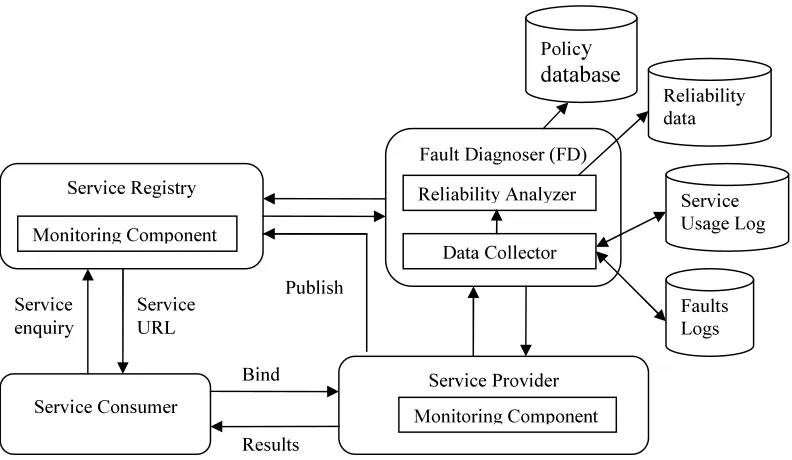
We extend our earlier work on runtime monitoring to perform the reliability analysis [15]. We had proposed WISDOM (Web Service Diagnoser Model), which describes a generic architecture for runtime monitoring of web service interactions and handling fault detection. Independent Monitoring Components (MC) located in service registries and service providers are used to intercept the web service interactions at these entities. The request and response messages between the web service components would be first intercepted by these monitoring
components and analyzed to detect faulty behavior.
The Fault Diagnoser is designed to be an independent external entity that would co-ordinate the individual
monitoring components. Policies were used to describe the intended behavior of web services and
[image:3.595.105.501.361.591.2]faults are recorded as deviations from the intended behavior. Policies support standard assertions and provide a simple method to express the capabilities, requirements and characteristics of web services. The extended model with the Reliability Analysis Component is shown in Figure 1.
Figure 1: Runtime Fault Detection And Reliability Analysis Architecture
Service providers publish services in service registries to make their services available for use by service consumers. Users would then be able to discover the services by searching the service registry. The service details obtained are used to invoke (bind) and execute the service offered by the service provider.
Faults can occur during publishing if the service description given by the service provider is
incorrect. Service discovery faults can occur during the search process if the service name is not listed or the search criteria is incorrect. Error can also occur if the service description does not match the service specifications given in WSDL. Fault can occur during binding if
there are authentication failures or if the service invocation details, like port number, are incorrect. Faults can occur during execution because the input parameters given by the
Service Provider Service Registry
Service Consumer
Service Usage Log Fault Diagnoser (FD)
Data Collector Reliability Analyzer
Monitoring Component Monitoring Component
Bind
Results Service
enquiry
Service URL
Polic
y
database
Faults Logs Reliability data
service user are incorrect. Faults can also occur if
the execution has errors or if the output returned to the user is incorrect as it does not match the service specifications. Network failure would cause any of the above operations to be timed out. Faults recorded during publishing, discovery, binding, execution and composition has been used for reliability analysis.
Reliability analysis is concerned with failure rate and the time between failures. These parameters are calculated from the real fault data obtained using the above model. Reliability prediction considers the history of failures to predict the probability that the web services will work without failure for a given time period under the prevailing operational conditions. Reliability Analyzer component located in the Fault Diagnoser performs the reliability analysis: computing the failure rates and also predicating reliability using standard models. The Data Collector sorts and aggregates the data from the fault log and service usage log. The Reliability Analyzer performs the reliability analyses and reliability estimation.
3.1 Runtime Log Data details
Two logs were designed to maintain service usage and fault data in the Fault Diagnoser. The format of the logs and details of data maintained are now described in detail.
3.1.1 Service Usage Log
Service Usage log was designed to store details of usage of all the web services. The data gets updated when a web service is invoked and executed. Details of Atomic (Single) and Composite web services are updated in this table. The details of data stored in the Service Usage Log are given in Table 1.
Table 1: Service Usage Log
Data Field Description
Service_ID Web Service Identifier
Service_Provider_Na me
Service Provider name
Service_name Name of the specific web
service
Service_status Executed successfully or
Failed
Date_Time_Stamp Date and time of
invocation of web service
Execution_Time Total time taken for
execution
Flag Atomic service or
Composite service
Previous_Service_ID ID of Previous Service
invoked, for Composite service
Next_Service_ID ID of Next Service
invoked, for Composite service
3.1.2 Fault Log
Fault logs were used to keep a record of all faults that have happened during the runtime execution of web services. Faults which occurred during publishing, discovery, binding, execution and composition of web services were recorded in this log.
Faults were classified under the major heads, Publishing, Discovery, Binding, Execution and Composition. Each fault class was given a unique numeric code which was recorded as Fault_Code. Each fault in the class was given a unique fault identifier which is recorded in the field Fault_ID. The description of the fault is stored in Fault_String. For example, for Publishing Fault, Fault_Class was given as “Publishing”, Fault_code was given the code 100, Fault_String was given as “Format Fault” and Fault_ID was given as 101.
The data gets updated whenever a web service fault occurs during runtime. Fault details of Atomic (Single) and Composite web services are updated in this table. The details of data stored in the Runtime Fault Log are given in Table 2.
Table 2: Runtime Fault Log
Data Field Description
Service_ID Web Service Identifier
Service_Provider_ Name
Service Provider name
Service_name Name of the specific
web service
Fault_Class Fault Classification
description
Fault_Code Fault Class ID
Fault_ID Fault ID
Fault_String Fault Description
Date_Time_Stamp Date and time of
invocation of web
service
3.2 Reliability Analysis
calculating the MTBF is given in Equation 1
[Musa et al [16] .
Θ = T/R (1)
Where Θ represents MTBF, T is the time slot for
which reliability is calculated and R gives the number of failures within the time slot T.
Then Failure Rate is calculated as the inverse of
the MTBF. The formula for Failure Rate (λ) is
given by Equation 2.
λ = 1/Θ (2)
Reliability (R) is calculated as Exponential of Failure Rate and is given by Equation 3.
R = e –λT (3)
4. IMPLEMENTATION
IBM Rational Application Developer IDE has been used for the implementation of runtime Fault Detection system. jUDDI (Java Universal Description Discovery and Integration) has been used to configure the web service registry. The web services are published in the jUDDI registry which is implemented using MySQL database. SOAP handlers have been configured using JAX-RPC to detect faults in the execution of web services.
The policies which define the intended behavior of web services have been generated using WS-Policy standard. Web services have been composed using BPEL for static composition and semi dynamic composition and OWL-S has been used for dynamic composition.
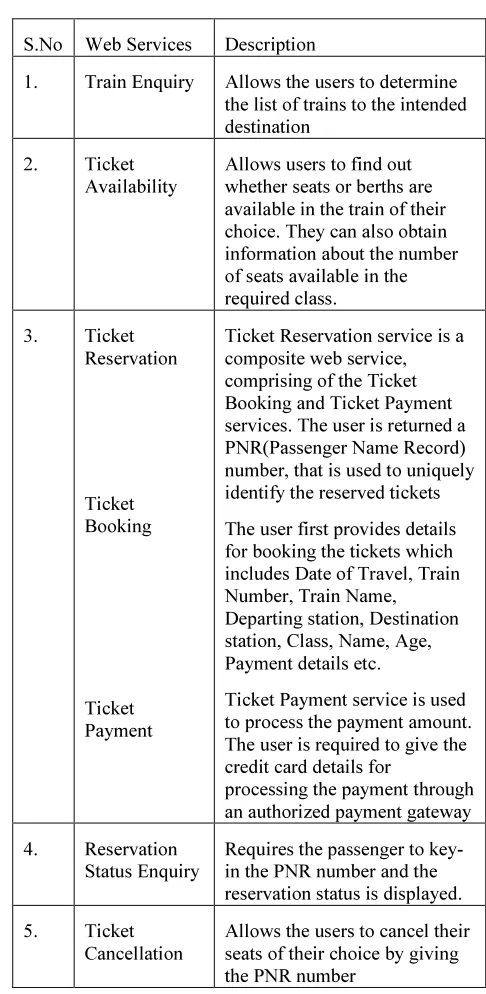
[image:5.595.309.552.149.646.2]A sample web service application for Railway Reservation was developed to record fault behavior. The list of services used and their description is given in Table 3.
Table 3: List of Web Services for Railway Ticketing Application
S.No Web Services Description
1. Train Enquiry Allows the users to determine
the list of trains to the intended destination
2. Ticket
Availability
Allows users to find out whether seats or berths are available in the train of their choice. They can also obtain information about the number of seats available in the required class.
3. Ticket
Reservation
Ticket Booking
Ticket Payment
Ticket Reservation service is a composite web service, comprising of the Ticket Booking and Ticket Payment services. The user is returned a PNR(Passenger Name Record) number, that is used to uniquely identify the reserved tickets
The user first provides details for booking the tickets which includes Date of Travel, Train Number, Train Name, Departing station, Destination station, Class, Name, Age, Payment details etc.
Ticket Payment service is used to process the payment amount. The user is required to give the credit card details for
processing the payment through an authorized payment gateway
4. Reservation
Status Enquiry
Requires the passenger to key-in the PNR number and the reservation status is displayed.
5. Ticket
Cancellation
Allows the users to cancel their seats of their choice by giving the PNR number
Faults were injected in the application and faults
during publishing, discovery, binding,
0 1 2 3 4 5 6 7 8 9
Publishing Faults Binding Faults Execution Faults
No.of.Faults
Figure 2. Faults occurrence in specific service provider
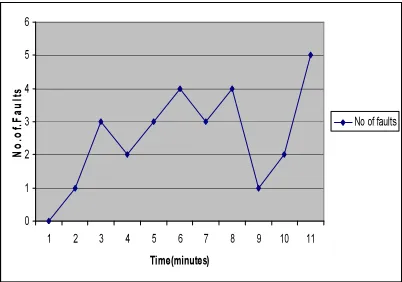
Figure 3 shows the fault injected in a particular service; PNR service which is used for Ticket Reservation Enquiry.
0 1 2 3 4 5 6
1 2 3 4 5 6 7 8 9 10 11
Time(minutes)
N
o
.o
f.
F
a
u
lt
s
[image:6.595.89.290.326.467.2]No of faults
Figure 3: Fault occurrence in Execution of PNR Service
[image:6.595.87.305.570.692.2]Ticket Reservation Service is a composite web service which comprises of two atomic services; Ticket Booking and Ticket Payment. Figure 4 shows the fault injected in the two component services.
Figure 4. Faults in Composite Ticket Reservation Service
Multiple instances of the web services were created for reliability analysis and the service details are given in Table 4.
Table 4: Web Services Details Used For Reliability Analysis
Log Data 200
Number of Web services 20
Number of service providers 10
Number of service clients 10
Number of web service execution instances
200
Publishing faults injected 20
Discovery faults injected 13
Binding faults injected 9
Execution faults injected 35
Composition faults injected 45
4.1 Reliability Estimation and Prediction
Metrics-based Software Reliability Assessment Tool (M-SRAT) has been used for software reliability assessment. M-SRAT is a JAVA application that offers multiple models for software reliability. Reliability estimation and prediction was carried out using Jelinski-Moranda (J-M) and Goel-Okumoto (G-O) models.
4.1.1. Jelinski-Moranda model (J-M)
This is one of the earliest and the most commonly used model for assessing software reliability. In this model the failure time is calculated as proportional to the remaining faults. This is taken as an exponential distribution. Reliability estimation is given by Equation 4.
(MTBF) t = 1 / ( N – (I – 1)) (4)
where, N is the total number of faults, I is the number of fault occurrences, MTBF is the Mean Time between failures and T is the time between the occurrence of the (i-1).
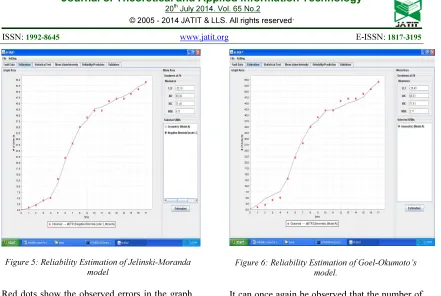
Figure 5: Reliability Estimation of Jelinski-Moranda model
Red dots show the observed errors in the graph. It can be observed that the number of defects observed map closely with the curve obtained with the model.
4.1.2 Goel-Okumoto Model (G-O)
Goel-Okumoto’s model assumes that the cumulative number of failures follows a Poisson process [15]. The data required by Goel-Okumoto’s model consists of :
1. (n1,n2,….,nk), the number of faults
detected for each time interval
2. (t1,t2,…..tk), the time intervals for
which the.(n1,n2,….,nk) are observed.
[image:7.595.86.527.78.374.2]The graph obtained using the sample data and the estimation procedure in the tool is shown in the Figure 6. The cumulative number of faults detected in the web services is shown in the graph as red dots.
Figure 6: Reliability Estimation of Goel-Okumoto’s model.
It can once again be observed that the number of defects observed map closely with the curve obtained with the model.
[image:7.595.87.303.109.330.2]Figure 7 shows the comparison of the reliability prediction curves of both the models.
Figure 7: Comparison of Reliability Prediction by Jelinski-Moranda and Goel-Okumoto models.
[image:7.595.314.523.446.639.2]
5. CONCLUSION
This paper presents a reliability analysis of web services based on runtime faults. Runtime monitoring of web services has been carried out for a sample application which was injected with faults. Log formats were designed to store the service usage and fault occurrences in the services. Reliability estimation was performed on the fault data using Jelinski Morando model and Goel-Okumoto models and the results obtained have been presented. It was observed that the number of defects observed was found to map closely with the reliability curve obtained with the model. This helps to establish the
validity of the fault detection process.
Reliability prediction was carried out for the two models and compared. This analysis helps the service providers to understand and improve the reliability of the web services offered by them.
REFERENCES
[1] Papazoglou, M. P., Georgakopoulos, D.:
Service-oriented computing,
Communications of the ACM, Vol. 46, No. 10, 2003, pp. 25–28.
[2] L. Arockiam and N. Sasikaladevi Simulated Annealing Versus Genetic Based Service Selection Algorithms International Journal of u- and e- Service, Science and Technology Vol. 5, No. 1, March, 2012. [3] Laprie 1992 J-C Laprie editor Dependability:
Basic concepts and Terminology, Springer-verlog 1992.
[4] Alan Wood, software reliability Growth Model, Technical Report 96.1,September 1996, Part Number: 130056.
[5] Karanta, Ilkka Methods and problems of
software reliability estimation VTT
Technical Research Centre of Finland
1459-7683 (URL:
http://www.vtt.fi/publications/index.jsp) [6] Y.Pan Will Reliability Kill the Web Service
Composition? citeseerx.ist.psu.edu/
viewdoc /download? doi=10.1.1.136.5893 [7] M. R. Lyu. Handbook of Software Reliability
Eng. McGraw-Hill, New York, 1996. [8] J.D. Musa, A. Iannino, and K. Okumoto,
Software Reliability Measurement
Prediction Application, 1987: McGraw-Hill.
[9] Criteria Analysis and Validation of the
Reliability of Web Services-oriented
Systems JiaZhang, Liang-Jie Zhang
Proceedings of the IEEE International Conference on Web Services (ICWS’05) [10] W. T. Tsai, D. Zhang, Y. Chen, H. Huang,
R. Paul, N. Lia A Software Reliability model for web services
[11] Senol Arikan Automatic Reliability
Management in SOA-based critical
systems
[12] N.Sasikaladevi, Dr.L.Arockiam Reliability evaluation model for composite services International Journal of Web & Semantic Technology Vol 1 No. 2 April 2000. [13] XIE Chunli LI Bixin, LIAO Li WANG
Xifeng Combining Control Structure and Composition Condition for Web Services Reliability Prediction Chinese Journal of Electronics Vol.21, No.3, July 2012. [14] Zibin Zheng, Zheng, Z, Michael, R Lyu
‘Collaborative Reliability Prediction of
Service-Oriented systems 2010 ,
proceedings of the 32nd ACM/IEEE
International conference on software
Engineering, pp 35-44.
[15] K.Jayashree, Sheila Anand, Policy Based Distributed Runtime Fault Diagnoser Model for Web Services, LNICST 2012 pp 9-16.
[16] Software Reliability Engineering: