Distance Based Power Control for D2D
Communication in LTE-Advanced Networks
Ravindra S
1, Siddesh G K
21Department of ECE, DSCE, K.S.Layout, Bengaluru, India
2Department of ECE, JSSATE, Uttarahalli-Kengeri Rd, Bengaluru, India
Abstract: Device to device communication systems places a very important role in handling both voice and data services efficiently in LTE-A networks. Power control techniques that we adopt for efficient D2D communication becomes a challenging issue. D2D and cellular signals under the same network may result in In-band Emission Interference (IEI). This degrades discovery range which result in loss of energy efficiency, throughput and hence increases the power requirement in both uplink and downlink transmissions. In this paper, a power control algorithm is introduced which greatly helps in saving power in LTE-Advanced networks for D2D communication. Power calculation mechanisms for D2D users and cellular users are shown separately. Based on mode selection, transmit and receive power requirements are evaluated to obtain the preset Quality of Service (QoS) parameters. The simulation results presented in the proposed method demonstrates the effectiveness of power consumption in LTE-Advanced networks for device to device communication.
Keywords: D2D users, Interference, QoS,SINR, LTE-A.
1.
Introduction
Device-to-device (D2D) communication permits two mobile user equipments to communicate directly which are closely located. Reducing the power of UEs and base stations enhances the spectrum/Energy efficiency. In the existing cellular communication system call setup between two user equipments takes place through base stations and mobile switching centers irrespective of the distance between the user equipments. In this mechanism power consumption is high in both uplink and downlink transmissions [17]. This paper gives a proposed power control mechanism based on the distance between the user equipments. To reduce interference, co-channel interference problems while device to device users reuse uplink and downlink resources are explored in [7]. Quality-of-service (QoS) constraints to increase sum rate with the cellular users and D2D pairs are presented in [4]. Authors of [8] proposed techniques to maximize the network throughput considering the QoS requirements for both CUs and DUs. Signal transmission through the base station (BS) consumes large power, which leads to interference between the DUs. Optimization of the device to device and cellular users matching for power control in uplink resource sharing is considered in [3]. The QoS requirements to share the cellular spectrum for both CUs and DUs and to increase the overall throughput and maximizing the spectrum efficiency are explored in [9]. The peak data rates of LTE-A networks for downlink and uplink transmissions are approximately around 1 Gbps and 500 Mbps, with a bandwidth scalability of 100 MHz [2].In LTE-A networks due to high speed internet and data rate batteries discharges rapidly. Hence this major issue of sudden battery discharge in the user equipments is considered as achallenging issue in this paper. In the present approaches irrespective of the distance between the mobile
terminals, the call setup takes place through base stations. The increased uplink power in mobiles for high speed and data rate allows interference problems [1]. Due to this the cell edge user equipments are not able to connect to the eNBs.
The two main types of power control mechanisms are centralized and distributed. The centralized approach computes power levels of the mobile stations. In the distributed mechanism, the transmitpower of base station is determined and power calculations are to be carried within the user equipments [5]. The distributed power control technique is advantageous thanthe centralized power control for reducing delay and complexity. To overcome the complexity in reducing the power at D2D and cellular user terminals, the proposed system allow each cell to calculate the transmission power requirement independently. The transmission power level parameters like traffic load and smart discontinues transmission (DTX) are considered in which for the UE distribution in neighboring cells [19]. A power control algorithm is introduced which limits uplink and downlink power in LTE-Advanced networks. The transmit power calculation is based on the UEs distance measurement and the networkcapacity [18].
The contribution of this paper is as follows:
• The proposed method calculates the power requirement for base stations and D2D users to communicate based on the D2D distance.
• If the D2D distance is less i.e. the users are closely located, the UEs communicate directly without using BS power.
• BS power is utilized when the D2D distance increases. • A power control algorithm is proposed to find the
optimal power level allocated to each user in LTE-A networks.
The organization of the paper is as follows:
Section II describes the related work. Section III describes the power control mechanism with the proposed algorithm. Simulation results described in Section IV and last section concludes the paper.
2.
Related Work
communications of LTE-A network in downlink. The algorithm has two stages. In the first stage, BS allocates the same resources for D2D pairs and cellular users [14]. Then, the power control technique is to be applied to decrease the interference for device to device communication. The uplink resources for D2D transmitter based on the distance between the cellular and D2D pairs are illustrated in [10].
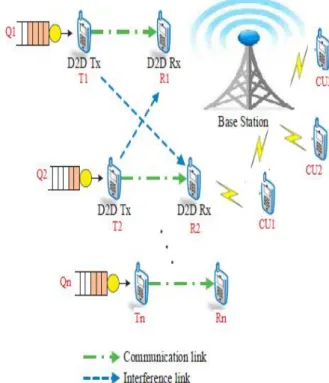
Consider a system with a single base station and multiple device to device users as shown in Figure 1. There are two different users: D2D users communicate directly without BS and cellular users require BS to communicate with the other cellular/D2D users. The users in the D2D mode to transmit/receive calls should satisfy the distance constraint. If the user equipments distance is in the region of proximity, the UEs communicate directly without using BS power and these UEs are called D2D pairs. If the D2D distance is not in the region of proximity, then these UEs use BS to communicate and these are called cellular users (CU).
Figure 1. A single base station with multiple device to device and cellular users
The system model of the proposed work is shown in Figure 1. The cellular users communicate with the other users through the base station and D2D users communicate directly without the involvement of BS based on the distance constraint between the called and calling parties. The interference minimization using uplink resources to perform D2D communication are presented in [11]. Since the interference effect between the cellular and D2D users is very small and is neglected in the proposed work.
Figure 2 shows the interference probabilities between the D2D users at different conditions. Let Q1, Q2,…Qn are the queues at which the D2D users waiting for D2D communication at time intervals T1, T2,….Tn to communicate with D2D receivers R1, R2,…Rn.
When a D2D transmitter T1 is in conversation with D2D receiver R1and during that time if D2D transmitter T2 also tries to connect with D2D receiver R1, interference affects the communication process. Interference effect can also be observed when cellular user connects call with the D2D user. The solutions for these kinds of interference problems are explained in the proposed technique. The proposed method reduces the interference effect based on the distance between the users.
The resources distribution for D2D communication is as follows: the CUs and device to device users share same
resources if any D2D pairs are close to each other. When the distance increases the base station automatically allocates resources in such a way that the cellular users collect resources from BS and allow D2D pairs to communicate with the use of cellular users through BS. We assume that there are K CUs and M pairs of D2D users, whose sets are denoted as Cs = {1, 2,…..,K} and Ds = {K +1,K +2,…..,K +M} respectively. Let the ith CU has already chosen the ith
radio base station in the LTE-A system with transmission power pi. The transmit power of CUs is denoted as Pc= {p1, p2,…., pK}. The transmit power of D2D users is denoted as Pd = {pK+1, pK+2,….,pK+M}. Let hij be the channel gain from user equipment i to user equipment j.
Figure 2. Interference in Device to Device communication For downlink transmissions, the D2D receivers are synchronized with their closest D2D transmitters [13]. D2D transmitters use path-loss inversion power control techniques to transmit data in a cell. The devices are classified into primary and secondary nodes based on the distance and the algorithm derives the required transmit power for communication.
The power control scheme established makes the D2D transmitters to sense the average received power levels of receivers. The distance between the devices and receiver sensitivity determines the transmission power requirement. The guard zones are placed around the primary receivers and transmitters [20].
3.
Proposed Power Control Mechanism
It is assumed that the base station is covered by three cellular users and two pairs of D2D users. When the distance between the D2D users of D2D pairs and distance between the two D2D pairs are in the region of proximity, they are allowed to communicate directly without the involvement of base station [15]. If the distance increases these D2D pairs use BS to transmit/receive data. During channel resource sharing, interference is observed when a base station receives from the D2D transmitter and a D2D receiver receives from the cellular user. This signal to interference noise ratio (SINR) is a important factor to meet the quality of service requirements.
Let each user equipment is covered by an mth base station
(eNB) with N users for transmitting information with a power level of Pnm and data rate of γnm in the LTE-A
network. σis the Gaussian noise variance and δ is the path loss exponent with channels are modeled at a distance of lnm
meters. hnm is the frequency flat Rayleigh fading function.
The Signal to Interference Noise Ratio at nth user γ
nm [1] is
expressed as
2
2
nm nm nm nm
P l h
−
=
(1)where: Pnm = Power level of the eNB for transmitting
information
γnm = Signal to Interference Noise Ratio of nth user
at the mth base station
hnm = Frequency flat Rayleigh fading function
σ= Gaussian noise variance
δ = the path loss exponent
The D2D user Signal to Interference Noise Ratio SINRkDUE from [3] is expressed as
2
2
K K
DUE DUE K
DUE K
P
h
SINR
IEI
=
+
(2)The data transmission rate between the nth D2D user and mth
eNB is rnm and is given by
nm nm nm
r
=
(3) where:
nm= the power gain between nth D2D user andmth eNB
The power gain of the D2D user from [3] is given by
2 2
/
K K K
DUE DUE nm
nm
P
h
IEI
P
=
+
(4)where: PDUE k = the D2D power of the kth user
|hDUEk |2 = the D2D user equipment channel gain of the kth user
IEIk = the D2D interference from the kth user
The utility function of nth D2D user and mth eNB is U nm
(Pnm) [9] and is given by
nm nm nm nm nm nm
U
=
r
−
P
−
P
(5) where:
nm = pricing parameter of the utility function for uplink transmission
nm = pricing parameter of the utility function for downlink transmissionThe details of these pricing parameters [6] are shown in Table 1.
Table 1. Parameters of utility function Parameter Number of D2D users (n)
βnm n= 1 n= 5 n= 10 n= 15 n= 20
m=1 0.2 0.5 0.8 1.1 1.4
m=2 0.3 0.36 0.42 0.48 0.54
ϕnm n= 1 n= 5 n= 10 n= 15 n= 20
m=1 0.75 0.78 0.82 0.85 0.88
m=2 0.72 0.77 0.81 0.84 0.88
The D2D optimal power Pnm∗ required for each user is given by
*
[
/{(
)ln 2
(
/ (
)ln 2}] (1/
)
nm m nm nm n N nm nm nm nm
P
=
C
+
+
−
(6)where:
C
m = the total capacity of mth eNBThe the total capacity of mth base station from [13] is given
by
(1
)
{
/ (
) ln 2}
m nm n N nm nm nm
C
= −
+
(7)where:
nm = wavelength of nth D2D user at the mth eNBThe proposed algorithm for power control is as follows.
Algorithm: Proposed algorithm for power control
The distributed power control mechanism [16] is used by D2D users for maximum transmit power constraint. This power control mechanism compensates path-loss to maintain the average signal power at a certain threshold level.
4.
Simulation Results
This section gives the simulation results of the proposed power control mechanism for an LTE-Advanced network with a cell consisting of base station covered by cellular users and D2D pairs. It is seen that the proposed scheme saves considerably large power than the iterative transmission scheme. In this simulation, we considered the number of mobile users to be 5 to calculate the optimal power level. The D2D users and cellular users position are iteratively altered to obtain the average value of N.
1 Initialize PDUE,k |hDUEk |, IEIk and σ
2 Find SINR = γnm using equation (2)
3 Obtain αnmusing equation (3)
4 Calculate the total capacity of mth base station
m
C
using equation (7)5 The D2D optimal power Pnm∗ required for each user is
We performed the simulation under LabVIEW platform. A plot of optimal power levels versus number of mobile users for the proposed and conventional methods is shown in Figure 3 and Figure 4.
Results in Figure 3 show that the proposed algorithm efficiently saves power by calculating optimal power levels required for the transceivers based on the distance. The results of the proposed and conventional methods are compared. It is found that the performance of the proposed system greatly enhances power levels of both D2D and cellular users. The initial power level of each user in the base station is assumed to be 14mW.
Figure 3. Optimal power level calculation for the proposed technique
Figure 4. Optimal power level calculation of the conventional technique
For the simulation, 5 mobile terminals considered. Simulation results show that the optimal power level that can be allocated for each user is 10mW for the proposed system and it is 6mW for the iterative method.
Hence we can allocate 4mW extra power for each user as compared to the conventional method. Thus the proposed technique can be efficiently used to save power in LTE-Advanced networks for device to device communication.
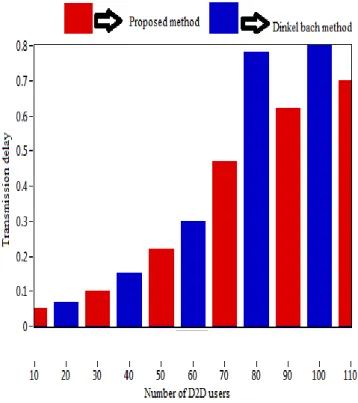
The time switching fraction to calculate the outage SINR threshold in [20] is considered with a constant value of 0.5. But in our proposed approach it varies from 0.5 to 0.7 according to the distance between D2D users. Using statistical model the uplink and downlink network performances are evaluated under different scenarios. Figure 5 shows the transmission delay of D2D users for the proposed and Dinkelbach methods. The results show that the data transmission delay can be further reduced by using the proposed technique.
Figure 5. Data transmission delay of D2D users From the Dinkelbach method it is also observed that there is a rapid increase in the data transmission delay with the increase in the number of D2D users. But this can be greatly reduced by using the proposed method.
To meet the QoS requirements of D2D users for given number of CUs a plot of feasible number of D2D users versus the number of CUs is shown in Figure 6.
Since a large number of cellular areas can be reused by D2D users, the feasible number of D2D users number increases with the increase in number of cellular users. But the ratio of the number of feasible device to device users to the number of cellular users decreases with the increase in number of cellular users. Hence the number of feasible D2D users increases slowly compared to cellular users. From the figure it is observed that the proposed method allows more number of feasible device to device users compared to Dinkelbach method and DFC algorithm.
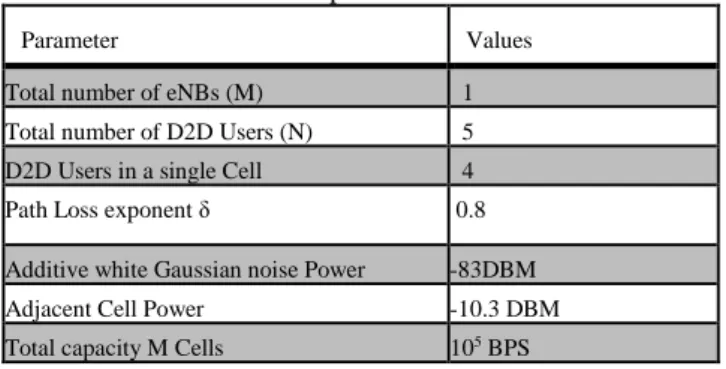
The network parameters considered for simulation are listed in the Table 2.
Table 2. Network parameters for simulation
Parameter Values
Total number of eNBs (M) 1
Total number of D2D Users (N) 5
D2D Users in a single Cell 4
Path Loss exponent δ 0.8
Additive white Gaussian noise Power -83DBM
Adjacent Cell Power -10.3 DBM
Total capacity M Cells 105 BPS
The power dissipation is assumed constant for all the D2D and cellular users throughout the simulation, but in reality this varies depending on the distance between the D2D users. At minimum power levels maximum time switching coefficients observed during simulation.
5.
Conclusion
The proposed work helps to save power of the eNBs and UEs for Device to Device communication system in LTE-Advanced networks. Simulation results proved that the proposed power control algorithm effectively reduces power requirements at both the base stations and user equipments with lower complexity. In this paper we examined the performance of the work considering a single cell consisting of a base station, covered by cellular and D2D users. This work can be further enhanced by considering more cells with effective interference mitigation approaches.
References
[1] T Gopi Sai Krishna, Ramarakula Madhu, “A Utility Function based Uplink Power Control Algorithm in LTE-Advanced Networks,” International Conference on Communication and Signal Processing, Vol. 16, pp. 705-708, 2016.
[2] Hind Albasry and Qasim Zeeshan Ahmed, “Network-Assisted D2D Discovery Method by using Efficient Power Control Strategy,” IEEE 83rd vehicular technology conference, pp. 1-5,
2016.
[3] Yongjun Kwak, Sangmin Ro, Sangbum Kim, Younsun Kim, and Juho Lee, “Performance Evaluation of D2D Discovery with eNB Based Power Control in LTE-Advanced,” IEEE 80th vehicular technology conference, pp. 1-5, 2014.
[4] Yifei Huang, Ali A. Nasir, Salman Durrani, “Mode Selection, Resource Allocation, and Power Control for D2D-Enabled Two-Tier Cellular Network,” IEEE Transactions on Communication, Vol. 64, No. 8, pp. 3534-3543, 2016. [5] Yanxiang Jiang, Qiang Liu, Fuchun Zheng, “Energy-Efficient
Joint Resource Allocation and Power Control for D2D Communications,” IEEE Transactions on Vehicular Technology, Vol. 65, No. 8, pp. 6119–6125, 2016.
[6] Zekun Zhang, Rose Qingyang Hu, Yi Qian, “D2D Communication Underlay in Uplink Cellular Networks with
Distance Based Power Control, ”IEEE International Conference on Communication, pp. 1–5, 2016.
[7] MD. Yeakub Hassan1, Faisal Hussain1, MD. Sakhawat Hossen1, “Interference Minimization in D2D Communication Underlying Cellular Networks”, IEEE Access, Vol. 5, pp.22471-22484, 2017.
[8] Xiaomeng Li, Yuan Ren, Hui Gao, and Tiejun Lv, “Opportunistic Interference Alignment Approach in Device-to-Device Communications Underlaying Cellular Networks”, 2016 24th European Signal Processing Conference (EUSIPCO), pp. 1838-1842, 2016.
[9] Wonjun Hwang, Donghoon Lee, and Hyung-Jin Choi, “A New Channel Structure and Power Control Strategy for D2D Discovery in LTE Cellular Network,” The 20th Asia-Pacific
Conference on Communication, Vol. 17, No. 8, pp. 150-155, 2014.
[10]Amen Memmi, Zouheir Rezki, Mohamed-Slim Alouini, “Power Control for D2D Underlay Cellular Networks With Channel Uncertainty,” IEEE Trans. Wireless Communication, Vol. 16, No. 2, pp. 1330-1343, 2017.
[11]Chungang Yang, Jiandong Li, Prabodini Semasinghe, “Distributed Interference and Energy-Aware Power Control for Ultra-Dense D2D Networks,” IEEE Trans. Wireless Communication, Vol. 16, No. 2, pp. 1205-1217, 2017. [12]Jianfeng Ding, Lingge Jiang, and Chen He, “Energy-Efficient
Power Control for Underlaying D2D Communication with Channel Uncertainty User-Centric Versus Network-Centric,” Journal of Communications and Networks, Vol. 18, No. 4, pp. 589–599, 2016.
[13]P. Phunchongharn, E. Hossain, and S. Camorlinga, “Electromagnetic interference-aware transmission scheduling and power control for dynamic wireless access in hospital environments,” IEEE Trans. Inform.Technol. Biomed., Vol. 15, No. 6, pp. 890–899, 2011.
[14]M. R. Javan and A. R. Sharafat, “Efficient and distributed SINR-based joint resource allocation and base station assignment in wireless CDMA networks,” IEEE Transactions Communication, Vol. 59, No. 12, pp. 3388–3399, 2011. [15]X. Y. Qiu et al., “Energy efficiency analysis in device to
device communication underlying cellular networks,” Proceedings IEEE Consumer Communication Networking Conference, pp. 625–630, 2013.
[16]V. N. Ha and L. B. Le, “Distributed base station association and power control for heterogeneous cellular networks,” IEEE Transactions on Vehicular Technologies, Vol. 63, No. 1, pp. 282–296, 2014.
[17]G. Fodor, D. Della Penda, M. Belleschi, M. Johansson, and A. Abrardo, “A comparative study of power control approaches for device-to-device communications,” in Proceedings IEEE International Conference Communication, pp. 6008–6013, 2013.
[18]J. Liu, N. Kato, “Device-to-Device communication overlaying two-hop multi-channel uplink cellular networks,” in Proc. ACM International Symposium On Mobile Ad Hoc Networking and Computing, pp. 307-316, 2015.
[19]H. Tang and Z. Ding, “Mixed mode transmission and resource allocation for D2D communication,” IEEE Transactions Wireless Communication, Vol. 15, No. 1, pp. 162–175, 2016. [20]Dinh-Thuan Do, “Performance Analysis in Wireless Powered