“INFLUENCE OF PERSONALITY AND COMPETENCY ON PERFORMANCE OF PEOPLE MANAGERS”
Stephen DeepakAsst Professor Department of Management Studies
[email protected] Mount Carmel Institute of Management
Bengaluru, Karnataka
Abstract – Personality and Competency are two defining variables that determine the functioning of any manager. Personality is a stable set of characteristics and tendencies that determine those commonalties and differences in the psychological behaviour (thoughts, feelings and actions) of people that have continuity in time and that may not be easily understood as the sole result of the social and biological pressures of the moment and Competency is a set of defined behaviours that provide a structured guide enabling to the identification, evaluation and development of the behaviours in individual employees.
Many previous research studies have proved that the Influence of personality and competency has a great bearing on the decision making of people managers. The study was conducted on people managers and their subordinates from the three sectors of Retail, Information Technology and B.P.O to study the influence of these two variables on the functioning of the managers. The findings present a clear picture that since Retail, I.T and B.P.O are sunrise sectors and people oriented, the people managers need to work with more dynamism, energy and effective people understanding, as the demands of these sectors offer competitive scenarios, the handling of these produces good results for the firms and the managers.
Keywords–Personality,Competency,Leadership, Extroversion, Conscientiousness, Neuroticism
Introduction
Human resource management (HRM) is an approach to the management of people, based on four fundamental principles.
First, human resources are the most important assets an organization has and their effective management is the key to its success. Second, this success is most likely to be achieved if the personnel policies and procedures of the enterprise are closely linked with, and make a major contribution to, the achievement of corporate objectives and strategic plans. Third, the corporate culture and the values, organizational climate and managerial behaviour that emanate from that culture will exert a major influence on the achievement of excellence.
This culture must, therefore, be managed which means that organizational values may need to be changed or reinforced, and that continuous effort, starting from the top, will be required to get them accepted and acted upon.
Conceptual Framework
Personality is a stable set of characteristics and tendencies that determine those commonalties and differences in the psychological behaviour (thoughts, feelings and actions) of people that have continuity in time and that may not be easily understood as the sole result of the social and biological pressures of the moment."Personality"can be defined as a dynamic and organized set of characteristics possessed by a person that uniquely influences his or her cognitions, emotions, motivations, and behaviours in various situations. The word "personality" originates from the Latin persona, which means mask. Significantly, in the theatre of the ancient Latin-speaking world, the mask was not used as a plot device to disguise the identity of a character, but rather was a convention employed to represent or typify that character.
Personality may also refer to the patterns of thoughts, feelings and behaviours consistently exhibited by an individual over time that strongly influence our expectations, self-perceptions, values and attitudes, and predicts our reactions to people, problems and stress.
Measuring Personality
There are three main ways personality is measured
Self-report surveys: They are completed by the individual. They are the most common
way to measure personality. One concern with self-report surveys,however,is that the individual might lie or practice impression management that is, the person could fake good on the test to create a good impression
Observer-rating survey: It has been developed to provide an independent assessment of
personality.Therefore,instead of an individual taking the survey as in the case of self-report surveys perhaps a coworker could do the rating .Even though self-self-reporting surveys and observer0reporting surveys are strongly correlated, research suggests that observer-reporting surveys are better predictor of success on the job
Competence (or competency) is the ability of an individual to do a job properly. A competency is a set of defined behaviours that provide a structured guide enabling the identification, evaluation and development of the behaviours in individual employees. Competency is also used as a more general description of the requirements of human beings in organizations and communities.
Competency is sometimes thought of as being shown in action in a situation and context that might be different the next time a person has to act.
The process of competency development is a lifelong series of doing and reflecting. As competencies apply to careers as well as jobs, lifelong competency development is linked with personal development as a management concept. And it requires a special environment, where the rules are necessary in order to introduce novices, but people at a more advanced level of competency will systematically break the rules if the situations require it. This environment is synonymously described using terms such as learning organization, knowledge creation, self-organizing and empowerment.
Review of Literature
1.In a study titled “An examination of personality in occupational outcomes: antagonistic
managers, careless workers and extraverted salespeople” opined that
Human capital variables are found to exhibit strong credentialism effects and there is evidence for some small dynasty hysteresis. Personality effects are found to be significant, relatively large and persistent across all occupations. The personality effects are strong enough to rival that of various education credentials. These personality effects include but are not limited to managers being less agreeable and more antagonistic; labourers being less conscientiousness; and salespeople being more extraverted Authors: Wells, Robert, Ham, Roger, Junankar, P. N. (Raja), Source: Applied Economics. Feb2016, Vol. 48 Issue 7, p636-651. 16p.
2. The study titled ‘Core personality traits of managers’
As hypothesized, compared to non-managers, managers had significantly higher scores across nine traits, all of which correlated significantly with managerial career satisfaction. Research limitations/implications – Although job tenure and managerial level are not examined, the findings align with managerial competence models, the Attraction-Selection-Attrition model, and vocational theory and raise questions for research on the adaptive value of these traits for managers’ satisfaction and effectiveness. Authors:Lounsbury, John W.1, Sundstrom, Eric D., Gibson, Lucy W., Loveland, James M., Drost, Adam W, Source: Journal of Managerial Psychology. 2016, Vol. 31 Issue 2, p434-450. 17p.
3. MBTI Personality Types of Project Managers and Their Success: A Field Survey
This paper describes a survey of 280 project managers that reveals both their personality types (via Myers-Briggs personality inventory) and their success in project management. The results show that a project manager's personality is better suited for functioning with partial data and under ambiguity than the rest of the population. These traits were found for both women and men. The conclusion is that project managers (females and males) have a unique personality-type distribution that distinguishes them from the general population. The findings can contribute to better understanding the traits that characterize the project management population, and their relationship to project success. Authors - Yuval Cohen, Hana Ornoy and Baruch Keren
Project Management Journal. Volume 44, Issue 3, pages 78–87, June 2013
4. Competencies, Personality Traits, and Organizational Rewards of Middle Managers: A Motive-Based Approach
The goals of this study were (a) to identify a motive-based competency structure and (b) to understand the antecedents and consequences of these motive-based dimensions. We found that a three-factor structure formed by “achievement,” “power,” and “affiliation” fit our data well. Each of the three dimensions showed a distinct pattern of personality correlates. Power was found to have the strongest impact on organizational rewards. Our results further suggested that personality impacts organizational rewards mainly through the motive-based dimensions. Theoretical and practical contributions are discussed.
Author - Laura Guilléna& Willem E. Saris. Human Performance, Volume 26, Issue 1, 2013
5. Key personality traits of sales managers.
than a sample of 79,512 individuals in a variety of other occupations. Nine of these traits were significantly correlated with sales managers' career satisfaction.
Based on the results, a psychological profile of sales managers was presented as were implications for their recruitment, selection, training, development, and mentoring.
Author - Lounsbury JW, Foster NA, Levy JJ3, Gibson LW
6. The Big Five personality traits, material values, and financial well-being of self-described money managers
Results suggest that (a) individuals who believe that material possessions can provide happiness manage their money less and (b) highly conscientious individuals manage their money more because they have positive financial attitudes as well as a future orientation. Further, money management is significantly related to increased savings, decreased debt, and less compulsive buying even after controlling for numerous socio-demographic and
dispositional variables. Authors - Grant Donnelly,Ravi Iyer, Ryan T. Howell
Journal of Economic Psychology. Volume 33, Issue 6, December 2012, Pages 1129–1142
7. Personality Type and Leadership Focus: relationship between self and line manager perceptions
The relationship between personality type and leadership focus is examined in this article. Personality type is assessed by means of the Myers-Briggs Type Indicator (MBTI), and leadership focus is explored both with participants and their line-managers using a Leadership. Results showed that in circumstances associated with change, Feeling and Perceiving types are favoured for managing the stress of competing leadership demands. Line-managers of participants rely more on Intuition while participants prefer Sensing in dealing with external stakeholders. Article in SA Journal of Human Resource Management 7(1) · April 2009
8. The Great Eight Competencies: A Criterion-Centric Approach to Validation
The author presents results of a meta-analysis of 29 validation studies (N = 4,861) that uses the Great Eight competency factors (Kurz& Bartram, 2002) as the criterion measurement framework. Predictors of the Great Eight competencies based only on personality scales show moderate to good correlations with line-manager ratings for all 8 of the competencies. On their own, ability tests correlate with 4 of the 8 competencies, and together ability and personality data yield operational validities ranging from 0.20 to 0.44 for the 8 competencies. Authors: Bartram, Dave. Source: Journal of Applied Psychology. Nov2005, Vol. 90 Issue 6, p1185-1203. 19p.
9. The Identification of Key Managerial Competencies as a Tool for Increasing Business Competitiveness.
Competency Models, but there's no guarantee that these Competency Models will address the
key managerial competencies for a given, specific company. Authors - Bańasová,
Lucia,Cagáńová, Dagmar, Čambál, Miloš
Statement of the problem
The purpose of this study is to identify the relationship between personality, competency and behaviour of people managers in performing their jobs. The study covers people managers from four different sectors - IT, BPO & Retail. This research is conducted to understand the relationship these factors have on decision making. The study will also help in identifying the gaps in performance. This enables the firm to determine appropriate HR interventions dealing with people of different traits and competencies to help them reach higher levels of performance.
Objectives of the study
•To understand and analyze personality traits & personal characteristics of people managers •To study job characteristics &competencies required for job performance by people managers •To identify &analyze personal & work outcomes based on job characteristics & personality.
Methodology
The study includes a sample of different people managers in Retail, Information Technology and B.P.O sectors. The data was collected through survey using questionnaire and also by understanding the records and journals maintained in the organization. Information was gathered by using both primary and secondary data. Primary data was collected from the managers through Questionnaire, Face to face interviews and Telephonic interviews. Secondary data was collected through review of literature conducted from notable management journals Non random sampling with (N=140), People manager (N=70) , Reporting Subordinates (N=70) Retail (N=60), I.T (N=60), BPO (N=20)
Analysis and Interpretation:
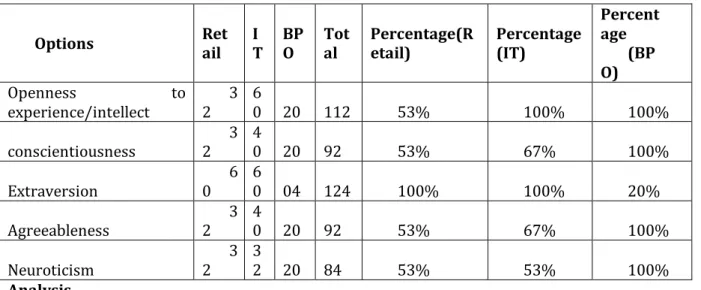
Table 1: Personality type of people manger’s in Retail, IT, BPO sectors.
Options Retail IT BPO Total Percentage(Retail) Percentage(IT)
Percent age
(BP O)
Openness to
experience/intellect
3 2
6
0 20 112 53% 100% 100%
conscientiousness 2 3 40 20 92 53% 67% 100%
Extraversion 0 6 60 04 124 100% 100% 20%
Agreeableness 2 3 40 20 92 53% 67% 100%
Neuroticism 2 3 32 20 84 53% 53% 100%
The Analysis is drawn from the survey conducted in these three sectors with the help of the Big Five Model Personality test. This test is taken from the authorised website (www.outofservice.com/bigfive) for the data collection. The table shows that openness and extraversion are the most sought out attributes in IT. It can be seen that all the qualities are equally wanted in Retail. And almost all the qualities are very important
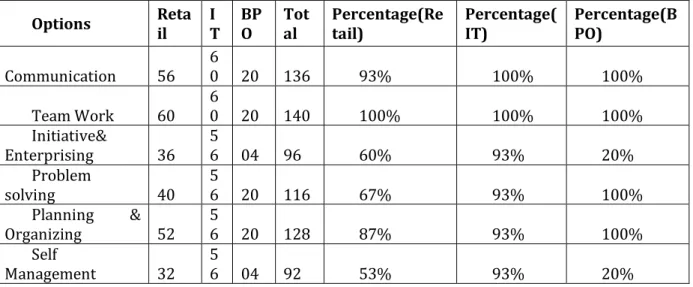
Table 2: Essential competency required for people manager
Options Retail IT BPO Total Percentage(Retail) Percentage(IT) Percentage(BPO)
Communication 56
6
0 20 136 93% 100% 100%
Team Work 60 60 20 140 100% 100% 100%
Initiative&
Enterprising 36 56 04 96 60% 93% 20%
Problem
solving 40 56 20 116 67% 93% 100%
Planning &
Organizing 52 56 20 128 87% 93% 100%
Self
Management 32
5
6 04 92 53% 93% 20%
Analysis
Majority fo the respondent belives that above mentioned competencies are essenital for a people manger.
Retail:93% of the respondent said that communication is an essential competency for a people managers,100% of them said that team work is essential competency,60% of them said that initative & enterprising skill is essential for a people manger,67% said problem solving is also a relevent competency for a people manger,87% said planinng &organizing is essential skill for a people manger,53% of the respondent said that self mangement is also a essential competency for people manger to lead a team.
IT:100% of the respondent agree with communication as a competency required for a people
manger,100% of them said team building is an essential competency required,93% of them said initative & enterprising,problem solving,planning & organising and self management is an essenital competency required for a people manager to lead a team.
BPO:100% of the respondent said that communication and team work is essential competency
for a people manager,20% of the respondents said that initative & enterprising and self management are essential competency for a people manager,100% of the respondend said that problem solving and planning & organising are essential for a people manger to lead a team.
Table 3: Ranking of competency according to priority
Options Retail IT BPO Total Percentage (Retail) Percentage (IT) Percentage(BPO)
Communication 18 18 20 56 90% 90% 100%
Initiative&
Enterprising 12 16 08 36 60% 80% 40%
Problem
solving 10 16 12 38 50% 80% 60%
Planning &
Organizing 18 20 20 58 90% 100% 100%
Self
Management 08 12 12 36 40% 60% 60%
Analysis
This table shows the ratings of different competencies. From the above table the analysis drawn in each sector is that the people mangers consider communication and team work as the priority, then it comes planning & organizing and then initiative & enterprising and self management
Table 4: Relevant job characteristics of people manager’s job
Option
s Retail IT BPO Total Percentage(Retail) Percentage(It) Percentage(BPO) Ability to
lead 56 44 10 110 93% 73% 100%
Ability to planning &organizin
g 56 40 08 104 93% 67% 80%
Ability to analyse informatio
n 48 16 10 74 80% 27% 100%
Ability to serve customer
needs 44 40 10 94 73% 67% 100%
Ability to work with
team 6 3 32 16 84 60% 53% 80%
Ability to achieve
business 2 3 32 16 80 53% 53% 80%
Ability to manage the
process 8 2 44 08 80 47% 73% 40%
Analysis
Retail:93% of the respondent said that ability to lead and ability planing & organizing is an essential job characteristics for a people mangers job,80% of them said ability to analyse information,73% said that ability to serve customer needs,60% of them said ability to work with team,53% said that ability to achieve business,47% of them said that ability to manage the process,these are the the relevent job characteristics of a people managers job.
IT:73% of the respondent said ability to lead is relevent job characteristics,67% of them said
that ability to analyse to planning & organizing and ability to serve customer needs are relevent job characteristics,27% said that ability to analyse information is relevent job characteristics,53% of them said that ability to work with team and ability to achieve business are relevent job characteristics,73% of the respondents said that ability to manage the process is relevent job characteristics of people mangers job.
BPO:100% of the respondents said that ability to lead,ability to serve customer needs and
ability to analyse infromation are relevent job charcteristics,80% of them said that ability to planning & organizing,ability to work with team and ability toacheive business are relevent job cahracteristics,40% of them said that ability to manage the process is relevent job characteristics of people managers job
Table 5: Rating of degree of autonomy on people mangers job
OPTION RETAIL IT BPO Total Percentage (RETAIL) Percentage (IT) Percentage (BPO)
Very high 0 08 0 08 0% 13% 0%
Moderate 60 52 20 132 100% 87% 100%
Low 0 0 0 0 0% 0% 0%
Very low 0 0 0 0 0% 0% 0%
Analysis
The above table denotes the rate of degree of autonomy on people manager’s job. 100% of the respondents in Retail and BPO sector said that the degree of autonomy is moderate,87% of them in IT sector said that the degree of autonomy is moderate,13% of them in IT sector said that the degree of autonomy is very high on people manager’s job. And no respondent opined that the degree of autonomy is low or very low on people manager’s job.
Table 06: Frequency of people manager’s get feedback for their job
OPTION RETAIL IT BPO Total Percentage (RETAIL) Percentage (IT) Percentage (BPO) Immediate
04 24 08 36 7% 40% 40%
Weekly 36 36 16 88 60% 60% 80%
Quarterly 04 00 00 04 7% 0% 0%
Half yearly
Yearly 16 00 00 16 27% 0% 0%
Analysis
Table shows that the feedback was given immediately or weekly in all the three sectors and 7% of them said feedback is given quarterly in Retail sector, 27% said feedback is given yearly in Retail sector.
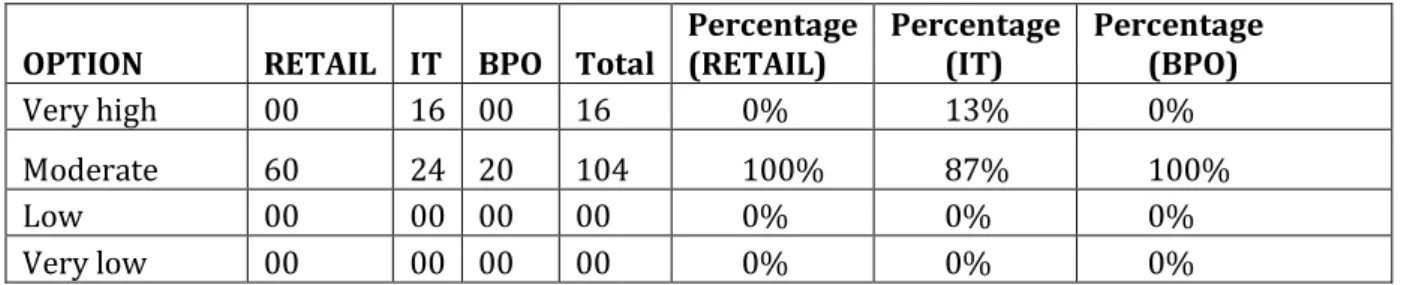
Table 07: Rating of quality on performance of people managers
OPTION RETAIL IT BPO Total
Percentage (RETAIL) Percentage (IT) Percentage (BPO)
Very high 00 16 00 16 0% 13% 0%
Moderate 60 24 20 104 100% 87% 100%
Low 00 00 00 00 0% 0% 0%
Very low 00 00 00 00 0% 0% 0%
Analysis
The table denotes that 100% of the respondent in Retail and BPO sector rated that quality of performance of people mangers as moderate,87% of them said in IT sector rated that quality of performance of people mangers as moderate,13% of them said in IT sector rated that quality of performance of people mangers as moderate.
Table 08: Areas were people managers seek improvement
Option
s Retail IT BPO Total Percentage(Retail) Percentage (IT)
Percentage(BPO )
Ability to lead
32 3
2
20 8
4
53%
53% 100%
Ability to planning & organizing
32 3
2 20 4 8 53%
53% 100%
Ability to analyse informatio n
08 1
2 04 4 2 13%
20% 20%
Ability to serve customer needs
28 2
4 20 2 7 47%
40% 100%
Ability to work with team
32 3
2 04 8 6 53%
53% 20%
Ability to manage the process
08 0
4
04 1
6
13%
Analysis
The table shows that the area were the people manager’s seek improvement is on ability to lead, Ability to planning & organizing is second. Ability to analyse information is, ability to serve customer needs, ability to work with team have almost equal level of required improvement.
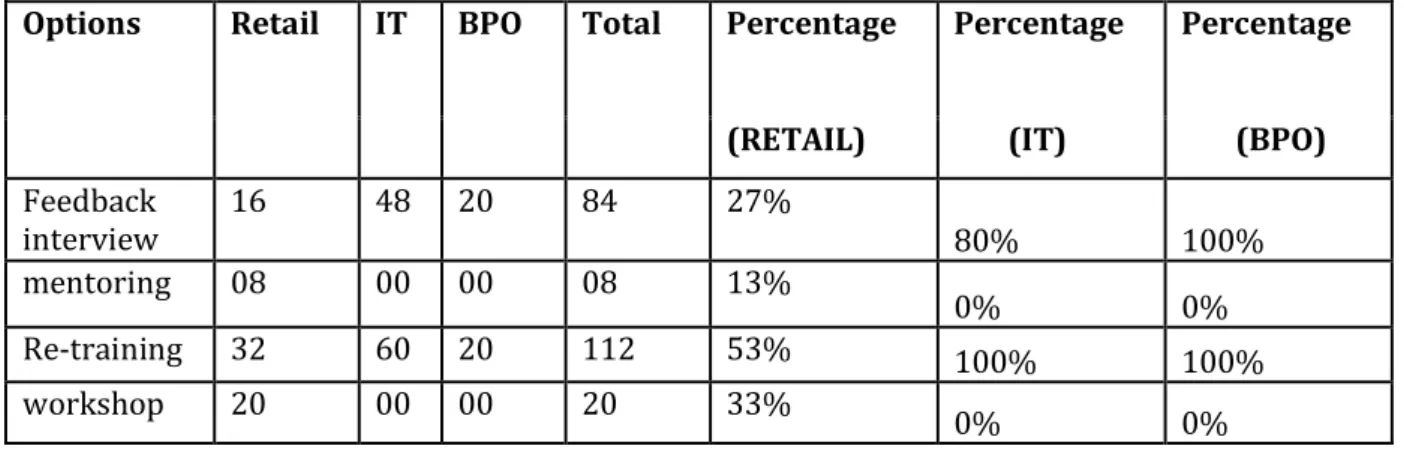
Table 09: Current HR interventions used in the firm to improve performance of people manager
Options Retail IT BPO Total Percentage Percentage Percentage
(RETAIL) (IT) (BPO)
Feedback
interview 16 48 20 84 27% 80% 100%
mentoring 08 00 00 08 13%
0% 0%
Re-training 32 60 20 112 53% 100% 100%
workshop 20 00 00 20 33% 0% 0%
Analysis
Majority says that the current HR interventions used in the firm to improve performance of people manger are Feedback interview. 27% in Retail, 80% in it, 100% in Bop and re-training 53% in Retail, 100% in it and100% in Bop and mentoring 13% in Retail and workshop 33% in Retail sector are the current HR interventions used in the firm to improve performance people managers.
Table 10: Feedback of subordinates about their people mangers
OPTION RETAIL IT BPO
Percentage (Retail
) Percentage (IT) Percentage (BPO) My manager Empowers me to
do my job. 18 16 16 90% 80% 80%
My manager Identifies clear,
attainable goals and
objectives, by stating what
needs to be accomplished 20 20 20 100% 100% 100%
My manager provides an environment that motivates me to achieve my goals and
objectives. 16 16 18 80% 80% 90%
My manager provides me challenging opportunities that
My manager acts as a
sounding board for ideas. 12 16 16 60% 80% 80%
My manager recognizes and
rewards innovation and
creativity. 12 20 20 60% 100% 100%
My manager enables good
performance by clearing
roadblocks and providing
support. 12 14 16 60% 70% 80%
My manager provides
opportunities for professional
development and
improvement of skills 14 20 18 70% 100% 90%
My manager demonstrates flexibility in management style
16 20 20 80% 100% 100%
My manager communicates and departmental goals and
objectives 16 16 00 80% 80% 0%
My manager acts as coach and
mentor. 16 20 20 80% 100% 100%
My manager helps to builds a
cohesive team 12 16 14 60% 80% 70%
My manager provides honest and constructive feedback
about my performance 16 20 18 80% 100% 90%
My manager delegates
effectively. 12 16 16 60% 80% 80%
My manager conducts regular
one-on-one feedback
meetings. 10 14 14 50% 70% 70%
Findings based discussions:
In the Retail sector, the following Job characteristics were considered relevant.93% - Ability to lead and ability plan & organize, 80% - Ability to analyse information,73% - Ability to serve customer,60% -Ability to work with ateam. In the I.T sector - 73% - Ability to lead,67% - Ability to plan & organize ,27% - Ability to analyse information as relevent job characteristics. In the BPO sector - 100% -Ability to lead, Ability to serve customer needs and Ability to analyse infromation are relevent job charcteristics. The findings produce before us the nature of the repective Industries – as these are SunriseIndustries bwcoming relevant in the last 15 years are the new face of jobs in India. Sice the nature of the Industry is competive and since IT and the BPO sectors are dependent on clients from the Western world, the findings go hand in hand to prove the competitive nature, higher demands from clients, superior customer service delivery, analyzing information for informed decision making are relvant job characterisitics.
the degree of autonomy was moderate,13% of them in IT sector said that the degree of autonomy was high. A higher degree of autonomy ranging from 80% to 100% shows the decentralized setups and freedom that managers are given to work within their job responsibilities.
Feedback on Job performances is also a relevant indicator as this can provide information on what a people manager is doing and what he/she has to do. The frequency of feedback was weekly, in the Retail sector was 60% , and in the IT sector was 60% , and the BPO sector was . 80%. Feedback as a relevant factor does provide inputs that can enable the manager to be more job focused and address issues immediately.
Areas of improvement for people managers were in the following areas.
Ability to lead, Ability to plan & organize, Ability to analyse information , Ability to serve customer needs, Ability to work with team.
These improvement areas establish job responsbilities where competencies are most needed and people to managers have opined that they need training and further assistance to improve in these areas.
Current HR interventions used in the firm to improve performance of people manger are Feedback interview. 27% in Retail, 80% in IT, 100% in BPO and re-training 53% in Retail, 100% in IT and100% in BPO and mentoring 13% in Retail and workshop 33% in Retail sector are the current HR interventions used in the firm to improve performance people managers. The identified HR interventions can help HRD managers to formulate HRD Interventional training modules to assist mangers to become further skilled, equipped and performing.
Conclusion:
Peronality of an individual and comptency of an individual are linked – It is the person who possesses competencies and whole self is at role while performing job duties. The study that was condcuted on people managers in three sectors – Retail, I.T and B.P.O threw up the following interesting results.
People managers in all sectors are open to new experiences in their jobs, as these are challenging sectors where work expereiences remain varied, hence majority of managers surveyed were well organized and reliable in their outlook. Since these are service sectors people managers are outgoing, social and energetic. They tend to consider others feelings and are empathetic towards the needs and requirements of fellow employees. These findings provide us ample information to prove that personality traits and personal characteristics have a strong influence and bearing of the job performance of people managers.
References:
Wells, Robert; Ham, Roger; Junankar, P. N. (Raja). “An examination of personality in occupational outcomes: antagonistic managers, careless workers and extraverted salespeople”. - Applied Economics. Feb2016, Vol. 48 Issue 7, p636-651. 16p.
Cohen, Yuval; Ornoy, Hana; Keren, Baruch “MBTI Personality Types of Project Managers and Their Success: A Field Survey”-. Project Management Journal. Jun2013, Vol. 44 Issue 3, p78-87. 10p.
Guillén, Laura; Saris, Willem E. “Competencies, Personality Traits, and Organizational Rewards of Middle Managers: A Motive-Based Approach”. Academic Journal - Human Performance. 2013, Vol. 26 Issue 1, p66-92. 27p.
Lounsbury, John W.; Foster, Nancy A.; Levy, Jacob J.; Gibson, Lucy W. “Key personality traits of sales managers”.Academic Journal Work. 2014, Vol. 48 Issue 2, p239-253. 15p. 3 Charts.
Donnelly, Grant; Iyer, Ravi; Howell, Ryan T. “The Big Five personality traits, material values, and financial well-being of self-described money managers” Academic Journal - Journal of Economic Psychology. Dec2012, Vol. 33 Issue 6, p1129-1142. 14p.
Sieff, Grant. “Personality Type And Leadership Focus: Relationship Between Self And Line-Manager Perceptions”. - Academic Journal - South African Journal of Human Resource Management. Nov2009, Vol. 7 Issue 1, p63-73. 11p.
Wronka-Pośpiech, “The identification of skills and competencies for effective management in social enterprises. A managerial perspective”.Academic Journal - Martyna. Management (1429-9321). May2016, Vol. 20 Issue 1, p40-57. 18p.
Bartram, D. (2005). The great eight competencies: A criterion-centric approach to validation. Journal of Applied Psychology, 90(6), 1185-1203, http://dx.doi.org/10.1037/0021-9010.90.6.1185 [CrossRef]
Boudreau, J.W., Boswell, W.R. & Judge, T.A. (2001). Effects of personality on executive career success in the United States and Europe. Journal of Vocational Behavior, 58(1), 53-81, http://dx.doi.org/10.1006/jvbe.2000.1755 [CrossRef]
Boyatzis, R.E. (2009). Competencies as a behavioral approach to emotional intelligence. Journal
of Management Development, 28(9), 749-770,
http://dx.doi.org/10.1108/02621710910987647 [CrossRef]
Gosling, S.D., Rentfrow, P.J. & Swann Jr., W.B. (2003). A very brief measure of the Big-Five
personality domains. Journal of Research in Personality, 37(6), 504-528,