R E S E A R C H A R T I C L E
Open Access
What are the differences among
occupational groups related to their
palliative care-specific educational needs
and intensity of interprofessional
collaboration in long-term care homes?
S. Kaasalainen
1,6*, T. Sussman
2, M. Bui
1, N. Akhtar-Danesh
1, R. D. Laporte
3, L. McCleary
4, A. Wickson Griffiths
5,
K. Brazil
6, D. Parker
7, V. Dal Bello-Haas
1, A. Papaioannou
1, J. O
’
Leary
1and the SPA-LTC Team
Abstract
Background:The purpose of this study was to compare the differences across occupational groups related to their end-of-life care-specific educational needs and reported intensity of interprofessional collaboration in long-term care (LTC) homes.
Methods:A cross-sectional survey, based on two questionnaires, was administered at four LTC homes in Ontario, Canada using a modified Dilman’s approach. The first questionnaire, End of Life Professional Caregiver Survey, included three domains: patients and family-centered communication, cultural and ethical values, effective care delivery. The Intensity of Interprofessional Collaboration Scale included two subscales: care sharing activities, and interprofessional coordination. In total, 697 LTC staff were given surveys, including personal support workers, support staff (housekeeping, kitchen, recreation, laundry, dietician aids, office staff), and registered staff (licensed nurses, physiotherapists, social workers, pharmacists, physicians).
Results:A total of 317 participants completed the survey (126 personal support workers, 109 support staff, 82 registered staff) for a response rate of 45%. Significant differences emerged among occupational groups across all scales and subscales. Specifically, support staff rated their comfort of working with dying patients significantly lower than both nurses and PSWs. Support staff also reported significantly lower ratings of care sharing activities and interprofessional coordination compared to both registered staff and personal support workers.
Conclusions:These study findings suggest there are differing educational needs and sense of interprofessional collaboration among LTC staff, specific to discipline group. Both the personal support workers and support staff groups appeared to have higher needs for education; support staff also reported higher needs related to
integration on the interdisciplinary team. Efforts to build capacity within support staff related to working with dying residents and their families are needed. Optimal palliative care may require resources to increase the availability of support for all staff involved in the care of patients.
Keywords:Palliative care, Long-term care, Interprofessional care, Aged care
* Correspondence:[email protected]
1Faculty of Health Sciences, 3N25F, McMaster University, 1280 Main Street
West, Hamilton, ON L8N 3Z5, Canada
6Queen’s University Belfast, Belfast, UK
Full list of author information is available at the end of the article
Background
As a unique health care environment with medically complex older adult residents, significant challenges exist in establishing a national end of life strategy for Canadian long-term care (LTC) homes that is integrated with non-LTC palliative care services [1–4]. Twenty-seven percent of Canadian residents will die in LTC annually [5] and this rate is expected to increase to 39% by 2020 [6]. Currently, Canadian LTC homes have in-sufficient resources to meet the needs of their dying residents with 19.1% of LTC residents dying in acute care and 40.7% being hospitalized within 6 months prior to death [7]. National LTC staff-to-resident ratios remain significantly lower (5 h per resident per day) than other palliative care delivering facilities, with Ontario ranking consistently below national averages (4 h per resident per day) [8].
Most LTC residents die from non-cancer conditions, such as co-occurring dementia, heart failure, and chronic obstructive pulmonary disease, which have not tradition-ally been major focuses of study in palliative care research [9–12]. Cognitive, communication, functional, and behav-ioural barriers to delivering effective palliative care exist in LTC since over 75% of residents have some degree of cog-nitive impairment [13–16]. Pain and other symptoms are often poorly managed in LTC [17], which is especially evident among residents with advanced dementia. Fur-thermore, LTC residents are among the frailest and most vulnerable older adult populations with approximately 52.3% (95% confidence interval 37.9%–66.5%) of LTC resi-dents being classified as frail and 40.2% (28.9%–52.1%) be-ing considered pre-frail [18, 19]. As a result, many palliative care tools and approaches primarily developed from cancer care research have limited applicability in LTC settings.
An interprofessional collaborative approach has been supported and strongly encouraged by health care workers [3], law and policy makers [7, 20] and researchers [10, 17, 21–24] as an essential component for addressing the complex physical, psychosocial, emotional and spirit-ual needs of LTC residents undergoing palliative care. The Canadian Interprofessional Health Collaborative (CIHC) defines interprofessional collaboration as the “process of developing and maintaining interprofessional working re-lationships with learners, practitioners, patients/clients/ families and communities to enable optimal health out-comes” [23]. Evidence on the interprofessional collabor-ation, however, is especially sparse in the context of LTC and requires further study to establish the effectiveness of practice-based interventions.
Unlike other health care settings, physician involve-ment is usually very minimal in LTC and other regulated health professionals, such as pharmacists, dieticians, physiotherapists, and occupational therapists, are not
regularly onsite [1]. LTC staff primarily consists of un-regulated health care workers with limited training and education including personal support workers, dietary aides, recreational aides, and chaplains [1]. These un-regulated health care workers are rarely examined or considered in studies regarding interprofessional pallia-tive care in LTC settings. The lack of regulation amongst many of the core team members and low ratios of regu-lated health professionals create challenges in develop-ing, reinforcdevelop-ing, and evaluating the therapeutic quality of interprofessional palliative care programs in LTC. Thus, in order to improve staff capacity to communicate with families and residents about end of life issues and deliver effective palliative care services, it is imperative to know how comfortable different LTC workers are regarding palliative care delivery and the nature of LTC as a unique collaborative environment.
Theaim of this study was to compare the differences across occupational groups related to their palliative care-specific educational needs and intensity of interpro-fessional collaboration in long-term care (LTC) homes. Study data and findings reported in this paper are part of a larger mixed methods study that is currently explor-ing the implementation of a palliative program, called Strengthening a Palliative Approach in Long Term Care (SPA-LTC). This paper reports on the analysis of survey data that was collected at baseline from the four partici-pating LTC homes in the SPA-LTC program.
Methods
Design
A cross-sectional survey design was used to examine the educational needs and intensity of interprofessional col-laboration among LTC staff. This study was approved by three university-affiliated Research Ethics Boards in two provinces of Canada.
Setting and sample
Data were collected from staff at four LTC homes in southern Ontario in 2015. The facilities were purposively chosen to represent a set of diverse conditions in LTC (e.g., for-profit/not-for profit status, facility size). Staff were grouped into the following categories: Personal Support Workers (PSWs) or nursing care aides; Support Staff (i.e., housekeeping, kitchen, cooks, recreation, laun-dry, dietician aid, office/administrative staff (who are not registered staff ), reception); Registered Staff (i.e., licensed nurses, physiotherapists, social workers, dieticians, phar-macists, physicians).
Measurement
developed to assess palliative care-specific educational needs within an interprofessional team related to: (a) clinical knowledge/technical skills; (b) communication/ interpersonal skills with patients, family, and other clini-cians; (c) spiritual and cultural issues; (d) ethical, profes-sional, and legal principles; (e) organizational skills; and, (f ) attitudes, values and feelings of health care profes-sionals. The ELPC is a 28-item scale with strong internal consistency (alpha = .96) [25]. Each item scored on a 5-point Likert scale ranging from 1 (lowest level of skill) to 5 (greatest level of skill). It includes three subscales: a 12-item Patient-and Family-Centered Communication (PFCC); 8-item Cultural and Ethical Values (CEV); and 8-item Effective Care Delivery (ECD) [25]. The PFCC subscale measures includes items focused on the com-fort with discussing palliative issues (e.g., helping family accept a prognosis or manage conflict, goal setting, ad-vance care planning, grieving etc) with family and/or health care professionals. Items included in the CEV subscale are focused on providing culturally and ethically competent care while ECD items include related to clinical competence (e.g., referring to hospice, famil-iarity with PC principles, linking with appropriate services when needed and navigating the system) and perceived workplace supports available to them to deal with palliative issues.
IP collaboration was measured using the IPC which is an 18-item scale that measures two factors: care sharing activities and IP co-ordination [26]. Initial factor ana-lysis and validation of this scale reported that the main factors associated with interdisciplinary collaboration are most closely aligned to intragroup dynamics and values, as opposed contextual factors, such as the size of an employing program’s workforce, or whether a program formally assesses the quality of its care [26]. The survey took approximately 10–15 min to complete. Demographic and employment data was also collected, such as age, gender, length of time working in LTC, oc-cupational group, and involvement in care planning activities.
Procedure
We worked with the LTC administrative staff to dis-tribute the survey via inter-facility mail to all LTC staff. We also distributed surveys at staff educational events to improve the response rate. We tracked those staff who completed the survey and followed up with those who did not with a subsequent mailing distribution. To encourage completion, we held a draw at each of the participating LTC homes and told staff that they would be entered to win a $50 gift card if they completed a survey. All completed sur-veys were returned to the principal investigators of the study (SK & TS).
Statistical analysis
All statistical analysis was performed in SPSS 23.0 statis-tical analysis software for Windows (IBM Corp., Armonk, NY, USA). A frequency distribution was completed on demographic variables and employment responsibilities of interest (attending care conferences, contributing to the development of care plans). Individual descriptive statis-tics were also reported for each of the three occupational groups studied (PSW, Registered Staff, Support Staff ). Mean responses were generated for each scale and their subscales according to occupational group and a stepwise regression analysis was performed to evaluate the contri-bution of the independent variables to these mean re-sponses. Criteria for inclusion in the predictive model was aP value of <0.05. Significant predictors from the regres-sion models were selected for between groups compari-sons on survey subscale responses using ANOVA and Tukey post hoc analyses.
Results
Characteristics of the sample
Of the 697 surveys distributed, 317 were completed and returned to study investigators, for a total response rate of 45% (see Table 1). Response rates for the different occupational groups were 45% for the PSWs (126/317), 50% for support staff (109/219), and 55% for registered staff (82/148).
Staff were primarily female (86.9%) with the majority (82%) aged 35 and older. Most participants earned a college diploma or higher (79.7%) and were employed on a full-time basis (64%). The participants had a mean of 10.6 (SD = 8.5) years of experience working in LTC and a mean of 8.5 years (SD = 7.6) working with their current employer.
Fifty-six percent of participants reported that they had attended care conferences; highest among registered staff (74%) and lowest among support staff (31%). Seventy-two percent of participants reported that they had contributed to the development of care plans for residents; these rates are highest among registered staff (91%) and lowest among support staff (39%).
ELPC and IIPC survey
subscale. Interestingly, for this subscale the regression coefficient for years spent working in LTC was negative (β=−.012, p= 0.027, CI 95% [−0.022,−0.001]), suggest-ing that the longer staff worked in LTC, the lower their appraisal of care sharing activities across occupational groups.
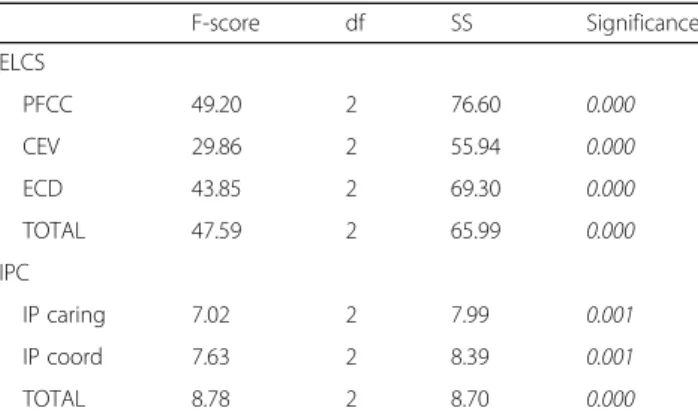
ANOVAs were performed to evaluate the relationship between significant predictors in the regression models and the subscale responses. Analysis showed a signifi-cant relationship between occupational group and all three subscales of the ELPC, as well as the Interdis-ciplinary Coordination subscale of the IIPC. (Table 3). Subsequent Tukey post hoc tests reported significant differences between all occupational groups in the ELPC subscales (p < .01). Analysis of occupational groups also revealed significant groups differences in the Inter-professional coordination subscale of the IIPC (see Table 4). Subsequent Tukey post hoc tests re-vealed significant difference between the Support Staff
and both PSWs (p = 0.004) and Registered Staff
(p = 0.001). The PFCC and ECD subscales of the
ELPC were compared based on different education levels. Only PFCC responses were significantly related Table 1Demographic and employment characteristics by occupational group
Demographic characteristics PSWsn= 126 Registered staffn= 82 Support staffn= 109 aTotalN= 317 Sex N (%)
Male 1 (0.8) 14 (17.1) 26 (24.3) 41 (13.1)
Female 124 (99.2) 68 (82.9) 81 (75.7) 273 (86.9)
Age N (%)
Under 25 1 (0.8) 1 (1.4) 3 (2.8) 5 (1.6)
25 to 34 13 (10.7) 17 (20.1) 20 (18.5) 50 (16.1)
35 to 44 28 (23.0) 26 (31.7) 28 (25.9) 82 (26.4)
45 to 54 41 (33.6) 24 (29.3) 34 (31.5) 99 (31.8)
55 to 64 34 (27.9) 10 (12.2) 19 (17.6) 63 (20.3)
65+ 4 (3.3) 3 (4.2) 4 (3.7) 11 (3.5)
Highest level education completed N (%)
High school or equivalent 35 (28.0) 2 (2.9) 26 (24.5) 63 (20.3)
College 64 (51.2) 35 (42.7) 44 (41.5) 143 (46.0)
Undergraduate degree 8 (6.4) 13 (15.9) 21 (19.8) 42 (13.5)
Graduate degree 13 (10.4) 30 (36.6) 11 (10.4) 54 (17.4)
Other 5 (4.0) 0 (0.0) 4 (3.8) 9 (2.9)
Employment status N (%)
Full-time 69 (55.6) 54 (65.9) 76 (69.7) 199 (63.6)
Part-time 55 (44.4) 26 (31.7) 33 (30.3) 112 (35.8)
Years working in LTC mean (SD) 12.1 (9.2) 8.8 (7.9) 10.2 (7.6) 10.6 (8.5)
Years w/ current employer mean (SD) 10.6 (8.5) 5.8 (5.9) 8.2 (7.0) 8.5 (7.6)
Attended care conferences N (%) 66 (61.1) 61 (74.4) 30 (30.6) 157 (55.9)
Contributed to care plans N (%) 95 (84.8) 75 (91.5) 37 (38.5) 207 (72.1)
a
Total number may not equal 100% due to missing responses
Table 2Stepwise regression results for mean ELPC and IIPC subscales
Subscale β CI 95% P-value
ELPC
PFCC
Occupation 0.31 0.185; 0.443 0.001
Education 0.16 .054; 0.260 0.003
CEV
Occupation 0.31 0.174; 0.448 0.001
ECD
Occupation 0.38 0.255; 0.509 0.001
IIPC
IP Caring
Occupation 0.12 0.020; 0.225 0.019
Yrs in LTC -0.01 −0.022;−0.001 0.027
IP Coord
Occupation 0.15 0.053; 0.255 0.003
to education level (p = 0.002). The relationship be-tween education and ECD responses approached sig-nificance with a reported p-value of 0.053. Post hoc Tukey tests reported differences between individuals with a high school level of education compared to ei-ther college or graduate degrees. There was no differ-ence in PFCC between the high school graduates and those who completed university-level education. No significant differences were found in the post hoc comparisons of education level on the ECD subscale responses.
Discussion
These survey findings contribute to our understanding of the needs, gaps, and perspectives of LTC staff to support an interdisciplinary approach to palliative care. To the best of our knowledge, this is the first study to Table 3Analysis of variance (ANOVA) results for mean ELPC
and IIPC subscale scores by occupational group
F-score df SS Significance
ELCS
PFCC 49.20 2 76.60 0.000
CEV 29.86 2 55.94 0.000
ECD 43.85 2 69.30 0.000
TOTAL 47.59 2 65.99 0.000
IPC
IP caring 7.02 2 7.99 0.001
IP coord 7.63 2 8.39 0.001
TOTAL 8.78 2 8.70 0.000
ELPCEnd of Life Professional Caregiver Survey consists of:PFCCPatient and Family Centered Communication,CEVCultural and Ethical Values,ECD Effective Care Delivery,IPCIntensity of Inter-professional Collaboration P<0.05 is significant
Table 4Differences in the End of Life Professional Caregiver (ELPC) and intensity of Inter-Professional Collaboration (IPC) surveys amoung occupational groups
Survey Support staff
mean (SD)
PSW mean (SD) Registered staff mean (SD)
All groups mean (SD)
Comparison between occupational groups
Mean difference (A-B) Pvalue
A B
ELPCa
SS RS -1.28 0.001
PFCC 2.00 (1.1) 2.64 (0.8) 3.29 (0.6) 2.60 (1.0) PSWs −0.64 0.049
PSWs RS −0.18 0.228
SS RS -0.109 <0.001
CEV 1.93 (1.2) 2.59 (0.9) 3.02 (0.7) 2.48 (1.0) PSWs −0.66 <0.001
PSWs RS −0.43 0.006
SS RS -1.17 <0.001
ECD 1.55 (1.1) 2.35 (0.9) 2.72 (0.7) 2.18 (1.0) PSWs −0.80 <0.001
PSWs RS −0.36 0.011
SS RS -1.18 <0.001
Total 1.87 (1.0) 2.54 (0.8) 3.04 (0.6) 2.45 (0.9) PSWs −0.67 <0.001
PSWs RS −0.51 <0.001
IIPCa
SS RS -0.42 0.001
IPC Caring 3.73 (0.8) 3.97 (0.8) 4.15 (0.6) 3.94 (0.8) PSWs −0.24 0.049
PSWs RS −0.18 0.228
SS RS -0.39 0.001
IPC coordination 3.73 (0.8) 4.05 (0.8) 4.12 (0.6) 3.96 (0.8) PSWs −0.32 0.004
PSWs RS −0.07 0.788
SS RS -0.42 <0.001
Total 3.72 (0.8) 4.00 (0.7) 4.13 (0.6) 3.94 (0.7) PSWs −0.29 0.007
PSWs RS −0.13 0.405
a
Higher scores reflect greater skill, with 5 reflecting the greatest and 1 reflecting the least
ELPCEnd of Life Professional Caregiver Survey consists of:PFCCPatient and Family Centered Communication,CEVCultural and Ethical Values,ECDEffective Care Delivery,IPCIntensity of Inter-professional Collaboration,SSSupport Staff,PSWPersonal Support Workers,RSRegistered Staff
explore this topic with a group of licensed staff, personal support workers, and support staff.
The finding that support staff rated their comfort of working with dying patients significantly lower than both nurses and PSWs was somewhat surprising. Swinney et al. found similar results in a pediatric pal-liative setting; whereby support staff reported feeling uncomfortable with interactions with dying children and their families, largely due to their insufficient knowledge and training in palliative care [27]. More-over, support staff reported that experiencing a child’s death adversely affected their lives outside of work, with 43.1% experiencing greater problems with de-pression since they started working with dying chil-dren, and 25% of them reporting that the death of a child had had an adverse effect on their ability to work. While it is true that support staff spend less time in care planning, attending care conferences (supported by the results of this study), they still spend a great deal of time interacting with residents and family members. For ex-ample, maintenance workers are needed to replace light-bulbs and housekeeping clean resident rooms; these activities often involve conversations with residents and/ or their family members. Perhaps having these conversa-tions without being involved in other care-related discus-sions that involve the typical‘care team’, makes them feel less empowered and hence, more vulnerable, to distressing emotional responses in response to death and dying situations. Given that support staff spend 60% of their time interacting with patients and families, Swinney et al. state that organizations need to allocate resources for support staff to participate in palliative care training programs to improve their knowledge, confidence while equipping them with coping skills to deal with difficult dying situations [27].
Based on our study findings, one could argue that the caring component of support staff’s work is invisible, and hence their grief is not acknowledged by the health care team, the LTC organization or society itself. Doka coined this term ‘disenfranchised grief’, such that the relationship of support staff with LTC residents is not recognized and subsequent loss is not acknowledged, and they are excluded from‘the grieving circle’[28]. Spi-dell et al. found that 21% of chaplains felt that their grief was not supported or affirmed in the workplace [29]. Moreover, Anderson and Gaugler reported that certified nursing assistants, or personal support workers, felt ex-cluded from grieving the loss of their patients despite the depth of their relationship with the LTC resident [30]. However, our findings suggest that personal sup-port workers felt more supsup-ported than supsup-port staff, consistent with the proposition that disenfranchised grief is not binary (e.g., present or absent) but rather a hier-archical based on social norms about the legitimacy of
bereavement based on relationships [31]. Interestingly, Wlodarczyl found that a group music intervention with hospice workers has the potential to improve grief resolution associated with disenfranchised grief [32]. Clearly, interdisciplinary palliative training programs along with other interventions aimed at resolving grief in LTC homes for support staff are needed, based on our study findings.
Interdisciplinary palliative training programs have been shown to improve collaboration in LTC [33]. In an evaluation of the Gold Standards Framework in Care Homes (GSFCH), Badger et al. found that staff reported improved knowledge of palliative care, confidence, com-munication and collaboration. They state that the GSFCH helped to address limitations to collaborative working, including some perceptions of unequal status and lack of trust between practitioners by providing training, networking and support. However, it is unclear whether this training was inclusive of all team members in LTC. Most commonly, teams include professional staff, such as nurses, physicians, and occasionally nonreg-ulated staff (i.e., personal support workers) but including support staff is rare.
Interdisciplinary palliative care training programs can be delivered in a variety of ways. Wagner et al. suggest the use of interdisciplinary ‘huddles’ enable teams to have short but frequent briefings, offering a mechanism for immediate learning in LTC homes [34]. Evidence on the use of huddles in acute care shows that workplace culture, communication, collaboration and staff satis-faction improves [35]. Comfort Care Rounds, as a more formal type of ‘huddle’, have been used to provide a LTC home-wide forum for case-based discussions about deceased residents or those who are dying [36]. Pilot evaluation of Comfort Care Rounds showed that staff reported: (a) new learning about palliative care; (b) im-proved communication and relationships between staff members; (c) increased confidence in providing palliative and end-of-life care; (d) empowered PSWs in pro-viding and discussing palliative care; (e) provided op-portunities for debriefing and reflection; and, (f ) increased awareness and use of palliative care human resources [36].
improve interdisciplinarity, team identity, collegial deci-sions, and professional identity [42, 43].
Including support staff as members of the palliative champion team or as part of team huddles or palliative care program training, may facilitate improved palliative care knowledge, support and collaboration for all occu-pational groups who work in LTC. Efforts are beginning to focus on empowering personal support workers or care aides within a palliative approach to care [44], but these survey findings highlight the need to support other groups of staff as well, especially support workers. Al-though support workers may not spend as much time at the bedside as personal support workers, they interact with residents and families often and need to be sup-ported so that they can work within a palliative approach if the need arises.
There are some limitations to this study. The results may not be generalizable to all LTC settings due to the use of convenience sampling that included only four LTC homes that were mostly in urban southern Ontario. Moreover, we were not able to capture the perspectives of physicians in these LTC homes due to their nonresponse to the survey. Future studies should use larger sample sizes over a larger geographical area. Moreover, the limitations of survey designs should be acknowledged, in particular the superfi-cial nature of the data that is elicited. The use of rigorous qualitative methods that employ more in-depth data collection and analysis strategies would provide richer data related to LTC staff perceptions of educational and supportive needs in providing palliative care.
Conclusions
These study findings suggest there are differing needs of LTC staff, specific to occupational group. There appears to be an implicit hierarchical nature among staff which can contribute to more disenfranchised grief, particularly for support staff. Given the nature of relationships that can be developed in LTC, more attention needs to be given to acknowledging these relationships within a sup-portive environment to help support staff manage their own grief and bereavement. In doing so, staff will be in a better position to support LTC residents and their family members more effectively.
Abbreviations
LTC :long term care; PSW : personal support workers; ELPC : End of Life Professional Caregiver Survey; PFCC: Patients and Family-Centered Communi-cation; CEV : Cultural and Ethical Values; ECD: Effective Care Delivery; IPC: Intensity of Interprofessional Collaboration Scale; IP
Caring: Interprofessional Care Sharing Activities; IP Coordination: Inter-Professional Coordination
Acknowledgements
This research was funded by the Clinical Frailty Network (previously named the Technology Evaluation in the Elderly Network), which is supported by the Government of Canada through the Networks of Centres of Excellence program.
Funding
No authors have entered into an agreement with the funding organization that has limited their ability to complete the research as planned and publish the results. Funding sources and types of financial support was provided by the Clinical Frailty Network through peer review funding approval. All authors have had full control of all the primary data.
Availability of data and materials
All data generated or analysed during this study are included in this published article. The datasets generated and/or analysed during the current study are not publicly available due to constraints of our ethical review approvals related to privacy laws.
Authors’contributions
SK and TS: PIs, ultimate authority over any activities of study design; collection, management, analysis, and interpretation of data; writing of the manuscript for publication. MB, NAD, DL: conducted data analysis. MB: conducted literature search and draft of introduction section. LM, AWG, KB, DP, VDH, AP, JO provided critical feedback on interpretation of study results and writing of the manuscript. All authors have read the manuscript and have approved its submission.
Competing interests
The authors declare that they have no competing interests.
Consent for publication
Not applicable.
Ethics approval and consent to participate
This study was approved by the Hamilton Integrated Research Ethics Board (#14–863), the McGill University Ethics Review Board (#243–1214), and Brock University Bioscience Research Ethics Board (#15–103). All participants and long term care homes have given consent to participate.
Publisher’s Note
Springer Nature remains neutral with regard to jurisdictional claims in published maps and institutional affiliations.
Author details
1Faculty of Health Sciences, 3N25F, McMaster University, 1280 Main Street
West, Hamilton, ON L8N 3Z5, Canada.2McGill University, Montreal, QC, Canada.3University of Toronto, Toronto, Canada.4Brock University, St.
Catharines, ON, Canada.5University of Regina, Regina, SK, Canada.6Queen’s University Belfast, Belfast, UK.7Deborah Parker, University of Western Sydney,
Sydney, Australia.
Received: 9 August 2016 Accepted: 3 May 2017
References
1. Silversides, A. (2009). Long-term Care in Canada.
2. Fowler R, Hammer M. End-of-life care in Canada. Clin Invest Med. 2013;36(3): E127–E32.
3. Quality End-of-Life Care Coalition of Canada. Blueprint for Action 2010 to 2020: A Progress Report.Quality End-of-Life Care Coalition of Canada (QELCCC), (January).2010.
4. Brazil K, Bédard M, Krueger P, Taniguchi A, Lou M, Carrie K. Barriers to providing care in long-term care facilities. Can Fam Physician. 2006; 52(1):472–8.
5. Canadian Institute of Health Information. Quick stats: Continuing Care Reporting System. 2012. https://www.cihi.ca/en/quick-stats. Accessed 11 Dec 2015.
6. Jayaraman J, Joseph KS. Determinants of place of death: a population-based retrospective cohort study. BMC Palliat Care. 2013;12:1–9.
7. Menec VH, Nowicki S, Blandford A, Veselyuk D. Hospitalizations at the end of life among long-term care residents. J Gerontol: Med Sci. 2009;64(3):395–402. http://doi.org/10.1093/gerona/gln034
9. Berta, W., Laporte, A., Zarnett, D., Valdmanis, V., & Anderson, G .( 2006 ). A pan-Canadian perspective on institutional long term care. Health Policy, 79 (2–3), 175–194. doi: 10.1016/j.healthpol.2005.12.006.
10. Doupe M, Fransoo R, Chateau D, Dik N, Burchill C, Soodeen RA, et al. Population aging and the continuum of older adult care in Manitoba. Winnipeg, MB: Manitoba Centre for Health Policy; 2011.
11. Hirdes JP, Mitchell L, Maxwell CJ, White N. Beyond the‘iron lungs of gerontology’: using evidence to shape the future of nursing homes in Canada. Can J Aging. 2011;30(3):371–90. doi:10.1017/S0714980811000304. 12. Hall P, Schroder C, Weaver L. The last 48 hours of life in long-term care: a
focused chart audit. J Am Geriatr Soc. 2002;50:501–6.
13. Proctor W, Hirdes J. Pain and cognitive status among nursing home residents in Canada. Pain Res Manag. 2001;6:119–25.
14. Ferri CP, Prince M, Brayne C, Brodaty H, Fratiglioni L, Ganguli M, et al. Global prevalence of dementia: a Delphi consensus study. Lancet. 2005;366(9503):2112–7. 15. Sachs GA, Shega JW, Cox-Hayley D. Barriers to excellent end-of-life care for
patients with dementia. J Gen Intern Med. 2004;19:1057–63. 16. Kaasalainen S, Brazil K, Ploeg J, Martin LS. Nurses’perceptions around
providing palliative care for long-term care residents with dementia. J Palliat Care. 2007;23(3):173–80.
17. Teno JM, Clarridge BR, Casey V, Welch LC, Wetle T, Shield R, et al. Family perspectives on end of life care at the last place of care. J Am Med Assoc. 2004;291:88–93.
18. Kojima G. Prevalence of frailty in nursing homes: a systematic review and meta-analysis. J Am Med Dir Assoc. 2015:5–10. http://doi.org/10.1016/j. jamda.2015.06.025
19. Lahousse, L., Maes, B., Ziere, G., Loth, D. W., Verlinden V. J. a, Zillikens M. C., …Stricker, B. H. (2014). Adverse outcomes of frailty in the elderly: the Rotterdam study. Eur J Epidemiol, 29(6), 419–427. http://doi.org/10.1007/ s10654-014-9924-1.
20. Long Term Care Homes Act (2007, c.8). Retrieved from the Government of Ontario website: http://www.ontario.ca/laws/regulation/r10079
21. Heyland DK, Allan DE, Rocker G, Dodek P, Pichora D, Gafni A. Discussing prognosis with patients and their families near the end of life: impact on satisfaction with end-of-life care. Open Med. 2009;3(2):71–80.
22. Zwarenstein, M., Goldman, J., & Reeves, S. (2014). Interprofessional collaboration: effects of practice-based interventions on professional practice and healthcare outcomes.Cochrane Database of Systematic Reviews. In: Cochrane Library, (1), art. No. CD000072. http://doi.org/10.1002/14651858. CD000072.pub2.
23. Canadian Interprofessional Health Collaborative. (2010). A national interprofessional competency framework. Health San Francisco. Retrieved from http://www.cihc.ca/files/CIHC_IPCompetencies_Feb1210.pdf 24. Schmidt I, Claesson CB, Westerholm B, Nilsson LG, Svarstad BL. The impact
of regular multidisciplinary team interventions on psychotropic prescribing in Swedish nursing homes. J Am Geriatr Soc. 1998;46(1):77–82.
25. Lazenby M, Ercolano E, Schulman-Green D, McCorkle R. Validity of the End-of-life professional caregiver survey to assess for multidisciplinary educational needs. J Palliat Med. 2012;15(4):427-31. doi:10.1089/jpm. 2011.0246.
26. Sicotte C, D’Amour D, Moreault MP. Interdisciplinary collaboration within Quebec community health care centres. Soc Sci Med. 2002;55(6):991–1003. 27. Swinney R, Lu Y, Lee A, Rubin D, Anderson C. The role of support staff in
pediatric palliative care: their perceptions, training, and available resources. J Palliat Care. 2007;23(1):44–50.
28. Doka K. Disenfranchised grief: new directions, challenges, and strategies for practice. Champaign, IL: Research Press; 2002.
29. Spidell S, Wallace A, Carmack C, Nogureras-Gonzales G, Parker C, Cantor S. Grief in healthcare chaplains: investigation of the presence of
disenfranchised grief. J Health Care Chaplain. 2011;17:75–86.
30. Anderson K, Gaugler J. The grief experiences of certified nursing assistants: personal growth and complicated grief. Omega (Westport). 2006;54:301–18. 31. Robson P, Walter T. Hierarchies of loss: a critique of disenfranchised grief.
Omega. 2013;66(2):97–119.
32. Wlodarczyk N. The effect of a group music intervention for grief resolution on disenfranchised grief of hospice workers. Progress in Palliative Care. 2013;21(2):97–106.
33. Badger F, Plumridge G, Hewison A, Shaw KL, Thomas K, Clifford C. An evaluation of the impact of the gold standards framework on collaboration in end-of-life care in nursing homes. A qualitative and quantitative
evaluation. Int J Nurs Stud. 2012;49(5):586–95. http://doi.org/10.1016/j. ijnurstu.2011.10.021
34. Wagner LM, Huijbregts M, Sokoloff LG, Wisniewski R, Walsh L, Feldman S, Conn DK. Implementation of mental health huddles on dementia care units. Can J Aging. 2014;33(3):235–45. http://doi.org/10.1017/ S0714980814000166
35. Quigley P, White S. Hospital-based fall program measurement and improvement in high reliability organizations. OJIN:Online J Issues Nurs. 2013;18(2)
36. Wickson-Griffiths A, Kaasalainen S, Brazil K, McAiney C, Crawshaw D, Turner M, Kelley ML. Comfort care Rounds: a staff capacity-building initiative in LTC. J Gerontol Nurs. 2015;18:1–7.
37. Hockley J, Froggat K. The development of palliative care knowledge in care homes for older people: the place for action research. Palliat Med. 2006;20:835–43.
38. Kaasalainen S, Brazil K, Akhtar-Danesh N, Coker E, Ploeg J, Donald F, Martin-Misener R, DiCenso A, Hadjistavropoulos T, Dolovich L, Papaioannou P. (2012). The evaluation of an interdisciplinary pain protocol in long-term care.JAMDA, published online, doi.Org/10.1016/j.Jamda.2012.05.013. 39. Parker D, Hughes K, Tuckett A. Comprehensive evidence-based palliative
approach in residential aged care: final Report: The University of Queenland/Blue Care Research & Practice Development Centre; 2010. 40. Spruyt O. Team networking in palliative care. Indian J Palliat Care. 2011 Jan;
17(Suppl):S17–9. doi:10.4103/0973-1075.76234.
41. Wittenberg-Lyles E. Information sharing in interdisciplinary team meetings: an evaluation of hospice goals. Qual Health Res. 2005;15:1377–91. 42. Arber A. Pain talk in hospice and palliative care team meetings: an
ethnography. Int J Nurs Stud. 2007;44(6):916–26.
43. Goldsmith J, Wittenberg-Lyles E, Rodrigues D, Samcjes-Reilly S. Interdisciplinary geriatric and palliative care team narratives: collaboration practices and barriers. Qual Health Res. 2010;20(1):93–104.
44. Kaasalainen S, Brazil K, Kelley ML. Building capacity in palliative care for personal support workers in long term care through experiential learning. Int J Older People Nursing. 2014;9(2):151–8. doi:10.1111/opn.12008.
• We accept pre-submission inquiries
• Our selector tool helps you to find the most relevant journal
• We provide round the clock customer support
• Convenient online submission
• Thorough peer review
• Inclusion in PubMed and all major indexing services
• Maximum visibility for your research
Submit your manuscript at www.biomedcentral.com/submit