A Game Theory based Contention Window
Adjustment for IEEE 802.11 under Heavy Load
Mahdieh Ghazvini
1, Naser Movahedinia
2, Kamal Jamshidi
21
Computer Engineering Department, Shahid Bahonar University of Kerman, Kerman, Iran 2
Computer Engineering Department, University of Isfahan, Isfahan, Iran [email protected], [email protected], [email protected]
Abstract: The 802.11 families are considered as the most
applicable standards for Wireless Local Area Networks (WLANs) where nodes make access to the wireless media using random access techniques. In such networks, each node adjusts its contention window to the minimum size irrespective to the number of competing nodes. So in the case of large number of nodes, the network performance is reduced because of raising the collision probability. In this paper, a game theory based method is being proposed to adjust the users’ contention window in improving the network throughput, delay and packet drop ratio under heavy traffic load circumstances. The system performance, evaluated by simulations, shows some superiorities of the proposed method over 802.11-DCF (Distribute Coordinate Function.
Keywords: Contention window, Game theory, 802.11, MAC
(Media Access Control) layer, Transmission probability.
1.
Introduction
MAC protocols are classified into two general classes: deterministic and random (based on competition). In deterministic media access methods reservation mechanisms are used in central or distributed fashions. In random access methods, channel access time is not predictable. In IEEE 802.11 DCF mode, wireless nodes compete to access the shared wireless medium. The most important problem in such networks is the way in which a node is selected to access the channel. The MAC layer is responsible for optimal and fair channel assignment, while preventing collision which occurs if two or more nodes sent frames simultaneously.
Many studies are conducted on the application of game theory in medium access control. Game theory examines the decision making process in a common environment with several decision makers, who have various objectives in mind. So the nodes of 802.11 based wireless networks are good examples of such a situation and game theory is highly applicable in the wireless networks.
Designing a payoff function, including utility and cost functions is an important challenge in using game theory. In most random access games, payoff functions have been defined heuristically without enough explanation. But, in the present study, a reasonable payoff function from analytical aspects of DCF is suggested. In the proposed method, an infrastructure-less network, consisting of N similar nodes is considered. The nodes have the same radio range and hear each other. It is also assumed that all packets have equal sizes, and errors are only caused by collision. Considering the number of active nodes in the network, a game theory based method is presented to improve the network performance. In this method, the nodes can adjust their minimum contention wondows by creating a tradeoff
between network throughput, delay and the time period needed for dropping a frame due to the retransmission limit exceeding.
A list of abbreviations and acronyms used throughout the paper is given in Table 1.
Table 1. List of acronyms and abbreviations
AP Access Point
CSMA/CA Carrier Sense Multiple Access/Collision Avoidance
CTS Clear-To-Send
CW Contention Window
CWmax Maximum Contention Window
CWmin Minimum Contention Window
DCF Distributed Coordination Function
DIFS Distributed Inter-Frame Space
DSSS Direct Sequence Spread Spectrum
EDCA Enhanced Distributed Channel Access
MAC Media Access Control
NE Nash Equilibrium
PCF Point Coordination Function
PHY Physical
PSO Particle Swarm Optimization
QoS Quality of Service
RTS Request-To-Send
SIFS Short Inter-Frame Space
SNR Signal-to-Noise ratio
TFT Tit-For-Tat
V-CSMA Virtual Carrier Sense Multiple Access
WLAN Wireless Local Area Networks
In the rest of this paper, carrier sense multiple access methods are briefly reviewed in section 2. Section 3 is devoted to game theory introduction. In section 4 some related researches are addressed. The proposed method is presented in section 5. To evaluate the performance of the propose method, the simulation results are reported and discussed in section 6 and finally the paper is concluded in section 7.
2.
Carrier Sense Multiple Access (CSMA)
Protocols
The CSMA protocols maybe based on non-persistent and
p-persistent methods. In non-p-persistent CSMA method, a
probability of q=1-p. Due to propagation delay and waiting for the idle channel, collision is still possible. But it is avoided during the frame transmission via backoff algorithms based on Contention Window (CW) or persistence
probability.
In the backoff algorithm, before transmission, each node waits for a random time, limited to its CW size. In persistence mechanism, each node maintains a persistence probability and whenever it finds the channel idle, it makes an access to the channel with this persistence probability. Moreover, CSMA/CA is an enhanced version of CSMA in radio environments [1].
The 802.11 families are considered as the most applicable set of standards for WLANs which may be configured and implemented centrally or in distributed manner. In centralize mode a key element called AP (Access Point) is responsible to establish the connection among stations. All of the stations served according to this scheme should be in the AP coverage area. In this way, channel access procedure is under the constant control of AP. In IEEE literature, this is known as PCF (Point Coordination Function) mode.
In the distributed 802.11 mode, which is known as DCF (Distributed Coordination Function), there is no central element to control the shared channel access procedure. So each station has to enter a contention procedure and resolve possible collisions before each frame transmission. In DCF, stations use CSMA/CA as their multiple access control protocol, in fact a backoff algorithm with a contention binary signal, expressing transmission success or failure is exploited.
Each node monitors the channel activity. If the channel is idle for a time interval called DIFS, the node begins sending data. Otherwise, it persists on monitoring until the channel becomes idle for DIFS duration. Next, a random backoff time is selected by the node based on Equation.1.
Backoff Time = Random (CW) × a slot time (1) There are two access mechanisms in DCF mode: Basic access mechanism; and RTS/CTS mechanism. In basic access mechanism, when the backoff timer is timed out, the transmitter station begins to transmit. Whenever a receiver receives a frame successfully, it will send an acknowledgment frame (ACK) back to the transmitter after a time interval called SIFS [2].
However, in RTS/CTS mechanism, at first the transmitter station sends an RTS (request-to-send) frame to the receiver. After the RTS is received by the receiver, it sends back a CTS (clear-to-send) frame to the transmitter. It is worth noting that CTS is sent out only if the channel is idle. The transmitter recognizes a collision, if it does not receive any CTS. The data frame transmission begins after receiving the CTS. And finally the receiver will send the ACK frame to the transmitter if it receives the data frame correctly. Because of simultaneous transmissions, collision is possible with this protocol. So after each unsuccessful transmission, the CW is multiplied by σ, which is called persistence coefficient, then the backoff process is repeated again. The process continues until the size of the contention window reaches its maximum value, CWmax=σmCWmin, where m is the
maximum backoff stages. Once CW reaches CWmax, it is
preserved until the frame is transmitted successfully or the retransmission times gets to the re-try limit r. When the latter takes place, the frame will be dropped. An example of this procedure is presented in Figure 1.
Figure 1. An example of increasing CW: CWmin=7,
CWmax=255, σ=2, r=7 and m=5 [1].
If persistence mechanism is implemented, channel access probability equals to the persistence probability (τi). In case
of using backoff mechanism, by assuming m=0, the transmission probability is related to the minimum contention window
i min
CW
according to Equation 2 [3],[5]:1
2
=
i min
+
iCW
τ
(2)If some nodes make access to the channel simultaneously, collision happens, so the collision probability (pi) is defined
as Equation3, where N is the number of competing nodes:
)
(1
1
=
,j i j
N j i
p
−
∏
∈ ≠−
τ
(3)Generally, users are able to tune their transmission probability by modifying the backoff control parameter (persistence coefficient σ), CWmin value and maximum
backoff stages (m value) [6].
In WLANs, middle nodes are exposed to collision more, rather than the ones with less contending neighbors, so middle nodes tend to choose longer backoff delay [5 and 7]. In the original version of DCF, each new transmission begins with the minimum value of CW,disregarding the contention level of the network. Hence, in the presence of a large number of nodes, if no real contention status is considered, the CW value increases due to consecutive collisions. Therefore, to gain higher throughput, lower collision and better fairness other methods which can adjust the CW or persistence probability dynamically through modifying the contention parameters like CWmin , CWmax , m, σ , and r are
needed.
3.
Game Theory
measuring the satisfaction level of a user. By maximizing the network utility (e.g. the sum of all users’ utilities) the social welfare is maximized. One player’s strategy can include each action out of the player’s action spaces or a mixture of them. The mathematical representation of a game is as follows where N is the number of players, Ais are the users’ actions
space and uis are the payoff functions.
(4)
{ }
u
>
},
{
,
=<
G
N
A
i iIn a game, the point where all players have made their decisions and a result is obtained, is called Equilibrium. The most popular equilibrium is a Nash Equilibrium (NE) where none of the users gain any benefit by changing its strategy on its own part. Let
x
i be a strategy profile of playeri
andi
x
− be a strategy profile of all players except playeri
; when each playeri
∈
N
selects the strategyx
i, then playeri
obtains payoffu
i(
x
i)
as follows[11], [13]-[19]:)
,
(
)
,
(
:
,
,
x
iA
ix
ix
i*u
ix
i*x
*iu
ix
ix
*ii
∈
≠
−≥
−∀
(5)If players clearly choose an action; it is called the “pure strategy” and when they have no total trust in opponent’s action, this type of action is called “mixed strategy”. In the latter a pure strategy is chosen stochastically. Nash proved that by exploiting mixed strategies, in a game with a finite number of players who can choose from finitely many pure strategies, there is at least one NE.
Pareto efficiency is obtained when a distribution strategy is developed in a manner where one party's situation cannot get better without making another party's situation worse. In formal definition, a Pareto optimal Nash equilibrium of a game is any Nash equilibrium
=
(
1*,
,
*)
*
n
x
x
x
K
providedthat there does not exist any equilibrium
)
,
,
(
=
* *1 *
n
y
y
y
K
withu
(
x
*)
<
u
(
y
*)
i
i . Since the early
1990s, computer science and engineering have been added to this list. [10 to 14 and 20 to 22].
Games are divided into several types from various aspects. For example, static and dynamic, cooperative and non-cooperative, complete information and incomplete information, repetitive and non-repetitive games. In static games, the users choose their own strategies simultaneously and even if they adopt the strategies in different times, they do not have any kind of information about other user’s strategies. In the dynamic games, the players make alternative decisions and every player is informed about the strategies as previously selected by the other players. Moreover, as the players should gain enough information regarding all other features like strategy space, payoffs and so on; they are divided into two complete and incomplete information games. If the payoffs of all the other players for any combination of strategies are clear, the game has complete information. Otherwise, even if it is not clear for one of the players, the information will be an incomplete one.
In cooperative games, the players collaborate with each other and the problem will be turned into an optimization problem whereby every player leads the system toward a social equilibrium. In a cooperative game, all the players try to maintain agreements through collaboration, bargaining and negotiation with one another, so that they may obtain
maximum payoff rather than the corresponding non-cooperative game. Pareto efficiency is the regular standard criteria for expressing the equilibrium profitability in cooperative games. Pareto means that a user may be unable to increase his/her utility without decreasing at least one user’s utility. The other type is the non-cooperative game where every player adopts strategies without sharing information with others. In non-cooperative games, if there exists equilibrium, it is the Nash equilibrium. In general, the Pareto optimality is an optimal operating point for a system; but the non-cooperative game’s equilibriums are inefficient under general conditions. The manner the interactive players are convergent towards equilibrium is defined as the dynamics of a game. There are many techniques that lead a system towards Nash equilibrium, the most common are: best response, Gradient, and Jacobian method.
The simplest technique for updating strategies is the best response strategy. This means that at every stage, each node selects the best possible reaction against the behaviors of other nodes in the previous stage. Another technique for updating a strategy compared to the optimal response is the Gradient game which is considered as “the better response”. Here, every node gradually adjusts its strategy. Finally, in the Jacobi method, every node adjusts its strategy preferably towards the better response.
The ability to model individual independent decision makers, whose actions potentially would affect all other decision makers, makes the game theory particularly attractive in analyzing the performance of ad hoc networks.
In medium access games, the reverse engineering models of available protocols, reverse engineering of desirable point, and forward engineering and heuristic methods are usually used to determine the utility function. In forward engineering, usually an optimization problem takes into account and the utility function and payoff are formulated according to the player’s actions. Convergence and consistency features, derivability and convexity of these functions are necessary. As heuristic and mathematical models can introduce various functions as a utility and payoff, forward engineering process accepts a larger class of utility functions [23].
4.
Related works
Figure 2. Taxonomy of CSMA Games [1]
As the optimal value of CWmin depends on the number of
nodes, in [26], [27] the channel contention process between the nodes is modeled as a dynamic game. Zhao et al have proposed cooperative games for improving the performance in Mesh networks, WSNs and Ad Hoc networks [6], [26]-[35]. In these proposed games each node estimates the number of competing node n and then adjusts its minimal contention window as follows:
( )
( )
≤
×
≤
×
n
rand
n
n
rand
n
CW
min6
,8
7
5
,7
6
=
(6)Where, rand(x,y) returns a random value between x, y and
z
is the largest integer not more than its argument. In [29] mesh routers estimate the game state based on an incomplete cooperative game and broadcast this information to the clients. Then all clients perform a cooperative game based on estimated game state and obtain the optimal equilibrium strategy. The best strategy for nodes with more competitors is the selection of a grater CWmin in order toreduce the collision probability. One advantage of games compared to other games is that there is no need to exchange information like SNR [7].
If the distribution function of the payload size of the frames is known, the optimal CWmin is a function of bit rate and
number of competing nodes. In [28], it is suggested that each node estimates the number of its opponents n-1, then tunes its CWmin based on its bit rate. In [30], [35] a game-theoretic
EDCA (G-EDCA) to improve QoS in WLANs is proposed. Another simple protocol called (G-CSMA/CA) that calculates CWmin after each packet transmission to maintain
the real contention level is proposed in [29]. With respect to
particle swarm optimization, [36] has proposed a game called (G-PSO) for WMNs.
Along the utility function definition, new utility functions to capture their gain from channel access is defined [37], [38]. Authors of [39] have proposed a non-cooperative and contention-based medium access game (CAG) with initial frameworks similar to that of the [40] with selfish users. Then CAG is converted into a constrained optimization problem and the strategy is updated by the gradient method to reach Nash equilibrium. The behavior of non-cooperative users who tune their access probability by changing their persistence coefficient or the backoff exponential control parameter in proportion to the network collision status is studied in [5]. To minimize the communication overhead in the cooperative scheme, Yang et al. [4], [41] formulated the random access as a non-cooperative game to maximize the individual payoff. The utility expresses users’ satisfaction of successful transmission and the cost function captures the energy cost and transmission failure due to collision. Unlike non-cooperative protocols such as [5], [40], this Non-cooperative Random Access scheme(NRA) uses a general increasing and twice differentiable function instead of the linear collision cost in order to express different levels of services tolerances of transmission failure due to collision. Authors of [42], [43] have established a MAC protocol with selfish users who are energy constrained and are able to change their contention window as a repeated non-cooperative game, GMAC. In GMAC all network nodes are selfish, rational and do not cooperate in managing their communication. A tolerant strategy called Generous TFT (GTFT) for the random access game is suggested in [42]. Since [42] selects a generic utility function and does not consider packet delay, jitter or other factors, the resulted CW in some cases is too long. A Two Round non-cooperative Game (TRG/CSMA) is defined in a work proposed by [44]. In the first round of the game, throughput and delay are selected as the optimization goals [45]. Then two games are played separately, between N nodes to achieve the Nash equilibrium in each case. In the second round, the throughput and delay are considered as the players and form a 2-player game to adjust the transmission probability. The authors [46] propose two non-cooperative games one of which is complete information and the other is incomplete in order to model the contention based medium access. It is proven that there are an infinite number of Nash equilibria for the incomplete one but not all end up in fairness. Therefore, it may be beneficial for the selfish users to adhere to a set of constraints that result in fairness in a non-cooperative fashion. The complete information results are extended to a more realistic incomplete-information scenario.
formulated in [51], both in the static and dynamic game settings. In [52] an Incentive Compatible Medium Access Control(ICMAC) is presented. It provides incentives for the players in a wireless network for optimizing the overall utility by using a Bayesian game formulation. In , channel contention problem is implemented as a non-cooperative power control game called GMAC. GMAC uses a shared channel for data and control and a linear pricing factor of power consumption is used in the definition of utility function. In [56], [57], a distributed power-aware MAC algorithm called PAMG is modeled for Ad Hoc networks, using static non-cooperative game idea. In this game, each active link is considered as a player and its strategy vectors are two-dimensional including transmission and power probabilities. In [58], the issue of joint random access and power control design in wireless Ad Hoc networks is addressed with the use of game theory. A cross layer optimization problem of power allocation by controlling the contention window size in sensor networks is formulated in [59] and the utility function is considered as the reciprocal of time delay. To get more information about random access games , refer to [1 and 60] for more details.
5.
The proposed method
In the proposed method, a network consisting of n similar nodes is considered. Nodes have the same radio range and each node hears the others. Also, it is assumed that all packets are of the equal size and errors are only caused by collision. Many studies have shown that DCF performance is very sensitive to the number of competing nodes which try to transmit their packets on the shared media, simultaneously [61 and 62]. DCF analysis indicates that the number of competing players is a function of conditional collision probability p and transmission probability τ. Each node can
measure p and τ through several counters independently: Transmitted-Fragment Counter that counts the total number of successfully transmitted data frames, ACK Failure Counter that counts the total number of unsuccessfully transmitted data frames and the Slot Counter that counts the total number of experienced time slots. Assuming an ideal channel (free of noise or interference) the number of competing nodes can be obtained from the following equations [62]:
( )
(
(
)
)
+ +
− − +
Count AckFailure ount
dFragmentC Transmitte
Count AckFailure p
SlotCount
Count AckFailure ount
dFragmentC Transmitte
log p log p
f n
= =
1 1 1 = , =
τ
τ
τ (7)
(8)
(9)
In [62] a clear statement of n against p and contention parameters like CWmin, m and σ has been derived. However,
Vercauteren et al., [63] have shown that Equation.7 is only correct in the saturated situations where each node always has a packet to transmit, so they do not work properly for bursty traffic. To resolve this problem, [61] proposes two mechanisms for estimating the operation time, ARMA and
Kalman filters. These two methods are accurate even in unsaturated situations but their implementation in mesh nodes is very complicated. A model called VCSMA/CA is proposed in [29], which works like CSMA/CA but only manages virtual frames. To schedule such frames is similar to real frames and their difference lies in the fact that in VCSMA/CA when a node decides to transmit a virtual frame, no other frame is transmitted [29].
In the proposed game, each node with packets to transmit, estimates the number of competing nodes using CSMA/CA and in case of having no packet to transmit, it obtains the number of nodes through VCSMA/CA.
In DCF, each selfish node attempts to increase its transmission probability or equivalent by decreasing its contention window to improve its throughput. Increasing the transmission probability by a node stimulates other nodes to retaliation, which enhances the collision, so the delay and packets drop ratios are increased. Therefore, every long-sighted rational user, paying attention to the other users’ retaliation, knows that she/he should cooperate with other users in order to maintain or increase her/his throughput in a satisfactory level.
Since it is assumed that all nodes hear one another, they can estimate the number of contending nodes and can form a cooperative game as [29]. The contention window control problem can be formulated as a cooperative game or an optimization problem. In game theory, payoff function is very important. Payoff function includes utility functions and cost functions. The utility function is used for defining the user’s satisfaction level from her/his action. Maximizing the network utility will result in maximizing social welfare of the system. The payoff function should be convex to result a unique optimum solution. The objective here is to obtain a tradeoff in maximizing global throughput and reducing the delay and packet drop probability.
In the game, throughput is considered as a benefit for users, the users are also inclined to reduce their packet drop probability. The average delay of successful transmitted packet is considered as the cost observed by each user. In other words, increasing the contention level leads to an increase in the time required to win a transmission opportunity which increases the media access delay time for waiting packets in the transmission buffer. An increase in contention also causes an increase in collision probability which requires a greater number of retransmissions to minimize the packet loss ratio. Finally, these retransmissions increase the delay time required for a successful packet transmission [64]. For this purpose, first, definitions of throughput, packet drop ratio and delay, which are obtained by DCF analysis, are given and next the payoff function is determined.
In accordance with the presented analysis models for 802.11, the saturation throughput (S) is defined as a fraction of time during which the channel succeeds in transmitting packet as follows [62 and 65]:
(
tr)
s tr s s tr ctr s
T
P
P
T
P
P
P
P
E
P
P
S
)
(1
1
]
[
=
−
+
+
−
σ
(10)Where,
σ
is the duration of an empty physical slot time, Ptris the channel busy probability– due to transmission or collision - and Ps is the successful transmission probability
n tr
P
=
1
−
(1
−
τ
)
(11)r
P
t 1 n sP
)
1
(
n
=
−−
τ
τ
(12)Ts,Tc,n and indicate the duration of successful
transmission, duration of collision, the number of nodes and transmission probability, respectively. Ts and Tc are
calculated as follows [65], [66]:
( )
2
δ
=
H
+
E
P
+
SIFS
+
ACK
+
DIFS
+
T
sbasic (13)( )
+
+
δ
+
E
P
DIFS
H
T
cbasic=
(14)where, E[P] is the useful data (payload), H is the header of MAC and PHY layers and δ is the propagation delay. DIFS and SIFS are DCF Frame Spacing and Short Inter-Frame Spacing, respectively, defined in the 802.11 standard. Based on Equation.10, it is apparent that each node can make its throughput grow by incrementing its transmission probability. In fact, increasing the transmission probability means choosing lower values for CWmin, which is equivalent
to access the channel more quickly, that results in higher throughput. As it is assumed that all nodes are similar and they always have packets to transmit. The transmission probability increase results in the collision probability growth. Hence, there is an optimal transmission probability that depends on the number of nodes, payload size and other parameters in order to achieve higher throughput.
The MAC delay can be considered as the time interval between the beginning of the backoff stage and the successful reception of a frame. In other words, the average time duration between two successive transmitting packets is considered as the delay. MAC delay is measured from the moment a packet is arrived at the head of the MAC queue until the transmission is acknowledged. If a packet is dropped, the delay for such a packet is not calculated in the average MAC delay. Therefore, assuming that E[X] is the average number of time slots for a packet’s successful transmission, the average delay for a packet to be transmitted successfully is estimated by Equation.16 , where r is the retransmission limit and is the collision probability[67]:
[ ] [ ]
D
=
E
X
E
[
slot
]
E
(15)[ ]
(
)
E
[ ]
slot
p
p
p
CW
D
E
r r i i r i
−
−
+
+ +∑
1 1 0=
2
1
1
=
(16)
E[slot] is the average length of a virtual slot time defined as:
(
P
tr)
P
sP
trT
sP
sP
trT
cslot
E
[
]
=
1
−
σ
+
+
(1
−
)
(17) In addition, Pdrop is the probability that a packet has reachedits re-try limit (r), that is the maximum back off stage, and experiences another collision or error. By increasing transmission probability, Pdrop is increased, because of an
increase in collision probability which is due to the small size of CWmin. The packet drop probability is defined as
the probability that a packet is dropped when the retry limit is reached. This phenomena are defined as :
1
=
r+drop
p
p
(18) The average time required for a packet to experience r+1 collision or error is named the average duration of dropping time. The average time to drop a packet is given by Equation. [67]:[ ] [ ]
T
E
N
E
[ ]
slot
E
drop=
drop (19)[ ]
T
CW
E
[ ]
slot
E
r ii drop
2
1
=
0 =+
∑
(20)where
E
[ ]
N
drop is the average number of slot times required for a packet to experience r+1 collisions or errors in (0,1,…r) stages andCW
i is the contention window size at stage i. Based on Equation 20 , it could be concluded that in order to decrease the drop rate, the E[Tdrop] has to be prolongedthrough initializing CWmin with a great value.
As mentioned, the objective of this article is to reach a tradeoff in maximizing the throughput, decreasing the MAC delay and reducing the packet drop probability by using game theory. For this purpose, a cooperative game includes an infinite set of strategies (0< τi<1) and a set of utility functions {ui}.
It is obvious that throughput, delay and drop time have different units in different ranges, and they have to be normalized. Therefore the payoff function is defined as the following optimization equation:
( )
(
( )
)
(
( )
( )
i)
i dropi dropi i i i i
D
E
Max
D
E
T
E
Max
T
E
w
S
Max
S
w
u
1 2w
3)
(
=
)
(
τ
+
−
(21)
1
<
<
0
ito
Subject
τ
(22)1
=
3 1 = i iw
∑
(23)The weights
(
w
i)
can be adjusted based on traffic types and some users’ objectives such as increasing throughput, decreasing delay or reducing the number of dropped frames. Payoff function for different number of nodes (2, 5 and 10) is presented in Figure 3. It is obvious that this function is concave in [0, 1] region.0 0.2 0.4 0.6 0.8 1
-0.2 0 0.2 0.4 0.6 0.8 1 1.2 Transmission Probability N o rm a li z e d P a y o ff F u n c ti o n n=2 n=5 n=10
optimization problem is solved by the best response method, the optimal transmission probability which is also the Pareto optimal will be obtained through:
0
=
d
τ
ii
du
(24)
( )
(
( )
dropi)
(
( )
i)
ropi
i i
D
E
Max
D
T
E
Max
T
S
Max
dU
ii
3 i
d
2 i
i
1 i
)
(
dE
w
)
(
dE
w
dS
w
=
d
τ
τ
τ
τ
+
−
(25) Considering that the obtained optimum transmission
probability, the minimum size of the contention window can be calculated. The obtained results have shown that in the suggested game, each user improves its successful transmission chance by increasing its transmission probability, while this increase causes an increment in collision probability, as well. Such collisions will result in increasing the packets drop ratio and time delay. Thus, in case of less number of contending nodes, the nodes should select a smaller CWmin and it to be as the best strategy. In the
case of more contending nodes, greater CWmin is more
appropriate in order to reduce the collision probability and the drop probability. This game can be implemented in a decentralized manner.
6.
Simulation results
To assess the accuracy of the proposed game, a widespread simulation was performed with different number of nodes up to 60 nodes and by physical layer information included in Table 2. It is also assumed that all the nodes have similar traffic types. The time duration for simulation was 1000 seconds and the CBR input traffic was considered with 0.11 packets/Sec arrival rate. Therefore as the traffic rate gets heavier, the network enters in saturation status from about five nodes. Each simulation is repeated several times with different seeds and a series of values for each seed are gathered. Consequently, the obtained results are all based on mean values of all simulations.
Table 2. Simulation Parameters 192 bit PHY Header
272 bit MAC Header
112 bit ACK frame size
4096bit Payload size (E[p])
IEEE802.11 DSSS Physical layer
20 µs Time slot
7 Maximum retransmission limit
11Mbps Physical Data Rate
To have a better understanding with respect to the performance of the suggested method, this method is compared with the 802.11 DCF. These comparisons are made based on three criteria: global throughput, end to end delay and packet drop ratio.
6.1 Throughput Comparison
The network throughput represents the total number of bits (in bits/Sec) forwarded from wireless LAN layers to higher layers in all WLAN nodes of the network (Figure 2). For the total number of nodes in the DSSS PHY model, CWmin is 31
in DCF. Therefore by increasing the network arrival traffic, collision probability is increased and DCF throughput is decreased. In fact, collisions waste the channel bandwidth and a big fraction of time is used as contention time. In the proposed method, collision probability is controlled by changing the minimum size of contention window as shown in Figure 4. The network throughput of the proposed scheme is fairly fixed around 3.5Mbps. In addition, the numerical results of DCF and the proposed method are presented in Figure 4, which show the similarities of the numerical and simulation results.
Figure 4. Throughput comparison between the proposed game and 802.11 DCF
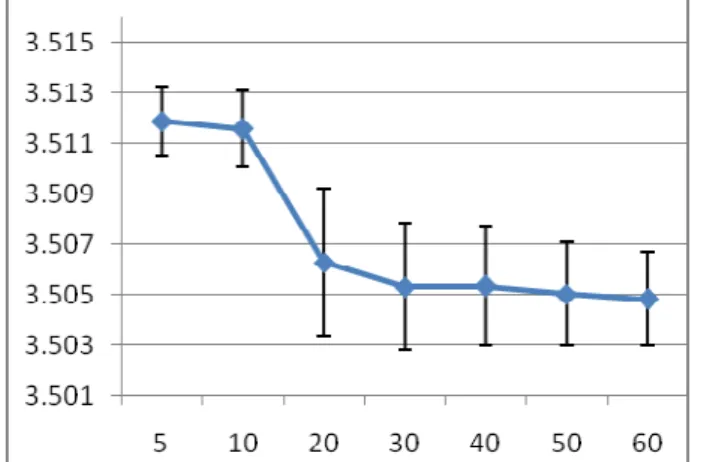
To show the proposed method accuracy, throughput with confidence interval 0.95 is illustrated in Figure 5.
Figure 5. Throughput of the proposed method with 0.95 confidence interval.
6.2 Delay Comparison
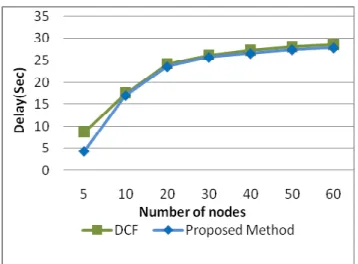
comparison of the proposed method and DCF delay.
Figure 6. Comparison of the end to end delay of DCF and the proposed method.
At DCF, CWmin for all numbers of nodes in DSSS model is
always the same and is equal 31. When the number of nodes is less this size of CW is great, so in this situation, the delay of DCF is about 4 second more than that of the proposed algorithm. Since the proposed method uses CWmin smaller
than DCF, it has lower delays. Due to the lower number of nodes, traffic is not very heavy so queuing delay and MAC delay is lower. By an increase in nodes number, the delays are increasing; however, the delay of the proposed method is lower than that of the DCF. Since a great queue size (e.g. 10000 packets) is used in this simulation, there is not any drop because of queue overflow and all packets are processed. However, it causes an increase in queuing delay which resulted in an end to end delay growth. As the delay is great and its confidence interval is very small, it is not visible clearly and it is not shown here. In the saturation mode, however, the DCF collision rate is drastically increased and lots of packets are dropped, but the delays of these packets are not considered in the MAC delay calculation. Although the delay of dropped packets is not considered in the media access delay, the delay of DCF is more than that of the proposed method in most states. This is because of the extra collisions occurring in DCF.
6.3 Drop Comparison
From Drop perspective, a packet may be dropped due to two reasons: queue overflow or retransmission limit surpasses. It is clear that queue overflow dropping rate is highly depended on the queue size. As the MAC queue size is assumed to be about as a great value, the total size of higher layer data packets, no data packet in WLAN MACs is dropped to the queue saturation.
Retransmission exceeds dropping is defined as total higher layer data traffic (in bits/Sec) dropped by all the WLAN MACs in the network as a result of consistently failing retransmissions. It represents the number of the higher layer packets that are lost because the MAC could not receive any ACKs for the (re)transmissions of those packets and the packets’ re-try counts reached the MAC’s re-try limit. In retransmission exceed aspect of dropping; the drop rate of
DCF is much greater than the proposed scheme as shown in Figure 7.
Figure 7. Comparison of retransmission exceed drop ratio of DCF and the proposed method
The considerable improvement of the suggested method with respect to packet drop rate in time compared to 802.11 is indicated in Figure 7. The packet drop rate because of exceeding from retransmission limit in this proposed method is very small and ignorable. Figure 8 illustrates the packet drop ratio with a 0.95 confidence interval.
Figure 8. The Proposed Method Delay with Confidence Interval 0.95
The proposed method improves the network performance with respect to throughput and drop ratio. The suggested method is considerably different from 802.11. However, amongst the advantages of the suggested game compared to that of the other existing games, one can mention no requirement of exchanging any information like SNR, queue size and additional signaling. Despite the fact that the periodical exchange of the game status is difficult for the nodes and results in more energy consumption and bandwidth wastage, the nodes are always sensing the channel in order to obtain the probable packets, nodes can estimate the game status by the channel sensing. It should be understood that taking the dynamism of the game’s status, it is not always possible to estimate the status of the game on time and accurately.
selection based on the number of opponents is being suggested. In other words, each node before any attempt to contention, can make its lookup table which determines the
CWmin based on the number of contending nodes. After that,
it can estimate the number of contending nodes and use this lookup table to adjust its CWmin, in each state, fast.
7
Conclusion and Future Works
In this study, a cooperative game is presented to determine the best minimum contention window size under heavy traffic. AS game theory has turned into a powerful tool for analyzing and improving the performance of contention-based protocols several MAC games are presented, where the nodes’ actions are transmission mode or waiting. In most of the games, a set of behaviors including transmission probability, transmission power and data rate are considered. Specifying proper utility functions provide better medium access schemes which can gain service differentiation and a better contention control. Consequently, it can obtain a higher throughput. Therefore, payoff functions that include utility and cost functions, is very important in random access games. In most studies, however, this function is defined heuristically without sufficient explanation, but, it is trying to use a reasonable payoff function. In the proposed method, first every node estimates the number of nodes, based on its local information and then, it adjusts the minimum size of contention window by maximizing the global network’s payoff function. The simulations indicate some improvements of the suggested method compared to DCF in terms of the throughput, decreasing end to end delay and drop rate.
In the future tasks, one can mention adjusting cooperative multi hop contention window and some influencing parameters on throughput by considering the node's mobility. It seems that applying multi-dimensional strategy vectors which consider parameters like transmission opportunity, rate and power, modulation type and spatial reuse are more rational options while the users have different preferences. In this game, the traffic arrival rate is not considered while it may be beneficial.
In addition, in CSMA networks, the users normally do not have much information about one another and they make decisions based on estimating incomplete information. They may improve the power of their decision makings through gathering more beneficial information; thus, some simple solutions for gathering more information may be beneficial as well. Combining the game theory and the artificial intelligence and learning methods may be helpful to estimate the game status.
Acknowledgment
This work is partially supported in finance by the Iran Telecommunication Research Canter ion under Grant ITRC No.18507/500.
References
[1] M. Ghazvini, N. Movahedinia, K. Jamshidi, and N. Moghim, "Game Theory Applications in CSMA/CA Method," IEEE Communications Surveys and Tutorials, Accepted for Publication, 2012.
[2] B. H. Walke, S. Mangold, and L. Berlemann, IEEE 802 Wireless Systems: Protocols, Multi-hop Mesh/Relaying, Performance and Spectrum Coexistence: Wiley, 2006.
[3] L. Chen, S. H. Low, and J. C. Doyle, "Contention control: A game-theoretic approach," in 46th IEEE Conference on Decision and Control, New Orleans, LA, 2007, pp. 3428-3434.
[4] X. Guan, B. Yang, G. Feng, and C. Long, "Random access game in ad hoc networks with cooperative and noncooperative users," Int. J. Syst. Control Commun, vol. 1, no. 1, pp. 13-30, 2008.
[5] Y. Jin and G. Kesidis, "Distributed contention window control for selfish users in IEEE 802.11 wireless LANs," IEEE J. Sel. Areas Commun, vol. 25, no. 6, pp. 1113-1123, 2007.
[6] L. Zhao, J. Zhang, K. Yang, and H. Zhang, "Using incompletely cooperative game theory in mobile ad hoc networks," in IEEE International Conference on Communications,ICC '07, 2007, pp. 3401-3406. [7] Y. Xiao, X. Shan, and Y. Ren, "Game theory models
for IEEE 802.11 DCF in wireless ad hoc networks," IEEE Commun. Mag., vol. 43, no. 3, pp. S22-S26, 2005.
[8] N. Nisan, Algorithmic game theory: Cambridge Univ Press, 2007.
[9] T. Roughgarden, "Algorithmic game theory," Commun. ACM, vol. 53, no. 7, pp. 78-86, 2010. [10] D. N. Zhu Han, Walid Saad, Tamer Başar, Are
Hjørungnes, Game Theory in Wireless and Communication Networks: Theory, Models, and Applications: Cambridge University Press, 2011. [11] Y. Zhang and M. Guizani, Game Theory for
Wireless Communications and Networking: Taylor and Francis, 2011.
[12] K. R. Apt and E. Grädel, Lectures in Game Theory for Computer Scientists: Cambridge Univ Pr, 2011. [13] D. E. Charilas and A. D. Panagopoulos, "A Survey
on Game Theory Applications in Wireless Networks," Computer Networks, 2010.
[14] M. Felegyhazi and J. P. Hubaux, "Game theory in wireless networks: A tutorial," Technical Report: LCA-REPORT-2006-002, EPFL 2006.
[15] M. J. Osborne and A. Rubinstein, A Course in Game Theory: MIT press, 1994.
[16] E. Altman, R. E. Azouzi, and T. Jiménez, "Slotted ALOHA as a game with partial information," Computer Networks vol. 45, no. 6, pp. 701–713., 2004.
[17] A. B. MacKenzie and L. A. DaSilva, Game Theory For Wireless Engineers: Morgan & Claypool, 2006. [18] A. B. MacKenzie and S. B. Wicker, "Game theory
and the design of self-configuring, adaptive wireless networks," IEEE Commun. Mag., vol. 39, no. 11, pp. 126-131, 2001.
[19] A. Dixit, K., and Nalebuff, Ð’., Thinking Strategically: WW Norton & Company, New York, 1991.
[20] V. Georgiev, "Using Game Theory to Analyze Wireless Ad Hoc Networks," RWTH Aachen,Department of Computer Science 2008. [21] S. Mehta and K. S. Kwak, "Application of Game
InTech, 2010.
[22] V. Srivastava, J. Neel, A. B. MacKenzie, R. Menon, L. A. DaSilva, J. E. Hicks, J. H. Reed, and R. P. Gilles, "Using game theory to analyze wireless ad hoc networks," IEEE Commun. Surv. Tutorials, vol. 7, no. 4, pp. 46–56, 2005.
[23] J. W. Lee, M. Chiang, and A. R. Calderbank, "Utility-optimal medium access control: reverse and forward engineering," in 25th IEEE International Conference on Computer Communications, 2006, pp. 1 - 13.
[24] L. Chen, T. Cui, S. H. Low, and J. C. Doyle, "A game-theoretic model for medium access control," in WICON ’07, Austin, Texas, USA, 2007.
[25] T. Cui, L. Chen, and S. Low, "A game-theoretic framework for medium access control," IEEE J. Sel. Areas Commun., vol. 26, no. 7, pp. 1116-1127, 2008.
[26] G. Zhang and H. Zhang, "Modelling IEEE 802.11 DCF in wireless LANs as a dynamic game with incompletely information," in IET International Conference on Wireless, Mobile and Multimedia Networks, Mumbai, India, 2008, pp. 215-218. [27] G. Zhang, H. Zhang, and L. Zhao, "A novel MAC
scheme for wireless LANs from the perspective of game theory," in IET Conference on Wireless, Mobile and Sensor Networks, (CCWMSN07). , Shanghai, China, 2007, pp. 112-116.
[28] L. Zhao, X. Zou, H. Zhang, W. Ding, and J. Zhang, "Game-theoretic cross-layer design in WLANs," in International Wireless Communications and Mobile Computing Conference, IWCMC '08 2008, pp. 570-575.
[29] L. Zhao, J. Zhang, and H. Zhang, "Using incompletely cooperative game theory in wireless mesh networks," IEEE Network, vol. 22, no. 1, pp. 39-44, 2008.
[30] L. Zhao, H. Zhang, and J. Zhang, "Selfish traffic with rational nodes in WLANs," IEEE Commun. Lett., vol. 12, no. 9, pp. 645-647, 2008.
[31] L. Zhao, H. Zhang, and J. Zhang, "Using incompletely cooperative game theory in wireless sensor networks," in Wireless Communications and Networking Conference, WCNC 2008, 2008, pp. 1483-1488.
[32] L. Zhao, L. Guo, J. Zhang, and H. Zhang, "Game-theoretic medium access control protocol for wireless sensor networks," IET Commun., vol. 3, no. 8, pp. 1274-1283, 2009.
[33] L. Zhao, L. Guo, G. Zhang, H. Zhang, and K. Yang, "An energy-efficient MAC protocol for WSNs: game-theoretic constraint optimization," in 11th International Conference on Communication Systems, ICCS., 2008, pp. 114-118.
[34] L. Zhao, L. Guo, L. Cong, and H. Zhang, "An energy-efficient MAC protocol for WSNs: game-theoretic constraint optimization with multiple objectives," Wirel. Sensor Networks, vol. 1, no., pp. 358-364, 2009.
[35] L. Zhao, L. Cong, H. Zhang, W. Ding, and J. Zhang, "Game-theoretic EDCA in IEEE 802.11e WLANs," in IEEE 68th Vehicular Technology Conference,VTC Calgary, BC, 2008, pp. 1-5. [36] L. Zhao, H. Zhang, W. Ding, and J. Zhang,
"Game-theoretic particle swarm optimization for WMNs," in 19th International Symposium on Personal,
Indoor and Mobile Radio
Communications(PIMRC), Cannes 2008, pp. 1-5. [37] D. K. Sanyal, M. Chattopadhyay, and S.
Chattopadhyay, "Improved performance with novel utility functions in a game-theoretic model of medium access control in wireless networks," in IEEE Region 10 Conference,TENCON Hyderabad 2008, pp. 1-6.
[38] D. K. Sanyal, M. Chattopadhyay, and S. Chattopadhyay, "Performance improvement of wireless MAC using non-cooperative games," Adv. Ele. Eng. Comput. Sci., vol. 39, no., pp. 207-218, 2009.
[39] X. He and L. Tan, "Contention Access Game Method in Wireless Ad-Hoc Networks," in 4th International Conference on Wireless Communications, Networking and Mobile Computing, WiCOM '08. , 2008, pp. 1-4.
[40] L. Chen, S. H. Low, and J. C. Doyle, "Random access game and medium access control design," IEEE/ACM Trans. Networking, vol. 18, no. 4, pp. 1303-1316, 2010.
[41] B. Yang, "Competition, cooperation and cognition in wireless resource allocation." vol. PhD dissertation, City Univ.of Hong Kong, 2009. [42] L. Chen, "On Selfish and Malicious Behaviors in
Wireless Networks-A Non-cooperative Game Theoretic Approach," Ph.D. dissertation, Ecole Nationale Superieure des Telecommunications, Paris, 2008.
[43] L. Chen and J. Leneutre, "Selfishness, not always a nightmare: Modeling selfish mac behaviors in wireless mobile ad hoc networks," in 27th International Conference on Distributed Computing Systems (ICDCS'07), 2007, p. 16.
[44] J. Yang and H. Shi, "Two Rounds Game CSMA algorithm of WSNs," in 2nd International Conference on Networking and Digital Society (ICNDS), Wenzhou 2010, pp. 270-273.
[45] E. Ziouva and T. Antonakopoulos, "CSMA/CA performance under high traffic conditions: throughput and delay analysis," Comput. Commun., vol. 25, no. 3, pp. 313-321, 2002.
[46] S. Rakshit and R. K. Guha, "Fair bandwidth sharing in distributed systems: a game-theoretic approach," IEEE Trans. Comput, vol. 54, no. 11, pp. 1384-1393, 2005.
[47] M. Yan, L. Xiao, L. Du, and L. Huang, "On selfish behavior in wireless sensor networks: a game theoretic case study," in Third International Conference on Measuring Technology and Mechatronics Automation (ICMTMA), Shangshai 2011, pp. 752-756.
[48] B. Yang, G. Feng, and X. Guan, "Random access in wireless ad hoc networks for throughput maximization," in 9th International Conference on Control, Automation, Robotics and Vision, 2006, pp. 1-6.
[50] K. J. Park, J. Choi, J. C. Hou, Y. C. Hu, and H. Lim, "Optimal physical carrier sense in wireless networks," Ad Hoc Networks, vol. 9, no. 1, pp. 16-27, 2011.
[51] H. J. Lee, H. Kwon, A. Motskin, and L. Guibas, "Interference-aware MAC protocol for wireless networks by a game-theoretic approach," in INFOCOM '09, Rio de Janeiro 2009, pp. 1854-1862.
[52] N. BenAmmar and J. S. Baras, "Incentive compatible medium access control in wireless networks," in workshop on Game theory for communications and networks, 2006, p. 5.
[53] F. Wang, O. Younis, and M. Kiunz, "Throughput-Oriented MAC for Mobile Networks with Variable Packet Sizes," in 3rd Annual IEEE Communications Society on Sensor and Ad Hoc Communications and Networks, 2006. SECON '06, Reston, VA, 2007, pp. 421-430.
[54] F. Wang, O. Younis, and M. Krunz, "GMAC: A game-theoretic MAC protocol for mobile ad hoc networks," in 4th International Symposium on Modeling and Optimization in Mobile, Ad Hoc and Wireless Networks, 2006, pp. 1-9.
[55] F. Wang, O. Younis, and M. Krunz, "Throughput-oriented MAC for mobile ad hoc networks: A game-theoretic approach," Ad Hoc Networks, vol. 7, no. 1, pp. 98-117, 2009.
[56] A. Ghasemi and K. Faez, "A Nash power-aware MAC game for ad hoc wireless networks," in IEEE 19th International Symposium on Personal, Indoor and Mobile Radio Communications(PIMRC) 2008, pp. 1-5.
[57] A. Ghasemi and K. Faez, "A non-cooperative game approach for power-aware MAC in ad hoc wireless networks," Comput. Commun., vol. 33, no. 12, pp. 1440-1451, 2010.
[58] C. Long, Q. Chi, X. Guan, and T. Chen, "Joint random access and power control game in ad hoc networks with noncooperative users," Ad Hoc Networks, vol. 9, no. 2, pp. 142-151, 2011.
[59] H. Kim, H. Lee, and S. Lee, "A cross-layer optimization for energy-efficient MAC protocol with delay and rate constraints," in International Conference on Acoustics, Speech and Signal Processing (ICASSP), Prague 2011, pp. 2336-2339. [60] K. Akkarajitsakul, E. Hossain, D. Niyato, and D.
Kim, "Game theoretic approaches for multiple access in Wireless networks: a survey," IEEE Commun. Surv. Tutorials, vol. 13, no. 3, pp. 372-395, 2011.
[61] G. Bianchi and I. Tinnirello, "Kalman filter estimation of the number of competing terminals in an IEEE 802.11 network," in INFOCOM ’03, 2003. [62] G. Bianchi, "Performance analysis of the IEEE
802.11 distributed coordination function," IEEE J. Sel. Areas Commun., vol. 18, no. 3, pp. 535-547, 2000.
[63] T. Vercauteren, A. L. Toledo, and X. Wang, "Batch and sequential bayesian estimators of the number of active terminals in an IEEE 802.11 network," IEEE Trans. Signal Proc., vol. 55, no. 2, pp. 437-450, 2007.
[64] T. Debnath, "A Novel QoS-Aware MPEG-4 Video
Delivery Algorithm over the Lossy IEEE 802.11 WLANs to Improve the Video Quality," PhD Thesis, School of Electronic and Communications Engineering, Dublin Institute of Technology, 2012. [65] E. Ziouva and T. Antonakopoulos, "CSMA/CA
performance under high traffic conditions: throughput and delay analysis," Computer Communications, vol. 25, no. 3, pp. 313-321, 2002. [66] G. Bianchi, "IEEE 802.11-saturation throughput
analysis," Communications Letters, IEEE, vol. 2, no. 12, pp. 318-320, 1998.

![Figure 1. An example of increasing CW: CW min =7, CW max =255, σ=2, r=7 and m=5 [1]](https://thumb-us.123doks.com/thumbv2/123dok_us/8126600.2155269/2.892.512.797.90.347/figure-example-increasing-cw-cw-min-cw-max.webp)
![Figure 2. Taxonomy of CSMA Games [1]](https://thumb-us.123doks.com/thumbv2/123dok_us/8126600.2155269/4.892.75.431.84.572/figure-taxonomy-of-csma-games.webp)