Cross-Layer Routing Based on Semantic Web
Services Discovery with Energy Evaluation and
Optimization in MANET
Soheyb Ayad
1, Okba Kazar
1, Nabila-Aicha Benharkat
2and Labib-Sadek Terrissa
11LINFI laboratory, Computer science department, Biskra University, Algeria 2
LIRIS Laboratory, INSA Lyon, France
[email protected], [email protected], [email protected], [email protected]
Abstract: The web services discovery process in mobile ad hoc
networks is considered as a very difficult challenge due to the continuous change in the topology of the network and also the lack of a fixed central directory for publishing web services. Several approaches have been proposed which are based on either keywords or identifiers representing the service to be searched or by using a specific scenario of discovery. All of those proposed solutions try to respect the constraints of mobile ad hoc networks MANET such as energy, bandwidth, throughput, etc. In this paper we present our new proposed model for measuring the cost of the overall energy consumption in ad hoc networks depending on the web services discovery protocols. We also present a new optimized web services discovery protocol in MANET based on cross_layer routing techniques with the dissemination in the routing process at the same time the semantic web services information and a DISCOVERY_DIAMETER parameter that we have proposed to limit the area of discovery in the network. Finally, we present simulation results of our defined approach showing a significant optimization of the energy consumption level and the average throughput.
Keywords: Ad hoc, Energy consumption, MANET, Semantic
web services discovery, Average Throughput, Routing protocols.
1.
Introduction
A web service is a technology that makes any application or software available over Internet. Nowadays web services are widely used by companies due to their efficiency and their security; besides this they are based on internet standards. Web services are described in a WSDL (Web Services Description Language) form, specifying the methods that can be invoked; those methods are accessible via SOAP (Simple Object Access Protocol). Furthermore, Web services are published in a common fixed repository UDDI (Universal Description Discovery and Integration) in order to facilitate their research. However, in a mobile environment without infrastructure such as MANETs (Mobile Ad Hoc Networks), where the topology of the network changes all the time, we cannot use a fixed directory for publishing web services, because this situation makes the process of finding web services a difficult challenge, especially if we take into consideration the limits of ad hoc networks, such as bandwidth and energy. In that regard, several approaches and protocols have been developed.
In this work we have first proposed a model to calculate, verify and validate protocols of web services discovery in mobile ad hoc networks depending on the global energy consumed. Moreover, we have proposed an optimized protocol that has two main objectives: The first one is to
create a new mechanism for semantic web services discovery in mobile ad hoc networks, otherwise, to perform a semantic discovery based on functional parameters (Inputs and Outputs) present in the semantic descriptions OWL-S (Ontology Web Language-Service) of web services without the intervention of the client in the selection phase of the discovered services; this means achieving an automatic and precise discovery of the desired services. The second objective is to develop a new strategy which simultaneously elaborates the routing and the web service discovery using cross-layer techniques over a modified AODV protocol with dissemination in the routing process of some semantic web services information and the DISCOVERY_DIAMETER parameter that we have proposed to limit the area of discovery in the network. This technique will greatly minimize bandwidth and energy consumption in the network. This paper is organized as follows, a presentation of some related works, then our proposed model to evaluate protocols of web services discovery in mobile ad hoc networks depending on the global energy consumption, our new optimized protocol. Finally, an illustration and a discussion of the obtained simulation’s results.
2.
Related Works
Research in the field of ad hoc networks focused initially on routing, and several routing protocols such as DSR, AODV, TORA, OLSR, etc., have emerged. However, the initial assumption of those routing protocols is that the packet destination address is known to the source node at the beginning. Applications in ad hoc networks often use resources or services that are present in another mobile node, it is important for applications to discover in a transparent manner those remote services. Existing routing protocols are not suitable for services discovery process, since in the latter case the destination address is not initially known. To remedy this situation, several approaches and protocols have been proposed.
that focus on the description language of services, like XML (Extensible Markup Language) and DAML (DARPA Agent Markup Language). These approaches include: SSDP (Microsoft's Simple Service Discovery Protocol) [31], DReggie [32], GSD (Group based Service Discovery) [36], Konark [20], Web Service Discovery Replication and Synchronization in Ad-Hoc Networks [19], etc.
However there are other studies as in [15], [33] and [34] which showed that, proposing an approach of service discovery based on cross-layer (Interaction between the application layer and network layer) using existing ad hoc routing protocols is much more efficient in terms of optimizing the network performance compared to traditional approaches.
There is also another type of works that aims to optimize the services discovery protocols using QoS or more specifically based on the trust to servers that respond to the client request, this trust is assessed through a set of parameters such as energy, response time and mobility of servers. Among these works we find [1], [2], [3], [4], [5] and [6].
In another category of works on web service discovery in mobile ad hoc networks there are those who focus on the Sensor Web Services field (SWS) which emerged from the need to offer data captured by the Wireless Sensor Networks (WSN) via the web, especially works in [8], [11], [12], [13], [14] and [7]. In the same category there is also an interesting work in [10] where the authors carried out a comparative study on the impact of mobility between the PDP, SDP, UPnP and TinySDP protocol proposed in [9].
3.
Evaluating the Energy Consumption
The problem of energy consumption represents the center of interest for the research community of mobile ad hoc networks (MANET) and wireless sensor networks (WSN) like works in [38], [39], [40], [41], [42] and [43], this led us to study the impact of the web services discovery protocols on the energy consumed in MANET. After our study of some existing works we have noticed that each one of those approaches violates one or more technical constraints that should be respected in ad hoc networks such as bandwidth and storage resources, etc. As a result a significant consumption of energy occurred. Also, we have noticed that the proposed discovery approaches are based on the identifiers of the services or their names and their types with the client intervention to select the services which satisfy their needs.
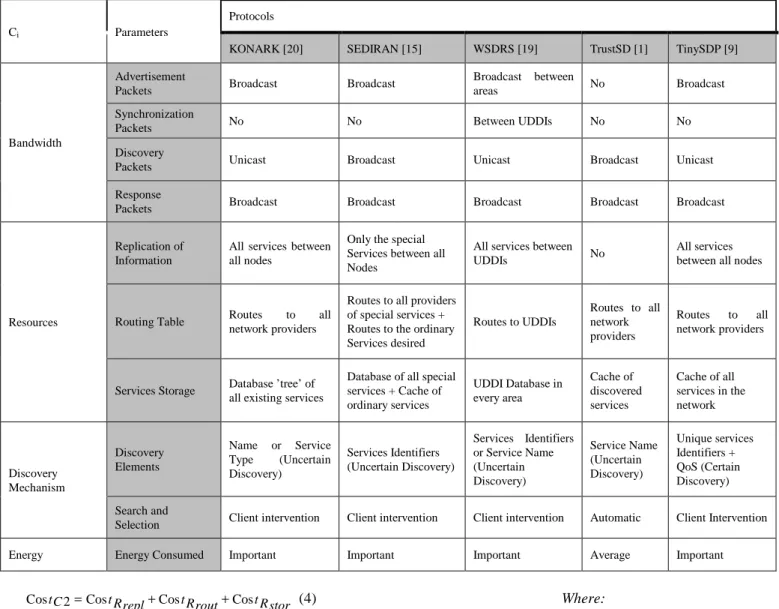
The Table 1 shows a comparison between five different services/web services discovery approaches (protocols): KONARK [20], SEDIRAN [15], WSDRS [19], TrustSD [1] and TinySDP [9] that we have chosen to propose our cost evaluation model of the consumed energy by any service discovery protocols, depending on a set of elements which influence in direct or indirect manner on the overall energy consumed in MANET.
In Table 1, we collected several constraints Ci that influence in a direct or indirect manner on the main technical constraints to be respected in mobile ad hoc networks, where:
Ci = {Bandwidth, Resources, Discovery_Mechanism, Energy}
We used all these specific constraints as well as the results of works in [17] and [37], to propose a formula for measuring and evaluating the overall energy consumed according to any web services discovery protocol in MANET.
The formula (1) for measuring the cost of energy consumed in each node depending on constraints Ci is given as follows:
3
Cos Cos Cos
1
tenr tack tCi
i
∏
= +
= (1)
Where:
Cos tenr: Cost of energy consumed in each node.
Cos t ack: Cost of energy consumed in the transmission or reception of control packets.
Cos tCi: Cost of energy relative to each constraint Ci in
each node.
To calculate CostC1that represents the cost of influence on the electrical energy consumed in each node depending to the number, size and type of packets circulating in the network, we are interested in the work proposed in [17] who presented several results of the measuring energy consumption; they identified four states of energy consumption:
• Transmission: the transmission of packets.
• Reception: the reception of packets.
• Waiting: waiting for a packet transfer.
• Sleeping: the state of lowest energy consumption when the node cannot receive or transmit.
The energy cost associated with each packet to each node is represented by the total incremental cost m proportional to the packet size, and a fixed cost b associated with acquisition channel. The formula (2) below is used to calculate the energy cost of each packet in each node on the network.
Cos t= ×m size+b (2)
The formula (3) is the formula that we have proposed to calculate CostC1
CostC1=CostEadv+CostEdisc+CostEsync+CostEresp (3) Where:
Cos t Eadv: Cost of energy consumed by the transmitting and receiving services advertisements packet.
Cos t Edisc: Cost of energy consumed by the transmitting and receiving services discovery packets.
Cos t Esync: Cost of energy consumed by the transmitting and receiving nodes synchronization packets.
Cos t Eresp: Cost of energy consumed by sending response packets by the provider.
Table 1. Comparison between existing approaches
Ci Parameters
Protocols
KONARK [20] SEDIRAN [15] WSDRS [19] TrustSD [1] TinySDP [9]
Bandwidth
Advertisement
Packets Broadcast Broadcast
Broadcast between
areas No Broadcast
Synchronization
Packets No No Between UDDIs No No
Discovery
Packets Unicast Broadcast Unicast Broadcast Unicast
Response
Packets Broadcast Broadcast Broadcast Broadcast Broadcast
Resources
Replication of Information
All services between all nodes
Only the special Services between all Nodes
All services between
UDDIs No
All services between all nodes
Routing Table Routes to all
network providers
Routes to all providers of special services + Routes to the ordinary Services desired
Routes to UDDIs
Routes to all network providers
Routes to all
network providers
Services Storage Database ’tree’ of
all existing services
Database of all special services + Cache of ordinary services
UDDI Database in every area
Cache of discovered services
Cache of all services in the network
Discovery Mechanism
Discovery Elements
Name or Service
Type (Uncertain
Discovery)
Services Identifiers (Uncertain Discovery)
Services Identifiers or Service Name (Uncertain Discovery)
Service Name (Uncertain Discovery)
Unique services Identifiers + QoS (Certain Discovery)
Search and
Selection Client intervention Client intervention Client intervention Automatic Client Intervention
Energy Energy Consumed Important Important Important Average Important
CostC2=CostRrepl+CostRrout+CostRstor (4) Where:
Cos t Rrepl: Cost of replication of the same information between nodes.
Cos t Rrout: Cost relative to routes stored in the network nodes.
Cos t Rstor: Cost relative to the structure of service’s directory.
The formula (5) represents the proposed formula to calculate CostC3 which represents the cost of influence on the energy consumed in each node depending to the proposed discovery mechanism.
CostC3=CostMresr+CostMclient (5)
Where:
Cos t M resr: Cost relative to the discovery elements proposed.
Cos t M client: Cost relative to the involvement of the client in the discovery process.
The proposed formula to calculate the cost of influence on the overall energy consumed in all the network depending on the discovery approach is represented as follows:
_ 3
Cos (Cos Cos )
1 1
nb nodes
t tack tCi
j i
∑
= + ∏
= = (6)
Figure 1. Comparison between discovery approaches
As shown in Figure 1 after evaluation of the studied approaches by our formula, the approach proposed in TrustSD [1] is less greedy in terms of the overall energy consumption compared to other approaches, this is due to the mechanism proposed, because the authors have proposed a cross-layer protocol and also a Trust parameter calculated according to a set of characteristics of the servers (energy of the server, response time and the mobility of server) which are added into the provider’s reply packet. The Trust parameter ensures a QoS and an automatic provider’s selection.
4.
The Proposed Optimized Approach
Due to the limitations of ad hoc networks we propose a new protocol where we assume that each provider node is the advertisement’s directory of its own services in order to avoid overloading the network with the announcement packets of services such as the works in [15], [19], [20], [32], [36] and [9]. This assumption is justified with the permanent change of the topology because in the studied existing approaches we have noticed that at every movement in the topology of the network there is a new election of publication directories, re-execution of the synchronization mechanism inter-directories or a re-execution of the announcement mechanism of services across the network. Our approach is based on the interconnection of the application layer and the network layer because using a cross-layer approach in service discovery as presented in [33] and [34], increases the performance of the network in terms of bandwidth and the overall energy consumed, also in [17] the author proved that there is a direct relation between number of the packets, the bandwidth and the energy consumed.
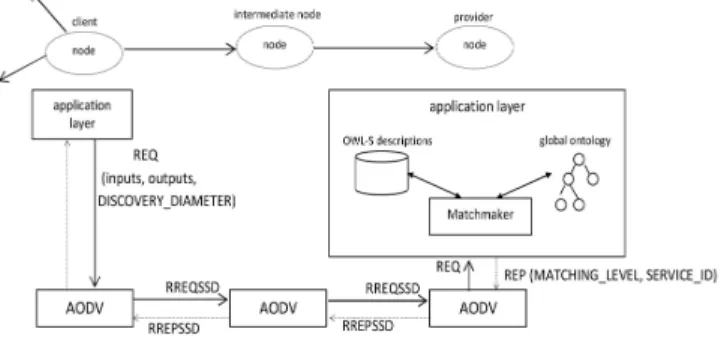
In our protocol we have modified and adapted the existing AODV protocol to satisfy our needs. The choice of the routing protocol AODV is justified by its simplicity of implementation, also it does not require a lot of computing power, and most importantly, it is a reactive routing protocol, which means that it does not look for routes only on demand. The proposed architecture is shown in Figure 2.
In our new approach, we have added two new types of packets to AODV protocol, RREQSSD (Route Request Semantic Services Discovery) and RREPSSD (Route Reply Semantic Services Discovery), they are similar to the existing packets RREQ (Route Request) and RREP (Route Reply) but with more fields that correspond to the REP and REQ messages, where REQ represents the query containing the
necessary information to discover routes to the desired service by the Client and REP represents the response of the provider that offers the desired service.
Figure 2. The proposed architecture
4.1 The discovery packet RREQSSD
To search a service in our approach, the Client at the Application layer enters all the information concerning the desired service (information about the Client, service name, functional parameters such inputs/outputs, etc.). He specifies also the value of the field DISCOVERY_DIAMETER, this value is used to control the distance of research according to the client needs. This will lead us to an important reduction in the number of research packets flowing through the network, therefore an important optimization of the total energy consumed in this discovery process. After validation by the Client, a REQ packet containing the functional concepts INPUTS/OUTPUTS of the desired service and the distance of discovery DISCOVERY_DIAMETER, will be sent to the AODV protocol of the network layer (the choice of INPUTS/OUTPUTS parameters is justified in section The Matchmaker Module), to be integrated into the routes discovery process to the desired destination via the new RREQSSD packet that we have proposed (Figure 3).
Figure 3. Structure of RREQSSD
RREQSSD will be sent in broadcast mode to all neighbors depending on the DISCOVERY_DIAMETER field that indicates the number of nodes that the packet can pass. The flowchart in Figure 4 shows the behavior of the network nodes at receiving the RREQSSD packet.
hop_count+1 is less than the DISCOVERY_DIAMETER if so it forward the packet RREQSSD.
Figure 4. The flowchart of RREQSSD reception
The Algorithm 1 represents the new actions executed by AODV protocol, upon receipt of the new RREQSSD packet.
The Algorithm 2 represents the actions performed by the application layer at the reception of REQ packet.
The parameter REP packet contains: the degree of matching MATCHING_LEVEL of the service found by the Matchmaker module relatively to the inputs/outputs of the client request and the inputs/outputs in the OWL-S descriptions of the services offered by the provider. The
message REP contains also the identifier SERVICE_ID of the service found.
The Algorithm 3 represents the new actions performed by the AODV protocol of the destination at the reception of the REP packet from the application layer.
4.2 The matchmaker module
The main role of Matchmaker module is based on the principle of semantic matching. There are several approaches of semantic web services discovery [16], [18], [21], [22] and [23]. We can say that, although the principle proposed by Paolucci et al. is limited to the use of functional attributes inputs/outputs to adapt their system of web services semantic discovery in an environment with infrastructure, it remains the most simple and effective approach to solve this problem, because, the authors based on the modeling language DAML-S that provides a rich, simple and detailed description of web services, also they have integrated their solution over the known standards such as UDDI and WSDL. This leads us to exploit the principle proposed by Paolucci et al. in our approach.
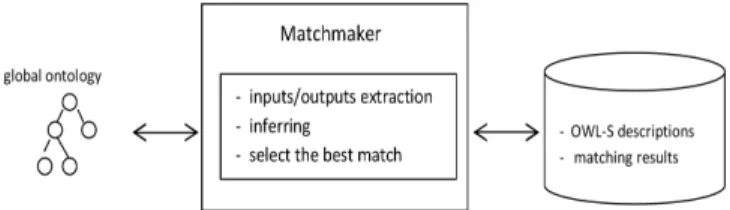
The detailed architecture of the Matchmaker module in our system is shown in Figure 5.
Figure 5. Architecture of the Matchmaker module
As illustrated in Figure 5 the Matchmaker module in the application layer performs several actions, it takes the inputs/outputs from the OWL-S descriptions of the services offered by the provider, then with the help of a global ontology which describes the ontological relationships between all concepts that exist (by theoretical definition of ontology), the Matchmaker will calculate and save the degrees of matching between the inputs/outputs of the user query with those of the services proposed by the provider. This research of the services which may correspond to the demand of the user is based on the following definition.
Definition: Let inR and outR are the inputs offered and
outputs required by the client request R. let inS and outS are the inputs required and the outputs offered by a web service
S, a web service S can respond the request R if inputs
required by R, are equivalent or include (according to the global ontology) those offered by S, and if the outputs offered by S are equivalent or include those required by R. [21]
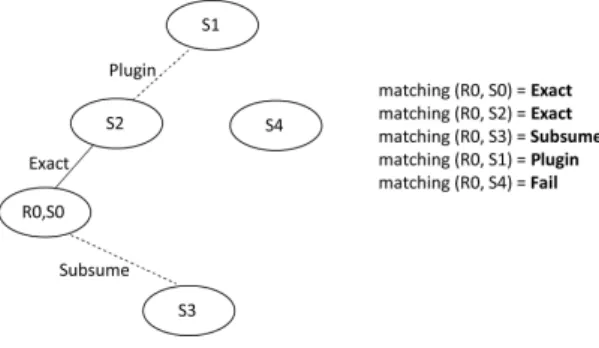
Concerning the degrees or levels of matching, there are four levels [21] shown in Figure 6 those levels depend to the relationship between the concepts associated with each input/output of the request R and the service S.
Algorithm 1: RREQSSD_Reception( ) if New RREQSSD_ID then
Save RREQSSD_ID( );
Extracting DISCOVERY_DIAMETER ( );
if DISCOVERY DIAMETER ≥Hop Count then SendTo_Application_Layer(REQ) ;
else
Drop_RREQSSD( ) ;
Algorithm 2: Application_Layer(REQ) if Provider() then
if Matchmaker(REQ) then
Generate_REP( MATCHING_LEVEL, SERVICE_ID); SendTo_AODV_Network_Layer(REP);
Algorithm 3: AODV_network_layer(REP)
...
Figure 6. Degrees of matching
Exact match: The Matchmaker recognizes an Exact match
between the service S and the request R, when outR = outS. Such service responds to the exact needs of the request. Also the matching can be Exact when outR is an immediate subclass of outS.
Plugin match: The Matchmaker recognizes a Plugin match,
if outS superclass of outR. This rule recognizes that there is a weak relationship between outR and outs.
Subsume match: In the case of Subsume match, the request
is more generic than the service found. In other words: outR is a superclass of outS. In this case, the service S can be chosen, but this service may or may not satisfy the query, it may be that another service may be sought to complete the lack (Web services composition).
Fail: If no one of the previous matching were identified it
means that the service S and the request R are incompatible. Once the Matchmaker finishes the matching process, he begins to sort the results found, knowing that the Exact match is the preferred then the Plugin match and finally comes the Subsume match. The main element in the sorting process is to select the highest degree of the outputs matches. The Inputs Matching is used secondarily to separate the outputs matches with the same degree.
If no match was found then the Matchmaker will not return any results, otherwise it sends a REP packet containing the identifier of the service found and the calculated matching degree, to the AODV protocol in the network layer.
4.3 The response packet RREPSSD
The Figure 7 shows the structure of the new RREPSSD packet according to our approach.
Figure 7. Structure of RREPSSD
After receiving the REP packet from the application layer, the AODV protocol will encapsulate it in the new RREPSSD packet and sends it to the client. The traversed nodes will update their routing tables; they add also the content of MATCHING_LEVEL field. The AODV protocol of the source node, after receiving the first RREPSSD packet, saves it for a waiting period WAITING_TIME which corresponds to the time to wait for other RREPSSD packets from other providers, once all packets are received it calculates the route
with the smallest MATCHING_LEVEL, after that the network layer sends to the application layer the SERVICE_ID of the service found to begin data transfer. In case of link failure during data transfer, the end node sends a packet RERR (Route Error) to the source node to prevent that the destination is now unreachable. If the source node always needs a route to this destination to complete the data transfer it will launch a route discovery process using only the classic packets RREQ and RREP.
The flowchart in Figure 8 shows the behavior of the network nodes at receiving the RREPSSD packet.
Figure 8. Flowchart of RREPSSD reception
4.4 An optimized routing discovery
We assume a scenario of disaster (earthquake), in which is deployed an ad hoc network of emergency, and in order to rescue and give the first aid to the injured before bringing them to the hospital, the ambulance man must first verify medical information about the patient, to check whether he has a chronic disease for example, or if he is allergic to a given injections. In this case the ambulance man will fetch a web service published by a specific hospital or medical center that provides access to a medical database that contains all the necessary medical information about the injured persons. In our case of study, for example, we assume that the information about the service sought are:
• Service name: Heart Disease.
• Inputs: Surname; Firstname; Identifier.
• Outputs: Hypertension
• DISCOVERY_DIAMETER = 2
Table 2. Web services offered
Medical
Centers Acronym
Service
Name Inputs Outputs
Hospital H S1
Surname; Firstname; Identifier;
Disease
Cardiovascular
Diseases Center CDC S2
Surname; Firstname; Identifier;
Chronic
Clinic of
Diabetology CD S3
Surname; Firstname; Identifier;
Diabetes
Pharmaceutical
Center PC S4 Medicines Quantity
Medical Center MC S5
Surname; Firstname; Identifier;
Disease
Figure 9 shows the execution of our proposed approach depending on the above scenario.
Figure 9. Routes discovery process
The Part (1) in Figure 9 illustrates the result of RREQSSD broadcasting process to all nodes in the network. As illustrated, the providers that correspond to DISCOVERY_DIAMETER (DD=2) are the nodes [H, CDC, PC and MC].
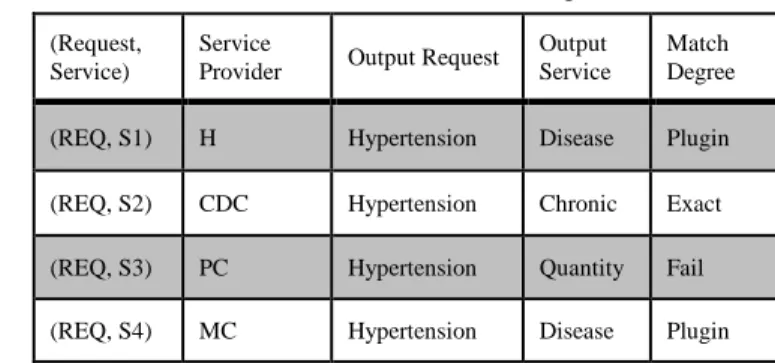
Then as illustrated in Part (2), the providers [H, CDC and MC] send a response packets RREPSSD with an ML (MACHING_LEVEL) equal to [2, 1 and 2] successively, (2: means that the degree of match = Plugin and 1: means that the degree of match = Exact); the provider PC did not send any response packet because it did not detected any degree of match it means a case of Fail. The results of the matching process are illustrated in Table 3.
Table 3. Results of matching
(Request, Service)
Service
Provider Output Request
Output Service
Match Degree
(REQ, S1) H Hypertension Disease Plugin
(REQ, S2) CDC Hypertension Chronic Exact
(REQ, S3) PC Hypertension Quantity Fail
(REQ, S4) MC Hypertension Disease Plugin
The degrees of matching in our case of study are calculated from the following domain ontology.
Figure 10. Domain ontology
Finally as illustrated in Figure 9 Part (3), the modified AODV protocol in the client node, will automatically select and save route to the provider CDC because it has the best match.
4.5 Validation of the proposed approach
To validate our approach according to the desired challenges presented in the introduction part, we have used the formula (6) to compare our approach with other existing works against the global consumed energy in the network during the discovery process.
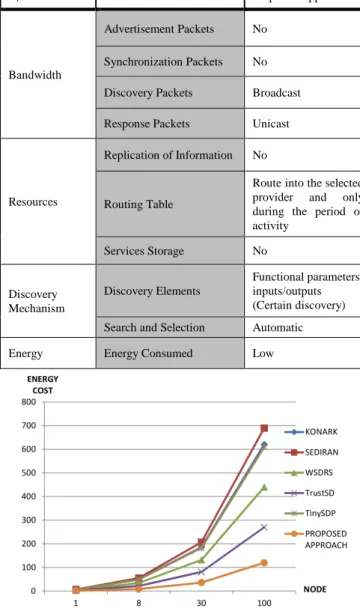
Table 4 presents the challenge of our proposed approach depending on the Ci parameters proposed and presented above.
Table 4. The challenge of our proposed approach
Ci Parameters Proposed Approach
Bandwidth
Advertisement Packets No
Synchronization Packets No
Discovery Packets Broadcast
Response Packets Unicast
Resources
Replication of Information No
Routing Table
Route into the selected
provider and only
during the period of activity
Services Storage No
Discovery Mechanism
Discovery Elements
Functional parameters inputs/outputs (Certain discovery)
Search and Selection Automatic
Energy Energy Consumed Low
Figure 11. Energy cost of our proposed approach.
As illustrated in the Figure 11 our proposed approach offers an important gain in term of energy consumption in the network.
5.
Experimentations
To analyze and evaluate our protocol, we have implemented it under the Network Simulator NS2. Table 5 below summarizes the proposed setup for this experiment.
In the proposed scenario we assumed five clients looking for services at different time intervals: [Client1: 0.1 → 2 sec], [Client2: 3 → 5 sec], [Client3: 3.3 → 5.3 sec], [Client4: 8 →10 sec], [Client5: 8 → 10 sec]; Also a data transfer with an FTP stream of 1500 bytes which represents the data services transfer, then we have measured and evaluated: the total energy consumed and the average throughput with and without using the DISCOVERY_DIAMETER parameter.
5.1 Energy consumption
Figure 12 illustrates the impact of DISCOVERY_DIAMETER parameter on the overall energy consumed in the network.
Table 5. Configuration of the simulation
Parameter Value
Simulator NS2.35
Simulation time 10s
Number of nodes 100
Simulation field 850*850
Number of clients 5
Number of providers 20
Number of probable providers 10
Propagation model Tworayground
Energy in each node 3.4
Energy consumed during transmission 0.33
Energy consumed during reception 0.1
Energy consumed during the rest 0.5
Energy consumed in standby mode 0.3
Mobility 100
Figure 12. Energy Consumption
By using the DISCOVERY_DIAMETER parameter we have noticed an optimization in the energy consumed due to the limitation of the broadcast domain. We have also noticed logic in the energy consumption according to the proposed scenario because there is stability in the time intervals of no activity [2 → 3 sec] and [5 → 8 sec]. However, in the case where we did not use the DISCOVERY_DIAMETER, the energy consumption is more important and random over time which is explained by the limitless dissemination of the discovery packets.
5.2 Average throughput
The average throughput A is calculated by dividing the sum of the discovery packets sizes on the average transmission time.
_ 1
nb disc S i A
T
∑ =
Where: A: Average throughput.
nb_disc: The number of all the discovery packets. S: The packet size.
T: The average time of packets transmission.
Figure 13 shows the average throughput consumed during the proposed scenario with and without using the DISCOVERY_DIAMETER.
Figure 13. Average throughput
The optimization and stability of the average throughput using the DISCOVERY_DIAMETER parameter is clearly illustrated in Figure 13, where for example in the time interval [0 → 2sec] throughput is reduced to half.
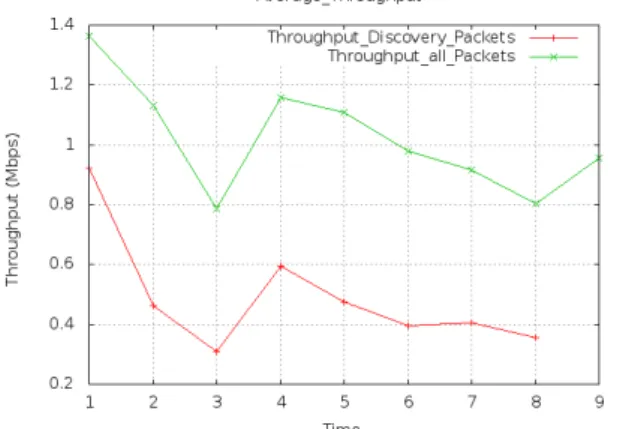
Figure 14 shows a comparison between the average throughput calculated according to the discovery packets (RREQSSD + RREPSSD) and the average throughput consumed by all generated packets in the network (Discovery packets, Control packets and DATA packets), this allows us to see the impact of the discovery on the bandwidth in with our proposed approach.
Figure 14. Service discovery packets throughput Vs All
network’s packets throughput
6.
Conclusion and Future Works
In this paper, we have presented a new formula to calculate the cost of the energy consumed in MANET depending on the approaches of web services discovery. The formula is based on Ci parameters that we have taken from our comparative study between different existing discovery approaches. This new model will allow us to evaluate any web services discovery protocol depending on the global energy consumed by the nodes of the network. In addition,
we have presented a new optimized approach of web services discovery in MANET which has the following characteristics:
• A decentralized architecture where each node in the network maintains its own services and it does not depend on a central directory.
• A routing discovery based on the diffusion of functional parameters of services.
• An automatic discovery and a best selection of services and routes to the destinations.
• A semantic discovery of web services.
• A significant reduction of energy consumed and of throughput in the discovery process.
To conclude we have presented the simulation results obtained where we have noticed that using the dissemination of the semantic web services information and the DISCOVERY_DIAMETER parameter proposed in the routing process, gives a significant optimization of the energy consumption level and the average throughput.
Further work would be to review the proposed evaluation formula of web service discovery protocols in an environment connected to Internet such as IoT (Internet of Things), where there will be an ad hoc network with gateways to Internet which means an access to existing UDDI directories where we can publish and find existing web services. Furthermore, it would propose the most appropriate approach for this network configuration.
References
[1] G. Bhumika, M. A. Zaveri, H. K. Rath, “Trust Based Service Discovery in Mobile Ad-Hoc Networks,” Lecture Notes on Software Engineering, Vol. 3, No. 4, pp. 308-313, 2015.
[2] A. Singh, P. Chakrabarti, “Ant based resource discovery and mobility aware trust management for Mobile Grid systems,” IEEE 3rd International Conference on Advance Computing Conference (IACC), pp. 637-644, 2013.
[3] S. Pariselvam, R. M. S. Parvathi, “Trust based security mechanism for service discovery in MANET,” Journal of Theoretical and Applied Information Technology, Vol. 56, No. 2, pp. 226-234, 2013.
[4] A. A. Pirzada, C. McDonald, “Trust establishment in pure Ad- hoc networks,” Wireless Personal Communications, Vol. 37, issue 1-2, pp. 139-168, 2006.
[5] I. D. Silva, A. Zisman, “A framework for trusted service,” Service-Oriented Computing, Heidelberg, Berlin: Springer, pp. 328-343, 2012.
[6] I. R. Chen, J. Guo, F. Bao, J.H Cho, “Trust management in mobile ad hoc networks for bias minimization and application performance maximization,” Ad Hoc Networks, Vol. 19, pp. 59-74, 2014.
[7] O. Asad, M. Erol-Kantarci, H. T. Mouftah, “A Survey of Sensor Web Services for the Smart Grid,” J. Sens. Actuator Netw, pp. 98-108, 2013.
[8] X. Chu, R. Buyya, N. Mahalik, “Service Oriented Sensor Web,” In Sensor Network and Configuration: Fundamentals, Standards, Platforms, and Applications, Springer-Verlag: Berlin, Germany, pp. 51-74, 2007.
[9] M. Kaur, S. Bhatt, L. Schwiebert, G. G. Richard, “An Efficient Protocol for Service Discovery in Wireless Sensor Networks,” GLOBECOM Workshops, IEEE, pp. 1-6, 2008.
[10] S. Ahmed, E. Akram, “An Evaluation of Mobility Effect on Tiny Service Discovery Protocol for Wireless Sensor
Networks,” INTERNATIONAL JOURNAL OF
[11] S. Ullah, H. Higgins, B. Braem, B. Latre, C. Blondia, I. Moerman, S. Saleem, Z. Rahman, K. Kwak, “A comprehensive survey of wireless body area networks,” J. Med. Syst, 2010.
[12] M. Chen, S. Gonzalez, A. Vasilakos, H. Cao, V. Leung, “Body area networks: A survey,” Mobile Netw. Appl. J, Vol. 16, Issue. 2, pp. 171-193, 2010.
[13] O. Asad, M. Erol-Kantarci, H. Mouftah, “Sensor Network Web Services for Demand-Side Energy Management Applications in the Smart Grid,” In Proceedings of IEEE Consumer Communications and Networking Conference, Las Vegas, VA, USA, 2011.
[14] O. Asad, M. Erol-Kantarci, H. Mouftah, “Management of PHEV Charging from the Smart Grid Using Sensor Web Services,” In Proceedings of the IEEE Canadian Conference on Electrical and Computer Engineering, Niagara Falls, ON, Canada, 2011.
[15] O. Abdel, K. Azeddine, M. Hafedh, L. Louise, “A Routing Based Service Discovery Protocol for Ad hoc Networks,” Third International Conference on Networking and Services, Athens, pp. 108, 2007.
[16] B. Boualem, H. Mohand-Said, L. Alain, R. Christophe, T. Farouk, “On Automating Web Services Discovery,” Vol. 14, Issue. 1, pp. 84-96, 2002.
[17] M. Laura, “An Energy Consumption Model for Performance Analysis of Routing Protocols for Mobile Ad Hoc Networks,” Mobile Networks and Applications 6, Netherlands, pp.
239-249, 2001.
[18] G. Javier, T. David, B. Claudio, “Description Logics for Matchmaking of Services,” In Trusted E-Services Laboratory, HP Laboratories Bristol, HPL-2001-265, 2001.
[19] J. Lukasz, L. Jaroslaw, D. Schahram, “Web Service Discovery Replication and Synchronization in Ad-Hoc Networks,” ARES’06 Proceedings of the First International Conference on Availability, Reliability and Security, IEEE Computer Society Washington, DC, USA, 2006.
[20] H. Sumi, D. Nitin, V. Varun, L. Choonhwa, “Konark: A Service Discovery and Delivery Protocol for Ad-Hoc Networks,” Wireless Communications and Networking, IEEE, Vol. 3, pp. 2107-2113, 2003.
[21] M. Paolucci, T. Kawamura, T. R. Payne, K. Sycara, “Semantic Matching of Web Services Capabilities,” International Semantic Web Conference (ISWC), 9-12 June, Sardinia, Italy, 2002.
[22] M. Paolucci, D. Martin, S. McIlraith, M. Burnstein, D. McDermott, D. McGuinness, B. Parsia, T. R. Payne, M. Sabou, M. Solanki, N. Srinivasan, K. Sycara, “Bringing Semantics to Web Services: The OWL-S Approach,” First International Workshop on Semantic Web Services and Web Process Composition (SWSWPC 2004), San Diego, CA, 2004.
[23] M. Paolucci, T. Kawamura, T. R. Payne, K. Sycara, “Importing the Semantic Web in UDDI,” Web Services, E- Business and Semantic Web Workshop, CAiSE, Toronto, Canada, 2002.
[24] K. Sycara, M. Paolucci, A. Ankolekar and N. Srinivasan, “Automated discovery, interaction and composition of Semantic Web services,” Web Semantics: Science, Services and Agents on the World Wide Web 1, Carnegie Mellon University, Pittsburgh, Pennsylvania, USA, pp. 27-46, 2003. [25] T. David, B. Claudio and G. C. Javier, “A Semantic Web
Approach to Service Description for Matchmaking of Services,” Trusted E-Services Laboratory, 2001.
[26] S. Kaarthik, V. Kunal, S. Amit, M. John, “Adding Semantics to Web Services Standards,” Proceedings of the first IEEE International Conference on Web Services (ICWS’03), Las Vegas, Nevada, pp. 395-401, 2003.
[27] Sun Microsystems, “JINI, Technology Core Platform Specification,” Version 2.0, 2003.
[28] B. A. Miller, R. A. Pascoe, “Salutation Service Discovery in Pervasive Computing Environments,” IBM Whitepaper, 2000.
[29] A. G. Eugene, “Service Discovery in Bluetooth,” Group for Robotics and Virtual Reality, Department of Computer Science, Helsinki University of Technology, Helsinki, Finland, 2006.
[30] E. Guttman, C. Perkins, J. Veizades, M. Day, “Service Location Protocol,” Version 2, 1999.
[31] Microsoft Corporation, “Understanding Universal Plug and Play,” A White Paper, 2000.
[32] D. Chakraborty, F. Perich, S. Avancha, A. Joshi, “DReggie: Semantic Service Discovery for m-commerce Applications,” Proceedings of Workshop on Reliable and Secure Applications in Mobile Environment, 2001.
[33] A. Varshavsky, B. Reid, E. D. Lara, “The Need for Cross- layer Service Discovery in MANETs,” Mobile Adhoc and Sensor Systems Conference, Technical Report, University of Toronto, 2005.
[34] J. A. Garcia-Macias, “Service discovery in mobile ad-hoc networks: better at the network layer?,” Parallel Processing, ICPP 2005 Workshops, pp. 452-457 , 2005.
[35] UPnP Forum, “UPnP Device Architecture v 1.0,” Version 1.0.1, 2003.
[36] D. Chakraborty, A. Joshi, Y. Yesha, T. Finin, “GSD: A novel group-based service discovery protocol for manets,” In Proc.of MWCN, pp. 140-144, 2002.
[37] A. Geraud, M. Pascale, N. Dang-Quan, S. Nirisha, “Evaluation of the Energy Consumption in MANET,” ADHOC-NOW’06 Proceedings of the 5th international conference on Ad-Hoc, Mobile, and Wireless Networks, Springer-Verlag Berlin, Heidelberg, pp. 170-183, 2006.
[38] A. Aloui, O. Kazar, L. Kahloul, S. Servigne, ” A new Itinerary planning approach among multiple mobile agents in wireless sensor networks (WSN) to reduce energy consumption,” International Journal of Communication Networks and Information Security (IJCNIS), Vol.7, No.2, 2015.
[39] M. Hussaini, H. Bello-Salau, A. F. Salami, F. Anwar, A. H. Abdalla, Md. Rafiqul Islam, “Enhanced Clustering Routing Protocol for Power-Efficient Gathering in Wireless Sensor Network,” International Journal of Communication Networks and Information Security (IJCNIS), Vol.4, No.1, 2012.
[40] Padmavathy, M. Chitra, “Performance Evaluation of Energy Efficient Modulation Scheme and Hop Distance Estimation for WSN,” International Journal of Communication Networks and Information Security (IJCNIS), Vol.2, No.1, 2010.
[41] M. M. Agarwal, M. C. Govil, A. K. Jhankal, “A probabilistic method to optimize energy consumption in Mobile Ad-Hoc networks,” Conference on Recent Advances and Innovations in Engineering (ICRAIE), IEEE, pp. 1-5, 2014.
[42] Z. Huang, R. Yamamoto, Y. Tanaka, “A multipath energy-efficient probability routing protocol in ad hoc networks,” 16th International Conference on Advanced Communication Technology, IEEE, pp. 244 – 250, 2014.