Energy Aware Multipath Routing Protocol for
Cognitive Radio Ad Hoc Networks
S. M. Kamruzzaman, Xavier Fernando and Mohammad Jaseemuddin
Department of Electrical and Computer Engineering, Ryerson University, Toronto, Canada [email protected], [email protected], [email protected]
Abstract: Cognitive radio networks (CRNs) have emerged as a
paradigm addressing the problem of limited spectrum availability and the spectrum underutilization in wireless networks by opportunistically exploiting portions of the unused spectrum by licensed primary users (PUs). Routing in CRNs is a challenging problem due to the PU activities and mobility that are beyond the control of CRNs. On the other hand, energy aware routing is very important in energy-constraint CRNs. In order to design a robust routing scheme for mobile cognitive radio ad hoc networks (CRANs), the constraints on residual energy of each CR user, reliability, and the protection of PUs must additionally be taken into account. Moreover, multipath routing has great potential for improving the end-to-end performance of ad hoc networks. Considering all these facts, in this paper, we propose an energy aware on-demand multipath routing (EOMR) protocol for mobile CRANs to ensure the robustness and to improve the throughput. The proposed routing scheme involves energy efficient multipath route selection and spectrum allocation jointly. The simulation results show that our approach improves the overall performance of the network.
Keywords: Spectrum, energy aware, multipath routing, cognitive
radio, ad hoc networks, cognitive user, primary user.
1.
Introduction
With the widespread use of mobile devices, wireless networks have become indispensable to the modern society [1]. Due to the rapid growing of wireless communication technologies, the radio spectrum has become one of the scarcest natural resources [2]. Cognitive radio (CR) technology has been proposed as a feasible solution to counteract both spectrum inefficiency and spectrum scarcity problems. The CR technology utilizes the concept of white space, where a CR user (CU) also called secondary user (SU) is uses the temporarily unused spectrum band licensed to a primary user (PU) [3]. Cognitive radio networks (CRNs) have been receiving significant research attention recently due to numerous advantages of CR. The CR paradigm can also be applied to ad hoc environment to construct CR ad hoc networks (CRANs) where, a number of mobile CUs exploit the white spaces for establishing multihop communications to improve the system capacity and performance [4].
Due to the dynamicity of spectrum availability in CRNs, design of protocols and schemes at different layers of CRANs have been challenging. The dynamic use of the spectrum bands may create adverse effects on network performance if the protocol is not designed considering the characteristics of CRNs. Thus, new protocols should be designed appropriately to suit the CRN environment. Existing research efforts of CRNs mainly focus on effective spectrum sensing and sharing schemes in the physical and
MAC layers [5]. This is done in a cooperative [6] or individual manner [7]. Some recent studies show that the next major research concentration in CRN lies in effectively utilizing the unused spectrum of PUs in the time, frequency, and space domains to improve transmissions among CUs [8]. Nowadays, there are a number of works that propose routing protocols for CRNs [9], [10], [11].
In CRANs, CUs search for vacant spectrum through spectrum sensing to utilize the licensed spectrum opportunistically. CUs must adapt it spectrum occupancy due to the dynamic nature of PUs’ activities, to minimize the interference with the PUs. Hence we may consider dynamic use of spectrum bands, among which the CUs switch [12]. Routing is a very important issue when we apply the CR technology to the mobile CRANs. In CRANs, the spectrum opportunity is time-varying and location-dependent because of the PU activity and the network topology change. Therefore, spectrum awareness is a necessity in route discovery process [13].
By using multiple channels, the throughput of multihop networks can be improved significantly since the interference can be reduced and the network load can be balanced on different channels. In this case, we need multichannel routing protocol in conjunction with efficient spectrum assignment mechanism for each link [14]. In multihop CRAN, CUs are distributed at different locations may experience different spectrum opportunities, which makes it extremely challenging for CUs to coordinate with each other and to exploit the benefits of multichannel systems. Some preliminary works on spectrum-aware routing have been proposed for joint channel assignment and route establishment in [15], [16]. However, these routing algorithms are not suitable for dynamic spectrum conditions of mobile CRANs but more appropriate for static spectrum access system, e.g., a CRN utilizing the TV white bands [16]. In mobile CRANs, spectrum access opportunities of mobile CUs may change over hops from time to time, which make it very difficult and costly to maintain routing information [17], [18].
Ad hoc networks consisting of portable devices (at least in part), energy management is of prime importance because of the limited energy availability in the portable devices. A key challenge in such networks is prolonging the lifetime of the networks by reducing energy consumption [19]. This can be supported by energy-efficient routing [20]. It also alleviates the network partitioning problem caused by the energy exhaustion of the relay nodes.
also spectrum assignment in energy constraint CRANs. The proposed protocol can select energy efficient multipath routing for a connection request to satisfy reliability in end-to-end communications.
2.
Related Work
A joint routing and time-slot assignment algorithm for multihop CRNs with PU protection is proposed in [21]. In multihop CRNs, SUs carefully select paths and time slots to reduce the interference to PUs. A weakness of their approach is that the entire network routing work is borne by a center. When routing demand increases in the network, the burden of the center will increase rapidly which in turn will increase the routing delay. A path combination based routing scheme for CRNs is proposed in [22] where communicating pairs share the links for all nodes. Spectrum resources are divided into conflict units and carefully allocated to links. The concept of price and spectrum blocks is used to judge the shared links. However, they did not consider the node mobility and the energy efficiency in their scheme.
A reliable routing mechanism based on ad hoc on demand distance vector (AODV) routing is proposed in [23] in order to maintain the connection between CUs and resume their communication as soon as possible when the current route is invalid. Meanwhile, how to choose candidate route, maintain or rebuild route are also presented in this routing. A modified AODV routing protocol for multihop CRANs that can efficiently utilizes the spectrum in an intelligent manner is proposed in [24]. The proposed routing method selects the best path to transmit the packets considering the PUs activity and switches to new route if there is any interference of PUs present. In this method, the routing table periodically updates its information and can be used to find the optimal route. Delay and energy based spectrum aware routing protocol (DESAR) in CRANs is proposed in [25], which consider both delay and energy for the computation of efficient path between source and destination. An energy-efficient routing (EER) protocol for CRANs is proposed in [26], which enabling for efficient data flow coordination and energy conservation among networking nodes with heterogeneous radio spectrum availability. The scheme is able to effectively determine efficient routing paths in a distributed networking architecture where networking nodes operate over television white spaces. However, in these proposals authors did not considered multipath scheme in selecting the routing path. A joint routing and timeslot-based channel selection scheme is proposed in [13], which assigns traffic over timeslots of different channels along a route in order to maximize network throughput. A spectrum and energy-aware routing (SER) protocol for CRANs is proposed in [20], which is based on the dynamic source routing (DSR). To establish routes on-demand with reserved bandwidth, the protocol involves route selection and channel-timeslot allocation jointly. Although they consider multipath in route selection, however, they show the performance only for single path routing.
A novel queuing theory based optimal traffic assignment algorithm for multipath routing in CRANs is proposed in [27] to minimize the overall end-to-end delay. The proposed algorithm dynamically assigns the traffic load on multiple routing paths considering the spectrum availability and service rate of each hop. The algorithm is performed in using a gradient-based search method to find the optimal traffic
assignment strategy. A multichannel assignment technique for multipath routing using routes closeness (MRRC) as the routing metric is proposed in [28]. It relies on the nodes of the different paths to early detect the existence of PUs and notify nodes on other routes to avoid using the PU’s channel that is going to be interrupted. In case the field has PUs occupying all channels, channels assigned to nodes based on how far the nodes are from the PU.
Multipath routing strategy in CRANs is normally considered in a centralized manner [29]. On the other hand, a distributed best-route (DBR) selection for multipath routing in CRANs is proposed in [30], which allows secondary users to select routes in light of the dynamic occupancy of a licensed spectrum. The concept of “route robustness” for path selection in multihop CRNs is introduced in [31] by taking into account the channel heterogeneity and the channel dynamics of CRNs. They propose a joint route selection and spectrum allocation algorithm for multihop CRNs by considering the multipath scenario for each flow. Moreover, a multipath-based and geographical routing scheme for CRNs is proposed in [32] in order to improve packet delivery rate and end-to-end delay. A graph model is applied to compute routing metric using link connectivity. The routing scheme selects routes in consideration of the number of hops to the destination, physical location of PUs, interference caused by the other SUs, as well as the channel switching delay caused by channel switches along the selected route. However, the energy efficiency is not taken into account in these proposals while designing their protocols.
Most of the aforementioned approaches can handle spectrum opportunity, energy awareness or multipath routing separately. To cope up with all these problems simultaneously, in this paper, we exploit the benefit of multipath routing and spectrum allocation in CRANs from the aspect of throughput, energy efficiency, and end-to-end delay. The proposed on-demand routing scheme can balance the energy consumptions, eliminates contention between nodes, decomposes contending traffics over different channels, and paths based on actual traffic demand. As a result, the proposed scheme leads to significant increases in network throughput, energy efficiency, and decreases the end-to-end delay.
3.
System Model
We consider an energy-constrained CRAN comprises of N CUs. Suppose that the CRAN contains one common control channel (CCC) and L orthogonal frequency data channels (indexed by 1, 2, …, L). The CCC with central frequency f0 usually belongs to the CR service provider [33], [34], which is basically used to exchange control packets. The data channels with central frequencies {f1, …, fL} are licensed to PUs and exploited opportunistically by CUs. A summary of various symbols and variables used in this paper is shown in Table 1.
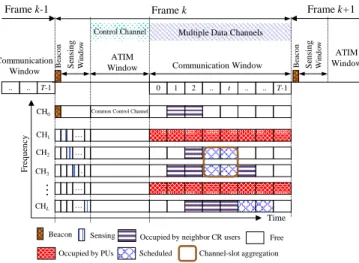
A channel-slot pair is defined as the “communication segment.” The communication segment (we can say segment later on for simplicity) for timeslot t (t = 0, 1, …, T−1) on channel l is denoted by the pair (l, t). A communication segment can be in one of the following three states (see Figure 1).
•Occupied: the segment is being used by other transmissions (PUs or other CUs).
•Scheduled: the segment is selected by the source-destination pair for packet transmission in a particular link. This state might become the occupied state after a confirmation process.
We assume that PUs randomly choose channels from the channel pool for their data transmissions and usage of each channel is modeled as an independent and identically distributed renewal process with ON (or active) and OFF (or idle) states. In ON state, PU is active (present) and the channel cannot be used by CUs. On the other hand, in OFF state, PU is inactive (absent) and CUs can utilize the channels without causing any harmful interference to PUs. The number and the locations of the PUs are considered unknown to the CUs. A link can be made between two CUs; if there exists one or more common channel available to both users. In this network model, each CU is equipped with a single CR transceiver. A pair of nodes can communicate with each other if they are on the same channel and are within the transmission range of each other. The CR transceiver is based on the software-defined radio so that it can realize channel-slot aggregation, which allows the CUs to use multiple channels with different transmit power simultaneously.
For accessing a channel, a CU must sense channels first, and can access the channels only if any of these L channels is not being used by PUs. Any efficient spectrum sensing scheme proposed in the literature can be used for this. We assume that CUs can obtain reliable sensing results at the end of the sensing period.
We consider that CU exchange control packets with maximum power Pmax and transmit data as well as acknowledgement (ACK) packet on controlled power. A radio signal can be correctly decoded by the intended receiver only if the signal to interference plus noise ratio (SINR) is above a certain hardware-dependent threshold, SINRth. The higher value of SINR ensures that more packets can be transmitted reliably. Depending of the modulation scheme, different threshold values of SINRth are valid. In the CRANs modeled above, the problem of routing (i.e., route selection and communication segment allocation) can be described with an optimization framework. Let us consider a route request from a source node to the destination
node. If we assume a fixed data rate, the bandwidth requirement for the route request, denoted by W, can be measured in the number of communication segments per frame. Let P denote the set of all candidate paths for the route, among which the route(s) should be selected. A candidate path p (p ∈ P) can be represented by an ordered list of nodes forming the path. That is, the list can be denoted by [ , ,…, ( ) , ( )], where h(p) is the hops for path p and the nodes and ( ) correspond to source and destination, respectively. Let denote the set of nodes on path p, excluding source and destination. Note that =
ℎ( ) − 1, where |Z| means the number of elements in the set Z. To prevent looping and excessive delay, the hop count of a path should be limited. That is, h(p) ≤ TTL for all p, where TTL is the limit on the number of hops (time to live). Let be the set of available communication segments, observed by node n. Then, the set of available communication segments on the link between node n and node m can be represented by ∩ . In order to assign the communication segments on a link to a path, the number of available segments should be larger than the bandwidth requirement of the route request. That is, | ∩ | ≥ W [0 ≤ i ≤ h(p) − 1, p ∈ P]. It is noted that the availability of communication segments is affected by many factors including the PU activity, the activity and transmission power of other CUs, the system load, and the wireless channel condition.
Let be the residual battery energy of node n. A threshold is used to improve the survivability of nodes. When < , node n does not participate in any candidate path for other source-destination pair. Let us define the minimal nodal residual energy on path p as , := ∈! . In selecting route among P candidates, we can consider many factors. For energy-efficient routing, the most important factor is the minimal nodal residual energy. The survivability of nodes can be largely improved by using nodes with high residual energy. This, in turn, extends the lifetime of CRANs. On the other hand, by selecting the candidate path with small hop count, the network-wide energy consumption can be reduced as well as the packet delay can be shortened. Thus, we define the utility for path p as a function of these two factors, denoted by
"( , , ℎ( )).
Now, the routing problem can be formulated as follows:
"
∈$ %&' () (
, , ℎ( )) (1)
s.t. h(p) ≤ TTL, p ∈ P (2)
≥ , n∈ , p ∈ P (3)
| ∩ | ≥ W, 0 ≤ i ≤ h(p) − 1, p ∈ P (4) Although the solution of (1) is an optimal route, it is hard to implement this algorithm directly in practice. The main reason is that, in order to take account of all possible candidate paths, all nodes in the network should exchange a huge amount of control information, which is unrealistic. Thus, in the next section, we propose an energy aware routing protocol which is satisfactorily efficient from the practical point of view, although it is not optimal in the absolute sense.
Table 1. Summary of various symbols and variables
Symbols Meanings
Residual battery energy of node n
mEres Minimum residual nodal energy Eth Threshold energy
f Channel frequency
L Number of channels
M Number of PUs
N Number of CUs
T Number of timeslots
W Bandwidth requirement for the route request
P Set of all candidate paths for the route
h(p) Hops for the path p
Np Set of nodes on path p
Ln Set of available communication segments of node n
α The path loss coefficient
Pmax Maximum transmit power
4.
Proposed Multipath Routing Scheme
The channel access mechanism of the proposed scheme is shown in Figure 1. The system time is divided into frames. A frame consists of a sensing window, an ad hoc traffic indication messages (ATIM) window, and a communication widow. The synchronization of the CUs is done with the help of periodic beaconing. In sensing window (sensing phase),
every CU carries out channel sensing to get the spectrum opportunity. In ATIM window (reservation phase), all CUs tune their radio interfaces to the control channel (CH0) and transmit/receive control packets for resource reservation. It is noted that during ATIM window only the control channel is used. Control packets exchanging are based on a kind of CSMA/CA protocol. In communication window (data transmission phase), CUs transmit/receive their traffic by using all available L+1 channels (CH0−CHL). The communication window is time-slotted. A timeslot consists of the data (packet) transmission time, the corresponding ACK transmission time, and the guard times. The guard time includes the propagation delay and the transition time from transmitting mode to receiving mode.
In this routing, multiple paths can be used interchangeably when route failure occur that increase the network performance, or simultaneously by introducing load balancing mechanisms to provide higher aggregated throughput. In many cases, simultaneous transmissions through multiple paths perform better end-to-end delay and high throughput. In our proposed scheme, we will use simultaneous transmissions technique through two paths. The route discovery/selection is to find a number of routes between a source-destination pair. Two types of control packets, the route request (RREQ) and the route reply (RREP), are used. First, the source broadcasts RREQ. RREQ is delivered to the destination with the information on the available spectrum of all intermediate nodes. Because of the broadcast nature, multiple copies of the RREQ can arrive at the destination and, therefore, the destination can have a number of candidate routes. The destination selects multiple paths based on energy efficient path and hop count. Finally, the destination can send multiple RREPs to the source, each of which corresponds to a path of route. When an RREP traverse the path, the spectrum assignment for every intermediate node is done. After receiving the RREP(s), the
source begins data transmission through multiple paths (e.g. two paths) simultaneously. Moreover, for route maintenance, the local route recovery (LREC) and the route error (RERR) control packets are used.
Our goal is to select energy efficient multiple paths that are completely or at least maximally disjoint. For this, we consider nodes with higher residual energy with lower hop count as routing metric. Initially, at the source node, the value of minimum residual nodal energy mEres equals the initial energy of the battery. To avoid nodes having very poor energy in a route, intermediate nodes should have higher than a threshold energy Eth to participate. Furthermore, because of the opportunistic properties of CRANs, a node should also have at least one channel (spectrum band) common with its previous hop. When the forwarding intermediate nodes receive the RREQ packet they compare their own residual battery energy Eres with the mEres and update mEres to ensure it remains as the minimum. This will ensure that the route has the minimal nodal residual battery energy. After collecting a number of RREQ copies, the destination makes route decision. In decision, the route having higher mEres value get higher priority. On the other hand, the route having smaller hop count is favorable because it may provide shorter delay.
4.1 Route Discovery
4.1.1 Broadcast of RREQ Packet
When a source node has packets to transmit to a specific destination, it initiates the route discovery process by broadcasting a spectrum-aware RREQ packet on the control channel to its neighbors. The fields of RREQ packet are shown in Table 2.
4.1.2 Assignment of Communication Segments Let us consider the (communication) segment assignment for the link between an upstream (source-side) node A and a downstream (destination-side) node B. With the help of periodic beaconing, node B can identify the usage states of segments of node A. Receiving RREQ form node A, node B compares its segment states with those of node A and identifies the segments being free from the viewpoints of both nodes. If there are sufficient free segments, node B selects W segments randomly and marks their states as
Table 2. Fields of the RREQ packet
Fields Descriptions
ReqId Unique route request sequence number SrcId Address of the source node
DstId Address of the destination node
mEres Minimum residual nodal energy in a route
RouteSeq List of the address of nodes from the source to the current traversed node W Bandwidth requirement at each link
FSeg Array of free communication segments (channel-timeslots) for a node SSeg List of the selected communication segments from the source to the current traversed node
HC Hop counter
TTL The limitation of hop-length of the search path Figure 1. Frame structure and channel access mechanism of the
proposed scheme for CRANs
Multiple Data Channels
Control Channel
ATIM
Window Communication Window
Frame k
S
en
si
n
g
W
in
d
o
w
Time
CH0
… … . … … CH2
CH3
…
CHL
F
re
q
u
en
cy
Sensing Occupied by PUs
Free Scheduled
Occupied by neighbor CR users CH1
B
ea
co
n
0 1 2 .. t .. .. T-1
Beacon
Channel-slot aggregation
S
en
si
n
g
W
in
d
o
w
B
ea
co
n
.. .. T-1 Communication
Window
Frame k+1
ATIM Window
Frame k-1
Tentatively Assigned. In addition, node B sends the identification of selected segments to node A by using ACK packet to node A. Node A then marks the states of corresponding segments to Tentatively Assigned. If segment assignment is impossible, the corresponding RREQ is dropped.
When the segment assignment is possible, the node attaches the segment assignment information to the RREQ: the address of the node is added in RouteSeq field (the list of nodes on the path); it records the allocated segments in SSeg field (the list of selected communication segments). In addition, the node indicates free segments in the FSeg field, for the successor nodes in the potential path. It also
increments the value of hop counter (in HC field) and decrements the value of time to live parameter (in TTL field). Finally, the node rebroadcasts the modified RREQ. Two purposes of the TTL are to limit the number of hops in a path and to reduce the network-wide broadcast overhead of RREQ packet. After receiving an RREQ packet, a node checks the TTL value. If it is zero and the node is not destination, the node drops the RREQ. Otherwise, if the value is not zero, the node decreases the value by one as discussed above.
In this multipath routing, an intermediate node does not drop duplicate RREQs to establish multiple paths. However, to get diversity by lessening the overlapped routes, an intermediate node sends duplicate RREQ packet only when an RREQ traversed through different incoming links and whose hop counts are not greater than that of firstly received RREQ. In addition, the number of duplicates for an RREQ, which an intermediate node can send, is limited (e.g., by two) to avoid excessive overhead.
The EOMR protocol aims to balance the nodal energy consumption. The energy-efficient paths are selected by considering the higher value of mEres of the candidate paths. To do so, the source node sets the mEres field (which indicates the minimum residual nodal energy of a path) as the value of its battery energy. When an intermediate node receives the RREQ packet, it compares the mEres in the RREQ with its own residual battery energy, Eres. If Eres is smaller than the value in the mEres field, the value is replaced with Eres. As a result, the mEres field of RREQ arrived at the destination contains the lowest battery energy value among all the nodes in the corresponding route. This value is called the ‘minimal residual path energy.’
On the other hand, every node has a threshold on battery energy, denoted by Eth, to contribute as an intermediate node of a route. If the battery energy of an intermediate node is less than Eth, it does not participate in the route discovery process by dropping the corresponding RREQ. However, the node which has already joined in a route may continue data transmission till the exhaustion of its battery energy. In addition, even though the battery energy of a node is less than Eth, it can act as a source or destination.
4.2 Route Decision and Route Reply
The destination makes route decision by selecting multiple appropriate paths. The destination makes the route decision with, at maximum, Q copies of an RREQ corresponding to a connection request. The destination starts waiting timer after receiving the first RREQ copy and collects all copies of the RREQ until the timer expires. If it gathers Q copies of an RREQ, it stops collecting even though the timer does not expire.
In taking route decision, the route having more minimal residual path energy gets higher priority. On the other hand, the route having smaller hop count is favorable because it may provide shorter delay. Taking account of these two factors, the destination computes route utility as (5).
,
m
,
0, 1, . . .,
(5)
res k k
k
E
U
k
K
HC
=
=
where mEres,k is minimal residual path energy of kth routing path and K (K ≤ Q) is the number of collected RREQ copies. And HCk is the hop count in the HC field of kth RREQ copy.
"* is the route utility of kth routing path. The destination sorts all "*’s in a descending order. Then it selects first P Figure 2. Local recovery mechanisms of EOMR in route
maintenance phase B A
C
(b) Local detour in response to the link failure that is not recoverable by segment reassignment
(a) Segment reassignment in response to the link failure due to PU activity
Occupied by PUs Occupied by CUs Free
(2, 2) (2, 3)
PU (CH3)
PU (CH2)
PU (CH3) PU (CH1)
CH1 B A CH2 CH3 CH4 CH1 CH2 CH3 CH4
(2, 2) (2, 3)
PU (CH1)
CH1 B A CH2 CH3 CH4 CH1 CH2 CH3 CH4
(4, 1) (4, 2)
T im e
PU (CH3)
PU (CH2) PU (CH1)
paths among K candidates. The order of a selected path becomes the priority of the corresponding path.
It is noted that only destination node is allowed to send RREP. An RREP contains its priority and the accumulated route record obtained from the corresponding RREQ copy. An RREP is delivered to the predecessor node along the path through control channel. When a node receives an RREP it changes the communication segment states from Tentatively Assigned to Occupied. Accordingly, the communication segments selected for each link along the path are reserved for data transmission. Moreover, all the other nodes in the neighborhoods of the nodes in the selected paths are notified by beaconing that these communication segments are occupied by the newly incoming connection. Finally, the destination replies to the source with multiple (P) RREP packets, each of which corresponds to a selected path. If route discovery process is successfully accomplished, the source node receives RREPs for an RREQ.
4.3 Route Maintenance
The route failure can occur during data transmission. Route maintenance is the mechanism by which source node is able to detect any sort of route failure.
In mobile CRANs, a link of a route can be broken because of the appearance of PUs, the topology changes due to node mobility, bad channel condition, and for the energy exhaustion of nodes. The appearance of a PU may cause to be the route failure in its vicinity [35]. In such case, CUs in the PU affected region must change their operating channel if possible to recover the current route. Moreover, under mobility conditions, CUs may also move toward the PU affected region, which is also liable for the possible route failure [36].
The proposed EOMR protocol has four types of route recovery mechanisms that include i) Segment reassignment ii) Local detour iii) Route rediscovering, and iv) Route recovery by cache route. Here, the first two types are local recovery, shown in Figure 2, whereas the last two types are end-to-end recovery.
4.3.1 Segment Reassignment
When PU activity is detected by a CU, transmitting packets, on its operating channel, then, it is necessary to use a different channel for packet forwarding; because the current operating channel is now unavailable. Let us consider a link between an upstream node A and a downstream node B, which are intermediate nodes on the route between source and destination. If the spectrum availability has been changed due to PU activity, therefore, node A cannot receive ACK from node B even after it retransmits a packet Nretx times (Nretx is predefined). To resolve this kind of problem, node A tries to reassign communication segments for that link. This is called the ‘segment reassignment.’
Figure 2 (a) shows the segment reassignment operation. In this figure, the upper part shows the data transmission by nodes A and B using segments (2, 2) and (2, 3). It has been seen that CH1 and CH3 are occupied by PUs in the coverage areas of the nodes A and B, respectively. However, after some time during data transmission another PU starts using CH2 in the coverage area of node B. Thus, node A fails to transmit data to node B using segments (2, 2) and (2, 3). In this route recovery mechanism, node A initiates segment reassignment and assign (4, 1) and (4, 2) segments newly for the given link, shown in the lower part of this figure.
4.3.2 Local Detour
If there is no free segment that can be used for the link, or the node B is beyond the transmission range of node A (e.g., caused by movement of node A or B), the node A tries to make a local detour. This operation is called ‘local recovery by detour.’ In this local recovery, node A finds another path from node A to node B, which contains only one additional intermediate node. To do so, node A gathers neighbor information from beacon signals, determines a candidate for the additional intermediate node (say, node C), and transmits a local route recovery (LREC) packet to node C. Then node C transmits a modified LREC to node B. As a result a detour A-C-B is made. It is noted that, the resulting end-to-end route is valid when its hop count is not greater than TTL. Figure 2 (b) illustrates the local detour operation.
4.3.3 Route Rediscovering
When the local recovery is also impossible, node A sends a RERR packet to the source. After receiving the RERR packet, the source starts to the rerouting process. This is called the ‘route rediscovering’.
4.3.4 Route Recovery by Cache Route
The source first checks its route cache to find backup paths that have been stored in the initial route discovery. If there is any backup path, the source chooses a backup path with highest priority as a new active path and transmits data through the new route immediately. This operation is called ‘route recovery by cache route.’
5.
Performance Evaluation
The effectiveness of the proposed EOMR scheme is validated through simulations. This section describes the simulation environment, performance metrics, and experimental results. To evaluate EOMR scheme, we developed a simulator written in C++ programming language, which implements the features of the protocol stack described in this paper. We have evaluated the performance of the EOMR scheme in comparison with EER [26], MRRC [28], and DBR [30].
5.1 Simulation Setting
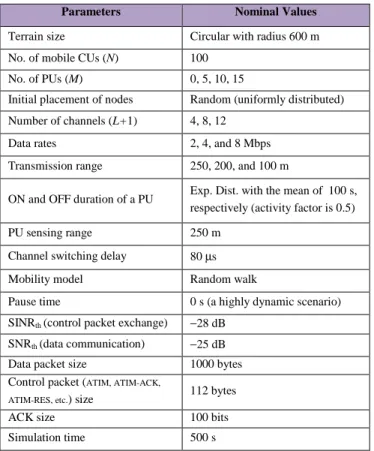
We consider a circular area with radius of 600 m. There are M stationary PUs being distributed uniformly within the circle. The PUs operate on L channels according to their own multichannel protocol. The details of PU operation is beyond the scope of this paper. We just model the PU activity as an ON/OFF process. A PU in ON state occupies a channel and it does not use any channel in OFF state. The ON and OFF durations of a PU are exponentially distributed with the mean of 100 s, respectively (i.e., the activity factor is 0.5), unless noted otherwise. A newly activated PU randomly chooses a channel among channels that are not used by other PUs. The sensing range of a PU is set to 250 m. An active PU is assumed to be perfectly detected by a CU within the sensing range.
dedicated control channel as well as L channels (licensed to PU) for data transmission.
Each CU supports three different data rates, which are 2, 4, and 8 Mbps, respectively. The corresponding transmission ranges are 250, 200, and 100 m, respectively. Data rate supported by CCC is 2 Mbps. We vary the number of channels from 4 to 12 among them one channel is CCC and the others are data channels. The maximum transmission power of a CU is set to 100 mW. We consider the path loss and shadowing as the propagation model. The channel gain is calculated by + × - ., where d is the distance between the transmitter and the receiver, and the constant γ is set to
−66.08 dB. The shadowing effect is modeled as a log normal shadowing with zero mean and standard deviation 5 dB. The thermal noise power is set to −103 dBm. Furthermore, the minimum required SINR for control packet exchange is set to −28 dB and the minimum required SNR for data communication is set to −25 dB. If the received SINR or SNR of a packet is higher than the minimum required value, the packet is assumed to be decoded correctly. The retransmission of erroneous packets is tried at maximum three times (Nretx = 3). The simulation time of each run corresponds to 500 s in reality. Each data point on the graphs is obtained by averaging the results from 10 simulation runs with random initial positioning of PUs and CUs. The summary of simulation parameters are listed in Table 3.
5.2 Performance Metrics
The following performance metrics are used to evaluate the proposed scheme:
Network Throughput: The total number of successfully received bits per second by all destinations in the CRANs.
Average End-to-End Packet Delay: Average latency incurred by the data packets between their generation time and their arrival time at the destinations.
Energy Efficiency: The total number of bits transmitted per unit of power consumption. The larger the value means the more efficient the transmit power is utilized.
Normalized Routing Overhead: The normalized routing overhead is defined as the number of routing packets transmitted per data packet delivered at the destinations. Network Lifetime: The network lifetime is defined as the duration from the beginning of the simulation to the first time a CU runs out of energy.
5.3 Simulation Results
Figure 3 shows the comparison results of the network throughput of EOMR scheme with other protocols as a function of the number of flows. We can see that, when the number of flows increases, EOMR offers better performance than all other protocols. The main reason is that the EOMR scheme uses the multipath routing and the channel-slot aggregation diversity technique, which can help CUs efficiently utilize available resources opportunistically for data transmissions. Moreover, the appropriate load sharing among CUs helps in increasing throughput. Furthermore, because of the power control mechanism of our proposed scheme, the mutual interference among neighbor CUs is reduced and the channel spatial reuse efficiency is improved, which are also promoting the improvement of the network throughput.
Figure 4 presents the comparison of average end-to-end packet delays by varying the number of flows. When network load increases there are many requests for routing, our proposed EOMR scheme established multipath routing that helps faster data transmission. When the load increases, queuing delay is raised. The queuing delay makes the performance of each protocol worse. However, the data traffic is split into multiple paths in the case of EOMR scheme. Therefore, the average end-to-end packet transmission delay of EOMR is increased slowly according to the increment of the number of flows.
Figure 3. Comparison of average network throughput as a function of the number of flows
0 5 10 15 20 25 30 35
0 1 2 3 4 5 6 7 8 9 10 11 12
A
v
er
ag
e
n
et
w
o
rk
t
h
ro
u
g
h
p
u
t
(M
b
p
s)
Number of flows
EOMR (Proposed) EER
DBR MRRC
Table 3. Summary of simulation parameters
Parameters Nominal Values
Terrain size Circular with radius 600 m
No. of mobile CUs (N) 100
No. of PUs (M) 0, 5, 10, 15
Initial placement of nodes Random (uniformly distributed)
Number of channels (L+1) 4, 8, 12
Data rates 2, 4, and 8 Mbps
Transmission range 250, 200, and 100 m
ON and OFF duration of a PU Exp. Dist. with the mean of 100 s, respectively (activity factor is 0.5)
PU sensing range 250 m
Channel switching delay 80 µs
Mobility model Random walk
Pause time 0 s (a highly dynamic scenario)
SINRth (control packet exchange) −28 dB SNRth (data communication) −25 dB
Data packet size 1000 bytes
Control packet (ATIM, ATIM-ACK,
ATIM-RES, etc.) size 112 bytes
ACK size 100 bits
Figure 4. Comparison of average end-to-end delay as a function of the number of flows
Figure 5. Comparison of average network throughput as a function of the number of PUs
Figure 6. Comparison of average end-to-end delay as a function of the number of PUs
Figure 7. Comparison of average energy efficiency
Figure 5 shows the comparison results of the network throughput of EOMR scheme with other protocols as a function of the number of PUs. We can see that, when the number of PUs increases, EOMR offers significantly better performance than all other protocols. It is shown that increasing number of PUs increases routes interruption which decreases network throughput.
Figure 6 presents the comparison of average end-to-end packet delay of the protocols by varying the number of PUs. When number of PUs increases and due to the less spectrum opportunities, queuing delay is raised and as a result end-to-end packet delay increases. However, our EOMR protocol efficiently utilizes the spectrum opportunities using the channel-slot aggregation diversity technique and dynamic traffic allocation scheme for achieving better performance.
Figure 8. Comparison of normalized routing overhead 0
0.4 0.8 1.2 1.6 2 2.4 2.8
0 1 2 3 4 5 6 7 8 9 10 11 12
A
v
er
ag
e
en
d
-t
o
-e
n
d
p
ac
k
et
d
el
ay
(
se
c)
Number of flows
EOMR (Proposed) EER
DBR MRRC
0 5 10 15 20 25 30 35
0 5 10 15
A
v
er
ag
e
n
et
w
o
rk
t
h
ro
u
g
h
p
u
t
(M
b
p
s)
Number of PUs
EOMR (Proposed) EER
DBR MRRC
0 0.4 0.8 1.2 1.6 2 2.4 2.8
0 5 10 15
A
v
er
ag
e
en
d
-t
o
-e
n
d
p
ac
k
et
d
el
ay
(
se
c)
Number of PUs
EOMR (Proposed) EER
DBR MRRC
0 0.02 0.04 0.06 0.08 0.1 0.12 0.14 0.16
0 1 2 3 4 5 6 7 8 9 10 11 12
A
v
er
ag
e
en
er
g
y
e
ff
ic
ie
n
cy
(
M
b
p
s/
m
W
)
Number of flows
EOMR (Proposed) EER
DBR MRRC
-4.16E-17 0.005 0.01 0.015 0.02 0.025 0.03 0.035 0.04
0 1 2 3 4 5 6 7 8 9 10 11 12
N
o
rm
al
iz
ed
r
o
u
ti
n
g
o
v
er
h
ea
d
Number of flows
EOMR (Proposed) EER
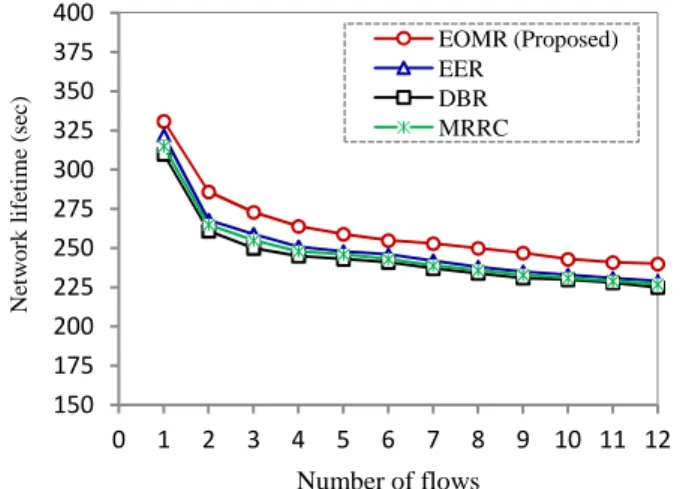
Figure 9. Comparison of network lifetime
Figure 7 shows the comparison of average network energy efficiency of EOMR scheme with other protocols in terms of the number of flows. From this plot, we can observe that, the network energy efficiency of the proposed EOMR scheme outperforms the other protocols, although the energy efficiency of our proposed scheme reduces when the number of flows is larger than six. With this proposed approach, multiple paths can be sufficiently utilized with appropriate data transmission rate. Moreover, mutual interference among CR neighbor nodes can be restrained. Furthermore, adapting doze mode operation also promotes to improve energy efficiency.
The normalized routing overhead is shown in Figure 8. When the network load increase, the routing overhead increases due to the increase of RREQ, RREP, RREC, and RERR. The result shows that our proposed protocol needs lower routing overhead per data packet delivery. The routing overhead of DBR is better than EER because of the multipath technique.
The network lifetime is shown in Figure 9. When the offered load increases the network lifetime decreases because of the increasing of the number of routes. It is shown that EOMR outperforms all other protocols because of the energy efficient approach that balances energy consumption of nodes throughout the network. When the network load increase the routings are distributed to the other CUs having higher residual nodal energy; thus prolongs the lifetime of individual CUs and overall network. In this case EER performs better than DBR because of the energy efficient mechanism.
6.
Conclusion
We have proposed an energy aware multipath on-demand routing protocol for multihop CRANs. We have studied the impact of number of flows and number of PUs activities on the operation of the proposed routing protocol. The proposed EOMR protocol combines the integration of spectrum and route discovery to establish communications across areas of spectrum heterogeneity. The dynamical traffic assignment is performed according to the traffic arrival rate, and spectrum availability to minimize the end-to-end overall delay performance in multipath CRANs. In addition, the EOMR scheme can efficiently increase the data transmission rate and thus improve the average network throughput. Our protocol balances the traffic load among different CUs according to their nodal residual battery energy and prolongs
the lifetime of individual CU and the overall networks. Simulation results show that the proposed EOMR protocol can provide a lower end-to-end packet delay and routing overhead but ensure the higher throughput and longer network lifetime. Furthermore, the proposed scheme achieves aggressive energy savings through multiple power saving mechanisms that give higher energy efficiency.
References
[1] A. Guirguis, M. Ibrahim, K. Seddik, K. Harras, F. Digham, and M. Youssef, “Primary user aware k-hop routing for cognitive radio networks,” IEEE Global Communications
Conference (GLOBECOM’ 15), San Diego, CA, USA, pp.
1-6, December 2015.
[2] P. Ren, Y. Wang, and Q. Du, “CAD-MAC: A channel-aggregation diversity based MAC protocol for spectrum and energy efficient cognitive ad hoc networks,” IEEE Journal
on Selected Areas in Communications, vol. 32, no. 2, pp.
237-250, February 2014.
[3] X. Hong, C.-X. Wang, H.-H. Chen, and Y. Zhang, “Secondary spectrum access networks,” IEEE Vehicular
Technology Magazine, vol. 4, no. 2, pp. 36-43, June 2009.
[4] T. M. Salem, S. M. Abd El-kader, S. M. Ramadan, M. Z. Abdel-Mageed, “Opportunistic spectrum access in cognitive radio ad hoc networks,” International Journal of Computer
Science Issues (IJCSI), vol. 11, no. 2, pp. 41-50, January
2014.
[5] A. D. Domenico, E. C. Strinati, and M.-G. Di Benedetto, “A survey on MAC strategies for cognitive radio networks”,
IEEE Communications Surveys & Tutorials, vol. 14, no. 1,
pp. 21-44, 2012.
[6] S. Hussain and X. Fernando, “Performance analysis of relay-based cooperative spectrum sensing in cognitive radio networks over non-identical Nakagami-m channels,” IEEE
Transactions on Communications, vol. 62, no. 8, pp. 2733-
2746, 2014.
[7] A. S. Zahmati, X. Fernando and A. Grami, “A hybrid spectrum sensing method for cognitive sensor networks,”
Springer Wireless Personal Communications, vol. 74, no. 2,
pp. 953-968, January 2014.
[8] M. Wellens, J. Riihijarvi, and P. Mahonen, “Evaluation of adaptive MAC-layer sensing in realistic spectrum occupancy scenarios,” IEEE Symposium on New Frontiers
in Dynamic Spectrum Access Networks (DySPAN’ 10),
Singapore, pp. 1-12, April 2010.
[9] M. Cesana, C. Francesca, and E. Eylem, “Routing in cognitive radio networks: Challenges and solutions,” Elsevier Ad Hoc Networks, vol. 9, no. 3, pp. 228-248, May 2011.
[10] H. A. A. Al-Rawi, K.-L. Alvin Yau, “Routing in Distributed Cognitive Radio Networks: A Survey,” Springer Wireless
Personal Communications, vol. 69, no. 4, pp. 1983-2020,
April 2013.
[11] S. Salim and S. Moh, “On-demand routing protocols for cognitive radio ad hoc networks,” EURASIP Journal on
Wireless Communications and Networking, 2013:102, pp.
1-10, April 2013.
[12] Y. Liu, L. X. Cai, and X. Shen, “Spectrum-aware opportunistic routing in multi-hop CRNs,” IEEE Journal on
Selected Areas in Communications, vol. 30, no. 10, pp.
1958-1968, November 2012.
[13] S. M. Kamruzzaman, E. Kim, and D. G. Jeong, “Spectrum and energy aware routing protocol for cognitive radio ad hoc networks,” IEEE International Conference on Communications (ICC’11), Kyoto, Japan, pp. 1-5, June
2011. 150
175 200 225 250 275 300 325 350 375 400
0 1 2 3 4 5 6 7 8 9 10 11 12
N
et
w
o
rk
l
if
et
im
e
(s
ec
)
Number of flows
EOMR (Proposed) EER
[14] C. B. Carvalho and J. F. de Rezende, “Routing for capacity improvement in multichannel-width multi-radio wireless mesh networks,” International Journal of Communication
Networks and Information Security (IJCNIS), vol. 7, no. 3,
pp. 197-206, December 2015.
[15] K. R. Chowdhury and M. D. Felice, “SEARCH: A routing protocol for mobile cognitive radio ad-hoc networks,”
Elsevier Computer Communications, vol. 32, no. 18, pp.
1983–1997, December 2009.
[16] M. Pan, C. Zhang, P. Li and Y. Fang, “Joint routing and link scheduling for cognitive radio networks under uncertain spectrum supply,” IEEE International Conference on
Computer Communications (INFOCOM’ 11), Shanghai,
China, pp. 2237-2245, April 2011.
[17] R. Murty, R. Chandra, T. Moscibroda, and P. Bahl, “SenseLess: A database-driven white spaces network,”
IEEE Transactions on Mobile Computing, vol. 11, no. 2,
pp.189–203, February 2012.
[18] M. Siraj and S. Alshebeili, “RPCRAN: A routing protocol for cognitive radio ad hoc networks,” International Journal
of Innovative Computing, Information and Control, vol. 9,
no. 11, pp. 4583-4594, November 2013.
[19] E. F. Orumwense, T. J. Afullo, and V. M. Srivastava, “Energy efficiency metrics in cognitive radio networks: A hollistic overview,” International Journal of Communication Networks and Information Security (IJCNIS), vol. 8, no. 2, pp. 75-85, August 2016.
[20] S. M. Kamruzzaman, E Kim, DG Jeong, and WS Jeon, “Energy-aware routing protocol for cognitive radio ad hoc networks,” IET Communications, vol. 6, no. 14, pp. 2159-2168, September 2012.
[21] H. Chen, Q. Du, and P. Ren, “A joint routing and time-slot assignment algorithm for multi-hop cognitive radio networks with primary-user protection,” International
Journal of Computers Communications & Control, vol. 7,
no. 3, pp. 403-416, September 2012.
[22] L. Zi, Z. Hongyang, and P. Qingqi, “A path combination based routing scheme for cognitive radio networks,” Genetic
and Evolutionary Computing, Advances in Intelligent
Systems and Computing 238, Springer International Publishing Switzerland, pp. 247-256, 2014.
[23] Q. Zhao, G. Feng, and C. Zheng, “A Routing mechanism for cognitive radio ad hoc networks,” Advanced Science and
Technology Letters, vol. 53, pp. 92-96, 2014.
[24] M. Mathew, G. S. Let, and G. J. Bala, “Modified AODV routing protocol for multi-hop cognitive radio ad hoc networks,” Artificial Intelligence and Evolutionary Algorithms in Engineering Systems, Advances in Intelligent
Systems and Computing, vol. 324, pp 89-97, November 2014.
[25] R. A. Rehman, M. Sher, and M. K. Afzal, “Efficient delay and energy based routing in cognitive radio ad hoc networks,” International Conference on Emerging Technologies (ICET’ 12), Islamabad, Pakistan, pp. 1-5,
October 2012.
[26] G. Mastorakis, A. Bourdena, C. X. Mavromoustakis, E. Pallis, and G. Kormentzas, “An energy-efficient routing protocol for ad-hoc cognitive radio networks,” Future
Network and Mobile Summit, Lisbon, Portugal, pp. 1-10,
July 2013.
[27] L. Gui, X. Zhong, and S. Zou, “traffic assignment algorithm for multi-path routing in cognitive radio ad hoc networks,”
IEEE Wireless Communications and Networking Conference (WCNC), Shanghai, China, pp 1168-1173, 2013.
[28] I. Beltagy, M. Youssef, M. Abd El-Azim, M. El-Derini, “Channel assignment with closeness multipath routing in cognitive networks,” Elsevier Alexandria Engineering
Journal, vol. 52, pp. 665–670, September 2013.
[29] B. Khanna and R. Ramanathan, “Interference-aware multipath routing in a cognitive radio ad hoc network,”
IEEE Military Communications Conference (MILCOM’ 11),
Baltimore, MD, USA, pp. 855-860, November 2011. [30] L. Gui, S. Zou and X. Zhong, “A distributed best-route
selection for multipath routing in cognitive radio ad hoc network,” IET Electronics Letters, vol. 48, no. 25, pp. 1630-1632, December 2012.
[31] C.-F. Shih, W. Liao, and H.-L. Chao, “Joint routing and spectrum allocation for multi-hop cognitive radio networks with route robustness consideration,” IEEE Transactions on
Wireless Communications, vol. 10, no. 9, pp. 2940-2949,
September 2011.
[32] A. Abbagnale and F. Cuomo, “Leveraging the algebraic connectivity of a cognitive network for routing design,”
IEEE Transactions on Mobile Computing, vol. 11, no. 7, pp.
1163-1178, July 2012.
[33] M. Timmers, S. Pollin, and A. Dejonghe, “A distributed multichannel MAC protocol for multihop cognitive radio networks,” IEEE Transactions on Vehicular Technology, vol. 59, no. 1, pp. 446−459, January 2010.
[34] Y. Wang, P. Ren, and G. Wu, “A throughput-aimed MAC protocol with QoS provision for cognitive ad hoc networks,”
IEICE Transactions on Communications, vol. E93-B, no. 6,
pp. 1426−1429, June 2010.
[35] I. Beltagy, M. Youssef, and M. El-Derini, “A new routing metric and protocol for multipath routing in cognitive networks,” IEEE Wireless Communications and Networking
Conference (IEEE WCNC’ 11), Quintana-Roo, Mexico, pp.
974-979, March 2011.
[36] K. R. Chowdhury and I. F. Akyildiz, “CRP: A routing protocol for cognitive radio ad hoc networks,” IEEE Journal
on Selected Areas in Communications, vol. 26, no. 4, pp.