GSR Behaviour Change Knowledge Review
Reference Report: An overview of
behaviour change models and their
uses
Andrew Darnton, Centre for Sustainable
Development, University of Westminster
July 2008
Contents
1.
Introduction
1
2.
Understanding Behaviour
5
2.1 Economic assumptions 5
2.2 Behavioural economics 7
2.3 The role of information and the value action gap 10
2.4 Values, beliefs and attitudes 11
2.5 Norms and identity 15
2.6 Agency, efficacy and control 18
2.7 Habit and routine 22
2.8 The role of emotions 24
2.9 External factors 26
2.10 Self regulation 29
2.11 Societal factors 32
3.
Using Behavioural Models
34
4.
Understanding Change
39
4.1 Changing habits 39
4.2 Change in stages 41
4.3 Change via social networks 44
4.4 Change as learning 47
4.5 Change in systems 51
5.
Applied Approaches to Change
57
6.
Issues Around Intervening
64
6.1 Ethical issues 64
6.2 Equity issues 65
6.3 Side effects 67
7.
Using Behavioural Models with Theories of Change
68
Appendices
70
i) Tables matching behaviours to models 70
ii) Methodology 74
iii) Organisations and Individuals Contacted 76
iv) Electronic bibliography 77
1. Introduction
This report has been designed to accompany the Practical Guide to Behaviour Change models1. It provides a descriptive account of over 60 social-psychological models and theories of behaviour and discusses some issues to consider when using models. It also provides additional resources in the Appendices to enable readers to access the vast amount of literature in this area and see where models have been used to address particular behaviours previously.
This review makes the distinction between models of behaviour and theories of change. This is primarily an explanatory step, taken to highlight the different uses (and limits) of the types of models and theories incorporated in the behaviour change literature. Models of behaviour help us to understand specific behaviours, by identifying the underlying factors, which influence them. By contrast, theories of change show how behaviours change over time, and can be changed. While behavioural theory is diagnostic, designed to explain the determinant factors underlying behaviour, change theory is more pragmatic, developed in order to support interventions for changing current behaviours or encouraging the adoption of new behaviours. While the two bodies of theory have distinct purposes, they are highly complementary; understanding both is essential in order to develop effective interventions. The distinction is stressed throughout this review, but its value is most apparent in the context of practical guidance. It underlines that an understanding of behaviour alone provides insufficient clues on which to base effective processes for changing behaviour. Theories of change suggest intervention techniques which can be effective in bringing about change, as well as broad approaches to intervention design, implementation and evaluation which can underpin effective policy planning and delivery. However, seen from a purely conceptual perspective, the distinction between theories of behaviour and theories of change can appear less clear-cut. There are considerable overlaps between the two bodies of theory; for instance, behavioural models tend to be linear (showing the relationships between influencing factors as a series of arrows), models of change tend to be circling, incorporating feedback loops. Alternatively, while behavioural models tend to describe specific behaviours, models of change more commonly depict generic processes of change. However in both these examples the distinctions do not hold fast, as some models predominantly of one type show characteristics of the other. Classifying models of behaviour change into discrete types based on their attributes is an apparently impossible task.
The structure of the report is as follows:
Section 2 – Understanding behaviour
Provides a description of Behaviour Change models. The section starts with a brief overview of economic theory, which represents a starting point for examining human behaviour and then moves onto more complex behavioural economic principles and models from social psychology - both of which build upon economic theory. The models are divided between those showing the factors influencing behaviour at the level of individuals, and those showing factors impacting from higher levels of scale, such as society as a whole.
Section 3 – Using behavioural models
Sets out key considerations when using behavioural models
1
Section 4 – Understanding change
Provides an overview of a range of theories of change from a variety of disciplines
Section 5 – Applied approaches to change
Describes some of the more overarching approaches to changing behaviour often used in policy contexts
Section 6 – Issues around intervening
Outlines wider contextual issues around intervening, including issues of ethics and equity
Section 7 – Using behavioural models with theories of change
Introduces a practical approach to designing behaviour change interventions based on learnings from theory
To help readers to use this report as a reference resource, Table 1 below organises the models and theories cited under the section headings used in the report. Many of the models featured are cited in several places throughout the report; in the table, the models are linked to the section where they are described at the most length. The task of model selection is further covered in the Practical Guide and two further tables are supplied there, which explicitly map the models onto specific behaviours and policy problems. While detailed instructions on how to use the Tables are given in the Guide, the tables are also reproduced in this Reference Report (see Appendix i) below).
Table 1: An Index to the Featured Models and Theories
Section Models & Theories page figure
Models & Theories of Behaviour at the Individual Level
2.1 Economic Assumptions
Expected Utility (EU) Theory 7
2.2 Behavioural Economics
Principles of Hyperbolic Discounting, Framing, Inertia
Simon’s Bounded Rationality (1955)
Tversky and Kahneman’s Judgment Heuristics (1974)
Kahneman and Tversky’s Prospect Theory (1979)
Stanovich and West’s System 1/System 2 Cognition (2000) 8 8 9 9 9 2.3 The Role of
Information
(Information) Deficit Models
Awareness Interest Decision Action (AIDA) The Value Action Gap (eg. Blake 1999)
10 10 10
2.1 2.2 2.4 Values, Beliefs and
Attitudes
(Adjusted) Expectancy Value (EV) Theory
Fishbein and Ajzen’s Theory of Reasoned Action
(TRA), (1975)
Rosenstock’s Health Belief Model (1974) Rogers’ Protection Motivation Theory (1977)
Stern et al’s Schematic Causal Model of Environmental Concern (1995)
11 11 12 12 14 2.3 2.4 2.5 2.7
Sykes and Maza’s Norm Neutralization Theory (1957)
Cialidini’s Focus Theory of Normative Conduct (1990)
Rimal et al’s Theory of Normative Social Behaviour (2005)
Turner and Tajfel’s Social Identity Theory (1979) Turner’s Self Categorisation Theory (1987)
16 17 17 17 18 2.6 Agency, Efficacy and
Control
Ajzen’s Theory of Planned Behaviour (TPB), (1986)
Bandura’s Theory of Self Efficacy (1977) Hovland’s Theory of Fear Appeals (1957)
Kolmuss and Agyeman’s Model of Pro-Environmental Behaviour (2002)
13 19 19 20 2.6 2.11 2.7 Habit and Routine Triandis’ Theory of Interpersonal Behaviour
(TIB), (1977)
Gibbons and Gerrard’s Prototype/Willingness Model (2003)
21 22
2.12 2.13 2.8 The Role of Emotions Slovic’s Affect Heuristic (2002)
Loewenstein et al’s Risk As Feelings Model (2001)
24
25 2.14 2.9 External Factors Spaagaren and Van Vliet’s Theory of
Consumption as Social Practices (2000) Giddens’ Theory of Structuration (1984)
28 28
2.16 2.10 Self Regulation Carver and Scheier’s Control Theory (1982)
Bandura’s Social Cognitive Theory of Self Regulation (1991)
30 31
2.17 2.18
Models & Theories of Behaviour at Higher Levels of Scale
2.11 Societal Factors Vlek et al’s Needs Opportunities Abilities (NOA)
Model (1997)
Dahlgren and Whitehead’s Main Determinants of Health Model (1991)
32 32
2.15 2.19
Theories of Change
4.1 Changing Habits Lewin’s Change Theory (1947) Bandura’s Mastery Modelling (1977)
Gollwitzer’s Implementation Intentions (1993)
40 40 41 4.2 Change in Stages Prochaska and Di Clemente’s Transtheoretical
Model of Health Behaviour Change (‘Stages of
Change’ Model) (1983) 41 4.22
4.3 Change via Social Networks
Rogers’ Diffusion of Innovations (1962 onwards) Gladwell’s Mavens, Connectors & Salesmen (2000) Network Theory Social Capital 44 45 46 46 4.4 Change as Learning Information-Motivation-Behavioural Skills (IMB)
Model
Monroe et al’s Framework for Environmental Education Strategies (2006)
Vare and Scott’s ESD1/ESD2 (2007)
Argyris and Schon’s Double Loop Learning (1978)
Schein’s Organisational Culture (1985)
47 47 48 49 50 4.23 4.24 4.5 Change in Systems Systems Thinking
Foresight’s Obesity System Map (2007)
51
Scharmer’s Theory U (2007) 56 4.28
Models and Frameworks
5. Applied Approaches to Change
McKenzie-Mohr’s Four Steps of Community Based Social Marketing (CBSM) (2000)
Andreasen’s Six Stage Model of Social Marketing (1995)
Gardner and Stern’s Principles for Intervening to Change Environmentally Destructive Behavior (1996)
Bartholomew et al’s Intervention Mapping (IM), (1998)
Defra’s 4Es Model (2005)
Knott et al’s Cultural Capital Framework (2008) Department for Communities and Local Government’s Model of Community Empowerment (2008)
Implications from Chapman’s System Failure (2004)
57 57
18 59 60 61
62 63
5.29
2.10 5.30 5.31 5.32
2. Understanding
Behaviour
The literature on the factors influencing human behaviour is very extensive: it has been described as “enormous” (Maio et al 2007) and “bordering on the unmanageable” (Jackson 2005). This research evidence is drawn from diverse disciplines (predominantly within economics, psychology and sociology) and it spans myriad human behaviours. The behaviour change agenda across government is most developed in the policy areas of environment, health, and transport. Through this recent work, there is growing consensus on what the scope of the relevant evidence base might be; indeed, this study has included thirteen reviews of the literature, all conducted in the last five years and predominantly focusing on social-psychological models.
This first section of this report attempts to summarise briefly some of the principle theories and models of behaviour.
2.1 Economic assumptions
Standard economic theory represents the starting point for modelling many aspects of human behaviour. Behaviours which involve a choice between options with clearly perceived costs and benefits for the decision maker are particularly suited to analysis based on economic theory. Economics often uses rational choice as a tractable assumption which is ‘fit for purpose’ over a wide range of economic analysis. Rational choice theory traditionally assumes that individuals make behavioural decisions based on a calculation of the expected costs and benefits of a behaviour. Strictly speaking, rational choice theory requires only ‘well-ordered’2 and consistent preference mappings over the relevant period; it does not attach any welfare attributes to these preferences. An individual’s own preferences could even be detrimental for that individual and irrational by most reasonable criteria, but if well ordered and consistent throughout the analysis then rational choice theory can be applied for the purposes of analysing choice behaviour. Rational choice models are often called (Subjective) Expected Utility (EU or SEU) models. The principle of Expected Utility is central to Consumer Preference Theory (eg. Begg et al 2003, in Jackson 2005). The Theory balances four elements: the consumer’s available income, the price of the goods, the consumer’s tastes or preferences, and the assumption of utility maximization. Rational choice theory is notably silent on the origins of the individual’s preferences; they are “exogenous to the model”.
For most purposes individuals’ preferences in economic models of consumer choice are assumed to follow the principle of utility maximisation. In such models, utility can best be thought of as levels of satisfaction, happiness or personal benefit. By using the assumption that individuals act in order to maximise personal subjective benefits, economists are more able to apply powerful mathematical techniques for modelling behavioural outcomes (techniques which can also address ‘constrained maximisation’). However, working on the assumption of utility maximisation also gives rise to a critical stereotype of ‘homo economicus’, an amoral self that would, for example, murder without hesitation for financial gain, so long as the risk of penalties did not outweigh that gain. The notion of utility can also include the welfare of others as a component of one’s own utility, however it is fair to say that economics has traditionally adopted an analytical approach based on ‘atomistic’ or socially-isolated individuals acting in pursuit of their own
2
Satisfying axiomatic conditions e.g. if A is preferred to B and B is preferred to C then A must be preferred to C
interests. This assumption often provides useful analysis, but it also has serious limitations. For example, relying only on atomistic individual agents may result in the ‘tyranny of small decisions’ whereby the outcome of millions of individual decisions is at odds with what people collectively want. For example, no one wants to be the only person paying tax, but most taxpayers may value a certain level of taxation as a collective requirement for the ‘common good’.
Nevertheless standard economic theory assuming the individual to be a rational man acting in his own interests can provide many powerful insights for human behaviour. In rational choice theory, costs and benefits are not necessarily defined in terms of money, and this approach has been found to be useful for analysing a very wide range of human behaviours not usually associated with economics, for example sex, crime, religion and wars (see eg. Harford 2008). This has led to a much wider range of phenomena being analysed by economists over the last fifteen years or so. It has also meant economists becoming more concerned with the origins of preferences and the deeper antecedents of behaviour. Diane Coyle, 2007 has described this as economics returning to its “rich and humane Enlightenment roots as the scientific study of collective human behaviour”. For example, economists are prominent in the new debates and empiricism on well-being and happiness. In interpreting different behavioural outcomes, economists now work with analysts from other disciplines to explore the extent to which less rational factors also apply, including the ‘endogeneity’ of preferences.
It is still the case however, that economists often employ a simple set of facilitating assumptions:
- decisions are made in a stable state: our preferences are fixed;
- individuals have access to all the relevant information bearing on the decision; - they are fully able to process this information in order to reach the optimal
(utility maximising) decision.
Of course, economists know these assumptions are not literally true. For much of economics, descriptive realism is far less important than the analytical power of assumptions. For example, snooker champions do not actually work out Newtonian Laws of motion in complex equations, but it can appear as if they are doing this. Standard economic theory assumes that individuals act rationally in order to make analysing complex behaviours easier and enable the hypothesising of likely courses of action. For Tim Harford, rational choice theory offers “a rigorously simplified view of the world”
(Harford 2008). In this view, people act rationally most of the time, but they are not the walking calculators of utility sometimes caricatured as ‘homo economicus’ (see eg. Persky 1995 in Harford 2008). Similarly, even when a number of factors are known to influence a behaviour, the assumption of rationality can be sufficient to explain the outcome (the London congestion charge being one example). Another consideration is that apparently irrational behaviour can have very rational explanations. A simple example is store cards which charge much higher interest rates than other forms of credit; however, store cards offer alternative benefits, for instance that they can be settled in cash such that their existence is easier to conceal. By analysing the way in which our decision making accounts for the behaviour of others, game theory has shed much light on behaviours previously thought to be irrational (see eg. Harford 2008).
with higher joining-up fees but a low usage fee. This means that health clubs can profit greatly by attracting as many people as possible to otherwise under-used facilities. In practice, competition between health club owners tends to drive down joining fees until the outcome reflects actual members’ behaviour. Financial markets often demonstrate super rationality even when many investors are ill-informed. Market processes then can be the ‘crane’ that makes a rational outcome emerge even where there is much irrationality. Understanding that rational choice is an assumption not a guiding principle in economic analysis, its value lies in being able to isolate some of the processes at play in determining behaviours. The assumption of rationality is also a useful base from which to build in greater complexity. Thus economic analysis can expand to include considerations of asymmetric (or partial) information, risk aversion, and varying preferences over time (some of these are introduced under ‘Behavioural Economics’, 2.2 below). It is ultimately not the descriptive truth of the working assumptions that should be judged, but their capacity to support productive analysis, although it is also vital that they are appropriate to the behaviour in question, and do not become a misleading metaphor. Given the inherently reductionist approach of standard economic theory, an insight into the factors determining behaviour gained from other disciplines will also be required to build up a complete understanding of a behaviour.
The assumptions of standard economic theory highlight the role of information in economic models of behaviour. Despite the limitations to rational choice theories, past attempts by government to deliver behaviour change have favoured the economic tools of information and incentives (see Demos/Green Alliance 2003, Talbot et al 2007, Lewis 2007). Such interventions plot a linear relationship between government at the centre and individuals, and base their strategy for behaviour change on a rational man approach. Not only is this an incomplete approach but there are social and political norms that limit the degree to which financial levers may be applied. For example, it is well-documented that alcohol taxation can reduce alcohol consumption, even where exhortation and information fails to do so (see eg. Dahlgren and Whitehead 2007). However using only this approach to reduce anti-social and health problems would mean penalising all responsible drinkers and go against principles of fairness (see eg. Pearce 2007, discussed in Section 6 below). As in this example, much behaviour is irrational, self-harming, and driven by habit, and in such cases choice-based models may not provide a useful starting point from which to develop policy.
The assumption that people act primarily from self-interest goes beyond government. Being the earliest model of human behaviour, Expected Utility Theory has long served as the benchmark for models of cognitive decision making; other models are understood as deviations from that standard (Loewenstein et al 2001). Acknowledging this heritage, this section of the review will follow that course, and in presenting the numerous factors which are known to influence behaviour, suggest further limitations to the economic model of rational choice.
2.2 Behavioural economics
The simple rational choice model has proven itself to be a useful predictor of choice over a very wide range of phenomena. Nevertheless, there are areas of human behaviour where rational choice can be an unhelpful assumption. To complement economics, theorists have sought to build bridges between economic theory and learnings from psychology. Behavioural economics is a general label for the overlap between these two disciplines, aiming to account for human limitations in the decision making process. Evidence from common experience shows that individuals’ preferences do not remain constant.
Psychological experiments have also been used to demonstrate that the rational choice assumption is not realistic.
However, behaviour in a laboratory experiment setting is not necessarily a reliable guide to behaviour in a real world context. For example, when the costs and benefits of a behaviour are hypothetical people do not necessarily respond in the same ways as they would if the costs and benefits were actual and personal. At the same time observation can also be an unreliable indicator of the underlying influences on behaviour. Economic and psychological approaches can be highly complementary; for example while a concern for fairness, altruism and risk aversion can appear to contradict the assumption of rationality, rational choice models may still prove useful if a wider definition of utility which incorporates such concerns can be applied.
Behavioural economics provides numerous principles combining economic and psychological theory, all of which serve as qualifications to rational choice theory. These principles have been summarised in a review for policy audiences by the New Economics Foundation (Dawnay and Shah 2005). Some of the most widely applied principles are: • Hyperbolic Discounting
In prospective decision making, people tend to offset long-term benefits against short-term rewards; this calculation results in a discount rate. Different people apply different discount rates (eg. those in disadvantaged groups tend to have high discount rates, showing a greater preference for short-term rewards – see Halpern et al 2003), while an individual’s discount rates vary according to the behavioural decision in question (eg. different products attract different rates; airconditioning is commonly highly discounted – Wilson and Dowlatabadi 2007). Such considerations mean that the rates applied vary across the timeframe of the decision (hence they are ‘hyperbolic’), with the result that people’s preferences appear inconstant. However, it is not clear that this always contradicts rational choice. For example, it may appear that people are irrational in not providing sufficiently for their own pensions, but life expectancy is uncertain, investments are uncertain, health is uncertain and people may simply prefer to consume when younger even as they wish they had more for their old age. (For more information on discounting, see HMT 2003.)
• Framing
The decision made by an individual depends on how the available choices (the ‘reference frame’) are presented to them. Framing the same choice in terms of losses instead of gains can alter the decision made, as can presenting the items in a different order (see Talbot et al 2007, Harford 2008).
• Inertia
When faced with a difficult decision or one involving too much choice, people may choose not to change their behaviour at all, or to choose the easiest option (the path of least resistance). This principle is often in evidence in financial decisions (such as investments, or changing energy supplier – see Talbot et al 2007, Wilson and Dowlatabadi 2007).
The reaching out of economic theory towards psychology can be traced back to the economist Herbert Simon, who in the 1950s compared accounts of decision making from the two disciplines. Simon evolved the concept of ‘bounded rationality’ to explain how, even when individuals are pursuing utility, their decision making processes are ‘bounded’
quickly or easily by reducing the ‘cognitive load’ which deliberative thought places on the brain. Bounded rationality itself is consistent with economic assumptions of rationality, as basing decisions on broad options (rather than weighing each item) reduces the costs of gathering and processing the information required to make a totally rational calculation. The psychologists Daniel Kahneman and Amos Tversky advanced this thinking through their research on decision making under uncertainty. They were intrigued by the observation that people’s intuitive responses (under time pressure) deviated from their deliberative responses based on knowledge (this was even the case among experts in the area at issue). Kahneman and Tversky proposed the theory of ‘judgement heuristics’, rules of thumb which reduce probability calculations into simpler judgements. These heuristics act as useful shortcuts to reaching decisions, but also lead to systematic errors of judgement (‘biases’ – see Kahneman 2002). Heuristics can thus be used to explain idiosyncracies in our apparently rational decision making. Tversky and Kahneman’s paper ‘Judgement Under Uncertainty’ (1974) identified three heuristics (and 12 resulting biases) as follows:
• Representativeness
Decisions on likely outcomes are not made based on probability (the ‘base rate’) but on their likeness to previous outcomes (hence the ‘gambler’s fallacy’, that the next coin toss will come up the reverse of this one).
• Availability
The likelihood of an event is assessed by the ease with which it can be recalled (thus memorable, and traumatic, events are deemed more likely).
• Adjustment/Anchoring
When a reference point (or value) is given, people will make assessments based on adjustment from that point; if no reference point is given they may assume one. Kahneman and Tversky’s Prospect Theory (including that changes in wealth are more influential than mean states, and losses are more influential than gains) follows on from this principle.
The core concept linking judgement heuristics is ‘accessibility’, that the rule of thumb is more accessible than the probability-based calculation, and thus is preferred (especially under time pressure or while under a heavy cognitive load). More recently, Kahneman and Frederick (2002, in Kahneman 2002) found heuristics to be operating through a process of attribute substitution: instead of judging the target attribute of the decision frame, we judge the heuristic attribute which we have automatically substituted for it. This explanation draws on recent understandings of cognition as a dual process, for instance, Stanovich and West’s description of System 1/System 2 cognition (2000, in Kahneman 2002). In this theory, System 2 is ‘reasoning’, being deliberative, effortful and slow; reasoning generates explicit judgements. System 1 is ‘intuition’, being fast, automatic and effortless; we are often not conscious of intuitive responses, which result in impressions. Being a dual process, both Systems run simultaneously; in intuitive decisions, System 2 takes impressions from System 1, monitors them (often casually) and makes explicit judgements based upon them. The process of heuristic-based decision making by substitution follows this model.
This work on heuristics is important, not just for the explicit principles it generates (which policies directed at more deliberative decisions should account for), but because it conceptualises decision making as being both more and less rational. In turn this is key to understanding behaviour: many decisions are based on System 1 processing, and involve only low levels of deliberation. Meanwhile the concept of a heuristic has wider applications in demonstrating how much of our behaviour bypasses effortful deliberation.
2.3 The role of information and the value action gap
Standard economic assumptions of rational choice foreground the role of information in determining behavioural outcomes. Rational choice theory thus results in linear models of behaviour; researchers from other disciplines have termed these (information) deficit models. In such rational models, information generates knowledge, which shapes attitudes, which lead to behaviour (Kolmuss and Agyeman 2002 – Figure 2.1). The AIDA
model in marketing theory (Awareness Interest Decision Action) is another example of an information-based rational choice model.
Figure 2.1: A linear model of pro-environmental behaviour [reproduced from Kolmuss and Agyeman 2002]
While these linear models have clarity, it is widely noted that in practice information alone is insufficient to led to action (see eg. Kolmuss and Agyeman 2002, Demos/Green Alliance 2003, Talbot et al 2007). Information is nonetheless prerequisite for many behaviours, as a source of knowledge. For instance, timetables enable people to use buses instead of driving, while nutrition information can help people to make healthy eating choices. Information also performs a persuasive function, as seen in much marketing and communications activity.
Yet while information can play a significant role in shaping attitudes, the relationship between attitudes and behaviour is often less strong. Put colloquially, there is a difference between what people say and what they do. An example of this disconnect is provided by the environmental educator Martha Monroe who addresses the question “…why, if people care about polar bears, they still drive SUVs” (Monroe 2006). The disparity between attitudes and actions has been termed the ‘Value Action Gap’.
Rather than the Gap appearing as a void, it is filled with barriers blocking the progress from values to action. In this model, inaction is not down to information deficit or a lack of rationality; instead, the presupposed decisional flow is blocked by other factors intruding into the process. Blake cites Redclift and Benton’s explanation for inaction: “This is not because… ‘we’ are irrational but because the power to make a significant difference… is immensely unevenly distributed” (in Kolmuss and Agyeman 2002).
Blake identifies three barriers coming between pro-environmental concern and behaviour: individuality, responsibility, and practicality. Although not standard psychological concepts, these barriers draw upon many of the factors common to social-psychological models of behaviour. However, rather than conceptualising factors as barriers preventing rational action, most social-psychological models aim to present a wide range of factors determining end behaviours, and to show the relationships between these factors. Such models are discussed below.
2.4 Values, beliefs and attitudes
The simplest form of social-psychological model of behaviour is Expectancy Value (EV) Theory. The Theory presents attitudes as the result of a calculation in which I balance my beliefs about an object (or behaviour) with the value I attach to those characteristics. EV is essentially a rational choice theory, but approached from the discipline of psychology; attitudes are still the product of linear deliberation (such as in EU models), but the difference is that the Theory explores the antecedent factors contributing to attitudes. The attitudinal component based on an EV calculation is a common factor in many social-psychological models of behaviour. In some of the earliest models, it is the dominant factor, eg in Fishbein and Ajzen’s Theory of Reasoned Action (TRA, 1975 – Figure 2.3).
Evaluative beliefsabout conseq uences
of behaviour
Attitude tow ard behaviour
Norm ative beliefs of how others would v iew perform ance of the
behaviour and
M otivation to com ply
with these views
Relative im portance of attitudinal and norm ative considerations
Behavioural intention
Behaviour
Subjective norm
Figure 2.3: Fishbein and Ajzen’s Theory of Reasoned Action (TRA), (1975)
The TRA holds that my beliefs about behavioural outcomes and my evaluation of those outcomes determine my attitudes to the behaviour. The TRA then bridges the gap between attitudes and behavioural outcomes by inserting the construct of ‘intentions’; the TRA holds that intentions directly lead to behaviour. However, other factors than attitudes also impact
on intentions (‘subjective norms’ in the case of the TRA). Including extra factors results in such models being classified as ‘adjusted expectancy value’ models.
Well-known models based on expectancy value theory include the Health Belief Model
(HBM - Rosenstock 1975, in Becker et al 1977 - Figure 2.4).
P e r c e p t io n s o f
B e n e f i t s
P e r c e p t io n s o f
B a r r i e r s
C u e s t o A c t i o n
m e a s u r e d a t T im e 1
P e r c e p t io n s o f
V u ln e r a b il it y
P e r c e p t io n s o f
S e v e r i t y
P r e v e n t iv e H e a lt h B e h a v io u r
Figure 2.4: Rosenstock’s Health Belief Model (1975)
Rogers’ Protection Motivation Theory (Rogers 1975 – Figure 2.5 below) is also based on expectancy value theory. In this model, the ‘protection motivation’ construct acts as the mediating variable between attitudes and the end behaviour (in place of intention in TRA). Like the TRA, both the HBM and Protection Motivation Theory are deliberative, construing behaviour as a decision making process. Both are also consequentialist, assuming behaviour to involve planning ahead, based on outcome expectations (EV models can thus also be called means-end theories). They may be considered multi-linear, as multiple factors are shown to contribute to behavioural outcomes.
A T T IT U D E C H A N G E C O G N IT IV E M E D IA T IO N P R O C E S S E S
C O M P O N E N T S O F A F E A R A P P E A L
M A G N IT U D E O F N O X IO U S N E S S
P R O B A B IL IT Y O F O C C U R R E N C E
E F F IC A C Y O F R E C O M M E N D E D
R E S P O N S E
A P P R A IS E D S E V E R IT Y
E X P E C T A N C Y O F E X P O S U R E
B E L IE F IN E F F IC A C Y O F C O P IN G R E S P O N S E
IN T E N T T O A D O P T R E C O M M E N D E D
R E S P O N S E P R O T E C T IO N
M O T IV A T IO N
Figure 2.5: Rogers’ Protection Motivation Theory (1975)
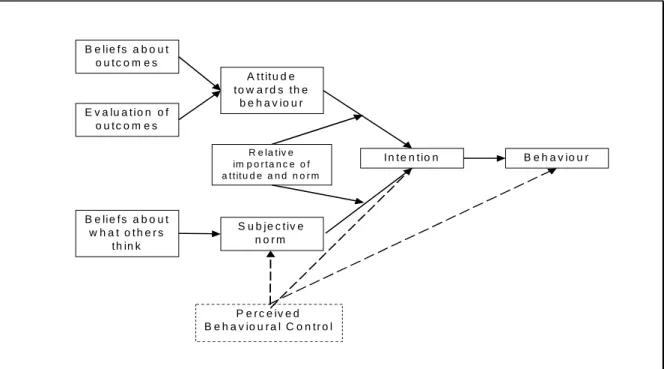
As EV models become more extended (and thus more ‘adjusted’) through the inclusion of additional factors, so the relative influence of attitudes in predicting behavioural outcomes declines. This pattern can be seen as Ajzen extended the TRA into the even more widely-used Theory of Planned Behaviour (TPB, first published in 1986, in Ajzen 1991 - Figure 2.6).
B e h a v io u r I n t e n t io n
A t t it u d e t o w a r d s t h e
b e h a v io u r
S u b je c t iv e n o r m B e lie f s a b o u t
o u t c o m e s
E v a lu a t io n o f o u t c o m e s
B e lie f s a b o u t w h a t o t h e r s
t h in k
R e la t iv e im p o r t a n c e o f a t t it u d e a n d n o r m
P e r c e iv e d B e h a v io u r a l C o n t r o l
Although the TPB includes additional factors which mean that for many behaviours it is more predictive of outcomes than the TRA (ie. it can account for more of the statistical variance in the end behaviours), the TPB is still an adjusted expectancy value model. However psychological understandings of behaviour have continued to evolve, to the point where attitudinal factors are often found to be relatively minor contributors to behavioural outcomes. For instance, in a meta-analysis of pro-environmental behaviours, Fliegenschnee and Shelakovsky (1998, in Kolmuss and Agyeman 2002) found that at least 80% of the factors influencing behaviour did not stem from knowledge or awareness. It should be emphasised that attitudes are defined as being specific to the behaviour in question. Indeed in the TRA it is stressed that the attitudes must be measured in relation to the specific behaviour in question (and not behaviours of that type) in order to maximise the predictive power of the attitudinal construct. EV theory shows that beliefs are antecedent to attitudes; in the TPB beliefs are shown as the “underlying foundations” of behaviour (Ajzen 1991). Paul Stern and colleagues’ hierarchical Schematic Causal Model of Concern (Stern et al 1995 – Figure 2.7) similarly places beliefs above attitudes, being more broad-based expressions of a general worldview, and less specific to a behaviour. However Stern disagrees with Ajzen by placing values at the top of the hierarchy; values are conceptualised as broad-based dispositions which are constructed earlier in life than beliefs and attitudes; they are also more stable over time. At the same time, values are less effective at predicting specific behavioural outcomes than attitudes; in Stern et al’s schema, they are further removed from the end behaviour.
Position in social structure, Institutional constraints, Incentive structure
Values
General Beliefs, Worldview,
Folk Ecological Theory
Specific Beliefs, Specific Attitudes
Behavioral Commitments and Intentions
E c o lo g ic a l w orld v iew (N E P )
A d v e rse c o n s e q ue n ce s fo r v a lu e d o b je c ts (AC )
P erce ive d a b ility to re d u ce th rea t (AR )
S e n se o f o b lig a tio n to ta ke p ro e n v iro n -m e n ta l a c tio n s
Ac tiv is m
N o n ac tiv is t p u b lic -s p h ere b e h a v io u rs
P riva te -s p h ere b e h a v io u rs
B e ha v io u rs in o rg a n is atio n s
V a lu es B e lie fs
P ro e nv iro n m e n ta l
P ers o n a l N orm s B e ha v io u rs
B io s p h e ric
A ltru is tic
E g o is tic
Figure 2.8: Stern et al’s Values Beliefs Norms (VBN) Theory (1999)
As well as flowing from values and beliefs, social-psychological theory shows how attitude formation is subject to external influence. The concept of persuasion is an obvious example, although modelling persuasion proved problematic for psychologists, until the development of Petty and Cacioppo’s Elaboration Likelihood Model (ELM, 1986 – in Bagozzi et al 2002 and Jackson 2005). Like the System 1/System 2 model of cognition, ELM is a dual process model, which describes how messages are processed via two routes: peripheral and central processing. The central route involves effortful deliberation, while the peripheral route is less conscious. The balance between the routes is determined by the individual’s levels of motivation and ability, which in turn can be influenced by the context and the message. Consideration of the message generates an emotional response (affect) which in turn leads to attitude formation; processing via the central route creates stronger and more durable attitudes. The ELM clearly has important implications for communicators, but it also points to a more complex, and less sequential, understanding of behaviour than EV models present.
Finally, it should be noted that not all attitudinal influence on behaviour is mediated by intentions; sometimes attitudes can generate behaviour without any conscious deliberation being involved. Fazio’s MODE model is based on EV theory, but omits the intention construct, replacing it instead with definition of the event (1986 – see Bagozzi et al 2002). The MODE model also describes a dual process, whereby under time pressure, accessible attitudes determine behavioural outcomes, as a kind of attitudinal heuristic. When under less cognitive pressure, decision making is more deliberative, and follows the paths described by the TRA (see Terry et al 2000).
2.5 Norms and identity
Put simply, “Norms guide how we should behave” (McKenzie-Mohr in Darnton 2007). The TRA’s major adjustment to EV theory was the inclusion of social norms (as well as the concept of intention). Norms appear in the TRA as ‘subjective norms’, defined as a
person’s “perception that most people who are important to him think he should or should not perform the behaviour in question” (Ajzen and Fishbein 1980, in Jackson 2005). Like attitudes, norms are specific to a behaviour (eg. the norm to recycle). The social component which norms represent is fundamental to psychological understandings of behaviour, and offers a further challenge to standard economic theory, working on the assumption of the rational man as an individual acting in isolation to maximise his subjective utility. Norms are conceptualised differently by different theorists and observing these distinctions is vital to anyone seeking to use social influence to change behaviour. While norms is generally used as a term to describe social norms, Shalom Schwartz presented the distinct but complementary concept of personal norms (Schwartz 1977). Personal norms are defined as feelings of moral obligation to act, which are free from social expectations. Schwartz used the theory to explain altruistic or ‘helping’ behaviours, a class of behaviour which has proved problematic to utility-based theories (including Darwin’s). Schwartz presents personal norms as arising from an individual’s innate values (we may recall Stern’s VBN model), but he also describes them as being internalised from social norms (“originating in social interaction but anchored in the self” – ibid.). The key distinction between personal and social norms is that the influence of social norms is seen to be dependent on external sanctions, whereas the only sanctions applying to personal norms are internalised, measured in terms of discrepancy with an individual’s self concept (ie. his sense of self). Guilt is one emotion that could arise from such a discrepancy. Personal norms are found to be better predictors of altruistic behaviours than social norms; they have also been found to be more effective at predicting a range of pro-environmental behaviours (Thogersen 2007), although distinguishing between these two closely-related factors in research experiments is clearly challenging.
In theories of both personal and social norms, it is held that norms are constantly present in cognitive processes, but that they only exert a significant influence when they become salient. Schwartz’s Norm Activation Theory (Schwartz 1977 - Figure 2.9) describes the process by which personal norms are activated.
Figure 2.9: Schwartz’s Norm Activation Theory (1977) [reproduced from Jackson 2005]
Behaviour Personal
Norm Awareness of
Consequences
Ascription of responsibility
Theory, was specifically designed to cover such delinquent behaviour (1957 - in Burgess and Nye 2006).
An equivalent activation process for social norms was proposed by Cialdini in his Focus Theory of Normative Conduct (Cialdini et al 1990). Cialdini makes the important distinction between two types of social norms: ‘descriptive norms’ which specify what is done, based on the observation of the majority of others, and ‘injunctive norms’ which specify what ought to be done. Cialdini notes that these two kinds of social norm usually act in the same direction, but that this is not always the case. Tim Jackson gives the example of motorway driving (Jackson 2005): if other drivers around him are driving over the speed limit, he may be likely to do the same (following the descriptive, not the injunctive, norm). If he sees a police car up ahead, he is likely to reduce his speed; the police car performs a focusing function, making the injunctive norm salient. The police car also provides an element of ‘surveillance’, the sense of foreboding that sanctions may be imposed which is a requirement for adherence to injunctive norms. The focusing function is also required in activating descriptive norms. In his experiments on littering, Cialdini found that when a research confederate dropped litter in an otherwise clean street, individuals under research tended not to litter themselves. Instead of mimicking the confederate, his littering drew their attention to the descriptive norm showing that most people had not littered.
More recent work by colleagues of Cialdini’s has underlined the importance of distinguishing between the two types of norms when using them as the basis for behaviour change interventions (Schultz et al 2007). The experiments were undertaken in the context of alcohol use by US college students; the research noted that the majority of colleges have undertaken information campaigns which operationalise descriptive norms, by attempting to debunk the myth that heavy drinking is widespread among their peers. By using trial communications of their own, the researchers found that messages based on descriptive norms could have a (‘destructive’) boomerang effect on those students who already drank less than the level stated in the communications. They note that, when used in isolation, the descriptive norm acted as a “magnet”, drawing individuals to achieve its stated level of behaviour. However, by adding a message based on injunctive norms (not to drink) to the communication, a positive ‘reconstructive’ effect was achieved.
In some cases, descriptive norms have also been shown to influence behavioural outcomes directly. This is especially the case in ‘morally neutral’ situations, as demonstrated in Milgram’s famous experiment where one research confederate standing in the street and staring up into the sky caused a crowd of people to gather round him and do likewise (1969, in Cialdini et al 1990). Attempts have also been made to conceptualise descriptive norms as the underlying determinants of individual behaviour, for example in Rimal’s Theory of Normative Social Behaviour (Rimal et al 2005).
Theorists are unanimous in construing social norms as instruments for maintaining the coherence of the groups to which they relate. Kurt Lewin describes ‘group standards’ as serving this function in his early work in social psychology (Lewin 1951). Schwartz similarly sees the primary function of social norms as “preserving the welfare of the collective” (Schwartz 1977). Norms are thus shown to mediate between the identity of the individual and that of the group. Turner and Tajfel’s Social Identity Theory breaks down the processes at work in this relationship (1979, in eg. Terry et al 2000). The Theory is used to explain the processes by which groups of individuals (however arbitrarily assembled) tend to differentiate themselves from one another. The two processes described are ‘categorization’, by which individuals identify themselves with like others in an in-group and differentiate themselves from the out-group, and ‘self enhancement’, through which individuals favour the in-group, and promote themselves relative to others.
Turner further developed the process of categorisation in his Self Categorisation Theory
(1987, in Terry et al op. cit.), which described how the process of constructing the in-group begins with the individual creating a ‘group prototype’, based on a set of values, beliefs, actions and feelings. In that process of construction, the individual blends his own identity with that of the group and develops shared standards. Terry describes the self-reinforcing relationship of group and individual identity in the Theory, saying “norms are inextricable properties of groups that influence individuals through self-categorisation”.
The implication of these theories for those seeking to bring about lasting behavioural change is that they must also engage with social norms, and notions of identity. While identity is influential in shaping behaviour, behaviour is also undertaken as a means of defining our sense of identity. This is a central line of narrative in Tim Jackson’s review of behavioural theory in which he demonstrates how self identity is constructed through the consumption of goods and services. As part of this thesis, he cites Giddens’ analysis of ever-increasing consumer choice as generating “dilemmas of the self” (1991, in Jackson 2005). In this complex and shifting dynamic, it may not be possible to target individuals’ sense of identity directly, but an understanding of social norms suggests that it is possible to highlight those factors, and bear on those processes by which social norms are internalised, and self identity defined.
2.6 Agency, efficacy and control
Along with attitudes and norms, agency is the third common element of most adjusted expectancy value models. Agency can be defined as an individual’s sense that they can carry out an action successfully, and that that action will help bring about the expected outcome. The broad concept of agency appears in most social-psychological models, but in a variety of different guises. It is common in the pro-environmental literature, and in health (for instance in the Health Belief Model, where it appears as an ‘enabling factor’ or ‘self efficiency’ in some versions – see eg. Conner 2002). In political thought, agency also is key to models of voter turnout: agency is inherent in ‘pivotality’, the driving belief that one’s vote could determine the final outcome (the ‘paradox of voting’ is that the odds of it doing so are very low, as Kahneman noted – see Clarke et al 2004).
For the sociologist Anthony Giddens, agency is simply the power to act (Giddens 1984); he deliberately omitted the subjective (belief-based) dimension which makes agency so indispensable to psychologists. In his Structuration Theory, Giddens opposes agency (the force exerted by the agent) and structure (the rules and resources of society). Because individuals have agency, they are also described by Giddens as ‘actors’, and this is consistent with other social-psychological theorists, such as Paul Stern (eg. in Gardner and Stern’s ‘Principles for Intervening…’ in Stern 2000 – Figure 2.10). Reflecting this thinking, in a review on pro-environmental behaviour change Darnton concluded that the audience for an intervention should not be regarded “as a passive target…but as actors who themselves are at the heart of the change process” (Darnton et al 2006). It is after all their behaviour which is to change.
A. Use multiple intervention types to address the factors limiting behaviour change
1. Limiting factors are numerous
2. Limiting factors vary with actor and situation, and over time 3. Limiting factors affect each other
B. Understand the situation from the actor’s perspective
C. When limiting factors are psychological, apply understanding of the human choice process
1. Get the actors’ attention; make limited cognitive demands
2. Apply principles of community management (credibility, commitment, face to face communication etc.)
D. Address conditions beyond the individual that constrain pro-environmental choice
E. Set realistic expectations about outcomes
F. Continually monitor responses and adjust programmes accordingly G. Stay within the bounds of actors’ tolerance for interventions
H. Use participatory methods of decision-making
Figure 2.10: Gardner and Stern’s Principles for Intervening to Change Environmentally Destructive Behaviour (1996)
In the context of pro-environmental behaviour change, action researcher David Ballard defines agency in terms of a person’s belief that they can take “meaningful action”, ie. that their action will be effective in creating positive outcomes (Ballard and Ballard 2005). Public responses to climate change are commonly characterised by a lack of agency, for instance, the sense that the problem is too large for individuals to make a difference. Ballard identifies a contrasting minority of climate change champions for whom agency is felt in a visceral way as an obligation to act; this version of agency can be read as spanning personal norms, agency, and emotions. In common with other commentators, Ballard finds that agency is accumulated through personal experience, although he also contends that agency can be acquired or learnt, primarily through working in groups with likeminded others. “Groups offer agency”, he writes, through sharing personal experiences and building shared commitment.
Self efficacy is the most widely used conceptualisation of agency in social-psychological models. Bandura’s version of the concept is the most popular; he defines self efficacy as “the conviction that one can successfully execute the behaviour required to produce the outcomes” (Bandura 1977). Bandura advocated the self efficacy construct for use in frameworks analysing “fearful and avoidant behaviour”; the concept can be derived from Hovland’s Theory of Fear Appeals, in which it appeared as “belief in the effectiveness of coping responses” (1953, in Rogers 1975). Self efficacy also appears in another model of responses to fear appeals, Rogers’ Protection Motivation Theory (Rogers 1975 – Figure 2.5). Rogers’ and Bandura’s conceptualisations are particularly similar; in both models self efficacy mediates the influence of motivations on behaviour - if the behaviour is deemed impossible it will not be undertaken (despite motivation being present).
Self efficacy determines both the initiation and the continuation of behaviour: whether to attempt the behaviour, and how long to sustain it before giving up. Self efficacy arises chiefly from past behaviour (‘performance accomplishments’, or “personal mastery experiences” for Bandura, op. cit.). For Bandura, self efficacy can also be acquired through vicarious experience, although it is noted that this is not such a reliable indicator of the likelihood of one’s achieving a particular outcome. Lastly, Bandura suggests that verbal persuasion and emotional arousal can also help increase self efficacy, although ultimately proof of mastery through personal experience is needed. Like attitudes in Ajzen and Fishbein’s models, self efficacy is deemed most predictive when measured in relation to the specific behaviour in question. Also like the attitudinal construct, self efficacy is seen as the product of a deliberative calculation, here about how much effort to expend on a given behaviour (Bandura suggests that self efficacy calculations are performed in a dedicated “central processor”). However, in contrast to theoretical accounts of attitudes and norms, self efficacy is not construed as determining behaviours alone; instead it requires “appropriate skills and adequate incentives” to be in place.
Ajzen borrowed Bandura’s self efficacy for his Perceived Behavioural Control (PBC) construct in the Theory of Planned Behaviour (TPB, Ajzen 1991 – Figure 6). Indeed the inclusion of PBC is the principal revision to the earlier TRA. Ajzen developed the TPB to allow analysis of “behaviours lacking total volitional control”; nonetheless it still operates on deliberative lines, being a (further) adjusted EV model. The concept of behavioural control is fundamental to psychology; in presenting PBC, Ajzen refers back to Rotter’s use of control in 1954.
Control is still present in some models developed since the TPB, for instance Kolmuss and Agyeman’s Model of Pro-Environmental Behaviour (Kolmuss and Agyeman 2002 – Figure 2.11). Kolmuss and Agyeman explain the ‘locus of control’ construct they use through reference to Newhouse (1991) who differentiated between people with an internal locus of control (and thus high agency) and those with an external locus of control (thus low agency). Unlike self efficacy and PBC, the locus of control is not behaviour-specific, but a general dispositional characteristic.
A similar internal/external distinction can be made between Perceived Behavioural Control (broadly internal) and actual behavioural control (based on material circumstances, or ‘facilitating conditions’ – Triandis 1977). PBC is a perception of the “ease or difficulty” of performing a behaviour (Ajzen 1991) which in turn is based on an assessment of the material limits to that behaviour; however Ajzen argues that PBC is of “greater psychological interest” than measuring the material limits per se. Ajzen uses PBC as a proxy measure for actual behavioural control, and notes that it can substitute for control when an individual’s perceptions are realistic. As Bandura observed however, this is not always the case; Ajzen reportedly commented to the health psychologists Armitage and Conner that “when PBC is inaccurate, all kinds of possibilities open up” (Armitage and Conner 2001).
Figure 2.11: Kolmuss and Agyeman’s Model of Pro-Environmental Behaviour (2002) [reproduced from Kolmuss and Agyeman 2002]
Armitage and Conner report that comment in a paper showing the results of a meta-analysis of research studies which had used either PBC or the self efficacy construct to predict behavioural outcomes. While Ajzen originally claimed that PBC and self efficacy were interchangeable, and essentially the same concept under different names, Bandura had countered that PBC was the more solidly external, while self efficacy was more internalised and purely cognitive. The distinction can be understood by an example from healthcare: when it comes to handwashing, health practitioners tend to have high self efficacy (believing themselves well able to do it). However, they may report lower PBC, due to external constraints such as a lack of time. Armitage and Conner’s analysis led them similarly to differentiate between the two constructs; given the variation in predictiveness that their analysis revealed, they recommend that studies using the TPB adapt it to substitute self efficacy for PBC.
2.7 Habit and routine
While the TPB is the best known and most widely-used social-psychological model of behaviour, it does not explicitly incorporate some factors which research shows to be significant in influencing specific behaviours. Habit is one such factor, which is highlighted by Harry Triandis in his Theory of Interpersonal Behaviour (TIB, Triandis 1977 – Figure 2.12).
Behaviour Intention Attitude Beliefs about outcomes Evaluation of outcomes Habits Facilitating Conditions Emotions Affect Social factors Norms Roles Self -concept Frequency of past behaviour Behaviour Intention Attitude Beliefs about outcomes Evaluation of outcomes Habits Facilitating Conditions Emotions Affect Social factors Norms Roles Self -concept Frequency of past behaviour Behaviour Intention Attitude Beliefs about outcomes Evaluation of outcomes Habits Facilitating Conditions Emotions Affect Social factors Norms Roles Self -concept Frequency of past behaviour
Figure 2.12: Triandis’ Theory of Interpersonal Behaviour (TIB), (1977) [reproduced from Jackson 2005]
The TIB is an adjusted expectancy value model, like the TPB (which it predates), but through the inclusion of habit, it offers an alternative view to that put forward by the TPB, of behaviour as the result of a solely deliberative process. Whereas the TPB holds beliefs as the “underlying foundations” of behaviour (Ajzen 1991), habit is seen as the primary determinant in the TIB (Triandis 1977). Triandis ranks the top three factors in the Theory in terms of their determining the probability of action, as follows: i) habit ii) intention iii) facilitating conditions. In experimental research into students’ car use behaviour, the social psycholgists Bamberg and Schmidt contrasted the two approaches of the TIB and the TPB, and compared the models’ predictive power in the context of car use (Bamberg and Schmidt 2003). They found the TIB to be more predictive of the outcomes than the TPB, due to the model’s emphasis on habit.
Rather than an adjusted expectancy value model (like TPB), it is easier to see the TIB as a dual process model; the diagram shows how intention and habit represent separate paths to the behavioural outcome. Triandis describes how, as experience of a behaviour is acquired, the influence of habit increases, and that of intention declines (Triandis 1977). This shift over time charts a process of routinisation, or increased automaticity. A similar dynamic is at play in the Prototype/Willingness Model from health psychologists Gibbons and Gerrard (Gibbons et al 2003 – Figure 2.13), which was developed to describe ‘risky behaviours’ among young people, such as drinking and drug use.
Subjective Norms
(Peers’ Behavior)
Attitudes
(Personal Vulnerability)
Behavioral Intention
Behavioral Willingness
Risk Images
Risk Behavior Previous
Behavior
Social Comparison
Figure 2.13: Gibbons and Gerrard’s Prototype/Willingness Model (2003) [reproduced from Gibbons et al 2003]
The Prototype/Willingness Model is also a dual process model, with a rational path (based on intention, or ‘behavioural expectation’) and a ‘social reaction’ path (based on ‘behavioural willingness’). As young people acquire more experience of a risky behaviour so intentions become more significant in predicting that behaviour, and they effectively move up the model. However, this model demonstrates a twist to Triandis’ Theory by showing that for ‘less appropriate’ behaviours, habit works counter-intuitively: as people begin to develop ‘bad habits’ so their behaviour becomes more not less deliberative. In later stages of drink and drug use (such as addiction) the relationship flips once again, and the habitual behaviour becomes counter-intentional.
Triandis defines habit as “situation-behaviour sequences that are or have become automatic…. The individual is not usually ‘conscious’ of these sequences.” (Triandis 1980, cited in Bamberg and Schmidt 2003). In the TIB habit is measured in terms of the frequency of the behaviour in the past, but it is activated by a system of cues triggered in response to a situation or environment. Again, we might recall the generation of ‘impressions’ in System 1 cognition. Triandis himself cites Pavlov’s theory of Classic Conditioning in which people (or famously dogs) respond to the cue (the bell ringing) as they would to the behavioural stimulus it is substituted for (food in the bowl) (Triandis 1977). In the context of Bamberg and Schmidt’s experiment, habit explains why, if it’s raining, I automatically get in the car. Habit thus serves as a heuristic or shortcut, minimising the cognitive load required to make frequently-repeating decisions.
Also addressing the role of cues, Cialdini writes how routinised behaviour becomes detached from the original motivating factors; changing those factors (eg. attitudes or intentions) will not necessarily change the habit, as their power in influencing the behaviour
has become attenuated (cited in Maio et al 2007). In this dynamic, habitual behaviours can be seen to bypass deliberative processes. Intervention techniques for changing habits thus include the rehearsal of conscious behavioural cues, and goal setting, which is designed to bring habitual behaviours back under cognitive control (Maio et al 2007 – see 4.1 below).
The groundbreaking social psychologist Kurt Lewin presented a different view of the process of habitual behaviours, not based on behavioural cues but on group standards (Lewin 1951). For Lewin, what makes habits stick is group values (as discussed above under ‘norms’). Behavioural constancy reflects the need to maintain the integrity of the group (and in so doing, self identity). Lewin thus closely relates norms and habits, and his theoretical work on change requires group participation if lasting change in habits is to be brought about (see 4.1 below). Lewin noted that habit itself is hard to conceptualise. As the theories presented here have shown, it arises from the frequency (and recency) of past behaviour, but it is more than just repeated choice. It is the automatic element of habit that differentiates it from past behaviour, and makes it cohere into patterns of routine.
Routine is a key concept in Structuration Theory, resulting from the circular (‘recursive’) flow of the self through “the sustained activities of day to day life” (Giddens 1984). Structuration also includes the dualist division of consciousness into ‘practical’ and ‘discursive’ consciousness. For Giddens, practical consciousness is implicit: “all the things an individual knows about how to go on in the context of social life”. When given voice (post-rationalised) these ‘things’ move into discursive consciousness. The central recursive process in Structuration called ‘reflexiveness’ describes a continual monitoring of our own behaviour and that of others, based on which we adapt our behaviour accordingly. This process, of which we are not aware much of the time, occurs in the practical consciousness. The reflexive process is inherently conservative, aiming to reproduce the existing social system it apprehends, and thus it perpetuates routines. For Giddens much behaviour in day to day life is “not directly motivated”, but beneath deliberation, being driven by practical consciousness (similar to a System 1 process). Social psychologists tend to agree with this conclusion. For example, Paul Stern has written “Many environmentally significant behaviours are matters of personal habit or household routine…and are rarely considered at all.” (Stern 2000).
2.8 The role of emotions
In another variation from most adjusted expectancy value models, the TIB explicitly includes the purely emotional factor of ‘affect’ (Triandis 1977 – Figure 12). This represents a further dilution of the deliberative assumption in models like the TPB. Unlike habit, which has a direct influence on behaviour in the TIB model, affect is incorporated as part of the process of intention formation. For Bamberg and Schmidt, intention in the TIB is generated via two paths: cold cognition (the expectancy value construct) and hot evaluation (the affect factor, or emotional response) (Bamberg and Schmidt 2003).
This analysis of the behavioural decision process again recalls the model of System 1/2 cognition, in which System 2 makes judgements based on System 1’s impressions (Stanovich and West 2000, in Kahneman 2002). Emotion as a basis for decision making was formalised in Slovic’s concept of the ‘affect heuristic’ (2002, in Kahneman op.cit.). Slovic, a longtime co-researcher with Kahneman, used the heuristic concept to explain the
perceptions of risk and their influence on behaviour, and the affect heuristic evolved from that work, in which people often base their personal assessments of risk not on probabilities, but quick emotional responses.
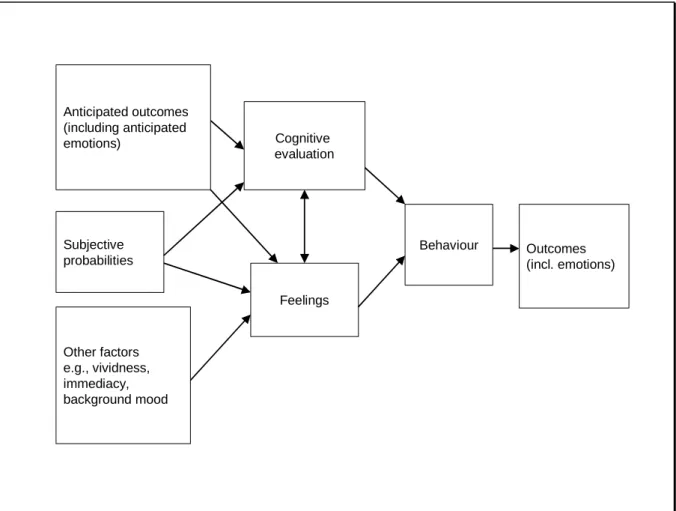
The ‘affect as information’ hypothesis and the affect heuristic both assume that emotions are congruent with attitudes. However, as Loewenstein and colleagues demonstrate, that is not always the case; clear examples are provided in the psychological conditions of anxiety and phobias. Here people’s behaviour is driven by their emotions, even though they know they have nothing to fear. Spurred by such observations, the researchers developed the Risk as Feelings Model (ibid. – see Figure 2.14), which demonstrates how behavioural outcomes can run counter to the perceived best course of action.
Anticipated outcomes (including anticipated emotions)
Subjective probabilities
Other factors e.g., vividness, immediacy, background mood
Cognitive evaluation
Feelings
Behaviour Outcomes (incl. emotions)
Figure 2.14: Loewenstein et al’s Risk as Feelings Model (2001)
Like the TIB, Risk as Feelings is a dual process model, but instead of habit, the model identifies a direct path between emotion and behaviour. However, the model also follows the TIB in showing emotion also to influence attitude formation (as ‘cognitive evaluation’) at the start of the process. As well as emotions impacting in two places, Risk as Feelings also has a temporal dimension: the theory observes how fears grow as the moment of action grows nearer, although the factors involved in the original cognitive evaluation remain unchanged. When emotions eventually overcome intentions, the result is “chickening out”.
Fear offers a clear example of the influence emotions can have on behaviour; in extreme cases it demonstrates how emotions can determine behavioural outcomes alone, without any deliberation occurring. However, emotions are more commonly construed as influencing through other social-psychological factors, such as attitudes as in the TIB. It may be recalled that the Elaboration Likelihood Model of Persuasion (Petty and
![Figure 2.1: A linear model of pro-environmental behaviour [reproduced from Kolmuss and Agyeman 2002]](https://thumb-us.123doks.com/thumbv2/123dok_us/8438072.2245330/12.892.102.815.302.417/figure-linear-model-environmental-behaviour-reproduced-kolmuss-agyeman.webp)



![Figure 2.9: Schwartz’s Norm Activation Theory (1977) [reproduced from Jackson 2005]](https://thumb-us.123doks.com/thumbv2/123dok_us/8438072.2245330/18.892.98.720.695.994/figure-schwartz-s-norm-activation-theory-reproduced-jackson.webp)
![Figure 2.11: Kolmuss and Agyeman’s Model of Pro-Environmental Behaviour (2002) [reproduced from Kolmuss and Agyeman 2002]](https://thumb-us.123doks.com/thumbv2/123dok_us/8438072.2245330/23.892.98.799.111.571/figure-kolmuss-agyeman-environmental-behaviour-reproduced-kolmuss-agyeman.webp)
![Figure 2.12: Triandis’ Theory of Interpersonal Behaviour (TIB), (1977) [reproduced from Jackson 2005]](https://thumb-us.123doks.com/thumbv2/123dok_us/8438072.2245330/24.892.100.724.105.577/figure-triandis-theory-interpersonal-behaviour-tib-reproduced-jackson.webp)
![Figure 2.13: Gibbons and Gerrard’s Prototype/Willingness Model (2003) [reproduced from Gibbons et al 2003]](https://thumb-us.123doks.com/thumbv2/123dok_us/8438072.2245330/25.892.98.759.114.606/figure-gibbons-gerrard-prototype-willingness-model-reproduced-gibbons.webp)