Reducing Behavior Problems
in the Elementary School Classroom
Reducing Behavior Problems
in the Elementary School Classroom
NCEE 2008-012
challenges that cannot currently be addressed by single interventions or programs. Authors of practice guides seldom conduct the types of systematic literature searches that are the backbone of a meta-analysis, although they take advantage of such work when it is already published. Instead, authors use their expertise to identify the most important research with respect to their recommendations, augmented by a search of recent publications to ensure that research citations are up-to-date. Unique to IES-sponsored practice guides is that they are subjected to rigorous exter-nal peer review through the same office that is responsible for independent review of other IES publications. A critical task for peer reviewers of a practice guide is to determine whether the evidence cited in support of particular recommendations is up-to-date and that studies of similar or better quality that point in a different di-rection have not been ignored. Because practice guides depend on the expertise of their authors and their group decisionmaking, the content of a practice guide is not and should not be viewed as a set of recommendations that in every case depends on and flows inevitably from scientific research.
The goal of this practice guide is to formulate specific and coherent evidence-based recommendations for use by educators to address the challenge of reducing behav-ior problems in elementary school classrooms. The guide provides practical, clear information on critical behavior-related topics and is based on the best available evidence, as judged by the panel. Recommendations presented in this guide should not be construed to imply that no further research is warranted on the effectiveness of particular strategies for preventing and intervening with behavior problems.
Reducing Behavior Problems
in the Elementary School Classroom
September 2008
Panel
Michael Epstein (Chair) UNIVERSITYOF NEBRASKA–LINCOLN
Marc Atkins
UNIVERSITYOF ILLINOIS–CHICAGO
Douglas Cullinan
NORTH CAROLINA STATE UNIVERsity
Krista Kutash
UNIVERSITYOF SOUTH FLORIDA
RESEARCHAND TRAINING CENTERFOR CHILDREN’S MENTAL HEALTH
Robin Weaver
PRINCIPAL, HARMONY HILLS ELEMENTARY SCHOOL
Staff
Michelle Woodbridge Jennifer Yu
Mary Wagner SRI INTERNATIONAL
NCEE 2008-012
Works Clearinghouse, which is operated by Mathematica Policy Research, Inc. Disclaimer
The opinions and positions expressed in this practice guide are the authors’ and do not necessarily represent the opinions and positions of the Institute of Education Sci-ences or the U.S. Department of Education. This practice guide should be reviewed and applied according to the specific needs of the educators and education agency using it, and with full realization that it represents the judgments of the review panel regarding what constitutes sensible practice, based on the research that was available at the time of publication. This practice guide should be used as a tool to assist in decisionmaking rather than as a “cookbook.” Any references within the document to specific education products are illustrative and do not imply endorse-ment of these products to the exclusion of other products that are not referenced. U.S. Department of Education
Margaret Spellings Secretary
Institute of Education Sciences Grover J. Whitehurst
Director
National Center for Education Evaluation and Regional Assistance Phoebe Cottingham
Commissioner September 2008
This report is in the public domain. While permission to reprint this publication is not necessary, the citation should be:
Epstein, M., Atkins, M., Cullinan, D., Kutash, K., and Weaver, R. (2008). Reducing Behav-ior Problems in the Elementary School Classroom: A Practice Guide (NCEE #2008-012). Washington, DC: National Center for Education Evaluation and Regional Assistance, Institute of Education Sciences, U.S. Department of Education. Retrieved from http:// ies.ed.gov/ncee/wwc/publications/practiceguides.
This report is available on the IES website at http://ies.ed.gov/ncee and http://ies. ed.gov/ncee/wwc/publications/practiceguides.
Alternative Formats
On request, this publication can be made available in alternative formats, such as Braille, large print, audiotape, or computer diskette. For more information, call the Alternative Format Center at (202) 205–8113.
in the Elementary School Classroom
Contents
Introduction
1The What Works Clearinghouse standards and their relevance to this guide 2
Overview
5Scope of the practice guide
11Checklist for carrying out the recommendations
13Recommendation 1. Identify the specifics of the problem behavior and the
conditions that prompt and reinforce it
14Recommendation 2. Modify the classroom learning environment to decrease
problem behavior
22Recommendation 3. Teach and reinforce new skills to increase appropriate
behavior and preserve a positive classroom climate
29Recommendation 4. Draw on relationships with professional colleagues and
students’ families for continued guidance and support
37Recommendation 5. Assess whether schoolwide behavior problems warrant
adopting schoolwide strategies or programs and, if so, implement ones shown
to reduce negative and foster positive interactions
44Appendix A. Postscript from the Institute of Education Sciences
51Appendix B. About the Authors
54Appendix C. Disclosure of potential conflicts of interest
56Appendix D. Technical information on the studies
57List of tables
1. Institute of Education Sciences levels of evidence for practice guides
32. Recommendations and corresponding level of evidence to support each
63. Example tally-mark data collection tool for a high-frequency behavior problem
204. Example entry sheet for a low-frequency problem behavior
20This guide is intended to help elementary school educators as well as school and district administrators develop and imple-ment effective prevention and intervention strategies that promote positive student behavior. The guide includes concrete rec-ommendations and indicates the quality of the evidence that supports them. Addition-ally, we have described some, though not all, ways in which each recommendation could be carried out. For each recommen-dation, we also acknowledge roadblocks to implementation that may be encoun-tered and suggest solutions that have the potential to circumvent the roadblocks. Finally, technical details about the stud-ies that support the recommendations are provided in Appendix D.
We, the authors, are a small group with ex-pertise in various dimensions of this topic and in research methods commonly used in behavior research. The evidence we considered in developing this document ranges from experimental evaluations, to single-subject research studies,1 to expert
analyses of behavioral intervention strat-egies and programs. For questions about what works best, high-quality experimen-tal and quasi-experimenexperimen-tal studies,2 such
1. Single-subject studies rely on the comparison of intervention effects on a single participant or group of single participants, where outcomes of the participant are compared in nontreatment (baseline) phases and in treatment phases. Some single-subject methods use subsequent with-drawal and reapplication of treatment to estimate effects. Others estimate effects using several baselines with variable-length durations for dif-ferent subjects (see Horner et al. 2005).
2. Experimental studies, often called randomized controlled trials, estimate effects of interventions by comparing outcomes of participants who are randomly assigned to experimental and one or more comparison groups (Schwartz, Flamant, and Lellouch 1980). Using random assignment rules out any pre-existing differences between groups as a reason for different outcomes and the
ncee/wwc), have a privileged position. In all cases, we pay particular attention to patterns of findings that are replicated across studies.
The process for deriving the recommen-dations began by collecting and examin-ing research studies that have evaluated the impacts of individual, classwide, and schoolwide behavioral interventions. Re-search conducted in the United States in the last 20 years was reviewed by the What Works Clearinghouse (WWC) to determine whether studies were consistent with WWC standards.
Behavioral interventions almost always in-clude multiple components. This bundling of components presents challenges when reviewing levels of evidence for each rec-ommendation because evidence of the im-pact of specific intervention components on students’ behavior cannot formally be attributed to one component of an inter-vention. Identification of key components of each intervention therefore necessar-ily relied, to a significant degree, on the panel’s expert judgment.
After identifying key components of in-dividual interventions, the interventions and their key components were placed in a working matrix that helped us identify features that were common to multiple interventions and, therefore, were logi-cal candidates for generally successful practices.
intervention becomes the probable cause of those differences. Quasi-experimental studies, such as studies that match intervention participants with individuals who are similar on a range of charac-teristics, also are used to estimate effects of inter-ventions. However, because quasi-experimental approaches cannot rule out pre-existing differ-ences between participants and the group created by matching as reasons for different outcomes, they are considered to be less valid approaches for estimating intervention effects.
The panel determined the level of evi-dence for each recommendation by con-sidering the effects of the intervention as determined by the WWC (table 1), the contribution of each component to the impacts found in the evaluation, and the number of evaluations conducted on the behavioral interventions that included the component.3
Strong refers to consistent and generaliz-able evidence that an intervention strategy or program causes an improvement in be-havioral outcomes.4
Moderate refers either to evidence from studies that allow strong causal conclu-sions but cannot be generalized with as-surance to the population on which a rec-ommendation is focused (perhaps because the findings have not been widely repli-cated) or to evidence from studies that are generalizable but have more causal ambiguity than offered by experimental designs (statistical models of correlational data or group comparison designs for which equivalence of the groups at pretest is uncertain).
Low refers to expert opinion based on rea-sonable extrapolations from research and theory on other topics and evidence from studies that do not meet the standards for moderate or strong evidence.
3. A number of specific classwide and schoolwide interventions are cited in this guide as examples of programs that include both components that align with the panel’s recommendations of ef-fective strategies to reduce student behavior problems and rigorous research methods in the study of program effectiveness. Other programs with similar components may be available. The panel recommends that readers consult the WWC website regularly for more information about in-terventions and corresponding levels of evidence (http://ies.ed.gov/ncee/wwc/reports/).
4. Following the WWC guidelines, we consider a positive, statistically significant effect or an effect size greater than 0.25 as an indicator of positive effects.
It is important for the reader to remember that the level of evidence is not a judg-ment by the panel of how effective each of these five recommended practices would be when implemented in a classroom or school or of what prior research has to say about an intervention’s effectiveness or whether the costs of implementing it are worth the benefits it might bestow. Instead, these levels of evidence ratings reflect judgments by the panel of the qual-ity of the existing research literature to support a causal claim that when these recommended practices have been imple-mented in the past, positive effects on stu-dent behaviors have been observed. They do not reflect judgments by the authors of the relative strength of these positive effects or the relative importance of these individual recommendations.
The What Works Clearinghouse
standards and their relevance to
this guide
For the levels of evidence in table 1, we rely on WWC evidence standards to rate the quality of evidence supporting behavioral prevention and intervention programs and practices. The WWC addresses evidence for the causal validity of programs and prac-tices according to WWC standards. Infor-mation about these standards is available at http://ies.ed.gov/ncee/wwc/references/ review_process. Each study is assessed ac-cording to standards and placed into one of three categories:
• Meets Evidence Standards for random-ized controlled trials and regression discontinuity studies that provide the strongest evidence of causal validity. • Meets Evidence Standards with
Reser-vations for all single-subject research studies5 and quasi-experimental studies
5. At the time this practice guide was developed, the WWC did not have standards for assessing the validity of single-subject studies (although a
Table 1. Institute of Education Sciences levels of evidence for practice guides
Strong
In general, characterization of the evidence for a recommendation as strong requires both studies with high internal validity (i.e., studies whose designs can support causal conclusions) and studies with high external validity (i.e., studies that in total include enough of the range of participants and settings on which the recommendation is focused to support the conclusion that the results can be generalized to those participants and settings). Strong evidence for this practice guide is operationalized as:
• A systematic review of research that generally meets the standards of the What Works Clearing-house (WWC) (see http://ies.ed.gov/ncee/wwc/) and supports the effectiveness of a program, prac-tice, or approach with no contradictory evidence of similar quality; OR
• Several well-designed, randomized controlled trials or well-designed quasiexperiments that gener-ally meet the WWC standards and support the effectiveness of a program, practice, or approach, with no contradictory evidence of similar quality; OR
• One large, well-designed, randomized controlled, multisite trial that meets the WWC standards and supports the effectiveness of a program, practice, or approach, with no contradictory evi-dence of similar quality; OR
• For assessments, evidence of reliability and validity that meets the Standards for Educational and Psychological Testing.a
Moderate
In general, characterization of the evidence for a recommendation as moderate requires studies with high internal validity but moderate external validity, or studies with high external validity but mod-erate internal validity. In other words, modmod-erate evidence is derived from studies that support strong causal conclusions but where generalization is uncertain, or studies that support the generality of a relationship but where the causality is uncertain. Moderate evidence for this practice guide is opera-tionalized as:
• Experiments or quasiexperiments generally meeting the WWC standards and supporting the ef-fectiveness of a program, practice, or approach with small sample sizes and/or other conditions of implementation or analysis that limit generalizability and no contrary evidence; OR
• Comparison group studies that do not demonstrate equivalence of groups at pretest and there-fore do not meet the WWC standards but that (a) consistently show enhanced outcomes for par-ticipants experiencing a particular program, practice, or approach and (b) have no major flaws related to internal validity other than lack of demonstrated equivalence at pretest (e.g., only one teacher or one class per condition, unequal amounts of instructional time, highly biased outcome measures); OR
• Correlational research with strong statistical controls for selection bias and for discerning influ-ence of endogenous factors and no contrary evidinflu-ence; OR
• For assessments, evidence of reliability that meets the Standards for Educational and Psychological Testingb but with evidence of validity from samples not adequately representative of the
popula-tion on which the recommendapopula-tion is focused.
Low
In general, characterization of the evidence for a recommendation as low means that the recommenda-tion is based on expert opinion derived from strong findings or theories in related areas and/or expert opinion buttressed by direct evidence that does not rise to the moderate or strong level. Low evidence is operationalized as evidence not meeting the standards for the moderate or high level.
a. American Educational Research Association, American Psychological Association, and National Council on Measure-ment in Education (1999).
with no design flaws and random-ized controlled trials that have prob-lems with randomization, attrition, or disruption.
• Does Not Meet Evidence Screens for studies that do not provide strong evi-dence of causal validity.6
panel was being convened to develop evidence standards for single-subject studies). To ensure that the single subject studies cited in this report met basic criteria for supporting causal state-ments, a special review process was established for these studies. A review protocol was prepared to assess the design of each study. This protocol was reviewed by the chair of the panel develop-ing evidence standards for sdevelop-ingle-subject studies. Five WWC reviewers with backgrounds in single-subject research methodology received training on this protocol and then applied the protocol to the relevant single subject studies. Reviewers were directed to identify issues that could com-promise the validity of the study, and these is-sues were examined by a second reviewer. Only studies that reviewers deemed valid are refer-enced in this practice guide.
Following the recommendations and sug-gestions for carrying out the recommen-dations, Appendix D presents more in-formation on the research evidence that supports each recommendation.
Dr. Michael Epstein Dr. Marc Atkins Dr. Doug Cullinan Dr. Krista Kutash Ms. Robin Weaver
6. Studies that were eliminated included those with major design flaws that seriously under-mined the technical adequacy of the research, such as comparison studies that did not establish equivalent groups at baseline. In addition, only studies conducted in the United States in the last 20 years that examine the effects on student be-havioral outcomes were included in the review.
Problems in the
Elementary School
Classroom
Overview
Much of the attention currently given to improving students’ academic achieve-ment addresses issues of curriculum, instructional strategies, and interven-tions or services for struggling learn-ers, and rightfully so. However, even after addressing these issues, barriers still remain for some students. An esti-mated one-third of students fail to learn because of psychosocial problems that interfere with their ability to fully attend to and engage in instructional activities, prompting a call for “new directions for addressing barriers to learning.”1 These
new approaches go beyond explicitly aca-demic interventions to take on the learn-ing challenges posed by problematic stu-dent behavior and the ways schools deal with it. Approaches aimed at improving school and classroom environments, in-cluding reducing the negative effects of disruptive or distracting behaviors, can enhance the chances that effective teach-ing and learnteach-ing will occur, both for the students exhibiting problem behaviors and for their classmates.
In many schools general education ele-mentary classrooms are generally orderly, teacher-student and student-student rela-tionships are positive, and teaching and learning go on without major disruption. Teachers in such classrooms recognize the importance of preventing significant be-havior problems and are effectively using fundamental prevention tools—engaging instruction, well-managed classrooms, and positive relationships with students.
1. Adelman and Taylor (2005).
promoting good behavior at school. How-ever, some teachers have a class in which one or a few students exhibit persistent or significant problem behaviors—those that are disruptive, oppositional, distract-ing, or defiant. Sometimes when a number of students in a classroom demonstrate such behaviors, it can create a chaotic en-vironment that is a serious impediment to learning for all students. In these cases teachers have exhausted their classroom management strategies without success-fully eliminating the obstacles to learning that problem behaviors pose. The purpose of this practice guide is to give teachers additional tools to help them deal proac-tively and effecproac-tively with behaviors that seriously or consistently fail to meet class-room expectations.
This practice guide offers five concrete recommendations (see table 2) to help ele-mentary school general education teachers reduce the frequency of the most common types of behavior problems they encoun-ter among their students. The recommen-dations begin with strategies teachers can use immediately on their own initiative in their classrooms (recommendations 1–3), then broaden to include approaches that involve resources from outside the class-room. We recognize that teachers encoun-ter situations where they need the guid-ance, expertise, and support of parents and other teachers or behavior profession-als (for example, a school psychologist or behavior specialist) in the school or com-munity, and that school administrators play a critical role in enabling mentoring and collaborative opportunities for staff (recommendation 4). We also acknowledge that the social and behavioral climate of a classroom can reflect the climate of the school more broadly, and we address the contributions of schoolwide strategies or programs to improving student behavior (recommendation 5).
Table 2. Recommendations and corresponding level of evidence to
support each
Recommendation Level of evidence
1. Identify the specifics of the problem behavior and the conditions that prompt and reinforce it. Every teacher experiences difficulty at one time or another in trying to remedy an individual student’s behavior problem that is not responsive to preventative efforts. Because research suggests that the success of a behavioral intervention hinges on identifying the specific conditions that prompt and reinforce the problem behavior (i.e., the behavior’s “antecedents” and “consequences”), we recommend that teachers carefully observe the conditions in which the problem behavior is likely to occur and not occur. Teachers then can use that information to tailor effective and efficient intervention strategies that respond to the needs of the individual student within the classroom context.
Moderate
2. Modify the classroom learning environment to decrease problem behav-ior. Many effective classroom-focused interventions to decrease stu-dents’ problematic behavior alter or remove factors that trigger them. These triggers can result from a mismatch between the classroom set-ting or academic demands and a student’s strengths, preferences, or skills. Teachers can reduce the occurrence of inappropriate behavior by revisiting and reinforcing classroom behavioral expectations; rear-ranging the classroom environment, schedule, or learning activities to meet students’ needs; and/or individually adapting instruction to pro-mote high rates of student engagement and on-task behavior.
Strong
3. Teach and reinforce new skills to increase appropriate behavior and preserve a positive classroom climate. We recommend that teachers actively teach students socially- and behaviorally-appropriate skills to replace problem behaviors using strategies focused on both indi-vidual students and the whole classroom. In doing so, teachers help students with behavior problems learn how, when, and where to use these new skills; increase the opportunities that the students have to exhibit appropriate behaviors; preserve a positive classroom climate; and manage consequences to reinforce students’ display of positive “replacement” behaviors and adaptive skills.
Strong
4. Draw on relationships with professional colleagues and students’ fami-lies for continued guidance and support. Social relationships and col-laborative opportunities can play a critical role in supporting teachers in managing disruptive behavior in their classrooms. We recommend that teachers draw on these relationships in finding ways to address the behavior problems of individual students and consider parents, school personnel, and behavioral experts as allies who can provide new insights, strategies, and support.
5. Assess whether schoolwide behavior problems warrant adopting school-wide strategies or programs and, if so, implement ones shown to reduce negative and foster positive interactions. Classroom teachers, in coordi-nation with other school personnel (administrators, grade-level teams, and special educators), can benefit from adopting a schoolwide ap-proach to preventing problem behaviors and increasing positive social interactions among students and with school staff. This type of sys-temic approach requires a shared responsibility on the part of all school personnel, particularly the administrators who establish and support consistent schoolwide practices and the teachers who implement these practices both in their individual classrooms and beyond.
Moderate
Source: Authors’ compilation based on analysis described in text.
Fundamental to these recommendations is the notion that behavior is learned— children’s behaviors are shaped by the expectations and examples provided by important adults in their lives and by their peers.2 In the elementary grades, general
education classroom teachers are argu-ably the most important adults at school for the large majority of students. As such, they can play a critical role both in pro-actively teaching and reinforcing appro-priate student behaviors and in reducing the frequency of behaviors that impede learning. Accepting responsibility for the behavioral learning of all students is a natural extension of the responsibility for the academic learning of all students that general education teachers exercise with such purpose every day. The goal of this practice guide is to help teachers carry out their dual responsibility by recommending ways to shape and manage classroom be-havior so that teaching and learning can be effective.
Understanding what prompts and rein-forces problem behaviors can be a power-ful tool for preventing them or reducing their negative impacts when they occur. The first recommendation emphasizes teachers’ gathering information about important aspects of problem behaviors in their classrooms—for example, the
2. Bandura (1977).
specific behavior a student exhibits, its effects on learning, and when, where, and how often it occurs. This information can provide important clues to the underlying purpose of the problem behavior and a foundation for developing effective ap-proaches to mitigate it.
The second recommendation points to classroom conditions or activities that teachers can alter or adapt to influence the frequency or intensity of problem be-haviors. When teachers understand the behavioral hot spots in their classroom in terms of timing, setting, and instruc-tional activities, for example, they can pro-actively develop classwide and individual student strategies (such as a change in instructional groupings, the seating plan, or the order or pace of reading and math instruction) to reduce the contribution of these classroom factors to students’ prob-lem behaviors.
The third recommendation recognizes that, just as poor academic performance can reflect deficits in specific academic skills, some students’ failure to meet be-havioral expectations reflects deficits in specific social or behavioral skills. And just as explicit instruction can help stu-dents overcome some academic deficits, explicit instruction can help students learn the positive behaviors and skills they are expected to exhibit at school. Showing
students how they can use appropriate behaviors to replace problem behaviors and consistently providing positive rein-forcement when they do so can increase students’ chances of experiencing social and behavioral success.
Recognizing the collective wisdom and problem-solving abilities of school staff, the fourth recommendation encourages teachers to reach out to colleagues in the school—other classroom teachers, spe-cial educators, the school psychologist, or administrators—to help meet the be-havioral needs of their students. Similarly, by engaging family members, teachers can better understand their students’ behavior issues and develop allies in intervening both at school and at home to help stu-dents succeed. When behavior problems warrant the services of behavioral or mtal health professionals, teachers are en-couraged to play an active role in ensuring that services address classroom behavior issues directly.
The fifth recommendation reflects an un-derstanding that a teacher may be more successful in creating a positive behavioral environment in the classroom when there also are schoolwide efforts to create such an environment. Just as teachers can docu-ment and analyze the nature and contexts of behavior problems in the classroom, school leadership teams can map the be-havioral territory of the school and use the information to develop prevention strate-gies and select and implement schoolwide programs for behavior intervention and support when warranted.
Several principles run throughout these recommendations. One relates to the im-portance of relationships in any focus on student behavior. Schooling is “an intrin-sically social enterprise.”3 Student
behav-ior is shaped by and exhibited and inter-preted in a social context that involves
3. Bryk and Schneider (2002), p. 19.
multiple actors (teachers, students, sup-port personnel, specialists), multiple set-tings ( classrooms, hallways, lunch room, playground), and multiple goals (enhanc-ing academic performance, encourag(enhanc-ing development of the whole child). Positive behavior is more likely to thrive when re-lationships at all levels are trusting and supportive and reflect a shared commit-ment to establish a healthy school and community.
In the classroom, for example, positive teacher-student interactions are at the heart of the recommendation regarding modifying classroom environment and instructional factors to improve student behavior. Associations have been found between positive interactions with teach-ers and increases in students’ social skills, emotional regulation, motivation, engage-ment, cooperation with classroom rules and expectations,4 and academic
perfor-mance. Associations also have been noted between negative interactions with teachers and increases in students’ risk for school failure.5 Teachers show the warmth,
re-spect, and sensitivity they feel for their students through small gestures, such as welcoming students by name as they enter the class each day, calling or sending posi-tive notes home to acknowledge good be-havior, and learning about their students’ interests, families, and accomplishments outside of school. Teachers also can help students develop peer friendships by hav-ing them work together, thereby learnhav-ing to share materials, follow directions, be polite, listen, show empathy, and work out dis-agreements. Fostering students’ social and emotional development can improve their interactions and attitudes toward school, thereby reducing problem behaviors.6
4. Greenberg et al. (2003); Hamre and Pianta (2005); Pianta et al. (2002); Solomon et al. (1992); Wentzel (2003); Zins et al. (2004).
5. Hamre and Pianta (2005). 6. Zins et al. (2004).
Enabling the development of strong teacher-teacher relationships in support of collaborative problem-solving regarding student behavior is central to the fourth recommendation. Schools with strong, trusting staff relationships are more likely to have teachers who are willing to engage in new practices and, consequently, who can help to produce gains in student out-comes.7 The fifth recommendation also
reflects the importance of relationships in seeking to establish “a schoolwide cul-ture of social competence.”8 Changes in
practices, structures, or programs within schools are unlikely to be implemented, sustained, or effective in the long term without concerted attention to enhanc-ing the fundamental relationships within schools.
Another principle that underlies the pan-el’s recommendations is the critical need for increased cultural competence in de-veloping positive relationships in school and community contexts. As our school and community populations become in-creasingly diverse, all school staff are chal-lenged to learn about, become sensitive to, and broaden their perspectives regarding what may be unfamiliar ways of learn-ing, behavlearn-ing, and relating. Teachers can establish an inclusive classroom environ-ment through practices such as using and reinforcing language that is gender neutral and free of stereotypes, selecting curric-ular materials that reflect and honor the cultures and life experiences of students in the class, encouraging and respecting the participation of all students in class-room activities, and holding high expecta-tions for all learners.9 School leaders can
be proactive in supporting opportunities for expanding the cultural competence of school staff through “a vigorous,
ongo-7. Bryk and Schneider (2002).
8. Vincent, Horner, and Sugai (2002), p. 2. 9. Davis (1993); Gay (2000); Harry and Kalyanpur (1994); Shade, Kelly, and Oberg (1997).
ing, and systemic process of professional development”10 that involves building
trusting relationships among school staff, taking on issues of personal culture and social disparities, and engaging the entire school community in creating a welcom-ing environment for all students and their families.
Additionally, the panel recognizes the need for and ability of school staff to translate the recommendations into ac-tions that are appropriate to their specific contexts. One clearly important contex-tual factor is the age and developmental stage of the students with whom teachers work. The ways that recommendations involving rewards for positive behavior are carried out, for example, will neces-sarily look different in 1st and 5th grade classrooms, because different forms of motivation are appropriate to students’ developmental stages. Schools in large urban districts often encounter different kinds and intensities of behavior issues than schools in affluent suburbs and have different forms and levels of resources in and outside the school to address them. The panel honors the insights of school staff in understanding what will work in their schools, classrooms, and communi-ties. Thus, recommendations emphasize processes and procedures that can be adapted to a wide range of contexts rather than providing specific recipes that may have limited applicability.
Finally, the recommendations emphasize the importance of being data driven. This means having current, timely information about behavior problems and successes at the school, classroom, and student lev-els, such as where and when the behav-ioral hot spots occur in the school and during the school day, which classroom instructional periods or transitions are associated with increased behavioral dis-ruptions, which students exhibit the most
challenging behaviors and when they are most likely to occur, and what strategies teachers have found to be effective in im-proving classroom behavior. Without a solid foundation in these kinds of data, interventions might not just be ineffective, but might even exacerbate the problems they are meant to solve. Observation and documentation of student, classroom, and school behavior challenges can be invalu-able in targeting resources and changing
strategies to improve behavior at school. Monitoring the effectiveness of strategies by continuing to collect and review data also can support continuous improvement to achieve maximum results. Challenging behaviors are learned over a long period of time; acquiring positive behaviors also takes time. Monitoring progress and cel-ebrating small achievements along the way can help sustain the efforts needed to bring success.
practice guide
The purpose of this practice guide is to help school staff promote positive stu-dent behavior and reduce challenging behaviors in U.S. elementary schools— those serving students in kindergarten through 5th grades. Because most stu-dents, including students who receive special education services, spend the majority of their school day in general education classrooms,11 the teachers in
those classrooms play a central role in influencing students’ behaviors. Thus, they are a primary focus of this practice guide. Elementary school principals and other administrators also are an audience for the recommendations presented here because they establish the structures and direct the resources needed to support teachers and other school staff in promot-ing positive environments in classrooms and schoolwide.
In the panel’s view, improving the behav-ioral climate at school must begin with an emphasis on prevention—heading off behavior problems through programs and approaches that set, encourage, and rein-force positive behavioral expectations for all students. These “universal prevention programs”12 often are described as the first
component of a three-tiered prevention model13 and, when applied to children’s
behavioral health, are considered to be effective in preventing behavior problems
11. Wagner, Marder, and Chorost (2004). 12. Kutash, Duchnowski, and Lynn (2006). 13. Commission on Chronic Illness (1957). The three-tiered model of behavioral supports in-cludes an emphasis on matching the intensity of the intervention to the severity of the behavior problem, including primary or universal (school-wide) strategies, secondary targeted intervention efforts, and tertiary or intensive individual sup-port for students with the most severe problems (Sugai et al. 2000).
of the panel’s recommendations that in-volve, for example, collecting data on inci-dents of problem behaviors, communicat-ing expectations and reinforccommunicat-ing positive behaviors, and managing classrooms ef-fectively to avoid negative behaviors. We draw on the considerable research that explicitly addresses prevention strategies and intervention programs related to chil-dren’s behavior and mental health needs in this guide. But the research on the most intensive interventions that are provided to students with the most serious behavior problems (tier 3), often outside the general education classroom, is not the primary focus of this guide. Rather, the panel sug-gests strategies to help general education classroom teachers address the needs of students for whom preventive approaches are insufficient to head off behavior prob-lems but whose behavior does not warrant removal from their classrooms.
A focus on providing recommendations to help general education teachers deal with problem behaviors in part reflects the fact that many teachers come to the classroom poorly prepared to manage the range of behaviors common among today’s students.15 Indeed, only one-third of
prin-cipals believe that their teachers are well prepared to maintain order in the class-room, and only 30 percent believe that teachers are well prepared to meet the needs of students with disabilities.16
Im-proving teachers’ preparation in classroom and behavior management at colleges and universities could be an important step in improving students’ behavior at school. Further, ongoing professional develop-ment provided by districts or schools is
14. Office of Special Education Programs (2008); Sugai et al. (2000); Sugai, Sprague, et al. (2000). 15. Levine (2006); MetLife, Inc. (2006).
much more likely to focus on building the instructional skill set of teachers than on strategies for managing classroom be-havior. For example, a national study that involved general education teachers who had students with disabilities in their lan-guage arts classes indicated that teach-ers received an average of 60 hours per year of professional development, or 180 hours over a three-year period. Yet only 36 percent of students had teachers who reported receiving at least 8 hours of pro-fessional development related to behav-ior management in that time, whereas 81 percent had teachers who received that level of professional development related to reading and language arts instruction.17
These data raise the question of whether increasing teachers’ capacity to promote positive student behavior and to deal ef-fectively with problem behavior should be a higher priority for both preservice and ongoing professional development.
17. Special Education Elementary Longitudinal Study, Wave 1 Teacher Survey (2001).
Recommendations for changes to teacher preparation and teacher professional development programs are beyond the scope of this practice guide. However, such changes must be addressed by institutions of higher education and school districts if teachers and their schools are to be fully successful in addressing the diversity of students’ behavioral support needs. Finally, the charge presented to the panel in developing this guide stressed that we focus on students’ behavior. There-fore, any academic outcomes that might be attributed to interventions were not considered to be evidence for their effec-tiveness. Only behavioral outcomes were considered in evaluating the strength of evidence for an intervention. Also, we did not consider the effects of interventions on adults (parents or teachers) in evaluating the evidence for their effectiveness. Within these parameters, the panel reached consensus on the five recommendations that follow and on the implementation steps associated with them.
Recommendation 1.
Identify the specifics of the problem behavior and the conditions that prompt and reinforce it
Concretely describe the behavior prob-lem and its effect on learning.
Observe and record the frequency and context of the problem behavior.
Identify what prompts and reinforces the problem behavior.
Recommendation 2.
Modify the classroom learning environment to decrease problem behavior
Revisit, re-practice, and reinforce class-room behavior expectations.
Modify the classroom environment to encourage instructional momentum.
Adapt or vary instructional strategies to increase opportunities for academic success and engagement.
Recommendation 3.
Teach and reinforce new skills to increase appropriate behavior and preserve a positive classroom climate
Identify where the student needs ex-plicit instruction for appropriate behavior.
Teach skills by providing examples, practice, and feedback.
Manage consequences so that reinforc-ers are provided for appropriate behavior and withheld for inappropriate behavior.
professional colleagues and students’ families for continued guidance and support
Collaborate with other teachers for con-tinued guidance and support.
Build collaborative partnerships with school, district, and community behavior experts who can consult with teachers when problems are serious enough to warrant help from outside the classroom.
Encourage parents and other family members to participate as active partners in teaching and reinforcing appropriate behavior.
Recommendation 5.
Assess whether schoolwide
behavior problems warrant adopting schoolwide strategies or programs and, if so, implement ones shown to reduce negative and foster positive interactions
Address schoolwide behavior issues by involving a school improvement team.
Collect information on the hot spots throughout the school, such as the frequency of particular schoolwide behavior problems and when and where they occur.
Monitor implementation and outcomes using an efficient method of data collection and allow ample time for the program to work.
If warranted, adopt a packaged inter-vention program that fits well with identi-fied behavior problem(s) and the school context.
Identify the specifics of
the problem behavior
and the conditions that
prompt and reinforce it
Every teacher experiences difficulty
at one time or another in trying to
remedy an individual student’s behavior
problem that is not responsive to
preventative efforts. Because research
suggests that the success of a behavior
intervention hinges on identifying the
specific conditions that prompt and
reinforce the problem behavior (that
is, the behavior’s “antecedents” and
“consequences”), we recommend that
teachers carefully observe the conditions
in which the problem behavior of an
individual student is likely to occur
and not occur. Teachers then can use
that information to tailor effective and
efficient intervention strategies that
respond to the needs of the individual
student within the classroom context.
Level of evidence:
Moderate
The panel judged the level of evidence supporting this recommendation to be moderate. A number of single-subject research studies demonstrate the effec-tiveness of behavioral interventions that are designed to address and modify what prompts and reinforces the problem be-haviors of special and general educa-tion elementary school students.1 Three
1. Much of the evidence for this recommendation is from studies involving students with school-identified emotional and behavioral disabilities— some receiving a majority of their education in self-contained classrooms. The panel believes the evidence is relevant for general education teachers because many students with disabili-ties spend part or all of their day in a general education environment. In addition, behaviors exhibited by students with disabilities are similar
sen for individual students after teach-ers gathered data on the antecedents and consequences of students’ problem behaviors, as opposed to interventions selected without attention to these fac-tors.2 Findings demonstrated greater
suc-cess in reducing inappropriate behaviors through the use of approaches based on the gathered data. An emerging lit-erature provides further evidence that general educators can play a key role in this information-gathering process by identifying the context of a problem be-havior (when, where, and why a problem behavior occurs) and selecting appropri-ate strappropri-ategies that meet students’ needs. But more research is needed to deter-mine whether consistent results can be obtained when the strategies are imple-mented by a teacher without professional consultation.3
Brief summary of evidence to
support the recommendation
Research suggests that identifying the problem behavior’s specific antecedents and consequences and then tailoring an intervention to address the distinct needs of the individual student in the classroom context are more likely to yield positive outcomes than an intervention applied without attention to the factors prompting
to those exhibited by students without school-identified disabilities in the general education population. Studies include Broussard and Nor-thup (1995); Ervin et al. (2000); Lane et al. (2007); Moore, Anderson, and Kumar (2005); Sasso et al. (1992); Stahr et al. (2006); Umbreit (1995). For re-search reviews, see Ervin et al. (2001); Heckaman et al. (2000); Kern et al. (2002).
2. Ingram, Lewis-Palmer, and Sugai (2005); New-comer and Lewis (2004); Payne, Scott, and Con-roy (2007).
3. Kamps, Wendland, and Culpepper (2006); Lane, Weisenbach et al. (2007); Mueller, Edwards, and Trahant (2003).
and reinforcing it.4 In fact, strategies not
linked to the specific context of a problem behavior are associated with increases in the occurrence of the problem behavior, perhaps because such strategies can inad-vertently reinforce the misbehavior.5
The practice of analytically identifying the purpose of a behavior before select-ing and applyselect-ing an intervention forms the foundation offunctional behavioral as-sessments6conductedto support students
with emotional disabilities or severe be-havior problems. It is important to clarify that although the panel has drawn on the research evidence from studies in which teachers contributed to functional behav-ioral assessment processes, we are not suggesting that general education teach-ers conduct formal functional behavioral assessments and analyses on their own. However, we do believe that teachers can benefit from observing and collecting data on where, when, and why a specific prob-lem behavior occurs so they can establish effective and efficient behavioral supports for all students in their classrooms. This information can assist teachers in fulfilling their important classroom duties by
neu-4. Ingram, et al. (2005); Newcomer and Lewis (2004); Payne, Scott, and Conroy (2007).
5. Ibid.
6. A functional behavioral assessment identifies and measures a specific problem behavior by de-scribing and analyzing the student’s interactions in his environment to understand variables that contribute to the occurrence of the misbehavior. There is no standard set of resources and proce-dures to conduct a functional behavioral assess-ment, but often it includes a variety of indirect assessments (for example, teacher interviews, parent interviews, or school records review), direct assessments (such as classroom observa-tions or standardized behavior checklists), and data analysis conducted by the school psycholo-gist or other behavioral experts to determine whether there are patterns associated with the behavior. For a review of sample methods and procedures to conduct a functional behavioral assessment, see O’Neill et al. (1997).
tralizing events that may trigger problem behaviors, maintaining consequences for appropriate behaviors, and eliminating the rewarding consequences of inappropriate behavior (recommendations 2 and 3). Three single-subject studies have demon-strated the success of an approach that specifically identifies and modifies what is prompting and reinforcing problem behav-iors in general education settings, with gen-eral education teachers taking substantive roles in data gathering and in the design and implementation of behavioral strate-gies. In these studies investigators success-fully trained general education elementary school teachers to respond effectively to in-appropriate behaviors by following a rein-forcement protocol developed for each stu-dent who exhibited problem behaviors—all while teachers fulfilled regular classroom responsibilities and routines.7
These studies do not provide enough evi-dence to conclude that these practices will be effective for all students or in all settings. The studies differ in data collection methods (using a variety of both direct and indirect assessment measures such as observations and interviews), in the extent of assistance from behavioral consultants (for example, in-school specialists such as school psy-chologists or outside resources such as community-based behavioral experts), and in the methods used to select interventions and strategies on the basis of accumulated knowledge about the problem behavior. As a result, some researchers have called for additional studies to be conducted with a variety of target behaviors across different settings because of concerns regarding in-consistencies when the approach involves different types of students, school-based personnel, and assessment methods.8
7. Kamps et al. (2006); Lane, Weisenbach, et al. (2007); Mueller et al. (2003).
8. Gresham (2004); Gresham et al. (2004); Sasso et al. (2001); Scott et al. (2005).
Nevertheless, the evidence suggests that the practice of understanding a problem behavior’s context can yield an effective intervention to change the behavior. We offer guidelines and examples on how general education teachers can adopt these practices. Still, teachers who be-lieve they are not equipped to handle a student’s behavior problem alone should seek ways to collaborate with other school staff, including general education teach-ers, special education teachteach-ers, school counselors, school psychologists, and administrators (as described in recom-mendation 4). As teachers gain experience and confidence in their ability to observe and collect data on target behaviors, we believe their capacity for selecting and designing effective strategies to engage students with behavioral difficulties will grow.
How to carry out the
recommendation
1. Concretely describe the behavior problem and its effect on learning.
When a student repeatedly displays off-task behavior, it is important to define the specific behavior and pinpoint the setting (or settings) in which it occurs. We recom-mend that teachers describe the behavior problem in concrete terms that are easy to communicate to the student and simple to measure. If descriptions of behaviors are vague (for example, “Jacob is always dis-ruptive”), it is difficult to assess the extent of the problem, when and where it most often occurs, and how to intervene appro-priately. Examples of concrete descriptions of problem behaviors are:
• Abraham blurts out answers without raising his hand during whole-class instruction.
• Thanh is physically aggressive toward his peers (hits, kicks, punches) during recess.
• Silvia frequently leaves her seat with-out permission during small-group instruction.
It is equally important to assess the be-havior’s impact on student learning. Mis-behavior that is brief and does not seri-ously interfere with learning (such as short instances of daydreaming, talking during transitions, or momentary inattention) should be addressed without interrupt-ing instruction through eye contact or physical proximity, for example.9
Behav-ior warrants immediate and additional at-tention if it:
• Persists, escalates, or spreads to other students.
• Lessens the student’s or other stu-dents’ ability to successfully engage in learning.
• Detracts from a positive classroom climate.
• Deviates significantly from the devel-opmentally appropriate behavior of other students.
• Causes other students or adults to avoid interacting with the student. • Threatens the safety of students or
the teacher.10
Teachers also should weigh other impor-tant factors as they try to understand a student’s behavior:
• Could the behavior reflect a cultural difference? Some behaviors, such as a student’s persistent lack of eye contact or unwillingness to compete against
9. Evertson, Emmer, and Worsham (2006). 10. Wolery, Bailey, and Sugai (1988) review char-acteristics of problem behaviors that warrant at-tention due to the behavior’s impact on class-room climate and instructional time.
peers, may be indicative of a student’s cultural background.11 Teachers should
account for differences in cultural back-ground when assessing the severity of students’ behavior problems.
• Does the student have the academic or behavioral skills necessary to meet expectations? Students with skill defi-cits may exhibit behavior problems to help them avoid or escape tasks that are difficult for them. Teachers should frequently assess students’ abilities and help them build requisite skills for appropriate behavior (see recom-mendation 3).
• Could the behavior reflect episodic stress or trauma? A student’s behavior may be a temporary reaction to a diffi-cult event, such as the death or illness of a family member. Regular commu-nication with students’ families helps teachers be understanding and sup-portive when events in students’ lives affect them in school.
2. Observe and record the frequency and context of the problem behavior.
Teachers should carefully observe and record key information about a student’s persistent problem behavior in different settings and during different activities (for example, during solitary time, group assignments, unstructured peer interac-tions) to understand better the contexts in which it does and does not occur. De-pending on the frequency of the behav-ior problem, teachers should make note of its occurrence over the course of a few days to a week until clear patterns emerge between the behavior and envi-ronmental conditions.12 Key information
11. See, for example, Gay (2000); Harry and Ka-lyanpur (1994); Shade et al. (1997).
12. O’Neill et al. (1997). See roadblock 1.1 for fur-ther recommendations on how (and how often) to document behavior problems.
to note about each instance of the behav-ior includes:
• Time of day.
• Classroom location (for example, com-puter center, reading area).
• Subject matter being taught. • Type of learning activity. • Difficulty of the task.
• Presence of particular peers or adults. Teachers might also consult with parents about whether they see similar behavior at home and, if so, the specific context of its occurrence (for example, with adults or peers). Once these data are collected, teachers may decide to discuss the findings with colleagues or local school or district behavior experts (see recommendation 4). Patterns revealed by this information will provide important clues as to what prompts the problem behavior, when it is most likely to happen, and what reinforces it.
3. Identify what prompts and reinforces the problem behavior.
Because students learn to behave in ways that satisfy a need or result in a desired outcome, we recommend that teachers ex-amine the frequency and context data they have collected to figure out the prompts and payoffs for a particular student’s misbehavior.
Teachers should carefully examine triggers that may prompt a student’s misbehavior by asking themselves when, where, and with whom problem behaviors are most likely to occur. Common environmental triggers usually cluster in three general categories: • Curricular variables (tasks that are too
hard, easy, boring, or unstructured for the student).
• Social variables (small or large group settings or the presence of particular individuals).
• Setting variables (for example, time of the day or week; distractions at home or in class; or the student’s phys-ical states, such as fatigued, ill, or hungry).13
We recommend that teachers also care-fully reflect on what usually happens after the behavior occurs, including how they react, how other students react, and the consequences that may be reinforcing the behavior. Reinforcers of a student’s persis-tent problem behavior usually derive from two common outcomes—the student’s tempt either to get something, such as at-tention or access to a preferred activity, or to escape something, such as demands, reprimands, or difficult tasks.14
Consider this example:
Michael’s disruptive behavior during math instruction is distracting others from par-ticipating and learning. When the teacher asks three students to solve a problem at the board, Michael teases the students when they walk past his desk. The snide remarks continue while they are solving the problems, and at one point, Michael takes the pencils off one of the student’s desk and hides them in his desk. When the teacher’s reprimand is not effective, she moves closer to his desk to monitor his behavior. This only causes Michael’s mis-behavior to escalate and further disrupt the lesson, so she sends him out of class to the principal’s office.
To anticipate Michael’s disruptive behav-ior and adjust environmental triggers and reinforcers, his teacher noted what hap-pened before the misbehavior to prompt
13. O’Neill et al. (1997). 14. Ibid.
it (its antecedents) and after the mis-behavior to reinforce or decrease it (its consequences).
What happened before (antecedent): A dif-ficult concept in math was modeled to the class and students were called on to work problems at the board.
Behavior: Michael distracted and teased students who were participating in whole class exercises in math. The disruptive behavior recurred two days later during a math lesson.
What happened after (consequence): Verbal reminders, physical proximity, and finally removal from class (allowing student to avoid doing the math lesson).
The teacher observed that the disruptive behaviors only occurred during math, in-dicating that Michael may have wanted to avoid engaging in the lesson. The teacher asked herself if the concept was too dif-ficult or too easy to sustain his attention and gauged the developmental appro-priateness of Michael’s behavior against the instructional and disciplinary strat-egies in play. She realized that removal of Michael from the classroom may have inadvertently reinforced his disruptive behavior because it allowed him to avoid doing the task. Because the context for the disruptive behavior was identified, the teacher planned to adjust the antecedent and consequences by using the develop-mentally appropriate strategies described below, and to continue to observe his be-havior to evaluate the success of her new approach.
Adjusted antecedents: Forewarn Michael when new concepts will be introduced in math and tell him he will be one of the students called on to offer an answer to a problem. Gauge Michael and his class-mates’ understanding of the new concept by asking several questions and offering a variety of problems for students to solve.
Adjust the difficulty of the problems on the basis of the students’ success.
Consequences: If misbehavior occurs, take Michael aside and remind him of behavior expectations during whole-group lessons. Describe how the observed behavior af-fects students’ learning. If behavior per-sists, give Michael a choice of participating in the lesson or relocating to a designated area to work on problems independently until he is ready to return to the whole group.
As demonstrated in the example, teach-ers’ attention to the antecedents and con-sequences of reoccurring behavior prob-lems can inform the development of more effective and efficient behavioral support strategies to prevent or reduce behaviors that interfere with successful classroom learning.
Potential roadblocks and solutions
Roadblock 1.1. “I don’t know how to col-lect all this information about behavior problems when I’m trying to teach a room full of students.” General education teach-ers in public schools must attend to, on average, more than 20 students in their classroom,15 so to add data collection
re-sponsibilities to their tasks can seem im-practical or impossible.
Suggested Approach. We recommend keeping methods of information gathering very simple. For example, if the problem behavior occurs several times a day, we recommend that teachers record occur-rences over just a few days. If the prob-lem behavior occurs infrequently (such as a few times a week), we recommend that teachers gather data over one or two weeks to be sure to include enough instances of the behavior to inform a plan for inter-vention. For daily observations teachers can use a chart of their daily classroom
15. U.S. Department of Education (2004).
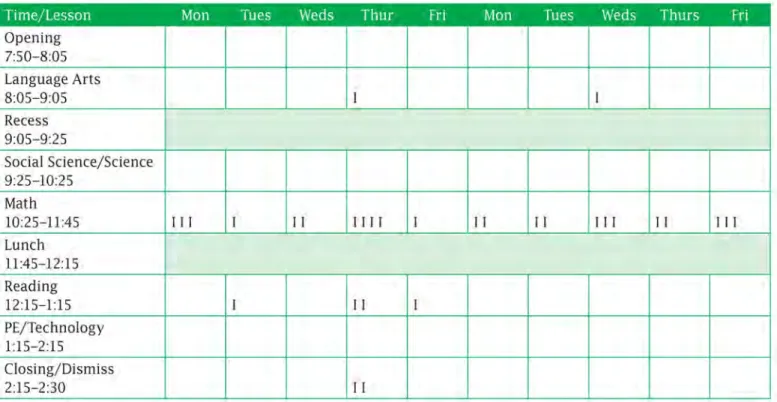
schedule and make a simple tally under the time of day and lesson activity when the target behavior occurs (see table 3).16
Over time patterns should become appar-ent, showing when the behavior is more likely and less likely to occur. For a behav-ior of low frequency teachers can make a very brief entry in a notebook or journal during transition periods (for example, at recess or between lessons) or at the end of the day about the immediate anteced-ents and consequences of the target be-havior (see table 4).17 After recording and
reviewing a number of these observations, teachers should be able to denote pat-terns in the frequency and triggers of the misbehavior.
Roadblock 1.2. “This class has so many behavior problems, I don’t know where to start.” Students’ problem behaviors can be a source of great frustration and confusion to teachers, especially when they are per-sistent and appear to be inexplicable. Suggested Approach. Multiple problem behaviors, such as disruption, inattention, and noncompliance, often originate from similar student needs, so by concentrating on one behavior in one setting, teachers may have a positive impact on others. We suggest that the teacher identify one prior-ity behavior problem—not necessarily the most troublesome or disruptive—on which to focus initial efforts. By assessing the an-tecedents and consequences that prompt and reinforce the problem behavior and developing strategies that specifically link to the underlying function of the student’s
16. The example data collection tool was adapted from O’Neill et al. (1997), p. 29. In table 3, each tally mark represents an occurrence of the high-frequency target behavior.
17. The example data collection tool was adapted from O’Neill et al. (1997), p. 33. Using table 4, teachers can enter information about low-fre-quency problem behaviors by describing the behavior in concrete terms and its antecedent(s) and consequence(s).
Table 3. Example tally-mark data collection tool for a high-frequency behavior problem
Name:
Directions: Mark a tally under the time and day when behavior problems occur with the student.
Source: Authors’ adaptation from O’Neill et al. (1997), p. 29.
Table 4. Example entry sheet for a low-frequency problem behavior
Name: Date:
Class Period:
Antecedents: What happens before the problem behavior?
(curricular, social, and set-ting variables)
Behavior: What does it look like?
(frequency, duration, intensity)
Consequences: What happens after the
problem behavior?
(reactions and reinforcers)
When, where, and with whom is the problem behavior most likely to occur? Least likely to occur? (for example, during solitary time, group assign-ments, or unstructured peer interactions)
How often does the problem behavior occur?
How long does it last? How serious is it?
How do you react?
How does the student react? How do other students react?
behavior, there may be immediate relief of problems across multiple settings and even across other problem behaviors and students. When such improvements are noted, however small, celebrate those suc-cesses with the students involved to en-courage behavior improvements in other contexts.
Roadblock 1.3. “I identified the trigger for the problem behavior and applied an inter-vention, but the student is still misbehav-ing.” Sometimes problem behaviors persist following careful selection and implemen-tation of an intervention.
Suggested Approach. First, it is impor-tant to be sure that the intervention has been given enough time to work. As a gen-eral rule, teachers should stick with an intervention for about a month or more to adequately assess its effect on problem behavior. It is not uncommon for teachers to observe a rebound effect, the worsening of behavior problems following an initial decrease, so patience and persistence are important. It also is important to remem-ber that a single problem behavior may stem from multiple triggers, so sometimes a succession of changes in classroom con-ditions is required to remedy one problem behavior. Thus, we suggest that teachers continue to collect data and observe any recurrences of a problem behavior after an initial intervention has been imple-mented, identify antecedents and conse-quences, and assess if there might be an-other explanation for the behavior. With this additional information, teachers can try another approach that responds to the function of the misbehavior and continue to collect data to assess the effectiveness of the intervention.
Roadblock 1.4. “The problem isn’t in my classroom—it travels into my classroom
from the playground.” Some teachers rec-ognize that disruptions outside the class-room can carry over and disrupt learning within it, but they are unsure how to deal with it or do not feel it is their responsibil-ity to correct such problems.
Suggested Approach. To maintain posi-tive behaviors in the classroom, we rec-ommend that teachers agree together to invest time and attention in monitor-ing behaviors that ensue throughout the school (see recommendation 5). By step-ping out of the classroom and observing lunchtime or recess activities, teachers can identify where behavior problems tend to erupt, the antecedents and conse-quences of those problem behaviors, and where increased adult supervision or be-havioral interventions may be warranted to improve the situation. Brief but regu-lar conversations between general educa-tion teachers and other staff (for example, lunchroom and recess aides, P.E. teach-ers, and music teachers) can bridge sup-port systems responsible for supervising students’ behavior inside and outside the classroom. Teachers also can inform stu-dents that their behavior will continue to be monitored outside the classroom and that in-class rewards and consequences will be administered accordingly.
In addition, to calm and focus students after they reenter the classroom from an outside activity or class, teachers can im-plement a brief cool down period before beginning a lesson. The structure and du-ration of the cool down can be adjusted to the students’ developmental levels. For example, younger elementary stu-dents could be expected to refocus their attention after the conclusion of a song; older elementary students may need just a 10-second countdown before proceeding with instruction.