Rev. 01 — 18 June 2007
Application note
Document information
Info Content
Keywords I2C-bus, level shifting
Abstract Logic level shifting may be required when interfacing legacy devices with newer devices that use a smaller geometry process. For bidirectional bus
systems like the I2C-bus, such a level shifter must also be bidirectional,
without the need of a direction control signal. The simplest way to solve this problem is by connecting a discrete MOS-FET to each bus line.
Revision history
Rev Date Description
1.
Introduction
Present technology processes for integrated circuits with clearances of 0.5µm and less limit the maximum supply voltage and consequently the logic levels for the digital I/O signals. To interface these lower voltage circuits with existing 5 V devices, a level shifter is needed. For bidirectional bus systems like the I2C-bus, such a level shifter must also be
bidirectional, without the need of a direction control signal. The simplest way to solve this problem is by connecting a discrete MOS-FET to each bus line.
2.
Bidirectional level shifter for Fast-mode and Standard-mode I
2C-bus
systems
In spite of its surprising simplicity, such a solution not only fulfils the requirement of bidirectional level shifting without a direction control signal, it also:
•
isolates a powered-down bus section from the rest of the bus system•
protects the ‘lower voltage’ side against high voltage spikes from the ‘higher-voltage’ side.The bidirectional level shifter can be used for both Standard-mode (up to100 kbit/s) or in Fast-mode (up to 400 kbit/s) I2C-bus systems. It is not intended for Hs-mode systems,
which may have a bridge with a level shifting possibility.
2.1 Connecting devices with different logic levels
Different voltage devices could be connected to the same bus by using pull-up resistors to the supply voltage line. Although this is the simplest solution, the lower voltage devices must be 5 V tolerant, which can make them more expensive to manufacture. By using a bidirectional level shifter, however, it is possible to interconnect two sections of an I2C-bus
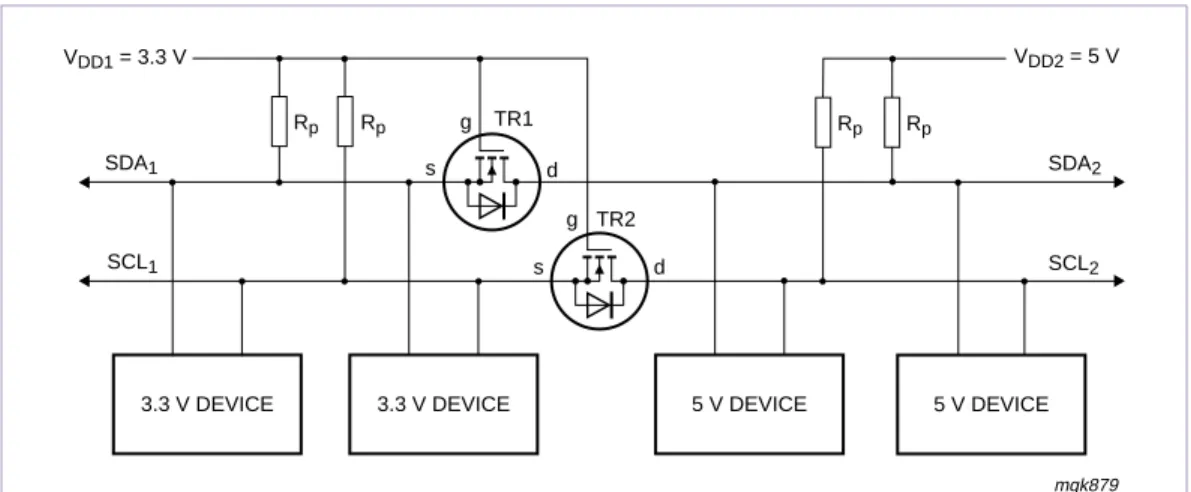
system, with each section having a different supply voltage and different logic levels. Such a configuration is shown in Figure 1. The left ‘low-voltage’ section has pull-up resistors and devices connected to a 3.3 V supply voltage; the right ‘high-voltage’ section has pull-up resistors and devices connected to a 5 V supply voltage. The devices of each section have I/Os with supply voltage related logic input levels and an open-drain output configuration.
The level shifter for each bus line is identical and consists of one discrete N-channel enhancement MOS-FET; TR1 for the serial data line SDA and TR2 for the serial clock line SCL. The gates (g) have to be connected to the lowest supply voltage VDD1, the
sources (s) to the bus lines of the ‘lower-voltage’ section, and the drains (d) to the bus lines of the ‘higher-voltage’ section. Many MOS-FETs have the substrate internally connected with its source, if this is not the case, an external connection should be made. Each MOS-FET has an integral diode (n-p junction) between the drain and substrate.
2.1.1 Operation of the level shifter
The following three states should be considered during the operation of the level shifter:
1. No device is pulling down the bus line. The bus line of the ‘lower-voltage’ section is pulled up by its pull-up resistors Rp to 3.3 V. The gate and the source of the MOS-FET
are both at 3.3 V, so its VGS is below the threshold voltage and the MOS-FET is not
conducting. This allows the bus line at the ‘higher-voltage’ section to be pulled up by its pull-up resistor Rp to 5 V. So the bus lines of both sections are HIGH, but at a
different voltage level.
2. A 3.3 V device pulls down the bus line to a LOW level. The source of the MOS-FET also becomes LOW, while the gate stays at 3.3 V. VGS rises above the threshold and
the MOS-FET starts to conduct. The bus line of the ‘higher-voltage’ section is then also pulled down to a LOW level by the 3.3 V device via the conducting MOS-FET. So the bus lines of both sections go LOW to the same voltage level.
3. A 5 V device pulls down the bus line to a LOW level. The drain-substrate diode of the MOS-FET the ‘lower-voltage’ section is pulled down until VGS passes the threshold
and the MOS-FET starts to conduct. The bus line of the ‘lower-voltage’ section is then further pulled down to a LOW level by the 5 V device via the conducting MOS-FET. So the bus lines of both sections go LOW to the same voltage level.
The three states show that the logic levels are transferred in both directions of the bus system, independent of the driving section. State 1 performs the level shift function. States 2 and 3 perform a ‘wired-AND’ function between the bus lines of both sections as required by the I2C-bus specification.
Supply voltages other than 3.3 V for VDD1 and 5 V for VDD2 can also be applied, e.g., 2 V
for VDD1 and 10 V for VDD2 is feasible. In normal operation VDD2 must be equal to or Fig 1. Bidirectional level shifter circuit connecting two different voltage sections in an
I2C-bus system
mgk879
3.3 V DEVICE 3.3 V DEVICE 5 V DEVICE 5 V DEVICE
g s d g s d TR1 TR2
VDD2 = 5 V
SDA2
SCL2
VDD1 = 3.3 V
SDA1
SCL1
3.
Abbreviations
Table 1. Abbreviations
Acronym Description
I2C-bus Inter-Integrated Circuit bus
I/O Input/Output
FET Field-Effect Transistor
4.
Legal information
4.1
Definitions
Draft — The document is a draft version only. The content is still under internal review and subject to formal approval, which may result in modifications or additions. NXP Semiconductors does not give any representations or warranties as to the accuracy or completeness of information included herein and shall have no liability for the consequences of use of such information.
4.2
Disclaimers
General — Information in this document is believed to be accurate and reliable. However, NXP Semiconductors does not give any representations or warranties, expressed or implied, as to the accuracy or completeness of such information and shall have no liability for the consequences of use of such information.
Right to make changes — NXP Semiconductors reserves the right to make changes to information published in this document, including without limitation specifications and product descriptions, at any time and without notice. This document supersedes and replaces all information supplied prior to the publication hereof.
Suitability for use — NXP Semiconductors products are not designed, authorized or warranted to be suitable for use in medical, military, aircraft, space or life support equipment, nor in applications where failure or malfunction of a NXP Semiconductors product can reasonably be expected to result in personal injury, death or severe property or environmental damage. NXP Semiconductors accepts no liability for inclusion and/or use of NXP Semiconductors products in such equipment or applications and therefore such inclusion and/or use is at the customer’s own risk.
Applications — Applications that are described herein for any of these products are for illustrative purposes only. NXP Semiconductors makes no representation or warranty that such applications will be suitable for the specified use without further testing or modification.
4.3
Trademarks
Notice: All referenced brands, product names, service names and trademarks are the property of their respective owners.
© NXP B.V. 2007. All rights reserved.
For more information, please visit: http://www.nxp.com
For sales office addresses, please send an email to: [email protected]
Date of release: 18 June 2007
Please be aware that important notices concerning this document and the product(s) described herein, have been included in section ‘Legal information’.
5.
Contents
1 Introduction . . . 3
2 Bidirectional level shifter for Fast-mode and Standard-mode I2C-bus systems . . . 3
2.1 Connecting devices with different logic levels . . . 3
2.1.1 Operation of the level shifter. . . 4
3 Abbreviations . . . 5
4 Legal information. . . 6
4.1 Definitions . . . 6
4.2 Disclaimers . . . 6
4.3 Trademarks. . . 6