Provable Data Possession at Untrusted Stores
∗Giuseppe Ateniese
†Randal Burns
†Reza Curtmola
†Joseph Herring
†Lea Kissner
‡Zachary Peterson
†Dawn Song
§ABSTRACT
We introduce a model forprovable data possession(PDP) that allows a client that has stored data at an untrusted server to verify that the server possesses the original data without retrieving it. The model generates probabilistic proofs of possession by sampling random sets of blocks from the server, which drastically reduces I/O costs. The client maintains a constant amount of metadata to verify the proof. The challenge/response protocol transmits a small, constant amount of data, which minimizes network communication. Thus, the PDP model for remote data checking supports large data sets in widely-distributed storage systems.
We present two provably-secure PDP schemes that are more efficient than previous solutions, even when compared with schemes that achieve weaker guarantees. In particular, the overhead at the server is low (or even constant), as op-posed to linear in the size of the data. Experiments using our implementation verify the practicality of PDP and re-veal that the performance of PDP is bounded by disk I/O and not by cryptographic computation.
Categories and Subject Descriptors
H.3.2 [Information Storage and Retrieval]: Informa-tion Storage.; E.3 [Data Encryption]General Terms
Security, PerformanceKeywords
Provable data possession, PDP, homomorphic verifiable tags, archival storage, storage security
†Department of Computer Science, Johns Hopkins
University, Baltimore, MD – {ateniese, randal, crix}@cs.jhu.edu, [email protected], [email protected] ‡Google, Inc. –[email protected]
§University of California Berkeley/Carnegie Mellon
Univer-sity –[email protected]
∗An extended version of the paper is available as IACR ePrint report 2007/202 [3].
Permission to make digital or hard copies of all or part of this work for personal or classroom use is granted without fee provided that copies are not made or distributed for profit or commercial advantage and that copies bear this notice and the full citation on the first page. To copy otherwise, to republish, to post on servers or to redistribute to lists, requires prior specific permission and/or a fee.
CCS’07, October 29–November 2, 2007, Alexandria, Virginia, USA.
Copyright 2007 ACM 978-1-59593-703-2/07/0011 ...$5.00.
1.
Introduction
Verifying the authenticity of data has emerged as a critical issue in storing data on untrusted servers. It arises in peer-to-peer storage systems [29, 35], network file systems [30, 26], long-term archives [32], web-service object stores [48], and database systems [31]. Such systems prevent storage servers from misrepresenting or modifying data by providing authenticity checks when accessing data.
However, archival storage requires guarantees about the authenticity of data on storage, namely that storage servers possess data. It is insufficient to detect that data have been modified or deleted when accessing the data, because it may be too late to recover lost or damaged data. Archival storage servers retain tremendous amounts of data, little of which are accessed. They also hold data for long periods of time during which there may be exposure to data loss from ad-ministration errors as the physical implementation of storage evolves,e.g., backup and restore, data migration to new sys-tems, and changing memberships in peer-to-peer systems.
Archival network storage presents unique performance de-mands. Given that file data are large and are stored at re-mote sites, accessing an entire file is expensive in I/O costs to the storage server and in transmitting the file across a net-work. Reading an entire archive, even periodically, greatly limits the scalability of network stores. (The growth in stor-age capacity has far outstripped the growth in storstor-age access times and bandwidth [44]). Furthermore, I/O incurred to establish data possession interferes with on-demand band-width to store and retrieve data. We conclude that clients need to be able to verify that a server has retained file data
without retrieving the data from the serverandwithout hav-ing the server access the entire file.
Previous solutions do not meet these requirements for proving data possession. Some schemes [20] provide a weaker guarantee by enforcing storage complexity: The server has to store an amount of data at least as large as the client’s data, but not necessarily the same exact data. Moreover, all previous techniques require the server to ac-cess the entire file, which is not feasible when dealing with large amounts of data.
We define a model for provable data possession (PDP) that provides probabilistic proof that a third party stores a file. The model is unique in that it allows the server to access small portions of the file in generating the proof; all other techniques must access the entire file. Within this model, we give the first provably-secure scheme for remote data checking. The client stores a small O(1) amount of metadata to verify the server’s proof. Also, the scheme uses
O(1) bandwidth1. The challenge and the response are each
slightly more than 1 Kilobit. We also present a more efficient version of this scheme that proves data possession using a single modular exponentiation at the server, even though it provides a weaker guarantee.
Both schemes use homomorphic verifiable tags. Because of the homomorphic property, tags computed for multiple file blocks can be combined into a single value. The client pre-computes tags for each block of a file and then stores the file and its tags with a server. At a later time, the client can verify that the server possesses the file by generating a random challenge against a randomly selected set of file blocks. Using the queried blocks and their corresponding tags, the server generates a proof of possession. The client is thus convinced of data possession, without actually having to retrieve file blocks.
The efficient PDP scheme is the fundamental construct underlying an archival introspection system that we are developing for the long-term preservation of Astronomy data. We are taking possession of multi-terabyte Astron-omy databases at a University library in order to preserve the information long after the research projects and instru-ments used to collect the data are gone. The database will be replicated at multiple sites. Sites include resource-sharing partners that exchange storage capacity to achieve reliabil-ity and scale. As such, the system is subject to freeload-ing in which partners attempt to use storage resources and contribute none of their own [20]. The location and physi-cal implementation of these replicas are managed indepen-dently by each partner and will evolve over time. Partners may even outsource storage to third-party storage server providers [23]. Efficient PDP schemes will ensure that the computational requirements of remote data checking do not unduly burden the remote storage sites.
We implemented our more efficient scheme (E-PDP) and two other remote data checking protocols and evaluated their performance. Experiments show that probabilistic pos-session guarantees make it practical to verify pospos-session of large data sets. With sampling,E-PDPverifies a 64MB file in about 0.4 seconds as compared to 1.8 seconds without sampling. Further, I/O bounds the performance ofE-PDP; it generates proofs as quickly as the disk produces data. Fi-nally, E-PDP is 185 times faster than the previous secure protocol on 768 KB files.
Contributions. In this paper we:
formally define protocols for provable data possession (PDP) that provide probabilistic proof that a third party stores a file.
introduce the first provably-secure and practical PDP schemes that guarantee data possession.
implement one of our PDP schemes and show experi-mentally that probabilistic possession guarantees make it practical to verify possession of large data sets. Our PDP schemes provide data format independence, which is a relevant feature in practical deployments (more details on this in the remarks of Section 4.3), and put no restriction on the number of times the client can challenge the server to prove data possession. Also, a variant of our
1Storage overhead and network overhead are constant in the
size of the file, but depend on the chosen security parameter.
F client F'
m
client generates metadata (m) and
modifed file (F')
client store server store
m F'
input file
no server processing
(a) Pre-process and store
client
m
(1) client generates a random challenge R
client store server store
m F'
(3) client verifies server's proof
server
(2) server computes proof of possession P
F' R
P 0/1
(b) Verify server possession
Figure 1: Protocol for provable data possession.
main PDP scheme offers public verifiability (described in Section 4.3).
Paper Organization. The rest of the paper is organized as follows. In Section 2, we describe a framework for provable data possession, emphasizing the features and parameters that are relevant for PDP. Section 3 overviews related work. In Section 4, we introduce homomorphic verifiable tags, fol-lowed by definitions for PDP schemes and then we give our constructions (S-PDPand E-PDP). We support our theo-retical claims with experiments that show the practicality of our schemes in Section 5 and conclude in Section 6.
2.
Provable Data Possession (PDP)
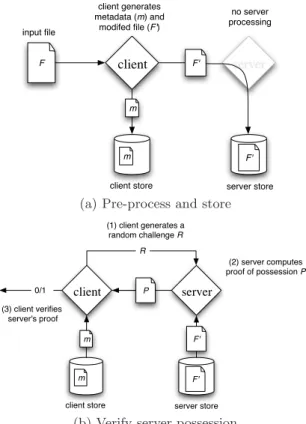
We describe a framework for provable data possession. This provides background for related work and for the spe-cific description of our schemes. A PDP protocol (Fig. 1) checks that an outsourced storage site retains a file, which consists of a collection ofnblocks. The clientC(data owner) pre-processes the file, generating a piece of metadata that is stored locally, transmits the file to the serverS, and may delete its local copy. The server stores the file and responds to challenges issued by the client. Storage at the server is in Ω(n) and storage at the client is in O(1), conforming to our notion of an outsourced storage relationship.
As part of pre-processing, the client may alter the file to be stored at the server. The client may expand the file or include additional metadata to be stored at the server. Be-fore deleting its local copy of the file, the client may execute a data possession challenge to make sure the server has suc-cessfully stored the file. Clients may encrypt a file prior to out-sourcing the storage. For our purposes, encryption is an orthogonal issue; the “file” may consist of encrypted data
[20] [20]-Wagner [17, 19] [41] [40] S-PDP E-PDP
(MHT-SC) (B-PDP)
Data possession No No Yes Yes Yes∗ Yes Yes
Supports sampling No No No No No† Yes Yes
Type of guarantee deterministic probabilistic / probabilistic
deterministic
Server block access O(n) O(logn) O(n) O(n) O(n) O(1) O(1)
Server computation O(n) O(1) O(n) O(1) O(n) O(1) O(1)
Client computation O(1) O(1) O(1) O(1) O(1) O(1) O(1)
Communication O(1) O(logn) O(1) O(1) O(n) O(1) O(1)
Client storage O(1) O(1) O(1) O(n) O(1) O(1) O(1)
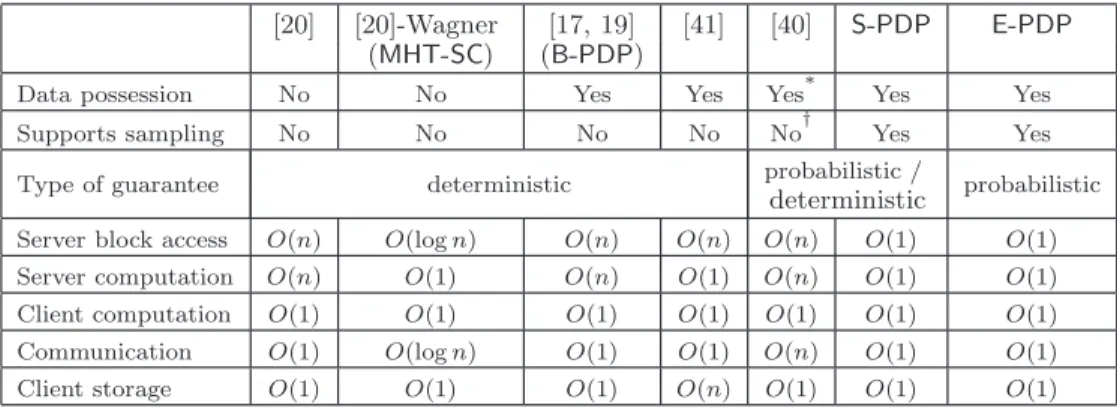
Table 1: Features and parameters (per challenge) of various PDP schemes when the server misbehaves by deleting a fraction of ann-block file (e.g., 1% of n). The server and client computation is expressed as the total cost of performing modular exponentiation operations. For simplicity, the security parameter is not included as a factor for the relevant costs.
∗ No security proof is given for this scheme, so assurance of data possession is not confirmed. † The client can ask proof for select symbols inside a block, but cannot sample across blocks.
and our metadata does not include encryption keys. At a later time, the client issues a challenge to the server to establish that the server has retained the file. The client requests that the server compute a function of the stored file, which it sends back to the client. Using its local metadata, the client verifies the response.
Threat model. The serverSmust answer challenges from the clientC; failure to do so represents a data loss. However, the server is not trusted: Even though the file is totally or partially missing, the server may try to convince the client that it possesses the file. The server’s motivation for mis-behavior can be diverse and includes reclaiming storage by discarding data that has not been or is rarely accessed (for monetary reasons), or hiding a data loss incident (due to management errors, hardware failure, compromise by out-side or inout-side attacks etc). The goal of a PDP scheme that achieves probabilistic proof of data possession is to detect server misbehavior when the server has deleted a fraction of the file.
Requirements and Parameters. The important perfor-mance parameters of a PDP scheme include:
Computation complexity: The computational cost to pre-process a file (at C), to generate a proof of pos-session (atS) and to verify such a proof (atC);
Block access complexity: The number of file blocks ac-cessed to generate a proof of possession (atS);
Communication complexity: The amount of data trans-ferred (betweenCandS).
For a scalable solution, the amount of computation and block accesses at the server should be minimized, because the server may be involved in concurrent interactions with many clients.We stress that in order to minimize bandwidth, an efficientPDPscheme cannot consist of retrieving entire file blocks. While relevant, the computation complexity at the client is of less importance, even though our schemes minimize that as well.
To meet these performance goals, our PDP schemes sam-ple the server’s storage, accessing a random subset of blocks. In doing so, the PDP schemes provide a probabilistic guar-antee of possession; a deterministic guarguar-antee cannot be pro-vided without accessing all blocks. In fact, as a special case
of our PDP scheme, the client may ask proof for all the file blocks, making the data possession guarantee determinis-tic. Sampling proves data possession with high probability based on accessing few blocks in the file, which radically alters the performance of proving data possession. Interest-ingly, when the server deletes a fraction of the file, the client can detect server misbehavior with high probability by ask-ing proof for a constant amount of blocks, independently of the total number of file blocks. As an example, for a file with n= 10,000 blocks, ifShas deleted 1% of the blocks, thenC can detect server misbehavior with probability greater than 99% by asking proof of possession for only 460 randomly se-lected blocks (representing 4.6% ofn). For more details see Section 5.1.
We list the features of our PDP schemes (S-PDP and
E-PDP) in Table 1. We also include a comparison of re-lated techniques [20], [17, 19](B-PDP), [41] and [40]. The scheme [20]-Wagner (MHT-SC) refers to the variant sug-gested by David Wagner [20], based on Merkle hash trees. Both schemes in [20] do not provide a data possession guar-antee, but only enforce storage complexity. Indeed, as noted by Golleet al.[20], the server could pass the verification pro-cedure by using (and storing) a different file, which is at least as big as the original one. We emphasize that PDP schemes that offer an inherently deterministic guarantee by access-ing all the blocks of the file ([20, 17, 19]) cannot offerboth
sampling across blocks and constant storage on the client; fundamental changes would be required in these schemes in order to avoid storingO(n) metadata on the client. The scheme in [40] allows the client to request proof of possession of segments from each file block. However, the server’s re-sponse includes one “signature” per each block, which makes its size linear with respect to the number of blocks.
A “strawman” solution.We notice that if one is willing to allow the server to send entire file blocks back to the client as proof of possession, then a simple solution is possible. Initially, the client computes a message authentication code (MAC) for each file block and stores the MACs at the server. Later, to obtain a probabilistic proof of data possession, the client retrieves a number of randomly selected file blocks and their corresponding MACs. However, this solution requires an arbitrarily large amount of bandwidth, which is linear
with respect to the number of queried blocks. In contrast, our solutions have constant network communication.
3.
Related Work
Deswarteet al.[17] and Filhoet al.[19] provide techniques to verify that a remote server stores a file using RSA-based hash functions. Unlike other hash-based approaches, it al-lows a client to perform multiple challenges using the same metadata. In this protocol, communication and client stor-age complexity are bothO(1). The limitation of the algo-rithm lies in the computational complexity at the server, which must exponentiate the entire file, accessing all of the file’s blocks. Further, RSA over the entire file is extremely slow — 20 seconds per Megabyte for 1024-bit keys on a 3.0 GHz processor [19]. In fact, these limitations led us to study algorithms that allowed for sub-file access (sampling). We implement this protocol for comparison with our PDP scheme and refer to it asB-PDP(basic PDP). A description of B-PDP is provided in the full version of the paper [3]. Shahet al. [42] use a similar technique for third-party au-diting of data stored at online service providers and put forth some of the challenges associated with auditing online storage services.
Schwarz and Miller [40] propose a scheme that allows a client to verify the storage of m/n erasure-coded data across multiple sites even if sites collude. The data possession guar-antee is achieved using a special construct, called an “alge-braic signature”: A function that fingerprints a block and has the property that the signature of the parity block equals the parity of the signatures of the data blocks. The parame-ters of the scheme limit its applicability: The file access and computation complexity at the server and the communica-tion complexity are all linear in the number of file blocks (n) per challenge. Additionally, the security of the scheme is not proven and remains in question.
Sebe et al. [41] give a protocol for remote file integrity checking, based on the Diffie-Hellman problem inZN. The
client has to storeN bits per block, where N is the size of an RSA modulus, so the total storage on the client isO(n) (which does not conform to our notion of an outsourced storage relationship). Indeed, the authors state that this so-lution only makes sense if the size of a block is much larger thanN. Moreover, the protocol requires the server to ac-cess the entire file. Similar techniques were proposed by Ya-mamotoet al. [47], in the context of checking data integrity through batch verification of homomorphic hash functions.
Homomorphic hash functions have been used in source authentication, e.g., to verify data transfer in a pay-for-bandwidth content distribution network. Krohnet al. [28] provide the best example and give a good review of other applications of homomorphic hashing. They use homomor-phism to compose multiple blocks inputs into a single value. However, this protocol can only compose specific subsets of blocks, based on erasure coding. Source authentication techniques do not apply to provable data possession.
Related to provable data possession is the enforcement of storage complexity, which shows that a server retains
an amount of information at least as large as the file re-ceived from the client; the server does not necessarily retain the original file. To the best of our knowledge, Golleet al.
[20] were the first to propose a scheme that enforces storage complexity, based on a new assumption (n-Power Decisional Diffie-Hellman). Their scheme considers a different setting
that involves three parties and provides two additional fea-tures (binding and concealing) that resemble commitment schemes. Golle et al. also briefly mention a scheme sug-gested by David Wagner, based on Merkle hash trees, which lowers the computational requirements for the server at the expense of increased communication. We implement Wag-ner’s suggestion for comparison with our PDP scheme and refer to it asMHT-SC. A description ofMHT-SCis provided in the full version of the paper [3].
Oprea et al. [39] propose a scheme based on tweakable block ciphers that allows a client to detect the modification of data blocks by an untrusted server. The scheme does not require additional storage at the server and if the client’s data has low entropy then the client only needs to keep a rel-atively low amount of state. However, verification requires the entire file to be retrieved, which means that the server file access and communication complexity are both linear with the file size per challenge. The scheme is targeted for data retrieval. It is impractical for verifying data possession. Memory checking protocols [12, 37] verify that all reads and writes to a remote memory behave identically to reads and writes to a local memory. PDP is a restricted form of memory checking in that memory checking verifies every read and write generated from a program at any granularity. Due to this restriction, memory checking is much more dif-ficult and expensive than proving data possession. Related to PDP, Naor and Rothblum introduced the problem of sub-linear authentication [37], verifying that a file stored on a remote server has not been significantly corrupted. They show that the existence of one-way functions is an essential condition for efficient online checking.
Similar to PDP, Juels and Kaliski introduce the notion of
proof of retrievability (POR) [25], which allows a server to convince a client that it can retrieve a file that was previously stored at the server. The main POR scheme uses disguised blocks (called sentinels) hidden among regular file blocks in order to detect data modification by the server. Although comparable in scope with PDP, their POR scheme can only be applied to encrypted files and can handle only a limited number of queries, which has to be fixed a priori. In contrast, our PDP schemes can be applied to (large) public databases (e.g., digital libraries, astronomy/medical/legal repositories, archives, etc.) other than encrypted ones and put no restric-tion on the number of challenges that can be executed.
An alternative to checking remote storage is to make data resistant to undetectable deletion through entanglement [45, 2], which encodes data to create dependencies among un-related data throughout the storage system. Thus, delet-ing any data reveals itself as it deletes other unrelated data throughout the system.
Our homomorphic verifiable tags are related with the con-cept of homomorphic signatures introduced by Johnson et al. [24]. As pointed out by the same authors, fully-additive homomorphic signature schemes cannot be secure; our ho-momorphic verifiable tags are able to achieve a form of mes-sage homomorphism under addition because of their special structure that uses one-time indices.
The PDP solutions that we present are the first schemes that securely prove the possession of data on an untrusted server and are computationally efficient,i.e., require a con-stant number of modular exponentiations and have concon-stant I/O complexity. This makes our PDP solutions the first schemes suitable for implementation in large data systems.
4.
Provable Data Possession Schemes
4.1 PreliminariesThe clientCwants to store on the serverS a fileFwhich is a finite ordered collection ofnblocks: F= (m1, . . . , mn).
We denote the outputxof an algorithmAbyx← A. We denote by|x|the absolute value ofx.
Homomorphic Verifiable Tags (HVTs). We introduce the concept of a homomorphic verifiable tag that will be used as a building block for our PDP schemes.
Given a messagem(corresponding to a file block), we de-note byTmits homomorphic verifiable tag. The tags will be
stored on the server together with the fileF. Homomorphic verifiable tags act as verification metadata for the file blocks and, besides being unforgeable, they also have the following properties:
Blockless verification: Using HVTs the server can con-struct a proof that allows the client to verify if the server possesses certain file blocks, even when the client does not have access to the actual file blocks.
Homomorphic tags: Given two valuesTmiandTmj, anyone can combine them into a valueTmi+mj corresponding to the sum of the messagesmi+mj.
In our construction, an HVT is a pair of values (Ti,m,Wi),
whereWiis a random value obtained from an indexiandTi,m
is stored at the server. The indexican be seen as a one-timeindex because it is never reused for computing tags (a simple way to ensure that every tag uses a different indexi is to use a global counter fori). The random valueWiis
gen-erated by concatenating the indexito a secret value, which ensures thatWiis different and unpredictable each time a tag
is computed. HVTs and their corresponding proofs have a fixed constant size and are (much) smaller than the actual file blocks.
We emphasize that techniques based onaggregate signa-tures[13], multi-signatures [33, 38], batch RSA [18], batch verification of RSA [22, 4], condensed RSA [36], etc. would all fail to provideblockless verification, which is needed by our PDP scheme. Indeed, the client has to have the ability to verify the tags onspecificfile blocks even though hedoes notpossess any of those blocks.
4.2 Definitions
We start with the precise definition of a provable data possession scheme, followed by a security definition that cap-tures the data possession property.
Definition 4.1. (Provable Data Possession Scheme (PDP))A PDP scheme is a collection of four polynomial-time algorithms (KeyGen,TagBlock,GenProof,CheckProof)
such that:
KeyGen(1k)→ (pk,sk) is a probabilistic key generation
al-gorithm that is run by the client to setup the scheme. It takes a security parameter kas input, and returns a pair of matching public and secret keys(pk,sk). TagBlock(pk,sk, m)→Tm is a (possibly probabilistic)
algo-rithm run by the client to generate the verification meta-data. It takes as inputs a public keypk, a secret keysk
and a file block m, and returns the verification meta-dataTm.
GenProof(pk,F,chal,Σ)→ V is run by the server in order to generate a proof of possession. It takes as inputs a pub-lic keypk, an ordered collectionFof blocks, a challenge
chaland an ordered collectionΣwhich is the verification metadata corresponding to the blocks inF. It returns a proof of possessionV for the blocks inFthat are deter-mined by the challengechal.
CheckProof(pk,sk,chal,V)→ {“success”,“f ailure”}is run by the client in order to validate a proof of possession. It takes as inputs a public key pk, a secret key sk, a challenge chal and a proof of possession V. It returns whetherV is a correct proof of possession for the blocks determined bychal.
A PDP system can be constructed from a PDP scheme in two phases,SetupandChallenge:
Setup: The client C is in possession of the file F and runs (pk,sk) ← KeyGen(1k), followed by T
mi ←
TagBlock(pk,sk, mi) for all 1≤i≤n. Cstores the pair
(sk,pk). Cthen sends pk,Fand Σ = (Tm1, . . . ,Tmn) to Sfor storage and deletesFand Σ from its local storage.
Challenge:C generates a challenge chal that, among other things, indicates the specific blocks for whichC wants a proof of possession. C then sendschal toS. S runs V ←GenProof(pk,F,chal,Σ) and sends toC the proof of possessionV. Finally,Ccan check the validity of the proofV by runningCheckProof(pk,sk,chal,V). In theSetup phase, C computes tags for each file block and stores them together with the file atS. In theChallenge
phase, C requests proof of possession for a subset of the blocks inF. This phase can be executed an unlimited num-ber of times in order to ascertain whetherS still possesses the selected blocks.
We state the security for a PDP system using a game that captures the data possession property. Intuitively, the Data Possession Game captures that an adversary cannot success-fully construct a valid proof without possessing all the blocks corresponding to a given challenge, unless it guesses all the missing blocks.
Data Possession Game:
Setup: The challenger runs (pk,sk) ← KeyGen(1k),
sends pk to the adversary and keeps sk secret.
Query: The adversary makes tagging queries adap-tively: It selects a block m1 and sends it to the
chal-lenger. The challenger computes the verification meta-dataTm1 ←TagBlock(pk,sk, m1) and sends it back to
the adversary. The adversary continues to query the challenger for the verification metadata Tm2, . . . ,Tmn on the blocks of its choice m2, . . . , mn. As a general
rule, the challenger generates Tmj for some 1≤j≤n, by computingTmj ←TagBlock(pk,sk, mj). The adver-sary then stores all the blocks as an ordered collection F= (m1, . . . , mn), together with the corresponding
ver-ification metadataTm1, . . . ,Tmn.
Challenge: The challenger generates a challenge chal
and requests the adversary to provide a proof of pos-session for the blocksmi1, . . . , mic determined bychal, where 1≤ij≤n,1≤j≤c,1≤c≤n.
Forge: The adversary computes a proof of possession V for the blocks indicated bychaland returnsV. If CheckProof(pk,sk,chal,V) = “success”, then the adver-sary has won the Data Possession Game.
Definition 4.2. A PDP system (Setup,Challenge) built on a PDP scheme(KeyGen,TagBlock,GenProof,CheckProof)
guarantees data possession if for any (probabilistic polynomial-time) adversaryAthe probability thatAwins the Data Pos-session Game on a set of file blocks is negligibly close to the probability that the challenger can extract those file blocks by means of a knowledge extractorE.
In our security definition, the notion of a knowledge ex-tractor is similar with the standard one introduced in the context of proofs of knowledge [5]. If the adversary is able to win the Data Possession Game, thenEcan executeGenProof
repeatedly until it extracts the selected blocks. On the other hand, ifEcannot extract the blocks, then the adversary can-not win the game with more than negligible probability. We refer the reader to [25] for a more generic and extraction-based security definition for POR and to [37] for the security definition of sub-linear authenticators.
4.3 Efficient and Secure PDP Schemes
In this section we present our PDP constructions: The first (S-PDP) provides a strong data possession guarantee, while the second (E-PDP) achieves better efficiency at the cost of weakening the data possession guarantee.
We start by introducing some additional notation used by the constructions. Let p = 2p′+ 1 and q = 2q′+ 1
be safe primes and let N = pq be an RSA modulus. Let g be a generator of QRN, the unique cyclic subgroup of
Z∗N of orderp′q′ (i.e.,QRN is the set of quadratic residues
moduloN). We can obtaingasg=a2, wherea←R Z∗Nsuch
that gcd(a±1, N) = 1. All exponentiations are performed moduloN, and for simplicity we sometimes omit writing it explicitly. Leth:{0,1}∗→QRN be a secure deterministic
hash-and-encode function2 that maps strings uniformly to
QRN.
The schemes are based on the KEA1 assumption which was introduced by Damgard in 1991 [14] and subsequently used by several others, most notably in [21, 6, 7, 27, 15]. In particular, Bellare and Palacio [6] provided a formulation of KEA1, that we follow and adapt to work in the RSA ring:
KEA1-r(Knowledge ofExponentAssumption): For any adversaryAthat takes input (N, g, gs) and returns group
elements (C, Y) such thatY = Cs, there exists an
“ex-tractor” ¯Awhich, given the same inputs asA, returnsx such thatC=gx.
Recently, KEA1 has been shown to hold in generic groups (i.e., it is secure in the generic group model) by A. Dent [16] and independently by Abe and Fehr [1]. In private com-munication, Yamamoto has informed us that Yamamoto, Fujisaki, and Abe introduced the KEA1 assumption in the RSA setting in [46]. Their assumption, named NKEA1, is the same as ours, KEA1-r, except that we restrictg to be a generator of the group of quadratic residues of orderp′q′. As noted in their paper [46], if the order is not known then the extractor returns anxsuch thatC=±gx.
Later in this section, we also show an alternative strategy which does not rely on the KEA1-r assumption, at the cost of increased network communication.
2his computed by squaring the output of the full-domain
hash function for the provably secure FDH signature scheme [8, 9] based on RSA. We refer the reader to [8] for ways to construct an FDH function out of regular hash functions, such as SHA-1. Alternatively, h can be the deterministic encoding function used in RSA-PSS [10].
S-PDP overview. We first give an overview of our prov-able data possession scheme that supports sampling. In the
Setupphase, the client computes a homomorphic verifiable tag (Ti,mi,Wi) for each block mi of the file. In order to maintain constant storage, the client generates the random valuesWi by concatenating the index ito a secret value v;
thus,TagBlockhas an extra parameter,i. Each valueTi,mi includes information about the index iof the blockmi, in
the form of a valueh(Wi) This binds the tag on a block to
that specific block, and prevents using the tag to obtain a proof for a different block. These tags are stored on the server together with the file F. The extra storage at the server is the price to pay for allowing thin clients that only store a small, constant amount of data, regardless of the file size.
In theChallengephase, the client asks the server for proof of possession of c file blocks whose indices are randomly chosen using a pseudo-random permutation keyed with a fresh randomly-chosen key for each challenge. This prevents the server from anticipating which blocks will be queried in each challenge. Calso generates a fresh (random) challenge gs = gs to ensure that S does not reuse any values from
a previous Challenge phase. The server returns a proof of possession that consists of two values: T and ρ. T is ob-tained by combining into a single value the individual tags Ti,mi corresponding to each of the requested blocks. ρ is obtained by raising the challengegs to a function of the
re-quested blocks. The valueTcontains information about the indices of the blocks requested by the client (in the form of theh(Wi) values). C can remove all theh(Wi) values fromT
because it has both the key for the pseudo-random permuta-tion (used to determine the indices of the requested blocks) and the secret value v(used to generate the values Wi). C
can then verify the validity of the server’s proof by checking if a certain relation holds betweenTandρ.
S-PDP in detail. Let κ, ℓ, λbe security parameters (λ is a positive integer) and letH be a cryptographic hash func-tion. In addition, we make use of a pseudo-random function (PRF) f and a pseudo-random permutation (PRP)πwith the following parameters:
f:{0,1}κ× {0,1}log2(n)→ {0,1}ℓ; π:{0,1}κ× {0,1}log2(n)→ {0,1}log2(n)
We write fk(x) to denote f keyed with keyk applied on
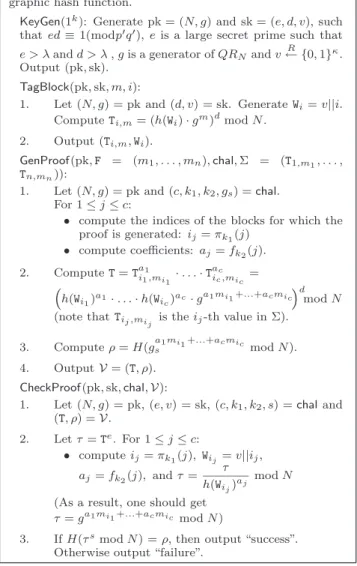
inputx. OurS-PDPscheme is described in Fig. 2. The pur-pose of including the the aj coefficients in the values for ρ
andTcomputed bySis to ensure thatS possesses each one of the requested blocks. These coefficients are determined by a PRF keyed with a fresh randomly-chosen key for each challenge, which preventsSfrom storing combinations (e.g., sums) of the original blocks instead of the original file blocks themselves. Also, we are able to maintain constant commu-nication cost because tags on blocks can be combined into a single value.
In Appendix A, we prove:
Theorem 4.3. Under the RSA and KEA1-r assump-tions, S-PDPguarantees data possession in the random or-acle model.
Regarding efficiency, we remark that each challenge re-quires a small, constant amount of communication between C andS (the challenge and the response are each slightly more than 1 Kilobit). In terms of server block access, the
As previously defined, letfbe a pseudo-random function, let πbe a pseudo-random permutation and letH be a crypto-graphic hash function.
KeyGen(1k): Generate pk = (N, g) and sk = (e, d, v), such
that ed≡1(modp′q′), eis a large secret prime such that
e > λandd > λ,gis a generator ofQRNandv← {R 0,1}κ.
Output (pk,sk). TagBlock(pk,sk, m, i):
1. Let (N, g) = pk and (d, v) = sk. GenerateWi=v||i.
ComputeTi,m= (h(Wi)·gm)dmodN.
2. Output (Ti,m,Wi).
GenProof(pk,F = (m1, . . . , mn),chal,Σ = (T1,m1, . . . , Tn,mn)):
1. Let (N, g) = pk and (c, k1, k2, gs) =chal.
For 1≤j≤c:
• compute the indices of the blocks for which the proof is generated:ij=πk1(j)
• compute coefficients: aj=fk2(j).
2. ComputeT=Ta1
i1,mi1 ·. . .·T ac ic,mic =
h(Wi1)a1·. . .·h(Wic)ac·g
a1mi1+...+acmic
d
modN (note thatTij,mij is theij-th value in Σ).
3. Computeρ=H(ga1mi1+...+acmic
s modN).
4. OutputV= (T, ρ). CheckProof(pk,sk,chal,V):
1. Let (N, g) = pk, (e, v) = sk, (c, k1, k2, s) =chaland
(T, ρ) =V.
2. Letτ=Te. For 1≤j≤c:
• computeij=πk1(j),Wij =v||ij, aj=fk2(j), andτ=
τ h(Wij)
aj modN (As a result, one should get
τ=ga1mi1+...+acmicmodN)
3. IfH(τsmodN) =ρ, then output “success”.
Otherwise output “failure”.
We construct a PDP system from a PDP scheme in two phases,SetupandChallenge:
Setup: The client C runs (pk,sk) ← KeyGen(1k), stores
(sk,pk) and sets (N, g) = pk, (e, d, v) = sk. C then runs (Ti,mi,Wi) ←TagBlock(pk,(d, v), mi, i) for all 1 ≤i ≤ n and sends pk,Fand Σ = (T1,m1, . . . ,Tn,mn) toSfor stor-age. Cmay now deleteFand Σ from its local storage. Challenge: C requests proof of possession for c distinct blocks of the fileF(with 1≤c≤n):
1. Cgenerates the challengechal= (c, k1, k2, gs), where k1 ← {R 0,1}κ, k2 ← {R 0,1}κ, gs = gsmodN and s←R Z∗N.CsendschaltoS.
2. S runs V ← GenProof(pk,F,chal,Σ = (T1,m1, . . . , Tn,mn)) and sends toC the proof of possessionV. 3. Csetschal= (c, k1, k2, s) and checks the validity of
the proofVby runningCheckProof(pk,(e, v),chal,V).
Figure 2: S-PDP: a PDP scheme with strong data possession guarantee
demands are c accesses for S, while in terms of computa-tion we havecexponentiations for bothC andS. WhenS deletes a fraction of the file blocks, cis a relatively small, constant value, which gives theO(1) parameters in Table 1
(for more details, see Section 5.1). Since the size of the file is O(n), accommodating the additional tags does not change (asymptotically) the storage requirements for the server.
In our analysis we assume w.l.o.g. that the indices for the blocks picked by the client in a challenge are different. One way to achieve this is to implementπusing the techniques proposed by Black and Rogaway [11]. In a practical deploy-ment, our protocol can tolerate collisions of these indices. Moreover, notice that the client can dynamically append new blocks to the stored file after theSetupphase, without re-tagging the entire file.
Notice that the server may store the client’s fileFhowever it sees fit, as long as it is able to recover the file when an-swering a challenge. For example, it is allowed to compressF (e.g., if all the blocks ofFare identical, then the server may only store one full block and the information that all the blocks are equal). Alternatively, w.l.o.g., one could assume thatFhas been optimally compressed by the client and the size ofFis equal toF’s information entropy function.
A concrete example of using S-PDP. For a concrete example of usingS-PDP, we consider a 1024-bit modulusN and a 4 GB file F which has n = 1,000,000 4KB blocks. DuringSetup,Cstores the file and the tags atS. The tags require additional storage of 128 MB. The client stores about 3 Kbytes (N, e, deach have 1024 bits and v has 128 bits). During theChallenge phase,C andS use AES forπ (used to select the random block indicesi), HMAC forf (used to determine the random coefficients a) and SHA1 forH. In a challenge,C sends toS four values which total 168 bytes (c has 4 bytes, k1 has 16 bytes, k2 has 20 bytes, gs has
1024 bits). Assuming thatS deletes at least 1% of F, then C can detect server misbehavior with probability over 99% by asking proof forc= 460 randomly selected blocks. The server’s response contains two values which total 148 bytes (Thas 1024 bits, ρ has 20 bytes). We emphasize that the server’s response to a challenge consists of a small, constant value; in particular, the server does not send back to the client any of the file blocks and not even their sum.
A more efficient scheme, with weaker guarantees (E-PDP). OurS-PDPscheme provides the guarantee that S possesses each one of thecblocks for whichC requested proof of possession in a challenge. We now describe a more efficient variant ofS-PDP, which we callE-PDP, that achieves better performance at the cost of offering weaker guarantees. E-PDPdiffers fromS-PDPonly in that all the coefficientsaj are equal to 1:
In GenProof (steps 2 and 3) the server computesT = Ti1,m1·. . .·Tic,mc andρ=H(g
mi1+...+mic
s modN).
In CheckProof (step 2) the client computes τ = Te
h(Wi1)·. . .·h(Wic)
modN.
TheE-PDPscheme reduces the computation on both the server and the the client to one exponentiation, as described in Table 1 (see Server Computation details in Section 5.2, the server computesρas one exponentiation to a value whose size in bits is slightly larger than|mi|). E-PDPonly
guar-antees possession of the sum of the blocksmi1+. . .+mic and not necessarily possession of each one of the blocks for which the client requests proof of possession. However, we argue next that this is not a practical concern.
If the server pre-computes and stores the sums of all possi-ble combinations ofcblocks out of thenblocks ( n
c
values), then the server could successfully pass any challenge. When usingE-PDP, the client needs to choose the parameters of the scheme such that it is infeasible for the server to mis-behave by pre-computing and storing all these sums. For example, ifn= 1000 andc= 101, the server needs to pre-compute and store≈10140 values and might be better off
trying to factorN. The client can also reduce the server’s ability to misbehave by choosingc as a prime integer and by using a differentcvalue for each challenge.
An alternative strategy (No KEA1-r Assumption).
Instead of the value ρ, the server S could send the sum of the queried blocks as an integer (S does not know the order ofQRN) and letCverify the proof of possession using
this value. Thus, we will not have to rely on the KEA1-r assumption. However, network communication will increase by a significant amount.
In addition, notice that any solution based on proofs of knowledge of the sum would require even more bandwidth than just sending the sum itself. This is, again, becauseS does not know the order ofQRN and would have to work
with large integers.
Public verifiability.The variant of the protocol described above that does not rely on KEA1-r can be further modified in order to offer thepublic verifiability property, which al-lows anyone, not just the data owner, to challenge the server for data possession. The advantages of having public veri-fiability are akin to those of public-key over symmetric-key cryptography.
The size of the each file block and the coefficientsai’s (the
outputs of the pseudo-random functionf) is now limited so that the sum of anycblocks will be less thanλ/2 (remember thate > λ). The following changes should be applied to the
S-PDPprotocol (described in Fig. 2):
the client (data owner) makesepublic (along withN, g). the values Wi are generated as Wi = wv(i), where w is a
PRF such that w : {0,1}κ× {0,1}log2(n) → {0,1}ℓ and
v← {0R ,1}κ.
after the initialSetupphase, the client (data owner) pub-lishesv(the key for the PRFw).
inGenProofand inCheckProof, the challengechaldoes not contain the valuesgs andsanymore (also, in theChallenge
phase these values are not used anymore).
inGenProofthe server computesM =a1mi1+. . .+acmic instead ofρand returnsV = (T, M).
inCheckProof, step 3, the client now checks whethergM = τ and, in addition, the client checks whether |M| < λ/2. (This test ensures that, in the proof in Appendix A, the condition gcd(e,2(M∗−M)) = 1 is verified.)
The communication cost of this variant is now slightly larger than the size of a file block. We leave as an open problem devising publicly-verifiable PDP schemes where the size of challenges and responses is less than the size of a single file block.
In Appendix A, we prove:
Theorem 4.4. Under the RSA assumption, the scheme above guarantees publicly-verifiable data possession in the random oracle model.
Remark 1 (Data Format Independence). Our PDP schemes put no restriction on the format of the data, in particular files stored at the server do not have to be en-crypted. This feature is very relevant since we anticipate that PDP schemes will have the biggest impact when used with large public repositories (e.g., digital libraries, astron-omy/medical/legal repositories, archives etc.).
Remark 2 (Prime-order Group Variant). Alterna-tively, our PDP schemes can potentially be modified to work within a group of a publicly-known prime orderq. In this case, however, file blocks (seen as integers) must be less thanq, otherwise the server could simply store them reduced moduloq. In a prime-order setting, network communication is further reduced (particularly in the elliptic curve setting), but pre-processing becomes more expensive given the small size of the file blocks. In contrast, the RSA setting allows us to work with arbitrarily large file blocks.
Remark 3 (Multiple Files). We have described PDP schemes for the case when a client stores a single file Fon the server. In theTagBlockalgorithm, for each blockmithe
client computes a tag over the tuple (Wi, mi). We emphasize
that the valuesWicannot be reused. SinceWiis obtained by
concatenating a secret valuevwithi, this implies that the indicesi must be different across all tags. In other words, the client should not use the same index twice for computing tags. This condition holds because in our scheme an index iis simply the position of the blockmiin the file.
In order to store multiple files on the server, the client must ensure that indices used to compute tags are dis-tinct not only across the tags corresponding to the blocks of each file, but also across the tags corresponding to the blocks of all files. One simple method to achieve this is to pre-pend the file’s identifier to the index. For exam-ple, if the identifier of a file F = (m1, . . . , mn) is given
by id(F), then for each block mi, 1≤ i ≤n, C computes
the tag (Tid(F)||i,mi,Wid(F)||i)←TagBlock(pk,sk, mi,id(F)||i). The uniqueness of indices is ensured under the assumption that each file has a unique identifier. Another simple way to ensure that indices are only used once is to use a global counter for the index, which is incremented by the client each time after a tag is computed.
5.
System Implementation and
Perfor-mance Evaluation
5.1 Probabilistic FrameworkOur PDP schemes allow the server to prove possession of select blocks of F. This “sampling” ability greatly reduces the workload on the server, while still achieving detection of server misbehavior with high probability. We now ana-lyze the probabilistic guarantees offered by a scheme that supports block sampling.
AssumeS deletest blocks out of then-block file F. Let cbe the number of different blocks for whichC asks proof in a challenge. LetX be a discrete random variable that is defined to be the number of blocks chosen byCthat match the blocks deleted byS. We computePX, the probability
that at least one of the blocks picked byC matches one of the blocks deleted byS. We have:
PX =P{X ≥1} = 1−P{X = 0}= 1−n−t
n ·
n−1−t n−1 ·
c (number of queried blocks) (as a percentage of n)
n (number of file blocks)
0.99
0.9 0.8 0.7 0.6 0.5
0 5 10 15 20 0
2000 4000 6000 8000 10000
(a)t= 1% ofn
c (number of queried blocks) (as a percentage of n)
n (number of file blocks)
0.99
0.9 0.8 0.7 0.6 0.5
0 1 2 3 4 5 0
2000 4000 6000 8000 10000
(b)t= 5% ofn
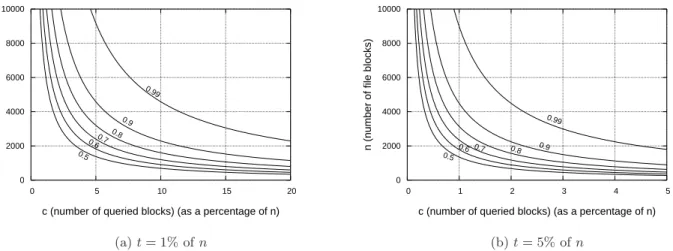
Figure 3: PX, the probability of server misbehavior detection. We show PX as a function ofn (the number
of file blocks) and c(the number of blocks queried by the client, shown as a percentage of n) for two values oft(the number of blocks deleted by the server). Note that each graph has a different scale.
n−2−t n−2 ·. . .·
n−c+ 1−t n−c+ 1 . Since
n−i−t n−i ≥
n−i−1−t n−i−1 , it follows that: 1−
n−t
n
c
≤PX≤1−
n−c+ 1−t n−c+ 1
c
. PX indicates the probability that, if S deletes t blocks
of the file, then C will detect server misbehavior after a challenge in which it asks proof forc blocks. Fig. 3 plots PX for different values ofn, t, c. Interestingly, whentis a
fraction of the file,C can detect server misbehavior with a certain probability by asking proof for a constant amount of blocks, independently of the total number of file blocks:e.g., ift= 1% ofn, thenC asks for 460 blocks and 300 blocks in order to achievePX of at least 99% and 95%, respectively.
5.2 Implementation and Experimental Results
We measure the performance ofE-PDPand the benefits of sampling based on our implementation ofE-PDPin Linux. As a basis for comparison, we have also implemented the scheme of Deswarteet al.[17] and Filhoet al. [19] (B-PDP), and the more efficient scheme in [20] (MHT-SC) suggested by David Wagner (these schemes are described in the full version of the paper [3]).
All experiments were conducted on an Intel 2.8 GHz Pen-tium IV system with a 512 KB cache, an 800 MHz EPCI bus, and 1024 MB of RAM. The system runs Red Hat Linux 9, kernel version 2.4.22. Algorithms use the crypto library of OpenSSL version 0.9.8b with a modulusN of size 1024 bits and files have 4KB blocks. Experiments that measure disk I/O performance do so by storing files on an ext3 file system on a Seagate Barracuda 7200.7 (ST380011A) 80GB Ultra ATA/100 drive. All experimental results represent the mean of 20 trials. Because results varied little across trials, we do not present confidence intervals.
Sampling. To quantify the performance benefits of sam-pling forE-PDP, we compare the client and server perfor-mance for detecting 1% missing or faulty data at 95% and 99% confidence (Fig. 4). These results are compared with usingE-PDPover all blocks of the file at large file sizes, up to 64 MB. We measure both the computation time only (in memory) as well as the overall time (on disk), which includes
I/O costs.
Examining all blocks uses time linear in the file size for files larger than 4MB. This is the point at which the compu-tation becomes bound from either memory or disk through-put. Larger inputs amortize the cost of the single exponen-tiation required byE-PDP. This is also the point at which the performance of sampling diverges. The number of blocks needed to achieve the target confidence level governs perfor-mance.
For larger files,E-PDPgenerates data as fast as it can be accessed from memory and summed, because it only com-putes a single exponentiation. InE-PDP, the server gener-atesP
c
i=1mi, which it exponentiates. The maximum size of
this quantity in bits is|mi|+ log2(c); its maximum value is
c·2|mi|. Thus, the cryptographic costs grows logarithmically in the file size. The linear cost of accessing all data blocks and computing the sum dominate this logarithmic growth.
Comparing results when data are on disk versus in cache shows that disk throughput bounds E-PDP’s performance when accessing all blocks. With the exception of the first blocks of a file, I/O and the challenge computation occur in parallel. Thus, E-PDPgenerates proofs faster than the disk can deliver data: 1.0 second versus 1.8 seconds for a 64 MB file. Because I/O bounds performance, no protocol can outperformE-PDPby more than the startup costs. While faster, multiple-disk storage may remove the I/O bound to-day. Over time increases in processor speeds will exceed those of disk bandwidth and the I/O bound will hold.
Sampling breaks the linear scaling relationship between time to generate a proof of data possession and the size of the file. At 99% confidence,E-PDPcan build a proof of pos-session for any file, up to 64 MB in size in about 0.4 seconds. Disk I/O incurs about 0.04 seconds of additional runtime for larger file sizes over the in-memory results. Sampling per-formance characterizes the benefits ofE-PDP. Probabilistic guarantees make it practical to use public-key cryptography constructs to verify possession of very large data sets.
Server Computation. The next experiments look at the worst-case performance of generating a proof of possession,
0 0.2 0.4 0.6 0.8 1 1.2 1.4 1.6 1.8 2
0 10000 20000 30000 40000 50000 60000
File Size (KB)
T
ime (seconds)
All Blocks 99% 95%
(a) Server (in cache)
0 0.2 0.4 0.6 0.8 1 1.2 1.4 1.6 1.8 2
0 10000 20000 30000 40000 50000 60000
File Size (KB)
T
ime (seconds)
All Blocks 99% 95%
(b) Server (on disk)
Figure 4: Performance of sampling at multiple con-fidence levels.
which is useful for planning purposes to allow the server to allocate enough resources. ForE-PDP, this means sampling every block in the file, while forMHT-SCthis means com-puting the entire hash tree. We compare the computation complexity of E-PDPwith other algorithms, which do not support sampling. All schemes perform an equivalent num-ber of disk and memory accesses.
In step 3 of theGenProof algorithm ofS-PDP,S has two ways of computingρ: Either sum the valuesajmij (as inte-gers) and then exponentiategsto this sum or exponentiate gsto each valueajmij and then multiply all values. We ob-served that the former choice takes considerable less time, as it only involves one exponentiation to a (|mi|+ℓ+log2(c))-bit
number, as opposed tocexponentiations to a (|mi|+ℓ)-bit
number (typically,ℓ= 160).
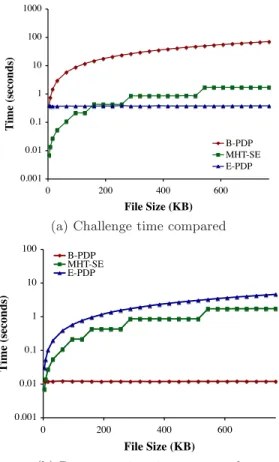
Fig. 5(a) shows the computation time as a function of file size used at the server when computing a proof forB-PDP,
MHT-SCand E-PDP. Note the logarithmic scale. Compu-tation time includes the time to access the memory blocks that contain file data in cache. We restrict this experiment to files of 768 KB or less, because of the amount of time consumed byB-PDP.
E-PDP radically alters the complexity of data posses-sion protocols and even outperforms protocols that provide weaker guarantees, specificallyMHT-SC. For files of 768 KB,
E-PDPis more than 185 times faster thanB-PDPand more than 4.5 times as fast asMHT-SC. These performance ra-tios become arbitrarily large for larger file sizes. ForB-PDP
performance grows linearly with the file size, because it
ex-0.001 0.01 0.1 1 10 100 1000
0 200 400 600
File Size (KB)
T
ime (seconds)
B-PDP MHT-SE E-PDP
(a) Challenge time compared
0.001 0.01 0.1 1 10 100
0 200 400 600
File Size (KB)
T
ime (seconds)
B-PDP MHT-SE E-PDP
(b) Pre-processing time compared
Figure 5: Computation performance.
ponentiates the entire file. ForMHT-SC, performance also grows linearly, but in disjoint clusters which represent the height of the Merkle-tree needed to represent a file of that size.
Pre-Processing. In preparing a file for outsourced stor-age, the client generates its local metadata. In this experi-ment, we measure the processor time for metadata genera-tion only. This does not include the I/O time to load data to the client or store metadata to disk, nor does it include the time to transfer the file to the server. Fig. 5(b) shows the pre-processing time as a function of file size forB-PDP,
MHT-SCandE-PDP.
E-PDP exhibits slower pre-processing performance. The costs grow linearly with the file size at 162 KB/s. E-PDP
performs an exponentiation on every block of the file in order to create the per-block tags. For MHT-SC, preprocessing performance mirrors challenge performance, because both protocol steps perform the same computation. It generates data at about 433 KB/s on average.
The preprocessing performance ofB-PDPdiffers from the challenge phase even though both steps compute the exact same signature. This is because the client has access toφ(N) and can reduce the file moduloφ(N) before exponentiating. In contrast, the security of the protocol depends on φ(N) being a secret that is unavailable to the server. The prepro-cessing costs comprise a single exponentiation and comput-ing a modulus against the entire file.
E-PDPalso exponentiates data that was reduced modulo φ(N) but does not reap the same speed up, because it must
0 20 40 60 80 100 120
1000 10000 100000 1000000
Block Size (bytes)
T
ime (secon
ds)
Challenge Pre-Process
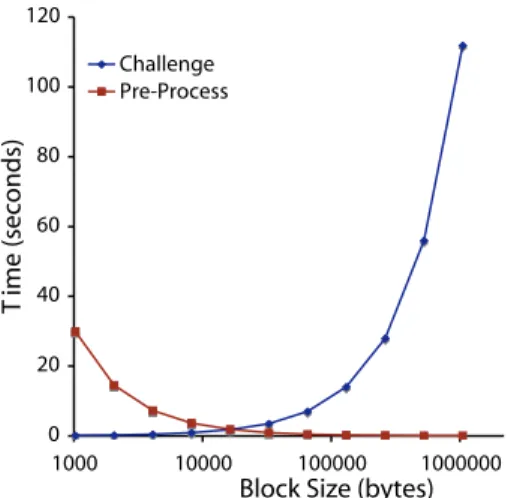
Figure 6: E-PDPpre-processing vs. challenge trade-offs with block size for a 1 MB file.
do so for every block. This creates a natural trade-off be-tween preprocessing time and challenge time by varying the block size;e.g., the protocol devolves toB-PDPfor files of a single block. Fig. 6 shows this trade-off and indicates that the best balance occurs at natural file system and memory blocks sizes of 4-64 KB (note that in this example all file blocks are checked in a challenge). We choose a block size of 4K in order to minimize the server’s effort.
Given the efficiency of computing challenges, pre-processing represents the limiting performance factor forE-PDP. The rate at which clients can generate data to outsource bounds the overall system performance perceived by the client. However, there are several mitigating factors. (1) Outsourc-ing data is a one time task, as compared to challengOutsourc-ing out-sourced data, which will be done repeatedly. (2) The process is completely parallelizable. Each file can be processed in-dependently at a different processor. A single file can be parallelized trivially if processors share key material.
6.
Conclusion
We focused on the problem of verifying if an untrusted server stores a client’s data. We introduced a model for provable data possession, in which it is desirable to mini-mize the file block accesses, the computation on the server, and the client-server communication. Our solutions for PDP fit this model: They incur a low (or even constant) overhead at the server and require a small, constant amount of com-munication per challenge. Key components of our schemes are the homomorphic verifiable tags. They allow to verify data possession without having access to the actual data file. Experiments show that our schemes, which offer a prob-abilistic possession guarantee by sampling the server’s stor-age, make it practical to verify possession of large data sets. Previous schemes that do not allow sampling are not practi-cal when PDP is used to prove possession of large amounts of data. Our experiments show that such schemes also impose a significant I/O and computational burden on the server.
7.
Acknowledgments
This work was supported in part by NSF awards CCF-0238305 and IIS-0456027 and by the IBM Corporation. We thank Gene Tsudik, Susan Hohenberger, Roberto Di Pietro, Luigi Mancini, R˘azvan Mus˘aloiu-E., Seny Kamara,
and Brent Waters for their insightful comments.
8.
References
[1] M. Abe and S. Fehr. Perfect NIZK with adaptive soundness. In
Proc. of Theory of Cryptography Conference (TCC ’07),
2007. Full version available on Cryptology ePrint Archive, Report 2006/423.
[2] J. Aspnes, J. Feigenbaum, A. Yampolskiy, and S. Zhong. Towards a theory of data entanglement. InProc. of Euro.
Symp. on Research in Computer Security, 2004.
[3] G. Ateniese, R. Burns, R. Curtmola, J. Herring, L. Kissner, Z. Peterson, and D. Song. Provable data possession at untrusted stores. Cryptology ePrint archive, May 2007. Report 2007/202.
[4] M. Bellare, J. Garay, and T. Rabin. Fast batch verification for modular exponentiation and digital signatures. InProc. of
EUROCRYPT ’98, LNCS, pages 236–250, 1998.
[5] M. Bellare and O. Goldreich. On defining proofs of knowledge.
InProc. of CRYPTO ’92, volume 740 ofLNCS, pages
390–420, 1992.
[6] M. Bellare and A. Palacio. The knowledge-of-exponent assumptions and 3-round zero-knowledge protocols. InProc. of
CRYPTO ’04, Lecture Notes in Computer Science, pages
273–289. Springer, 2004.
[7] M. Bellare and A. Palacio. Towards plaintext-aware public-key encryption without random oracles. InProc. of ASIACRYPT ’04, volume 3329 ofLNCS, pages 48–62. Springer, 2004. [8] M. Bellare and P. Rogaway. Random oracles are practical: A
paradigm for designing efficient protocols. InFirst Conference
on Computer and Communications Security, pages 62–73.
ACM, 1993.
[9] M. Bellare and P. Rogaway. The exact security of digital signatures - How to sign with RSA and Rabin. In
EUROCRYPT, pages 399–416, 1996.
[10] M. Bellare and P. Rogaway. PSS: Provably secure encoding method for digital signatures. IEEE P1363a: Provably secure signatures, 1998.
http://grouper.ieee.org/groups/1363/P1363a/PSSigs.html. [11] J. Black and P. Rogaway. Ciphers with arbitrary finite
domains. InProc. of CT-RSA, volume 2271 ofLNCS, pages 114–130. Springer-Verlag, 2002.
[12] M. Blum, W. Evans, P. Gemmell, S. Kannan, and M. Naor. Checking the correctness of memories. InProc. of the FOCS ’95, 1995.
[13] D. Boneh, C. Gentry, B. Lynn, and H. Shacham. Aggregate and verifiably encrypted signatures from bilinear maps. In
Proc. of EUROCRYPT ’03, volume 2656 ofLNCS, pages
416–432. Springer, 2003.
[14] I. Damg˚ard. Towards practical public key systems secure against chosen ciphertext attacks. In J. Feigenbaum, editor,
CRYPTO91, volume 576, pages 445–456. Springer, 1992.
[15] A. W. Dent. The Cramer-Shoup encryption scheme is plaintext aware in the standard model. InProc. of EUROCRYPT ’06, volume 4004 ofLNCS, pages 289–307. Springer, 2006. [16] A. W. Dent. The hardness of the DHK problem in the generic
group model. Cryptology ePrint Archive, Report 2006/156, 2006.http://eprint.iacr.org/2006/156.
[17] Y. Deswarte, J.-J. Quisquater, and A. Saidane. Remote integrity checking. InProc. of Conference on Integrity and
Internal Control in Information Systems (IICIS’03),
November 2003.
[18] A. Fiat. Batch RSA. In G. Brassard, editor,Proc. CRYPTO 89, pages 175–185. Springer-Verlag, 1990. Lecture Notes in Computer Science No. 435.
[19] D. L. G. Filho and P. S. L. M. Baretto. Demonstrating data possession and uncheatable data transfer. IACR ePrint archive, 2006. Report 2006/150,http://eprint.iacr.org/2006/150. [20] P. Golle, S. Jarecki, and I. Mironov. Cryptographic primitives
enforcing communication and storage complexity. InFinancial Cryptography, pages 120–135, 2002.
[21] S. Hada and T. Tanaka. On the existence of 3-round zero-knowledge protocols. InProc. of CRYPTO ’98, volume 1462 ofLecture Notes in Computer Science, pages 408–423. Springer, 1998.
[22] L. Harn. Batch verifying multiple RSA digital signatures.
Electronics Letters, 34(12):1219–1220, 1998.
[23] R. Hasan, W. Yurcik, and S. Myagmar. The evolution of storage server providers: Techniques and challenges to outsourcing storage. InProc. of the Workshop on Storage
Security and Survivability, 2005.
[24] R. Johnson, D. Molnar, D. Song, and D. Wagner.
Homomorphic signature schemes. InProc. of CT-RSA, volume 2271 ofLNCS, pages 244–262. Springer, 2002.
[25] A. Juels and B. S. Kaliski. PORs: Proofs of retrievability for large files. Cryptology ePrint archive, June 2007. Report 2007/243.
[26] M. Kallahalla, E. Riedel, R. Swaminathan, Q. Wang, and K. Fu. Plutus: Scalable secure file sharing on untrusted storage. InProc. of FAST, 2003.
[27] H. Krawczyk. HMQV: A high-performance secure Diffie-Hellman protocol. InProc. of CRYPTO ’05, volume 3621 ofLNCS, pages 546–566. Springer, 2005.
[28] M. N. Krohn, M. J. Freedman, and D. Mazi`eres. On-the-fly verification of rateless erasure codes for efficient content distribution. InProceedings of the IEEE Symposium on Security and Privacy, 2004.
[29] J. Kubiatowicz, D. Bindel, Y. Chen, P. Eaton, D. Geels, R. Gummadi, S. Rhea, H. Weatherspoon, W. Weimer, C. Wells, and B. Zhao. Oceanstore: An architecture for global-scale persistent storage. InProceedings of ACM
ASPLOS ’00. ACM, November 2000.
[30] J. Li, M. Krohn, D. Mazi`eres, and D. Shasha. Secure untrusted data repository (SUNDR). InProceedings of the Symposium
on Operating Systems Design and Implementation, 2004.
[31] U. Maheshwari, R. Vingralek, and W. Shapiro. How to build a trusted database system on untrusted storage. InProc. of OSDI, 2000.
[32] P. Maniatis, M. Roussopoulos, T. Giuli, D. Rosenthal, M. Baker, and Y. Muliadi. The LOCKSS peer-to-peer digital preservation system.ACM Transactions on Computing Systems, 23(1):2–50, 2005.
[33] S. Micali, K. Ohta, and L. Reyzin. Accountable-subgroup multisignatures: extended abstract. InProc of ACM CCS ’01, pages 245–254, 2001.
[34] G. L. Miller. Riemann’s hypothesis and tests for primality.
JCSS, 13(3):300–317, 1976.
[35] A. A. Muthitacharoen, R. Morris., T. M. Gil, and B. Chen. Ivy: A read/write peer-to-peer file system. InProceedings of 5th Symposium on Operating Systems Design and Implementation, 2002.
[36] E. Mykletun, M. Narasimha, and G. Tsudik. Authentication and integrity in outsourced databases. InProceedings of NDSS. The Internet Society, 2004.
[37] M. Naor and G. N. Rothblum. The complexity of online memory checking. InProc. of FOCS, 2005. Full version appears as ePrint Archive Report 2006/091.
[38] T. Okamoto. A digital multisignature schema using bijective public-key cryptosystems.ACM Transactions on Computer Systems, 6(4):432–441, 1988.
[39] A. Oprea, M. K. Reiter, and K. Yang. Space-efficient block storage integrity. InProc. of NDSS ’05, 2005.
[40] T. S. J. Schwarz and E. L. Miller. Store, forget, and check: Using algebraic signatures to check remotely administered storage. InProceedings of ICDCS ’06. IEEE Computer Society, 2006.
[41] F. Sebe, A. Martinez-Balleste, Y. Deswarte, J. Domingo-Ferrer, and J.-J. Quisquater. Time-bounded remote file integrity checking. Technical Report 04429, LAAS, July 2004. [42] M. Shah, M. Baker, J. C. Mogul, and R. Swaminathan.
Auditing to keep online storage services honest. InProc. of
HotOS XI. Usenix, 2007.
[43] A. Shamir. On the generation of cryptographically strong pseudorandom sequences.ACM Trans. Comput. Syst., 1(1):38–44, 1983.
[44] D. Thompson and J. Best. The future of magnetic data storage technology.IBM Journal Research and Development, 44(3):311–319, May 2000.
[45] M. Waldman and D. Mazi`eres. Tangler: a censorship-resistant publishing system based on document entanglements. InProc. of CCS, 2001.
[46] G. Yamamoto, E. Fujisaki, and M. Abe. An
efficiently-verifiable zero-knowledge argument for proofs of knowledge. Technical Report ISEC2005-48, IEICE, July 2005. [47] G. Yamamoto, S. Oda, and K. Aoki. Fast integrity for large
data. InProc. of SPEED ’07, 2007.
[48] A. Y. Yumerefendi and J. Chase. Strong accountability for network storage. InProc. of FAST, 2007.
APPENDIX
A.
Proof of Theorem 4.3
Under the KEA1-r assumption, we reduce the security of ourS-PDPscheme to the security of the RSA problem and the security of integer factoring. We model both hash func-tions h(·) andH(·) as random oracles. However we do not use the ”full power” of the random oracle model and indeed a scheme that does not use any random oracles can be easily derived from ours but at the cost of increased computational cost and bandwidth requirement.
We assume there exists an adversaryBthat wins the Data Possession Game on a challenge picked byAand show that Awill be able to extract the blocks determined by the chal-lenge. IfB can break the data possession guarantee of the
S-PDP scheme, we show how to construct an adversaryA that usesBin order to either break RSA or factor the prod-uct of two large primes.
For the RSA problem,Ais given (N, e, y), withy←R Z∗N,
and needs to find a value b ≡ y1/emodN. We assume
w.l.o.g. that e is a large prime number. A will play the role of the challenger in the Data Possession Game and will interact withB.
We first look at the case when inGenProofandCheckProof
all the coefficientsa1, . . . , acare equal to 1. This corresponds
to the case where the server proves it possesses the sum of the requested blocks. We then generalize the proof to the case where the coefficients are random and pairwise distinct, which corresponds to the case where the server proves it possesses each individual block.
Asimulates a PDP environment forBas follows:
Setup: A computes g = y2modN, sets the public key pk = (N, g) and sends pk toB. Agenerates the secret value v← {0R ,1}κ.
Query: B makes tagging queries adaptively: B selects a blockm1 and is also allowed to select an indexi1. B sends
m1 and i1 to A. A generates Ti1,m1 and sends it back to
B. B continues to query Afor the tags Ti2,m2, . . . ,Tin,mn on the blocksm2, . . . , mnand indicesi1, . . . , inof its choice.
The only restriction is thatBcannot make tagging queries for two different blocks using the same index. AanswersB’s tagging oracle queries as follows:
whenAreceives a tagging query for a blockmand index i, with 1≤i≤n:
•if a previous tagging query has been made for the same mandi, thenAretrieves the recorded tuple (m, i, ri,Wi)
and returnsTi,m=ri.
•else,Apicksri←R QRN, computesWi=v||i, records the
tuple (m, i, ri,Wi) and returnsTi,m=ri.
whenAreceives a hash query for a valuex:
•if a previous hash query was made for a valuex, thenA retrieves the recorded tuple (x, ωx) and returnsh(x) = ωx.
•else A picksω ←R QRN, records the tuple (x, ωx) and
returnsh(x) =ωx.
A’s view of the hash values h(Wi), for 1 ≤ i ≤ n, is: h(Wi) =rie·g−mimodN. ClearlyBcould query the random
oracle on valuesWi with only negligible probability. Notice
that in the random oracle modelh(Wi) is simply a PRF under
the secretv.