WHITE PAPER
SECURE, DEPLOYABLE BILATERAL
(CLIENT/SERVER) AUTHENTICATION
SecureAuth®
Secure, Deployable Bilateral (Client/Server)
Authentication
As enterprises move their applications to the Web and mobile platforms, the issue of providing strong security for those applications takes root. An enterprise must gauge an array of factors prior to implementing a solution that it deems viable and secure. Chief among these factors are strong security, ease-of-use for end-users, deployable technology, maintenance, and cost.
Traditionally, Public Key Infrastructure (PKI) has been regarded as the strongest form of authentication. However, PKI’s promise has never stretched beyond government agencies and organizations who can boast the infinite budgets and resources needed to manage PKI. PKI technology has been stagnant due to the fact that it is not easy to deploy; it is cost-prohibitive; it is difficult to manage and use; and the fundamental elements of its technology have never evolved. For these reasons, PKI has failed to be widely adopted by most enterprises.
SecureAuth distinguishes itself from PKI by delivering X.509v3 technology that is not only more secure than traditional PKI, but infinitely more feasible. SecureAuth is a solution that is founded on the principle of providing strong, 2-factor authentication that is easy for end-users to use, for administrators to maintain, and for
companies to afford.
1.
PKI is Difficult to Deploy – SecureAuth® is Not
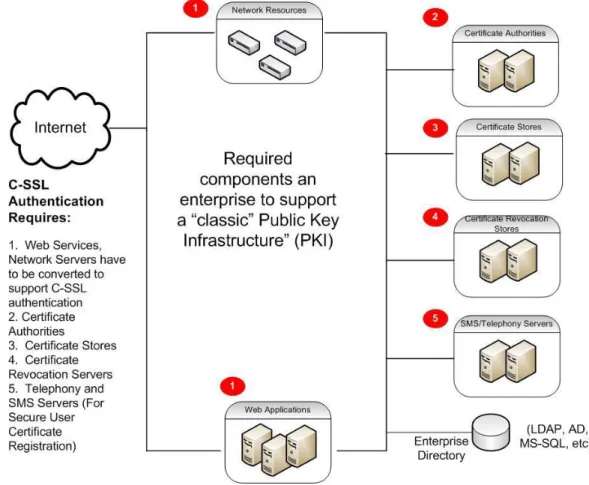
Traditional PKI requires several infrastructure components to function:
A Redundant Set of Certificate Servers
A Redundant Set of Certificate Revocation Lists
A data store of certificates issued
A set of servers for out-of-band registrationIn addition, if the “enforcement point” is a web server, then the webserver must be converted to allow Client Side SSL (C-SSL). This is not a trivial task and breaks many pre-existing applications (see Figure 2).
Figure 2 – PKI has an onerous amount of infrastructure for an enterprise to install
SecureAuth acknowledges that this standard PKI infrastructure is burdensome on an enterprise and SecureAuth does NOT require these components for an installation.
1.
PKI
is
Difficult
to
Deploy
–
SecureAuth
is
Not
(Cont’d)
SecureAuth
installs
a
simple
authentication
appliance
that
meets
the
requirements
of
the
above
components
without
the
overhead.
SecureAuth
is
able
to
meet
these
functional
requirements
through
two
key
architectural
differences:
a)
SecureAuth
utilizes
the
native
data
store
The
SecureAuth
authentication
appliance
is
shipped
with
data
store
connectors
that
enable
it
to
integrate
into
an
enterprise’s
native
data
store.
This
ability
to
use
the
“data
store
of
record”
means
that
there
is
no
data
synching
and
no
need
for
certificate
retention
and
certificate
revocation
list.
(See
Figure
3)
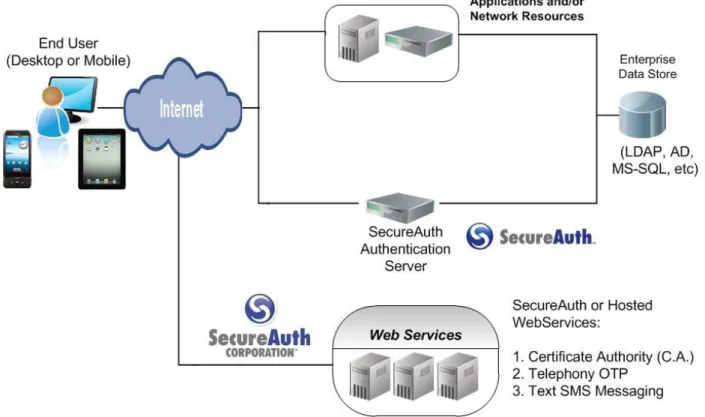
Figure 3 – SecureAuth in a deployed environment for network and web authentication.
b)
SecureAuth utilizes secure web servicesUpon deployment the SecureAuth authentication appliance is enabled to utilize SecureAuth’s hosted webservices for key functional needs. The SecureAuth webservices include:
o
Telephony One-Time-Authentication Passwordso
SMS One-Time-Authentication Passwordso
Certificate Authorities1.
PKI is Difficult to Deploy – SecureAuth® is Not (Cont’d)These web services allow for a simple installation and integration of the SecureAuth authentication appliance into a network and web deployment. (See Figure 3)
SecureAuth’s secure, WCF- authenticated webservices insure that an enterprise does not have to deploy additional infrastructure and thus saves the cost and expense of the initial install and maintenance of these components.
Summary:
Because standard PKI has so many infrastructure components to install and maintain – it has typically been eliminated as a deployable authentication solution. (See Figure 2) SecureAuth eliminates these deployment issues by:
Utilizing the existing data store, requiring no data synching
Simple SecureAuth Authentication Appliance installation2.
PKI is Difficult to Maintain – SecureAuth is NotPKI is the only technology in the world that requires:
A list of all valid credentials
A list of all invalid credentialsIt is this 2nd list, the “anti-database” that has made PKI all but impossible to maintain.
The reason for this ‘anti-database’ is actually built in to the fundamentals of certificates. A certificate has subject data such as a username, an expiration date, a public/private key-pair and a signature from a trusted Certificate Authority. The validity of a certificate is based on the expiration date and the signature. A certificate that has not expired and is properly signed by an authority you trust is considered a valid username/password combination.
You can see how this system can rapidly break down. Once a certificate is issued it will be granted access until it expires. What happens when the person associated with the certificate leaves the organization,
though? It is not always feasible to retrieve the certificate, so there must be some other mechanism to exclude previously issued certificates.
Hence PKI came up with the database” technology to compensate for this. The dates of these “anti-database” technologies is illuminating:
CRL – Certificate Revocation List (RFC 1422) 1993
OCSCP - Online Certificate Status Protocol (RFC 2560) 1999
Both of these technologies were devised and implemented before enterprise directories were implemented and available as the data store of record. PKI, when implemented in the past, had little or no relation to the central location where an enterprise manages user-accounts. To lock an account the additional step of revoking the certificate was a requirement.
Systems that rely on certificates for identity information, and to validate access to systems or networks, did create mechanisms to ‘authorize’ access against the datastore of record, but in the end a valid certificate still equated to a passed authentication.
Even with authorization against a central store, enterprises often required these CRL and OCSP architectures, which have proven to be unweidly and undeployable to anything but limited B2E network deployments. There has been no market acceptance of CRLs and OCSP technologies for B2C and web environments because of the cost and complexity associated with the solution.
SecureAuth leverages the advances in technology since 1999, namely the central datastore that now exist in virtual every enterprise today (See Figure 3). SecureAuth enables an enterprise to set a “Per User Certificate Limit” in the SecureAuth admin console. This is configurable per SecureAuth instance (see Figure 4).
2. PKI is Difficult to Maintain – SecureAuth is Not (Cont’d)
Figure #4 – SecureAuth allows an enterprise to configure # of certificates per user
SecureAuth, because it is an abstracted Authentication Appliance (Figure #3) is able to inspect two sets of information upon every new authentication and credential information. These (2) sets of information are:
The Instance certificate limit for the resource (Figure #4)
The Current Certificate Issued , per user (Figure #5, item “A”)
B
A
Figure #5 – SecureAuth keeps track of the certificates issued to the user (Item A) and allows “1-touch” revocation with the Cert Revocation Button (Item B).
Because SecureAuth is the authentication enforcement point, SecureAuth is able to inspect current issued certificates and choose NOT to distribute subsequent certificates based on this count.
Just as important, a SecureAuth admin is able to revoke the validity of certificates with the action of a single button on the SecureAuth console (See Figure #5, Item”B”). Invoking this feature sets:
The Validation Date to the current time (See Figure #6, Item “A”)
The Certificate Count to 0 (See Figure #6, Item “B”)A
B
Figure #6 – A single button, “The Revoke All Certificates”, revokes the certificates for the user without CRLs or OCSPs.
The key here, and unique to the SecureAuth solution, is that SecureAuth Authentication appliance is the authentication enforcement point. (See Figure #7, item “A”) SecureAuth does not have to rely on the “kludgey” and hard to manage CRLs and OCSP infrastructure to enforce the revocation – SecureAuth is the enforcement point and thus can inspect and choose not to accept the credential.
Figure #7 – SecureAuth (Item A) is the enforcement point and thus can check the certificate off the information stored in the central data store (Item B). No CRLs or OCSPs are needed.
3.
PKI is Difficult to Scale – SecureAuth is Not
Most enterprises are very comfortable with deploying high availability IT resources. The concept of load redundant web servers and load balancers is commonplace in the modern IT infrastructure.
Unfortunately, Certificate Authorities (C.A.s), the core component of the PKI infrastructure, does not lend itself to this type of scaling. Unlike web servers, the concept of simply adding another server and the placing a load balancer in front of the set of certificate servers simply will not work. In addition, Certificate Authorities do not have any concept of clustering.
Creating a high availability C.A. infrastructure is not an activity that most IT enterprises have the talent or resources to create. The knowledge required to create a Trusted Root Certificate Authority and then create a set of Intermediate Servers signed with the Trusted Root Certificate, is not common place in todays’s
environment. The cost associated with this skill set is prohibitive for a high availability deployment of PKI to most enterprises.
SecureAuth alleviates this cost set by removing this costly infrastructure from the enterprise. (See Figure #8,
“Item B”) . A secure WCF Web Service call is made between the SecureAuth Authentication Appliance
(Figure #8, Item A) and the SecureAuth Web Service (Figure #8, Item B). This call is secure, because this is a X.509 v3 authenticated web service connection, and requires the enterprise to have a registered SecureAuth server to access the Web Service.
Figure #8 – SecureAuth authentication appliance (Item A) makes a secure WCF authenticated webservice call to the SecureAuth Certificate authorities (Item B).
3. PKI is Difficult to Scale – SecureAuth is Not (Cont’d)
Creating a set of certificate authorities residing behind a protected set of Web Services is not a trivial task and beyond the scope of most enterprises. SecureAuth has created a unique set of high- availability certificate authorities behind a protected set of Web Services. (See Figure #9) This is an industry unique configuration that:
Securely created/distribute 509v3 credentials without infrastructure
Scale their authentication to infinite user counts
Figure #9 – SecureAuth hosts a high availability infrastructure of certificate authorities authenticated by WCF webservices. For large deployments (100,000+ users) SecureAuth can aid the enterprises in creation of this infrastructure.
It important to note that different end user X.509 certificates created from this infrastructure contain information ONLY germane to the specific enterprise deploying a SecureAuth authentication appliance.
A certificate created for enterprise A is not valid for enterprise B – despite being issued from the SecureAuth infrastructure. SecureAuth is able to do this via an advanced set of policy servers executing policy on the SecureAuth Certificate Authorities. The information is “tagged” in the PKCS #10 request sent from the SecureAuth appliance (Figure 8, Item A) to the SecureAuth Webservice C.A. (Figure 8, Item B). The result is an end user certificate with OU and DC information in the end user certificate that maps only to the deploying SecureAuth authentication site.
Figure #10 - The enterprises is assigned a unique OU and DC that maps to the SecureAuth authentication appliance registered to the enterprise.
4.
PKI is Difficult for Application Integration – SecureAuth is NOTIt is important to note that for PKI deployments, the act of creating a PKI infrastructure and then deploying the certificates does not complete the task for the enterprise – the enterprise now has to determine how to make its current application and network resources accept an X.509 v3 authentication.
PKI for applications requires web services to “turn-on” Client side SSL authentication (C-SSL). This is not a trivial activity (Microsoft Outlook Web Access has a 32-page documentation on the process). It is NOT a matter of just re-writing the authentication page. The actual web server or virtual web server has to be configured to conduct a C-SSL authentication. This is a global setting that has ramifications across all applications that are hosted on the web server. It’s important to note that the process of turning on and supporting C-SSL on web servers is NOT the same across disparate webservers:
o
Microsoft IISo
Apacheo
IBM HTTP-Do
ZeusSecureAuth Solves the Application Integration Issue
Applications do not have to convert the web-server to enable C-SSL authentication to utilize the strength of SecureAuth’s bilateral X.509v3 authentication. Unlike C-SSL, SecureAuth is able to utilize the native target/redirect and sessioning mechanisms of the application (See Figure #11).
Figure #11 - The SecureAuth has the unique ability of integrated directly with the application requiring X.509 authentication without forcing the enterprise to “turn-on” C-SSL on the webserver.
4.
PKI is Difficult for Application Integration – SecureAuth is NOT (cont’d)
SecureAuth integration to an existing application can be as simple as turning on Forms Based Authentication and directing the resource to the SecureAuth server. This is the case for applications such as Microsoft SharePoint/MOSS, Outlook Web Access and other ASP.NET applications. Similar target/redirect
methodologies exist for J2EE applications and application servers such as IBM’s WebSphere which utilizes a mechanism called Lightweight Third-Party Authentication (LTPA).
SecureAuth is currently integrated in the following environments:
ASP.NET applications
Microsoft Outlook Web Access
Microsoft SharePoint/Moss applications
J2EE applications
CA SiteMinder
IBM TAMeb
Applications that can take a SAML (1.1 and 2.0) assertion
Applications that accept OpenID authentication
Any application that can read a GUID in share datastoreo For any other apps
In addition, SecureAuth uniquely facilitates an incremental approach to federation. SecureAuth becomes the authentication mechanism for the Identity Provider (IdP) . Once implemented SecureAuth or another
mechanism can create the SAML , OpenID, WS-* or other assertion that the Relying party is expecting.
(See Figure #12)
Figure #12 – SecureAuth can be the Authentication Mechanism for the Identity Provider in a federated environment.
5.
PKI is Difficult for End Users to Obtain Credentials – SecureAuth is NOT
One of biggest “deal killers” of a PKI deployment is the difficulty associated in delivering the X.509 credentials to the end user. One central issue has been in educating end users on what mechanism to use to:
Request a public/private key
Store the public/private key
Transport the public/private keyTraditional PKI does not have an answer for this problem. End users simply do not have PKI backgrounds nor do they possess the understanding of the nuances and complexities of private and public keys. Attempts to put the credentials on portable key store have failed because of the lack of knowledge on the export and import process.
SecureAuth addresses all of these issues with:
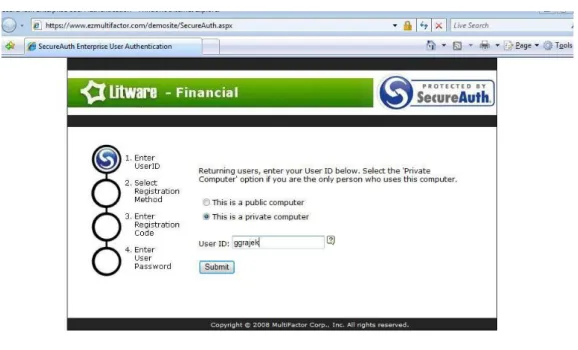
User Self-Service Registration (Figures #13-#18 below)
One-Touch User Certificate Revocation (Figures #5, #6)The user self-service registration process is self-explanatory and requires no help desk support. Here is a step-thru of the process: (Figures #13-#18)
5. PKI is Difficult for End Users to Obtain Credentials – SecureAuth is NOT
(cont’d)
Figure #14: The user selects a method from the (enterprise-configurable) list of options
5. PKI is Difficult for End Users to Obtain Credentials – SecureAuth is NOT
(cont’d)
Figure #16: User inputs his enterprise (AD, LDAP MS-SQL, etc) password
(Note: This is stored at the enterprise and not duplicated by SecureAuth)
Figure #17: SecureAuth creates the public/private key pair on the end users device. (The SecureAuth private key never transverses the network.)
5.
PKI is Difficult for End Users to Obtain Credentials – SecureAuth is NOT
(cont’d)
Figure #18: Lastly the user is redirected back to the Application
SecureAuth handles the creation of the public/private key for the end user. The explanatory, user self-service registration process takes all the guesswork out of the registration process.
6.
PKI is Single Factor Authentication – SecureAuth is True 2-Factor
One of the biggest security concerns that eliminate PKI from authentication decisions is that PKI is actually only single factor authentication. The argument is that the choices for “factors” are:
o
Something you haveo
Something you knowPKI, the authentication factor is only the first, something you have. And the security argument is: ”if the device is compromised or stolen” – there is no other factor since the certificate is the only factor.
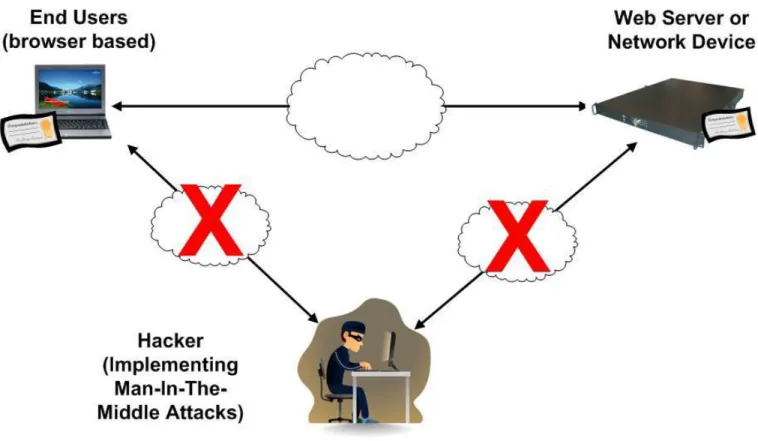
It’s important to note here, that there are new “PKI” solutions on the market being offered. These solutions promise to add a factor into the equation by utilizing a password in the “unlocking” of the key store. Security analysts have accurately stated that these solutions are not true 2-factor authentication. The fact that the password is locked with the credential simply means the solution is purely 1-factor and the attack method is simply a “brute force” attack on the credential to “guess” the password. In this manner, the security analyst are correct – these solutions are simply 1-factor since the certificate can be removed from the device and then brute force attacked. One the certificate is unlocked from these means, the credential can be replayed and the identity of the legitimate user impersonated by the hacker.
SecureAuth is different from both PKI and these “PKI solutions with a twist”.
SecureAuth is unique in the X.509 authentication market by its ability to conduct its own validation of the X.509 credential. That is SecureAuth is able to conduct the public/private key pair exchange that occurs in the SecureAuth authentication dialogue. SecureAuth does not rely on legacy PKI code for validation – instead it has the application redirect the authentication to the SecureAuth authentication appliance for the authentication dialogue. (See Figure #19)
6.
PKI is Single Factor Authentication – SecureAuth is true 2-Facotor
(Cont’d)
Figure #19 – SecureAuth conducts its own client/server validation
Because SecureAuth is not relying on legacy, circa 1988 validation code, SecureAuth is able to conduct a true 2-Factor, 2-way authentication, utilizing the original and valid public and private key infrastructure. Since, the SecureAuth authentication is conducting the authentication – a 2nd factor authentication is enforced.
The SecureAuth 1st Factor - X.509 Authentication
In a SecureAuth X.509 validation, the user’s X.509v3 credential (the first) factor is validated via the following means:
1.
User’s public Key Sent to SecureAuth Server2.
Certificate Request Identifier (CRI), a SecureAuth authentication nonce3.
The SecureAuth X.509 server information SSL Certificate4.
The SecureAuth Authentication URLThis information packet is then signed with the user’s private key, by the SecureAuth client and then returned to the SecureAuth server on validation. SecureAuth is insuring the legitimacy of the user by implementing a public/private key pair signing of the user’s SecureAuth’s X.509 key pair. In addition,
6.
PKI is Single Factor Authentication – SecureAuth is true 2-Factor (Cont’d)
SecureAuth is validating that the end user is dialoguing with the legitimate SecureAuth server in (2) ways:
1.
The SecureAuth client obtains, and signs with user’s private key, the SecureAuth server’sX.509 identity certificate
2.
The SecureAuth server signs the SecureAuth CRI (Certificate Request Identifier) with the SecureAuth private key and then encrypts with the SecureAuth user’s public keyThis 2-step mechanism to insure that the end user is communicating with the legitimate server provides the authentication with a “defense in depth” procedure. The first mechanism ensures that the SSL termination point for the SecureAuth server is the legitimate destination. The 2nd mechanism ensures that the
SecureAuth authentication packet is not tampered with inside the “corporate cloud” – e.g. the SSL termination point may exist away from the SecureAuth server. For this and for other security reasons, SecureAuth has a 2nd defense layer. SecureAuth signs the authentication nonce with the SecureAuth server private key and then encrypts it with the user’s public key. This mechanism insures that only the SecureAuth server is able to validate the SecureAuth authentication packet – and not another illegitimate authentication server in the enterprise’s corporate cloud. (See Figure #20)
Figure #20 - SecureAuth can conduct it’s own PKI validation, which insures there is not replay occurring during the authentication.
It is important to note, the SecureAuth X.509 credential is not encrypted with the user’s password. As stated previously – this method simply makes the credential vulnerable to brute-force decryption attacks. Instead, the SecureAuth credential is “fingerprinted” with the information unique to that particular device. In this manner, the credential is NOT valid if removed and is not vulnerable to the off- device brute force attack method. If the end-user desires portability, the end-user simply steps through the SecureAuth unique user self-enrollment functionality, (see pages 13-16).
6. PKI is Single Factor Authentication – SecureAuth is True 2-Factor (Cont’d)
particular device. In this manner, the credential is NOT valid if removed and is not vulnerable to the off- device brute force attack method.
The SecureAuth 2nd Factor – Encrypted credentials from the Enterprise Data Store
The above scenario details how the SecureAuth X.509 key exchange is thwarts man-in-the-middle and other replay attacks with a true “Something you have” authentication credential. This factor is the SecureAuth X.509v3 key pair. As detailed, SecureAuth does not tamper with the credential with the user’s password and claim this to be a 2nd factor – as other solutions do – instead SecureAuth fingerprints the credential with device information that can be only be valid from authentication device.
Once SecureAuth has validated the X.509 key exchange, as detailed above, the user is asked to submit a credential that is NOT stored on the SecureAuth appliance – but is actually obtained from the enteprise’s data store. Because SecureAuth is conducting both the left (client) and right (server) side dialogue in this
discussion, SecureAuth is able to ensure that this credential is not inspected, stored and replayed in an attack. (See Figure #20)
In addition, in the SecureAuth 2nd Factor scenario, the SecureAuth prompts the end user for his password. This is NOT a SecureAuth retained credential. This is the password that the user is utilizing in his other accounts and stored in the enterprise data store. (See Figure #19).
SecureAuth does not just rely on the SSL connection for a safe transmission of this factor. Instead it utilizes the SecureAuth components that made the 1st factor, the X.509 certificate authentication valid. The SecureAuth JRE client, upon receipt of the user’s password, signs the credential with the user’s private key and then encrypts the password with the SecureAuth server’s public key. Once again, this insures that:
The SecureAuth server can be sure the password came from the client’s machine
The User can be assured that only the SecureAuth server can decrypt and utilize the password.
Figure #21 - SecureAuth ensures that the User’s Password, the 2nd Factor, is not replayed or altered in transmission
Summary:
Because the user password is obtained from the enterprise’s data store and is NOT tied to credential, SecureAuth can legitimately be called a true 2- factor authentication product. It is important to note that SecureAuth uniquely, encrypts the user’s password separately and signs it to insure confidentiality and to insure that man-in-the-middle attack is occurring.
8965 Research Drive, Suite 200, Irvine, CA 92618
p: 1-949-777-6959 f: 1-949-743-5833 gosecureauth.com