Cryptanalysis of RAKAPOSHI Stream Cipher
†Lin Ding, Jie Guan
Zhengzhou Information Science and Technology Institute, China
E-mail: [email protected]; [email protected]
Abstract. RAKAPOSHI is a hardware oriented stream cipher designed by Carlos Cid et al. in 2009. The stream cipher is based on Dynamic Linear Feedback Shift Registers, with a simple and potentially scalable
design, and is particularly suitable for hardware applications with restricted resources. The RAKAPOSHI
stream cipher offers 128-bit security. In this paper, we point out some weaknesses in the cipher. Firstly, it
shows that there are weak (key, IV) pairs in RAKAPOSHI stream cipher. Secondly, for weak (key, IV)
pairs of RAKAPOSHI, they are vulnerable to linear distinguishing attack and algebraic attack. Finally, we
propose a real time related key chosen IV attack on RAKAPOSHI. The attack on RAKAPOSHI recovers the
128-bit secret key of with a computational complexity of , requiring 47 related keys, chosen IVs
and keystream bits. The success probability of this attack is 0.999, which is quite close to 1. The
experimental results corroborate our assertion. 192
2
37
2 28
14.555 2
Keywords: Cryptanalysis; linear distinguishing attack; algebraic attack; related key chosen IV attack; RAKAPOSHI; stream cipher.
1 Introduction
Stream ciphers are symmetric encryption algorithms based on the concept of pseudorandom keystream
generator. Although it seems rather difficult to construct a very fast and secure stream cipher, some efforts to
achieve this have recently been deployed. The NESSIE project [1] launched in 1999 by the European Union
did not succeed in selecting a secure enough stream cipher. In 2005, the European project ECRYPT decided
to launch a competition to identify new stream ciphers that might be suitable for widespread adoption. This
project is called eSTREAM [2] and received 35 submissions. Those candidates are divided into software
oriented and hardware oriented stream ciphers. Hardware oriented stream ciphers should be suitable for
deployment on passive RFID tags or low-cost devices such as might be used in sensor networks. Such
devices are exceptionally constrained in computing potential because of the number of logic gates available
or the amount of power that might realistically be available.
In 2009, Carlos Cid et al. [3] proposed a new hardware-oriented stream cipher called RAKAPOSHI,
which aims to complement the current eSTREAM portfolio of hardware-oriented stream ciphers. The
RAKAPOSHI stream cipher offers 128-bit security. The designers claimed that the cipher design and
†
security evaluation incorporates lessons learned during the several years of extensive analysis in the
eSTREAM process, and thus RAKAPOSHI is less likely to be susceptible to more recent attacks, such as
initialization attacks.
RAKAPOSHI is based on Dynamic Linear Feedback Shift Registers (DLFSR), with a simple and
potentially scalable design, and is particularly suitable for hardware applications with restricted resources. A
Dynamic Linear Feedback Shift Register scheme is a general construction consisting usually of two registers:
the first subregister A, is clocked regularly and updated using a fixed mapping. Subregister B, is updated
using a linear mapping, which varies with time and depends of the state in register A. The design can be seem
as a generalization of constructions found in early designs, including the stop-and-go generator [4], LILI [5], dynamic feedback polynomial switch [6], and K2 [7]. In fact, the RAKAPOSHI stream cipher is in fact a
successor of the K2 stream cipher, but aiming at low-cost hardware implementations.
In this paper, we point out some weaknesses in the cipher. Firstly, the result shows that there are
weak (key, IV) pairs in RAKAPOSHI stream cipher. Secondly, for weak (key, IV) pairs of RAKAPOSHI,
they are vulnerable to linear distinguishing attack and algebraic attack. Finally, we proposed a real time
related key chosen IV attack on RAKAPOSHI. The time complexity of our related key chosen IV attack on
RAKAPOSHI is about , requiring 39 related keys on average. The results show that there exist some
weaknesses in the cipher. See also [8] and [9] for two works that were done independently of our results. 192 2
34 2
This paper is organized as follows. In Section 2, we briefly describe RAKAPOSHI stream cipher. We
discuss the existence of weak (key, IV) pairs, and present linear distinguishing attack and algebraic attack
against the weak (key, IV) pairs of RAKAPOSHI in Section 3. Section 4 proposes a real time related key
chosen IV attack on RAKAPOSHI. The Section 5 concludes this paper.
2 Brief Description of RAKAPOSHI
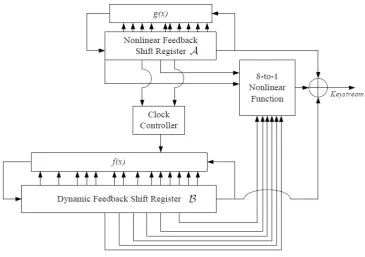
The RAKAPOSHI stream cipher consists of three main building blocks, namely a 128-bit Non-Linear
Feedback Shift Register (denoted as register A), a 192-bit Linear Feedback Shift Register (denoted as
register B), and a non-linear filter function over . It uses two bits from the state of the NLFSR to
select and dynamically modify the linear feedback function of the LFSR. The keystream is produced by
combining the output of both registers with the output of the non-linear filter function. An overview of the
different blocks used in the stream cipher can be found in Fig. 1. 8
Figure 1. The structure of RAKAPOSHI stream cipher
We denote by the contents of the LFSR at time t. Similarly, the content of the
NFSR is denoted by at time t.
1 1
( , , , )
t
t t t
A a a a
1 127
( , , , )
t
t t t
B b b b 27
4
Non-Linear Feedback Shift Register A. The register A is a 128-bit NLSFR, defined using the
following recurrence relation.
128 6 7 11 16 28 36 45 55 62
6 7 11 16 28 36 45 55 62 7 45 11 55 7 28 28 55 6 45 62 6 11 62
( , , , , , , , , , )
1
t t t t t t t t t t t
t t t t t t t t t t t t
t t t t t t t t t t t t
a g a a a a a a a a a a
a a a a a a a a a a a a
a a a a a a a a a a a a
Linear Feedback Shift Register B. The register B is a 192-bit dynamic LFSR. Register A is used to
select and dynamically modify the feedback function of LFSR B using two bits from the state of register A,
and as a result, Register B, which can use four different linear recursive functions, presents an irregular
updating mechanism. Let and be the 42nd and 90th bits of register A at time t, respectively (that is,
and ). Then LFSR B at time t is defined by the following recurrence relation. 0
c c1
0 t
c a1 c1at89
192 0 1 14 37 41 49 51 93 107 120 134 136 155 158 176 14 37 41 49 51 93 0 1 107 0 1 120 0 1 134 0 1 136 0
( , , , , , , , , , , , , , , , )
t t t t t t t t t t t t t t t
t t t t t t t t t t
t t
b f c c b b b b b b b b b b b b b b
b b b b b b b c c b c c b c c b
c c b c b
155 c b0 t158bt176
Whereci ci 1 represents the negation ofci.
Non-Linear Filter. The 8-to-1 non-linear filter function is the same function used as the non-affine
component of the AES S-Box. This function is a balanced Boolean function, with polynomial representation
(ANF) of degree 7. In the RAKAPOSHI stream cipher, the input bits for this function are extracted from
both registers A and B, as
67 127 23 53 77 81 103 128
( , , , , , , ,
t t t t t t t t t
s v a a b b b b b b )
Initialization Process. The RAKAPOSHI stream cipher supports key size of 128 bits and IV size of 192
bits. Before the generation of the cipher keystream, the cipher is initialized with the secret key and a selected
IV. The initialization process of RAKAPOSHI is done as follows.
Firstly, the secret keyK( ,k0 ,k127)andIV (iv0,,iv191)are loaded into the NLFSR and DLFSR,
respectively, as follows.
0 127 0 127 0 191 0 19 ( , , ) ( , , ) ( , , ) ( , , )
a a k k
b b iv iv
1
Secondly, the cipher then clocks 448 times with the output of the filter function v( ) (i.e.,st) being fed
back
0 cycles, with the output of the non-linear
for further 128 cycles, with the output of the
), and it is ready to produce the first
neration. The cipher outputs one keystream bit at each cycle. Given the cipher state
The t
into the cipher state. This process is divided into two stages: In the first stage of the initialization, the cipher runs for 32
filter function v( ) being fed back into the register B. In the second stage of the initialization, the cipher runs
non-linear filter function v( ) being fed back into the register A. At the end of the initialization, the cipher internal state is 448 448
( , S A B448
keystream bit z0.
Keystream Ge
(A B, )at time t, the cipher operates as follows: keystream bit zt is computed as zt at t t t
S
t
b s
and is output.
B. c c0, 1Atare used to update the register Registers A and B are updated to obtain t 1
A and t 1
B , respectively.
3 Weak (key, IV) Pairs of RAKAPOSHI
3.1 The Existence of the Weak (key, IV) Pairs
RAKAPOSHI uses a dynamic linear feedback shift register to ensure good cryptographic properties.
of the weak (key, IV) pairs in RAKAPOSHI stream cipher. For a weak
(key
However, there is an “lock-up” state for the register A That is, if the initialization process leaves A in the all
ones state, then it will remain permanently in that state, and register B will become a simple linear feedback
shift register, which is the only active block of the cipher. As well known, keystream sequences generated by
a single LFSR and a non-linear filter function are vulnerable to distinguishing attack and algebraic attack.
Consequently, if the key and IV pair results in this “lock-up” state for the register A, we define the key and
IV pair as a weak (key, IV) pair. Now we reveal the existence
, IV) pair, the state 448
A is the all one state(1,1,,1). Then our following purpose is to obtain an available S0 from known 48 in reverse. According to the structure of RAKAPOSHI, we present an
algorithm compute the weak (key, IV) pairs. 4
S
to
1. Set 448
A be the all o
2. From t = 447 to t = 320 do
.
pute ).
ne state(1,1,,1), and select 448
B randomly.
(2.a) Compute 0 t 41and 1
(2.b) Com
c a 89
127 23 53 77 81 103 128
( , , , , , , ,
t t t t t t t t t
s v a a b b b b b b
t
c a
67 (2.c) Compute 192 t t c c
14 37 41 49 51 93 0 1 107 0 1 120 0 1 134 0 1 136 0 155 0 158 176
t t t t t t t t t
t t t t
b b b b b b c c c c b c c b
b c b c b b
(2.d) Compute
3. From t = 319 to t = 0 do
(3.a) Comput and .
). put
b b b
128 6 7 11 16 28 36 45 55 62 7 45 11 55 7 28 28 55 6 45 62 6 11 62
1
t t t t t t t t t t t t t
t t t t t t t t t t t t
a a a a a a a a a a a a a
a a a a a a a a a a a s
t
a
ec0 at41 9
23 53 77 81 103 128 ( ,bt ,bt ,bt ,bt ,bt ,bt
1 t 8 c a (3.b) Computest v at67,at127 (3.c) Com e
192
t t t
b b 14 37 41 49 51 93 0 1 b 107 0 1 120 0 1 134
1 136 0 155 0 158 176
t t t t t t t t
t t t t t
b b b b b b c c c c b c c b
c b c b c b b s
(3.d) Compute
itial stat 0 . 0
c
128 6 7 11 16 28 36 45 55 62 7 45 11 55 7 28 28 55 6 45 62 6 11 62
1
t t t t t t t t t t t t t
t t t t t t t t t t t t
a a a a a a a a a a a a a
a a a a a a a a a a a a
4. Output the in e 0 0 ( , ) S A B
According the algorithm above, it is easy to see that for each value of , there exists a unique weak
(key, IV) pair. Since can be randomly selected in this algorithm, there are certainly weak (key, IV)
pairs One example is illustrated in Table 1.
I
Ke
448 B
448
B 2192
in RAKAPOSHI stream cipher.
Table 1. Weak (key, IV) pair of RAKAPOSH
y 0x81094ef5d124b47934d15b5228e5b8fa IV 0x4f9fe37b7c5a87f592ed1e89175e0f6d6634eada6411eaf3 0xffffffffffffffffffffffffffffffff 448 A 0x7a72bd70c98392497034e2ba72c56fb629adfc8265f4aada 448 B
3.2 Linear Distingu
n
airs
In distinguishing attacks, n ly random sequence.
For weak (key, IV) pairs of RAKAPOSHI, we tried to construct linear distinguishers, by considering linear
KAPOSHI, the
distinguisher using 11 keystream bits as follows.
ishi g Attack and Algebraic Attack on Weak (key, IV) P
o e attempts to distinguish the keystream sequence from a pure
approximations of functions used in the stream cipher. For each weak (key, IV) pair of RA
internal states of the register A are all ones after the initialization process, the recurrence relation of LFSR B
will remain permanently as follows.
192 14 37 41 49 51 93 136 158 176
t t t t t t t t t t t
b b b b b b b b b b b
14 37
: t t t
D z z z zt41zt49zt51zt93zt136zt158zt176zt1920
Simultaneity, the 8-to-1 non-linear filter function can be simplified as follows since the first two
inpu
( ) v
t bits are set to ones.
67 127
( , ,
t t t t
s v a a b 23 53 77 81 103 128
23 53 77 81 103 128
, , , , , )
(1,1, , , , , , )
( )
t t t t t t t t t t t
b b b b b
v b b b b b b
v
nonlinear filter has bias The best affine approximation of the v( ) 26
near filterv( )
as claimed in sec.5.3 by the
designers [3]. However, the best affine approximation of the nonli has bias . Using the
Pilling-up Lemma [10], the bias of the linear distinguisher is estimated as
KAPO
imed in sec.5.3 by the designers,
RAKAPOSHI stream cipher is secure against distinguishing attacks. However, for weak (key, IV) pairs of
RAK
rs.
RAKA e internal states of the register A are all ones after the
initialization process. Here we use the XL method [12] to estimate the time complexity f solving the above
algebraic equation system, and obtain that its time complexity is about
2.42 2
10 2.42 11 16.62 2 (2 ) 2
So, if the keystream sequence is generated by RAKAPOSHI with a weak (key, IV) pair, the linear
distinguisher D holds with the probability bias216.62. As a result, to distinguish the RA SHI with a
weak (key, IV) pair, it requires
1 / 216.62
2233.24keystream bits. As claAPOSHI, it is vulnerable to linear distinguishing attacks.
A weak Key-IV can be distinguished means that the register A initial state of the weak Key-IV is the all
ones state. Consequently, the next task is to recover the register B initial state. Algebraic attacks against
stream ciphers were originally proposed in 2003 by Courtois and Meier [11]. The attack is a powerful
cryptanalytic technique against some LFSR-based stream ciphe
For the RAKAPOSHI stream cipher with a weak (key, IV) pair, the keystream output zt is computed
by means of a Boolean function overGF(2 )7 given by
67 127 23 53 77 81 103 128
( , , , , , , , )
1 ( )
t t t t t t t t t t t t t t t
z a b s a b v a a b b b b b b
b v
This function has degree 5 and algebraic immunity 3 (which is the same of the functionv )).
For each weak (key, IV) pair of POSHI, th
(
o
3 3 192
60.51
0
2
i i
ime complexity of this attack is
much smaller than the time complexity of a brute force attack. Therefore for weak (key, IV) pairs of
RAKAPOSHI, it is weak against algebraic attack.
4 R
n IV attack on RAKAPOSHI stream cipher. The attack on
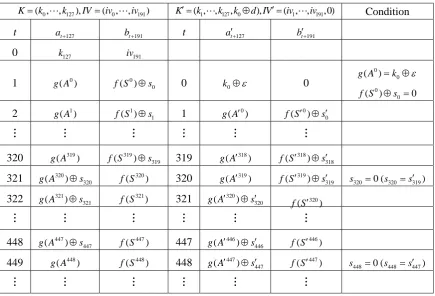
RAKAPOSHI is done by assuming four conditions as shown in Table 2. The relation of
The algebraic attack requires approximately 20.17
2 keystream bits. The t
elated Key Chosen IV Attack on RAKAPOSHI
In this section, we will propose a related key chose
(K IV, ) is as follows.
0 127 1 127 0
0 191 1 191
( , , ) ( , , , 0)
IV iv iv IV iv iv
( , , ) ( , , , )
K k k K k k k
.
{0,1}
Where , is a binary constant.
Table 2. Conditions used in the attack on RAKAPOSHI
0 127 0 191
( , , ), ( , , )
K k k IV iv iv K( ,k1,k127,k0d IV), ( ,iv1,iv191,0) Condition
t at127 bt191 t at127 bt191
0 k127 iv191
1 g A( 0) ( 0) 0
f S s 0 k0 0
0 0 ( )
g A k
0 0 (S )s 0 f
2 1
( )
g A 1
1 ( )
f S s 1 0
( )
g A 0
0 ( ) f S s
… … … …
320 319
( )
g A f S( 319)s319 319 318
( )
g A f S( 318)s318 321 320
320 ( )
g A s 320
( )
f S 320 319
( )
g A 319
31
( ) 9
f S s s3200 (s320s319 )
322 321 321
( )
g A s f S( 321) 321 320 320
( )
g A s f S( 320)
… … … …
448 447 447
( )
g A s f S( 447) 447 ( 446) 446
g A s f S( 446)
449 448
( )
g A f S( 448) 448 447 447
( )
g A s f S( 447) s448 0 (s448s447 )
… … … …
Let Z andZbe keystream sequences generated from( ,K IV)and(K IV, ). According to table 2, we can
get Propert 1 as follows.
Pr ty 1. The sy em 0
holds when the following two conditions are simultaneously satisfied.
a y
oper st 1 S S ) g(A0)k0;
n of RAKAPOSHI stream cipher. It consists of two stages, which differ from each
othe
b) 0
0
( ) 0
f S s .
Recall the initializatio
r in the feedback ofst. According to table 2 and Property 1, we can get Property 2 as follows.
Property 2. If the system 1 0holds, the system
S S Si1Siholds for when the following two s are simult usly satisfied.
system
1 i condition aneo
c) s3200 ;
d) s4480.
It is easy to see that if the 449 448
S S holds, there exists a clear relation between Z andZ, i.e.,
1
i i
z zfori0.
LetZ m[ ]( ,z1,zm)be the m-bit keystream sequence starting from the second keysteam bit generated
by related (K IV, )pair. We define the event Z m[ ]Z m[ ] (i.e., zi1zifor 0 i m 1) by and its
ment by
comple . We denote the event that the conditions a) mu ously satisfied by L and
its co Sin
c
c
c
L
and b) are si ltane
mplement by ce the conditions c) and d) are obtained in different clocks, and then are assumed to
be independent to facilitate cal ulation of probability. Hence, when the event L occurs, the event .
occurs
with probab
2 Pr( | )L Pr(c d) Pr( ) Pr( )c d 2 ility
.
However, when the event c
L occurs, after 447 clocks of iteration, the differentials of internal states will
be fairly even and unpredictable, the eventoccurs with probability2m. That is,
Pr(|Lc)2m fectively, In order to recover the some key bits ef
choo
we should fix some IV bits. Here, we
seiv107iv120iv134iv136 iv1550andiv1581. Thus, the equation 0
0
( ) 0
f S s can be simplified as
follows.
0
0 0 14 37 158
0 7
( )
0
41 49 51 93 0
41
176 0
176 0 0 14 37 41 49 51 93 41 158 176 0
14 3 41 49 51 93
f S s iv iv iv
iv iv iv
iv iv
127, 23, 53, 77
iv iv c iv
k 103 128 , , iv s s
iv iv iv iv iv iv iv k iv iv s
iv iv iv iv iv
(1)
Wheres0 v a( 67,a127, 23, 53, 77, 81, 103, 128) ( 67, , 81 )
23 53 iv iv
b b b b b b v k k iv
iv iv iv
ee functions can be obtaine
1
iv iv .
Recall the non-linear filter function . Thr
When and
d as follows. ( )
v
,
53 77 81 ,iv ,iv ,iv ,iv
1 77 81 128 0
iv iv iv iv103
0 ( 67, 127, 23 103,
s v k k iv iv128)1 (2)
he and
W niv23iv53iv77iv103iv1280 iv81 ,
,iv ,iv ,iv ,iv
1
0 ( 67, 127, 23 53 77 81 103, 128 67
s v k k iv iv )k 1 (3)
and
, Wheniv77 iv81iv103 iv1280 iv23iv53
0 ( 67, 127, 23, 53, 77, 81, 103, 128) 127 s v k k iv iv iv iv iv i
y bit with
Algorithm 1
v k
chosen IVs, nam
(4)
Now, we will introduce a method to recover one ke 2h ed Algorithm 1.
1. Under fixed and unknownK andK, choose 2hIVs whereiv107 iv120 iv134 iv136iv1550,iv1581,
-bit values and the rema
0 1
(iv,,ivh)are all 2h ining bits are fixed toe( {0,1}) . 2. U
stream sequences
ntil no more chosen IV remain, repeat the followings.
Generate the key Z m[ ]( ,z1 ,zm)using( ,K IV);
Generate the keystream sequencesZ m[ ]( ,z0 ,zm1)using(K IV, );
CheckZ m[ ]Z m[ ]. If the two keystream sequences pass the check, output 0 0
( )
g A k. Otherwise
utpu try other chosen IVs.
3. If no chosen IVs passes the check, then o t 0 1 0 ( )
g A k .
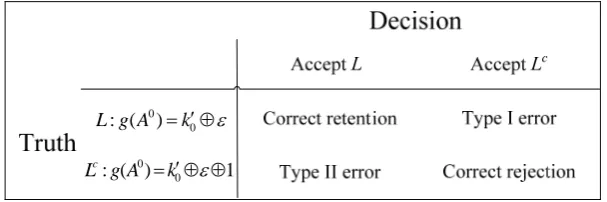
With a decision rule of Algorithm 1, two types of errors denoted as type I and type II exist, see Figure.2.
Let and de the probabilities of type I and II errors, respectively. Th Pr( ) (1 2 )2 2h and 2
Pr( ) 1 (1 2m)h . Hence,
note us,
we can obtain the equation 0 with a success probability 0
of1 Pr( ) if the equation 0 0
( )
g A k holds, and obtain the equation 0 0
( ) 1
g A k with a success probability of1 Pr( ) if the equation 0
0 ( )
g A k does not hold. Thus, the success probability of this
algorithm bounded below byis 1 Pr( ) Pr( ) . In our paper, we usep0 1 Pr( ) Pr( ) cess
ttack. The actual value of success prob act more, making our attack
ma stronger.
as the suc
o ability is
probability
rginally
f our a in f
0 0
: ( ) 1
L g A k 0
: ( )
L g A k
c
0
Figure 2. Tw rs in the decision rule of Algorithm 1
ber of chosen IVs used i . For each chosen IV, the algorithm needs to execute the ocess of RAKAPOSHI omputational complexity of Algorithm 1 i
o types of erro
In Algorithm 1 two times. Thus, t The num
encryption pr
s2h
he c s2h 2 2h1
. It requires
In our
1 2h ( 1 ) 2h (2
m m
m1)keystream bits.
related key attacks on RAKAPOSHI, we use2m1related keys, which are shows as follows.
For0 j m 1,
0 0 1
0 127 1 1 127 0 1 1 127 0
191 1 1
( , , ) ( , , , ), ( , , , 1)
) (
j j j
K k k K k k k K k k k
IV iv
0 191
( , , , , 0)
IVj iv ,iv j iv
Note that 0 0 K K.
Now, we will ore key bits using these related keys, named Algorithm 2.
Algorithm 2 introduce a method to recover m
For0 j m1, do the followings.
1. Under the related keys 0
j
K and 0 1
j
K , run Algorithm 1. If Algorithm 1 outputs 0 0
( )
g A k, goto step 2.
O
elated key the
2. Under the r rwise, goto step 3.
and 0 1
j
K , do the fo
80andiv103
llowings. s 0
j
K
Set , and then run Algorithm 1. Recover the key bitk41of
0
j
K 23
iv iv53iv77iv81iv12 1
using the equation (1) and (2 Setiv23iv53iv
).
128 0 iv
andiv81 , and then run Algorithm 1. Recover the key bitk67of 0
j
K 77iv103 1
using the equation (1) and (3).
0
Set andiv23iv531, and then run Algorithm 1. Recover the key bitk127of 0
j
K 77 81 103 128
iv iv iv iv
using the equation (1) and (4).
3. Under the related keys 0
j
K and 1 1
j
K , d
0andiv103
o the followings.
Setiv23iv53iv77iv81iv128 , and then run Algorithm 1. Recover the key bitk41of 0
j
K 1
usin (2).
Setiv23iv53iv77iv103iv128 g the equation (1) and
0andiv81 , and then run Algorithm 1. Recover the key bitk67of 0
j
K 1
using the equation (1) and (3).
Set andiv23iv531, and then run Algorithm 1. Recover the key bitk127of 0
j
K 77 81 103 128 0
iv iv iv iv
using the equation (1) and (4).
Using the Algorithm 2, we can recover the following key bits.
41mod128, , 41m 1mod128
k k
67 mod128, , 67 m1mod128
k k
127 mod128, , 127 m1mod128
k k
Furthermore, we also can obtain m non-linear functions with some key bits. In Algorithm 2,
for , we should run Algorithm 1 four times under s. Hence, Algorithm 2 requires
chosen IVs and m keystre bits. The computational complexity of of Algorithm 2 is bounded below by , since the
In order
properly selected. When we set , then the attacker
tain 23 non
ts
reco
related key 0 j m 1
2 2h 4 2h
gorithm 2 is cce
am
1 3
2h (2m 1) 4 2h (2 1) The success probability Al
su
1 3
2h 4 2h . 3
0
m
p
ss probability of Algorithm 1 is bounded below byp0.
to get a high success probability for recovering the 128-bit secret key, mandhshould be
can recover 69 key bits( , ,k0k k21, 41, ,k k63, 67, ,k k89, 127).
We also can ob -linear functions with 22 key bits(k22,,k40,k64,k65,k66). In fact, w n simplify
these non-linear functions using the recovered 69 key bi . T 23
m
e
s(k22, k40 k ,k66)can be
e computa nal complexity ca
65 k hus, the 22 key bit
ut 3 22 37 2h 2 2
64
, , ,
m
tio vered easily, with a computational complexity of 22
2 at most. Finally, the re aining 37 key bits(k90,,k126)should be exhaustive searched. Thus, considering Algorithm 2, th
of our related key chosen IV attack on RAKAPOSHI is abo ,
2m
requ
for parame iring 2
2h chosen IVs and 3
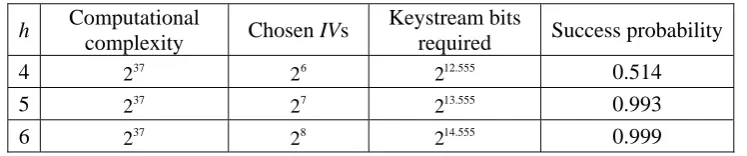
2h (2m1) keystream bits. Table 3 shows the complexities of our attack on RAKAPOSH ters h.
Note that in our related key attacks on RAKAPOSHI, we use 1 47
I
related keys in Algorithm 2.
Table 3. Our results on RAKAPOSHI for parameters h
h Computational
complexity Chosen IVs
Keystrea required
m bits
Success probability
4 237 26 212.555 0.514
5 37
2 7
2 13.555 0.993
2
6 237 28 214.555 0.999
Here, we cho , w er re SHI with a
computational compl requiring 47 related ke sen IVs an stream bits. The
success probability of our attack on RAKAPOSHI is 0.999, which quite close to
We also validate our result by simulating Algorithm 2 and solving the 23 near functions. The
resu
e ho
+, CPU 2.31GHz, 768
Gb R
oseh6. Thus exity of237,
e can recov the 128-bit sec t key of RAKAPO
ys, 28cho d214.555key
is 1.
non-li
lt shows that we can recover the 91 (=69+22) key bits within 10.8 minutes on average. By simulating RAKAPOSHI stream cipher, the remaining 37 can be recov red within 23.04 urs on average. The
simulation was implemented on AMD Athlon(tm) 64 X2 Dual Core Processor 4400
AM, OS Windows XP Pro SP3. These experimental results corroborate our assertion.
RAKAPOSHI is a hardware-oriented stream cipher designed by Carlos Cid et al. in 2009. The RAKAPOSHI
stream cipher offers 128-bit security. Until now, no attack on the cipher has been published. In this paper, we
point out some weaknesses in the cipher. Firstly, the result shows that there are weak (key, IV) pairs in
cipher. Secondly, for weak (key, IV) pairs of RAKAPOSHI, they are vulnerable to
linear distinguishing attack and algebraic attack. Finally, we proposed a real time related key chosen IV
wledgements
nessie.org, Accessed August 18, 2003
[2] ECRYPT. eSTREAM: ECRYPT Stream Cipher Project, IST-2002-507932. Available at
.ecrypt.eu.org/stream/, Accessed September 29, 2005
[3] Carlos Cid, Shinsaku Kiyomoto, and Jun Kurihara. The RAKAPOSHI Stream Cipher. Information and
84, number
Generator. In Selected Areas in
eudo Random Binary Sequences for
puter Science, Springer Berlin Heidelberg, 2012, pp. 138-155. 192 2
RAKAPOSHI stream
attack on RAKAPOSHI. The time complexity of our related key chosen IV attack on RAKAPOSHI is
about 34
2 , requiring 39 related keys on average. The results show that there exist some weaknesses in the
cipher.
We hope our results can be helpful in evaluating the security of RAKAPOSHI stream ciphers against
related key attacks, and we look forward to further work in evaluating RAKAPOSHI stream ciphers against
other kinds of cryptanalytic attacks.
Ackno
This work is supported in part by the National Natural Science Foundation of China (No. 61202491,
61272041, 61272488).
References
[1] NESSIE. New European Schemes for Signatures, Integrity, and Encryption. Available at
http://www.crypto
http://www
Communications Security, LNCS 5927[C]. 2009. 32-46.
[4] T. Beth and F.C. Piper. The stop-and-go-generator. In Proceedings of EUROCRYPT 19
209 in LNCS, pages 88–92. Springer-Verlag, 1985.
[5] L.R. Simpson, E. Dawson, J. Golic, and W. Millan. LILI Keystream
Cryptography 2000, number 2012 in LNCS, pages 248–261. Springer-Verlag, 2000.
[6] D. Horan and R. Guinee. A Novel Keystream Generator using Ps
Cryptographic Applications. In Irish Signals and Systems Conference 2006, pages 451–456. IEEE,
2006.
[7] S. Kiyomoto, T. Tanaka, and K. Sakurai. K2: A Stream Cipher Algorithm Using Dynamic Feedback
Control. In Proceedings of SECRYPT 2007, pages 204–213, 2008.
[8] T. Isobe, T. Ohigashi, and M. Morii, Slide cryptanalysis of lightweight stream cipher rakaposhi, in
Advances in Information and Computer Security, G. Hanaoka and T. Yamauchi, eds., vol. 7631 of
[9] Mohammad Ali Orumiehchiha, Josef Pieprzyk, Elham Shakour and Ron Steinfeld. Security Evaluation
of Rakaposhi Stream Cipher. Cryptology ePrint Archive Report 2012/656, http://eprint.iacr.org/.
ack. In E. Biham,
3-337, 2004.
[10] M. Matsui. Linear Cryptanalysis Method for DES Cipher. In Proceedings of EUROCRYPT 1993,
number 765 in LNCS, pages 386–397. Springer-Verlag, 1993.
[11] N. Courtois and W. Meier. Algebraic Attacks on Stream Ciphers with Linear Feedb
editor, Advances in Cryptology – EUROCRYPT 2003, volume 2656 of LNCS, pages 345–359.
Springer–Verlag, 2003.
[12] C. Diem, The XL-Algorithm and a Conjecture from Commutative Algebra, In Pil Joong Lee, editor,