Hell of a Handshake: Abusing TCP for
Reflective Amplification DDoS Attacks
Marc K¨uhrer, Thomas Hupperich, Christian Rossow, Thorsten Holz
Horst G¨ortz Institute for IT-Security, Ruhr-University Bochum, Germany
Abstract
Nowadays, a common way for attackers to perform Distributed Denial-of-Service(DDoS) attacks is via so calledamplification attacks. The basic idea is to send relatively small requests with spoofed source address to public hosts (e.g., NTP servers), which reflect signifi-cantly larger responses to the victim of the attack. Recent studies focused on UDP-based attacks and analyzed the attack surface in detail. First results also suggested that TCP-based protocols are in principle vulnerable to such attacks, despite the three-way-handshake mechanism.
In this paper, we continue this line of work and demon-strate that TCP protocols indeed can be abused in prac-tice. More specifically, we show that the handshake it-self often yields amplification, especially since a lot of devices on the Internet react in unforeseen ways during the connection establishment. To estimate the landscape of Internet devices vulnerable to TCP amplification at-tacks, we performed Internet-wide scans for common TCP-based protocols and identified thousands of ampli-fiers that allow an amplification of factor 50x and higher.
1
Introduction
Different kinds ofDistributed Denial-of-Service(DDoS) attacks are known for a long time [1, 2, 11]. As a consequence, multiple countermeasures were proposed (e.g., [4, 5, 7, 9, 12]) that reduce the impact of tradi-tional DDoS attacks such asTCP SYN andUDP flood-ing. Recently, miscreants elevated their DDoS attacks to attack bandwidth of up to 400 Gbps by switching to so calledamplification attacks, in which vulnerable (typ-ically UDP-based) protocols are abused to amplify the attack traffic by a factor of up to 4,670 [10]. In such an amplification attack, the attacker sends relatively small requests with spoofed source address to so called ampli-fiers—often public hosts offering services such as DNS or NTP—thatreflect[8] considerably larger responses to the attack victim, exhausting the capacity of the victim’s network. As UDP lacks any verification of the communi-cation partners by design, many UDP protocols are vul-nerable to such reflection attacks.
On the contrary, TCP-based protocols employ a three-way-handshake, in which the two communication part-ners are validated by interchanging three sequential, equally-sized TCP packets before the actual payload data is transmitted. As we assume the end hosts to randomly select the initial sequence numbers, the handshake thus cannot be completed by sending TCP segments with spoofed source addresses. More specifically, when a spoofed SYN packet is sent to an end host, only a sin-gle SYN/ACKor RSTsegment should be reflected to the victim’s network.
As a consequence, TCP thus should not permit traffic amplification. In prior work, we have shown that TCP can in general be abused for amplification attacks [6]. In that work, we enumerated theSYN/ACKresponses upon sending a single SYNpacket to HTTP and Telnet hosts and revealed hundreds of thousands of systems (mostly business and consumer routing devices) that repeatedly sent up to 20SYN/ACKpackets in response.
In this paper, we extend this work and consider the general threat of TCP-based amplification attacks. More specifically, we do not limit our focus on the obvious threat ofSYN/ACKretransmissions, but rather dissect all kinds of unexpected responses received upon sending a single SYN packet. We performed scans in the en-tire IPv4 address space for common TCP-based proto-cols. Inspecting the response traffic revealed that there are other, more severe amplification vulnerabilities than theSYN/ACKretransmissions studied before. In fact, we identified hosts that respond with an excessive number of RSTpackets and others that transmit actual payload data via PSHpackets—even before the three-way-handshake has completed. In total, our scans exposed more than 4.8 million devices vulnerable to an average amplification factor of 112x. However, we also identified thousands of hosts that can be abused for amplification up to a factor of almost 80,000x, respectively, reflect more than 5,000 packets within 60 seconds, causing a serious impact on a victim’s network. Leveraging fine-granular fingerprint techniques, we assigned thousands of vulnerable devices to various manufacturers and device models, showing a high diversity in the landscape of TCP-based amplifiers.
To summarize, our contributions are as follows:
• We performed scans in the entire IPv4 address space for common TCP-based protocols to identify hosts vulnerable to reflective amplification attacks.
• We classified the amplifiers into categories based on the monitored network traffic and determined the number of hosts, the average amplification factor, and the packet frequency for each category.
• We applied protocol-specific fingerprinting to ob-tain as much information as possible about the am-plifiers, showing a high diversity in the landscape of vulnerable systems.
• Lastly, we evaluated potential countermeasures to mitigate TCP-based amplification attacks.
2
Related Work
Our work is based on the analysis of UDP-based ampli-fication attacks [10]. Rossow identified 14 network pro-tocols with amplification vectors and gave an overview of potential countermeasures. TCP-based amplification attacks are not tackled in this work, though.
We continued this line of research and enumerated the number of potential amplifiers for TCP- and UDP-based protocols [6]. Inter alia, we focused on HTTP and Telnet hosts that repeatedly transmitSYN/ACK packets, allow-ing an amplification factor of up to 20. In this work, we thoroughly analyze the TCP responses and identify fur-ther TCP vulnerabilities such as payload exchange prior the handshake or aggressiveRSTsegment storms.
Paxson [8] labeled end hosts that respond to arbitrary TCP packets with SYN/ACKor RSTsegments as reflec-tors, which can be abused for spoofing attacks. In such an attack, a high number of spoofed TCP packets are transmitted to a large number of reflectors, which in turn forward the responses to a target host in the victim’s net-work. While this attack reflects TCP traffic to the victim, no amplification is achieved. An attacker thus is required to generate an enormous number of spoofed packets to achieve a high impact on the victim’s network.
3
TCP Handshake Amplification
Our goal is to quantify the threat landscape of devices vulnerable to TCP handshake amplification attacks. In this section, we explain our experimental TCP scanning setup and the results in terms of amplification. The gen-eral methodology is similar to our previous work on this topic [6] and we refer to that paper for further details.
3.1
Amplifier Magnitude
We determine the number of Internet devices that are vul-nerable to TCP handshake amplification in a two-step approach. First, we performed sampled TCP scans in IPv4 on 20 million randomly chosen hosts (about 0.5% of the IPv4 address space) for a set of widely distributed protocols. We then dissected the received network traf-fic to identify and enumerate the hosts that are vulner-able (i.e., in our context, hosts that reflect and amplify network traffic). Second, based on the number of esti-mated amplifiers from the sampled scans, we performed scans in the entire IPv4 address space for the most popu-lar TCP-based protocols.
Scanning Setup. We use the same scanning tool that we developed for our previous work on this topic [6]. In the following, we briefly recap the scanning setup. The scanner employs a linear feedback shift register that generates a pseudo-random permutation of the IPv4 ad-dress space, thus limits the number of packets a network receives within a short time span, as suggested by Du-rumeric et al. [3]. We also distributed a scan of one pro-tocol over 14 hours to refrain from aggressive scanning.
For every protocol, the scanner sends a single SYN packet to each target host (i.e., either 20 million random hosts or all addresses in the IPv4 address space) while we record the corresponding responses. Note that we do not complete a TCP handshake with validACKsegments. We further do not reply withRSTpackets, i.e., we do not cancel a connection when receiving SYN/ACK seg-ments. This simulates the same situation as if a victim suffers from network overload and thus cannot reply with RSTsegments. Similarly, an attacker might target unas-signed IP addresses in the victim’s network so that also noRSTpackets are generated to cancel the connections.
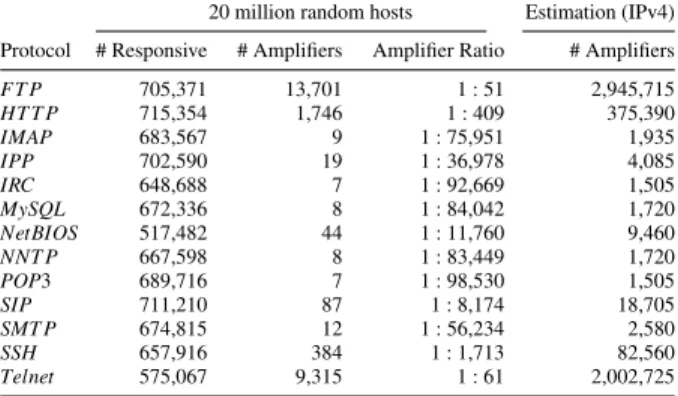
Results. We scanned 20 million random IP addresses for 13 common TCP-based protocols. To enumerate the hosts that transmit payload data before the three-way-handshake is finished, we mainly focused on protocols, in which a server sends payload data first once the hand-shake is completed (e.g., banner information). When analyzing the received network traffic, we only consid-ered hosts that amplify ourSYNpacket by a factor>20, whereas the amplification factor is defined by the num-ber of layer-2 bytes sent by an amplifier divided by the size of our initialSYNpacket of 54 bytes. The factor thus also takes into account the TCP, IP, and Ethernet headers. Table 1 shows the number of vulnerable hosts that we identified in the sampled scans. We found the highest number of amplifiers for FTP and Telnet, while most of the other protocols had a few amplifiers at all. We considered protocols for an Internet-wide scan if we es-timated to find at least 5,000 amplifiers in the entire IPv4 space (i.e., FTP, HTTP, NetBIOS, SIP, SSH, and Telnet).
Table 1: Number of potential amplifiers with an amplifi-cation factor>20 based on scans of 20 million hosts
20 million random hosts Estimation (IPv4) Protocol # Responsive # Amplifiers Amplifier Ratio # Amplifiers
FT P 705,371 13,701 1 : 51 2,945,715 HT T P 715,354 1,746 1 : 409 375,390 IMAP 683,567 9 1 : 75,951 1,935 IPP 702,590 19 1 : 36,978 4,085 IRC 648,688 7 1 : 92,669 1,505 MySQL 672,336 8 1 : 84,042 1,720 NetBIOS 517,482 44 1 : 11,760 9,460 NNT P 667,598 8 1 : 83,449 1,720 POP3 689,716 7 1 : 98,530 1,505 SIP 711,210 87 1 : 8,174 18,705 SMT P 674,815 12 1 : 56,234 2,580 SSH 657,916 384 1 : 1,713 82,560 Telnet 575,067 9,315 1 : 61 2,002,725
Table 2: Number of potential amplifiers per protocol based on scans in the entire IPv4 address space
# Amplifiers with amplification factor Protocol # Responsive >20 >50 >100 >500>1,000>2,500 FT P 152,026,322 2,913,353 3,500 1,868 1,032 937 847 HT T P 149,521,309 427,370 15,426 6,687 1,596 649 347 NetBIOS 82,706,193 12,244 2,449 1,463 873 811 783 SIP 154,030,015 22,830 5,158 3,913 3,289 3,123 2,889 SSH 141,858,473 87,715 4,611 2,141 1,275 1,176 1,082 Telnet 126,133,112 2,120,175 16,469 7,147 2,008 1,393 994
Table 2 illustrates the results obtained for the Internet-wide scans. For FTP and Telnet, we find almost 2% of the responsive hosts to be vulnerable for amplification higher than 20x. That is, the number of bytes received from the amplifiers (including packet headers of Ether-net, IP, and TCP) is more than 20 times higher than the size of theSYNpacket that we sent. The number of am-plifiers drops rapidly for higher amplification rates. At an amplification factor of>2,500, though, attackers can still abuse almost 2,900 hosts—using the SIP protocol.
Table 3 outlines the intersection between the protocols relative to the overall number of vulnerable hosts for the protocols stated in the first table column. We observe the largest overlap for NetBIOS and SIP: more than 50% of the NetBIOS amplifiers can also be abused using SIP. The share between HTTP and FTP, respectively, Telnet ranges from a 1/4 to 1/3. In total, we find 4.8 million distinct IP addresses of amplifiers for the six protocols.
3.2
Amplification Type
In face of this problem’s impact, we need to ascertain what TCP implementation artifacts cause such high am-plification rates. In general, we would expect to see ei-ther a singleRSTpacket upon ourSYNsegment when a port is closed or aSYN/ACKpacket when a service is lis-tening for connections and the second step of the hand-shake is completed.SYN/ACKsegments, however, might
Table 3: Intersection of potential amplifiers Intersection (in %)
Protocol FT P HT T P NetBIOS SIP SSH Telnet FT P - 4.5 0.1 0.2 0.6 19.2 HT T P 30.8 - 0.6 1.1 4.3 26.7 NetBIOS 20.9 21.9 - 53.8 14.7 22.5 SIP 21.9 21.4 28.9 - 22.5 26.0 SSH 19.8 21.1 2.1 5.9 - 21.0 Telnet 26.3 5.4 0.1 0.3 0.9
-Table 4: Number of vulnerable hosts and average ampli-fication factor (AF) per protocol and ampliampli-fication type
SYN/ACK PSH RST
Protocol # Ampl. AF # Ampl. AF # Ampl. AF
FT P 2,907,279 22x 274 103x 5,577 53,927x HT T P 421,487 60x 241 147x 3,411 432x NetBIOS 8,863 54x 64 71x 3,087 78,042x SIP 16,496 1,596x 2 696x 6,306 32,411x SSH 81,256 80x 391 57x 5,889 29,705x Telnet 2,112,706 28x 2,353 3,272x 4,242 79,625x
be retransmitted multiple times until i) anACKsegment is received, ii) a threshold is met and the half-open con-nection is terminated by the initial recipient, or iii) the connection attempt is aborted by the initial sender (e.g., by transmitting aRSTsegment).
Motivated by the fact that the observed behavior di-verged from our initial assumption for thousands of hosts, we analyzed the recorded network packets in more detail. In particular, we studied the distribution of TCP flags and identified three main categories of flags that caused most of the amplification. We identified ampli-fiers that i) aggressively retransmitSYN/ACKpackets, or ii) transmit payload data via PSHpackets even though the three-way-handshake is never actually completed, or iii) send many RSTsegments to refuse our connection attempt. Table 4 outlines the number of hosts per ampli-fication type and the average ampliampli-fication factor.
SYN/ACK: The majority of amplifiers cause ampli-fication by repeatedly retransmitting SYN/ACK packets upon ourSYNsegments. This attack type amplifies traffic up to 80x on average, and for SIP even up to 1,596x.
PSH:The number of amplifiers that transmit payload data viaPSH(without a completed handshake) is low for most protocols. Nevertheless, the amplification factor is higher compared to theSYN/ACKamplifiers.
RST:The by far highest amplification is observed for hosts that transmit a tremendous number of RST seg-ments. As such, an attacker could abuse the 4,242 vul-nerable Telnet hosts to achieve an average amplification rate of 79,625x. Compared to SYN/ACK, the RST am-plifiers of most protocols also have a much higher traf-fic volume—even though the number of hosts is signif-icantly lower. That is, the 8,863 SYN/ACKamplifiers of
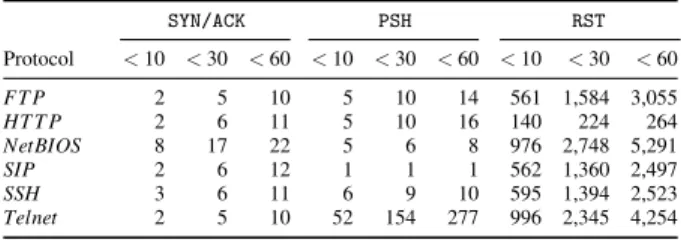
Table 5: Number of packets transmitted by the amplifiers within 10, 30, and 60 seconds after the first response
SYN/ACK PSH RST Protocol <10 <30 <60 <10 <30 <60 <10 <30 <60 FT P 2 5 10 5 10 14 561 1,584 3,055 HT T P 2 6 11 5 10 16 140 224 264 NetBIOS 8 17 22 5 6 8 976 2,748 5,291 SIP 2 6 12 1 1 1 562 1,360 2,497 SSH 3 6 11 6 9 10 595 1,394 2,523 Telnet 2 5 10 52 154 277 996 2,345 4,254
NetBIOS transmitted about 25 MB of traffic, while the RSTamplifiers caused traffic of more than 12 GB. Sim-ilarly, even though we observed most of the FTP ampli-fiers sendingSYN/ACKpackets (causing a total of 3.2 GB of traffic), theRSTamplifiers transferred 15.1 GB of traf-fic in the same amount of time, a multitude of factor 5x.
Unknown:Note that we could not assign 3,763 hosts (less than 0.1% of the identified amplifiers) to one of the main amplification types, as these devices replied with seemingly arbitrary TCP flags. More specifically, we identified 1,841, respectively, 712 amplifiers repeat-edly transmittingACKsegments for HTTP and Telnet that caused amplification from factor 265x to 405x. The num-ber of unclassified hosts, however, is negligible com-pared to the overall number of amplifiers.
Packet Frequency. A high amplification factor is im-portant to achieving a high impact on a victim’s network. However, the impact is also affected by the number of packets that reach the target host simultaneously. We thus also determine the initial packet frequency for the different types of TCP-based amplifiers. More specifi-cally, we measure the number of packets that were trans-mitted by each amplifier within 10, 30, and 60 seconds after observing the first response from the host. As il-lustrated in Table 5, the average number of packets re-flected bySYN/ACKamplifiers within the first 60 seconds is rather low for all protocols. We suspect the majority of hosts to implement common delays to distribute the retransmission ofSYN/ACKpackets over time.
ThePSHamplifiers draw a similar picture—with a sin-gle exception for Telnet. The TelnetPSHamplifiers send 52 packets on average within the first 10 seconds. Within 60 seconds, almost 280 packets are transmitted per am-plifier, causing a significant impact on the target host.
We observe completely different results for the RST amplifiers. For most protocols, we find theRST ampli-fiers to transmit more than 500 packets within the first 10 seconds and up to 5,300 packets (NetBIOS) in the first 60 seconds. Considering that we found 3,087 NetBIOS am-plifiers with an average amplification factor of 78,042x, this poses a serious threat to the Internet community.
Real-world TCP-based attacks. We also determine whether the identified amplifiers can be abused for real-world DDoS attacks, in which an attacker would repeat-edly send spoofedSYNpackets to the amplifiers to flood the victim’s network with reflected traffic. That is, we create a subset of 100,000 randomly chosen SYN/ACK amplifiers and allPSHandRSTamplifiers we found to be vulnerable for the Telnet protocol and send a single, respectively, 5 and 10SYNpackets to each of the individ-ual hosts using different source ports for allSYNpackets. Our analysis is based on all responses that arrive up to 60 seconds after sending the lastSYNsegment. In total, we find up to 62,736SYN/ACK, 2,203PSH, and 1,593RST amplifiers responding to ourSYNsegments (the remain-ing hosts presumably went offline in the mean-time).
For SYN/ACK, we find an almost negligible increase in the attack volume. More specifically, theSYN/ACK amplifiers transmitted 34.2 MB of traffic when sending a single SYN segment. Transmitting 5 SYN segments resulted in traffic of 55.1 MB, while 10SYN segments caused 76.0 MB of traffic, an increase of factor 2.2x.
We observe completely different results for the hosts vulnerable toPSH amplification. That is, we received 11.2 MB of network data when sending a singleSYN seg-ment, while 110.8 MB of traffic was transmitted when sending tenSYNsegments, a multitude of factor 10x.
We find similar results for theRSTamplifiers. Of the 1,593 respondingRSTamplifiers, we find 1,391 hosts to amplify a singleSYNpacket by a factor of 1,250x within 60 seconds, causing network traffic of 89.6 MB. We find a rise of traffic volume by factor 4.4x when sending five SYNpackets (resulting in 392.4 MB of reflected traffic) and observe another rise of factor 2x in the attack vol-ume for 10SYNpackets. More specifically, within 60 seconds after sending the lastSYNsegment, we recorded 789.2 MB of network traffic.
We thus conclude thatSYN/ACKamplifiers are not suit-able to be used in large-scale amplification attacks.PSH andRST amplifiers, in contrast, can indeed be abused when repeatedly sendingSYNsegments to exhaust the ca-pacity of a victim’s network with reflected traffic.
3.3
Amplifier Classification
After determining the amplification factor and packet fre-quency of each amplification type, we try to shed light onto the types of systems that permit amplification via the TCP protocol. More specifically, we request infor-mation via the protocols FTP, HTTP, HTTPS, SSH, and Telnet from each previously identified amplifier to lever-age details in protocol banners and payload fragments. Based on the returned payload, we applied 1,873 regular expressions we already utilized in previous work [6], re-spectively, manually compiled 279 additional regular
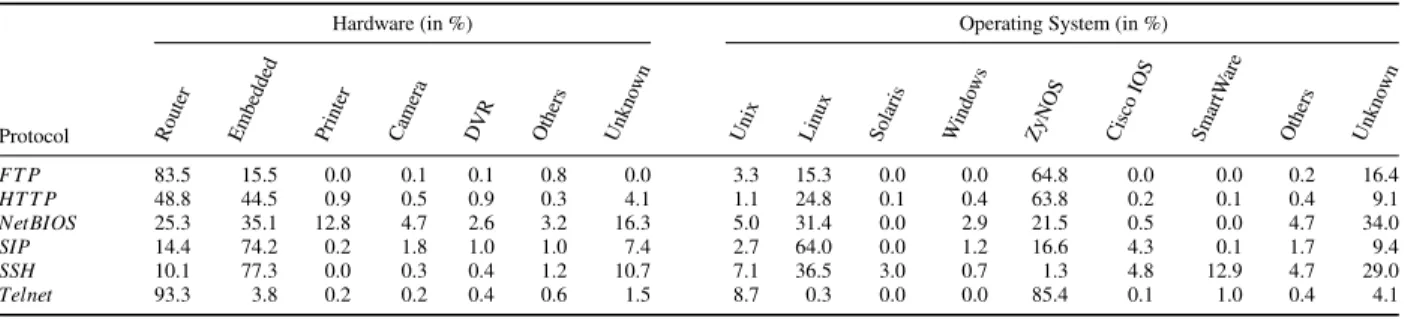
ex-Table 6: Device fingerprinting results of the identified TCP-based amplifiers
Hardware (in %) Operating System (in %)
Protocol Router Embedded Printer Camera DVR Others Unkno wn
Unix Linux Solaris Windo ws ZyNOS Cisco IOS SmartW are Others Unkno wn FT P 83.5 15.5 0.0 0.1 0.1 0.8 0.0 3.3 15.3 0.0 0.0 64.8 0.0 0.0 0.2 16.4 HT T P 48.8 44.5 0.9 0.5 0.9 0.3 4.1 1.1 24.8 0.1 0.4 63.8 0.2 0.1 0.4 9.1 NetBIOS 25.3 35.1 12.8 4.7 2.6 3.2 16.3 5.0 31.4 0.0 2.9 21.5 0.5 0.0 4.7 34.0 SIP 14.4 74.2 0.2 1.8 1.0 1.0 7.4 2.7 64.0 0.0 1.2 16.6 4.3 0.1 1.7 9.4 SSH 10.1 77.3 0.0 0.3 0.4 1.2 10.7 7.1 36.5 3.0 0.7 1.3 4.8 12.9 4.7 29.0 Telnet 93.3 3.8 0.2 0.2 0.4 0.6 1.5 8.7 0.3 0.0 0.0 85.4 0.1 1.0 0.4 4.1
pressions to perform fine-granular device fingerprinting, i.e., a classification into two categories: the underlying hardware (e.g., routers, cameras, or printers) and the OS.
Results. Table 6 illustrates the fingerprinting results obtained for all enumerated amplifiers. Note that the cat-egoryRouter also covers similar devices such as gate-ways, switches, and modems. Further, the category Embeddedincludes various kinds of embedded systems such asserial to LANdevices.
In general, we observed many routing devices. Par-ticularly for FTP and Telnet, most of the vulnerable de-vices are consumer routers running Linux or ZyNOS, an OS that is distributed on ZyXEL devices. We further find 996 (12.9%) of the SSH amplifiers use SmartWare, which is running on SmartNode VoIP gateways. Besides a high number of routing devices and embedded systems, we identified miscellaneous types of printers and surveil-lance cameras. We also observed a surprisingly wide dis-tribution of devices running the NetBIOS protocol.
When looking at the hosts of specific amplification types, we find a diversity of devices forRSTamplifiers such as routers, camera systems, and DVRs of various manufacturers. We thus cannot determine a specific de-vice or vendor that causes the high amplification rates.
However, we find theSYN/ACKamplifiers for the SIP protocol to be specific Wireless ADSL2 VoIP devices manufactured by ZyXEL. Further, the majority of Tel-netPSHamplifiers can be assigned to SmartNode VoIP gateways transmitting a specific message each second. A minority ofPSHamplifiers was found to be a specific routing device of Avocent Cyclades, while we also ob-served several printing servers transmitting actual pay-load data before completing the TCP handshake. As part of responsible disclosure, we have notified the vendors about these protocol implementation deficiencies.
In general, though, we found the fingerprints to show a high diversity of devices and manufacturers, thus the TCP amplification vulnerabilities are not caused by a sin-gle manufacturer and represent a generic attack vector.
3.4
Countermeasures
After classifying the individual amplifiers, we discuss potential countermeasures to either mitigate or com-pletely stop TCP-based amplification attacks.
As previously stated, we do not reply with TCPRST packets during our scans, thus potential amplifiers will not refrain from continuously retransmitting packets. To evaluate the impact ofRST, we repeated the Internet-wide scan for the FTP protocol withRSTtransmission enabled. We clearly observed a large diversity between the num-bers of amplifiers. While the number ofSYN/ACK ampli-fiers dropped to 2,222 hosts (a decrease of 99.9%), we still monitored 5,187 amplifiers distributing a large num-ber ofRSTpackets (a decline of 7.0%), resulting in an average amplification of 19,149x. Further on, the num-ber of hosts that amplify traffic of factor>50x remains stable compared to the results in Table 2.
In an attempt to also stop the remaining hosts from distributing large amounts of packets, we evaluated the effects of specific types of network packets on the be-havior of the amplifiers. More specifically, we sent a sin-gleSYNpacket to each remaining amplifier and replied with a predefined message upon received packets. In par-ticular, we responded with TCPACK,PSH, orFIN seg-ments to eventually trigger specific behavior that stops the hosts from amplifying the initialSYNpacket. We fur-ther replied with ICMP host prohibitedand ICMP port/host/protocol unreachablemessages.
We obtained responses from about 3,500 amplifiers upon ourSYNpackets (the remaining hosts presumably went offline) and observed the highest decrease of ampli-fiers when transmitting ICMPport unreachable mes-sages. That is, we merely found 742 hosts (21.2% of the responsive hosts) to still amplify traffic. For the re-maining TCP and ICMP messages, we found in-between 1,218 (TCPACK) and 1,728 (ICMPhost prohibited) hosts to still transmit an excessive number of packets. We thus conclude that particularly TCPRSTand ICMPport unreachablemessages help to mitigate the attack traf-fic, however, are not a general solution to remediate the root causes for TCP-based amplification vulnerabilities.
3.5
TCP- and UDP-based Amplifiers
The majority of vulnerable UDP-based protocols amplify the number of UDP payload bytes from 3.8x (NetBIOS) to 556.9x (NTPmonlist) on average [10]. When inten-tionally selecting the most responsive 10% of the ampli-fiers an attacker could achieve an amplification factor up to 4,670x for NTP monlistrequests while the ampli-fication remains in-between 4.9x (NetBIOS) and 98.3x (DNS) for the other dissected UDP protocols. However, in terms of actual bandwidth amplification (including Ethernet, IP, and UDP headers), the amplification factor is actually significantly lower, e.g., less than 1,000x in the worst case of NTPmonlistamplifiers. On the con-trary, many common TCP-based protocols allow much higher bandwidth amplification. Particularly forRST, we identified thousands of vulnerable hosts that amplify a singleSYNpacket by a factor of up to 79,625x, causing a serious impact on a victim’s network.
From the viewpoint of an attacker, also the number of amplifiers is important to scale up the overall at-tack bandwidth. For UDP, approximately 2.8 million NetBIOS amplifiers, 30.5 million DNS amplifiers, and 87,463 NTPmonlistamplifiers could be found [6]. Es-pecially the huge number of DNS amplifiers can cause a considerably higher impact (about 10x compared to an attack using FTP) than any TCP protocol in Table 4. Fur-ther, the number of TCP-based amplifiers that can cause serious impact on a victim’s network is rather low, partic-ularly forRST. An attacker thus has to scan a high num-ber of hosts in the IPv4 address space to find the most ef-fective amplifiers. It is thus likely that attackers currently stick to vulnerable UDP protocols to perform large-scale amplification attacks. However, TCP-based attacks are attractive for attackers who only have little bandwidth available and want to amplify it as much as possible. Similarly, TCP traffic is considerably harder to block or filter at the network edges than protocols like the UDP-based NTP—this holds especially for widely distributed protocols such as HTTP or FTP. Distinguishing legiti-mate and harmful TCP packets requires DDoS defense appliances to keep state of TCP connections, and simple port-based filtering techniques cannot be applied to most networks, as these would also block benign communica-tion. Moreover, in contrast to attacks abusing UDP-based protocols, TCP-based amplification traffic typically does not carry payload that can be inspected for validity.
4
Conclusion
In this paper, we have shown that reflective DDoS at-tacks are not limited to UDP-based protocols only. Our in-depth analysis of common TCP protocols identified millions of hosts that are vulnerable for TCP-based
am-plification. While for the majority of amplifiers the im-pact can be mitigated by sendingRSTsegments on unex-pected TCP segments, we also observed devices that do not respect this common TCP behavior and can therefore be abused. We further showed that TCP-based amplifi-cation attacks can induce similar impact than UDP-based attacks, although the number of amplifiers is lower. TCP thus permits reflective amplification attacks causing high attack traffic despite its three-way-handshake.
Acknowledgment
We would like to thank the anonymous reviewers for their constructive and valuable comments. This work was supported by the German Federal Ministry of Edu-cation and Research (BMBF Grants 16BY1110 (MoBE) and 16BY1201D (iAID)).
References
[1] COMPUTER EMERGENCY RESPONSE TEAM. CERT
advi-sory CA-1996-21: TCP SYN Flooding and IP Spoofing
At-tacks. https://www.cert.org/historical/advisories/
CA-1996-21.cfm, 1996.
[2] DITTRICH, D. Distributed Denial of Service (DDoS)
Attacks/tools. http://staff.washington.edu/dittrich/
misc/ddos/, 2000.
[3] DURUMERIC, Z., WUSTROW, E., AND HALDERMAN, J. A.
ZMap: Fast Internet-Wide Scanning and its Security
Applica-tions. InUSENIX Security Symposium(2013).
[4] FREILING, F. C., HOLZ, T., ANDWICHERSKI, G. Botnet
Tracking: Exploring a Root-cause Methodology to Prevent
Dis-tributed Denial-of-service Attacks. InEuropean Symposium on
Research in Computer Security (ESORICS)(2005).
[5] IOANNIDIS, J.,ANDBELLOVIN, S. M. Implementing Pushback:
Router-Based Defense Against DDoS Attacks. InSymposium on
Network and Distributed System Security (NDSS)(2002).
[6] K ¨UHRER, M., HUPPERICH, T., ROSSOW, C.,ANDHOLZ, T.
Exit from Hell? Reducing the Impact of Amplification DDoS
Attacks. InUSENIX Security Symposium(2014).
[7] MIRKOVIC, J.,ANDREIHER, P. A Taxonomy of DDoS Attack
and DDoS Defense Mechanisms.SIGCOMM Comput. Commun.
Rev. 34, 2 (Apr. 2004).
[8] PAXSON, V. An Analysis of Using Reflectors for Distributed
Denial-of-Service Attacks. InComputer Communication Review
31(3)(July 2001).
[9] PENG, T., LECKIE, C.,ANDRAMAMOHANARAO, K. Survey
of Network-based Defense Mechanisms Countering the DoS and
DDoS Problems.ACM Comput. Surv. 39, 1 (Apr. 2007).
[10] ROSSOW, C. Amplification Hell: Revisiting Network Protocols
for DDoS Abuse. InSymposium on Network and Distributed
Sys-tem Security (NDSS)(2014).
[11] SCHUBA, C. L., KRSUL, I. V., KUHN, M. G., SPAFFORD,
E. H., SUNDARAM, A.,ANDZAMBONI, D. Analysis of a
De-nial of Service Attack on TCP. InIEEE S&P(1997).
[12] YAAR, A., PERRIG, A.,ANDSONG, D. Pi: A Path
Identifica-tion Mechanism to Defend Against DDoS Attacks. InIEEE S&P