Building Regulations 2010
Technical Guidance Document M
Access and Use
ARNA FHOILSIÚ AG OIFIG AN tSOLÁTHAIR BAILE ÁTHA CLIATH
Le ceannach díreach ón
OIFIG DHÍOLTA FOILSEACHÁN RIALTAIS,
TEACH SUN ALLIANCE, SRÁID THEACH LAIGHEAN, BAILE ÁTHA CLIATH 2, nó tríd an bpost ó
FOILSEACHÁIN RIALTAIS, AN RANNÓG POST-TRÁCHTA,
AONAD 20 PÁIRC MIONDÍOLA COIS LOCHA, CLÁR CHLAINNE MHUIRIS, CONTAE MHAIGH EO (Teil: 01-6476834/37 nó 1890 213434; Fax: 01-6476843 nó 094-9378964)
nó trí aon díoltóir leabhar. ________________________
PUBLISHED BY THE STATIONERY OFFICE DUBLIN
To be purchased directly from the
GOVERNMENT PUBLICATIONS SALE OFFICE
SUN ALLIANCE HOUSE, MOLESWORTH STREET, DUBLIN 2, or by mail order from
GOVERNMENT PUBLICATIONS, POSTAL TRADE SECTION, UNIT 20 LAKESIDE RETAIL PARK, CLAREMORRIS, CO. MAYO (Tel: 01-6476834/37 or 1890 213434; Fax: 01-6476843 or 094-9378964) or through any bookseller.
_______________________ Price € 12.00
Contents
Page Introduction 6 Transitional Arrangements 6 The Guidance 6 Existing Buildings 7 Technical Specifications 7Materials and Workmanship 7
Interpretation 7
Part M – The Requirement 9
0.1 General 9
0.2 The Requirements 10
0.3 Buildings other than dwellings 10
0.4 Dwellings 10
0.5 Use of the Guidance 11
0.6 Application of Part M 11 0.7 Determination of practicability 13 0.8 Existing Buildings 14 0.9 Fire Safety 15 0.10 Diagrams 15 0.11 Disability Act 2005 15 0.12 Management 15
Section 1 Access and Use of buildings other than dwellings 17
Section 1.1 Approach to buildings other than dwellings 18
1.1.1 Objective 18
1.1.2 Introduction 18
1.1.3 Access routes 19
1.1.3.1 General 19
1.1.3.2 Level access routes 22
1.1.3.3 Gently sloped access routes 22
1.1.3.4 Ramped access routes 23
1.1.3.5 Stepped access routes 26
1.1.3.6 Handrails 31
1.1.4 Pedestrian crossings 34
1.1.5 On-site car parking 34
1.1.6 On-site setting down areas 37
Section 1.2 Access to buildings other than dwellings 38
1.2.1 Objective 38
1.2.2 Introduction 38
1.2.3 Accessible entrances 38
1.2.4 Accessible entrance doors 39
Contents
1.2.4.3 Accessible power-operated doors 44
1.2.4.4 Low energy swing doors 45
1.2.5 Entrance lobbies 45
Section 1.3 Circulation within buildings other than dwellings 47
1.3.1 Objective 47
1.3.2 Introduction 47
1.3.3 Horizontal features 47
1.3.3.1 Reception area in entrance halls 47
1.3.3.2 Internal doors 49
1.3.3.3 Corridors and passageways 50
1.3.3.4 Internal lobbies 52
1.3.4 Vertical features 54
1.3.4.1 Provision 54
1.3.4.1.1 Lifts 54
1.3.4.1.2 Stairs 54
1.3.4.2 Passenger lift details 54
1.3.4.3 Internal stairs suitable for ambulant disabled people 57
1.3.4.4 Internal ramps 60
1.3.4.5 Handrails 60
Section 1.4 Sanitary facilities for buildings other than dwellings 61
1.4.1 Objective 61
1.4.2 Introduction 61
1.4.3 General provisions 61
1.4.3.1 Provisions for wheelchair accessible unisex WCs 62
1.4.3.2 Provisions for WC cubicles 62
1.4.3.3 Provisions for urinals 63
1.4.3.4 Provisions for accessible bathrooms/shower rooms 63
1.4.3.5 Provisions for changing and/or showering facilities 64
1.4.4 Sanitary facilities – General 64
1.4.5 Wheelchair accessible unisex WC 67
1.4.6 Cubicles 71
1.4.6.1 Standard cubicles 71
1.4.6.2 Cubicles for ambulant disabled people 72
1.4.6.3 Enlarged cubicles 72
1.4.7 Accessible urinals 74
1.4.8 Accessible bathrooms/shower rooms 76
1.4.9 Changing and/or showering facilities 80
1.4.9.1 Changing facilities 80
1.4.9.2 Showering facilities 80
Section 1.5 Other facilities in buildings other than dwellings 83
1.5.1 Objective 83
1.5.2 Introduction 83
Contents
1.5.4 Audience and spectator facilities without fixed seating 85
1.5.5 Refreshment facilities 88
1.5.6 Accessible sleeping accommodation 90
1.5.7 Switches, outlets and controls 91
Section 1.6 Aids to communication 94
1.6.1 Objective 94 1.6.2 Introduction 94 1.6.3 Signage 95 1.6.4 Visual contrast 95 1.6.5 Lighting 96 1.6.6 Audible aids 96
Section 2 Access and Use of existing buildings other than dwellings 97
2.0 Introduction 98
Section 2.1 Approach to existing buildings other than dwellings 99
2.1.1 Objective 99
2.1.2 Introduction 99
2.1.3 Access routes 99
2.1.3.1 General 99
2.1.3.2 Level access routes 99
2.1.3.3 Gently sloped access routes 99
2.3.3.4 Ramped access routes 100
2.1.3.5 Stepped access routes 101
2.1.3.6 Handrails 101
2.1.4 Pedestrian crossings 102
2.1.5 On-site car parking 102
2.1.6 On-site setting down areas 102
Section 2.2 Access to existing buildings other than dwellings 102
2.2.1 Objective 102
2.2.2 Introduction 102
2.2.3 Accessible entrances 102
2.2.4 Accessible entrance doors 102
2.2.4.1 Accessible glass doors 102
2.2.4.2 Accessible manual doors 102
2.2.4.3 Accessible power-operated doors 102
2.2.4.4 Low energy swing doors 102
2.2.5 Entrance lobbies 103
Section 2.3 Circulation within existing buildings other than dwellings 103
2.3.1 Objective 103
2.3.2 Introduction 103
Contents
2.3.3.2 Internal doors 103
2.3.3.3 Corridors and passageways 103
2.3.3.4 Internal lobbies 103
2.3.4 Vertical features 103
2.3.4.1 Provision 103
2.3.4.1.1 Lifts 104
2.3.4.1.2 Stairs 104
2.3.4.2 Passenger lift details 104
2.3.4.3 Internal stairs suitable for ambulant disabled people 104
2.3.4.4 Internal ramps 105
2.3.4.5 Handrails 105
Section 2.4 Sanitary facilities for existing buildings other than dwellings 105
2.4.1 Objective 105
2.4.2 Introduction 105
2.4.3 General provisions 105
Section 2.5 Other facilities in existing buildings other than dwellings 108
2.5.1 Objective 108
2.5.2 Introduction 108
2.5.3 Audience and spectator facilities with fixed seating 108
2.5.4 Audience and spectator facilities without fixed seating 108
2.5.5 Refreshment facilities 108
2.5.6 Accessible sleeping accommodation 108
2.5.7 Switches, outlets and controls 108
Section 2.6 Aids to communication 108
2.6.1 Objective 108
2.6.2 Introduction 108
2.6.3 Signage 108
2.6.4 Visual contrast 108
2.6.5 Audible aids 108
Section 3 Access and Use of dwellings 109
Section 3.1 Approach to dwellings 110
3.1.1 Objective 110
3.1.2 Access route to a dwelling 110
3.1.2.1 General 110
3.1.2.2 Level access route 111
3.1.2.3 Gently sloped access route 111
3.1.2.4 Ramped access route 111
Contents
Section 3.2 Access to dwellings 114
3.2.1 Objective 114
3.2.2 Accessible entrance 114
Section 3.3 Circulation within dwellings 115
3.3.1 Objective 115
3.3.2 Circulation within a dwelling 115
3.3.2.1 Horizontal circulation within a dwelling 115
3.3.2.2 Vertical circulation within a dwelling 117
Section 3.4 Sanitary facilities for dwellings 118
3.4.1 Objective 118
3.4.2 Accessible WC 118
3.4.3 WC in smaller dwellings 120
Section 3.5 Switches and sockets in dwellings 121
3.5.1 Objective 121
3.5.2 Switches and sockets 121
Standards and publications 122
Building Regulations 2010
Technical Guidance Document M
-
Access and Use
Introduction
This document has been published by the Minister for the Environment, Heritage and Local Government under article 7 of the Building Regulations 1997. It
provides guidance in relation to Part M of the Second Schedule to the Regulations as amended by the Building Regulations (Part M Amendment) Regulations 2010 (S.I. No. 513 of 2010). The document should be read in conjunction with the Building Regulations 1997 - 2010 and other documents published under these Regulations.
In general, Building Regulations apply to the construction of new buildings and to extensions and material alterations to buildings. In addition, certain parts of the Regulations apply to existing buildings where a material change of use takes place. Otherwise, Building Regulations do not apply to buildings constructed prior to 1 June, 1992.
Transitional Arrangements
In general, this document applies to works, or buildings in which certain material changes of use take place, where the works commence or the change of use takes place, as the case may be on or after 1 January 2012. Technical Guidance Document M – Access for People with Disabilities, dated 2000, also ceases to have effect from that date.
However, the latter document may
continue to be used in the case of works, or buildings where –
(a) the works commence or certain change of use takes place, as the case may be, on or before 31 December 2011, or
(b) the works, or buildings are the subject of –
(i) a planning application made on or before 31 December 2011 for planning permission or approval pursuant to the Local Government (Planning and Development) Act 2000, and where substantial work has been completed by 31 December 2013, or (ii) a notice pursuant to the
provisions of Part 8 of the Local Government (Planning and Development) Regulations 2001 (S.I. No. 600 of 2001) has been published on or before 31 December 2011, and where substantial work has been completed by 31 December 2013, or
(c) a Fire Safety Certificate or a Disability Access Certificate under the Building Control Regulations, in respect of the works or buildings, has been granted on or before 31 December 2011, and where substantial work has been
completed by 31 December 2013. “Substantial work has been completed” means that the structure of the external walls has been erected.
The Guidance
The materials, methods of construction, standards and other specifications (including technical specifications) which are referred to in this document are those which are likely to be suitable for the purposes of the Regulations. Where works are carried out in accordance with
Building Regulations 2010
Technical Guidance Document M
-
Access and Use
the guidance in this document, this will, prima facie, indicate compliance with Part M of the Second Schedule to the Building Regulations (as amended). However, the adoption of an approach other than that outlined in the guidance is not precluded provided that the relevant requirements of the Regulations are complied with.
Those involved in the design and
construction of a building may be required by the relevant building control authority to provide such evidence as is necessary to establish that the requirements of the Building Regulations are being complied with.
Existing Buildings
In the case of material alterations or change of use of existing buildings, the adoption without modification of the guidance in this document may not, in all circumstances, be appropriate. In
particular, the adherence to guidance, including codes, standards or technical specifications, intended for application to new work may be unduly restrictive or impracticable. Buildings of architectural or historical interest are especially likely to give rise to such circumstances. In these situations, alternative approaches based on the principles contained in the
document may be more relevant and should be considered.
Technical Specifications
Building Regulations are made for specific purposes, e.g. to provide, in relation to buildings, for the health, safety and welfare of persons, the conservation of energy and access for people with disabilities. Technical specifications (including harmonised European Standards, European Technical Approvals, National Standards and
Agrément Certificates) are relevant to the
extent that they relate to these considerations. Any reference to a
technical specification is a reference to so much of the specification as is relevant in the context in which it arises. Technical specifications may also address other aspects not covered by the Regulations. A reference to a technical specification is to the latest edition (including any
amendments, supplements or addenda) current at the date of publication of this Technical Guidance Document.
However, if this version of the technical specification is subsequently revised or updated by the issuing body, the new version may be used as a source of guidance provided that it continues to address the relevant requirements of the Regulations.
A list of other standards and publications that deal with matters relating to this Part of the Building Regulations is included at the end of this document. These
standards and publications may be used as a source of further information but do not form part of the guidance.
Materials and Workmanship
Under Part D of the Second Schedule to the Building Regulations, building work to which the Regulations apply must be carried out with proper materials and in a workmanlike manner. Guidance in relation to compliance with Part D is contained in Technical Guidance Document D.
Interpretation
In this document, a reference to a section, sub-section, part, paragraph or diagram is, unless otherwise stated, a reference to a section, sub-section, part, paragraph or diagram, as the case may be, of this document. A reference to
Building Regulations 2010
Technical Guidance Document M
-
Access and Use
another Technical Guidance Document is a reference to the latest edition of a
document published by the Department of the Environment, Heritage and Local Government under Article 7 of the Building Regulations (as amended). Diagrams are used in this document to illustrate particular aspects of
construction - they may not show all the details of construction.
Access and Use
Part M – The Requirement
Part M of the Second Schedule to the Building Regulations, (as amended), provides as follows:
0.1 General
Part M aims to foster an inclusive
approach to the design and construction of the built environment. The
requirements of Part M (M1 - M4) aim to ensure that regardless of age, size or disability:
(a) new buildings other than dwellings are accessible and usable;
(b) extensions to existing buildings other than dwellings are where practicable, accessible and useable;
(c) material alterations to existing buildings other than dwellings increase the accessibility and usability of existing buildings where practicable;
(d) certain changes of use to existing buildings other than dwellings increase the accessibility and usability of existing buildings where practicable; and
In doing so, the Requirements, underpin the principle of Universal Design.
Universal design is defined in the Disability Act 2005 as “the design and composition of an environment so that it may be accessed, understood and used to the greatest practicable extent, in the most independent and natural manner possible, in the widest possible range of situations and without the need for adaptation, modification, assistive devices or specialised solutions, by persons of any age or size or having any particular physical, sensory, mental health or intellectual ability or disability.” Buildings should be designed so that they are easy for people to use and to reflect the fact that all people experience
changes in their abilities as they progress through the different stages of life. It is important for designers to take all of the users of buildings into account throughout the design process in order to avoid the creation of a built environment that
excludes certain groups from participating in normal everyday activities.
Access and Use M1 Adequate provision shall be made for people to access and
use a building, its facilities and its environs.
Application of the Part M2 Adequate provision shall be made for people to approach and access an extension to a building.
M3 If sanitary facilities are provided in a building that is to be extended, adequate sanitary facilities shall be provided for people within the extension.
M4 Part M does not apply to works in connection with extensions to and material alterations of existing dwellings, provided that such works do not create a new dwelling.
Access and Use
Experience has shown that meeting the needs of people with disabilities or elderly people frequently generates design
solutions which benefit a wider range of user groups, including people with young children in buggies, people with
temporary injuries or carrying heavy luggage.
This document, Technical Guidance Document M (TGD M) sets out guidance on the minimum level of provision to meet requirements M1-M4. However, those involved in the design and construction of buildings should also have regard to the design philosophy of Universal Design and consider making additional provisions where practicable and appropriate. For this purpose, a list of useful references, advocating greater accessibility, is given at the end of this document. Further advice and guidance can be found at the Centre for Excellence in Universal
Design, www.universaldesign.ie and in the publication ‘Building for Everyone’.
0.2 The Requirements
In order to satisfy the requirements of Part M, all buildings should be designed and constructed so that:
(a) people can safely and independently approach, gain access and use a building, its facilities and its environs, and
(b) elements of the building do not constitute an undue hazard for people, especially for people with vision, hearing or mobility
impairments.
0.3 Buildings other than dwellings
In the case of buildings other than dwellings, the building should also be designed and constructed so that:
(a) people can circulate within the building and use the building’s facilities;
(b) where sanitary facilities are
provided, adequate sanitary facilities are available and accessible to people with a range of abilities; (c) where relevant facilities such as
fixed/ unfixed seating for audience or spectators, refreshment facilities, sleeping accommodation and the like are provided, adequate
provision is made for people with a range of abilities;
(d) suitable aids to communication are available for people with vision, hearing or mobility impairments.
0.4 Dwellings
Dwellings should be designed and constructed so that:
(i) people can safely and conveniently approach and gain access. Where due to site specific constraints or where all entrances are on other than ground level and a suitable passenger lift is not provided, it is considered adequate to provide access by means of steps, or a stairway suitable for use by ambulant disabled people;
(i) people can have access to the main habitable rooms at entry level. Where there is no habitable room at this level, it is considered adequate to provide for access to habitable rooms on the storey containing the main living room. Access to this storey from the entry storey may be by means of a stairway suitable for use by ambulant disabled people;
Access and Use
(iii) a WC is provided at entry level or, where there are no habitable rooms at this level, on the storey containing the main living room.
0.5 Use of the Guidance
Technical Guidance Document M 2010 is divided into 3 sections. Each section deals with different types of works.
Section 1: The guidance in Section 1
sets out the minimum level of provision for the following buildings to meet the requirements of M1:
(a) buildings other than dwellings and their environs, and
(b) the common areas of apartment blocks and their environs.
Section 1 applies to both new and existing buildings.
Section 2: The guidance in Section 2
should be read in conjunction with Section 1 and is intended to provide additional guidance for:
(a) existing buildings other than dwellings and their environs; and (b) the common areas of existing
apartment blocks and their environs. Section 2 provides additional guidance on the minimum provisions for certain
elements and features of existing
buildings where it is not practicable (refer 0.7) to achieve the provisions set out in Section 1. Where works (e.g. extensions, material alterations and certain material changes of use, etc) to existing buildings are carried out in accordance with
Section 1 and, where necessary Section 2, this will prima facie indicate compliance
with Requirement M1. Reference should be made to 0.6 and 0.8 for the application of Part M to existing buildings and 0.7 for considerations that should be made when determining ‘practicability’.
Section 3: The guidance in Section 3
applies to dwellings and their environs. This includes individual dwelling houses and individual apartments. It does not apply to the common areas of apartment blocks. The guidance in Section 3 also applies to the common areas of duplex buildings.
0.6 Application of Part M
The Requirements of Part M apply to: (a) works in connection with new
buildings and new dwellings;
(b) works in connection with extensions to existing buildings, and in
particular:
(i) under M2, adequate provision must be made to approach and access an extension. This may be provided by an adequate
independent approach1 and
entrance to the extension, or where this is not practicable, the existing approach and entrance modified where necessary and where practicable, must provide
adequate approach and access to the extension, and
1
Independent approach means a route of access that does not require the user to pass through any
Access and Use
(i) under M3, where sanitary facilities are provided in a building, adequate accessible sanitary facilities must be provided for the people within the extension i.e. people using the extension. These may be provided by accessible sanitary facilities in the extension or alternatively, those facilities in the existing building, modified where necessary, must be adequate and accessible from the extension.
(c) works in connection with material alterations of existing buildings. Building Regulations (Part M
Amendment) Regulations 2010 (S.I.
No. 513of 2010), extends the
definition of material alteration to include Part M. As a result, the Building Regulations apply to any alterations subject to the
requirements of Part A, B or M. The incorporation of Part M means that alterations to features relevant to compliance with Part M e.g. entrances, sanitary facilities, etc, must comply with M1. The building as a whole, including the approach from the site boundary and from on-site car parking where provided, must be no less compliant with M1 following a material alteration of a building. However, this does not mean it is necessary to upgrade the existing access to the building
entrance unless the entrance itself is subject to a material alteration; (d) an existing building or part of an
existing building, which undergoes a material change of use to a day centre(i), hotel, hostel or guest
building(ii), institutional building(iii),
place of assembly(iv),shop(v) (which
is not ancillary to the primary use of the building) or shopping centre(vi).
S.I. No. 513 of 2010 amends Article 13 of the Building Regulations
dealing with material changes of use to require Part M to apply to certain material changes of use. Where such material change of use applies to the whole building (including approach and access, where practicable), the building must comply with M1. Where such material change of use only applies to part of the building, that part must comply with M1, the approach and access to that part (through
independent access or through another part of the building) where practicable (refer to 0.7) must comply with M1 and any sanitary facility provided in or in connection with it must comply with M1;
The Requirements of Part M do not apply to works in connection with extensions to and the material alterations of existing dwellings, provided that such works do not create a new dwelling. However, an extension or a material alteration of a dwelling must not make the building, as a whole, less satisfactory in relation to Part M than it was before. This means an extension or a material alteration of a dwelling need not itself comply with Part M, but it must not result in the dwelling being less compliant than it previously was;
Also, the Requirements of Part M do not apply to the part(s) of a building used solely to enable inspection, repair or maintenance.
Access and Use
Definitions relating to 0.6(d)
(i)
Day centre means a building used for the provision of treatment or care to persons where such persons do not stay
overnight and includes a day care centre, crèche, pre-school and a day nursery.
(ii)
Guest building means a building (other than a hotel or hostel) providing overnight accommodation for reward, and
includes a guest house.
(iii)
Institutional building includes a hospital, nursing home, home for old people or for children, school or other similar establishment used as living accommodation or for the treatment, care or maintenance of persons suffering from illness or mental or physical disability or handicap, where such persons sleep on the premises.
(iv)
Place of assembly includes:
a) theatre, public library, hall or other building of public resort used for social or recreational purposes; b) a non-residential school or other educational establishment;
c) a place of public worship;
d) a public house, restaurant or similar premises used for the sale to members of the public of food or drink for consumption on the premises,
but no building shall be treated as a place of assembly solely because it is a building to which members of the public are occasionally admitted.
(v)
Shop includes a building used for retail or wholesale trade or business (including retail sales by auction, self selection
and over-the-counter wholesale trading, the business of lending books or periodicals for gain and the business of a barber or hairdresser) and premises to which the public is invited to deliver or to collect goods in connection with their hire, repair or other treatment, or where they themselves may carry out such repairs or other treatments.
(vi)
Shopping centre includes a building which comprises a number of individually occupied premises to which common
access is provided principally for the benefit of shoppers.
0.7 Determination of practicability
In the determination of ‘practicability’ with respect to works to an existing building, its facilities or its environs the following non-exhaustive list of circumstances should be considered.
(i) Where the works would have a significant adverse effect on the historical significance of the existing building, facility or environs e.g. works to a Protected Structure2; (ii) Where the existing structural
conditions would require moving or altering a load bearing member which is an essential part of the overall structural stability of the building;
(iii) Where other existing physical or site constraints would prohibit
(iv) Where the works would need to be carried out on part of a building, its facilities or its environs that are not under the same control/ ownership e.g. in the case of a sub-leaseholder in a multi-occupancy building;
(v) Where specific alternative guidance to Section 1 is provided in Section 2 and an existing feature or facility satisfies that guidance;
(vi) Where a specific planning condition prohibits modification of an identified existing feature.
2
These buildings have been identified as having particular cultural significance and heritage value and are included by each Planning Authority on a Record
Access and Use
0.8 Existing Buildings
Building Regulations do not apply to buildings subject to the National Monuments Acts 1930 to 2004.
0.6 sets out the application of Part M to buildings, new and existing.
The term ‘practicability’ is used in connection with works (e.g. material alterations and certain material changes of use) to existing buildings which
identifies instances where achieving standards of accessibility associated with new buildings is not feasible because of particular circumstances. Refer to 0.7 for guidance on determining practicability. Where works to existing buildings are carried out in accordance with the guidance in Section 1 of this document, this will, prima facie, indicate compliance with Part M. Where it is not practicable to apply the guidance in Section 1 and works are carried out to Section 2, this will also prima facie indicate compliance with Part M.
Works to existing buildings, such as extensions, material alterations and certain material changes of use, can present many design challenges because of the individual character, appearance and environs of existing buildings. The adoption without modification of the guidance in this document may not in all circumstances be appropriate. While each existing building and site will present its own unique access
opportunities and constraints, which may result in different ways of addressing accessibility, the fundamental priorities of accessibility should be as set out in M1, i.e. accessing and using a building, its facilities and environs.
The application of this Part may pose particular challenges for buildings which are of architectural or historical interest. When considering works to an historic building, it is important to establish what is important or significant about the building. Historic buildings can be significant in many different ways, for example, in its physical fabric, in its historical associations or in its
archaeological potential. The better the understanding of what is important, the easier it will be to design appropriate accessible solutions. Information about the significance of a building may be obtained from a conservation plan or statement, where these exist, or from the architectural conservation officer from the relevant local authority.
Historic buildings include Protected Structures, which are included by each Planning Authority on a Record of Protected Structures. These buildings have been identified as having particular cultural significance and heritage value. As previously stated, the adoption without modification of the guidance in this
document may not, in all circumstances, be appropriate for historic buildings. Liaison with the local Building Control Authority on alternative approaches based on the principles contained in this document may be more relevant and should be considered. In specific cases, a dispensation or relaxation (or partial dispensation or relaxation) of the Requirements may be granted by the local Building Control Authority. Whilst the provisions of the Building Regulations do not relate to
management, the role it can play in improving the accessibility of existing buildings is acknowledged. Designers/
Access and Use
owners should be mindful of this and consider enhancing the accessibility of existing buildings through appropriate management solutions or compensating for existing buildings that have to apply for a (partial) dispensation or relaxation from Part M. For guidance on
management refer to 0.12.
For more guidance on historic buildings refer to:
• Architectural Heritage Protection - Guidelines for Planning Authorities Planning Guidelines No. 9 published by the Department of the
Environment, Heritage and Local Government;
• Advice Series: Access – improving
the accessibility of historic buildings and places published by the
Department of the Environment, Heritage and Local Government.
0.9 Fire Safety
Access provision must be linked to provision for emergency egress in the case of a fire. The scope of Part M is limited to matters of access to and use of a building. For guidance on means of escape or evacuation, reference should be made to Technical Guidance
Document B (Fire Safety) and the NDA publication ‘Promoting Safe Egress and Evacuation of People with Disabilities’.
0.10 Diagrams
Diagrams included in this document are intended to clarify certain aspects of the guidance. They are not necessarily to scale and do not represent fully detailed solutions. Where dimensions are stated, they refer to minimum or a range of finished dimensions. Allowance should
finishes and on-site deviation. Reference should be made to Technical Guidance Document D (Materials and
Workmanship) for guidance in relation to manufacturing and other tolerances applicable to building components generally.
0.11 Disability Act 2005
The Disability Act 2005 aims to advance the participation of people with disabilities in everyday life by, for example,
improving access to buildings, services and information. Attention is drawn to the obligation on Public bodies (such as Government Departments, Local Authorities, Health Service Executive, Semi-state Bodies, etc) to make their public buildings comply with Part M 2000, by 2015. It also requires that these public buildings be brought into compliance with amendments to Part M not later than 10 years after the commencement of the amendment. For the purposes of this part of the Disability Act “public building” means a building, or that part of a
building, to which members of the public generally have access and which is occupied, managed or controlled by a public body.
The NDA may prepare a draft code of practice relating to the accessibility of public buildings for persons with disabilities, for the purpose of giving guidance to these public bodies, if so requested.
0.12 Management
Whilst the provisions of the Building Regulations do not relate to management or maintenance and compliance with the Regulations is not dependent on these, it is acknowledged that they are important functions and contribute to the ongoing
Access and Use
which are generally the responsibility of the management and or maintenance teams include:
• arranging furniture appropriately;
• keeping circulation routes clear,
facilities clean, equipment (lifts, communication aids, etc) functioning;
• carrying out maintenance audits on
a regular basis;
• conducting staff training and
awareness campaigns on peoples specific needs and the use of
assistive equipment in buildings e.g. maintenance of induction loops, hoists and other assistive devices;
• putting a detailed emergency action
plan in place to ensure safe egress for all in the event of an emergency;
• procurement of accessible goods
and services (office furniture, security services, etc);
• providing pre-visit information
regarding access to the building on the organisation’s website;
• providing information on the
accessibility features of the building to occupants, in order to allow for effective management procedures to be put in place.
For guidance on managing buildings refer to Building for Everyone, BS 8300:2009, the NDA publication ‘Access Handbook Template’ and www.nda.ie.
Section 1
Access and Use of buildings other than dwellings
The guidance in Section 1 applies to buildings other than dwellings and their environs. The guidance in Section 1 also applies to the common areas of apartment blocks and their environs.Additional guidance on certain elements and features of existing buildings of the above mentioned types is given in Section 2.
Section 1.1
Approach to buildings other than dwellings
Section 1.1
Approach to buildings other than dwellings
1.1.1 Objective
The objective is to provide
independently accessible means of approach to the accessible entrance(s) of a building and means of circulation around a building.
1.1.2 Introduction
The approach route(s) to the accessible entrance(s) of a building are the routes from:
(a) the adjacent road or the entrance point at the boundary of the site, and (b) any designated car-parking spaces
for people with disabilities and/or setting down areas.
The circulation routes around a building are the routes:
(c) between the accessible entrance(s) and any other subsidiary entrances and buildings, where external
circulation is required between them; (d) to and from facilities associated with
the building and within the complex; and
(e) from the building exits to assembly points or to the boundary of the site. The building should be designed within the overall constraints of space, so that the difference in level between the entrance storey and the site entry point, any designated car-parking spaces, any setting down areas, other subsidiary
entrances/ buildings, any associated facilities or assembly points is minimised. The approach and circulation routes as defined in 1.1.1 should be designed and constructed as access routes in
accordance with 1.1.3.
Level access routes accommodate the widest range of abilities and should be provided. For the purpose of this
guidance a gradient of 1:50 or less steep is considered to be level. Changes in level are difficult for many people to negotiate (e.g. wheelchair users, people using walking aids, pushing buggies, people with vision impairment) and should be avoided.
Where it is not possible to provide a level access route, a gently sloped access route should be provided. The gradient of a gently sloped approach should be as shallow as possible. For the purpose of this guidance a gradient steeper than 1:50 (but less steep than 1:20) is
considered to be gently sloped. Access routes of 1:20 or less steep are preferred. Where it is not possible to provide a gently sloped access route, a ramped access route should be provided. For the purpose of this guidance a gradient of 1:20 or steeper is considered to be a ramp.
Where the ramp has a rise greater than 300 mm (equivalent to 2 x 150 mm steps), a stepped access route should be
provided in addition to a ramped access route. Some people find it easier to use a flight of steps rather than to travel on a ramp e.g. people with mobility difficulties who use certain walking aids; older people, people with vision impairment. Alternatively, a platform lift may be
Section 1.1
Approach to buildings other than dwellings
provided where site specific constraintsrequire it (in addition to a ramped or stepped access route) conforming to BS 6440:19993.
It is important to restrict the number of barriers, restrictions or other hazards that people encounter on an access route. Guidance on hazard protection is given in 1.1.3.
Where pedestrian crossings are provided along access routes they should be designed and constructed in accordance with the guidance given in 1.1.4.
Where car-parking is provided on site, designated car-parking spaces
(exclusively for the use of holders of a disabled person’s parking permit) should be provided on a proportional basis. The level of provision, design and construction of designated car-parking spaces should be in accordance with the guidance given in 1.1.5.
Where there is a road on site leading to the building, there should be a setting down area provided at or adjacent to at least one accessible entrance. This facilitates a person arriving at a building as a passenger in a vehicle, to alight from the vehicle and enter the building safely and conveniently. Where setting down areas are provided, they should be designed and constructed in accordance with the guidance given in 1.1.6.
1.1.3 Access routes 1.1.3.1 General
The following guidance applies to all access routes, whether level, gently sloped, ramped or stepped. Additional specific guidance on the above four types
of access route is given in 1.1.3.2 to 1.1.3.5.
Where an access route is provided: (a) projecting features, which may
present hazards, should be avoided to reduce the risks to peoplewith
vision impairment. However, if they
are unavoidable hazard protection should be provided if objects project more than 100 mm into an access route and their lower front edge is more than 300 mm above the ground. A window or door in general use should not open out onto these routes, within a height of 2100 mm above floor or ground level. Where such hazards are unavoidable, the area should be protected by guarding, planting or other suitable barrier incorporating low level cane detection (refer to Diagrams 1 and 2);
(b) the minimum headroom provided should be 2100 mm. The underside of stairs, ramps or similar features that restrict headroom below this level should be enclosed.
Rationale: This reduces the risk to people especially those with vision impairment from colliding with the edge of these features;
(c) tapping rails or low level kerbs should be avoided beneath free-standing stairs as they can be a tripping hazard;
3 Platform lifts should comply with the Machinery Directive 2006/42/EC. BS 6400:1999 is partially superseded by EN 81-40. The remainder will eventually be superseded by EN 81-41.
Section 1.1
Approach to buildings other than dwellings
(d) street furniture, such as lightingcolumns, signposts, litter bins, seats, etc, should be located at or beyond the boundaries of the access route;
(e) low level posts e.g. bollards should not be located within an access route. Wherever bollards are provided they should contrast visually with their background (refer to 1.6.4) and should be at least 1000 mm high. Bollards should not be linked with chains.
Rationale: These can be hazardous to people with vision impairment;
(f) the danger of inadvertently walking into a vehicular route should be minimised by providing a separate pedestrian route. Otherwise, tactile paving should be used to provide warning and guidance for people with vision impairment (refer to 1.1.4);
Section 1.1
Approach to buildings other than dwellings
Diagram 2 Hazard protection on access routes
(g) the access route should be clearly identifiable and well lit. Where this is provided by artificial light it should achieve a minimum luminance of 20 lux on level and gently sloped access routes, with a minimum luminance of 100 lux on ramps or steps, measured at ramp, tread and landing level. Signage should be provided where necessary (refer to 1.6.3);
(h) drainage gratings should be
positioned beyond the boundaries of the access route. Where this is not feasible they should be flush with the surrounding surface.
Rationale: It is important to minimise the risk of trapping canes or
wheelchair wheels;
(i) dished channels should not be incorporated within an access route Rationale: They increase the risk of tripping;
(j) the surface should be firm, reasonably smooth and durable. Materials such as loose pebbles should not be used;
(k) the surface should be slip resistant, especially when wet. Guidance on slip resistance is given in BS 8300:2009 Annex E;
(l) the frictional characteristics of the surface materials used along the access route should be similar to prevent tripping and falling at interfaces between different materials.
Section 1.1
Approach to buildings other than dwellings
1.1.3.2 Level access routes
The following guidance applies to all level
access routes in addition to the general
guidance in 1.1.3.1.
For the purpose of this guidance, a gradient of 1:50 or less steep is considered to be level. Where the
gradient of the access route is 1:50 or less steep, it is acceptable for a cross-fall gradient of not steeper than 1:40 to be provided to ensure effective surface drainage.
Where a level access route is provided: (a) the minimum clear width (between walls, upstands or kerbs) should be 1500 mm;
(b) passing places for wheelchair users should be provided. They should be 2000 mm long and 1800 mm wide (inclusive of the width of access route) and located within direct sight of another passing place, or at a maximum spacing of 25 m from each other whichever is closer. Passing places are not required if the access route is a minimum width of
1800 mm.
Rationale: An 1800 mm wide access route can accommodate
non-vehicular traffic without the need for passing places as it allows two wheelchair users to pass one another.
1.1.3.3 Gently sloped access routes
The following guidance applies to gently
sloped access routes in addition to the
general guidance in 1.1.3.1 above.
For the purpose of this guidance, a
gradient steeper than 1:50 (but less steep
than 1:20) is considered to be gently sloped.
Where a gently sloped access route is provided:
(a) the minimum clear width (between walls, upstands or kerbs) should be 1500 mm;
(b) passing places for wheelchair users should be provided. They should be 2000 mm long and 1800 mm wide (inclusive of the width of access route) and located within direct sight of another passing place, or at a maximum spacing of 25 m from another, whichever is closer.
Passing places are not required if the access route is a minimum width of 1800 mm or if the access route is less than 25 m long.
Rationale: An 1800 mm wide access route can accommodate
non-vehicular traffic without the need for passing places as it allows two wheelchairs users to pass one another;
(c) where the gradient or part of the gradient is steeper than 1:50 and less steep than 1:20, level landings should be provided at each rise of 500 mm;
(d) a landing should be provided at the top and bottom of the slope. The top and bottom landings should be at least 1800 mm wide and 1800 mm long and be clear of any door swings or other obstructions; (e) intermediate landings should be at
least 1500 mm long and clear of any door swings or other obstructions. Intermediate landings should be at
Section 1.1
Approach to buildings other than dwellings
least 1800 mm wide and 1800 mmlong to act as passing places when it is not possible for a wheelchair user to see from one end of the slope to the other or the slope has three flights or more;
(f) the landings should be level. A level landing is considered to include gradients of 1:50 or less steep.
1.1.3.4 Ramped access routes
The following guidance applies to ramped
access routes in addition to the general
guidance in 1.1.3.1 above.
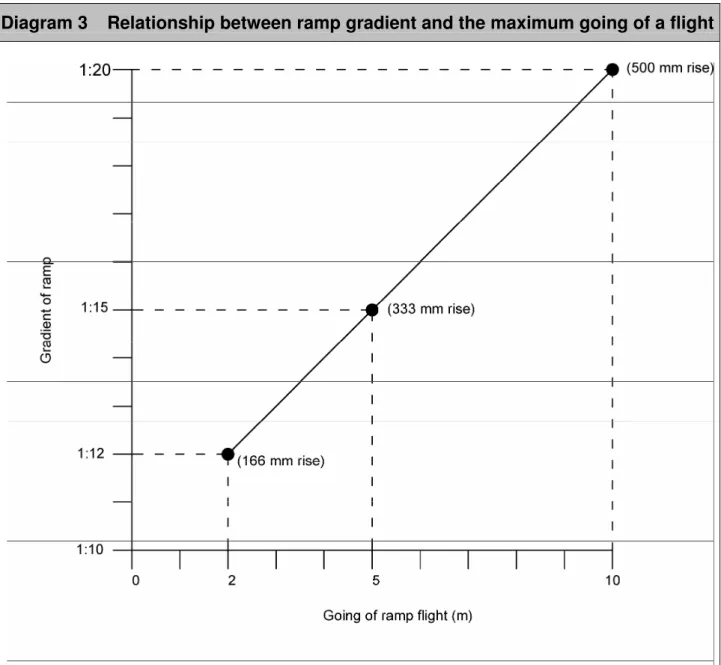
For the purpose of this guidance, a gradient of 1:20 or steeper is considered to be a ramp. Ramped access routes should be designed to have the shallowest gradient practical. The preferred maximum gradient is 1:20 but where site specific constraints require it, ramps not steeper than 1:12 may be provided if individual flights are not longer than 2000 mm.
If the gradient is too steep or an individual flight too long, a person using or pushing a wheelchair may not have sufficient strength to travel up the ramp. There is also the danger of falling forwards going downhill or backwards when going uphill if the gradient is too steep. To ensure adequate control and braking power, the ramp gradients are limited to those in Table 1 and Diagram 3.
Where a ramped access route is provided: (a) the minimum clear width (between
walls, upstands or kerbs) should be 1500 mm;
(b) level landings should be provided
accordance with Table 1 and
Diagram 3) or wherever a change in direction occurs. A level landing is considered to include gradients of 1:50 or less steep;
(c) a level landing should be provided at the top and bottom of the ramp. The top and bottom landings should be at least 1800 mm long x 1800 mm wide and clear of any door swings or other obstructions;
(d) intermediate landings should be at least 1500 mm long and clear of any door swings or other obstructions. Intermediate landings should be at least 1800 mm wide and 1800 mm long to act as passing places when it is not possible for a wheelchair user to see from one end of the ramp to the other or the ramp has three flights or more;
(e) the minimum unobstructed width between handrails should be not less than 1200 mm. Handrails, in accordance with 1.1.3.6 should be provided on both sides. ,
Rationale: People with restricted mobility may be weaker on one side and therefore a handrail on each side of the flight is essential for support when ascending and descending ramps;
(f) edge protection in the form of a 100 mm high (minimum) upstand should be provided on the open side of any ramp or landing. It should contrast visually with the surface of the ramp and landing (refer to 1.6.4). Reference should be made to Part K/ TGD K where additional guarding may be required in some
Section 1.1
Approach to buildings other than dwellings
(g) the ramped access route may formpart of a wider ramped area. The intended ramped access route(s) should be clearly identified and signposted where necessary (refer to 1.6.3). Additional handrails should be used to divide any intended ramped access route into channels of unobstructed width not less than 1200 mm and not greater than 2500 mm.
Rationale: This permits a person with less strength on one side to be within easy reach of support; (h) a stepped access route should be
provided in addition to a ramped access route where the rise of the ramp is greater than 300 mm (equivalent to 2 x 150 mm steps). Rationale: Some people find it easier to use a flight of steps rather than to travel on a ramp e.g. people with mobility difficulties who use certain walking-aids, older people, people with vision impairment; (i) an alternative means of access for
wheelchair users should be provided e.g. a platform lift, where the ramp is 1:20 or greater and the total rise of the ramp is greater than 2000 mm. A platform lift should conform to BS 6440:19993.
Rationale: Ramps simply become too tiring for wheelchair users beyond this height.
3
Platform lifts should comply with the Machinery Directive 2006/42/EC. BS 6400:1999 is partially superseded by EN 81-40:2008. The remainder will eventually be superseded by EN 81-41.
Section 1.1
Approach to buildings other than dwellings
Table 1 Limits for ramp gradients and lengths
Maximum going of a flight Maximum gradient Maximum rise
Not exceeding 10 m 1:20 500 mm
Not exceeding 5 m 1:15 333 mm
Not exceeding 2 m 1:12 166 mm
NOTE: For goings between 2 m and 10 m, it is acceptable to interpolate between the maximum
gradients (refer to Diagram 3).
Section 1.1
Approach to buildings other than dwellings
1.1.3.5 Stepped access routes
Functional requirements and guidance on compliance, for stairs are given in various Parts of the Building Regulations namely Part B for escape, Part K for stairs in general and Part M for stairs suitable for ambulant disabled people. Designers should be aware of the function of the stairs they are designing and refer to the appropriate Part and accompanying TGD. The following guidance applies to all
stepped access routes in addition to the
general guidance in 1.1.3.1.
Where a stepped access route is provided:
(a) the minimum clear width (between enclosing walls, strings or upstands) should be 1200 mm;
(b) a landing should be provided at the top and bottom of each flight; (c) the landings should be level and
have an unobstructed length (clear of any door or gate swing) of at least 1200 mm;
(d) tactile hazard warning surfaces should be incorporated at both the top and bottom landings. A corduroy tactile warning surface should be provided in accordance with Diagrams 4a and 4b.
Rationale: People with vision impairment risk tripping or losing their balance if there is no warning that steps provide a change in level. The greatest risk lies at the top of a flight of stairs when a person is descending;
(e) an intermediate landing with side access should have a tactile hazard warning surface 400 mm deep on
the landing 400 mm from both upper and lower flights (if there is sufficient space to accommodate the surface outside the line of the side access). Where space is insufficient to
accommodate the above, a tactile warning surface 400 mm deep should be provided, within the side access 400 mm from the
intermediate landing so long as there is a continuous handrail opposite the side access;
(f) there should be no single steps; (g) the rise of a flight between landings
should not exceed 1500 mm.
However a single flight containing 18 risers or less is acceptable if the going is 350 mm or greater. Rationale: A greater going allows people with mobility difficulties or vision impairment to place their feet square on a step. It also allows a person to stand and rest at any point within a flight and thus the flight can be extended to greater heights; (h) all step nosings should incorporate a
permanently contrasting continuous material on the tread. The material should be between 50 mm and 65 mm wide on the tread and should contrast visually with the remainder of the tread (refer to 1.6.4).
Rationale: This will help people with vision impairment appreciate the extent of the stair and identify the individual treads;
(i) projecting or overhanging step nosings should be avoided
Rationale: Projecting step nosings can cause people to trip or catch their feet. Refer to Diagram 5 for
Section 1.1
Approach to buildings other than dwellings
(j) the rise and going of each stepshould be consistent throughout a flight;
(k) the rise of each step should be between 150 mm and 180 mm. Rationale: Excessively high risers may result in strain being placed on knee and/or hip joints when
descending and should thus be avoided;
(l) the going of each step should be between 300 mm and 450 mm. Rationale: For people with mobility difficulties, a going of at least
300 mm is preferred. A larger going helps avoid accidents on a stair particularly on descent, as it allows a person to place more of their foot on the step;
(m) tapered treads and open risers should not be used.
Rationale: They create a sense of insecurity for people with vision impairment;
(n) there should be a continuous handrail on each side of flights and landings in accordance with 1.1.3.6. The minimum unobstructed width between handrails should be not less than 1000 mm. ;
(o) the stepped access route may form part of a wider stepped area. The intended stepped access route(s) should be clearly identified and signposted where necessary (refer to 1.6.3). Additional handrails should be used to divide any
intended stepped access route into channels of unobstructed width not less than 1000 mm and not greater
Rationale: This permits a person with less strength on one side to be within easy reach of support; (p) the surface of the treads should be
slip resistant, especially when wet. Guidance on slip resistance is given in BS 8300:2009 Annex E.
Section 1.1
Approach to buildings other than dwellings
Diagram 4a Stepped Access – Key dimensions and use of hazard warning
Section 1.1
Approach to buildings other than dwellings
Section 1.1
Approach to buildings other than dwellings
Diagram 5 Examples of step profiles and key dimensions for stepped access
Section 1.1
Approach to buildings other than dwellings
Diagram 6 External steps and stairs – Key dimensions
1.1.3.6 Handrails
General guidance on handrails and guarding is given in TGD K, but the guidance that follows applies to handrails on accessible access routes.
Where handrails are provided on a ramped or stepped access route: (a) the vertical height to the top of the
upper handrail from the pitch line of the surface of a flight should be between 900 mm and 1000 mm and from the surface of a landing should be between 900 mm and 1100 mm (refer to Diagram 6). Where a
second handrail on stairs is provided for children or those of short stature the vertical height to the top of a second lower handrail from the pitch line of the surface of a flight should be between 600 mm and 700 mm;
(b) where there are two or more flights separated by a landing or landings, the handrails should be continuous across flights and landings, except where broken by side access routes on landings;
(c) where the handrail is not continuous the handrail should extend at least 300 mm beyond the top and bottom of a ramped approach and the top and bottom risers of a stepped approach, and terminate in a closed end which does not project into a route of travel. Handrails should be terminated in such a way that reduces the risk of clothing being caught;
(d) the background against which the handrails are seen should contrast visually without being highly
Section 1.1
Approach to buildings other than dwellings
(e) the profile should be either circularwith diameter of between 40 mm to 50 mm or oval with a width of 50 mm (refer to Diagram 7);
(f) handrails should not protrude more than 100 mm into the surface width of the access route where this would impinge on the stair width
requirement of TGD B – Methods of Measurement;
(g) there should be a clearance of at least 50 mm to 60 mm between the handrail and any adjacent wall surface (refer to Diagram 7); (h) there should be a clearance of at
least 50 mm between a cranked support and the underside of the handrail (refer to Diagram 7). The handrail support should meet the handrail centrally on its underside Rationale: This will minimise the risk of the handrail supports interrupting the smooth running of a person’s hand along the rail;
(i) the handrails inner face should be located no more than 50 mm beyond the surface width of the access route (refer to Diagram 7);
(j) handrail fixings should be designed to meet the loading
recommendations of I.S. EN 1991-1-1:2002.
Section 1.1
Approach to buildings other than dwellings
Section 1.1
Approach to buildings other than dwellings
1.1.4 Pedestrian crossings
Where pedestrian crossings are provided, tactile paving and dropped kerbs should be provided at controlled and
uncontrolled pedestrian crossings in accordance with ‘Good Practice Guidelines on Accessibility of Streetscapes’.
1.1.5 On–site car parking
For the purposes of this section,
designated car parking spaces are those spaces exclusively provided for the holders of a disabled person’s parking permit.
Where on-site car parking is provided, whether for residents, employees, visitors or others, a number of designated car parking spaces should be provided, on a proportional basis.
In the absence of a specific number of designated spaces being required by a Local Authority through Development Plans or as a condition of planning, the following guidance applies.
For buildings (including apartment
buildings), at least 5% of the total number of spaces should be designated car parking spaces, with a minimum provision of at least one such space.
Further guidance on the provision of designated car parking spaces is given in BS 8300:2009 and Sustainable Urban Housing: Design Standards for New Apartments - Guidelines for Planning Authorities.
Where designated parking is provided either outside or within a building: (a) it should be easily located. If
necessary signage should be
provided, (refer to 1.6.3), at the entrance to each car park and at each change in direction to direct motorists to designated spaces; (b) ticketing machines, access routes to
buildings or other services such as lifts, etc; should be easily located. Clear signage should be provided, where necessary, to direct people (refer to 1.6.3);
(c) it should be possible for all motorists to activate car park control barriers. Ticket, swipe card or key activated controls can be difficult to reach and manipulate by some drivers (Refer to BS 8300:2009 for further
guidance). Barrier control systems should conform to BS 6571- 4:1989; (d) the minimum dimensions of the
designated parking bays should be in accordance with Diagrams 8 and 9;
(e) A 1200 mm wide access zone should be provided on both sides and at the rear of each designated parking bay. The access zone at the rear of the parking bay should be clear of vehicular circulation routes. The access zone should contrast visually with the adjoining surfaces to ensure it is kept clear (refer to 1.6.4).
Rationale: This provides sufficient space to enter and leave the vehicle and move to the rear of the vehicle and should safely lead to an access route;
(f) a minimum clear vertical clearance of 2600 mm (on level ground) should be provided to allow the passage of high top conversion vehicles. This
Section 1.1
Approach to buildings other than dwellings
should be maintained along theroute to and from the designated car parking bays from the site boundary. Alternatively, drivers should be
warned about the height restrictions and directed to alternative parking spaces or a setting down area suitable to accommodate high top conversion vehicles;
(g) all designated parking bays should be clearly marked on the ground with the symbol of access and, if necessary further signage should be provided (refer to 1.6.3);
(h) the designated parking bay should be on firm, level4 ground and be the
parking bay(s) located closest to the accessible entrance(s) with which the provision of parking spaces is associated;
(i) the surface of the access zone should be firm, level4, durable, reasonably smooth and slip
resistant. Materials such as loose pebbles should not be used;
(j) dropped kerbs should be provided in accordance with 1.1.4 to facilitate easy transfer from the designated parking bay(s) to the access routes without undue effort or barrier; (k) ticket machines, where used, should
be situated adjacent to the
designated parking bays and at least one machine should have controls between 750 mm and 1200 mm above ground. The supporting plinth should not project in front of the face of the machine in a way that
prevents its convenient use. There should be a clear space of 1850 mm
machine to allow adequate space for a wheelchair user to approach, manoeuvre side on to the machine, turn and return to the vehicle. For further guidance on the accessibility of ticket machines refer to the NDA publication ‘Guidelines for Public Access Terminals’.
4 For the purpose of this guidance, a gradient of 1:50
or less steep is considered to be level. Where the gradient is 1:50 or less steep, it is acceptable for a cross-fall gradient of not steeper than 1:40 to be
Section 1.1
Approach to buildings other than dwellings
Diagram 8 Access around designated on-site perpendicular parking bay
Section 1.1
Approach to buildings other than dwellings
1.1.6 On–site setting down areas
Where there is a road on site leading to the building, there should be a setting down area provided at, or adjacent to, at least, one accessible entrance. This facilitates a person arriving at a building as a passenger in a vehicle, to alight from the vehicle and enter the building safely and conveniently.
Where a setting down area is provided: (a) it should be easily located. If
necessary signage should be provided, (refer to 1.6.3);
(b) it should be located on firm and level4 ground as close as practicable
tothe accessible entrance(s) and
should not form an obstruction to through traffic;
(c) an access route in accordance with 1.1.3 should lead from the setting down area to an accessible entrance;
(d) the surface of the access route alongside the setting down area should be level4 with the
carriageway at that point to facilitate wheelchair users. Otherwise
dropped kerbs should be provided.
4 For the purpose of this guidance, a gradient of 1:50
or less steep is considered to be level. Where the gradient is 1:50 or less steep, it is acceptable for a cross-fall gradient of not steeper than 1:40 to be
Section 1.2
Access to buildings other than dwellings
Section 1.2
Access to buildings other than dwellings
1.2.1 Objective
The objective is to provide entrances to buildings that are independently accessible and to avoid segregation based on a person’s level of ability. 1.2.2 Introduction
All of the following entrances should be accessible:
(a) the main entrance which a visitor not familiar with the building would normally expect to approach; (b) the entrance closest to the
designated parking area, and (c) the entrance closest to the setting
down area.
Subsidiary external entrances that should also be accessible include:
(d) any main entrance to a unique functional area or facility of a building e.g. in multi-occupancy buildings (retail, office, residential areas, etc), or multi-functional buildings (hospitals with separate entrances for reception, A&E, outpatients, etc);
(e) any entrance used exclusively by staff, and
(f) building exits to assembly points or to the boundary of the site.
Where main entrances are accessible to all they promote a spirit of inclusion that segregated accessible entrances do not. In certain exceptional situations it may not
be practicable for each of the entrance(s) above to be accessible, due to steeply sloped or restricted sites or planning requirements. Therefore, in such circumstances only, an alternative
accessible entrance or entrances may be provided.
1.2.3 Accessible entrances
Accessible entrances should facilitate the widest possible range of abilities.
Approaches to accessible entrances should comply with Section 1.1.
The route from an alternative accessible entrance should lead directly, via an accessible internal route conforming to Section 1.3, to the spaces served by the corresponding main entrances.
Likewise, entrances close to the
designated parking area and setting down area, (b) and (c) above, should connect to the main entrance reception area (or equivalent), via an accessible internal route conforming to Section 1.3.
Main entrances and subsidiary entrances should be clearly identifiable. Signage should be provided where necessary (refer to 1.6.3).
Where an accessible entrance is provided:
(a) it should be easily identified among the other elements of the building under all lighting conditions, shadow or strong sunlight e.g. by lighting and/or visual contrast (refer to 1.6.4). Glare and reflection from lighting or materials should be avoided as it is confusing for those with vision impairment (refer to 1.6.5);