1
Optimize Application Delivery for Global
Deployment Of SAP
®
BusinessObjects™
Enterprise with Blue Coat Systems
Acceleration
A Report from SAP Co-Innovation Lab
Blue Coat:
Chris Webber, Jonathan Bensen, Chris Wood
SAP:
Jay Thoden van Velzen, Canyang Kevin Liu, Joerg Nalik
2
Contents
Executive Summary ... 3
Global Deployments of SAP Business Object Enterprise ... 4
Problem with Wide Area Networks ... 4
Network Optimization: SAP BusinessObjects Enterprise and Blue Coat ... 6
Blue Coat WAN Acceleration Technology ... 7
The Test Landscape at SAP Co-Innovation Lab ... 9
Bandwidth Reduction ... 10
User Response-Time Improvement ... 10
Ensure Performance Without Bandwidth Upgrades ... 12
Executive Summary
SAP® BusinessObjects™ Enterprise enabling customers to discover and share
service-oriented architecture, SAP BusinessObjects Enterprise solutions on a single platform. As part of
portal is a Web application used to run, view, and schedule reports world. Depending upon customer business requirements,
can be flexibly deployed into many architectural choices an exceptional user experience.
One challenge common to any feature
network (WAN) overhead for remote users accessing the application over long distance network bandwidth. Customer experience
by network overhead for global deployments
evident where the application is installed on one central location and is accessed by users around the world, which can represent a comp
Blue Coat WAN optimization is designed to application delivery performance to remote end
and TCP optimizations, Blue Coat ProxySG reduces the bandwidth required for WAN
application. More critically, ProxySG reduces the amount of data sent back and forth across the WAN, dramatically reducing the impact of latency on application performance.
SAP and Blue Coat worked closely in
wide area network impact on global deployment solution over various communication network c
lines. In addition, network latencies and packet losses from locations from different continents were included
Our testing shows that the joint solution
tremendous improvement in the user experiences conditions tested. In these tests, Blue Coat
bandwidth utilization reduction and to
global deployment of SAP BusinessObjects Enterprise reduction of up to 95%, and up to 40
Blue Coat.
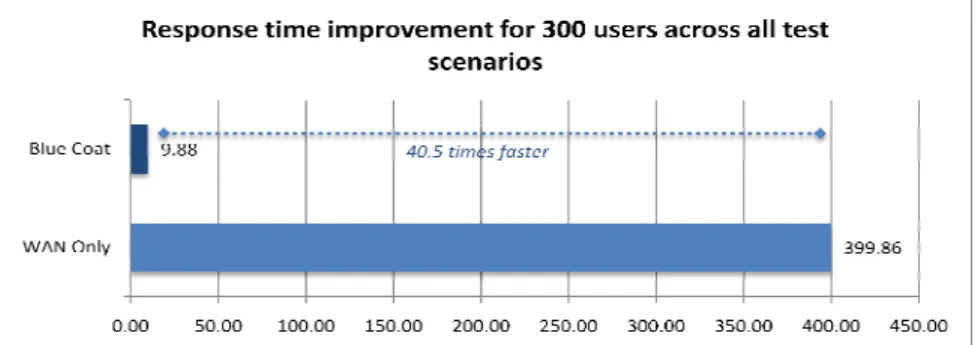
Figure 1 depicts the average response time concurrent users (see Table 1) accessing
various WAN conditions with and without Blue Coat acceleration.
Figure 1: On average Blue Coat across 4 300-concurrent
3
Enterprise software is a market-leading business intelligence (BI) discover and share business insight for optimal decision making. Built on a
SAP BusinessObjects Enterprise software offers an extensive set of As part of SAP BusinessObjects Enterprise, the business intelligence eb application used to run, view, and schedule reports online from anywhere in the
on customer business requirements, SAP BusinessObjects Enterprise into many architectural choices, achieve excellent performance
One challenge common to any feature-rich Web-based application is how to mitigate the overhead for remote users accessing the application over long distance
experience often varies, and performance degradation
lobal deployments of SAP BusinessObjects Enterprise. This is most where the application is installed on one central location and is accessed by users around
complex challenge.
designed to address the type of network overhead that impacts to remote end users. Using a combination of caching, compression ProxySG reduces the bandwidth required for
WAN-application. More critically, ProxySG reduces the amount of data sent back and forth across the WAN, dramatically reducing the impact of latency on application performance.
closely in SAP Co-Innovation Lab to develop a joint solution to mitigate global deployment of SAP BusinessObjects Enterprise. We tested the solution over various communication network configurations emulating T3, DSL, ISDN
network latencies and packet losses from accesses in different geographic were included.
joint solution developed in SAP Co-Innovation Lab provides a user experiences of SAP BusinessObjects Enterprise
lue Coat demonstrated a consistent ability to achieve impressive and to significantly reduce the impact of network latency
SAP BusinessObjects Enterprise. In our study the team observed
40 times faster response time across all the WAN conditions with
response time of 4 tests conducted in the lab where we emulate 300 accessing SAP BusinessObjects Enterprise from various locations and with and without Blue Coat acceleration.
On average Blue Coat shows 40.5 times response-time improvement concurrent-user tests in SAP Co-Innovation Lab
business intelligence (BI) solution, insight for optimal decision making. Built on a
offers an extensive set of the business intelligence online from anywhere in the SAP BusinessObjects Enterprise software achieve excellent performance, and deliver
based application is how to mitigate the wide area overhead for remote users accessing the application over long distances and low
ce degradation is introduced This is most where the application is installed on one central location and is accessed by users around
at impacts Using a combination of caching, compression,
-delivered application. More critically, ProxySG reduces the amount of data sent back and forth across the
a joint solution to mitigate . We tested the ISDN, and satellite different geographic
provides a
SAP BusinessObjects Enterprise for all WAN to achieve impressive
latency on a observed bandwidth faster response time across all the WAN conditions with
conducted in the lab where we emulate 300 from various locations and
4
Global Deployments of SAP Business Object Enterprise
As business intelligence has become progressively more business-critical, what often were local departmental solutions are now enterprise-wide deployments. For global corporations, that means a centralized deployment with a global end-user community accessing the application over long distances.
Global deployments pose some unique challenges, most of which are relatively small obstacles. Except for nationwide or continental systems, you cannot assume there will ever be a batch window for scheduled reports where no users are online, or allow you to take cold system backups. You have to estimate the number of concurrent users on the system by time zone, and factor in overlap between European and North America East Coast business days. However, none of these factors put severe limits in place, and all can be resolved with careful planning. One aspect related to global deployments, however, is often overlooked initially, and may only become apparent during user acceptance testing (UAT) or
– much worse – after going live: the impact of network connectivity on global deployments.
Problem with Wide Area Networks
Consider the following scenario: A decision is made to implement a global deployment of SAP BusinessObjects Enterprise. The system will be hosted in the same data center in the United States as the enterprise data warehouse, to get the best report refresh times.
Performance tests are conducted, and in the data center
everything performs as expected. Users on either coast are included in the user acceptance testing, and the performance is more than acceptable to them.
However, after the system goes live, complaints start coming in from Europe, Asia, and Africa that the response times are unacceptable. For all intents and purposes the new system is unusable for users who connect to the application over WAN links with low bandwidth, high latency, some packet loss, or any combination of those. Additionally, there is a mobile
workforce that connects over 3G and certain small offices that connect over DSL or satellite connections. What happened?
SAP Business Objects Enterprise provides a rich Web-based user interface to end users, but unfortunately, that rich interface comes at a cost. Even a simple operation, like requesting a list of documents, may involve a total of 90 individual HTTP requests. Each request needs to travel the full distance from the end user to the centralized system. Users that are geographically close to the data and connect over a good broadband connection won’t notice that impact. But
geographically remote users, or those connecting over links with low bandwidth and high latency, certainly will. This is simply physics: how long does it take for a network packet to traverse the world and reach the server? How long does it take for the response network packet to return to the end user’s browser? When many “round trip” HTTP requests are sent across the WAN, congestion and latency can drastically reduce application performance.
“With Blue Coat, faster response times are to be expected even over global WAN links with relatively low
bandwidth/high latency.”
5
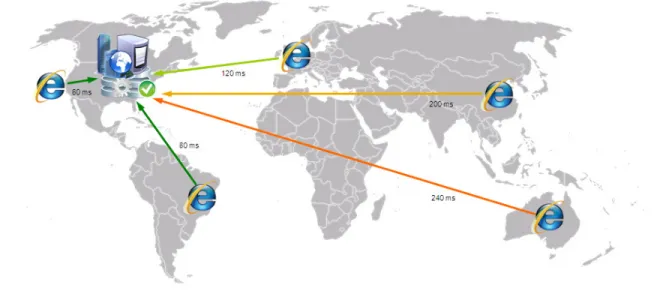
Figure 2: Global centralized deployment of SAP BusinessObjects Enterprise with users connecting from various parts of the world
Figure 2 describes the SAP BusinessObjects Enterprise global deployment scenario. While users in the United States may experience near-instant response times, users in China and Australia are likely to find requests take significantly longer. So much longer, in fact, that the system does not invite further analysis and thus loses its potential impact on business value. If the effort involved to retrieve valuable information takes longer and longer, users will think twice before running another query or performing deeper analysis. Network impact from Australia, for instance, could easily add more than 10 seconds to the response time, just on the basis of network latency alone.
SAP has previously tried to limit the impact of network on remote users through a number of approaches:
• Choosing the location of the data center on the basis of the location of the majority of the
users
• Remote desktop–style solutions
• Deploying multiple instances of SAP BusinessObjects Enterprise synchronized through
federation
Choosing the location of the data center on the basis of the location of the end users can be very beneficial. However, it doesn’t solve all problems, because it makes compromises for those users who are still geographically remote. This approach can limit the impact for some users, but it is not ideal, and choosing any location may not always be possible.
Remote desktop–style solutions can seem beneficial, but they are not an ideal situation either, and require extra steps by end users and extra complexity for deployment. And can still fall victim to latency. These solutions are not nearly as simple as just pointing your browser to the URL for SAP BusinessObjects Enterprise.
Using federation, we have attempted to run multiple instances of SAP BusinessObjects
Enterprise in different parts of the globe, which are synchronized through federation to share content between the two systems. This limits the impact of network connection because it aims to place a system close to where the end users are. However, this is not ideal, as it requires a lot
6
of planning, difficulties in performance for remote content, and extra expense for systems and management expertise. If a user in Australia wants to refresh a report whose data source resides in the United States, and depending on how many systems we put in place, some users may still experience unsatisfactory response times.
Moreover, this federated approach defeats the purpose of trying to centralize systems for improved hardware efficiency (since putting more systems in place is going to require more hardware). And it can hardly improve operational management, as now two or more instances of SAP BusinessObjects Enterprise need to be administered, patched, and upgraded.
There must be a better way.
Network Optimization:
SAP BusinessObjects Enterprise and Blue Coat
In SAP BusinessObjects Enterprise, a small number of interactive requests are made to view reports, create new documents, and refresh them. The vast majority of requests are for static content, like images, JavaScript files, Cascading Style Sheets, and so forth. A lot of this content is cached in the browser, but the browser will still verify with the server whether certain files have been updated. All this checking adds round trips across the network, compounding latency with each trip. This is exactly the sort of traffic that Blue Coat’s ProxySG WAN optimization addresses.
If we review Figure 1 again, we see that the problem is really about location and network connection. The performance of the application is poor in China and Australia only because of network latency and potentially poor bandwidth. If we could handle static content more efficiently and, for instance, cache this content close to the end user, we should have a significant positive impact on response times, and therefore user experience.
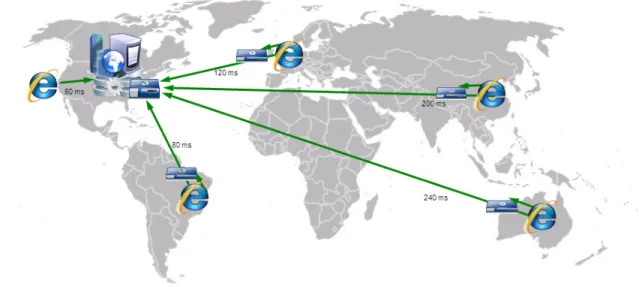
With its strong features in caching, compression, and bandwidth reduction, Blue Coat can mitigate the problems previously described. Figure 3 describes the logical equivalent
architecture of the solution with Blue Coat, where its appliances are symmetrically deployed in the central deployment site of SAP BusinessObjects Enterprise and in all the remote locations to accelerate network performance.
7
Figure 3: Global centralized instances of SAP BusinessObjects Enterprisewith Blue Coat Network Optimization
We tested this exact scenario in SAP Co-Innovation Lab together with Blue Coat. In the
following section we will examine the specifics of the testing we performed. But, let’s first have a look at what Blue Coat offers and how its solution works.
Blue Coat WAN Acceleration Technology
Blue Coat’s WAN Acceleration is provided by its ProxySG appliances. Blue Coat ProxySG appliances run a secure hardened operating system, with a common administrative interface across all ProxySG products. This reduces administrative overhead, while providing
acceleration and performance improvements on a secure and reliable platform.
ProxySG utilizes a patent-pending combination of five separate application management and tuning technologies, which are collectively referred to as Multiprotocol Accelerated Caching Hierarchy (MACH5) technology. MACH5 accelerates delivery of mission-critical business applications, including SAP BusinessObjects Enterprise, using five different techniques that work in concert:
Object Caching
• Stores content locally, providing LAN-like performance for WAN users. This limits WAN
requests for content, eliminating latency and download times entirely. For content delivery, no technology does more to reduce latency and bandwidth to improve the end-user experience.
Byte Caching
• Caches repetitive traffic found in the byte stream and subsequently serves it locally to
reduce the amount of traffic that actually traverses the WAN. This leads to dramatic bandwidth savings and aids in response time improvement.
Compression
• Inline compression can reduce predictable patterns even on the first pass, making it an
8 Bandwidth Management
• Provides the mechanism to assign priority and network resources based not only on
port or device, but on users, applications, and content to more accurately reflect corporate policies on the network. This works by itself, or integrates with infrastructure QoS to provide application intelligence to the packet-switching network.
Protocol Optimization
• Improves the performance of protocols that are
inefficient over the WAN through specific enhancements that make them more tolerant to
the higher latencies typically found there. Blue Coat offers multiple improvements for TCP, CIFS, HTTP, HTTPS, MAPI, and most streaming video.
Combined, these technologies help ensure the performance and delivery of key business applications – in this case our global implementation of SAP BusinessObjects Enterprise. All of these techniques work together to optimize delivery of applications to remote locations. Object and byte caching, combined with powerful adaptive compression, were the keys to accelerating all the SAP BusinessObjects Enterprise traffic. As described above, SAP
BusinessObjects Enterprise makes only a small number of interactive requests to view reports, create new documents, and refresh them. The vast majority of application requests within SAP BusinessObjects Enterprise are for static content – images, JavaScript files, Cascading Style Sheets, and so forth. Without WAN acceleration, many of the files must be checked against the server for updates before they can be served from the browser cache. Even then, an individual user’s browser can only serve objects that the user has seen before.
With Blue Coat ProxySG acceleration, all objects are cached on the local appliance the first time they are downloaded. All subsequent requests for that object, from any user, will be served that locally cached object. In the event that an object or request is slightly different from a previous request, the appliance will only request the changes to the data over the WAN.
For example, Blue Coat object cache maintains up-to-date copies of all downloaded objects. If a user requests an outdated or changed copy of a document, the byte-caching capability of the ProxySG has patterns and tokens that require only the tokens, plus the changes to be sent. In addition, the patented Blue Coat “Adaptive Refresh” technology is used to proactively refresh cacheable items. Based on dynamic change frequency and use, every object in the store will be updated as appropriate. Adaptive Refresh increases effectiveness of the cache, and ensures all data served from cache is up-to-date.
What little information ends up being requested over the WAN is first compressed by the ProxySG. Compression gains can range from 10% up to 650%, depending on the information requested and then protocol optimized to further reduce bandwidth consumed and round trips.
“In testing, we saw
bandwidth reduction up to 98%, due to byte and object caching and compression.”
9
The Test Landscape at SAP Co-Innovation Lab
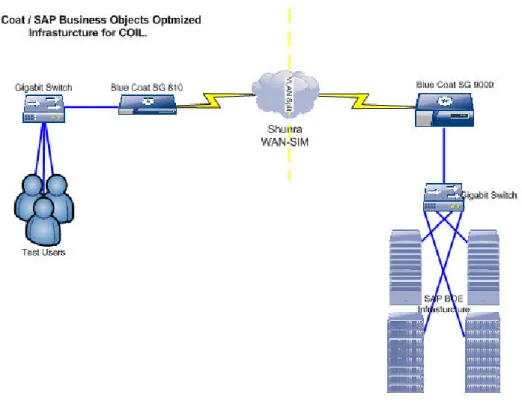
To implement the logical architecture described in Figure 2, SAP and Blue Coat together set up a testing landscape at SAP Co-Innovation Lab. In this landscape, Blue Coat ProxySG appliances are deployed on both sides of a WAN network, with a basic transparent deployment shown in Figure 4 below.
Figure 4: SAP BusinessObjects Enterprise and Blue Coat Network Deployment at SAP Co-Innovation Lab
In the lab deployment and testing, technology from Shunra, a member of SAP Co-Innovation Lab, was used to emulate the following network configurations:
Network Scenario Description Bandwidth (Mbps) Latency (milli sec.) Packet loss (%) Number of current SAP BusinessObjects Enterprise users tested Tokyo 5 200 1 300 China 2.5 250 1 300 India 1.5 350 10 300 T3 44.7 300 1 300 DSL 0.768 40 1 80 ISDN 0.128 300 1 80 Satellite 45 1200 20 80
10
The following sections highlight the key results we collected in the lab.
Bandwidth Reduction
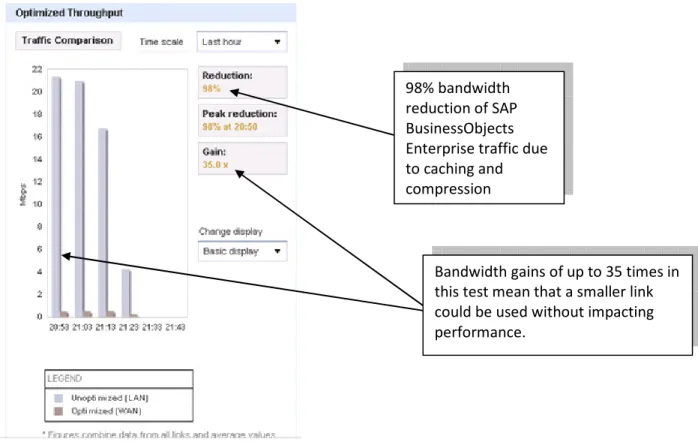
From tests conducted in our lab, we saw byte and object caching, combined with compression, reduce the traffic over the WAN up to 95% for each scenario tested. Figure 5 below shows the bandwidth statistics in a snapshot of the ProxySG user interface during the “China” test
described in Table 1 above. All other tests with the scenarios described in Table 1 achieved very similar results.
Figure 5: Portion of the ProxySG UI during testing showing 97% bandwidth reduction
Freeing up bandwidth in such a dramatic fashion means that a customer has many options:
• Serve more users, thanks to free space on the WAN
• Offer more or richer applications over the same WAN link
• Save cost by reducing the amount of bandwidth required at each branch
User Response-Time Improvement
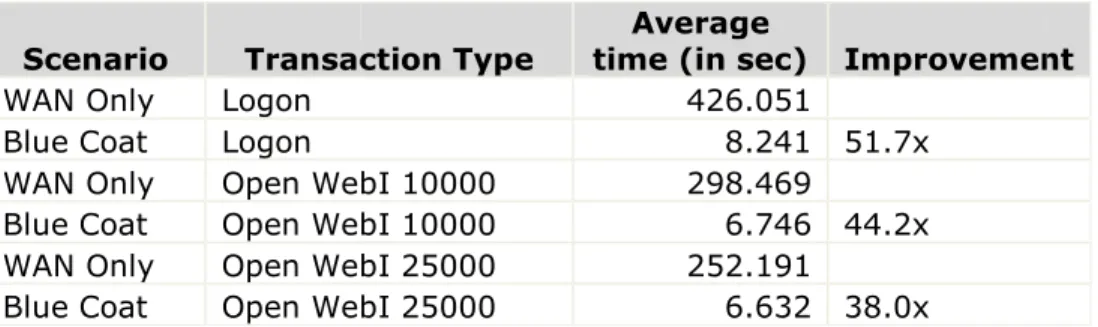
The results summarized in Table 2 below are typical for Blue Coat WAN acceleration for a deployment of SAP BusinessObjects Enterprise over a link simulated to perform like typical WAN links in India with the following network characteristics:
• 300 users • 1.5Mpbs
• Latency of 350ms • 1% packet loss
This is very typical of the size, speed, and latency of links serving many Indian offices. 98% bandwidth
reduction of SAP BusinessObjects Enterprise traffic due to caching and compression
Bandwidth gains of up to 35 times in this test mean that a smaller link could be used without impacting performance.
The gains in this scenario mean that response times for viewing a report with 10,000 rows (shown in transaction type “Open WebI 10000”) go from just under
seconds with Blue Coat WAN Optimization.
Scenario Transaction Type
WAN Only Logon
Blue Coat Logon
WAN Only Open WebI 10000
Blue Coat Open WebI 10000
WAN Only Open WebI 25000
Blue Coat Open WebI 25000
Table 2: WAN response time dropped from over five minutes to under 10 seconds with Blue Coat
Across all tests, Blue Coat accelerated the user response of
from high bandwidth down to very low bandwidth links, with varied latencies. As shown in Figure 6, our test saw response
bandwidth link T3 scenario with the following properties:
• 300 users • 44.7 Mbps
• Latency of 300 ms • 1% packet loss
Figure 6: Response times for 10,000
On the opposite side of the bandwidth spectrum, time improvements of nearly 200 times
characteristics: • 80 users • 768 kbps • Latency of 40 ms • 1% packet loss 11
The gains in this scenario mean that response times for viewing a report with 10,000 rows (shown in transaction type “Open WebI 10000”) go from just under 5 minutes to just 6.7
Optimization.
Transaction Type
Average
time (in sec) Improvement 426.051 8.241 51.7x Open WebI 10000 298.469 Open WebI 10000 6.746 44.2x Open WebI 25000 252.191 Open WebI 25000 6.632 38.0x
esponse time dropped from over five minutes to under 10 seconds with Blue Coat
Across all tests, Blue Coat accelerated the user response of SAP BusinessObjects Enterprise very low bandwidth links, with varied latencies.
saw response-time improvements of over 4 times in our high scenario with the following properties:
Response times for 10,000-row report improved 4.3 times over T3 connection; 1% packet
On the opposite side of the bandwidth spectrum, as shown in Figure 7, we proved response times for a simulated DSL connection with the following The gains in this scenario mean that response times for viewing a report with 10,000 rows
minutes to just 6.7
mprovement
esponse time dropped from over five minutes to under 10 seconds with Blue Coat
SAP BusinessObjects Enterprise,
in our
high-acket loss
we proved response-the following
Figure 7: Response times for 10,000
Ensure Performance Without Bandwidth Upgrades
Based upon our lab results, we can see
scenarios is latency. As latency rises, so do user response times. This type of one performance degradation due to increased latency is typical of applications round trips across the WAN to access and present data.
Bandwidth is a secondary problem, causing extreme user response degradation in the tests where bandwidth is limited to less than 1Mbps. However, adding bandwidth is not a guarantee of success, as throughput increases overcome the performance degradation imposed by high latency.
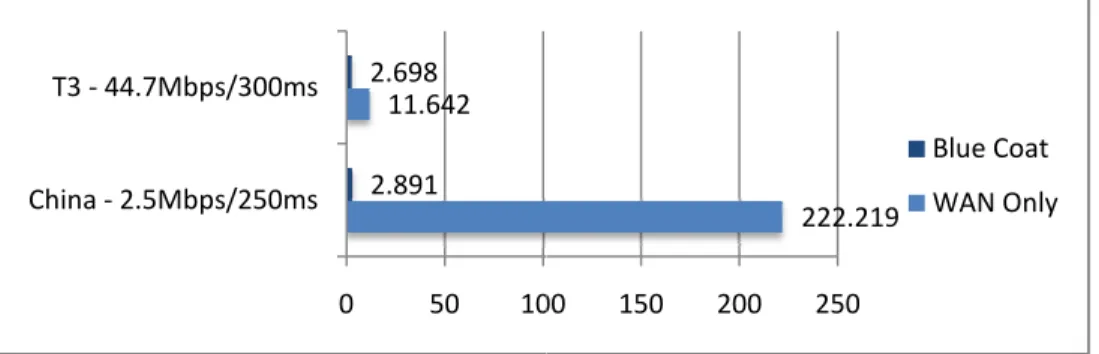
As shown in Figure 8, our testing showed that Blue Coat accelerat
upgrade bandwidth in many cases. Without Blue Coat acceleration, the lower bandwidth in the China scenario results in a report returning 10,000 rows of data taking over 220 seconds (3.6 minutes) to load. Blue Coat WAN acceleration brings that time down to 2.9 seconds
of the time it took before acceleration. The same test seems to perform re acceleration over a T3 link, requiring only 11.6 seconds for the same 10,000
However, Blue Coat improves that performance as well, bringing the same transaction down to 2.7 seconds on the T3 link.
Figure 8: Blue Coat Acceleration means low-bandwidth links perform just like high
These results indicate that the size of the link is significantly less important after acceleration. Both the expensive 44.7 Mbps link and the significantly less expensive 2.5M
same performance after acceleration. This means
Enterprise do not necessarily require costly bandwidth upgrades if Blue Coat acceleration is deployed as part of the solution.
11.642 2.891 2.698 0 50 100 China - 2.5Mbps/250ms T3 - 44.7Mbps/300ms 12
Response times for 10,000-row report improved 199 times over DSL connection
Performance Without Bandwidth Upgrades
can see that the primary problem with each of the tested scenarios is latency. As latency rises, so do user response times. This type of one-to
performance degradation due to increased latency is typical of applications that require many ross the WAN to access and present data.
Bandwidth is a secondary problem, causing extreme user response degradation in the tests where bandwidth is limited to less than 1Mbps. However, adding bandwidth is not a guarantee
es overcome the performance degradation imposed by high
ur testing showed that Blue Coat acceleration negates the need to Without Blue Coat acceleration, the lower bandwidth in the scenario results in a report returning 10,000 rows of data taking over 220 seconds (3.6 minutes) to load. Blue Coat WAN acceleration brings that time down to 2.9 seconds
of the time it took before acceleration. The same test seems to perform relatively well without acceleration over a T3 link, requiring only 11.6 seconds for the same 10,000-row report.
However, Blue Coat improves that performance as well, bringing the same transaction down to
bandwidth links perform just like high-bandwidth links
These results indicate that the size of the link is significantly less important after acceleration. Mbps link and the significantly less expensive 2.5M bps link show the same performance after acceleration. This means that deployments of SAP BusinessObjects
do not necessarily require costly bandwidth upgrades if Blue Coat acceleration is 222.219
100 150 200 250
Blue Coat WAN Only
the primary problem with each of the tested to-one require many
Bandwidth is a secondary problem, causing extreme user response degradation in the tests where bandwidth is limited to less than 1Mbps. However, adding bandwidth is not a guarantee
es overcome the performance degradation imposed by high
negates the need to Without Blue Coat acceleration, the lower bandwidth in the scenario results in a report returning 10,000 rows of data taking over 220 seconds (3.6 minutes) to load. Blue Coat WAN acceleration brings that time down to 2.9 seconds – just 1.3%
latively well without row report.
However, Blue Coat improves that performance as well, bringing the same transaction down to
These results indicate that the size of the link is significantly less important after acceleration. link show the of SAP BusinessObjects do not necessarily require costly bandwidth upgrades if Blue Coat acceleration is
13
Conclusion
In each of the test scenarios developed in SAP Co-Innovation Lab, Blue Coat WAN Optimization dramatically improved end-user response time. With these types of performance numbers we can confidently state that a global centralized deployment of SAP BusinessObjects Enterprise can be similarly designed to ensure fast response times to end users around the world, with little network impact wherever they are located. Therefore:
• Tremendous cost savings in hardware, software, maintenance, and personnel can be
achieved by only having to deploy one system.
• Greater ease of operational maintenance can be achieved by only having to administer,
monitor, and patch/upgrade a single system.
• Quality response times and system access can be provided to users around the world,
wherever they may be located and through whichever (broadband) connection they may connect. This invites more extensive use of business intelligence, and therefore realizing the potential of its business value.
It is also worth mentioning that Blue Coat WAN optimization is by no means restricted to SAP BusinessObjects Enterprise software. It can optimize other Web applications in use, such as SAP applications, e-mail traffic, and other network-sensitive applications, improving the overall network experience of all users.