STUDY
Lisa H. Ozaeta
A dissertation submitted to the faculty of the University of North Carolina at Chapel Hill in partial fulfillment of the requirements for the degree of Doctorate of Public Health in
the Department of Health Policy and Management in the Gillings School of Global Public Health.
Chapel Hill 2015
Approved by: Mark Holmes Edward Brooks Sandra Greene
iii ABSTRACT
Lisa H. Ozaeta: Satisfying non-profit hospitals’ community benefit obligations by targeting population health programs with distributed ambulatory practices: The Results
of a Mixed Methods Study (Under direction of Mark Holmes)
The findings of this study indicate that reimbursement reform will drive population health efforts by hospitals. Until there is a financial imperative to improve the health of communities, hospitals are more likely to focus on their historical business model. However, once the financial case can be made, hospitals are willing to move toward activities that seek to improve population health. Even as hospitals seek to develop population health programs, there remains many silos between hospitals and
ambulatory physicians, which make effective partnerships challenging. The findings of this study include:
1) Health reform and new payment models have started discussions about population health, but have not affected reimbursement significantly enough to cause most hospitals to fully embrace population health programs.
2) Hospitals rely on community partnerships to address the community health needs that cannot be addressed in the hospital.
iv
4) In order for community benefit offices and community physicians to create programs that affect population health together in the future, several key requirements will need to be met.
v
To my wife, Myra, and our four kids, Haley, John Mark, Heath and Francie, thank you for your unending support. You sacrificed many evenings and weekends to make this
vi
ACKNOWLEDGEMENTS
vii
TABLE OF CONTENTS
LIST OF TABLES ... x
LIST OF FIGURES ... xi
CHAPTER 1: PROBLEM STATEMENT ... 1
Section 1: Plan for Change Framework ... 2
Section 2: Background: Tax Exemption and Community Benefit... 4
CHAPTER 2: CREATING A SENSE OF URGENCY ... 10
Section 1: Regulatory Scrutiny ... 12
Section 1.A.: Internal Revenue Service ... 12
Section 1.B.: Accountable Care Act ... 13
Section 2: Healthcare Trends ... 14
Section 2.A.: Accountable Care Organizations ... 14
Section 2.B.: Practice Acquisition Trends ... 15
Section 2.C.: Developing New Health Framework ... 17
CHAPTER 3: BUILDING COALITIONS ... 21
viii
Section 1: Study Approach and Design ... 26
Section 1.A.: Study Overview ... 26
Section 1.B.: Study Participants and Recruitment ... 27
Section 1.C.: IRB Approval ... 30
Section 2.: Data Analysis ... 30
Section 3.: Privacy of Information ... 31
CHAPTER 5: RESULTS AND DISCUSSION ... 32
Section 1: Summary of Findings ... 32
Section 2: Finding 1 ... 33
Section 3: Finding 2 ... 36
Section 4: Finding 3 ... 41
Section 5: Finding 4 ... 44
CHAPTER 6: CREATING A VISION AND ENABLING ACTION ... 51
Section 1: Recommendations ... 52
Section 1.A.: Payor Strategy... 52
Section 1.B.: Communication ... 53
ix
Section 1.D: Infrastructure ... 55
Section 2.: Further Recommendations Regarding Implementation ... 56
Section 2.A.: Short-term Wins ... 56
Section 2.B.: Enlisting Allies ... 56
Section 2.C.: Sustain Acceleration and Institute Change ... 57
CHAPTER 7: CONCLUSION ... 59
EPILOGUE ... 61
APPENDIX A: EMAIL REQUEST FOR PARTICIPATION ... 62
APPENDIX B: FACT SHEET ... 63
APPENDIX C: CONSENT FORM... 64
APPENDIX D: HOSPITAL EXECUTIVE INTERVIEW GUIDE ... 68
APPENDIX E: PHYSICIAN NETWOORK EXECUTIVE INTERVIEW GUIDE ... 71
x
LIST OF TABLES
Table 1 – Community Benefit Expenditures ... 4
Table 2 – Types of Community Benefit Programs ... 9
Table 3 – Health System Transformation ... 18
Table 4 – Community Partners of Hospitals ... 22
Table 5 – Self-Perceived Partnership Success ... 23
Table 6 – Coalition Success Factors ... 24
Table 7 – Bridging Community Partners with Primary Care ... 25
Table 8 – Study Sites ... 28
Table 9 – Study Participants ... 29
Table 10 – Summary of Findings ... 32
Table 11 – Community Benefit Priorities ... 37
Table 12 – Study Site Participants ... 40
Table 13 – Summary Recommendations ... 52
xi
LIST OF FIGURES
Figure 1 – Kotter’s 8 Steps for Change ... 3
Figure 2 – Drivers for Creating More Robust Community Benefit Programs ... 11
Figure 3 – Percentage of U.S. Physicians Practices Owned by Physicians ... 15
1
CHAPTER I: PROBLEM STATEMENT
The American Hospital Association states that its vision is “of a society of healthy communities where all individuals reach their highest potential for health.” Hospitals in the US, and healthcare providers generally, have not delivered on this vision. The United States continues to rank among the most expensive and lowest performing health care systems in the world ("Health - Organisation for Economic Co-operation and Development."). The US also has a significant uninsured population with an estimated 48 million people uninsured ("The Uninsured: A Primer, Key Facts About Americans Without Health Insurance, October 2012 - Issue Brief - 7451-08.pdf."). Finally, our system is wrought with socioeconomic disparities in access to care and outcomes ("Social Determinants of Health - Robert Wood Johnson Foundation."). To narrow these gaps, it will take efforts by multiple stakeholders; hospitals and health care systems will play a major role.
Meanwhile, nearly 3000 non-profit hospitals in the US receive approximately $12.6 billion dollars in annual tax exempt benefit; policymakers and the public are increasingly demanding that these non-profit hospitals make commensurate
contributions to the health of the communities they serve. (Bakken and Kindig; Young et al.). Historically, the majority of this “community benefit” provided by non-profit hospitals has been subsidizing public insurance programs such as Medicare and Medicaid
2
inefficient, there is an expectation for hospitals to do more in preventive health, care coordination, and outcome-oriented care. Hospitals can help fulfill the American Hospital Association mission by leading this transformation.
Over the last five years, hospital systems across the country have been changing strategy by increasingly purchasing physician practices. The hospitals are creating provider networks to prepare themselves to benefit from payment reform. These doctor practices are distributed in the hospital’s service area, creating multiple potential touch points within the community and providing vertical integration across the spectrum of care. Because these hospitals own physician practices throughout their service area, they can use the practices to improve population health and community building as a means of justifying the tax benefits they receive as a result of their non-profit status. However, use of the ambulatory practices to provide (reported) community benefit has been rare, likely due to the relatively nascent, co-occurring trends of increased practice acquisition and attention to community benefit. This underuse of ambulatory practices may represent a lost opportunity. This research seeks to understand how hospitals can use their distributed community physician practices as a mechanism to connect better with the community in order to provide more effective community benefit programs and ultimately affect improved population health outcomes.
Section 1.: Plan for Change Framework
The purpose of this dissertation extends beyond a didactic discussion of theory. Rather, the goal of this dissertation is to lay the framework for change to be
3
paper according to the 8 steps of change as outlined by John Kotter in his book XLR8 (Kotter). Figure 1 illustrates Kotter’s 8 steps.
Figure 1
KOTTER’S 8 STEPS FOR CHANGE
4
Section 2.: Background: Tax exemption and Community Benefit
Tax exemption for hospitals has a long historical tradition. From 1956 to 1969, hospitals were considered charitable because they provided care “for those not able to pay for the services rendered.” (Bakken and Kindig). In 1965, Congress created Medicare under Title XVIII under the Social Security Act to provide health insurance to people aged 65 and over regardless of health history or income. At the time, there was concern that hospitals would no longer be able to provide sufficient subsidized care to justify their tax exemption since older Americans would now be guaranteed insurance (Bakken and Kindig). In 1969, the IRS expanded the basis by which hospitals could maintain their non-profit status by declaring that ‘promotion of health’ was a charitable purpose under the Internal Revenue Code (IRS Revenue Ruling 69-535). As a result, the Community Benefit Standard was created. The Community Benefit Standard is defined as “promoting the health for a class of persons sufficiently large so the community as a whole benefits.” (IRS Revenue Ruling 69-535). This standard has continued from 1969 until today (Bakken and Kindig).
Nonprofit hospitals are able to avoid paying taxes because they attest to
satisfying the community benefit standard. There have been considerable challenges to this tax exempt status of hospitals at both the federal and state levels (Bazzoli, Clement, and Hsieh). In 1991, Senator Chuck Grassley, the head of the Senate Finance
Committee, expressed concern that hospitals were not earning the tax benefit they were receiving (Byrd and Landry). Since then, Congress has tried but failed to impose
5
Accountability Office reviewed data from 2005 and 2008 to examine the community benefit provided by hospitals (Byrd and Landry). It found that there was wide variation in how hospitals defined community benefit with a small number of hospitals providing a disproportionate amount of the community benefit programs (Byrd and Landry). In 2007, the IRS introduced a revision to the Form 990, Schedule H requiring hospitals to report for each community benefit activity 1) the number of people served, 2) total expenses involved, 3) direct offsetting revenues and 4) the resulting net community benefit expense (Bazzoli, Clement, and Hsieh). These public reports have given researchers the first complete data set to examine how community benefit dollars are being spent by non-profit hospitals.
In addition to federal action, some states have also enacted community benefit laws and policies. In 1993, Texas passed legislation requiring non-profit hospitals to justify their status by conducting a community needs assessment and demonstrating its value of charity care subject to rigorous mandatory minimum dollar contribution
standards (Buchmueller and Feldstein). In 1994, California passed a law requiring non-profit hospitals to complete a needs assessment in their communities and to adopt a community benefit plan addressing identified needs (Ainsworth, Diaz, and Schidtlein). In the last two decades, over 20 states have adopted reporting requirements for non-profit hospitals to justify the non-profit status and resulting tax exemption (Gray and
Schlesinger).
6
1. Financial assistance at cost (also called charity care).
2. Unreimbursed costs from Medicare and Medicaid (e.g. the difference between cost and the reimbursed amount)
3. Community health improvement services and community benefit operations. 4. Health professional education.
5. Subsidized health services. 6. Research.
7. Cash and in-kind contributions for community health.
In addition to these 7 categories, the IRS allows hospitals to report community building programs in a separate section of Schedule H to encourage hospitals to make upstream community health investments like physical improvements, housing,
economic development, and environmental support (Greenlining Institute). Not all states permit community building activities to be included in community benefit programs.
There is growing concern that non-profit hospitals are receiving a disproportionate tax break compared to the benefit provided to the community (Greenlining Institute). Recent studies have shown that hospitals are receiving a greater benefit from tax avoidance than the amount of funds that they invest back into the community. There have been six empirical studies that have examined how nonprofit hospitals are investing in community benefit programs (Young; Gray and Schlesinger; Bazzoli, Clement, and Hsieh; GAO; Congressional Budget Office ; Institute for Health and Economic Policy). A study reviewing 2010 community benefit
7
8
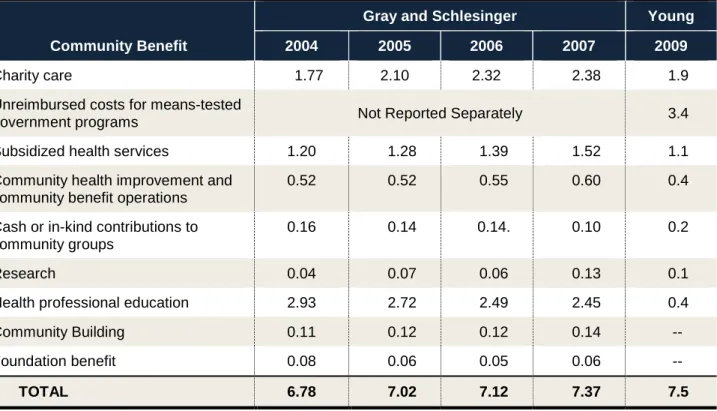
Table 1: Community Benefit Expenditures
Community Benefit
Gray and Schlesinger Young
2004 2005 2006 2007 2009
Charity care 1.77 2.10 2.32 2.38 1.9
Unreimbursed costs for means-tested
government programs Not Reported Separately 3.4
Subsidized health services 1.20 1.28 1.39 1.52 1.1
Community health improvement and community benefit operations
0.52 0.52 0.55 0.60 0.4
Cash or in-kind contributions to community groups
0.16 0.14 0.14. 0.10 0.2
Research 0.04 0.07 0.06 0.13 0.1
Health professional education 2.93 2.72 2.49 2.45 0.4
Community Building 0.11 0.12 0.12 0.14 --
Foundation benefit 0.08 0.06 0.05 0.06 --
TOTAL 6.78 7.02 7.12 7.37 7.5
Source: (Gray and Schlesinger, Young.)
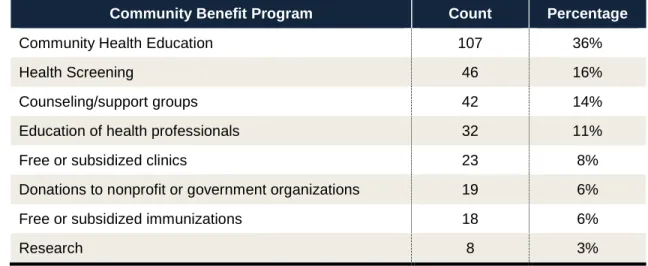
The Gray, Schlesinger and Young studies calculate the community benefit spending in the large Schedule H categories, but they do not provide insight into the types of community programs funded by these dollars. In a 1994 study of 100 California hospitals showed the distribution of community benefit programs undertaken by
9
Table 2: Types of Community Benefit Programs Provided by California Hospitals (N=100)
Community Benefit Program Count Percentage
Community Health Education 107 36%
Health Screening 46 16%
Counseling/support groups 42 14%
Education of health professionals 32 11%
Free or subsidized clinics 23 8%
Donations to nonprofit or government organizations 19 6%
Free or subsidized immunizations 18 6%
Research 8 3%
Source: (Buchmueller and Feldstein)
10
CHAPTER II: CREATING A SENSE OF URGENCY
Several factors are converging to make this the right time to focus on how community benefit programs can be used to improve population health. Figure 2
illustrates how regulatory scrutiny, healthcare trends, and developing new health frameworks are all providing the right external pressure to encourage ambitious community benefit programs to achieve better health. Hospitals are under regulatory pressure to demonstrate that they are providing services that are improving health outcomes in their communities. Health research has repeatedly demonstrated the importance of impacting distal causes of poor health to create a healthy population. Not only have researchers confirmed that non-clinical activities are important for improving health, they have identified several activities that can be undertaken by providers to prevent poor health outcomes. This research potentially provides hospitals and physician networks with a prescription for how to achieve to their mission. Finally, the trends in healthcare are forcing providers to think about how to work together to redesign healthcare so that patients are getting the right care at the right place at the right time. All of these factors together challenge us to seize the opportunity before us and dare to be innovative with our investments and seek to improve the health of our communities.
11
Culture of Health). For decades, a hospital’s mission was to provide excellent tertiary care to patients that received treatment inside the hospital. Over time, this singular mission expanded to improve the procedural outcomes of the patients that received treatment inside the hospital. Now, with the focus on reducing overall health spending, hospitals are being required to consider the health status and outcomes of entire populations. This is a monumental shift in mission for hospitals. Community health advocates must capitalize on these pressures faced by hospitals to create an urgency for hospital administrators to make necessary changes now.
Figure 2
12
Section 1.: Regulatory Scrutiny
Section 1.A.: Internal Revenue Service
First, the regulatory environment continues to drive hospitals to look outside their walls to improve community health. In response to questions about the appropriateness of allowing hospitals a tax exemption, the IRS instituted the Schedule H to Form 990 in 2009. By requiring explicit disclosure regarding the community benefit programs, the IRS can evaluate how the money is being spent to determine if the non-profit hospitals are living up to their obligation to invest back into the community at an equal rate to the benefit. The first comprehensive evaluation of Schedule H expenditures was published in 2013. The conclusion from the study was not favorable to the assertion that non-profit hospitals invest in improving community health in similar measure to the amount of tax breaks received. In fact, the study concluded that “little was spent on community health improvements.” (Young). A 2013 study in California, found that California not-for-profit hospitals received $3.27 billion dollars in total government subsidies and benefits, while only providing $1.43 billion in community benefit (Greenlining Institute). Additionally, out of the $1.43 billion spent on community benefit, only 1.1% of their overall operating revenue went to improving the community health outside of the
13
Section 1.B.: Affordable Care Act
Another important regulatory driver for creating a sense of urgency is the Patient Protection and Affordable Care Act (ACA). The Health and Human Services Strategic Plan enumerates six objectives of the ACA and establishes strategies to achieve each objective including to emphasize primary and preventive care, linked with community prevention services..
The strategic goals of HHS with respect to the ACA posits that the ACA “provides a unique opportunity to maximize the value of America’s health investment by
integrating public health approaches and health care service delivery.” Going further, HHS states that “integrating primary health care services and public health efforts, including linking to community prevention services, can promote efficiency, positively affect individual well-being, and improve population health.” (HHS, ACA Strategic Goals). Hospitals are in the process of creating and implementing strategic plans that are responsive to the challenges of the ACA. Community health advocates need to use these directives as a means to have expansive community benefit programs included in the hospital’s strategic plan.
14
understand the needs of residents beyond those that receive care at the hospital. When they conduct the community needs assessment, hospitals are encouraged to engage a broad array of stakeholders including community members, schools, other institutions, and public health professionals. Forming these collaborative relationships can help hospitals approach healthcare planning in a new way. This collaboration can assist in making the community benefit programs more accessible by the community and ultimately more successful in addressing a wider range of health needs. The community benefit programs cannot remain in a silo, but must be connected to primary care doctors in the community and community organizations. The community benefit office needs to create an effective link among the hospital, community primary care physicians and community organizations. The imperatives set forth in the ACA provide the impetus to be bold in demanding change now.
Section 2: Healthcare Trends
Section 2.A. Accountable Care Organizations
Included in the ACA was the expansion of the Accountable Care Organizations. ACOs are an emergent model of care that are viewed by many as a promising approach to achieving the Triple Aim (FAQ On ACOs: Accountable Care Organizations,
Explained - Kaiser Health News). ACOs are designed to move healthcare providers away from a model where they are paid for each patient encounter regardless of
15
healthcare networks will focus on prevention efforts; this focus requires a new approach to addressing population health needs. As hospitals and physicians seek to improve the health of their populations, they are confronted with the social determinants of health that are not easily addressed in an episodic-focused system. By requiring
physician networks to focus on outcomes and social determinants of health, ACOs have created an environment for change that can help redefine how we approach community benefit programs.
Section 2.B.: Practice Acquisition Trends
In an effort to be ready to participate in ACOs and payment reform, hospitals have been increasing the size of their ambulatory care networks by purchasing medical practices. Figure 3 illustrates the trend of hospital ownership of physician practices. In 2003, almost 70% of physician practices were owned by physicians. By 2011,
ownerships rates were nearly reversed with less than 25% of practices being owned by physicians and hospitals owning over 75% of physician practices.
Figure 3
Percentages of U.S. Physician Practices Owned by Physicians and by Hospitals
1
Source: Medical Group Management Association (MGMA) Physician Compensation and
Production Surveys: 2003 to 2012 Reports Based on 2002 to 2011 Data. 0%
10% 20% 30% 40% 50% 60% 70% 80%
2003 2004 2005 2006 2007 2008 2009 2010 2011
16
The aggregation of physician clinics by hospitals enables hospitals to more easily coordinate care across the care continuum, including pre- and post-acute transitional care. By coordinating care throughout the care continuum, hospitals can produce improved health outcomes over a defined population within a community. Additionally, the distributed primary care practices give the hospitals multiple points of contact with large populations within the community. Community primary care doctors hold a position of trust with their patients. They see the needs first. By integrating tightly with the community primary physicians, hospitals have an opportunity to impact the way that care is delivered in the local doctor’s office. Hospitals have more resources than an individual physician’s clinic. The hospital can provide the resources that a primary care doctor requires to transition to providing outcome-based care for a population of
17
Section 2.C.: Developing New Health Framework
The American Hospital Association’s 2012 Annual Survey of Hospitals found that 98 percent of CEOs believed that hospitals need to investigate and implement
population health management strategies (RWJF, Trends in Hospital-based Population Health Infrastructure). Population health is measured by the health outcomes of a group of individuals, including the distribution of the outcomes within the group (Kindig and Stoddart). Population health outcomes are achieved through a myriad of
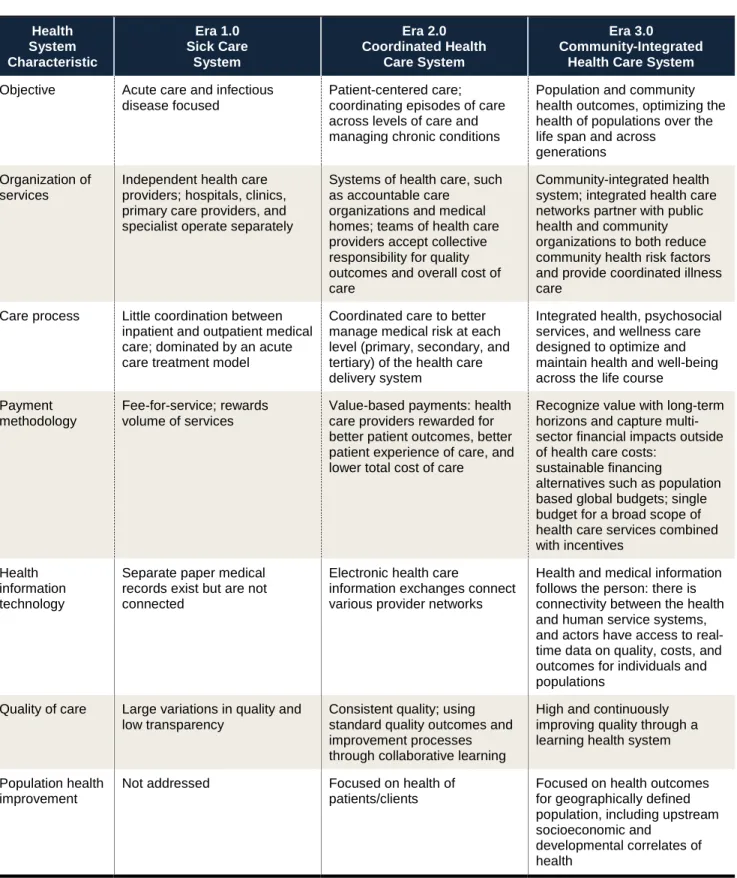
determinants of health including medical care, public health, genetics, behaviors, social factors, and environmental factors (Jacobson). Shifting from a hospital-centric mindset that focuses on providing medical care to a health system that delivers population health will require transformation in vision, organization, and coordination of care. Neal Halfon and Peter Long offer a description of how healthcare is moving into a third era. The first era was marked with the advent of modern medicine in the mid-1800s and extended through the 1950s to address infectious diseases and other immediate health threats, emphasizing acute, emergency, and rescue care to save lives. The second era started in the 1950s and has continued until today. This second era focuses on chronic diseases and focuses on prolonging life with chronic disease treatment and
18
Table 3: Health System Transformation
Health System Characteristic Era 1.0 Sick Care System Era 2.0 Coordinated Health Care System Era 3.0 Community-Integrated Health Care System
Objective Acute care and infectious disease focused
Patient-centered care; coordinating episodes of care across levels of care and managing chronic conditions
Population and community health outcomes, optimizing the health of populations over the life span and across
generations Organization of
services
Independent health care providers; hospitals, clinics, primary care providers, and specialist operate separately
Systems of health care, such as accountable care
organizations and medical homes; teams of health care providers accept collective responsibility for quality outcomes and overall cost of care
Community-integrated health system; integrated health care networks partner with public health and community organizations to both reduce community health risk factors and provide coordinated illness care
Care process Little coordination between inpatient and outpatient medical care; dominated by an acute care treatment model
Coordinated care to better manage medical risk at each level (primary, secondary, and tertiary) of the health care delivery system
Integrated health, psychosocial services, and wellness care designed to optimize and maintain health and well-being across the life course
Payment methodology
Fee-for-service; rewards volume of services
Value-based payments: health care providers rewarded for better patient outcomes, better patient experience of care, and lower total cost of care
Recognize value with long-term horizons and capture multi-sector financial impacts outside of health care costs:
sustainable financing
alternatives such as population based global budgets; single budget for a broad scope of health care services combined with incentives
Health information technology
Separate paper medical records exist but are not connected
Electronic health care
information exchanges connect various provider networks
Health and medical information follows the person: there is connectivity between the health and human service systems, and actors have access to real-time data on quality, costs, and outcomes for individuals and populations
Quality of care Large variations in quality and low transparency
Consistent quality; using standard quality outcomes and improvement processes through collaborative learning
High and continuously improving quality through a learning health system
Population health improvement
Not addressed Focused on health of patients/clients
Focused on health outcomes for geographically defined population, including upstream socioeconomic and
developmental correlates of health
19
The 3.0 Transformation Framework is more of a destination map than a conceptual framework that can assist hospitals in making the necessary transitions through each era. Today, most hospitals are working to move from a first era hospital to a second era health system. Hospitals need a framework that will assist them in
understanding how to create strategies to move from version 1.0 to 3.0. Figure 4 illustrates a hierarchy of low cost/high impact strategies that hospitals can implement to affect population health.
20
Hospitals have always focused on managing the top two wedges in this pyramid. In the 1.0 era, hospitals managed the specialty and primary care with the focus on acute care treatment. As the hospitals move into the 2.0 era, the focus on primary care shifts to patient centered medical homes, care teams with an increased emphasis on
information technology. In order to move into the 3.0 era, hospitals will need to engage in the bottom three wedges of the low cost/high impact pyramid. It is in these
interventions that the hospitals can make relatively low investments that can greatly improve population health.
21
CHAPTER III: BUILDING COALITIONS
As hospitals transform to include impacting population health into their core mission, they will need to reach outside of their walls to embrace community agencies and partners to accomplish this ambitious task. To really affect health outcomes,
hospitals will need to extend beyond the ten percent of determinants managed by health care to influence and measure other determinants of health for individuals and
populations (Children’s Hospitals: Creating Health). In order to address upstream factors that affect health, hospitals will need to partner with a broad range of partners that can assist on various issues including urban planning, education, housing,
transportation, public health, nutrition, community policing (Matterssich). The Robert Wood Johnson Foundation Commission to Build a Healthier America found a growing appreciation of the value of collaboration among hospital administrators (Matterssich). The Association for Community Health Improvement and the American Hospital
22
Table 4: Community Partners of Hospitals
Organization Type Current Partnership %
Primary and secondary school districts 78%
Public health department (local) 77%
Chamber of Commerce or other business group 71%
Community health center 70%
American Heart/Lung/Diabetes Associations 68%
City or county government 66%
Community health coalitions 61%
Faith community organizations(s) 58%
Postsecondary education (colleges, universities) 58%
Service leagues (Lions, Rotary, etc.) 55%
United Way 52%
Neighborhood organizations(s) 45%
Public health department (state) 43%
YMCA/YWCA 38%
Environmental organizations 18%
Source: Association for Community Health Improvement (2013)
23
Table 5: Self-Perceived Partnership Success
Issue
Level of Success in Cross Sector Collaboration None Incipient Emerging Successful
Opportunity for physical activity and active living 12% 19% 23% 46%
Promoting a culture of health and wellness in
schools, workplaces, and neighborhoods 11% 17% 28% 45%
Access to health care 12% 19% 25% 45%
Providing the evidence that decision makers
need to build health into policies and practices 12% 18% 28% 42%
Access to healthy food 12% 22% 25% 40%
High-quality early child care and education 17% 22% 26% 35%
Health impact assessments for community
development projects 16% 265 275 31%
Source: Mattessich
The self-reported impressions from 661 respondents regarding the
successfulness of the collaborative indicate that not quite half (297) of the collaborations are successful. In 2000, a study reviewing the effectiveness of collaborative
24
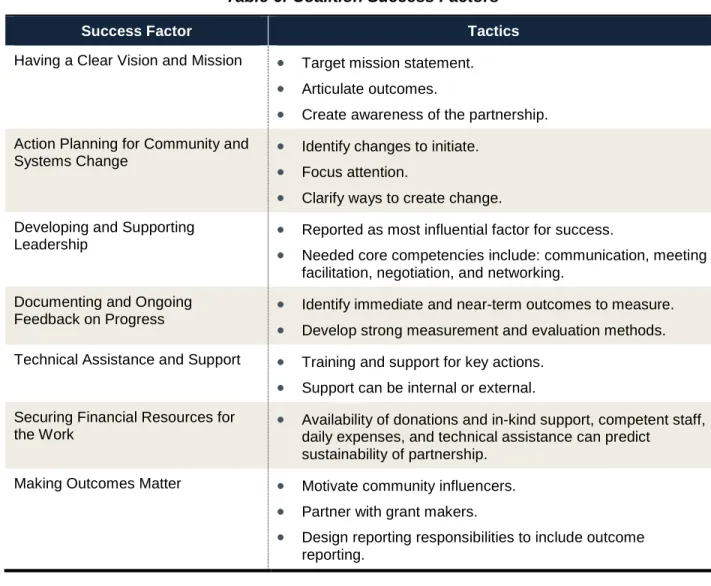
Table 6: Coalition Success Factors
Success Factor Tactics
Having a Clear Vision and Mission • Target mission statement. • Articulate outcomes.
• Create awareness of the partnership. Action Planning for Community and
Systems Change •
Identify changes to initiate. • Focus attention.
• Clarify ways to create change. Developing and Supporting
Leadership • Reported as most influential factor for success.
• Needed core competencies include: communication, meeting facilitation, negotiation, and networking.
Documenting and Ongoing
Feedback on Progress •
Identify immediate and near-term outcomes to measure. • Develop strong measurement and evaluation methods. Technical Assistance and Support • Training and support for key actions.
• Support can be internal or external. Securing Financial Resources for
the Work •
Availability of donations and in-kind support, competent staff, daily expenses, and technical assistance can predict
sustainability of partnership.
Making Outcomes Matter • Motivate community influencers. • Partner with grant makers.
• Design reporting responsibilities to include outcome reporting.
25
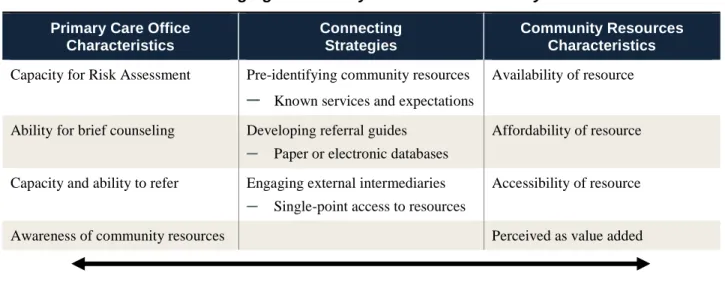
used by the physicians. In Bridging Primary Care Practices and Communities to Promote Healthy Behaviors, Rebecca Etz addresses linking or the work done to forge
connections between primary care practices and community resources. Etz developed a list of necessary elements to effectively create a bridge between the primary care office and the community resources.
Table 7: Bridging Community Partners with Primary Care
Primary Care Office Characteristics
Connecting Strategies
Community Resources Characteristics Capacity for Risk Assessment Pre-identifying community resources
─ Known services and expectations
Availability of resource
Ability for brief counseling Developing referral guides
─ Paper or electronic databases
Affordability of resource
Capacity and ability to refer Engaging external intermediaries
─ Single-point access to resources
Accessibility of resource
Awareness of community resources Perceived as value added
Bi-Directional Communication
Source: (Etz, 2008)
Community health advocates within the hospital must work with hospital leadership to understand the importance of engaging community partners to help address the health determinants that occur outside of the hospital. Hospitals can not affect population health working alone. The community benefit office in a hospital is typically responsible for establishing and nurturing these partnerships. As the
26
CHAPTER IV: RESEARCH DESIGN AND METHODOLOGY
Section 1.: Study Approach and Design
Section 1.A.: Study Overview
This study attempts to understand how community benefit offices are working through distributed physician clinics to affect community health. The study seeks to understand both current practice and identify potential improvements to the status quo. Due to the in-depth nature of the study, a qualitative design is the most desirable for creating knowledge and contributing to the body of research.
The research design and analysis addressed the study’s key research questions and research aims. The two research questions are:
1. How can nonprofit hospitals satisfy their community benefit obligation through partnerships between their community benefit office and ambulatory physician networks?
2. How can community benefit offices, physician networks, and community organizations partner together to design and implement programs that impact
population health?
The research aims are:
27
2. Identify how hospitals (through the community benefit office), physicians, and community agencies work together to create and implement programs focused on improving population health
3. Understand how community benefit offices connect with their ambulatory physician practices to coordinate efforts to improve population health
4. Identify factors that enhance or hinder the development of an effective partnership between the community benefit office and ambulatory physicians’ offices to create programs that affect population health
To answer the questions above, I used a two-step information gathering process. First, I conducted key informant interviews with hospital executives and community physicians to understand more about the community benefit programs used to improve population health. Second, I requested data from participants related to the community benefit program planning for the hospital and the hospital/physician network.
Section 1.B.: Study Participants and Recruitment
The study included 7 sites. At each site, I interviewed hospital executives with professional responsibility for developing and overseeing the community benefit
programs, hospital executives responsible for developing the physician network, as well as community physicians who are part of a hospital/physician network. The participants were selected using purposive sampling in an effort to identify participants who can best answer how a hospital/physician network can be successful in creating impactful
community benefit programs.
28
and the development of best practices. I identified 7 potential sites. I sent an
introductory email explaining the research study and asking if the selected individual would be willing to participate in the an interview to discuss how hospital/physician networks can and do engage in community health initiatives (see Appendix A). I included a copy of the Fact Sheet (see Appendix B) with the email. Out of the 7
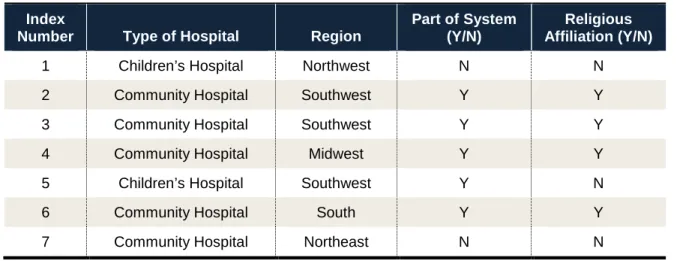
potential respondents, 4 responded that they would be willing to participate in the study. The other 3 potential respondents did not respond to the request to participate. Out of the 4 that responded, one site later dropped out of the study because of the inability to obtain consent from the physician network executive to participate in the study. I added 4 additional sites using my personal network. A total of 7 sites participated in the study. A breakdown of the participant characteristics is included below in Table 8.
Table 8: Study Sites
Index
Number Type of Hospital Region
Part of System (Y/N)
Religious Affiliation (Y/N)
1 Children’s Hospital Northwest N N
2 Community Hospital Southwest Y Y
3 Community Hospital Southwest Y Y
4 Community Hospital Midwest Y Y
5 Children’s Hospital Southwest Y N
6 Community Hospital South Y Y
7 Community Hospital Northeast N N
29
Table 9: Study Participants Participant Index Number Community Benefit Executive Title Physician Network Executive Title Community Physician Specialty
1 Director of Community Benefit
Chief Strategy Officer Primary Care
2 Chief Development Officer President and CEO Medical Group
Primary Care
3 Director Health and Wellness
Chief Physician Executive Primary Care
4 Director of Community Benefit
Chief Medical Officer Primary Care
5 Administrative Director Community Health
Chief Medical Officer Primary Care
6 Vice President of Ancillary Services
Chief Medical Officer Primary Care
7 Population Health Manager
Chief Medical Officer Primary Care
While the titles varied at each site, I was assured that the community benefit executive was, in fact, the executive responsible for the community benefit office. Each interview was conducted via telephone and lasted between 45-60 minutes. The interviews were conducted in English. Prior to asking questions, I read the consent form to participants and received verbal consent. The consent form is attached as Appendix D. The study was fully explained to potential participants and potential participants were informed that they could decline to participate in the study. The potential participants that consented to be included in the study were enrolled and became participants.
30
for physician network executives (see Appendix F), and one for community physicians (see Appendix G). Key informants were interviewed until theoretical saturation was reached and no new themes or concepts emerged regarding how hospital/physician networks can best implement community benefit programs. Theoretical saturation was reached at 7 participant sites.
Section 1.C.: IRB Approval
Study approval was obtained through the Institutional Review Board at the University of North Carolina at Chapel Hill.
Section 2.: Data Analysis
31
Section 3: Privacy of Information
32
CHAPTER V: RESULTS AND DISCUSSION
Section 1.: Summary of Findings
There are four major findings from this study:
1) Health reform and new payment models have started discussions about population health, but have not affected reimbursement significantly enough to cause most hospitals to fully embrace population health programs.
2) Hospitals rely on community partnerships to address the community health needs that cannot be addressed in the hospital.
3) There is not an effective link between the community benefit office and community physicians that promotes cooperation in designing and implementing programs that affect population health.
4) In order for community benefit offices and community physicians to create programs that affect population health together in the future, several key requirements will need to be met.
Each is discussed in turn.
Table 10: Summary of Findings
Finding Summary
Health reform and new payment models have started discussions about
population health, but have not affected reimbursement significantly enough to
33
Finding Summary
cause hospitals to fully embrace population health programs.
applied to understanding community needs. However, many hospitals expressed uncertainty about the future of
population health initiatives until reimbursement models create greater incentives. Some systems embrace addressing social determinants of health; other systems consider social determinants of health beyond the scope of the hospital’s mission.
Hospitals rely on community partnerships to address the community health needs that cannot be addressed in the hospital.
Hospitals recognize the power of community partnerships. Community benefit offices work with community
organizations on key priorities, which include some population health programs.
There is not an effective link between the community benefit office and community physicians that promotes cooperation in designing and implementing programs that affect population health.
Identified barriers include:
• Community benefit office and physicians each operate in their own silos.
• The community benefit office and community physicians do not communicate about community health needs, potential programs, or valued partnerships.
• The lack of coordination results in duplicative/fragmented programs.
In order for community benefit offices and community physicians to create programs that affect population health together in the future, several key requirements will need to be met.
• Create a partnership relationship between the community benefit office and the community physicians.
• Ensure a fully developed community physician network with strong primary care.
• Contract with payors under a reimbursement model that pays for population health outcomes.
• Align physician compensation models with focusing on population health.
• Create office systems that support population health. • Provide best practices uniformly across all patient
populations.
Section 2.
Finding 1:
Health reform and new payment models have started discussions about
population health, but have not affected reimbursement significantly enough to cause most hospitals to fully embrace population health programs.
34
creating significant impact in the community through programs implemented by the community benefit office. Below is a sampling of statements from the published community benefit reports of the study sites.
“…committed to improving the health and well-being of the people who live and work in the communities we serve.”
“…target preventative health to positively impact the health status of
disproportionate unmet health needs populations, to facilitate the coordination of care (specifically prevention and disease management outreach activities) across the entire community, and provide community based activities that support and enhance hospital service lines and key performance indicators.”
“…system goals reflect those of health reform… so that quality can be continuously improved and patients and communities are healthier.”
“…our efforts make a significant difference in the health status of our community.”
While these statements are clear in the intention that the community benefit programs affect community health and satisfy the community benefit obligation, the key informants were less convinced that their hospitals were ready to commit fully to
population health activities at this time. A frustrated community benefit executive explained that hospitals are a business and that the business is not focused on improving population health.
“what we're up against, as you know, is hospitals and medicine in general – are not public health. And a lot of our executives have that perspective. Their job is to run a hospital. And I would – I could see them saying, really, "What is the incentive for the hospital to do this? We're already giving millions in community benefits. Is that not enough? Why should we be concerned at all about
population health?" Community Benefit Executive
35
aligned to that goal. It did not matter if the participant was the community benefit executive, the physician network executive, or the primary care physician, all participants agreed that reimbursement would drive action.
“people will respond to their incentives; and right now, the hospital presidents are incentivized to bring people into the hospital. Now once they're there, they want to get them out quickly, but they definitely want to bring them in.” Physician Executive
Participants agreed that the Affordable Care Act has created an interest in understanding how healthcare delivery needs to be redesigned to improve population health. The strong belief was that once reimbursement was conditioned on outcomes in patient populations and/or community outcomes, the hospitals would shift not only their rhetoric, but also their strategic plans to include community health initiatives.
“As the reimbursement incentives migrate toward more of a population health approach and we get rewarded for maintaining a healthier population, to be more proactive in terms of chronic disease identification and management, then I think we will see this sort of spillover into creating healthier communities, which has sort of been our mission statement for the last 25 years, but they've done precious little to really address the determinants of health.” Physician Executive
“Until there is a direct financial justification to pursue a public health problem, then I don't see it changing. Maybe there's more lip service. But I don't really see that changing. Not yet, at least.” Community Benefit Executive
A few study sites are participating in payment models that reward health outcomes. Those sites had made more progress in implementing population health initiatives in their systems. The participants at those sites credit the payment
36
took a large portion of the physician reimbursement and directed into a pool focused on primary care network development and outcome improvement.
“ [the payor was the] chief architect who engaged with physicians in new ways to really develop the infrastructure that will drive the culture of population health management. When they [the payor] put a lot of money behind it, physicians had no choice but to pay attention. Absent significant payment reform, we're not going to see practice reform.” Physician Executive
The sites that are located in markets without pressure from payors to affect population health are taking small steps toward delivery redesign and taking a “wait and see” attitude.
Section 3.
Finding 2:
Hospitals rely on community partnerships to address the community health needs that cannot be addressed in the hospital.
37
40
Community benefit executives indicated that they rely on collaborative and partnerships with community organizations to implement several of these community benefit programs. Partnerships with outside organizations were used for a variety of reasons including: 1) the program objective focuses on upstream causes of poor health and requires collaboration of several institutions, 2) the program cannot be delivered within the hospital complex and/or 3) community partners are already providing the service. The quote below is from a one of the community benefit executives, however, this sentiment was shared by most participants.
“My approach has always been partnerships. For everything we do. It’s to bring in the experts in on it and work together. Because nobody can just do it on their own.”
“We need to be thinking about policy changes. So it’s like big picture. Your environment. What about transportation? What about the availability of food? What about these big kind of changes. So I say that that’s – but it’s hard. But there’s absolutely no way we’re going to do that kind of thing by ourselves “
A sampling of the types of partnerships used by the study participants in included in Table 11.
Table 12: Study Site Partnerships
Community Benefit Program Partnership Organization
Activity Classes YMCA, Boys & Girls Club.
Nutrition and Cooking Classes Local High Schools, Grocery Stores, Culinary Institutes, Local Farms, Churches.
Pro Bono legal services to patients to address social determinants (e.g. legal demand for landlord to change carpet that caused asthma).
Legal Aid, non-profit legal advocacy organizations.
Community building activities including safe neighborhoods, activity programs, food security, transportation, and access to care.
Health community collaboratives, public health departments.
41 Work Study programs, Mentoring
programs.
High Schools, Community Colleges
Development of an integrated network of home, community-based, and institutional long term care services for older adults and adults with disabilities.
Community Collaboration, Mayor’s Office
Homelessness elimination projects including establishing a hub where homeless individuals and families could access primary and mental health and addiction treatment, job readiness and search training, legal services, and life skills training.
Community Collaborative
The community benefit executives, the community benefit reports, and the
community health improvement implementation plans identified community partnerships as a key element of their successful community benefit program.
Section 4.
Finding 3:
There is not an effective link between the community benefit office and
community physicians that promotes cooperation in designing and implementing programs that affect population health.
“But I would say that the communication that I have with respect to the community benefit office is zero.” Community Physician
“Whereas right now everybody's working independently, and that is sad.” Community Benefit Executive
“Certainly the physicians are not directly connected with that [the community benefit] office.” Physician Executive
42
compelling finding was that the results of the Community Health Needs Assessments are not shared with the community physicians. In most cases, the community benefit executive admitted that sharing the information had not been considered previously even though it seems like a good idea. In one case, the community benefit executive commented that the report was shared with the senior leadership and that it was the job of the senior leadership to determine how the report should be disseminated from there.
The Community Health Needs Assessment is the foundation to the
implementation plan prepared by the community benefit office. In all but one case, this implementation plan was created separate from the physicians. The physicians were not included in the planning or implementation of the community health implementation plan. The community benefit offices have strong partnerships in the community to address the upstream causes of poor health, however, there is not a mechanism to link those partnerships to the community physicians. When asked how a community
physician can connect with the established partners, the most common answer was that there was a list on the website. In most cases, there was no effective way for a
physician to connect a patient to the community resources and no feedback loop from the community partner back to the physician.
43
program was available to all patients, regardless of ability to pay and
inpatient/outpatient status. The programs were separate, sometimes duplicative and always fragmented. In one site, the hospital had a patient navigator program for the inpatient patients and the physician network had a patient navigator program for the outpatient patients. The two navigator programs did not utilize the same community partners, same databases, or electronic health record. There was little communication between the two navigator programs. The physician executive from that site stated that while both the community benefit office and the physician network were implementing great programs, they were doing it in an uncoordinated manner.
It feels to me as though it is separate, and I'm not sure that's a good thing, but it just feels that way in all honesty. Physician Executive
44
physician was aware of the community partner programs, had an established point of referral and had a feedback loop for information.
Section 5.
Finding 4:
In order for community benefit offices and community physicians to create programs that affect population health together in the future, several key requirements will need to be met.
The respondents identified six foundational requirements that need to be in place before the community benefit office and the community physicians can work together to create meaningful programs that affected population health.
1. Create a partnership relationship between the community benefit office and the community physicians.
2. Ensure a fully developed community physician network with strong primary care. 3. Contract with payors under a reimbursement model that pays for population
health outcomes.
4. Align physician compensation models with focusing on population health. 5. Create office systems that support population health.
6. Provide best practices uniformly across all patient populations.
These six recommendations were elicited from respondents by asking what needed to change to allow the community benefit office and the ambulatory physicians to work together to create and robust population health programs.
1. Create a partnership relationship between the community benefit office and the community physicians.
45
between the community benefit office and the physicians. Some respondents explained that this partnership was hard to establish because the community benefit office is located in the hospital and the physician network is under separate governance. The strategic planning and communication between the two institutions was not always easy to accomplish. At least one respondent raised perceived legal constraints about the ability of the hospital and the physicians partnering on community benefit projects. Several of the community benefit executives perceived that ambulatory physicians were not interested in population health.
“I think we still struggle with physicians in terms of their grasp of population health management. I think there’s still – for the majority here, they’re still focused on more of a disease model than a population health model. I think that’s – it is different to them, and let’s face it, they’re reimbursed for taking care of sick people.” Community Benefit Executive
In one case, the community benefit executive did not feel comfortable approaching the physicians at all.
“I don’t even want to bring up because I’m scared but shouldn’t these physicians be doing Community Benefit because they’re basically part of the system. I think the answer is yes, but I don’t even dare bring it up right now around here.” Community Benefit Executive
46
impact of the community benefit office could be expanded if the physicians were
included in the implementation of the programs. Despite the concerns of the community benefit executives, most of the physicians were interested in creating a connection with the community benefit office to access programs offered by the community partners.
2. Ensure a fully developed community physician network with strong primary care.
In order for the community benefit office to engage with the ambulatory
physicians, the hospital needs to have a developed physician network. Respondents agreed that it was not practical for the community benefit office to attempt to work with a fragmented, uncoordinated group of community physicians. The responding sites were in different phases of developing their physician networks. The sites that had
established networks were more likely to be further along in population health efforts. The sites that were still acquiring practices were focused on the building of the network infrastructure and did not have the capacity to concentrate on disseminating community benefit programs through the ambulatory practices. Respondents agreed that once the physician network was established that it could be a partner with the community benefit office to create and implement community health programs.
3. Contract with payors under a reimbursement model that pays for population health outcomes.
As discussed in Finding 1, respondents cited reimbursement methodologies as a key driver for encouraging hospital and physician networks to implement population health focused programs. Respondents believed that the single biggest factor in
47
health efforts rather than paying on a fee-for-service model. See the discussion under Finding 1 for a longer discussion on this point.
4. Align physician compensation models with focusing on population health.
This point is connected to the prior point, but has important differentiation. The payor contracts determine how the hospital and/or physician network are compensated. These payor contracts create the pool of money that will be used to compensate the physicians. The physician’s compensation is determined by individual employment agreements with the hospitals and/or physician network entity. Currently, most of the respondents’ compensation plans are based on productivity. The more wRVUs (volume) the physician generates, the more she is paid. Respondents agreed that as long as we have a system that rewards volume of care provided, population health will not be a focus of physicians.
“The truth is that the way the system is designed, this is what we get. And if you change the system, which obviously I think there is a push to do, we’ll get a different result, but right now, this is what we’re living in.”
Below, one physician executive explains how he has been able to persuade his physicians to move to a population health mindset through compensation.
“You know I think they are receptive and interested. Physicians are like
everybody else and they have to figure out “okay, you're changing the rules, am I going to be able to send my kids to college and do the things I've always done? How is this going to impact my compensation? Am I going to earn 20 percent less or what?”
48
Physicians have, just like everybody else, have found it harder and harder to make a living over the last five to ten years.
If you say to physicians, hey, we want you to sort of care for people differently, and we think there's an upside in that, they're good to go. We kind of said to them, we're at the end of the life of your current business model, and the only way that you can think of earning more money is to earn money differently in the new population health model. And they've bought into that.”
Respondents reported that they are seeing the compensation plans for
physicians start to include quality metrics. The range of compensation that was at risk for meeting outcome based measured ranged from 0% to 50%. The more common percentage was around 15% of compensation being at risk for quality metrics. It was a compelling finding that the compensation of physicians would need to shift from a volume based compensation to value based compensation before physicians would be able to significantly engage in population health measures with the community benefit office in a sustainable way.
5. Create office systems that support population health.
Physician executives and the community physicians were clear in the tools that they needed to be able to deliver on the promise of affecting population health. The needed tools included:
• Patient Registries – A patient registry is standardized information set about patients who share a medical condition. An example of a registry is a list of all patients with diabetes with available appointment, medication, and diagnostic information.
• Panel Support Tools -- Panel support tools are information systems that sit on top of the EHR and patient registries. The panel support tools allow the
physician to examine trends in his entire patient portal by disease type, diagnosis code, age, gender, etc.
49
not missing appointments, connect to community resources, and have a single point of contact within the system.
• IT that communicates across systems – Hospitals and physicians do not always share the same electronic health record. Even when the information can be shared across the systems, the quality and quantity of the shared information is lacking.
• Time built into the schedule for the physician to engage in panel management – physicians’ schedules need to have time blocked off for the physician to monitor and manage the patient population health information provided through the points above.
Respondents agreed that these tools could be provided through joint programing with the community benefit office, however, the structures must be set up with guidance from counsel so that they do not violate Stark and anti-kickback laws.
6. Provide best practices uniformly across all patient populations.
The final recommendation from respondents was that best practices should be provided to all patients uniformly. Almost all of the respondents had an example of a program that had great potential to improve health outcomes at a community level, but that the program was only available for a subset of patients. One example was a
program funded through Blue Cross. The physician respondent was very frustrated that the referral process would not work for his other patients. Another complaint was that programs were often not available for patients who were not on Medicaid or on the Exchanges. Physicians expressed dissatisfaction that they could not refer their fully insured patients to programs that could be beneficial. On the one hand, physicians were frustrated about the lack of programs available for the working poor. They
50
being able to refer patients who were middle and upper middle class to beneficial programs. There was a sense that they system was not worried about these patients because they “had the means and ability to find resources on their own.” The physicians pushed back on this notion citing that the general public of all income levels was
51
CHAPTER VI: CREATING A VISION AND ENABLING ACTION
We are at an inflection point in healthcare that creates an opportunity for change in how hospitals engage in impacting population health. Hospitals cannot accomplish these changes alone. Changing the healthcare delivery system and the health
outcomes of a population require active participation of the hospital, the ambulatory physicians, community agencies and the community benefit office. By moving from silos to an interconnected partnership, these actors can create a system that delivers on the promise of a society of healthy communities where all individuals reach their highest potential for health. Each actor must contribute resources to the effort to affect
population health. The findings from this research establish that there is opportunity to improve the ability of hospitals to affect population health through coordination of efforts between the community benefit office and the ambulatory physicians. In developing a plan for change, the findings, taken as a whole, were used to develop a list of concrete recommendations. These recommendations strive to create an environment where community benefit offices in connection with ambulatory physicians can have maximum impact on population health. Section A. includes Table 12 with the list of the
52
Section 1.: Recommendations
Table 13: Summary Recommendations
Recommendations for coordinated effort among the hospital, physician network and community benefit office to create and implement programs that affect population health.
Recommendation Category Recommendation for Hospital Recommendations for Physician Network Recommendations for Community Benefit Office
Payor Strategy Convert payor contracts from Fee-for-service to value based contracts.
Convert payor contracts from Fee-for-service to value based contracts.
Support the hospital and physician network in developing population health outcomes that can be effectively used in the payor contracts.
Communication Develop a communication plan that includes the hospital, physician network, and the
community benefit office.
Develop a communication plan that includes the hospital, physician network, and the
community benefit office.
Develop a communication plan that includes the hospital, physician network, and the
community benefit office.
Partnerships Contribute the needed IT upgrades and personnel to provide the ability of the community benefit office, ambulatory physicians, and community partners to connect through a single referral point and have an information feedback loop.
Connect with community partners through the community benefit office using a single point of referral.
Expand the current partnerships to include a link with community physicians that includes single point of referral and information feedback loop.
Infrastructure Contribute the needed infrastructure to allow physician offices to participate in population health activities.
Contribute the needed infrastructure to allow physician offices to participate in population health activities.
Use community benefit programs to provide some of the needed
infrastructure to allow the ambulatory physicians to participate in population health activities.
Section 1.A.: Payor strategy
A compelling finding of the study showed that payor contracts had the ability to change the incentive for hospitals and physicians to focus on population health.