J
OURNAL OF
C
LINICAL
O
NCOLOGY
O R I G I N A L
R E P O R T
Author affiliations appear at the end of this
article.
Published online ahead of print at
www.jco.orgon June 20, 2016.
Supported by grants from the National Cancer Institute at the National Institutes of Health (1R01CA129142; A.Y.K.) and the Huntsman Cancer Foundation. Also supported by the Shared Resources (P30 CA042014; M.C.B.) at Huntsman Cancer Institute (Biostatistics and Research Design, Genetic Counseling, Research Informatics, and the Utah Population Database) and the University of New Mexico Comprehensive Cancer Center Support Grant: Development Funds and the Biostatistics Shared Resource (P30CA118100; C.L.W.); the Utah Cancer Registry, which is funded by Contract No. HHSN261201000026C from the National
Cancer Institute’s SEER Program, with
additional support from the Utah State Department of Health and the University of Utah; the National Center for Research Resources and the National Center for Advancing Translational Sciences, National Institutes of Health, through Grant No. 8UL1TR000105 (formerly UL1RR025764). This content is solely the responsibility of the authors and does not necessarily reflect the opinions or views of the funding and supporting agencies.
Authors’disclosures of potential conflicts
of interest are found in the article online at
www.jco.org. Author contributions are
found at the end of this article. Clinical trial information: NCT01346761. Corresponding author: Anita Y. Kinney, PhD, RN, Cancer Research Facility, 1 University of New Mexico, MSC07-4025, 2325 Camino de Salud NE, Albuquerque, NM 87131-0001; e-mail: [email protected].
© 2016 by American Society of Clinical Oncology
0732-183X/16/3424w-2914w/$20.00 DOI: 10.1200/JCO.2015.65.9557
Randomized Noninferiority Trial of Telephone Delivery of
BRCA1/2
Genetic Counseling Compared With In-Person
Counseling: 1-Year Follow-Up
Anita Y. Kinney, Laurie E. Steffen, Barbara H. Brumbach, Wendy Kohlmann, Ruofei Du, Ji-Hyun Lee,
Amanda Gammon, Karin Butler, Saundra S. Buys, Antoinette M. Stroup, Rebecca A. Campo, Kristina G. Flores,
Jeanne S. Mandelblatt, and Marc D. Schwartz
A B S T R A C T
Purpose
The ongoing integration of cancer genomic testing into routine clinical care has led to increased
demand for cancer genetic services. To meet this demand, there is an urgent need to enhance the
accessibility and reach of such services, while ensuring comparable care delivery outcomes. This
randomized trial compared 1-year outcomes for telephone genetic counseling with in-person
coun-seling among women at risk of hereditary breast and/or ovarian cancer living in geographically diverse
areas.
Patients and Methods
Using population-based sampling, women at increased risk of hereditary breast and/or ovarian
cancer were randomly assigned to in-person (n = 495) or telephone genetic counseling (n = 493).
One-sided 97.5% CIs were used to estimate the noninferiority effects of telephone counseling on
1-year psychosocial, decision-making, and quality-of-life outcomes. Differences in test-uptake
pro-portions for determining equivalency of a 10% prespeci
fi
ed margin were evaluated by 95% CIs.
Results
At the 1-year follow-up, telephone counseling was noninferior to in-person counseling for all
psychosocial and informed decision-making outcomes: anxiety (difference [d], 0.08; upper bound
97.5% CI, 0.45), cancer-speci
fi
c distress (d, 0.66; upper bound 97.5% CI, 2.28), perceived personal
control (d,
2
0.01; lower bound 97.5% CI,
2
0.06), and decisional con
fl
ict (d,
2
0.12; upper bound
97.5% CI, 2.03). Test uptake was lower for telephone counseling (27.9%) than in-person counseling
(37.3%), with the difference of 9.4% (95% CI, 2.2% to 16.8%). Uptake was appreciably higher for
rural compared with urban dwellers in both counseling arms.
Conclusion
Although telephone counseling led to lower testing uptake, our
fi
ndings suggest that telephone
counseling can be effectively used to increase reach and access without long-term adverse
psy-chosocial consequences. Further work is needed to determine long-term adherence to risk
man-agement guidelines and effective strategies to boost utilization of primary and secondary preventive
strategies.
J Clin Oncol 34:2914-2924. © 2016 by American Society of Clinical Oncology
INTRODUCTION
Increased awareness of associations between
BRCA1/2
mutations and breast and ovarian
cancer
1-10has led to an increased demand for
genetic counseling and testing.
11,12If
population-wide
BRCA1/2
screening is realized,
13the need for
evidence-based and ef
fi
cient counseling care
de-livery models will also increase. Specialized
ex-pertise is required to assess a woman
’
s risk of
geographic access barriers
while reducing costs.
Con-cerns remain, however, about whether telephone counseling can
support informed decision-making and minimize adverse
psy-chologic outcomes.
12,29-31Recent evidence indicates that in the
short term, telephone counseling is noninferior to in-person
coun-seling for key decision-making and psychosocial outcomes.
27,32There
are no data on longer-term noninferiority for these outcomes after
telephone counseling.
33-39To
fi
ll this gap, we examined 1-year outcomes from a
pre-viously reported randomized trial
32comparing telephone with
in-person counseling in a population with potential geographic
barriers to care. We hypothesized that telephone counseling would
be noninferior to in-person counseling at the 1-year follow-up
for psychologic, informed decision-making, quality-of-life, and
risk management outcomes. We also assessed geographic
dif-ferences in follow-up outcomes and described risk management
behaviors.
PATIENTS AND METHODS
Research Design and Study Population
A two-armed, parallel-cluster, randomized equivalency/noninferiority
trial compared telephone with in-person counseling for deleterious
BRCA1/2
mutations (NCT01346761). Enrollment began August 2010 and ended
September 2012. One-year outcome assessments were completed February
2014. Study details and short-term outcomes have been previously
published.
32The Utah Population Database
40and Utah Cancer Registry were used
to identify and recruit breast and ovarian cancer survivors. At-risk female
relatives were recruited through survivors who tested positive for a
BRCA1/2
mutation. Eligible participants were English speaking, 25 to 74 years of age,
Utah residents, had personal/family histories meeting HBOC genetic testing
guidelines,
41had telephone access, could travel to in-person counseling at
one of 14 clinics, and had no prior genetic counseling and/or
BRCA1/2
testing. The University of Utah and University of New Mexico Institutional
Review Boards approved study protocol. All participants provided informed
consent.
Randomization and Masking
Participants completed baseline assessments and were randomized by
family unit to one of the two study arms using a computer-generated
allocation algorithm based on a permuted block randomization plan.
32Study staff who conducted baseline assessments were blinded to the
identity of a woman
’
s participating relative(s).
Interventions
In-person counseling.
Women assigned to in-person counseling
re-ceived counseling by a cancer genetic counselor according to a standardized
protocol consistent with national guidelines
32,42,43and were given an
HBOC educational brochure and a copy of the visual aids used during the
counseling. Women who decided to have genetic testing could provide
a sample at their appointment or bring a
BRCA1/2
buccal test kit home
should they decide to test at a later time. Women who chose testing were
offered post-test counseling with the same genetic counselor who
per-formed pre-test counseling. Test result
–
speci
fi
c visual aids and
recom-mendations for both positive and negative test results were used.
Telephone counseling.
Women assigned to telephone counseling
re-ceived counseling by a cancer genetic counselor according to the same
standardized protocol as those in the in-person counseling arm. They were
mailed sealed packets containing the same print materials used for
in-person counseling, which were to be opened and used at the time of their
telephone counseling session. Women who decided to have genetic testing
were mailed a genetic test buccal kit. Post-test counseling was delivered by
the same genetic counselor using the same tailored visual aids based on the
results. Participants in both arms were mailed a letter summarizing their
personalized risk assessment based on family history and/or genetic test
result and management recommendations. Both groups were asked to
identify their healthcare provider(s) to also receive the letter.
Data collection and measures.
Data collectors, who were blinded to
intervention assignment, collected self-reported data via telephone,
In-ternet, or mailed surveys. Assessments were done at baseline, 1 week after
pre-test and post-test counseling, 6 months, and 1 year after the last
counseling session. This study focuses on 1-year outcomes.
Anxiety was measured at baseline and 1 year with the six-item state
anxiety subscale of the Brief Symptom Inventory-18.
44Higher scores
indicate more anxiety (Cronbach
’
s
a
coef
fi
cient = .90 to .91).
Cancer-speci
fi
c distress was measured at baseline and 1 year with the
15-item Impact of Event Scale.
45Higher scores indicate more distress
(
a
= .89 to .90).
Mental and physical health-related quality of life was measured at
baseline and 1 year with the 12-item Short Form Health Survey (SF-12,
version 2).
46,47Higher scores re
fl
ect better quality of life for the mental
(
a
= .84) and physical (
a
= .88) component summary scores.
Perceived control about risk of HBOC (ie,
“
the problem
”
) was
assessed at 1 year with the nine-item Perceived Personal Control
Ques-tionnaire.
31The questionnaire assesses three dimensions of control:
cognitive (eg,
“
I feel I understand the problem that brought me to genetic
counseling
”
), behavioral (eg,
“
I know what I can do to alleviate the
problem
”
), and decisional (eg,
“
I feel I can make decisions that would
in
fl
uence future outcomes
”
). Higher scores indicate more perceived
control (a
= .85).
Decisional con
fl
ict associated with the
BRCA1/2
testing decision was
measured with the 16-item version of the Decisional Con
fl
ict Scale at
1 year.
48,49Higher scores indicate more decisional con
fl
ict (
a
= .92).
Decisional regret about
BRCA1/2
testing decisions were measured
with the
fi
ve-item Decision Regret Scale at 1 year.
50Higher scores indicate
more decisional regret (
a
= .91).
Risk management behaviors.
Participants were provided with risk
management recommendations, which were based on National
Com-prehensive Cancer Network guidelines and tailored to their personal
cancer status, genetic test results, and presence of breast and ovaries
(Appendix
Table A1
, online only). Counseling recommendations
re-fl
ected the guidelines for surveillance at the time of the study.
51,52Breast
cancer screening, prophylactic mastectomy, and oophorectomy were
assessed.
51,53Statistical Analysis
The a priori primary noninferiority outcomes were 1-year changes
from baseline in anxiety and cancer-speci
fi
c distress. Noninferiority
margins re
fl
ected established clinically signi
fi
cant change
(cancer-speci
fi
c distress and decisional con
fl
ict: 4 points; mental and physical
quality of life:
2
2.5 points).
45,46,50In accordance with other
stud-ies and literature on meaningful changes in health,
54a margin of no
more than 0.5 standard deviation
“
worse
”
than the in-person
coun-seling mean value was used for measures without clinical guidelines
(decisional regret and anxiety: 5 points; perceived personal control:
2
0.2 points).
family. The same approach was used for the exploratory analysis of the
noninferiority effects for geographic (rural
v
urban) and genetic test status
(tester
v
nontester) subgroups.
The equivalency of genetic testing uptake between telephone and
in-person counseling within 1 year of the precounseling session was a
sec-ondary outcome. A sensitivity analysis showed that results did not differ
when including or excluding women who reported testing outside the
study; therefore, testing status included all women who had either
study-veri
fi
ed testing (n = 240) or testing outside the study (n = 21). To test
whether the interventions had equivalent rates of genetic testing uptake by
1 year and to exclude a potential clinically relevant difference, a two-sided
95% CI was estimated from 1,000 cluster bootstrap samples for the
dif-ference in uptake proportions (equivalence range
6
10%) for the
per-protocol and intent-to-treat equivalency analyses, accounting for the
correlation within families.
58For the intent-to-treat analysis, the multiple
imputation method
59,60was used to impute the missing observations using
cancer status, number of relatives with cancer, education level, and health
insurance status. We also delineated risk management behaviors across the
two interventions, by cancer and by genetic testing result status.
All analyses were performed using SAS 9.4 (SAS Institute Inc., Cary,
NC) and R 3.2.1 (R Development Core Team, Vienna, Austria).
Sample Size and Power Evaluation
Sample size and power calculations were based on the trial
’
s 6-month
primary outcome analysis using NQuery Advisor 7.0.
32,61Based on the
fi
nal randomized sample size of 988, 79% retention, a mean cluster size of
1.02, and an estimated intraclass coef
fi
cient of 0.07, our ad hoc power
was
.
80% to detect noninferiority in cancer-speci
fi
c distress and anxiety
at 1 year, with an
a
level of 0.05.
RESULTS
Study enrollment, randomization, and retention data are shown in
the CONSORT
fl
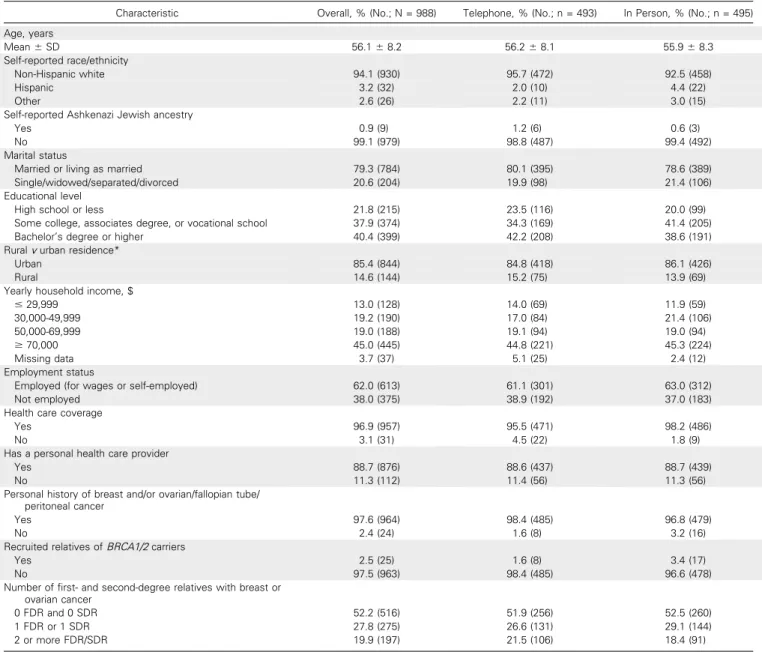
ow diagram (Fig 1). The study arms did not differ
at baseline (Tables 1,
2, and
3).
Psychosocial and Informed Decision-Making Outcomes
Table 2
shows measures of psychologic distress and
well-being by telephone and in-person counseling arms for the more
conservative per-protocol analysis. The mean differences for
participant-reported measures between the arms for noninferiority
measures from baseline and 1-year follow-up values were all within
the prespeci
fi
ed margins (Fig 2
and
Table 4). No differences were
observed for noninferiority based on rural versus urban residence
or test uptake (Table 3), cancer cases (Appendix
Table A2, online
only), or uninformative and nontester result status (Appendix
Table A3, online only). Results were similar for imputed data (data
not shown). Missing data for these analyses ranged from 17% to
28%.
Genetic Testing
At 1 year, 27.9% of telephone counseling and 37.3% of
in-person counseling participants underwent genetic testing. A 95%
CI of the difference in the testing uptake was 2.2% to 16.8%, which
falls outside of the equivalence range (
2
10% to 10%). Similar
results were observed for imputed data (difference = 8.2%; 95% CI,
0.9% to 15.4%). Testing uptake was appreciably higher for rural
compared with urban dwellers in both arms (rural telephone
counseling: 38.7% [95% CI, 26.2% to 50.0%]; urban telephone
counseling: 25.9% [95% CI, 21.1% to 30.9%]; rural in-person
counseling: 41.3% [95% CI, 29.1% to 53.9%]; urban in-person
counseling: 36.6% [95% CI, 30.8% to 42.8%]).
Risk Management Behaviors
Risk management behaviors based on testing status and
previous cancer diagnosis are shown in
Table 5. Three out of 20
women, who were
BRCA1/2
positive and had at least one breast
before testing, had a prophylactic mastectomy (telephone
coun-seling: 10% [one of 10 women]; in-person councoun-seling: 20% [two of
10 women]). Six of 10 women
$
35 years old, who were
BRCA1/2
positive and had at least one ovary, underwent a prophylactic
oophorectomy (telephone counseling: 50% [two of four women];
in-person counseling: 67% [four of six women]). Most women
whose test results were uninformative or who did not undergo
testing were up to date with breast cancer screening guidelines
based on personal and family history. Signi
fi
cance tests were not
conducted because of small subgroup sample size.
DISCUSSION
This trial provides important evidence that telephone genetic
counseling for HBOC is noninferior to in-person counseling
and can be delivered as safely as in-person counseling without
an adverse effect on long-term psychologic, quality-of-life, and
decision-making outcomes. This conclusion was robust across
subgroups of participants, including those living in geographically
remote areas and those choosing to be tested or not. The vast
majority of participants received uninformative test results. Thus,
noninferiority for women with
BRCA1/
2 mutations or variants of
uncertain signi
fi
cance cannot be certain from our data because of
small subgroups.
Overall, our
fi
ndings are concordant with previous research
that established nonequivalency of telephone counseling up to
6 months after genetic counseling
27,32and provide further
evi-dence that telephone genetic counseling for HBOC can be
de-livered safely.
62However, consistent with earlier reports focused on
shorter-term outcomes,
27,32at 12 months, telephone counseling
continued to generate lower genetic testing rates (27.9%) than
in-person counseling (37.3%) at 1 year. Reasons for this are unclear
but may be due to travel time to mail test kits, a delay between
telephone counseling and testing at home that might have reduced
enthusiasm for testing, or the wait between telephone counseling
and testing at home provided opportunity to further consider
potential out-of-pocket expenses or to discuss testing with social
network members. Future research is needed to better understand
how counseling mode might in
fl
uence testing uptake rates and
whether the women at lowest risk are opting appropriately to forgo
testing.
Rural women had higher test uptake rates in both the
tele-phone and in-person counseling arms, suggesting that
BRCA1/2
Assessed for eligibility (N = 2,035); families (N = 1,998)
Families (n = 988) Randomly assigned (n = 1,012)
Not randomly assigned (n = 1,023); families (n = 1,017)* Did not meet inclusion criteria Refused to participate Baseline survey not completed
(n = 835) (n = 146) (n = 42)
Assigned to in-person counseling (n = 510); families (n = 494) Received pre-test counseling
Not eligible for inclusion Previous GC and/or testing
Personal/family history not suggestive of HBOC
Other
Did not complete intervention Did not receive pre-test counseling
Died
(n = 441) (n = 69) (n = 11) (n = 7) (n = 1)
(n = 3) (n = 57) (n = 1)
Analyzed 1-year assessments
Available participants†
12-month (range, 354 to 382) Intent-to-treat (n = 495); families (n = 479)‡
(n = 383) (n = 418)
(n = 35) (n = 30) (n = 2) (n = 3) 12-month follow-up
Completed Not completed
Not returned Withdrew Died Withdrew
Died (n = 1)
(n = 13) Completed pre-test counseling (n = 437); families (n = 421)
Died
Withdrew at 1-week follow-up (n = 1) (n = 4) Not eligible for inclusion (n = 4)
Testers completed post-test counseling
(n = 139)
Assigned to telephone counseling (n = 502); families (n = 494) Received pre-test counseling
Did not receive pre-test counseling Not eligible for inclusion
Previous GC and/or testing
Personal/family history not suggestive of HBOC
Did not complete intervention
(n = 467) (n = 35) (n = 6) (n = 4) (n = 2)
(n = 29)
Analyzed 1-year assessments
Available participants†
12-month (range, 377 to 403) Intent-to-treat (n = 493); families (n = 485)‡ Withdrew
Died
(n = 10) (n = 2)
Completed Not completed 12-month follow-up
Not returned Withdrew Died
(n = 448)
(n = 39) (n = 409)
(n = 35) (n = 4) (n = 0) Not eligible for inclusion (n = 3)
Testers completed post-test counseling
(n = 101) Completed pre-test counseling (n = 464); families (n = 456)
Withdrew at 1-week follow-up Died
(n = 4) (n = 0)
the urban sample may have been biased toward women who were
less interested in testing. Nonetheless, the rates of testing in
our study are substantially lower than in other studies where
women who were members of families with a known deleterious
mutation
27,63,64were self- or physician-referred, but similar to
a study of African American women.
65A contributing factor to the lower overall uptake of testing in
this study may be the active recruitment strategy, which identi
fi
ed
eligible women from population-based sources without any direct
involvement of or referral from their primary health care
pro-viders. In general, recommendations from a health care provider
strengthen perceptions about the importance of recommendations.
66Outcomes of telephone and in-person genetic counseling will
likely be optimal when integrated into the health care system and
the messages are supported and reinforced by the patient
’
s entire
health care team.
To our knowledge, our study is the
fi
rst to assess risk
man-agement outcomes at 1 year after telephone and in-person
counseling. The majority of women adhered to screening
clini-cal breast examination and mammography guidelines (although
not for breast magnetic resonance imaging [MRI]). Uptake of
breast MRI was low, but during the timeframe of the study,
guidelines for use of breast MRI only addressed at-risk individuals,
and there were no formal guidelines recommending breast MRI
Table 1.Characteristics by Overall Sample and by Intervention Group
Characteristic Overall, % (No.; N = 988) Telephone, % (No.; n = 493) In Person, % (No.; n = 495)
Age, years
Mean6SD 56.168.2 56.268.1 55.968.3
Self-reported race/ethnicity
Non-Hispanic white 94.1 (930) 95.7 (472) 92.5 (458)
Hispanic 3.2 (32) 2.0 (10) 4.4 (22)
Other 2.6 (26) 2.2 (11) 3.0 (15)
Self-reported Ashkenazi Jewish ancestry
Yes 0.9 (9) 1.2 (6) 0.6 (3)
No 99.1 (979) 98.8 (487) 99.4 (492)
Marital status
Married or living as married 79.3 (784) 80.1 (395) 78.6 (389)
Single/widowed/separated/divorced 20.6 (204) 19.9 (98) 21.4 (106)
Educational level
High school or less 21.8 (215) 23.5 (116) 20.0 (99)
Some college, associates degree, or vocational school 37.9 (374) 34.3 (169) 41.4 (205)
Bachelor’s degree or higher 40.4 (399) 42.2 (208) 38.6 (191)
Ruralvurban residence*
Urban 85.4 (844) 84.8 (418) 86.1 (426)
Rural 14.6 (144) 15.2 (75) 13.9 (69)
Yearly household income, $
#29,999 13.0 (128) 14.0 (69) 11.9 (59)
30,000-49,999 19.2 (190) 17.0 (84) 21.4 (106)
50,000-69,999 19.0 (188) 19.1 (94) 19.0 (94)
$70,000 45.0 (445) 44.8 (221) 45.3 (224)
Missing data 3.7 (37) 5.1 (25) 2.4 (12)
Employment status
Employed (for wages or self-employed) 62.0 (613) 61.1 (301) 63.0 (312)
Not employed 38.0 (375) 38.9 (192) 37.0 (183)
Health care coverage
Yes 96.9 (957) 95.5 (471) 98.2 (486)
No 3.1 (31) 4.5 (22) 1.8 (9)
Has a personal health care provider
Yes 88.7 (876) 88.6 (437) 88.7 (439)
No 11.3 (112) 11.4 (56) 11.3 (56)
Personal history of breast and/or ovarian/fallopian tube/ peritoneal cancer
Yes 97.6 (964) 98.4 (485) 96.8 (479)
No 2.4 (24) 1.6 (8) 3.2 (16)
Recruited relatives ofBRCA1/2carriers
Yes 2.5 (25) 1.6 (8) 3.4 (17)
No 97.5 (963) 98.4 (485) 96.6 (478)
Number offirst- and second-degree relatives with breast or ovarian cancer
0 FDR and 0 SDR 52.2 (516) 51.9 (256) 52.5 (260)
1 FDR or 1 SDR 27.8 (275) 26.6 (131) 29.1 (144)
2 or more FDR/SDR 19.9 (197) 21.5 (106) 18.4 (91)
Abbreviations: FDR,first-degree relative; SDR, second-degree relative.
Table 2. Noninferiority of Telephone to In Person Counseling o n P sychosocial, Quality-of-Life, a nd Informed Decision – Making Outcomes by Intervention A rm: 1 -Year Follow-Up Outcome Baseline 1 -Year Follow-Up 1-Year Change From Baseline Overal l Telephone In Person Overall Teleph one In Person Overall Teleph one In Person No. of Participa n ts Mean Score (95% CI) No. of Participants Mean Score (95% CI) No. of Participants Me an Score (95% CI) No. of Participants Mean Score (95% CI) No. of Participants Mean Score (95% CI) No. of Partic ipants Mean Score (95% CI) No. of Participa nts Me an Score (95% CI) No. of Participa nts Mean Score (95% CI) No. of Participants Mean Score (95% CI) Anxiety (possible scores range from 0 to 24) 988 2.69 (2.50 to 2.88) 493 2.76 (2.49 to 3.05) 495 2.61 (2.36 to 2.88) 785 2.56 (2.34 to 2.77 ) 403 2.74 (2.42 to 3.09) 382 2.37 (2.08 to 2.67) 785 2 0.05 ( 2 0.24 to 0.13 ) 403 2
0.01 (20.26 to 0.24
) 382 2 0.09 ( 2 0.35 to 0.18) Cancer-speci fi c distress (possible scores range from 0 to 75) 981 15.4 3 (14.52 to 16.35) 490 15.41 (14.21 to 16.62) 491 15.45 (14.22 to 16.80) 770 10.64 (9.68 to 11.5 6 ) 397 11.19 (9.91 to 12.52) 373 10.06 (8.81 to 11.34) 764 2 4.09 ( 2 4.92 to 2 3.31) 395 2
3.77 (24.84 to 22.69)
369 2 4.43 ( 2 5.66 to 2 3.19) Quality of life: physical health (possible scores range from 0 to 100) 985 49.6 1 (49.03 to 50.17) 491 49.55 (48.74 to 50.34) 494 49.67 (48.82 to 50.47) 776 50.14 (49.44 to 50.8 3 ) 397 49.75 (48.74 to 50.65) 379 50.54 (49.61 to 51.52) 776 2 0.20 ( 2 0.70 to 0.32 ) 397 2
0.39 (21.10 to 0.32
) 379 0 ( 2 0.62 to 0.65) Quality of life: mental health (possible scores range from 0 to 100) 985 51.1 3 (50.57 to 51.70) 491 51.34 (50.50 to 52.14) 494 50.91 (50.14 to 51.70) 776 50.63 (49.95 to 51.2 9 ) 397 50.74 (49.77 to 51.70) 379 50.51 (49.60 to 51.41) 776 2 0.93 ( 2 1.49 to 2 0.35) 397 2
0.79 (21.58 to 0.04
Table 3. Noninferiority of Telephone to In-Person Counseling o n Informed Decision M aking a nd Change Between Baseline a nd 1-Year Follow-Up o f Psychosocial a nd Quality-of-Life Outcomes by Intervention A rm and Urban V ersus Rural, Tester Versus Nontester G roups Outcome Urban Rural Tester Nontester Telephone In Person Difference, Telephone 2 In Person Telephone In Person Difference, Telephone 2 In Person Telephone In Person Difference, Telephone 2 In Person Telephone In Person Difference, Telephone 2 In Person No. of Participants Mean (95% CI) No. o f Participants Mean (95% CI) Mean (95% CI) No. of Participants Mean (95% CI) No. of Participants Mean (95% CI) Mean (95% CI) No. of Participants Mean (95% CI) No. of Participants Mean (95% CI) Mean (95% CI) No. o f Participants Mean (95% CI) No. of Participants Mean (95% CI) Mean (95% CI) Anxiety* 344 2
0.03 (20.32 to 0.22)
321
0.00 (2 0.30 to 0.30) 2 0.03 ( 2 0.72 to 0.30) 59
0.10 (2 0.59 to
0.76)
61
2
0.54 (21.17 to 0.13)
0.64 ( 2 0.85 to 1.37) 105
0.16 (2 0.22 to
0.56)
130
2
0.45 (20.85 to 20.01)
0.61 ( 2 0.30 to 1.09) 291 2
0.12 (20.41 to 0.20)
247
0.08 (2 0.25 to 0.47) 2 0.19 ( 2 0.93 to 0.19) Cancer-speci fi c distress* 337 2
3.47 (24.64 to 22.30)
310
2
4.21 (25.53 to 22.80)
0.74 ( 2 2.30 to 2.15) 58 2
5.55 (28.90 to 22.17)
59
2
5.59 (28.95 to 22.61)
0.04 ( 2 6.70 to 4.05) 102 2
4.80 (26.80 to 22.76)
124
2
4.50 (26.60 to 22.53]
2 0.30 ( 2 5.35 to 2.00) 286 2
3.59 (24.82 to 22.24)
240
2
4.63 (26.14 to 23.07)
1.04 ( 2 2.24 to 2.81) Quality of
life: physical health*
339
2
0.29 (21.06 to 0.51)
318
0.20 (2 0.45 to 0.89) 2 0.49 ( 2 1.36 to 1.29) 58 2
1.02 (22.81 to 0.94)
61
2
1.05 (22.90 to 0.78)
0.03 ( 2 2.21 to 4.59) 104 2
0.67 (22.28 to 0.82)
129
2
0.56 (21.84 to 0.59)
2 0.11 ( 2 1.73 to 3.36) 286 2
0.24 (21.11 to 0.53)
245
0.27 (2 0.50 to 1.02) 2 0.51 ( 2 1.51 to 1.18) Quality of
life: mental health*
339
2
0.88 (21.75 to 0.06)
318
2
1.17 (22.07 to 20.23)
0.29 ( 2 0.80 to 2.30) 58 2
0.23 (22.17 to 1.74)
61
2
0.65 (22.35 to 0.98)
0.42 ( 2 1.66 to 5.39) 104 2
0.26 (21.92 to 1.34)
129
2
0.18 (21.50 to 1.33)
2 0.08 ( 2 1.95 to 3.14) 286 2
0.89 (21.91 to 20.02)
245
2
1.45 (22.54 to 20.47)
0.56 ( 2 0.55 to 2.61) Decisional con fl ict 325 27.25 (25.46 to 29.05) 300 26.41 (24.70 to 28.10) 0.84 ( 2 3.00 to 3.06) 54 23.80 (20.00 to 27.81) 55 29.42 (25.23 to 33.59) 2 5.62 ( 2 14.98 to 2 0.88) 103 17.43 (14.63 to 20.53) 120 22.62 (19.88 to 25.70) 2 5.19 ( 2 11.29 to 2 2.05) 270 30.37 (28.54 to 32.25) 231 29.16 (27.38 to 30.97) 1.21 ( 2 2.76 to 3.35) Decisional regret 323 21.53 (19.45 to 23.57) 300 21.34 (19.10 to 23.52) 0.19 ( 2 4.89 to 2.69) 54 18.33 (13.60 to 23.35) 54 21.57 (17.24 to 25.79) 2 3.24 ( 2 15.70 to 2.215) 103 10.73 (8.08 to 13.44) 120 12.58 (9.81 to 15.69) 2 1.86 ( 2 9.04 to 1.22) 268 25.20 (22.94 to 27.48) 230 25.95 (23.69 to 28.29) 2 0.74 ( 2 6.25 to 2.01) Perceived personal control 345 1.52 (1.48 to 1.56) 320 1.54 (1.50 to 1.58) 2 0.02 ( 2 0.06 to 0.06) 60 1.53 (1.44 to 1.63) 61 1.49 (1.38 to 1.61) 0.04 ( 2 0.08 to 0.26) 107
1.62 (1.57 to 1.69)
for ongoing screening for cancer survivors. Most
BRCA1/2
carriers
$
35 years old had a bilateral salpingo-oophorectomy, but only one
carrier had a prophylactic mastectomy. Available evidence indicates
that women undergo risk-reducing surgeries over time, well
be-yond the
fi
rst year.
67,68Thus, longer-term assessments of risk
man-agement behaviors and decision-making factors postcounseling
require further study.
The study
’
s results have implications for care delivery and
policy. Noninferiority of telephone counseling at 1 year provides
additional evidence that telephone-delivered genetic counseling
and testing could expand access to
BRCA1/2
counseling. Telephone
counseling can improve access from geographically remote areas,
ease the travel and care burden for patients traveling to a clinic, and
increase perceived control when patients are given a choice about
their preferred counseling mode. It can also address the limited
genetic counseling work force as the demand for clinical genetic
services increases.
20,69However, it is not clear whether telephone
counseling is noninferior for women who test
BRCA1/2
positive,
have variants of uncertain signi
fi
cance, and seek multigene testing.
Furthermore, telephone counseling strategies would have to be
reassessed in the general population in women without a previous
diagnosis of cancer.
National best practice guidelines recommend that trained
cancer genetic professionals provide comprehensive cancer
ge-netics risk assessment to women who meet testing criteria.
However, it is estimated that less than one-third of these women
receive genetic counseling.
29,30,66During our recruitment process,
we observed low rates of prior counseling and testing utilization by
women with a personal history of cancer (30%), providing
ad-ditional evidence for low rates of accessing genetic counseling and
Table 4.Noninferiority of Telephone Counseling to In-Person Counseling on Psychosocial, Quality-of-Life, and Informed Decision–Making Outcomes Per-Protocol Analysis
Outcome Mean Difference 97.5% CI Noninferiority Margin*
Anxiety 0.08 20.52 to 0.45 5
Cancer-specific distress 0.66 21.75 to 2.28 4
Quality of life: physical health 20.39 21.35 to 1.06 22.5
Quality of life: mental health 0.30 20.83 to 2.26 22.5
Decisional conflict 20.12 23.69 to 2.03 4
Decisional regret 20.31 24.25 to 2.29 5
Perceived personal control 20.01 20.06 to 0.06 20.2
*A noninferiority test tests that the telephone counseling mean is not worse than the in-person counseling mean (as the reference mean) by more than the prespecified noninferiority margin.
−0.2
5 4 −2.5
−2.5
4 5
Perceived personal control Decisional regret Decisional conflict Quality of life: mental, change from baseline Quality of life: physical, change from baseline Cancer-related distress, change from baseline Anxiety, change from baseline
−5 −2.5 0 2.5 5
Group difference (TEL-GC minus IP-GC)
One-Sided 97.5% CI Noninferiority range
testing. To our knowledge, our population-based recruitment
approach to deliver remote cancer genetic services is
unprec-edented. It is noteworthy that the Utah Cancer Registry was
able to contact 91.5% of potentially eligible cancer survivors, and
89.8% of eligible survivors who were invited to participate in the
study accepted genetic counseling. Cancer registries have primarily
focused on collecting epidemiologic data. Our study exempli
fi
es
how cancer registries can help implement health promotion
in-terventions with survivors and their at-risk family members.
Furthermore, patient contact through registries may be an effective
public health strategy for expanding access to telephone counseling
at a lower cost than in-person counseling
27,28to large numbers of
people who may bene
fi
t from such services.
70-73Involving patients
’
providers, especially in follow-up of test results and
recommen-dations, is likely to maximize program effectiveness.
Recent discussions about population-wide
BRCA
testing have
been spurred by new
fi
ndings that it is not uncommon for
BRCA1
and
BRCA2
mutations to be identi
fi
ed in individuals without
a clear indication for testing. Recent estimates suggest that
pop-ulation screening would identify a mutation in approximately one
in 300 women.
74,75Evidence-based alternative counseling models,
such as telephone counseling, could be implemented as part of
comprehensive precision cancer prevention approaches that
in-volve genetic testing.
Table 5. Breast and Ovarian Cancer Risk Management* byBRCA1/2Testing Status and Intervention Arm at 1-Year Follow-Up
Cancer Case/Relative Test Status
Screening by Guideline
Recommended Age No. of Participants† Overall In Person Telephone
Previous cancer diagnosis
BRCA1/2positive (n = 16) (n = 6) (n = 8)
CBE (.25 years old) 14 11 (78.6%) 6 (100%) 5 (62.5%) Mammogram (.25 years old) 14 10 (71.4%) 6 (100%) 4 (50.0%) Breast MRI (.25 years old) 14 7 (50.0%) 3 (50.0%) 4 (50.0%)
PM 14 1 (7.1%) 0 (0%) 1 (12.5%)
(n = 7) PO ($35 years old) 7 5 (71.4%) 3 of 3 (100%) 2 of 4 (50.0%)
(n = 0) PO (,35 years old) 0 0 (0%) 0 (0%) 0 (0%)
BRCA1/2negative‡(n = 2) (n = 1) (n = 1)
CBE 2 1 (50.0%) 1 (100%) 0 (0%)
Mammogram 2 1 (50.0%) 1 (100%) 0 (0%)
Breast MRI 2 0 (0%) 0 (0%) 0 (0%)
Uninformative§ (n = 191) (n = 82) (n = 74)
CBE 156 132 (84.6%) 70 (85.4%) 62 (83.8%)
Mammogram 156 133 (85.3%) 71 (86.6%) 62 (83.8%)
Breast MRI 156 10 (6.4%) 5 (6.1%) 5 (6.8%)
Nontester (n = 492) (n = 198) (n = 226)
CBE 424 375 (88.4%) 178 (89.9%) 197 (87.2%)
Mammogram 424 377 (88.9%) 177 (89.4%) 200 (88.5%)
Breast MRI 424 15 (3.5%) 4 (2.0%) 11 (4.9%)
Unaffected at-risk relative
BRCA1/2positive (n = 6) (n = 4) (n = 2)
CBE (.25 years old) 6 3 (50.0%) 2 (50.0%) 1 (50.0%) Mammogram (.25 years old) 6 2 (33.3%) 1 (25.0%) 1 (50.0%)
Breast MRI (.25 years old) 6 1 (16.7%) 1 (25.0%) 0 (0%)
PM 6 2 (33.3%) 2 (50.0%) 0 (0%)
Chemoprevention 6 0 (0%) 0 (0%) 0 (0%)
(n = 4) PO ($35 years old) 3 1 (33.3%) 1 of 3 (33.3%) 0 of 0 (0%)
(n = 3) PO (,35 years old) 2 0 (0%) 0 of 0 (0%) 0 of 2 (0%)
BRCA1/2negative (n = 4) (n = 3)
(n = 9) CBE ($40 years old) 7 7 (100%) 4 (100%) 3 (100%)
Mammogram ($40 years old) 7 7 (100%) 4 (100%) 3 (100%) (n = 2) (n = 1)
(n = 4) CBE (,40 years old) 3 2 (66.7%) 2 (100%) 0 (0%)
Mammogram (,40 years old) 3 1 (33.3%) 1 (50.0%) 0 (0%)
Nontester (n = 2) (n = 1) (n = 1)
CBE (.25 years old) 2 1 (50.0%) 0 (0%) 1 (100%)
Mammogram (.25 years old) 2 0 (0%) 0 (0%) 0 (0%)
Breast MRI (.25 years old) 2 0 (0%) 0 (0%) 0 (0%)
PM 2 0 (0%) 0 (0%) 0 (0%)
Chemoprevention 2 0 (0%) 0 (0%) 0 (0%)
(n = 0) PO ($35 years old) 0 0 (0%) 0 of 0 (0%) 0 of 0 (0%)
(n = 2) PO (,35 years old) 2 0 (0%) 0 of 1 (0%) 0 of 1 (0%)
NOTE. Percent of participants younger than 40 years of age are as follows: cancer case, seven of 701 participants (1%); at-risk relative, 12 of 21 participants (57%). Abbreviations: CBE, clinical breast examination; MRI, magnetic resonance imaging; PM, prophylactic mastectomy; PO, prophylactic oophorectomy.
*Those included in the analysis reported that at least one breast or ovary was present at baseline; age-eligible women were considered for specific screening and prophylactic surgery outcomes.
†These numbers include only those who responded to the baseline and the 6- and/or 12-month surveys. ‡Test result negative is defined as a person who tested negative for a known mutation.
Our study had several limitations. Because our sample was
from a single state, was largely non-Hispanic white, and had
a personal history of cancer, our study may have limited
gener-alizability. Furthermore, our
fi
ndings may be generalizable only to
settings where patients are counseled by board-certi
fi
ed genetic
counselors because adherence to best practices differs by provider
type.
17,76The small number of women who obtained genetic
testing limits our ability to draw meaningful conclusions about
the noninferiority of telephone counseling for risk management
outcomes. Our sample may not be representative of patients who
are physician- or self-referred for genetic counseling/testing, or
who are referred for urgent testing to help make immediate
treatment decisions. The small number of mutation carriers
limited our ability to draw meaningful conclusions about uptake of
prophylactic surgeries. We did not assess behavioral intent to
undergo surveillance or prophylactic surgery. Finally, our results
may not be generalizable to rapidly evolving multigene panel
testing, which poses challenges for risk communication, especially
given uncertainties about cancer risks and medical management.
77In conclusion, this study provides strong long-term evidence
that telephone counseling for women at risk of HBOC is not
inferior to in-person counseling with regard to fostering informed
decision making, minimizing adverse psychologic and
quality-of-life outcomes, and promoting perceived personal control 1 year
after counseling. Alternative care delivery approaches, such as
telephone communication, can make cancer genetic services more
widely accessible without sacri
fi
cing safety.
AUTHORS
’
DISCLOSURES OF POTENTIAL CONFLICTS
OF INTEREST
Disclosures provided by the authors are available with this article at
www.jco.org
.
AUTHOR CONTRIBUTIONS
Conception and design:
Anita Y. Kinney, Wendy Kohlmann, Jeanne S.
Mandelblatt, Marc D. Schwartz
Administrative support:
Wendy Kohlmann, Antoinette M. Stroup
Provision of study materials or patients:
Wendy Kohlmann, Antoinette
M. Stroup
Collection and assembly of data:
Anita Y. Kinney, Wendy Kohlmann,
Saundra S. Buys, Antoinette M. Stroup, Rebecca A. Campo
Data analysis and interpretation:
Anita Y. Kinney, Laurie E. Steffen,
Barbara H. Brumbach, Wendy Kohlmann, Ruofei Du, Ji-Hyun Lee,
Amanda Gammon, Karin Butler, Kristina G. Flores, Jeanne S. Mandelblatt
Manuscript writing:
All authors
Final approval of manuscript:
All authors
REFERENCES
1. Claus EB, Schildkraut JM, Thompson WD, et al: The genetic attributable risk of breast and ovarian cancer. Cancer 77:2318-2324, 1996
2. Couch FJ, DeShano ML, Blackwood MA, et al: BRCA1 mutations in women attending clinics that evaluate the risk of breast cancer. N Engl J Med 336: 1409-1415, 1997
3. Ford D, Easton DF, Stratton M, et al: Genetic heterogeneity and penetrance analysis of the BRCA1 and BRCA2 genes in breast cancer families. Am J Hum Genet 62:676-689, 1998
4. Frank TS, Critchfield GC: Hereditary risk of women’s cancers. Best Pract Res Clin Obstet Gynaecol 16:703-713, 2002
5. Martin AM, Blackwood MA, Antin-Ozerkis D, et al: Germline mutations in BRCA1 and BRCA2 in breast-ovarian families from a breast cancer risk evaluation clinic. J Clin Oncol 19:2247-2253, 2001
6. Spitzer E, Abbaszadegan MR, Schmidt F, et al: Detection of BRCA1 and BRCA2 mutations in breast cancer families by a comprehensive two-stage screening procedure. Int J Cancer 85: 474-481, 2000
7. Kadouri L, Hubert A, Rotenberg Y, et al: Cancer risks in carriers of the BRCA1/2 Ashkenazi founder mutations. J Med Genet 44:467-471, 2007
8. Finch A, Beiner M, Lubinski J, et al: Salpingo-oophorectomy and the risk of ovarian, fallopian tube, and peritoneal cancers in women with a BRCA1 or BRCA2 mutation. JAMA 296:185-192, 2006
9. Mavaddat N, Peock S, Frost D, et al: Cancer risks for BRCA1 and BRCA2 mutation carriers: Re-sults from prospective analysis of EMBRACE. J Natl Cancer Inst 105:812-822, 2013
10. Breast Cancer Linkage Consortium: Cancer risks in BRCA2 mutation carriers. J Natl Cancer Inst 91:1310-1316, 1999
11. Cohen SA, Marvin ML, Riley BD, et al: Iden-tification of genetic counseling service delivery models in practice: A report from the NSGC Service Delivery Model Task Force. J Genet Couns 22: 411-421, 2013
12. Madlensky L: Is it time to embrace telephone genetic counseling in the oncology setting? J Clin Oncol 32:611-612, 2014
13. Levy-Lahad E, Lahad A, King MC: Precision medicine meets public health: Population screening for BRCA1 and BRCA2. J Natl Cancer Inst 107:420, 2014
14. Pal T, Lee JH, Besharat A, et al: Modes of delivery of genetic testing services and the uptake of cancer risk management strategies in BRCA1 and BRCA2 carriers. Clin Genet 85:49-53, 2014
15. Scheuner MT, Sieverding P, Shekelle PG: Delivery of genomic medicine for common chronic adult diseases: A systematic review. JAMA 299: 1320-1334, 2008
16. Trivers KF, Baldwin LM, Miller JW, et al: Re-ported referral for genetic counseling or BRCA 1/2 testing among United States physicians: A vignette-based study. Cancer 117:5334-5343, 2011
17. Cragun D, Camperlengo L, Robinson E, et al: Differences in BRCA counseling and testing prac-tices based on ordering provider type. Genet Med 17: 51-57, 2015
18. Nelson HD, Pappas M, Zakher B, et al: Risk assessment, genetic counseling, and genetic testing for BRCA-related cancer in women: A systematic review to update the U.S. Preventive Services Task Force rec-ommendation. Ann Intern Med 160:255-266, 2014
19. Moyer VA; U.S. Preventive Services Task Force: Risk assessment, genetic counseling, and genetic testing for BRCA-related cancer in women: U.S. Preventive Services Task Force recommenda-tion statement. Ann Intern Med 160:271-281, 2014
20. Acheson LS, Stange KC, Zyzanski S: Clinical genetics issues encountered by family physicians. Genet Med 7:501-508, 2005
21. Brandt R, Ali Z, Sabel A, et al: Cancer genetics evaluation: Barriers to and improvements for referral. Genet Test 12:9-12, 2008
22. D’Agincourt-Canning L: Genetic testing for he-reditary cancer: Challenges to ethical care in rural and remote communities. HEC Forum 16:222-233, 2004
23. Fineman RM, Doyle DL: Public health needs assessment for state-based genetic services de-livery, in Khoury MJ, Burke W, Thomson E (eds): Genetics and Public Health in the 21st Century. Oxford, United Kingdom, Oxford University Press, 2000, pp 261-272
24. Vadaparampil ST, Wideroff L, Breen N, et al: The impact of acculturation on awareness of genetic testing for increased cancer risk among Hispanics in the year 2000 National Health Interview Survey. Cancer Epidemiol Biomarkers Prev 15:618-623, 2006
25. Wideroff L, Vadaparampil ST, Breen N, et al: Awareness of genetic testing for increased cancer risk in the year 2000 National Health Interview Sur-vey. Community Genet 6:147-156, 2003
26. Anderson B, McLosky J, Wasilevich E, et al: Barriers and facilitators for utilization of genetic counseling and risk assessment services in young female breast cancer survivors. J Cancer Epidemiol 2012:298745, 2012
27. Schwartz MD, Valdimarsdottir HB, Peshkin BN, et al: Randomized noninferiority trial of telephone versus in-person genetic counseling for hereditary breast and ovarian cancer. J Clin Oncol 32:618-626, 2014
28. Chang Y, Near AM, Butler KM, et al: Economic evaluation alongside a clinical trial of telephone ver-sus in-person genetic counseling for BRCA1/2 mu-tations in geographically underserved areas. J Oncol Pract 12:59-e1-e13, 2016
30. Burgess KR, Carmany EP, Trepanier AM: A comparison of telephone genetic counseling and in-person genetic counseling from the genetic coun-selor’s perspective. J Genet Couns 25:112-126, 2016
31. Smets EMA, Pieterse AH, Aalfs CM, et al: The perceived personal control (PPC) questionnaire as an outcome of genetic counseling: Reliability and val-idity of the instrument. Am J Med Genet A 140: 843-850, 2006
32. Kinney AY, Butler KM, Schwartz MD, et al: Expanding access to BRCA1/2 genetic counseling with telephone delivery: A cluster randomized trial. J Natl Cancer Inst 106:dju328, 2014
33. Butow PN, Lobb EA, Meiser B, et al: Psy-chological outcomes and risk perception after ge-netic testing and counselling in breast cancer: A systematic review. Med J Aust 178:77-81, 2003
34. Heiniger L, Butow PN, Price MA, et al: Dis-tress in unaffected individuals who decline, delay or remain ineligible for genetic testing for hereditary diseases: A systematic review. Psychooncology 22: 1930-1945, 2013
35. Hirschberg AM, Chan-Smutko G, Pirl WF: Psychiatric implications of cancer genetic testing. Cancer 121:341-360, 2015
36. Meiser B, Halliday JL: What is the impact of genetic counselling in women at increased risk of developing hereditary breast cancer? A meta-analytic review. Soc Sci Med 54:1463-1470, 2002
37. Schwartz MD, Peshkin BN, Hughes C, et al: Impact of BRCA1/BRCA2 mutation testing on psy-chologic distress in a clinic-based sample. J Clin Oncol 20:514-520, 2002
38. van Dijk S, Timmermans DR, Meijers-Heijboer H, et al: Clinical characteristics affect the impact of an uninformative DNA test result: The course of worry and distress experienced by women who apply for genetic testing for breast cancer. J Clin Oncol 24: 3672-3677, 2006
39. Watson M, Lloyd S, Davidson J, et al: The impact of genetic counselling on risk perception and mental health in women with a family history of breast cancer. Br J Cancer 79:868-874, 1999
40. Hurdle JF, Haroldsen SC, Hammer A, et al: Identifying clinical/translational research cohorts: As-certainment via querying an integrated multi-source database. J Am Med Inform Assoc 20:164-171, 2013
41. Genetic/Familial High-Risk Assessment: Breast and Ovarian Version 4.2013, NCCN Clinical Practice Guidelines in Oncology (NCCN Guidelines). Fort Washington, PA, National Comprehensive Cancer Network, 2013
42. Peshkin BN, Demarco TA, Graves KD, et al: Telephone genetic counseling for high-risk women undergoing BRCA1 and BRCA2 testing: Rationale and development of a randomized controlled trial. Genet Test 12:37-52, 2008
43. Trepanier A, Ahrens M, McKinnon W, et al: Genetic cancer risk assessment and counseling: Recommendations of the National Society of Genetic Counselors. J Genet Couns 13:83-114, 2004
44. Derogatis LR. BSI 18 Brief Symptom Inventory 18: Administration, Scoring, and Procedures Manual. NCS Pearson, Inc., Minneapolis, MN. 2000
45. Horowitz M, Wilner N, Alvarez W: Impact of Event Scale: A measure of subjective stress. Psy-chosom Med 41:209-218, 1979
46. Ware J, Jr, Kosinski M, Keller SD: A 12-Item Short-Form Health Survey: Construction of scales and preliminary tests of reliability and validity. Med Care 34:220-233, 1996
47. Ware JE, Jr: SF-36 health survey update. Spine 25:3130-3139, 2000
48. O’Connor AM: Validation of a decisional con-flict scale. Med Decis Making 15:25-30, 1995
49. O’Connor AM: User Manual - Decisional
Conflict Scale. Ottawa, Canada, Ottawa Hospital Research Institute, 1993
50. O’Connor AM: User Manual - Decision Re-gret Scale. Ottawa, Canada, University of Ottawa, 1996
51. Breast Cancer Screening and Diagnosis Ver-sion 1.2012, NCCN Clinical Practice Guidelines in Oncology (NCCN Guidelines). Fort Washington, PA, National Comprehensive Cancer Network, 2012
52. Daly MB, Pilarski R, Axilbund JE, et al: Genetic/familial high-risk assessment: Breast and ovarian, version 1.2014. J Natl Compr Canc Netw 12: 1326-1338, 2014
53. Moyer VA; U.S. Preventive Services Task Force: Screening for ovarian cancer: U.S. Preventive Services Task Force reaffirmation recommendation statement. Ann Intern Med 157:900-904, 2012
54. Norman GR, Sloan JA, Wyrwich KW: In-terpretation of changes in health-related quality of life: The remarkable universality of half a standard deviation. Med Care 41:582-592, 2003
55. International Conference on Harmonisation of Technical Requirements for Registration of Phar-maceuticals for Human Use: ICH Harmonised Tri-partite Guideline: Statistical Principles for Clinical Trials, E9. Current Step 4 version, February 5, 1998.
www.ich.org/fileadmin/Public_Web_Site/ICH_Products/ Guidelines/Efficacy/E9/Step4/E9_Guideline.pdf
56. Le Henanff A, Giraudeau B, Baron G, et al: Quality of reporting of noninferiority and equivalence randomized trials. JAMA 295:1147-1151, 2006
57. Piaggio G, Elbourne DR, Pocock SJ, et al: Reporting of noninferiority and equivalence ran-domized trials: Extension of the CONSORT 2010 statement. JAMA 308:2594-2604, 2012
58. Efron B, Tibshirani R. An Introduction to the Bootstrap. Chapman & Hall/CRC, Boca Raton, FL. 1993
59. Rubin DB: Inference and missing data. Bio-metrika 63:581-592, 1976
60. Rubin DB. Multiple Imputation for Non-response in Surveys. John Wiley & Sons, Inc., Hoboken, NJ. 1987
61. Elashoff JD: nQuery Advisor Version 7.0 User’s Guide. Los Angeles, CA, Statistical Solutions Ltd, 2007
62. Doughty Rice C, Ruschman JG, Martin LJ, et al: Retrospective comparison of patient outcomes after in-person and telephone results disclosure coun-seling for BRCA1/2 genetic testing. Fam Cancer 9: 203-212, 2010
63. Kinney AY, Simonsen SE, Baty BJ, et al: Ac-ceptance of genetic testing for hereditary breast
ovarian cancer among study enrollees from an Afri-can AmeriAfri-can kindred. Am J Med Genet A 140: 813-826, 2006
64. Botkin JR, Smith KR, Croyle RT, et al: Genetic testing for a BRCA1 mutation: Prophylactic surgery and screening behavior in women 2 years post testing. Am J Med Genet A 118A:201-209, 2003
65. Halbert CH, Kessler L, Stopfer JE, et al: Low rates of acceptance of BRCA1 and BRCA2 test re-sults among African American women at increased risk for hereditary breast-ovarian cancer. Genet Med 8:576-582, 2006
66. Armstrong J, Toscano M, Kotchko N, et al: Utilization and Outcomes of BRCA Genetic Testing and Counseling in a National Commercially Insured Population: The ABOUT Study. JAMA Oncol 1: 1251-1260, 2015
67. Metcalfe KA, Mian N, Enmore M, et al: Long-term follow-up of Jewish women with a BRCA1 and BRCA2 mutation who underwent population genetic screening. Breast Cancer Res Treat 133:735-740, 2012
68. Schwartz MD, Isaacs C, Graves KD, et al: Long-term outcomes of BRCA1/BRCA2 testing: Risk reduction and surveillance. Cancer 118:510-517, 2012
69. Vig HS, Armstrong J, Egleston BL, et al: Cancer genetic risk assessment and referral patterns in primary care. Genet Test Mol Biomarkers 13: 735-741, 2009
70. Carpentier MY, Tiro JA, Savas LS, et al: Are cancer registries a viable tool for cancer survivor outreach? A feasibility study. J Cancer Surviv 7: 155-163, 2013
71. Kinney AY, Boonyasiriwat W, Walters ST, et al: Telehealth personalized cancer risk communication to motivate colonoscopy in relatives of patients with colorectal cancer: The family CARE Randomized controlled trial. J Clin Oncol 32:654-662, 2014
72. Lowery JT, Axell L, Vu K, et al: A novel ap-proach to increase awareness about hereditary colon cancer using a state cancer registry. Genet Med 12: 721-725, 2010
73. Lowery JT, Horick N, Kinney AY, et al: A randomized trial to increase colonoscopy screening in members of high-risk families in the colorectal cancer family registry and cancer genetics network. Cancer Epidemiol Biomarkers Prev 23:601-610, 2014
74. Gabai-Kapara E, Lahad A, Kaufman B, et al: Population-based screening for breast and ovarian cancer risk due to BRCA1 and BRCA2. Proc Natl Acad Sci USA 111:14205-14210, 2014
75. Manchanda R, Legood R, Burnell M, et al: Cost-effectiveness of population screening for BRCA mutations in Ashkenazi Jewish women compared with family history-based testing. J Natl Cancer Inst 107:380, 2014
76. Vadaparampil ST, Scherr CL, Cragun D, et al: Pre-test genetic counseling services for hereditary breast and ovarian cancer delivered by non-genetics professionals in the state of Florida. Clin Genet 87: 473-477, 2015
77. Easton DF, Pharoah PD, Antoniou AC, et al: Gene-panel sequencing and the prediction of breast-cancer risk. N Engl J Med 372:2243-2257, 2015
Affiliations
Anita Y. Kinney, Laurie E. Steffen, Barbara H. Brumbach, Ruofei Du, Ji-Hyun Lee, Karin Butler, and Kristina G. Flores, University of
New Mexico, Albuquerque, NM; Wendy Kohlmann, Amanda Gammon, and Saundra S. Buys, University of Utah, Salt Lake City, UT;
Antoinette M. Stroup, Rutgers, The State University of New Jersey, New Brunswick, NJ; Rebecca A. Campo, University of North Carolina at
Chapel Hill, Chapel Hill, NC; and Jeanne S. Mandelblatt and Marc D. Schwartz, Georgetown University, Washington, DC.
AUTHORS’DISCLOSURES OF POTENTIAL CONFLICTS OF INTEREST
Randomized Noninferiority Trial of Telephone Delivery of
BRCA1/2
Genetic Counseling Compared With In-Person Counseling: 1-Year Follow-Up
The following represents disclosure information provided by authors of this manuscript. All relationships are considered compensated. Relationships are
self-held unless noted. I = Immediate Family Member, Inst = My Institution. Relationships may not relate to the subject matter of this manuscript. For more
information about ASCO
’
s con
fl
ict of interest policy, please refer to
www.asco.org/rwc
or
jco.ascopubs.org/site/ifc
.
Anita Y. Kinney
No relationship to disclose
Laurie E. Steffen
No relationship to disclose
Barbara H. Brumbach
No relationship to disclose
Wendy Kohlmann
Honoraria:
Myriad Genetics
Consulting or Advisory Role:
Myriad Genetics
Ruofei Du
No relationship to disclose
Ji-Hyun Lee
No relationship to disclose
Amanda Gammon
Honoraria:
InVitae
Karin Butler
No relationship to disclose
Saundra S. Buys
No relationship to disclose
Antoinette M. Stroup
No relationship to disclose
Rebecca A. Campo
No relationship to disclose
Kristina G. Flores
No relationship to disclose
Jeanne S. Mandelblatt
No relationship to disclose
Marc D. Schwartz
Acknowledgment
We thank the REACH Project participants, who made this research possible; Roger Edwards, Programmer/Analyst; and Sandra Edwards,
Research Associate. In addition, we thank the study coordinators, Amy Rogers and Madison Briggs, as well as the staff and administrators at
the community clinics and the Utah Cancer Registry.
Appendix
Table A1.National Comprehensive Cancer Network Risk Management Recommendations41,43
Risk Category Breast and Ovarian Cancer Risk Management
Previous cancer diagnosis* Test status
BRCA1/2positive
•
Follow-up of cancer as recommended by physician•
Annual clinical breast examination starting at 25 years of age•
Annual mammogram starting at 25 years of age•
Annual breast MRI starting at 25 years of age•
Consideration of prophylactic mastectomy•
Recommend prophylactic salpingo-oophorectomy between 35 and 40 years of age or after childbearing is completeNegative for familialBRCA1/2mutation
•
Follow-up of cancer as recommended by physician•
Annual clinical breast examination•
Annual mammogram•
Imaging with breast MRI may be considered based on personal and family history Uninformative†or VUS•
Follow-up of cancer as recommended by physician•
Annual clinical breast examination•
Annual mammogram•
Imaging with breast MRI may be considered based on personal and family historyNo testing done
•
Follow-up of cancer as recommended by physician•
Annual clinical breast examination•
Annual mammogram•
Imaging with breast MRI may be considered based on personal and family history Unaffected relative at risk of a familial mutationTest status
BRCA1/2positive
•
Annual clinical breast examination starting at 25 years of age•
Annual mammogram starting at 25 years of age•
Annual breast MRI starting at 25 years of age•
Consideration of prophylactic mastectomy•
Recommend prophylactic salpingo-oophorectomy between 35 and 40 years of age or after childbearing is complete•
Consider chemoprevention (eg, tamoxifen)‡BRCA1/2negative with known familial mutation§
•
Clinical breast examination every 3 years until 40 years of age; then annually•
Annual mammogram starting at 40 years of ageNo testing done
•
Annual clinical breast examination starting at 25 years of age•
Annual mammogram starting at 25 years of age•
Annual breast MRI starting at 25 years of age•
Consideration of prophylactic mastectomy•
Consideration of prophylactic salpingo-oophorectomy between 35 and 40 years of age or after childbearing is complete•
Consider chemoprevention (eg, tamoxifen)‡ Abbreviations: MRI, magnetic resonance imaging; VUS, variant of uncertain significance.*There are less specific guidelines for patients with cancer. Recommendations depend on the individual’s cancer history and are made in consultation with their oncologist. For example, patients with cancer may take estrogen inhibitors (ie, tamoxifen) as treatment rather than chemoprevention, as is the case for unaffected relatives.
†Test result uninformative is defined as no pathogenic mutation identified in the family, and the cause of the cancer risk remains unknown.