POLITICAL PARTY NETWORKS AND HUMAN DEVELOPMENT IN YOUNG DEMOCRACIES: EVIDENCE FROM BOSNIA AND HERZEGOVINA
Kiran Auerbach
A thesis submitted to the faculty at The University of North Carolina at Chapel Hill in partial fulfillment of the requirements for the degree of Master of Arts in the Department of
Political Science.
Chapel Hill 2014
Approved by:
Graeme B. Robertson
Milada Anna Vachudova
John D. Stephens
iii
ABSTRACT
Kiran Auerbach:Political Party Networks and Human Development in Young Democracies: Evidence from Bosnia and Herzegovina
(Under the direction of Graeme B. Robertson)
According to mainstream theories, democracy improves human development because
electoral competition strengthens accountability of politicians to citizens: If politicians do not
improve citizen welfare, they risk losing power. These approaches, however, neglect pathologies
of political competition in many young democracies where citizen participation is low and
corruption of parties high, thus reducing political responsiveness to broad societal interests. I
argue that in such environments, development is driven by partisan accountability whereby politicians remain loyal to party leaders since they control candidate lists and funnel resources to
lower level politicians. Pro-development practices are adopted only to the extent that they
improve a party’s re-election chances and maximize its expropriation of budgetary resources. I
provide preliminary evidence from the local level in Bosnia and Herzegovina, which suggests
that vertical, intra-party relations between mayors and regional governments improve local
business environments, while inter-party diversity in decision-making bodies increases political
iv
TABLE OF CONTENTS
LIST OF FIGURES AND TABLES ... v
INTRODUCTION ... 1
1. POLITICAL PARTICIPATION: THE MISSING LINK ... 5
2. PATHOLOGIES OF POLITICAL PARTIES IN YOUNG DEMOCRACIES ... 8
3. CONSEQUENCES OF IMPERFECT POLITICAL COMPETITION ... 11
4. A THEORY OF PARTISAN ACCOUNTABILITY ... 13
5. CASE SELECTION AND BACKGROUND ... 17
6. DATA AND OPERATIONALIZATION OF VARIABLES ... 24
Sample ... 24
Dependent Variables ... 25
Independent Variables And Controls ... 27
7. EMPIRICAL DESIGN ... 31
8. RESULTS AND INTERPRETATION ... 33
CONCLUSION ... 36
APPENDIX 1: MUNICIPALITIES OF BOSNIA AND HERZEGOVINA ... 38
APPENDIX 2: PAIRWISE CORRELATION TABLE OF VARIABLES ... 39
APPENDIX 3: RANDOM EFFECTS MODEL ... 40
v
LIST OF FIGURES AND TABLES
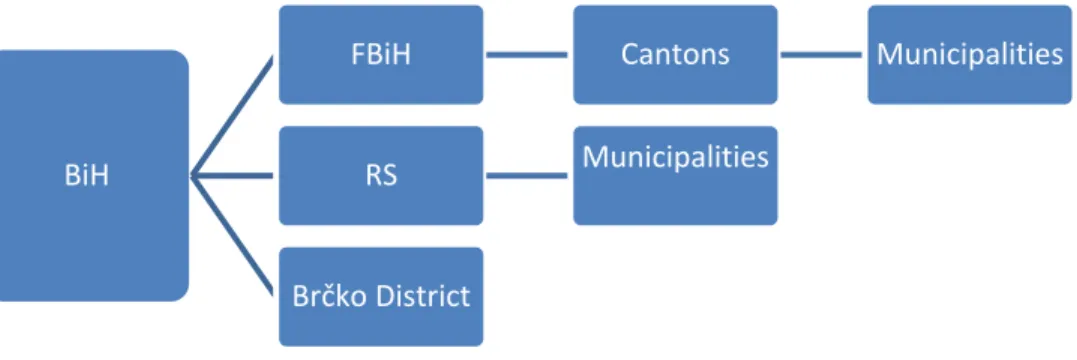
Figure 1: Decentralization in BiH ... 18
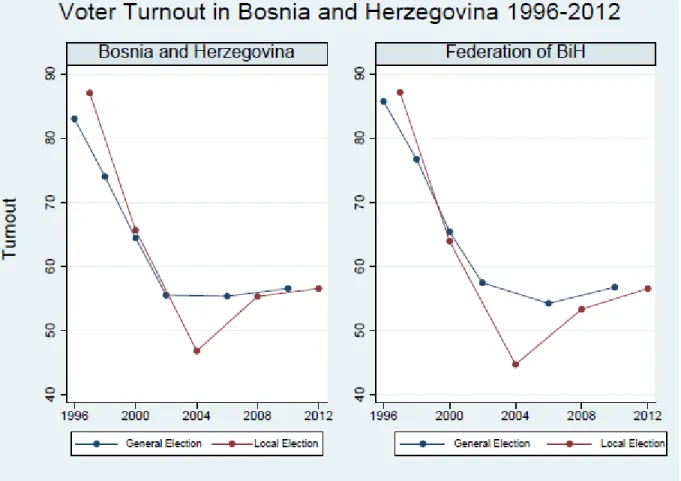
Figure 2: Voter Turnout in BIH ... 21
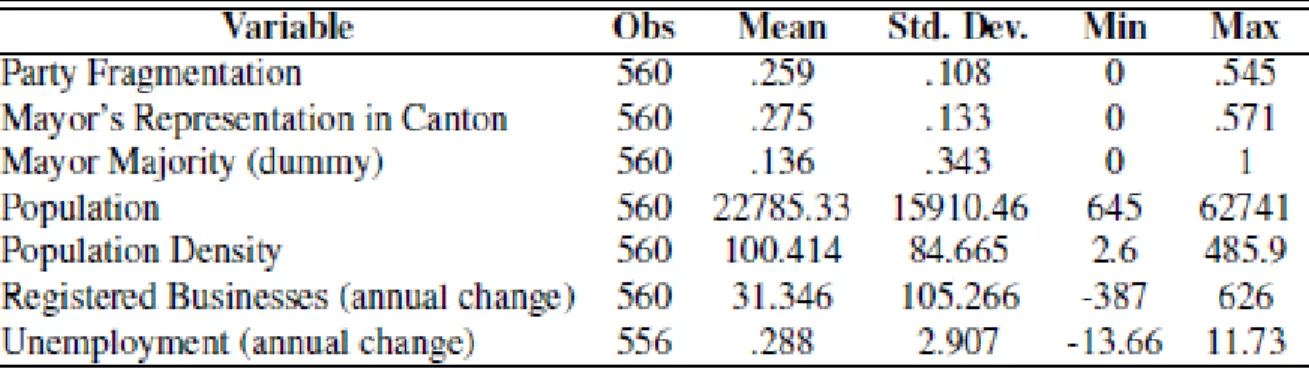
Table 1: Summary Statistics..………29
1
INTRODUCTION
There is broad theoretical consensus that democracy makes leaders more accountable to
the interests of ordinary citizens by expanding political competition. When citizens elect their
leaders, politicians should respond by improving societal well-being rather than merely serving
elite interests if they want to stay in power. Yet from the post-communist to the post-colonial
world, this premise does not seem to reflect the reality of many young democracies. While
democracy may provide some intrinsically important benefits on paper such as human rights and
freedoms, this has not meant that general well-being has necessarily improved. In countries as
diverse as Thailand, Ukraine, and Venezuela citizens are revolting against democratically elected
leaders in the name of poor socio-economic conditions and rampant corruption. But why have
these young democratic governments failed to substantially alleviate poverty, reduce inequality,
and curtail corruption? Why hasn’t democracy resulted in better socio-economic development?
In this paper, I attempt to unravel the disjoint between contemporary political economy
theories linking democracy to human development, and the empirical realities faced in many
young democracies. I argue that in order to understand variations in human development, we
need to broaden our scope beyond a preoccupation with electoral competition and also
incorporate other incentives and strategies that politicians use to retain power and control
resources in their polities. I first argue that political participation is essential for deepening
democratic accountability relations between citizens and elected politicians. However, many
influential works have overlooked participation when discussing the importance of political
2
with human development. If citizens are not politically engaged, then politicians have more
leeway to avoid addressing issues of mass concern such as redistribution, public goods
provisioning, and poverty reduction because they need to please fewer people in order to win
elections.
That manipulation of democratic mechanisms of accountability would be easier in young
democracies is due to their general inexperience with representative institutions, weak rule of
law, and nascent civil societies. Furthermore, if political parties are unable make credible
promises on broad policy agendas—as is often the case in transitioning countries—this creates
an enabling environment for political leaders to subvert democratic accountability to citizens in
favor of partisan accountability. In other words, politicians have greater incentives to comply with the interests of party leaders, since these leaders control party lists and funnel financial
resources as rewards for loyalty to party interests. Weak citizen participation also enables
politicians to maintain accountability to their elite party networks and cater to economically and
politically powerful constituencies rather than ordinary citizens.
The ways in which politicians suppress participation and mechanisms of accountability is
certainly an important question to be answered. However, my paper instead focuses on
understanding the consequences of low participation and imperfect electoral competition. I argue that in low participatory environments, socio-economic development is not driven by the
interests of the broader citizenry as democratic theory tells us, but rather by the interests of political party networks. Therefore we should expect variations in development to correspond to political configurations that alter the ability of politicians and their parties to maximize rents and
3
The political dynamics that I hypothesize to facilitate or hinder socio-economic
development may at first appear counter-intuitive, as they contradict existing theories from the
comparative politics literature. I argue that by changing scope conditions from a context of
programmatic party competition and adequate citizen participation to one of low citizen
engagement and weak programmatic platforms, prescriptions that emphasize the intensification
of electoral competition as a means to constrain rent-seeking and improve linkage between
citizens and elected officials do not hold. For example, contrary to Hellman (1998) and
Vachudova (2005), I argue that the inclusion of more political actors in decision-making and the
alternation of power between parties do not necessarily improve accountability relations.
By contrast, following the logic of partisan accountability, I argue that certain political
configurations may have a positive effect on local development in young democracies with
substantially imperfect democratic competition. I hypothesize that vertical, intra-party alliances
between local and regional governments give mayors better access to additional resources via
co-party members who control higher levels of government. While some of this money may be
diverted into the coffers of rent-seeking politicians, some of it may also ostensibly be invested
into the community in order for mayors to garner votes come election time. This is especially
true when greater economic development actually increases the amount of budgetary resources
that party members can redistribute among themselves and the public, thus perpetuating the
investment cycle in corruption and public goods provision. Horizontal, inter-party diversity in
decision-making bodies, by contrast, may increase collective action problems between
politicians, leading to sub-optimal decision-making, and thus inhibit the provisioning of public
goods and pro-development policies. My second hypothesis is therefore is that greater political
4
I investigate this process at the local level in Bosnia and Herzegovina (hereafter: BiH or
Bosnia). Bosnia is an excellent testing ground for my analysis since it began its transition to
democracy in 1995. Despite generally poor human development performance at the aggregate
national level, we find a great deal of variation in development outcomes amongst the 144
municipalities. Yet, importantly, this variation in development occurs in an environment of
dwindling political participation and a multiplicity of electorally competitive parties that are
devoid of broad programmatic stances. In addition, BiH has a highly decentralized administrative
structure that allows us to measure the effects of party networks at local and regional levels. I
find preliminary evidence that suggests that vertical, intra-party relations between mayors and
cantonal governments improve the local business environment, while inter-political party
5
1. POLITICAL PARTICIPATION: THE MISSING LINK
Mainstream social science theories have traditionally held that democracy improves
development by expanding political competition. In the comparative political economy literature,
the most commonly cited theoretical explanation is attributed to Bueno de Mesquita’s model
from 2003. According to this view, democracy disperses political power from a small ruling
class to the general population as a result of universal suffrage. Politicians therefore need to cater
to a larger constituency—particularly poorer socio-economic strata of the population—in order
to get elected over other competitors. This allegedly makes politicians more responsive to “bread
and butter” issues of mass concern such as poverty, human development, and public goods
(Siegle et al. 2004; Gerring et al. 2012).
Yet there continues to be a lack of empirical consensus over the matter. While several
prominent scholars such as Lake and Baum (2001) and Deacon (2009) have linked electoral
competition to greater public goods provisioning and a reduction in rent-seeking behavior, others
including Przeworski et al. (2001) find that although development sustains democracy, regime
type does not have an impact on economic growth. Furthermore, Tavares and Wacziarg (2001)
claim that despite the fact that democracy gives greater weight to the poor in decision-making
and reduces inequality, this effect is not robust enough to counteract an overall negative effect
that the lack of physical capital accumulation (because of higher wages) has on economic
growth.
One could argue that the lack of consensus is due to methodological imprecision since
these cross-national studies must inherently rely on crude measurements for regime type, deal
6
effects completely into account in their sophisticated statistical models. Yet, I maintain that the
reason there is no definitive answer after more than half a century of investigation into the
relationship between democracy and development stems from a more fundamental oversight
common to most of these studies. That is, by operationalizing democracy in terms of the
openness of political competition, scholars assume that there will be enough political
participation to hold politicians accountable to the interests of citizens. Dahl’s definition of
polyarchy, for example, directly assumes that the set of rights that democratic systems grant to their citizens, gives the latter the opportunity to formulate preferences, assert their demands to
other citizens and to their governments, and have their voice weighted equally without
discrimination. This process implies that political elites will be accountable to the public.
Participation is therefore at least implicitly viewed as a constant present in most democratic
contexts, even though few empirical studies have tested whether democracy implies high rates of
participation.
Nevertheless, some arguments relax this assumption and seek to further specify the
relationship between participation and democracy. O’Donnell points out that civil and political
rights are not sufficient on their own to guarantee fairness of the political system. Similarly,
according to Sen’s capabilities theory, agency, which results in the formulations of demands for
pro-poor, redistributive policies, depends not only on the existence of legal rights, but also on the
institutional arrangements that support them, the way they function in practice, and the public’s
involvement with these institutions (Sen and Drèze 2002). For example, Pateman (1970)
maintains that participation improves accountability relations by providing citizens with requisite
democratic skills, as well as a feeling of efficacy, which justifies participating in politics. Her
7
natural experiment in Mexico demonstrates how civic engagement in local decision-making via
traditional forms of governance does in fact improve the provisioning of public goods.
Moon and Dixon (1985), however, are less optimistic. They argue that while democracy
is likely to indirectly increase the physical well-being of their citizens, it cannot be a force for
redistribution if this agenda goes against the will of politically dominant classes. More recent
studies have confirmed this conclusion, acknowledging that instead of leading to more
egalitarian policies, democracy may serve to entrench pre-existing socio-economic hierarchies
because the lower classes are frequently unable to overcome collective action problems and
mobilize politically (Keefer 2013, Huber and Stephens 2012) or often lack the political capital to
hold elites accountable, which prevents public policies from adopting a clearly pro-poor focus
(Ross 2006, Tsai 2006, O’Donnell 2010).
A comprehensive empirical examination of the reasons for low political participation in
young democracies would certainly be of value in itself. However, due to the scope of this paper
I view low citizen participation as an aggravating condition that undermines democratic political
competition and enables political parties to undermine responsiveness to citizen interests and the
adoption of pro-development policies. In the following sections, I focus on the features of
political parties that contribute to variations in development outcomes under the backdrop of
8
2. PATHOLOGIES OF POLITICAL PARTIES IN YOUNG DEMOCRACIES
Several scholars have emphasized that the type of linkage between political parties and
citizens may affect accountability relations. In order to clarify the issue in the context of young
democracies, we need to evaluate party competition through the lens of credible commitment
problems. According to Keefer (2007), differences between policy outcomes between older and
younger democracies are due to the problem that in many young democracies, political parties
are not able to commit to broad policy agendas. Furthermore, Keefer and Vlaicu (2008)
demonstrate that authoritarian legacies in which parties were not organized to respond to the
broad interests of citizens may contribute to the lack of credible commitment. This leads political
actors to instead target narrow groups of constituents through direct vote-buying or patrons since
it is too costly to reach the entire electorate. If the electoral costs of corruption and rent-seeking
are low—particularly when citizen engagement in politics is low—this results in more targeted
goods, rent-seeking, and fewer public goods (Keefer 2007). In this way, the lack of broad
political credibility skews competition and responsiveness to citizens, which therefore
diminishes the importance of electoral competition as the driving force behind socio-economic
development in young democracies.
The case of Eastern Europe is illustrative in this regard. For example, Innes (2014) argues
that patterns of party competition are more important than institutional pluralism of competition.
She contrasts “representative competition” in which politicians commit to democracy from the
outset, with “corporate brokerage party systems” in which parties broker the relationship of the
state and private sector for personal gain, engaging only enough in representative politics to
9
which state capture, or systemic rent-seeking, “goes hand in hand with state formation” and
argues that party competition can constrain systematic rent-seeking and reduce state capture
“when voters are both responsive and available” (p. 668).
The lack of programmatic parties capable of credibly committing to broad public policy
agendas and low citizen participation therefore suggest a deeply flawed competitive
environment. Despite these pathologies, however, the strength of political competition has most
often been analyzed in terms of political party inclusion and pluralism: the number of parties,
alternation, ideological distance, and margin of victory (e.g. Vachudova 2005, Frye 2002, Ceka
2013). According to many scholars, opening up competition should reduce corruption and
improve accountability to citizens because the need to win votes drives political elites to promote
societal well-being. For example, Hellman (1998) argues that the incorporation of more political
actors and broad-coalitions constrain rent-seeking elites who hold up economic reforms.
Similarly, Vachudova (2005) argues that political turnover and a strong opposition create
incentives for elites to respond to broad citizen interests if they want to remain in power.
However, these theories do not take into account that if rent-seeking and other forms of
corruption are endemic, the inclusion of more political actors may not constrain such
opportunistic practices. In addition, opposition parties may become co-opted if they cannot resist
joining the rent-seeking bandwagon.
Furthermore, low participation and rent-seeking might reinforce each other, even in the
face of strong political party competition. For example, Ceka (2013) argues that intense party
competition in post-communist countries in Eastern Europe during the 1990s actually fueled
distrust and low participation as it exposed corruption and created an image of political parties as
10
may also enhance accountability problems despite party pluralism and turnover. In particular,
Kunicova and Rose-Ackerman (2005) find that proportional systems are more prone to
corruption than plurality systems because party lists empower party leaders over candidates (also
see: Persson and Tabellini 2000, Chapter 9). Alternation of power is also less clear in PR
systems as the number of coalition partners in government increase, thereby reducing voter-party
accountability. Finally, these scholars hold that opposition parties have fewer monitoring
incentives if there is a likelihood that they will need to form coalitions.
In sum, it is misleading to equate political competition with the existence of political
party pluralism and the alternation of power through elections, because it ignores other political
aspects of competition that might lead to a deeply flawed democratic system. In particular, the
lack of programmatic parties that are capable of committing to broad public policies and low
participation undermine party competition and reduce democratic accountability between
11
3. CONSEQUENCES OF IMPERFECT POLITICAL COMPETITION
The crux of my paper is to understand the causes of variations in socio-economic
development in imperfect competitive environments, namely, once the assumptions of credible
commitment and adequate citizen participation are removed. I argue that we must fundamentally
change our understanding of how the politics of development work in many young democracies
with these imperfect conditions of electoral competition. I claim that this is because in such
contexts, development is not driven by an increased responsiveness to citizens as we would
expect in a functioning democracy, but instead by the relations between politicians and their
party networks in their quest for re-election and control over resources.
I explain the counter-intuitive nature of my argument in terms of Lipsey and Lancaster’s
general theory of second best (1956), which states that when one of the conditions needed for
Pareto optimality is not met, then the other conditions may no longer be desirable. Applying this
theory to contexts in which there is weak linkage between citizens and parties, this would mean
that other democratic attributes—such as open political competition between many parties, broad
coalitions, and the threat of turnover—may not control rent-seeking nor improve development. I
argue that in low linkage environments, political responsiveness becomes skewed towards
partisan networks rather than to citizen interests, which I refer to this as partisan accountability. Partisan accountability reduces the political incentives to improve citizen welfare in favor of
loyalty to party interests, since party leaders reward loyal candidates with career opportunities
and monetary resources. As a result, lower level politicians become passive to the interests of
party leaders, which then trump citizen welfare. At the same time, the absence of programmatic
12
individual reputations rather than policy platforms. Politicians may therefore provide targeted
goods in order to win just enough votes for re-election, which serves as an effective electoral
strategy in the absence of credible programmatic parties.
In the following section, I elaborate on the concept of partisan accountability and use the
underlying logic to explain how three distinct types of partisan constellations affect human
development at the local level in such imperfect democratic contexts. I argue that vertical,
intra-party relationships in which members of the same intra-party are situated at different levels of
governance may be beneficial for economic development if improvements in the economic
environment provide party networks with additional monetary resources to expropriate. By
contrast, I argue that horizontal, inter-party relationships—in which there is a high degree of
political party diversity in decision-making bodies—would lead to a situation of political
fragmentation in which political consensus for pro-development policies is more difficult to
13
4. A THEORY OF PARTISAN ACCOUNTABILITY
According to partisan exchange theory in American politics literature, parties allocate
distributive benefits in order to encourage loyalty. For example in one recent study, Cann and
Sidman (2011) find that both Republicans and Democrats reward loyal partisan behavior through
direct payment outlays, federal funding, and pork barrel projects that benefit members’ districts
and chances for re-election. In this way, vertical relationships resolve collective action problems
related to voting unity by rewarding lower level politicians with increased access to funds via
co-party members at higher levels of government. If this is a widespread practice in established
democracies with a highly developed rule of law, then one could only imagine the extensiveness
of such a practice in young democracies with more limited institutional checks and less public
scrutiny.
Under this backdrop, I argue that political institutions do matter for citizen well-being in
young democracies with imperfect political competition, but the mechanism functions more akin
to what has been observed in authoritarian regimes in which there is strong partisan
accountability that overrides responsiveness to broad citizen interests. For example, Landry
(2008) claims that the Chinese Communist Party’s tightly disciplined appointment and
promotion procedures for government officials has fostered stability of the political regime, even
under conditions of decentralization. Similarly, Reuter and Robertson (2012) provide evidence
that loyalty of subnational appointees in electoral authoritarian regimes such as Russia—
exhibited by producing large margins of victory in elections for the ruling party—has been a
much more salient indicator of performance for party leaders than competency (operationalized
14
party control over regime change may stunt the development of rule of law and delay
democratization. In this vein, she provides evidence which starkly contrasts the more successful
democratization trajectories of Central East European countries compared to their Balkan
neighbors.
Partisan accountability centers around two key incentives: party leaders reward
politicians with career prospects and financial resources. In exchange, politicians remain loyal to
the interests of their parties, thus resolving collective action problems. Consequently, in
multi-party settings, political parties compete over the expropriation of public resources and attempt to
hurt other parties in this zero-sum game. Since politicians depend on party leaders to include
them in party lists and to funnel them with monetary resources, politicians tacitly comply with
party interests, even though this may contradict citizen welfare. More explicitly, the consequence
of strong partisan accountability is that citizen welfare is desirable only to the extent that it
improves the utility of parties to maximize their control of resources.
Therefore, in young democracies with low linkage between citizens and politicians, I
argue that partisan accountability serves as the mechanism which explains why certain political
configurations may improve economic development, while other configurations may hinder it.
First, I argue that intra-party accountability between lower and higher levels of governments
would be most influential for improving socio-economic development at the local level because
it would increase budgetary revenues that come from business and income taxes, licenses, fines,
etc. while simultaneously decreasing social welfare benefits needed to be spent on unemployed
and poor residents. These additional budgetary resources could be used to expand the coffers of
mayors and higher level party members who control electoral lists, while some of it could be
15
improve a mayor’s chances for re-election. The second scenario that appears advantageous
would be if one party were dominant in both local executive and legislative bodies. Greater party
monopoly over decision-making bodies would decrease collective action problems since co-party
members would have the same incentives to remain loyal to the executive (i.e. mayor) and party
members at higher levels. Majority status would increase a mayor’s control over budget
allocation and policies would give mayor ability to influence development and reap greater
monetary and electoral benefits.
Finally, I present a third scenario in which greater inclusion of competing parties in
legislative bodies would lead to fragmented decision-making and hinder development outcomes.
Using the logic of partisan accountability, this scenario contradicts Hellman’s prescriptions of
greater inclusion of diverse political actors. Instead, I argue party diversity would increase
collective action problems in decision-making bodies, since representatives of different parties
compete with each other over resources and do not have incentives to cooperate. We would
expect to see more deadlock, pork, log-rolling, and generally more inefficient and suboptimal
policy outcomes. My argument also finds support from Roubini and Sachs 1989, Alesina and
Perotti 1994 who find that greater number of parties in government are associated with higher
public spending and deficits because there is a lack of political consensus which leads to
deadlock. Likewise, Balassone and Giordano (1999) find that deficit spending increases when
there is greater preference polarization between parties and when bargaining power is more
evenly dispersed among coalition partners. I go further and also argue that in local politics,
inter-party fragmentation should hurt socio-economic development since improvements in community
16
of other party members in municipal councils who might benefit politically from mayoral
failures.
In young democracies with imperfect political competition, we therefore find a perverse
situation in which we should expect economic development to improve if it directly benefits
party interests as opposed to merely benefiting citizens. This discussion leads to three
hypotheses:
H1: Greater representation of the mayor’s party in the cantonal legislature should have a positive impact on human development.
H2: Majority status of mayor’s party in municipal councils should have a positive impact on human development.
17
5. CASE SELECTION AND BACKGROUND
I evaluate these hypotheses in the context of a young democracy, Bosnia and
Herzegovina. Bosnia began its transition to democracy as a result of an internationally-brokered
peace settlement in 1995, known as the Dayton Peace Agreement (DPA), which established the
current Bosnian Constitution as one of its annexes. Prior to this, BiH had no experience with
representative democracy.
The Constitution of BiH institutionalized a decentralized, ethno-federal administrative
structure consisting of two roughly equal territorial units called entities: the Federation of BiH
(FBiH) and Republika Srpska (RS), and a small, multi-ethnic territory of equal status called
Brčko District. The Federation is overwhelmingly populated by two ethno-religious groups—
Bosnian Muslims (also referred to as “Bosniaks”) and Croats, while the Republika Srpska is
mainly populated by Serbs. The Federation is then divided into ten cantons that comprise an
additional layer of governance; below the cantonal level there are 79 municipalities. The RS has
a more centralized structure in which municipalities are the only administrative units below the
18
Figure 1: Decentralization in BiH
Due to the consociational, ethnic power-sharing structure that was institutionalized by the
DPA, the political landscape in BiH consists of a multiplicity of political parties that mostly form
around ethnic cleavages. However, political competition occurs mainly between parties with the
same ethnic affiliation rather than between parties representing different ethnic groups. The
reasons underlying the intra-ethnic arena of competition can be traced to rigid ethnic quotas in
governmental bodies, the high degree of constitutional powers which Bosnia’s two entities enjoy,
plus major demographic shifts after 1995 which have led to increasing ethnic segregation.1
Underneath the nationalist rhetoric of most political parties, which aims at mobilizing
constituents from respective ethnic groups, no party in BiH can be said to espouse a concrete
programmatic agenda, nor do they attempt to make credible commitments on broad policy areas
apart from ethnic fear-mongering. This lack of credible commitment, the proliferation of political
parties, and general instability of the party system has led to a personalization of politics,
1
Executive and legislative bodies adhere to strict ethnic quotas at the state and entity levels. For example, the Presidency of BiH consists of three members in order to accommodate Bosniak, Croat, and Serb ethnic groups. In this way, political parties that represent different ethnic groups most often do not compete for the same elected positions, which is why party competition mainly falls within an ethnic block rather than between ethnic blocks. See: Annex 4 of the General Framework Agreement for Peace in Bosnia and Herzegovina, and Constitutions of the RS and Federation of BiH, available at http://www.ohr.int/ohr-dept/legal/const/).
BiH
FBiH Cantons Municipalities
RS Municipalities
19
particularly at the local level, in which citizens vote on “common sense” such as ethnicity or the
reputation of an individual candidate.2
The lack of political party development in BiH can also be traced to authoritarian legacies
that the country inherited as a formal republic of the former Yugoslavia from 1946 until BiH’s
declaration of independence in 1992. This administrative status gave political elites in BiH
substantial experience with decentralized authoritarianism. As Landry (2008) details in his work,
Yugoslavia was a unique case, having by far the highest degree of fiscal decentralization of any
authoritarian regime.3 This legacy may also help explain why partisan accountability remains so
strong despite BiH’s almost 18 years of experimentation with democracy. It may also put into
perspective the high degree to which municipal governments are dependent on cantonal and
entity level governments for fiscal transfers, and why several competencies and tax generating
activities are shared amongst different levels of government, with municipal governments
receiving small portions.4
In 2006, municipal governments were formally strengthened through local
self-government laws in both entities, as well as in Brčko District. This move delegated specific
developmental competencies to municipal units, such as infrastructure, zoning, local economic
policies, and public financing through taxes and other means (See: Law on the Principles of
Local Self-Government in the Federation of Bosnia and Herzegovina 2006 and Law on Local
Self-Governance (RS) 2006). However, this has led to a considerable amount of confusion of
2
For a discussion, see Zloklapa (2009).
3
The mean share of subnational expenditures in Yugoslavia was 74.86% from 1977 to 1990 compared to the next largest rate of 54.90% in China from 1958 to 2002 (Landry 2008, p.7).
4
20
competencies between different levels of government, as well as a general disdain among
citizens to interact with local-level government institutions (Stojanović and Bajrović 2008,
McNeil et al. 2009). Criticisms of municipal governments for their lack of transparency,
corruption, poorly trained staff, and poor service delivery have led the public to view them as
insufficiently equipped and disinterested in addressing the needs of their communities. For
example, a World Bank study from 2009 found that the public is poorly informed even about
basic functions and activities of municipal governments “with only 20 percent…actually willing
to participate in local government;” while 70 percent “believe local government decisions never
or almost never reflect their priorities,” and two-thirds felt that “local government’s decisions are
driven by political party interests” (McNeil et al. 2009, p.74). In another survey, 85% of BiH
citizens view local politicians as representing party, personal interests, or interests of important
individuals rather than the interests of the community (Zaklopa 2009, p.64).
In Figure 2, I present voter turnout in local and general elections, which is the number of
registered voters who actually voted. Although we can see a sharp decline over time, these
numbers overestimate meaningful political participation and should be interpreted with caution,
since the practice of vote-buying is widespread throughout the country.5
5 See for example: “Buying votes for prosperity: Lijanović shared three million marks earmarked for agriculture
21
Figure 2: Voter Turnout in BIH
The widely shared belief that policies reflect the interests of political parties and
politicians rather than the needs of citizens, may explain why most citizens disdain from
participating in the political sphere.6 Yet the lack of an informed and engaged citizenry has also
given politicians more leeway to expropriate wealth, since monitoring and sanctioning practices
by civil society are limited. As a result, most citizens believe that mayors, who personify
6
22
municipal governments, are more powerful than the pressures of partisan accountability allow
them to be (Zaklopa 2009).
Indeed, this perception of mayors has been reinforced with introduction of
first-past-the-post mayoral elections in 2009, while municipal council members continue to be elected on a
proportional basis through open lists. Direct elections make the individual reputation of mayors
particularly important7 and provide an electoral incentive for mayors to invest in community
development since a small number of votes often make the difference between winning and
losing reelection. Yet this also intensifies the dilemma between electoral and partisan
accountability, since mayors remain subject to party lists and must therefore maintain the
confidence of their parties in the same manner as politicians who are elected via PR lists.
To reiterate, my hypotheses follow the logic of partisan accountability in which lower
level politicians (mayors, municipal council members) are loyal to party leaders. The incentives
revolve around party leaders’ control of political candidacy through party lists and rewards such
as rents and fiscal transfers from higher levels of governments. My first hypothesis is that
representation of a mayor’s party in cantonal governments will improve local economic
development for the following reasons: (1) It increases the wealth of municipal and cantonal
budgets due to income taxes and revenues from local businesses as well as decreasing social
welfare expenditures; (2) Partisan loyalty provide additional financial resources from the
cantonal government which can also be used in capital expenditures and investments in service
delivery to improve the electoral chances of the mayor; (3) These investments will often involve
7
23
public utility companies (which are managed by municipal governments in FBiH) or
construction companies, which are excellent means to disguise corruption and rent-seeking
through public contracts (Zlokapa 2009).
Second, when the mayor’s party has a majority in the municipal council, council
members would display loyalty to the mayor and canton according to the logic of partisan
accountability. This would give the mayor’s party increased control over budgetary allocations
and allow him to increase his influence on economic development. Third, I hypothesize that the
inclusion of many parties in municipal councils would lead to a lack of political cohesion and
fragmented decision-making and blockage, since parties vie with each other for the control of
resources. Because municipal council members and the parties they represent compete for the
mayoral position, in fragmented contexts they would also attempt to block service delivery and
24
6. DATA AND OPERATIONALIZATION OF VARIABLES Sample
My sample consists of 70 municipalities in the Federation of BiH, which corresponds to
slightly less than half of the total 144 municipalities in the country. By limiting my sample to
municipal units in the Federation, I compare subnational units which contain identical
institutional structures to one another. I exclude nine municipalities in the Federation that belong
to cities, or are municipalities that have an atypical business environment.8 There are two reasons
for this: (1) formally recognized cities have an additional layer of governance (city councils and
a mayor of the city); (2) I suspect that relationships between political parties and development
undergo different processes in the largest cities of the Federation because international donors
and the entity government tend to be much more active in these areas. This privileged status
means that development and governance projects are implemented at a much higher rate in cities
than in smaller, less urbanized municipalities.
More generally, a cross-municipal analysis within one country allows me to
automatically control for country-specific factors. It also allows me to collect fine-grain data and
move my analysis as close as possible to the process under investigation, namely, the effects of
various political relationships amongst local and cantonal elites on socio-economic development
at the municipal level. My reasoning behind a comparative municipal level analysis is that it will
8
25
enable me to better understand the causal mechanisms at work and to apply the most salient
variables that could eventually be applied to a wider universe of cases. By contrast, large-N,
cross-national comparisons would not enable me to fully understand which intermediary
mechanisms are directly or indirectly causing variations in the dependent variable, and whether
they are the same across countries.
Although I have presented several advantages for my empirical analysis, there also exist
limitations. For example, despite my attempts to control for structural factors, it is possible that
the observed governance linkages may be specific to Bosnia and not generalizable. It is also
possible that restricting my empirical agenda to the municipal level (and narrowly to the cantonal
level when looking at vertical relationships) may exclude other relevant linkages at the cantonal,
entity, or state level.
Dependent Variables
I incorporate two dependent variables as indicators of economic development: annual
changes in unemployment rates and the number of locally registered businesses. These variables
comport to an explicit competence of local governments; namely, “the realization of services for
economic growth and job creation” (Law on the Principles of Local Self-Government in the
Federation of Bosnia and Herzegovina 2006, 2).
Rates of unemployment are measured as the percentage of unemployed people (job
seekers who are registered in the official employment services) in the total active labor force. I
calculate the difference in percentage points between consecutive years using data from 2004
through 2012. While unemployment is one of the most accessible measures of development, it is
26
on development, since there are several confounding factors that may also affect unemployment
rates.
The second dependent variable, annual change in the number of registered businesses,
contains two substantive features. First, it indicates the overall economic vibrancy of a
community, including entrepreneurship and the degree of economic competition. In addition, the
ability to register a business also implies that the party registering a business has achieved a basic
floor of human development required that enable the individual(s) to invest into a new business.
Second, this variable is also indicative of the complexity and transparency of business
registration and licensing procedures. In this sense, it also indicates the ease of doing business in
a community and the degree of corruption. That is, if licensing procedures are complex or
opaque, then one would need to resort to bribes and clientelistic relationships with bureaucrats
and politicians in order obtain business permits.
Politicians also have incentives to improve the business environment and to reduce
unemployment. This is because official unemployment accounts for the number of employees
who do not pay income taxes and whom are eligible for social benefits, so that a greater number
of businesses and lower unemployment would translate into greater public revenue in the form of
income tax, business taxes and fines, and fewer social benefits that would need to come out of
municipal and cantonal budgets. For example, value added tax (VAT) is directed to the state
level government where a board consisting of three ministers of finance and three experts meet
every few months to decide how to allocate the funds to the two entities, with entity governments
allocating the funds at their own discretion (Indirect Taxation Authority of Bosnia and
Herzegovina, 2008). Second, business registration fees, licenses and taxes involve entity,
27
politicians at all levels of government have incentives to encourage new businesses since this
would increase the size of their financial resources.9
Business registration in BiH is divided into three sectors: legal entities, parts of legal
entities, and crafts. Legal entities are considered to be legally owned and registered businesses,
while “parts of legal entities” include “organizational units in the business entity’s structure
(workshops, storages, offices, depots, etc.) situated on a geographically defined place (site)”
(FBiH Statistical Yearbook 2011, 45). “Crafts” refer to individually owned businesses that deal
with natural resources or artisanal products (FBiH Statistical Yearbook 2011, 45). For my
project, I calculate the total number of registered legal entities and crafts for the years
2004-2012.
Raw data for both dependent variables comes from the Federal Institute of Statistics, an
official government agency that annually compiles socio-economic and demographic data at the
municipal level. I measure my dependent variables as annual change so that this variable
corresponds to improvements over time rather than aggregate unemployment levels. This allows
me to make comparisons across municipalities regardless of a municipality’s starting point.
Independent Variables and Controls
I test three independent variables of interest. The first is an indicator of political party
fragmentation at the municipal level, which I measure as the number of political parties in the
municipal council divided by the total number of seats in the council. In other words, small
values close to zero indicate greater party homogeneity (i.e. one political party controls all seats
9
28
in the council), whereas a value of 1 would indicate complete fragmentation (each party controls
only one seat in the council). I expect inter-party fragmentation to be associated with worse
human development and unity to correspond to better human development outcomes.
The second independent variable that I incorporate corresponds to veto players in
municipal councils, namely whether the mayor’s party has a majority of seats in municipal
council. I code this as a dummy variable where 1 refers to the mayor’s party controlling 60% of
the seats in the municipal council. I choose this threshold since decisions are passed by
two-thirds majority, and I reason that it is likely for the mayor’s party to pick up a few additional
votes from municipal councilors to pass legislation.
I operationalize vertical, intra-party relationships (H1) as the proportion of seats that the
mayor’s party has in the cantonal legislature. Values of zero indicate that the mayor’s party has
no representation at the cantonal level, while values of one would indicate that the mayor’s party
is the only party in the cantonal legislature. I coded and compiled all independent variables from
official election results confirmed by the Central Election Commission of BiH. Municipal
elections took place in 2004 and 2008 while cantonal elections took place in 2002, 2006, and
2010. Since all elections take place in October, I lag these variables by one year to comport to
the years of interest (e.g. for the year 2008 I use municipal election data from 2004 and cantonal
election data from 2006). My reasoning is that it would take one year for politicians to exert
influence on policies and development. However, one of the limitations of my independent
variables is that I am not able to take post-election coalitions into account, since coalitions at the
municipal level operate at a very informal level, with information not publically available, and
29
Table 1: Summary Statistics
I employ two control variables that also come from the Federal Institute of Statistics in
BiH: population and population density. I use population as a control because municipalities that
are more populous tend to have more vibrant business environments with more opportunities for
formal employment. I therefore expect population to be correlated better economic indicators.
For the regression, I divide population by 1000 in order make the magnitude of the coefficient
estimates more easily interpretable. Taking the natural log of population is a common practice,
since the marginal effect of population on the dependent variables decreases as population
increase. However, I have omitted the largest cities from my sample, and a scatterplot reveals
there is no systematic pattern between population and the dependent variables that would justify
a log transformation.10
Population density, measured as the number of inhabitants per square kilometer, is an
indicator of urbanization in a municipality. Urban centers have an advantage over rural
10
30
communities, since compact residential settlement patterns favor a greater number of businesses,
job opportunities, services, and infrastructure connecting residents to business centers and
industrial parks. In contrast, rural areas favor the agricultural sector, which is more difficult for
municipal governments to regulate and often goes undocumented. In private business
opportunities since they are present in greater numbers.
Ethnic composition is a control variable that is currently missing from my project.
Although I do not believe that this is a principal factor driving economic development because
municipalities have become increasingly mono-ethnic, the omission in the case of an
ethno-federal country such as BiH is noticeable. The main reason for this is due to the fact that BiH did
not conduct an official census from 1991 until October 2013. The results of the census have not
been yet been released, and this also means that the indicators for population size and population
density are based on estimates by local governments, NGOs, and international organizations
31
7. EMPIRICAL DESIGN
I first ran a random effects model for 70 municipalities covering the years between 2004
and 2012. Because the dependent variable is measured as annual change, this time period
corresponds to eight observations per municipality. The reason for this timeframe is based on the
Laws of Local Self-Government that were adopted in 2006, which established clear standards
and competencies for local governments. The 2004-2005 interval therefore serves as a baseline.
In one model I regressed differences in annual unemployment percentage points on the
proportion of the number of political parties per total seats in municipal councils, mayoral party
majority, and on the proportion of seats of the mayor’s party in the cantonal legislature.11 In the
other model, I regressed the number of registered legal entities and crafts on the same
independent variables. In both random effects models I used population size and population
density as control variables.
I assumed that a random effects model (shown in the Appendix) would accommodate the
clustered nature of municipal data over eight years and distinguish between inter and
intra-municipal correlations. A Hausman test confirmed random effects model was favorable over
fixed effects model, since the test statistic is greater than 0.05. However, after running the model,
I discovered that variance of the group-level residual term turns out to be zero. This indicates
that the only unexplained variance occurs at the municipal-year level, or in other words, across
11
Since fragmentation and mayoral unity variables would seem to be inversely related, I ran a pairwise correlation between the two variables (Table 3 in the Appendix), which is only -0.26. In addition, I also ran models with only one of these variables at a time. In the business model, this did not affect the results in any significant or substantive way. However, in the unemployment model, when I excluded whether or not the mayor had a majority, party fragmentation lost statistical significance, and decreased by 1.5 percentage points. When I excluded party
32
municipalities. In other words, the explanatory power comes from variations across
municipalities rather than variations within clusters of municipalities over the eight years.
While this result was unexpected, it does make intuitive sense because both dependent
variables are being measured as differences in the number of registered businesses in consecutive
years, or differences in unemployment rates in consecutive years, rather than levels (total number
of businesses or percentage of unemployment for each year). Moving from aggregate levels to
differences between these levels in consecutive years takes away group level clustering, so that
quite literally, I have completely removed all unit differences. Therefore, a simple OLS model yields identical results. This is not problematic theoretically, since my goal is to understand
variations in human development across municipalities, not merely within a municipality over
time. In addition, measuring the dependent variable as a difference between levels in consecutive
years makes the most sense, since I am interested understanding improvements economic
development. If I chose to measure the dependent variables as levels, this would have been
misleading since I would not be taking into account the fact that municipalities have different
economic starting points. I present the equations for the two OLS models as follows:
𝑅𝑒𝑔𝑖𝑠𝑡𝑒𝑟𝑒𝑑𝐵𝑢𝑠𝑖𝑛𝑒𝑠𝑠∆ =
𝐵0 + 𝐵1(𝐹𝑟𝑎𝑔𝑚𝑒𝑛𝑡𝑎𝑡𝑖𝑜𝑛𝑖𝑡) + 𝐵2(𝑀𝑎𝑦𝑜𝑟𝑎𝑙𝑀𝑎𝑗𝑜𝑟𝑖𝑡𝑦𝑖𝑡)
+ 𝐵3(𝐶𝑎𝑛𝑡𝑜𝑛𝑎𝑙𝑅𝑒𝑝𝑟𝑒𝑠𝑒𝑛𝑡𝑎𝑡𝑖𝑜𝑛𝑖𝑡) +𝐵4(𝑃𝑜𝑝𝑢𝑙𝑎𝑡𝑖𝑜𝑛𝑖)
+𝐵5(𝑃𝑜𝑝. 𝐷𝑒𝑛𝑠𝑖𝑡𝑦𝑖𝑡) + 𝜀𝑖𝑡
𝑈𝑛𝑒𝑚𝑝𝑙𝑜𝑦𝑚𝑒𝑛𝑡∆ =
𝐵0 + 𝐵1(𝐹𝑟𝑎𝑔𝑚𝑒𝑛𝑡𝑎𝑡𝑖𝑜𝑛𝑖𝑡) + 𝐵2(𝑀𝑎𝑦𝑜𝑟𝑎𝑙𝑀𝑎𝑗𝑜𝑟𝑖𝑡𝑦𝑖𝑡+ 𝐵3(𝐶𝑎𝑛𝑡𝑜𝑛𝑎𝑙𝑅𝑒𝑝𝑟𝑒𝑠𝑒𝑛𝑡𝑎𝑡𝑖𝑜𝑛𝑖𝑡)
33
8. RESULTS AND INTERPRETATION
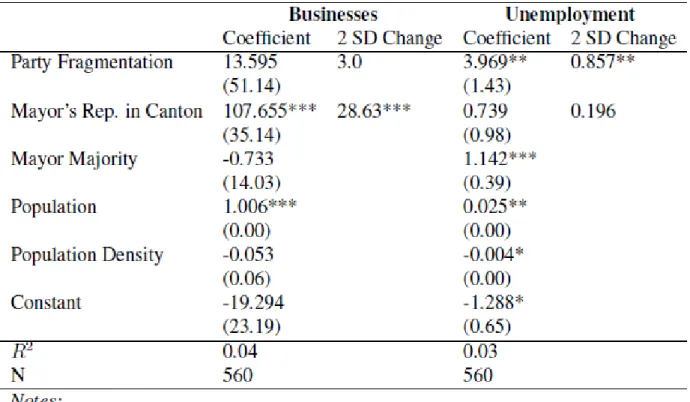
In the first model with the annual change in locally registered businesses as the dependent
variable, we see that representation of the mayor’s party in the cantonal government is
significant and in expected direction. Going from no representation (a mayor’s party has no seats
in the cantonal legislature) to full representation (mayor’s party is the only party represented in
the cantonal legislature), leads to an increase in approximately 107 registered businesses at the
municipal level. This finding is significant at the 0.005 level. However, since the range of this
variable falls between 0 and 0.571, we never actually observe a full one-unit change in my
sample. Therefore, I also provide the effect of a 2 standard deviation change to make the
coefficient estimates more interpretable.12 A two-standard deviation change in cantonal
representation of the mayor’s party is therefore associated with an increase in approximately 29
businesses. This seems to suggest that better access to material resources leads to a more
competitive business environment and entrepreneurship, while inter-party horizontal
relationships appear to have no effect on the business environment. Population size is also
significant and positively related to development, although the magnitude is very small.
Specifically, an increase of 1000 inhabitants is associated with an increase in 1 registered
business.
12
34
Table 2: OLS Regression Results
In the second model with changes in unemployment rates as the dependent variable, we
see that party fragmentation corresponds to an increase in unemployment rates. Explicitly, when
going from complete unity (one party controls all seats) to complete fragmentation (where each
seat in a municipal council are occupied by a different party), this leads to an approximately 4
percentage point increase in unemployment, and is significant at the 0.01 level. Again, since we
never observe a full unit change in our sample, I include the effect of a two standard deviation
change, which is associated with an increase of 0.86 percentage points in the unemployment rate.
The second finding in regard to the mayor’s party having a 60% majority in the municipal
council is unanticipated. Rather than improving development, when a mayor’s party has a
majority in council, this leads to an increase in unemployment by approximately 1 percentage
35
competence, a factor that has not been incorporated into either model. As Zlokapa (2009)
discusses, mayoral turnover is frequent, which attests to the political inexperience of mayors who
often pilfer budgetary resources into their pockets without providing any tangible investments
into the community (or at least giving the appearance of providing some public benefits). Second
a mayor may not be able to improve economic development without patronage at cantonal level.
The indicators used to measure local development are undoubtedly limited. While
business registration might be a satisfactory measure of economic vibrancy and corruption,
unemployment is prone to confounding factors that are not included in the models. Therefore, for
the future, I seek to incorporate more direct indicators of local development and corruption, such
as infrastructure (paved roads, residential and business construction projects, budget allocations
etc.). In addition, I would also like to incorporate additional control variables, particularly
demographic, when data from the 2013 census is released. In particular, it would be interesting to
36
CONCLUSION
In this paper, I have undertaken preliminary data analysis in order to show whether
partisan accountability matters for socio-economic development in young democracies. In the
absence of adequate electoral accountability, due to low citizen participation and the inability of
parties to credibly commit to broad policy areas, electoral accountability between politicians and
citizens remains weak. As a result, politicians behave according to the logic of partisan
accountability, in which elected officials are responsive to the interests of party leaders, who
control the distribution of electoral and monetary rewards (party lists and budgetary assets).
Politicians respond to citizen interests only to the extent that they garner enough votes to be
reelected.
Following the logic of partisan accountability, I show that particular political
configurations do matter for development; however they contradict existing theories that
emphasize party pluralism and the alternation of power as constraints on rent-seeking elites.
Instead I argue that since economic development improves budgetary resources for local
politicians and party members at higher levels of government, mayors have incentives to reduce
unemployment and encourage business growth. Additional budget revenues could be
expropriated by the mayor and counterparts at higher levels for personal or party gain, while
some of the money could be used for improved public service delivery in order for mayors to
garner enough votes to be reelected. Indeed, the results reveal that vertical, intra-party
relationships between mayors and cantonal governments in Bosnia and Herzegovina is positively
37
Second, horizontal relationships within municipal councils also appear have an effect on
economic development. Greater inclusion of parties leads to more fragmentation and less
efficient decision-making. Since parties compete with each other and try to hurt the mayor if he
is not from their party, it comes as no surprise that party fragmentation increases unemployment.
On the other hand, when the mayor’s party has a majority in the municipal council, this does not
improve economic development in contrast to my expectations.
In the future, I seek to incorporate additional indicators of development that are less
prone to confounding factors, such as physical infrastructure and budget allocations. I also plan
to include additional control variables, such as ethnic composition and institutional aspects of
good governance (e.g. transparency, bureaucratic capacity, etc.). In order to refine my
understanding of the causal mechanism, partisan accountability, I plan to further investigate the
micro-dynamics of decision-making and party networks (in particular post-election coalitions at
the local level) through in depth fieldwork. Another important area of exploration would include
relationships between politicians and business elites, which may contribute to the complex nature
of political and socio-economic development. Finally, I plan to incorporate data from the entire
geographic territory of BiH and to also incorporate cantonal and entity-level political factors into
38
APPENDIX 1: MUNICIPALITIES OF BOSNIA AND HERZEGOVINA
Source: Federal Development Development Planning Institute, Federation of BiH
Cantons in the Federation of BiH
1. Una-Sanski 2. Posavski 3. Tuzlanski
4. Zeničko-Dobojski 5. Bosansko-Podrinjski 6. Srednje Bosanski
7. Hercegovačko-Neretvanski 8. Zapadno Hercegovački 9. Sarajevo Canton 10. Herceg Bosanski
Municipalities of Sarajevo
1. Novi Grad 2. Novo Sarajevo 3. Vogošča 4. Centar 5. Stari Grad
Legend
39
40
APPENDIX 3: RANDOM EFFECTS MODEL
𝑅𝑒𝑔𝑖𝑠𝑡𝑒𝑟𝑒𝑑𝐵𝑢𝑠𝑖𝑛𝑒𝑠𝑠∆ =
𝐵0 + 𝐵1(𝐹𝑟𝑎𝑔𝑚𝑒𝑛𝑡𝑎𝑡𝑖𝑜𝑛𝑖𝑡) + 𝐵2(𝑀𝑎𝑦𝑜𝑟𝑎𝑙𝑀𝑎𝑗𝑜𝑟𝑖𝑡𝑦𝑖𝑡+ 𝐵3(𝐶𝑎𝑛𝑡𝑜𝑛𝑎𝑙𝑅𝑒𝑝𝑟𝑒𝑠𝑒𝑛𝑡𝑎𝑡𝑖𝑜𝑛𝑖𝑡)
+𝐵4(𝑃𝑜𝑝𝑢𝑙𝑎𝑡𝑖𝑜𝑛𝑖) +𝐵5(𝑃𝑜𝑝. 𝐷𝑒𝑛𝑠𝑖𝑡𝑦𝑖𝑡) + 𝑢𝑗𝑡 + 𝜀𝑖𝑡
𝑈𝑛𝑒𝑚𝑝𝑙𝑜𝑦𝑚𝑒𝑛𝑡∆ =
𝐵0 + 𝐵1(𝐹𝑟𝑎𝑔𝑚𝑒𝑛𝑡𝑎𝑡𝑖𝑜𝑛𝑖𝑡) + 𝐵2(𝑀𝑎𝑦𝑜𝑟𝑎𝑙𝑀𝑎𝑗𝑜𝑟𝑖𝑡𝑦𝑖𝑡+ 𝐵3(𝐶𝑎𝑛𝑡𝑜𝑛𝑎𝑙𝑅𝑒𝑝𝑟𝑒𝑠𝑒𝑛𝑡𝑎𝑡𝑖𝑜𝑛𝑖𝑡)
41
BIBILOGRAPHY
Alesina, Alberto and Roberto Perotti. 1994. “The Political Economy of Budget Deficits.” NBER Working Paper, no. 4637 (February).
Analitika- Center for Social Research. My Place. http://www.mojemjesto.ba/en Balassone, Fabrizio and Raffaela Giordano. 2001. “Budget Deficits and Coalition Governments.” Public Choice. 106 (3/4): 327-349.
Bueno de Mesquita, et al. 2003. The Logic of Political Survival. Cambridge: MIT Press.
Cann, Damon N. and Andrew H. Sidman. 2011. “Exchange Theory, Political Parties, and the Allocation of Federal Distributive Benefits in the House of Representatives.” Journal of Politics 73(4): 1128-1141.
Ceka, Besir. 2012. “The Perils of Political Competition: Explaining Participation and Trust in Political Parties in Eastern Europe.” Comparative Political Studies. 46(12): 1610-1635.
Central Election Commission of Bosnia and Herzegovina. “Election Results.”
http://www.izbori.ba/
Council of Europe, Congress of Local and Regional Authorities. 2006. “Local and regional democracy in Bosnia and Herzegovina.” 23 October 2006, CG(13)30 part2.
https://wcd.coe.int/
Deacon, Robert T. 2009. “Public Good Provision under Dictatorship and Democracy.”
Public Choice 139: 241–262.
Dahl, Robert. 1998. On Democracy. New Haven: Yale University Press.
———. 1971. Polyarchy: Participation and Opposition. New Haven: Yale Uni. Press. Diaz-Cayeros, Alberto, Beatriz Magaloni and Alexander Ruiz-Euler. 2013. “Traditional Governance, Citizen Engagement, and Local Public Goods: Evidence from Mexico.” World Development.
Drèze, Jean and Amartya Sen. 2002. India: Development and Participation. Oxford: Oxford University Press.
Dolenec, Danijela. 2013. Democratic Institutions and Authoritarian Rule in Southeast Europe. Colchester, UK: ECPR Press.
Federal Office of Statistics, Federation of Bosnia and Herzegovina. Statistical Yearbooks 2005-2012. Sarajevo: Federal Office of Statistics.
42
Frye, Timothy. 2002. The Perils of Polarization: Economic Performance in the Postcommunist World. World Politics 54: 308-337.
General Framework Agreement for Peace in Bosnia and Herzegovina. Office of the High Representative. 14 December 1995. http://www.ohr.int/dpa/default.asp?content_id=380
Gerring, John, Strom C. Thacker, and Rodrigo Alfaro. 2012. "Democracy and Human Development." The Journal of Politics 7(1):1-17.
Grzymala-Busse, Anna. 2008. “Beyond Clientelism: Incumbent State Capture and State Formation.” Comparative Political Studies 41(4/5): 638-673.
Hellman, Joel S. “Winners Take All: the Politics of Partial Reform in Postcommunist Transitions,” World Politics 50 (1998): 203-34.
Huber, Evelyne and John D. Stephens. 2012. Democracy and the Left: Social Policy and Inequality in Latin America. Chicago: University of Chicago.
Indirect Taxation Authority of Bosnia and Herzegovina. “Value Added Tax.” 2005-2008.
http://www.uino.gov.ba/en/Porezi/PDV/
Innes, Abby. 2014. “An Awkward Anniversary: EU Enlargement Ten Years Later.” Presented April 1, Princeton University.
Keefer, Philip. 2007. "Clientelism, Credibility, and the Policy Choices of Young Democracies." American Journal of Political Science 51(4): 804-821.
———. 2009. "Inequality, Collective Action, and Democratization." PS: Political Science and Politics 42, (4): 661-666.
———. 2013. “Organizing for Prosperity: Collective Action, Political Parties and the Political Economy of Development." The World Bank, Policy Research Working Paper Series: 6583,).
Keefer, Philip and Razvan Vlaicu. 2008. “Democracy, Credibility and Clientelism.” The Journal of Law, Economics, & Organization Vol. 24, No. 2.
Kunicova, Jana and Susan Rose-Ackerman. 2005. “Electoral Rules and Constitutional Structures as Constraints on Corruption.” British Journal of Political Science 35(4): 573-606.
Lake, D., and M. Baum. 2001. “The invisible hand of democracy.” Comparative Political Studies 34(6): 587-621.
Landry, Pierre F. 2008. Decentralized Authoritarianism in China: The Communist Party’s Control of Local Elites in the Post-Mao Era. New York: Cambridge University Press.