Sediment studies in Hungarian waters Section B-Research Paper
SEDIMENT STUDIES IN HUNGARIAN SURFACE WATERS
Erzsébet Krausz
[a]*, Judit Vallner
[b], Judit L. Halász
[a]Paper was presented at the 4th International Symposium on Trace Elements in the Food Chain, Friends or Foes, 15-17 November, 2012, Visegrád, Hungary
Keywords: sediment, epipelon, ETS-activity, water, trophity
The role of sediment and epipelon (organisms living on the surface of or in the fine-sized sediments) is significant in the life of aquatic ecosystems. The sediment is the place where the change of ion-transport occurs between the aquatic and solid phases, there are dynamic balance and buffer system between the sediment particles and the particles in the surrounding medium. As a result of the activity of the epipelon and the sediment organisms the metabolism pathways exist in the aquatic ecological systems that can indicate or influence on the habitat characteristics. Changes in the quality or quantity of epipelon indicate changes in water quality. From the point of view of nature conservation it can characterize a natural status or indicate the degree of disturbance (degradation). We measured the ETS (Electron Transport System) activity of the epipelon which gives the maximal intensity of the respiration metabolism. In the analysis of the epipelon the measuring of the ETS-activity can be used of the returns of taxonomic effects such as sublethal or physiologic damage caused by toxic poisons which cannot be discovered immediately and directly by taxonomic parameters, but the changing breath-activity can mark a changing state. ETS tests are suitable for indicating environmental stress.
* Corresponding Author
e-mail: [email protected]
[a] Institute of Environmental Sciences, College of Nyíregyháza, H-4400 Nyíregyháza, Sóstói út 31/b., Hungary,
[b] Institute of Teacher Training, College of Nyíregyháza, H-4400 Nyíregyháza, Sóstói út 31/b., Hungary.
Introduction and Theory
Sediment and epipelon play a significant role in wetlands and aquatic ecosystems. Sediment consists of three primary components: organic matter in various stages of decomposition, particulate mineral matter (including clays, carbonates and no clay silicates) and an inorganic component of biogenic origin1. Total organic carbon within
ecosystems results from autochthonus production augmented by imported allochthonous organic carbon from wetland and terrestrial sources. All of the organic carbon is not mineralized because much is deposited within low redox conditions within sediment. Most of the intense microbial respiration and fermentation is associated with the sediment2.
The organic sediments of lakes are considerably similar to the upper most A0 horizon in terrestrial soils3. The upper
layer of the sediment has a great influence on the water quality. Exchange of ions takes place on the sediment-water interface and particles of the sediment and those of the surrounding medium are constantly in a physical contact and form a dynamic equilibrium. In this process living organisms, including bacteria, play a key-role. “A conspicuous feature of microbial populations in lakes is the great increase in numbers in the transition from the overlying water to the diffuse, uncompact zone of the surfacial sediment. Bacteria increase about 3-5 orders of magnitude from the water to the surface sediments and decrease rapidly with increasing depth in the sediments. Expressed in numbers per gram dry weight of sediment, bacterial populations in the surfacial sediments can reach 6-7 orders of magnitude greater than in an equivalent weight
of overlying water. Saprophytic bacteria decrease much more rapidly than do total bacteria with increasing depth below the sediment interface, which suggests a reduction of readily assimilable organic substrates below the interface.”2
The autotrophic organisms of the epipelon produce oxygen and synthesize organic compounds by taking up inorganic plant nutrients from the soil and absorbing light energy. The organic matter produced this way is an essential food source for heterotrophic organisms of the epipelon just like for higher heterotrophic organisms such as fish4. The
activity of organisms of epipelon in aquatic ecosystems leads to activation of metabolic pathways, which can determine or greatly influence the features of a given habitat.
Electron Transport System (ETS) in organisms functions as a link between molecular oxygen and biological oxidation of organic compounds. The occurrence of ETS in aerobic organisms is universal, this way 90 % of biological oxidation in biosphere is the result of the activity of ETS5.
According to the Water Framework Directives (WFD) of EU, common principals are needed in order to coordinate Member States’ efforts to improve the protection of waters in terms of quantity and quality. Standardisation of monitoring, sampling and analysis methods is required. Common definitions of the status of water in terms of quality should be established and common water quality standards should be laid down. Aquatic ecosystems should be monitored on a systemic and comparable basis throughout the Community. It is necessary to reveal the principals lying behind the evaluation of present classification systems of water quality and there is a need for optimizing monitoring systems through developing the monitoring methods of ecological indicators and seeking for new indicators or new indicative parameters.
greater organic matter in sediments might appear obvious. A significant correlation between dehydrogenase activity and organic content of surface sediment has been found in euthrophic reservoirs. However, these correlations cannot be expected in organic-rich sediments, in which certain conditions depress the activity of microorganisms; or in sediments where much of the organic matter is chemically recalcitrant.2
From the ETS-activity value the maximal intensity of respiration can be calculated. ETS tests are used widely for measuring the metabolic activity of various prokaryotic and eukaryotic aquatic organisms. With the help of an empiric factor, the value of maximal oxygen consumption can be estimated from the ETS-activity, during field studies. Originally, ETS tests were worked out for sea-plankton6-8.
In the analysis of epipelon, measuring ETS-activity can be more informative than taxonomic studies, because taxonomic parameters cannot indicate immediately and directly sublethal physiological damage. Decreased respiration activity, in contrast, is suitable for revealing such changes. ETS tests can detect the presence of every compound that stimulates or inhibits the cytochrom system. If an ETS inhibitor is present in the surrounding water body, it can possibly get into the cytosol, and as a response to the inhibition of the specific activity of ETS multienzyme complex, the synthesis of enzymes is enhanced. Thus ETS tests are suitable for indicating environmental stress. Several studies confirmed that there is a direct connection between ETS-activity and the intensity of respiration in bacteria, phyto- and zooplankton, and sediment5, 9-15.
The ETS-activity of microbial community in sediment was affected by temperature and/or the amount and origin of the organic matter16. The negative correlations that were
found between EHI (ecosystem health index) and ETS-activity indicated a higher ETS ETS-activity at higher trophic status17. At the meantime a positive correlation between the
ETS-activity of the sediment and that of M.sppicatum and R.circinatus was also measured, while negative correlations or no correlation were observed for mosses and macroalgae16.
Looking through the literature we can agree with Simcic when saying sediment ETS-activity is a valuable source of information on the lake ecosystem, its funkcioning and its health, in combination with other indicators of information about the system17. However there are no data on how
exactly ETS-activity indicate environmental stress - see the (apparent) contradiction between: the higher ETS activity indicate higher trophic status17 and: ETS-activity is notably
higher in the eutrophic lake than in the hypertrophic lake18.
Investigating the structure and function of epipelon is of a great importance, since its structure and complexity characterises the conditions of different habitats. The aim of our study was to investigate the effect of a possible environmental stress on ETS-activity of a surface waters.
Experimental
Natural (a) and constructed (b) still waters and running waters (c) from Hungary were chosen as sampling sites (in
each year are given the number of samples, varying on sampling possibilities):
(a) lakes: Lake Velencei (2003 n=24, 2004 n=27, 2005 n=24), Balaton (2003 n=73, 2004 n=51, 2005 n=48);
(b) two reservoirs: Kis-Balaton (2003 n=45, 2004 n=51, 2005 n=51), Kisköre Reservoir (2003 n=30, 2004 n=24, 2005 n=24), wastewater pond: Nyírbogdány (2003 n=9, 2004 n=18, 2005 n=18);
(c) running waters: Kerka (2003 n=15, 2004 n=15, 2005 n=18), Tisza (2003 n=42, 2004 n=39, 2005 n=42).
Samples were taken in the summer of 2003, 2004 and 2005, due to the fact that ETS-activities are temperature-dependent16. Epipelon samples were taken with a
Hargrave-sampler from underwater, the 2-3 cm upper layer of the sediment was analysed15.
Commonly used characteristic, as dry weight content, organic matter content and chlorophyll-a concentration of the sediment samples were measured19, and ETS-activity
characteristic of biological oxidation capacity of the sediment was determined. Till measurements of ETS-activity samples were stored in a –30 ºC deep-freeze. This way the ETS-activity of the samples remains unchanged for two or three weeks20.
First we optimized the reaction circumstances (technique and time of homogenisation, separation of ETS fractions). Then we determined the saturation level of substrates (NAD, NADP and succinate) and reagent iodo-nitro-phenyl tetrazolium chloride (INT). The effect of pH, incubation time and homogenisation on formazane production was determined as well and the rate of breakdown of formazane was measured. All examinations were carried out in the laboratory, at 20 to 24ºC room temperature. Frozen epipelon samples weighed 20-80 mg (wet weight) was used for the analysis. Results were expressed in terms of absorbance or as μl/O2/g wet weight/h6.
The primary biomass production plays a central role in the algae population. Simplest approach of its determination is the measurement of chlorophyll-a in sediment per dry weight. The pigments were dissolved in boiling ethanol and quantified spectrophotometrically21.
The two main components of the sediment are water and dry matter. Drying on 105 ºC till constant mass gives the amount of dry matter. Dry matter is composed by two basic ingredients: organic matter and inorganic ash constituents. Mass of organic matter was determined as the difference between sediment dry weight of the residue (ash) after combustion on 600 ºC.
Results and discussion
Sediment studies in Hungarian waters Section B-Research Paper
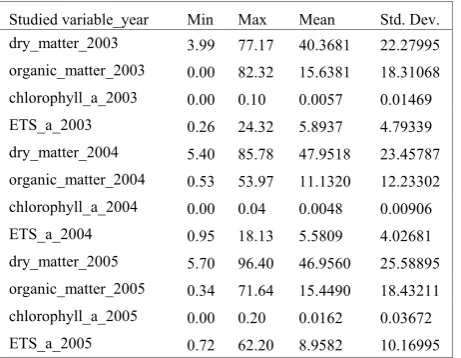
Table 1. Summary table of means and standard deviations for
measured variables in studied years.
Studied variable_year Min Max Mean Std. Dev. dry_matter_2003 3.99 77.17 40.3681 22.27995 organic_matter_2003 0.00 82.32 15.6381 18.31068 chlorophyll_a_2003 0.00 0.10 0.0057 0.01469
ETS_a_2003 0.26 24.32 5.8937 4.79339
dry_matter_2004 5.40 85.78 47.9518 23.45787 organic_matter_2004 0.53 53.97 11.1320 12.23302 chlorophyll_a_2004 0.00 0.04 0.0048 0.00906
ETS_a_2004 0.95 18.13 5.5809 4.02681
dry_matter_2005 5.70 96.40 46.9560 25.58895 organic_matter_2005 0.34 71.64 15.4490 18.43211 chlorophyll_a_2005 0.00 0.20 0.0162 0.03672
ETS_a_2005 0.72 62.20 8.9582 10.16995
The result of an Analyze of Variance (ANOVA) (Bonferroni Post Hoc Multiple Comparison) on the sampling sites shows that regarding each variable the sites differ significantly (p < 0.05, except chlorophyll-a which was found not in each year significantly different between sites). So, these commonly measured variables and ETS-activity do not duplicate each-other.
We have also tested whether running waters (Kerka, Tisza) and still waters (Lake Velencei, Balaton, Kis-Balaton, Kisköre Reservoir, wastewater pond Nyírbogdány) do differ significantly. We found that neither considering all investigated years, nor analyzing individual years there is no grouping tendency by water-type (hierarchical cluster on 3 principal components, cumulative variance above 93 %). We were given the same results testing the grouping tendency between “small” (Kerka) and “big” (Tisza) rivers: no evident differences between them were shown by the investigated variables.
We have carried out the hierarchical cluster analyzes on artificial vs. natural waters too. (Artificial: Kis-Balaton, Kisköre, Nyírbogdány; natural: Kerka, Tisza, Lake Velencei, Balaton.) Although Lake Balaton and Kisköre are forming separate groups (on 2 Eukleides Distance), the other waters do not show similar pattern, not even on 5 Eukleides Distance. This results from other present differences between waters, not the artificial vs. natural factor is crucial.
However when testing one after the other the parameters, different patterns occur. Altering sites show significant differences by measured variables and the studied year. As an example see Table 2.
These data are in strong correlation with our observations in both years about vision wastewater pollution prior to sampling (due to a foul-up of sewage-work) of Kis-Balaton (data not published). Although there is no any evidence about the mentioned pollutions, must be pay attention to this result. Calculated linear correlations (Pearson) are in concordance with our hypothesis; the changes in ETS-activity indicate disturbance in the water-life. When organic pollution appears, ETS-activity raises together with trophity (we found the same result as Muri et al.22).
Table 2. Result of an Analyze of Variance (ANOVA) (Bonferroni
Post Hoc Multiple Comparison) for dry weight, 2003. Sampling sites: Tisza (1), Lake Velencei (2), Kis-Balaton (3), Kisköre (4), Kereka (5), Balaton (6), Nyírbogdány (7).
Dry weight/2003 1 2 3 4 5 6 7
1 ** *** - - - -
2 ** - - * - -
3 *** - - *** ** -
4 - - - - -
5 - * *** - - -
6 - - ** - - -
7 - - -
Contrary in the case of ETS-activity Kis-Balaton (site 3) differed significantly from all the other sites (Table 3).
Table 3. Result of an Analyze of Variance (ANOVA) (Bonferroni Post Hoc Multiple Comparison) for ETS-activity, 2003. (Sampling sites coded as in Table 2.)
Ets/2003 1 2 3 4 5 6 7
1 - *** - - - -
2 - *** - - - -
3 *** *** *** *** *** **
4 - - *** - - -
5 - - *** - - -
6 - - *** - - -
7 - - ** - - -
The same ETS-activity significance occurred in 2005 too. The amount and origin of organic matter affects the ETS-activity of the microbial community in sediment. This is a relatively short period, and is more sensitive than taxonomic parameters would indicate an external organic matter excess (environmental stress) within a few days or weeks after pollution occurred. During the next period the living organisms are growing, preparing the conditions to the next step, when anaerobic processes start. In this period ETS-activity and chlorophyll-a are negatively correlated, because autotrophic living organisms are hindered (R = -0.22 N.S). The recovery of a still water takes time (months or years). Year 2004 shows positive correlation between ETS-activity and chlorophyll-a, but not significant (R = +0.80). By 2005 the R = +0.76 and p < 0.05 indicate the beginning of a new health period in lake’s life.
These are questioning the statement of Simcic et al.17,
whether on the whole trophity-scale is valid that higher ETS-activity belongs to a higher trophic status? The scientific literature also mentions similarly apparent contradictions. According to our results, such contradictions arises from the fact that time is not distinguished from proper organic stress which occurred in the water.
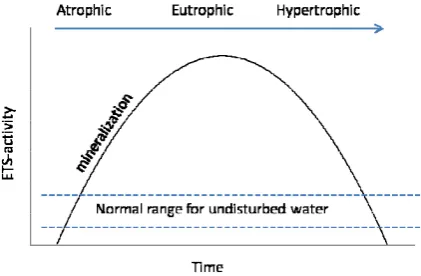
Our result may be a solution for this problem, since it describes ETS-activity as a kind of maximum curve in function of time. Our suggestion is presented on Figure 1.
For determining the ETS-activity of undisturbed water we excluded Kis-Balaton (site 3) from our calculations (mean: 5.63 μl/O2/g wet weight/h, SD: 4.66) – although there is no
Spain range: 24.99-34.9118). Therefore, we concluded that
determination of the so-called normal ETS-activity-range on a given site need long term (i.e. a few year long) monitoring of the given water, on a finer map scale.
Figure 1. Predicted ETS-activity in function of time after an
organic stress occurred in a natural water being in different trophity-stages.
Due to the fact that we could not find significant difference between artificial vs. natural waters, but the raised ETS-activity can be in correlation with organic influence of water, it is supposable that ETS-activity measurement could be used as a quick indicator of organic pollution occurrence. This preliminary study needs further investigations using published and proofed organic pollutions on different waters and well known undisturbed areas’ ETS-activity measurement, as well as the proper normal ETS-range determination (by monitoring) for Hungarian waters. After these steps we could possess a special, easy to carry and quickly signing method to find out illegal or hidden water-pollutions, earlier than taxonomic parameters would show, making possible an earlier action of environmental protection.
1. References
1Lerman, A., Lakes, E.,
Chemistry, Geology, Physics, Springer-Verlag, New York, 1978.
2Wetzel, R. , Limnology Lake and River Ecosystems, Academic
Press, San Diego, 2001, ISBN-10: 0-12-744760-1 3Hansen, K. J.,
Sediment. Petrol., 1959 29, 38.
4Lakatos, G., Kozák, L., Bíró, P.,
Verh. Internat. Verein. Limnol.
2001 27, 3893. 5Packard, T. T.,
J. Marine Res. 1971(29), 235. 6Kenner, R. A., Ahmed, S. I.,
Marine Biol. 1975(33), 119. 7Owens, T. G., King, F. D.,
Marine Biol. 1975(30), 27. 8Christensen, J. P., Pacard, T. T.,
Limnol. Ocenogr. 1979(24), 576. 9Packard, T. T.,
Adv. Aquat. Mikrobiol. 1985(3), 207. 10Packard, T. T., Denis, M., Rodier, M., Garfield, P.,
Deep-Sea Res.
1988(35), 371. 11Vosjan, J. H., Nieuwland, G
., Limnol. Oceanogr. 1987(32), 767. 12Vosjan, J. H., Tijssen, S. B., Nieuwland, G., Wetsteyn, F. J.,.
Neth. J. Sea Res. 1990,25, 89.
13Span, A. S. W.,
Water Res. 1986(20) 1497. 14Span, A. S. W.,
Arch. Hydrobiol. 1988,31, 141.
15Tóth G., Drits, A. V.,
Verh. Internat. Verein. Limnol. 199124, 993.
16Germ, M., Simcic, T.
J. Limnol., 201170, 305.
17Simcic, T., Brancelj, A.,
Fundam. Appl. Limnol., 2009 175 (4),
317.
18Vicente, I., Amores, V., Guerrero, F., Cruz-Pizarro, L.
Biomed. Life Sci. Naturwissenschaften, 2010,97 (7) 627.
19Lakatos, G., Kiss, M., Mészáros, I.,
Hydrobiologia1999,415, 47.
20Yamashita, Y., Bailey, K. M.,
Theragra chalcogramma, 1990,56, 1059.
21Felföldy, L.,
Vízügyi hidrobiológia, 4th Edition, VGI, Budapest,
1987.
22Muri, G., Simcic, T.,
Aquat. Microb. Ecol. 2004, 34(3), 291.
23Fontana, F. L., da Silva, F. S., de Figueiredo, N. G., Brum, D. M.,
Pereira Netto, A. D., de Gigueiredo Junior, A. G., Crapez, M. A. C An. Acad. Bras. Cienc, 2010, 82(4), 1013.