Virgin Comics’ Devi: Creating a New Goddess
Lindsay Heather Gordon
A thesis submitted to the faculty of the University of North Carolina at Chapel Hill in partial fulfillment of the requirements for the degree of Master of Arts in the Department of Art and Art History.
Chapel Hill 2009
ii © 2009
ABSTRACT
Lindsay Heather Gordon: Virgin Comics’ Devi: Creating a New Goddess (Under the direction of Dr. Pika Ghosh)
Virgin Comics’ Devi presents the story of Tara Mehta, a contemporary woman living in metropolitan India who becomes imbued with the essence of a great warrior goddess. I argue that the creators of Devi drew from numerous foundations to create their new goddess, as is seen in several images from the graphic novel. These images allow for an examination of the character’s mythological heritage in the Hindu myth, the
Dev-Mhtmya, her relationship to larger Hindu religious phenomena and experience, and her
visual legacy in terms of the depiction of American comic book superheroes, European sacred females, and Indian comic books. These sources enable the main character of
iv
To my parents, who opened my eyes.
TABLE OF CONTENTS
LIST OF FIGURES...vi
SECTIONS I. Introduction...1
Narrative Summary...8
II. Origins...10
III. Transformations...15
IV. Reclaiming Agency...21
V. Superheroes and Sacred Females…...………...………...…28
VI. Conclusion………..……….34
ILLUSTRATIONS………....………...….…35
vi
LIST OF ILLUSTRATIONS
Illustration
1. Origins……….36
1b. Origins……….………37
2. Transformations………..…38
3. Reclaiming Agency……….39
4. The Birth of a New Goddess………...…40
5. Marvel Comics’ Storm………...………...…41
6. Assumption of the Virgin………...42
7. Durga Slaying the Buffalo Demon….………43
8. The Great Red Dragon and the Woman Clothed with the Sun………44
9. The Ecstasy of Saint Teresa……….…45
10. Devi and Rahul………...………....46
INTRODUCTION
A multi-armed goddess floats in a dreamy, blue haze. A woman sits on a park bench, dressed in a fashionable red dress one instant and a warrior’s garb the next. A woman speaks to her reflection, which is both herself and a goddess. This same woman hovers above a sacrificial altar, emanating tendrils of energy and proclaiming herself a goddess. These vignettes are all scenes from the graphic novel Devi, which tells the story of the mortal Tara Mehta, the goddess Devi, and their union.
Tara, Devi, and the hybrid being they ultimately become are the main characters of the graphic novel Devi, the flagship title of Virgin Comics. Devi was conceived as part of Virgin Comics’ Shakti line, a branch focused specifically on Indian mythology and themes. The hybrid Tara-Devi is mortal, goddess, and a new and divine superhero for a new “global” age. The character’s position as a multicultural phenomenon was spearheaded by Virgin Comics, a creative endeavor founded by Sir Richard Branson’s Virgin Group, filmmaker Shekhar Kapur, author Deepak Chopra, and the Gotham Entertainment Group, South Asia’s largest publisher of comics.1 The goal of the company was to produce characters for use in media such as comic books, film, and video games. The founders stated that they wished to focus on Indian themes while courting a global audience, and that they wanted to give opportunities for a new generation of Indian artists and entertainers to develop a voice
1
2
through new media entertainment.2 Though many artists and writers have worked on the series, Mukesh Singh drew the first issues of the comic, and Siddharth Kotian conceived the original story. The first issue was published on July 12th, 2006. Currently Devi exists in four trade paperbacks, the last released in the summer of 2008.
As Virgin Comics declared in a press release, Devi was envisioned as a “modern take on a very ancient myth.”3 This thesis explores the iconographic and narrative strategies employed to create a new goddess by skillfully deploying elements of visual culture across multiple genres. I argue that the conjoined figure of Tara and Devi resonates with the origin narrative of the Hindu Great Goddess in the Dev-Mhtmya, a sixth-century Sanskrit text that has since enjoyed a rich and complex life into the present across many genres from oral performance to cinema. I trace the character’s genealogy also to American superhero traditions, Christian representations of sacred females, and Hindu devotional experience. I locate Devi’s self-reflexivity in the well-established American culture of comic books, in particular its use of mythology, and its focus on a female figure. I further situate this figure in relation to Indian comic books and films.
Geoff Klock, in his work How to Read Superhero Comics and Why, argues for a truly new superhero narrative, which he calls the “third movement,” following from the golden and silver ages of the industry.4 This third movement consists of works primarily from the
2
Liquid Comics, “Press Release,” Comic World News, http://www.liquidcomics.com/.
3Comic World News Headlines, “Bring on the Virgins: Virgin Comics announces July 2006 solicitations,”
Comic World News, http://www.comicworldnews.com/cgi-bin/index.cgi?column=headlines&page1189
4
1980s, such as Marv Wolfman’s Crisis on Infinite Earths, Frank Miller’s The Dark Knight Returns, and Alan Moore’s The League of Extraordinary Gentlemen. Such comic book series create what Klock calls a “revisionary superhero narrative” that expresses a self consciousness about the superhero narrative genre.5 He proposes that the creators of the comics were aware of the foundations on which these comic narratives were built, and attempted to incorporate this awareness into their new narratives. Klock identifies strategies for revising narratives, including the refashioning of existing characters, the layering of older narratives with greater complexity and nuance, and creating new characters that draw from the older repertoire such as DC Comics’ Watchmen. These new narratives, he claims, engage the reader more actively and allow for greater interpretive possibilities. In this process, Klock argues a new vision is presented; Devi fits within Klock’s analytical
framework in terms of its creators’ reconceptualization of the female superhero and goddess via the melding of multiple traditions and cultures. Like the works examined by Klock, Devi
grapples with past narratives in an attempt to provide a revisionary version.
Scholars including Richard Reynolds chart the development of mythic themes within American superhero comics, drawing upon the work of Carl Jung6 and Joseph Campbell.7 Reynolds writes that comic creators in the middle of the twentieth century realized that they
New Comics in Context (London: Pluto Press, 1988) and Warren Ellis, From the Desk of Warren Ellis, vol. 1 (Urbana, IL: Avatar, 2000).
5
Ibid., 3.
6
See Carl Jung, On Mythology (Princeton: Princeton University Press, 1998); The Esssential Jung (Princeton: Princeton University Press, 1997).
4
could weave existing figures seamlessly into their already established superhero narratives.8 Sacred, ancient, and medieval mythological figures and their imagined worlds were suitable for comic book recreation because they could easily be adapted to the science/fiction fantasy orientation of comic books from the middle of the twentieth century. By appropriating gods that were lesser-known but still familiar, such as those of the Norse pantheon, the creators could write characters that were new but still recognizable to the general comic book readership.9 The first superhero who was explicitly based on a mythological character was Marvel Comics’ Thor, created by Stan Lee and Roy Thomas in 1962. Devi therefore exists within a long and established precedent for mythological figures within the tradition of American graphic novels. Her relationship to the Hindu Great Goddess is analogous to Thor’s relationship to the Norse pantheon. Correspondingly, Asgard, the home of Thor and the Norse pantheon, could be envisioned by artists such as Jack Kirby in relation to
contemporary depictions of alien planets and other unusual locales in comic book narratives. Similarly, I argue that the designers of Devi depict locations such as the city of Sitapur, ancient temple ruins, and the underworld in a visual language that relates it to established decrepit urban landscapes in pre-existing comic book series such as Batman’s Gotham City.
Lillian Robinson offers precedents for figures such as Devi in her feminist
interpretation of female superheroes. Robinson states that female superheroes emerged as a critical response to the overwhelmingly masculine and violent narratives dominating comic
8
Richard Reynolds,Super Heroes A Modern Mythology (Jackson: University Press of Mississippi, 1994), 54.
9
book culture.10 Robinson pays close attention to the myths that are the foundation for female superheroes and traces their evolution in comic books. She identifies Wonder Woman, who debuted in 1941, as the birth of feminism in comics. She focuses on prominent figures such as Wonder Woman, the Invisible Girl, and She-Hulk. In this context, she points to two dimensions of the wondrous that can be potentially be embodied by women: first, physical prowess, and second, the ability to bear children.11 Thus, Robinson relates Wonder Woman with the Virgin Mary in her discussion of female superheroes. Devi displays both of these aspects of wonder. She is a warrior goddess, but is also presented as a physically attractive woman. 12 Her voluptuous figure emphasizes fertility, with large breasts and ample hips. The Indian comic book series Amar Chitra Katha also embodies the characteristics discussed by Klock, Reynolds, and Robinson including revision of old narratives, utilization of existing mythology, and incorporation of female characters who are both physically powerful, fertile, and sexual. Amar Chitra Katha, which means “Immortal Picture Stories,” was founded in the late 1960s by Anant Pai, who explicitly wanted to provide a balance to the British educational system by introducing young readers to ancient Indian history and mythology.13 Amar Chitra Katha advertised itself quite overtly on a platform of Hindu
10
Wonder Woman was created by Charles Moulton, the pseudonym of psychologist William Moulton Marston in 1941. Wonder Woman herself was loosely based on the myth of the amazons. Lillian Robinson, Wonder Women: Feminism and Superheroes (New York: Routledge, 2004), 7, 27.
11 Ibid.
12
The very concept of a female superhero calls to mind Judith Butler’s theory of gender performativity, in which gender identity is constituted through the repetition of a series of stylized and socially constructed acts, and that it is this repetition which gives these acts their power. Judith Butler, Gender Trouble (New York: Routledge, 1990), 183-191.
13
6
cultural nationalism in a post-Independence era. Titles covered both mythology of the Hindu pantheon and histories of legendary figures. Female characters were featured in many of these comics, such as Tales of the Mother Goddess, which includes the titles “Shiva Parvati,” “Sati and Shiva,” and “Tales of Durga.” 14 These stories present various wifely and warrior aspects of the Great Goddess of Hinduism, including a comic book retelling of the Dev-Mhtmya in “Tales of Durga.” Other titles, such as “Rani Durgavati,” “Chand Bibi,” and
“Sultana Razia,” recount legends of historical heroic female figures in India. Like Devi, these female warriors are presented as both strong and physically alluring.
At about the same time, the refashioning of the divine was also addressed through an exploration of the relationship of woman and goddess in Satyajit Ray’s 1960 film Devi. The film offers a precedent for the struggle Tara Mehta faces when encountering her new role as a goddess incarnate. Both Ray’s Devi and the graphic novel of the same name deal with issues of devotional experience, particularly in the impact of a relationship between an omnipotent deity and an unwary mortal. A young wife, Doyamoyee, is labeled the incarnation of the powerful and popular goddess Kali by her father-in-law. A following develops around her as devotees approach. Doyamoyee’s uncertainties about her status as incarnation are strengthened by her husband’s skepticism. Nevertheless, Doyamoyee spends numerous sessions receiving supplicants, as she seems to be able to perform miracles and heal the sick. She soon becomes a subject of pilgrimage and in these scenes is depicted on a ceremonial altar surrounded by a halo of sunlight and incense smoke and worshipped with
Katha is printed in numerous languages, including English, and continues to have a following among young adults who read the comics as children and Indians living abroad. Aruna Rao, “From
Self-Knowledge to Superheroes: The Story of Indian Comics,” in Illustrating Asia: Comics, Humor Magazines, and Picture Books, ed. John A. Lent (Honolulu: University of Hawai’i Press, 2001), 37-38.
14
bells, flowers, and chanting. She receives darshan as if she were a goddess icon.15
Doyamoyee’s discomfiture increases until she ultimately loses her sanity and self when she is unable to save her sick nephew. Doyamoyee offers a precedent for the careful social and psychological exploration undertaken in the comic book series. She seems to be periodically inhabited by the goddess, and struggles to manage her new existence as simultaneously divine and mortal. Both film and comic book thus explore the continuum from mortal to divine, from incarnation to possession. Unlike Doyamoyee, Tara Mehta has better success in negotiating the complex identity issues as her body and mind become inextricably
intertwined with Devi. Filmmaker Shekhar Kapur, one of the pioneering figures of Virgin Comics’ Shakti line, must surely be engaging with this earlier Devi, created by India’s best-known director.
The thesis will focus on the choices in visual imagery that create a new and multi-cultural comic book figure. A close examination of select images from the graphic novel uncovers Devi’s multiple facets as simultaneously goddess, superhero, and mortal;
contemporary yet timeless, global and cosmopolitan. I begin by locating Devi’s visual form in the literary description of the origin of the goddess in the Dev-Mhtmya. I then explore the relationship of the goddess and the mortal Tara by examining two scenes, one
demonstrating the initial conflict between Tara and Devi, and the second presenting their reconciliation. A fourth image allows me to analyze the layering of American superhero images on Devi. I will also consider how depictions of Madonnas and other sacred female figures, and Indian comic book representations of Hindu goddesses further enrich the new deity.
15
8
Narrative Summary of the Comic Book Series
Devi’s combination of the old and the new is evident in the beginning of the narrative: a prologue that takes place during the second century of man. Here, the reader meets the first Devi incarnate, which establishes a mythology within the graphic novel. A pantheon of male gods created Devi to combat an evil deity, Bala, who was once part of the pantheon, but now believes that humanity should be enslaved. Devi leads an army of
durapasya, human warriors of the light who form her cult. In an assault against Bala’s fortress, Devi defeats and blinds Bala. However Bodha, the leader of the pantheon, stops Devi before she can kill him. Bodha imprisons Bala deep underground, much to Devi’s dismay.16
The narrative then resumes in modern-day Sitapur, a fictional city in India where a woman named Tara Mehta lives a life unaware of her destiny as the next Devi incarnate.17 The metropolis is crumbling and decrepit, and home to mortal crime lords as well as more sinister, supernatural forms of evil. Bala has escaped from his divine prison and currently resides in Sitapur. Bala’s presence requires Tara to become the new Devi incarnate.
Tara, however, proves to be an unusual carrier of the goddess. Numerous individuals interrupt the ceremony conducted to transform her into the goddess, including a renegade
durapasya priest, two immortal demon assassins, and an alcoholic policeman named Rahul Singh, who eventually becomes Tara’s sidekick. Due to these interruptions, Tara does not
16
Bala is imprisoned in a similar manner to Loki, the trickster god of Norse mythology. The story also pulls from the legends of Lucifer and Beelzebub. This is indicative of the use of numerous mythologies within Devi.
17
ORIGINS
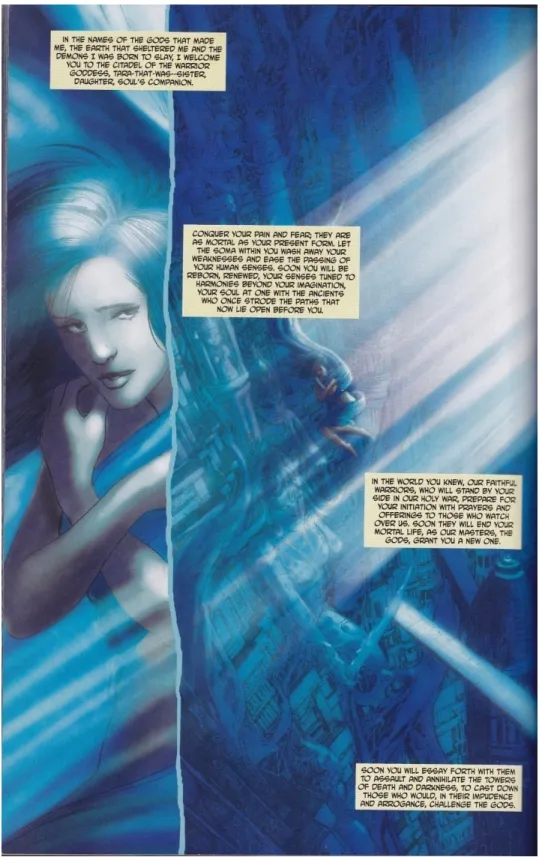
A multi-armed goddess sits cross-legged (Fig. 1). Two hands are clasped in the gesture of prayer (anjali mudra), and her other six hands hold an axe, a chakra (disc), a scimitar, a sword, a trident, and a gun. The goddess radiates energy (shakti) in the form of flames.18 Her face is inscrutable; her eyes glow brightly, and a third eye emits fire from her forehead. Her hair flows upright, also like a flame or the water of the Ganges River. This is Devi as she is envisioned in the graphic novel.
Devi, as she is depicted in the comic book, is based upon the description of the Great Goddess that has developed from its earliest written incarnation, the Dev-Mhtmya, a text composed approximately fifteen hundred years ago in northwest India.19 I argue that the designers of Devi draw heavily from the second chapter of the Dev-Mhtmya, which recounts the creation of the Great Goddess.20 She was created by the male gods in order to destroy demons, a task that the gods had been unable to complete either individually or together. Ultimately, this goddess was more powerful than any single god. The poem tells
18
For a more detailed disucssion of the concept of shakti see Kathleen M. Erndl, “Is Shakti Empowering for Women? Reflections on Feminism and the Hindu Goddess” in Is the Goddess a Feminist? The Politics of South Asian Goddesses, ed. Alf Hiltebeitel and Kathleen M. Erndl. (New York: New York University Press, 2000), 91-103.
19
The composers of the Dev-Mhtmya are unknown, as are the motivations for the text’s composition. The work was written in Sanskrit and the title can be translated to mean “The Specific Greatness (or Virtue) of (the) Goddess.” Thomas B. Coburn, Encountering the Goddess: A Translation of the Dev -Mhtmya and a Study of Its Interpretation (Albany: State University of New York press, 1991), 1.
of each of the gods granting his special attributes—physical characteristics and weapons—to the goddess:
Then from [Vishnu’s] face, which was filled with rage, came forth a great fiery splendor (tejas), (and also from the faces) of Brahm and iva. And from the bodies of the other gods, Indra and the others, came forth a great fiery splendor, and it became unified in one place. An exceedingly fiery mass like a flaming mountain did the gods see there, filling the firmament with flames. That peerless splendor, born from the bodies of all the gods, unified and pervading the triple worlds with its luster, became a woman.21
In addition, iva gives her his trident, Krishna gives her a discus, and other gods give her jewelry and clothing.22
The Devi of the graphic novel is created in a similar fashion, and given power and strength from facets of each of the gods of the comic book’s fictional pantheon.23 For instance, among other traits, she receives military skill from Ares, god of war, financial ability from Kapital, god of wealth, and power over men’s desire from Kama, god of love. Devi displays these gifts in her many arms, along with the weapons of the Great Goddess of the Dev-Mhtmya: iva’s trident, Krishna’s discus, Vivakarma’s axe, Kla’s sword, and Indra’s lightning bolt.24 However, Devi also holds a shotgun, which identifies her as a modern figure. Thus, the goddess is imagined by drawing upon multiple cosmologies.
21
Verses 2.8-2.13, Ibid., 40.
22
Ibid., 41.
23
12
Tara Mehta, the human heroine, and the reader, are introduced to this composite goddess in a dream sequence. Tara has been living as a kept woman in the city of Sitapur. Her boyfriend Iyam, who is actually the demon general of the evil god Bala, owns a seedy nightclub called the Abyss. As Tara leaves the Abyss one night, her car is blocked by a procession for Devi puja (goddess worship). Tara is then kidnapped by the durapasya. She is drugged with soma (divine elixir of immortality), and while unconscious she experiences an unusual dream in which she is introduced to her future existence as the Devi incarnate.25 Tara’s guide is Isana, the first Devi incarnate who lived thousands of years earlier. Tara is led through a dream-world and given hints of her future existence before she finally encounters the intimidating, flame-emitting goddess (Fig. 1).
The goddess floats in a blue haze that may be water, ether, light, or all of these. The haze evokes a moment of origination. Blue seas, of course, have been the birthplace of many goddesses, including Lakshmi and Aphrodite. Tara floats in the blue to Devi’s left, curled in a fetal position that evokes another image of birth (Fig. 1b). Beams of light radiate from Devi to Tara, an employment of yet another medium associated with origin to anticipate Tara’s rebirth as Devi. The light connects them and also proclaims the reincarnation of Devi as Tara. However, Tara and Devi are still independent beings. This light will eventually lead Tara into her new existence.
24
This could also be the trident of Poseidon or Neptune. I have attempted to attribute each weapon in the image to a specific god in the Dev-Mhtmya, but these identifications are speculative at best.
25
The seated Devi shares physical features with and displays traits that Tara will manifest in her new life (compare Figures 1 and 4). The glowing eyes and flaming third eye in her forehead are sacred markings, which will identify Tara as the Devi incarnate when she awakens. The shakti, emanating in fiery tendrils from Devi’s body, will also serve Tara as a weapon when battling enemies. Devi and Tara also share jewelry, elements of headdress, and a striking resemblance in their facial features.
This origination scene is presented in dramatic contrast to the comic’s linear, graphic style, with hard edges and bold colors as seen in figures 2, 3, 4, and 8. The dream sequences are painterly, almost resembling watercolor, and the hues are muted and blue-toned. The landscapes are sketchy and fluid. Although monuments and landmarks are visible around Tara as she moves through the dream world, these are not continuous from panel to panel. In this way, the artists emphasize a dream sequence where reality is elusive.
The accompanying text boxes reinforce the visual choices to establish a moment of creation, describing Devi’s purpose, and emphasizing the notion that Devi is both one and many goddesses, much as Tara and Devi will exist as two beings in one body.26 The words do not have any apparent source, as they are delivered in simple boxes that lack a speaker. It is as though the spirit realm itself is speaking:
We are Devi. Since the day Isana-First-Forged was made from mortal clay and cleansed with water, spirit, and fire, ours is the scared burden of leading the Armies of Light into the shadows and driving away the darkness that threatens to engulf the three worlds. Ours is the duty of preserving order, delivering justice, restoring the rule of the chosen and righteous, and protecting all that is good and holy. Wherever
26
11-14
great evil has risen, so have we; whenever chaos has challenged the worlds, we have answered, we have entered battle, and we have conquered. We are destroyers and renewers; we stand between all that is sacred and those who would seek to harm it…We say this without pride; this is what we were born to do. Our most devout wish is to not be needed. This, then, is the legacy you were born to uphold…Celebrate your new life as you protect the lives of others. Make us proud. Be us.27
This text introduces Tara and the reader to Devi, much as the text of the Dev-Mhtmya introduced a great goddess. The text describes Devi as both a destroyer and a renewer, foregrounding Devi’s contradictory existence as a mother goddess and an independent warrior. However, the Devi-voice expresses reluctance at such a battle-hardened existence: Devi’s most ardent desire is to not be needed. This will later be echoed in Tara’s hesitation to accept her new existence. Devi’s command “We are Devi,” makes Tara another link in the legacy of Devi. 28 If read as a performative utterance, it affirms and joins Tara to Devi. Therefore, Tara is now sacred.
The use of the first person plural to introduce Devi also anticipates Tara’s identification with her. The presence of past Devi incarnates in Tara’s dream sequence represents the multivalent nature of the goddess. Tara will soon gain the knowledge and experience of the previous Devi incarnates. Tara and Devi must share a single body. They will literally become we, a being of multi-consciousness who must learn to cooperate in order to accomplish specific and shared goals. Tara becomes a dual figure: human and goddess, sacred and mundane.
27 Ibid.
28
TRANSFORMATIONS
A sequence of four panels, superimposed over a fifth, depicts Tara-Devi’s
transformation from an inert to active goddess (Fig. 2).29 This sequence represents Tara’s developing relationship with the goddess who now shares her body, and introduces the issue of goddess possession. This discussion culminates in a final panel that provides the backdrop for the page, as well as the concluding image of the narrative sequence.
Although already divine, Tara-Devi is depicted in the first panel in her mortal state as Tara, an attractive young woman sitting on a wooden park bench in Sitapur. She wears a simple red dress and black heels, and her long hair is loose. Behind her is a long wrought-iron fence. The sun sets beyond, turning the sky shades of orange and purple. Tara-Devi’s arms are crossed in the first panel, and in the second she has shifted positions to place a hand against her face. Her face is drawn, and her lips are pressed tensely together, indicating discomfort and inner conflict. Her difficulty adjusting to her new life as the Devi incarnate is underscored by her pose, gesture, and facial expressions.
The third panel presents Tara-Devi’s shift into her active goddess state. Even as she protests, Tara-Devi is enveloped in a swirl of glowing golden-yellow light. Her body becomes translucent, and the viewer can now see the bench through her. The swirling haze highlights the supernatural aspect of Tara-Devi’s change from mortal to goddess. Tara says,
29
16
“Not happening,” in response to Devi’s activation. The text bubble is white, which indicates that it belongs to the mortal Tara, and emphasizes her attempt to defy the transformation. Tara does not have agency over her own body, and she is unable to resist Devi’s control.
The fourth panel presents Tara as the Devi incarnate, both a warrior and an alluring female as she was presented in the Dev-Mhtmya. Tara-Devi wears a fitted, black leather bodysuit that is surrounded at the hips by looser skirts. Her hair, held at the crown of her head in a headdress, flows loosely down her back.30 The bindi on her forehead is also a flame which further emphasizes her identity as pure energy. Tara-Devi has seven holes in the sleeve of her right arm which radiate shakti. She wears large hoop earrings and gloves, as well as high boots and an ornate breastplate. The costume indicates a warrior, but it also emphasizes sexuality, molding tightly to Devi’s breasts and hips.31 The transformation has just been completed, and wisps of glowing haze still linger around Tara-Devi’s body.
After completing the transformation, Devi tells Tara: “You will thank me later.” Devi’s voice is further differentiated from Tara by an alteration in the style of the text box. The thought is clearly Devi’s, as the box is yellow-gold and reminiscent of Devi’s flames and third eye. The artists use this text box convention to differentiate between Tara’s voice and Devi’s voice. Devi’s statement further emphasizes her control over Tara. Devi feels that
30
Mukesh Singh, Devi’s designer, states that he envisioned this hairstyle when looking at images of iva’s hair, particularly images of iva with the Ganges flowing from his coiffure. Singh draws connections to other goddesses of the Hindu pantheon through this physical attribute. Diana L. Eck writes that “iva as Gagdhara, ‘Bearer of the Gag,’ is commonly depicted wearing the Gag in his hair, either as the mermaid who clings to the crescent moon in his topknot or as the stream of water spurting up like a geyser. The Gag, therefore, is iva’s constant companion.” Diana L. Eck, “Gag: The Goddess Ganges in Hindu Sacred Geography,” in Devi: Goddesses of India, ed. John S. Hawley and Donna M. Wulff (Berkeley: University of California press, 1996), 147.
31 Reynolds notes that superheroes based on existing narratives often have costumes that visually locate
since she is a goddess, she has a full understanding of Tara’s mind, and therefore overrides Tara’s consciousness.
The fifth panel presents the physical trace that Tara-Devi leaves behind when she departs a scene.32 The goddess form left when Tara-Devi disappears from the park bench is a seated metal icon. She is cross-legged and has four arms. The front left arm drapes over the left leg, while the right arm is raised in front of the chest in an open-palmed gesture. The figure’s two back arms hold lotus blossoms. She wears a necklace and an elaborate headdress. The setting sun’s reflection on the metal surface causes it to gleam like the flaming bindi on Tara-Devi’s forehead. The seated position and the lotuses are suggestive of Lakshmi, the Hindu goddess of wealth and prosperity, and Tara, the Buddhist goddess of compassion.
This remainder of Devi, the metal icon of the goddess, is an inert figure. The statue sits alone in the center of the bench, much as Tara was seated alone at the beginning of the scene. Since the statue is not the object of worship, it is inactive: an empty vessel, not the goddess. The mortal Tara is similarly inactive before she fully embraces her role as the Devi incarnate.
Both Tara, in her early existence as the Devi incarnate, and the statue of the goddess indicate the necessity of another presence, the worshipper or devotee, for activation. Tara-Devi’s early transformations are activated by a worshipper or a devotee in need of aid, as in this episode, where a friend is in danger. Similarly, the icon of the seated Lakshmi requires a devotee for activation.
32
18
This final panel with the inert icon provides the backdrop for the four previous panels in the sequence. Since this is the background image, it suggests that the goddess in all of her forms is simultaneously present much like the Devi of the Dev-Mhtmya is one and many. The first three panels demonstrate Tara’s inability to ignore the goddess within her. The final two scenes represent the culmination of this realization: Tara becomes active as Devi,
container of all aspects of the goddess, much like the metal icon. Though Tara might try to resist the pull of her new existence, it is now a part of her very being.
Tara’s experience as a vessel inhabited by an external force can perhaps be interpreted in relation to the phenomenon of possession, although as used in European scholarship about South Asian practice, the term has a long and vexed history.33 Ann Gold writes that possession occurs when a known or unknown outside power takes temporary control of a person’s body, erasing that person’s consciousness and agency.34 This dominant force describes Tara’s initial experiences with Devi, for Tara is unable to control Devi and frequently does not recall shifting from her mortal to her goddess state. The existence of
33
Many different phenomena have been grouped under the general rubric of possession, from a person’s body being literally inhabited by an outside source, to divine incarnation, when an individual is perceived as actually being divine. The diversity of phenomena that are grouped under the word possession is indicative of the general lack of understanding of this term in its local contexts. Frederick M. Smith performed a linguistic analysis of the term possession, and wrote that references to Hindu possession first emerged in the Rigveda with the term avesa. The term avesa was found in the chapter that also contained the hymns to soma, and argues that Vedic soma drinkers may have experienced a form of possession. Smith then writes about the ambiguous notion of “self” and “other” as understood in Vedic philosophy, and states that it differs from contemporary Western conceptions of “self.” He continues by emphasizing that the Western understanding of possession does not represent the full continuum of possession as discussed in early Sanskrit texts, and that possession is not a single experience but, rather, a multi-layered experience involving issues of language, aesthetics, emotions, and personal identity. Frederick M. Smith, The Self Possessed: Deity and Spirit Possession in South Asian Literature and Civilization (New York: Columbia Univerity Press, 2006), XXII-4.
34
Tara and real-life possessed individuals as vessels, however, is far more complicated than a simple hierarchy of agency.
In her essay “ervl: The Mother Who Possesses,” Kathleen M. Erndl focuses on goddess possession and offers further possibilities for exploring the relationship between Tara and Devi. Erndl states, “to understand the phenomenon of Goddess possession, one must treat the Goddess herself as an agent who interacts with both the person possessed and the devotees who worship her.”35 Erndl stresses the ambiguity of the pronoun at the end of this quote. Devotees worship both the goddess and the individual who is possessed; both are considered holy and called Mt (divine mother). Erndl inquires “whether the Goddess and her human vehicle are completely separate entities, one of which temporarily ‘overtakes’ the other, or whether they are in some sense in a relation of identity with each other, perhaps in a process of exchange or transformation.”36 This process of transformation blurring the lines between the mortal and the divine, is analogous to the visual sequence presenting Tara’s transformation from inert to active goddess.
Erndl also pays specific attention to how divine possession manifests in various individuals, and categorizes the experiences into two: pavan or “wind form,” and kheln or “to play.”37 This first category is of relevance to my discussion of Tara Mehta’s
transformation. Witnesses stated that when an individual becomes possessed, the wind form of the goddess has entered her. Typically the vehicle’s hair, regardless of how tightly it is
35
Kathleen M. Erndl, “ervl: The Mother Who Possesses,” in Devi: Goddesses of India, ed. John S. Hawley and Donna M. Wulff (Berkeley: University of California Press, 1996), 175.
36 Ibid.
37
20
bound, is said to unwind and fly freely because of the force of the pavan.38 The possession is characterized by an alteration in voice, glazed eyes, and a circular movement of the head that causes the woman’s hair to fly loosely.39 These elements represent the active goddess within the possessed individual, much as the transformation scene in Devi indicates the activation of the goddess within Tara.40
38 Ibid.
39
Erndl discusses hair symbolism among Hindu women, stating that a woman’s hair would typically be bound and braided; therefore this aspect of the possession is particularly startling. Ibid., 107-108.
40
RECLAIMING AGENCY
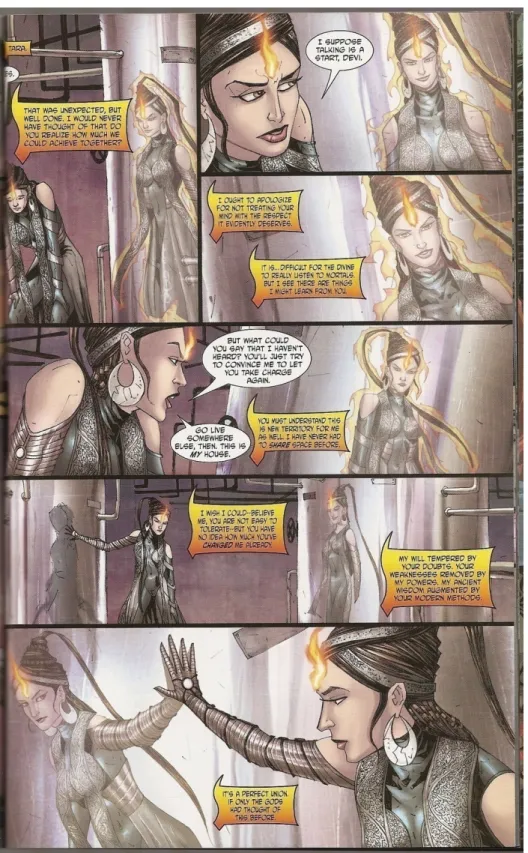
The scene immediately following Tara-Devi’s disappearance from a park bench involves a gruesome battle with a demon who is able to grow swords from his own body. Tara uses modern knowledge of electromagnetic principles to defeat the demon, overriding Devi’s judgment and asserting her own presence as a shrewd warrior. This marks a turning point in the narrative: Tara exercises her will over Devi, and ultimately moves toward accepting her new existence as Tara-Devi. The narrative unfolds as a development of
confrontations over the first four panels and reconciliations in the last two. The conversation traces Tara and Devi’s growing acceptance of their new and shared existence as a hybrid being, and ultimately ends in agreement and compromise between mortal and goddess.
22
The text boxes also maintain this disjunction. Devi, impressed by Tara’s ability to adapt quickly in battle, states that she believes much could be accomplished could she and Tara learn to cooperate.41 She goes further to offer Tara a truce and a compromise, as she realizes that Tara is not merely an empty vessel, but an intelligent and competent individual who might be an asset to her. Devi’s use of the word “together” indicates her willingness to relinquish nonconsensual control of Tara’s body, as well as the promise of an actual union of goddess and mortal.
Tara’s reluctance to trust such a union is emphasized in the next panel. Tara’s face is foregrounded, placing Devi in the background. Her face is drawn from the effort of battle, and she regards Devi warily. Tara agrees that conversation would be a step toward
strengthening her relationship with the goddess, and Devi’s expression is knowing and satisfied in response.42 Tara still feels hesitation, but her acknowledgment of the goddess, both visually and in terms of her offer of conversation, underlines her willingness to begin considering her new existence and its inherent possibilities.
Panel three is a close up of Devi in a halo of flames, offering to renegotiate the relationship further. Tara’s face is no longer in the frame, but she is still inherently present because she shares Devi’s features. The focus on one figure rather than two indicates a potential movement toward an agreement between the two beings that now share one body. Additionally, the focus on Devi’s face in this panel indicates the importance of the words inside the Devi-style text boxes. Devi apologizes for disrespecting and underestimating Tara,
41
Refer to panel 1, Figure 3. “That was unexpected but well done. I would never have thought of that. Do you realize how much we could achieve together?” Samit Basu (w.), Aditya Chari and Saumin Patel (p.), and Nanjan J. and N. Sivakami (i.), “Aks.” Devi #8 (Virgin Comics: New York, September 2007), 15.
42
and states that Tara offers the opportunity to discover new knowledge.43 Devi admits that even the gods can be wrong, which underscores the potential for the mortal Tara’s equality with the divine Devi. Devi offers to create a two-way bridge between the mortal and the divine; rather than battle with Tara for control over her body, Devi suggests a true union of minds.
Tara responds to Devi in the fourth panel, initiating her acceptance of the goddess’s offer. Tara and Devi are still presented as physically separate on opposite sides of the panel; Tara’s face is in profile, turned toward the goddess’ image on the metal surface of the tank. Her features are drawn with irritation, and her third eye flares dramatically on her forehead. The tension in Tara’s features represents the lingering frustrations and hesitations she feels toward Devi, and these misgivings are represented in her response. Tara argues that Devi will only retake control.44 Tara feels that Devi has not respected her bodily autonomy. She does not believe that Devi will allow her to have a voice about her own existence.
Devi, shown at a slight distance and with an equally tense expression, echoes Tara’s anxieties. Devi has never before shared a body.45 The goddess is also discomforted by her new existence as not just Devi, but Tara-Devi. Tara-Devi, in the mythology of the comic, is truly unusual—a composite being, rather than a divine spirit housed in an empty, mortal vessel. Tara responds by telling the Devi to leave; she labels her body her own and attempts
43
The absence of Tara’s face could also be incidental, as the text boxes cover any space for a second figure. The text boxes in panel 3, Figure 3, state, “I ought to apologize for not treating your mind with the respect it evidently deserves. It is…difficult for the divine to really listen to mortals. But I see there are things I might learn from you.” Ibid.
44
Refer to panel 4, Figure 3. “But what could you say that I haven’t heard? You’ll just try to convince me to let you take charge again.” Ibid.
45
24
to reclaim her agency.46 She uses the first person possessive singular to indicate her
unwillingness to share what she considers her personal property. Tara was given no choice in becoming Devi; the transformation was a matter of destiny, not decision. Tara continues to struggle against what she views as an invader within her body, and this is evident both in her hostile words and in the space between Tara’s body and the reflected Devi image. This space is filled with the text boxes. Thus while Tara and Devi are still separated by a
disagreement they are at least conversing and attempting to reach a truce.
Tara and Devi reconcile in the fifth panel. The scene consists of three forms; Tara leaning against a metal tank, Tara’s shadow cast upon that same tank, and the Devi reflection as seen on the opposite tank. Neither the shadow nor the reflection match Tara’s stance; the shadow is an ambiguous form, a murky darkness behind Tara, while the reflection is shown with an upright posture. The reflection is no longer surrounded by a border of flames, suggesting that the image is not the goddess but, rather, the combined Tara-Devi. The disappearance of the supernatural flames indicates that the two separate images are
coalescing into the two-in-one entity that is Tara-Devi, despite the physical distance that still exists between Tara’s corporeal form and the reflection in the water cooler. Devi-style text boxes fill the space between Tara and the industrial tank as well as the space behind the Devi reflection. In them, the goddess admits that Tara’s modern-day thinking has altered her.47 Devi also acknowledges the potential in a union between the sacred and the mundane.
Tara moves toward acceptance of her new existence in the final panel. Tara leans against the tank, resting her weight against her splayed right hand. She is reflected in the
46
Refer to panel 4, Figure 3. “Go live somewhere else, then. This is my house.” Ibid.
47
surface of the tank. The two figures’ hands meet, and it is difficult to discern where Tara’s body begins and where the reflection ends. This reflection can be read as Devi, though it can alternatively be seen as merely Tara’s reflection. Both readings indicate Tara’s acceptance of her new identity and new existence. A Devi-style text box floats beneath the point where the two hands join, further underlining the combination of goddess and mortal. Devi calls the joining a “perfect union.”48 Devi herself is admitting that mortal and goddess can achieve more together than alone.
Tara, her face in profile, regards her likeness. Her features are pensive in consideration of Devi’s statement. Tara’s reflection also appears thoughtful. The hand splayed against the tank’s surface remains the point of focus; the two figures emerge from the hand to fill the rest of the composition. As Tara considers the connection of the corporeal hand and the reflected hand, she accepts her new life not just as an individual, but as Tara-Devi. A compromise between sacred and mundane has been achieved. The mortal and the goddess are joined by their open palms, linked hand to hand in a “perfect union.”
Anthropologist Manuel Moreno reminds us that in order to conceptualize such a perfect union, the divine force must be understood as fluid. He states: “as persons, the gods’ identities are not permanently fixed; to the contrary, they are fluid and transformable by their active involvement in transactions with other gods and with humans.”49 Moreno thus also employs a mutable concept of the individual.50 This allows the possessing agent and the
48
Refer to panel 6, Figure 3. “It’s a perfect union. If only the Gods had thought of this before.” Ibid.
49
Manuel Moreno, “God’s Forceful call: Possession as a Divine Strategy,” in Gods of Flesh, Gods of Stone: The Embodiment of Divinity in India, ed. Joanne Punzo Waghorne, Norman Cutler, and Vasudha Narayanan (New York: Columbia University Press, 1985), 103.
50
26
person to coexist and, indeed, alter each other, rather than one presence simply overpowering the other.
Erndl offers an example of this form of compromise and coexistence in a relationship between vessel and possessing agent in her ethnographic study of Tara Devi, a wife and mother of four from the Kangra Valley Region of North India.51 Erndl writes that Tara Devi initially had to respond to the goddess’s demands, but that ultimately there was room for negotiation.52 When Erndl undertook this research, Tara Devi was a thirty-four year old woman who had been experiencing goddess possession for eight years and had developed a cult through her reputation as a healer and a medium.53 Once her possession and her ability as a healer and a medium became well known, Tara Devi was approached daily by a mass of
person” in European and non-European societies. Mauss writes of a distinction between person and self, and states that human beings are distinguished by their awareness of the physical and the metaphysical. Mauss places the origin of the European idea of self and personhood in Roman-Latin and Christian roots. The idea of the persona evolved in Christian thought to our modern, European idea of the morally distinguished person. Mauss argues that this moral and social significance is absent in non-European societies. He states that the Roman creation of the persona created the idea of the condition of a man. Mauss also writes that “It is Christians who have made a metaphysical entity of ‘moral person’ after they became aware of its religious power. Our own notion of the human person is till basically the Christian one” (19). Earlier in his essay, Mauss traces the concept of the individual in earlier, Non-Western societies. Of Indian society in particular, he writes, “India appears to me indeed to have been the most ancient of civilizations aware of the notion of the individual, of his consciousness” (13). He dissects the word “Ahamkara” stating that aham translates to “I” or “ego.” He states that “ahamkara is clearly a technical word, invented by some school of wise seers, risen above all from general consciousness” (13). Marcel Mauss, trans. W.D. Halls, “A Category of the Human Mind: The Notion of Person; the Notion of Self,” in The Category of the Person, ed. Michael Carrithers, Steven Collins, and Steven Lukas (Cambridge: Cambridge University Press, 1985), 1-25.
51
Kangra Valley is located in the foothills of the Dhauladhar Range of the Himalayas. Women in Kangra society often assume religious leadership roles via goddess possession, acting as healers, serving as mediums, and leading devotional group songs. Kathleen M. Erndl, “The Goddess and Women’s Power: A Hindu Case Study,” in Women and Goddess Traditions in Antiquity and Today, ed. Karen L. King (Minneapolis: Fortress Press, 1997), 18.
Ibid., 22.
53
devotees seeking her guidance. At this point, Tara was exhausted and her health weakened. Tara Devi and her husband begged the goddess to restrict her presence to specific times, and eventually the goddess agreed to only receive questioners and devotees on Sunday, Tuesday, and Friday.54 An analogous depiction of negotiation is depicted in Figure 3. Initially Tara had no control over her possession, but ultimately she was able to achieve an understanding with the goddess.
54
SUPERHEROES AND SACRED FEMALES
The visual image for the goddess Tara-Devi draws upon super-human tropes from multiple cultures. This new goddess is empowered with a rich visual ancestry including superheroes, goddesses, and sacred female figures, much as the goddess of the
Dev-Mhtmya was created from the weapons and abilities of the male gods. I argue that this
imagery, drawn from diverse cultural contexts, including American superhero comics, depictions of Hindu goddesses in Indian comics, and European depictions of sacred females, makes Tara-Devi familiar to the primarily Euro-American and South Asian audience targeted by the comic book series.
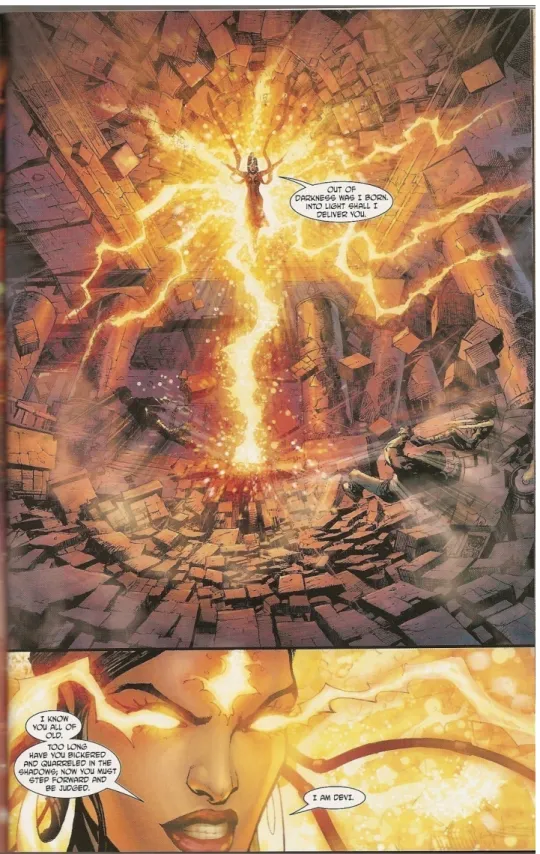
The reader first sees Tara-Devi in her new state as the Devi incarnate at the end of the first trade paperback of the graphic novel series (Fig. 4). At this point, Tara has completed the dream walk during which she has learned of her new destiny and has been gifted abilities by the gods of the comic book’s pantheon. During this time her body was transported through Sitapur to an old temple on the outskirts of town for the ritual that will awaken the goddess.55 As the battle rages around Tara’s prone body, she is imbued with the essence of the goddess.
55
When the goddess enters Tara’s body she explodes upward, thrust toward heaven by the force of Devi’s power. She is suspended directly above the ceremonial altar. Her arms are outspread, and tendrils of supernatural flame emanate from her. Tara-Devi, at the center of this flame, emerges as had the goddess of the Dev-Mhtmya, formed from the “great fiery splendor” produced by the gods.56 Tara emerges from the hazy darkness of her dream world into an explosion of light and energy. The shockwave of this explosion destroys the temple, reducing ancient stone to rubble. The force of Tara-Devi’s birth also strikes the bodies of the demon assassins and the mortal policeman, who fly through the debris of the collapsing temple.
A second, smaller panel at the bottom of the page presents a close up of Tara-Devi’s face. Her features are taut with concentration, lips parted as she announces her arrival to the world.57 Flames of energy emerge from Tara-Devi’s forehead and from her eyes, shooting from her face like bolts of lightning. The background behind Tara-Devi’s face is bright with light and energy. The close-up on Tara-Devi’s face foregrounds the idea that this is Tara and
Devi: the physical features are those of Tara, yet the individual proclaims herself as Devi. In doing so, the reader is now given a more human glimpse of the awesome divine in the wider view of the remote and omnipotent goddess.
This goddess is drawn from a number of sources. Devi stands alongside American comic book figures such as Wonder Woman and the female members of Marvel Comics’ X-Men. Devi is presented as a sexualized superhero, what Robinson in her discussion of
56
Figure 4. “Out of darkness was I born. Into light shall I deliver you.” This moment of physical awakening mirrors Tara’s earlier dream walk from darkness into light. Samit Basu (w.), Mukesh Singh (p.), and Nanjan J. and Mukesh Singh (i.), “Aagaman.” Devi #5 (Virgin Comics: New York, May 2007), 19.
57
30
female superheroes and feminism calls “that elusive combination, the conjunction of two connotations of the female ideal, perfectly strong and perfectly desirable.”58
In particular Devi shares visual elements with the character Storm from the X-Men (Fig. 5).59 Both are dark-skinned with long hair that is frequently depicted as loose and billowing. When Storm accesses her powers of weather control her eyes turn white, much as Devi’s eyes change color when she is exuding shakti. Strips of fabric surround both figures, providing a dramatic way in which to depict movement and energy. Both have the ability to manipulate energy: Storm’s arms are outstretched, and tendrils of lightning entwine about her arms and wrists, and Devi in Figure 4 emanates shakti. Storm and Devi also have bodies that are strong and voluptuous, powerful and sexual. The creators of Devi likely drew upon characters such as Storm in order to make their new goddess familiar to an American audience.
Devi also draws from representations of Hindu goddesses in Indian comic books, such as in “Tales of Durga,” a comic book produced by the company Amar Chitra Katha
(Fig. 6). The narrative tells of the creation of Devi, in this case shown in her warrior aspect as Durga, as recounted in the Dev-Mhtmya. Durga wears a red skirt and a green top, leaving her middle bare and emphasizing her breasts and hips, much as Virgin Comics’ Devi’s costume emphasizes her sexuality. Her hair, like Devi’s, is long, flowing, and
58
Lillian S. Robinson, Wonder Women: Feminism and Superheroes (New York: Routledge, 2004), 101.
59
crowned with a headdress. She has numerous arms that hold the attributes given to her by the gods.60 Both she and Devi share a third eye in the middle of the forehead, which is typically understood as a mark of omniscience: knowledge of the past, present, and future. Most important, however, is the halo of light and energy which emanates from both
goddesses. As Durga raises her weapons to strike the buffalo-demon Mahisha, a cloud of light appears behind her. The pale yellow halo of light surrounds the goddess and endows her with an aura of power. Thus, Durga and Devi are both empowered by the depiction of
shakti and the emphasison a powerful, sexual female form.
William Blake’s Great Red Dragon paintings offer another example of a powerful, sacred female figure bathed in light. In The Great Red Dragon and the Woman Clothed with the Sun, Blake presents a female figure, often identified as the Bride of Christ who is also associated with Mary, encountering the demonic form of the Anti-Christ or Satan(Fig 7).61 The demon is cloaked in darkness and shadow, and the woman combats this shadow with the shield of light which both surrounds and emanates from her. The woman’s arms are
outstretched and she gazes upward at the dragon who is attempting to destroy her. Rays of light emerge from the woman’s head and from around her arms like glowing wings. Jagged lines of illumination, like bolts of lighting, also appear around the woman. Devi, both in stance and her use of light and energy, echoes Blake’s dramatic depiction.
Both Virgin Comics’ Devi and Blake’s apocalyptic paintings share a pose that has been associated with the Virgin Mary, particularly in High Renaissance painting such as
60
As seen in Figure 1. 61
32
Titian’s Assumption of the Virgin (Fig. 8).62 The Virgin Mary rises to heaven on a cloud, surrounded by cherubic angels and saints. She looks up, her facial features peaceful, her arms outstretched. She is surrounded by divine light. Devi is also presented in this manner: suspended in midair, arms outstretched, surrounded by light. Further, Tara is a vessel for divinity, as was Mary.
Devi also visually echoes images of devotional ecstasy as seen in works such as Bernini’s Ecstasy of Saint Teresa (Fig. 9).63 Saint Teresa is in the thrall of the heavenly, touched by rays of holy light and caressed by a smiling cherub. Her head falls back in a moment of bliss, and her closed eyes and open mouth emit the powerful sensations flooding her body. Like Saint Teresa, Devi in this image is also ecstatic, suspended within a cloud of light and imbued with divine power and emotion.64
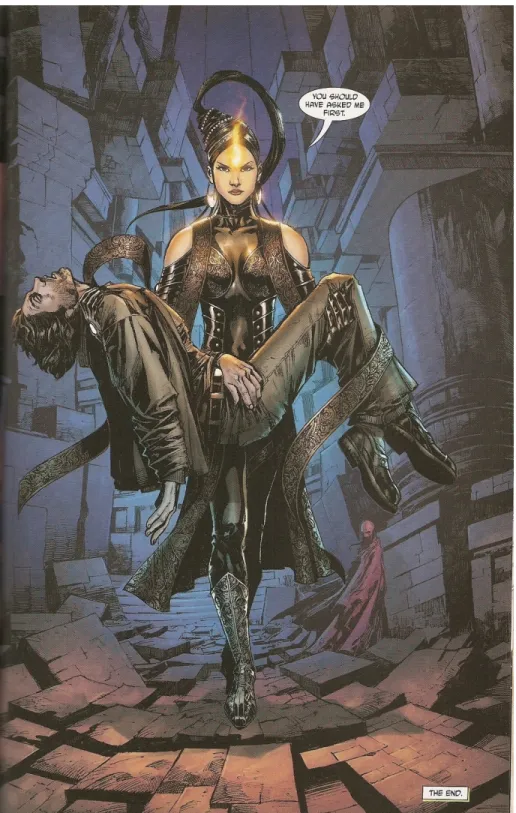
A later image of Devi within the graphic novel reiterates the association with the Virgin Mary (Fig. 10).65 When Tara-Devi walks through the debris of the temple, carrying a grown male figure as though he were nothing more than a ragdoll in her arms, she is depicted in a pose reminiscent of Pietà images presenting the Virgin lamenting the dead Christ. Michelangelo, for example, represented the Virgin Mary as beautiful and stalwart, able to
62
The work was created between 1515 and 1518 and is located in the Basilica di Santa Maria Gloriosa dei Frari in Venice.
63
This work was created between 1647 and 1652 and is located in the church of Santa Maria della Vittoria in Rome.
64
Analogous ecstatic experiences in the Indian context have been discussed by many scholars, including June McDaniel in The Madness of Saints, which traces ecstatic religious experiences in Bengal. June McDaniel, The Madness of Saints (Chicago: University of Chicago Press, 1989).
65
fully support the body of her full-grown son on her lap despite her grief (Fig. 11).66 Devi is similarly able to carry the burden of a fallen man. This image of Devi is not one of
lamentation, however, but one of strength and sexuality, a woman, superhero, and goddess shouldering her new role as a defender of humankind.
Devi is given visual power through this wide range of artistic sources including but not limited to American comic book superheroes, Indian comic representations of Hindu mythology, and depictions of sacred females in Christian iconography. This combination of imagery enables Devi to exist as a modern multi-cultural goddess who is accessible to readers from diverse backgrounds. Devi is thus given powers both superhuman and divine.67
66
Completed in 1499, currently at St. Peter’s Basilica in Vatican City.
67
CONCLUSION
The character of Devi embodies the appropriation of ancient histories and belief systems to create composite characters that are new and relevant to contemporary readers. Devi exists as a figure who is ancient and modern, Indian and American, beautifully feminine and unapologetically powerful. Her densely layered foundations are rooted in multiple eras and cultures, and this very worldliness is what makes her story specific and relatable to readers from diverse backgrounds. In a genre where women have often been reduced to a single dimension, Virgin Comics’ Devi exists as a character who is multi-layered not simply in cultural sources, but also in her potential to redefine our understanding of a woman, a superhero, and a goddess today. As Robinson acknowledges, female superheroes do not have a set message. Rather, they have the ability to inspire all women to become wondrous in their own ways. 68 Perhaps Devi can encourage female readers to find both the wonder and the goddess within themselves, as Tara sees the goddess in her own reflection.
68
40
Figure 5. Marvel Comics’ Storm, from the X-Men.
42
44
46
BIBLIOGRAPHY
Austin, J.L. How to do Things with Words. edited by. J.O. Urmson and Marina Sbisa, Cambridge: Harvard University Press, 1975.
Bolton, Andrew. Superheroes: Fashion and Fantasy. New York: The Metropolitan Museum of Art, 2008.
Butler, Judith. Gender Trouble. New York: Routledge, 1990.
Campbell, Joseph. Pathways to Bliss: Mythology and Personal Transformation. Novato: New York Library, 2004.
______The Hero with a Thousand Faces. Princeton: Princeton University Press, 2004.
Carrier, David. The Aesthetics of Comics. University Park: The Pennsylvania State University Press, 2000.
Coburn, Thomas B. Encountering the Goddess: A Translation of the Dev-Mhtmya and
a Study of Its Interpretation, Albany: State University of New York Press, 1991. ______. “What is a ‘Goddess’ and What Does It Mean to ‘Construct’ One?”
In Seeking Mahadevi: Constructing the Identities of the Hindu Great Goddesses, edited by Tracy Pintchman, 213-222 Albany: State University of New York Press, 2000.
Dehejia, Vidya. Devi the Great Goddess: Female Divinity in South Asian Art. Washington D.C.: Arthur M. Sackler Gallery, 1999.
Doniger, Wendy. Dreams, Illusions, and Other Realities. Chicago: University of Chicago Press, 1984.
Devi. Dir. Satyajit Ray. Perf. Sharmila Tagore, Soumitra Chatterjee. 1960.
Eck, Diana L. “Gag: The Goddess Ganges in Hindu Sacred Geography.” In Devi: Goddesses of India, edited by John S. Hawley and Donna M. Wulff, 137- 153. Berkeley: University of California Press, 1996.
______. Darsan: Seeing the Divine Image in India. New York: Columbia University Press, 1998.
Ellis, Warren. From the Desk of Warren Ellis: Volume 1. Urbana: Avatar, 2000.
48
______. “ervl: The Mother Who Possesses.” In Devi: Goddesses of India, edited by John S. Hawley and Donna M. Wulff, 173-194. Berkeley: University of
California Press, 1996.
______. “The Goddess and Women’s Power: A Hindu Case Study.” In Women
and Goddess Traditions, edited by Karen L. King, 17-38. Minneapolis: Fortress Press, 1997.
______. Victory to the Mother: The Hindu Goddess of Northwest India in Myth, Ritual, and Symbol. New York: Oxford University Press, 1993.
Flood, Gavin. An Introduction to Hinduism. Cambridge: Cambridge University Press,
1996
Flueckiger, Joyce Burckhalter. “Wandering from ‘Hills to Valleys’ with the Goddess: Protection and Freedom in the Matamma Tradition of Andhra.” In Women’s Lives, Women’s Rituals in the Hindu Tradition, edited byTracy Pintchman, 35-54. Oxford: Oxford University Press, 2007.
Foulston, Lynn. At the Feet of the Goddess: The Divine Feminine in Local Hindu Religion. Brighton: Sussex Academic Press, 2002.
Freed, Stanley A. and Ruth S Freed. “The Psychomedical Case History of a Low-Caste Woman of North India.” In Anthropological Papers of America. Volume 60: Part 2 (1985): 102-228.
Garrett, Greg. Holy Superheroes!: Exploring the Sacred in Comics, Graphic Novels, and Film. Louisville: Westminister John Knox Press, 2008.
Gold, Anne Grodzins. “Spirit Possession Perceived and Performed in Rural Rajasthan.” In Contributions to Indian Society n.s. 22, no. 1 (1988): 20-35.
Gross, Rita M. “Is the Goddess a Feminist?” In Is the Goddess a Feminist? The Politics of South Asian Goddesses, edited by Alf Hiltebeitel and Kathleen M. Erndl, 104-112. New York: New York University Press, 2000.
Gupta, Lina. “Hindu Women and Ritual Empowerment.” In Women and Goddess Traditions, edited by Karen L. King, 95-110. Minneapolis: Fortress Press, 1997. Johnsen, Linda. The Living Goddess: Reclaiming the Tradition of the Mother of the