EXPLAINING RESTRAINT FROM FILIBUSTERING IN THE U.S. SENATE: A QUALITATIVE COMPARATIVE ANALYSIS APPROACH
Rachel Ramsay
A thesis submitted to the faculty at the University of North Carolina at Chapel Hill in partial fulfillment of the requirements for the degree of Master of Arts in the Department of
Sociology.
Chapel Hill 2014
iii ABSTRACT
Rachel Ramsay: Explaining Restraint from Filibustering in the U.S. Senate: A Qualitative Comparative Analysis Approach
(Under the direction of Andrew Perrin)
While Senate observers describe the modern filibuster as costless, senators still sometimes choose to forgo filibustering even when that results in the passage of legislation that they oppose. This study seeks to identify the circumstances under which legislation that is opposed by a cloture-blocking minority is not filibustered. Fuzzy-set qualitative
iv
ACKNOWLEDGEMENTS
v
TABLE OF CONTENTS
INTRODUCTION ... 1
LITERATURE REVIEW ... 3
HYPOTHESES ... 7
DATA AND METHODS ... 8
FINDINGS AND DISCUSSION ... 11
CONCLUSION ... 14
APPENDIX 1: FIGURES ... 16
APPENDIX 2: TABLES... 18
APPENDIX 3: STATA LOGS ... 19
1 INTRODUCTION
Symbolic boundaries are an inescapable aspect of social life (Durkheim and Mauss 1963, Zerubavel 1991). Such boundaries are neither neutral nor static; the power to impose symbolic distinctions is key for both incumbents’ upholding and challengers’ disputing social positions (Bourdieu 1984, Lamont 1992, Lamont and Molnár 2002). Complicating this struggle is the danger that symbolic acts are subject to diminishing returns, and this applies to the political field no less than any other (Klapp 1991, Best 2008). Symbolic inflation
contributes to recent dysfunction in U.S. government: it is a key driver in the increasing use of the filibuster as routine opposition becomes ever more extreme.
Unlike the House of Representatives, the Senate has a long tradition of unlimited debate. In 1806, the Senate discontinued its little-used “previous question” rule and thereby opened the door to senators’ holding the floor for the purpose of obstructing legislation. It was not until 1917 that pressure from the public and president alike forced the Senate to again adopt a means of closing debate. The parliamentary innovation of invoking cloture, thereby placing a time limit on further debate, introduced new problems, and most research on the filibuster focuses on its role in legislative gridlock (Krehbiel 1998; Binder 1999, 2003; Chiou and Rothenberg 2003, 2006, 2009). Because invoking cloture requires a
2
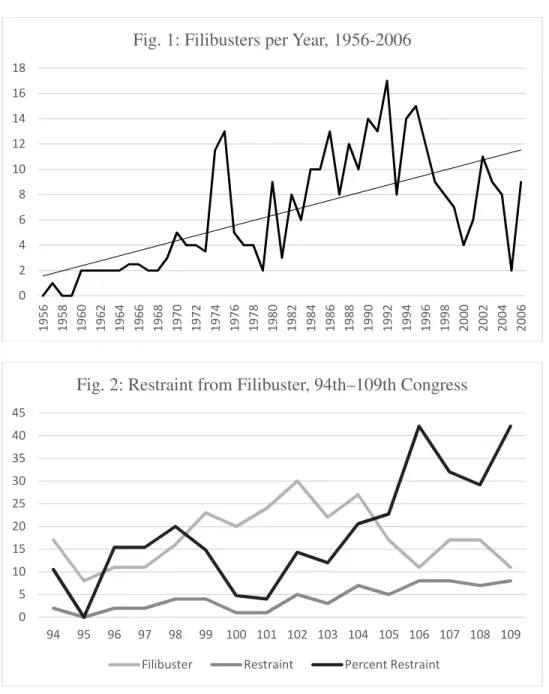
The number of filibusters per Congress has climbed rapidly since the 1960s (Fig. 1). Investigations of the causes of this increase have highlighted the impact of changing
institutional arrangements, such as the introduction of tracking in 1970 (Binder, Lawrence and Smith 2002; Koger 2010).1 Tracking, which allows filibustered legislation to occupy a separate track than the rest of Senate business, ended the requirement that filibustering senators hold the floor. The end of the physical cost of filibustering, plus decreased social costs due to changing senatorial norms, have prompted observers to describe the modern filibuster as costless (Oppenheimer 1985, Ornstein 2003, Wawro and Schickler 2006). The question then is not, “Why are there so many filibusters?” but rather, “Why aren’t there more?”
Jones (2000) offers trailblazing work on restraint from filibuster. Unfortunately, despite hypotheses that are formulated in set-theoretic terms, his study employs logistic regression.2 Too often in the social sciences, we theorize the world one way but model it another (Abbott 1988). Instead of estimating the net effects of independent variables, I use Boolean logic to explore how the causes of restraint are patterned. In this method, different causal pathways are not treated as though they arein competition with each other.
Furthermore, certain causes may need to occur simultaneously to produce a result, which is not captured by regression. In order to expose these causal patterns, I employ fuzzy-set qualitative comparative analysis (fsQCA), developed by Ragin (2000, 2008).
1 Confusion over when tracking began abounds (Wawro and Schickler 2006:261). I follow Binder, Lawrence,
and Smith (2002:419), who confirmed the date with the then–assistant parliamentarian.
2 For example, “While high party polarization is always expected to foster filibustering, low party polarization
3 LITERATURE REVIEW
Members of Congress have three basic goals: to craft public policy, secure re-election, and obtain influence within their chamber (Fenno 1973). To say that senators’ actions are strategic is not to subscribe to a rational actor model. Senators’ decisions are embedded in sequences fraught with contingency. As Wawro and Schickler (2006:35) point out, if senators had access to perfect information, then filibusters would not occur.
Before discussing why senators might refrain from filibustering, it is important to understand why they filibuster in the first place.3 When legislation runs counter to the policy preferences of senators, yet cannot be defeated in an up-or-down vote, the legislation’s opponents can delay a final vote by filibustering. This may prompt changes to the legislation so that it meets with the filibustering senators’ approval, or kill the bill entirely by preventing a final vote from occurring.
Filibustering is more than just a tool for crafting policy: it may also help senators achieve their goal of re-election. Throughout the twentieth century, the Senate became more visible to the public, and senators became more dependent on the attention of the electorate. Filibustering is one way for senators to distinguish themselves in the media, and the
introduction of legislative television (e.g., C-SPAN) increased senators’ likelihood of filibustering (Mixon 2002; Mixon, Gibson and Upadhyaya 2003). In addition to “making a name” for the senator with their constituents, filibusters are also used to attract the attention of donors and interest groups (Sinclair 1989; Mixon, Crocker and Black 2005). Finally, filibustering may help to protect against primary challenges by providing senators with the
4
opportunity to position themselves as outsiders, thereby creating symbolic distance between them and “Washington.”
While acknowledging the “political and electoral demands on senators,” Binder and Smith (1997:13) attribute the increase in filibustering since the 1960s to “changes in
workload, partisanship, [and] procedural strategies.” As the Senate’s workload has increased, legislation-supporting majorities have been increasingly unable to wait out filibusters. In the two multivariate analyses of the increase in filibusters, time pressures are significantly positively correlated with filibusters per Congressional session (Binder, Lawrence and Smith 2002; Koger 2010). Senate leaders have responded to increasing legislative demands by dropping wars of attrition in favor of tracking. Binder and Smith (1997:15) partly blame tracking for the increase in filibusters because it makes them “more tolerable and less costly to the filibustering senators.” Conversely, Koger (2010:137), like Wawro and Schickler (2006), sees tracking as “a minor reform that is symptomatic of a broader shift from attrition to cloture as the dominant response to obstruction but that has little independent effect.”
Binder and Smith (1997) also propose increased party cohesion as an explanation for the rise in filibusters. Binder, Lawrence and Smith (2002) find that party strength, measured as an interaction between size and cohesion, is significantly positively correlated with filibusters per session. One explanation for the recent increase in party cohesion holds that party members are more likely to vote together when parties are polarized, and Koger (2010) does find the gap between the parties’ average DW-NOMINATE scores to be significant.4
4The NOMINATE score places Congress members within a two-dimensional ideological space based on their
5
Yet Lee (2009:2) finds that the parties’ ideological differences do not “account for the extent of party conflict in Congress.” Rather, Lee argues that the members of a party share in its fortunes and are locked into a zero-sum reputational game with the opposing party. I contend that this reputational game is where the dynamics of symbolic inflation drive the increase in filibusters, and that party polarization does not independently affect the incidence of the filibuster.
With the lowered costs and heightened reasons to filibuster, why would senators who oppose a bill and have the numbers to block cloture refrain from filibustering? Jones
(2000:56) suggests that “restraint should be more likely when the opportunity costs of filibustering are higher, when the rewards for restraint are more likely, and when retaliation for non-restraint is more likely.” Even a so-called costless filibuster has its opportunity cost. When it comes to pursuing policy goals, in addition to modifying or blocking legislation that they disagree with, senators also have policies that they would like to make law. Time spent negotiating a filibuster, even one that occurs in the background of normal Senate business, is time not spent on other goals.
6
Overby and Bell’s (2004:920) analysis of filibustering by retiring senators, who should no longer have to worry about rewards or retaliation from any quarter, is “ambiguous.” Koger (2010) includes Senate turnover as a proxy for the continuity of norms, but this variable is not significant.
Retaliation for past obstruction may play a role in senators’ decision to filibuster. A “parliamentary arms race” seems to be underway in the Senate:
“Republicans, for example, defended their use of the filibuster to block much of President Bill Clinton’s congressional agenda in 1994 on the grounds that the Democrats had done the same thing to George Bush and the Republicans in 1992. And Democrats filibustered regulatory reform, congressional term limits, and other aspects of the Republican agenda in 1995 and 1996, knowing that Republicans had used the filibuster effectively against the Democrats in 1994. As one Senate observer noted, ‘Once parliamentary strategies such as these have been unleashed, they—like the atom bomb—cannot be uninvented’” (Binder and Smith 1997:17).
This is supported by Binder, Lawrence and Smith’s (2002) analysis, which finds the lagged number of filibusters from the previous session to be predictive of the number of filibusters in a Congressional session. I contend that this is a case of symbolic inflation: senators have become more willing to filibuster as routine opposition requires increasingly extreme
measures. Since past filibusters predict future ones, the question arises of how this arms race was set off; I argue that the minority party’s repertoire produced diminishing returns until it evolved (Swidler 1986, Lamont 1992).
7
affect the incidence of filibustering, but this may change since Senate Majority Leader Harry Reid (D-NV) displayed not only the willingness but the capability to reform the filibuster, albeit in limited fashion. Of course, such reform may merely set off another parliamentary arms race, leading to the filibuster’s complete dismantling upon the Republicans’ winning control of the Senate.
HYPOTHESES
I expect senators to refrain from filibustering when:
1. Much time remains in the Congressional calendar or the Senate’s workload is light. When senators are under pressure to pass legislation, whether due to the close of the
Congressional calendar or a heavy workload, filibusters are more likely to occur because they tend be met with quick concessions (Oppenheimer 1985). When the reverse is true, I expect senators who are considering a filibuster to bide their time instead.
2. The preceding Congress witnessed comparatively few filibusters.
I believe that this factor boosts senators’ collegiality and thereby increases their willingness to exercise restraint. Although the precise level of symbolic inflation cannot be measured, this factor also provides a clue to the symbolic inflation “rate.”
3. The president is a member of the Senate’s minority party.
When the president is a member of the Senate’s majority party, a victory for the majority is a victory for the president (Lee 2009); therefore, I expect the minority to filibuster in such instances. When the reverse is true, I expect it to exercise restraint.
4. Democrats are the Senate’s minority party.
8
94th through 109th Congress, the average Democratic minority exercised restraint 27% of the time, while the average Republican minority exercised restraint 9% of the time. Therefore, I expect restraint to occur more often when Democrats are in the minority.
5. Legislation is considered to be non-major.
Whether they are being collegial or fearing reprisal, senators should be more willing to exercise restraint when the legislation under consideration is comparatively unimportant. Also, even filibusters that do not involve holding the floor still have their opportunity costs; therefore, senators should be more willing to let the “little things” go.
Separate from the above and consistent with the discussion on page 4,
6. I do not expect party polarization to affect senators’ propensity to restrain from filibustering.
DATA AND METHODS
To solve the puzzle of why senators who could filibuster refrain from doing so, I compiled a population of cases by searching Senate roll call votes from the 94th through 109th Congress for Nay votes equal to or less than 50 (so that a bill’s opponents could not simply vote it down) yet greater than 40 (so that the majority party could not simply impose cloture and thereby overcome a filibuster).5 Since the beginning of the 94th Congress in 1975, sixty votes have been needed to pass a cloture motion.6 Prior to that, two-thirds of present and
5 Information about legislation is retrieved from Congress.gov, which is operated by the Library of Congress.
6 The sixty-vote threshold for imposing cloture is derived from “three-fifths of the Senators duly chosen and
9
voting senators were required, which caused the threshold to shift depending on the number of senators in attendance on a given day.
Bills with 41 to 50 Nays were then checked to ensure that they could be filibustered: budget-related bills are subject to reconciliation rules that allow only twenty hours of debate (Heniff and Murray 2012). At this stage, I added filibustered bills that never received a roll-call vote to the population of cases, yielding a total of 175. From this population, I then determined the cases where restraint from filibuster is present. “Filibuster” is not a technical term and thus establishing one’s presence poses methodological difficulties (Beth 1995). Because the existence of a filibuster is ultimately determined by a senator’s intent, there are no clear-cut criteria. Using cloture votes as proxies is unwise because “cloture may be sought when no filibuster is taking place, and filibusters may occur without cloture being sought” (Beth and Palmer 2011:2). Building on the work of Burdette (1940) and Beth (1994), Bell and Overby (2007) have created the most exhaustive and transparent
identification of filibusters, and I used their list. Of the 455 filibusters identified since 1826, 282 occurred between the opening of the 94th Congress in 1975 and close of the 109th
Congress in 2006; that is to say, 62% of the filibusters occurred in just 18% of the time under consideration.
10 Time Constraints
• Days remaining in Congress
• Measures introduced during Congress
To measure time constraints, I included the days remaining in the Congress when the legislation was introduced, calibrated in the program fs/QCA to determine cases’ degree of membership in the short-time set (Ragin, Drass and Davey 2006). The calibration thresholds did not have qualitative bases, but rather were selected based on deviations from the mean. Senators’ workload also increases pressure on their time. I followed Jones’ (2000:62) workload measure by recording the “total number of bills and resolutions introduced during the Congress in which each item is considered.” That number was then calibrated to
determine membership in the high-workload set, and the union of these two sets form the constrained-time set.
Previous Filibusters
• Number of filibusters during the preceding Congress
Senators’ decisions take into account their colleagues’ past choices, so I used the number of filibusters during the preceding Congress to calibrate cases’ degree of membership in the low-previous-filibuster set.
Partisanship and Party Differences
• Presidential membership in the Senate’s majority party
11
• Difference in party means on the first DW-NOMINATE dimension7
Both whether the president shares membership in the Senate’s majority party and whether Democrats form the Senate’s minority party were straightforwardly established in crisp sets. The difference between the party means on the first DW-NOMINATE dimension was calibrated to form the high-polarization set.
Importance of Legislation
• Listed as “Major Legislation”
Taking inspiration from Jones (2000), I included a case in the major-legislation set if the bill is listed in Congressional Quarterly Weekly Report as “Major Legislation” or is featured in Congressional Quarterly Almanac’s year-end summary. Unfortunately, these periodicals are
incompletely digitized, so this set only includes the 94th through 102nd Congress.
FINDINGS AND DISCUSSION
Once the sets were established, I analyzed them using Fuzzy, a program that allows QCA to be performed in Stata (Longest and Vaisey 2008). Fuzzy features probabilistic testing of causes’ necessity and sufficiency, which defuses a common criticism of QCA. Solutions are tested along two dimensions: consistency and coverage. Consistency may be likened to significance and coverage to strength (Ragin 2008:45). Consistency evaluates the extent to which “cases sharing a given condition or combination of conditions” (e.g., low filibustering during the previous Congress) “agree in displaying the outcome in question”
7 DW-NOMINATE data was retrieved from the website maintained by the measure’s developer, Dr. Keith
12
(i.e., restraint from filibuster), while coverage concerns how many cases feature a cause or causal combination (Ragin 2006:292).
For the complete population of cases, there are five causal conditions: constrained time, low filibustering during the previous Congress, the president’s membership in the Senate’s majority party, a Democratic minority in the Senate, and high party polarization. My hypotheses are that membership in the restraint set is consistent with membership in the low-previous-filibuster and Democratic-minority sets, while also being consistent with the absence of membership in the constrained-time and majority-president sets; meanwhile, party polarization should not be part of the causal pathway.
Two combinations are significantly consistent with restraint (Log 1). Using Boolean algebra, these combinations reduce to ~constrained time
•
low previous filibuster•
presidentmajority
•
~Democratic minority (Table 2).8 The pathway’s consistency is 0.789, safely above the 0.75 cut-off for meaningful consistency identified by Ragin (2008:46). Its coverage is low; however, there can be a “trade-off” between consistency and coverage due to the complexity of the pathway and the high number of set relations involved (Ragin 2008:117). In this pathway to restraint, time is not constrained, there was low filibustering during the previous Congress, the president shares membership in the Senate’s majority party, and Democrats are not in the minority. Note that party polarization is not part of the pathway. This result validates hypotheses 1, 2, and 6, but not hypotheses 3 and 4.Hypothesis 3 was designed to adjudicate between Jones (2000) and Lee (2009) regarding the impact of presidential policy preferences on senators’ decision to filibuster. These results support Jones’ (2000) finding that presidents’ backing legislation encourages
8 The symbol “~” indicates negation, while the symbol “
13
senators to refrain from filibustering; however, Lee (2009) is partially vindicated because party polarization, i.e., divergent ideologies, does not make a difference to the outcome. Likewise, although hypothesis 4 regarding Democratic minorities was incorrect, this result still points toward party differences.
Although included in the previous analysis, cases from the 94th through 102nd Congress were analyzed again with six causal conditions, this time including legislation’s importance. This configuration has two solutions: ~constrained time
•
low previousfilibuster
•
president majority•
~Democratic minority and low previous filibuster•
presidentmajority
•
~Democratic minority•
high party polarization•
~major legislation (Table 3).The first pathway is the same as for the full population. Interestingly, the second pathway suggests a relationship between hypotheses 5 and 6: for party polarization to matter, legislation must be unimportant, and even then, it is high polarization that is conducive to restraint. This relationship would have been overlooked in a net-effects analysis. It should be noted, however, that this causal combination did not occur in the population, and is a counterfactual pathway. Counterfactuals were introduced to sociology by Weber (1949) and form an important part of fsQCA (Ragin 2008:147-175).
14
countervailing influences, there will be only more filibusters in the years to come, as formerly extreme responses solidify into routine opposition.
CONCLUSION
Studies of the filibuster, and legislative gridlock more generally, tend to treat the two parties as interchangeable, but they are subject to different political and electoral demands. Although hypothesis 4, that Democrats qua Democrats promote restraint, did not prove correct, even this refutation indicates party differences; further research should be carried out on the distinct cultures of the two parties. In addition, the president’s role in gridlock
remains an open question. Although hypothesis 3, that the president’s alignment with the Senate’s minority party promotes restraint, did not prove correct, I am not convinced that Lee (2009) is wrong about presidential leadership intensifying opposition. It’s possible that opposing parties used to be more deferential to the president than they are today. Further research should be carried out on the role of the president in legislative gridlock; for example, with more time and funding, this research could be updated through the 113th Congress.
Perhaps the most interesting result is the confirmation of hypothesis 6, that party polarization does not affect senators’ propensity to refrain from filibustering. This finding differs from that of Jones (2000), whose dichotomous measure of polarization is significant. While the recent trend in party polarization remains intriguing evidence of symbolic
15
With senators serving longer terms than their counterparts in the House and originally being elected by state legislatures rather than by popular vote, the senate was designed to be the more conservative chamber. While not devised by Constitutional framers, the filibuster has been a hallmark of the Senate since 1826. As the Senate enters the 21st century, however, some senators are questioning whether the filibuster should remain a feature of the chamber. The filibuster is an inherently conservative device, as it impedes the passage of new
legislation and thereby preserves the status quo. But this brake now threatens to halt the Senate entirely.
An arms race, even a parliamentary one, leads to the certainty of mutually assured destruction, but senators would not be the only ones destroyed in the event of complete legislative breakdown. Symbolic inflation and the other causes that underlie the escalating rate of filibustering can still be checked. Perhaps it is time for partial reform, such as requiring filibustering senators to hold the floor or lowering the cloture threshold. By uncovering the factors that prompt senators to refrain from filibustering, this study, along with future research, holds out the hope of reducing filibustering while nonetheless
16
APPENDIX 1: FIGURES
0 2 4 6 8 10 12 14 16 18 1 9 5 6 1 9 5 8 1 9 6 0 1 9 6 2 1 9 6 4 1 9 6 6 1 9 6 8 1 9 7 0 1 9 7 2 1 9 7 4 1 9 7 6 1 9 7 8 1 9 8 0 1 9 8 2 1 9 8 4 1 9 8 6 1 9 8 8 1 9 9 0 1 9 9 2 1 9 9 4 1 9 9 6 1 9 9 8 2 0 0 0 2 0 0 2 2 0 0 4 2 0 0 6
Fig. 1: Filibusters per Year, 1956-2006
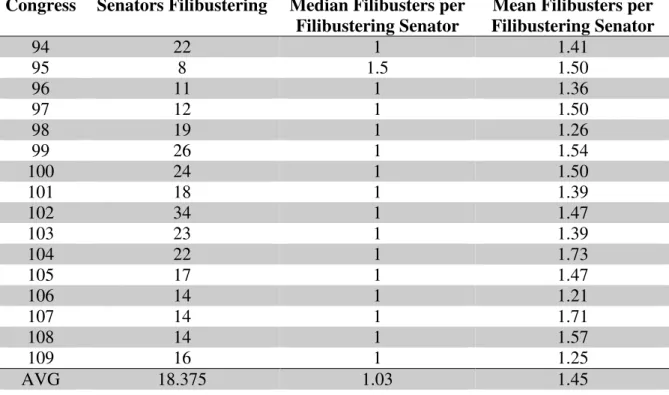
0 5 10 15 20 25 30 35 40 45
94 95 96 97 98 99 100 101 102 103 104 105 106 107 108 109
Fig. 2: Restraint from Filibuster, 94th–109th Congress
17 0
20 40 60 80 100 120 140 160
18
APPENDIX 2: TABLES Table 1: Filibustering Behavior, 94th–109th Congress
Congress Senators Filibustering Median Filibusters per
Filibustering Senator
Mean Filibusters per Filibustering Senator
94 22 1 1.41
95 8 1.5 1.50
96 11 1 1.36
97 12 1 1.50
98 19 1 1.26
99 26 1 1.54
100 24 1 1.50
101 18 1 1.39
102 34 1 1.47
103 23 1 1.39
104 22 1 1.73
105 17 1 1.47
106 14 1 1.21
107 14 1 1.71
108 14 1 1.57
109 16 1 1.25
AVG 18.375 1.03 1.45
Table 2: Final Reduction Set, 94th–109th Congress
Set Raw Coverage Unique Coverage
Solution Consistency
c•L•P•d 0.004 0.004 0.789
Total Coverage = 0.004 Solution Consistency = 0.789
Note: “C” represents a measure of constrained time, “L” is a measure of low filibustering during the previous Congress, “P” is a measure of the president’s membership in the Senate’s majority party, and “D” is a measure of Democrats being the Senate’s minority party. A lower case letter indicates the negation of that set. See text for operationalization and Log 1 for how this table was generated.
Table 3: Final Reduction Set, 94th–102nd Congress
Set Raw Coverage Unique Coverage
Solution Consistency
L•P•d•Z•m 0.000 0.000 1.000
c•L•P•d 0.010 0.009 0.789
Total Coverage = 0.010 Solution Consistency = 0.789
19
APPENDIX 3: STATA LOGS Log 1: Testing and Reducing with Fuzzy, 94th–109th Congress . insheet using Dataset_Full.csv
(24 vars, 175 obs)
. fuzzy restraint constrtimef lowfilif highpolarf prezmajor demminor, label(R C L Z P D)
. fuzzy R C L Z P D, matx(coincid suffnec) standardized
Coincidence Matrix
| R C L Z P D ---+--- R | 1.000 C | 0.723 1.000 L | 0.614 0.836 1.000 Z | 0.622 0.710 0.571 1.000 P | 0.522 0.698 0.733 0.496 1.000 D | 0.746 0.699 0.761 0.840 0.790 1.000
Sufficiency and Necessity Matrix
| R C L Z P D ---+--- R | 1.000 0.723 0.614 0.622 0.522 0.746 C | 0.381 1.000 0.594 0.511 0.445 0.621 L | 0.455 0.836 1.000 0.571 0.657 0.761 Z | 0.455 0.710 0.563 1.000 0.439 0.840 P | 0.432 0.698 0.733 0.496 1.000 0.790 D | 0.442 0.699 0.608 0.681 0.566 1.000
. fuzzy R C L Z P D, settest(yvv yvn) conval(.75) greater(col1) common
Y-CONSISTENCY vs N-CONSISTENCY
Set YCons NCons F P NumBestFit cLzPd 0.789 0.211 3.02 0.084 0 cLZPd 1.000 0.000 . . 0 cLZPD 0.555 0.445 0.27 0.604 19 CLZpD 0.557 0.443 0.32 0.571 13 CLZPd 0.667 0.333 0.37 0.542 0 CLZPD 0.544 0.456 0.28 0.600 17
Y-Consistency vs. Set Value
Set YConsist Set Value F P NumBestFit cLzPd 0.789 0.740 0.09 0.767 0
cLZPd 1.000 0.740 . . 0
Common Sets cLzPd cLZPd
. reduce
20 Minimum Configuration Reduction Set cLPd
Final Reduction Set
Coverage
Set Raw Coverage Unique Coverage Solution Consistency c*L*P*d 0.004 0.004 0.789
Total Coverage = 0.004
Solution Consistency = 0.789
Log 2: Testing and Reducing with Fuzzy, 94th–102nd Congress . insheet using Dataset_Full.csv
(24 vars, 175 obs)
. drop if cqmajor==. (72 observations deleted)
. fuzzy restraint constrtimef lowfilif highpolarf prezmajor demminor cqmajor, label(R C L Z P D M)
. fuzzy R C L Z P D M, matx(coincid suffnec) standardized
Coincidence Matrix
| R C L Z P D M ---+--- R | 1.000
C | 0.849 1.000 L | 0.497 0.922 1.000 Z | 0.328 0.748 0.287 1.000 P | 0.484 0.716 0.673 0.250 1.000 D | 0.548 0.770 0.652 0.622 0.622 1.000
M | 0.258 0.833 0.595 0.132 0.455 0.424 1.000
Sufficiency and Necessity Matrix
| R C L Z P D M ---+--- R | 1.000 0.849 0.497 0.252 0.484 0.548 0.258 C | 0.332 1.000 0.523 0.225 0.406 0.456 0.346 L | 0.343 0.922 1.000 0.152 0.673 0.652 0.436 Z | 0.328 0.748 0.287 1.000 0.250 0.622 0.132 P | 0.333 0.716 0.673 0.132 1.000 0.622 0.333 D | 0.362 0.770 0.625 0.316 0.596 1.000 0.298 M | 0.242 0.833 0.595 0.095 0.455 0.424 1.000
. fuzzy R C L Z P D M, settest(yvv yvn) conval(.75) greater(col1) common
Note: clZPdM ClZPdM Have No Information and Excluded from Test
Y-CONSISTENCY vs N-CONSISTENCY
21
CLZPdm 1.000 0.000 . . 0
Note: clZPdM ClZPdM Have No Information and Excluded from Test
Y-Consistency vs. Set Value
Set YConsist Set Value F P NumBestFit cLzPdm 0.789 0.740 0.04 0.835 0
cLzPdM 0.789 0.740 0.04 0.835 0 cLZPdm 1.000 0.740 . . 0 cLZPdM 1.000 0.740 . . 0 CLZPdm 1.000 0.740 . . 0
Common Sets
cLzPdm cLzPdM cLZPdm cLZPdM CLZPdm
. reduce
5 Solutions Entered as True
Minimum Configuration Reduction Set LZPdm cLPd
Final Reduction Set
Coverage
Set Raw Coverage Unique Coverage Solution Consistency L*Z*P*d*m 0.000 0.000 1.000
c*L*P*d 0.010 0.009 0.789
22 REFERENCES
Abbott, Andrew. 1988. “Transcending General Linear Reality.” Sociological Theory 6:169– 186.
Bell, Lauren Cohen and L. Marvin Overby. 2007. “Extended Debate over Time: Patterns and Trends in the History of Filibusters in the U. S. Senate.” Paper prepared for the Annual Meeting of the Midwest Political Science Association.
Best, Joel. 2008. “Prize Proliferation.” Sociological Forum 23:1–27.
Beth, Richard S. 1994. “Filibusters in the Senate, 1789–1993” (Memorandum). Washington, DC: Congressional Research Service.
---. 1995. “What We Don't Know about Filibusters.” Paper prepared for the Annual Meeting of the Western Political Science Association.
Beth, Richard S., Valerie Heitshusen and Betsy Palmer. 2010. “Filibusters and Cloture in the Senate” (CRS Report RL30360). Washington, DC: Congressional Research Service. Beth, Richard S. and Betsy Palmer. 2011. “Cloture Attempts on Nominations” (CRS Report
RL32878). Washington, DC: Congressional Research Service.
Binder, Sarah A. 1999. “The Dynamics of Legislative Gridlock, 1947-96.” American Political Science Review 93:519–533.
---. 2003. Stalemate: Causes and Consequences of Legislative Gridlock. Washington, DC: Brookings Institution.
Binder, Sarah A., Eric D. Lawrence and Steven S. Smith. 2002. “Tracking the Filibuster, 1917 to 1996.” American Politics Research 30:406–422.
Binder, Sarah A. and Steven S. Smith. 1997. Politics or Principle? Filibustering in the United States Senate. Washington, DC: Brookings Institution.
Bourdieu, Pierre. 1984. Distinction: A Social Critique of the Judgement of Taste. Trans. Richard Nice. Cambridge, MA: Harvard University Press.
Burdette, Franklin L. 1940. Filibustering in the Senate. Princeton, NJ: Princeton University Press.
Chiou, Fang-Yi and Lawrence S. Rothenberg. 2003. “When Pivotal Politics Meets Partisan Politics.” American Journal of Political Science 47:503–522.
23
---. 2009. “A Unified Theory of U.S. Lawmaking: Preferences, Institutions, and Party Discipline.” The Journal of Politics 71:1257–1272.
Durkheim, Emile and Marcel Mauss. 1963. Primitive Classification. Trans. Rodney Needham. Chicago, IL: University of Chicago Press.
Fenno, Richard. F., Jr. 1973. Congressmen in Committees. Boston, MA: Little, Brown. Heniff, Bill, Jr. and Justin Murray. 2012. “Congressional Budget Resolutions: Historical
Information” (CRS Report RL30297). Washington, DC: Congressional Research Service.
Jones, David R. 2000. “Explaining Restraint from Filibustering in the U.S. Senate.” The Journal of Legislative Studies 6:53–68.
Klapp, Orrin E. 1991. Inflation of Symbols: Loss of Values in American Culture. New Brunswick, NJ: Transaction Publishers.
Koger, Gregory. 2010. Filibuster: A Political History of Obstruction in the House and Senate. Chicago, IL: University of Chicago Press.
Krehbiel, Keith. 1998. Pivotal Politics: A Theory of U.S. Lawmaking. Chicago, IL: University of Chicago Press.
Lamont, Michèle. 1992. Money, Morals and Manners: The Culture of the French and American Upper-Middle Class. Chicago, IL: University of Chicago Press.
Lamont, Michèle and Virág Molnár. 2002. “The Study of Boundaries in the Social Sciences.” Annual Review of Sociology 28:167–195.
Lee, Frances E. 2009. Beyond Ideology: Politics, Principles, and Partisanship in the U.S. Senate. Chicago, IL: University of Chicago Press.
Longest, Kyle C. and Stephen Vaisey. 2008. “Fuzzy: A Program for Performing Qualitative Comparative Analyses (QCA) in Stata.” The Stata Journal 8:79–104.
Matthews, Donald R. 1960. U.S. Senators and Their World. Chapel Hill, NC: University of North Carolina Press.
Mixon, Franklin G., Jr. 2002. “Does Legislative Television Alter the Relationship Between Voters and Politicians?” Rationality and Society 14:109–128.
24
Mixon, Franklin G., Jr., M. Troy Gibson and Kamal P. Upadhyaya. 2003. “Has Legislative Television Changed Legislator Behavior? C-SPAN2 and the Frequency of Senate Filibustering.” Public Choice 115:139–162.
Oppenheimer, Bruce I. 1985. “Changing Time Constraints on Congress: Historical
Perspectives on the Use of Cloture.” Pp. 393–413 in Congress Reconsidered, 3rd ed., edited by Lawrence C. Dodd and Bruce I. Oppenheimer. Washington, DC:
Congressional Quarterly Press.
Ornstein, Norman J. 2003. “Reform Is Needed, but Tread Carefully,” Roll Call, May 21. Overby, Martin L. and Lauren C. Bell. 2004. “Rational Behavior or the Norm of
Cooperation? Filibustering Among Retiring Senators.” The Journal of Politics 66(3): 906–924.
Packer, George. 2010. “The Empty Chamber,” The New Yorker, August 9.
Ragin, Charles C. 2000. Fuzzy-Set Social Science. Chicago, IL: University of Chicago Press. ---. 2006. “Set Relations in Social Research: Evaluating Their Consistency and Coverage.”
Political Analysis 14(3):291–310.
---. 2008. Redesigning Social Inquiry: Fuzzy Sets and Beyond. Chicago, IL: University of Chicago Press.
Ragin, Charles C., Kriss A. Drass and Sean Davey. 2006. Fuzzy-Set/Qualitative Comparative Analysis 2.0. Tucson, AZ: Department of Sociology, University of Arizona.
Sinclair, Barbara. 1989. The Transformation of the U.S. Senate. Baltimore, MD: Johns Hopkins University Press.
Swidler, Ann. 1986. “Culture in Action: Symbols and Strategies.” American Sociological Review 51:273–286.
Wawro, Gregory J. and Eric Schickler. 2006. Filibuster: Obstruction and Lawmaking in the U.S. Senate. Princeton, NJ: Princeton University Press.
Weber, Max. 1949. “Objective Possibility and Adequate Causation in Historical
Explanation.” Pp. 164–188 in The Methodology of the Social Sciences, edited by Edward A. Shils and Henry A. Finch. Glencoe, NY: Free Press.