ANIMATE TEXTS: HIEROGLYPHIC READING PRACTICES IN EARLY MODERN ENGLAND, 1564-1658
Katherine Irene Shrieves
A dissertation submitted to the faculty of the University of North Carolina at Chapel Hill in partial fulfillment of the requirements for the degree of Doctor of Philosophy in the Department of English and Comparative Literature.
Chapel Hill 2013
Approved by:
Mary Floyd-Wilson
Megan Matchinske
Reid Barbour
Jessica Wolfe
ii ©2013
iii
ABSTRACT
KATHERINE IRENE SHRIEVES: Animate Texts: Hieroglyphic Reading Practices in Early Modern England, 1564-1658
(Under the direction of Mary Floyd-Wilson)
Sixteenth- and seventeenth-century hieroglyphs have rarely been studied as a
distinct category, yet they offer a new venue to deepen and complicate our understanding
of how contemporary readers, writers, and theatrical audiences conceived of their own
engagement with multimodal texts. My dissertation argues that early modern authors and
audiences conceived of “reading” such symbols not as passive consumption of a static
text but rather as an active, embodied experience of transformation as well as
interpretation. Situating my argument within the early modern intellectual contexts of
emblem theory and spiritual alchemy, I suggest that hieroglyphic reading can be
understood as a dynamic process thought to transmute both individual and collective
identities, refining the reader as well as forging new bonds among groups of elite
reader-participants.
My investigation tracks this notion of transformative reading across discursive
domains and somatic zones, beginning with a unitary, self-contained symbol in
Elizabethan polymath John Dee's alchemical writing, and ending with Sir Thomas
Browne's quincunx, an expansive hieroglyph that fully contains, describes, and embodies
humanity's capacity to perceive and interpret the world. In John Dee’s Monas
iv
masques of Ben Jonson, and Sir Thomas Browne’s Garden of Cyrus, I consider how
hieroglyphic texts “work” upon their readers in contexts both public and private, both
published and manuscript, both dramatic and non-dramatic. Although new criticism on
reading practices has begun to map the material, cognitive, and affective dimensions of
book use, my project revises our understanding of reading in the period as an active,
v
ACKNOWLEDGEMENTS
In his Monas Hieroglyphica, John Dee describes Holy Roman Emperor
Maximilian II as having profound influence over his book: “During the whole time of
birth your very pleasing countenance seemed to be present before my eyes. You have
thus eased and expedited my labors in bringing forth [this child].”1 Although my project aspires to far humbler aims than Dee’s cosmically ambitious work, there have
nonetheless been many people whose “pleasing countenances” have guided its
development. First and foremost, I am honored that Mary Floyd-Wilson has been willing
to advise me. Her guidance at all stages of the writing process has challenged me to
uncover and draw together the threads of an argument, and most of all to consider my
project’s contribution to the field of early modern literary scholarship. I could not wish
for a better mentor. I also thank Reid Barbour, Darryl Gless, Megan Matchinske, and
Jessica Wolfe for their encouragement and advice. They have each inspired me with the
models of scholarship and teaching that they embody.
I am indebted to my writing group for their contributions to Animate Texts. My
fellow writers and friends, Kate Attkisson, Lauren Garrett, Ben Sammons, and Heath
Sledge, have been willing to read everything from sketchy outlines to polished articles.
Their careful readings and probing questions have encouraged me to define the
vi
conceptual underpinnings of this project. Together we have learned, and are still learning,
what it means to be scholars. I thank them for welcoming me into their community.
My family has also been instrumental in bringing this dissertation to fruition. For
their encouragement and support in ways both tangible and intangible, I thank my
parents, Ann and Alfred Shrieves. Finally, this project could not have been completed
without Stan Rydzewski’s unwavering love and wise advice. When I was confused, he
helped me navigate the “Labyrinth of Truth”; when the tasks ahead seemed
vii
TABLE OF CONTENTS
LIST OF FIGURES...viii
Chapter
INTRODUCTION...1
I. HIEROGLYPHIC READERSHIP AND “COSMOPOLITICAL”
ALCHEMY IN JOHN DEE’S MONAS HIEROGLYPHICA...47
II. MAPPING THE HIEROGLYPHIC SELF IN THE LETTERS
OF JOHN WINTHROP, JR., AND EDWARD HOWES (1627-1640)...96
III. SPIRITUAL ALCHEMY THROUGH EMBODIED
HIEROGLYPHS IN THE JONSONIAN MASQUE...140
IV. “THE HIEROGLYPHIC OF THE WORLD”: QUINCUNCIAL
READING IN SIR THOMAS BROWNE’S GARDEN OF CYRUS...180
viii
LIST OF FIGURES
Figure
1. Emblem 21 from Michael Maier’s Atalanta Fugiens...24
2. Image from Heinrich Khunrath’s Amphitheatrum Sapientiae Aeternae (1609)...27
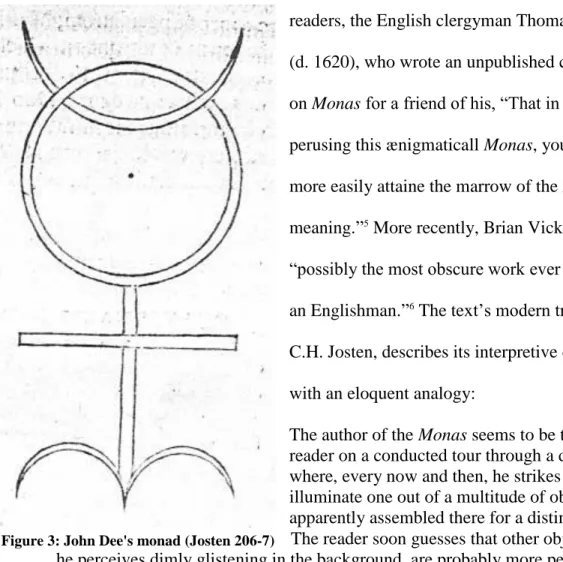
3. John Dee’s monad...51
4. Arbor raritatis, from John Dee’s Monas Hieroglyphica...90
5. Detail from letter by Edward Howes to John Winthrop, Jr., 22 January 1627...100
6. Detail from Syons Calamitye or Englands Miserye Hieroglyphically Delineated (London, 1643)...181
7. Illustration of the quincunx from Browne's Garden of Cyrus (1658)...183
8. Illustration from Rene Descartes, La Dioptrique (1637)...201
9. Illustration from Athanasius Kircher, Oedipus Aegyptiacus (1652)...214
INTRODUCTION
The Symbol: that is the means by which we infer and know something […] In short it is a representation by which something is concealed.
-- Abraham Fraunce, Symbolicæ Philosophiæ Liber Quartus et Ultimus (1585)
The story of this project begins in 1419, on the island of Andros in the Aegean Sea,
where the Florentine traveler Cristoforo Buondelmonti acquired a copy of a previously
lost text. This manuscript was Hieroglyphica, supposedly written by Horapollo, a fifth
century Alexandrian, and it contained two books with a total of 189 unillustrated
descriptions and definitions of Egyptian hieroglyphs. Buondelmonti brought the book
back to his native Florence, where it inspired a new interest in hieroglyphs and became
one of the seminal influences on the new trend for symbolic expression in the form of
emblems, imprese, and other meaningful signs that began in Italy but by the sixteenth
century had spread throughout Europe. The Greek original of Hieroglyphica was first
published in 1505 and over the next hundred years went through thirty more editions.1 After its printing made it more widely accessible, authors began translating it and
supplementing it with images, such as Willibald Pirckheimer’s translation illustrated by
Albrecht Dürer (c. 1512), or writing their own hieroglyphic texts inspired by Horapollo,
such as Piero Valeriano’s Hieroglyphica (1556).
Early modern interest in hieroglyphs continued for more than two centuries after
the rediscovery of Horapollo’s Hieroglyphica. Some authors became interested in the
specifically Egyptian provenance of such symbols, for instance Michael Maier’s Arcana
arcanissima hoc est Hieroglyphica Aegyptio-Graeca (1613) or Athanasius Kircher’s
mid-seventeenth-century “translations” of Egyptian hieroglyphs. For other authors, however,
the hieroglyphic became a mode of thought, folded into established modes like emblems
and imprese or, more generally, coming to mean symbolic expression concealing
profound, often spiritual truth that must be interpreted by the skilled reader.2
Somewhat surprisingly, given the manuscript’s dubious provenance, some portion
of Horapollo’s knowledge of hieroglyphs actually has been proven correct.3
The
historical accuracy of Hieroglyphica, however, is in some ways beside the point, as early
modern authors and artists incorporated their own imperfect understanding of ancient
Egyptian language into a broad philosophical framework that saw symbolic weight in
every object, word, and gesture. This includes the often-discussed idea of reading the
Book of Nature, but also the overarching frameworks of symbolic expression informing
early modern rhetorical practices.
As Thomas M. Greene describes it, hieroglyphs were only one part of the early
modern “mundus significans, a signifying universe, which is to say a rhetorical and
symbolic vocabulary, a storehouse of signifying capacities potentially available to each
2
Examples of this latter understanding of the hieroglyphic (that is, less explicitly Egyptian), include references to hieroglyphs in many emblem books such as Estienne’s Art of Making Devises (1655) and Paradin’s Heroicall Devises (1591), as well as works using “hieroglyphic” in a more general sense to mean any occult or mystical symbolism, such as Elsliot’s True Mariner, and his Pixis Nautica (1653) or
Pordage’s Mundorum Explicatio (1661).
3
member of a given culture.”4 An accurate reconstruction of how early modern authors and readers understood the hieroglyphic is difficult, since what Greene calls the “shifting
and tangled matrix of semiotic reserves” makes sense only within a particular cultural
and historical context.5 Indeed, excising hieroglyphs from the larger context of symbolic expression in general may seem problematic. As Michael Bath writes in Speaking
Pictures, “It is often impossible to distinguish the hieroglyphic theories of the
Renaissance, which conceived the book of the creatures as a language of natural signs,
from rhetorical theory concerning figurative constructions.”6 One fundamental task of this project, then, before discussing the particular hieroglyphs with which this dissertation
will be concerned, is to sketch the outlines of the early modern conception of the
hieroglyphic.
Two “simple” definitions immediately come to mind, but neither of these proves to
be entirely sufficient. On one hand, the term describes ancient Egyptian logographic
writing, which was a relatively new area of study in early modern Europe due to the
rediscovery of Horapollo’s Hieroglyphica. On the other hand, the term “hieroglyphic” is
used in the context of contemporary emblem theory texts to describe one of the many
varieties of early modern symbolic expression. I argue that the hieroglyphic is neither
exclusively Egyptian nor exclusively emblematic, but instead is a conceptual category
4
Thomas M. Greene, The Light in Troy: Imitation and Discovery in Renaissance Poetry (New Haven: Yale University Press, 1982), 20. On the ubiquity of nonverbal symbolic discourse in early modern culture, see also Mary E. Hazard, Elizabethan Silent Language (Lincoln and London: University of Nebraska Press, 2000). One important scholarly work that offers a comprehensive survey of hieroglyphs in relation to other forms of symbolic expression is Liselotte Dieckmann, Hieroglyphics: The History of a Literary Symbol (St. Louis, Washington University Press, 1970).
5
Ibid., 21.
that can be used to interrogate the relationship between text, image, and meaning as well
as the interpretive practices and expectations of authors and readers. Hieroglyphs have
some characteristics in common with emblems, but can nonetheless be distinguished
from them in nature, purpose, and scope.
Emblem theorists associate hieroglyphic writing with natural language, as opposed
to other types of symbolic expression, which might be “conventional” rather than
“natural.” Writers like Samuel Daniel and Francis Bacon repeatedly note that hieroglyphs
represent what Bacon calls “an affinity with the things signified.”7 More than a simple imagistic representation, that is, hieroglyphs were thought to have a congruence with the
intangible essence of the “things signified.” That essential link between a hieroglyph and
its meaning, though, can be problematic. As we will see in Chapter 4, for instance, Sir
Thomas Browne’s Garden of Cyrus both excavates quincuncial structures in nature and
imposes Browne’s hieroglyph upon the world.
The Egyptian provenance of hieroglyphs contributes to their status as ambiguously
natural signs, originally thought to be the expressions of a people with a more direct
connection to occult knowledge in the natural world. Because of their association with
Egyptian antiquity, emblem theorists often viewed them as a precursor both of written
language and of contemporary forms of symbolic expression. Hieroglyphs, thus, connote
not only antiquity but also hidden, mystical knowledge. Simply put, the purpose of
hieroglyphs is to reveal secret meanings to some readers while concealing from others.
This notion surfaces in various discursive contexts throughout this project as a
fundamental concern with community-building among readers.
5
Hieroglyphs may also be distinguished from other form of early modern symbolic
expression by the scope of their intended audience. Imprese or devices, for example, are
highly personal expressions of an individual’s character, while published emblem books
are intended for a more public venue. The hieroglyphic examples I consider here fall
somewhere in between, ranging from widely-distributed published books to private
letters. As critic Diana Galis writes, distinguishing between imprese and hieroglyphs:
“The former [imprese], so esoteric as to be intelligible only to one’s circle of
acquaintances, has a purely private application; the latter, secret yet expressive of a
tradition of wisdom accessible to all sufficiently learned men, has universal application.”8 While some hieroglyphs may have “universal application” or be publicly displayed, as
Galis’s distinction suggests, these signs nonetheless self-select an audience by virtue of
their esotericism. The group of “all sufficiently learned men” may in some cases be quite
small, and in others more expansive.
These several qualities seem at first to contradict one another. Hieroglyphs may
claim to be a public contribution to the collective human knowledge, yet they also
participate in the tradition of concealing arcane wisdom. They reflect the fundamentally
natural “essence” of the things they represent, yet that representation is mediated through
complex visual and social rhetoric. Through the exercise of defining the hieroglyphic, I
argue that hieroglyphs provide a unique locale in which to interrogate the relationship
between author, reader/audience, and text. Hieroglyphs (like and yet not-quite-like
imprese) supposedly provide a direct connection between the reader and the author’s
private, inner mind. From an authorial perspective, hieroglyphic expression entails a
8 Diana Galis, “Concealed Wisdom: Renaissance Hieroglyphic and Lorenzo Lotto’s Bergamo Intarsie,” The
balance between obviousness and obscurantism. From a readerly perspective, there is
tension along two axes: whether readers are inherently worthy to engage with a particular
text versus whether they can be trained in proper interpretation, and whether hieroglyphic
interpretation is primarily innate and nonrational or learned and rational.
These attributes of hieroglyphs, however, are interrelated and complicate one
another. For instance, the fact that hieroglyphs originate in ancient Egypt might call into
question their supposed natural affinity. As English emblem theorist Abraham Fraunce
writes, some might object that “hieroglyphs are the invention of the Egyptians, not of
nature,” but he counters this objection by noting that many hieroglyphics “find their
source in the most secret inward parts of nature herself.”9 Another area of complication is the issue of how hieroglyphic knowledge is imparted. In his introduction to Horapollo’s
Hieroglyphica, George Boas writes, “This kind of knowledge is contemplation; it is not
reasoning. It is direct, immediate, non-verbal: connaissance not science, kennen not
wissen.”10
Hieroglyphs claim to mirror their meaning so that the reader may experience it
directly, as Boas suggests, but in practice they often require elaborate explanations and
expect advanced interpretive skills from their readers. Early modern hieroglyphic
expression is a site of paradox: allegedly natural and yet fully meaningful only within
highly specific cultural contexts, carefully mediated and yet positioning itself as direct,
visual, and unmediated.
These paradoxes and difficulties do not preclude the possibility of defining the
early modern conception of the hieroglyphic, though. In fact, such paradoxes are essential
9
Abraham Fraunce, Symbolicæ Philosophiæ Liber Quartus et Ultimus, ed. John Manning, trans. Estelle Haan (New York: AMS Press, 1991), 34-5.
7
to understanding how readers and writers deploy that term. Emblem theorists often
distinguish among terms like hieroglyph, emblem, impresa, sign, and symbol, yet in
practice the boundaries between such varieties of symbolic expression are porous. (And
this does not even take into account the use of the word “hieroglyphic” in a more general
context, apart from the learned and courtly world of emblem theory.) Therefore, any
definition of the hieroglyphic cannot be generalized to all authors and all instances, and
must take into account the paradoxes inherent in the form.
There are four images or series of images around which this dissertation centers:
John Dee’s hieroglyphic monad as explicated in Monas Hieroglyphica (1564); a
geometric diagram drawn in a letter from Edward Howes to John Winthrop, Jr. (1627);
the procession of significant images in Ben Jonson’s Mercury Vindicated from the
Alchemists at Court (1615); and Sir Thomas Browne’s quincunx in The Garden of Cyrus
(1658). These images span almost a century, and none of them might be described as a
typical hieroglyph: they are not directly inspired by sources like Horapollo or Valeriano
and they do not mimic Egyptian hieroglyphs. Nonetheless, grouping these particular
images together sheds light on early modern reading practices and conceptions of
knowledge.
In these particular hieroglyphic examples, a significant image or series of
significant images functions as the embodiment of transformation, with the goal of
effecting change and perfecting the reader. Some of these images are static, by which I
mean that they are one image rather than a series of images that can be connected
syntactically. The imagery in Jonson’s masque is fluid rather than static, consisting of a
purpose: to effect change in the reader that approximates an alchemical transformation.
Within themselves, these hieroglyphs contain transformative power that the properly
engaged reader may unlock.
In the epigraph at the beginning of this chapter, Fraunce (copying directly from
French emblem theorist Claude Mignault) claims that “the symbol” allows us to “know
something” that is otherwise hidden. The purpose of symbolic expression in such a
definition is to conceal and reveal at the same time: to reveal the right meaning to the
right reader at the right time. I would go farther and argue that the purpose of early
modern hieroglyphic expression is to catalyze transformation in the individual reader and,
in the cases I will examine, in society at large.
This notion of transformative hieroglyphic interpretation is a new example of what
Jennifer Richards terms “instrumental book-use” or the model of reading as active
reinterpretation described by Lisa Jardine and Anthony Grafton.11 Beginning with Adrian Johns’ Nature of the Book, much recent scholarship has focused on the materiality of
books represented by works like William Sherman’s Used Books and Bradin Cormack
and Carla Mazzio’s Book Use, Book Theory 1500-1700.12 The aforementioned scholars all quote a maxim from Geoffrey Whitney’s 1586 Choice of Emblems, noting that early
moderns did not conceive of reading in the same way that we do: “Usus libri, non lectio
11 Jennifer Richards, “Useful Books: Reading Vernacular Regimens in Sixteenth-Century England,”
Journal of the History of Ideas 73.2 (2012): 248; Lisa Jardine and Anthony Grafton, “’Studied for Action’: How Gabriel Harvey Read His Livy,” Past and Present 129 (1990): 30-78.
12 For other works on the material, cognitive, and affective processes and import of early modern books and reading, see also the Huntington Library Quarterly special issue on early modern reading, 73 (2010); Cecile M. Jagodzinski, Privacy and Print: Reading and Writing in Seventeenth-century England
(Charlottesville: University Press of Virginia, 1999); Femke Molekamp, “Early modern women and affective devotional reading,” European Review of History: Revue europeenne d'histoire 17.1 (2010): 53-74; Kevin Sharpe, Reading Revolutions: The Politics of Reading in Early Modern England (Connecticut: Yale University Press, 2000); Kevin Sharpe and Stephen Zwicker, eds., Reading, Society, and Politics in Early Modern England (Cambridge: Cambridge University Press, 2003); Jennifer Summit, Memory’s
9
prudentes facit (The use, not the reading, of books makes us wise).”13 Cormack and Mazzio describe early modern reading as an intellectually labor intensive process of
internalizing a book rather than simply plodding through its words.14 This new critical focus on process suggests a model of active interpretation rather than passive
consumption. Katharine Craik characterizes such a process as an interchange between
text and reader that bridges the gap between intellectual and physical and may even
impinge upon the reader’s body, “a series of transactions between material language and
the material bodies of readers and writers.”15 A historicized understanding of early modern reading practices, thus, acknowledges that texts may have the capacity to change
readers on material and immaterial levels, inside the mind but also upon the body.
Hieroglyphs have not been specifically distinguished and considered within this
context, although emblems have. Cormack and Mazzio also describe a particular emblem
as a text that “[enables] a difficult kind of cognition, whereby the mind’s movement
across different and incommensurate media enacts an otherwise unrepresentable
dimension of the psyche.”16 Just as emblems combine text and image in a way that makes them uniquely poised to allow reflection on readership, so too do hieroglyphs draw
attention to the often unacknowledged processes of engaging with – transforming and
being transformed by – texts. Much book-use criticism has focused on physical use: e.g.
13
William H. Sherman, Used Books: Marking Readers in Renaissance England (Philadelphia: University of Pennsylvania Press, 2008), xiii.
14 Bradin Cormack and Carla Mazzio, Book Use, Book Theory 1500-1700 (Chicago: University of Chicago Library, 2005), 2.
15 Katharine A. Craik, Reading Sensations in Early Modern England (New York: Palgrave Macmillan, 2007), 3. See also the model of “collaborative” readership proposed in Stephen B. Dobranski, Readers and Authorship in Early Modern England (Cambridge: Cambridge University Press, 2005).
marginalia, commonplace-books, note-taking, and other physical evidence of how readers
used books. In her article about sixteenth-century medical self-help books, Jennifer
Richards turns the focus inward to books’ “instrumental” value upon the reader’s mind.
She argues that thoughtful and critical intellectual digestion of medical texts (that is, not
just practical application of their advice) is in-and-of-itself intended to have a salubrious
effect on the reader.17 The hieroglyphs this project explores reveal a similarly intellectual yet embodied interchange between “reader” – a broad category that also includes
theatrical audience members – and symbol.
Some historical and conceptual background is necessary to unfold this model of
early modern hieroglyphic reading. First, a closer examination of contemporary writings
on language and symbolic expression enables us to distinguish hieroglyphs from similar
forms like emblems, and to unpack the “natural” and “Egyptian” connotations of these
signs. Next, a consideration of the early modern conception of spiritual alchemy enables
us to see the epistemological connections between alchemical and hieroglyphic
knowledge. The esoteric symbolism of hieroglyphs has much in common with alchemical
symbolism, and early modern alchemical practice invariably had a spiritual dimension to
it. Exploring the connection between hieroglyphs and alchemy enables us to understand
what readerly transformation entails and by what processes it might occur. After
synthesizing these historical contexts of emblem theory and spiritual alchemy, an
explication of a brief excerpt from John Dee’s Monas Hieroglyphica demonstrates how
the complex of issues and definitions that characterize the early modern hieroglyphic can
be applied in a particular instance. Finally, this introduction will summarize how my
11
chapters work together to give a fuller sense of the nature of early modern hieroglyphs,
and how each individual chapter contributes to my project.
I. DEFINING THE HIEROGLYPHIC MODE OF KNOWLEDGE
What kind of knowledge do hieroglyphs represent? And how are readers meant to
engage with them? By considering early modern definitions of “the hieroglyph” we may
begin to apprehend contemporary opinions about the philosophical potential of this
symbolic mode and the way readers might approach and interpret such signs. Perhaps
because emblems and other “devices” were such popular book subjects in early modern
Europe, “emblem theory,” or the categorization of different types of symbolic expression
and meditation on their purposes and proper construction, was a frequent topic of
scholarly discourse.18 Early modern writers frequently made distinctions between various types of emblematic expression, and although these distinctions may occasionally be
stated clearly, words like emblem, device, and hieroglyphic are more often than not used
ambiguously, and the boundaries between these categories are porous. In one of the most
often-cited definitions of the hieroglyphic, Francis Bacon’s Advancement of Learning
distinguishes the symbolic category by its Egyptian heritage, natural affinity, and
capacity to be connected in sentence-like structures.
Bacon defines writing in general as a method of notating human thought, and
further divides “these Notes of Cogitations” into two broad categories: those in which
there is a direct correspondence between meaning and sign, and those in which the
relationship between meaning and sign is arbitrary and determined by cultural context.
18 For surveys of early modern emblems and emblem theory, see in particular Michael Bath’s Speaking
Pictures; Rosemary Freeman, English Emblem Books (New York: Octagon Books, 1996);and Mario Praz,
Hieroglyphs and gestures both fall into the former category in which “the note hath some
similitude or congruity with the notion.”19
Bacon defines these two terms as follows:
For as to Hieroglyphics (things of ancient use, and embraced chiefly by the Egyptians, one of the most ancient nations), they are but as continued impresses and emblems. And as for Gestures, they are as transitory Hieroglyphics, and are to Hieroglyphics as words spoken are to words written, in that they abide not; but they have evermore, as well as the other, an affinity with the things signified.20 Bacon’s definition of hieroglyphs puts the term into two separate contexts: linguistic and
emblematic. He defines hieroglyphs as a type of writing of ancient provenance, and
distinguishes them from modern “characters real” and “words” which accumulate
meaning through custom and time rather than by natural “affinity.”21
This affinity or
“similitude or congruity” also gestures toward the contemporary mental framework of
occult correspondences, placing hieroglyphs within a philosophical tradition of
significant references and influences. At the same time that hieroglyphs are contrasted
with modern written languages, Bacon also defines them in terms linked to early modern
emblem theory, as “continued impresses and emblems.” Imprese, emblems, and
hieroglyphs are similar to words insofar as they all are methods of representing thoughts
and ideas in abiding visual form (as opposed to Bacon’s definition of gestures and speech
as “transitory”), yet the type of knowledge encapsulated in these symbolic forms and the
methods of accessing that knowledge seem notably different from words. Bacon’s
definition of hieroglyphs also calls attention to the fact that hieroglyphs, unlike emblems,
can be formed into sentences and can represent an extended series of ideas.22
19
Bacon, 231.
20 Ibid., 231.
21 Ibid., 231.
13
Bacon defines emblems not as “Notes of Cogitations” like hieroglyphs, but rather
as tools in the “art of Memory,” mnemonic devices that “reduceth conceits intellectual to
images sensible, which strike the memory more.”23 Emblems, unlike hieroglyphs, are entirely removed in Bacon’s taxonomy from their linguistic context. Instead they are a
separate method of representing thought visually, but with a personal goal of aiding
individual memory rather than communicating ideas to others. Bacon’s definition places
hieroglyphs ambiguously between words and emblems, between written and emblematic
expression. Like words, they may be used in combination with one another to express
complex ideas, but like emblems they contain a structural or visual similarity to the ideas
they express.24
In Bacon’s Advancement of Learning, hieroglyphs are poised between language and
emblem. Other early modern emblem theorists place hieroglyphs more firmly in the
category of emblematics, often as the progenitors of other forms of symbolic expression
such as emblems and imprese.25 Two significant English categorizations of symbolic
expression can be found in Samuel Daniel’s Worthy Tract of Paulus Giovius (1585) and
Abraham Fraunce’s Symbolicæ Philosophiæ. Both of these texts are translations (into
English and Latin, respectively) of Italian works specifically about imprese, yet both are
in which hieroglyphs “were linked up into syntactic strings” (51).
23
Bacon, 230.
24 Rosemary Freeman also notes the tendency, inspired by early modern writers’ engagement with
Horapollo, to describe “hieroglyphics as the prototype of the emblems and of all other symbolical writing” (40-1). She writes, following the eighteenth-century emblem theorist Anthony Ashley Cooper, third Earl of Shaftesbury, that hieroglyphics are “forms half way between pictures and words” and connects them with idea of “reading” divinely inscribed meaning in the Book of Nature (41).
more than simple translations, and both place imprese as a particular star within the larger
constellation of symbolic expression that also includes hieroglyphs.
For example, Daniel draws a historical trajectory from primitive human expressive
impulses, to Egyptian hieroglyphs, to medieval and early modern heraldic imagery. His
Worthy Tract is a translation of an Italian treatise on imprese, which are personal devices
used in courtly contexts, typically consisting of an image paired with a short motto.26 In Daniel’s preface to the translation, he notes that children always want to draw on walls
(scratching out pictures with a coal, for example), and he identifies this as an innate
human tendency toward pictorial expression, out of which emerged the ancient practice
of hieroglyphic expression:27
This naturall disposition hath raigned generally euen from the beginning when the worde was but yet new, and induced nations first to figure beasts, plants, trees, celestiall signes, and such like, obseruing the nature and qualitie of euery creature represented by their figures, whereby in times they became able to shewe their intent so their frends and others vayled vnder the forme of these creatures, in which facultie the Ægyptians were most singulare as the first authors of this Hieroglyphicall art.28
Daniel’s narrative of hieroglyphic origins envisions hieroglyphs emerging naturally from
the human tendency to represent the visible world in artistic form, evolving from the
primitive doodles of children to ancient peoples’ visual reproductions of nature. This
origin story suggests a tension between the seemingly crude simplicity of hieroglyphs and
their surprising symbolic weight. More than just, say, a drawing of a fish, a hieroglyph
26 Paolo Giovio, Dialogo dell’Imprese militari et amorose (Lyons: G. Roville, 1574).
27 As several scholars have noted, Daniel’s preface, while represented as his own writing, consists largely of quotations from another Italian emblem text, Ruscelli’s Discorso. See Norman K. Farmer’s introduction to the 1976 facsimile of Daniel; Katherine Duncan-Jones, “Two Elizabethan Versions of Giovio’s Treatise on Imprese,” English Studies 52 (1971): 118-123; Michael Bath, 140.
15
represents the essence of “fishiness” in a way that the word “fish” fails to do. In this
characterization of hieroglyphic knowledge, such symbols are primitive yet also deeply
significant, reflecting the notion of Egyptian wisdom. For Daniel, though, early modern
forms of emblematic expression are superior to hieroglyph, because of the addition of
explanatory “mots or posies” – i.e. poetic mottoes that enhance and supplement the
meaning of the image.29 Since Daniel is primarily concerned with courtly imprese, he discusses hieroglyphs only as a historical precursor. Nonetheless The Worthy Tract sheds
some light on the perceived purpose of emblematic expression in general and hieroglyph
in particular.30
In the introductory letter “To his good friend Samuel Daniel,” N.W. wonders: “But
to what end serued this [hieroglyphic writing]? to shadow suerly their purposes and
intents by figures.” N.W. then moves from ancient Egypt to contemporary Europe and
wonders similarly about the purpose of imprese: “Then what was the intent of these
Ensignes and Deuises? What cause can bee pretended for them? What did they import?
Iamblichus saieth that they were conceiptes, by an externall forme representing an inward
purpose.” Both emblematic forms represent meaning via imagery, and N.W.’s reference
to Iamblichus continues the philosophical line from Egyptian wisdom through to
Neoplatonism, further suggesting that the “inward purpose” represented by hieroglyphs
may be a secret essential knowledge. This representation is not straightforward, though:
hieroglyphs “shadow” the inward meaning of the concepts they represent, sketching or
suggesting rather than literally stating. Even if hieroglyphs originated from sketches on a
29
Giovio, A.ii.r.
wall, N.W. and Daniel suggest, as a fully developed form of expression they go beyond
simple one-to-one visual representation.
Abraham Fraunce also puts great importance on the idea of emblematic expression
as an outward representation of the author’s inner thoughts: “And so, the first inventor of
the impresa presumably wished to disclose by this means a concept deeply implanted
within his mind, and to reveal it to his mistress or his friends or to other onlookers. Now
he was aware that in order to disclose to others the ideas conceived within his mind he
needed either a motto or symbolic images.”31 He describes imprese as an expression of “an idea which he [the inventor] had already conceived within his mind” and again as an
“idea conceived within the mind.”32
Fraunce’s Symbolicæ, which draws upon several
Italian theorists in addition to Giovio, conceives of imprese as an alternative to written
language, a form of expressing oneself with different aims and interpretive practices from
writing.
As in Daniel’s Worthy Tract, hieroglyphs are characterized as another species
within the broader genus of symbols, under which Fraunce distinguishes between
emblems, imprese, and hieroglyphics. Emblems are very similar to imprese but more
public, meant to have a “general application” rather than, like imprese, representing the
character and worldview of a particular individual.33 For Fraunce, hieroglyphs are
distinguished from other symbolic categories because they lack any supplemental text; an
impresa with no motto “will be confused with hieroglyphs.”34 Moreover, they have
31
Fraunce, 6-9.
32 Ibid., 8-9 and 14-15.
33 Ibid., 14-17.
17
particular connotations of ancientness and secret wisdom.35 So far in Bacon, Daniel, and Fraunce, we have seen that hieroglyphs share characteristics with emblems and imprese,
but they differ in their Egyptian origins and supposedly natural correspondence between
meaning and sign.
This “affinity with the things signified,” to return to Bacon’s phrase, relates
hieroglyphs to the debate over natural versus conventional signs and the search for
“natural language” or “real characters” that was part of intellectual culture in sixteenth-
and seventeenth-century Europe.36 Natural language or real characters are signs that have a direct relationship to their referents, either because the symbol literally looks like what
it represents, or because it reflects the intangible essence of what it represents. Many
early modern scholars viewed hieroglyphic writing as a type of natural language, as when
Bacon notes that in hieroglyphs “the note hath some similitude or congruity with the
notion.”37
The linguistic puzzle of constructing or reconstructing a truly natural language had
both religious and epistemological implications. For many scholars, this project meant
recovering or reconstructing the prelapsarian or “adamic” language, and many early
modern thinkers considered hieroglyphs to have a central place in this quest. As critic
Thomas C. Singer notes, however, early modern ideas about natural language were
hardly monolithic. Singer makes a chronological distinction between earlier efforts,
which focused on the theological implications of natural language, and later thought,
35 Ibid., 28-9 and 34-5.
36 See, among others, James Knowlson,
Universal Language Schemes in England and France 1600-1800; Umberto Eco, The Search for the Perfect Language, trans. James Fentress (Cambridge, Mass.: Blackwell, 1995); Thomas C. Singer, “Hieroglyphs, Real Characters, and the Idea of Natural Language in English Seventeenth-Century Thought,” Journal of the History of Ideas 50.1 (1989): 49-70.
which focused more on a “philosophical language” by which scholars from all nations
might communicate with each other:
While early humanists conceived of a natural language as being related in some way to the language spoken by Adam in the Garden of Eden and to animal symbolism, many proponents of a natural language in the mid-seventeenth
century conceived of it either as a universal language that might be understood by all men or as a philosophical language made up of ‘real characters,’ whose
composition would mirror the composition of and relation between the things of the world38
Singer notes, moreover, that hieroglyphs are an intellectual site in which these ideas
converge: “In England hieroglyphs, universal languages, real characters, philosophical
languages, and natural language form a spectrum of related ideas during the late
Renaissance and the first three-quarters of the seventeenth century […] within the culture
as a whole these languages provided mutual support for one another.”39 My project is not primarily concerned with early modern universal language endeavors, but rather with
what it means that hieroglyphs are conceptually associated with such endeavors. As
Singer suggests here, early moderns saw the ancientness of hieroglyphs as aligned not
only with the Egyptian tradition but also with the prelapsarian origins of human
expression itself. In either case, these origin stories align hieroglyphic knowledge with
ancient secrets and special insight into the inner workings of the natural world.
At the same time as early modern authors associated hieroglyphs with natural
language, however, the symbols also inevitably have something conventional or arbitrary
about them. In his survey of Italian emblem theory, Abraham Fraunce notes that some
theorists reject hieroglyphs because they are the obscure relics of a foreign culture:
38 Singer, 51.
19
…for hieroglyphs are the invention of the Egyptians, not of nature. But because many, or rather very many, of the hieroglyphs which I have described in previous books find their source in the most secret inward parts of nature herself and have been acclaimed for some time in the literature and tongues of all nations, let us retain them and acquire from them the ‘bodies’ and images of imprese; let us abandon the others which are more abstruse and contain some Egyptian mysteries or other, but have no connection with the workings of nature.40
In this critique, Fraunce notes that some hieroglyphs are purely “the invention of the
Egyptians” - that is, conventional signs whose original meaning was situated within
Egyptian philosophy and culture - but other hieroglyphs are more like natural signs that
“find their source in the most secret inward parts of nature herself.” For the purposes of
his treatise on imprese, Fraunce rejects the influence of those “abstruse” hieroglyphs,
arguing that if imprese are to adopt and incorporate hieroglyphs, they should be easier to
understand and thus natural, rather than conventional (since one idea about natural signs
is that they require no particular expertise to interpret them, because everyone
“understands” an image of the natural world).
One contention of this dissertation is that hieroglyphs are a category fraught with
paradox. They are natural and yet arbitrary, obvious and arcane. Fraunce’s discussion of
Egyptian hieroglyphic origins assumes that Egyptians themselves were uniquely
positioned to understand the “secrets inward parts of nature herself.” Thus, signs that are
“the invention of the Egyptians” are nonetheless natural or real characters.
Fraunce’s perspective is a result of the connotations of ancient Egypt to an early
modern European mind. Erik Hornung and Erik Iversen’s accounts of early modern ideas
about Egyptian wisdom are particularly useful for understanding the cultural context of
hieroglyphs.41 In The Secret Lore of Egypt, Erik Hornung coins the term “egyptosophy” to describe “the study of an imaginary Egypt, viewed as the profound source of all
esoteric lore.”42 Hornung’s definition elegantly captures the philosophical context within which early modern readers would have placed hieroglyphs, and his book unfolds the
story of how legitimate Egyptian lore became transformed through processes of
inaccurate representation and imaginative addition into the hermetic-esoteric material that
would have been familiar to early modern authors. When early modern emblem theorists
and authors thought about ancient Egypt, they thought not only of the pyramids or
historical examples of hieroglyphs on Roman obelisks, but also of what we now
recognize as inaccurately-attributed texts like the famous Emerald Tablet of alchemical
secrets, or quasi-mythical figures like Hermes Trismegistus. Thus, hieroglyphs cannot be
separated from the loosely-defined esoteric tradition invoked by their association with
Egypt.
In The Myth of Egypt, Erik Iversen tells a similar story of the early modern
fascination with Egypt. Iversen notes that the interest in late antique authors like
Iamblichus and Plotinus during the Florentine Neoplatonist revival resulted in a lasting
connection between hieroglyphs, Neoplatonic philosophy, and transcendent mysticism.
Iversen writes: “Egyptian wisdom, Neo-Platonic philosophy, and the humanistic studies,
41 See also J.R. Harris, The Legacy of Egypt (Oxford: Clarendon Press, 1971), Garth Fowden, The Egyptian
Hermes: A Historical Approach to the Late Pagan Mind (Princeton: Princeton University Press, 1993), Jan Assmann, Moses the Egyptian: The Memory of Egypt in Western Monotheism (Cambridge: Harvard University Press, 1998), and Edgar Wind, Pagan Mysteries in the Renaissance (London: Faber, 1968). See also Erwin Panofsky’s description of Dürer’s hieroglyphic inspiration for the triumphal arch for
Maximilian I: “Egypt, the home of sacred mysteries, had always held a strange fascination for the erudite and would-be erudite, and the humanists greeted with enthusiasm a new ideographic language which could express a whole sentence by a series of images and was both international and esoteric” (173).
21
became in this way consecutive links in an unbroken chain of tradition, joined together
and united with Christianity by their common aim: the knowledge and revelation of
God.”43 Hieroglyphs thus become freighted with the semantic weight of Egyptian wisdom, and their “true significance thus revealed was nothing less than an insight into
the very essence of things […] made possible by an immediate contact between the
human intellect and the divine ideas.”44 We see Hornung’s and Iversen’s “Egyptosophy” illustrated in Bacon’s reference to the Egyptians as “one of the most ancient nations,”
Daniel’s explanation of the Egyptians’ development of symbolic visual expression, and
Fraunce’s grudging acknowledgement of signs that “contain some Egyptian mysteries or
other.” Hieroglyphs, thus, were thought to be both unmediated representations of nature
and reflections of the Egyptian’s unique insight into the natural world.
Nevertheless, Fraunce’s measured critique of the Egyptian wisdom tradition
suggests that, like attitudes toward natural language, attitudes toward Egyptian wisdom
were not monolithic or uncritical. Fraunce acknowledges that some people might reject
hieroglyphs as purely “the invention of the Egyptians,” and he does not view this
rejection as entirely unreasonable. In his acknowledgement that some hieroglyphs are
culturally-bound relics while others reflect the “secret inward parts of nature herself,” he
strives to find a middle ground between viewing all hieroglyphs as simply arbitrary signs
and uncritically accepting the Egyptian wisdom tradition.
These issues of arbitrary vs. natural signs and the extent to which the early modern
conception of Egyptian wisdom informs the hieroglyphic tradition both touch upon what
43
Erik Iversen, The Myth of Egypt and its Hieroglyphs in European Tradition (Princeton: Princeton University Press, 1993), 60.
Thomas C. Singer calls “a problem of representation.”45
The writings of Bacon, Daniel,
and Fraunce suggest that hieroglyphs were thought of as “natural” signs, that is, direct
and unmediated representations of true meaning, yet notions of “naturalness” were
complicated by the potential origins of hieroglyphs as reflections of ancient Egyptian
mystical knowledge, as echoes of prelapsarian written language, or as expressions of the
mind of individual authors. Nonetheless, these signs were thought to allow special access
to a hieroglyphic mode of knowledge, enabling the reader to attain unique philosophical
insight. I turn next to the mechanisms of reading, the recursive processes of interacting
with a hieroglyphic text that early modern readers conceived of as potentially
transformative.
II. ENGAGING WITH HIEROGLYPHS AS ALCHEMICAL PRACTICE
Early modern alchemical discourse provides a useful context for deepening our
understanding of hieroglyphic reading practices, both because alchemical texts were
often rife with symbolic images and because the concept of spiritual alchemy enables us
to understand how hieroglyphic interpretation was thought to change readers. As Alison
Adams and Stanton J. Linden write in their introduction to Emblems and Alchemy,
alchemical texts often rely heavily upon emblems, and “alchemical representation, like
the traditional emblem, is characteristically a fusion of the verbal and the visual, word
and picture.”46 Even alchemical texts that lack illustrations often rely upon highly visual, figurative language, but many illustrated works include symbolic images that represent
alchemical processes or hieroglyphic signs denoting alchemical substances. Moreover,
45
Singer, 50.
23
alchemical texts often display the same the paradoxical impulses of revelation and
concealment that characterize hieroglyphic expression. On several levels, then, a
consideration of alchemical rhetoric and spiritual alchemy provides a model for how
hieroglyphic texts were thought to transform the individual and communal identities of
their readers.
One need only see an example like the illustration from Michael Maier’s 1617
Atalanta Fugiens, a book of alchemical emblems, to confirm the close relationship
between hieroglyphs and alchemy (Figure 1). Moreover, in this particular alchemical
emblem we can see the confluence of emblem and hieroglyph – and material and spiritual
alchemy – that characterize the early modern hieroglyphs examined in this project.
Maier’s emblem 21 follows the traditional emblem pattern of an image accompanied by a
motto, but the image itself has much in common visually with the geometric hieroglyphs
of Howes’s Mysterium diagram, Dee’s monad, and Browne’s quincunx. Moreover, the
image reflects a simultaneous concern with material and spiritual alchemical practice.
The emblem describes the role of “squaring the circle” in the process of creating the
philosophers’ stone, and the imagery of the man and woman inscribed within a series of
geometric figures represents the alchemical trope of the “chemical wedding” of mercury
and sulphur. Yet the image has a spiritual valence as well: as Hereward Tilton writes,
Maier uses “an occult geometry to describe a ‘spiritual’ body that is the image of divine
perfection, uniting opposites within itself.”47 Maier’s emblem represents not only the technical processes of metallic refinement but also the perfectibility of the individual
human soul.
47 Hereward Tilton, The Quest for the Phoenix : Spiritual Alchemy and Rosicrucianism in the Work of
Like Maier’s alchemical emblem, the hieroglyphs examined in this dissertation
operate on at least two levels. They claim to describe or reveal occult properties of the
natural world, or to teach specific material processes for manipulating natural objects. At
the same time, they seek to transform the reader through revelatory understanding, a
process which has implications beyond self-improvement for the single reader, reaching
outward to larger-scale social or spiritual transformation. How does this transformation
occur, though? There is a danger that this process might seem so vague and mysterious as
to be incomprehensible, but one aim of this project is to situate the transformative act of
hieroglyphic engagement within an early modern epistemological and alchemical context.
Figure 1: Emblem 21. Michael Maier, Atalanta Fugiens (Kassel: Bärenreiter, 1964),
25
The hieroglyphs that I will examine are often paired with text, yet the act of
engaging with a hieroglyph is not exactly equivalent to “reading.” Hieroglyphic
engagement, as characterized in the examples that this project will examine, is less like
interpreting a text and more like experiencing a text. Even “experiencing” might be too
passive a verb: in Dee’s Monas Hieroglyphica, the “reader” is meant to actively
manipulate the text’s central symbol, and in Jonson’s Mercury Vindicated, both the
masquers and the audience participate in the creation of the hieroglyphic text through
their dances.
Two concepts – one rhetorical and one drawn from occult philosophy – can help us
to theorize hieroglyphic engagement. The first is the concept of enargeia, a rhetorical
figure in which an author seeks to achieve “the graphic portrayal of living experience”
through vivid, visually-engaging language.48 Drawing upon Erasmus’ definition of enargeia, Michael Bath in Speaking Pictures applies this concept to emblems, noting that
“emblems persuade the reader that he has ‘seen,’ not ‘read’ […] the meaning of an
emblem,” and that “an appeal to the eye was felt to be a more immediate and direct route
to the reader’s memory and his understanding.”49
In hieroglyphs, perhaps even more than
emblems, it is through visual engagement with the symbol that the reader gains access to
meaning.50 By conveying their meaning through sight rather than words, hieroglyphic
48
Gerard Paul Sharpling, “Towards a Rhetoric of Experience: the Role of Enargeia in the Essays of Montaigne,” Rhetorica: A Journal of the History of Rhetoric 20.2 (Spring 2002): 173.
49 Bath, 55.
reading becomes an experiential process, purporting to offer an unmediated connecting
between sign, meaning, and the reader’s understanding.
The rhetorical concept of enargeia allows us to understand how visual
representation could be thought of as a uniquely direct mode of apprehension, but how
might this process of apprehension actually work? Stephen Clucas’s concept of
inspectival knowledge offers a model of how meaning was thought to have been
transmitted from hieroglyph to reader/audience. Drawing on a twelfth-century text of
Solomonic magic owned by John Dee, Clucas argues that the visual components (such as
the seals detailed in the Liber Misteriorum) and the “visual logic” of Dee’s angelic
conversations were intended to work through an “inspectival” process, in which
physically looking at an object or image, combined with inward meditation, results in
“revelatory access” to meaning.51
Clucas writes that this mode of knowledge “involves a
kind of seeing which involves both physical sight and ‘the eyes of faith’ (or spiritual
vision) and requires the ocular infusion of prophetic ‘mysteries’ or revealed knowledge,”
and that the “inspectival” process applies not only to images, but also to “the highly
visual language of parable, allegory, and visionary narrative.”52 As we can see in Figure 2, an illustration used by Clucas that depicts a scholar receiving knowledge through
“magical inspection,” the inspectival knowledge is also embodied knowledge. The
magical adept in Khunrath’s image acquires knowledge by prostrating himself before
symbolic texts, recalling Craik’s characterization of reading as a “material transaction.”
51 Stephen Clucas, “’Non est legendum sed inspicendum solum’: Inspectival knowledge and the visual logic of John Dee’s Liber Mysteriorum,” in Emblems and Alchemy, ed. Alison Adams and Stanton J. Linden (Glasgow: Glasgow Emblem Studies, 1998), 112. Clucas describes Dee’s monas as working through this type of “inspectival” process, “in which the eponymous magical character or talisman was […] to be ‘inspected’ rather than analyzed” (121).
27
If enargeia describes the seeming unity of sign and meaning that characterizes
hieroglyphs, then inspectival knowledge explains the method by which the
reader/operator accesses and activates that meaning. Clucas notes, interestingly, that this
idea of “visionary infusion” gives the reader less agency: the sign’s fixed meaning
influences and works upon the reader, rather than the other way around.53 Hieroglyphic engagement is a two-way-street of agency: the reader must be prepared through study or
inherent receptivity, and he or she must go through the motions (whatever those may be)
of “actuating” the hieroglyph, yet at some level the hieroglyph infuses the receptive
reader with meaning.
“Reading,” thus, is too narrow a
term to describe the complex
interaction between reader, symbol,
and meaning that occurs when
someone engages with a hieroglyphic
text. At the very least, the reader must
have an active understanding of the
symbol’s import (as we will see in
Edward Howes’ expectation for his
friend John Winthrop, Jr.’s
understanding of the Mysterium
diagram). At its most extreme, this
53 Ibid., 121.
Figure 2: Image from Heinrich Khunrath’s
Amphitheatrum Sapientiae Aeternae (1609),
active understanding becomes active participation, in the form of Jonson’s masque
participants and audience joining together in dance: through ritualized dance (not unlike
ceremonial magic), both observers and operators act out a hieroglyphic performance, and
through their actions are transformed.
This transformation is crucial, and is the reason why the notion of spiritual
alchemy, broadly defined as personal or even political refinement, unifies these
seemingly disparate texts. The knowledge imparted by these early modern hieroglyphs is
not simply theoretical, and does not simply augment the reader’s store of knowledge. The
ultimate result of hieroglyphic engagement, I argue, is transmutation: of the individual
reader/audience member, but also potentially of society as a whole. Alchemy is not just a
metaphor for the action that occurs when readers engage with hieroglyphics. Rather,
hieroglyphic reading is in itself a kind of spiritual alchemy.
As cultural historians have long noted, an understanding of alchemy as operating on
immaterial as well as material levels was commonplace in sixteenth- and
seventeenth-century England.54 Early modern alchemy inevitably made claims not only to the
transmutation of metals or other chemical processes, but also to the inward purification of
the alchemist. Lyndy Abraham writes that alchemical emblems “simultaneously represent
a ‘chymical’ substance and a psychic truth” and notes, “From the earliest treatises,
alchemy had been concerned with both the physical and metaphysical […] such a unified
54 The notion of spiritual alchemy has been discussed extensively in scholarly work on the history of science and the history of ideas. See, for instance, Robert M. Schuler, “Some Spiritual Alchemies of Seventeenth-Century England,” Journal of the History of Ideas 41 (1980): 293-318; Bruce Janacek,
Alchemical Belief: Occultism in the Religious Culture of Early Modern England (University Park, PA, Penn State University Press: 2011); B.J.T. Dobbs, Alchemical Death and Resurrection: The Significance of Alchemy in the Age of Newton (Washington, D.C., Smithsonian Institution Libraries: 1990); Neil Kamil,
29
philosophical experience of matter existed beyond the scope of the rational mind, and
could only adequately be expressed in symbol, emblem, paradox, and allegory.”55 Peter Levenda describes early modern alchemy (specifically in the Rosicrucian text The
Chymical Wedding of Christian Rosenkreuz) as “a mutually reinforcing system of inner
transformation and outer chemical process.”56 Spiritual alchemy, I suggest, offers a historically-grounded model for the kind of readerly refinement that hieroglyphs were
thought to enable.
Although alchemical writing and practice inevitably had a spiritual valence, this is
not to say that early modern thinkers had a uniform idea of what spiritual alchemy
entailed. At the most extreme end of the spectrum were those who saw material alchemy
as a fruitless discipline and saw only figurative value in an alchemical analogy of
spiritual betterment.57 Most people were less skeptical of the claims of material alchemy and saw the connection between material and spiritual practice as more integral, although
to varying degrees.58 As Bruce Janacek notes in his recent Alchemical Belief, spiritual alchemy entailed creating the philosophers’ stone in order to “redeem ‘corrupted’ matter
and therefore possibly - hopefully - transform and restore the entire natural world to its
55 Lyndy Abraham, A Dictionary of Alchemical Imagery (Cambridge: Cambridge University Press, 1998), 99.
56 Peter Levenda, Stairway to Heaven: Chinese Alchemists, Jewish Kabbalists, and the Art of Spiritual
Transformation (New York: Continuum, 2008), 207.
57
See, for example, Bruce Janacek’s discussion of Patrick Scot’s Tillage of Light (1623): “Scot thought it was fine to believe in alchemy metaphorically, that is, to believe that individuals could be transformed and that even the bases of individuals might be redeemed in the eyes of God, but he argued that it was at best unhelpful and at worst spurious to believe that actual transmutations of metal were possible and that these transmutations could emanate to other properties in the natural world.” Janacek, 43.
pristine, prelapsarian state, when humanity and nature were in perfect harmony.”59 For others, working with physical substances was less important than a quest for “spiritual
enlightenment” via alchemically-directed meditation.60
As Robert M. Schuler has noted
in his discussion of pluralistic “spiritual alchemies,” however, “In a period of such
religious heterogeneity […] the term ‘spiritual alchemy’ is useful only in a very general
way.”61 I would suggest, though, that the flexibility of this concept makes it more rather than less useful: it thus becomes possible to locate and contextualize different models of
the spiritual alchemical transaction in the different hieroglyphic texts this project
examines.
Such notions crossed denominational borders, and people of widely varying
theological viewpoints “could find in alchemy something to harmonize with their very
different religious beliefs and experiences.”62 The connection between, for instance, Paracelsian philosophy and medical practice and Puritanism has been well-documented,
and individuals from every conceivable early modern religious proclivity drew upon
various aspects of the alchemical and hermetic traditions.63 Acknowledging the diverse definitions of spiritual alchemy in the early modern period is important, and my project
does not conceive of spiritual alchemy as a monolithic concept. Each chapter situates the
59 Janacek, 3.
60 See Schuler’s reading of the bylaws of a seventeenth-century secret society (294-303).
61 Schuler, 318. Schuler is speaking specifically about seventeenth-century England, but his point applies more broadly to sixteenth- and seventeenth-century Europe as a whole.
62 Ibid., 294.
63 On Paracelsian alchemical and medical thought and Puritanism, see P.M. Rattansi’s seminal essay, “Paracelsus and the Puritan Revolution,” Ambix 11 (1963):24-32, and more recent scholarship, including J. Andrew Mendelsohn, “Alchemy and Politics in England 1649-1665,” Past and Present 135 (1992): 30-78; Neil Kamil, Fortress of the Soul (Baltimore: Johns Hopkins UP, 2005); Walter W. Woodward, Prospero’s
31
author’s ideas about material and spiritual alchemical practice within his own particular
cultural and philosophical context.
The process of spiritual alchemy offers a model for transformative reading, but this
conceptual parallel is not the only point of contact between alchemy and hieroglyphs.
Alchemical practice shares with hieroglyphic discourse its characteristic tension between
revelation and concealment. As Seth Ward and John Wilkins wrote in the
mid-seventeenth century, “‘Hieroglyphicks […] were invented for concealment of things,’
rather than ‘for explication of our minds and notions.’”64
Erik Hornung’s definition of
“esoteric” from his discussion of the Egyptian wisdom tradition also evokes some of the
key characteristics of the early modern hieroglyph: “Esoteric matters have to do with
hidden, often deliberately concealed truths that can be grasped only through intuition or
revelation and that elude any and all experimental verification.”65 Pamela Long’s discussion of openness and secrecy in scientific and occult thought provides another
useful perspective on the paradoxical impulses toward openness and secrecy. Writing
about an earlier hieroglyphic moment, the late antique neoplatonism of authors like
Iamblichus (who in turn directly inspired the fifteenth-century Florentine neoplatonists,
feeding directly into the early modern hieroglyphic tradition), Long describes
hieroglyphic writing as particularly suited to denoting esoteric knowledge: “[they] valued
in particular the process by which one gained an understanding of these symbols […] that
person would then understand how much righteousness and truth these symbols
64 Allen G. Debus, Science and Education in the Seventeenth Century: The Webster-Ward Debate (New York: American Elsevier Publishing Company, 1970), 212.
contained when they were freed from their enigmatic forms.”66 For Long, cloaking arcane knowledge within specialized, symbolic discourse is a way of establishing community
bonds among like-minded thinkers: “Secrecy would have served to reinforce the intense
closeness of the group, giving them a bond of shared knowledge from which outsiders
were excluded.”67 In general, alchemical and hieroglyphic texts are similarly concerned with constructing an elite community of the initiated.
This community-building impulse in both alchemical and hieroglyphic discourse
seeks to conceal meaning from unworthy readers and reveal it to the worthy. Like Long’s
description of esoteric bonds, Umberto Eco portrays hieroglyphs as creating a community
through the exclusion of the supposedly unworthy: “These symbols were initiatory,
because the allure of Egyptian culture was given by the promise of a knowledge that was
wrapped in an impenetrable and indecipherable enigma so as to protect it from the idle
curiosity of the vulgar multitudes.”68 Similarly, what Diana Galis calls “the hieroglyphic method” consists of revealing meaning “to the knowledgeable few, while concealing it
from the ignorant multitude.”69 This divide between worthy and unworthy reveals a profound anxiety about the “vulgar” or “ignorant” masses acquiring hieroglyphic
knowledge. In the chapters to come, we will see this anxiety in Dee’s fear of what might
happen “if vulgar men were listening” to his hieroglyphic explication and Howes’ worry
that his letters might “fall into vnworthie hands.”70
Even the characteristic divide between
66 Pamela Long, Openness, Secrecy, Authorship: Technical Arts and the Culture of Knowledge from
Antiquity to the Renaissance (Baltimore: Johns Hopkins University Press, 2001), 57. 67
Ibid., 63.
68 Eco, 154.
69 Galis, 364.