The effects of economic and sociocultural stressors on the
well-being of children of Latino immigrants living in poverty
Marina M. Mendoza1, Julia Dmitrieva1, Krista M. Perreira2, Eliana Hurwich-Reiss1, and Sarah Enos Watamura1
1University of Denver
2University of North Carolina at Chapel Hill
Abstract
Objectives—This paper explored whether preschooler's physical (body mass index and salivary cortisol levels) and psychological (internalizing/externalizing behaviors) well-being were predicted by economic hardship as has been previously documented, and further whether parental immigration-related stress and/or acculturation level moderated this relationship in low-income Latino families.
Methods—The sample for the current study included 71 children of Latino immigrants (M = 4.46 yrs, SD = .62). Parents completed questionnaires assessing immigration-related stress, acculturation level, economic hardship and child internalizing and externalizing behaviors. Child's BMI was also calculated from height and weight. Salivary cortisol samples were collected mid-morning and mid-afternoon at home on non-child care days. Salivary cortisol values were averaged and log transformed.
Results—Children's salivary cortisol was predicted by an interaction between economic hardship and acculturation, with lower cortisol values except when children were protected by both lower acculturation and lower economic hardship. Both internalizing and externalizing behaviors were predicted by an interaction between economic hardship and immigration-related stress, with highest behaviors among children whose parents reported high levels of both economic hardship and immigration-related stress.
Conclusions—The effects of economic hardship on the well-being of young children of Latino immigrants may depend on concurrent experiences of sociocultural stress, with detrimental effects emerging for these outcomes only when economic hardship and sociocultural stressors are high.
Keywords
children of immigrants; Latino children; immigration stress; stress physiology
In the United States, nearly half of Latino children have at least one immigrant parent (Murphey, Guzman, & Torres, 2014), and children of immigrants are disproportionally represented among those living in poverty (Chaudry & Fortuny, 2010; Lopez & Velasco, 2011; Murphey et al., 2014). Poverty is well known to have negative effects on child health and development especially early in life (e.g., Bradley & Corwyn, 2002; Brooks-Gunn & Duncan, 1997; Garner et al., 2012). Living in poverty is associated with poorer physical
HHS Public Access
Author manuscript
Cultur Divers Ethnic Minor Psychol
. Author manuscript; available in PMC 2017 July 01.Published in final edited form as:
Cultur Divers Ethnic Minor Psychol. 2017 January ; 23(1): 15–26. doi:10.1037/cdp0000111.
A
uthor Man
uscr
ipt
A
uthor Man
uscr
ipt
A
uthor Man
uscr
ipt
A
uthor Man
uscr
(for a review, see; Sirin, 2005), an increased risk of serious emotional and behavioral problems in childhood (Murdock, Zey, Cline, & Klineberg, 2010), and mental health problems in adulthood (Lynch, Kaplan, & Shema, 1997; Wadsworth, Raviv, Santiago, & Etter, 2011). Exposure to the multiple physical and psychosocial risks that occur more commonly when families are facing poverty contributes to increased risk for behavior problems in low-income children (Evans & English, 2002; Evans, Li, & Whipple, 2013).
Despite the documented importance of early life stress on long term health outcomes (Essex et al., 2011) and cumulative risk models showing the detrimental effects of stressors
particularly in low income families (Evans & English, 2002) few studies have examined how environmental stressors interact to influence child outcomes in young low-income children of Latino immigrants. Even less research has investigated how culturally relevant factors may interact with poverty-related stressors to affect the well-being of young children of Latino immigrant. Within the last 10 years, increased attention has been placed on the impact of culturally specific stressors on mental health outcomes (for a review, see; Gupta, Leong, Valentine, & Canada, 2013; Yoon et al., 2013). The National Research Center on Hispanic Children and Families recently urged researchers to reflect the diversity within the Latino population by consistently including measures of demographics and acculturation. The Center emphasized that this is necessary to improve the well-being of low-income Latino children and families (Wildsmith, Ansari, & Guzman, 2015). Since so little research has addressed children’s well-being within immigrant families, we were interested in the associations among economic hardship, immigration stress, acculturation, and child outcomes. We were interested in whether consideration of sociocultural and economic factors —both unique to immigrant families (immigration-related stress, acculturation levels) and potentially shared by families facing poverty regardless of immigration status (economic hardship) —was important to consider. This information will allow us to better understand and serve Latino immigrant children and their families.
Theoretical Framework
Bronfenbrenner’s Ecological Systems framework (1977) posits that economic and
sociocultural factors such as economic hardship, immigration stress, and acculturation levels and interactions among them influence the child in complex ways. A potential pathway that links environmental stressors to poor child outcomes are through psychosocial mechanisms (Yoshikawa, Aber, & Beardslee, 2012). Conger and colleague’s Family Stress Model (FSM; Conger & Elder, 1994) illustrates how environmental stressors influence child outcomes through changes in parent psychosocial behaviors. Family Stress Models find that economic hardship leads to poor child outcomes via its negative impact on parental mental health, inter-parental relationships, and parenting practices. The FSM has been replicated among diverse low-income populations including Latino families (Parke et al., 2004). However, in the replication study in low-income Latino families the link between economic hardship and poor child outcomes differed between Latino and European American samples (Parke et al., 2004). Specifically, the effect of inter-parental conflict on child problem behaviors among Mexican American families was strong but was negligible for European American families. Taking into account acculturation levels greatly improved the model fit for Mexican American families; showing greater maternal acculturation was associated with increased
A
uthor Man
uscr
ipt
A
uthor Man
uscr
ipt
A
uthor Man
uscr
ipt
A
uthor Man
uscr
marital problems but lower levels of hostile parenting. Traditional Latino values of familism, which reflect family closeness, loyalty, and obligation, may have a strong impact on child outcomes, especially in less acculturated Latino families (Calzada, Tamis-LeMonda, & Yoshikawa, 2013).
A study by White and colleagues (2009) examined the FSM within Mexican American families, and included the effects of immigrant-related stress (i.e., acculturative stress) on parental depression and parenting behaviors yet did not include child outcomes. The current study extends these mentioned works using FSM by testing the interactions among
economic hardship and sociocultural stressors (e.g., immigration-related stress, acculturation) on multiple domains of child outcomes (e.g., body mass index, cortisol patterns, and problem behaviors). Due to cross sectional data and a small sample size the current study includes the outer anchors of the FSM (economic/immigration stress and child outcomes), but not the mediating pathways of parental depression and parenting. Inclusion of all aspects of the FSM and culturally relevant measures is a clear direction for future research.
Economic and Sociocultural Stressors Separately Affect Multiple Domains
of Child Outcomes
Body mass index (BMI)
Financial strain puts children at an increased risk of being obese and overweight (for a review, see; Gundersen, Lohman, Garasky, Stewart, & Eisenmann, 2008). Latino children are more likely to be overweight than their non-Latino counterparts (Wang & Beydoun, 2007). For immigrant families, higher acculturation levels may change meal time patterns that in turn lead to higher BMIs than families who are less acculturated (Franzen & Smith, 2009). Higher BMIs at a young age is problematic because childhood obesity predicts serious adult diseases such as cardiovascular disease and diabetes (e.g., Lane, Bluestone, & Burke, 2012). This evidence suggests that economic and sociocultural factors including distress due to economic hardships, elevated immigration-related stress, and acculturation may interact to contribute to these elevated rates of overweight and obese profiles in Latino children.
Salivary cortisol
Neurobiological systems that regulate stress are affected by a broad range of environmental stressors (Gunnar & Quevedo, 2007). The hormone cortisol, the downstream product of the hypothalamic pituitary adrenal (HPA) axis, is often used as marker of stress exposure. Children experiencing low socioeconomic status have shown higher basal cortisol levels as compared to their higher income peers (Lupien, King, Meaney, & McEwen, 2001).
Relatedly, immigrant children living at low socioeconomic status display higher daily levels of cortisol secretion than their non-immigrant counterparts (Gustafsson, Gustafsson, & Nelson, 2006). It is not clear whether higher or lower cortisol is related to sociocultural factors. For example, one study found that Latino children who experience extreme poverty and who have mothers with high depressive symptoms have low basal levels of cortisol (Fernald, Burke, & Gunnar, 2008). Yet another study found that economic stress was related
A
uthor Man
uscr
ipt
A
uthor Man
uscr
ipt
A
uthor Man
uscr
ipt
A
uthor Man
uscr
to greater cortisol reactivity for children of Latino immigrants but not their non-immigrant peers (McFadyen-Ketchum et al., 2015). It is important to note that very limited research has investigated the physiological functioning of Latino children. Given the underdeveloped research foundation, it is too early to speculate how or if culturally relevant factors
contribute to physiological functioning of Latino children and if so, in what direction. In the current study we consider children’s cortisol as an outcome because it may be impacted by economic and sociocultural stressors, although the direction of effects with regard to risks and outcomes, particularly in children of immigrants, is still under active investigation.
Child behavior problems
It is well-documented that children living in poverty are at elevated risk for social, emotional and behavioral difficulties (Evans & English, 2002). Evidence suggests that the elevated risk is the result of exposure to multiple environmental stressors (Evans & English, 2002). The U.S. Surgeon General in 2001 reported that Latino children were at an increased risk for mental health problems as compared to non-Latino Caucasian children. Unfortunately, even after a decade of opportunity to research this disparity, little is known regarding exactly what puts Latino children at this elevated risk (Perreira & Orneals, 2011). Since low-income children are at increased risk for internalizing and externalizing problems (e.g., Rescorla, 2005; Slopen, Fitzmaurice, Williams, & Gilman, 2010), one possibility is simply that children of Latino immigrants’ increased mental health risk is attributable to their
disproportionate likelihood of living in poverty (Lopez & Velasco, 2011). However, due to the additional risk factors frequently faced by children of Latino immigrants such as immigration stress and acculturation pressures, it remains unclear if economic factors are sufficient to explain behavior problems within this population.
Moving Beyond Separate Effects and Exploring Interactive Effects of
Economic and Sociocultural Stressors
As discussed above, there is strong evidence that economic and sociocultural risk factors separately have negative effects across multiple domains of child outcomes. To
accommodate the complex ways that these stressors affect child development, interactive models are considered. While cumulative risk models would have been simple to create and test, those models fail to consider the potential differential effects of economic and
sociocultural stressors on child outcomes. Interactive models allow for the richness of the immigration experiences to be brought to light instead of consolidating the experience with other stressors of poverty. Latino immigrants have identified numerous aspects of post-migration life that they find stressful including economic/occupational stress, parenting and martial stress, language barriers, legal stress surrounding immigration, discrimination, and culture and family conflicts (Cervantes, Padilla, & Salgado de Snyder, 1991; Gil, Vega, & Dimas, 1994).
Sociocultural stressors such as those defined by immigrants may play an important role in understanding child outcomes. There is evidence of a direct relationship between parent’s experiences of discrimination (a common feature of the immigration experience), and problematic child internalizing and externalizing behaviors among low-income racially/
A
uthor Man
uscr
ipt
A
uthor Man
uscr
ipt
A
uthor Man
uscr
ipt
A
uthor Man
uscr
ethnically diverse families (Anderson et al., 2014; Tran, 2014) as well as in Latino immigrant families (Gassman-Pines, 2015). Similarly, Latino immigrant parents reporting ethnic and language-based discrimination also report taking their toddlers to more sick-child doctor visits (Halim, Yoshikawa, & Amodio, 2013). Together this suggests that sociocultural stressors, even those not directly experienced by the child, have effects on child well-being.
Another reason to test interactive effects is that the role of some hypothesized risk factors for immigrant families remains unclear. A convincing example of this is acculturation.
Theoretically, adopting values and traditions of the new county may lead to better adjustment and optimal outcomes (Berry, 2005). The Immigrant Paradox is a well-documented population-level phenomenon that shows that immigrants tend to have better than expected health outcomes despite increased odds of lower income and education levels. However, as immigrants acculturate to the United States, both over time and across
generations, they tend to lose the health advantage with third generations and beyond displaying the worst outcomes (García-Coll & Marks, 2012). This phenomenon is still evident even after controlling for differences in education and income (Marks, Ejesi, & García-Coll, 2014). Not aggregating the sociocultural and economic stressors in young children of immigrants (second-generation) provides insight and understanding of when and how health advantages decline across generations and what strengths are necessary to promote in order to retain immigrant health advantages.
Current Study
Despite evidence for the importance of both economic and sociocultural stressors on child outcomes, to date we simply have a limited understanding of what combination of factors are important for physical and psychological well-being in young children of Latino immigrants. As this population is rapidly growing and diverse, the current study took advantage of a dataset that included important economic and sociocultural stressors and varied child outcome constructs for a sufficient sub-sample of children of Latino
immigrants. To our knowledge, this study is the first to examine whether economic hardship, immigration stress, and parent acculturation levels interact to predict physical, physiologic, and behavioral outcomes in preschool children of Latino immigrants.
The goal of this study was to explore whether sociocultural stressors (immigration-related stress exposure and acculturation level) would exacerbate or buffer the hypothesized effects of economic hardship on the physical and psychosocial well-being of young children of Latino immigrants living in poverty. We hypothesized that economic hardship would predict poor outcomes in children of Latino immigrants living in poverty, and that poor child outcomes may most clearly emerge when other sociocultural stressors were also present. Therefore, we predicted interactive effects among economic hardship, immigration-related stress and acculturation for child BMI, salivary cortisol levels, and internalizing and externalizing behaviors. We expected that higher economic hardship would be related to poor outcomes when immigration-related stress was also high, and/or when families were more acculturated to the U.S. mainstream culture.
A
uthor Man
uscr
ipt
A
uthor Man
uscr
ipt
A
uthor Man
uscr
ipt
A
uthor Man
uscr
Method
Participants
Participants were selected from a larger study on stress and buffering in young children and families conducted in a metropolitan area of Colorado (Badanes, Dmitrieva, & Watamura, 2012; Badanes, Watamura, & Hankin, 2011; Hankin, Badanes, Abela, & Watamura, 2010; Lumian, Dmitrieva, Mendoza, Badanes, & Watamura, 2016; McFadyen-Ketchum et al., 2015). Selection criteria for the parent study was enrollment in at least a half-time state- or federally-subsidized child care center and with no pervasive developmental delays (i.e., Autism). For the current study, additional inclusion criteria were a) child of a Latino immigrant (defined by mothers’ nativity), and b) completed questionnaires asked only of immigrant families (the Hispanic Stress Inventory and language use preference to assess acculturation level). The 71 children in the current study ranged in age from 3.13 to 5.61 years (Mage = 4.46, SD = .62) and 41% were female. Mothers ranged in age from 20 to 47 years (M = 31, SD = 6). In the sample, 57% of parents reported having less than a high school education, 26% having a high school education or equivalent, and 17% reported completing or attending some college. Of the mothers that provided specific information about their Latino country of origin (n = 59), 55 were native to Mexico and 4 to Honduras, El Salvador, Guatemala, and Nicaragua, respectively. On average mothers reported living in the U.S. for 10 years. The average net income for this sample was $15,758. Families were compensated $110 for their time and participation across several weeks of the study which was approved by the IRB at the corresponding author’s university.
Procedure
Families were recruited by a bilingual and bicultural project manager from child care classrooms and questionnaires were filled out during a home visit. Ninety-six percent of parents completed the questionnaire packets in Spanish. Measures for immigration stress, economic hardship, acculturation level and behavior problems have standardized Spanish versions and all other materials were translated using a forward and back translation procedure by two bilingual researchers, one a native Spanish speaker.
Saliva sampling—For detailed sampling procedures see,Badanes et al. (2012); however, note that only diurnal samples were used in the current analyses because the majority of children of Latino immigrants were in part-time child care and we only collected stress reactive samples when children were in full-time care. In brief, cortisol samples were collected mid-morning and mid-afternoon at home by parents, as close to 10:00 am (M = 10:08, SD = 0:32) and 4:00 pm (home M = 4:13, SD = 0:55) as possible. The home samples were taken on two at-home days by parents when the child was not in child care. Participants were requested to collect four samples at home (80% of children had all samples, 17% had 3 samples, 3% had 2 samples and no participants had only 1 sample). For home sampling compliance, materials were stored in boxes that recorded the time when they were opened and closed. Compliance data revealed that parent-recorded versus box-recorded times differed by a median of 7 minutes. Further because of interference with cortisol assay procedures, five children were excluded from the cortisol analysis due to parent reports of steroid inhalers, topical ointment cream, or allergy medication.
A
uthor Man
uscr
ipt
A
uthor Man
uscr
ipt
A
uthor Man
uscr
ipt
A
uthor Man
uscr
Measures
Economic hardship—Commonly, income-to-needs ratios are used to index poverty. However, income alone (particularly assessed at a single time point) cannot account for how income is used among families nor fluctuations due to seasonal or unstable employment, which may be more common among immigrants. Measures of economic hardship are better equipped to capture low resources as a result of factors including income as well as unstable work, debts to assets, support available from other family and friends (resource sharing), and skills at managing (potentially low and unstable) resources (Conger & Elder 1994). Thus, for the current study economic hardship was assessed using a five-question measure adapted from the Iowa Youth and Family Project (Conger & Elder, 1994). Parents were asked if five events related to housing or utility loss had or had not occurred in the past 12 months, for example, “You didn’t pay all or part of the rent/mortgage because you didn’t have enough money.” Each endorsed event received a score of one. The five items were then summed. In this sample the internal consistency was α = .62.
Immigration-related stress—To capture immigration stress, the immigration subscale from the Hispanic Stress Inventory for Immigrants (HSI-I; Cervantes et al., 1991) was used. This subscale captures adversities that parents may face because of their immigrant status in the U.S. (e.g., I have been discriminated against, I have been questioned about my legal status) in the prior 3 months. A frequency score was obtained by summing the 14 items (0 = did not occur and 1 = occurred). This measure has high internal consistency (Cronbach’s alphas from .77 to .91; Cervantes, Padilla, & Salgado de Snyder, 1990), and in this sample the internal consistency was α = .87.
Acculturation level—Parent language preference was used to assess parent’s
acculturation level. Although acculturation often involves complex psychological and social processes, it is common for researchers to use language use as a proxy for acculturation level (Lara, Gamboa, Kahramanian, Morales, & Hayes-Bautista, 2005; Marín & Gamba, 1996), and language has been shown to be a valid and reliable index of acculturation among Latino samples (Esptein, Botvin, Dusenbury, Diaz, & Kerner, 1996; Marín & Gamba, 1996). Five items about language preference were used (Gil et al., 1994; Turner, Lloyd, & Taylor, 2006). Parents answered on a 1–5 scale (1 = Spanish all the time, 2 = Usually Spanish, 3 = Spanish/ English equally, 4 = Usually English, and 5 = English all the time) which language they preferred to speak in general, at home, at work, with friends, and in which language they prefer to read, listen and watch media. An average was computed such that values closer to 5 reflected high acculturation (more preference for English). Together these items had a high reliability, Cronbach’s α = .84.
Body mass index—Children’s height and weight were recorded in classrooms by
research assistants and BMI was calculated . Using age and sex adjusted norms children were assigned a BMI percentile.
Salivary cortisol—Saliva samples were collected using a synthetic cotton roll (Salivettes; Sarstedt, Nuembrecht, Germany). The saliva was then extracted by centrifuging for 4
A
uthor Man
uscr
ipt
A
uthor Man
uscr
ipt
A
uthor Man
uscr
ipt
A
uthor Man
uscr
minutes at 2500 RPM. The vials were frozen at -20° C until data collection was complete. The samples were then sent to the Biochemical Laboratory, Psychobiology, University of Trier, Germany to be assayed. Samples were assayed in duplicate using a competitive solid phase time-resolved fluorescence immunoassay with fluorometric end point detection (DELFIA; Höferl, Krist, & Buchbauer, 2005); duplicates were averaged. The interassay coefficients of variation for low and high controls were 0.4% and 11.7%. For duplicates the intraassay coefficient of variation was 5.5%. The cortisol values were averaged across the collection time points and then this average was log transformed to normalize the distribution.
Child behavior problems—The parent that self-identified as the primary caregiver (97% mothers) was asked to report on child emotional and behavioral problems in the past 6 months using the 99-item Child Behavior Checklist (Achenbach & Rescorla, 2000). In the current study, we utilized total scores for internalizing and externalizing behaviors. The internal consistency for the CBCL is generally high for internalizing and externalizing behaviors (Cronbach’s alphas of .76 and .88, respectively, Rescorla, 2005). In this sample the internal consistency was α = .88 for internalizing and α = .90 for externalizing.
Control variables—Parents reported on the child’s age, sex, family income and number of people in the household. Poverty level was characterized using U.S. Census Bureau (2009) income-to-need guidelines for the middle study year, 2009. According to these guidelines, 95% of the sample was living at or below the poverty line. Poverty level was coded such that lower numbers are associated with higher poverty levels (e.g., 0 = 100% at or below poverty threshold, 1 = 150%, 2 = 200% poverty threshold, 3 = 250% poverty threshold, 4 = 300% poverty threshold, and 5 = 350%+ poverty threshold).
Results
Analytic Plan
Hierarchical linear regression was used to examine main and interactive effects of the economic hardship, immigration stress, and acculturation variables on measures of BMI, cortisol, and behavior problems. The final models included control variables (age, sex, and poverty level) at the first step, main effects of the three key study variables at the second step, and their interactions at the third step. Significant interaction effects were probed for significance of simple slopes at the 1SD below and above the mean for the moderator variable. Furthermore, we examined the 95% confidence bands for the regions of
significance plot – plotting the range of moderator values, for which there were significant simple slope effects (Aiken & West, 1991; Curran, Bauer, & Willoughby, 2006). Please see Table 1 for descriptive data and cross-correlations between considered variables.
Physical Health: BMI and Cortisol
Overall in this sample, 71% of children had healthy BMI’s (n = 44), 11% were overweight (n = 8), and 18% (n = 11) were obese (BMI was not available for 8 participants). As can be seen in Table 2, none of the key study variables or their interactions had an effect on BMI at
A
uthor Man
uscr
ipt
A
uthor Man
uscr
ipt
A
uthor Man
uscr
ipt
A
uthor Man
uscr
the .05 level within this small low-income sample. There was a main effect of age on BMI percentiles, b = 15.06, p < .05; 95% CI [2.52, 27.60].
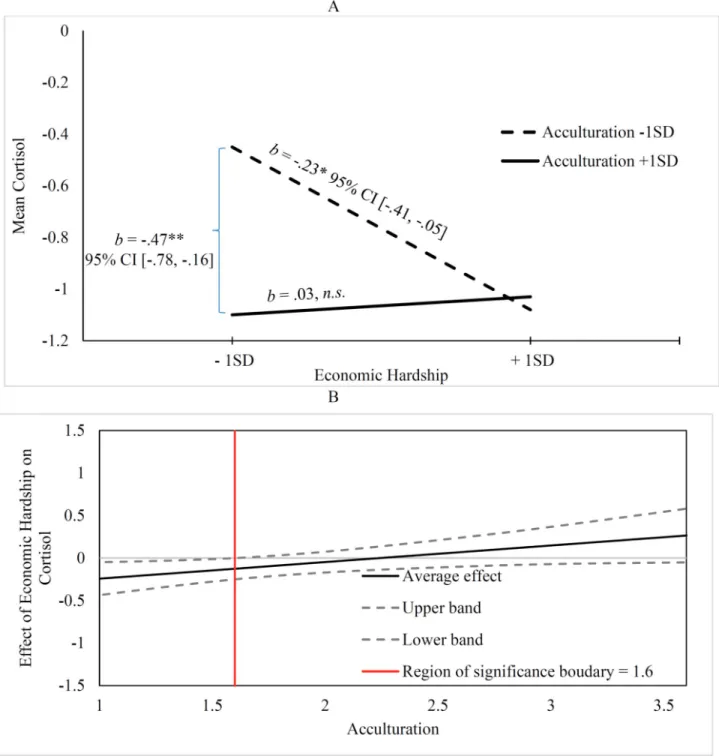
Table 2 also reports results for mean cortisol. Older children had lower mean cortisol levels, b = −.29, p < .05; 95% CI [−.56, −.03], and economic hardship and parental acculturation levels interacted to predict mean cortisol levels, b = .20, p < .05; 95% CI [.02, .37]. The effect of economic hardship on cortisol was not significant for participants scoring 1 SD above the mean on acculturation (Figure 1A). In contrast, economic hardship was associated with lower cortisol levels among participants scoring 1 SD below the mean on acculturation. Furthermore, under low economic hardship conditions, children of less acculturated parents (1 SD below the mean) had significantly higher cortisol levels than children of the more acculturated parents (1SD above the mean; b = −.47, p < .01; 95% CI [−.78, −.16]. Inspection of the 95% CI regions for the effect of economic hardship (Figure 1B) revealed that economic hardship was associated with lower cortisol among children whose parents scored below 1.6 on the acculturation measure.
Child Behavior Problems
Behavior problems were more prevalent than has been previously reported in large samples. Specifically, 7.8% of children were above the clinical cutoff for internalizing behaviors, while 15.6% were borderline clinical. For externalizing behaviors, clinical and borderline clinical levels were reported for 6.3% and 4.7% of children, respectively. As can be seen in Table 3, there was a significant interaction between economic hardship and parent reported immigration stress on child internalizing and externalizing behaviors. The effects of economic hardship on internalizing behaviors were not significant at immigration stress levels 1 SD below and above the sample mean (Figure 2A). However, inspection of the 95% CI regions for the effect of economic hardship (Figure 2B) revealed that economic hardship was associated with more internalizing behaviors among children whose parents scored 9.82 and above on the measure of immigration stress.
As can be seen in Figure 3A, the effect of economic hardship on externalizing behaviors was significant when immigration stress was 1 SD above the mean, b = 2.23, p < .01; 95% CI [. 47, 3.99]. Furthermore, inspection of the 95% CI regions of significance demonstrated that the effect of economic hardship becomes significant once parental immigration stress scores exceed the 6.52 mark (Figure 3B).
Discussion
This study took advantage of an existing small but rich data set to explore the interactive effects of economic hardship, parental immigration stress and acculturation level on child BMI, salivary cortisol levels, and behavior problems. Based on the existing data testing the Family Stress Model, we hypothesized that even within a low-income sample, greater economic hardship would impact key child outcomes particularly when coupled with sociocultural stressors. Specifically, higher economic hardship would be related to poor outcomes when immigration-related stress was also high, and/or when families were more acculturated to the U.S. language customs. Overall, interaction effects between economic and sociocultural stress were common. Acculturation measured via language use and
A
uthor Man
uscr
ipt
A
uthor Man
uscr
ipt
A
uthor Man
uscr
ipt
A
uthor Man
uscr
economic hardship significantly interacted to predict mean cortisol at home, with lower mean cortisol for all children except those with parents who reported both low acculturation levels and low economic hardship. Finally, immigration stress interacted with the effect of economic hardship on both internalizing and externalizing behaviors, with greater problem behaviors reported when both parental immigration stress and economic hardship were high.
In these data, very few main effects emerged. One important distinction in this study is that nearly the entire sample was living in poverty. Therefore, we were investigating the impact of economic hardship above and beyond the low financial resources that are experienced when living at or below the poverty line. If we were able to assess economic hardship within a sample of children of Latino immigrant across a more varied income distribution, we would expect that economic hardship would have main effects. A lack of main effects even within a poverty sample could also be due to our small sample size resulting in low power and/or Type II error.
Within this low income sample, a full 30% of children were at unhealthy BMI percentages. Although slightly less than the reported percentage of unhealthy weights for Hispanic 2–5 year old children nationally (33%), it is still concerningly high, and greater than national percentages of unhealthy weights for non-Hispanic white and non-Hispanic black 2–5 year olds (23.8 and 28.9% respectively; Ogden, Carroll, Kit, & Flegal, 2012). Due to inconclusive (trend level) statistical findings in this sample, more research is warranted on the interactive effects of economic and sociocultural stressors on child BMI.
We explored the associations among economic hardship, immigration stress, and cortisol values. We found that economic hardship and parental acculturation level interacted to predict mean cortisol collected at home at two midday time points (10am and 4pm) across several days. Specifically, highest mean cortisol values were found for children with parents who reported both low acculturation levels and less economic hardship. For children with high economic hardship, or with low economic hardship and parents who reported higher levels of acculturation to U.S. culture (English language use), mean cortisol levels were quite low. We tested the simple slopes for economic hardship and also tested the difference in cortisol between children of parents with low vs high acculturation, and indeed both are statistically significant. Low cortisol levels, if indicative of poor physiological functioning, would be related to greater risk (Gunnar & Vazquez, 2001). We interpret these findings in that light; however, as there are not objective indicators of “low” cortisol that is generally agreed upon in the field, this interpretation is speculative. Definitive interpretation of low cortisol values are also hampered by the fact that wake time for the majority of these children were not measured. Although the samples are not collected around typical wake times for young children, higher mean cortisol in less acculturated families could simply be driven by later wake times for these children. The results were not driven by time of day but later wake time may impact cortisol in the afternoon as well as in the morning. Thus, these findings should be interpreted with caution. We emphasize, that other authors have reported associations between higher cortisol and greater stress exposure, and no consensus currently exists on absolute thresholds for risk at either the low or the high end. Certainly these results need replication with objectively verified wake time, samples also taken at bedtime, samples
A
uthor Man
uscr
ipt
A
uthor Man
uscr
ipt
A
uthor Man
uscr
ipt
A
uthor Man
uscr
collected in response to stressful situations and with a larger sample experiencing a broader range of income.
When considered with the other data we present here, it is possible that many of the low income children of Latino immigrants included in the study may be at risk for
hyporesponsive cortisol, a serious dyregulation of the HPA axis (Sapolsky, Krey, & McEwen, 1986). If hyporesponsive cortisol patterns are the case for those experiencing low levels of cortisol, then it would be the less acculturated children who are relatively protected. This suggestion fits well with the immigrant paradox, and may be a physiological precursor showing that as families acculturate, health advantages decline. Determining if this is the case, and if so what can be done to better support families during acculturation to retain good health is imperative as dsyregulated stress physiology is important risk factor for impairments in both physical and psychological well-being across the lifespan.
Lastly, we found that when economic hardship or immigration-related stress was low, children of Latino immigrants had relatively fewer behavior problems; however, as economic hardship and parental immigration related stress increased, child problem behaviors also increased. This finding is potentially important for both internalizing and externalizing problems. Low immigration stress even in the face of economic hardship on average was associated with below clinical symptom levels, while high immigration stress was associated with above clinical levels (approximately 14 and 21 for internalizing and externalizing behaviors, respectively). It is also important to note that behavior problems were elevated in this sample as compared to large sample of preschoolers (n = 3,860), with average clinical prevalence rates of 3.7% for both internalizing and externalizing behaviors (Lavigne et al., 1996). In contrast, in this sample we report 7.8 and 6.3%, respectively for internalizing and externalizing. Further, these data point to a potentially important role of parental immigration stress for lower overall well-being in low-income children of
immigrants (Foundation for Child Development, 2012) and increased risk for mental health issues in some Latino children (Office of the Surgeon General (US), 2001). Importantly, however, it indicates that when children of Latino immigrants experience less economic and immigration stress, they may have better mental health. However, it is important to
acknowledge that these behavior problems are only part of a larger index of health and well-being in young children (Causadias, 2013). The lack of internalizing and externalizing behaviors is not synonymous with optimal well-being.
Strengths, Limitations, and Future Directions
This study adds to scientific knowledge in several ways. To begin, it highlights the interactive nature of multiple stressors as outlined in the seminal work of Gary Evans and colleagues (Evans & English, 2002). The study identifies the role of immigration stress and acculturation levels with the known negative effects of economic hardship on well-being to the understudied population of children of Latino immigrants. We also explored the effects of economic hardship, and parental acculturation level and immigration stress on the HPA-axis and on BMI. This is the first study to our knowledge that has explored these two types of environmental stressors (economic and sociocultural) in a sample of children of Latino immigrants. We found at least trend level effects for interactions with each outcome
A
uthor Man
uscr
ipt
A
uthor Man
uscr
ipt
A
uthor Man
uscr
ipt
A
uthor Man
uscr
explored (BMI, mean cortisol, internalizing and externalizing behaviors), despite the small sample and nearly all living in poverty. These results emphasize the need to consider interactive risk models when examining economic and sociocultural factors. We also extended the work of White and colleagues (2009) who examined the FSM within Mexican American families and included similar sociocultural indicators but did not include child outcomes. Though our sample size did not allow for a comprehensive exploration of the FSM that included the mediating pathways, we found that the outer sociocultural and economic anchors predicted child outcomes. A comprehensive model that includes all aspects of the FSM in Latino families is an essential direction for future research.
This study suffered from a number of limitations. It is non-experimental, so causal inferences are not justified. The sample size is small and some null effects for expected relationships could be due to Type II error. Furthermore, due to the small sample size we were not able to examine all the potential mediating pathways in the original Family Stress Model (e.g., parenting, parent mental health, and inter-parental conflict). We also relied heavily on maternal report, and did not cross-validate child symptoms with father/co-parent, teacher, or clinician assessments. These additional perspectives on child outcomes and also consideration of father/co-parent immigration status, immigration stress, and mental health are significant limitations. Finally, as discussed above, our cortisol measure lacked the precision we and others strongly recommend because we were unable to collect wake times, or an array of samples to reflect full diurnal and stress reactive cortisol. Effect sizes are in general modest, and confidence intervals are large, as is expected when the sample size is small. However, the consistent pattern of results is suggestive of meaningful relationships of economic and sociocultural stressors on child outcomes.
Implications
This study demonstrates the impact of sociocultural stress in families living in poverty on the developing child. It shows that the added risk of immigration stress in families facing economic hardship and the process of acculturation may put children of Latino immigrants at risk for increased behavioral and physical health problems. The implications of these findings are particularly important for intervention efforts and immigration policies. With regard to intervention, families and children may be better served with approaches that include a focus on helping families cope with immigration-related stress and the challenges inherent to the acculturation process. Finally, legislation aimed at reducing immigration-related stressors, like fear of deportation and discrimination, may reduce the risk of increased behavioral problems in young children of Latino immigrants, thus allowing more opportunity for positive youth development.
References
Achenbach, TM., Rescorla, LA. Achenbach System of Empirically Based Assessment preschool forms and profiles. 2000. Retrieved from http://www.aseba.org/ordering/ASEBA%20Reliability
%20%26%20Validity-Pre-school%20.pdf
Aiken, LS., West, SG., Reno, RR. Multiple regression: Testing and interpreting interactions. Thousand Oaks, CA: Sage; 1991.
A
uthor Man
uscr
ipt
A
uthor Man
uscr
ipt
A
uthor Man
uscr
ipt
A
uthor Man
uscr
Anderson RE, Hussain SB, Wilson MN, Shaw DS, Dishion TJ, Williams JL. Pathways to pain racial discrimination and relations between parental functioning and child psychosocial well-being. Journal of Black Psychology. 2014; 41(6):491–512. [PubMed: 26594069]
Badanes LS, Dmitrieva J, Watamura SE. Understanding cortisol reactivity across the day at child care: The potential buffering role of secure attachments to caregivers. Early Childhood Research Quarterly. 2012; 27(1):156–165. [PubMed: 22408288]
Badanes LS, Watamura SE, Hankin BL. Hypocortisolism as a potential marker of allostatic load in children: Associations with family risk and internalizing disorders. Development and
Psychopathology. 2011; 23:881–896. [PubMed: 21756439]
Berry JW. Acculturation: Living successfully in two cultures. International Journal of Intercultural Relations. 2005; 29(6):697–712.
Bradley RH, Corwyn RF. Socioeconomic status and child development. Annual Review Psychology. 2002; 53(1):371–399.
Bronfenbrenner U. Toward an experimental ecology of human development. American Psychologist. 1977; 32(7):513–531.
Brooks-Gunn J, Duncan GJ. The effects of poverty on children. The Future of Children. 1997; 7(2): 55–71. [PubMed: 9299837]
Calzada EJ, Tamis-LeMonda CS, Yoshikawa H. Familismo in Mexican and Dominican families from low-income, urban communities. Journal of Family Issues. 2013; 34(12):1696–1724.
Causadias JM. A roadmap for the integration of culture into developmental psychopathology. Development and Psychopathology. 2013; 25:1375–1398. [PubMed: 24342846]
Cervantes RC, Padilla AM, Salgado de Snyder N. Reliability and validity of the Hispanic Stress Inventory. Hispanic Journal of Behavioral Sciences. 1990; 12(1):76–82.
Cervantes RC, Padilla AM, Salgado de Snyder N. The Hispanic stress inventory: A culturally relevant approach to psychosocial assessment. Psychological Assessment: A Journal of Counseling and Clinical Psychology. 1991; 3(3):438–447.
Chaudry, A., Fortuny, K. Children of Immigrants Brief 6. Washington, DC: The Urban Institute; 2010. Children of immigrants: The changing face of metropolitan America. Retrieved from http:// www.urban.org/publications/412435.html
Conger, RD., Elder, GH. Families in troubled times: Adapting to change in rural America. Hawthorne, NY: Aldine de Gruyter Press; 1994.
Curran, PJ., Bauer, DJ., Willoughby, MT. Testing and Probing Interactions in Hierarchical Linear Growth Models. In: Bergeman, CS., Boker, SMS., editors. Methodological issues in aging research. Mahwah, NJ: Lawerence Erlbaum Associates; 2006. p. 99-129.
Essex MJ, Shirtcliff EA, Burk LR, Ruttle PL, Klein MH, Slattery MJ, Armstrong JM. Influence of early life stress on later hypothalamic–pituitary–adrenal axis functioning and its covariation with mental health symptoms: a study of the allostatic process from childhood into adolescence. Development and Psychopathology. 2011; 23(4):1039–1058. [PubMed: 22018080]
Epstein JA, Botvin GJ, Dusenbury L, Diaz T, Kerner J. Validation of an acculturation measure for Hispanic adolescents. Psychological Reports. 1996; 79(3):1075–1079. [PubMed: 8969119] Evans GW, English K. The environment of poverty: Multiple stressor exposure, psychophysiological
stress, and socioemotional adjustment. Child Development. 2002; 73:1238–1248. [PubMed: 12146745]
Evans GW, Li D, Whipple SS. Cumulative risk and child development. Psychological Bulletin. 2013; 139(6):1342–1396. [PubMed: 23566018]
Franzen L, Smith C. Acculturation and environmental change impacts dietary habits among adult Hmong. Appetite. 2009; 52(1):173–183. [PubMed: 18848592]
Fernald LC, Burke HM, Gunnar MR. Salivary cortisol levels in children of low-income women with high depressive symptomatology. Development and Psychopathology. 2008; 20(2):423–436. [PubMed: 18423087]
Foundation for Child Development. Children in immigrant families: essential to America’s future (FCD Child and Youth Well-Being Index Policy Brief). 2012. Retrieved from http://fcd-us.org/ sites/default/files/FINAL%20Children%20in%20Immigrant%20Families%20(2)_0.pdf
A
uthor Man
uscr
ipt
A
uthor Man
uscr
ipt
A
uthor Man
uscr
ipt
A
uthor Man
uscr
García-Coll, C., Marks, AK. The immigrant paradox in children and adolescents: Is becoming American a developmental risk?. Washington, DC: American Psychological Association; 2012. Garner AS, Shonkoff JP, Siegel BS, Dobbins MI, Earls MF, McGuinn L, .Wood DL. Early childhood
adversity, toxic stress, and the role of the pediatrician: Translating developmental science into lifelong health. Pediatrics. 2012; 129(1):e224–e231. [PubMed: 22201148]
Gassman-Pines A. Effects of Mexican immigrant parents’ daily workplace discrimination on child behavior and family functioning. Child Development. 2015; 86(4):1175–1190.
Gil AG, Vega WA, Dimas JM. Acculturative stress and personal adjustment among Hispanic adolescent boys. Journal of Community Psychology. 1994; 22(1):43–54.
Gundersen C, Lohman BJ, Garasky S, Stewart S, Eisenmann J. Food security, maternal stressors, and overweight among low-income US children: Results from the National Health and Nutrition Examination Survey (1999-2002). Pediatrics. 2008; 122(3):e529–e540. [PubMed: 18762488] Gunnar MR, Quevedo K. The neurobiology of stress and development. Annual Review of Psychology.
2007; 58:145–173.
Gunnar MR, Vazquez DM. Low cortisol and a flattening of expected daytime rhythm: Potential indices of risk in human development. Development and Psychopathology. 2001; 13(3):515–538.
[PubMed: 11523846]
Gupta A, Leong F, Valentine JC, Canada DD. A meta-analytic study: The relationship between acculturation and depression among Asian Americans. American Journal of Orthopsychiatry. 2013; 83:372–385. [PubMed: 23889028]
Gustafsson PE, Gustafsson PA, Nelson N. Cortisol levels and psychosocial factors in preadolescent children. Stress and Health. 2006; 22(1):3–9.
Halim ML, Yoshikawa H, Amodio DM. Cross-generational effects of discrimination among immigrant mothers: Perceived discrimination predicts child's healthcare visits for illness. Health Psychology. 2013; 32(2):20–213.
Hankin BL, Badanes LS, Abela , Watamura SE. Hypothalamic–pituitary–adrenal axis dysregulation in dysphoric children and adolescents: Cortisol reactivity to psychosocial stress from preschool through middle adolescence. Biological Psychiatry. 2010; 68(5):484–490. [PubMed: 20497900] Höferl M, Krist S, Buchbauer G. Adaptation of DELFIA™ cortisol kit for determination of salivary
cortisol concentration. Archiv der Pharmazie. 2005; 338(10):493–497. [PubMed: 16211655] Lane SP, Bluestone C, Burke CT. Trajectories of BMI from early childhood through early adolescence:
SES and psychosocial predictors. British Journal of Health Psychology. 2012; 18(1):66–82. [PubMed: 22574894]
Lara M, Gamboa C, Kahramanian MI, Morales LS, Hayes-Bautista DE. Acculturation and Latino health in the United States: a review of the literature and its sociopolitical context. Annual Review Public Health. 2005; 26:367–397.
Lavigne JV, Gibbons RD, Christoffel KK, Arend R, Rosenbaum D, Binns H, Isaacs C. Prevalence rates and correlates of psychiatric disorders among preschool children. Journal of the American Academy of Child & Adolescent Psychiatry. 1996; 35(2):204–214. [PubMed: 8720630] Lopez, MH., Velasco, G. Childhood poverty among Hispanics sets record, leads nation. Washington,
DC: Pew Hispanic Center; 2011. Retrieved from http://www.pewhispanic.org/2011/09/28/ childhood-poverty-among-hispanics-setsrecord-leads-nation
Lumian DS, Dmitrieva J, Mendoza MM, Badanes LS, Watamura SE. The impact of program structure on cortisol patterning in children attending out-of-home child care. Early Childhood Research Quarterly. 2016; 34:92–103. [PubMed: 26568654]
Lupien SJ, King S, Meaney MJ, McEwen BS. Can Poverty get under your skin? Basal cortisol levels and cognitive function in children from low and high socioeconomic status. Development and Psychopathology. 2001; 13(3):653–676. [PubMed: 11523853]
Lynch JW, Kaplan GA, Shema SJ. Cumulative impact of sustained economic hardship on physical, cognitive, psychological, and social functioning. The New England Journal of Medicine. 1997; 337(26):1889–1895. [PubMed: 9407157]
Marín G, Gamba RJ. A new measurement of acculturation for Hispanics: The Bidimensional Acculturation Scale for Hispanics (BAS). Hispanic Journal of Behavioral Sciences. 1996; 18(3): 297–316.
A
uthor Man
uscr
ipt
A
uthor Man
uscr
ipt
A
uthor Man
uscr
ipt
A
uthor Man
uscr
Marks AK, Ejesi K, García-Coll C. Understanding the U.S. immigrant paradox in childhood and adolescence. Child Development Perspectives. 2014; 8(2):59–64.
McFadyen-Ketchum LS, Hurwich-Reiss E, Stiles AA, Mendoza MM, Badanes LS, Dmitrieva J, Watamura SE. Self-Regulation and Economic Stress in Children of Hispanic Immigrants and Their Peers: Better Regulation at a Cost? Early Education and Development. 2015:1–21. (ahead-of-print).
Murdock S, Zey M, Cline ME, Klineberg S. Poverty, educational attainment and health among America’s children: Current and future effects of population diversification and associated socioeconomic change. Journal of Applied Research on Children: Informing Policy for Children at Risk. 2010; 1(1):1–33. Retrieved from http://digitalcommons.library.tmc.edu/childrenatrisk/vol1/
iss1/2.
Murphey, D., Guzman, L., Torres, A. America’s Hispanic children: Gaining ground, looking forward. Bethesda, MD: Child Trends Hispanic Institute; 2014. Retrieved from http://
www.childtrends.org/wp-content/uploads/2014/09/2014-38AmericaHispanicChildren.pdf
Office of the Surgeon General (US). Mental Health: Culture, Race, and Ethnicity: A Supplement to Mental Health: A Report of the Surgeon General. Rockville (MD): Substance Abuse and Mental Health Services Administration (US); 2001. Retrieved from http://www.ncbi.nlm.nih.gov/books/ NBK44243/
Ogden CL, Carroll MD, Kit BK, Flegal KM. Prevalence of obesity and trends in body mass index among US children and adolescents, 1999-2010. Journal of the American Medical Association. 2012; 307(5):483–490. [PubMed: 22253364]
Parke RD, Coltrane S, Duffy S, Buriel R, Dennis J, Powers J, Widaman KF. Economic stress, parenting, and child adjustment in Mexican American and European American families. Child Development. 2004; 75(6):1632–1656. [PubMed: 15566370]
Perreira KM, Ornelas IJ. The physical and psychological well-being of immigrant children. The Future of Children. 2011; 21(1):195–218. [PubMed: 21465861]
Rescorla LA. Assessment of young children using the Achenbach System of Empirically Based Assessment (ASEBA). Mental Retardation and Developmental Disabilities Research Reviews. 2005; 11(3):226–37. [PubMed: 16161094]
Sapolsky RM, Krey LC, McEwen BS. The Neuroendocrinology of stress and aging: The
glucocorticoid cascade hypothesis. Endocrine Reviews. 1986; 7(3):284–301. [PubMed: 3527687] Shonkoff JP, Boyce WT, McEwen BS. Neuroscience, molecular biology, and the childhood roots of
health disparities. The Journal of the American Medical Association. 2009; 301(21):2252–2259. [PubMed: 19491187]
Sirin SR. Socioeconomic status and academic achievement: A meta-analytic review of research. Review of Educational Research. 2005; 75(3):417–453.
Slopen N, Fitzmaurice G, Williams DR, Gilman SE. Poverty, food insecurity, and the behavior for childhood internalizing and externalizing disorders. Journal of American Academy of Child and Adolescent Psychiatry. 2010; 49(5):444–452.
Tran AG. Family contexts: Parental experiences of discrimination and child mental health. American Journal of Community Psychology. 2014; 53(1):37–46. [PubMed: 24146093]
Turner RJ, Lloyd DA, Taylor J. Stress burden, drug dependence and the nativity paradox among U.S. Hispanics. Drug and Alcohol Dependence. 2006; 83:79–89. [PubMed: 16330158]
U.S. Census Bureau. Poverty Thresholds for 2009 by size of family and number of related children under 18 years. Washington, DC: 2009. Retrieved from http://www.census.gov/hhes/www/poverty/ data/threshld/thresh09.html
Wadsworth ME, Raviv T, Santiago CD, Etter EM. Testing the adaptation to poverty-related stress model: Predicting psychopathology symptoms in families facing economic hardship. Journal of Clinical Child and Adolescent Psychology. 2011; 40(4):646–657. [PubMed: 21722035] Wang Y, Beydoun MA. The obesity epidemic in the United States—gender, age, socioeconomic,
racial/ethnic, and geographic characteristics: A systematic review and meta-regression analysis. Epidemiologic Reviews. 2007; 29:6–28. [PubMed: 17510091]
A
uthor Man
uscr
ipt
A
uthor Man
uscr
ipt
A
uthor Man
uscr
ipt
A
uthor Man
uscr
White RM, Roosa MW, Weaver SR, Nair RL. Cultural and contextual influences on parenting in Mexican American families. Journal of Marriage and Family. 2009; 71(1):61–79. [PubMed: 20126298]
Wildsmith, E., Ansari, A., Guzman, L. Improving data to recognize Hispanic diversity in the United States (Brief from the National Research Center on Hispanic Children and Families). Bethesda, MD: Child Trends Publication; 2015. Retrieved from http://www.childtrends.org/wp-content/ uploads/2015/06/Measure-Brief_Final.pdf
Yoon E, Chang CT, Kim S, Clawson A, Cleary SE, Hansen M, Gomes AM. A meta-analysis of acculturation/enculturation and mental health. Journal of Counseling Psychology. 2013; 60(1):15– 30. [PubMed: 23163612]
Yoshikawa H, Aber JL, Beardslee WR. The effects of poverty on the mental, emotional, and behavioral health of children and youth: Implications for prevention. American Psychologist. 2012; 67(4): 272. [PubMed: 22583341]
A
uthor Man
uscr
ipt
A
uthor Man
uscr
ipt
A
uthor Man
uscr
ipt
A
uthor Man
uscr
Figure 1. Cortisol on Economic Hardship by Acculturation
(A) Associations between economic hardship and cortisol for high (1 SD above the mean) and low (1 SD below the mean) values of acculturation; (B) The association between economic hardship and cortisol is significant and negative for individuals scoring below 1.6. * p < .05. ** p < .01.
A
uthor Man
uscr
ipt
A
uthor Man
uscr
ipt
A
uthor Man
uscr
ipt
A
uthor Man
uscr
Figure 2. Internalizing Behaviors on Economic Hardship by Immigration Stress
(A) Associations between economic hardship and internalizing for high (1 SD above the mean) and low (1 SD below the mean) values of immigration stress; (B) The association between economic hardship and internalizing behaviors is significant and positive for individuals experiencing 9.82 immigration stressors.
A
uthor Man
uscr
ipt
A
uthor Man
uscr
ipt
A
uthor Man
uscr
ipt
A
uthor Man
uscr
Figure 3. Externalizing Behaviors on Economic Hardship by Immigration Stress
(A) Associations between economic hardship and externalizing for high (1 SD above the mean) and low (1 SD below the mean) values of immigration stress; (B) The association between economic hardship and externalizing problems is significant and positive for individuals experiencing 6.52 immigration stressors. ** p < .01.
A
uthor Man
uscr
ipt
A
uthor Man
uscr
ipt
A
uthor Man
uscr
ipt
A
uthor Man
uscr
A
uthor Man
uscr
ipt
A
uthor Man
uscr
ipt
A
uthor Man
uscr
ipt
A
uthor Man
uscr
ipt
T ab le 1 Descripti ve Data and Bi
v
ariate Correlations of all K
ey V ariables V ariable n M SE 1 2 3 4 5 6 7 8 9 10 1. Age 71 4.46 .07 --−.07 −.29 * .17 −.02 −.29 * .30 * −.29 * −.13 −.08 2. Se
x (1 = female)
71 .41 .06 --.10 −.08 −.22 .07 .11 −.12 −.15 −.36 ** 3. Po v erty Le v el 65 .31 .08 --−.28 * −.30 * .14 −.02 .16 −.04 −.09
4. Economic Hardship
66 1.73 .17 --.41 ** −.18 .16 −.15 .10 .25
5. Immigration Stress
63 4.46 .47 --−.19 .15 .02 .39 ** .46 ***
6. Acculturation Le
v el 70 1.85 .08 --−.14 −.16 −.16 −.18
7. BMI Percentile
62 64.18 3.52 --−.19 −.04 .04
8. Mean Cortisol (µg/dL)
66 .11 .01 --−.05 −.06 9. Internalizing 64 8.64 .94 --.82 *** 10. Externalizing 64 11.92 .89 --Note. SE
= Standard Error of the mean.
* p < .05. **
p < .01.
***
A
uthor Man
uscr
ipt
A
uthor Man
uscr
ipt
A
uthor Man
uscr
ipt
A
uthor Man
uscr
ipt
T ab le 2Body Mass Inde
x (BMI) and Mean Cortisol Re
gressed on K
ey Study V
ariables and their Interactions
BMI Mean Cortisol B SE β t Semipartial R 2 ΔR 2 B SE β t Semipartial R 2 ΔR 2
Step 1: Control V
ariables .14 .14 † Age 15.06 * 6.40 .34 2.35 .11 −.29 * .13 −.32 −2.24 .09 Se x
(1 = female, 0 = male)
11.44 7.99 .20 1.43 .04 −.15 .16 −.12 −.92 .02 Po v erty Le v el −1.49 7.75 −.03 −.19 .00 .07 .13 .07 .51 .00
Step 2: Main Ef
fects .03 .09 Economic Hardship 1.31 3.58 .05 .31 .00 −.07 .06 −.17 −1.13 .02 Immigration Stress 1.22 1.37 .15 .89 .02 .02 .03 .14 .87 .01 Acculturation Le v el 1.95 7.00 .04 .28 .00 −.24 † .13 −.27 −1.92 .06
Step 3: Interactions
.06
.09
Economic Hardship X Immigration Stress
−.09 .76 −.02 −.12 .00 −.01 .01 −.09 −.64 .01
Economic Hardship X Acculturation
9.32 † 5.17 .28 1.80 .06 .20 * .09 .32 2.26 .08
A
uthor Man
uscr
ipt
A
uthor Man
uscr
ipt
A
uthor Man
uscr
ipt
A
uthor Man
uscr
ipt
T ab le 3Internalizing and Externalizing Beha
viors Re
gressed on K
ey Study V
ariables and their Interactions
Inter nalizing Beha viors Exter nalizing Beha viors B SE β t Semipartial R 2 ΔR 2 B SE β t Semipartial R 2 ΔR 2
Step 1: Control V
ariables .06 .18 Age −1.87 1.49 −.19 −1.26 .03 −2.04 1.53 −.19 −1.33 .03 Se x
(1 = female, 0 = male)
−1.99 1.80 −.16 −1.11 .03 −5.26 ** 1.85 −.38 −2.84 .14 Po v erty Le v el −20 1.42 −.02 −.14 .00 −.88 1.46 −.08 −.60 .01
Step 2: Main Ef
fects .17 .22 Economic Hardship .07 .78 .02 .09 .00 .71 .76 .14 .93 .01 Immigration Stress .68 * .30 .39 2.29 .09 .72 * .29 .38 2.53 .09 Acculturation Le v el −1.16 1.37 −.12 −.85 .01 −91 1.32 −.09 −.69 .01
Step 3: Interactions
.15
.14
Economic Hardship X Immigration Stress
.46 ** .15 .40 3.03 .14 .49 ** .14 .40 3.49 .14
Economic Hardship X Acculturation
−1.58 1.00 −.24 −1.58 .04 −1.26 .95 −.17 −1.33 .02
Note. * p < .05. **