University of South Carolina
Scholar Commons
Theses and Dissertations
2017
Garlic Inhibits Inflammation during Dengue
Infection
Alex R. Hall
University of South Carolina
Follow this and additional works at:https://scholarcommons.sc.edu/etd
Part of theBiomedical and Dental Materials Commons
This Open Access Dissertation is brought to you by Scholar Commons. It has been accepted for inclusion in Theses and Dissertations by an authorized administrator of Scholar Commons. For more information, please [email protected].
Recommended Citation
Hall, A. R.(2017).Garlic Inhibits Inflammation during Dengue Infection.(Doctoral dissertation). Retrieved from
G
ARLICI
NHIBITSI
NFLAMMATIOND
URINGD
ENGUEI
NFECTIONby
Alex R. Hall
Bachelor of Science Clemson University, 2014
Submitted in Partial Fulfillment of the Requirements
For the Degree of Master of Science in
Biomedical Science
School of Medicine
University of South Carolina
2017
Accepted by:
Tonya Colpitts, Director of Thesis
Ioulia Chazistamou, Reader
Hippokratis Kiaris, Reader
ACKNOWLEDGEMENTS
I just want to use this space to thank everyone that has helped me both with the
techniques used in this paper as well as everyone who has helped me throughout this
entire process specifically Tonya Colpitts, Ioulia Chazistamou, Hippokratis Kiaris,
ABSTRACT
Dengue virus (DENV) is a mosquito-borne flavivirus that causes significant human
disease and mortality in the tropics and subtropics. There has been a recent global trend of
increased epidemic activity, and DENV infection is considered a serious emerging health
problem worldwide. A relatively unexplored approach to develop new treatments for
dengue virus infection and the prevention of severe disease development is through
investigation of natural medicines. Inflammation plays both beneficial and harmful roles
during the host response to dengue virus infection. Several studies have proposed that it is
the oxidative stress response induced by dengue virus infection that is responsible for
triggering the pro-inflammatory cytokine cascade. Thus, blocking the oxidative stress
response and reducing inflammation could together reduce the likelihood of severe disease
development. Garlic has been shown to have several health benefits, and many of these are
thought to be due to the reduction of inflammation. Garlic has also been shown to have
effects on the oxidative stress response and prevent intracellular glutathione depletion.
Here, we hypothesized that garlic could reduce inflammation during dengue virus infection
through the reduction of the oxidative stress response. Our results indicate that garlic active
compounds reduce inflammation during dengue virus infection and show that this
reduction is due to the effects on the oxidative stress response. These results suggest that
garlic could be used as an alternative treatment for dengue virus infection and for the
TABLE OF CONTENTS
Acknowledgements ... iii
Abstract ... iv
List of Figures ... vi
List of Abbreviations ... vii
Chapter 1: Introduction ...1
Chapter 2: Materials and Methods ...4
Chapter 3: Results ...7
Chapter 4: Discussion ...13
LIST OF FIGURES
Figure 3.1 Garlic Organosulfur compounds do not significantly affect dengue virus infection ...9
Figure 3.2 Garlic organosulfur compounds significantly reduced inflammatory cytokines during dengue virus infection ...10
LIST OF ABBREVIATIONS
DAS... Diallyl Sulfide
DATS ... Diallyl Trisulfide
IFN-γ ... Interferon Gamma
IL-12 ... Interleukin 12
IL-18 ... Interleukin 18
TNF-α ... Tumor Necrosis Factor Alpha
DADS ...Diallyl Disulfide
CHAPTER 1
INTRODUCTION
Garlic has been used for centuries for the treatment of medical ailments and human
disease (1-6). Crushed garlic contains active organosulfur compounds, which are
responsible for the biological activity of garlic. Several of these compounds have been
shown to have specific therapeutic and preventative effects on disease development and
progression, including alliin, diallyl sulfide (DAS) and diallyl trisulfide (DATS) (2, 7). The
combined data from a number of studies also indicates that the active components of garlic
may be used to combat inflammation due to a variety of disorders (7).
Dengue virus causes serious human disease and mortality worldwide. In recent
years, there has been increased epidemic activity and geographic expansion of dengue
infection along with its mosquito vector, and it is considered a serious emerging global
health problem (8-11). There are no vaccines or specific therapeutic agents approved for
dengue virus, aside from Dengvaxia, which has been approved in a few endemic countries
(12). Investigation of novel treatments to alleviate symptoms and lessen disease severity
during dengue infection is necessary.
Inflammation is a main component of the host immune response to dengue
infection, and can have both protective and pathogenic roles. For example, interferon
gamma (IFN-γ), interleukin 12 (IL-12) and interleukin 18 (IL-18) are essential for an
pro-inflammatory cytokines play pathogenic roles during dengue infection. For example,
several studies have shown that tumor necrosis factor alpha (TNF-α) levels are higher in
patients with severe dengue versus mild dengue fever (15, 16). Together, data have shown
that excessive inflammation and the increased levels of certain cytokines and chemokines
can contribute to vascular leakage and endothelial permeability that may lead to severe
forms of dengue disease (17-19). Thus, the reduction of inflammation during dengue
infection is key to reducing the chance that severe forms of dengue will develop.
Several herbal supplements have been under investigation in recent years for their
ability to reduce inflammation during disease, including flavonoids, carotenoids and plants
such as turmeric and garlic. Garlic has been shown to have anti-inflammatory activity in
several studies of disease, including cancer and heart disease (7). Garlic has been shown to
have both immunomodulatory and anti-inflammatory effects in several types of cancer (1,
2, 20). One study showed that garlic elicits anti-inflammatory and anti-oxidative responses
that can stop emerging tumor growth (1). Another study showed that several organosulfur
compounds found in garlic, including DAS, DADS and DATS, were able to destroy cells
in a glioblastoma, indicating that garlic may be clinically useful to eradicate brain cancer
cells in patients (21, 22).
The oxidative stress response during dengue virus infection has been linked to the
development of inflammation as well as the development of severe disease (DHF/DSS)
(23, 24). It is thought that free radical release during the oxidative stress response may
trigger the induction of inflammatory cytokines, leading to excessive inflammation and
blocking the oxidative stress response may reduce the pro-inflammatory response leading
to severe symptoms in dengue virus infection. Garlic has been shown to suppress nitric
oxide production through the inhibition of NF- KB downregulating expression of inducible
nitric oxide synthase (iNOS) and blocking nuclear translocation of NF-KB (27). Garlic has
also been found to inhibit oxidative injury in liver through AMP-activated protein kinase
(28).
Thus, the combined data from a number of studies has shown that garlic has
anti-inflammatory activities, including the reduction of pro-anti-inflammatory cytokines such as
TNF-α, which is known to be a key player in the development of severe disease in dengue
infection. Garlic has also been shown to act through the reduction of oxidative stress, and
may inhibit the cytokine-induced inflammation found in severe dengue cases.
Here, we examined the role that garlic has on inflammation and the oxidative stress
CHAPTER 2
MATERIALS AND METHODS
Cells
The cell lines Huh-7 (kind gift of Dr. Brett Lindenbach, Yale University) and U937
(ATCC) were used for all studies. Cells were maintained in DMEM (Huh-7) or RPMI 1640
(U937) complete medium with 10%FBS at 37ºC with 5% CO2.
qRT-PCR
Briefly, total RNA was isolated from cells using RNeasy kit according to manufacturers
instructions (Qiagen, CA). The qRT-PCR assays were conducted using the QuantiFast
SYBR Green RT-PCR kit according to manufacturer’s instructions (Qiagen) and a BioRad
CFX cycler.
ELISA
Standard ELISAs were performed to measure the levels of IL-8, IL-10, and TNF-in the
cell supernatants. The following kits were used — Hu IL-8 Cytoset (#CHC1303;
Invitrogen, CA), Hu IL-10 Cytoset (#CHC1323; Invitrogen, CA), and Hu TNF- Cytoset
(#CHC1753; Invitrogen, CA). All kits were used according to the manufacturer’s
instructions. Briefly, supernatant was diluted and coated onto plates in a 96-well format.
Capture (purified) and detection Abs (Invitrogen, CA) used were: IL-8 (#58.130.09 and
Serially diluted recombinant cytokine standards specific for each cytokine (Invitrogen,
CA) were used to generate standard curves. Standard ELISA was also performed to
measure levels of iNOS in cell supernatants using capture antibody #ab129372 (Abcam,
MA) and HRP detection Ab #7074S (Cell Signaling, MA). Plates were incubated with the
TMB substrate, BioFX TMB One Component HRP Microwell Substrate
(#TMBW-0100-01; SurModics) for 30 min at RT. The reaction was stopped with 2 N sulfuric acid and
plates were read at 450 nm in a BioTek Synergy HT microplate reader (Biotek Instruments,
VT) and Gen5 Data Analysis Software.
Dengue Virus
We used DENV-2 NGC virus for these studies. Virus was propagated in C6/36 Ae.
albopictus mosquito cells and titered using the Vero monkey kidney cell line. Virus was
added to either Huh7 or U937 cells at an MOI of 1.0 for all studies unless otherwise
indicated. Briefly, virus was added to cell cultures and allowed to infect for 1h at 37°C.
The cells were washed, and infection allowed to continue for indicated times. Cell lysates
and supernatants were used at 24h post-infection.
Garlic Treatment
We used three active organosulfur garlic compounds in our assays: DAS (#103021000;
Acros Organics, Belgium), DADS (#A14400; Pfaltz & Bauer, CT) and Aliin (#027253S;
Indofine Chemical Company Inc., NJ.) Cells were treated with varying concentrations of
Lipid Peroxidation Assay
We measured malondialdehyde (MDA) using the Lipid Peroxidation (MDA) Assay kit
(#ab118970; Abcam) to fluorometrically measure lipid peroxidation according to
manufacturer’s instructions. The colorimetric reaction was measured at 532 nm on a
BioTek Synergy HT microplate reader (Biotek Instruments, VT) and Gen5 Data Analysis
Software.
Western Blot
Cell lysates were run on a 4–12% SDS-PAGE gel (Bio-Rad, CA) and the proteins were
transferred to a nitrocellulose membrane. The membrane was blocked with 5% milk in 1%
TBST for 1h at RT and then incubated with a primary antibody specific for iNOS
(ab129372; Abcam, MA) overnight at 4°C. The membrane was washed and then incubated
with the appropriate horseradish peroxidase secondary antibody for 1h at RT. The protein
blots were incubated with ECL substrates (Bio-rad, CA) for 5 min at RT and then detected
CHAPTER 3
RESULTS
Garlic organosulfur compounds reduce inflammation during dengue virus infection
To investigate the effects of garlic on inflammation during dengue virus infection,
we used three active organosulfur garlic compounds: DAS, DADS and Aliin. We chose
our doses based on published literature (7). We chose to use two human cell lines in our
study due to their involvement in natural dengue virus infection: U937 human
macrophage-like cells and Huh-7 human liver cells. First, we examined dengue virus infection levels
with and without the presence of garlic compounds. We found that the addition of the
compounds did not significantly affect dengue virus infection levels in the cells (Fig.1A
and 1B). This was somewhat expected and removed a confounder from subsequent studies.
Next, we examined the levels of the pro-inflammatory cytokines TNF-alpha, 8 and
IL-10 in the supernatants of dengue virus-infected cells with and without the garlic
compounds. Garlic compounds have previously been shown to reduce inflammation during
cancer and heart disease (1, 7, 29). We found that the addition of garlic compounds reduced
the levels of all three pro-inflammatory cytokines during dengue virus infection at all doses
examined (Fig. 2A-F)
As oxidative stress is thought to be the mechanism through which dengue virus acts
to trigger the pro-inflammatory immune response during infection, and garlic has
(28) and decrease reactive oxygen species (ROS) levels (30), we examined the anti-oxidant
activity of garlic organosulfur compounds during dengue virus infection. Oxidative
stress induced by lipid peroxidation has been shown to contribute to inflammation. We
planned to quantify lipid peroxidation as a measure of oxidative stress. The end products
of lipid peroxidation are reactive aldehydes such malondialdehyde (MDA) and
4-hydroxynonenal (4- HNE), and measuring these end products is a widely accepted assay
for oxidative damage. To this end, we measured MDA using the Lipid Peroxidation (MDA)
Assay kit (Abcam) to fluorometrically measure lipid peroxidation in dengue virus-infected
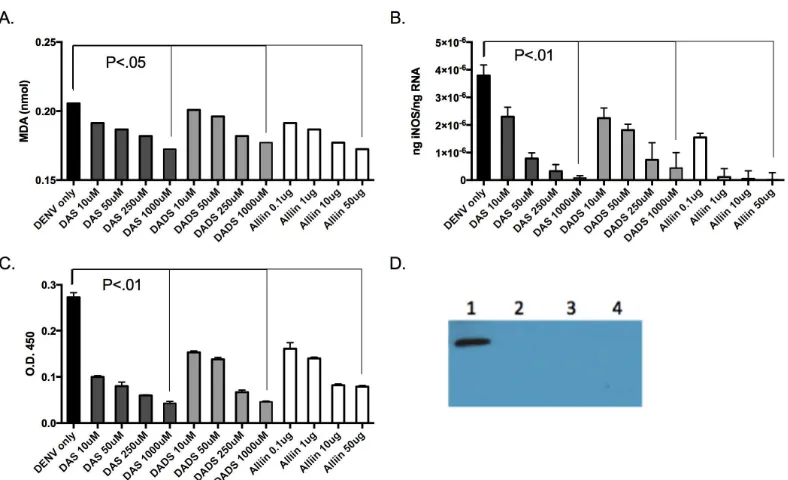
cells. We found that with higher doses of garlic compounds, levels of MDA produced from
the infected cells were reduced (Fig. 3).
Levels of nitric oxide synthase (iNOS) have been correlated with increased
inflammation in several infection models and can be a marker for the oxidative stress
response (31). There is also evidence for an association between increased vascular nitric
oxide and severe dengue disease (32). To this end, we measured levels of iNOS in the cells
that we infected with dengue virus with and without garlic. We first isolated RNA from the
cells and tissues and quantified iNOS using qRT-PCR analysis (Fig. 4A). We next
quantified iNOS protein levels in cell lysates using antibodies with ELISA (Fig. 4B) and
Western blot analysis (Fig. 4C). Our results indicate that levels of iNOS were reduced with
In summary, we found that garlic organosulfur compounds acted to reduce
Figure 3.3 Garlic organosulfur compounds reduced cellular lipid peroxidation, iNOS gene expression and both intra- and extracellular protein levels during dengue virus
CHAPTER 4
DISCUSSION
Dengue virus infection has an enormous impact on the health and economies of
tropical and subtropical regions, with dengue infections occurring in Asia, the Americas,
Africa, Pacific and Mediterranean regions (11, 33-36). In addition, there have been recent
outbreaks in Texas and Florida where transmission occurred on American soil (37, 38). As
there are no specific antiviral regimens for the treatment of dengue virus infection, or the
development of severe disease (39), it is imperative to investigate alternative treatments,
including naturally bioactive compounds and herbal supplements.
Inflammation during dengue virus infection plays both beneficial and pathogenic
roles. Studies in mice have shown that TNF- levels are linked to increased vascular
leakage during dengue infection and that blocking TNF-results in reduced lethality due
to dengue infection (40-42). Levels of another pro-inflammatory cytokine, macrophage
inhibitory factor (MIF), have also been correlated with severe dengue infection in humans
(43), and MIF knock-out mice develop less severe dengue infection and have higher
survival than wild-type mice (44). Various chemokines have also been associated with
dengue severity and clinical outcomes in humans. Levels of the chemokine C-C ligands 2,
3 and 4 (CCL2, CCL3 and CCL4) have been correlated with severe dengue disease in
humans in several studies (45, 46), and mice lacking these chemokines have reduced
lethality and milder disease during dengue infection (47). Thus, the reduction of
Garlic has been shown to have several health benefits, and many of these are
thought to be due to the reduction of inflammation. The bioactive compounds from garlic
have been shown to have anti-inflammatory activity during cancer and heart disease (7).
Garlic has been shown to have both immunomodulatory and anti-inflammatory effects in
several types of cancer (1, 2, 20). One study showed that garlic elicits anti-inflammatory
and anti-oxidative responses that can stop emerging tumor growth (1). Another study
showed that several organosulfur compounds found in garlic, including DAS, DADS and
DATS, were able to destroy cells in a glioblastoma, indicating that garlic may be clinically
useful to eradicate brain cancer cells in patients (21, 22). Further investigation is needed to
gain a comprehensive picture of how garlic reduces inflammation, and in what disease
states this can be used as treatment.
The development of inflammation during severe forms of dengue has been
associated with the oxidative stress response, which can trigger the production of
inflammatory cytokines (23, 24) (25, 26). In addition, lipid peroxidation and an increase in
redox status as measured by MDA levels have also been linked with an increase in
pro-inflammatory cytokines in patients with severe dengue disease (26). It has been shown that
an organosulfuric compound found in garlic has the ability to inhibit TNF--induced
inflammation by decreasing reactive oxygen species (ROS) levels (30). Garlic has also
been shown to act as an anti-oxidant in liver cells by inducing the antioxidant enzyme
glutamate-cysteine ligase, which increases glutathione (GSH) content and prevented
hydrogen peroxide production and cell death (48).
both inflammation and oxidative stress during dengue virus infection of human cells. This
could lead to a novel alternative therapeutic for treatment of infection and/or prevention of
progression to severe disease. We next plan to examine the effects of garlic consumption
REFERENCES
1. Schafer G, Kaschula CH (2014) The immunomodulation and anti-inflammatory effects of garlic organosulfur compounds in cancer chemoprevention. Anticancer Agents Med Chem 14: 233-240.
2. Fleischauer AT, Arab L (2001) Garlic and cancer: a critical review of the epidemiologic literature. J Nutr 131: 1032S-1040S.
3. Ide N, Lau BH, Ryu K, Matsuura H, Itakura Y (1999) Antioxidant effects of fructosyl arginine, a Maillard reaction product in aged garlic extract. J Nutr Biochem 10: 372-376.
4. Karmakar S, Banik NL, Patel SJ, Ray SK (2007) Garlic compounds induced calpain and intrinsic caspase cascade for apoptosis in human malignant neuroblastoma SH-SY5Y cells. Apoptosis 12: 671-684.
5. Kay HY, Won Yang J, Kim TH, Lee DY, Kang B, et al. (2010) Ajoene, a stable garlic by-product, has an antioxidant effect through Nrf2-mediated glutamate-cysteine ligase induction in HepG2 cells and primary hepatocytes. J Nutr 140: 1211-1219.
6. Keophiphath M, Priem F, Jacquemond-Collet I, Clement K, Lacasa D (2009) 1,2-vinyldithiin from garlic inhibits differentiation and inflammation of human preadipocytes. J Nutr 139: 2055-2060.
7. Lee da Y, Li H, Lim HJ, Lee HJ, Jeon R, et al. (2012) Anti-inflammatory activity of sulfur-containing compounds from garlic. J Med Food 15: 992-999.
8. Beatty ME, Stone A, Fitzsimons DW, Hanna JN, Lam SK, et al. (2010) Best practices in dengue surveillance: a report from the Asia-Pacific and Americas Dengue Prevention Boards. PLoS Negl Trop Dis 4: e890.
9. Mangold KA, Reynolds SL (2013) A review of dengue fever: a resurging tropical disease. Pediatr Emerg Care 29: 665-669; quiz 670-661.
10. Gibbons RV, Vaughn DW (2002) Dengue: an escalating problem. Bmj 324: 1563-1566.
12. Flasche S, Jit M, Rodriguez-Barraquer I, Coudeville L, Recker M, et al. (2016) The Long-Term Safety, Public Health Impact, and Cost-Effectiveness of Routine Vaccination with a Recombinant, Live-Attenuated Dengue Vaccine (Dengvaxia): A Model Comparison Study. PLoS Med 13: e1002181.
13. Fagundes CT, Costa VV, Cisalpino D, Amaral FA, Souza PR, et al. (2011) IFN-gamma production depends on IL-12 and IL-18 combined action and mediates host resistance to dengue virus infection in a nitric oxide-dependent manner. PLoS Negl Trop Dis 5: e1449.
14. Costa VV, Fagundes CT, Valadao DF, Cisalpino D, Dias AC, et al. (2012) A model of DENV-3 infection that recapitulates severe disease and highlights the
importance of IFN-gamma in host resistance to infection. PLoS Negl Trop Dis 6: e1663.
15. Chaturvedi UC, Agarwal R, Elbishbishi EA, Mustafa AS (2000) Cytokine cascade in dengue hemorrhagic fever: implications for pathogenesis. FEMS Immunol Med Microbiol 28: 183-188.
16. Mangada MM, Endy TP, Nisalak A, Chunsuttiwat S, Vaughn DW, et al. (2002) Dengue-specific T cell responses in peripheral blood mononuclear cells obtained prior to secondary dengue virus infections in Thai schoolchildren. J Infect Dis 185: 1697-1703.
17. Nielsen DG (2009) The relationship of interacting immunological components in dengue pathogenesis. Virol J 6: 211.
18. Srikiatkhachorn A (2009) Plasma leakage in dengue haemorrhagic fever. Thromb Haemost 102: 1042-1049.
19. Navarro-Sanchez E, Despres P, Cedillo-Barron L (2005) Innate immune responses to dengue virus. Arch Med Res 36: 425-435.
20. Shukla Y, Kalra N (2007) Cancer chemoprevention with garlic and its constituents. Cancer Lett 247: 167-181.
21. Wallace GCt, Haar CP, Vandergrift WA, 3rd, Giglio P, Dixon-Mah YN, et al. (2013) Multi-targeted DATS prevents tumor progression and promotes apoptosis in ectopic glioblastoma xenografts in SCID mice via HDAC inhibition. J Neurooncol 114: 43-50.
23. Soundravally R, Sankar P, Bobby Z, Hoti SL (2008) Oxidative stress in severe dengue viral infection: association of thrombocytopenia with lipid peroxidation. Platelets 19: 447-454.
24. Seet RC, Lee CY, Lim EC, Quek AM, Yeo LL, et al. (2009) Oxidative damage in dengue fever. Free Radic Biol Med 47: 375-380.
25. Chaturvedi UC, Nagar R (2008) Dengue and dengue haemorrhagic fever: Indian perspective. J Biosci 33: 429-441.
26. Soundravally R, Hoti SL, Patil SA, Cleetus CC, Zachariah B, et al. (2014)
Association between proinflammatory cytokines and lipid peroxidation in patients with severe dengue disease around defervescence. Int J Infect Dis 18: 68-72.
27. Ryu JH, Park HJ, Jeong YY, Han S, Shin JH, et al. (2015) Aged Red Garlic Extract Suppresses Nitric Oxide Production in Lipopolysaccharide-Treated RAW 264.7 Macrophages Through Inhibition of NF-kappaB. J Med Food 18: 439-445.
28. Han CY, Ki SH, Kim YW, Noh K, Lee da Y, et al. (2011) Ajoene, a stable garlic by-product, inhibits high fat diet-induced hepatic steatosis and oxidative injury through LKB1-dependent AMPK activation. Antioxid Redox Signal 14: 187-202.
29. Ho CY, Weng CJ, Jhang JJ, Cheng YT, Huang SM, et al. (2014) Diallyl sulfide as a potential dietary agent to reduce TNF-alpha- and histamine-induced
proinflammatory responses in A7r5 cells. Mol Nutr Food Res 58: 1069-1078.
30. Kay HY, Won Yang J, Kim TH, Lee da Y, Kang B, et al. (2010) Ajoene, a stable garlic by-product, has an antioxidant effect through Nrf2-mediated glutamate-cysteine ligase induction in HepG2 cells and primary hepatocytes. J Nutr 140: 1211-1219.
31. Singh UP, Prithiviraj B, Sarma BK, Singh M, Ray AB (2001) Role of garlic (Allium sativum L.) in human and plant diseases. Indian J Exp Biol 39: 310-322.
32. Malaviya R, Gow AJ, Francis M, Abramova EV, Laskin JD, et al. (2015) Radiation-induced lung injury and inflammation in mice: role of inducible nitric oxide synthase and surfactant protein D. Toxicol Sci 144: 27-38.
33. Thein TL, Wong J, Leo YS, Ooi EE, Lye D, et al. (2015) Association Between Increased Vascular Nitric Oxide Bioavailability and Progression to Dengue Hemorrhagic Fever in Adults. J Infect Dis.
35. Burke DS, Kliks S (2006) Antibody-dependent enhancement in dengue virus infections. J Infect Dis 193: 601-603; author reply 603-604.
36. Mackenzie JS, Gubler DJ, Petersen LR (2004) Emerging flaviviruses: the spread and resurgence of Japanese encephalitis, West Nile and dengue viruses. Nat Med 10: S98-109.
37. Guzman MG, Halstead SB, Artsob H, Buchy P, Farrar J, et al. (2010) Dengue: a continuing global threat. Nat Rev Microbiol 8: S7-16.
38. Murray KO, Rodriguez LF, Herrington E, Kharat V, Vasilakis N, et al. (2013) Identification of dengue fever cases in Houston, Texas, with evidence of
autochthonous transmission between 2003 and 2005. Vector Borne Zoonotic Dis 13: 835-845.
39. Munoz-Jordan JL, Santiago GA, Margolis H, Stark L (2013) Genetic relatedness of dengue viruses in Key West, Florida, USA, 2009-2010. Emerg Infect Dis 19: 652-654.
40. Atrasheuskaya A, Petzelbauer P, Fredeking TM, Ignatyev G (2003) Anti-TNF antibody treatment reduces mortality in experimental dengue virus infection. FEMS Immunol Med Microbiol 35: 33-42.
41. Zellweger RM, Prestwood TR, Shresta S (2010) Enhanced infection of liver
sinusoidal endothelial cells in a mouse model of antibody-induced severe dengue disease. Cell Host Microbe 7: 128-139.
42. Clyde K, Kyle JL, Harris E (2006) Recent advances in deciphering viral and host determinants of dengue virus replication and pathogenesis. J Virol 80: 11418-11431.
43. Chuang YC, Lei HY, Liu HS, Lin YS, Fu TF, et al. (2011) Macrophage migration inhibitory factor induced by dengue virus infection increases vascular
permeability. Cytokine 54: 222-231.
44. Assuncao-Miranda I, Amaral FA, Bozza FA, Fagundes CT, Sousa LP, et al. (2010) Contribution of macrophage migration inhibitory factor to the pathogenesis of dengue virus infection. FASEB J 24: 218-228.
45. Rothman AL (2011) Immunity to dengue virus: a tale of original antigenic sin and tropical cytokine storms. Nat Rev Immunol 11: 532-543.
47. Guabiraba R, Marques RE, Besnard AG, Fagundes CT, Souza DG, et al. (2010) Role of the chemokine receptors CCR1, CCR2 and CCR4 in the pathogenesis of experimental dengue infection in mice. PLoS One 5: e15680.