Increasing
the
translation
of
mouse
models
of
MERS
coronavirus
pathogenesis
through
kinetic
hematological
analysis
SarahR.Leist☯,KaraL.Jensen☯,RalphS.Baric,TimothyP.SheahanID*
DepartmentofEpidemiology,UniversityofNorthCarolinaatChapelHill,ChapelHill,NorthCarolina,United StatesofAmerica
☯These authors contributed equally to this work. *[email protected].
Abstract
Newly emerging viral pathogens pose a constant and unpredictable threat to human and animal health. Coronaviruses (CoVs) have a penchant for sudden emergence, as evidenced by severe acute respiratory syndrome coronavirus (SARS-CoV), Middle East respiratory syndrome CoV (MERS-CoV) and most recently, swine acute diarrhea syndrome coronavi-rus (SADS-CoV). Small animal models of emerging viral pathogenesis are crucial to better understand the virus and host factors driving disease progression. However, rodent models are often criticized for their limited translatability to humans. The complete blood count is the most ordered clinical test in the United States serving as the cornerstone of clinical medicine and differential diagnosis. We recently generated a mouse model for MERS-CoV pathogen-esis through the humanization of the orthologous entry receptor dipeptidyl peptidase 4 (DPP4). To increase the translatability of this model, we validated and established the use of an automated veterinary hematology analyzer (VetScan HM5) at biosafety level 3 for analysis of peripheral blood. MERS-CoV lung titer peaked 2 days post infection concurrent with lymphopenia and neutrophilia in peripheral blood, two phenomena also observed in MERS-CoV infection of humans. The fluctuations in leukocyte populations measured by Vetscan HM5 were corroborated by standard flow cytometry, thus confirming the utility of this approach. Comparing a sublethal and lethal dose of MERS-CoV in mice, analysis of daily blood draws demonstrates a dose dependent modulation of leukocytes. Major leuko-cyte populations were modulated before weight loss was observed. Importantly, neutrophil counts on 1dpi were predictive of disease severity with a lethal dose of MERS-CoV highlight-ing the predictive value of hematology in this model. Taken together, the inclusion of hema-tological measures in mouse models of emerging viral pathogenesis increases their translatability and should elevate the preclinical evaluation of MERS-CoV therapeutics and vaccines to better mirror the complexity of the human condition.
OPEN ACCESS
Citation: Leist SR, Jensen KL, Baric RS, Sheahan
TP (2019) Increasing the translation of mouse models of MERS coronavirus pathogenesis through kinetic hematological analysis. PLoS ONE 14(7): e0220126.https://doi.org/10.1371/journal. pone.0220126
Editor: Stefan Po¨hlmann, Deutsches
Primatenzentrum GmbH - Leibniz-Institut fur Primatenforschung, GERMANY
Received: March 20, 2019
Accepted: July 9, 2019
Published: July 24, 2019
Copyright:©2019 Leist et al. This is an open access article distributed under the terms of the
Creative Commons Attribution License, which permits unrestricted use, distribution, and reproduction in any medium, provided the original author and source are credited.
Data Availability Statement: All relevant data are
within the manuscript and its Supporting Information files.
Funding: This work was funded by the National
Introduction
Small animal models of emerging viral pathogenesis are fundamental tools to further our understanding of the molecular and genetic mechanisms driving severe disease outcomes after infection. These models are essential to systematically dissect both viral and host determinants of disease presentation and are key for the critical evaluation of vaccines and antiviralsin vivo. To maximize the utility, impact and biological relevance of pathogenesis studies or therapeutic evaluation, the measurement of multiple complementary and translatable metrics over time is crucial.
Emerging viral pathogens like Ebola virus, yellow fever virus, Severe Acute Respiratory Syn-drome Coronavirus (SARS-CoV) and Middle Eastern Respiratory SynSyn-drome Coronavirus (MERS-CoV) are major threats to global public health [1]. Viral emergence is typically the result of zoonotic virus spill over from animal reservoirs into human populations. Without preexisting immunity, vaccines or therapeutics to newly emerged viral pathogens, sustained human to human transmission coupled with the ease and frequency of human travel could fuel explosive and catastrophic global pandemic disease. In 2012, MERS-CoV was discovered to have emerged from bats through a camel intermediate host in the Middle East, thus far caus-ing 2,428 cases and 838 deaths in 27 countries [2,3]. Viruses similar to both SARS- and MERS-CoV are currently circulating in bats making the emergence of a SARS- or MERS-like virus in the future a real possibility [4]. Currently there are no approved vaccines or therapies specific for any human CoV.
The complete blood count (CBC) is a routine rapid hematological test that can aid in the diagnosis of blood disorders and infectious disease. In 2016, 42 million CBCs were ordered in the United States, making it the most requested clinical lab test [5]. Moreover, the CBC can be performed without specialized machinery or expensive equipment, providing key clinical information for disease management in patients even in rural or resource limited settings. For example, the CBC described thrombocytopenia and lymphopenia in patients with SARS-CoV [6] and MERS-CoV [7–9] and an increased absolute neutrophil count early during SARS-CoV infection was a strong predictor for intensive care unit (ICU) admission and death [10].
In this study, we characterized the daily variation of different peripheral blood cell popula-tions in a mouse model of MERS-CoV infection and pathogenesis until 4 days post infection (dpi). Peripheral blood was analyzed by an automated veterinary hematology analyzer at bio-safety level 3 (BSL3) and by routine flow cytometry techniques. Similar to what was observed in human CoV patients, we observed significant modulation of leukocytes in MERS-CoV infected mice which was virus dose dependent and measurable prior to notable weight loss. Importantly, neutrophil counts on 1dpi were predictive of disease severity with a lethal dose of MERS-CoV highlighting the predictive value of hematology in this model. These data highlight the predictive value and clinical translatability of the CBC in the study of emerging virus pathogenesis. Therefore, this approach should elevate future studies further dissecting the host factors driving severe MERS-CoV disease and preclinical evaluation of therapeutics and vaccines.
Materials and methods
Ethics statement
This study was carried out in strict accordance with the recommendations in the Guide for the Care and Use of Laboratory Animals of the National Institutes of Health. The protocol was approved by the Committee on the Ethics of Animal Experiments of the University of North Carolina at Chapel Hill (Protocol Number: 17–097).
Competing interests: The authors have declared
MERS-CoV pathogenesis model
We previously modified the murine ortholog of the human MERS-CoV receptor, dipeptidyl peptidase 4 (Dpp4), in C57BL/6J mice through CRISPR/Cas9 to substitute human residues at positions 288 and 330 (A288L and T330R) thus rendering the mice susceptible to MERS-CoV infection [11]. The resultant mice expressing a humanized DPP4 referred to herein as “288/ 330+/+”were housed in accordance to guidelines set by the Department of Laboratory Animal Medicine at the University of North Carolina at Chapel Hill. Mice were acclimated to the BSL3 environment for one week prior to infection. Ten-week female 288/330+/+mice were ran-domly assigned to treatment groups, anaesthetized with ketamine and xylazine and infected intranasally with 5.0 x 10⁴plaque forming units (PFU) mouse adapted MERS-CoV maM35C4 in 50μl of virus collection medium (OptiMEM (Gibco), 3% Fetal Clone 2 serum product (Hyclone) and antibiotic/antimycotic (Gibco) and non-essential amino acids (Gibco)). MERS-CoV maM35C4 is a previously published clonal isolate generated after 35 passages in mice; subsequently plaque purified and clone 4 was expanded two times on Vero CCL81 cells to obtain our working stock grown in virus collection medium [12]. Body weight was mea-sured daily to monitor progression of virus associated morbidity and mortality. Subsets of mice were euthanized via isofluorane overdose and lungs were harvested on days one, two, three and four after infection. The inferior right lobe was frozen at -80˚C and then utilized to measure lung viral load via plaque assay [12]. Results described herein are derived from two independent studies.
To measure fluctuations of blood cells in live mice infected with a lethal or sublethal dose of MERS-CoV, we infected 10 to 11-week old male and female 288/330+/+mice with PBS, 5E+03 or 5E+05 PFU MERS maM35c4 as described above. Body weight was measured daily. On days 1–3 post infection, mice were bled via the submandibular route and blood was analyzed via VetScan HM5. On 4dpi, mice were sacrificed and the inferior right lung lobe was harvested, frozen at -80˚C and then utilized to measure virus lung titer by plaque assay as described above.
Bronchoalveolar lavage and blood sample collection
Bronchoalveolar lavage (BAL) suspensions were collected immediately following euthanasia by gently injecting 1ml sterile PBS into the mouse lung cavity through the trachea using a cath-eter attached to a syringe. After 30 seconds, the maximum recoverable volume of PBS (gener-ally 500–800μl) was collected and stored in Eppendorf tubes until prompt VetScan analysis. PBS was not aspirated and re-injected due to the delicate nature of lung tissues following MERS-CoV infection. After lancing the posterior vena cava, peripheral blood was collected in EDTA tubes (Sarstedt) to prevent coagulation. For hematological analysis, 50μl of each blood sample was diluted in 200μl PBS and analyzed via VetScan HM5 (Abaxis) (See below). Remaining BAL and blood samples were saved for flow cytometric analyses (See below).
VetScan
distribution width (RDWc); platelets (PLT), plateletcrit (PCT), mean platelet volume (MPV), and platelet distribution width (PDWc).
Flow cytometry
For validation of Vetscan reported values, we performed flow cytometry on the identical BAL and whole blood samples after VetScan analysis. Remaining, BAL and whole peripheral blood (100–500μl) samples were stained for flow cytometry. Antibodies used to evaluate the cellular composition of blood were: CD3 (clone 145-2C11; eBioscience), CD19 (clone 6D5), CD45 (clone 30-F11), CD49b (clone DX5), CD115 (clone AFS98), Ly6G (clone 1A8), and NK1.1 (clone PK136; eBioscience). All antibodies were purchased from Biolegend, unless otherwise noted, and were titrated prior to use. Samples were also treated with a Fixable Live/Dead Dye (Invitrogen) to exclude dead cells from downstream analyses. Following antibody staining, erythrocytes were lysed using RBC Lysis Buffer (Biolegend). Samples were acquired using an LSRII cytometer (BD Biosciences) and analyzed using FlowJo software v10.5 (TreeStar). For samples of peripheral blood, samples were run until 50,000+ live, singlet events were acquired, when possible (range 32,000–154,000; mean 99,000 total events). For BAL, samples were acquired until depletion, which resulted in a minimum of 28,000 events (range 28,000–153,000; mean 82,000 events). For analysis, samples were gated to first remove debris, multiplet events, and nonviable cells before positive gates were set using fluorescence minus one staining controls. In addition to expression of CD45, cellular populations were further defined as i) “lymphocytes” which included T cells (CD3+), B cells (CD19+), NK cells (CD3+NK1.1+CD49b+), and NK T cells (CD3+NK1.1+CD49b+), ii) “monocytes” (CD115+), and iii) “neutrophils” (Ly6G+) [13–15]. These cell populations were assigned to reflect to those measured by VetScan HM5.
Statistical analysis
Data was analyzed using GraphPad Prism (GraphPad Prism Software, San Diego, California). The specific statistical test to determine significance is noted in each figure legend.
Results
Peripheral blood leukocyte populations are modulated in MERS-CoV
infection
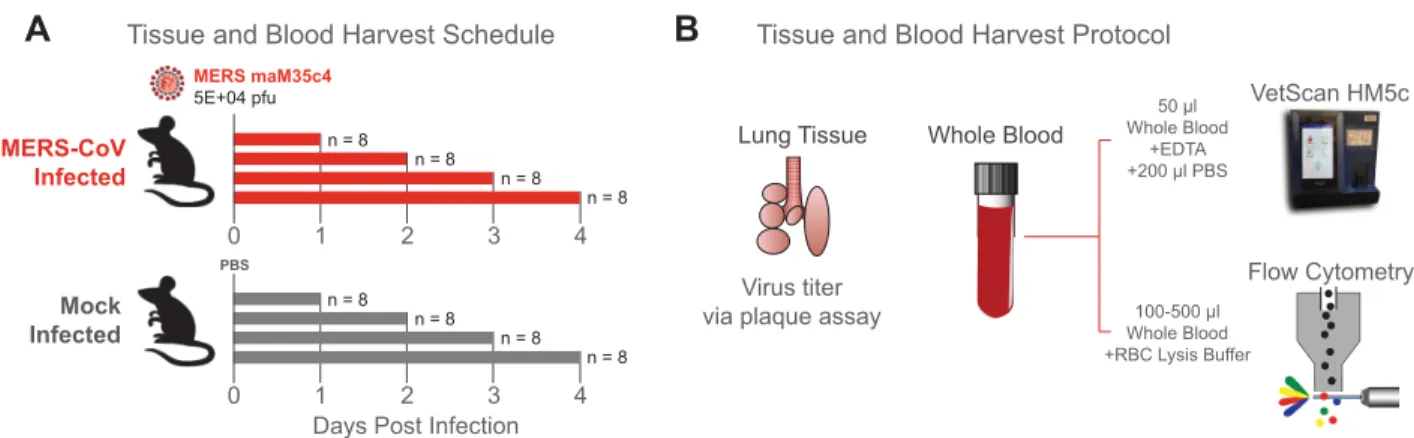
We utilized an established transgenic mouse model of MERS-CoV pathogenesis for these stud-ies where the murine ortholog of the human receptor, dipeptidyl peptidase 4 (DPP4) was humanized at residues 288 and 330 (288/330+/+mice) to facilitate infection and pathogenesis reminiscent to that in humans [12]. We infected 288/330+/+mice with either PBS (mock) or 5E+04 PFU of the mouse adapted MERS-CoV strain maM35C4 and harvested blood and lung tissue for analysis each day after infection for four days (Fig 1A and 1B). Unlike mock infected mice, MERS-CoV infected mice lost significant (P<0.0001) body weight over time (Fig 2A), which is an expected yet crude marker of MERS-CoV pathogenesis. Similarly, we observed rapid and high titer MERS-CoV replication in lung tissue peaking 2 days post infection (2dpi) and titers were slightly reduced by 4dpi (P<0.05) (Fig 2B).
reported as a percentage of total white blood cells (WBC). Importantly, this machine can be placed in a biosafety cabinet to process infectious samples at biosafety level 3 (BSL3). In mock and MERS-CoV infected animals, levels of total WBCs were not significantly modulated over time with consistent and unvarying cell count and frequency readings obtained at each time point (range P = 0.4 to 0.9) (Fig 2C). While the numbers and frequencies of lymphocytes, monocytes and neutrophils were invariant over time in mock infected mice, these populations were significantly modulated in MERS-CoV infected animals where cell number and fre-quency were highly correlated (Fig 2CandS1 Fig). By 2dpi, neutrophil (P<0.0001) and monocyte (P = 0.03) counts and frequencies (neutrophil P<0.0001, monocyte P = 0.02) were significantly elevated in MERS-CoV infected animals. After 2dpi, the numbers and frequencies of neutrophils remained elevated but slowly waned over the course of our experiment. For monocytes, the variation in cell number and frequency after 2dpi prevented the determination of statistical differences between infected and mock groups (Fig 2C). In infected animals, the numbers of lymphocytes were significantly reduced (P = 0.0004) on 2dpi as compared to mock. Similarly, lymphocyte frequency was reduced in infected animals on 2-4dpi. Other met-rics (i.e. RBC counts, hemoglobin, hematocrit, platelets, etc.) measured by VetScan HM5 were not modulated by MERS-CoV infection (S2 Fig). Importantly, the VetScan HM5 phenotypes described above as combined data were reproducible across two independent experiments (S3 Fig). Taken together, systemic immune activation can be detected in peripheral blood follow-ing MERS-CoV infection prior to the onset of severe weight loss yet after significant virus rep-lication in the lung.
Infection mediated modulation of lymphocytes, neutrophils and
monocytes measured by Vetscan is corroborated by flow cytometry
Since Vetscan HM5 discriminates cell populations based on size, we then sought to validate its accuracy using phenotype staining of paired samples via flow cytometry. While VetScan is designed to enumerate absolute cell numbers from anticoagulated peripheral blood, prepara-tion of blood samples for flow cytometry requires addiprepara-tional processing (e.g. red blood cell lysis) and reports relative cell frequencies based on cell surface marker staining. The cell sur-face marker, CD45, is a unique marker and is ubiquitously expressed on all white blood cells
1 2 3 4
A
B
MERS maM35c4 5E+04 pfu
MERS-CoV Infected
0
n = 8 n = 8
n = 8 n = 8
1 2 3 4
PBS
Mock Infected
0
n = 8 n = 8
n = 8 n = 8
Tissue and Blood Harvest Schedule
Days Post Infection
Tissue and Blood Harvest Protocol
Lung Tissue
Virus titer via plaque assay
Whole Blood
VetScan HM5c
Flow Cytometry 50 µl
Whole Blood +EDTA +200 µl PBS
100-500 µl Whole Blood +RBC Lysis Buffer
Fig 1. Experimental design. (A) Study design outlining infection and sample collection schedule. 10-week-old female 288/330+/+mice were mock
infected (PBS, gray) or infected with 5.0 x 10⁴PFU maM35C4 (red). Per independent experiment, 4 animals/day/group were harvested on 1, 2, 3, and
4dpi (cumulative mice/time/group = 8) for virus titer and hematological analysis. This study was independently repeated once. (B) Tissue and blood harvest protocol. Per day, the inferior right lung lobe was harvested, stored at -80˚C until titration by plaque assay of clarified homogenized tissue. Whole blood was harvested, and 50μl was mixed with EDTA and analyzed via VetScan HM5. The remaining whole blood (100–500μl) was mixed with red blood cell lysis buffer, antibody stained and analyzed via multicolor flow cytometry.
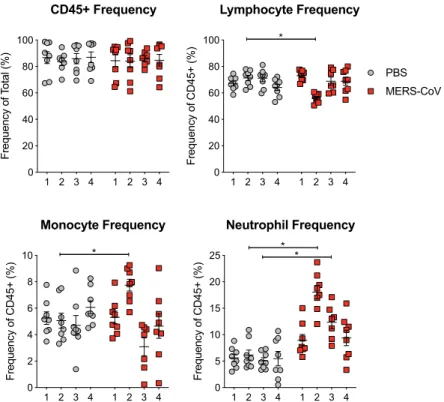
[16]. Similar to the Vetscan measurement of “total white blood cells”, the frequency of CD45+ cells observed in both mock and MERS-CoV infected animals was consistent and invariant over time (Fig 3). Because a single common lymphocyte surface marker does not exist, we combined the independent frequencies of T cell, B cell, NK cell and NK T cell subsets to
A
B
C
75 80 85 90 95 100 105% Starting W
eight
Percent Starting Weight MERS-CoV Lung Titer
1 2 3 4
Limit of detection
Days Post Infection 1
0 2 3 4
Days Post Infection
Days Post Infection
Days Post Infection Days Post Infection Days Post Infection Days Post Infection Days Post Infection Days Post Infection
Virus Titer (pfu/lobe)
PBS MERS-CoV 101 102 103 104 105 106 107 108 109 * * * *
1 2 3 4 1 2 3 4 0
5 10 15
Total Lymphocytes
1 2 3 4 1 2 3 4 0.0
0.5 1.0 1.5
Total Monocytes
1 2 3 4 1 2 3 4 0 1 2 3 4 5 Total Neutrophils
1 2 3 4 1 2 3 4 0 50 100 150 % WBC Percent Lymphocytes
1 2 3 4 1 2 3 4 0 5 10 15 % WBC Percent Monocytes
1 2 3 4 1 2 3 4 0 10 20 30 40 50 % WBC Percent Neutrophils 10
9 cells/L
10
9 cells/L
10
9 cells/L
10
9 cells/L
1 2 3 4 1 2 3 4 0
5 10 15 20
Total White Blood Cells
PBS MERS-CoV * * * * * * * * * * *
Key
Fig 2. Peripheral leukocyte populations are modulated in MERS-CoV infection. (A) Percent starting weight of mock or MERS-CoV infected animals of mice described inFig 1. The symbols represent the mean per time/group combined from two independent experiments and the error bars represent the standard deviation. Asterisks denote statistical significance as determined by two-way ANOVA with Sidek’s multiple comparison test. (B) Virus lung titer via plaque assay of mock or MERS-CoV infected animals combined from two independent experiments. Each symbol represents the titer for a single mouse. The line is at the mean titer and the error bars represent the standard deviation. Asterisks denote statistical significance as determined by two-way ANOVA with Tukey’s multiple comparison test. (C) VetScan hematology analysis. Data for total white blood cells (WBCs) as well as the numbers and frequencies of lymphocytes, monocytes and neutrophils are shown. All cell frequencies are expressed as a percentage of total WBCs. Each symbol represents the data from one mouse. The line is at the mean and the error bars represent the standard error of the mean. The dotted lines represent the normal expected range of each cell type according to the manufacturer. Asterisks denote statistical significance as determined by two-way ANOVA with Sidek’s multiple comparison test.
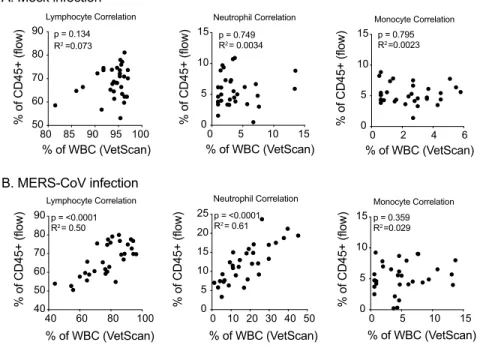
generate an aggregated “lymphocyte” frequency, to capture the cell types quantified as lym-phocytes by Vetscan. Notably, we observed a decrease in the frequency of lymlym-phocytes on 2dpi thus validating the lymphopenia measured by Vetscan HM5. Similarly, monocytes and neutro-phil frequencies as measured by flow cytometry in blood were significantly elevated following MERS-CoV infection as compared to mock infected mice mirroring that observed by Vetscan (Fig 3). We then performed Pearson Correlation analysis to compare the frequencies of lym-phocytes, neutrophils and monocytes from both flow cytometry and VetScan HM5. Unlike mock infected animals which did not show a correlation among cell frequencies for any cell type (Fig 4A), lymphocyte (P<0.001, R2= 0.5) and neutrophil (P<0.001, R2= 0.61) fre-quency data from MERS-CoV infected mice was highly correlated between flow cytometry and VetScan (Fig 4B). Lastly, the overall trends of cell population frequency modulation as measured by either flow cytometry or VetScan HM5 from the entire time course were remark-ably similar (Fig 4C). Thus, two independent techniques generated similar results demonstrat-ing modulation of peripheral leukocyte populations followdemonstrat-ing MERS-CoV infection in mice.
Numbers of peripheral blood leukocytes on day 1 post infection are
predictive of MERS-CoV disease severity
To determine if the numbers of leukocytes in peripheral blood early in MERS-CoV infection are predictive of disease severity, we infected 10–11 week old male and female 288/330+/+mice
1 2 3 4 1 2 3 4
0 20 40 60 80 100
Frequency of
Total (%)
CD45+ Frequency
1 2 3 4 1 2 3 4
0 2 4 6 8 10
Frequency of CD45+ (%)
Monocyte Frequency
*
1 2 3 4 1 2 3 4
0 20 40 60 80 100
Frequency of CD45+ (%)
Lymphocyte Frequency
PBS MERS-CoV *
1 2 3 4 1 2 3 4
0 5 10 15 20 25
Frequency of CD45+ (%)
Neutrophil Frequency
* *
Fig 3. Corroboration of VetScan data by flow cytometry. Whole peripheral blood from mock or MERS-CoV infected mice was stained and analyzed by flow cytometry from two independent experiments and the data was combined. Total white blood cells were identified by cell surface marker CD45. Lymphocyte frequency was generated by combining the frequencies of T, B, NK and NK-T cells. Monocytes and neutrophils were identified by CD115 and Ly6G, respectively. The line is at the mean and the error bars represent the standard error of the mean. Each data point represents the data from one mouse. Asterisks denote statistical significance (P<0.05) as determined by two-way ANOVA and Sidek’s multiple comparison test.
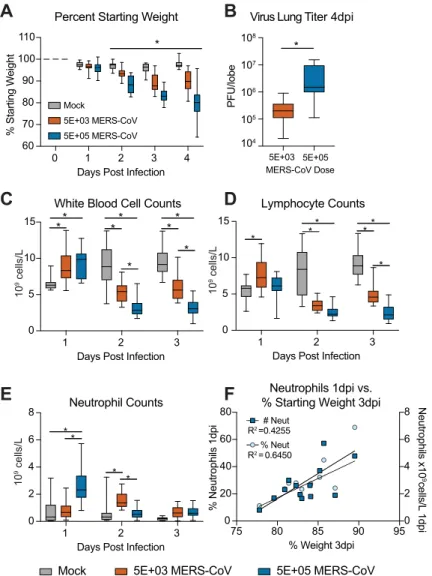
with either PBS (mock) or 5E+03 or 5E+05 PFU MERS maM35C4. These doses have previ-ously been shown to cause sub-lethal (5E+03) and lethal (5E+05) disease in our model [12]. Since our above analysis had been performed on blood from terminal cardiac puncture, in this study we bled live mock and MERS-CoV infected mice via submandibular bleed to obtain lon-gitudinal CBC data per mouse. In addition, the studies described in previous figures were all performed with a dose of MERS-CoV in between (i.e. 5E+04 PFU) those described inFig 5. Similar to previously reported data [12], we observed MERS-CoV dose dependent weight loss with sublethal and lethal doses of MERS-CoV where all groups were significantly different from each other beginning 2dpi (Fig 5A, P value range P = 0.0461 to P =<0.0001). Virus lung titer was also different among infected groups on 4dpi (P = 0.004) (Fig 5B). While we did not see significant differences in total WBC counts among mock and MERS-CoV infected (5E+04
80 85 90 95 100
50 60 70 80 90
% of WBC (VetScan)
% of CD45+ (flow)
Lymphocyte Correlation
p = 0.134 R2 =0.073
40 60 80 100
40 50 60 70 80 90
% of WBC (VetScan)
% of CD45+ (flow)
Lymphocyte Correlation
0 2 4 6
0 5 10 15
% of WBC (VetScan)
% of CD45+ (flow)
Monocyte Correlation p = 0.795 R2 =0.0023
0 5 10 15
0 5 10 15
% of WBC (VetScan)
% of CD45+ (flow)
Monocyte Correlation
0 5 10 15
0 5 10 15
% of WBC (VetScan)
% of CD45+ (flow)
Neutrophil Correlation
0 10 20 30 40 50
0 5 10 15 20 25
% of WBC (VetScan)
% of CD45+ (flow)
Neutrophil Correlation A. Mock infection
B. MERS-CoV infection
0 1 2 3 4
0 20 40 60 80 100 Day Post-Infection Frequency of
CD45+ events (%)
Flow Cytometry
0 1 2 3 4
0 20 40 60 80 100 Day Post-Infection
Frequency of WBC (%)
VetScan
lymphocytes
neutrophils
monocytes C. Kinetic freqencies of blood immune cells by flow and VetScan
p = 0.359 R2 =0.029 p = <0.0001
R2 = 0.61 p = <0.0001
R2 = 0.50
p = 0.749 R2 = 0.0034
Fig 4. Flow cytometry and VetScan hematological data are highly correlated. (A) Pearson Correlation analysis of data from mock infected mice. Lymphocyte (left), neutrophil (center) and monocyte (right) cell frequencies measured by VetScan (x-axes; frequency of WBC) and flow cytometry (y-axes; frequency of CD45+events) from peripheral
blood. (B) Pearson Correlation analysis data from MERS-CoV infected mice similar to that of A. For A and B, the correlation coefficient (R squared) and p-values obtained are indicated in each plot. (C) The kinetic frequencies of blood lymphocytes (circles), neutrophils (squares) and monocytes (triangles) in MERS-CoV infected mice through day 4 post-infection, as measured by flow cytometry (left) and VetScan (right). Time “zero” was generated from mock infected animal data to represent the baseline values. Each symbol represents merged values for 8 animals across two independent experiments; error bars identify median±SEM.
PFU) mice inFig 2C, we observed virus dose dependent differences in this metric when com-paring mock, sublethal and lethal doses of MERS-CoV (Fig 5C). Although there was an increase in WBCs with both doses of virus on 1dpi as compared to mock infection, on 2 and 3dpi leukopenia was observed (Fig 5C). CBC derived from cardiac puncture and submandibu-lar bleed of mice have been shown by others to be equivalent[17]. Thus, the differences in WBC trends in Figs2and5are not likely because of bleeding route and are more likely related to the differences in virus dosage and/or slight differences in the numbers of measured cells (i.e. lymphocytes, monocytes, neutrophils, etc.) which revealed (Fig 5) or obscured (Fig 2)
A
B
C
D
E
F
0 1 2 3 4
60 70 80 90 100 110
Percent Starting Weight
Lymphocyte Counts Days Post Infection
% Starting W
eight Mock 5E+03 MERS-CoV 5E+05 MERS-CoV * PFU/lobe
Virus Lung Titer 4dpi
*
5E+03 MERS-CoV Dose
5E+05
1 2 3
0 5 10 15
White Blood Cell Counts
Days Post Infection
5E+03 MERS-CoV 5E+05 MERS-CoV
Mock ** * * * * **
1 2 3
0 5 10 15
Days Post Infection
* *
*
*
**
1 2 3
0 2 4 6
8 Neutrophil Counts
Days Post Infection *
*
* *
Neutrophils 1dpi vs. % Starting Weight 3dpi
105 104 106 107 108 10
9 cells/L
10
9 cells/L
10
9 cells/L
75 80 85 90 95
0 20 40 60 80 0 2 4 6 8
% Weight 3dpi
% Neutrophils 1dpi
R2 =0.6450 # Neut
% Neut R2 =0.4255
Neutrophils x10
9
cells/L
1dpi
Fig 5. Numbers of peripheral blood leukocytes on day 1 post infection are predictive of MERS-CoV disease severity. (A) Percent starting weight of mock infected (N = 10) or those infected with either 5E+03 (N = 13) or 5E+05 (N = 13) PFU MERS-CoV maM35C4. Daily blood samples were obtained by submandibular bleed for each mouse on 1, 2, and 3dpi. (B) MERS-CoV virus lung titer on 4dpi via plaque assay. The asterisk indicates a statistically significant difference (P = 0.004) by Mann-Whitney test. (C) The numbers of white blood cells in mock or MERS-CoV infected mice described in A. (D) The numbers of lymphocyte cells in mock or MERS-CoV infected mice described in A. (E) The numbers of neutrophil cells in mock or MERS-CoV infected mice described in A. For the box and whisker plots in A, B, C, D and E, the line is at the median, the box extends from the 25thto 75thpercentile and the whiskers encompass the range. For A, C, D and E, the asterisk indicates statistically different values by Two-Way ANOVA with Sidek’s multiple comparison test. (F) Weight loss on 3dpi in high dose MERS-CoV (5E+05 PFU) infected mice is correlated with % neutrophils in peripheral blood on 1dpi. Linear regression was performed to determine correlation. The goodness of fit R2value is shown in the plot.
trends in the WBC metric. Similar toFig 2C, MERS-CoV infection caused significant lympho-penia on 2 and 3dpi with both sublethal and lethal doses virus (Fig 5D). In addition, the num-bers of neutrophils were elevated on 1dpi with the lethal dose but this increase was kinetically delayed in the sublethal dose to 2dpi (Fig 5E). Thus, neutrophil elevation kinetics in peripheral blood was differentially modulated with virus dose (Figs2Cand5E). Importantly, in mice infected with a lethal dose of MERS-CoV, there was a positive correlation between weight loss on 3dpi and the percentage and total numbers of neutrophils in blood on 1dpi (Fig 5F). These data demonstrate that the levels of peripheral blood leukocytes correlate with MERS-CoV dis-ease in a dose dependent manner. More specifically, neutrophil numbers on 1dpi in peripheral blood of mice infected with a lethal dose of MERS-CoV was predictive of disease severity.
The potential application of VetScan technology to evaluate
bronchoalveolar lavage fluid
After establishing the utility of the VetScan HM5 to perform routine hematology on MERS-CoV infected mice, we then evaluated the potential for VetScan to characterize leukocytes in extra-hematological samples more directly relevant to respiratory infection, such as bronchoal-veolar lavage (BAL). The VetScan instrument requires a minimum cell density to generate a reading. We found that BAL samples generated measurable results using VetScan HM5, but only under certain experimental conditions. Although we were able to characterize BAL iso-lated cells by flow cytometry (manuscript in preparation) in all animals regardless of infection status, Vetscan only intermittently provided reliable readings in MERS-CoV infected animals at late times post infection (3dpi and 4dpi) (S2 Table). Thus, most BAL samples from mock and MERS-CoV infected did not exceed the threshold required to generate reliable enumera-tion by VetScan HM5. We attempted to overcome this issue through concentraenumera-tion of the BAL samples but were still unable to generate reliable reads for both, mock and MERS-CoV infected animals. Thus, without further optimization of enumerating immune cells in BAL via VetScan HM5, flow cytometry remains the ideal application for evaluating immune popula-tion dynamics in these kinds of samples.
Discussion
and elevated monocytes in peripheral blood by two different methodologies. Importantly, we demonstrated that the disease severity could be differentiated by CBC performed daily in a longitudinal study of mice infected with either a sublethal or lethal dose of MERS-CoV. While flow cytometry is the gold standard used to characterize immune cell populations, this tech-nique requires technical expertise, expensive reagents and equipment, and often significant sample processing time especially for those working at BSL3 where biosafety procedures com-plicate this already complex process. The VetScan HM5 offers a simple and rapid alternative to flow cytometry when aiming to understand general responses in peripheral blood in emerging models of viral pathogenesis, especially those studied in BSL3 environment. Thus, the data from VetScan HM5 could serve to inform experimental design (i.e. choose timepoints) and simplify more rigorous immune cell phenotyping by flow cytometry for BSL3 pathogens.
Small animal models of emerging viral pathogenesis are fundamental tools that further our understanding of human infectious diseases. These models are essential to systematically dis-sect both viral and host determinants of disease and are key for the critical evaluation of vac-cines and antivirals. To maximize the utility, impact and biological relevance of pathogenesis studies or therapeutic evaluation, the measurement of multiple complementary and translat-able metrics is crucial. Recently, several transgenic mouse models have been generated on the C57BL/6 background that facilitate the study of MERS-CoV pathogenesis through the modifi-cation of the murine ortholog of the human MERS-CoV receptor, dipeptidyl peptidase 4 (DPP4). Although the genetic approaches vary from complete replacement of murine DPP4 with human DPP4 [18], replacement of exons 10–12 in mouseDpp4with those of human DPP4 [19], or single amino acid changes at residues 288 and 330 to “humanize” murine DPP4 [11], these models have offered complementary insights into the viral and host factors that contribute to severe lung disease after MERS-CoV infection. Only one of these studies per-formed CBC [19] but this was performed manually on blood smears to obtain percentages of lymphocytes, monocytes and neutrophils and only on 3 and 4 dpi. Nevertheless, the data that Liet.alreported with mouse adapted MERS-CoV infection of their transgenic mice are con-cordant with those reported herein with overall reductions lymphocyte percentages and increases in monocytes and neutrophils. Interestingly, using blood smears, Robertset.al reported lymphopenia and neutrophilia following infection of BALB/c mice with mouse adapted SARS-CoV strain MA15 [20]. Thus, VetScan has potential utility in characterizing the biology of multiple models of emerging CoV disease.
with a lethal dose of MERS-CoV, neutrophil numbers prior to the onset of significant weight loss were predictive of disease severity as measured by weight loss on a per mouse basis. There-fore, neutrophils in peripheral blood prior to the onset of severe clinical disease may serve as a predictive biomarker of severe MERS-CoV disease in mice, just as elevated neutrophils at the time of SARS-CoV patient admission predicted adverse outcomes in humans.
The studies described herein highlight the predictive value and clinical translatability of the CBC in the study of emerging virus pathogenesis. This technique when coupled with whole body plethysmography to measure pulmonary function [21], Bio-Plex to measure cytokines and chemokine levels in the lung, flow cytometry to immunophenotype inflammatory cells in the lung, viral load and histopathology will yield a more comprehensive view of emerging viral pathogenesis and increase the biological relevance of mouse models of emerging CoV disease. Therefore, the inclusion of the CBC should elevate, increase the biological relevance and trans-lation of future studies of emerging virus pathogenesis as well as the preclinical evaluation of therapeutics and vaccines.
Supporting information
S1 Fig. High correlation of total lymphocyte, neutrophil and monocyte cell counts and cell frequencies in peripheral blood measured by Vetscan. (A) The correlation of lymphocyte (left), neutrophil (center) and monocyte (right) cell counts (cells/L) with cell frequencies (% of WBC) reported from VetScan reads on peripheral blood in mock infected mice. (B) The corre-lation of lymphocyte (left), neutrophil (center) and monocyte (right) cell counts (cells/L) with cell frequencies (% of WBC) reported from VetScan reads on peripheral blood in MERS-CoV-infected mice. Pearson R squared and p-values are indicated on each plot.
(EPS)
S2 Fig. Red blood cells, hemoglobin, hematocrit and platelets are not modulated after MERS-CoV infection. Red blood cells, hemoglobin, hematocrit and platelets as determined by VetScan HM5. Each symbol represents the data from one mouse. The data are combined from two independent studies. Each time point per group is created from 8 individual mice. The line is at the mean and the error bars represent the standard error of the mean. Differences were not statistically significant by Two-way ANOVA with Tukey’s multiple comparison test. (EPS)
S3 Fig. VetScan data reproducibility between independent experiments. (A) The WBC, lymphocyte, neutrophil and monocyte counts and frequencies of WBC are shown for mock infected animals processed during two independent experiments (light and dark grey differen-tiate experiment 1 and 2). (B) The WBC, lymphocyte, neutrophil and monocyte counts and frequencies for animals experimentally infected with MERS-CoV. Error bars indicate the median±SEM.
(EPS)
S1 Table. Mock or MERS-CoV infected mouse peripheral blood samples collected for VetS-can and flow cytometry analysis across experiments 1 and 2. Except for one animal at one timepoint, blood samples from all animals in both experiments and both treatment groups had readings by VetScan HM5 and flow cytometry.
(DOCX)
frequencies of immune cell subsets. However, most VetScan readings from experiment 1 for BAL samples were too dilute to generate measurements; just one infected animal on days 3 and 4 post infection contained sufficient cellular density to generate a VetScan reading within range. During experiment 2, BAL samples were concentrated in an attempt to improve VetS-can read efficiency. Concentrating samples did produce a greater proportion of usable reads, particularly in MERS-CoV-infected animals, but reads from uninfected and infected animals day 1 post-infection were still outside of VetScan range. Flow cytometry analysis of BAL sam-ples from experiments 1 and 2 were possible, demonstrating that the BAL collection method did result in immune cell recovery.
(DOCX)
Acknowledgments
We would like to acknowledge the superb technical support from Madeleine Douglas and Kendra Gully.
Author Contributions
Conceptualization: Sarah R. Leist, Kara L. Jensen, Timothy P. Sheahan.
Formal analysis: Sarah R. Leist, Kara L. Jensen.
Funding acquisition: Ralph S. Baric, Timothy P. Sheahan.
Investigation: Sarah R. Leist, Kara L. Jensen, Timothy P. Sheahan.
Methodology: Sarah R. Leist.
Project administration: Sarah R. Leist, Timothy P. Sheahan.
Supervision: Timothy P. Sheahan.
Validation: Timothy P. Sheahan.
Visualization: Timothy P. Sheahan.
Writing – original draft: Sarah R. Leist, Kara L. Jensen, Timothy P. Sheahan.
Writing – review & editing: Sarah R. Leist, Kara L. Jensen, Ralph S. Baric, Timothy P. Sheahan.
References
1. Marston HD, Folkers GK, Morens DM, Fauci AS. Emerging viral diseases: confronting threats with new technologies. Sci Transl Med. 2014; 6(253):253ps10.https://doi.org/10.1126/scitranslmed.3009872 PMID:25210060.
2. de Wit E, van Doremalen N, Falzarano D, Munster VJ. SARS and MERS: recent insights into emerging coronaviruses. Nat Rev Microbiol. 2016; 14(8):523–34.https://doi.org/10.1038/nrmicro.2016.81PMID: 27344959.
3. WHO. Middle East respiratory syndrome coronavirus (MERS-CoV). 2018.
4. Hu B, Ge X, Wang LF, Shi Z. Bat origin of human coronaviruses. Virol J. 2015; 12:221.https://doi.org/ 10.1186/s12985-015-0422-1PMID:26689940; PubMed Central PMCID: PMC4687304.
5. DHHS. Medicare Payments for Clinical Laboratory Tests in 2014: Baseline Data. 2015.
6. Yang M, Ng MH, Li CK. Thrombocytopenia in patients with severe acute respiratory syndrome (review). Hematology. 2005; 10(2):101–5.https://doi.org/10.1080/10245330400026170PMID:16019455.
8. Guery B, Poissy J, el Mansouf L, Sejourne C, Ettahar N, Lemaire X, et al. Clinical features and viral diagnosis of two cases of infection with Middle East Respiratory Syndrome coronavirus: a report of nos-ocomial transmission. Lancet. 2013; 381(9885):2265–72.https://doi.org/10.1016/S0140-6736(13) 60982-4PMID:23727167.
9. Assiri A, Al-Tawfiq JA, Al-Rabeeah AA, Al-Rabiah FA, Al-Hajjar S, Al-Barrak A, et al. Epidemiological, demographic, and clinical characteristics of 47 cases of Middle East respiratory syndrome coronavirus disease from Saudi Arabia: a descriptive study. Lancet Infect Dis. 2013; 13(9):752–61.https://doi.org/ 10.1016/S1473-3099(13)70204-4PMID:23891402.
10. Lee N, Hui D, Wu A, Chan P, Cameron P, Joynt GM, et al. A major outbreak of severe acute respiratory syndrome in Hong Kong. N Engl J Med. 2003; 348(20):1986–94.https://doi.org/10.1056/
NEJMoa030685PMID:12682352.
11. Cockrell AS, Yount BL, Scobey T, Jensen K, Douglas M, Beall A, et al. A mouse model for MERS coro-navirus-induced acute respiratory distress syndrome. Nat Microbiol. 2016; 2:16226.https://doi.org/10. 1038/nmicrobiol.2016.226PMID:27892925.
12. Douglas MG, Kocher JF, Scobey T, Baric RS, Cockrell AS. Adaptive evolution influences the infectious dose of MERS-CoV necessary to achieve severe respiratory disease. Virology. 2018; 517:98–107. Epub 2017/12/27.https://doi.org/10.1016/j.virol.2017.12.006PMID:29277291; PubMed Central PMCID: PMC5869108.
13. Gregoire C, Chasson L, Luci C, Tomasello E, Geissmann F, Vivier E, et al. The trafficking of natural killer cells. Immunol Rev. 2007; 220:169–82.https://doi.org/10.1111/j.1600-065X.2007.00563.xPMID: 17979846.
14. Breslin WL, Strohacker K, Carpenter KC, Haviland DL, McFarlin BK. Mouse blood monocytes: stan-dardizing their identification and analysis using CD115. J Immunol Methods. 2013; 390(1–2):1–8. https://doi.org/10.1016/j.jim.2011.03.005PMID:21466808.
15. Carlin LM, Stamatiades EG, Auffray C, Hanna RN, Glover L, Vizcay-Barrena G, et al. Nr4a1-dependent Ly6C(low) monocytes monitor endothelial cells and orchestrate their disposal. Cell. 2013; 153(2):362– 75.https://doi.org/10.1016/j.cell.2013.03.010PMID:23582326; PubMed Central PMCID:
PMC3898614.
16. Altin JG, Sloan EK. The role of CD45 and CD45-associated molecules in T cell activation. Immunol Cell Biol. 1997; 75(5):430–45.https://doi.org/10.1038/icb.1997.68PMID:9429890.
17. Hoggatt J, Hoggatt AF, Tate TA, Fortman J, Pelus LM. Bleeding the laboratory mouse: Not all methods are equal. Exp Hematol. 2016; 44(2):132–7 e1. Epub 2015/12/09.https://doi.org/10.1016/j.exphem. 2015.10.008PMID:26644183; PubMed Central PMCID: PMC5810935.
18. Pascal KE, Coleman CM, Mujica AO, Kamat V, Badithe A, Fairhurst J, et al. Pre- and postexposure effi-cacy of fully human antibodies against Spike protein in a novel humanized mouse model of MERS-CoV infection. Proc Natl Acad Sci U S A. 2015; 112(28):8738–43.https://doi.org/10.1073/pnas.1510830112 PMID:26124093; PubMed Central PMCID: PMC4507189.
19. Li K, Wohlford-Lenane CL, Channappanavar R, Park JE, Earnest JT, Bair TB, et al. Mouse-adapted MERS coronavirus causes lethal lung disease in human DPP4 knockin mice. Proc Natl Acad Sci U S A. 2017; 114(15):E3119–E28.https://doi.org/10.1073/pnas.1619109114PMID:28348219; PubMed Cen-tral PMCID: PMC5393213.
20. Roberts A, Deming D, Paddock CD, Cheng A, Yount B, Vogel L, et al. A mouse-adapted SARS-corona-virus causes disease and mortality in BALB/c mice. PLoS Pathog. 2007; 3(1):e5.https://doi.org/10. 1371/journal.ppat.0030005PMID:17222058; PubMed Central PMCID: PMC1769406.