Scholarly Research Journal for Interdisciplinary Studies, Online ISSN 2278-8808, SJIF 2016 = 6.17, www.srjis.com UGC Approved Sr. No.45269, SEPT-OCT 2017, VOL- 4/36 https://doi.org/10.21922/srjis.v4i36.10082
IMPACT OF ACADEMIC STRESS ON STUDENTS OF CLASS +1
Navdeep Kaur Gill, Ph. D.
Principal, Muktisar Institute of Higher Education, Sri. Muktsar Sahib (Punjab)
Stress arises when the combination of internal and external pressures exceeds the individual’s resources to cope with their situation. For many young adults, college is the best time of life. These critical years can also be undermined by depression, anxiety and stress. Students are very likely to experience some or many stressors which may test their ability to cope: adapting to a new environment, balancing a heavy work load, making new friends, becoming more independent, and dealing with myriad of other issues. Looking from a closer perspective, the college students’ encounters a number of challenges in his day to day life, therefore the whole idea of an existing and vibrant college life is unveiled by these challenges which in turn contribute to stress and if not dealt with can only escalate and hamper their academic performance, emotional and social well-being. The purpose of the study is to find out the level of academic stress among students Of Class +1 having different streams. A sample of 200 students of class +1 studying in school of Ferozepur District of Punjab, India was drawn using random sampling technique. The main focus of this paper to examines the sources and effects of stress on students. The study reveals that the students of class +1 are having moderate level of academic stress and irrespective of sub samples of students are having moderate level of academic stress.
Introduction
Stress (psychology), an unpleasant state of emotional and physiological arousal that people
experience in situations that they perceive as dangerous or threatening to their well-being.
The word stress means different things to different people. Some people define stress as
events or situations that cause them to feel tension, pressure, or negative emotions such as
anxiety and anger. Others view stress as the response to these situations. This response
includes physiological changes-such as increased heart rate and muscle tension-as well as
emotional and behavioral changes. However, most psychologists regard stress as a process
involving a person's interpretation and response to a threatening event. Stress is a common
experience. We may feel stress when we are very busy, have important deadlines to meet, or
have too little time to finish all of our tasks. Often people experience stress because of
problems at work or in social relationships, such as a poor evaluation by a supervisor or an
argument with a friend. Some people may be particularly vulnerable to stress in situations
involving the threat of failure or personal humiliation. Others have extreme fears of objects or
Dr. Navdeep Kaur Gill
(Pg. 7064-7069) 7065
things associated with physical threats-such as snakes, illness, storms, or flying in an
airplane-and become stressed when they encounter or think about these perceived threats.
Major life events, such as the death of a loved one, can cause severe stress.
Stress can have both positive and negative effects. Stress is a normal, adaptive reaction to
threat. It signals danger and prepares us to take defensive action. Fear of things that pose
realistic threats motivates us to deal with them or avoid them. Stress also motivates us to
achieve and fuels creativity. Although stress may hinder performance on difficult tasks,
moderate stress seems to improve motivation and performance on less complex tasks. In
personal relationships, stress often leads to less cooperation and more aggression.
If not managed appropriately, stress can lead to serious problems. Exposure to chronic stress
can contribute to both physical illnesses, such as heart disease, and mental illnesses, such as
anxiety disorders. The field of health psychology focuses in part on how stress affects bodily
functioning and on how people can use stress management techniques to prevent or minimize
disease. The purpose of this study is to examine the prevalence of academic stress and exam
anxiety among private secondary school students in India as well as the associations with
socio-economic and study-related factors. Participants were 400 adolescent students (52
percent male) from five private secondary schools in Kolkata who were studying in grades 10
and 12. Participants were selected using a multi-stage sampling technique and were assessed
using a study-specific questionnaire. Findings revealed that 35 and 37 percent reported high
or very high levels of academic stress and exam anxiety respectively. All students reported
high levels of academic stress, but those who had lower grades reported higher levels of
stress than those with higher grades. Students who engaged in extra-curricula activities were
more likely to report exam anxiety than those who did not engage in extra-curricula activities.
According to Lazarus & Folkman (1984), stress is a mental or physical phenomenon formed
through one’s cognitive appraisal of the stimulation and is a result of one’s interaction with
the environment. The existence of stress depends on the existence of the stressor
Feng (1992) and Volpe (2000) defined stressor as anything that challenges any individual’s
adaptability or stimulates an individual’s body or mentality. Stress can be caused by
environmental factors, psychological factors, biological factors, and social factors. It can be
negative or positive to an individual, depending on the strength and persistence of the stress,
the individual’s personality , cognitive appraisal of the stress and social support. Marwan
Dr. Navdeep Kaur Gill
(Pg. 7064-7069) 7066
faculty at King Saud University. This study investigated the academic stressors experienced
by the students at university. A total sample of 232 subjects participated in this study were
obtained from faculty of education at KSU. Data were collected through self- administered
questionnaire which was randomly distributed to the students during lecture time. Data
obtained were analyzed using descriptive statistics, correlation, and analysis of variance
(ANOVA). The result showed that academic overloads, course awkward, inadequate time to
study, workload every semester, exams awkward, low motivation, and high family
expectations were drive moderately stress among students. It was also found that fear of
failure is the major source of stress among undergraduate students. Moreover, the study
found that there were positive correlation between religiosity sources and academic stress (r=
.300**, p=.00). Lastly, the study found that there were no significant differences in academic
stress among students with different, level of study and specializations. Rajasekar (2013).
Impact of academic stress among the management students of AMET university – An
analysis. The study examined the impact of academic stress among the management students.
Stress management encompasses techniques to equip a person with effective coping
mechanisms for dealing with psychological stress. Students have different expectations, goals
and values that they want to fulfill, which is only possible if they are integrated with that of
the institution. The objective of the study is to find out the present level of stress, sources of
stress and stress management techniques that would be useful for management students. The
study takes into account various criteria like physical, psychological, individual,
demographical and environmental factors of stress among the management students. The
sample comprises of 100 students of AMET Business School, AMET University in Chennai.
Data was collected through structured questionnaire by using convenient sampling method.
Objectives of the Study
1. To find out the level of academic stress among students of class +1 of Ferozepur
District of Punjab India.
2. To find out whether there is significant difference between the following sub samples
with respect to academic stress.
1. Gender [Male / Female]
2. Locality [Rural / Urban]
3. Management [ Government / Private]
Dr. Navdeep Kaur Gill
(Pg. 7064-7069) 7067
Hypotheses of the Study
1. There is significant mean difference between male and female students with respect to
academic stress.
2. There is significant mean difference between rural and urban area students with
respect to academic stress.
3. There is significant mean difference between Government and private school students
with respect to academic stress.
4. There is significant mean difference guidance needs between science and arts subject
students with respect to academic stress
Method
In the present study, the investigator applied normative survey as a method. The normative
survey method studies, describes and interprets what exists at present.
Sample
A sample is a small proportion of a population selected for observation and analysis. By
observing the characteristics of the sample, one can make certain inferences about the
characteristics of the population from which it is drawn. The present study consists of 200 XI
standard students studying in . schools situated in Ferozepur District of Punjab, India. The
sample was selected by using simple random sampling technique. The sample forms a
representative sample of the entire population.
Tool Used
The investigator of the present study selected and used the academic stress scale was
constructed and standardized by „R.Balaji Rao‟ for data collection. DESCRIPTION OF
ACADEMIC STRESS SCALE One of the important objectives of the present investigation is
to find out the level of academic stress among higher secondary school students for this
purpose the investigator used the academic stress scale constructed and standardized by
R.Balaji Rao. This scale consists of as many as 40 items and each item has five alternative
responses i.e. “No Stress”, “Slightly Stress”, “Moderate Stress”, “ Highly Stress” and “Extremely High Stress”. So the scoring to the response given by the students should be
like1. No Stress -0,2. Slightly Stress- 1, 3. Moderate Stress- 2, 4. Moderate Stress- 3, 5.
Extremely High Stress- 4. High scores are an indication of high stress and low scores on the
scale are an indication of low stress. S For the analysis of the data, descriptive analysis
Dr. Navdeep Kaur Gill
(Pg. 7064-7069) 7068
Results And Discussion
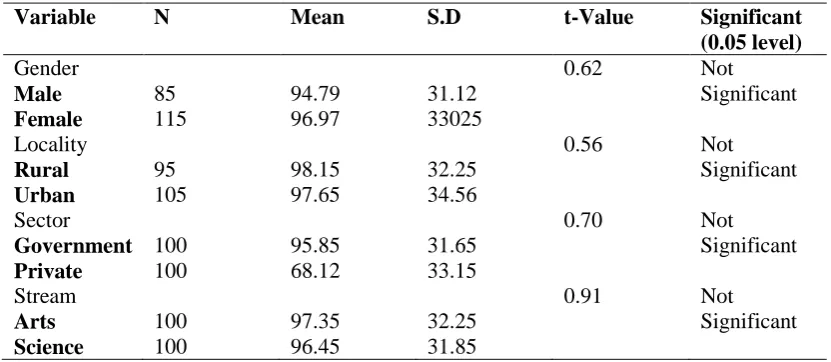
In following table all Mean ,S.D and t-values of academic stress scores of students are given
[image:5.595.90.506.184.365.2]as shown in table which shows that :
Table The Mean, Standard Deviation And T-Value Of Academic Stress Scores Student
Variable N Mean S.D t-Value Significant
(0.05 level) Gender Male Female 85 115 94.79 96.97 31.12 33025
0.62 Not
Significant Locality Rural Urban 95 105 98.15 97.65 32.25 34.56
0.56 Not
Significant Sector Government Private 100 100 95.85 68.12 31.65 33.15
0.70 Not
Significant Stream Arts Science 100 100 97.35 96.45 32.25 31.85
0.91 Not
Significant
The higher secondary students are having moderate level of academic stress and irrespective
of sub samples of the higher secondary students are having moderate level of academic stress.
Male and female students do not differ significantly in their academic stress scores. Rural and
urban area students do not differ significantly in their academic stress scores. Government
and private school students do not differ significantly in their academic stress scores. Science
and Arts students do not differ significantly in their academic stress scores..
Conclusion
The present study reveals that students of class +1 are having moderate level of academic
stress and irrespective of sub samples students are having moderate level of academic stress.
The male student‟s academic stress is higher than female student. The urban student‟s academic stress is higher than rural student. The Government school student‟s academic
stress is less than private school student. The science subject student‟s academic stress is
higher than arts student
References
Babar T. S., Kahloon, A., Kazmi, M., Khalid, H., Nawaz, K., Khan, N.A., and Khan,S. (2004). Students, Stress and Coping Strategies: A Case of Pakistani Medical School Community Health Sciences Department, Aga Khan University (AKU), Karachi, Pakistan Education for Health, 17( 3), 346-353.
Dr. Navdeep Kaur Gill
(Pg. 7064-7069) 7069
Blake, R.L., & Vandiver, T. A. (1988). The association of health with stressful life changes, social supports, and coping. Family Practice Research Journal, 7 (4), pp. 205-218.
Campbell, R.L., and Svenson, L.W. (1992). Perceived level of stress among university undergraduate students in Edmonton, Canada. Perceptual and Motor Skills, Vol 75, 552-554.
Deb, Sibnath, Esben Strodl, & Jiandong Sun (2014). "Academic-related stress among private secondary school students in India." Asian Education and Development Studies, 3,2, 118-134. Erkutlu HV, Chafra J (2006). Relationship between leadership power bases and job stress of
subordinates: example from boutique hotels, Manage. Res. News 29(5): 285-297.
Fairbrother K, & Warn, J. (2003). Workplace Dimensions, Stress and Job Satisfaction, J. Managerial Psychol. 18(1): 8-21.
Keinan,G. & Perlberg, A.(1986). Sources of stress in Academe: The Israeli Case. Higher Eduv´cation, Vol.15,No.1/2,73-88
Laney, C., Morris, E.K., Bernstein, D.M., wakefield, B.M., & Loftus, E.F.,(2008). Asparagus, a love story: Healthier eating could be just a false memory away. Experimental Psychology, 55, 291-300.
Lazarus, R.S. & Cohen, J.B. (1977). “Environmental Stress”. In I. Altman and J.F. Wohlwill (eds.), Human Behavior and Environment. (Vol 2) New York: Plenum.
Lazarus, R.S. & Cohen, J.B. (1977). “Environmental Stress”. In I. Altman and J.F. Wohlwill (eds.), Human Behavior and Environment. (Vol 2) New York: Plenum.
Marwan Zaid Bataineh (2013). Academic stress among undergraduate students: the case of education faculty at King Saud University. International Interdisciplinary Journal of Education – January 2013, Volume 2, Issue 1, 82-88.
McKean,M.,Misra, R., West, S, and Tony , R.( 2000). College Student Journal. Vol.34(2), 236-245 Passer, M.W and Smith, R.E (2007) Psychology: The Science of the Mind and Behavior (3rd edition)