Early Adolescent Friendship Selection Based on Externalizing
Behavior: the Moderating Role of Pubertal Development.
The SNARE Study
Aart Franken1&Mitchell J. Prinstein2&Jan Kornelis Dijkstra3& Christian E. G. Steglich3&Zeena Harakeh1&Wilma A. M. Vollebergh1
Published online: 20 February 2016
#The Author(s) 2016. This article is published with open access at Springerlink.com
Abstract This study examined friendship (de-)selection pro-cesses in early adolescence. Pubertal development was exam-ined as a potential moderator. It was expected that pubertal development would be associated with an increased tendency for adolescents to select their friends based on their similarities in externalizing behavior engagement (i.e., delinquency, alco-hol use, and tobacco use). Data were used from the first three waves of the SNARE (Social Network Analysis of Risk be-havior in Early adolescence) study (N= 1144; 50 % boys; Mage= 12.7;SD= 0.47), including students who entered the
first year of secondary school. The hypothesis was tested using Stochastic Actor-Based Modeling in SIENA. While tak-ing the network structure into account, and controlltak-ing for peer influence effects, the results supported this hypothesis. Early adolescents with higher pubertal development were as likely as their peers to select friends based on similarity in external-izing behavior and especially likely to remain friends with peers who had a similar level of externalizing behavior, and thus break friendship ties with dissimilar friends in this re-spect. As early adolescents are actively engaged in reorganizing their social context, adolescents with a higher pubertal development are especially likely to lose friendships
with peers who do not engage in externalizing behavior, thus losing an important source of adaptive social control (i.e., friends who do not engage in externalizing behavior).
Keywords Alcohol use . Delinquency . Pubertal
development . Social network analysis . SIENA . Tobacco use
It has been well-established that the dramatic increase in youths’externalizing behaviors (e.g., delinquency, alcohol use, tobacco use) over the adolescent transition period is strongly associated with social peer processes (e.g., Brechwald and Prinstein 2011; Dishion and Tipsord 2011; Moffitt2007; Veenstra et al.2013). Social network theories suggest that early adolescents and their friends’engagement in similar behaviors are due to two simultaneous peer socializa-tion processes. First,selection effectssuggest that youth tend to befriend peers who engage in similar levels of behaviors. Second, influence effects suggest that adolescents tend to adapt their behavior to become more similar to their friends (for more details see Steglich et al. 2010). Interestingly, al-though there has been an increasing focus on factors that may mediate or moderate influence effects, still little is known regarding the factors that may make youth more (or less) like-ly to select friends with similar behavioral proclivities (Veenstra et al.2013).
Selection effects have substantial potential implications for understanding adolescent social and behavioral development. In particular, selection effects may establish a pattern of person-environment transactions that have implications for both social relationships and for longer-term adjustment. By engaging in specific behaviors (e.g., externalizing behaviors) some adolescents are afforded new social opportunities (i.e., formation of new relationships), or are able to maintain existing relationships with peers (e.g., Moffitt 1993,2007). Electronic supplementary materialThe online version of this article
(doi:10.1007/s10802-016-0134-z) contains supplementary material, which is available to authorized users.
* Aart Franken [email protected]
1 Utrecht Centre for Child and Adolescent Studies, Utrecht University, PO Box 80.140, 3508 TC Utrecht, The Netherlands
2
Conversely, de-selection effects can lead to dissolution of friendships. In other words, adolescents may break friendship ties with peers who are dissimilar to themselves (e.g., DeLay et al.2013; Van Zalk et al. 2010). Less is known about the process of de-selection. Findings of studies investigating deselection indicate that deselection of friends who are dis-similar in tobacco use tends to happen among late adolescents who use tobacco (DeLay et al.2013), and that among 14 year olds selection rather than de-selection is important to explain similarity in delinquency and alcohol use (Van Zalk et al. 2010). Hence, it is important to take both selection and de-selection effects into account. This might be especially impor-tant for externalizing behavior, as retention of friendships with peers who do not engage in externalizing behavior may confer a variety of adjustment benefits (Richmond et al.2012), while more stable friendships with externalizing peers might in-crease the spread of externalizing behavior (Laursen et al. 2012). Thus, selection is a dynamic process between adoles-cents’ behaviors and the navigation of their social relation-ships; by choosing to drink alcohol, smoke cigarettes, or en-gage in delinquent acts, adolescents are actively enen-gaged in reorganizing their social context (Dishion2013). An initial step for understanding these processes is to more thoroughly examine factors that impact (de-)selection effects.
Selection effects based on externalizing behaviors may be critical to examine in the early adolescent period for at least two reasons. First, externalizing behavior becomes especially appealing to early adolescents as it might allow them to bridge thematurity gap(Moffitt 1993, 2007). Adolescents experi-ence this maturity gap when they feel biologically mature, but society does not grant them adult rights and responsibili-ties. Adolescents experiencing the maturity gap may be likely to engage in perceived‘adult-like’behaviors, such as in ex-ternalizing behavior (Moffitt1993,2007). Second, brain mat-uration during early adolescence is associated with increased susceptibility to social rewards before cognitive control is ful-ly developed (e.g., Blakemore and Mills 2014; Crone and Dahl2012; Prinstein and Giletta 2016; Somerville 2013). The desire to attract such rewarding friends may be especially powerful in early adolescence. For these reasons, early ado-lescence may be an important period for understanding selec-tion effects based on externalizing behaviors.
Substantial prior research indicates that early adolescents select friends based on similarity in externalizing behaviors, such as delinquent activities, alcohol use, and tobacco use (Burk et al.2012; Huisman and Bruggeman 2012; Kerr et al.2012; Light et al.2013; Mercken et al.2009; Mercken et al. 2012; Osgood et al. 2013; Steglich et al. 2012). However, not all adolescents are equally likely to do so. Moreover, findings regarding friendship selection on external-izing behavior have been inconsistent (e.g., Weerman2011). Weerman (2011) provides several explanations for the lack of selection effects in some past work. For instance, studies using
two measurement waves may not be sufficient to detect ef-fects. Moreover, Weerman (2011) notes that selection effects might take place in smaller rather than in larger multiple grade-level friendship networks. Alternatively, there might have been other factors that moderate friendship selection ef-fects (see also Veenstra et al.2013). The current study uses three waves of grade wide nomination data to assess pubertal development as a potential moderator.
Pubertal development might be relevant to selection and de-selection effects, yet it has been understudied and has not been studied as a moderating variable using models simulta-neously estimating (de-)selection and influence effects. Pubertal development precipitates the experience of the matu-rity gap (Moffitt1993), as well as an increased susceptibility to social rewards, such as those that come from friendship (e.g., Blakemore and Mills 2014; Crone and Dahl 2012; Somerville2013). Moreover, early pubertal development is generally considered a risk factor for the development of ex-ternalizing behavior among both boys and girls (for a review, see Negriff and Susman 2011). Preliminary results suggest that among boys with more advanced levels of pubertal de-velopment, friends’externalizing behavior is associated with boys’own externalizing behavior, while this is not the case for boys with a less advanced pubertal development (Felson and Haynie2002). Westling and colleagues (Westling et al.2008) found that the association between pubertal development and externalizing behavior (including alcohol and tobacco use) was moderated by affiliation with deviant peers for girls and not for boys. Furthermore, among early developing girls, older friends might be important for the development of externaliz-ing behaviors such as delinquency (see Stattin et al. 2011). Last, friends’delinquency affects the association between ear-ly pubertal development and externalizing behaviors (i.e., de-linquency) for boys and girls in a similar way and it is there-fore possible to study these effects for boys and girls simulta-neously (Lynne et al.2007). Thus, it can be expected that early adolescents with more advanced pubertal development are especially interested in the social rewards associated with ex-ternalizing behavior for both boys and girls and may therefore be more likely to select friends based on similarity in exter-nalizing behavior tendencies.
the co-evolution of friendship and behaviors. Moreover, SABM disentangles longitudinal friendship selection, de-se-lection, and influence processes.
It was hypothesized that higher levels of adolescents’ pu-bertal development would be associated with a stronger ten-dency to select friends based on similar levels of externalizing behavior, and to de-select friends based on different levels of externalizing behavior. Data from the SNARE (Social Network Analysis of Risk behavior in Early adolescence) study were used to examine these hypotheses. A unique strength of this dataset is the opportunity to examine friend-ship networks of two cohorts in the first year of secondary school, starting at age 12, in each of two schools in the Netherlands, thus enabling the examination of selection of friends in an largely unacquainted network. The study of the same hypothesis across all four social networks allows for an examination of internal replication of findings.
Methods
Procedure and Participants
Participants included 1144 students from the first year of sec-ondary school (i.e., similar to 7th grade in the US; 50 % boys), aged 11.1 till 15.6 (M= 12.7, SD = 0.47). A total of 97 % of participants were born in the Netherlands (as were 87 % of their fathers and 88 % of their mothers).
The SNARE study is an ongoing prospective cohort study involving schools in two regions of the Netherlands; ethical approval for the study was granted by the first author’s uni-versity. Participants were recruited in their first or second grade of school (i.e., similar to 7th-8th grades in the US) in Year 1. In Year 2, a second cohort was added, including stu-dents in first grade at the same schools. A passive consent procedure was used; students or their parents were asked to send a reply card or email within 2 weeks, it they wished to refrain from participation. In total 1826 students participated in the SNARE study, and 40 students (2.2 %) refused to participate.
Data from the first three waves of data collection were available for analysis. As the focus was on the development of externalizing behavior during early adolescence, only data from the 1444 first grade students were used. Of the partici-pants, 46.1 % followed lower level education (including pre-paratory secondary school for technical and vocational train-ing) and 53.9 % followed higher level education (including preparatory secondary school for higher professional tion and university). As intergenerational mobility in educa-tion is rather low in the Netherlands (see Van de Werfhorst et al.2001), this indicates that a bit less than half of the partici-pants came from relatively lower socioeconomic status back-ground, and a bit more than half of the participants came from
higher socioeconomic status background. The first assessment took place in October (Time 1), the second in December (Time 2), and the third in April (Time 3). During each assessment, participants completed study questionnaires on the computer while a teacher and research assistant were present. The per-centage of missing participants, who did not agree to partici-pate or were absent during data collection, in the four friend-ship networks ranged between 1 and 5 % (see Table 2). At Time 1 participants who were absent or indicated not to take part in the study were (if data was available) compared to their peers who were not absent. Absent participants did not differ (p> 0.05) from their peers in gender (53 % were boys, versus 50 % of the present participants), their received friendship nominations (25.0 % of their classmates selected them as friends, compared to 24.8 % of the present participants), edu-cational level (50 % followed higher level education, com-pared to 53.9 % of the present participants). However, they were slightly older (p< 0.05; absent participants had an aver-age aver-age of 12.8 years, while the present participants had an average age of 12.7 years). Peer nominations were completed using CS socio software (www.sociometric-study.com). Friendship nominations were conducted by asking participants to select an unlimited number of their closest same- or cross-gender friends from a roster of all classmates, presented in alphabetical order, starting with a random name. Participants were permitted to list peers outside their class-room, using a search function.
Measures
rather than the frequency of externalizing behavior engage-ment. An exploratory factor analysis (using maximum likeli-hood estimations and oblique rotation) tested if the binary-coded externalizing behaviors loaded on a single factor; they loaded on one factor, explaining 55.3 % of the variance (sim-ilar results were obtained with the continuous scores, explaining 61.4 % of the variance). Therefore, a composite
variable, representing the number of different externalizing behaviors participants engaged in (i.e., delinquency, alcohol, or tobacco use), was computed; resulting in scores between zero (no externalizing behaviors) and three (all externalizing behaviors).
Pubertal Development (Time 1, Time 2) The Pubertal Development Scale (PDS; Petersen et al.1988) was used to assess pubertal development. The PDS used a 4-point scale, ranging fromnot yet started(0),recently started(1),started a while ago(2), toalready completed(3), to measure various indicators of pubertal development. Girls were asked four questions regarding their body grow spurt, body hair (pubic hair), changes in skin (pimples), and breast growth. Girls were allowed to skip the question regarding menarche, as a result there were more missing scores and this question was not included in the current analyses. Boys were asked about their body growth, body hair (pubic hair), skin changes, voice changes, and beard growth. Mean scores were computed for girls and boys separately, resulting in a scale with an accept-able internal consistency at Time 1 (alpha = 0.70 for girls, and 0.79 for boys).
Friendship Nominations (Time 1 – Time 3) Participants were asked to name their best friends. Participants could nom-inate unlimited friends within their class and, afterwards, friends from their grade. Grade networks were used for the current analyses resulting in four friendship networks (i.e., two schools, two cohorts).
Analysis Strategy
Preliminary analyses included descriptive statistics for each of the four social networks (i.e., two cohorts in two schools). For each network and each assessment, the average age, percent-age of boys, averpercent-age externalizing behavior level, the number of externalizing behaviors participants engaged in, pubertal development scores, the fraction of missing participants per assessment, and the average number of friends for participants were computed. A Jaccard index, indicating relative network stability over time, also was calculated.
All network analyses were conducted using SIENA (Simulation Investigation for Empirical Network Analyses), version 4, in R. SIENA is actor based, and models the longi-tudinal co-evolution of social networks and individual charac-teristics (Ripley et al.2014). For the social networks, at each time point SIENA reads the presence (identified by the score 1) or absence (identified by the score 0) of friendship ties between participants (actors) in the network, and the number of externalizing behaviors participants engage in. As there were three time points, each network has three friendship net-work input files and each participant has three scores on ex-ternalizing behavior. SIENA also reads two types of Table 1 Overview of the number of participants scoring 0, 1, or higher
than 1 on delinquency, alcohol use, and tobacco use; at Time 1, Time 2, and Time 3
School 1 School 2
Cohort 1 Cohort 2 Cohort 1 Cohort 2 Participants Participants Participants Participants Delinquency Time 1
0 332 (78.3 %) 273 (72.6 %) 135 (78.6 %) 95 (70.9 %) 1 47 (11.1 %) 44 (11.7 %) 14 (8.1 %) 25 (18.7 %) >1 45 (10.6 %) 59 (15.7 %) 23 (13.3 %) 14 (10.4 %) Delinquency time 2
0 316 (75.1 %) 268 (72.6 %) 139 (79.4 %) 95 (71.4 %) 1 47 (11.2 %) 49 (13.3 %) 12 (6.9 %) 22 (16.5 %) >1 58 (13.8 %) 52 (14.1 %) 24 (13.7 %) 16 (12.0 %) Delinquency Time 3
0 304 (75.1 %) 273 (72.6 %) 128 (73.1 %) 94 (70.7 %) 1 46 (11.4 %) 49 (13.0 %) 24 (13.7 %) 13 (9.8 %) >1 55 (13.6 %) 54 (14.4 %) 23 (13.1 %) 26 (19.5 %) Alcohol Time 1
0 376 (89.3 %) 321 (86.3 %) 161 (93.1 %) 126 (94.7 %) 1 27 (6.4 %) 28 (7.5 %) 6 (3.5 %) 6 (4.5 %) >1 18 (4.3 %) 23 (6.2 %) 6 (3.5 %) 1 (0.8 %) Alcohol Time 2
0 376 (89.3 %) 328 (90.4 %) 161 (92.5 %) 119 (90.8 %) 1 24 (5.7 %) 16 (4.4 %) 8 (4.6 %) 10 (7.6 %) >1 21 (5.0 %) 19 (5.2 %) 5 (2.9 %) 2 (1.5 %) Alcohol Time 3
0 355 (87.9 %) 319 (89.4 %) 154 (89.0 %) 107 (86.3 %) 1 22 (5.4 %) 27 (7.5 %) 8 (4.6 %) 8 (6.5 %) >1 27 (6.7 %) 15 (4.2 %) 11 (6.4 %) 9 (7.3 %) Tobacco Time 1
0 407 (96.2 %) 349 (93.6 %) 171 (98.8 %) 134 (100 %) 1 7 (1.7 %) 9 (2.4 %) 1 (0.6 %)
>1 9 (2.1 %) 15 (4.0 %) 1 (0.6 %) Tobacco Time 2
0 405 (96.2 %) 343 (93.5 %) 168 (96.0 %) 125 (94.7 %) 1 10 (2.4 %) 9 (2.5 %) 3 (1.7 %) 3 (2.3 %) >1 6 (1.4 %) 15 (4.1 %) 4 (2.3 %) 4 (3.0 %) Tobacco Time 3
individual characteristics, constant or varying characteristics. Constant characteristics do not change over time (such as par-ticipants’ gender). Varying characteristics can change over time (such as the pubertal development scale). SIENA uses information about a varying characteristic at Time 1 to esti-mate changes between Time 1 and Time 2, and information at Time 2 to estimate changes between Time 2 and Time 3.
While controlling forstructural network effects (i.e., the structure of friendships in the network), SIENA estimates both selection effects(network dynamics)and influence effects (be-havior dynamics)longitudinally. The changes in individual behavior were modeled as an increase or decrease in the num-ber of externalizing behaviors participants engaged in (rang-ing from zero to three externaliz(rang-ing behaviors). SIENA esti-mates changes between two points in time. For the current analyses the dependent variables are the network ties (friendships) and the number of externalizing behaviors par-ticipants engaged in (delinquent behavior, alcohol use, and tobacco use). The outcomes of SIENA analyses are based on an iterative Markov chain Monte Carlo approach (Snijders et al.2010; Ripley et al.2014). SIENA shows t-ratios as con-vergence statistics for the different effects in the model, with t-ratios below 0.10 signifying good convergence; models with good convergence were used for interpretation of the results. The pubertal development score at Time 1 was used for the analyses in the first period (between Time 1 and Time 2), and the score at Time 2 was used for the analyses in the second period (between Time 2 and Time 3). The effects which were modeled will be described below, for more detail and the equations behind these effects we refer to the SIENA manual (Ripley et al.2014).
Structural network effectscommonly used in comparable studies were added (see Ripley et al.2014; Veenstra et al. 2013) afterwards, using goodness of fit indices, other network effects were added to optimally capture the friendship struc-ture in the current networks. The effects which are generally included in SIENA analyses were network density (1A 1the number of present versus absent friendship ties in the net-work), reciprocity (1Bthe likelihood of reciprocated friendship ties), transitive triplets (1Clikelihood to befriend friends of friends), three-cycles (1D indicates generalized reciprocity and negative hierarchies), indegree popularity (1Esquare root version; likelihood for participants who receive many friend-ship nominations to receive extra friendfriend-ship nominations), indegree activity (1Fsquare root version; likelihood for partic-ipants who receive many friendship nominations to send extra friendship nominations), and outdegree activity (1Gsquare root version; likelihood for participants who send out many friendship nominations to send out extra friendship nomina-tions); for more details see Ripley et al. (2014). To improve
model fit, density and indegree popularity were allowed to vary between assessment periods. Furthermore, transitive re-ciprocated triplets were modeled to estimate the likelihood for triads (a group of three friends) to reciprocate friendships.
Before examining study hypotheses, several factors poten-tially affecting the social network (i.e., network dynamic effects) were estimated as covariates (see Veenstra et al. 2013). The effects of same-gender friendship selection (2Ci.e., girls nominate girls; boys nominate boys; girls were coded as 0, boys as 1) were estimated as well as the effects of proximity by using adolescents’classroom and school loca-tions as covariates (2CSchool 1 consisted of four locations). The effects of gender on provision (2Bego) and receipt of (2Aalter) friendship nominations also was controlled.
To examine our main hypotheses, we included the effects of pubertal development and externalizing behavior on friend-ship nominations given (2Bego effects) and received (2Aalter effects). Furthermore, we included the selection similarity ef-fect (2C) modelling the likelihood of providing and selecting similar friends based on externalizing behavior and pubertal development. Of particular note, two interaction effects were added to examine if pubertal development had an impact on the likelihood for participants to select and deselect friends who were dissimilar in externalizing behavior (maintain (2D) and create (2E) pubertal development x externalizing behavior similarity selection).
Although not a focus of the current study, SIENA simulta-neously examines influence, as well as selection effects. Thus, several behavior dynamic effects also were estimated (see Veenstra et al.2013). Behavior dynamic effects model chang-es in externalizing behavior. They model the rate of change (externalizing behavior change period 1 & 2), and whether behavior change conforms to linear (externalizing behavior linear shape) or quadratic (externalizing behavior quadratic shape) trends. A main effect of influence is estimated as the likelihood that participants adapt their externalizing behavior to become more similar to the average externalizing behavior of their friends (externalizing behavior influence). The effects of pubertal development on behavior change was also modeled (effects from pubertal development). An interaction effect between pubertal development and externalizing behav-ior also was examined (pubertal development x externalizing behavior influence) to determine whether susceptibility to peer influence depends on pubertal development. Overall, the inclusion of these effects was similar to prior research using SIENA (e.g., DeLay et al.2013; Van Zalk et al.2010). A meta-analysis of the parameters was conducted on the four networks. This meta-analysis was conducted using the SIENA likelihood based method for meta analyses (for more information see Ripley et al.2014). Although this analysis is usually not viable for less than 10 networks (Ripley et al. 2014) it worked well with the current networks due to normal-ity of distributions of estimates.
1
Results
Descriptive Statistics of the Networks, and Externalizing Behaviors Within Networks
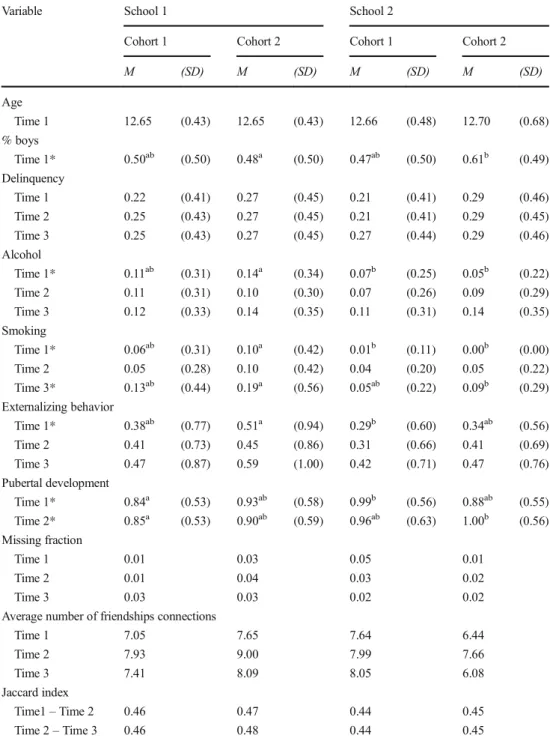
Table2lists descriptive statistics for each of the four networks examined in this study. Results at Time 1 suggested that all four networks did not differ in age or delinquency level. There
were some small differences in gender distribution, alcohol use, tobacco use, overall externalizing behavior, and or puber-tal development. None of the students of the smallest network, cohort 2 of School 2 used tobacco at Time 1.
Table2also includes network characteristics for each co-hort. There were between 1 and 5 % absent participants during the assessments. On average, participants had between six and nine friends in all networks and waves. The Jaccard index
Table 2 Descriptive statistics of friendship networks for school 1 (Cohort 1N= 432, Cohort 2 N= 390) and school 2 (Cohort 1 N= 186, Cohort 2N= 136), Times 1, 2 and 3
Variable School 1 School 2
Cohort 1 Cohort 2 Cohort 1 Cohort 2
M (SD) M (SD) M (SD) M (SD)
Age
Time 1 12.65 (0.43) 12.65 (0.43) 12.66 (0.48) 12.70 (0.68) % boys
Time 1* 0.50ab (0.50) 0.48a (0.50) 0.47ab (0.50) 0.61b (0.49) Delinquency
Time 1 0.22 (0.41) 0.27 (0.45) 0.21 (0.41) 0.29 (0.46) Time 2 0.25 (0.43) 0.27 (0.45) 0.21 (0.41) 0.29 (0.45) Time 3 0.25 (0.43) 0.27 (0.45) 0.27 (0.44) 0.29 (0.46) Alcohol
Time 1* 0.11ab (0.31) 0.14a (0.34) 0.07b (0.25) 0.05b (0.22) Time 2 0.11 (0.31) 0.10 (0.30) 0.07 (0.26) 0.09 (0.29) Time 3 0.12 (0.33) 0.14 (0.35) 0.11 (0.31) 0.14 (0.35) Smoking
Time 1* 0.06ab (0.31) 0.10a (0.42) 0.01b (0.11) 0.00b (0.00) Time 2 0.05 (0.28) 0.10 (0.42) 0.04 (0.20) 0.05 (0.22) Time 3* 0.13ab (0.44) 0.19a (0.56) 0.05ab (0.22) 0.09b (0.29) Externalizing behavior
Time 1* 0.38ab (0.77) 0.51a (0.94) 0.29b (0.60) 0.34ab (0.56) Time 2 0.41 (0.73) 0.45 (0.86) 0.31 (0.66) 0.41 (0.69) Time 3 0.47 (0.87) 0.59 (1.00) 0.42 (0.71) 0.47 (0.76) Pubertal development
Time 1* 0.84a (0.53) 0.93ab (0.58) 0.99b (0.56) 0.88ab (0.55) Time 2* 0.85a (0.53) 0.90ab (0.59) 0.96ab (0.63) 1.00b (0.56) Missing fraction
Time 1 0.01 0.03 0.05 0.01
Time 2 0.01 0.04 0.03 0.02
Time 3 0.03 0.03 0.02 0.02
Average number of friendships connections
Time 1 7.05 7.65 7.64 6.44
Time 2 7.93 9.00 7.99 7.66
Time 3 7.41 8.09 8.05 6.08
Jaccard index
Time1–Time 2 0.46 0.47 0.44 0.45
Time 2–Time 3 0.46 0.48 0.44 0.45
indicates the relative stability of each network over time. An index between 0.44 and 0.48, indicating the percentage of stable friendships, is well within the desired range for longi-tudinal social network analyses (Veenstra et al.2013).
Effects of Pubertal Development on Friendship Selection of Externalizing Behavior
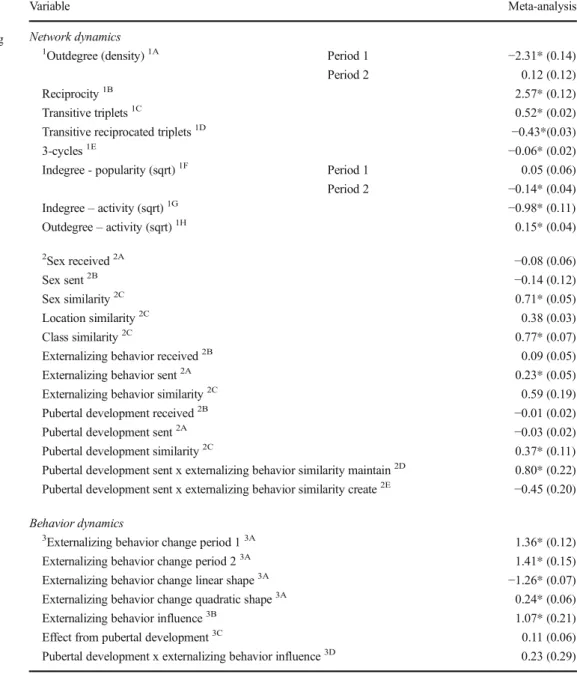
The outcomes of the SIENA analyses are shown in Table3. The structural network effects model the network structure, and optimize the goodness of fit of the networks. Network dynamic effects indicate the effects of externalizing behavior, pubertal development, and control variables on selection ef-fects. Main effects were generally consistent with prior re-search. Participants’selection of friends was significantly as-sociated with similarity in gender and class. Location was marginally significant in the meta-analysis atp= 0.05, proba-bly because the effect was only based on the two networks of school 1. Both of these effects were significant when exam-ined in their respective network (see supplementary materials). Higher levels of participants’engagement in exter-nalizing behaviors were associated with the provision of more friendship nominations (see positive externalizing behavior sent effect). Participants were more likely to select friends who were similar in their engagement of externalizing behav-ior (see externalizing behavbehav-ior similarity), although this effect was marginally significant (p= 0.05). Participants also were likely to select friends at similar levels of pubertal develop-ment (see pubertal developdevelop-ment similarity effect). Behavior dynamics results also revealed a significant negative linear effect, and positive quadratic effect, for changes in externaliz-ing behavior over time.
Consistent with hypotheses interaction effects (between pubertal development and maintaining friends based on exter-nalizing behavior) emerged, suggesting that over time puber-tal development influenced the likelihood to maintain friends who are similar in externalizing behavior. As can be seen in Fig.1, this effect indicates that among more pubertally devel-oped participants, maintenance of friendship ties over time was more strongly associated with similarity in externalizing behavior especially at higher engagement in externalizing be-havior. In other words, adolescents with a higher pubertal development who engage in externalizing behavior were more likely to de-select friends with dissimilar levels of externaliz-ing behavior; there was no difference for adolescents who do not engage in externalizing behavior. However, pubertal de-velopment did not influence the likelihood to create friend-ships based on similarity in externalizing behavior.
Although not a focus of the current study, results also indi-cated a significant effect for peer influence in externalizing behavior, suggesting that participants’externalizing behavior became more similar to the average level of their friends’ externalizing behavior over time. Specifically, results
indicated that friends’engagement in more types of external-izing behavior (i.e., delinquency, alcohol, tobacco use) was associated with participants’adoption of more types of exter-nalizing behavior over time. The direct effect of pubertal de-velopment on externalizing behavior nor the interaction be-tween pubertal development and externalizing behavior influ-ence were significant. In other words, participants’ level of pubertal development was not associated with an increase in externalizing behavior over time, nor with differences in ado-lescents’propensity for peer influence.
Discussion
This study focused on friendship (de-)selection processes in early adolescence. Pubertal development was examined as a potential moderator of the relationship between externalizing behavior and friendship (de-)selection. It was hypothesized that more advanced pubertal development would be associat-ed with an increasassociat-ed tendency for adolescents to select their friends based on their similarities in externalizing behavior engagement. This study is unique in its focus on pubertal development as a moderator of selection effects using contem-porary approaches for examining peer selection. Results sup-ported the hypotheses. Overall, results indicated that adoles-cents are especially likely to select peers as friends if those peers are similar in their externalizing behavior engagement; this effect was increasingly evident for deselection of friends by early adolescents with higher levels of adolescents’ puber-tal development. Those adolescents with higher puberpuber-tal de-velopment were more likely to remain friends with peers who have a similar engagement in externalizing behavior, and to break friendship with those who do not.
Results have several important implications for adolescent development. First, findings suggest that more pubertally-developed adolescents are not more inclined to externalizing behavior, but are more likely to lose their friends who do not engage in externalizing behavior, thus they might lose an im-portant source of adaptive social support (e.g., Richmond et al. 2012). Research suggests that adaptive social support, from non-deviant peers, may be especially important for helping adolescents cope with stressors, and for socializing adoles-cents towards adaptive developmental outcomes such as high academic achievements (Dishion and Tipsord2011). Findings may elucidate a mechanism by which early-starter adolescent externalizing behavior leads to maladaptation in other domains.
susceptibility to peer influence, however. An interesting direc-tion for future work will be the examinadirec-tion of these processes over a wider range of development. It is possible that early adolescents selection processes lead to heightened influence processes later in adolescence that were beyond the
assessment window in this study. Alternatively, it is possible that the effects of pubertal development on peer influence processes may be limited to selection effects, and not as rele-vant for influence effects. Both are intriguing possibilities for future work.
Table 3 Meta-analysis estimates the evaluation functions and standard errors of selection and influence effects for externalizing behavior and pubertal
development in friendship, Time 1, 2, and 3
Variable Meta-analysis
Network dynamics 1
Outdegree (density)1A Period 1 −2.31* (0.14)
Period 2 0.12 (0.12)
Reciprocity1B 2.57* (0.12)
Transitive triplets1C 0.52* (0.02)
Transitive reciprocated triplets1D −0.43*(0.03)
3-cycles1E −0.06* (0.02)
Indegree - popularity (sqrt)1F Period 1 0.05 (0.06)
Period 2 −0.14* (0.04)
Indegree–activity (sqrt)1G −0.98* (0.11)
Outdegree–activity (sqrt)1H 0.15* (0.04)
2
Sex received2A −0.08 (0.06)
Sex sent2B −0.14 (0.12)
Sex similarity2C 0.71* (0.05)
Location similarity2C 0.38 (0.03)
Class similarity2C 0.77* (0.07)
Externalizing behavior received2B 0.09 (0.05)
Externalizing behavior sent2A 0.23* (0.05)
Externalizing behavior similarity2C 0.59 (0.19)
Pubertal development received2B −0.01 (0.02)
Pubertal development sent2A −0.03 (0.02)
Pubertal development similarity2C 0.37* (0.11)
Pubertal development sent x externalizing behavior similarity maintain2D 0.80* (0.22) Pubertal development sent x externalizing behavior similarity create2E −0.45 (0.20) Behavior dynamics
3
Externalizing behavior change period 13A 1.36* (0.12) Externalizing behavior change period 23A 1.41* (0.15) Externalizing behavior change linear shape3A −1.26* (0.07) Externalizing behavior change quadratic shape3A 0.24* (0.06)
Externalizing behavior influence3B 1.07* (0.21)
Effect from pubertal development3C 0.11 (0.06)
This study revealed several additional interesting results. First, adolescents were likely to select their friends based on similarity in pubertal development, even when taking selec-tion on externalizing behavior into account. Second, although several studies have associated early pubertal development with externalizing behavior during early adolescence (for an overview see Graber et al.2010), this association might dis-appear when taking friendship selection and influence pro-cesses into account.
This study has several strengths. First, by investigating participants at the start of secondary schools it was possible to capture the beginning of new friendship networks, thus allowing us to study selection effects isolated from previous networks. Second, it was possible to look at generalizability of our findings as we studied four independent but similar whole grade friendship networks; which can be found in the supple-mentary materials. Furthermore, our study builds on previous studies investigating friendship selection and deselection pro-cesses in externalizing behavior among adolescents (e.g., DeLay et al.2013; Van Zalk et al. 2010) by showing that deselection based on externalizing behavior is important es-pecially among adolescents with a higher pubertal develop-ment and engagedevelop-ment in externalizing behavior.
Future studies should address several limitations of this study. First, to examine cohesive social networks, peer nomi-nations emphasized friendships within children’s own school grade. However, deviant peer affiliations in particular may include peers from other grades. Future research allowing cross-grade nominations, and even friendship nominations outside of the school context may reveal additional relevant
social influences (Kerr et al.2007). Although we were able to use a meta-analysis there were some differences between the networks (see thesupplementary materials) which merit fur-ther investigation. Also Mercken et al. (2009) showed out-comes to differ across several meta-analyses in different coun-tries, our findings add to this study by showing that differ-ences might also occur while comparing networks within the same country or even within the same school. Possibly, power issues due to the dichotomization of our variables (see Markon et al.2011) might have affected our results; as most significant findings occurred in the larger cohorts examined in this study. Alternatively, differences between the networks might occur because of factors not captured in the current analyses. A recent review (Marschall-Lévesque et al. 2014) pointed out the importance of studying school, neighborhood, and parent-ing effects when studyparent-ing the associatparent-ing between peers and substance use. Parenting effects might be especially important while studying pubertal development (Westling et al.2008). Therefore, future studies should investigate such factors as potentially affecting the interplay between externalizing be-havior, peers, and pubertal development. Third, this study examined an externalizing behavior composite, indicating whether adolescents had engaged in any delinquent behavior, alcohol, or tobacco use. This composite score was used as the data was highly skewed, however the consequence of com-bining these variables should be further investigated. Moreover, the dichotomized variables were then further col-lapsed into an ordinal scale. This is an unfortunate, but neces-sary limitation of SIENA. Identifying alternate approaches for handling continuous measures in SABM is a critical direction for future work. Furthermore, whether these same processes are relevant for the frequency with which adolescents engage in each of these behaviors remains unexplored as we did not conduct analyses at the individual item level. Especially the role of adolescents who engage very frequently in externaliz-ing behaviors might be important to investigate. Future studies could investigate the role of pubertal development in influence and selection processes related to changes in different forms of externalizing behaviors separately, such as delinquency, alco-hol use, and tobacco use. Such studies might benefit from investigating slightly older adolescents, when there is a higher occurrence of and change in externalizing behavior. Last, the sophistication of the models examined in this study prohibited a test of more complex gender or family interactions as even larger sample sizes would be needed. Nevertheless, the study of further moderation is a critical future direction.
In conclusion, this study suggested that during early ado-lescence pubertal development plays a pivotal role in adoles-cents’friendship selection. The implications of externalizing behavior engagement on adolescents’social network has been relatively under-explored, but could be a useful direction to consider whether providing psychological services to at-risk youth. Especially pubertally more advanced adolescents Fig. 1 The interaction between pubertal development and maintaining
should be supported in maintaining friendships with peers who do not engage in externalizing behavior, as such friends provide an important social support network (Richmond et al. 2012).
Acknowledgments We are grateful to all adolescents, their parents and teachers who participated in this research and to everyone who worked on this project and made it possible. The first author was supported by a Fulbright scholarship, and a grant from NWO (programme Youth and Family, project number 431-09-027). The third author was supported by a grant from the Netherlands Organisation for Scientific Research (NWO) (Vernieuwingsimpuls; VENI. project number 451-10-012) during the preparation of this manuscript. The fourth author was supported by a grant from the Netherlands Organisation for Scientific Research (NWO) (Vernieuwingsimpuls; VENI. project number 451-08-018) during the preparation of this manuscript.
Compliance with Ethical Standards
Conflict of Interest The authors declare that they have no conflict of interest.
Ethical Approval The procedures were in accordance with the ethical standards of the institutional and/or national research committee and with the 1964 Helsinki declaration and its later amendments or comparable ethical standards.
Informed Consent Informed consent was obtained from all individual participants included in the study (see Methods section).
Open AccessThis article is distributed under the terms of the Creative C o m m o n s A t t r i b u t i o n 4 . 0 I n t e r n a t i o n a l L i c e n s e ( h t t p : / / creativecommons.org/licenses/by/4.0/), which permits unrestricted use, distribution, and reproduction in any medium, provided you give appropriate credit to the original author(s) and the source, provide a link to the Creative Commons license, and indicate if changes were made.
References
Blakemore, S. J., & Mills, K. L. (2014). Is adolescence a sensitive period for sociocultural processing?Annual Review of Psychology, 65, 187–207. doi:10.1146/annurev-psych-010213-115202.
Brechwald, W. A., & Prinstein, M. J. (2011). Beyond homophily: a de-cade of advances in understanding peer influence processes.Journal of Research on Adolescence, 21, 166–179. doi:10.1111/j.1532-7795.2010.00721.x.
Burk, W. J., van der Vorst, H., Kerr, M., & Stattin, H. (2012). Alcohol use and friendship dynamics: selection and socialization in early-, mid-dle-, and late-adolescent peer networks.Journal of Studies on Alcohol and Drugs, 73, 89–98.
Crone, E. A., & Dahl, R. E. (2012). Understanding adolescence as a period of social-affective engagement and goal flexibility.Nature Reviews. Neuroscience, 13, 636–650. doi:10.1038/nrn3313. DeLay, D., Laursen, B., Kiuru, N., Salmela-Aro, K., & Nurmi, J. E.
(2013). Selecting and retaining friends on the basis of cigarette smoking similarity.Journal of Research on Adolescence, 23, 464– 473. doi:10.1111/jora.12017.
Dishion, T. J. (2013). Stochastic agent-based modeling of influence and selection in adolescence: current status and future directions in un-derstanding the dynamics of peer contagion.Journal of Research on Adolescence, 23, 596–603. doi:10.1111/jora.12068.
Dishion, T. J., & Tipsord, J. M. (2011). Peer contagion in child and adolescent social and emotional development.Annual Review of Psychology, 62, 189–214. doi:10.1146/annurev.psych.093008. 100412.
Felson, R. B., & Haynie, D. L. (2002). Pubertal development, social factors, and delinquency among adolescent boys.Criminology, 40, 967–988. doi:10.1111/j.1745-9125.2002.tb00979.x.
Graber, J. A., Nichols, T. R., & Brooks-Gunn, J. (2010). Putting pubertal timing in developmental context: implications for prevention. Developmental Psychobiology, 52, 254–262. doi:10.1002/dev. 20438.
Huisman, C., & Bruggeman, J. (2012). The social network, socioeconom-ic background, and school type of adolescent smokers.International Journal of Behavioral Development, 36, 329–337. doi:10.1177/ 0165025412444078.
Kerr, M., Stattin, H., & Kiesner, J. (2007). Peer and problem behaviour: have we missed something? In R. C. M. E. Engels, M. Kerr, & H. Stattin (Eds.),Friends lovers and groups: key relationships in adolescence(pp. 125–153). London: Wiley.
Kerr, M., van Zalk, M. H. W., & Stattin, H. (2012). Psychopathic traits moderate peer influence on adolescent delinquency.Journal of Child Psychology and Psychiatry, and Allied Disciplines, 53, 826– 835. doi:10.1111/j.1469-7610.2011.02492.x.
Laursen, B., Hafen, C. A., Kerr, M., & Stattin, H. (2012). Friend influence over adolescent problem behaviors as a function of relative peer acceptance: to be liked is to be emulated.Journal of Abnormal Psychology, 121, 88–94. doi:10.1037/a0024707.
Light, J. M., Greenan, C. C., Rusby, J. C., Nies, K. M., & Snijders, T. A. B. (2013). Onset to first alcohol use in early adolescence: a network diffusion model.Journal of Research on Adolescence, 23, 487–499. doi:10.1111/jora.12064.
Lynne, S. D., Graber, J. A., Nichols, T. R., Brooks-Gunn, J., & Botvin, G. J. (2007). Links between pubertal timing, peer influences, and ex-ternalizing behaviors among urban students followed through mid-dle school.The Journal of Adolescent Health, 40, 181.e7–181.e13. doi:10.1016/j.jadohealth.2006.09.008.
Markon, K. E., Chmielewski, M., & Miller, C. J. (2011). The reliability and validity of discrete and continuous measures of psychopatholo-gy: a quantitative review.Psychological Bulletin, 137, 856–879. doi: 10.1037/a0023678.
Marschall-Lévesque, S., Castellanos-Ryan, N., Vitaro, F., & Séguin, J. R. (2014). Moderators of the association between peer and target ado-lescent substance use.Addictive Behaviors, 39, 48–70. doi:10.1016/ j.addbeh.2013.09.025.
Mercken, L., Snijders, T. A. B., Steglich, C. E. G., & de Vries, H. (2009). Dynamics of adolescent friendship networks and smoking behavior: social network analyses in six European countries.Social Science & Medicine, 69, 1506–1514. doi:10.1016/j.socscimed.2009.08.003. Mercken, L., Steglich, C. E. G., Sinclair, P., Holliday, J., & Moore, L.
(2012). A longitudinal social network analysis of peer influence, peer selection, and smoking behavior among adolescents in British schools.Health Psychology, 31, 450–459. doi:10.1037/a0026876. Moffitt, T. E. (1993). Adolescent-limited and life-course-persistent
anti-social behavior: a developmental taxonomy.Psychological Review, 100, 674–701. doi:10.1037/0033-295X.100.4.674.
Moffitt, T. E. (2007). A review of research on the taxonomy of life-course persistent versus adolescence-limited antisocial behavior. In D. Flannery, A. Vazonsyi, & I. Waldman (Eds.),The Cambridge hand-book of violent behavior and aggression(pp. 49–74). New York: Cambridge University Press.
Negriff, S., & Susman, E. J. (2011). Pubertal timing, depression, and externalizing problems: a framework, review, and examination of gender differences.Journal of Research on Adolescence, 21, 717– 746. doi:10.1111/j.1532-7795.2010.00708.x.
Nijhof, K. S., Scholte, R. H. N., Overbeek, G., & Engels, R. C. M. E. (2010). Friends’and adolescents’delinquency: the moderating role of social status and reciprocity of friendships.Criminal Justice and Behavior, 37, 289–305. doi:10.1177/0093854809355776. Osgood, D. W., Ragan, D. T., Wallace, L., Gest, S. D., Feinberg, M. E., &
Moody, J. (2013). Peers and the emergence of alcohol use: influence and selection processes in adolescent friendship networks.Journal of Research on Adolescence, 23, 500–512. doi:10.1111/jora.12059. Petersen, A. C., Crockett, L., Richards, M., & Boxer, A. (1988). A self-report measure of pubertal status: reliability, validity, and initial norms.Journal of Youth and Adolescence, 17, 117–133. doi:10. 1007/BF01537962.
Prinstein, M. J., & Giletta, M. (2016). Peer relations and developmental psychopathology. In D. Cicchetti (Ed.), Developmental psychopathology(3rd ed.). Hoboken: Wiley.
Richmond, M. J., Mermelstein, R. J., & Metzger, A. (2012). Heterogeneous friendship affiliation, problem behaviors, and emo-tional outcomes among high-risk adolescents.Prevention Science, 13, 267–277. doi:10.1007/s11121-011-0261-2.
Ripley, R. M., Snijders, T. A. B., Boda, Z., Vörös, A., & Preciado, P. (2014). Manual for RSiena. Oxford: University of Oxford, Department of Statistics, Nuffield College.
Snijders, T. A. B., van de Bunt, G. G., & Steglich, C. E. G. (2010). Introduction to stochastic actor-based models for network dynamics. Social Networks, 32, 44–60. doi:10.1016/j.socnet.2009.02.004. Somerville, L. H. (2013). Special issue on the teenage brain: sensitivity to
social evaluation.Current Directions in Psychological Science, 22, 121–127. doi:10.1177/0963721413476512.
Stattin, H., Kerr, M., & Skoog, T. (2011). Early pubertal timing and girls’ problem behavior: Integrating two hypotheses.Journal of Youth and Adolescence, 40, 1271–1287. doi:10.1007/s10964-011-9696-9.
Steglich, C. E. G., Snijders, T. A. B., & Pearson, M. (2010). Dynamic networks and behavior: separating selection from influence. Sociological Methodology, 40, 329–393.
Steglich, C. E. G., Sinclair, P., Holliday, J., & Moore, L. (2012). Actor-based analysis of peer influence in A Stop Smoking in Schools Trial (ASSIST).Social Networks, 34, 359–369. doi:10.1016/j.socnet. 2010.07.001.
Van de Werfhorst, H. G., De Graaf, N. D., & Kraaykamp, G. (2001). A detailed examination of the role of education in intergenerational social-class mobility.European Sociological Review, 41, 275–293. doi:10.1093/esr/17.3.275.
Van der Laan, A. M., Veenstra, R., Bogaerts, S., Verhulst, F. C., & Ormel, J. (2010). Serious, minor, and non-delinquents in early adolescence: the impact of cumulative risk and promotive factors. The TRAILS study.Journal of Abnormal Child Psychology, 38, 339–351. doi:10. 1007/s10802-009-9368-3.
Van Zalk, M. H. W., Kerr, M., Branje, S. J. T., Stattin, H., & Meeus, W. H. J. (2010). It takes three: selection, influence, and de-selection pro-cesses of depression in adolescent friendship networks. Developmental Psychology, 46, 927–938. doi:10.1037/a0019661. Veenstra, R., Dijkstra, J. K., Steglich, C., & van Zalk, M. H. W. (2013).
Network-behavior dynamics.Journal of Research on Adolescence, 23, 399–412. doi:10.1111/jora.12070.
Wallace, J. M., Bachman, J. G., Patrick, M. O. M., Johnston, L. D., Schulenberg, J. E., & Cooper, S. M. (2002). Tobacco, alcohol, and illicit drug use: racial and ethnic differences among U.S. high school seniors, 1976–2000.Public Health Reports, 117, 67–75.
Weerman, F. M. (2011). Delinquent peers in context: a longitudinal net-work analysis of selection and influence effects.Criminology, 49, 253–286. doi:10.1111/j.1745-9125.2010.00223.x.