The handle http://hdl.handle.net/1887/25180 holds various files of this Leiden University
dissertation
Author: Rietveld, K.F.D.
A Versatile Tuple-Based
Optimization Framework
P
ROEFSCHRIFTter verkrijging van
de graad van Doctor aan de Universiteit Leiden, op gezag van Rector Magnificus prof.mr. C.J.J.M. Stolker,
volgens besluit van het College voor Promoties te verdedigen op donderdag 10 april 2014
klokke 16:15 uur
door
K
RISTIANF
RANSD
ANIEL¨
R
IETVELDPromotor: Prof.dr. H.A.G. Wijshoff
Overige leden: Prof.dr. B.H.H. Juurlink (Technische Universit¨at Berlin) Prof.dr. F. Arbab (CWI, Universiteit Leiden)
Prof.dr. F.J. Peters
Prof.dr.ir. E.F.A. Deprettere Prof.dr. J.N. Kok
Advanced School for Computing and Imaging
This work was carried out in the ASCI graduate school. ASCI dissertation series number 301.
A Versatile Tuple-Based Optimization Framework Kristian Frans Dani¨el Rietveld
PhD Thesis, Universiteit Leiden ISBN: 978-90-8891-855-1
Printed by: Proefschriftmaken.nl
Aan Ginny
What I cannot create, I do not understand.
Contents
1 Introduction 1
1.1 Optimizing Compilers . . . 4
1.2 Database Systems . . . 8
1.2.1 Integration of Database Systems Query Processing Into Im-perative Programming Languages . . . 9
1.2.2 Query Planning and Optimization . . . 12
1.3 Sparse Computations . . . 13
1.4 Contributions of Part I . . . 15
1.5 Contributions of Part II . . . 16
1.6 Outline . . . 16
I
Optimization of Database Applications
19
2 Quantifying Instruction-Count Overhead of Web applications 21 2.1 Introduction . . . 212.2 Determination of non-essential MIPS . . . 23
2.3 Experimental Setup . . . 23
2.4 Quantification . . . 24
2.5 Energy Consumption . . . 30
2.6 Related Work . . . 35
2.7 Conclusions . . . 36
3 Specification of the Forelem Intermediate Representation 37 3.1 TheforelemLoop Nest . . . 39
3.2 Relationship Between SQL andforelem . . . 42
3.3 Transformations onforelemLoop Nests . . . 43
3.3.1 Loop Invariant Code Motion . . . 43
3.3.2 Loop Interchange . . . 44
3.3.3 Loop Fusion . . . 45
3.3.4 Loop Merge . . . 46
3.3.5 Loop Collapse . . . 47
3.3.6 Reverse Loop Collapse . . . 50
3.3.7 Horizontal Iteration Space Reduction . . . 50
3.3.9 Table Reduction Operators . . . 52
3.3.10 Combined transformations . . . 53
3.4 Example Application of the Transformations . . . 54
3.5 Conclusions . . . 58
4 Forelem Extensions for Nested Queries 59 4.1 Expressing Subqueries as Procedures . . . 59
4.2 Expressing Nested Query Operators inforelem . . . 61
4.3 Set Operators . . . 64
4.4 Transformations on Nested Queries . . . 65
4.4.1 Transforming a Nested Query to a SingleforelemLoop Nest 65 4.4.2 Temporary Table Reduction . . . 66
4.4.3 Modifier Manipulation . . . 67
4.4.4 Canonical Forms for Nested Queries . . . 69
4.4.5 Relationship BetweenINNested Query Operators and Joins 70 4.5 Example . . . 71
4.6 Conclusions . . . 77
5 Forelem Extensions for Aggregate Queries 79 5.1 Expressing Aggregate Functions . . . 79
5.2 Specification ofdistinct . . . 81
5.3 Group-by queries . . . 85
5.4 Having keyword . . . 89
5.5 Example . . . 90
5.6 Conclusions . . . 96
6 Query Optimization Using the Forelem Framework 97 6.1 Introduction . . . 97
6.2 Specific Forelem Transformations for Query Optimization . . . 98
6.2.1 Inline . . . 98
6.2.2 Iteration Space Expansion . . . 99
6.2.3 Table Propagation . . . 100
6.2.4 Dead Code Elimination . . . 101
6.2.5 Index Extraction . . . 101
6.3 Example . . . 102
6.4 Optimization and Code Generation Strategies . . . 107
6.5 Experimental Results . . . 109
6.6 Conclusions . . . 112
7 Automatically Reducing Database Applications To Their Essence 113 7.1 Introduction . . . 113
7.2 Attainable Results . . . 115
7.3 Vertical Integration . . . 115
7.3.1 PHP layer . . . 115
7.3.2 DBMS layer . . . 117
7.3.3 DBMS API layer . . . 119
7.4 Incorporation in an Operational Workflow . . . 119
Contents ix
7.5.1 Read-only Operations . . . 121
7.5.2 Read/Write Operations . . . 121
7.6 Further Optimizations . . . 125
7.7 Related Work . . . 127
7.8 Conclusions . . . 127
8 A Trade-Off Analysis For Locally Cached Database Systems 129 8.1 Introduction . . . 129
8.2 Significant Parameters . . . 130
8.3 Experimental Setup . . . 132
8.4 Method 1: Benchmarking . . . 134
8.5 Method 2:In vivo . . . 138
8.6 Analysis of Trade Offs . . . 140
8.7 Conclusions . . . 142
II
Tuple-Based Optimization of Irregular Codes
145
9 Transformations for Automatic Data Structure Reassembly 147 9.1 Introduction . . . 1479.2 The Forelem Intermediate Representation . . . 148
9.3 Expressing Sparse BLAS routines in Forelem . . . 150
9.4 Orthogonalization . . . 151
9.5 Materialization . . . 153
9.5.1 Loop Independent Materialization . . . 153
9.5.2 Loop Dependent Materialization . . . 154
9.5.3 Materialization Combined with Other Transformations . . . 156
9.6 Transformations on the Materialized Form . . . 157
9.6.1 Horizontal Iteration Space Reduction . . . 157
9.6.2 Structure splitting . . . 157
9.6.3 N∗materialization . . . 158
9.6.4 N∗sorting . . . 158
9.6.5 Dimensionality Reduction . . . 159
9.7 Concretization . . . 159
9.8 Initial Experimental Results . . . 163
9.9 Conclusions . . . 165
10 Search Space Characterization 167 10.1 Introduction . . . 167
10.2 Reassembling Data Structures . . . 169
10.3 The Transformation Search Space . . . 170
10.4 Rank Correlations . . . 175
10.5 Irregularity Of Other Kernels . . . 178
10.6 Comparison To Existing Sparse Computation Libraries . . . 179
10.6.1 Search Space Reduction for Loop Unroll Optimization . . . 179
10.6.2 Other Kernels . . . 182
11 Handling Data Dependencies In The Forelem Framework 187
11.1 Introduction . . . 187
11.2 Handling Data Dependencies Between Tuples . . . 189
11.2.1 Iteration of Tuples . . . 189
11.2.2 The Ready Clause . . . 190
11.2.3 Tuple Marking . . . 191
11.2.4 Specification of thereadyclause . . . 191
11.2.5 Ensuring All Tuples Are Processed . . . 192
11.3 Execution Models . . . 193
11.3.1 Affine Embedding . . . 194
11.3.2 Static Execution . . . 195
11.4 Transformations For Ready Loops . . . 196
11.4.1 Before Execution Scheduling . . . 196
11.4.2 After Execution Scheduling . . . 197
11.5 Characteristics of the Extended Forelem Framework . . . 198
11.5.1 Applicability . . . 199
11.5.2 Universality . . . 200
11.5.3 Transferability . . . 201
11.5.4 Versatility . . . 202
11.5.5 Optimality . . . 204
11.6 Case Study: Triangular Solve . . . 204
11.6.1 Transformation Process to Produce Parallelized Implemen-tations . . . 204
11.6.2 Experimental Evaluation . . . 206
11.7 Conclusions . . . 208
12 Controlling Distributed Execution of Forelem Loops 209 12.1 Introduction . . . 209
12.2 Distribution of Forelem Loops . . . 210
12.3 Iteration Space Expansion . . . 213
12.4 Illustration of the application of transformations . . . 216
12.5 Application on Big Data Programs . . . 221
12.5.1 URL Access Count . . . 221
12.5.2 Reverse Web-Link Graph . . . 223
12.5.3 Initial Performance Comparison . . . 226
12.6 Conclusions . . . 228
13 Summary & Future Perspectives 229
Samenvatting 241
Acknowledgments 245
CHAPTER 1
Introduction
In imperative programming, the computation to be carried out is specified step by step. Declarative programming languages, on the other hand, allow the speci-fication ofwhatdata must be retrieved, but not how. Naturally, these two different programming paradigms give rise to different manners by which codes expressed in these paradigms are translated to code that can be executed on a Central Pro-cessing Unit (CPU) and different manners by which these codes are optimized. Whereas code optimization for imperative programming languages focuses on reordering the steps by which the computations are carried out without affecting the final results of these computations and selecting efficient instructions to en-code these computations for a particular CPU en-code, optimization for declarative programming languages focuses on determining an efficient execution plan for retrieving the specified data.
Application programs are in general written in an imperative programming language. Declarative programming languages are used to write codes, or que-ries, that specify data to be retrieved from a Database Management System (DBMS). Such queries can be performed by application programs and the retrieved data can be further processed by these application programs. Applications that per-form such requests are referred to asdatabase applications. In database applications, the data processing code is written in an imperative programming language and the data retrieval request is written in a declarative programming language. As a consequence, data processing code and data retrieval code undergo different and independent optimization procedures. For example, queries are optimized and executed in a DBMS, independent from the application code that further pro-cesses the result data.
per-formed on application codes by traditional optimizing compilers. The DBMS (query) optimizations are necessary to efficiently retrieve the desired data from a database, especially when the data set does not fit in main memory, while the traditional optimizations performed on application codes are vital for the gener-ation of efficient machine code. Theforelemframework unifies these seemingly distinct fields of programming by expressing queries as a series of array accesses governed by simple loop control, which are subsequently optimized by traditional optimizing compiler techniques accomplishing results similar to query optimiza-tion.
Secondly, theforelemframework provides a solution for the (semi-)automatic problem-specific optimization process for applications, which runtime is very much dependent on the underlying characteristics of the problem to be solved. Problem-specific optimizations often consist of the selection of a good data layout or data storage method. In general, compilers do not have the capability to optimize data layout or storage. Although techniques to extend compilers with the abil-ity to optimize data structures have been researched, they have not yet found a widespread use. With theforelemframework, a universal approach is introduced for the optimization of an application’s data layout and storage. By incorporating details about the data access performed by the application into the optimization process, the application and its data access method can be synchronized. This syn-chronization leads to a better alignment of the application’s computational loops with the order in which data is accessed.
Thirdly, the unification of transactional programming and other kinds of pro-gramming enables the vertical integration of application code and data access frameworks. Applications typically access data through a framework that ab-stracts away peculiarities of accessing a particular file format, database system or distributed file system. Such frameworks inhibit optimizing compilers from potentially optimizing data access as performed by an application. Theforelem intermediate representation provides a generic way for expressing data access, based on series of array accesses and simple loop control. In vertical integration, the data access operations that are performed through a data access framework, are expressed in this generic intermediate representation. As a result, the data ac-cess code is combined with the surrounding application code in the optimization process. Traditional analysis methods, such as Def-Use analysis, will detect and eliminate data access of which the results are unused, or will detect related data accesses that can be combined. For database applications, methods that optimize both the application and data access codes (in the form of queries) have been pro-posed [66, 37, 21]. However, because both codes are kept separate, these methods often rely on pattern recognition to detect possible code segments where a specific optimization can be applied. In theforelemframework generic optimizations can be applied, which unlock many more potential optimization opportunities.
3
evaluate these queries and directly access a data store, subsequently, the applica-tion and data access codes are optimized together (Chapter 7); (2) reducapplica-tion of en-ergy consumption: a reduction in enen-ergy consumption up to 90% can be obtained by the application of vertical integration coupled with aggressive optimization (Chapter 2); (3) exploration of the optimization search space: theforelem interme-diate representation expresses data access using simple loop control, which en-ables re-use of traditional compiler loop transformations and in conjunction with this new transformations and heuristics are to be developed, as well as method-ologies to effectively explore the optimization search space (Chapter 10); (4) data reformatting: an optimization process incorporating details about the application code and associated data access is able to optimize storage layout and format for this particular application (Chapter 9); (5) Big Data: new optimization techniques for Big Data applications can be devised using distributedforelemloops combined with automatic optimization of the data distribution and layout (Chapter 12); (6) universality: data access expressed in many different methods, such as SQL or MapReduce, can be translated to theforelemintermediate representation and vice versa.
This thesis describes a versatile tuple-based optimization framework. A ver-satile framework, because it is capable of optimizing traditional imperative codes (such as sparse matrix computations) as well as declarative codes (such as data-base queries). Although the framework is tuple-data-based due to initially being de-signed for the optimization of database applications, tuples are especially suited as an elementary data representation because they are the most fundamental ob-jects that allow multiple values that are related with each other to be coupled. All data structures can be represented as tuples, in fact, computer memory can be ex-pressed as tuples by creating pairs of address and an associated value. From a representation of the data in the form of tuples, many different data layouts can be automatically generated.
As an initial target of our vertical integration efforts, we selected an important class of database applications: web applications. Web applications are these days ubiquitous and empower the modern, interactive World Wide Web. The increase of such web applications led vendors to significantly scale up their banks of web and database servers in order to handle all incoming requests. This has resulted in ever increasing complexity of distributed server architectures. Optimization of such systems not only leads to faster response times, but also to the ability to han-dle similar loads with a smaller amount of servers. For the implementation of this vertical integration, theforelemframework is introduced. Theforelemframework is ideally suited to support an integrated, holistic optimization process as will be discussed in the first part of this thesis.
As will be described in Chapter 2 of this thesis, this global integrated optimiza-tion process is capable of aggressively optimizing web applicaoptimiza-tions, eliminating up to 90% of the instructions that need to be executed without affecting the final result, resulting in a tremendous increase in performance. The further chapters in Part I of this thesis describe a framework within which this optimization process can be carried out. The main constituent of this framework is theforelemloop, which specifies iteration of a subset of a multiset of tuples, and transformations that can be carried out on these loops, as described in Chapters 3, 4 and 5.
The generic nature of the forelemframework also allow the developed tech-niques to be applied in other application domains. This is the focus of Part II of this thesis. In this part, the use of theforelemloop is explored for the optimization of irregular applications. To accomplish this, the computation to be optimized is expressed in terms of tuples: the data that is operated on is translated to tuples, computations are translated toforelemloops processing these tuples. Chapter 10 focuses on sparse matrix computations. By expressing these in terms of tuples, the computation is reordered as well as the way in which tuples are stored is reor-ganized. As will be described in the chapter, this results in a large search space of different variants of the same computation. In Chapters 11 and 12, the techniques are further generalized to irregular applications and extended to be capable of expressing distributed computations.
In this chapter, the necessary background knowledge for this thesis is intro-duced, as well as work that is related to this thesis. This background knowledge has been divided into three fields, Optimizing Compilers, Database Systems and Sparse Computations, that will be discussed in turn.
1.1
Optimizing Compilers
1.1. Optimizing Compilers 5
transformations such as loop blocking and loop interchange. The other level at which optimization can be performed is the code generation level, where exe-cutable code for a particular target is generated from an internal representation of the program code. At this level, optimizations are performed such as instruction selection and scheduling. These optimizations are generally very specific to the instruction set architecture (ISA) of the target architecture.
Within theforelemframework, optimizations are defined that operate on the loop structure. These optimizations are based on traditional optimizing compiler transformations that are described in the literature. These transformations need slight adaptation to account for the semantics of theforelemloop. In this section, common optimizations that are carried out by optimizing compilers are intro-duced that will be referred to throughout this thesis. Optimizations that occur at the code generation level are not discussed in this thesis. These optimizations can be conducted on top of forelemtransformations. Therefore, we will rely on common compiler tools, like for instance LLVM [63], to implement these backend transformations.
An important class of transformations are loop transformations, a number of which are now discussed. Loop blocking is often used to improve cache re-use of a loop nest by processing data in blocks. In [60] the influence of the stride of data access and the size of the blocks on cache efficiency is discussed. When Loop Blocking is used in conjunction with Loop Interchange, the data locality of a program can be further improved [35].
Using the Loop Interchange transformation it is possible to enable vectoriza-tion and/or parallelizavectoriza-tion by moving dependence cycles, and to increase cache re-use by improving the locality of the code. Loop Interchange can only be per-formed under certain conditions. Because the order in which statements inside loops are executed is changed by an interchange, the interchange of loops is valid only if the new order of statement execution preserves all dependencies of the old order. We will illustrate this using two examples from [104].
for (i = 1; i <= 100; i++) for (j = 1; j <= 100; j++)
A[i][j+1] = A[i][j] * B[i][j]
for (i = 1; i <= 100; i++) for (j = 1; j <= 100; j++)
A[i+1][j] = A[i][j+1] * B[i][j]
The loop on the left can be interchanged. This Loop Interchange will eliminate the dependency in level 2 (iterated byj) which makes it possible to vectorize the inner loop.
Contrary, the loop on the right cannot be interchanged. For example fori = 3, j = 3the value A[3][4]is read and the valueA[4][3]is written. The value A[3][4]is generated by the iterationi= 2, j= 4. In fact this statement at iteration
i= 3, j= 3has a dependency on the statement at iterationi= 2, j = 4. With the current nesting assuming standard execution order, the iterationi= 2, j= 4will be executed beforei = 3, j = 3. However, when the two loops are interchanged, or swapped, this will no longer be the case. The dependency has then been broken which makes this instance of Loop Interchange invalid.
re-sults in data-dependence relations which reflect the constraints on the statement execution order.
Three classes of dependencies are usually distinguished: (i)atrue dependency, where a value is first defined and then used (Read-After-Write), (ii) an anti
de-pendency, when a value is read and then written (Write-After-Read), and(iii) an
output dependencywhen a value is written and written again (Write-After-Write).
A dependency between loop statements is eitherloop independent, indicating that the dependency holds for equal iteration vectors, orloop carried, meaning that the dependency holds for different iteration vectors of the loop.
When there exists a data dependency in the original loop that no longer exists in the loop-interchanged loop, this is said to be a loop-interchange preventing de-pendency. Observe that this was indeed the case in the second loop we discussed above.
A related analysis is def-use analysis [2, 50]. In this analysis statements are analyzed to see whether they are a definition (an assignment) or a use of a value. From this information definition-use and use-definitions chains can be set up for a variable in a basic block. This can be used to reason whether a variable is assigned a constant or whether an assigned (defined) variable is used at all, etc. Optimiza-tions such as constant propagation and variable substitution use this analysis.
For a more thorough and formal treatment of these analysis techniques, we refer the reader to the cited literature as well as to [104] for a concise overview.
Two loops (at the same level if contained in a larger loop nest) can be merged into a single loop under certain conditions using the Loop Fusion transforma-tion [52]. For now, we only consider serial loops. Consider the separated loops and the fused loop:
for (i = 0; i < 100; i++) A[i] = B[i] + C[i];
for (j = 0; j < 100; j++) D[j] = A[j] + X[j];
for (i = 0; i < 100; i++) {
A[i] = B[i] + C[i]; D[i] = A[i] + X[i]; }
Loop Fusion is defined if the loops to be fused iterate the same iteration space and valid if there does not exist a dependency which prevents fusion of serial loops. Fusion is prevented if there is a dependency from a use in the second loop to a definition in the first loop for whichi > jholds true. When the loops would be fused, the value would be read before it is written. This can be verified by replacing the read ofA[j]in the second loop withA[j + 1]and similarly in the
fused loop.
1.1. Optimizing Compilers 7
int A[100][100], B[100][100], C[100][100];
for (i = 0; i < 100; i++) for (j = 0; j < 100; j++)
A[i][j] = B[i][j] * C[i][j]
int A[100][100], B[100][100], C[100][100];
for (i = 0; i < 10000; i++) A[0][i] = B[0][i] * C[0][i];
Note that in languages that support vector statements, such as Fortran, the result-ing sresult-ingle-level loop can be written as a sresult-ingle statement.
Other examples of loop optimizations are loop unrolling, loop rerolling, loop fission and iteration space morphing. Zima [104] provides a comprehensive treat-ment of this kind of compiler optimizations. Finally, [95] discusses how loops that traverse a data structure using a pointer can be turned into counted loops oper-ating on arrays that indirectly access the original data structure. This technique enables the application of existing loop optimization methods which are often not successful when applied on the original pointer-traversing loop.
Loop Invariant Code Motion is a kind of common subexpression elimination where statements which are invariant under the inner loop iteration variable can be moved to an outer loop or completely out of the loop nest. If the statement is, for example, a memory load, then the pressure on the memory bus can be significantly reduced. A simple example of the application of this optimization is:
for (i = 0; i < 100; i++) {
Y = 154;
A[i] = B[i] + Y; }
Y = 154;
for (i = 0; i < 100; i++) {
A[i] = B[i] + Y; }
Vectorizing compilers have the capability to recognize reduction operations. Reduction operations are operations such as computing the sum or product of all elements of a vector, or determining the minimum or maximum element of a vec-tor [77]. The compiler will replace a loop performing such an operation with a vector statement performing the same operation. The vector statement is imple-mented using specific vector instructions. Consider the following example, taken from [77], which computes the sum of a vectorA:
DO I = 1, N
A(I) = B(I) + C(I) ASUM = ASUM + A(I) END DO
A(1:N) = B(1:N) + C(1:N) ASUM = ASUM + SUM(A(1:N))
The loop, written in Fortran, can be replaced with two vector statements. TheSUM
function used in the example returns the sum of the vector provided as argument. Scalar Expansion is a transformation that is typically used to enable paral-lelization of loop nests. Consider the following loop:
for (k = 1; k <= N; k++) {
C[k] = tmp / 2; }
Due to the loop-carried anti-dependency of tmp, subsequent iterations cannot write totmpbeforetmphas been used in the assignment toC[k]. This is solved by the Scalar Expansion transformation which expands the scalartmpto a vector:
for (k = 1; k <= N; k++) {
tmp[k] = A[k] + B[k]; C[k] = tmp[k] / 2; }
Now that the loop-carried dependency has been broken, the loop can be paral-lelized.
In Global Forward Substitution, the right-hand side of an assignment state-ment is substituted into the right-hand side of other assignstate-ment statestate-ments [58]. This potentially eliminates flow dependencies, but also eliminates temporary vari-ables in a subsequent dead code elimination phase. The well-known Constant Propagation optimization is considered a special case of Forward Substitution [77]. An example of Forward Substitution, adapted from [77], is:
NP = N + 1
for (i = 1; i < N - 1; i++) {
B[i] = A[NP] + B[i]; A[i] = A[i] - 1 }
for (i = 1; i < N - 1; i++) {
B[i] = A[N + 1] + B[i]; A[i] = A[i] - 1
}
In the code on the left side, there is a dependency between the two statements within the loop body. The compiler can typically not reason about the address of A[NP], thus it is possible that A[i]overwrites the value used byA[NP]. The code on the right side is the result after Forward Substitution. Now,NPhas been substituted withN + 1. From the expression the compiler can determine that the assignment toA[i]will never reachA[N + 1], because the inclusive upper bound of the loop isN - 2. So, after Forward Substitution, the dependency no longer
holds.
1.2
Database Systems
1.2. Database Systems 9
The purpose of a DBMS is to store data at a central location, concurrently ac-cessible by multiple clients. It is the responsibility of the DBMS to safeguard the data, such that it does not become corrupted or inconsistent. To this extent, data-base systems implement the ACID properties: atomicity,consistency,isolationand durability. This ensures, respectively, that database transactions are always atomic; the database is always left in a consistent state; transactions that are running con-currently are fully isolated; and that committed data is guaranteed to be stored in a way such that it cannot be lost due to system crashes or power loss in the future. Clients can access this data by submittingqueries, written in a declarative programming language such as SQL. A DBMS needs to translate these queries to a query plan, or execution plan, that specifies which actions need to be carried out and in which order, to process the query. During this translation stage transforma-tions can be applied to the query plan to optimize the query execution, a process known as query optimization.
Work that is related to the global integrated optimization process as described in this thesis roughly touches two areas in the field of databases. The first area concerns the integration of the usage of database systems into imperative pro-gramming languages. The second area concerns applying optimizing compiler technology to query planning and optimization. In this section, both areas are explored in turn.
1.2.1
Integration of Database Systems Query Processing Into
Imperative Programming Languages
Integration of query processing of database servers into programming languages is an area that has been under research for a long time. In this area, this often is referred to as the “impedance mismatch” [25, 65]. The impedance mismatch refers to the mismatch of elements of procedural programming languages and declarative database languages, such as procedural types versus database types, optimizations in procedural programming languages versus database query opti-mizations, concurrency versus transactions, etc. It is this mismatch that highlights the key problem in integrating usage of a DBMS in a programming language. Cook et al. [25] give a thorough review of the definition of this problem and ap-proaches to solve it.
There are many examples of techniques that try to overcome this impedance mismatch. Most of these solutions focus on the integration of the database appli-cation programming interface (API) into programming languages and setting up a mapping between application code value types and database value types. Note that most of these techniques are tools that aid programmers to more effectively create database applications, and do not have as goal to support a integrated op-timization process as is proposed in this thesis.
is handled at run-time, when a query parse tree is built for the query. In case LINQ is used with a DBMS, LINQ will generate a set of SQL queries that are sent to the DBMS for execution. Given that the query parse tree is built at run-time, opportunities to extensively merge the query code with the application code at compile-time are not fully exploited.
Systems similar to LINQ also exist for example for the C++ language [39]. The focus is on solving the impedance mismatch and checking for correctness and se-curity concerns (SQL injection attacks) at run-time. This is much like the static analysis of the correctness of SQL statements proposed by [20, 27]. In these pa-pers, analyses are described to find security problems in the application code’s usage of database APIs and to incorporate the time spent in the DBMS in the application profiling respectively. The latter also supports the rewriting of SQL queries, which is for example possible when it is detected that three columns are projected in the query but only two of those are used in the code. In such cases, the programmer can be alerted by the development environment. Also, an ap-proach to static analysis of strings containing SQL fragments has been described, which results in compile-time warnings of problems in these fragments [96]. This analysis is based on the SQL grammar specification and the schemas of the target database.
Note that these systems solely concentrate on the facilitation of integration of the database API into the programming language realm. They do not concern the impedance mismatch in optimization as described in [25] and do not propose techniques for the explicit break down of layers between the application and da-tabase codes.
A different way to integrate database and application codes is to express da-tabase queries in the same imperative language as the application code. This was the approach taken by a specific class of programming languages known as Data-base Programming Languages (DBPLs). These languages are characterized by the fact that they include the ability to iterate through sets. In order to obtain good performance it is critical that DBPL compilers are extended to include database-style optimizations, such as join reordering. Initial work into such compile-time optimizations is described in [62]. The described transformations make standard transformation-based compilers capable of optimizing iterations over sets that correspond to joins. This work was later extended to include transformations that enable the parallelization of loops in DBPLs [61].
The Tycoon project aimed to replace special-purpose representations for que-ries, programs and scripts with a single expressive intermediate language [38]. This intermediate language, the Tycoon Machine Language, was based on con-tinuation passing style. Concon-tinuation passing style is a functional programming construct wherein a function call has as last argument another function to call (named the continuation) once the called function has finished execution [89]. The language was used to move towards an integrated database language where user-defined code and query expressions are fully integrated. No final results or benchmark figures were published [25].
simulta-1.2. Database Systems 11
neously. Such transformations have been researched by several groups. Holistic transformations for web applications are proposed in [66, 37]. The papers argue that tracking the relationship between application data and database data might yield advancements. It is exactly this relationship that we aim to exploit with the global integrated optimization methodology that is described in this thesis, how-ever, we do not track the relationship, we rather eliminate this relationship by integrating the application and DBMS codes.
A similar holistic approach for Java code bases is described in [21], which mo-tivates the approach by stating that rewrites of queries and programs are done independently by the database query optimizer and the programming language compiler. This independence leaves out many optimization opportunities. Their approach centers around a tool which aims to bridge this gap by performing holis-tic transformations on the program code and queries.
Cheung et al. describe a system, StatusQuo, to optimize the performance of database applications written in Java accessing a database through JDBC or Hi-bernate by considering both the application code as well as the queries [22]. Simi-lar to us they state that the hard separation between the application and database code often results in applications with suboptimal performance. The system is ca-pable of automatically partitioning the database application into a Java and SQL code, for optimal performance. To accomplish this, it may rewrite SQL into Java code, or vice versa. Whereas StatusQuo translates imperative code into a declar-ative form, our system translates declardeclar-ative code into an imperdeclar-ative form and generates executable code from this imperative form.
The UltraLite system, described in [102], combines application and database logic together in one program. Given a program using embedded SQL for the Ul-traLite system, the query is compiled to C code which executes this query. This is done by sending the query to the host database server for parsing and optimiza-tion. The returned plan is used to generate the C code. The C code makes use of UltraLite run-time functions which implement SQL functionality. Concurrent execution of queries is supported by the run-time library. UltraLite is meant for usage on mobile devices with no hard disk and very little memory.
While the integration of the application and database logic may seem similar to what we are proposing, the integration limits itself to simply placing the ap-plication and database logic in a single executable. The generated C code does call functions in the run-time library, which diminishes the possibility to fully in-tegrate the application and database codes at a code level. We propose a much finer grained integration of application and database codes, by intertwining these codes, which is not described in the cited patent.
will mostly be used for read-only access, optimizations based on this hint can be carried out across all layers. The approach taken by GignoMDA only works on newly written applications using the MDA approach. This is different from our proposed code optimization backend, which works on existing codes and aims to do the optimization automatically rather than relying on hints.
1.2.2
Query Planning and Optimization
In query planning and optimization an execution plan is devised for a given query. Traditionally, the speed of disk I/O was the main bottleneck in query execution and thus query plans were traditionally optimized to minimize disk I/O. How-ever, with the emergence of main-memory DBMSs such as MonetDB [16, 18, 17], the optimization objective has shifted from optimizing for minimal disk I/O to making best use of the available main memory bandwidth and exploitation of the CPU caches. Similar to optimizing compilers being equipped with techniques to improve caching reuse and utilization of memory bandwidth, query optimizers have to be equipped with such techniques as well.
The importance of optimizing for CPU cache re-use and vector processing was also demonstrated by the X100 query engine for MonetDB [18]. By mapping que-ries toprimitives, simple C functions that apply a given operation on a given input vector in a tight loop, a one to two orders of magnitude performance improve-ment compared to existing DBMS technology was demonstrated. The sizes of the vectors to be used during the query processing are selected in such a way that they all fit in CPU cache. Optimizing compilers are responsible for compiling the primitives, written in C, into highly efficient code by application of aggressive loop pipelining and vectorization optimizations.
Another methodology is to architecture query optimization in such a way that use can be made of the transformations implemented in optimizing compilers. Re-cent research has explored the possibility of translating a query to an imperative code that can be processed and optimized by an optimizing compiler. For exam-ple, a strategy to transform entire queries to executable code is described in [57]. The technology, called “holistic query evaluation”, works by transforming a query evaluation plan into source code, based on code templates, and compiling this into a shared library using an aggressively optimizing compiler. The shared library is then linked into the database server for processing. Although significant speed-ups over traditional and currently-emerging database systems are achieved, this approach does not include the integration of application and query evaluation codes. Instead, these codes remain separated because the query code is isolated in a shared library. Optimizing compiler technology is used to compile a translation of the query plan into C/C++ code through the use of code templates into efficient executable code.
1.3. Sparse Computations 13
than clearly maintaining the boundaries of relational operators. In fact, the rela-tional operators are “blurred” when generating the code and the operators can be spread out over multiple code fragments. This technique results in very efficient query codes. However, note that just the query is taken into account during query compilation and the DBMS/application code split still exists.
DBToaster [1] is described as a novel query compilation framework for pro-ducing high performance compiled query executors that incrementally and con-tinuously answer standing aggregate queries using in-memory views. DBToaster compiles queries into C++ code that incrementally maintain aggregate views at high update rates. The focus of DBToaster is on compiling queries to view main-tenance code, contrary to the translation of entire queries which return the result of the query as you would normally receive it from a DBMS.
Compiler optimizations have also been used to take on the problem of multi-query optimization. In [9] an approach is demonstrated where queries are written as imperative loops, on which compiler optimization strategies are applied. The use of loop fusion, common subexpression elimination and dead code elimination is described. This work is tailored towards a certain class of analysis queries and not to generic queries. Furthermore, the loop fusion transformation described in the paper works by detecting multidimensional overlap. So, the strategy of loop fusion is used, but not an exact mapping of the traditional loop fusion optimiza-tion.
A different approach to multi-query optimization is described in [47], where optimization techniques are applied to the “algorithm-level” of a database pro-gram. In the algorithm-level, a query is represented as a sequence of algorithms, e.g. selection, join, that should be performed to compute the query results. The exact implementation of the algorithms is not made explicit at this level. As a consequence, knowledge is required about the implementation of algorithms that can appear in the representation by the optimizer in order to be able to carry out optimizations.
In [11], a “For-Loop Approach” is described to better handle aggregated sub-queries that containwhereclauses that overlap with the main query’swhereclause. By introducing a “for-loop operator” and “for-loop program”, which are used to-gether with relational algebra, the subqueries with overlappingwhereclauses can be integrated into the main query, eliminating redundant iterations over tables. The proposed “for-loop” operator and programs are meant to be an extension or tool to standard relational algebra.
As can be seen from this summary, many different approaches have been pro-posed to make DBMSs and especially query optimization more efficient. How-ever, none of the approaches described above exploit (existing) compiler optimiza-tions to their fullest extent.
1.3
Sparse Computations
discussed. Contrary to dense matrix computations, sparse matrix computations are irregular applications because specific data structures are used to store the matrix data instead of a regular two-dimensional array. From these specific data structures matrix elements with a zero value are omitted. An example of such a data structure is pointer-linked data structure in which elements that are located in the same row or column are linked to each other. Because these elements may not be placed in memory in consecutive order, the memory access may be very irregular. Irregular memory access in sparse computations is also caused by the selection of a data structure that does not store the matrix elements in the order in which they are accessed by the computation, also yielding ineffective use of the CPU cache next to irregular memory access.
There is a large body of literature on the optimization of sparse computations. More recent work covers overcoming the memory wall in modern CPUs using compression techniques [97, 56], the optimization of sparse matrix-vector multi-plication on multicore platforms [98], the optimization for register reuse [44], and the implementation of matrix-vector multiplication on GPUs [14].
Many of the solutions described in the literature, such as specific algorithms and data structures are implemented in sparse algebra libraries. An extensive amount of work has been invested in designing several sparse libraries for dif-ferent storage formats and computer architectures [14, 87, 81, 10]. While these libraries in general provide an adequate solution and are used frequently by code developers to generate optimal codes, use of these libraries is relying on pre-defined code. The libraries have fixed storage formats and especially when hy-brid storage formats are needed, one cannot expect all different combinations to be pre-defined in the library.
Bik and Wijshoff described compiler techniques to automatically generate an implementation of a computation that operates on sparse matrix structures from an implementation of that computation expressed in terms of dense matrices that is supplied to the compiler [15]. User annotations about matrix statistics (e.g. its sparsity) or interactive user input is used to aid the compiler in selecting an effi-cient, pre-defined, sparse storage format for the matrices used in the computation. Mateev et al. proposed a generic programming methodology to bridge the gap between algorithm implementation API and storage format API [68]. Algorithms are implemented as generic dense matrix programs, without considering a par-ticular data storage format. The details of different, pre-defined, data structure formats are exposed using a low-level API. Their framework views sparse ma-trix formats are indexed-sequential access data structures and uses a restructur-ing technology based on relational algebra to convert a high-level algorithm into a data-centric implementation that exploits characteristics of the available sparse formats whenever possible. Matrices are considered as collections of tuples for the purpose of restructuring towards an existing sparse storage format. This restruc-turing process is covered in more depth in [55], which expresses the iterations, or tuples, that should executed as relational queries and finds a solution for these relational queries through the application of join reordering and determining suit-able join algorithms to compute the joins.
De-1.4. Contributions of Part I 15
sign by Transformation (DxT) [67]. Their method works by modeling algorithms in a data-flow graph. The graph contains nodes that represent redistribution oper-ations or a LAPACK or BLAS function call. Optimization is carried out by apply-ing graph transformations to find equivalent graphs that potentially exhibit better performance.
1.4
Contributions of Part I
The contributions of the first part of this thesis are developments towards a ver-satile intermediate representation for the optimization of codes and the develop-ment of a global, integrated, optimization framework for database applications. More specifically, the contributions of Part I of this thesis are:
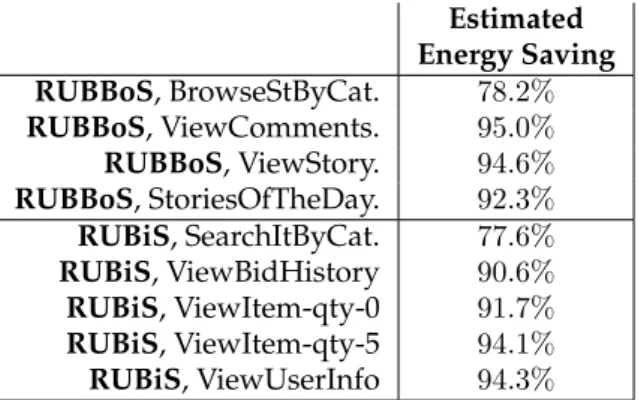
1. An initial study of the cost of the overhead of the modular development methodologies for web applications that are in use today. This study shows that up to 90% of the instructions can be eliminated without affecting the final result, leading to substantial savings in energy consumption of web servers and a tremendous improvement of the performance of the web ap-plication. This work has been published in [84].
2. A tuple-based intermediate representation, theforelemloop, in which SQL queries can be naturally expressed in terms of loops governed by simple control. Extensions are described that allow nested and aggregate SQL que-ries to be represented.
3. The re-targeting of established compiler optimizations onto theforelemloops. The foundations of the intermediate representation and the re-targeted com-piler optimizations have been published in [83].
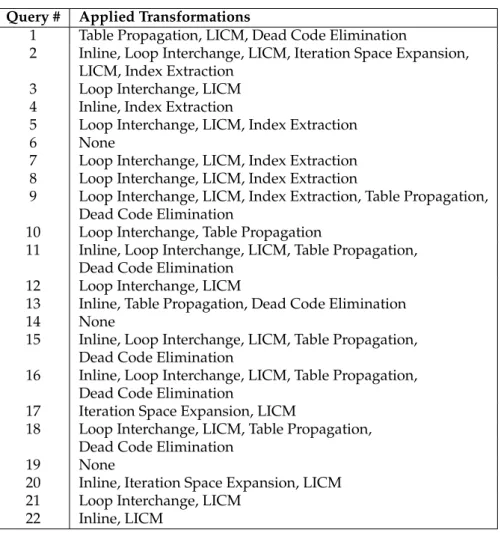
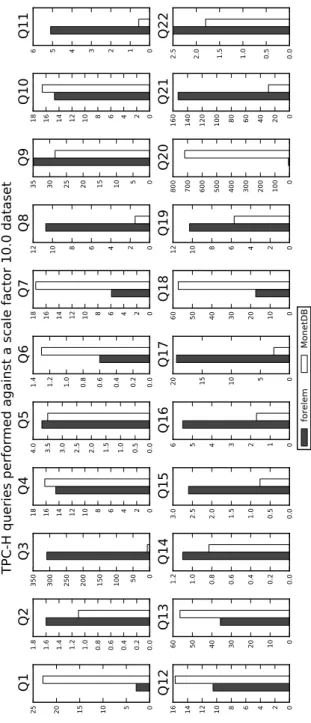
4. Additional transformations forforelemloops and strategies for the optimiza-tion of database queries expressed in terms offorelemloops solely by using simple compiler optimizations. This optimization methodology results in executables codes that evaluate queries with a performance comparable to that of contemporary state-of-the-art database systems.
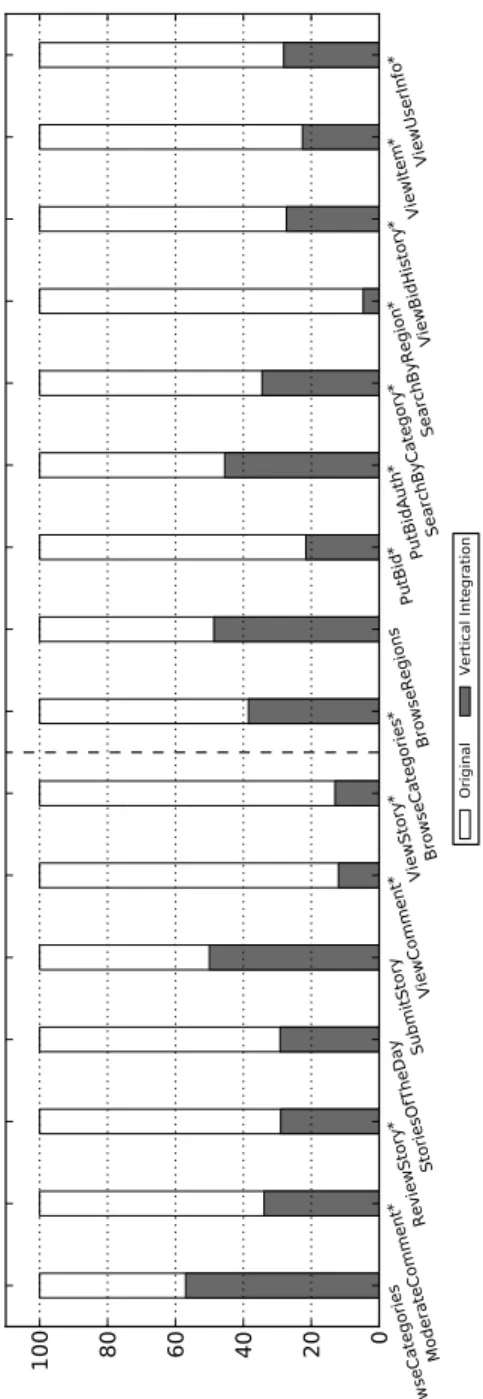
5. An automatic global integrated optimization process to reduce database ap-plications to their essence. For two web apap-plications it is shown that this au-tomatic optimization process is very effective, on average eliminating 75% of the instructions and in specific cases up to 95% without affecting the exe-cution and output of the application.
1.5
Contributions of Part II
The second part of this thesis contributes techniques to support automatic gen-eration of code and data structures from aforelemrepresentation of a problem in terms of tuples. More specifically, the contributions of Part II are:
1. Extensions to the forelemframework for the automatic generation of data storage formats from a representation of the code that operates on tuples. These extensions consist out of a materialization and concretization phase. In the case of sparse matrices, using these techniques established data stor-age formats, such as Jagged Diagonal Storstor-age, can be automatically derived, that could up till now only be derived by hand. Part of this work has been published in [83].
2. A characterization of the search space consisting of many different variants of a sparse matrix computation represented in terms of tuples that can be automatically generated using theforelemframework. This characterization shows that by performing an exhaustive search through this search space, variants of the computation can be found that are in most cases faster than the implementations of these computations supplied by sparse algebra li-braries, and at least on par in performance.
3. A further extension of theforelemframework, theready clause, that allows dependencies between tuples to be naturally expressed. As such, generic irregular computations can be expressed in terms of tuples. By expressing dependencies as dependencies between tuples, it is trivial to deduce which operations on tuples can be executed at the same time. Preliminary experi-ments show that from an ordinary triangular solver code expressed in terms of a dense matrix, a highly parallel implementation is automatically derived that operates on sparse storage. This automatically derived implementation has a performance that is competitive to that of hand-optimized implemen-tations. This work has been published in [86].
4. Initial work to support the expression of distributedforelemloops. By putting the optimization process in control of howforelemloops are distributed, opti-mal data decompositions and distributions can be determined. This extends the capability of the forelemframework to also optimize data composition and distribution in additional to the optimization data storage formats that are used locally. Part of this work has been published in [83].
1.6
Outline
1.6. Outline 17
in energy use of web servers and a tremendous improvement of the performance of the web application. This chapter has been published in [84].
Chapter 3 introduces the forelemloop, which is the main constituent of the
forelemframework. Aforelemloop specifies iteration of a subset of a multiset of
tuples. SQL queries can be naturally expressed in terms offorelemloops. Transfor-mations can be carried out on these loops to optimize the performance.
Chapter 4 extends the basicforelemframework introduced in Chapter 3 with syntax and transformations for handling nested SQL queries. In Chapter 5 further extensions are proposed for handling aggregate functions and group-by queries.
Chapter 6 describes how queries that are expressed in terms offorelemloops can be effectively optimized solely through the use of simple compiler optimiza-tions.
Chapter 7 discusses how the global integration optimization process of data-base applications can be performed automatically for reducing datadata-base applica-tions to their essence.
Chapter 8 describes a trade-off analysis that can be used by an automatic opti-mization process to determine for what parts of a web application it is beneficial to perform integral optimization, implying the construction of a local copy of the data, and for which parts this is not beneficial. This chapter has been published in [85].
Part II of this thesis explores the use of the techniques developed for the in-tegral optimization of database applications in other application domains. Chap-ter 9 describes extensions to theforelemframework to support the automatic gen-eration of data structures from a representation of a problem in terms of tuples. Parts of this chapter have been published in [83].
Chapter 10 characterizes the search space that consists of many different vari-ants generated from an initial representation of a sparse matrix computation in
forelemthrough the application of transformation. It is shown that by performing
an exhaustive search through this search space, variants of the computation can be found that are in most cases faster than the implementations of these computa-tions supplied by sparse algebra libraries.
Chapter 11 further extends theforelemframework with a ready clause. Using this clause, dependencies between tuples can be naturally expressed, resulting in a method that is especially suited for the automatic parallelization of irregular codes. This chapter has been published in [86].
Chapter 12 proposes a syntax for expressing and controlling distributed exe-cution offorelemloops. It is described how this makes theforelemviable for the optimization of Big Data applications.
Finally, Chapter 13 summarizes the thesis and discusses future perspectives of
PART I
CHAPTER 2
Quantifying Instruction-Count
Overhead of Web applications
2.1
Introduction
Applications that have seen a steady rise in ubiquity in the last 10 years are web applications. In many data centers web applications are hosted that provide much of the World-Wide Web’s content. Web applications are often built from several readily available components to speed up development, such as web development frameworks and database management systems (DBMSs). This modularity allows for rapid prototyping, development and deployment. The World-Wide Web has heavily benefited from this modular approach.
However, it is well known that modularity does not come for free. In the last decade, the increasing energy consumption of data centers has already drawn the attention of governments. The US Environment Protection Agency (EPA) reported on the energy efficiency of data centers in a 2007 report [93]. Their study says energy consumption of US data centers had doubled in the period from late 2000 to 2006. Based on this trend, they projected another doubling in electricity use for the period from 2006 to 2011. This would mean a quadrupling in electricity use by data centers in about 10 years time.
Contrary to the EPA prediction, a 2011 report by [46] claims electricity by US data centers increased by 36% instead of doubling from 2005 to 2010. This is sig-nificantly lower than predicted by the EPA report. Koomey attributes this to a lower server installed base than predicted earlier, caused by the 2008 financial crises and further improvements in server virtualization. Nevertheless, the en-ergy consumption is still increasing and while the increase was only 36% in the US, according to the Koomey report the increase amounted to 56% worldwide.
Many of these recommendations seek for solutions in hardware. Better power management can make servers more energy efficient. The server installed base can be reduced by making better use of virtualization to consolidate servers. Rec-ommendations are also made to develop tools and techniques to make software more efficient by making better use of parallelization and to avoid excess code. However, these recommendations are not as concrete as those for hardware im-provements.
An interesting observation in the EPA report is that those responsible for se-lecting and purchasing computer equipment are not the same as those responsible for power and cooling infrastructure. The latter typically pay the electricity bills. This leads to a split incentive, because those who could buy more energy efficient hardware have little incentive to do so. We believe a similar split incentive ex-ists with software developers. Software developers are not in charge of obtaining the necessary computing equipment in data centers and also are not aware of the electricity bills. Therefore, software developers have very little incentive to fur-ther optimize the software to reduce energy consumption. The fact that software optimization is a very diligent and costly task does not help.
Many statistics have been collected on data center cost and performance. For example [24] describes several metrics that are used in data center management to optimize performance and drive costs down. Many of these metrics concentrate around MIPS or the number of servers and processors. Mainframe size is ex-pressed in MIPS, and cost can be exex-pressed in spending (on hardware, software, personnel, etc.) per MIPS. Statistics on Intel-based UNIX and Windows operating environments are expressed in number of servers and processors. In such statis-tics a distinction is made betweeninstalled MIPSversusused MIPS. These numbers should not be too far apart, because server capacity staying idle is neither cost nor energy efficient. However, as soon as a server is no longer idle, the work per-formed is counted asused MIPS. Of such used MIPS it is not investigated whether these MIPS did useful work or were mainly overhead. In other words, no distinc-tion is made between essential MIPSand non-essential MIPS, with non-essential MIPS being accrued from the cost of the usage of rapid development frameworks and software modularity.
In this chapter, we address the quantification of energy usage through non-essential instruction (MIPS) count overhead. To be able to effectively target efforts to reduce energy consumption of web applications, the sources of overhead must be quantified. An instruction-level quantification of overhead in web applications does not exist to our knowledge. We investigate three existing and representative web applications and show that in this manner accurate measurements on spilled energy usage can be obtained. In our opinion, this will result in an incentive for data centers to prioritize the need for software overhead reduction instead of only improving hardware energy efficiency.
2.2. Determination of non-essential MIPS 23
2.2
Determination of non-essential MIPS
A number of categories of overhead, or non-essential MIPS, in web applications that make use of the PHP language and a MySQL DBMS can be identified. The instruction count of non-essential MIPS for each category is obtained by count-ing instructions in the original program code and in the program code with the overhead source removed. The difference in instruction count is the number of instructions for the corresponding overhead source.
The first category of overhead we will consider is overhead caused by devel-opment frameworks for web applications. Many applications are written with the use of a framework which dramatically shortens development time and increases code re-use. One of the applications we survey in this chapter has been developed using the CakePHP framework. The CakePHP simplifies development of web ap-plications by performing most of the work serving web requests and abstracting away the low-level data access through a DBMS. Frameworks like this affect per-formance by, for example, performing unnecessary iterations and copies of results sets, or even by executing queries of which the results are not used at all.
The second category of overhead is the PHP language itself. Due to PHP’s nature as a script language, there is a start-up overhead due to parsing and inter-pretation of the source files and the potential to thoroughly optimize the code in a similar way to compiled languages is removed.
As a third category, we consider the current modular design of DBMSs, which has as result that a single DBMS instance can be easily used for a variety of appli-cations. A downside of this modularity is that when an application has a request to retrieve data, this request has to go out of process. Depending on the architec-ture of the website, the request is either served by a DBMS running on the same server as the web server executing the PHP code or the request is sent to a remote DBMS host. Overhead that is incurred can include: context switching overhead, network and protocol overhead and data copying overhead.
The fourth category of overhead is caused by DBMS APIs implemented in shared libraries. The library sends PHP queries to the DBMS and retrieves the results. As a result of this architecture details on the data accesses are shielded off and also overhead is introduced by iterating result sets at least twice: once when the DBMS builds up the result set and sends this to the application program and once in the application program itself when the results are iterated.
2.3
Experimental Setup
Discus
Discus is an in-house developed student administration system. The system is based on CakePHP development framework, version 1.2.0. To quantify the over-head for full page generations, all forms of caching (e.g. query or page caching) in CakePHP have been disabled. We focus on two particular page loads: the stu-dents index and the individual student view. All experiments have been carried out with three different data sets: small (25.000 tuples), medium (0.5 million tu-ples) and large (10 million tutu-ples).
RUBBoS
The RUBBoS benchmark was developed by a collaboration between RICE Univer-sity and INRIA and models a typical bulletin board system or news website with possibility to post comments [74]. We have used the PHP-version of RUBBoS. To quantify the overhead in different typical pages served by RUBBoS, we looked at the page generation times of the following pages:StoriesOfTheDay,
BrowseStories-ByCategory, ViewStory,ViewComment. We believe these pages are typical for the
workload that characterizes a news story website. As data set we have used the data set that is made available at the RUBBoS website.
RUBiS
The RUBiS benchmark [75] models a simple auction website and is similar to the RUBBoS benchmark as it has been developed by the same collaboration. For our tests with RUBiS we have used the same methodology as with RUBBoS. The PHP-version of RUBiS was used and the following pages were picked:ViewBidHistory,
ViewItem,ViewUserInfoandSearchItemsByCategory. The data set that is available
from the RUBiS website has been used as data set in our experiments.
The experiments have been carried out on an Intel Core 2 Quad CPU (Q9450) clocked at 2.66 GHz with 4 GB of RAM. The software installation consists out of Ubuntu 10.04.3 LTS (64-bit), which comes with Apache 2.2.14, PHP 5.3.2 and MySQL 5.1.41. No extraordinary changes were made to the configuration files for Apache and MySQL, except that in MySQL we have disabled query caching to be able to consistently quantify the cost for executing the necessary queries. In the experiments we obtained two metrics. First, we obtained the page generation time which we define as the difference between the time the first useful line of the PHP code started execution until the time the last line of code is executed. Secondly, we acquire the number of instructions executed by the processor to generate the page by reading out theINST_RETIREDhardware performance counter of the CPU.
2.4
Quantification
lan-2.4. Quantification 25
guage we have compared the performance of the three code bases to the code bases compiled to native executables using the HipHop for PHP project [42]. This project is developed by Facebook and is a compiler that translates PHP source code to C++ source code, which is linked against a HipHop runtime that contains implementations of PHP built-in functions and data types. Both the Apache HTTP server and the PHP module are replaced by the HipHop-generated executable.
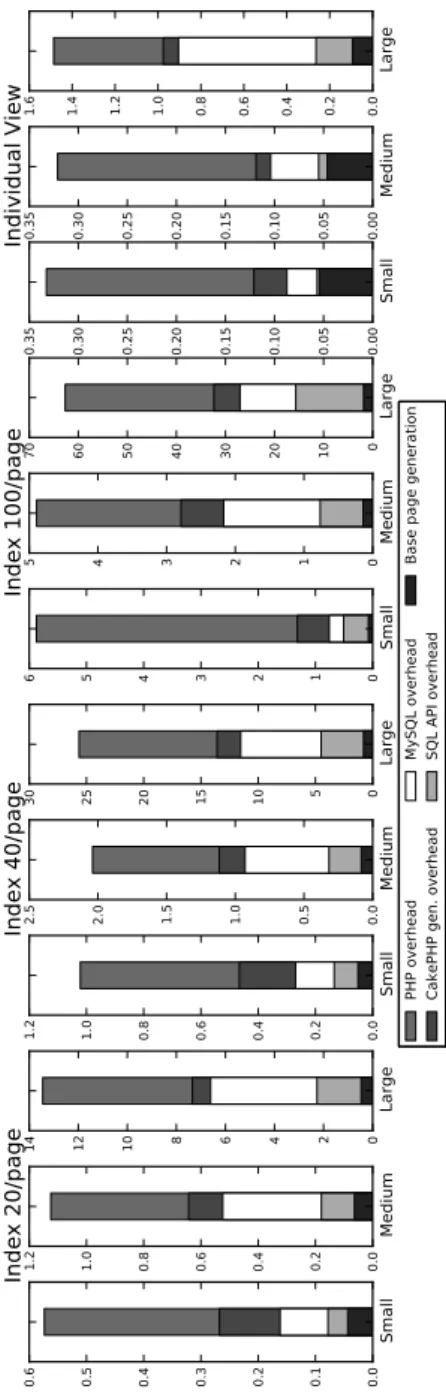
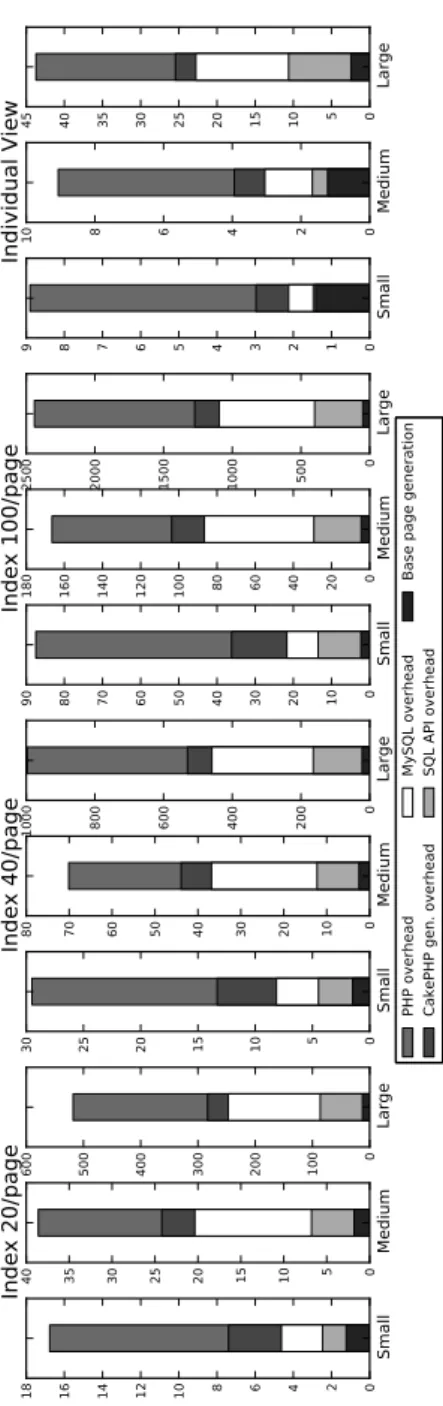
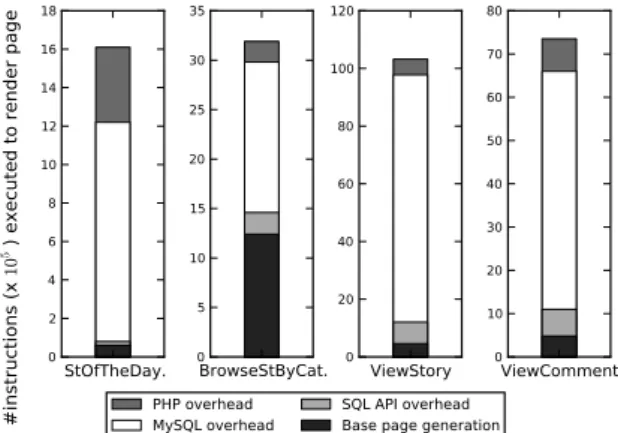
In Figures 2.1, 2.2 and 2.3 the difference in page generation time between Apache and the HipHop-compiled executables is shown as “PHP overhead”. Fig-ures 2.4, 2.5 and 2.6 depict the number of instructions executed to generate the page. For the Discus code base we observe that roughly1/3to2/3 of the page generation time can be attributed to PHP overhead. A similar overhead is found in the figures depicting the number of instructions
The RUBBoS and RUBiS benchmarks do not show an improvement in page generation time when the HipHop-version is tested. However, the instruction count does noticeably decrease. Compared to Discus, the RUBBoS and RUBiS source code is quite straightforward and it is possible that aggressive compiler optimizations do not have much effect. Although less instructions are retired, it is plausible that instead more time is spent waiting for (network) I/O.
To quantify the overhead of development frameworks, we have focused on one of the main sources of overhead in the CakePHP framework, which is the data access interface or in particular the automatic generation of SQL queries. The difference between the code bases with and without automatic query generation is displayed in Figures 2.1 and 2.4 as “CakePHP gen. overhead”. For most cases, the overhead of automatic query generation ranges from1/12to1/5of the total page generation time. This is significant if one considers the total page genera-tion time in the order of seconds and the fact that there is no technical obstacle to make the queries static after the development of the application. CakePHP em-ploys caching to get around this overhead (which was disabled to uncover this overhead). However, caching does not help if similar queries are often executed with different parameters. We have not done similar experiments for RUBBoS and RUBiS, because these code bases use static queries instead of a rapid development framework.
We made the application code compute the results of the SQL queries instead of sending these queries to a different DBMS process, to quantify the overhead of using common DBMS architecture. This was done by modifying the HipHop-compiled Discus, RUBBoS and RUBiS code bases by replacing calls to MySQL API with code that performs the requested query. For example, calls to the function
Small 0.0 0.1 0.2 0.3 0.4 0.5 0.6 Medium 0.0 0.2 0.4 0.6 0.8 1.0 1.2
Index 20/page
Large 0 2 4 6 8 10 12 14 Small 0.0 0.2 0.4 0.6 0.8 1.0 1.2 Medium 0.0 0.5 1.0 1.5 2.0 2.5Index 40/page
Large 0 5 10 15 20 25 30 Small 0 1 2 3 4 5 6 Medium 0 1 2 3 4 5Index 100/page
Large 0 10 20 30 40 50 60 70 Small 0.00 0.05 0.10 0.15 0.20 0.25 0.30 0.35 Medium 0.00 0.05 0.10 0.15 0.20 0.25 0.30 0.35Individual View
Large 0.0 0.2 0.4 0.6 0.8 1.0 1.2 1.4 1.6Page render time in seconds
PHP overhead CakePHP gen. overhead MySQL overhead SQL API overhead
Base page generation
PHP overhead CakePHP gen. overhead MySQL overhead SQL API overhead
Base page generation
PHP overhead CakePHP gen. overhead MySQL overhead SQL API overhead
Base page generation
PHP overhead CakePHP gen. overhead MySQL overhead SQL API overhead
Base page generation
2.4. Quantification 27 StOftheDay. 0 200 400 600 800 1000 1200 BrowseStByCat. 0 500 1000 1500 2000 ViewStory 0 1000 2000 3000 4000 5000 6000 ViewComment 0 500 1000 1500 2000 2500 3000 3500 4000
Page render time in microseconds PHP overhead
MySQL overhead SQL API overheadBase page generation
Figure 2.2: Page generation time in microseconds for different pages from the RUBBoS benchmark. Times displayed are averages of 10 runs on a warmed-up server. ViewBidHistory 0 100 200 300 400 500 600 700 800 ViewItem (qty=0) 0 100 200 300 400 500 600 ViewItem (qty=5) 0 100 200 300 400 500 600 700 800 900 ViewUserInf. 0 100 200 300 400 500 600 700 800 SearchIt.ByCat. 0 100 200 300 400 500 600
Page render time in microseconds
PHP overhead
MySQL overhead SQL API overheadBase page generation
Small 0 2 4 6 8 10 12 14 16 18 Medium 0 5 10 15 20 25 30 35 40
Index 20/page
Large 0 100 200 300 400 500 600 Small 0 5 10 15 20 25 30 Medium 0 10 20 30 40 50 60 70 80Index 40/page
Large 0 200 400 600 800 1000 Small 0 10 20 30 40 50 60 70 80 90 Medium 0 20 40 60 80 100 120 140 160 180Index 100/page
Large 0 500 1000 1500 2000 2500 Small 0 1 2 3 4 5 6 7 8 9 Medium 0 2 4 6 8 10Individual View
Large 0 5 10 15 20 25 30 35 40 45 #ins tru ctio ns ( x 10 8 ) ex ecu ted to re nde r p agePHP overhead CakePHP gen. overhead MySQL overhead SQL API overhead
Base page generation
PHP overhead CakePHP gen. overhead MySQL overhead SQL API overhead
Base page generation
PHP overhead CakePHP gen. overhead MySQL overhead SQL API overhead
Base page generation
PHP overhead CakePHP gen. overhead MySQL overhead SQL API overhead
Base page generation
2.4. Quantification 29 StOfTheDay. 0 2 4 6 8 10 12 14 16 18 BrowseStByCat. 0 5 10 15 20 25 30 35 ViewStory 0 20 40 60 80 100 120 ViewComment 0 10 20 30 40 50 60 70 80 #i ns tru cti on s ( x 10
5) e
xe cu te d to re nd er p ag e PHP overhead
MySQL overhead SQL API overheadBase page generation
Figure 2.5: Instruction count in 105of instructions for different pages from the RUBBoS benchmark. ViewBidHistory 0 2 4 6 8 10 12 14 16 ViewItem (qty=0) 0 2 4 6 8 10 12 ViewItem (qty=5) 0 2 4 6 8 10 12 14 16 18 ViewUserInf. 0 2 4 6 8 10 12 14 SearchIt.ByCat. 0 2 4 6 8 10 12 14 #i ns tru cti on s ( x 10
5) e
xe cu te d to re nd er p ag e PHP overhead
MySQL overhead SQL API overheadBase page generation
The time results are displayed in Figures 2.1, 2.2 and 2.3. Compared to the original execution time of the Apache-version of the Discus application, the MySQL overhead accounts for roughly 8% to 40% of the execution time. If we compare the MySQL overhead to the execution time of the original HipHop-compiled version however, the MySQL overhead accounts for roughly 20% to 60% of the execution time. These larger numbers are also reflected in the RUBBoS and RUBiS results, where the MySQL overhead is estimated to be around 72% to 90% of the page generation time. Put differently, elimination of the MySQL server improved the page generation times for the RUBBoS and RUBiS applications by about a factor 10. We again see similarly sized reductions in instruction count in Figures 2.4, 2.5 and 2.6.
Once the SQL queries have been expanded to code inside the application code, several sources of overhead of DBMS APIs become apparent. It is now possible to integrate the application code with the query computation code in a much more optimal fashion. In the majority of the cases the loops that iterate over the result set can be merged into the loops that perform the actual queries and thus build the result sets, saving an iteration of the result set.
In Figure 2.1 we observe that it is possible to achieve at least a factor 2 speedup in most cases compared to the HipHop-version of Discus. For the Index 100/page with the large data set case, a factor 10 speedup is obtained. Although the over-head of the DBMS API does not appear that significant compared to the total execution time, it does prove to be of significance when put in the perspective of the execution time of the application when the usage of MySQL has been re-moved. The same reasoning holds true when the results of the RUBBoS and RU-BiS applications are analyzed, displayed in Figures 2.2 and 2.3 respectively. When compared to the total execution time of the derivative of the application with the MySQL overhead removed, removing the SQL API overhead results in speedups close to a factor of 2 in half of the cases.
2.5
Energy Consumption
From the results collected we can deduce that in general the time spent per instruc-tion stays in the same order of magnitude both when non-essential (overhead) instructions are removed as well as when the problem size is increased. Overall, there is an approximately linear relation between the page generation time and the amount of instructions executed to generate a page. For the applications that have been surveyed, removal of non-essential instructions has an immediate ap-proximately linear impact on performance.
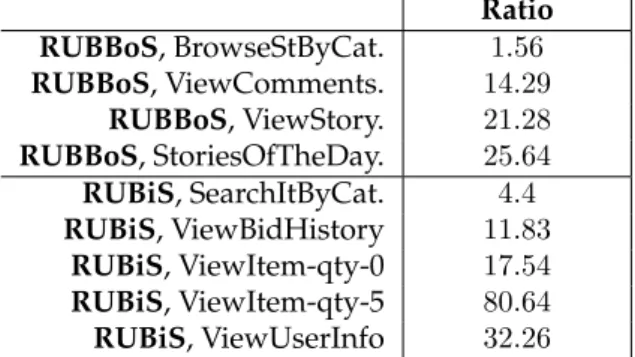
Tables 2.1 and 2.2 show the number of non-essential instructions that are ex-ecuted for each essential instruction for the Discus and RUBBoS/RUBiS experi-ments respectively. The overhead varies greatly from page to page. In the ma-jority of cases however, the overhead is significant: more than 20 non-essential instructions are executed for each essential instruction. An overhead of a factor 20.