A C
OMPLEXP
OLITICALE
CONOMY OF THEG
LOBALB
ANKINGS
YSTEMWilliam Kindred Winecoff
A dissertation submitted to the faculty of the University of North Carolina at Chapel Hill in partial fulfillment of the requirements for the degree of Doctor of Philosophy in the Department of Political Science.
Chapel Hill 2013
Approved by:
Thomas Oatley
Navin Bapat
Skyler Cranmer
Layna Mosley
c 2013
ABSTRACT
WILLIAM KINDRED WINECOFF: A Complex Political Economy of the Global Banking System.
(Under the direction of Thomas Oatley)
The global financial crisis which began in 2007 is the most severe economic event since the 1930s. The profound political and economic consequences of the crisis have clarified
the need to better understand the financial system at both micro and macro levels. This
dissertation advances research on both fronts. First, it utilizes network prominence
mea-sures to look at the pre- and post-crisis organization of the global banking system, finding
that American prestige has increased as a result of the crisis. Second, it employs
com-plex network theory and inferential statistical models to explain why the global banking
system is organized as it is, finding that endogenous processes interact with monadic and dyadic political economy variables to produce a global structure. Third, it examines bank
behaviors at the firm level, demonstrates that representative agent models are insufficient
for explaining the patterns observed, proposes an alternative approach drawing from
eco-logical finance theory, tests the model using Bayesian regression, and finds support for the
new approach. In sum, this dissertation demonstrates the need for further quantitative
po-litical economy work at both the micro and macro levels of the global financial system and
ACKNOWLEDGMENTS
I would first like to thank the committee for allowing me to undergo an ambitious project
that had a nonzero probability of ending in complete failure. Happily, because of their
guidance, it has not. Thomas Oatley in particular encouraged me to think in different ways
and to try new approaches. Layna Mosley did her best to rein in some of my excesses and
keep me grounded in international political economy theory. Skyler Cranmer’s approach to
methodology – both philosophical and technical – has benefited me enormously, as has his pragmatic advice. Navin Bapat and Michael Munger are excellent theorists in international
relations and political economy respectively, and provided valuable pointers for improving
and refining this aspect of my work. I could not have asked for a better committee, nor a
better mix of talents. I have learned so much from all of them.
I would like to acknowledge the assistance I have received from the Department of
Po-litical Science. The financial support for graduate students from Thomas Uhlman has been
remarkable. The office staff, and Chris Reynolds in particular, have been exceptionally helpful. The rest of the faculty have been provided needed advice, perspective, and
in-struction. My fellow graduate students have shared in the joys and pains of a postgraduate
program. The camaraderie and friendship I’ve developed with many of them has sustained
me through some of the more difficult days. I’d like to particularly mention Sarah, Alex,
Josh, Besir, Arta, Svet, Kevin, Greg, Derek, Amanda, and John.
Finally, I would like to thank my family. Bill and Margaret Noonan have encouraged
me in my education throughout my life, and have supported it in every way that they could.
TABLE OF CONTENTS
1 FINANCIAL POWER AND THE GLOBAL CRISIS . . . 1
1.1 Introduction . . . 1
1.2 Global Banking as a Complex Network . . . 8
1.3 Power As Prominence: Centrality and Prestige . . . 10
1.4 Degree-Based Measures of Prominence . . . 18
1.5 Eigenvector and Betweenness Prominence . . . 30
1.6 Conclusion . . . 35
2 GLOBAL BANKING AS A COMPLEX POLITICAL ECONOMY . . . 38
2.1 Introduction . . . 38
2.2 A complex political economy theory of financial power . . . 40
2.3 Monadic sources of power in global banking . . . 43
2.4 Dyadic sources of power in global banking . . . 45
2.5 Systemic sources of power in global banking . . . 49
2.6 Hypotheses . . . 54
2.7 Data and Models . . . 58
2.8 Results . . . 66
2.9 Summary and Conclusion . . . 74
3 BEYOND TOO BIG TO FAIL . . . 79
3.1 The Common View of Bank Behavior. . . 82
3.2 Embedding Firms Within Political Economies. . . 97
3.4 Data . . . 107
3.5 Method . . . 110
3.6 Results . . . 111
3.7 Conclusion . . . 115
A CHAPTER 3 APPENDIX . . . 119
A.1 Why Focus on Capital Ratios? . . . 119
A.2 Model Results: 2000 . . . 123
A.3 Model Results: 2003 . . . 124
A.4 Model Results: 2006 . . . 125
LIST OF TABLES
1.1 Degree-Based Taxonomy . . . 15
1.2 Placement of National Banking Systems. . . 28
1.3 Connection-Based Taxonomy . . . 31
1.4 Insiders, Outsiders, Core, and Periphery. . . 35
2.1 Locus, type, manifestation, and level of power in the global banking system.. 43
2.2 Hypotheses. . . 59
2.3 Results. . . 67
LIST OF FIGURES
1.1 The Global Banking Network, 2007 . . . 11
1.2 The Global Banking Network, 2012 . . . 12
1.3 The In-Strength Distribution . . . 19
1.4 The In-Strength Distribution, Varyingα. . . 22
1.5 The Out-Strength Distribution. . . 24
1.6 In-Strength vs. Out-Strength . . . 26
1.7 Betweenness vs. Eigenvector Prominence. . . 32
2.1 The Global Banking System in 1999 & 2009. . . 65
3.1 Theoretical Bank Behavior. . . 86
3.2 Actual Bank Behavior . . . 88
3.3 Risk-Weighted Tier 1 Capital Adequacy Ratios . . . 90
3.4 Results. . . 111
A.1 Results, 2000. . . 123
A.2 Results, 2003. . . 124
1 FINANCIAL POWER AND THE GLOBAL CRISIS
1.1 Introduction
The global financial crisis which began in 2007 was widely expected to weaken U.S.
hegemony. Nearly every possible configuration of the future of world politics has been
proposed as likely to emerge from the crisis: apolarity, region-based multipolarity, a
hege-monic shift to China, institutional multilateralism, a fragmentation of multilateral
institu-tions, the end of the nation-state as the relevant unit of analysis, the end of capitalism, the
end of democracy, the creation of Bretton Woods III, a reversion to Bretton Woods I, and
more. These conversations convey the sense that there should besomesignificant change resulting from the largest financial crisis since the previous period of hegemonic transition.
These accounts shared a premise if not a conclusion: the Anglo-American model of finance
capitalism has been discredited. The crisis has been compared to the end of the Cold War
(Cohen 2009b) and has been called a “transformative moment” (Reinhart and Rogoff 2009,
208); there was a palpable sense that an epochal shift was underway. How could it not be?
Despite such speculation there has been surprisingly little empirical analysis of the ways
in which the global financial system has changed since the crisis. This is of vital impor-tance to post-crisis conversation on the distribution of power in the global economy, but to
this point most analyses have focused on the effects of the crisis on attributes of individual
countries (e.g. inequality or debt in the United States, growth in China), regional
integra-tion efforts (e.g. strains within the European Union), instituintegra-tional reform (voting shares in
the IMF, shift in economic governance from the G7 to the G20), or regulatory reforms at
the national and international levels. Each of these political economy processes has been
conditioned by linkages in the global economy; none of them is fully understandable
with-out reference to the complex interdependencies in the world economy from which power is
constructed. The fact that post-crisis speculation has out-paced empirical analysis indicates
that the pre-crisis observation of Cohen (2000) may be accurate:
Theory calls for a reasonably parsimonious and well specified set of
propo-sitions about behavior - statements that are both logically true and, at least
in principle, empirically falsifiable. In that sense no true theory of monetary power may be said, as yet, to exist.
The same is true of financial power more generally. The geopolitical importance of
financial power is well-demonstrated. Financial power is inextricably linked with
hege-monic projects (Sobel 2012), restricts the ability of states to wage war in some instances
(Kirschner 2007), and in others provides opportunities for war-making without resolving
domestic political disagreements over how to pay for them (Oatley 2013). Yet financial
power is more often recognized than measured. Contrary to previous conceptualizations
of financial power imported from bargaining theory (Drezner 2007), I argue that financial
power arises from prominence within market structures which perform in non-monotonic ways. Unlike earlier intuitive conceptualizations of structural power (Strange 1987), I
pro-vide measures of prominence which are employed to show that the global banking system
was affected by the crisis in several ways. First, overall cross-national connectivity initially
declined as the crisis began and spread. In this way, comparisons to the 1930s crisis and
global depression were apt. Unlike the 1930s, however, this deterioration in connectivity
was temporary rather than persistent: since 2009 the system has been reinforced rather than
fragmenting further. Second, unlike the 1930s, the position of the most prominent country – the United Kingdom then, the United States now – at the core of this system hasincreased
generally declined and the so-called BRICS – Brazil, Russia, India, China, South Africa
– have remained quite peripheral. No other countries have increased in prominence as a
result of the crisis. Some others, including tax havens, have fallen in importance.
This outcome was generally not anticipated either before the crisis or after it. But quite
early on, it was possible to notice that in some key ways this timewasdifferent. As a recent
review of the literature noted:
In most emerging-market countries over the previous two decades, the bursting of domestic financial bubbles was accompanied by capital flight, which only
exacerbated these countries financial crises by generating exchange rate
depre-ciation and higher interest rates. But foreign funding of the United States –
both public and private – continued during the crisis, even as the United States
lowered interest rates dramatically. Indeed, the dollar even strengthened as the
crisis became more severe after mid-2008. ... IPE scholars have not yet
pro-duced detailed explanations for the foreign support provided during the crisis. ... But it seems very likely that one of the most important explanations was
the structural position of the United States in global financial markets.
De-spite the enormity of the U.S. financial troubles at the time, the U.S. Treasury
bill remained the investment of choice for financial institutions and investors
scrambling for liquidity and security in the midst of the panic (Helleiner 2011,
81).
It is not just emerging economies which faced capital flight during this crisis. A number
of OECD countries did as well, among them Iceland, Ireland, Greece, and Spain. Germany
and France were net exporters of banking finance before the crisis, and the United Kingdom switched from being a net recipient to a net sender. But despite suffering the worst internal
financial crisis since the 1930s, flight from the United States was moderate and temporary.
situation – a domestic banking crisis – some countries experienced capital outflows while
others experienced capital inflows. As Helleiner notes, an approach which focuses on the
internal attributes of states has difficulty explaining this outcome. Nevertheless, it has
ma-jor implications for the future performance of the global banking system, and in particular
the ways in which power is distributed within it. Prior theory in international political
economy, which has primarily focused on the internal attributes of states as being the pri-mary determinants of capital flows, have difficulty accounting for these divergent outcomes
(Cohen 2009b; Oatley 2011).
This realization is reflected in the policymaking community. The shift in focus among
regulators from “too big to fail” (TBTF) financial institutions to “systemically important
financial institutions” (SIFI) is revealing: TBTF considers internal characteristics, while
SIFI places the emphasis on positions within structures. While the two may correlate they
are conceptually distinct. This change in thinking took hold quite suddenly during and after the crisis. The report to the G7 of the Financial Stability Forum on April 7, 2008
contained no mention of “systemically important” institutions, and indicated that risk in the
global financial system was concentrated in the largest firms that operated cross-nationally
(Financial Stability Forum 2008).1 Seven months later, following the collapse of Lehman
Brothers, the first meeting of the Group of 20 (2008) tasked their finance ministers with
“defining the scope of systemically important institutions and determining their appropriate
regulation and oversight”.2 Since then, the Basel Committee on Banking Supervision and national regulators have worked to define SIFI by firms’ positions within the structure of the
global financial system in addition to traditional criteria such as size (Bank for International
Settlements 2011; Price and Walter 2011).
1The section of interest in the Financial Stability Forum report is VI.10, p. 52.
SIFI are more important than other firms, even other large firms, because their
promi-nent position within financial markets gives them influence which is both broad and deep.
There is an increasing awareness among policymakers that these positions confer
politi-cal power. Shortly after leaving her post as Director of Policy Planning for the U.S. State
Department, Anne-Marie Slaughter made explicit the argument that the U.S.’s role in the
world is determined by its position within a network structure:
For the next decade, the United States should pursue of a grand strategy of
network centrality. The most important shift for America is not the rise of
China and the realignment of power in the international system, but rather the ubiquity and density of global networks. Existing grand strategies – such as
primacy, containment, offshore balancing, isolationism, selective engagement
and order building – assume a world of states acting essentially as unitary
actors with defined military, economic, and diplomatic strategies. ... However,
even if [states] are the principal actors in the international system, they now
act side by side with many types of social actors who are able to come together
and act independently on the world stage. The resulting [network] system is messy, complex, and frustrating. Yet wishing for a simpler world will not make
it so. (Slaughter 2012, 45)
Among these “types of social actors” are financial institutions. Slaughter is arguing that the U.S. should exploit as strategy the position of the U.S. at the core of the global
economy, as this confers distinct geopolitical advantages beyond the U.S.’s internal
mate-rial capabilities. A corollary is that each country’s position within this structure conditions
outcomes and opportunities for that country. As the recent crisis demonstrated, the
organi-zation of the entire system is a meaningful variable which powerfully impacts interactions
This mode of thinking is not entirely new to studies of power within the global
econ-omy. Applications of network theory in international relations go back at least to Hart
(1974). Knoke and Burt (1983) and Knoke (1990) defined power in terms of prominence
within networks, although the networks they analyzed were not complex. The complex
interdependence tradition often used network logics if not network empirics, and following
Susan Strange the British school of IPE frequently considered power to be at least partially determined by structural position (Strange 1982, 1987, 1998). But conceptualizations of
power which employ network theory and quantitative methodologies are far from the norm
in contemporary international political economy.
Nor has the awareness of the importance of structure percolated far into contemporary
theories of interdependence, which are often presented in terms of diffusion which operate
at the dyad-level. Diffusion is only one dynamic process of interdependence, and it does
not involve the overall structure of relationships as being a meaningful condition. Similarly, very little work has considered structural dynamics as something that can be theorized
systematically and measured empirically (Cohen 2000). This is of particular concern in the
study of power in global banking (Cohen 2009b; Keohane 2009). A conceptualization of
structural power that is operationalized in terms of complex networks offers avenues for
the development of such a theory and the tools for an empirical examination of it.
I focus on two general types of structural power – prestige and centrality – which are
in some ways analogous to “sensitivity” and “vulnerability” in theories of complex inter-dependence (Keohane and Nye Jr. 1973). I offer several measures of each which contain
distinct properties. While I apply this framework to the global banking system, I suggest
that it may be useful in analyses of power in systems of security, production and exchange,
and information and knowledge. I use the recent global financial crisis to consider how a
results suggest that the hegemonic position of the United States has not disappeared as a
result of the crisis, at least in banking, contrary to the expectations of many, because of
pro-cesses which have previously been identified by network scientists but have not yet been
appreciated by political economists.
So a complex network conceptualization of power is not merely orthogonal with prior
conceptualizations of the global system. There are several advantages which come with the network approach. Among them are a wide range of statistical measures with known
prop-erties in complex systems. Another is a scientific expectation of future performance of the
system which draws from a large literature studying social processes in other disciplines.
That is, a complex network conceptualization of the global banking system not only allows
us to measure key features of the power distribution in that system empirically, but to infer
the likely patterns of future relationships from the distribution of prior relationships. Thus,
complex network theory and methods offer important additions to existing explanations of power dynamics, which are generally constructedpost hoc.
This paper presents a theory of power as stemming from prominence within
interde-pendent markets; defines particular forms of this power with substantive value for scholars
and policymakers; develops a taxonomy by which states may be considered as core or
pe-ripheral, bridges or prestigious, insiders or outsiders; and provides measures of each. It
applies this conceptualization to the global banking system pre- and post-crisis, and shows
how the crisis affected the global banking system, emphasizing the ways in which change (or no change) could have been anticipated by this approach but not prior approaches. As
such, I show how a power-based approach which emphasizes prominence within networks
fulfills the theoretical demands of Cohen (2000) in a way which lends itself to quantitative
1.2 Global Banking as a Complex Network
The global banking system is comprised of a set of contractual relationships which
exists across national boundaries. Taken together, these relationships can be conceptualized
as a network in which individual units (i.e. nodes) are connected via financial obligations
(i.e. ties) to other units. The units, in turn, can be conceptualized as individual investors or
firms, or as aggregated units such as national banking sectors. The connection of the system
of nodes and the relationships between them constitute a single entity whose outcomes are considered at the level of the network rather than the node or dyad. Thus, in a network
context, the unit of analysis is the system itself rather than any particular component which
exists within it such as a national economy or firm.3
Networks are often described in terms of the distribution of ties linking nodes.4 These
distributions can take many different organizational forms, which are referred to as
topolo-gies. Generally, there are two ideal types of networks: those in which the topology is
trivial – ties between nodes are formed according to a random process whereby new ties are formed with equal probability – and those in which network topology is non-trivial –
ties between nodes are formed partially in response to the endogenous characteristics of
the network itself. The former are random, the latter are “complex”. Complex networks
are often characterized by a heavy tail in the distribution of link between nodes, assortative
mixing between nodes, the formation of communities within the network, and (often) a
clearly hierarchical structure. Almost all real-world networks are complex. As we will see,
so is the global banking system.
The topology of the network matters. Networks behave differently under different
prob-ability distributions of tie-formation: if the topology is trivial, nodes will attract links with
3In this context “system” is not meant to bring to mind billiard balls and functionally undifferentiated
equiprobability; if the topology is non-trivial, some nodes will attract links with a higher
probability than others. This probability may be related to some inherent trait possessed by
some nodes, or it may relate to properties of the network structure. In finance, consider two
decision rules for portfolio allocation. In the first, investors determine which firms to invest
with by following the advice of economist Burton Malkiel in his famous bookA Random
Walk Down Wall Street: with efficient markets, the performance of all firms will be the same in expectation. Given that, a portfolio allocation rule which collects some monkeys,
blindfolds them, has them throw darts at a board listing financial institutions, and allocates
money according to where the darts land is as good as any otherex ante(and possibly better
than most) (Malkiel 1973). As many monkeys throw many darts many times, the
distribu-tion of financial ties will converge to the Gaussian normal distribudistribu-tion: few firms will have
very large or very small numbers of clients, and the mean and median number of ties will
be equivalent.
Under a different portfolio allocation decision rule, firms are treated as units whose
ex-pected investment return is partially a function of internal fitness and partially a function
of the connections that firm has to other actors (Barab´asi and Albert 1999; Bianconi and
Barab´asi 2001). The attractiveness of Goldman Sachs as a counterparty may have
some-thing to do with its particular skill at investing, but it also involves the fact that Goldman
Sachs has strong relationships with many other actors in the financial, business, and
gov-ernment sectors: it is prominent in the financial system. So Goldman Sachs attracts new business because it previously attracted business, and as this dynamic reinforces itself over
time the distribution of ties between nodes in the financial system will be skewed and have
a heavy tail: some (like Goldman Sachs) will attract a large number of ties while most
at-tract very few; the mean will be much larger than the median (Newman 2005). As new ties
are formed the network will not only become more densely connected but will also cluster
Whether the distribution of ties is distributed in a way which more closely resembles
a normal or skewed probability distribution is important on its own, but it also has
impli-cations for the development, evolution, and stability of the network. In random networks
information, viruses, financial crises, or other “shocks” will impact every node with roughly
equal probability as they diffuse through the system. In a complex network this is not the
case: the probability of contagion – or any other process involving interdependence – varies by whether a node is in the core or periphery.5 As such, an understanding of the empirical
reality of the global banking system is a prerequisite for building theory, locating puzzles,
and understanding the system.
1.3 Power As Prominence: Centrality and Prestige
Networks are generally described in terms of the amount and distribution of
connectiv-ity. These two criteria allow us to consider structural features of the total network as well
as the relative importance of particular nodes within that structure. Each of these features has substantive importance for the behavior of the network. In this section I describe the
the network of global banking relationships from before and after the crisis, focusing first
on the network at an aggregate level before shifting to an analysis of the distribution of ties
between nodes. The underlying data come from the Bank for International Settlements’
consolidated banking statistics on an immediate borrower basis.6 The network is
“egocen-tric”, meaning that full information is available for only a subset of nodes. In this case, the
5For more discussion on this point see Oatley et al. (2013).
6In an online appendix I also report the results for the same banking statistics on an ultimate risk basis,
data-collecting process involved surveying “egos” (roughly two dozen leading economies)
regarding their connections to “alters” (every other economy in the world), but the
recip-rocal information was not collected. There are methods for correcting the potential bias
which could result from this, but for now it is simply worth pointing out that any problems
with the egocentric nature of these data will tend to under-emphasize the importance of
financial centers, especially those which attract many in-links from diverse sources. Figure 1.1 presents a snapshot of the global banking network before the global financial
crisis, while Figure 1.2 reports the same network in the most recent period for which data
are available. The nodes are national financial systems, which form ties when banks in one
jurisdiction have claims on banks in another jurisdiction.7 The ties are directed – assets
owned by countryithat are held in countryj generates one weighted tie while links from
country j to country i generates a separate weighted tie – while the width of each tie is
proportional to the amount (in U.S. dollars) of the ties connecting the two nodes. The nodes are arranged uniformly (in alphabetical order) on the surface of a sphere; thus, this
layout portrays the network in three dimensions.8 The size of nodes are the summation of
all of the ties connecting to that node. The color of node indicates whether the node has
more in-links than out-links (red) or the opposite (black). The size of the edges indicate the
strength of the relationship between two nodes.
From a glance at this visualization we can see the importance of the United States
(and, to a lesser extent, the United Kingdom) in the global banking system was not much diminished by the crisis. Those two countries have far more cross-national banking ties
7This network therefore depicts stocks of assets, not flows.
8Force-directed layout algorithms, such as that proposed by Fruchterman and Reingold, are often not
than any others, and this is not proportional to simple differences in size of the national
economy. Most countries are so peripheral that they are not even visible. Moreover, the
United States has been a net host for foreign bank holdings during the entire period under
observation; all of the other important nodes are net senders.9 In short, the United States is
the world’s banker: a tremendous proportion of overall network activity can be described as
the rest of the network being organized around depositing assets into U.S. banks.10 In some ways, as described below, the status of the U.S. as the global banker has been enhanced by
the crisis.
Although these are merely snapshots, they already reveal the extent to which the crisis
presented less of a transformation than many expected: there was little fundamental
reor-ganization of the network. From this, we might conclude as Oatley et al. (2013) did that
the U.S. is likely to remain in possession of the bulk of structural power in global banking.
But we can go much further by calculating statistics which describe key features of the network, and linking them to conceptions of power within systems. In particular, we can
isolate different forms of power which arise from structural positions within the network.
These, in turn, follow from the distribution of ties within the network.
Often, we are concerned with the distribution of ties in a network because they
con-stitute outcomes in many static analyses, but also because they function as inputs guiding
future tie formation in dynamic networks. The distribution of ties across nodes determines
nodes’ prominence. A node is prominent if it is conspicuous relative to other nodes. Specif-ically, I consider the two types of node prominence proposed by Knoke and Burt (1983):
9Note that “under observation” here means 1999-2012. The U.K. was a net receiver until the third quarter
of 2008, when it became a net sender in response to the global financial crisis. Italy was the most important node (other than the U.S.) that was a net receiver of bank assets until the height of eurozone crisis in the third quarter of 2010. Ireland and the Cayman Islands (abbreviated ‘KY’ in the graph) were the next most significant recipients prior to the crisis, but both receded after it. In the ultimate risk data the importance of both Ireland and the Cayman Islands is reduced.
Out-Links
In-Links
Low High
High Central
Sender
Core
Low Peripheral Prestigious
Receiver
Table 1.1: A taxonomy of country type, delineated by the distribution of ties in the global banking system.
centrality and prestige.11 In brief, central nodes send many ties while prestigious nodes
attract many ties. In this way the direction and intensity of ties connecting nodes is
impor-tant for theory and inference. If we distinguish between ties a node sends and ties a node receives, we may find large asymmetries. The level of prestige increases as the number of
ties a node receives increases. In this way, all prestigious nodes have high prominence on
at least one dimension but not all nodes with high prominence are prestigious. The same is
true for centrality. We can distinguish between types of nodes according to their position
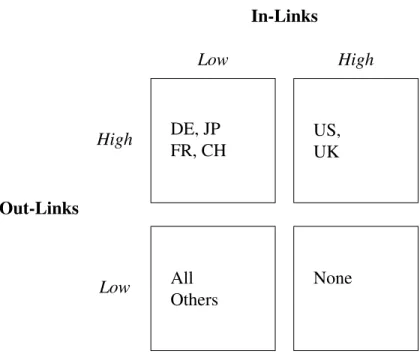
within the structure of the network, as in Table 1.1: those which attract many in-links and
send many out-links constitute the core of the network. Those which attract many in-links
but send few out-links are prestigious receivers; their mirrored image are central senders.
Those who receive few in-links and send few out-links are peripheral nodes.
11This framework was explicitly extended to political networks in Knoke (1990), which indicated that node
Note that different uses of terminology exist in the literature.12 Some refer to in-links
as “prominence” (or “prestige”) and out-links as “influence” (Hanneman and Riddle 2005).
In many social systems such a separation may make sense. But in financial systems,
dif-ferent forms of influence come from an ability to attract a large number of in-links and
from extending a large number of out-links. Because banks act as intermediaries between
savers and borrowers, they must first receive finance before they can lend it out. Thus, a bank’s out-link influence is dependent upon its capacity at persuading savers to entrust
their funds to the bank: its in-link influence. This persuasion capacity will vary with
the bank’s prior performance in successfully transforming in-links into out-links, from
saver− > bank− > borrower and, eventually, back again. Therefore, I distinguish
between types of prominence: the broad influence of prestigious nodes and the narrow
influence of central nodes.
Both prestigious and central nodes are prominent in networks. Prominent nodes have the quality of being “in the thick of things” (Freeman 1978, 219). That is, most
activ-ity within the network involves them in some way. Prominent positions give the nodes
that occupy them power over the broader network such as a capacity to initiate (or curtail)
certain types of activities. In informational networks, prominent nodes disproportionately
influence the spread of information from one part of the network to other parts. In viral
networks, prominent nodes are capable of communicating disease to more victims than
peripheral nodes. Destroying the prominent nodes in terrorist networks can fragment the
12“Centrality” is a general term, often applied to high rankings on various measures of prominence as
entire organization, causing it to cease functioning. The collapse of a “systemically
impor-tant financial institution” (SIFI), and only the collapse of a SIFI, can threaten the collapse
of the entire financial system.13
The concept of prominence is relatively easily to understand. It simply implies that
some nodes are more important than others according to some criterion, and that the
im-portance of these nodes is defined in some manner by its connections with the rest of the network. Because of the importance of prominence, its properties have been extensively
studied. In real-world networks, prominent nodes are those which exist at the core of the
network structure, such as the hub of a wheel. Most nodes are connected to it and to
rel-atively few other nodes. Scholars in international relations have recently defined power in
terms of network prominence (Nexon 2009; Carpenter 2011), sometimes using alternative
language to describe the same intuition.14
But while the general intuition of prominence is easy to grasp, precise operational-izations of the concept beg the question: what trait should “prominence”, as a concept,
prioritize? Prominence may be measured bydegree, which counts up the number of other
nodes to which one node is tied. It may operationalized as strength, the weight on each
of those ties. Since not all ties are equivalent, perhaps we should consider what types
of connections nodes have in addition to the amount of connections, thus conceptualizing
prominence in terms ofEigenvector scores: ties to other high-tie nodes are weighted more
heavily than ties to low-tie nodes. Prominence could also refer to the number of paths – linear or geodesic – in which a node is situatedbetween two other nodes, which has
im-plications for transmission through networks that the former measures lack, since nodes
with high betweenness prominence will serve as bridges connecting various clusters in the
13A summary discussion of types of prominence can be found in (Borgatti 2005), although he focuses on
unweighted and undirected networks and thus uses the term “centrality” rather than “prominence”.
14For example, Strange (1987) refers to the “structural power” that states attain by being at the center of
network.
1.4 Degree-Based Measures of Prominence
In network studies, “degree” refers to the number of ties connecting one node to other
nodes. A node with high degree prominence is thus in contact with many other nodes.
As a result, high-degree nodes have the ability to influence the entire network in some
way. There are a variety of degree-based prominence measures. In its simplest form, a node’s degree is the number of other nodes to which it is connected. In a weighted
network where ties can take on values other than zero or one, the cumulative weight of
all of a node’s connections – its cumulative degree – is known as its “strength”. In a
directed network in-links may be distinguished from out-links, and the total in-strength may
function as a measure of prestige while total out-strength measures centrality. Moreover,
the distribution of degree centrality tends to be durable: nodes which are prominent at time
t tend to remain prominent at time t+1 (Burt, Marsden, and Rossi 1985). This tendency becomes increasingly important when the size of the network changes over time. As new
connections are formed between nodes, the probability that they will involve high-centrality
nodes is higher than the probability that they will involve low-centrality nodes.15
The size of the global banking network is largely invariant across time in one sense: the
number of national banking systems (nodes) generally does not change from one period to
the next. As a result, we should expect degree prominence to remain relatively fixed. But
new relationships are frequently formed (or dissolved) between banks in different jurisdic-tions, so the density of the network may vary significantly from one period to another. This
is especially true when the network is “shocked” by a crisis. As a result, the relative
promi-nence of nodes as measured by strength may change quite a lot over time. If we expect
nodes with an initial strength advantage to increase in relative importance as the network
15There are various mechanisms by which this might occur, including preferential attachment, triadic
develops, we should also understand that this dynamic may not be a monotonic function
of a linear process: some relatively high-strength nodes may lose ties when shocked, while
others gain.
Figure 1.3:The weighted in-degree (in-strength) distribution before (black) and after (red) the financial crisis. Overall network connectivity suffered, but the United States, and to a lesser extent the United Kingdom, remain the most prestigious nodes.
Figure 1.3 shows one measure of prominence in the global banking network, where
countries are arranged in alphabetical order and plotted according to their in-strength.16
Pre-crisis observations are depicted in black, while post-crisis observations are in red.
This snapshot shows a clear delineation between prestigious nodes, particularly the United
States, and all others. Most countries have very low in-strength: their banking systems do not attract much foreign bank capital. A handful – including major European economies
and Japan – attract a significant number of strong ties, but far fewer than the U.S. The crisis
brought the U.S. back to the pack somewhat, and the U.K. somewhat more, but the gap is
16A time series animation is included in the online appendix. It shows that the prestige of the U.S. increased
still enormous.17 The gains by the BRICS – “BR”, “CN”/“HK”, “IN”, “RU”, “SA” – are
slight or non-existent. Keep in mind that many of the out-links of countries which might
“fly to safety” in the United States as the crisis spread to other locales are not reported
in these data; therefore, the gap between the U.S. and the rest is likely understated to a
significant extent.
How does this confer power? Cohen (2000) refers to “internal power” which comes from prominence in the international financial system. If the United States is able to attract
foreign bank finance even during the worst crisis period since the Great Depression rather
than experiencing capital flight, then it possesses what Cohen refer to as the power of
“autonomy”. It is not constrained by foreign finance to the same extent as any other country.
It enjoys policy flexibility that others do not. And, indeed, we have observed this flexibility.
The U.S. has been able to engage in the most significant monetary expansion in modern
history without suffering a decline in the dollar’s value. It has been able to run trillion-plus dollar deficits annually as it recovers from the crisis without a spike in the interest rate it
pays on its bonds. It has therefore been able to avoid the sort of harsh austerity which
have been imposed on other polities during crisis periods. And, perhaps more importantly
for this analysis, it has allowed its domestic banking sector to recover quickly from the
crisis, and become more active in the global banking system in other ways.18 Other major
economies – even the U.K., Germany, and France – have not had this flexibility despite
the fact that the crisis did not originate in those jurisdictions, nor were its effects most pronounced there. This analysis shows one source of this internal power-as-autonomy: the
high level of American prestige in global banking.
The converse is also true. The spread of the U.S. crisis throughout the system had
17This could provide evidence either of capital flight or of wealth being destroyed by the crisis, thus
devastating effects on many others. Thus, using the language of complex interdependence,
the high in-degree and in-strength of the United States implies a high level of sensitivity and
vulnerability of other countries in the face of a crisis in the U.S.19In this context, sensitivity
would refer to the set of specific relationships between the U.S. and other countries, while
vulnerability would refer to the cumulative effect of all relationships.20
The crisis clearly eroded some of the absolute advantage the U.S. had over other states, at least by this measure. But it did not erode the position of the U.S. at the core of the
system. Contrary to expectations, no country moved into a position from which it could
challenge American banking supremacy as a result of the crisis. As the network has begun
re-building itself it has done so by reinforcing American prominence.21 Thus, the
hierar-chical structure of the global banking system was not altered as a result of the crisis. In
fact, the most likely pre-crisis challenger to Anglo-American dominance – the European
Union – suffered (and at this writing continues to suffer) greatly from the crisis. The net result appears to be a more unequal distribution of internal power – prestige – in the global
banking system than before the crisis.
But a simple plotting of in-strength does not tell us whether nodes attract a tremendous
amount of strength from one or two nodes, or whether it attracts quite a lot of bank finance
from many nodes. In the case of the United States’ position, this is important. If the U.S.
receives most of its finance from one country – perhaps Japan, due to developments in the
balance of payments – then it will have far greater influence over Japan than it has over all
19In Keohane and Nye’s framework, sensitivity refers to the ability of a state to avoid repercussions
em-anating from outside. Vulnerability refers to the inability of states to reverse patterns of outside influence except at extremely high cost. In this case, the cost would likely be segregation from the network.
20Cohen (2000) thus refers to sensitivity as a relational concept and vulnerability as a structural concept.
While perhaps useful in some cases, this assumes that that the sensitivity ofitoj is independent of those countries’ relationships withk. This is now always, or perhaps even often, the case. I elaborate below.
21I again refer readers to the separate appendix which contains the full time series, in which this dynamic
Figure 1.4:The weighted in-degree (in-strength) distribution before (black) and after (red) the financial crisis, at differentα. The distribution appears to be exponential: an increase in-degree does not correspond to a large increase in in-strength, except at the height of the distribution.
other nodes.22 Conversely, if the U.S. receives a lot of strong in-links from many nodes, it
has broad influence over much of the system. In other words, the question is whether there is a positive relationship between in-degree and in-strength: does the former rise with the
latter? If not, then prestige may be deep but narrow.
One way of parsing this is to plot both in-degree and in-strength on a two-dimensional
plane as in Figure 1.4.23 Here, we adjust the value of ties by a tuning parameter α as
proposed by Opsahl, Agneessens, and Skvoretz (2010), which allows us to adjust the level
of importance given to node strength relative to node degree. In other words, α allows
us to distinguish between two nodes, one of which attracts ties from 10 different nodes each with a weight of 1, and another which attracts a tie from 1 node with a weight of
10. When α = 0, the measure is equivalent to the number of binary ties, which is a
node’s degree. When α = 1, the measure equals the sum of weighted ties irrespective
of the number of unique ties, which is a node’s strength. When 0 > α > 1, nodes are
rewarded for being connected to many other nodes; when1> α > 2, nodes are rewarded
for being strongly connected to other nodes. In Figure 1.4, the horizontal axis arranges
national banking sectors when α = 0.1 while the vertical axis places the same banking sectors when alpha = 1.5. As we can see, there is a correlation between the two: the
same nodes tend to be prestigious regardless of which α is used, and an increase in one
measure generally coincides with an increase in the other. But the relationship appears
to be exponential. The U.S. is slightly more prominent than Germany and France when
strength is heavily discounted, but much more prestigious when it is rewarded.24 This
provides some preliminary evidence that ties may be formed by some sort of a preferential
attachment mechanism, “rich get richer” effect, and/or triadic closure. Structural processes may guide tie formation in addition to national characteristics.
In-strength is not the only measure of prominence which is important. The out-link
23Again, see the separate appendix for a time series of these statistics.
24Whenalpha <1, this statistic is very likely to be heavily biased against the United States, as in-degree is
centrality of nodes provides them with another form of influence within the network. As
traditionally defined, senders of cross-national bank finance are powerful because they
con-trol the international supply of credit. Figure 1.5 shows that the centrality of the U.S., U.K.,
and Japan actually increased as a result of the crisis, while that of most European countries
fell significantly.25 Pre-crisis, the U.S. had a much higher prestige than centrality: it
at-tracted many more in-links than it sent out-links. Other countries, particularly European countries, were larger net senders of bank finance. Post-crisis, many of those countries have
declined in out-link centrality, while the U.S. has risen markedly in addition to remaining
the most prestigious.
Figure 1.5: The weighted out-degree (out-strength) distribution before (black) and after (red) the financial crisis. Overall network connectivity suffered, but the United States in-creased in centrality. European prominence mostly declined.
The rapid post-crisis increase in the United States’ out-link centrality could be
inter-preted in several ways. First is as a fulfillment of responsibility to provide
translated into private self-interest with the same result: as the crisis spread from the U.S.
outward, and cross-national banking ties deteriorated (particularly in Europe), U.S. banks
were able to invest internationally because they recovered from the crisis first – due to the
substantial interventions made by American policymakers at the Treasury and Federal
Re-serve, and the lack of capital flight – and were willing to do so because such opportunities
were attractive. Indeed, it appears that most countries which could increase foreign lending post-crisis did so: the U.K., Japan, South Korea, and Australia all increased their foreign
exposure. But none so much as the U.S., which nearly doubled the amount of claims on
foreign banks after the crisis.
This confers a distinct type of power from internal autonomy, what Cohen (2000) refers
to as “external power”, which involves mechanisms of control. In response to the crisis the
U.S. moved into position as a preeminent source of cross-national bank finance. Its ability
to extend (or not extend) this finance provides it with opportunities for control throughout the system. It suggests that outcomes in other jurisdictions are dependent upon outcomes
in the United States to a significant extent. This not only gives the U.S. leverage in
in-ternational negotiations over global banking regulations (Oatley and Winecoff 2012), but
increases the dependence of the rest of the system on American finance, both as a safe
haven destination and as a source of finance capital.
The overall portrait of a degree-based measure of power is visible in figure 1.6. The
global banking network shows a sharp delineation between nodes with high prestige, those which are prominently central but are not prestigious, and those which are not prominent
in any sense. Figure 1.6 plots countries’ out-strength (y-axis) against its in-strength, with
α = 1for both.26 We again see that only one country is truly prestigious both before and
26Several things immediately stand out from the time series reported in the separate appendix. First, the
after the crisis: the United States. Thus, referring to the taxonomy in table 1.1, the U.S. is
the only definitively core country, while the U.K. is a borderline case. Germany and France
were central senders before the crisis and remain so post-crisis, but their prominence has
diminished. Japan’s centrality has risen, while its prestige remains unchanged.
The fact that in-strength prominence is distributed so much more unequally than
out-strength prominence is both striking and important. It suggests that even if the system
becomes more interconnected in coming years – meaning that more countries have more
cross-national banking relationships – a disproportionate amount of that activity will
in-volve the United States. Such an outcome would not be expected by extant political
econ-omy theories based on balancing, portfolio diversification, or hegemonic decline, but would be expected by a complex network approach which anticipates hierarchical networks to
contain positive feedback mechanisms – such as preferential attachment – that exacerbate
inequalities over time.27 Thus, the rest of the world will be more sensitive to outcomes in
the United States than the United States will be to outcomes elsewhere. If positive feedback
mechanisms do operate in this system, and a full analysis of that question will have to be
the subject of another paper, reversing these dynamics would come at a very high cost: the
dissolution of the network. The only historical referrent we have of this happening during an era of globalized capitalism is the 1930s, the nadir of modern civilization. Thus, those
who wish to move away from a financial system organized around American prestige do so
at great risk, since the rest of the world is vulnerable to American prominence.28
While the results which are observed (summarized in Table 1.2) may not be
espe-cially surprising, the results which we donotobserve might be. None of the high-growth
emerging markets which have been speculated as possible additions to (or replacements
of) the U.S. and E.U. at the core of the global economy made in-roads in prestige, despite the largest crisis to hit the industrialized core since the 1930s. None of the BRICS gained
noticeably in network importance on any degree-based measure during the period. This
provides some descriptive evidence, at least, that the architecture of the global financial
system is not undergoing a major reorganization. This is significant. It calls into question
27There is a large literature on this, but see as examples Barab´asi and Albert (1999) and Oatley et al. (2013).
28There are few examples from history, maybe none, in which the transition from one financial core to
Out-Links
In-Links
Low High
High DE, JP
FR, CH
US, UK
Low All
Others
None
Table 1.2: Placement of national banking systems according to the taxonomy in Table 1, from various degree-based network statistics reported above. The U.S., and arguably the U.K., are the only core nodes. All others are peripheral, excepting Japan and several European countries which are central but not prestigious.
speculation that the center of gravity in the global financial system is shifting from West
to East or from North to South. To the extent that there has been a reorganization at all, it
has been to reduce the rise of continental European powers and reinforce the prominence
of the U.S. and U.K.29
At this point a note of caution is in order. Because of the ego-centric quality of the data
collection, some countries may have increased in centrality (but likely not prestige) without being appropriately measured. China, for example, may have become more important as
a source of cross-national bank finance even if it remains peripheral as a destination for
29Even before the crisis the role of off-shore or lax-regulation financial havens as hosts of banking assets
it.30 Indeed, in absolute terms there is little doubt that it has; in relative terms it may not
have. These data cannot tell us, despite being the best available. But the identical fact
also understates the prominence nodes which are present, and in particular downplays the
prestige of the United States: for China to be a large sender, others must be large receivers.
Many emerging markets – especially those with high national savings, from China and
other newly-industrialized exporters to countries which recycle petrodollars through New York and London – hold large amounts of claims on the United States and United Kingdom.
These are not reported in the BIS data. Given the endogenous growth mechanisms which
likely exist in the global banking network, the absolute gap between the U.S. and the rest
has likely grown since the crisis.
In summary, descriptions of the global banking network based on the number or strength
of ties connecting nodes show that the U.S. is the most prestigious national financial sector
– it attracts the most ties – and is one of the most central. Some of this surely reflects the U.S.’s status as a “safe haven” for international investment, and its deep internal market,
which did not significantly change despite the subprime financial crisis. We might suspect
that endogenous processes played a significant role in this development, since the
inter-nal attributes of the U.S. – such as financial health, macroeconomic growth prospects, and
political stability – were incontrovertibly weakened by the crisis. Other major economies
– particularly Germany, Japan, and the United Kingdom – are highly central, but are less
prestigious. The spread of the subprime crisis throughout the global financial system had a major impact on the network but not necessarily in obvious ways. Some previous trends
of prominence growth were halted or went into reverse. Continental European centrality
decreased, while that of Japan, the U.K., and the U.S. increased. No nodes moved into a
more prestigious position as a result of the crisis.
30This argument cannot be applied to emerging markets more generally: Brazil, Chile, India, Mexico,
1.5 Eigenvector and Betweenness Prominence
Node prominence can be measured in ways other than simple summation of degree
and strength. Other types of network performance are important besides adding up ties
connecting nodes to each other. Two of these are betweenness and Eigenvector
promi-nence.31 Degree-based measures of prominence treat all ties as if they were of the same
importance. Proposed by Bonacich (1972, 1987), Eigenvector prominence complicates this
approach and distinguishes between ties with others according totheir prominence. Ties which connect to a core node are thus weighted more heavily than ties which connect to
a peripheral node. Because it takes the connectivity of other nodes into account,
Eigen-vector prominence is a weighted sum of direct and indirect connections, and provides a
measure of a node’s prominence within the entire structure of connections comprising the
network: nodes with high Eigenvector prominence are not just the most connected nodes
in the network, they are the most well-connected nodes in the network. The Eigenvector
score combines in-links and out-links, providing an overall measure of a node’s influence. Betweenness prominence is a measure of the paths which indirectly connect nodes
via a third party, taken as a function of the total number of paths in the network. For
example, if i and k are connected to each other only by mutual connection to j, then j
provides a “bridge” for the other two. Nodes with high betweenness prominence are critical
conveyers of “information” throughout a network by connecting disparate clusters to each
other. In financial systems, high-betweenness nodes may be conduits of crisis by providing
the pathway for instability to spread from one country to others. As such, the overall connectivity of the network is enhanced by nodes with high betweenness scores, but the
same feature also entails vulnerabilitys.
31Most network literature does not distinguish between centrality and prestige for these measures, because
Betweenness
Eigenvector
Low High
High Bridge Core
Low Outsider Insider
Table 1.3:A taxonomy of node importance according to their betweenness and Eigenvector prominence.
Thus, these measures capture different structural relationships than degree-based
mea-sures. The scores of nodes do not just depend on their direct connections to others, but
on indirect connections as well. As such, they complicate conceptions of sensitivity and vulnerability. When bridges connect clusters in the global banking network, nodes in one
cluster may become sensitive to nodes in other clusters even if they are not directly
con-nected. Through these connections, many or most states may be vulnerable to those with
high Eigenvector prominence even if they are not directly tied to them.
Looking at the two in conjunction can provide information regarding the importance of
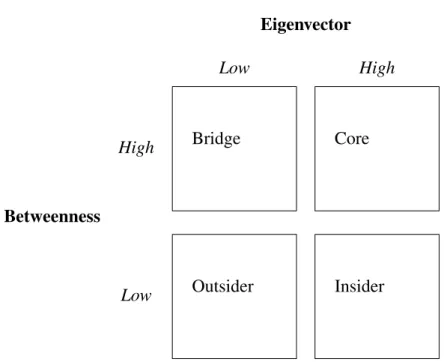
nodes within a network along multiple dimensions as Table 1.3 portrays (Conway 2012).
Nodes with high Eigenvector but low betweenness prominence are network “insiders”:
they occupy a core position in the network but have few (direct) connections outside their immediate cluster. Nodes with high betweenness prominence but low Eigenvector
promi-nence function as significant bridges linking together major components of the network,
measures are outsiders: they exist in the periphery and do not create pathways connecting
clusters. Nodes with high betweennessandEigenvector prominence constitute the core of
the network and provide bridges to most other clusters.
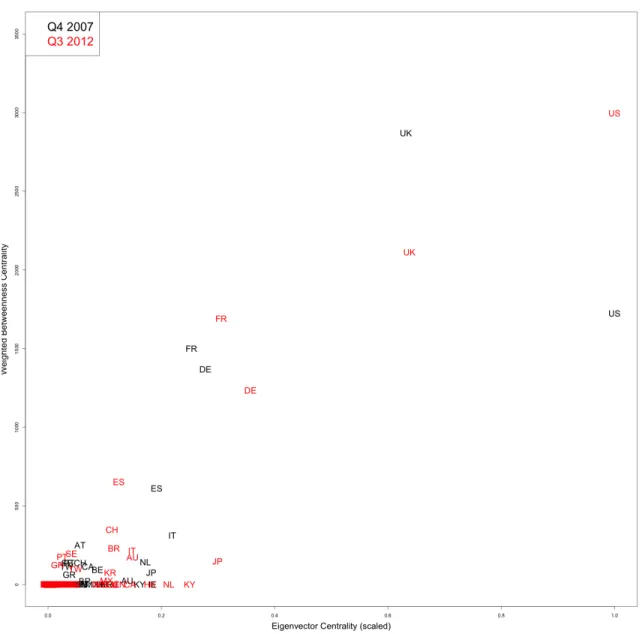
Figure 1.7 plots countries according to their Eigenvector (horizontal axis) and
between-ness (vertical axis) prominence before and after the financial crisis.32 The U.S. stays in the
most prominent position according to Eigenvector scores; in fact, there are no important
countries to which the U.S. isnotconnected. No other national banking system comes close
to the U.S.’s importance on this dimension, and the financial crisis did not erode it. This
in-dicates that not only is the U.S. the most connected node, it is also the most well-connected node, and suggests that there are no major national banking sector which is not influenced,
in some way, by the United States. The converse is not true of any other country.33
Before the crisis, some European nodes were important pathways for other nodes to
connect to the broader system – and thus are prominent by the betweenness measure –
but are not themselves at the core of the system, as is made clear by low Eigenvector
scores. In most cases the crisis led to an erosion in the betweenness prominence of Europe.
This follows intuition. The European economic integration project has revolved around several large economies within the eurozone, particularly Germany and France, which
con-nect financial centers outside of the eurozone with smaller economies inside the eurozone.
Through these connections the rest of Europe is linked to the rest of the world. Thus,
prominent European countries have great regional importance, but their global importance
is less significant. The spread of the crisis to the eurozone led to a reversal of capital flows
from the Eurocore to the Europeriphery, thus disconnecting parts of the network. As a
re-sult the regional importance of Germany and Italy declined as a rere-sult of the spread of the subprime crisis to the eurozone. Perhaps surprisingly France and Spain actually increased
slightly. Japan is connected to well-connected countries – increasingly so post-crisis – but
32As before, a full time series is available in the appendix. Again, the increasing importance of some nodes
over the period under observation is remarkable: the prominence of several nodes increases to a large extent from 1999-2007, then the system reorganizes as a response to the global financial crisis.
33A few others (Japan, Germany, and France) slightly increased in Eigenvector importance following the
does not serve as an important bridge. This perhaps reflects the fact that Asian regional
integration has lagged behind European regionalism, particularly in finance.
The most significant development in terms of magnitude was the increase in the
im-portance of the U.S. as a bridge and the drop in imim-portance of the U.K. Prior to the crisis
the U.S. was the second most important bridge, and the difference between it and
Franco-Germany was small. After the crisis the U.S. was by far the most important bridge in addition to being the most well-connected node. Indeed, the rising importance of the U.S.
by these measures shows the extent to which the U.S. held the entire structure together in
the face of the shock: had the U.S. failed as a bridge, the entire network may have
frag-mented into isolated clusters with few connections between them. Such was the experience
in the 1930s, and many expected a similar outcome during this crisis. Instead, the U.S.
was able to stay connected to all the most important countries while building bridges
be-tween them.34 According to this measure the prominence of the United States increased significantly as a result of the crisis.
This is reflected in table 1.4, which summarizes the graphical depiction in figure 1.7.
Most nodes are unimportant by either measure, but a handful are important betweenness
nodes (bridges) and two are globally important on both accounts (core nodes): the United
States and United Kingdom (and in particular the former). Both also became more
impor-tant by both measures over the time series, despite the fact that the financial crisis emanated
from their national financial systems. This reinforces the result from degree prominence, but in a more nuanced way. Moreover, as a result of the crisis the U.S. became the most
important bridge maintaining connections between disparate parts of the network. Without
the U.S. occupying this position, the recent financial crisis may have led to the
disappear-ance of a truly global banking network, as the network fragmented into regional or local
34This may have been an intentional policy goal. The U.S. Federal Reserve extended liquidity to foreign
coun-Betweenness
Eigenvector
Low High
High DR
FR
US, UK
Low All
Others
JP?
Table 1.4: Placement of national financial systems according to the taxonomy in Table 3, from the betweenness and Eigenvector centrality score above. The U.S., and arguably the U.K., are the only core nodes. Several European countries act as bridges. All others are outsiders, with the possible exception of Japan.
clusters in an analogous way to the 1930s.
All of these results tell a similar story in slightly different ways: the U.S. remains the
most important banking system, and there are no strong contenders for displacing it. In
fact, the relative gap between the U.S. and the rest has grown since the subprime crisis, and
as the global financial system has begun to recover it has re-organized itself with the U.S.
occupying a reinforced position at the core. This cannot be easily explained by reference to the internal attributes of the United States which were not favorable during this period.
Instead, we should consider how the structural properties of the banking network may have
facilitated patterns of endogenous growth.
1.6 Conclusion
Theories of international politics have often conceived of power as arising from the
structure of relationships in the global system, but measures of power have been limited
be operationalized in terms of statistics describing prominence in complex networks, and
provides an application to the global banking system. Besides offering precision, such an
operationalization offers novel conclusions regarding the performance of the system in the
wake of the most severe financial crisis since the 1930s: despite being the epicenter of the
crisis, the United States has increased in prestige according to some measures and remained
at the core in others. European financial centers have declined by most measures, while the rest of the countries have remained peripheral. Notably, this includes emerging markets
like the BRICS – Brazil, Russia, India, China, South Africa – which have not increased in
prominence in global banking according to these metrics.
The complex network conceptualization of power can be applied to substantive areas
other than banking. Strange (1987) conceived of structural power as existing in four areas:
finance, production and exchange, security, and knowledge generation. Future analyses
may be able to demonstrate whether American preeminence in banking has extended to other areas of the global financial system as well as these other areas. Such an approach
might provide a different picture than metrics now in common usage such as the Composite
Index of National Capabilities (CINC) scores, which counter-intuitively suggests that the
Soviet Union was more powerful than the United States during the 1980s and that Chinese
power eclipsed American power in the late-1990s.
Moreover, a complex network approach provides expectations regarding future
perfor-mance of the system. While such dynamics have barely been mentioned here, inferential models of networks allow researchers to formally test whether mechanisms such as
pref-erential attachment, triadic closure, or other structural processes exist in networks. Such
models are increasingly common in political science, but have yet to be utilized to
an-alyze the distribution of power in the system. These models allow for the inclusion of
processes in network formation. For this reason, applications of complex network science
– especially in its dynamic form – may complement and enrich other conceptualizations of
power, and may unify disparate strands of the literature.
This analysis has barely scratched the surface. Many other measures of network
promi-nence exist and can be applied to studies of the global political economy and security
sys-tem. Among others, such possibilities include analyzing when crises are likely to arise and spread, the conditions under which states move from the periphery to the core, the
mani-festations of structural power in bargaining over global governance structures and security
situations, and many other topics. By providing an empirically precise and theoretically
rich environment in which to study the global political system as a system, a complex