PROBABLE PERINATAL DEPRESSION, ENGAGEMENT IN HIV CARE, AND VIRAL SUPPRESSION AMONG MALAWIAN WOMEN
Bryna J. Harrington
A dissertation submitted to the faculty at the University of North Carolina at Chapel Hill in partial fulfillment of the requirements for the degree of Doctor of Philosophy in the Department of
Epidemiology in the Gillings School of Global Public Health.
Chapel Hill 2018
ABSTRACT
Bryna J. Harrington: Probable Perinatal Depression, Engagement in HIV Care, and Viral Suppression among Malawian Women
(Under the direction of Brian W. Pence)
With broadened antiretroviral treatment (ART) eligibility, long-term HIV care engagement has been sub-optimal. Care engagement may be hindered by antenatal depression, yet depression screening is not routine in most African countries. We estimated factors associated with antenatal depression, the prevalence and incidence of perinatal depression, and the relationship of antenatal depression with HIV care engagement among a cohort study of pregnant women living with HIV (n=725) recruited from a government antenatal clinic in Malawi in 2015-2016. Depression was assessed at enrollment and four times postpartum with the Edinburgh Postnatal Depression Scale (EPDS) and Patient Health
Questionnaire-9 (PHQ-9).
Participants’ median age was 29 years, and at enrollment had a median 22 weeks gestation. Most were married (90%) and their current pregnancy was unintended (68%). Many women reported a history of depression or anxiety: 46% had a personal history and 20% had a family history; 17% reported experiencing intimate partner violence (IPV). Women were more likely to have probable antenatal depression if they reported a history of depression (adjusted prevalence ratio 2.42; 95%CI 1.48-3.95), IPV (1.77; 1.11-2.81), had an unintended current pregnancy (1.78; 0.99-3.21), were unmarried (1.66; 0.97-2.84), or were employed (1.56; 1.00-2.44).
Most women were engaged in care through 12 months post-ART initiation: 85% attended all scheduled visits, and 81% were in care and virally suppressed. For both care engagement outcomes, there were no differences by antenatal depression status (visit attendance risk difference: -0.02; 95%CI -0.16-0.12; adjusted: -0.04; 95%CI -0.18-0.10) (viral suppression prevalence difference: -0.02; 95%CI -0.17-0.13; adjusted: -0.01; 95%CI -0.17-0.15).
ACKNOWLEDGMENTS
This dissertation represents four years of collaboration with the S4 study in Malawi and has benefitted from support from numerous people. I am particularly grateful to my advisor and dissertation chair, Brian W. Pence, who has facilitated an exemplary learning process through providing thoughtful advice, enthusiastic support, and professional expertise since I began the PhD program. Mina
Hosseinipour continues to be a strong role model for collaborative and productive global health
research and clinical care, and welcomed me to work with her and her S4 study team in Malawi for over 12 months on-site during this dissertation research. Brad Gaynes generously shared his clinical and research acumen on perinatal psychiatry in resource-limited settings. Joanna (Asia) Maselko encouraged me to dig deeper into our data on psychosocial factors in order to better contextualize them in the Malawian setting. Bill Miller has provided incredibly useful advice both for this dissertation’s nuts and bolts, and the overall clinician-epidemiologist career since I arrived at UNC six years ago. Together, my committee is a talented team of epidemiologists and clinicians whose guidance has greatly improved my dissertation. The process has, in fact, been quite fun, and a large part of that results from the excellent mentorship they have provided.
The S4 study team is a dedicated and vibrant group that continues to work hard to provide care to women in the Option B+ program in Lilongwe, Malawi. I am grateful to Madalitso Maliwichi, Jacob Phulusa, Allan Jumbe, Trywin Phiri, Mathias John, and Shaphil Wallie for their direct assistance with my dissertation research while in Malawi. S4 team members who have offered important support include Caroline Melhado, Laura Limarzi, Bethany DiPrete, Annie Thom, and Austin Wesevich. The women who participated in S4 deserve our appreciation for volunteering to help us learn from their experiences.
I have been incredibly fortunate for the financial support that has made my dissertation
research possible: the National Institute of Mental Health F30 award (F30MH111370), the UNC Medical Scientist Training Program grant (T32GM008719), the Fulbright-Fogarty Fellowship, and travel awards from the UNC Center for Global Initiatives, UNC Office of International Activities, Infectious Diseases Society of America, American Society of Tropical Medicine and Hygiene, and the HIV Medicine
Association. In addition to supporting my travel to Malawi, these funds have facilitated my professional development and contextual insights that directly improved the dissertation.
The faculty and staff in the UNC Epidemiology Department have helped make the learning journey manageable and challenging (in a good way). I appreciate the time and effort from Valerie Hudock, Jennifer Moore, Nancy Colvin, Spencer Gee, Vicki Moore, and Chandra Caldwell. I am grateful for Eugene Orringer, Toni Darville, Mohanish Deshmukh, Alison Regan and Carol Herion from the MD-PhD program leadership team for their helpful coaching and support. Special thanks go to “Dr. O” for recruiting me to become a Tarheel and for demonstrating a keen gift for recognizing a person’s potential.
guesswork and increase the enjoyment of this long process. I have numerous friends in the
Epidemiology Department and from Malawi who have offered help, resources, insights, and laughter along the way. Thank you.
Finally, my family has been the best. My parents, Christine Kiley and Dennis Harrington, are supportive and patient, and have not shied away from continuing to help me build character through stacking firewood and shoveling snow while at home in Maine. Nora and Annie are wonderful sisters, friends, and housemates whose infectious laughter has remedied most any day of frustration. Luke and Amber continue to be wise older siblings whose perspectives and advice I appreciate even more as time goes on. I must especially note my partner, Jeff Lansford, for the enthusiastic and steady
TABLE OF CONTENTS
LIST OF TABLES ... xi
LIST OF FIGURES ... xii
LIST OF ABBREVIATIONS ...xiii
CHAPTER I: INTRODUCTION ... 1
Aim 1: Identify factors associated with probable antenatal depression ... 2
Aim 2: Estimate the prevalence and incidence of probable perinatal depression through 12 months postpartum ... 2
Aim 3: Estimate the association of probable antenatal depression with postpartum engagement in care and viral suppression ... 3
CHAPTER II: BACKGROUND ... 5
Significance ... 11
Innovation ... 12
CHAPTER III: METHODS ... 14
Overview ... 14
Study Description and Design ... 14
Study Population ... 16
Data Collection & Variable Descriptions ... 18
S4 visit schedule & interviews ... 19
Perinatal depression assessment ... 19
Outcome assessments ... 20
Covariates... 22
Aim 2: Estimate the prevalence and incidence of perinatal depression
through 12 months postpartum ... 24
Aim 3: Estimate the association of probable antenatal depression with engagement in care and with viral suppression ... 27
Overall Limitations ... 29
CHAPTER IV: PREVALENCE AND FACTORS ASSOCIATED WITH PROBABLE ANTENATAL DEPRESSION AMONG WOMEN ENROLLED IN OPTION B+ IN MALAWI ... 33
Introduction ... 33
Materials and Methods ... 34
Study setting and population ... 34
Measures ... 35
Statistical analysis ... 36
Results ... 37
Discussion and Conclusions ... 39
CHAPTER V: PREVALENCE AND INCIDENCE OF PROBABLE PERINATAL DEPRESSION AMONG WOMEN ENROLLED IN OPTION B+ ANTENATAL HIV CARE IN MALAWI ... 47
Introduction ... 47
Methods ... 48
Study setting and population ... 48
Measures ... 49
Statistical analysis ... 50
Sensitivity analysis... 51
Results ... 52
Prevalence and incidence of probable perinatal depression ... 52
Agreement between the EPDS and PHQ-9 ... 53
Commonly endorsed depressive symptoms ... 54
CHAPTER VI: PROBABLE ANTENTATAL DEPRESSION AT ANTIRETROVIRAL INITIATION AND POSTPARTUM VIRAL SUPPRESSION AND ENGAGEMENT IN OPTION B+ HIV CARE IN
MALAWI ... 66
Introduction ... 66
Methods ... 67
Study setting and population ... 67
Measures ... 68
Statistical analysis ... 70
Results ... 71
Discussion ... 73
CHAPTER VII: DISCUSSION AND CONCLUSIONS ... 80
Summary of Results ... 80
Interpretation and Implications of Results ... 82
Future Directions ... 88
Improving the measurement of depression ... 88
Exploring a broader set of psychosocial factors that may affect engagement in care ... 90
Examining targets for engagement in care that are most meaningful in the Malawian context ... 91
Conclusions ... 93
LIST OF TABLES
Table 1. S4 study: safety, suppression, second-line, survival in Lilongwe, Malawi ... 15 Table 2. Dissertation aims and contributing data ... 18 Table 3. Participant characteristics (n=725) ... 44 Table 4. Probable antenatal depression prevalence and prevalence ratios (unadjusted,
and adjusted (aPR)) according to participant characteristics ... 46 Table 5. Participant demographics (n=299) ... 59 Table 6. Prevalence of screening positive for probable perinatal depression on the EPDS
or PHQ-9 at enrollment and postpartum time points ... 60 Table 7. Concordance of EPDS & PHQ-9 scores when using categories based on no, mild,
moderate, or severe depressive symptoms... 64 Table 8. Endorsed items on the EPDS and PHQ-9 – proportion of women who scored >0
LIST OF FIGURES
Figure 1. Map of Malawi in sub-Saharan Africa ... 5 Figure 2. S4 exposure & outcome assessment timeline ... 16 Figure 3. Enrollment diagram for S4 cohorts A and B at Bwaila antenatal clinic, May 2015
– December 2016 ... 18 Figure 4. Directed acyclic graph (DAG) of probable antenatal depression and visit
attendance at HIV care appointments (AIM 3) ... 31 Figure 5. Directed acyclic graph (DAG) of probable antenatal depression and viral
suppression (AIM 3) ... 32 Figure 6. Histogram of EPDS scores at first antenatal care visit with reference line for
positive depression cut-point (EPDS score ≥6) ... 45 Figure 7. Prevalence of probable depression and 95% confidence intervals ... 61 Figure 8. Prevalence and incidence of probable perinatal depression ... 62 Figure 9. Sensitivity analysis of probable depression prevalence at postpartum time
points on the EPDS, accounting for missing data ... 63 Figure 10. Comparison of engaged in care with viral suppression (<1000 copies/mL) by
probable antenatal depression status (EPDS score) ... 78 Figure 11. Risk and prevalence differences of engagement in HIV care outcomes
comparing women with and without probable antenatal depression at time of ART
LIST OF ABBREVIATIONS AIDS Autoimmune deficiency syndrome
aPD Adjusted prevalence difference aRD Adjusted risk difference ART Antiretroviral therapy CI Confidence interval DAG Directed acyclic graph
DRC Democratic Republic of the Congo
DSM-5 Diagnostic and Statistical Manual of Mental Disorders, Fifth Edition EPDS Edinburgh Postnatal Depression Scale
HIV Human immunodeficiency Virus IPV Intimate partner violence IQR Interquartile range LTFU Lost to follow up PD Prevalence difference
PHQ-9 Patient Health Questionnaire-9
PMTCT Prevention of maternal to child transmission of HIV PrEP Pre-Exposure Prophylaxis
RD Risk difference
S4 Safety, Suppression, Second-Line, Survival Study SMR Standardized Mortality Ratio
UNC University of North Carolina
VL Viral Load
CHAPTER I: INTRODUCTION
Women of reproductive age in Malawi have one of the highest HIV prevalence rates in the world, with 12% of adult women infected.1 Moreover, 16,000 infants are infected each year in Malawi during pregnancy or breastfeeding.2 Access to antiretroviral treatment (ART) for adult women is a priority to maintain women’s health and to reduce HIV transmission to their infants and partners. ART drastically reduces the likelihood of HIV transmission via suppressing viral load and rendering the person effectively noninfectious.3–6
To realize the full health and prevention potential of ART, people living with HIV must know their HIV status, initiate HIV care, and remain engaged in care long-term with high ART adherence and sustained viral suppression.7 Antenatal care provides an inherent opportunity to identify women living with HIV during pregnancy due to routine opt-out testing. Until recently, in Malawi as in most African countries, women were eligible for ART only during pregnancy and breastfeeding unless their HIV disease progression was advanced. In 2011, in order to increase ART coverage among women overall, the Malawian Ministry of Health implemented the Option B+ program: pregnant women living with HIV became eligible for lifelong ART regardless of their CD4 count or HIV disease stage. While the Option B+ program has increased the number of women initiating ART antenatally,8 long-term engagement in HIV care and sustained viral suppression postpartum have emerged as major challenges for the program: 25% of women starting ART in Option B+ are lost to follow up within six months, yet the United Nations Programme on HIV and AIDS (UNAIDS) target to eliminate the AIDS epidemic is to have 90% of those living with HIV on ART.9–11
depression) or within 12 months after delivery (postpartum depression).12 In studies from the United States, depression is more common in persons living with HIV than in the general population,13,14 and predicts poor engagement in HIV care, lower ART adherence,15–17 poorer HIV viral suppression,18 and higher mortality rates.19,20 Among women living with HIV in sub-Saharan Africa, perinatal depression prevalence estimates are as high as 43%.21 However, there is little information on the timing and predictors of perinatal depression, or on how perinatal depression affects engagement in HIV care and viral suppression during the postpartum period.
To address these gaps, we leveraged data from a longitudinal cohort study on the safety and efficacy of the Option B+ program in Malawi among pregnant women with HIV who sought antenatal care at a public clinic in the capital city. Specifically, we addressed the following three aims:
Aim 1: Identify factors associated with probable antenatal depression
Rationale: Identifying demographic, clinical, and psychosocial items that are associated with probable antenatal depression will be useful in focusing depression screening and treatment efforts.
Hypothesis 1: We anticipate that variables indicative of stressors will be more prevalent among women with probable antenatal depression.
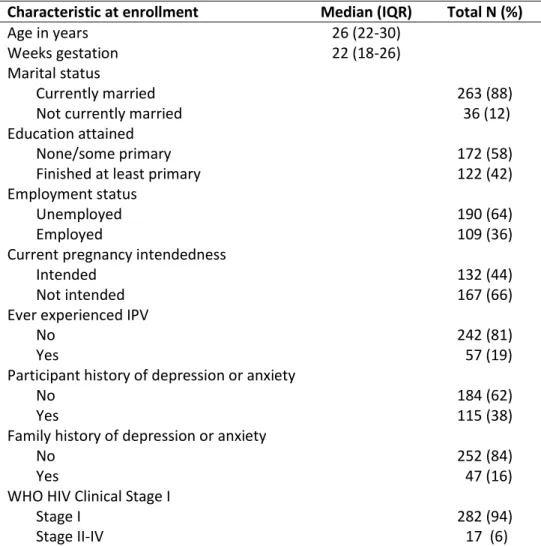
For this aim, we assessed factors that may be associated with probable antenatal depression among 299 pregnant women initiating ART and 426 pregnant women who had been on ART for at least 6 months (total n=725). We described the prevalence of and factors associated with probable antenatal depression among pregnant women enrolled in Option B+ HIV care in Malawi.
Aim 2: Estimate the prevalence and incidence of probable perinatal depression through 12 months postpartum
Hypothesis 2: Malawian women enrolled in Option B+ will have a prevalence and incidence of perinatal depression comparable to that of other perinatal women living with in sub-Saharan Africa.
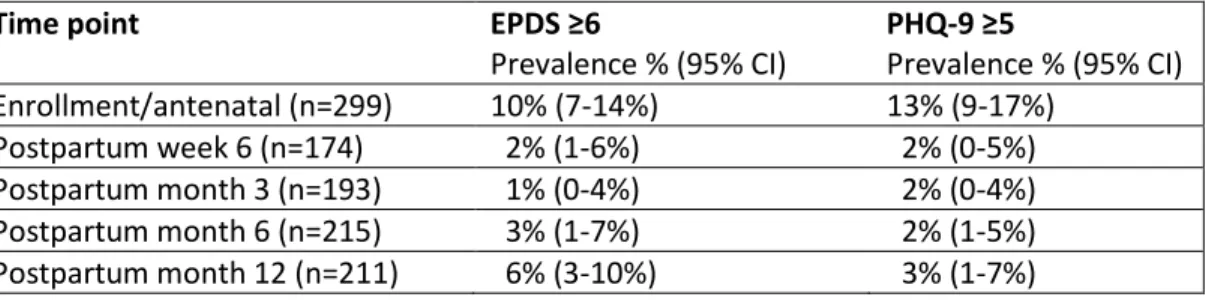
For this aim, we followed women in the cohort study who were initiating ART for the first time during their pregnancies and up to 12 months postpartum. Women’s depressive symptoms were assessed at four time points (enrollment, postpartum week 6, and postpartum months 3, 6, and 12). Both the Edinburgh Postnatal Depression Scale (EPDS), a 10 question instrument that is validated for both antenatal and postpartum depression screening, and the Patient Health Questionnaire-9 (PHQ-9), a 9 question depression screening instrument, were used to assess depression. A total of 299 women who initiated ART through Option B+ in 2015 and 2016 were included. We calculated point prevalence and incidence of probable perinatal depression, concordance between EPDS and PHQ-9 scores, and identified the most frequently endorsed depressive symptoms.
Aim 3: Estimate the association of probable antenatal depression with postpartum engagement in care and viral suppression
Rationale: Antenatal depression is a modifiable condition, and properly managing antenatal depression may improve postpartum engagement in care and viral suppression.
Hypothesis 3a: Women with probable antenatal depression will be less likely to have attended all expected visits through 12 months post-ART initiation than women without probable antenatal depression.
Hypothesis 3b: Women with probable antenatal depression will be less likely to have a suppressed viral load at 12 months post-ART initiation than women without probable antenatal depression.
CHAPTER II: BACKGROUND
Sub-Saharan Africa bears a large proportion of the global burden of HIV. Of the 37 million people living with HIV globally, over 25 million live in sub-Saharan Africa; 58% of the individuals living with HIV in sub-Saharan Africa are women.22 Within the goal of helping all people living with HIV manage their disease to stay healthy, women are particularly important in strategies to reduce HIV incidence because they can transmit to both their sexual partners and their infants. While recent prevention of maternal to child transmission (PMTCT) of HIV efforts have been successful – the number of new HIV infections among children declined by 24% between 2009 and 2011 in sub-Saharan Africa – there are still approximately 1,000 infants infected with HIV per day.23
Malawi, a country in southern Africa of 16 million inhabitants (Figure 1), is a leader in
implementing a public health approach to PMTCT. Malawi has a notable HIV epidemic with 12% of adult women infected with HIV.1 Along with its neighboring countries, Malawi has recognized the importance of providing HIV care in the context of antenatal visits as a way to reach both women and their infants. Despite the improvements and expanded HIV programs, over
16,000 infants were infected during their gestation, birth, or breastfeeding in Malawi each year as of 2010.2 In this setting of an undesirably high number of infant HIV infections and high HIV prevalence, Malawi was the first country to opt for an expanded ART program, called “Option B+” in 2011.
Option B+ has dramatically expanded the number of pregnant women with HIV eligible for antiretroviral treatment (ART). Option B+ is an innovative strategy that expanded national HIV treatment coverage, and provides lifelong ART to pregnant or breastfeeding women living with HIV regardless of their immune status. Option B+ is a public health approach to reduce maternal to child transmission of HIV and to improve long-term maternal outcomes. The rationale stemmed from high HIV prevalence in reproductive age women, high fertility rates, prolonged breastfeeding, programmatic simplification, and scientific evidence supporting the preventive benefit of earlier ART initiation.2,3,5,8 The number of pregnant women starting ART increased by 748% during Option B+’s first year, a major success for Malawi.8 Moreover, in 2013, the WHO formally recommended Option B+ for PMTCT guidelines, and multiple countries in sub-Saharan Africa have since implemented Option B+.25
Engagement among women in Option B+ is generally lower than among pregnant or non-postpartum adults on ART in sub-Saharan Africa, which ranges from 80-93%.35,39 Some of the women who appear to be ‘lost to follow up’ may have actually transferred their HIV care to another clinic without notifying their original health facility. However, tracing efforts found that only one in three women who had missed their scheduled HIV visits were still obtaining ART from another source.40 Long-term engagement in care and viral suppression are keys to the success of Option B+, but currently the program is not adequately engaging one-fifth of women.
Engagement in care and viral suppression are necessary for reducing mortality and transmission of HIV. A higher fraction of deaths occurred in patients who were lost to follow up compared to those who remained in care in a study of multiple HIV care settings in east Africa.41 Sustained viral suppression dramatically reduces the risk of heterosexual 4 and of mother to child transmission.3 Grounded in the evidence supporting sustained viral suppression, the UNAIDS developed the ’90-90-90’ goals to reduce the number of new infections and to curb the AIDS epidemic.11 The goals are to have 90% of persons living with HIV know their status, to have 90% of those who test positive for HIV to be on ART, and to have 90% of those on ART have a low viral load. In the antenatal setting in Malawi, HIV testing is opt-out, and coverage is reasonable but has room for improvement.42,43 The focus of the current research is on care engagement through Option B+ once women know their HIV status. For ART, about 75-80% of women remain in care 12 months after initiation.31,44 For viral suppression in Option B+, the single available estimate is 84% among women in care.45 There is clear room for progress toward reaching 90% of those living with HIV on ART, and 90% of those on ART to be virally suppressed. Moreover, the first-line ART regimen for Option B+ has a relatively low barrier to resistance, so poor adherence or
Engagement in care consists of linking to HIV care, initiating ART, and continuing to take ART.47 A practical goal of engagement in HIV care is to achieve viral suppression to reduce the likelihood of transmitting HIV to infants or partners. Facilitators to engaging in care include a desire to prevent transmission of HIV to the infant, motivation to help one’s own health, a desire to prevent visible symptoms of HIV, and knowledge about ART.48–50 Barriers include initiating ART at a younger age (<25), on the same day as receiving an HIV diagnosis, or late in pregnancy, having a lack of social support, HIV-related stigma, denial of HIV status, lack of understanding about Option B+ and ART, financial concerns, and clinic-level factors such as poor treatment from health care workers or long wait times at
clinics.38,40,51–55
Engagement in care may be hindered by antenatal depression, but evidence is sparse from sub-Saharan Africa. In higher-resource settings, depression reduces HIV care engagement, ART adherence, and viral suppression in non-pregnant adults.13–20,56–58 Among adults in sub-Saharan Africa, depression has a negative or null effect on engagement in HIV care.56,59–61 However, the general adult population have historically been sick patients with advanced HIV, due to ART eligibility guidelines; consequently, generalization to relatively healthy perinatal women is unclear. In a study among women in Option B+ engaged in a cash transfer randomized controlled trial, antenatal depression did not appear to be associated with postpartum visit attendance, but women were followed only for 6 weeks.62
What has been established specific to the perinatal time period typically consists of studies citing depression as an actual or theoretical barrier to care engagement, but without a quantification of the effect of depression on engagement in care.51,63–66 For example, among Kenyan women diagnosed with HIV at their first antenatal visit, those with sub-optimal engagement in care were
those without a history of depression.67 To our knowledge, only one study in the Option B+ population has explicitly examined the effect of antenatal depression on postpartum retention in HIV care; it had null results.62 In Ethiopia, women with antenatal depressive symptoms had similar attendance at
scheduled antenatal care visits, yet had more non-scheduled antenatal or urgent care visits compared to their non-depressed counterparts; HIV status was not incorporated into their analysis.68 In a recent systematic review of barriers and facilitators to retention in Option B+ care in sub-Saharan Africa, none of the featured studies examined perinatal depression as a distinct contributor.38 Given the lack of substantial data from sub-Saharan Africa, results from other countries supporting a null or negative relationship between depression and HIV care engagement, qualitative evidence suggesting a link between depression and HIV in Malawi,69,70 and the documented challenges with sustained engagement in care in Option B+, we sought to characterize the burden and predictors of perinatal depression, and estimate the association between probable antenatal depression and engagement in HIV care.
rather than the mother’s health. Thus, identifying the magnitude of perinatal depression provides information relevant to discussions around improving mental health screening and treatment services.
Estimates of the prevalence of perinatal depression vary, yet the condition is considered to be one of the most common during pregnancy.12 In Western populations, estimates are 10-15%,12,72,73 and from sub-Saharan Africa, estimates are generally higher with a wider range: among the general perinatal population, the estimated prevalence is 11% antenatally and 18% postpartum, and among women living with HIV in the region, a pooled study estimated that approximately 23% suffer from depression in the antenatal and in the postpartum periods.21,74 However, prevalence estimates range from 8.3%75 to 48.7% among perinatal African women,76 and from 7.7%77 to 55.0%78 among pregnant African women living with HIV. The significant spread of prevalence estimates could be due to heterogeneity of depression assessment methods used (screening tool versus diagnostic, self-report versus clinician interview, major versus major or minor depression), variability in timing of depression assessment during pregnancy, variations in the populations studied, and cultural differences in depressive symptom expression. Some studies note similar a prevalence of depression among participants with and without HIV,66,79,80 whereas others estimate a higher burden among women living with HIV.12–14,81,82 Overall, perinatal depression is not rare, and additional information on the magnitude, timing, and associated factors would guide care improvements and further research.
Little is known about the risk factors for antenatal depression among women living with HIV in sub-Saharan Africa. From other countries, predictors of antenatal depression that have been identified include history of depression, history of trauma, poor social support, food insecurity, recent stressful life events, past-year intimate partner violence, and unplanned pregnancy.75,80,83–86 A recent systematic review of perinatal mental health research in Africa demonstrated that lack of support and
focus on factors that may be unique to or more prominent among women living with HIV, such as disclosure of HIV status, infant HIV status, or intimate partner violence.87 Identifying predictors that are readily available to clinicians would expand the toolset to customize comprehensive HIV care.
Early recognition of perinatal depression among women living with HIV is imperative given that untreated perinatal depression can lead to adverse outcomes for mothers and infants. For mothers, consequences include impaired functioning, poor quality of life, or death.79 Infants born to mothers with untreated perinatal depression have increased risk of low birth weight,88 preterm birth,89,90 behavioral difficulties,89 malnutrition,91 and social interaction difficulties.92,93 Mothers with perinatal depression can be less responsive and less sensitive to their infants,94,95 which can lead to infants with insecure
attachment and colic.96 Children of mothers with perinatal depression may be at higher risk for depression themselves.97–99
Taken together, we know that engagement in Option B+ is sub-optimal, that depression is at least as common among people living with HIV as among those uninfected, that untreated perinatal depression carries adverse outcomes for mothers and infants, and that depression may negatively affect engagement in HIV care. Despite over 6 years passing since Malawi implemented Option B+, perinatal depression has not been well characterized among participants. Thus, the motivation for this research is to shed light on the magnitude of perinatal depression, and to evaluate to what degree antenatal depression contributes to sub-optimal engagement in care.
Significance
and mental health services. The study focuses on Malawi, but could be useful to other sub-Saharan African countries that have implemented Option B+ as part of their prevention of maternal to child transmission of HIV program. The contribution from this research include estimates and
characterization of probable antenatal depression, and the effect of these symptoms on postpartum engagement in care among women living with HIV enrolled in Option B+.
Innovation
In 2011, Malawi became the first sub-Saharan African country to implement Option B+, which went on to become the WHO-recommended PMTCT approach. As such, Malawi has the most mature Option B+ program, and results from Malawi may be informative for neighboring countries who have subsequently adopted the Option B+ program. Our research leverages the data from an established cohort study that collected thorough covariate data on clinical, demographic, and psychosocial factors. We provide the first estimates of the magnitude of perinatal depression and factors associated with antenatal depression among Malawian women enrolled in Option B+.
CHAPTER III: METHODS Overview
The overarching questions that drove this research were: 1) Who in Option B+ has probable perinatal depression?; 2) When in the perinatal period does probable perinatal depression occur among women enrolled in Option B+?; and, 3) Does the presence of probable antenatal depression contribute to the sub-optimal engagement in Option B+ HIV care during the postpartum period? Thus, the goals of this research were to identify factors associated with probable antenatal depression, characterize the prevalence and incidence of probable perinatal depression, and examine the relationship between probable antenatal depression and HIV care outcomes. The data come from a cohort study of pregnant women living with HIV in Lilongwe, Malawi called the Safety, Suppression, Second Line, Survival (S4) study. We used the available perinatal depression scores to estimate the prevalence, incidence, and associated factors using a dichotomous threshold for probable perinatal depression. Participant follow up data provided information on who remained engaged in care through 12 months post-ART initiation and 12 months postpartum.
Study Description and Design
Table 1. S4 study: safety, suppression, second-line, survival in Lilongwe, Malawi
Objective Characterize the safety, durability, ART resistance, and clinical outcomes for mothers and infants enrolled in Option B+ for prevention of mother to child transmission and HIV treatment in Malawi
Study design Longitudinal observational cohort, following until ≥12 months postpartum (S4 duration: 2015-2020)
Study population
600 women living with HIV in Lilongwe city, recruited at their 1st antenatal care visit Inclusion
criteria
• Female age ≥18 years (or 16-17 and married), pregnant; plan to birth in Lilongwe • HIV positive by 2 rapid tests approved by the Malawi Ministry of Health (Alere
Determine™ and Unigold™)
• Willing and able to provide informed consent Exclusion
criteria
• Female age <18 years (or 16-17 but unmarried); not pregnant; plan to give birth outside Lilongwe
• HIV negative
• Incapable or unwilling to provide informed consent
For this dissertation’s study population, the S4 study enrolled women at their first antenatal care visit at a governmental antenatal health center in Lilongwe between May 2015 and July 2016. Women living with HIV were enrolled at any point during pregnancy if they met eligibility criteria for one of two sub-cohorts: newly HIV-diagnosed pregnant women initiating first-line ART (cohort A); or
established HIV-positive women on ART during a subsequent pregnancy requiring second-line ART (cohort B). Women living with HIV who defaulted from ART care (either for their own health or for a previous pregnancy) but return for subsequent pregnancy management, were enrolled into S4 but are not featured in this dissertation. In the current research, cohort A (women initiating ART) are the study population for aims 1 and 3, and both cohorts A and women screened for cohort B (women who had been on ART ≥6 months) constitute the population for aim 2. S4 participants returned to the S4 clinic for their antenatal and postpartum care, which includes ART medicine dispensing. All S4 study visits were in-person at a clinic adjacent to the governmental health facility.
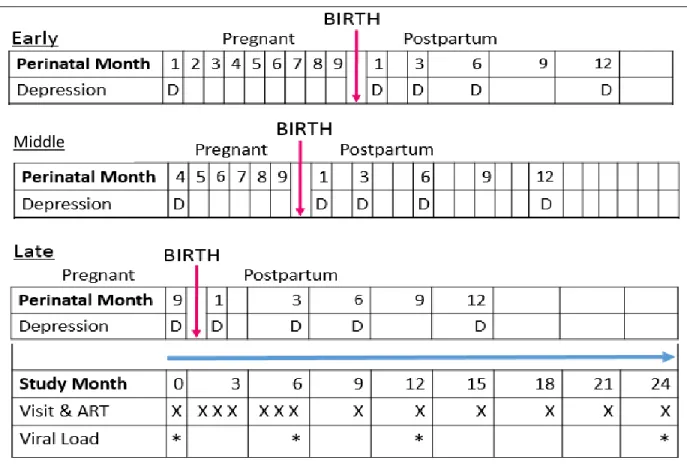
the study at any month of gestation, the alignment of the study month and pregnancy/postpartum time scales varies. Perinatal depression was assessed at study entry and four times postpartum (months 1.5, 3, 6, and 12). Figure 2 features example timelines for a study participant based on whether she enrolled in S4 in the early, middle, or late in her pregnancy.
Figure 2. S4 exposure & outcome assessment timeline
Study Population
During the period when participants featured in the current research were enrolled (May 2015 – June 2016), n=18,116 women registered for antenatal care at Bwaila hospital. Of those, n=952 (5.2%) were newly diagnosed with HIV, and n=964 (5.3%) had previously tested positive for HIV, for an overall HIV prevalence of 10.6% among women who sought antenatal care at Bwaila. During the same time period in the overall Lilongwe district, n=97,154 women registered for antenatal care, and n=5,504
(5.8%) were living with HIV. Thus, Bwaila served 19% of women seeking antenatal care, and had a population with a higher HIV prevalence compared to the overall Lilongwe district.
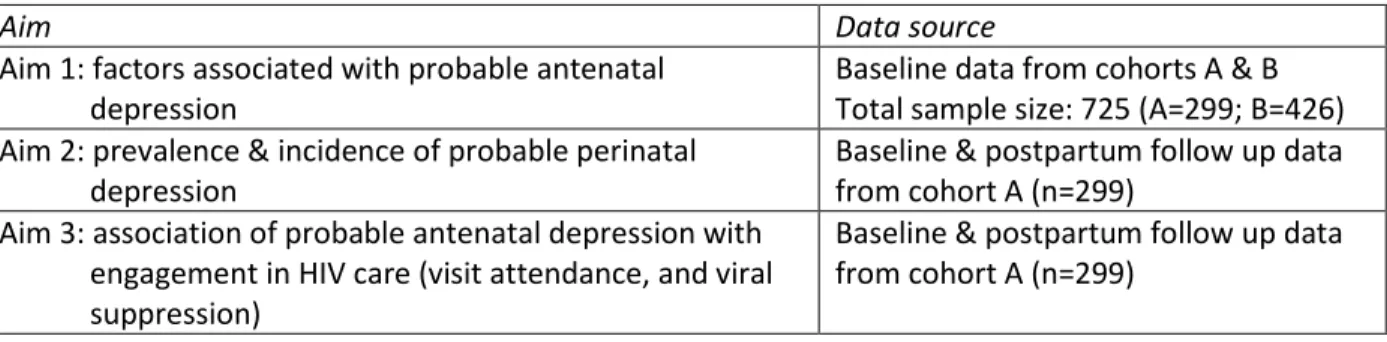
S4 study nurses recruited from women who tested positive or were known positive for HIV at their first antenatal visit. More women were available for recruitment than S4 could enroll, so nurses approached as many women with an HIV diagnosis as possible each day to describe what participation in S4 would entail, and referred interested women who could not be seen on the same day to return on a subsequent day. Women who chose not to participate or were ineligible received routine antenatal and HIV care through the government clinic. Aim 1 (chapter 4) required baseline data from women initiating ART (cohort A) and women who had been on ART at least 6 months (cohort B; see Table 2). Aims 2 and 3 (chapters 5 and 6) required follow up data through 12 months postpartum from women newly initiating ART (cohort A).
Table 2. Dissertation aims and contributing data
Aim Data source
Aim 1: factors associated with probable antenatal depression
Baseline data from cohorts A & B Total sample size: 725 (A=299; B=426) Aim 2: prevalence & incidence of probable perinatal
depression
Baseline & postpartum follow up data from cohort A (n=299)
Aim 3: association of probable antenatal depression with engagement in HIV care (visit attendance, and viral suppression)
Baseline & postpartum follow up data from cohort A (n=299)
Figure 3. Enrollment diagram for S4 cohorts A and B at Bwaila antenatal clinic, May 2015 – December 2016
Data Collection & Variable Descriptions
All S4 study visits were in-person interviews at the study site conducted at enrollment, monthly for 6 months, and quarterly thereafter including visits coinciding with postpartum months 1.5, 3, 6, 9 and 12 (see Figure 2 above). The interviews were conducted in Chichewa (the predominant language in Lilongwe) by an S4 study nurse in a quiet, private room at the antenatal care clinic. The S4 nurses received training directly on the questionnaires used in S4 to assess the psychosocial aspects of interest. All S4 study nurses and physicians were veteran researchers with ample experience interviewing
S4 visit schedule & interviews
The baseline antenatal interview addressed demographics (age, education, socioeconomic measures), relationship status, HIV testing and treatment history, pregnancy history, and antenatal depression. Follow up interviews at postpartum months 1.5, 3, 6, and 12 addressed HIV status disclosure, postpartum depression, social support, and stressful life events. At all follow up visits, S4 collected self-reported ART adherence and treatment side effects.
Perinatal depression assessment
Perinatal depression was assessed at the first antenatal care visit (S4 study enrollment), and at postpartum months 1.5, 3, 6, and 12 with the Edinburgh Postnatal Depression Scale (EPDS) and the Patient Health Questionnaire-9 (PHQ-9). The EPDS contains 10 questions about depressive symptoms in the past 7 days, and was designed to detect depression while women are pregnant or postpartum.100 The EPDS omits the physical symptom items featured on other depression screening tools including the PHQ-9 because pregnant women may experience increased fatigue and appetite or sleep changes due to pregnancy or having a young infant and not necessarily due to any depression.101 Anxiety symptoms may be more prominent in perinatal depression compared to major depression that occurs at other times in life,102 and 3 of the 10 EPDS questions focus on about anxiety symptoms. Each item on the EPDS is scored from 0 to 3, giving an overall score range of 0 to 30. A previous study validated the EPDS in Chichewa,103 and recommended a score threshold of 6 rather than the typical 13 for a dichotomous cut-point to indicate probable major perinatal depression (sensitivity: 76.3%, specificity: 74.1%). Thus, in our analyses, women who scored ≥6 on the EPDS screened positive for probable perinatal depression. In a review of EPDS validation studies in Africa, the EPDS performed well as a screening tool for major depression among perinatal populations.104
(symptom occurred zero days in the past two weeks) to 3 (nearly every day), for an overall score range of 0 to 27. A score of 10 or more is traditionally used as indicative of major depression, with a score of 5-9 suggestive of mild depression.105,106 In the current analyses, a score of 5 or greater on the PHQ-9 was considered a positive screen for probable perinatal depression. The PHQ-9 was translated and back-translated in Chichewa and has been used in multiple neighboring countries, however there has not yet been a validation of the PHQ-9 published in Malawi.107–109
For either the PHQ-9 or EPDS, prevalent probable depression is defined as screening positive on the EPDS or PHQ-9 at any given time point during study participation, whereas incident probable postpartum depression is defined as a positive EPDS or PHQ-9 screen during the postpartum period among women who were previously classified as not meeting depression criteria. A new postpartum depression episode in women with a history of depression prior to S4 enrollment will be considered incident. Continuous EPDS or PHQ-9 scores were not used due to the low overall prevalence of probable perinatal depression and the heavily skewed distribution of the scores. Any woman scoring ≥6 on the EPDS, ≥5 on the PHQ-9, or who endorsed suicidal ideation was referred to a study clinician and offered a referral to local mental health services as indicated.
Outcome assessments
pregnancies and the early postpartum period. We focus on 12 months post-ART initiation because it contained the same amount of follow up time for all participants. We examined 12 months postpartum in a sensitivity analysis because it provides information on whether women had ART coverage during pregnancy and the majority of the breastfeeding period, and programmatically is the middle of 3 time points when HIV-exposed infants are tested for the virus and aligns with WHO breastfeeding
recommendations.111,112
Engagement is operationalized in the current analyses as HIV care visit attendance because the visits are when women received their monthly or quarterly supply of ART medicines. The primary outcome definitions are:
• Visit attendance: participant attended all 8 scheduled visits in the first 12 months post-ART initiation within 30 days of the appointment date
• HIV viral suppression: in care and <1000 viral copies/mL at 12 months post-ART initiation
Visit attendance is assessed by reviewing the S4 database and whether each scheduled visit was attended or not according to the above definition. For patients initiating ART in Malawi, standard of care involves monthly visits through 6 months and visits every 3 months thereafter. Patients receive their next month(s) supply of ART during these visits. Similarly, pregnant clients are encouraged to attend monthly antenatal, and then well-child visits at week 6 and months 3 and 9 postpartum. Regular
In a sensitivity analysis, we examined engagement in care through 12 months postpartum, and used the same “engaged in care” definition of attended all scheduled visits from ART initiation through the first 12 months postpartum. Women who missed any of their scheduled visits were considered to be inadequately engaged in care. Scheduled visits were counted as those when a woman was due to pick up her next supply of ART medicines.
HIV viral suppression at 12 months post-ART initiation was defined as <1000 copies/mL per Malawi Ministry of Health HIV ART Management Guidelines.113 Women were considered unsuppressed if they did not attend their 12 month visit within the 30 day window, or if they attended but had a viral load ≥1000 copies/mL. The local standard of care treatment algorithm is based in part on this 1000 copies/mL cut-point. Viral load is an objective measure of ART adherence. Adequate ART adherence generally results in viral suppression, yet measuring adherence itself is prone to error with methods such as patient self-report, pill counts, dispensary information, or serum drug levels.114–119
HIV viral load was assessed in the UNC Project-Malawi laboratory from standard venipuncture at enrollment, delivery, and at months 6 and 12 post-ART initiation with the Abbott m2000rt using the Abbott HIV-1 Real Time Quantitative Viral Load Assay, with standard protocol. The laboratory is certified by the ACTG and HPTN network laboratory leadership. Laboratory values were exported to the main S4 study database and linked via the participant’s unique study identification number. All participants who were virally unsuppressed (≥1000 copies/mL, per Malawi Ministry of Health guidelines)113 were notified by a study clinician and clinical management followed standard of care. Venipuncture specimens also permitted CD4 count measurement.
Covariates
WHO HIV clinical stage; psychosocial variables included current relationship status, whether the current pregnancy was intended, HIV status disclosure to partner (among women who had been on ART ≥6 months), history of verbal or physical intimate partner violence (IPV), and self-reported personal or family history of depression or anxiety. The self-reported personal history was asked as “Do you have any past history of depression or anxiety?”, and an analogous question was asked about first-degree family history. No information was available on clinical diagnoses of psychiatric conditions for participants or their family.
All potential factors were dichotomized due to sample size and response distribution: age above versus below the median (29 years); education as finished at least primary school (through Standard 8, approximately equivalent to 8th grade) versus less; unemployed versus any employment; relationship status as currently married versus not; pregnancy intendedness as wanted to become pregnant at that time versus not; HIV status disclosure as already disclosed to partner versus not; personal and family history of depression or anxiety as ever versus never; history of previous child death and of IPV as ever versus never; ART history as ART-naïve versus currently on ART; and WHO HIV clinical stage as 1 versus stages 2-4.
Data Analyses for the Specific Aims Aim 1: Identify factors associated with probable antenatal depression
evaluated collinearity prior to simplifying the full model via manual backward elimination. To estimate PRs while addressing convergence issues, we used a previously described 2-step modeling process that first uses a modified Poisson model to generate starting estimates for the second-stage log binomial model.121–124 For backward elimination, we omitted the variable that had the highest p-value, then re-ran the simplified model. Variables were eliminated one at a time until each remaining variable had a p -value of <0.10. As in bivariable models, a higher p--value threshold was chosen to retain variables with potentially meaningful relationships with probable antenatal depression. A variable indicating whether the woman was newly initiating ART or had been on ART for ≥6 months (referent) was retained in the multivariable model for theoretical differences between the two groups of women. We present adjusted PRs (aPR) and 95% confidence intervals (CI) for each variable retained in the final model.
The binary outcome (probable antenatal depression) was modeled as follows:
(Pr(antenatal depression𝑖)) = 𝛽0𝑖+ 𝛽1𝑋1𝑖+ ⋯ + 𝛽𝑛𝑋𝑛𝑖+ 𝜀𝑖 with predictor variables 𝑋1 … 𝑋𝑛,
coefficients 𝛽0 … 𝛽𝑛, and binomially distributed error term 𝜀. We only included 6 independent variables
given our sample size and the prevalence of depression so to not over stratify our data.
Handling missing data. We had minimal missing data in the baseline dataset. The following variables were missing values for participants: WHO clinical stage (n=1 missing); family history of depression or anxiety (n=2); personal history of depression or anxiety (n=2); previous child died (n=3); and disclosed HIV status to partner (n=10). A total of 723 women of the 725 were included in the final multivariable model. Thus, with the small proportion of missing data, we did not use multiple
imputation to address those missing values.
depression coding was binary (0 = EPDS score <6; 1 = EPDS ≥6; and 0 = PHQ-9 <5; 1 = PHQ-9 ≥5). We compared participants’ PHQ-9 and EPDS scores to determine how often scores were concordant positive (PHQ-9 ≥5 and EPDS ≥6), concordant negative (PHQ-9 <5 and EPDS <6), or discordant (PHQ-9 ≥5/EPDS <6, or EPDS ≥6/PHQ-9 <5). We calculated Cohen’s kappa statistic, proportions of negative and positive agreement, and the prevalence and bias adjusted kappa given that the prevalence of positive probable perinatal depression was very low.125,126 We further categorized each EPDS and PHQ-9 score into no, mild, moderate, or severe symptoms based on score categories from previous studies106,127 and
compared concordance of EPDS and PHQ-9 scores at a given clinic visit to understand how the symptom severity endorsed for each instrument aligned. From this comparison, we calculated a kappa statistic and weighted kappa.128 The most and least commonly endorsed items on the EPDS and PHQ-9 are noted as proportions of people who scored >0 on that item. Three women died during postpartum follow-up and five women withdrew from the study; their completed EPDS and PHQ-9 scores are included, but they are not in the analysis for the postpartum time points after their deaths or study withdrawal.
was linked to the infant’s week 6 and month 3, 6 and 12 visits; thus, when no infant was present the depression questions were not asked.
In the sensitivity analysis, we estimated a plausible range of the prevalence of probable depression we would have observed with complete data. For all scenarios, we assumed that women who attended clinic with a live infant but were not asked the EPDS/PHQ-9 had a prevalence of probable perinatal depression comparable to that of women who completed the EPDS/PHQ-9. To account for the other two groups of missing data (women who attended clinic without a live infant, and women who did not attend clinic), we considered the following three scenarios of low, intermediate, and high
depression: 1) In the lowest prevalence scenario, we estimated that women who did not attend clinic had a prevalence of probable depression half that of women who answered the EPDS/PHQ-9 but
women with non-live infants who attended clinic had a prevalence equal to that of women who did have scores at that visit; 2) In the intermediate prevalence scenario, women who did not attend clinic or attended but had a non-live infant had a prevalence of probable depression twice as high as women who answered the EPDS/PHQ-9; and 3) In the highest prevalence scenario, women who did not attend clinic or attended but had a non-live infant had a prevalence of probable depression five times as high as women who answered the EPDS/PHQ-9. In our “lowest prevalence” scenario 1, we did not assign a lower probable depression prevalence to the women who had non-live infants based on previous literature that suggests pregnancy losses and infant deaths may be associated with increased maternal depression.129–132
Aim 3: Estimate the association of probable antenatal depression with engagement in care and with viral suppression
Statistical analyses.In the primary analyses, two separate models were run. The exposure was defined as an EPDS score ≥6 on the day of ART initiation, and the two engagement in care outcomes of interest – visit attendance through 12 months post-ART initiation, and viral suppression – were defined as dichotomous variables at 12 months post ART-initiation (attended all ART-dispensing visits within 30 days of scheduled date in the first 12 months, and viral load <1000 copies/mL). We used linear binomial regression models to estimate crude and adjusted risk differences (RD) for visit attendance and
prevalence differences (PD) for viral suppression, each with 95%CI at 12 months by probable antenatal depression status.
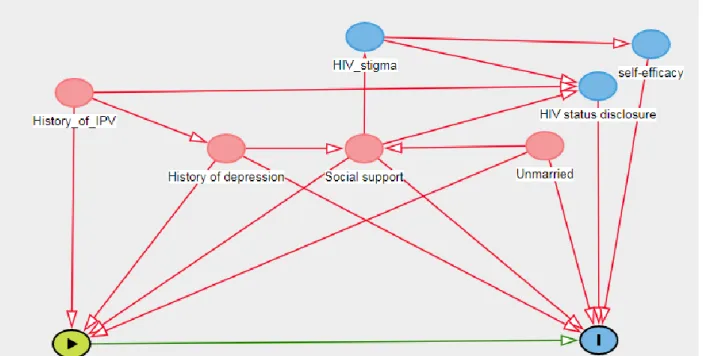
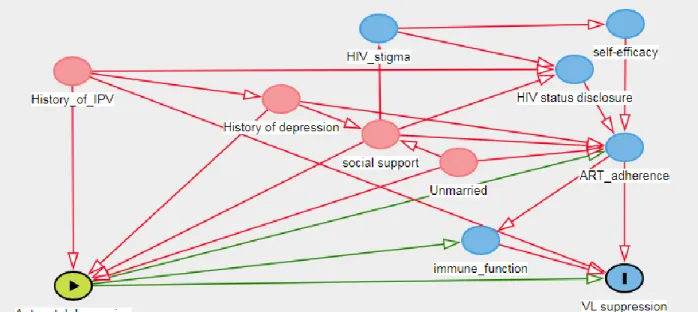
Our literature review informed the development of directed acyclic graphs (DAGs) representing each of the exposure-outcome relationships. The DAGs identified the following potential confounders: depression history, IPV history, marital status, and social support. We used standardized mortality ratio (SMR) weights with robust variance estimation for the 95% confidence interval to control for the minimally sufficient set of potential confounders, but did not have a measure of social support. We did not include any mediators in the models for theoretical reasons.134 SMR adjustment reweights the unexposed population to resemble the exposed to remove confounding, and produces estimates of the difference in HIV care engagement outcomes if antenatal depression could be removed from those who screened positive for the condition.135–138 Our models yielded estimates of the risk or prevalence
100% visit attendance through 12 months postpartum, a time interval that coincides with the WHO breastfeeding recommendation.112
We performed two sensitivity analyses to address potential bias from inappropriate selection into the study and from outcome misclassification. Inappropriate selection into the study sample could have arisen because some women may have reported being ART-naïve at enrollment when in fact they were already taking ART. In our sample, 28 women had viral loads ≤400 copies/mL on the date of ART initiation. While it is possible to have a low viral load in the absence of ART, a recent study from Malawi showed that over half of participants who said they had not been on ART but had viral loads ≤400 copies/mL at enrollment were found to have detectable plasma ART drug levels.139 In this first sensitivity analysis, we repeated our models after excluding these 28 women.
Outcome misclassification may have arisen because we defined all women lost to study care as out of care and unsuppressed, whereas in fact some of them may have transferred care to another HIV clinic and remained on ART and suppressed without the study’s knowledge. A study in Malawi found that 36% of women “lost to follow up” were accessing ART from other clinics not documented in the available electronic medical record.40 Thus, to account for potential imperfect sensitivity in our outcome assessment, we calculated the crude risk difference of visit attendance and of viral suppression with lower sensitivity. For visit attendance, sensitivity was 36% lower per the previous study, and for viral suppression, sensitivity was 32% lower. We chose 32% lower sensitivity as plausible for viral
suppression if 36% of women who were lost to follow up in our sample were in care elsewhere, and 90% of those in care were virally suppressed (36%*90%=32%), as was found among our observed
Handling missing data. In primary analyses, those who were lost to follow up and had neither evidence of ART refills in the electronic medical record system nor documented transfer of care to another clinic were considered to be virally unsuppressed. We conducted a sensitivity analysis guided by literature that found 36% of women “lost to follow up” were accessing ART from other clinics not documented in the available electronic medical record.40 Thus, a notable proportion of women lost to follow up could have still been on ART and some virally suppressed. We accounted for potential bias in the sensitivity analysis described above.
Power, sample size & precision. For these calculations, visit attendance is used as the outcome. We will test the null hypothesis that there is no difference in visit attendance between those with versus without antenatal depression symptoms. Calculations are based on two-sided hypothesis tests, an alpha level of 0.05 and a power of 80% (beta=0.20). We present power estimates based on a sample of 300 participants.
Literature from our study sites show that 75% of women will remain in care by 12 months post-ART initiation.140 A clinically meaningful difference in engagement in care is 20%. We expect attendance to be lower among women with probable depression. We have between 80-98% power to detect a RD of 0.20 comparing non-depressed to depressed, depending on the prevalence of antenatal depression (range: 10-33%). Thus, the study is powered to detect moderate effects, which are plausible based on prior literature.60
Overall Limitations
Our research results should be interpreted in light of some limitations. The perinatal depression assessments are screening tools, not diagnostic instruments, which may introduce measurement error. The EPDS and PHQ-9 were read aloud to participants by study nurses to ensure consistency in
CHAPTER IV: PREVALENCE AND FACTORS ASSOCIATED WITH PROBABLE ANTENATAL DEPRESSION AMONG WOMEN ENROLLED IN OPTION B+ IN MALAWI
Introduction
Antenatal depression is common worldwide, affecting over one in ten pregnant women.12 Antenatal depression strongly predicts postpartum depression,71 and if untreated, is associated with poor outcomes for both mothers and infants. For mothers, consequences include impaired functioning, poor quality of life, or death due to suicide.79 Infants born to mothers with untreated antenatal
depression have increased risk of low birth weight,88 preterm birth,89,90 and behavioral difficulties.89 Predictors of antenatal depression include history of depression or trauma, poor social support, food insecurity, recent stressful life events, intimate partner violence, and unplanned pregnancy.75,80,83–
86 In Africa, lack of support and family/marital conflict are associated with poorer mental health, but evidence regarding sociodemographic and obstetric or medical variables is inconclusive.74 Notably, factors that are unique to or more prominent among HIV positive women, such as disclosure of HIV status or intimate partner violence, have not been thoroughly addressed.87 Overall, depression may be more common among persons with HIV than the general population and depression negatively affects engagement in care, including retention in care, antiretroviral therapy (ART) adherence, and viral suppression.13–20,56,57 The risk factors for antenatal depression among women living with HIV in sub-Saharan Africa have been underexplored.
the number of perinatal HIV infections. Option B+ is novel because it provides lifelong eligibility for ART to pregnant and breastfeeding women regardless of their immune status – there are no CD4 count or AIDS-defining condition criteria for ART eligibility. While Option B+ has increased the number of women who initiated ART,8 retention in HIV care has been suboptimal: approximately 25-30% of women
stopped returning to HIV care within 12 months of initiating ART.10,44,141 Antenatal depression may affect retention in HIV care, yet the prevalence of antenatal depression or its associated factors among women enrolled in Option B+ is unclear. We describe here the prevalence of and factors associated with
probable antenatal depression among pregnant women enrolled in Option B+ HIV care in Malawi. Materials and Methods
Study setting and population
Data are cross-sectional from baseline interviews conducted in 2015-2016 for an observational cohort study (“Safety, Suppression, Second-line, Survival - S4”, ClinicalTrials.gov identifier:
NCT02249962) at the Bwaila Family Health Unit, the busiest government antenatal clinic in Lilongwe, Malawi, with over 15,000 deliveries annually. S4’s primary objectives are to evaluate the long-term safety and efficacy of Option B+. All women presenting for antenatal care were offered HIV testing with two rapid tests (Alere Determine™ and Unigold™) per the Malawi standard of care for opt-out HIV testing. Women who tested positive or were known to be HIV positive at their first antenatal care visit were approached to enroll in the S4 study. More women were available for recruitment than S4 could enroll, so nurses approached as many women with an HIV diagnosis as possible each day to describe what participation in S4 would entail, and referred interested women who could not be seen on the same day to return on a subsequent day. Women who chose not to participate or were ineligible received routine antenatal and HIV care through the government clinic.
interviewed participants on the day of their first antenatal care visit in rooms adjacent to the antenatal clinic; all interviews were conducted in Chichewa, the predominant local language, with interview guides that had been translated and back-translated by certified professional Chichewa and English speakers. Most women initiating ART (tenofovir/lamivudine/efavirenz) were newly diagnosed, but a small portion had a previous positive HIV test but had not yet started ART. Our analyses include women who at the time of study enrollment, were initiating ART through Malawi’s Option B+ program, and those who had been on tenofovir/lamivudine/efavirenz ART for at least 6 months. While an important group, women who had been on ART less than 6 months were not invited to enroll because the parent study was evaluating women for potential need to switch to second line ART, which is only done among women with at least 6 months on ART.
Measures
Outcome. Current probable antenatal depression was evaluated with the Edinburgh Postnatal Depression Scale (EPDS). The EPDS is a 10-question instrument designed to identify symptoms of depression among women who are pregnant or postpartum.100 The EPDS omits physical symptom items featured on other depression screening tools because pregnant women may experience increased fatigue and appetite changes due to pregnancy and not necessarily their depression.101 Additionally, the EPDS features three items about anxiety symptoms, which can be particularly prominent during the perinatal period.102 Scores range from 0 to 30. The EPDS has been translated, back translated, and validated in Chichewa.103 Although typically a threshold of 13 on the EPDS is used to indicate likely major depression, the Malawian validation study recommended a threshold of 6, which had a sensitivity of 76.3% and specificity of 74.1%.103 Thus, we considered women who scored ≥6 on the EPDS to screen positive for current probable antenatal depression.
attained, and employment status; clinical variables included death of a previous child, ART history, and WHO HIV clinical stage; psychosocial variables included current relationship status, whether the current pregnancy was intended, HIV status disclosure to partner (among women who had been on ART ≥6 months), history of verbal or physical intimate partner violence (IPV), and either self-reported personal or family history of depression or anxiety. The self-reported personal history was asked as “Do you have any past history of depression or anxiety?”, and an analogous question was asked about first-degree family history. No information was available on clinical diagnoses of psychiatric conditions for participants or their family.
All potential factors were dichotomized: age above versus below the median (29 years); education as finished at least primary school (through Standard 8) versus less; unemployed versus any employment; relationship status as currently married versus not; pregnancy intendedness as wanted to become pregnant at that time versus not; HIV status disclosure as already disclosed to partner versus not; personal and family history of depression or anxiety as ever versus never; history of previous child death and of IPV as ever versus never; ART history as ART-naïve versus currently on ART; and WHO HIV clinical stage as 1 versus stages 2-4.
Statistical analysis
convergence issues, we used a previously described 2-step modeling process that first uses a modified Poisson model to generate starting estimates for the second-stage log binomial model.121–123 For backward elimination, we omitted the variable that had the highest p-value, then re-ran the simplified model. Variables were eliminated one at a time until each remaining variable had a p-value of <0.10. As in bivariable models, a higher p-value threshold was chosen to retain variables with potentially
meaningful relationships with probable antenatal depression. A variable indicating whether the woman was newly initiating ART or had been on ART for ≥6 months (referent) was retained in the multivariable model for theoretical differences between the two groups of women that may not have been captured in other variables in our dataset. We present adjusted PRs (aPR) and 95% confidence intervals (CI) for each variable retained in the final model.
All analyses were conducted in SAS version 9.4 (SAS Institute, Cary, NC, USA).
Ethical approval: Both the University of North Carolina at Chapel Hill institutional review board and the Malawi National Health Sciences Research Committee approved the S4 study. Any woman scoring ≥6 on the EPDS or who endorsed suicidal ideation was counseled by a study clinician and offered a referral to local mental health services.
Results
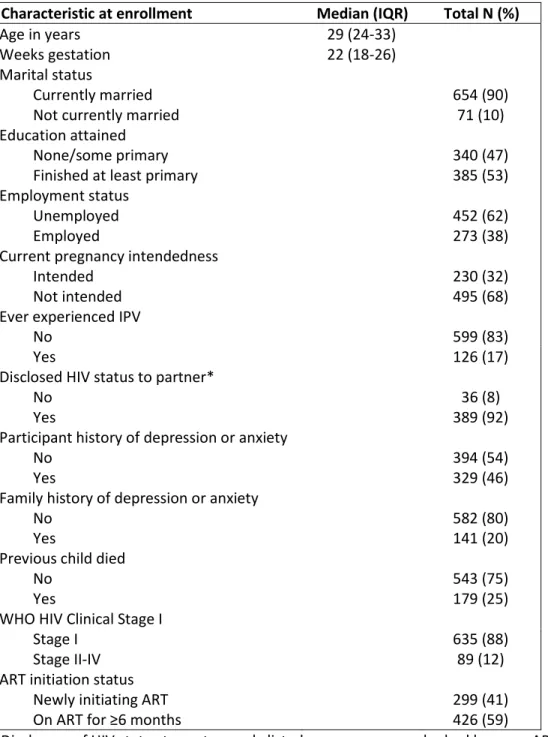
Participants’ median age was 29 years (interquartile range (IQR) 24-33), and women presented at a median 22 weeks gestation (IQR 18-26) (Table 3). Most women were married (90%), unemployed (62%), and reported that their current pregnancy was unintended (68%). Half had completed primary school or more (53%), 17% reported ever experiencing IPV, and 12% had a WHO HIV clinical stage ≥2. Many participants self-reported a history of depression or anxiety: 46% had a personal history and 20% had a family history.
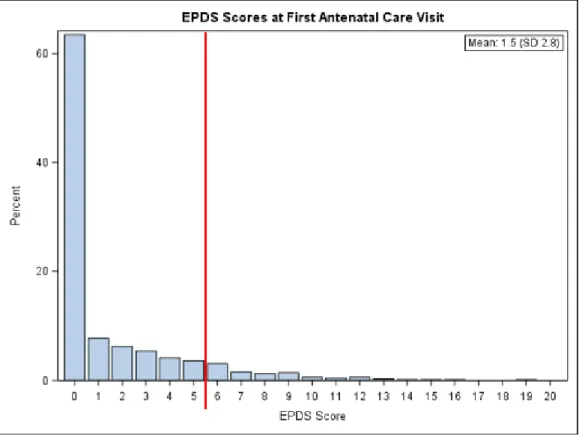
Overall, 9.5% (95%CI 7.5-11.9%) (n=69) of women screened positive for depression, with EPDS scores distributed as shown in Figure 6 (mean score 1.5 (SD 2.8)). By pregnancy trimester, 12.8% (5/39), 8.7% (46/528), and 11.4% (18/158) screened positive in the first, second, and third trimester of
pregnancy, respectively. The prevalence of probable antenatal depression among women newly initiating ART (10.0%) and those who had been on ART ≥6 months (9.1%) was similar in bivariable analyses. Unmarried women had the highest prevalence of probable antenatal depression (18.3%), whereas women without a personal history of depression or anxiety had the lowest prevalence (5.6%).
having not intended their current pregnancy (1.78; CI 0.99-3.21) were associated with probable antenatal depression but had confidence intervals that included the null. While a less precise estimate, women newly initiating ART were more likely to have probable antenatal depression than women who had been on ART for ≥6 months (1.39; CI 0.88-2.18).
Discussion and Conclusions
In this study of pregnant women living with HIV enrolled in Malawi’s Option B+ ART program, we estimated the prevalence of and identified factors associated with probable antenatal depression. About 10% of participants screened positive for current probable depression during the antenatal period. Compared to other maternal morbidity conditions during pregnancy, only anemia and HIV infection are more prevalent in Malawi.142
In other sub-Saharan African countries, antenatal depression prevalence estimates range from 8.3% 75 to 48.7%,76 with an estimated 10.7% among antenatal Malawian women.143 Among pregnant women with HIV, estimates range from 7.7% 77 to 55.0%,78 with a weighted mean prevalence of over 20%.21 The significant range of prevalence estimates could be due to heterogeneity of depression assessment methods used (screening tool versus diagnostic, self-report versus clinician interview), variability in timing of depression assessment during pregnancy, and cultural differences in depressive symptom expression. Our estimate that nearly 1 in 10 pregnant women with HIV suffer from probable antenatal depression approximates the weighted average of 11.3% (95%CI 9.5-13.1%) estimated in a systematic review of studies in Africa that did not stratify by participants’ HIV status.74 Some studies have found that persons living with HIV have higher prevalence of depression,13,14,57,144 whereas others have shown a comparable burden of depression among those living with and without HIV.80,143,145
pregnancy,71,76,84,146–149 and being unmarried.74,75,84,149 About half of participants self-reported a history of depression or anxiety. While the reported depression or anxiety was not necessarily clinically diagnosed, the information serves as a marker of notable past stress, though participants with current depression may have had recall bias that led to over-reporting a history of depression or anxiety. Women in low resource settings appear to be at increased risk of depression given structural challenges such as food insecurity, unemployment, and gender-based violence, yet evidence has been inconsistent. 150 Age and having had a previous child die were not significantly associated with current probable antenatal depression among participants.
We considered HIV status disclosure to the participant’s sexual partner among women who had been on ART ≥6 months. Women who had not disclosed their status had a prevalence of probable antenatal depression about twice that among women who had disclosed, but did not reach statistical significance. The positive association between HIV status non-disclosure and probable antenatal depression could also be a marker of relationship instability and lack of social support from the partner.155
For theoretical reasons, we retained the variable for ART initiation status in our multivariable model to distinguish women who had been on ART from those who were initiating ART that day. Most women who were initiating ART on the day of their first antenatal visit (study enrollment) were newly diagnosed with HIV. As such, newly diagnosed women had not yet had the opportunity to fully process their HIV diagnosis or disclose their status to anyone because it is uncommon for male partners or other family members to accompany women to their antenatal visits. Newly diagnosed women may have had slightly higher EPDS scores in part due to the diagnosis. In the multivariable model, initiating ART was positively associated with probable antenatal depression, although the confidence interval for the adjusted PR includes the null. It is plausible that women who demonstrated longer-term engagement in HIV care had a lower prevalence of probable antenatal depression because women with probable antenatal depression may be less adherent to their ART.58 Women who had trouble adhering to ART, due to depression or otherwise, would not have met the study criterion for enrollment to the group of women who had been on ART ≥6 months.