Provider perspectives on patient-provider communication for
adjuvant endocrine therapy symptom management
Kea Turner1, Cleo A Samuel1,2, Heidi AS Donovan3, Ellen Beckjord4, Alexandra Cardy4, Mary Amanda Dew5, and GJ van Londen6
1Department of Health Policy and Management, University of North Carolina at Chapel Hill,
Gillings School of Global Public Health, 1105F McGavran-Greenberg Hall, CB#7411, Chapel Hill, NC, USA
2Lineberger Comprehensive Cancer Center, University of North Carolina at Chapel Hill, 450 West
Drive, Chapel Hill, NC, USA
3University of Pittsburgh Medical Center Cancer Center, School of Nursing, University of
Pittsburgh, 415 Victoria Building, 3500 Victoria Street, Pittsburgh, PA, USA
4University of Pittsburgh Medical Center Health Plan, University of Pittsburgh, 600 Grant Street,
Pittsburgh, PA, USA
5Departments of Psychiatry, Psychology, Epidemiology, Biostatistics, and Clinical and
Translational Science, University of Pittsburgh, 3811 O’Hara Street, Pittsburgh, PA, USA
6Department of Medicine, University of Pittsburgh, A. 140 Cooper Pavilion, 5115 Centre Avenue,
Pittsburgh, PA, USA
Abstract
Purpose—Providers’ communication skills play a key role in encouraging breast cancer survivors to report symptoms and adhere to long-term treatments such as adjuvant endocrine therapy (AET). The purpose of this study was to examine provider perspectives on patient-provider communication regarding AET symptom management and to explore whether patient-provider perspectives vary across the multi-disciplinary team of providers involved in survivorship care.
Methods—We conducted three one-hour focus groups with a multi-disciplinary group of health care providers including oncology specialists, primary care physicians, and non-physician providers experienced in caring for breast cancer survivors undergoing AET (n = 13). Themes were organized using Epstein and Street’s (2007) Framework for Patient-Centered Communication in Cancer Care.
Results—The findings of this study suggest providers’ communication behaviors including managing survivors’ uncertainty, responding to survivors’ emotions, exchanging information, and
Correspondence to: Kea Turner.
Compliance with ethical standards
Conflict of interest statement We wish to confirm that there are no known conflicts of interest associated with this publication and
there has been no significant financial support for this work that could have influenced its outcome.
HHS Public Access
Author manuscript
Support Care Cancer
. Author manuscript; available in PMC 2017 April 01.Published in final edited form as:
Support Care Cancer. 2017 April ; 25(4): 1055–1061. doi:10.1007/s00520-016-3491-9.
A
uthor Man
uscr
ipt
A
uthor Man
uscr
ipt
A
uthor Man
uscr
ipt
A
uthor Man
uscr
enabling self-management influences the quality of patient-provider communication about AET symptoms. Additionally, lack of systematic symptom assessment tools for AET requires providers to use discretion in determining which symptoms to discuss with survivors resulting in approaches that vary based on providers’ discipline.
Conclusion—There may be AET-specific provider communication skills and behaviors that promote effective patient-provider communication but additional research is needed to identify practices and policies that encourage these skills and behaviors among the many providers involved in survivorship care. Efforts are also needed to coordinate AET symptom assessment across providers, clarify providers’ roles in symptom assessment, and determine best practices for AET symptom communication.
Keywords
Patient-provider communication; Breast cancer; Adjuvant endocrine therapy; Aromatase inhibitors; Symptom management; Patient-centered communication
Background
Adjuvant endocrine therapy (AET) is associated with lower likelihood of recurrence and improved survival outcomes among women with hormone receptor-positive breast cancer [1–4]. Despite these clinical benefits, AET adherence rates remain suboptimal [5–9]. Prior studies suggest that the frequency and severity of AET symptoms contribute to AET underutilization and poor quality of life among breast cancer survivors [3, 10–12]. Although symptom management options (e.g. antidepressants, acupuncture) for common symptoms (e.g. pain, vasomotor flushing) exist [13–15], patient-provider communication about such strategies is often inadequate and fragmented [16–19]. Patient-provider communication can influence survivors’ awareness of symptom management options, participation in decision-making regarding symptom management, and quality of life [16, 20–25]. Therefore, understanding the factors that influence patient-provider communication about AET symptom management is a priority for breast cancer care.
During the extended stage of cancer survivorship, when active treatment is completed or a survivor goes into remission [26], there are numerous barriers to patient-provider
communication [25, 27]. Cancer survivors begin to seek care from primary care physicians who may have less confidence in their ability to communicate about treatment-related symptoms than oncology providers [28]. Additionally, few oncology specialists or primary care providers have received formal training in cancer survivorship care [25]. Few studies have evaluated patient-provider communication about AET symptom management specifically; however, related research suggests that breast cancer survivors receiving AET may have higher information needs regarding side effects and long-term treatment effects than women not receiving AET [29]. Furthermore, studies suggest that survivors may be dissatisfied with patient-provider communication regarding AET symptom management. In a recent study examining AET symptom management experiences, survivors reported that providers were often dismissive of symptom concerns and failed to provide adequate information regarding symptom management [17].
A
uthor Man
uscr
ipt
A
uthor Man
uscr
ipt
A
uthor Man
uscr
ipt
A
uthor Man
uscr
The Framework for Patient-Centered Communication in Cancer Care suggests that effective patient-provider communication is influenced by the communication behaviors of providers such as active listening and asking open-ended questions [30]. To date, most prior studies have obtained survivors’ perspectives on patient-provider communication regarding AET symptoms; yet, no studies, to our knowledge, have assessed provider perspectives on this care process [17, 29]. Providers’ communication skills play a key role in eliciting survivors’ report of symptoms and ensuring survivors’ adherence to long-term treatments such as AET [30]. Additionally, since a multi-disciplinary team of providers are involved with
survivorship care such as oncology specialists and primary care providers, it is important to understand how provider perspectives may vary by discipline. Past cancer communication research has primarily focused on medical oncologists while fewer studies have involved primary care providers [30], who may experience different challenges with patient-provider communication about AET symptoms than oncology specialists. The purpose of this study was to examine provider perspectives on patient-provider communication regarding AET symptom management and to explore whether provider perspectives varied across disciplines.
Methods
Study design
We conducted focus groups with a multi-disciplinary group of health care providers including oncology specialists, primary care physicians, and non-physician providers experienced in caring for breast cancer survivors undergoing AET. A focus group design was chosen to facilitate dialog and explore consensus and disagreement regarding AET symptom management [31] among this diverse group of health care providers. Three one-hour focus groups were conducted in 2012 and led by a facilitator and a co-facilitator using a semi-structured discussion guide. Two focus groups were comprised of physician providers and one focus group was comprised of non-physician providers.
Recruitment and participants
We recruited study participants from the University of Pittsburgh Medical Center (UPMC). Focus groups were conducted in comfortable and convenient locations at UPMC.
Participants provided written informed consent prior to the focus group and received a $20 payment for their participation. The Institutional Review Board of the University of Pittsburgh approved this study.
Data analysis
Focus groups were audio-recorded and transcribed verbatim by research assistants. Codes were generated that covered key sections of the discussion guide, such as patient-provider communication about symptom management. Next a codebook was generated to document definitions of the codes and examples of how each code could be applied. All co-authors reviewed and provided feedback on the codebook. To ensure inter-coder reliability, two members of the research team coded one focus group transcript and came to a consensus on coding. Once agreement was achieved, one member of the research team coded the final two
A
uthor Man
uscr
ipt
A
uthor Man
uscr
ipt
A
uthor Man
uscr
ipt
A
uthor Man
uscr
transcripts using Dedoose qualitative analysis software (version 4.12) and generated summary reports for each of the codes.
All research team members reviewed the summary reports and came to a consensus on the themes. Themes were organized using the Framework for Patient-Centered Communication in Cancer Care [30]. The Framework describes six key functions of patient-provider communication: 1) managing survivors’ uncertainty; 2) responding to survivors’ emotions; 3) exchanging information; 4) making decisions; 5) enabling self-management; and 6) fostering the patient-provider relationship. During the focus groups, there was little discussion of making decisions or fostering patient-provider relationships and therefore these themes are not reported in the results.
Results
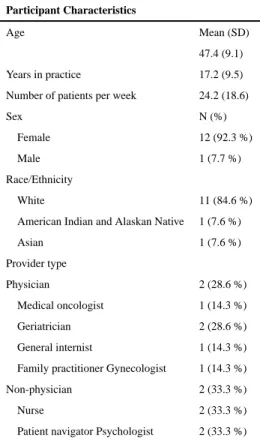
Our study sample (n = 13) consisted of 7 physician and 6 non-physician providers who regularly cared for breast cancer survivors undergoing AET (see Table 1). The majority of providers in the study were white (84.6 %) and female (92.3 %). On average, focus group participants saw 24.2 patients per week, had 17.2 years of experience, and a mean age of 47.4.
Managing survivors’ uncertainty about symptom management
Providers from all disciplines described the need to manage survivors’ uncertainty about AET symptom management in order to facilitate patient-provider communication. Providers believed that survivors experience uncertainty over whether symptom management should be a priority, which makes survivors reluctant to discuss AET symptoms with providers. Additionally, non-physician providers believed that survivors are reluctant to discuss symptoms with physicians for fear that symptom reporting will negatively impact the patient-physician relationship. To manage survivors’ uncertainty, participants recommended educating survivors’ about anticipated AET symptoms.
Providers felt that survivors’ primary concern is cancer treatment and potential recurrence while symptom management is viewed as a lower priority and less important topic to discuss with providers. A patient navigator described, “I’ve had the same impression where women feel like they shouldn’t even bring it [AET symptom] up, because it’s not life threatening, and they’ve been in the life threatening realm for so long.” Similarly, providers indicated that survivors viewed AET symptoms as less severe than cancer treatment-related symptoms and therefore not warranting discussion. A nurse described her view of the comparison that survivors make as, “Now you are well and you should maybe tolerate it because you’re not having the hair loss, you’re not having the nausea or vomiting. It’s not this and that. It’s only joint aches.”
Providers also believed that the cancer experience leaves many survivors with the feeling that their symptoms are inevitable and unmanageable. Providers suggested that survivors are often hesitant to initiate discussion about AET symptoms because survivors believe that there is nothing that can be done about the symptoms. One nurse said, “When I talk to women about hot flashes or sexual function issues, I’ve heard women talk about it almost
A
uthor Man
uscr
ipt
A
uthor Man
uscr
ipt
A
uthor Man
uscr
ipt
A
uthor Man
uscr
like a little bit of a hopelessness. They sort of think of this as a consequence of their cancer.” Similarly, a patient navigator indicated that, “In regards to some of the side effects, I think they talk about it but a lot of times people just feel like they have to endure it.”
Non-physician providers explained that survivors are especially reluctant to discuss symptoms with physicians for fear that symptom reporting will detract from the quality of their cancer care or negatively impact the physician-patient relationship. A nurse described, “They don’t want to get the physician off track because the goal is, ‘Please I want to keep living.’ They sometimes feel like reporting some of these other things will be distracting to the physician.” Simil patient navigator reported that survivors would not bring up symptoms with their physician for fear of negatively impacting the patient-physician relationship. One patient navigator explained, “They might [acknowledge symptoms] to other people, but in the end I think it’s the fear and they have to keep this person [the physician] on their side... I think there is a strong desire to please the physician.”
To help survivors manage uncertainty, all providers recommended providing ongoing patient education and acknowledging the uncertainty survivors might experience with AET
symptoms and symptom management. One general internist explained the importance of “proactive education at the beginning [of initiating AET] to know what side effects are so that patients aren’t thinking that they have bone metastasis when they have arthralgia.” Additionally, providers discussed the importance of letting survivors know that they might not know they are experiencing symptoms. A medical oncologist described telling survivors, “I want to see you every 6 months. I know you may not have any symptoms. You may not realize it, but maybe the way I ask, we can figure it out.” Participants also suggested communicating realistic expectations to survivors about the challenges of managing AET symptoms. Providers described strategies such as communicating the “trial-and-error nature of medicine” and prefacing symptom management discussions with “maybe we can’t take all those symptoms away, but maybe some.”
Responding to survivors’ emotions about symptom management
Providers’ ability to respond to survivors’ emotions also emerged as a key concern that influences cancer survivors’ willingness to initiate conversations about symptoms.
Participants commented on how providers sometimes dismiss survivors’symptom concerns, which can discourage survivors from pursuing symptom management. As one medical oncologist indicated, “Some women have said that they either didn’t think their physician took them seriously or a physician would say ‘well that symptom can’t be due to these medications’ and so that would kind of end the discussion.” Similarly, a general internist explained, “If the doctor shuts [the symptom] down as a possibility, the patient will not want to bring [the symptom] back [up] because they feel like, ‘I said something and got shot down.’.”
In addition to physical symptom concerns, participants explained the importance of
providers’ addressing survivors’ fears about seeking treatment for emotional symptoms such as anxiety and depression. Providers recalled referring survivors to mental health care providers and observing survivors’ reluctance to see a psychiatrist. One general internist explained, “I think it is fear. ‘There has to be something really wrong with me.’ .” Providers
A
uthor Man
uscr
ipt
A
uthor Man
uscr
ipt
A
uthor Man
uscr
ipt
A
uthor Man
uscr
described trying to alleviate survivors’ fears by communicating to survivors that mental health concerns are common among survivors and that seeing a mental health care provider is similar to seeing any other type of health care provider. One patient navigator described telling survivors, “You see the dietitian because she can get you on track with this, or the physical therapist to get you on track with that. We need to just see a behavioral therapist to get you on track with that.”
Exchanging information about symptom management
Providers expressed several challenges to exchanging information about symptom
management with survivors. Providers described difficulty interpreting survivors’ symptom reports and meeting survivors’ needs when survivors focused on non-evidence based strategies during patient-provider discussions. Additionally, focus group participants described how AET symptom assessment is not systematic and that providers must use discretion in determining which symptoms to discuss with survivors. Approaches for symptom assessment varied based on providers’ discipline.
Providers described how difficult it is to interpret and make diagnoses based on survivors’ descriptions of their complex set of symptoms. A general internist explained, “Sometimes patients have an undifferentiated constellation of symptoms that it’s difficult to get them to identify specific symptoms that you can attach a treatment to.” Providers reported that emotional symptoms were particularly difficult to interpret and diagnose. For example, a medical oncologist described, “We hear ‘I don’t feel like myself’ every day. Every day we hear that and I don’t know how to treat that.”
Providers expressed difficulty with facilitating communication about symptom management when cancer survivors are focused on information that is lacking evidence. A medical oncologist described that symptom management conversations can get off track when survivors present questions regarding symptom management strategies from information on the Internet. She said, “It’s just not a systematic discussion when they’re like, ‘I read this what do you think about this?” Participants indicated that once conversations with survivors get off course it can be difficult to ensure that symptoms are discussed in a systematic way— increasing the risk that some symptoms may not get discussed. Providers specifically mentioned that cancer survivors would bring up the use of products that are marketed as natural treatment for hot flashes such as estriol. A general internist recalled, “People come in and they think they know stuff that they don’t know. ‘Well this is natural. This is estriol.’ That part’s really challenging… So you’re spending time convincing them that they’re wrong.”
Providers described how there is not a systematic assessment for AET symptoms and as a result, providers often use their discretion to facilitate discussions with survivors about symptoms resulting in different approaches across disciplines. For example, some providers believed bringing up sexual dysfunction in discussions with survivors is important because survivors may be reluctant to discuss it. As one general internist explained, “I specifically ask about sexual dysfunction because people are very hesitant to bring it up.” On the other hand, some providers felt that discussions of sexual dysfunction may be less of a concern for survivors, especially older survivors. A medical oncologist described, “One thing I really
A
uthor Man
uscr
ipt
A
uthor Man
uscr
ipt
A
uthor Man
uscr
ipt
A
uthor Man
uscr
don’t ask about is vaginal dryness. Some people do bring it out, younger people, 50’s, ‘60 s, they may bring out. 70’s a lot of them they just feel odd, like, ‘Why do you ask this?’ ” Participants also discussed probing for symptoms relevant to their discipline. A gynecologist, for example, explained, “I ask about bowel, bladder, breasts, vasomotor symptoms, bleeding, sexual problems. I usually do not ask about joint pains. Sometimes I will, if I know they are on an AI, I’ll say are you doing ok with joints, but as a gynecologist, I am not the one treating that.”
Rather than deciding on which symptoms to discuss, some participants recommended systematically assessing survivors for AET symptoms. As an example, a nurse suggested adding AET symptoms to patient intake forms. She offered, “You could add it to the intake form. You could have a subheading of side effects related to medications such hot flashes, myalgia, arthralgia, etc. Because we have to review that with patients, it could spring board the discussion.” Participants indicated that systematic assessment of symptoms would ensure that cancer survivors’ symptoms are validated. A patient navigator explained, “A systematic approach of symptom management would be valuable for women because you know it would validate their concerns.”
Enabling self-management of symptoms
To facilitate patient-provider communication, providers from all disciplines described encouraging survivors to engage in self-management of symptoms, empowering survivors to seek additional resources, and framing symptom management within survivors’ personal goals. A patient navigator who encourages survivors to write their questions down and prioritize their top concerns, commented that, “When people get into the physician’s office, it’s like amnesia comes in for whatever reason, fear or other concerns.” In addition, providers recommended encouraging survivors to follow up by phone after discussing symptom management strategies, as survivors might not see their providers as regularly as they would during active treatment. As one medical oncologist explained, “I always tell people to call me back in 2-4 weeks if the strategy that we agreed on isn’t working because I think waiting until your next visit is too long to be suffering.”
Providers explained the importance of empowering survivors to seek additional resources when necessary and framing symptom management within the survivors’ goals of being a good caregiver. One patient navigator explained, “In some underserved patients, …there’s so much going on, for resources [for symptom management] you have to make it very simple, have the price in your hand, and say where they could go.” Additionally, providers described encouraging survivors to take care of themselves rather than neglect their symptoms as a way to accomplish their goals as being a caregiver. One nurse recalled telling survivors, “You know as a caregiver you’ve got to take care of yourself and how can we make it work where you can take care of yourself and take care of these other important people.”
Discussion
Patient-provider communication plays a key role in survivors’ ability to recognize and report symptoms and providers’ ability to diagnose and treat symptoms. The findings of this study suggest providers’ communication behaviors including managing survivors’ uncertainty,
A
uthor Man
uscr
ipt
A
uthor Man
uscr
ipt
A
uthor Man
uscr
ipt
A
uthor Man
uscr
responding to survivors’ emotions, exchanging information, and enabling self-management influences the quality of patient-provider communication about AET symptoms.
Additionally, the results indicate that there may be AET-specific provider communication skills and behaviors that promote effective communication but additional research is needed to identify practices and policies that encourage these skills and behaviors among the many providers involved in survivorship care.
Similar to previous research, our study findings suggest that providers’ ability to manage survivors’ uncertainty and respond to emotions plays a key role in survivors’ willingness to discuss symptoms with providers [32, 33]. Providers in this study reported that survivors may not know they are experiencing AET symptoms or fear that discussion symptoms will negatively impact the patient-physician relationship, which reduces their willingness to communicate symptoms to providers. Future studies should assess the efficacy of communication skills training that focuses on providers’ ability to manage survivors’ uncertainty and respond to survivors’ emotions regarding AET symptom management. A recent study found that provider communication training was effective at increasing
providers’ assessment of patients’ emotions and beliefs regarding pain and pain management [34] suggesting that provider communication training may be a promising approach for improving symptom management. Additionally, studies evaluating the effectiveness of communication skills training could explore combining sessions for all providers involved in survivorship care so that providers can clarify their roles in communicating about AET symptoms and identify best practices in symptom assessment and communication.
Results from this study suggest that providers across disciplines vary in their approaches to exchanging information about AET symptoms with survivors. For example, some providers asked about symptoms they believed patients were reluctant to discuss, such as sexual dysfunction, while other providers asked about symptoms relevant to their discipline. Past studies have demonstrated that pre-consultation, quality of life assessments for survivors have been effective at increasing patients’ satisfaction with providers’ ability to respond to their symptoms [27]. Future research should examine whether strategies such as a pre-consultation quality of life assessments are effective strategies for improving patient-provider communication about AET symptoms. Studies could also assess whether such strategies improve AET symptom discussions with non-oncology providers who may not be as familiar with AET symptoms as oncology providers [28].
Since effective patient-provider communication relies on the skills and behaviors of both patients and providers, it is equally important to design interventions that focus on survivors [30] who may be reluctant to report AET symptoms. Previous studies suggest incorporating patient-reported outcome assessments into follow-up appointments for survivors receiving AET significantly increases symptom reporting [35, 36]. Future research could examine strategies for routinely incorporating patient-reported outcome assessments into sur-vivorship care and optimal implementation such as collecting data at patient check-in and determining how best to organize, present, and respond to patient-reported AET symptoms within electronic health records [37, 38]. Future studies could also examine the effectiveness of providing survivors with a question prompt list about AET symptoms. Question prompt list have been effective at improving patient engagement in care in other settings [27].
A
uthor Man
uscr
ipt
A
uthor Man
uscr
ipt
A
uthor Man
uscr
ipt
A
uthor Man
uscr
This study has some limitations. The focus groups were conducted at an academic medical center with a small sample of providers, which may limit the generalizability of the findings to other provider settings. Additionally, most providers were female and White (see Table 1), limiting the diversity of perspectives on AET symptom management. Future studies should assess the perspectives of a more diverse set of providers since race/ethnicity, gender, and socioeconomic status can impact the quality of patient-provider communication [39, 40]. Nonetheless, this study offers valuable insight into provider perspectives on patient-provider communication pertaining to AET symptom management, which has not been previously examined. Additionally, by interviewing a multi-disciplinary team of providers, this study offers perspectives on patient-provider communication from many of the providers that make up a cancer care team.
Conclusion
During the extended phase of cancer survivorship, survivors experience a range of emotions including uncertainty regarding cancer recurrence, which makes their information needs regarding symptom management distinct from survivors in other phases of the cancer continuum. Providers’ communication skills regarding AET symptom management and cancer survivorship play an important role in engaging survivors’ in symptom management, which influences AET adherence and patients’ survival outcomes [3, 5, 10]. Therefore, identifying practices and policies that improve communication about AET symptom management between survivors and the multi-disciplinary team of providers involved in their care is a priority for improving breast cancer care.
Acknowledgments
Funding American Federation for Aging Research/John A. Hartford Foundation, the Magee-Women’s Research
Institute and Foundation, the University of Pittsburgh Multidisciplinary Clinical Research Scholars Program– National Institutes of Health Clinical and Translational Science Award(CTSA)(05 KL2 RR024154), the National Cancer Institute Cancer Center Support Grant (P30 CA047904), and the National Cancer Institute Award Diversity Supplement Award (3 R01 CA150980-04S1).
References
1. Burstein HJ, Temin S, Anderson H, Buchholz TA, Davidson NE, Gelmon KE, Giordano SH, Hudis CA, Rowden D, Solky AJ, Stearns V, Winer EP, Griggs JJ. Adjuvant endocrine therapy for women with hormone receptor-positive breast cancer: american society of clinical oncology clinical practice guideline focused update. Journal of clinical oncology : official journal of the American Society of Clinical Oncology. 2014; 32(21):2255–2269. DOI: 10.1200/JCO.2013.54.2258 [PubMed: 24868023]
2. Howell A, Cuzick J, Baum M, Buzdar A, Dowsett M, Forbes JF, Hoctin-Boes G, Houghton J, Locker GY, Tobias JS, Group AT. Results of the ATAC (Arimidex, tamoxifen, alone or in combination) trial after completion of 5 years' adjuvant treatment for breast cancer. Lancet. 2005; 365(9453):60–62. DOI: 10.1016/S0140-6736(04)17666-6 [PubMed: 15639680]
3. Coombes RC, Hall E, Gibson LJ, Paridaens R, Jassem J, Delozier T, Jones SE, Alvarez I, Bertelli G, Ortmann O, Coates AS, Bajetta E, Dodwell D, Coleman RE, Fallowfield LJ, Mickiewicz E, Andersen J, Lønning PE, Cocconi G, Stewart A, Stuart N, Snowdon CF, Carpentieri M, Massimini G, Bliss JM, van de Velde C, Study IE. A randomized trial of exemestane after two to three years of tamoxifen therapy in postmenopausal women with primary breast cancer. N Engl J Med. 2004; 350(11):1081–1092. DOI: 10.1056/NEJMoa040331 [PubMed: 15014181]
A
uthor Man
uscr
ipt
A
uthor Man
uscr
ipt
A
uthor Man
uscr
ipt
A
uthor Man
uscr
4. Early Breast Cancer Trialists' Collaborative Group (EBCTCG). Effects of chemotherapy and hormonal therapy for early breast cancer on recurrence and 15-year survival: an overview of the randomised trials. Lancet. 2005; 365(9472):1687–1717. DOI: 10.1016/S0140-6736(05)66544-0 [PubMed: 15894097]
5. Hershman DL, Kushi LH, Shao T, Buono D, Kershenbaum A, Tsai WY, Fehrenbacher L, Gomez SL, Miles S, Neugut AI. Early discontinuation and nonadherence to adjuvant hormonal therapy in a cohort of 8,769 early-stage breast cancer patients. Journal of clinical oncology : official journal of the American Society of Clinical Oncology. 2010; 28(27):4120–4128. DOI: 10.1200/JCO. 2009.25.9655 [PubMed: 20585090]
6. McCowan C, Shearer J, Donnan PT, Dewar JA, Crilly M, Thompson AM, Fahey TP. Cohort study examining tamox-ifen adherence and its relationship to mortality in women with breast cancer. Br J Cancer. 2008; 99(11):1763–1768. DOI: 10.1038/sj.bjc.6604758 [PubMed: 18985046]
7. Ayres LR, Baldoni AO, Borges AP, Pereira LR. Adherence and discontinuation of oral hormonal therapy in patients with hormone receptor positive breast cancer. Int J Clin Pharm. 2014; 36(1):45– 54. DOI: 10.1007/s11096-013-9833-5 [PubMed: 23934310]
8. Partridge AH, LaFountain A, Mayer E, Taylor BS, Winer E, Asnis-Alibozek A. Adherence to initial adjuvant anastrozole therapy among women with early-stage breast cancer. Journal of clinical oncology : official journal of the American Society of Clinical Oncology. 2008; 26(4):556–562. DOI: 10.1200/JCO.2007.11.5451 [PubMed: 18180462]
9. Owusu C, Buist DS, Field TS, Lash TL, Thwin SS, Geiger AM, Quinn VP, Frost F, Prout M, Yood MU, Wei F, Silliman RA. Predictors of tamoxifen discontinuation among older women with estrogen receptor-positive breast cancer. Journal of clinical oncology : official journal of the American Society of Clinical Oncology. 2008; 26(4):549–555. DOI: 10.1200/JCO.2006.10.1022 [PubMed: 18071188]
10. Crew KD, Greenlee H, Capodice J, Raptis G, Brafman L, Fuentes D, Sierra A, Hershman DL. Prevalence of joint symptoms in postmenopausal women taking aromatase inhibitors for early-stage breast cancer. Journal of clinical oncology : official journal of the American Society of Clinical Oncology. 2007; 25(25):3877–3883. DOI: 10.1200/JCO.2007.10.7573 [PubMed: 17761973]
11. Lash TL, Fox MP, Westrup JL, Fink AK, Silliman RA. Adherence to tamoxifen over the five-year course. Breast Cancer Res Treat. 2006; 99(2):215–220. DOI: 10.1007/s10549-006-9193-0 [PubMed: 16541307]
12. Whelan TJ, Pritchard KI. Managing patients on endocrine therapy: focus on quality-of-life issues. Clin Cancer Res. 2006; 12(3 Pt 2):1056s–1060s. DOI: 10.1158/1078-0432.CCR-05-2185 [PubMed: 16467124]
13. Cella D, Fallowfield LJ. Recognition and management of treatment-related side effects for breast cancer patients receiving adjuvant endocrine therapy. Breast Cancer Res Treat. 2008; 107(2):167– 180. DOI: 10.1007/s10549-007-9548-1 [PubMed: 17876703]
14. Loprinzi CL, Kugler JW, Sloan JA, Mailliard JA, LaVasseur BI, Barton DL, Novotny PJ, Dakhil SR, Rodger K, Rummans TA, Christensen BJ. Venlafaxine in management of hot flashes in survivors of breast cancer: a randomised controlled trial. Lancet. 2000; 356(9247):2059–2063. DOI: 10.1016/S0140-6736(00)03403-6 [PubMed: 11145492]
15. Crew KD, Capodice JL, Greenlee H, Brafman L, Fuentes D, Awad D, Yann Tsai W, Hershman DL. Randomized, blinded, sham-controlled trial of acupuncture for the management of aromatase inhibitor-associated joint symptoms in women with early-stage breast cancer. Journal of clinical oncology : official journal of the American Society of Clinical Oncology. 2010; 28(7):1154–1160. DOI: 10.1200/JCO.2009.23.4708 [PubMed: 20100963]
16. Paskett ED, Stark N. Lymphedema: knowledge, treatment, and impact among breast cancer survivors. Breast J. 2000; 6(6):373–378. [PubMed: 11348395]
17. van Londen GJ, Donovan HS, Beckjord EB, Cardy AL, Bovbjerg DH, Davidson NE, Morse JQ, Switzer GE, Verdonck-de Leeuw IM, Dew MA. Perspectives of postmenopausal breast cancer survivors on adjuvant endocrine therapy-related symptoms. Oncol Nurs Forum. 2014; 41(6):660– 668. DOI: 10.1188/14.ONF.660-668 [PubMed: 25355021]
18. Alfano CM, McGregor BA, Kuniyuki A, Reeve BB, Bowen DJ, Baumgartner KB, Bernstein L, Ballard-Barbash R, Malone KE, Ganz PA, McTiernan A. Psychometric properties of a tool for
A
uthor Man
uscr
ipt
A
uthor Man
uscr
ipt
A
uthor Man
uscr
ipt
A
uthor Man
uscr
measuring hormone-related symptoms in breast cancer survivors. Psychooncology. 2006; 15(11): 985–1000. DOI: 10.1002/pon.1033 [PubMed: 16470891]
19. Chlebowski RT, McTiernan A. Elements of informed consent for hormone replacement therapy in patients with diagnosed breast cancer. J Clin Oncol Off J Am Soc Clin Oncol. 1999; 17(1):130– 142.
20. Donovan HS, Hartenbach EM, Method MW. Patient-provider communication and perceived control for women experiencing multiple symptoms associated with ovarian cancer. Gynecol Oncol. 2005; 99(2):404–411. DOI: 10.1016/j.ygyno.2005.06.062 [PubMed: 16112174] 21. Liang W, Burnett CB, Rowland JH, Meropol NJ, Eggert L, Hwang YT, Silliman RA, Weeks JC,
Mandelblatt JS. Communication between physicians and older women with localized breast cancer: implications for treatment and patient satisfaction. J Clin Oncol Off J Am Soc Clin Oncol. 2002; 20(4):1008–1016.
22. Ong LM, Visser MR, Lammes FB, de Haes JC. Doctor-patient communication and cancer patients' quality of life and satisfaction. Patient Educ Couns. 2000; 41(2):145–156. [PubMed: 12024540] 23. Ong LM, Visser MR, van Zuuren FJ, Rietbroek RC, Lammes FB, de Haes JC. Cancer patients'
coping styles and doctor-patient communication. Psychooncology. 1999; 8(2):155–166. DOI: 10.1002/(SICI)1099-1611(199903/04)8:2<155::AID-PON350>3.0.CO;2-A [PubMed: 10335559] 24. Hack TF, Degner LF, Parker PA, Team SC. The communication goals and needs of cancer patients:
a review. Psychooncology. 2005; 14(10):831–845. DOI: 10.1002/pon.949discussion846-837 [PubMed: 16200519]
25. Hewitt, M., Greenfield, S., Stovall, E. From cancer patient to cancer survivor: lost in transition. National Academies Press; Washington DC: 2005.
26. Mullan F. Seasons of survival: reflections of a physician with cancer. N Engl J Med. 1985; 313(4): 270–273. DOI: 10.1056/NEJM198507253130421
27. Rodin G, Mackay JA, Zimmermann C, Mayer C, Howell D, Katz M, Sussman J, Brouwers M. Clinician-patient communication: a systematic review. Support Care Cancer. 2009; 17(6):627–644. DOI: 10.1007/s00520-009-0601-y [PubMed: 19259706]
28. Kantsiper M, McDonald EL, Geller G, Shockney L, Snyder C, Wolff AC. Transitioning to breast cancer survivorship: perspectives of patients, cancer specialists, and primary care providers. J Gen Intern Med. 2009; 24(Suppl 2):S459–S466. DOI: 10.1007/s11606-009-1000-2 [PubMed: 19838851]
29. de Bock GH, Bonnema J, Zwaan RE, van de Velde CJ, Kievit J, Stiggelbout AM. Patient's needs and preferences in routine follow-up after treatment for breast cancer. Br J Cancer. 2004; 90(6): 1144–1150. DOI: 10.1038/sj.bjc.6601655 [PubMed: 15026793]
30. Epstein, RM., Street, RLJ. Patient-centered communication in cancer care: promoting healing and reducing suffering. National Cancer Institute; Bethesda, MD: 2007.
31. Taylor, B. Qualitative research in the health sciences. Routledge; New York: 2013.
32. Golant M, Altman T, Martin C. Managing cancer side effects to improve quality of life: a cancer psychoeducation program. Cancer Nurs. 2003; 26(1):37–44. quiz 45-36. [PubMed: 12556711] 33. Osse BH, Vernooij-Dassen MJ, Schadé E, de Vree B, van den Muijsenbergh ME, Grol RP.
Problems to discuss with cancer patients in palliative care: a comprehensive approach. Patient Educ Couns. 2002; 47(3):195–204. [PubMed: 12088597]
34. Canivet D, Delvaux N, Gibon AS, Brancart C, Slachmuylder JL, Razavi D. Improving
communication in cancer pain management nursing: a randomized controlled study assessing the efficacy of a communication skills training program. Support Care Cancer. 2014; 22(12):3311– 3320. DOI: 10.1007/s00520-014-2357-2 [PubMed: 25099306]
35. Oberguggenberger A, Hubalek M, Sztankay M, Meraner V, Beer B, Oberacher H, Giesinger J, Kemmler G, Egle D, Gamper EM, Sperner-Unterweger B, Holzner B. Is the toxicity of adjuvant aromatase inhibitor therapy underestimated? Complementary information from patient-reported outcomes (PROs). Breast Cancer Res Treat. 2011; 128(2):553–561. DOI: 10.1007/
s10549-011-1378-5 [PubMed: 21311968]
36. Ruhstaller T, von Moos R, Rufibach K, Ribi K, Glaus A, Spaeti B, Koeberle D, Mueller U, Hoefliger M, Hess D, Boehme C, Thuerlimann B. Breast cancer patients on endocrine therapy
A
uthor Man
uscr
ipt
A
uthor Man
uscr
ipt
A
uthor Man
uscr
ipt
A
uthor Man
uscr
reveal more symptoms when self-reporting than in pivotal trials: an outcome research study. Oncology. 2009; 76(2):142–148. DOI: 10.1159/000195540 [PubMed: 19158446]
37. Wu AW, Kharrazi H, Boulware LE, Snyder CF. Measure once, cut twice–adding patient-reported outcome measures to the electronic health record for comparative effectiveness research. J Clin Epidemiol. 2013; 66(8 Suppl):S12–S20. DOI: 10.1016/j.jclinepi.2013.04.005 [PubMed: 23849145]
38. Bennett AV, Jensen RE, Basch E. Electronic patient-reported outcome systems in oncology clinical practice. CA Cancer J Clin. 2012; 62(5):337–347. DOI: 10.3322/n21150 [PubMed: 22811342] 39. Johnson RL, Roter D, Powe NR, Cooper LA. Patient race/ ethnicity and quality of
patient-physician communication during medical visits. Am J Public Health. 2004; 94(12):2084–2090. [PubMed: 15569958]
40. Cooper-Patrick L, Gallo JJ, Gonzales JJ, Vu HT, Powe NR, Nelson C, Ford DE. Race, gender, and partnership in the patient-physician relationship. JAMA. 1999; 282(6):583–589. [PubMed: 10450723]
A
uthor Man
uscr
ipt
A
uthor Man
uscr
ipt
A
uthor Man
uscr
ipt
A
uthor Man
uscr
A
uthor Man
uscr
ipt
A
uthor Man
uscr
ipt
A
uthor Man
uscr
ipt
A
uthor Man
uscr
ipt
Table 1
Focus Group Participant Characteristics (n = 13)
Participant Characteristics
Age Mean (SD)
47.4 (9.1)
Years in practice 17.2 (9.5)
Number of patients per week 24.2 (18.6)
Sex N (%)
Female 12 (92.3 %)
Male 1 (7.7 %)
Race/Ethnicity
White 11 (84.6 %)
American Indian and Alaskan Native 1 (7.6 %)
Asian 1 (7.6 %)
Provider type
Physician 2 (28.6 %)
Medical oncologist 1 (14.3 %)
Geriatrician 2 (28.6 %)
General internist 1 (14.3 %)
Family practitioner Gynecologist 1 (14.3 %)
Non-physician 2 (33.3 %)
Nurse 2 (33.3 %)