THE CLASSIFICATION OF MANDARIN IDIOMATIC VP
Hui An
A thesis submitted to the faculty at the University of North Carolina at Chapel Hill in partial fulfillment of the requirements for the degree of Master of Arts in Linguistics in the
Department of Linguistics in College of Arts & Sciences.
Chapel Hill 2017
© 2017 Hui An
ABSTRACT
Hui An: The Classification of Mandarin Idiomatic VP
(Under the direction of J. Michael Terry, Jennifer L. Smith and Katya Pertsova)
TABLE OF CONTENTS
LIST OF TABLES ··· vii
LIST OF FIGURES ··· viii
CHAPTER 1: INTRODUCTION ··· 1
CHAPTER 2: WHAT IS ASPECT? ··· 3
CHAPTER 3: THE DEBATE BETWEEN MCGINNIS (2002) AND GLASBEY (2006) ··· 7
CHAPTER 4: ASPECTUAL PROPERTIES OF MANDARIN VERBS ··· 12
Introduction ··· 12
Aspectual Classes in Mandarin ··· 12
Syntactic Properties of Different Aspectual Classes in Mandarin ··· 13
Activity ··· 13
State ··· 15
Accomplishment ··· 16
Achievement ··· 18
Summary ··· 19
CHAPTER 5: CLASSIFICATION OF MANDARIN IDIOMATIC VP ··· 20
Introduction ··· 20
Class 1 ··· 20
Class 2 ··· 22
Class 4 ··· 26
A Special Class ··· 28
Other Theoretical Classes ··· 29
Summary ··· 30
CHAPTER 6: THE CLASSIFICATION AND THE DEBATE BETWEEN DM AND RM ··· 32
Introduction ··· 32
RM & DM: A Brief Introduction ··· 32
Different Predictions DM and RM Make About Idiom Aspect ··· 34
CHAPTER 7: CONCLUSION ··· 38
APPENDIX ··· 40
LIST OF TABLES
Table
LIST OF FIGURES
CHAPTER 1: INTRODUCTION
Idioms are a charm for linguists for their irregularity of meaning-form correspondence. Contrary to the more frequent, non-idiomatic constructions, idioms have frequently been referred to as fixed in that their meanings do not seem to be computable based on the meanings of their syntactic parts. Take, for example, the famous idiom kick the bucket. The meaning of this expression does not seem to have anything to do with the meaning of either kick or the bucket. Because of this phenomenon, idioms have long been a key issue in debates about how human mind stores and computes meaning. Recently, McGinnis (2002) claims that all English idiomatic VPs have structural aspect in the sense that the aspectual meanings of these idioms are always computed in the Syntax as opposed to being stored in the lexicon. Meanwhile, Glasbey (2006) claims that there is actually a split in English idiomatic VPs in terms of how their aspectual meanings are put together after she discovers several counterexamples to McGinnis (2002). The complicated facts in English calls for a more detailed classification of idiomatic VPs. Thus, this current thesis aims to provide such a classification to Mandarin idiomatic VPs to more
systematically investigate their form-meaning paring. In so doing, this thesis also hopes to provide more evidence to future discussion on aspectual meaning of idioms, as well as to the broader issue on the semantic analyzability of idioms.
CHAPTER 2: WHAT IS ASPECT?
Though both being a type of temporal relation, Aspect is always distinguished from Tense. Tense concerns the time sequence between the situation and the time of utterance. For example, if a sentence is in “past tense”, we may easily construe that the situation described by the sentence happens prior to the time when the sentence is uttered. Aspect, on the other hand, deals with the internal temporal structure of a situation. More specifically, Aspect gives us information about the nature of the situation talked about, and a temporal viewpoint which concerns all or part of the situation (Smith 1997). Because of this, linguistically many scholars may further distinguish two types of Aspect: viewpoint aspect and situation aspect. Viewpoint aspect tells us what temporal perspective the speaker uses when a situation is described.
Traditionally two different viewpoint aspects are distinguished: perfective aspect which presents a situation as a whole, and imperfective aspect which presents only part of a situation (Smith 1997). This is all that will be said about viewpoint aspect in this paper as it is not the focus here. This paper focuses primarily on situation aspect.
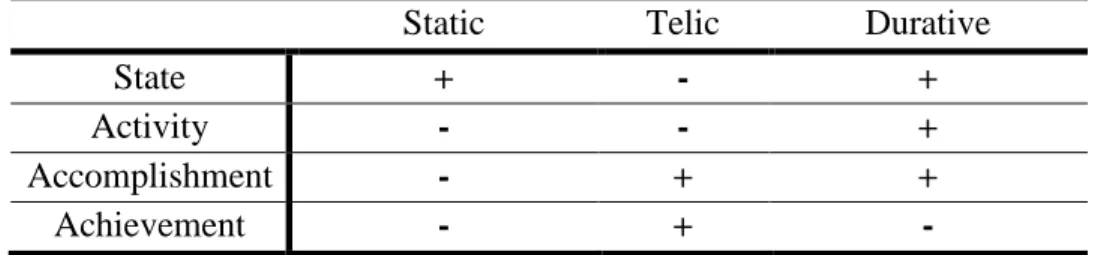
Static Telic Durative
State + - +
Activity - - +
Accomplishment - + +
Achievement - + -
Table 1. Feature Values of Different Situation Types
It should be noted that the above attributes of the four situation types are understood according to how they are conceived but not literally whether or not they have an endpoint or a duration etc. For example, in reality a situation of eating a grape does not seem to have a duration since the situation usually only involves one single bite. It is instantaneous. But this does not change our conception that an activity of eating usually is associated with a process. So we will still say a situation involving eating is durative.
Traditionally, situation aspect is considered as a property of verbs. This is the case with Vendler (1957) when he first proposed the four situation types. Later, it was discovered that semantic information of verbal arguments, adjuncts, as well as some adverbials all have an impact on the situation type of a sentence. Therefore, it is claimed that the domain of situation aspect is not verbs, but verb constellations rather (Dowty 2012, Smith 1997, Verkuyl 2013). For example, consider the following triplet of sentences:
(1) A. John climbed (activity)
B. John climbed a mountain (accomplishment) C. John climbed mountains (activity)
thus conclude that it must be the semantic information of the compliment that affects the overall situation aspect of the sentence. This can also be explained by Table 1. An event of climbing is understood to have no natural endpoint because theoretically, one can climb forever. However, an event of climbing a mountain completes when one reaches the summit of the mountain he or she climbs. Therefore, this event is understood to have an endpoint. This is how adding a compliment changes the situation aspect of the events involved in (1A) and (1B). Now let’s compare (1C) to (1B). The two sentences resemble each other syntactically. The only difference is that the compliment in (1C), mountains, is a bare plural unlike the one in (1B) which is a quantized NP. Again we can conceive that the two events have different situation aspect because an event of climbing mountains seems to describe a habit which has no endpoints. This is further evidence that semantic information of verbal compliments can in fact influence the situation aspectual meaning of sentences. In addition to this, Verkuyl (2013) also provides examples where the subject NP seems to also have an effect on situation aspect:
(2) A. Famous movie stars discovered that little spa for years B. A famous movie star discovered that little spa
CHAPTER 3: THE DEBATE BETWEEN MCGINNIS (2002) AND GLASBEY (2006)
McGinnis (2002)’s argument stems from an observation that the idiomatic VP kick the bucket ‘to die’ does not have the same aspectual properties as the non-idiomatic VP die:
(3) A. Hermione was dying for weeks
B. *Hermione was kicking the bucket for weeks.
She claims that if kick the bucket ‘to die’ has the same meaning as die as proposed in Jakendoff (1997: 169), the above should not be expected. Marantz (1997) explains this phenomenon as caused by the structures of this idiom carrying “semantic implications of a transitive VP and a definite direct object”. McGinnis also agrees that the syntactic structures of idioms should have an impact on their aspectual properties based on the following example:
(4) A. Hermione hang a left in/*for 5 seconds Hermione hang a picture in/*for 5 seconds
B. Hermione hang fire *in/for 5 seconds. C. Hermione hang laundry *in/for 5 seconds.
as Glasbey (2006) suggests, is to say that any given idiomatic VP should have the same aspectual properties on its literal interpretation and idiomatic interpretation since the two interpretations do share the exact same form. As we will see next, Glasbey (2006) proves that this prediction is not borne out.
Glasbey (2006) starts her argument by considering the English idiomatic VP paint the town red which she claims is a counterexample to McGinnis (2002). The literal interpretation of
this idiom describes an event of the town being painted in a specific color red, while the idiomatic interpretation of it describes an event of having great fun. Glasbey (2006) notes that McGinnis (2002) predicts the two constructions paint the town red (Lit.) and paint the town red (Id.) should have the same aspect class. However, she does not find this claim true:
(5) A. Mary and I painted the town red in/*for 2 hours (Lit.) B. Mary and I painted the town red *in/for 2 hours (Id.)
According to (5), the literal interpretation of this idiom is an accomplishment whereas the idiomatic interpretation is an activity. Other examples are readily available: cry one’s heart out ‘to weep inconsolably’; drown one’s sorrows ‘to drink liquor to escape one’s unhappiness’; drive one’s pigs to market ‘to snore’ etc. These examples suggest not all English idioms have
structural aspect. Glasbey (2006) tries to account for her observation by incorporating Krifka (1992)’s theory of aspect composition.
the “gradual patient” relation since the town undergoes a gradual process till being painted fully red. But there is no counterpart to the town in the idiomatic interpretation, thus the thematic relation is lost. This means that the input to aspect derivation is missing a piece in the idiomatic interpretation. Consequently, we would expect non-structural aspect on this interpretation.
This observation has another important indication to idiom aspect. Remember that the reason paint the town red does not have structural aspect is because the loss of thematic relation on the idiomatic interpretation. This is caused by the inability to semantically analyze the complement the town in that interpretation. Such an idiom bears much resemblance to what Nunberg, Sag and Wasow (1994) calls Idiomatic Phrase (IP). Indeed, Glasbey (2006) argues that a prerequisite of having structural aspect is for an idiomatic VP to have semantic counterparts of its complement on both interpretations. Idioms satisfying this property are termed Idiomatically Combining Expressions (ICE) in Nunberg et al. (1994). This argument is of course not shared by McGinnis (2002) when she explicitly mentions that IPs like hang a left or hang fire still have compositional aspect as suggested by examples in (2). Glasbey (2006) does not address these examples directly in her paper but she does mention one idiomatic VP that resembles hang fire. The idiom saw logs ‘to snore’ is one whose two interpretations both describe activity
eventualities despite the fact that it is an IP. Glasbey’s explanation of this is to say that this merely happens by accident because the complement in that idiomatic VP happens to be a bare plural. Similar explanation can be adopted for hang fire since it has a mass noun as its
complement. I find no reason to question her explanation here.
is if such a split also exists in another language. A preliminary examination of a couple Mandarin idiomatic VPs seems to yield a positive answer. Let’s first consider the idiom shuo dahua (shuo ‘to say’, dahua ‘big words’; Id. ‘to lie’):
(6) A. ta dui wo shuo-le shi nian dahua B. 3rd.SG.NOM.MASC to 1st.SG.NOM say-PERF ten year big words C. ‘He lied to me for ten years’
B. ta dui wo shuo-le shi nian huaihua C. 3rd.SG.NOM.MASC to 1st.SG.NOM say-PERF ten year bad words
D. ‘He said bad words to me for ten years’
Apparently, the idiom and the non-idiomatic construction which has exactly the same verb and same syntactic structure share the same aspectual property given that they can both be modified by the for-phrase. So, it seems idiomatic VPs with the same aspectual properties on both
interpretations do exist in Mandarin. Are there counterexamples? The answer is positive. Consider the Mandarin idiomatic VP chao youyu (chao ‘to cook’, youyu ‘squid’; Id. ‘to fire someone’):
(7) A. shangci zai chao wo-de youyu(*) B. supervisor PROG cook 1st.SG-POSS squid B. ‘supervisor is firing me’ (*)
B. chushi zai chao wo-de jidan C. chef PROG cook 1st.SG-POSS egg D. ‘chef is cooking my eggs’
instead of directly using the idiomatic VP in its literal interpretation is mainly due to the difficulty of a native Mandarin speaker (in this case, the author himself) to retrieve its literal meaning given how frequent this idiom is. Anyway, the two does not behave the same in aspect. The idiom describes an achievement eventuality while the non-idiomatic VP describes an activity. Since both idioms with and without the same aspectual properties on their two
interpretations can be found in Mandarin, it seems McGinnis (2002) would not suffice to account for the facts in this language, and the split in English as found in Glasbey (2006) can also be found in Mandarin. But there are still many questions yet to be answered. Let’s first recall the IP hang a left which is claimed by McGinnis (2002) to have compositional aspect. Glasbey (2006)’s
prediction would not be able to explain this. Naturally, one would like to know if such examples exist in Mandarin as well. In addition, Glasbey (2006)’s prediction incorporates the classification of idioms into IPs and ICEs by Nunberg, Sag and Wasow (1994), something McGinnis (2002) does not consider systematically. Therefore it is important to not only see whether the existence of both idiomatic VPs with and without compositional aspect can be attested in Mandarin, but also if they all fall nicely into Glasbey (2006)’s categories. All these questions call for a thorough classification of Mandarin idiomatic VPs. But before the classification can be
CHAPTER 4: ASPECTUAL PROPERTIES OF MANDARIN VERBS
Introduction
Before we go into much detail about the classification, a discussion about the aspectual classes in Mandarin is provided so that readers have a better idea of the ways in which Mandarin idioms are grouped aspectually.
Aspectual Classes in Mandarin
Vendler (1967) distinguishes four different aspectual classes in English based on the temporal nature of the eventualities denoted by the verbs. These four classes are state, activity, accomplishment and achievement. State and activity verbs are said to describe “atelic” events which have no internal endpoints. In contrast, accomplishment and achievement verbs are said to describe “telic” events which have internal endpoints. Some English examples from each
aspectual class are exemplified below: (8) A. I know the truth. (state)
B. I ran for an hour today. (activity)
C. I painted a picture today. (accomplishment) D. I noticed the suspicious man. (achievement)
Similar to English, Mandarin verbs can also be classified into one of the four Vendlerian aspectual classes. For example:
(9) A. wo lei-le. (stative) B. 1st.SG.NOM exhaust-PERF
B. wo zai chi wufan. (activity) C. 1st.SG.NOM PROG eat lunch
‘I am eating lunch’
C. wo gang xie-le yi-feng xin. (accomplishment) D. 1st.SG.NOM just write-PERF one-CL letter
D. ‘I just wrote a letter’
D. huoche dao-le. (achievement) E. train arrive-PERF
D. ‘The train arrived’
Syntactic Properties of Different Aspectual Classes in Mandarin
Activity
Activity verbs describe dynamic events with a certain duration. This means that they are compatible with the progressive marker zai in Mandarin. For example:
(10) ta zai shuijiao 3rd.SG.NOM.MASC PROG sleep ‘He is sleeping’
Just like English activity verbs, they can also appear in the imperative mood: (11) xi shou!
wash hand
‘Wash your hands!’
like zai shi fenzhong nei ‘in ten minutes’ (the zai in this adverbial expression is a different one from the progressive zai). For example:
(12) A. wo jintian pao-le shi fenzhong. B. 1st.SG.NOM today run-PERF ten minute C. ‘I ran for ten minutes today’
B. *wo jintian zai shi fenzhong nei pao-le C. * 1st.SG.NOM today in ten minute within run-PERF C. * ‘I ran in ten minutes today’
This is because frame adverbials typically entail the period of time needed for the completion or termination of the event. This in turn would suggest that the event has a natural endpoint. Since activity events do not have natural endpoints, their incompatibility with frame adverbials can be expected.
Second, activity verbs can appear with agentive adverbials like guyi ‘deliberately’. This is because these verbs almost always assign an agent theta role to their subjects. The following is an example:
(13) ta guyi ku-le yi xiaoshi cai ting xialai 3rd.SG.NOM.FEM deliberate cry-PERF one hour only stop down ‘she cried deliberately for an hour before she stopped’
(14) ta chayidian ku-le 3rd.SG.NOM.FEM almost cry-PERF
‘she almost cried’ entails that the event of crying did not happen State
Stative verbs in Mandarin are also durative and atelic. This suggests the compatibility with durative adverbials and incompatibility with frame adverbials. They differ from activity verbs in that they are static in nature, therefore the events described by them are not conceived as having different stages of development, thus they are unable to appear with the progressive marker zai. Furthermore, lack of dynamicity also implies that these verbs usually do not have volitional doers, hence they are incompatible with the imperative mood and agentive adverbials. Lastly, if paired with scalar adverbials, these verbs also entail that the events have not even reached the starting point. These properties can be exhibited by the following examples:
(15) Incompatible with progressive:
*wo zai zhidao zhenxiang 1st.SG.NOM PROG know truth ‘I am knowing the truth’
(16) Incompatible with frame adverbials but compatible with durative adverbials: A. wo yijing lei-le san tian le
B. 1st.SG.NOM already exhaust-PERF three day PART ‘I have already been exhausted for three days’
B. *wo zai san tian nei lei-le
(17) Incompatible with imperative: *lei!
Exhaust
‘Be exhausted!’
(18) Incompatible with agentive adverbials: *wo guyi lei-le
1st.SG.NOM deliberate exhaust-PERF ‘I am exhausted on purpose’
(19) Paring with scalar adverbials indicates event has not started: Wo chayidian jiu lei-le
1st.SG.NOM almost just exhaust-PERF
‘I almost got exhausted’ entails that the event of getting exhausted did not happen Accomplishment
(20) Compatible with imperative:
qing wei women gai yi-dong fangzi ba please for 1st.PL.DAT build one-CL house PART ‘Please build a house for us!’
(21) Compatible with progressive:
ta zai gai fangzi 3rd.SG.NOM.MASC PROG build house ‘He is building a house’
(22) Compatible with agentive adverbial:
ta guyi gai-le yi-dong chou fangzi 3rd.SG.NOM.MASC deliberate build-PERF one-CL ugly house ‘He built an ugly house on purpose’
However, since accomplishment verbs have internal endpoints, they describe telic events which pattern with frame adverbials but not durative adverbials:
(23) A. ta zai san tian nei zao-le yi-dong fangzi 3rd.SG.NOM.MASC in three day within build-PERF one-CL house ‘He built a house in three days’
B. *ta gai yi-dong fangzi san tian le 3rd.SG.NOM.MASC build one-CL house three day PART ‘He build a house for three days’
(24) ta chayidian gai-le yi-dong fangzi 3rd.SG.NOM.MASC almost build-PERF one-CL house ‘He almost built a house’
can entail that he did not even start to build the house
can entail that he already started building the house, but did not quite finish Achievement
Achievement verbs in Mandarin are dynamic, punctual and telic. Because they are punctual, they usually do not appear in imperative or progressive. They also do not work well with agentive adverbials or durative adverbials. When paring with scalar adverbials, these verbs can have only one reading which indicates that the event has not started. These properties are shown below:
(25) Incompatible with imperative: *qing kanjian zhe-fu hua
please see this-CL painting ‘Please see this painting’
(26) Incompatible with progressive:
*ta zai kanjian zhe-fu hua 3rd.SG.NOM.MASC PORG see this-CL painting
‘He is seeing this painting’
(27) Incompatible with agentive adverbials:
(28) Compatible with frame adverbials but not durative adverbials:
A. ta zai liang miao nei kanjian-le wu-fu hua 3rd.SG.NOM.MASC in two second within see-PERF five-CL painting ‘He saw five paintings in two seconds’
B. *zhe-fu hua ta yijing kanjian wu miao le *this-CL painting 3rd.SG.NOM.MASC already see five second PART
‘He already saw this painting for five seconds’ (29) Paring with scalar adverbials yields only one reading:
ta chayidian kanjian-le haitun 3rd.SG.NOM.MASC almost sww-PERF dolphin ‘He almost saw the dolphins’
Entails that the event of seeing dolphins did not happen Summary
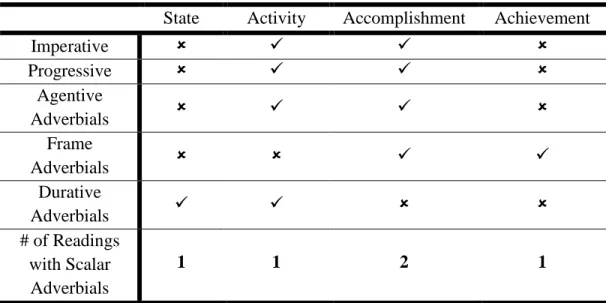
The following table summarizes the syntactic properties of different aspectual classes in Mandarin:
State Activity Accomplishment Achievement
Imperative ✓ ✓
Progressive ✓ ✓
Agentive
Adverbials ✓ ✓
Frame
Adverbials ✓ ✓
Durative
Adverbials ✓ ✓
# of Readings with Scalar Adverbials
1 1 2 1
CHAPTER 5: CLASSIFICATION OF MANDARIN IDIOMATIC VP
Introduction
The current classification is based on three criteria: 1) whether the said idiom is an IP or an ICE; 2) the thematic relation between its verb and the verb’s complement and 3) the aspectual classes on both the literal and the idiomatic interpretations. The distinction between IPs and ICEs is well established in Nunberg et al. (1994). ICEs have meaningful parts that contribute to the overall idiomatic meaning of the construction, whereas IPs do not. Thus, it is predicted that ICEs, but not IPs, should allow internal modification (Nunberg et al. 1994). In terms of thematic relations, Krifka (1992)’s distinction between gradual patient and normal patient (termed
“affected patient” in his work) relations is incorporated. Aspectual classes of idioms are
determined according to the syntactic properties of each aspectual class summarized in table 2. All Mandarin idiomatic VPs in this classification are from “Chinese Idiom Dictionary (2011)” published by Shanghai Lexicographical Publishing House.
Class 1
This class contains all Mandarin idiomatic VPs that 1) are ICEs; 2) maintain the same thematic relation between their verbs and complements on both literal and idiomatic
interpretations and 3) have the same aspectual properties on both interpretations. Examples (30) and (31) below exhibit a couple of idiomatic VPs from this class.
(30) bao huangzhang
This is an ICE because it can be easily construed that bao ‘to report’ corresponds to shuo ‘to tell’ and huangzhang ‘false statement’ corresponds to huang ‘lie’. In addition, the
complement huangzhang is assigned the same theta role “affected patient” in both interpretations since neither reporting false statements nor telling lies involves an endpoint.
The two interpretations have the same aspect class (activity):
A. zhe-ge kuaiji bao-le ershi nian huangzhang (Lit.) This-CL accountant report-PERF twenty year false statement ‘This accountant reported false statements for twenty years’
B. ni zhangfu gen ni bao-le ershi nian huangzhang le (Id.) 2nd.SG.GEN husband to you report-PERF twenty year false statement PART ‘Your husband lied to you for twenty years’
(31) ba dingzi
Lit. ba ‘to pull’, dingzi ‘snail’
Id. = qingchu zuai (qingchu ‘eliminate’, zuai ‘threat’)
Again, the literal interpretation of the verb and the complement both have counterparts in the idiomatic interpretation: ba ‘to pull’ idiomatically can mean qingchu ‘to eliminate’ and dingzi ‘snail’ idiomatically can mean zuai ‘threat’. Therefore, this idiom is an ICE. The same
thematic relation is also retained on both interpretations. In either case, there is a gradual patient. The two interpretations also have the same aspect class (accomplishment):
B. wo yi zhou nei ba-le haojige dingzi (Id) C. 1st.SG.NOM one week within pull out-PERF several snail D. ‘I eliminated several threats in a wee’
This class is expected by both McGinnis (2002) and Glasbey (2006). For McGinnis (2002), it is no wonder that she would welcome the existence of this class since her strong prediction says that all idioms should behave this way, albeit whether they are IPs or ICEs. Glasbey (2006) suggests only those idioms we call ICEs should have the same aspectual properties on both interpretations and the reason they do is because they maintain the same thematic relation on both interpretations. Though all idioms in this class are ICEs, as we will see next, this class does not subsume all ICEs in this classification.
Class 2
This class contains idiomatic VPs that 1) are ICEs; 2) have different thematic relations between their verbs and complements on the two interpretations and 3) have different aspectual properties for the two interpretations. Examples (32) and (33) below all fall into this category:
(32) ban shitou
Lit. ban ‘to carry’, shitou ‘stone’
Id. = qingchu zhangai (qingchu ‘to eliminate’, zhangai ‘obstacle’)
process is not relevant in carrying a stone as this event only features an “affected patient”. Therefore, the two interpretations have different thematic relations between the verbs and the verbs’ complements.
The two interpretations also have different aspect classes. The literal interpretation describes an activity eventuality while the idiomatic interpretation describes an accomplishment eventaulity:
A. ta ban zhe-kuai shitou ban-le liang-ge xiaoshi le (Lit) A. 3rd.SG.NOM.MASC carry this-CL stone carry-PERF two-CL hour PART
A. ‘He carried this stone for two hours’
B. ta zai liang-ge xiaoshi nei ban-le zhe-kuai shitou (Id) B. 3rd.SG.NOM.MASC in two-CL hour within carry-PERF this-CL stone B. ‘He eliminated this obstacle in two hours’
(33) bao jinwawa
Lit. bao ‘to hug’, jinwawa ‘golden stuffed toy’
Id. = zhuazhu jihui (zhuazhu ‘to seize’, jihui ‘opportunity’)
The two interpretations have different aspectual properties:
A. wode erzi zhengzai bao-zhe zhe-ge jinwawa
A. 1st.SG.POSS son PROG hold-IMPERF this-CL golden stuffed toy A. ‘My son is holding this golden stuffed toy’
B. *wo zhengzai bao-zhe zhe-ge jinwawa
B. *1st.SG.NOM PROG hold-IMPERF this-CL golden stuffed toy
B. *C. ‘I am seizing this opportunity’
According to Krifka (1992)’s theory of aspect composition, it is possible to have different
aspectual properties on the two interpretations even when this idiom is an ICE. All that is needed is for the complement in the idiom to be assigned different theta roles in the different
eventualities described by the two interpretations. Because of this, this class of idioms is tentatively suggested by Glasbey (2006). However, she does not provide any examples of this sort. Fortunately, the existence of this class in Mandarin not only proves Glasbey (2006)’s hypothesis, but it also validates the theoretical plausibility of Krifka (1992)’s account of aspect composition. In addition, the ICEs in this class strengthens Glasbey (2006)’s prediction that all ICEs can have structural aspect, even when the thematic relations between verbs and
complements are different. Though it appears that this class also supports McGinnis (2002)’s prediction that all idioms should have compositional aspect, I tend to think it is more
complicated than simply saying this. McGinnis (2002) takes “compositional aspect” to mean that both interpretations of an idiom has to have the same aspectual properties. While idioms in Class 2 are said to have compositional aspect, they do not have the same aspectual properties on both interpretations. In this sense, this class does not serve as evidence to McGinnis (2002)’s
Class 3
This class contains idiomatic VPs that 1) are IPs; 2) lose the thematic relation between their verbs and complements on the idiomatic interpretation and 3) have different aspectual properties for their two interpretations. Some examples are as follows:
(34) bao pipa
Lit. bao ‘to hold’, pipa ‘lute’
Id. = aishang bieren (aishang ‘to fall in love with’, bieren ‘someone else’)
This is an example of IP because the complement pipa ‘lute’ in the idiom clearly does not have a corresponding counterpart in the idiomatic interpretation. As a result, the “affected
patient” relation between the verb and the complement in the literal interpretation is lost in the idiomatic interpretation, causing the two interpretations to have different aspectual properties.
A. wo zhengzai bao-zhe pipa (Lit) B. 1st.SG.NOM PROG hold-IMPERF lute
C. ‘I am holding a lute’
B. *zhe-ge nvren zhengzai bao pipa ne (Id. achievement) C. *this-CL woman PROG hold lute PART
D. *‘This woman is loving someone else’
(35) bai longmenzhen
Lit. bai ‘to set up’, longmenzhen ‘a combat formation in ancient China’ Id. = liaotian ‘to chat’
idiomatic interpretation due to the complement longmenzhen ‘a combat formation in ancient China’ not having an identifiable counterpart in the idiomatic interpretation.
The two interpretations also have different aspect classes:
A. *shibing-men bai longmenzhen bai-le shi fenzhong (Lit.) A. *soldier-PL set up combat formation set up-PERF ten minute
A. *‘The soldiers set up the combat formation for ten minutes’
B. wo gen zhexie laoren bai-le liang xiaoshi longmenzhen (Id.) B. 1st.SG.NOM with these old man set up-PERF two hour combat formation
B. ‘I chatted with these old men for two hours’
This class would prove to be particularly difficult for McGinnis (2002) since this is a class of idioms clearly without compositional aspect. Krifka (1992)’s account of aspect
composition explains the reason that these idioms do not have compositional aspect as the loss of their thematic information on the idiomatic interpretation. This makes much sense since these idioms are all IPs which do not have identifiable syntactic chunks if interpreted idiomatically. Once again, Glasbey (2006)’s prediction that IPs should not have compositional aspect seems to apply here.
Class 4
This class contains idiomatic VPs that 1) are IPs; 2) lose the thematic relation on the idiomatic interpretation and 3) have the same aspectual properties for both interpretations. Below is an example of this sort:
(36) bao fojiao
Lit. bao ‘to hug’, fojiao ‘the buddha’s feet’
Clearly this idiom is an IP. No corresponding counterparts can be found in the idiomatic interpretation for either the verb bao ‘to hug’ or the complement fojiao ‘the buddha’s feet’. Here, in the literal interpretation the compliment is an affected patient. Since the compliment does not have a corresponding counterpart in the idiomatic interpretation, the affected patient relation is lost. Thus, we would expect to see different aspectual properties for its two interpretations. However, this is not the case:
A. wo jintian zai simiao bao-le wu fenzhong fojiao (Lit.) B. 1st.SG.NOM today in temple hug-PERF five minute buddha’s feet
C. ‘I held the buddha’s feet for five minutes in a temple today’
B. wo kaoshi qian bao-le yi zhengwan fojiao (Id.) C. 1st.SG.NOM exam before hug-PERF one night buddha’s feet D. ‘I worked much harder than usual for a whole night before the exam’
Obviously the two interpretations can both be modified by the for-phrase. This is not expected since the aspect on the idiomatic interpretation is predicted to not undergo aspect derivation if we assume Krifka (1992)’s account of aspect composition. This class of idioms resembles the
is to say that it is idiosyncratic. Since it is idiosyncratic, it definitely has the ability to go out of norms. This class of this idioms is such an idiosyncratic example.
A Special Class
This class is special in that all idioms in this class have the same verb ai ‘to endure’. They are all ICEs but do not have the same thematic relation preserved on their two
interpretations. Interestingly, they all have the same aspectual properties for both interpretations. This makes this class a deviation from Class 2. Below is one example from this class:
(37) ai banzi
Lit. ai ‘to endure’, banzi ‘stick’
Id. = shoudao zefa (shoudao ‘to get’, zefa ‘punishment’)
accomplishment eventualities because they all have two different readings when modified by scalar adverbials:
A. wo chayidian ai-le wu-dun banzi (Lit.) B. 1st.SG.NOM almost endure-PERF five-CL beating by stick C. ‘I almost endured five beatings by stick’
D. I did not endure any beating.
D. I endured some beatings, but less than five.
B. wo chayidian ai-le wu-dun banzi (Id.) C. 1st.SG.NOM almost endure-PERF five-CL beating by stick D. ‘I almost got punished five times’
E. I did not get punished at all. F. I got punished less than five times.
This class is of course a problem for all accounts and/or predictions made in both
McGinnis (2002) and Glasbey (2006). However, only idioms with this specific verb exhibit this peculiar property. In this sense, we might still be able to call this class “an accident”. But what exactly is the reason behind this class of special idioms requires further research.
Other Theoretical Classes
thematic relation is fed into the aspect composition process. Other hypothetical classes do not exist due to the same reason.
Summary
All Mandarin idiomatic VPs in the dictionary are accounted for in the classification. Idioms in Classes 1 and 2, which are all ICEs (ignoring the ones in the special class), all prove to have compositional aspect assuming Krifka (1992)’s account of aspect composition. As
mentioned earlier, they serve to support Glasbey (2006) but not McGinnis (2002) since Class 2 would violate what McGinnis (2002) describes as “compositional aspect” because these idioms do not have the same aspectual properties for their two interpretations. Classes 3 and 4 contain all the IPs in this classification but only idioms in Class 3 conform to Glasbey (2006)’s
prediction that no IPs should have compositional aspect. This is because Class 4 contains idioms that appear to have compositional aspect “by accident”. Glasbey (2006) also mentions one such accident saw logs, but apparently marking this idiom as “an accident” by mentioning the complement being a bare plural would not explain the “Mandarin accidents” since Mandarin nouns are always interpreted as bare plurals without any modification. Therefore, though Class 4 idioms are called “accidents”, what causes them to be “accidents” remains to be studied. What also needs further research is the existence of the special class of idioms ubiquitously featuring the verb ai ‘to endure’. At this current stage, it suffices to call this class of idioms another “accident” class due to the peculiarity behavior of the verb in the idioms in this class. No other classes can be attested in this classification.
So it appears Glasbey (2006)’s prediction would work much better for Mandarin
CHAPTER 6: THE CLASSIFICATION AND THE DEBATE BETWEEN DM AND RM
Introduction
There is a broader picture behind the exchange between McGinnis (2002) and Glasbey (2006), which is the debate between DM and RM regarding their models of idiomatic form-meaning pairing. As we will see later in this section, the classification just exhibited raises new questions in this discussion. In what follows, I will first provide a brief overview of DM and RM, then I will discuss the questions raised by the classification in this debate between DM and RM.
RM & DM: a brief introduction
Both Representational Modularity and Distributed Morphology are complex theories of grammar that aim at explaining how language works in our mind. In this section, I will only briefly introduce some basic claims and assumptions about the two theories that are relevant to our discussion of idiom aspect.
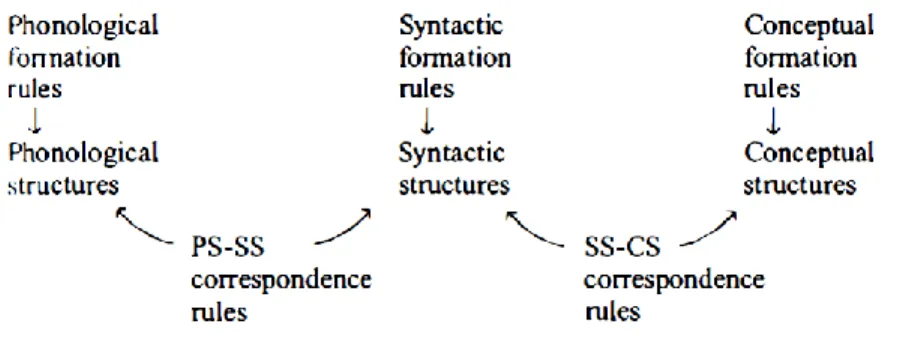
expressions that we call language. The figure below, borrowed from Jakendoff (1997: 39), provides a sketch of this basic architecture:
Figure 1. Architecture of RM
Similar to RM, Distributed Morphology (DM) also proposes a separate function between syntax and phonology. But it is different from RM in that it allows the ingredients to be fed into syntactic operations to contain semantic information as well. The figure below, borrowed from Marantz (1997), shows a sketch of the architecture of this theory:
Figure 2. Architecture of DM
List 1 contains morphemes which are atomic roots and atomic bundles of grammatical features in a language (Marantz 1997). Since DM assumes the same processes for word formation as for sentence formation, these morphemes are directly fed into syntactic operations Merge and Move. The syntactic structures such derived will get phonological contents by mapping to Vocabulary Items in List 2, also known as the Vocabulary. List 3, or the Encyclopedia, contains idiosyncratic
process is distributed over several components of the grammar rather than being completed in the lexicon as proposed in traditional lexicalist approaches, this theory is thus called Distributed Morphology.
Different Predictions DM and RM make about Idiom Aspect
According to Levin and Rappaport Hovav (1998), word meaning can be separated into two parts: a structural part that can be manipulated by syntax and an idiosyncratic part that cannot. Assuming this claim, we would anticipate the two theories to make different predictions about Aspect, which is a type of structural meaning, in idioms. It should be clear that Aspect is structural since the two expressions I climbed and I climbed a mountain has different aspectual properties. The former describes an activity eventuality while the latter describes an
accomplishment. In RM, both structural and idiosyncratic meaning are stored in the Conceptual module since RM requires each module to be distinct. Since Jakendoff explicitly argues for the position that fixed expressions like idioms are stored in the lexicon (Jakendoff 1997: 157), the conceptual structure of any given idiom will be listed in the lexical entry of the idiom along with the correspondence rules which tell us how it is linked to the syntactic and phonological structure of this idiom. What this means is that RM claims aspect is not structural.
DM predicts otherwise. Because in DM, the semantic component known as the
Encyclopedia only contains idiosyncratic information, the structural meaning is always predicted to be derived by syntactic operations. Indeed, since DM allows for morphemes to be bundles of syntactic and semantic features, it is not strange how these morphemes can be combined to give the overall aspectual class of a predicate.
Mandarin idiomatic VPs in this current thesis, it is not easy to decide on this matter since each model seems to be able to account for only a fraction of idioms. Specifically, ICEs in both
English and Mandarin seem to have compositional aspect, an observation in favor of DM. On the other hand, IPs in both English and Mandarin do not seem to have compositional aspect. Glasbey (2006) suggests it is best to consider that aspect of these idioms is stored in the lexicon, a claim that would be agreed with by RM. Now the question is, if it is possible to adjust some claims by either DM or RM so that one of them can account for all them idiomatic VPs?
Let’s consider RM first. We have all the ICEs in English and Mandarin to explain. This would not be an easy task since Jakendoff (1997) is strong in taking the position of lexical
storage of fixed expressions like idioms, albeit whether they are ICEs or IPs. To make ICEs work with RM, one would need to claim that these idioms are syntactically derived rather than
lexically stored. But since RM requires that each generative module remains distinct, we face the problem of how to determine the idiomatic status of the structure generated in syntax. For
example, suppose the English ICE bury the hatchet is generated in syntax and awaits mapping to some lexical conceptual structure. Literally, the LCS to be mapped onto the syntactic structure looks something like the following:
(38) [BURY ([ ], [THE ([HATCHET])])]
The empty bracket in (35) is the argument slot for an external argument such as the subject of the sentence where this idiom is put. And idiomatically, the LCS would look like this:
(39) [RECONCILE ([ ], [DISAGREEMENT])]
The grammar would not know which one should be mapped to a syntactic structure like bury the hatchet since nothing licenses the idiomatic status of this syntactic structure. This, of course,
suggested, then whenever such a structure is derived syntactically, the system would always know to map the literal interpretation onto it, thus creating no conflicts. Therefore, it would be difficult to alter the operations in RM so that an ICE can be syntactically derived and receive idiomatic interpretation.
Then, what about DM? Is it possible to tweak DM in a way that it could account for the existence of IPs? The first thought coming to mind would be to claim that some idioms do have non-structural aspect. Since this information is not structural, it must be idiosyncratic, thus needs to be stored in the Encyclopedia along with other idiomatic meaning. What this means is
basically saying that aspect of IPs is a part of their idiomatic meaning. However, this would also pose a problem for the syntax component in this theory. Let’s take the famous English IP kick the bucket as an example. As this structure is derived in syntax, semantic information like the lexical
aspect of the verb kick, the definiteness of the determiner and the singularity of the object noun will all have an impact on the aspectual properties of this structure. In other words, before
Encyclopedia entries can be mapped to this structure, this structure would already have an aspect as if it were a non-idiomatic expression. Then the mapping of idiomatic aspect as proposed above would cause a conflict. Or, one could propose that there are roots KICK, THE and
BUCKET that do not have semantic information bundled with it, so that when these are fed into syntax, we could derive the same syntactic structure without deriving the aspect along with it. But this requires that for every component in an idiom, we have two roots for it, one with semantic information and one without. This would pose a problem of redundancy and a challenge of our mental capacity.
CHAPTER 7: CONCLUSION
The classification in the current thesis attests the existence of idiomatic VPs both with and without compositional aspect and categorizes them into five different classes. This provides further cross-linguistic support to Glasbey (2006) regarding her debate with McGinnis (2002) concerning the aspect of English idiomatic VPs. For the broader debate between DM and RM about idiomatic form-meaning pairing, this classification stands to suggest that neither model accurately captures the whole picture of idiom aspect. Each model only accounts for a fraction of idioms with their arguments. But with this classification, researchers now know exactly which classes of idioms to target if they tend to use Mandarin idioms to support their arguments for or against one of the two models. In addition, since Mandarin idioms do seem to resemble English idioms in terms of their aspectual properties, it would no doubt be beneficial to perform a similar classification on English idioms as well. Especially, Class 2 Mandarin idioms, namely those ICEs that have different thematic relations and aspectual meanings on the two interpretations, are attested only in Mandarin but not in English. As mentioned earlier, Glasbey (2006) has a
thinking about ways to incorporate the two models into one. Such a procedure cannot be initiated without ample cross-linguistic data.
Apart from providing evidence and arguments to the DM vs. RM debate, the
classification in the current thesis is hoped to be an assistance to more future linguistic research. One could easily combine Classes 1, 2 & 5 to get all the ICEs in Mandarin, and combine Classes 3 & 4 to get all the IPs in Mandarin. This would be convenient for research in the area of internal syntactic structures of idioms. Classes 4 idioms raise this interesting question about their
emergence. As mentioned earlier, though these idioms are also said to occur by “accident” like saw logs as proposed in Glasbey (2006), the reason to call saw logs “an accident” cannot be
APPENDIX: ALL IDIOMS USED IN THE CLASSIFICATION
Idioms Interpretation Class
Lit. Id.
an dixian an 'to place'; dixian
'bottom line' to put a mole in enemy 1
an dingzi an 'to place'; dingzi 'snail' to put a mole in enemy 1
an maozi an 'to place'; maozi 'hat' to give a bad reputation 1
bai kuoqi bai 'to display'; kuo 'rich';
qi 'atmosphere' to show off richness 1
bai gandie bai 'to kowtow'; gandie
'godfather'
to get in with influential
people 1
bai pusa bai 'to kowtow'; pusa
'buddha'
to get in with influential
people 1
bao cutui bao 'to hug'; cutui 'thick
leg'
to ask for help from
influential people 1
ban jiubing ban 'to carry'; jiubing
'savior' to seek help 1
bao huangzhang bao 'to report'; huangzhang
'false statement' to tell lies 1
bi gaodi bi 'to compare'; gao 'high';
di 'low'
to compete against each
other 1
bi ermu bi 'to hide'; er 'ear'; mu
'eye' to avoid trouble 1
bi fengtou bi 'to hide'; feng 'wind'; tou
'head' to avoid trouble 1
ba dingzi ba 'to pull'; dingzi 'snail' to eliminate threat 1
ba luobo ba ' to pull'; luobo 'carrot' to eliminatge threat 1
ba yanzhongding
ba 'to pull'; yanzhongding 'snail in one's eye
to take out the person
one hates 1
bai leitai bai 'to set up'; leitai
'boxing ring' to issue challenges 1
bo huapi bo 'to peel'; huapi 'makeup' to reveal the truth 1
bao lengmen bao 'to explode'; leng
'cold'; men 'gate'
unexpected iccident
taking place 1
bai matou bai 'to kowtow'; matou
'wharf'
to visit influential
people 1
bo huozhong bo 'to spread'; huozhong
'fire'
to publicize a possitive
thought or theory 1
bu kongzi bu 'to fill up'; kongzi
'empty spot' to take one's place 1
bu quantao bu 'to place'; quantao
'round rope' to set up traps 1
bu yanxian bu 'to place'; yan 'eye';
xian 'line'
to secretly arrange
scouts 1
bai changshezhen
bai 'to set up'; changshezhen 'a combat
bu houchen
bu 'to follow'; hou 'dust one leaves behind when
walking'
to imitate someone else 1
caliang yanjing caliang 'to wipe clean';
yanjing 'eye'
to acknowledge the
situation 1
cai yami cai 'to guess'; yami 'silent
puzzle'
to infer one's true meaning behind
utterance
1
cai daolu cai 'to stomp'; daolu 'road' to acknowledge the
situation 1
cai gangsi cai 'to walk on'; gangsi
'wire'
to do risky things with
extra care 1
cha dingzi cha 'to place'; dingzi 'snail' to put a mole in enemy 1
chai taizi chai 'to destroy'; taizi
'stage' to make something fail 1
chang dujiaoxi
chang 'to sing'; dujiaoxi 'an opera with only one
performer
to do things alone 1
chi dingban chi 'to eat'; dingban 'tool
for torment' to get punished 1
chi dingxinwan chi 'to eat'; dingxinwan
'tranquilizer'
to settle one's mind
(after given a promise) 1
chui laba chui 'to blow'; laba 'horn' to flatter influential
people 1
diu fanwan diu 'to lose'; fanwan 'bowl' to lose one's job 1
gan mobanche gan 'to chase'; mobanche
'last bus or train'
to fight for the last
opportunity 1
ge lanchuang ge 'to cut off'; lanchuang
'rotten wound' to eradicate threat 1
ge yiba ge 'to cut off'; yiba 'tail' to eliminate redundancy 1
he gancu he 'to drink'; gancu 'dry
vineger' to envy out of no reason 1
hu duzi hu 'to protect'; duzi
'maverick'
to overly protect one's
child 1
hui niangjia hui 'to return'; niangjia
'wife's hometown'
to return to places one
used to work or live 1
jie gaizi jie 'to lift'; gaizi 'lid' to reveal the truth 1
jie huangbang jie 'to tear off'; huangbang
'king's announcement
to self-volunteer for
task 1
jie yinshou
jie 'to take off'; yinshou 'ribbon to tie up official document in ancient China
to quit one's job 1
kai heidian kai 'to open up'; heidian
'illegal shop' to start up a mafia 1
kai kongtouzhipiao
kai 'to write'; kongtouzhipiao 'invalid
check'
to make a false promise 1
kai zhipiao kai 'to write'; zhipiao
lao daocao lao 'to hold onto'; daocao 'straw'
to hold onto life-saving measures in desperate
situation
1
liang hongpai liang 'to show'; hongpai
'red card in soccer game'
to give penalty because
of violation of law 1
lou majiao lou 'to leak'; majiao 'hoof' to expose secret
unexpectedly 1
mai guanjie mai 'to buy'; guanjie 'key
element to success'
to bribe influential people to get things
done
1
huo xini huo 'to stir'; xini 'diluted
cement'
to reconcile
disagreement 1
na powan na 'to hold'; powan 'broken
bowl' to live a poor life 1
pan gaozhi pan 'to climb'; gaozhi 'tall
tree'
to try to be associated
with influential people 1
pao longtao pao 'to run'; longtao
'walk-on'
to be in a very
unimportant position 1
pao yema pao 'to run'; yema 'wild
horse' to speak off topic 1
qi liangtouma qi 'to ride'; liangtouma
'two-headed horse'
to do two things at the
same time 1
qian bizi qian 'to drag'; bizi 'nose' to control other people 1
qiang dipan qiang 'to rob'; dipan 'area' to take away other
people's achievement 1
qiang fanwan qiang 'to rob'; fanwan
'bowl'
to take away other
people's job 1
ru hukou ru 'to get into'; hukou
'tiger's mouth' to get into danger 1
sha fengjing sha 'to kill'; fengjing 'view' to kill the buzz 1
shuai baofu shuai 'to drop'; baofu
'baggage' to be free of burden 1
shuo dahua shuo 'to tell'; dahua 'big
words' to lie 1
tan fengsheng tan 'to listen to'; fengsheng
'sound of wind' to observe situation 1
tian haiyan tian 'to stuff'; haiyan
'spring'
to make up for huge
loss 1
tian kulong tian 'to stuff'; kulong 'hole' to repay debt 1
tiao longmen tiao 'to jump over';
longmen 'dragon gate'
to improve social status through certain
measures
1
xia taijie xia 'to get down'; taijie
'stair'
to get out of
embarrassment 1
xie tianji xie 'to leak'; tianji
'revelation' to reveal top secret 1
za fanwan za 'to break'; fanwan 'bowl' to make someone lose
his/her job 1
zou heidao zou 'to walk'; heidao 'dark
path' to do illegal things 1
ba huxu ba 'to pull'; huxu 'tiger's
beard
to mess with influential
people 2
ba xiangtou ba 'to pull'; xiangtou 'head
of incense' to end friendship 2
ban shitou ban 'to carry'; shitou 'stone' to eliminate obstacle 2
bao jinwawa bao 'to hug'; jinwawa
'golden sutffed toy' to seize opportinuty 2
ca pigu ca 'to wipe'; pigu 'butt' to clean up the mess 2
chai yutou chai 'to pull apart'; yutou
'fish's head'
to handle difficult
matter 2
chi doufu chi 'to eat'; doufu 'bincurd' to flirt with women 2
chi dushi chi 'to eat'; du 'alone'; shi 'food'
to take all the benefits
alone 2
chi shaobing chi 'to eat'; shaobing
'pancake'
to score 0 (in a
competition) 2
chi wobiancao chi 'to eat'; wobiancao
'grass near an animal's lair'
to harrass people
intimate to one 2
chi xiaozao
chi 'to eat'; xiaozao 'specially made delicious
food'
to enjoy special
treatment 2
diu baofu diu 'to lose'; baofu
'baggage' to escape from burden 2
he moshui he 'to drink'; moshui 'ink' to receive education 2
he yangmoshui he 'to drink'; yangmoshui
'foreign ink'
to receive education
abroad 2
jie dongfeng jie 'to borrow'; dongfeng
'east wind'
to seize great
opportunity 2
ken yinggutou ken 'to bite'; yinggutou
'hard bone' to undertake tough task 2
nian huxu nian 'to pick up'; huxu
'tiger' beard'
to mess with influential
people 2
qiao sangzhong
qiao 'to knock'; sangzhong 'bell rung in funeral for
religious people'
to announce failure or
death 2
shao yehuo shao 'to burn'; yehuo 'wild
fire' to start a rumor 2
shua bigan shua 'to play with'; bigan
'pen' to write an article 2
tiao youguo tiao 'to jump into'; youguo
'pot full of boiling oil' to do dangerous things 2
tong mafengwo tong 'to poke'; mafengwo
'beehive'
to mess with tough
people 2
ban shifei ban 'to carry'; shi 'right';
fei 'wrong' to cause trouble 3
ba duanti ba 'to pull'; duanti 'short
ladder'
to set people up from
bai tiandi bai 'to kowtow'; tian 'sky';
di 'earth' to get married 3
bai longmenzhen
bai 'to set up'; longmenzhen 'combat
formation in ancient China'
to chat 3
ban naodai ban 'to carry'; naodai 'head' to die 3
bao pipa bao 'to hold'; pipa 'lute' to fall in love with
someone else 3
bei heiguo bei 'to piggyback'; heiguo
'black pot' to be a skapegoat 3
bei shizijia bei 'to piggyback'; shizijia 'crucifix'
to suffer for hope or
faith 3
biao bangzi biao 'to hold tightly with
arm'; bangzi 'shoulder' to be intimate 3
bo tianguan bo 'to knock'; tianguan
'heaven's door to be very powerful 3
bo mianzi bo 'to refuse'; mianzi 'face' to shut down one's
request 3
ca jianbang ca 'to rub'; jianbang
'shoulder' to hook up with 3
cai jiaohougen cai 'to stomp'; jiaohougen
'heel' to stalk 3
cao xianxin cao 'to worry'; xian 'spare'; xin 'heart'
to worry about
unnecessary things 3
cha gangzi cha 'to insert'; gangzi 'bar' to interfere 3
chai bijiao chai 'to destroy'; bijiao 'the
root of a wall' to demean from behind 3
chai houtai chai 'to take away'; houtai
'background'
to take away one's
support 3
chan shuifen chan 'to add in'; shuifen
'water' to overstate 3
chang fandiao chang 'to sing'; fan
'opposite'; diao 'tone' to oppose 3
chang laodiao chang 'to sing'; lao 'old';
diao 'tone' to repeat 3
chang peijue chang 'to perform'; peijue
'minor role to assist 3
chang toupai chang 'to perform'; toupai
'major role'
to be assigned an
important task 3
chang zhujue chang 'to perform'; zhujue
'leading actor'
to be assigned an
important task 3
chao lengfan chao 'to cook'; lengfan
'cold dish' to repeat 3
chao youyu chao 'to cook'; youyu
'squid' to fire 3
che pi che 'to chat gossip'; pi
'skin' to entangle 3
cheng qihou cheng 'to become'; qihou 'weather'
to have great
achievement 3
cheng yingxiong cheng ' to show off';
yingxiong 'hero'
to pretend to be hero when not qualified to be
one
3
chi baifan chi 'to eat'; baifan 'white
rice'
to get paid without
actually doing anything 3
chi dingzi chi 'to eat'; dingzi 'snail' to be refused 3
chi heizao chi 'to eat'; heizao 'bullet' to get executed 3
chi ruanfan chi 'to eat'; ruan 'soft'; fan 'meal'
(men) to live by receiving support from
women
3
chi wapian chi 'to eat'; wapian 'tile' to make a living by
renting houses 3
chi xieyao chi 'to eat'; xieyao
'lustramentum'
to persuade one to calm
down 3
chong lengshui chong 'to pour'; lengshui
'cold water' to demean 3
chu lenghan chu 'to happen'; lenghan
'cold sweat'
to be very nervous or
scared 3
chuan xiaoxie chuan 'to wear'; xiaoxie
'small shoe'
to set one up from
behind 3
da bianche da 'to ride'; bian
'convenient'; che 'vehicle'
to benefit from intricately using convenient resources
3
da baopiao da 'to write'; baopiao
'warranty' to guarantee 3
da buding da 'to knit'; buding 'patch' to fill in the empty spot 3
da mengun da 'to hit'; men
'suffocated'; gun 'stick' to attack surprisingly 3
da qiangxinzhen
da 'to inject'; qiangxinzhen 'an injection to ease the blood flow into and/or out
of one's heart
to encourage 3
da xiashou da 'to work'; xia 'under';
shou 'hand' to be a sidekick 3
dai gaomao dai 'to put on'; gaomao 'tall
hat' to flatter 3
dai lvmao dai 'to put on'; lvmao
'green hat' to cheat on one's blouse 3
dao kushui dao 'to pour'; kushui 'bitter
water'
to complain about bad
experience 3
diao shudai diao 'to drop'; shudai 'bag
full of book'
to show off literary
talent 3
diao naodai diao 'to drop'; naodai 'head' to die 3
diu lian diu 'to lose'; lian 'face' to embarrase oneself 3
dong gange dong 'to use'; gange
fang changxian fang 'to let go'; changxian
'long line' to plan the future 3
fang lengjian fang 'to let go'; leng 'cold';
jian 'arrow' to ambush 3
ge kouzi ge 'to slice'; kouzi 'wound' to search for a
breakthrough 3
gei mianzi gei 'to give'; mianzi 'face' to avoid embarrasing
someone else 3
gua huzi gua 'to shave'; huzi 'beard' to scold 3
guan xianshi guan 'to get involved'; xian
'spare'; shi 'matter'
to meddle with other
people's bussiness 3
gun xueqiu gun 'to roll'; xueqiu
'snowball' to enlarge 3
he xibeifeng he 'to drink'; xibeifeng
'northwest wind' to starve 3
he daocai he 'to shout'; dao 'reverse';
cai 'chant' to boo 3
hui laojia hui 'to return'; laojia
'hometown' to die 3
ji yagao ji 'to squeeze'; yagao
'toothpaste' to stutter 3
jia shetou jia 'to set up'; shetou
'tongue' to demean from behind 3
jia yangzi jia 'to set up'; yangzi 'crop' to provoke 3
jian pianyi jian 'to pick up'; pianyi
'cheap goods'
to benefit greatly
without an effort 3
jian shangdi jian 'to meet'; shangdi
'Jesus' to die 3
jian yanwang jian 'to meet'; yanwang
'Hades' to die 3
jiang jiaqian jiang 'to speak'; jiaqian
'price' to bargain 3
jiang panzi jiang 'to speak'; panzi
'plate' to negotiate 3
jiao baijuan jiao 'to submit'; baijuan
'empty exam paper' (task) not finished at all 3
jiao xuefei jiao 'to pay'; xuefei 'tuition'
to learn a lesson by failing something or
paying a price
3
jiao lengshui jiao 'to pour down';
lengshui 'cold water' to discourage 3
jiao hunshui jiao 'to stir'; hunshui 'dirty water'
to cover up the truth by messing up the
bussiness
3
jie xiangyan jie 'to continue'; xiangyan
'smoke of incense' to be pregnant 3
jie chuangba jie 'to uncover'; chuangba
'wound'
to mention tragedy or scandal in the past
again
jin guancai jin 'to get in'; guancai
'coffin' to die 3
juan pugai juan 'to roll up'; pugai
'blanket' to resign 3
kai houmen kai 'to open'; houmen
'backdoor'
to benefit someone else
with one's priviledge 3
kai lvdeng kai 'to turn up'; lvdeng
'green light' to approve 3
kan dashan kan 'to talk about'; dashan
'tall mountain' to chat 3
kan fengjing kan 'to see'; fengjing 'view' to look on 3
ken shuben ken 'to bite'; shuben 'book' to study very hard 3
lachang lian lachang 'to stretch'; lian
'face' to be angry 3
la heiniu la 'to drag'; heiniu 'black
bull'
to advertise false
information 3
li menhu li 'to stand'; menhu 'house' to stop living together 3
liang hongdeng liang 'to light up';
hongdeng 'red light' to come across obstacle 3
luan fangcun luan 'to mess up'; fang
'square'; cun 'inch' to be disturbed 3
mo mianzi mo 'to wipe'; mianzi 'face' to show no mercy 3
mai changshe mai 'to sell'; changshe
'long tongue' to lie 3
mai zuipizi mai 'to sell'; zuipizi
'mouth'
to only talk without
actually doing anything 3
mao lenghan mao 'to emerge'; lenghan
'cold sweat' to be extremely afraid 3
mo dixi mo 'to touch'; di 'under'; xi
'narrow'
to acknowledge the
situation 3
mo yanggong mo 'to dawdle'; yanggong
'work'
to work very slowly to
stall 3
mo bozi mo 'to cut with a knife';
bozi 'neck' to commit suicide 3
na etou na 'to hold'; etou 'mistake' to blackmail 3
na houjiao na 'to hold'; houjiao 'back
foot'
to reveal other people's
shortcomings 3
pai mapi pai 'to tap'; mapi 'horse's
butt' to flatter 3
pai xiongpu pai 'to clap'; xiongpu
'chest' to guarantee 3
pan sixing pan 'to sentence'; sixing
'death penalty' to deny completely 3
pao zufen pao 'to dig'; zufen 'tomb of
ancestors'
to give the most serious
punishment 3
pao shetou pao 'to run'; shetou 'tongue' to deceive 3
peng choujiao
peng 'to hold in both hands'; choujiao 'stinky
foot'
to flatter without any
pie danzi pei 'to ditch'; danzi
'burden' to quit 3
po lengshui po 'to pour'; lengshui 'cold
water' to discourage 3
po zangshui po 'to pour out'; zangshui
'dirty water' to demean 3
qian hongxian qian 'to drag'; hongxian
'red line'
to set up dates for men
and women 3
qiao jingzhong qiao 'to knock'; jingzhong
'bell' to warn 3
qiao zhugang qiao 'to knock'; zhugang
'bamboo stick' to blackmail 3
qiao bianzi qiao 'to perk'; bianzi 'braid' to die 3
qiao yiba qiao 'to perk'; yiba 'tail' to act arrogantly 3
qu xitian qu 'to go'; xitian
'afterworld' to die 3
ru kongmen ru 'to get into'; kongmen
'empty door'; to be a monk 3
sai goudong dai 'to stuff'; goudong
'dong's lair' to bribe 3
tang hunshui tang 'to step in'; hunshui
'dirty water'
to follow suit and do
bad things 3
tai gang tai 'to raise'; gang 'bar' to argue with 3
ti piqiu ti 'to kick'; piqiu 'ball' (both parties) to wriggle
out of responsibility 3
tian gouhe tian 'to stuff'; gouhe
'sewage' to die 3
tian wanbian tian 'to lick'; wanbian 'edge
of bowl' to beg 3
tie baitiao tie 'to attach'; baitiao
'white sticker' to criticize 3
tuo houtui tuo 'to drag'; houtui 'leg' to hinder 3
wa qiangjiao wa 'to dig'; qiangjiao 'root
of wall'
to sabotage other people
or group's interest 3
wan kuanglan wan 'to save'; kuanglan
'huge wave' to change the situation 3
xia dushou xia 'to do'; du 'poisonous';
shou 'hand' to hurt people ruthlessly 3
xian yinqin xian 'to present'; yinqin
'effort' to please someone 3
yao caigen yao 'to bite'; caigen 'root of
vegetable' to live a poor life 3
yao eduo yao 'to bite'; eduo 'ear' to whisper 3
zhua babing zhua 'to catch'; babing
'handle'
to have something on
someone 3
zhua bianzi zhua 'to catch'; bianzi
'braid'
to have something on
someone 3
zhuang sunzi zhuang 'to pretend'; sunzi 'grandson'
to act like one is lower
than others socially 3
zhuang nanqiang
zhuang 'to hit'; nanqiang
'south wall' to be refused 3
zou houmen zou 'to enter'; houmen
'back door'
to get a shortcut (often
illegal) 3
zou xiapolu zou 'to walk'; xiapolu
'downhill' to gradually decline 3
zuo jiaozi zuo 'to sit in'; jiaozi 'sedan
chair' to be flattered 3
zuo lengbandeng
zuo 'to sit on';
lengbandeng 'cold bench' to be ignored 3
zuo paohui zuo 'to be'; paohui 'powder'
to sacrifice unneccessarily for
someone else
3
bao jiaozi bao 'to make'; jiaozi
'dumpling' to besiege enemy 4
bao fojiao bao 'to hug'; fojiao
'buddha's foot'
to work much harder before the deadline than
usual
4
cheng daqi cheng 'to become'; da 'big';
qi 'machine' to succeed 4
cheng paoying cheng 'to become'; paoying
'bubble' to completely fail 4
chui lengfeng chui 'to blow'; lengfeng
'cold breeze' to mock 4
chui niupi chui 'to blow'; niupi 'skin
of bull' to lie 4
gao yitou gao 'to be higher than';
yitou 'a head'
to be significantly better
than 4
jiao shegen jiao 'to chew'; shegen 'root
of tongue' to demean 4
la dunju la 'to use'; dunju 'blunt
saw' to speak haltingly 4
mo doufu mo 'to grind'; doufu
'bincurd' to speak garrulously 4
nong huaqiang nong 'to play'; huaqiang
'colored spear' to deceive 4
nong kongtou nong 'to play'; kongtou 'no
reason' to deceive 4
ai banzi ai 'to endure'; banzi 'stick' to receive punishment 5
ai gunzi ai 'to endure'; gunzi 'stick' to receive punishment 5
ai heiqiang ai 'to endure'; heiqiang
'black pistol' to get ambushed 5
ai mengun ai 'to endure'; men
'suffocated'; gun 'stick' to get ambushed 5
ai qiangzi ai 'to endure'; qiangzi