Gender Role Formation: Qatar 1950-1970.
By Al Jawhara Al Thani
08
Fall
31st January 2020
I would like to dedicate this thesis to those who have supported me throughout my
writing journey:
My mother for her patience and encouragement, Sheikha Dr. Haya Ali Al Thani for
giving me access to many of the sources used in this thesis, and for her counsel,
Sheikha Dr. Asma Ali Al Thani for helping me set up the interviews and sparking my
interest in gender norms in Qatar’s history, to Mariam Al Thani for her constant
support, to my supervisor Dr. Andrew DJ Shield for guiding me through my thesis,
and to all my relatives and friends who have, directly or indirectly, supported me.
3
Table of Contents
Introduction ... 4
Historiography ... 6
Sources ... 9
Literature Review ... 14
Gulf women edited by Amira Sonbol. ... 14
Contested Modernity; Sectarianism, Nationalism, and colonialism in Bahrain Omar H. AlShehabi ... 22
Historical background ... 25
“Colonial” past and politics ... 26
Chapter 1: Bedouin to Sedentary lifestyle. ... 29
Attire as a representation of gender construct ... 30
Bedouin gender “roles” and creating the private sphere. ... 35
Chapter 2: Education ... 43
Chapter 3: Public Sphere: from necessity to recreation. ... 48
Cinemas ... 49
Photography as public sphere ... 51
Conclusion ... 54
“In the past she [Qatari woman] used to play both the mother and father’s role, and fills the gap of the fathers absence when he left to trade or dive [for pearls].1
Introduction
Arabian women have been, and still tend to be viewed as docile, passive and
submissive to the men in their lives. This narrative has dominated for far too long and
has created a narrow lens in which the world currently views Arab women. In recent
years however, many historians and academics have begun to examine the historical
roots that caused the construction of such images and portrayals of Arab women.
Many have come to conclude that it stems from a, mainly western, European male
imagination of what women in the east should look and act like.2
Evidence of this
exists in sources coming from the many travelogues of explorers, officials and
missionaries who dared to explore these so called exotic lands and cultures.3
In order
to get closer to the reality of Gulf women at the time one must move past the
traditional sources and incorporate new sources, and methods that would “correct
many of the stereotypical images” created by the Western travellers.4
In this thesis I
aspire to add to the existing literature of revising history through the gender lens by
examining the developments of gender roles in Qatar in the 20th century. More
1
Tahani Al-Burtaqali, “Qatar Balad Almaha Alabyad wa AlSuqoor,” AL-Kuwait Magazine, Issue 12, 58. In Qatar in Arabian Journals 1909-1998 (Doha; Katara Publishing House, 2015), 402.
2
Edward W. Said, Orientalism (New York: Vintage Books, 2004)
3
Travellers such as, Wilfrid Blunt, William Gifford Palgrave. 4
5 specifically, I will be arguing that the main period of critical change in gender norms
in Qatar occurs during the 1950s, 1960s, and early 1970s. Whilst there are many ways
in which one can study the development in gender norms, in this essay we shall
approach the topic by looking at the overall transformations that occur to and in the
private - public sphere.
This thesis will try to demonstrate that the wealth generated from exporting
petroleum gas has had a ripple effect on every aspect of cultural norms in Qatar, more
specifically gender norms. The thesis will be divided into through main categories
that seek to understand the factors that contributed to the changes in gender roles in
Qatar. The categories are: settlement, education, and the modern public sphere. Under
the first category, we will look at the typical life of a Qatari family from various
aspects, such as attire, daily activities, and societal norms; we will then examine how
the process of modernizing the country, such as the transition from nomadic to settled
culture, has led to major shifts in their gender roles starting from the late 1950s
onwards. As for Education, Qatar, as with many other countries, had to fight to
provide girls with the right to attend school. However, unlike many other countries
those in Qatar who advocated for girls’ right to attend school were mainly men. In this
case we will observe how institutional education added to defining gender norms.
Furthermore, we will study the developments in education and understand how the
emergence of a standardized education system has affected gender roles. Lastly we
will examine how the rise of public spheres such as cinemas, theatre, and libraries and
how that affected social-gender-etiquette during the 1960s and early 1970s.
Furthermore, we will examine how the lack of female representation through
photography legitimized the constructed notion that women belonged to the private
factors are interlinked. For example under chapter two, which will discuss the role of
standardized education in constructing gender roles we will also discuss the
representation of women in photography and public space in general.
However, before diving into the main arguments we shall first get a brief
background on the emergence of oil in the region because it plays an essential role in
generating the wealth that lead to major shifts in gender roles. Furthermore, we shall
also examine the impact of the institutional political sphere on gender roles. In
particular we will observe the rise of Qatar as a nation starting from 1868 and the
cooperation that occurred between the male leaders and the British officials and how
that lead to the institutionalization of a more patriarchal society.
Historiography
Gender norms have been largely accepted as a way of being rather than a
phenomenon that has been constructed over time. However, due to the rise of global
history many historians have begun revising their understanding of gender norms in
different cultures and societies. This has led to an increase in literature concerning
gender norms that deter from a Eurocentric point of view; a view that can hinder our
understanding of non-Western, non-European gender norms. A great example of this
is the book Gender History: Global Perspectives by Merry Wiesner-Hanks in which
she looks at the history of gender starting from the Paleolithic era (2,000,000-9500
BCE) up to 2010.5
Her chapter titled Economic Life proves to be most useful to the
argument of this thesis as it maps out how the rise of capitalism has increased the
5
7 gendering of different forms of labor overtime.6
Furthermore, it shows how
capitalistic tendencies aided the construction of new gender norms. Wiesner-Hanks
gives the example of textile mills in Colombia that preferred to employ men and thus
utilized the public’s perception that women who worked in factories were improper
thus leading to a decrease in female workers in the factories.7 Another relevant
chapter to our discussion is Chapter six, Political Life where the author points out the
significance of political historiography and how it has played a role in silencing
women’s history.8
According to Wiesner-Hanks the first histories recorded were
politically oriented and usually centered around male experiences in war and
conquest.9
Despite it being a general statement it is highly applicable to the case of the
Middle East; seeing as most of the literature that exists on the region mainly engages
with the political sphere and thus overlooks other aspects that take part in the history
of the Middle East. In the case of this thesis we will note that one of the sources
focuses heavily on the political sphere and thus minimizing women’s visibility in the
national narrative.
Whilst Wisener-Hanks does give example from different cultures and ethnicities
from around the world she does not give the Middle East and the Gulf as much
attention as she does to other regions. Furthermore, due to the large scope the author
is trying to cover with regards to global-gender history, she tends to be very general
and shallow in her analysis.
A second notable scholarly work on gender that must be mentioned in any work
that references gender as a mode of analysis, as it lays down the foundation for
anyone who is interested in using gender as a means of historical analysis, is Joan
6
Wiesner-Hanks, “Economic life.” 7
Wiesner-Hanks, 70. 8
Scott’s 1986 article Gender; A Useful Category of Historical Analysis.10
Scott
provides her readers with the etymology of the word “gender” showing the origins
and the various meaning the word signified over time. According to Scott, gender has
had a multitude of meanings; most recently it has moved away from denoting the
differences in the sexes and became more of an indication of the “designated” social
relations between males and females.11
Scott defines gender as, “a way of denoting
‘cultural constructions’ – the entirely social creation of ideas about appropriate roles
for women and men. It is a way of referring to the exclusively social origins of the
subjective identities of men and women. Gender is in this definition, a social category
imposed on a sexed body.”12
It is this definition in which we shall proceed to refer to
gender as throughout this thesis. Moreover, Scott provides us with guidelines in which
one should conduct gender studies. She explicitly states, that one should not dismiss
the archives or traditional methods of studying history but rather one should revise
their previous approach by,
“Scrutiniz[ing] our methods of analysis, clarify our operative assumptions, and explain how we think change occurs. Instead of a search for single origins, we have to conceive of processes so interconnected they cannot be disentangled…We must ask more often how things happened in order to find out why they happened."13
It is with this spirit that we shall proceed to conduct gender studies in Qatar.
Another notable work is The Industrious Revolution: Consumer Behavior and
the Household Economy, 1650 to the Present by Jan de Vries. Despite the fact that
this book takes an economic approach to history and does not deal directly with
10
Joan W. Scott, “Gender: A Useful Category of Historical Analysis”, The American Historical Review 91, no. 5 (1986): 1053-075. doi:10.2307/1864376
11
Scott, “Gender,” 1056. 12
Ibid
9 gender it is still relevant to this research because it looks at how industrialization and
capitalism have affected the private sphere. Whilst the author claims that it is most
applicable to patterns observed in northern Europe, one is able to see how these
patterns are paralleled elsewhere around the world.14
Vries introduces his audiences to
two main phases; the first phase, the industrious phase, which takes place in the long
18th
century in which both men and women are agents in the economy due to the type
of demands that exist at the time. Furthermore, the main sphere in which people
would generate any form of income was in agriculture, in farms that reside in the
same sphere as the household. Therefore, there did not exist a rigid line between the
public and private sphere, as it was the same sphere. It started with men working in
the farm, which is private but it is the same sphere in which the family lived thus also
making it a space for women. The second phase is post industrialization, during the
19th
century, in which an emergence of a different type of demand of labor arises
consequently leading the men to leave the house in order to generate income.
Therefore, this created a “breadwinner-homemaker” dynamic where the women’s
participation in the economy, which existed during the industrial revolution, has
diminished and men are the ones providing their household with an income.15
Thus,
creating a division between the private and public sphere. It is precisely this division
between the private and public sphere, the “breadwinner and homemaker, dynamic
that is most useful to the research that will be conducted in this thesis.
Sources16
14 Jan De Vries, The Industrious Revolution: Consumer Behavior and the Household
Economy, 1650 to the Present (New York: Cambridge University Press, 2008.) x. 15
Jan De Vries, “The Breadwinner-Homemaker Household” in The Industrious Revolution (New York: Cambridge University Press, 2008.), 186-237.
16
In order to decenter the narrative of gender norms in Gulf history, one must try
to move away from mainly using western textual sources on the Gulf that generally
underlie an orientalist perspective. This in itself makes the already scarce sources that
deal explicitly with Qatari women’s history even more scarce. There are two main
reasons that explain why we may not have many sources revolving around Qatari
women: firstly, sources that revolve around women on a global level are scarce to
begin with due to the fact that history has been written mainly by men. Secondly, it is
due to the oral, rather than written, tradition of recording history in Qatar. Thus, I
have opted to be more flexible and creative with the primary sources that I will be
using for my research.
There are three main primary sources that I will be using for this research;
firstly, Bedouins of Qatar by Klaus Ferdinand and Jette Bang.17
More specifically I
will be using the photographs in the book to look at the reality of Bedouin life in
Qatar during the 1950’s. In his work Eye witnessing: The Uses of Images as
Historical Evidence Peter Burke discusses the variety of ways in which one can use
images that come from various parts of the world, during various periods of history,
as a mode of historical analysis.18
Burke mentions an important concept about
studying women’s history and the use of images as historical analysis. He states, that
women’s history “has often had to be written against the grain of the sources,
especially the archive sources, created by men … the silence of the official documents
has encouraged historians of women to turn to images representing activities in which
women engaged in different places and times.”19
Thus, we shall be using what
17
Klaus Ferdinand, and Ida Nicolaisen, Bedouins of Qatar (New York, N.Y.: Thames and Hudson ; Copenhagen : Rhodos International Science and Art Publishers, 1993). 18
Peter Burke, Eyewitnessing: the Use of Images as Historical Evidence (London: Reaktion Books, 2001)
11 photographs we have gathered to observe what activities Qatari women were
photographed to be participating in, and what those photographs tell us about gender
formation in Qatar in the 1950s, 1960s and the early 1970s.
Bang was already well known at the time for her documentary of Greenland
where she showed “empathy” towards the inhabitants through her stories. As a female
in Qatar she had the advantage of having access to Qatari females who tended to stay
away when strangers/foreigners were in the vicinity.
Ferdinand graduated from the University of Copenhagen but eventually became
the founder of the department of ethnography and social Anthropology in Aarhus.
Ethnographers, of Danish origins were invited to join the Danish archeologists who
were excavating in Qatar at the time. These archeologists were fascinated by the
Bedouin life they witnessed around them and thus invited Bang and Ferdinand to
capture and investigate Bedouin culture. These photographs that were taken had not
been available for the public until 1993 when the book Bedouins in Qatar was
published.
This source offers a unique outlook on Bedouin life, as it depicts the roles and
responsibilities of males and females in a Qatari Bedouin society. As a woman, Bang
is able to get more familiar with both males and females thus giving us a more
intimate and revealing idea of their daily life. Whilst this book has been long out of
print, Qatar Museums Authority in collaboration with Moesgard Museum has since
published a book titled The Danish Expedition to Qatar 1959: Photos by Jette Bang
and Klaus Ferdinand and rematerialized the images depicting Bedouin life in Qatar
and thus making them more accessible to the average person.20
20
The second primary source stems from a recent publication of a collection of
Arabic-language articles extracted from journals, magazines and newspapers that
revolve around Qatar from 1909-1998 titled Qatar in Arabian Journals 1909-1998.21
The journals, magazines, and newspapers mainly came from countries such as Egypt,
Saudi Arabia, Kuwait, Oman, Lebanon, and Iraq; these publications were resurfaced
by Katara Publishing House, a publishing firm based in Qatar, in 2015 and have been
left unedited. This collection has been assembled into a book by a group of
researches under the supervision of Abdulrahman Saleh Al Khulaifi, president of
Katara Cultural Village, and Dr. Khalid Ibrahim Al-Sulaiti, General Manger of
Katara. This collection proves highly useful to the research due to the fact that the
perspectives of Qatar that it brings forth stem mainly from the Middle East itself. This
contrasts with attempting to read against the grain of British, Dutch, French, or
American orientalists, who have written extensively on Arabia but through the lens of
their own culture and religion. Using sources that come from the region itself helps us
create a more decolonized, and decentered narrative and analysis on gender roles in
20th
century Qatar. Despite the book’s extensiveness, it does not encompass every
single article or magazine that has mentioned Qatar during that period but rather it
appears as though the archivists have selected these articles specifically for unknown
reasons. This source provides many details on the social and cultural aspect of a
typical Qatari life, and thus helps in identifying the development and changes that
occurred during the 20th
century. Out of the numerous articles found in this collection
we shall be giving special attention to those coming from two Kuwaiti magazines
AL-Arabi and Al-Kuwait, two Egyptian newspapers Al-Ahram and Al-Balagh, and the
Egyptian magazine Al-Musawir. Unlike the other articles in the book that exclusively
13 focus on the political sphere and the emergence of oil in Qatar, the above-mentioned
sources have focused more on the social sphere. Since the emergence of oil and the
political sphere was mainly a male-dominated narrative, one does not get a glimpse of
what roles the females were performing in Qatar at the time. If one were to read the
other articles without a critical eye one might make the assumption that women did
not have a noticeable role or a public role in the rise of Qatar as a nation.
Furthermore, it may not have escaped the reader’s attention that the main sources that
do refer to Qatari women come from Egypt and Kuwait, two countries who were
arguably most progressive when it came to gender equality in the Middle East.
The third and final primary source is a set of interviews that I have conducted in
order to reinforce the analysis that will be made about the photographs taken by
Ferdinand and Bang. As the interviewees will remain anonymous we shall proceed by
calling them interviewee A, B, and C. Interviewee A comes from a middle-class
background, and was born during the 1930s. Interviewee B comes from a wealthier
family and was born during the 1940s. Both interviewee A and B come from the same
region. Interviewee C comes from a middle-class family, who grew up in a different
region than interviewees A and B but was also born during the 1940s. Furthermore, a
fourth interview was conducted with a Qatari History specialist in order to provide
further context to the interviews and confirm certain factual information provided by
the interviewees. Whilst these interviews are not the main primary source that will be
used throughout this research, they have contributed by strengthening the analysis that
will be made about the construction of gender dynamics. Moreover, they diminish any
biased assumptions that may be put forth by the author of this thesis when analyzing
interwoven throughout this thesis alongside both the photographic analysis and the
collections of journals, newspapers, and magazines.
Literature Review
During the last decade there has been a growth in scholarly work that engages
with rewriting Middle Eastern and Islamic history through exploring different
methodology and sources.22
These scholarly works have tried to fill an existing gap
and correct the misconceptions that are widespread in Middle Eastern and Islamic
history. The gap mainly derives from the fact that Middle Eastern History tends to be
politically oriented and consequently it becomes focused on prominent male figures
and encounters with foreign political figures, who also tend to be male. Moreover, one
of the greatest gaps in such histories is that fact it has been mainly written through the
view of others, mainly Western male travellers, colonial officials, and scholars who
use these sources without being critical about them. This chapter will explore two
recently published books, Gulf Women and Contested Modernity; Sectarianism,
Nationalism, and colonialism in Bahrain, that strive to fill in the mentioned gap.
Gulf women edited by Amira Sonbol.
Gulf Women is a book made up of a collection of essays and articles that call to
reconsider the construction of the normalized gender roles that exist today. It
demonstrates chapter by chapter that our modern day understanding of Gulf women is
clouded by a presentist point of view that requires a new methodology into studying
22 See books such as Islam Between East and West by Alija Izetbegović, Misquoting Muhammad: The Challenge and Choices of Interpreting the Prophet's Legacy
15 Gulf women’s history.23
The author argues that because we view this history with a
presentist perspective we construct a history in which women were “relegated to a
private space, ‘imagined’ rather than real.”24
Moreover, it gives its readers an insight
to how gender norms have been formed in the Gulf and what elements factored into
their developments throughout history. This scholarly work is not only highly
significant for its contributions to gender history but also to Islamic, and Gulf history.
Both Islamic and Gulf history has been dominated by men and modern politics in the
Gulf. The book is a collection of articles that deal with the history of women in the
Gulf starting from ancient history to contemporary history. The articles use sources
such as western travel accounts, missionary records, oral history, and court records.
By “Gulf” the book does not only refer to Qatar, Saudi Arabia, Oman, Kuwait, the
United Arab Emirates but also Yemen, Jordan, Iraq and other countries. Whilst it
may seem at first glance that ancient history is irrelevant to 1950-1970 Qatar it is
actually very significant as it portrays how far back in history gender construction
begins. Another reason why ancient history is very significant to gender history in the
Gulf is because it explores pre-Islamic gender norms. In the introduction Researching
the Gulf Amira El-Azhary Sonbol states that Medieval Muslim scholars rendered the
history of the Gulf prior to Islam as insignificant; a period where women were active
participants of the society has been erased/silenced due to the neglect of pre-Islamic
history in the Gulf.25
Sonbal challenges her readers to redirect the way in which they understand and
study Gulf history, by requesting them to stay away from topics that are centered
around modern political history in the Gulf and women’s history during the Prophet
23
Amira Sonbol, Gulf Women, (Doha: Hamad Bin Khalifa Univeristy Press), 2017. 24
Ibid. 7.
Mohammed’s (pbuh) lifetime.26
The book consists of fourteen articles; twelve out of
fourteen of these articles are written by women and the other two by men. These
authors come from all over the world, they are historians, anthropologists, literature
specialists etc. However for the sake of this brief literature review we shall proceed to
focus on four of these chapters that are most closely linked to the thesis. The four
chapters are: chapter two Tribalism, Tribal Feuds and the social status of Women,
chapter six women and the economy Pre-Gulf States, chapter seven A Labor of Love:
Making Space for Midwives in Gulf History, and chapter twelve the Family in Gulf
History.
Tribalism, Tribal Feuds and the social status of Women written by Allen
Fromherz, an American historian who specializes in Middle East and Mediterranean
history, and it is one of two articles that is written by a male author.27
This chapter
deals with Poetry feud between the poets al-Naqa’id of Jarir and al-Farazdaq during
the latter half of the 7th century and how poetry played a role in making women the
symbol of a certain tribes’ honor. Fromherz highlights the value Arabs placed in the
power of poetry and how tribes used poetry to retaliate against other tribes.
Furthermore, the author makes an interesting link between the tribe’s need to maintain
modesty and their claim on Islam. The author argues that it is through these poems
that tribes constructed their ideas of modest women and made women the center of
26Ibid. 6. 27
“Allen Fromherz,” History, accessed December 31, 2019,
https://history.gsu.edu/profile/allen-fromherz- 3/?__cf_chl_captcha_tk__=870c0ebb9895d0ac42d7b00371d9c871176fe8c6-
1577797325-0-AVp0ItGnVHXRN_u5Vy1Ma1dP2PJNz-iX0IfhUBauhn5x381ahXYWomrinkwhJTsK0PUvu640YRM3DBH1Afav4TLGqhWi ZlbmmHTqRNgmGxwwrhYoah4_skpSFB0Q9VAm06NVzApOHal1A0wo8BDt_gt OnmTt67WUMOEgkPFFIHYf1rNEyOkOH0h4V0NBKrTgqGSwST9cI2GWbm3Jj_
h9HvcGT-OxYQ99YWZlS5r7_qI_uDEuQGdVLrAi3uQ6i6jdGL0nc2g5n31nU_N8s94m_oSuZi
17 the tribe’s shame and pride. Therefore, making the females of the tribe as a staple for
how “Islamic” their tribe is. This phenomenon gave the males of the tribe an excuse to
assert themselves, and control the actions of women. Despite the fact that this article
discusses events that occurred during the 7th
century, it helps us understand the root of
the current norm that places the reputation of a certain family in the hands of its
female members rather than their male counterparts.
Moving forward, in chapter six, Women and the Economy Pre-Gulf States,
Hoda El Saadi, an Egyptian historian who focuses on gender in early and medieval
Islamic history, discusses the realities of working class women in the Gulf during the
19th
to early 20th
century.28
In this Chapter El Saadi strives to fill the gap of social
history in the Gulf by reestablishing women’s presence and movements in Gulf
history. El Saadi does so by demonstrating female’s agency, and their financial
independence. She believes this shall, “defy the stereotypical image projected by the
West that Arabian Gulf societies rendered women helpless and secluded at all
times.”29
She argues that women’s participation in the economy gave them economic
independence and played a vital role in the health of the economy itself, despite how
little those earnings may be. These earnings would not only support themselves but
also their families.30
El Saadi creates apt categorizations for the various roles taken up by men and
women and that is “gendered occupations” and “non-gendered occupations.”31
Gendered occupations, according to El Saadi, include, for women, midwifery,
beautician, matchmaker, muftiyat (a person with high religious understanding), and a
28
Hoda El Saadi, “Women and the Economy Pre-Gulf States,” in Gulf Women, ed., Amira Sonbol (Doha: Hamad Bin Khalifa University Press, 2017), 147-166.
29
El Saadi, “Women and the Economy Pre-Gulf States,” 147-148. 30
dallala (a woman who would bring goods to households in order for women to shop
within their homes).32 On the other hand, non-gendered occupations included jobs that
pertained to medicine, and healing.33
This categorization is extremely relevant to the
thesis, and mimics the same methodology used in the thesis. More specifically, it is
used in the chapter on Bedouin Culture to Settlers; in which we have seen how the
division of labor between the two genders were not explicitly defined, as both males
and females completed each others roles and tasks rather than stick to a certain status
quo. When it comes to choosing sources El Saadi makes strong claims on the issues
one may face when using Western travel accounts to recount Gulf history. One of the
most interesting points she makes is the fact that some of these travelers had no
understanding of the Middle East or its cultures, and thus no context in which they
can seek to understand what they have observed. 34
Meanwhile, they still had the
power to construct an image of the Middle East to their Western audience.35
Furthermore, El Saadi discredits missionary accounts in the Gulf due to the fact that
their mission was founded on the idea that the locals needed them in order to create a
better life, especially Arabian women. This rendered their accounts as an exaggeration
of the reality of living conditions in the Middle East.36
El Saadi adds another dimension to her article by discussing the role women,
from different social classes, had in the economy. For example, she states that for the
more wealthy women of the Gulf, or those who married rulers or merchants did not
occupy themselves with the occupations mentioned above but some of them had their
32
Ibid,157. 33
Ibid,158 34
Ibid,150. 35
19 own initiatives such as trading jewelry.37
El Saadi believes that a closer look at Gulf
women’s presence in the market place, pre-oil, proves four major points; firstly, that
woman did have a major presence in the public-economic sphere and were not simply
confined to their houses. Secondly, it shows that whilst it is not the golden age of the
Gulf it nonetheless deconstructs the “unquestioned” model of the past. Thirdly, it
shows that there is more work that needs to be done in order to understand women’s
history in the Arab and Islamic sphere. Lastly, the research shows that women played
a major role in Gulf States historically. 38
Chapter seven, A Labor of Love: Making Space for Midwives in Gulf History,
is written by Hibba Abugideiri, a gender historian who specializes in Middle Eastern
history.39
She argues that female labor has not received as much attention as male
labor due to the fact that a Marxist approach divides production into the “private” and
“public” sphere. From the Marxist perspective, public contributions are seen as more
tangible and therefore more valuable, whereas private production is only valued when
it can be observed to affect public production. 40
The above argument is picked up by
Abugideiri from Judith Tucker’s critique on Marxists approach to labor and how it
undermines women’s contributions to the society.41
Moreover, Abugideiri seeks to
combat misconceptions that revolve around women in the Gulf, misconceptions such
as seclusion from society, harem lifestyle etc. She believes that these misconceptions
arose due to two factors: firstly, a Victorian cultural lens towards the Gulf that has
37
Ibid,164. 38
Ibid, 165-166. 39
“Biodetail,” Biodetail | Villanova University, accessed December 31, 2019,
https://www1.villanova.edu/villanova/artsci/africana/facstaff/biodetail.html?mail=hib [email protected]&xsl=bio_long).
40
Hibba Abugideiri, “A Labor of Love: Making Space for Midwives in Gulf History,” in Gulf Women, ed., Amira Sonbol (Doha: Hamad Bin Khalifa University Press, 2017), 168.
manifested itself in English travelogues, and secondly, the reliance on the
private-public paradigm to understanding Gulf history. In this paradigm, the private sphere
carries negative connotations with it such as being oppressed, secluded, uneducated
and dependent on their male counterpart.42
Abugideiri seeks to show how the entire
paradigm of private versus public sphere collapses by examining the roles of Arabian
Midwives. Furthermore, she believes that this form of labor should be looked at for its
social value rather than monetary value. 43
According to Abugideiri, missionaries felt that the injustice towards women of
the Gulf was rooted in Islam and its teachings. Furthermore, she upholds her
arguments by using many quotes from missionary accounts to show how they
perceived Gulf societies and Gulf women in particular. For example, one missionary
states, “Nowhere in the world is the condition of woman hood so pitiful as that found
behind the veil in Moslem lands.” 44
Whilst Gulf women rarely converted to
Christianity the missionaries saw their mission as a success whenever their medical
services were accepted.45
By focusing on midwifery the readers also get a sense about
the discussions that revolved around sexuality and reproduction. Abugideiri gives the
example of how women would put salt into their vaginas after childbirth in order to
“clean the wounds of childbirth” and to keep things compact in order to maintain
ones’ husbands pleasure. 46
This shows that women did not shy away from having
open discussions about sexual matters. Abugideiri also points out that more than one
male doctor recounts such tales of openness thus leading us to believe that even
towards these foreign unknown men women were rather “open” about such matters.
42 Hibba Abugideiri, “A Labor of Love: Making Space for Midwives in Gulf History,” 169.
43
Ibid, 169-170. 44
Ibid, 174. 45
21 In fact one male doctor was shocked that women would breastfeed her baby in
public.47 However, it is clear that for the Gulf woman these were simply facts of life
that do not need sheltering.
Chapter twelve, the Family in Gulf History, written by Amira El-Azhary Sonbol
who is a specialist in women’s history in the Middle East and Islamic history and the
editor of the book Gulf Women.48
Sonbol, similar to Abugideiri, is critical to the
recently risen public-private sphere paradigm. She believes that the idea of a
“‘womanless’ public sphere” has been normalized throughout the Gulf, and it has
been further normalized and legitimized by recent technology. For example, women
were rarely represented in photographs thus making it seem as if the public sphere is
in fact ‘womenless’.49
Photography and representation of women in general will be addressed further
under the chapter Public Sphere: from Necessity to Recreation. Within this chapter
the author gives the same argument that is the focal point of this thesis; in fact Sonbol
herself asks the quintessential question to this thesis and that is, what occurred during
the 20th
century that constructed such gender norms in Gulf countries?50
She states
that the lives of the women in the Gulf comes from a context that includes
developments brought on by “oil wealth” and that this wealth has had a major impact
on social relations. Furthermore, she argues that these changes are strengthened by
nation-state building and modernization of legal codes that are different from the ones
47
Ibid, 191.
48 “Amira Sonbol: Biographical Information,” Faculty, accessed December 31, 2019, https://gufaculty360.georgetown.edu/s/contact/00336000014RZbCAAW/amira-sonbol)
49
Amira Sonbol, “the Family in Gulf History,” in Gulf Women. ed., Amira Sonbol (Doha: Hamad Bin Khalifa University Press, 2017), 312.
that preexisted it.51
However, Sonbol solely focuses on changes in family dynamics in
the Gulf and does not go in depth; rather her work serves to lay the foundation for
those interested to examine these constructs further. This is what I hope to achieve in
this thesis by focusing on Qatar during 1950-1970. All together this book has
contributed a great deal to gender studies in the Gulf, and as its main goal was to
encourage more research into Gulf women’s history, one can not fault it for its gaps
because it recognizes itself as a stepping stone for further research.
Contested Modernity; Sectarianism, Nationalism, and colonialism in Bahrain Omar H. AlShehabi
Moving on, Contested Modernity; Sectarianism, Nationalism, and colonialism
in Bahrain a book written by Omar H. AlShehabi, a specialist in political economy in
the Gulf.52
AlShehabi, similarly to Gulf Women, questions previous methods and
sources used to understand Gulf history. AlShehabi was motivated to write his book
because he noticed that the language being used to discuss matters in the Gulf
resembled the language and terminology used during the early 20th
century by British
colonial officials.53
He argues that using the British colonial archives can be
dangerous to studying the history of Bahrain because if one does not approach it
carefully and knowingly one will adopt a similar outlook on Bahraini society as the
British colonialists had. The way the information is written in these documents
assumes a colonial gaze towards the people of Bahrain. AlShehabi argues two main
factors that contribute to the way political mobilization in Bahrain is practiced today.
Firstly, is the generic understanding of the rise of nationalism. Through this type of
understanding one tends to focus on the divisions between different sects, classes and
51
Ibid, 316. 52
23 groups. Secondly, is the way the colonial experience has affected the Bahraini
political system.54 AlShehabi believes that these ethnosectarian divisions were a way
of categorizing Bahraini society, for example Sunni versus Shi’a a division that is still
very prominent when one reads any political article about Bahrain or even the Gulf.55
More specifically, AlShehabi talks about the ethnosectarian-colonial gaze. He defines
ethnosectarianism as:
“Political mobilization, practice, and discourse that is primarily defined in ethnosectarian terms and categories. It is a process through which race, ethnicities, religions, sects, and other such ‘primordial’ social categories take on the role of being the central factors in determining how political power dynamics are read and practiced within a society, whether by the state or other social actors.”56
AlShehabi’s notion of the ethnosectarian-colonial gaze was to be the initial
methodology used in this thesis, because primarily I was set to examine how Qatari
society had internalized and adapted the western gaze on its own society. However, it
was hard to apply this to Qatar, as it did not suffer the same colonial experience as
other Gulf countries, thus the sources to make such a case were not sufficient.
Contested Modernity is a heavily politically focused book, as it discusses in
comprehensive details the political history of the rulers in Bahrain from late 18th
century to the 20th
century. Nevertheless the book coincides with the rising literature
in the Gulf that seeks to rewire the way one studies Gulf history.
Furthermore, correspondingly to the thesis, it challenges the modern day
understanding of social, economic, and political reality of Bahrain by exhibiting the
factors that contributed to constructing these imagined divisions. This rewiring aids us
in understanding the origins of our current view on social and political dynamics in
Bahrain and it makes one more critical of the accepted social or political divides that
54
Ibid, 7-8. 55
have risen during the past century. A Chapter that is of particular significance to this
thesis is chapter two, Politics and Society Before Divided Rule 1783-1900, in which
the author discusses how political mobilization occurred before the interference of the
British colonialists.57
The author uses the reality of the political scene in Bahrain
during the latter half of the 18th century to showcase how the presentist perspective on
Bahraini socio-political dynamics is both invalid and a product of imagined
categorizations and divisions made by the British colonialists.
Although this book is not directly linked to understanding gender formation in
Qatar during the 1960s and 1970s, it has been an introduction to some of the essential
primary sources that have documented events in the Gulf. For example, AlShehabi’s
most referred to primary source is John Gordon Lorimer’s Gazetteer of the Persian
Gulf Volume one and two.58
This colossal source is made up of 5,000 pages worth of
statistical, geographical, genealogical, tribal, environmental, and more information
about the Gulf. However, it did not prove to be of use for one who is seeking to study
women’s history in the region as Lorimer does not give much account of any females.
In fact his history of the Gulf is heavily male-dominated. Furthermore, for the
majority of his accounts, Lorimer tells the history of the Gulf through interactions
with the colonizer. AlShehabi, cleverly points throughout his book out how many
scholars have relied on Lorimer’s work without being critical of the colonial gaze it
was projecting on the Gulf. AlShehabi demonstrates his point by making a table out
of the information Lorimer has gathered, in which he divides the Bahraini population
to three categories: Sunni, Shi’a, and Non-Muslims.59
57
Omar H. AlShehabi, “Politics and Society Before Divided Rule 1783-1900,”
Contested Modernity: Sectarianism, Nationalism, and Colonialism in Bahrain
(London, England: Oneworld Academic, 2019) 58
25 Historical background
During the 1930s both the United States and the UK were prying around the
Gulf to discover oil.60
In Qatar, the digging for oil started in 1938 and oil was soon
after discovered in 1939. However, everything was put to a halt for a few years due to
World War II and resumed thereafter. Once they resumed digging for oil again, and
started exportation of oil in 1949, the British company Gulbenkian took up 50% of the
profits. 61 62 This slowed down Qatar’s ability to fully utilize and take advantage of
their own resources and reap their rewards.
This all changed during the 1950s, as Bonna Walter states in her Qatar History
book, “In the 1950s, rulers routinely demanded an equal share of oil company profits
in addition to a royalty fee.”63
Furthermore, only by the end of 1974, two years after
gaining independence from the British, does Qatar seize full control over their own
resources.64
This is the main reason why we shall keep this discussion away from the
stereotypical pre- and post-oil discovery discourses that prevails in many of the
scholarly work surrounding the Gulf.65
These preexisting works have made it seem
like oil discovery in the Gulf is the only element that has affected the nature of
various Gulf States. Furthermore, by making oil discovery the focal point of Gulf
60
Bonna Walter, “Discovery of Oil,” in Qatar History: Government, Politics,
Economy, People, Environment, Tourism (Place of publication not identified: Digital Light Publishing, 2016). 45-47.
61 Walter, Qatar History, 96. 62
Fayez Karkotli, “Qatar in the Midst of Independence,” AL-Balagh. September 1, 1971, 10. In Qatar in Arabian Journals, 434.
63
Walter, Qatar History, 47. 64
Sadiq Yali, and Fahed Al koh, “Mesaieed madinah alsinaia fe Qatar” Al Arabi,
January, 1988, 106. In Qatar in Arabian Journals, 166.
65 See books such as; Qatari Women Before/After Oil and Gas by Buthaina Hassan Al-Ansari, Kuwait: The Transformation Of An Oil State (Nations of the
Contemporary Middle East) by Jill Crystal, Oil, God and Gold: The Story of Aramco and the Saudi Kings by Anthony Cave Brown, The New Post-Oil Arab Gulf:
history one tends to erase other significant historical events of the Gulf, and creates a
narrative in which the interaction with Western colonialists who were digging around
for oil discovery to be the start of significant change in the Gulf. As already
mentioned, this kind of narrative centers around interactions between men, hence
discounting women from the national narrative or relegating them to a lesser status.
Therefore, in this thesis we shall endeavor to include women in such a narrative
whilst also being critical of falling into the generic pre- and post- oil discourse.
Whilst one can not deny that oil revenue is an essential driving force for most of
the changes and developments in the region, the discovery and the actual utilization of
the rewards of petroleum gas has a much more complex timeline. Therefore, one
cannot and should not confine these changes to the restricting pre- and post-oil
discovery discourse, as it simplifies a rather multilayered journey. In addition, in 1930
a dramatic event occurred that altered social and gender dynamics in the Gulf and that
is the invention of pearl farming by the Japanese. These pearls were less expensive for
the consumer and it required much less labor than actual pearl diving. However, the
consequences were heavily felt in the Gulf as the main source of income was
overtaken by a modern invention.
“Colonial” past and politics
Many current revisions of history focus on how the colonial experience shaped
gender roles in various countries. For example, for the case of South Asia there is
Tanika Sarkar’s book Hindu Wife,66
Hindu Nation and for African case you have
66
27
Women in African Colonial Histories.67
Both books place the impact of colonialism in
the center of their arguments however this is not the case for Qatar. Looking at gender
roles specifically from a colonial angle would not be sufficient in this case because,
whilst there are certain impacts to British presence in Qatar in the early 20th
century
they are not similar to the effects it had in other countries such as India.68 That may be
due to several factors: firstly, the longevity of the British colonial past in India is
much longer than in Qatar. Secondly, the British interfered in South Asian politics
much more than they had in any Gulf state. Lastly, the British’s interest in the Gulf
States came at a much later time than its other colonial counterparts. This meant there
were better and faster modes of transportation allowing the British officials to avoid
long settlements in the desert’s heat, thus minimizing the interaction between the
British officials and the locals. Hence, whilst the British’s presence in Qatar is a
contributing factor to the construction of gender roles it is not as direct or as impactful
as it has been in other countries colonized by the British. Furthermore, the British
never officially colonized Qatar but rather they were under their protectorate.69
The first time Qatar was recognized as an independent sovereign state was in
1868 when Sheikh Mohammed bin Thani, the leader in Qatar at the time, signed a
treaty put forth by the British official Sir Lewis Pelly to maintain maritime peace in
the Gulf.70
In addition, it is widely acknowledged that Sheikh Jassim bin Mohammed,
the founder of Qatar as a nation state, avoided being colonized by the British by
67
Jean Marie. Allman, Susan Geiger, and Nakanyike Musisi, Women in African Colonial Histories (Bloomington: Indiana University Press, 2002)
68
Tanika Sarkar, Hindu Wife, Hindu Nation.
69 Whilst protectorates and colonies are very similar the main difference between the two is that a under a protectorate the British were able to exercise less power and their power was only confined to the internal order of said country.
70
Karen Stapley, “The Emergence of Qatar: Pelly's Role in Britain's 1868 Recognition of the State,” Qatar Digital Library, October 16, 2014,
balancing the two colonial powers against each other, the British and the Ottoman.
Thus, Qatar was never officially a British colony but a protectorate. In 1916 Sheikh
Abdulla bin Jassim AL Thani agreed to a treaty between Qatar and the British that
exemplifies the nature of the relationship. The British were to provide protection to
the citizens and trade against neighboring countries and in turn the British government
would be welcomed and protected in the land.71
Whilst the Qatari society was not necessarily a matriarchal one in the political
sphere before the arrival of international entities, or to be more specific the arrival of
the British, in the country the gender gap increased dramatically due to their
interaction with the locals. In general, whilst the locals were friendly to travelers they
were very wary of any foreign powers intervening in their lands. This has led the men
to take center stage to initiate dialogue with external entities in order to protect their
land, women and children. An example of this can be seen through the way Sheikh
Jassim Mohammed Al Thani played off the Ottomans and the British forces against
one another in order to not have one force dominate and fully colonize Qatar.72 This
interaction not only succeed in paving the way for the negotiators to become the
ruling family in Qatar but it also meant that a patriarchal party was rising in political
power. “At the end of World War I, the Arab states of the Gulf were weak, with
faltering economies and with local rulers who maintained their autonomy only with
71
Text of Treaty, dated November 3, 1916, and ratified on March 23, 1918, between His Majesty's Government and Sheikh Abdullah-bin-Jasim-bin-Thani of al-Katar' [ 1v] (2/4), British Library: India Office Records and Private Papers, IOR/L/PS/18/B429, in
Qatar Digital Library
<https://www.qdl.qa/archive/81055/vdc_100023626988.0x000003> [accessed 10 December 2019]
72
29 British assistance.”73
Thus, making the political sphere institutionally male dominated.
Previous to a more global interaction with other countries, Qatar, or as it were before
the official borders were drawn, only interacted with neighboring countries either in
business relations or due to land conflicts.74
Therefore, there was no need to have an
official, organized, and male-dominated political system.
The presence of the British also played a role in effecting gender dynamics in a
nonpolitical way as a Kuwaiti magazine Al Arabi published in 1970 states, “There has
been a lot of change to the dynamics of social life during the last two decades, which
accompanied the reception of Qatar's foreign migration, for example, the popular
dance on certain occasions such as weddings, which was a mixed (i.e. both females
and males participated) dance, and no longer do women appear in it after the arrival of
strangers."75
This commentary on Qatari wedding ceremonies shows that the mere
presence of British officials in the country can be seen as one of the first incidents
where women appear to get a designated space.
Chapter 1: Bedouin to Sedentary lifestyle.
“The reality of someone who wanders around Qatar gives one the sense that they are walking in a city limited to one sex and that is the rough/coarse sex… There are men everywhere… There is no trace of the gentler sex... The woman lives in her house..”76
73
Bonna Walter, Qatar History: Government, Politics, Economy, People,
Environment, Tourism (Place of publication not identified: Digital Light Publishing, 2016). 45.
74
For more information about the conflicts one should have a look at Conflicts in the Persian Gulf: Origins and Evolution By Hossein Askari.
75
The word for strangers and westerners have the same meaning in Arabic. 76
There is a general belief amongst the generation of people born in Qatar from
the 1960s onwards that the Qatari society has always been a segregated one; one
where the women belong to the private sphere and men dominate the public sphere.
However, according to the primary sources we can observe that gender dynamics
looked differently prior to the 1960s. Before we proceed to examine the era of change
we should have an understanding of how gender norms looked like in Qatar prior to
the 1950s. In order to do so we will look at certain photographs captured by Ferdinand
and Bang in their book Bedouins of Qatar in combination with the collections of
articles, magazines and newspapers in the Qatar in Arabian Journals 1909-1998. The
photos coming from Bang and Ferdinand only portray the lifestyle of two major
Bedouin families, Al-Na’im and Al-Murrah. Bedouins are a nomadic people who
usually move in a tribal unit. Therefore, these photos alone are not able to tell us the
whole story as there are families coming from other social classes and different parts
of the region. Thus, we will be combining our findings and relating them to the
conducted interviews in order to provide a more comprehensive view of the gender
norms at the time. The interviews are able to fill that gap even more because they
were conducted with women who come from different classes and regions. This
consequently, gives us an insight on how gender roles differed between the different
classes and show us how differently they developed.
Attire as a representation of gender construct
One of the most easily observed developments in gender norms in Qatar can be
seen through how women’s attire changed over time. Whilst discussions over how
women should dress are a tired one internationally it is nonetheless an important one.
The attire reflects to us the society’s mindset at the time by showing us what was
31 Furthermore, one will be able to see how the change from a more varied way of
dressing to a more homogenous way reflects the change from fluid to rigid gender
roles. Currently, younger generations believe that the current traditional dress is
unchanged and has been in existence throughout history however the research shows
otherwise. Moreover, a more prominent image of what a Gulf Woman, even more
generally a Middle Eastern woman, has emerged and it usually portrays a woman
completely covered in a black garment, and with it certain connotations follow. One
can see these images in mainstream movies and television shows such as Sex in the
City 2 and Homeland. These images usually portray a woman covered from head to
toe in a black garment as an oppressed, and passive woman. Whilst the examples
presented portray a more recent stereotypical image of an Arab woman there lies a
deeper historical root to these images. Historically, western travellers have created an
image of oppressed and uneducated Arabian women, making them the focal point of
an Arabian society. El Saadi states, “Notions of Western superiority were constructed
on and around Gulf women, the primary symbol of social decay.”77
However, this stereotypical lens in which one views Arab women can also be
seen within the Middle East itself. In a special edition of the Egyptian magazine
Almusawir comments on Qatari women in 1961 by stating, “and the Qatari woman
despite her veil (headcover) and her preservation and hold on their traditions is an
enlightened lady.”78
Already the appearance of a covered woman gives off the
impression of an uneducated, passive entity that does not partake a significant role.
This begs the question, what does an “enlightened lady” look like?
77
Amira Sonbol, Gulf Women, (Doha: Hamad Bin Khalifa Univeristy Press), 2017, 151.
78
According to my interviews, the women mentioned that they used to wear a
sheer fabric over their heads that did not necessarily cover their hair. Furthermore, it
was seen as essential, according to interviewee B, to wear a Burqaa to cover ones
face. Additionally, if we look at Ferdinand and Bang’s photography of Qatari women
all of them had their faces covered with a Burqaa (or a Batulah79) and only a sheer
fabric to “cover” their hair. This indicates to us that this is what women perceived to
be as modest clothing whereas nowadays in Qatar you are more likely to see more
women cover their hair rather than their faces. In
fact certain sources have stated that the tradition
of women covering their faces with a Burqaa
actually comes from Persia. In her autobiography,
My Life in Doha: Between Dream and Reality,
Rachel Hajar sought to understand the origins of
the tradition by interviewing “local historians”;
she found that the tradition can be traced back to
the 10th
century in Bandar Siraf, an Iranian coastal
town.80
It found its way to the Gulf when the people of Bandar Siraf migrated to the
countries of the Gulf.81
Furthermore, other practical reasons for wearing the facemask
may be considered, such as protection from the sun and to repel foreign invaders or
travellers. In figure 2, a photograph from the BBC’s travel gallery, one can see how
similar the masks the woman of Bandar Siraf wore in comparison to the Qatari
79
Both Batulah and Burqaa are face covers but they are made of different materials. 80
Rachel Hajar, My Life in Doha (Cork: Publish on Demand Global LLC, 2011), 49-50.
81 Ibid.
33 Woman (see figure 1). Moreover, in this travel gallery The Mysterious Masked
Women of Iran Rodolfo Contreras states that,
“The roots of the tradition are unknown, although some say that it started during Portuguese rule, when women were trying to avoid recognition by slave masters looking for pretty girls….As well as being part of their religion and culture, the masks also protect the eyes and skin from the sun, which can be very strong in the Persian Gulf.”82
It is interesting to note that the whilst the origins of the Burqaa come from
cultural interactions between the Gulf and Persia, interviewees both B and C believe it
to be a timeless piece of Qatari culture. Moreover, they have viewed it to be an object
worn by young girls once they reach puberty, or even
before that if the girl is seen as “beautiful.” Through
this perception one can observe how an item of
clothing that was initially used for purposes such as
protection from the sun, colonial interactions, and
slave traders transformed into being viewed solely as
a mode of modesty. For example, we can see in figure
3 a young Qatari girl visiting the hospital, a modern
public space at the time, and the young girl is wearing a Burqaa. This is an odd
photograph because the girl is not covering her hair, which is more closely linked to
religious purposes, but rather only covering her face. It appears to be a way of
keeping her anonymous and a way of adapting to new public space.
Whilst there is not a source that explicitly states that Qatari woman wore the
face masks in order to repel the colonizers, general strangers or for sun protection
82
Rodolfo Contreras, “Travel - The Mysterious Masked Women of Iran,” BBC (BBC, January 10, 2017), http://www.bbc.com/travel/gallery/20170106-the-mysterious-masked-women-of-iran)
Figure 2 Bandari woman
photographed by Contreras
rather than religious purposes. Thus, one
cannot help but reconsider what the true
purpose for the Burqaa was, perhaps it
served more than just one purpose and
with the passing of time it became an
uncontested staple of Qatari culture.
During the 1960s a more strict
understanding of how women should dress
arose, and a more homogenous way of
dressing appears for both men and women. For example, we notice the rise of the
Abaya, a clothing item usually in the color black that covers the entire body, which
did not exist the way we know it now. Whilst some women did wear a black garment
over their clothes they did not wear it consistently as seen in the photographs. From
the perspective of the interviewees’ they saw this as an indication of how ill informed
their generation and the generation before theirs was about the demands of their own
religion. Moreover, the abaya is said to be a more recent addition to women’s attire as
it became more accessible to them after the increase of wealth due to the oil exports.83
83
Amira Sonbol, Gulf Women, (Doha: Hamad Bin Khalifa Univeristy Press), 2017, 326.
35 Bedouin gender “roles” and creating the private sphere.
The photographs depict men and women doing their daily routines, for this I
have chosen to look at several photographs to examine the “designated” roles the
genders had at the time. These photos show us the various roles that women took on
as part of the Bedouin family. What is interesting to note is that Bedouin families go
beyond identified spaces and rigid spatial divisions thus moving us further away from
the idea that there is a designated area for men and women. However, these
photographs go against such general discussion. Moving forward we will be
examining a set of images that portray a typical daily routine of a Qatari women.
Women are generally
depicted to be sowing the
tent, riding camels, setting
up the tent, closing down
the tent for migration,
gathering wood, and water.
Erecting a tent is a form of
hard physical labor and in
todays standards one would
generally categorize such physical labor under the roles and responsibilities of men.
In interview A the woman stated that men and women completed each others
roles in a sense that whatever the man was not able to do the woman would step in
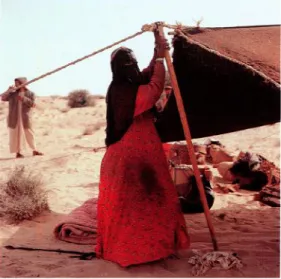
and vice versa.84 A clear example of this can be seen in the manner in which the tents
were set up, whilst in most narratives we are told that the women took on this job the
photographs show that both men and women teamed up to perform this task (see
84 Interview A. 21 August 2019.
Figure 4. “Donkey with pack saddle being watered at a ”clay
crib” Photographed by Ferdinand and Bang, in Bedouins of
figure 5). This demonstrates that there did not exist an explicit set of expected gender
performative roles, and there wasn’t a designated role for men and women. During
pre 1950s the main sources of income for Qatari families was through pearl trading.85
According to interviewee A, usually the men, or boys above the age of seven, would
go on a dhow, a sailing boat usually found in the Gulf, for four months out of the year
and dive for pearls.86
However other sources have stated that pearl diving can take up
to five months and was spread throughout the year as it included trips into the sea for
harvesting and later on the pearl diving would start in June and would last until
September.87
This meant that it could be described as a matriarchal society, because
for half the year women assumed all the
roles that were essential to have a
functioning society.88
This is very interesting
as it showcases that women had to take on
roles that, today, may be viewed as men’s
roles. This shows that the line between male
and female roles were rather blurred and
thus more flexible.
On the other hand, women who came
from wealthier families, and who were able
to afford servants, did not perform the variety of roles performed by the average
85
Barry Rubin, The Middle East: a Guide to Politics, Economics, Society and Culture
(Hoboken: Taylor and Francis, 2015), 151. 86
Interview A. 21 August 2019.
87 Amira Sonbol, Gulf Women, (Doha: Hamad Bin Khalifa Univeristy Press), 2017, 328.
88
For a better understanding of what a matriarchal society looks like one could have a look at Peter Davies’s book Myth, Matriarchy and Modernity. Johann Jakob
Bachofen in German Culture. 1860–1945.
Figure 5. “Safiya erects the central eastern end pole...Her husband can be seen in the background” Photographed by Ferdinand