TESTING MODERATION AND MEDIATION MODELS OF THE RELATIONSHIPS BETWEEN SELF-OBJECTIFICATION AND DISORDERED EATING AND RISKY
SEXUAL BEHAVIORS
Mary K. Higgins
A thesis submitted to the faculty of the University of North Carolina at Chapel Hill in partial fulfillment of the requirements for the degree of Masters of Arts in the Department of
Psychology.
Chapel Hill 2011
Approved by:
Anna Bardone-Cone, Ph.D. Mitch Prinstein, Ph.D.
ii
ABSTRACT
MARY K. HIGGINS: Testing Moderation and Mediation Models of the Relationships between Self-Objectification and Disordered Eating and Risky Sexual Behaviors
(Under the direction of Anna Bardone-Cone)
Self-objectification has been linked to disordered eating in a number of studies, and body shame is a well-documented mediator of this relationship. The relationship between self-objectification and risky sexual behaviors has been examined much less, although preliminary studies have provided support for this linkage. Due to the limited evidence for this relationship, as well as the lack of moderator findings for both relationships, we probed these relationships further by
iii
TABLE OF CONTENTS
LIST OF TABLES... v
LIST OF FIGURES ... vi
Chapter I. INTRODUCTION…………...1
Self-objectification and Disordered Eating...2
Self-objectification and Sexual Behaviors...6
The Current Study………...8
Hypotheses related to self-objectification and disordered eating…………....9
Hypotheses related to self-objectification and risky sexual behaviors...9
II. METHOD...11
Participants and Procedure ...11
Measures...11
Analytic Strategy...…...………...………...15
III. RESULTS ...16
Descriptive Analyses...17
Self-Objectification and Disordered Eating Moderation Analyses...18
Self-Objectification and Disordered Eating Mediation Analyses...20
iv
Self-Objectification and Risky Sexual Behavior Mediation
v
LIST OF TABLES Table
1. Means and standard deviations of primary measures………...38 2. Correlations among primary constructs………...………...……..39 3. Hierarchical multiple regression analyses of the interaction of body surveillance
and body shame with disordered eating as dependent variables…...……....40 4. Hierarchical multiple regression analyses of the interaction of body surveillance
and sexual self-efficacy with disordered eating as dependent variables…...41 5. Hierarchical multiple regression analyses of the interaction of body surveillance
and body shame with risky sexual behaviors as dependent variables…...….…42
vi
LIST OF FIGURES Figure
1. Interaction between body surveillance and body shame with the
dependent variable of the EAT-26 scores………...44 2. Interaction between body surveillance and body shame with the
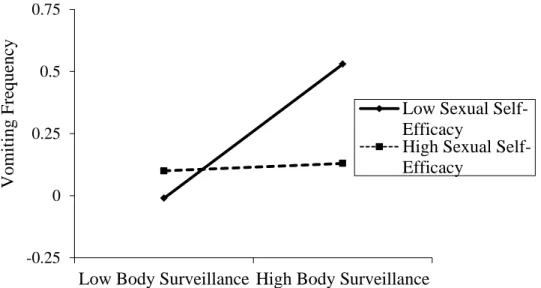
dependent variable of vomiting frequency………...45 3. Interaction between body surveillance and body shame with the
dependent variable of the combined Weight and Shape Concern subscales
of the EDE-Q...46 4. Interaction between body surveillance and sexual self-efficacy with the
dependent variable of EAT-26 scores...47 5. Interaction between body surveillance and sexual self-efficacy with the
dependent variable of vomiting frequency...48 6. Body shame and sexual self-efficacy as mediators of the relation between
body surveillance and EAT-26 scores...49 7. Body shame and sexual self-efficacy as mediators of the relation between
body surveillance and binge eating frequency...50 8. Body shame and sexual self-efficacy as mediators of the relation between
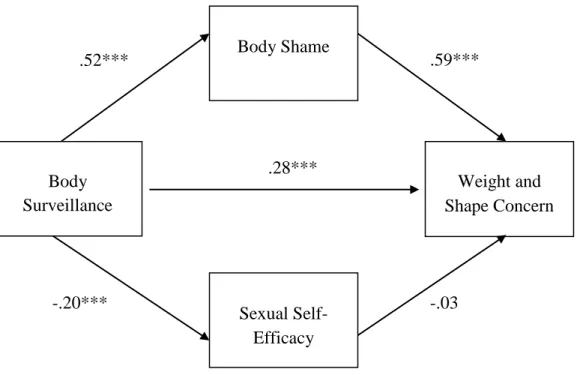
body surveillance and vomiting frequency...51 9. Body shame and sexual self-efficacy as mediators of the relation between
body surveillance and weight and shape concern...52 10. Interaction between body surveillance and sexual self-efficacy with the
dependent variable of number of sexual partners in the past year...53 11. Body shame and sexual self-efficacy as mediators of the relation between
body surveillance and number of sexual partners in the past year...54 12. Body shame and sexual self-efficacy as mediators of the relation between
CHAPTER 1 INTRODUCTION
Objectification theory (Fredrickson & Roberts, 1997) states that the widespread and chronic sexual objectification to which women in our culture are exposed (through the media, men, and peers) causes women to take an outsider’s perspective when assessing their own bodies. This phenomenon of viewing oneself from an outsider’s perspective is known as self-objectification, and has been linked to a number of adverse psychological and physical outcomes including eating disorders, depression, and sexual dysfunction. Research has shown that objectification and negative body esteem occur in very young girls. In a
surprising study conducted by Murnen, Smolak, and Good (2003) the authors found that girls as young as 6 to 12 years of age who were exposed to objectified images of women and responded positively to such images endorsed a desire to look like these women, as well as a belief that achieving such an appearance would be easy. Furthermore, internalization and awareness of society’s pressure to be thin was related to body esteem, in that girls who had
internalized the thin ideal less had higher body esteem. Regarding objectification and sexual health, in the 2007 Report of the American Psychological Association Task Force on the
Sexualization of Girls the authors called for research investigating the impact of sexualization
2
the increased sexual objectification of girls at younger and younger ages (Coy, 2009), there is a growing and pressing need to identify the negative outcomes of such sexual
objectification.
Youth’s susceptibility to objectification highlights the importance of investigating (and hopefully unveiling) those who are most at risk of experiencing the effects of living in an objectifying world. In this study we will investigate two factors, high body shame and low sexual self-efficacy, that we believe may increase the probability of engaging in
disordered eating and risky sexual behaviors among women living in an objectifying culture where these concerns are prevalent.
Self-objectification and disordered eating
Fredrickson and Roberts’ (1997) objectification theory draws a clear link between
self-objectification and disordered eating. As women start to view themselves from an outsider’s perspective, they are more likely to compare themselves to the “ideals” found in
the media. Women in the media are commonly portrayed as very thin and sexualized. In fact, numerous studies have shown that women are objectified and sexualized more often than men in mainstream media (Copeland, 1989; Furnham & Mak, 1999; Zhang, Dixon, & Conrad, 2010). As this is the culture that women grow up in, it is not surprising that women are critical of themselves and often fail to “measure up,” leading to increased body
dissatisfaction. Furthermore, in striving to achieve the perfection they see in the media, they may engage in unhealthy behaviors such as dieting and the compensatory behavior of
purging (Hawkins, Richards, Granley, & Stein, 2004; Stice & Shaw, 1994).
3
Tylka, 2006; Noll & Fredrickson, 1998; Prichard & Tiggemann, 2005). Rolnik, Engeln-Maddox, and Miller’s (2010) study exemplifies this link. The authors found that women who
were going through sorority rush had higher levels of self-objectification and subsequent increased disordered eating behaviors and attitudes, when compared to undergraduate women who were not rushing. Furthermore, the authors found a strong link between increases in self-objectification and increases in disordered eating over time. These findings suggest that women who more often take on an observer’s perspective when evaluating their own bodies
may engage in eating disorder activities, presumably as a means of achieving or maintaining the bodies they feel are most prized in our culture (e.g., via restrained eating and
compensatory behaviors) or as a means of escaping negative affect generated by failing to meet up to highly prized body standards (e.g., binge eating).
While the self-objectification/disordered eating link has been well-established, why is it that not all women engage in disordered eating in our culture? Few studies have tested moderation models in relation to this linkage, but of those that have, no clearly supported moderators have emerged. Choma, Shove, Busseri, Sadava, and Hosker (2009) investigated body shame and body image coping strategies (e.g., ways in which individuals handle threats to body image) as potential moderators and mediators of the linkage between
4
undergraduate female sample, finding no support for either ethnic identity or feminist identity as moderators.
Although moderators of the self-objectification/disordered eating relationships have not been identified, Fredrickson and Roberts (1997) outlined a few potential mediators in their objectification theory, body shame being one such example. Body shame is closely related to self-objectification such that engaging in self-objectification leads to body shame. This occurs when a woman compares her body to an idealized version of the female form (set forth by depictions in the media, through comments made by peers, etc.), and finds that she fails to “measure up.” This realization may lead to embarrassment, sadness, and shame.
Shame has been shown to cause an intense desire to hide, escape scrutiny by others, or disappear, along with feelings of worthlessness (Tangney, Miller, Flicker, & Barlow, 1996), all which may drive disordered eating. Furthermore, Fredrickson and Roberts (1997) posit that in American culture, body size and weight are believed to be controllable factors. Thus, for women who self-objectify, the belief that the body is eminently controllable may
contribute both to body shame and to efforts to change their appearance through extreme compensatory behaviors.
Multiple studies have found support for body shame as a mediator of the relationship between self-objectification and disordered eating (Choma et al., 2009; Noll & Fredrickson, 1998; Slater & Tiggemann, 2002; Tiggemann & Kuring, 2004). The work of Fredrickson, Roberts, Noll, Quinn, and Twenge (1998) highlights the role of body shame using an experimental paradigm. They found that the manipulation of self-objectification (i.e., wearing a swimsuit) resulted in body shame which in turn predicted restrained eating in an
5
that among women who endorsed working out for at least 20 minutes, two times per week, self-objectification increased body shame, which then mediated the relationship between self-objectification and disordered eating. This finding held, even when looking at younger (ages 18-30) versus older (ages 39-64) women, demonstrating the potentially broad relevance of this linkage for women, regardless of age.
A less studied mediator of the relationship between self-objectification and disordered eating is sexual self-efficacy. Bandura (1986) stated that self-efficacy is an individual’s belief about her ability to perform a given activity or task in a particular situation. For example, sexual self-efficacy is one’s belief that she can convince her partner to engage in safe sexual practices (e.g. contraception use) or one’s belief that she herself can abstain from sexual experiences she does not want (Rosenthal, Moore, & Flynn, 1991). Applying
objectification theory to sexual experiences, it makes sense that women who feel they solely exist for others’ pleasure (i.e. sexually, visually), may feel less empowered to insist that their partner wear a condom or to say “no” to an unwanted sexual advance. In relation to
disordered eating, women who view themselves as objects may feel incapable of asking their partners to engage in safe sex (i.e., low sexual self-efficacy) and may be more likely to engage in disordered eating, either as an escape from their unpleasant feelings, as could be the case with binge eating (Heatherton & Baumeister, 1991), or as a means of exerting control over their bodies, as could be the case with anorexic behaviors (Dignon, Beardsmore, Spain, & Kuan, 2006).
Calogero and Thompson (2009) tested sexual self-esteem and sexual self-efficacy as mediators of the self-objectification/disordered eating relation with two groups of
6
that higher levels of self-objectification were related to less sexual self-esteem, which mediated the relationship between self-objectification and disordered eating. In a follow-up study, using a British sample, the authors performed the same analyses, but used sexual self-efficacy as a mediator, finding that the relationship still held, but was weaker. Thus, women who engaged in objectification were more likely to have lower levels of sexual self-esteem and sexual self-efficacy, which were associated with higher levels of disordered eating. More broadly, this line of research demonstrates a link between objectification, feelings about sexuality, and eating behaviors and attitudes.
Self-Objectification and Sexual Behaviors
Far less research has examined the link between self-objectification and sexual behaviors. Fredrickson and Roberts (1997) discuss this possible link, stating that the shame associated with not living up to cultural standards of beauty can make women feel negatively towards their bodies and sexual experiences more generally. Additionally, Martin (1996) argues that the cultural expectation of women to be inactive participants in sexual situations (i.e., function more as objects) subsequently leads adolescent girls and young women to be more passive in their sexual encounters.
7
partners, or may engage in intercourse without the use of a condom or other contraception. These women may not feel they are worth men’s attention, and as a result, may be more willing to engage in risky sexual intercourse, thinking that if they do not permit sexual activity to occur, they will lose the man’s attention. In contrast, other women may refrain
from sexual activities (or, when they do engage in sexual activities, they may find themselves having difficulties achieving orgasm or enjoying the experience more generally) because of shame and embarrassment associated with their bodies as a result of self-objectification (Fredrickson & Roberts, 1997). Thus, it is possible that women may either become
hypersexual and engage in risky sexual behaviors if they self-objectify, or they may become avoidant of sexual activity or unable to enjoy sexual intercourse, which could lead to sexual dysfunction.
Of the scant research linking self-objectification with sexual behaviors, most studies have investigated possible mediators, explicitly or implicitly, in order to understand this association. Two theoretically compelling mediators that have been investigated are body shame and sexual self-efficacy. Schooler (2005) found that among a sample of women, those reporting more body shame had less sexual experience, less condom use self-efficacy, and less sexual assertiveness. Because the author highlights body shame as implicitly emerging from objectification, this study can be seen as at least suggestive evidence of body shame as a possible mediator.
8
women who engage in self-objectification are likely to feel less sexually self-efficacious, which in turn helps explain engagement in risky sexual practices. Those who do not think they are “worthy” of asking a partner to wear a condom, or who feel that their bodies are not
really their own, but are for others’ enjoyment, may not feel they have the right to act responsibly or healthfully in sexual situations.
The Current Study
The current study aimed to investigate the relationship between self-objectification and disordered eating, and between self-objectification and risky sexual behaviors,
considering the potential moderating and mediating roles of body shame and sexual self-efficacy among a group of undergraduate college women. Most research in this area has focused on self-objectification and disordered eating or self-objectification and risky sexual behaviors, but few have considered, in the same sample, how self-objectification may be related to both of these behaviors. This approach could provide valuable information about the way in which women view their bodies and themselves as sexual entities.
9
change in their sexual encounters, in the hopes of buffering these harmful relationships. Since both variables have some support as mediators in the relationships between self-objectification and disordered eating and self-self-objectification and risky sexual behaviors, testing the mediation models in the current study may primarily replicate findings, albeit often with different assessments than used previously (e.g., Noll & Fredrickson, 1998). By additionally investigating these variables as moderators, we expand the potential roles body shame and sexual self-efficacy may have in the relationship between self-objectification and both disordered eating and risky sexual behaviors.
Hypotheses related to self-objectification and disordered eating
Hypothesis 1. Self-objectification will be positively associated with disordered eating such that higher levels of self-objectification will be associated with higher levels of
disordered eating.
Hypothesis 2-moderation. Body shame and sexual self-efficacy are each proposed to moderate the relationship between self-objectification and disordered eating, such that this relationship will be exacerbated among those with high body shame and among those with low sexual self-efficacy. However, it is proposed that body shame will be the stronger moderator of this relationship.
Hypothesis 3-mediation. Body shame and sexual self-efficacy are each proposed to mediate the relationship between self-objectification and disordered eating, such that the effect of self-objectification on disordered eating is at least partially explained through body shame and at least partially explained through sexual self-efficacy. Body shame is proposed to be a stronger mediator of this relationship, as well.
10
Hypothesis 4. Self-objectification will be positively associated with risky sexual behaviors, such that higher levels of self-objectification will be associated with more risky sexual behaviors.
Hypothesis 5-moderation. Body shame and sexual self-efficacy are each proposed to
moderate the relationship between self-objectification and risky sexual behaviors such that this relationship will be exacerbated among those with high body shame and among those with low sexual self-efficacy. It is proposed that sexual self-efficacy will be a stronger moderator of this relationship.
Hypothesis 6-mediation. Body shame and sexual self-efficacy are each proposed to
CHAPTER 2 METHOD Participants and Procedure
Participants were 441 female undergraduate students at a large Southeastern
university. All participants were enrolled in the university’s introductory psychology courses and received course credit for their participation which occurred in the 2010-2011 academic year. After providing informed consent, participants completed an online survey lasting about 45-60 minutes and then received a debriefing statement about the study. All aspects of this study were approved by the university’s Institutional Review Board.
Participants ranged in age from 17 to 24 with a mean age of 18.71 (SD = 1.01 years). The majority of the participants (73.2%) self-reported as Caucasian, 9.1% as African
American, 8% as Latina, 5% as Asian, .2% as Pacific Islander, 4.3% as multiple races or ethnicities, and .2% as other races/ethnicities. One participant did not report her race or ethnicity. Highest parental education, which is as a proxy for socioeconomic status, ranged from 7 to 21 years (M = 17.00 years, SD = 2.67). Based on their self-report of current height and weight, participants averaged a body mass index (BMI) of 22.39 kg/m2 (SD = 3.73) with a range of 16.76 to 41.24.
Measures
12
others see it, and is thus closely related to self-objectification. The Body Surveillance subscale consists of eight items that measure how much a woman monitors her body based on how it looks, rather than how it feels. Items are measured on a 7-point scale (1 = strongly
disagree, 7 = strongly agree), with higher scores reflecting greater body
surveillance/self-objectification. There is also a “not applicable” option, in case the participant has never been confronted with the situation described. McKinley and Hyde (1996) found that the Body Surveillance subscale has adequate reliability (e.g., coefficient alpha of .89), as well as good construct validity as indicated by its
-.39 correlation with the Body Esteem Scale (BES; Franzoi & Shields, 1984) among a sample of undergraduate women. In the current study, coefficient alpha was .84.
Disordered Eating. Disordered eating was assessed with the Eating Attitudes Test-26 (EAT-Test-26; Garner, Olmsted, Bohr, & Garfinkel, 1982) and the Eating Disorder
Examination-Questionnaire (EDE-Q 6.0; Fairburn & Beglin, 2008). The EAT-26 is a 26-item self-report questionnaire that measures the degree to which participants engage in a variety of disordered eating behaviors and attitudes (e.g., “I am terrified about being overweight,” “I avoid eating when I am hungry”) and has been posited to, in particular, capture anorexic attitudes (Garner, Olmsted, Bohr, & Garfinkel, 1982). Items are rated on a 6-point scale (1 = never, 6 = always), with higher scores reflecting greater eating pathology. Items endorsed as 1, 2, or 3 are scored as “0,” while items marked as 4, 5, or 6 are scored as “1,” “2,” or “3,” respectively. The EAT-26 has been shown to be reliable among college women (α =.92; Moradi, Dirks, & Matteson, 2005). As an indicator of this measure’s
13
score of 20 indicating a probable eating disorder (King, 1989, 1991) among a sample of men and women aged 16-35. In the current study, coefficient alpha for the EAT-26 was .90.
The Eating Disorder Examination-Questionnaire is a 28-item questionnaire that assesses disordered eating behaviors and attitudes over the past 28 days and is derived from the Eating Disorder Examination (EDE) interview (Fairburn & Cooper, 1993). Items are scored on a 7-point scale, with higher scores reflecting greater eating pathology. This
measure has the subscales of Weight Concern and Shape Concern which are combined in this study, given evidence that these two subscales loaded on the same factor in a study
investigating the factor structure of the EDE-Q (Peterson et al., 2007). Additionally, the EDE-Q assesses frequency of specific eating disorder behaviors (e.g., binge eating, self-induced vomiting over the past 28 days). Studies have shown high levels of agreement between earlier versions of the EDE-Q and the EDE across various populations (Fairburn & Beglin, 1994; Mond, Hay, Rodgers, Owen, & Beumont, 2004). Acceptable internal
consistency (.89 and .93) and test-retest reliability (.92 and .94) have been found for the subscales of weight concern and shape concern of an earlier version of this measure, respectively (Luce & Crowther, 1999). In the current study, coefficient alpha for the combined Weight Concern and Shape Concern subscale was .95.
Risky Sexual Behaviors. Risky sexual behaviors were assessed with the Sexual Experiences Questionnaire (SEQ) which was compiled from a variety of sources and authors (Feiring, 1996; Feiring, 1999; McCabe & Collins, 1984; Treboux & Busch-Rossnagel, 1990) and has been used in prior work (Allen, Porter, & McFarland, 2006). The SEQ asks
14
than 10”) and how often the participant or her partner(s) have used protection against
pregnancy when having sex (response scale from 1 = never to 5 = all of the time). Questions involving sexual behavior were only asked of those who reported having engaged in sexual intercourse in the past 12 months.
Body Shame. Body shame was assessed with the Body Shame subscale of the OBCS (McKinley & Hyde, 1996). This subscale contains eight items that measure the degree to which one feels shame when her body does not conform to cultural standards. Each item is rated on a 7-point scale (1 = strongly disagree, 7 = strongly agree), with higher scores reflecting greater body shame. Participants have the option to mark “not applicable” if they encounter an item that does not apply to their experiences. McKinley and Hyde (1996) found that the Body Shame subscale has adequate reliability (e.g., coefficient alpha of .75), as well as good construct validity as indicated by its -.51 correlation with the Body Esteem Scale (BES; Franzoi & Shields, 1984) among a sample of undergraduate women. In the current study, coefficient alpha was .84.
Sexual Efficacy. Sexual self-efficacy was assessed with the Sexual Self-Efficacy Scale (SSES; Soet, Dudley, & Dilorio, 1999). For the purposes of this study, only the Refusal subscale was used, and items were slightly modified from the original wording “can” to “can/could” in order to allow participants who had not engaged in sexual intercourse
to respond to the items. The Refusal subscale contains four items, scored on a 10-point scale (1 = not at all sure I can do it, 10 = completely sure I can do it). It asks about one’s
perceived ability to say “no” to a sexual partner in favor of engaging in safe sexual behaviors
15
if I have had sex with them before”). The Refusal subscale of the SSES has been shown to be reliable among college women (α =.74; Soet, Dudley, & Dilorio, 1999). Additionally, the
overall SSES has demonstrated validity; those who stated they did not use a condom at last sexual intercourse were found to have significantly lower sexual self-efficacy ratings than those who stated they did. In the current study, coefficient alpha was .85.
Analytic Strategy
Moderation Analyses. Hypothesized interactions were assessed using hierarchical
multiple regression following the guidelines prescribed by Cohen and Cohen (1983). As recommended by Frazier, Tix, and Barron (2004), continuous variables entering into interactions (i.e., objectification and body shame or objectification and sexual self-efficacy) were centered. A significant two-way interaction would indicate that the strength or direction of the association between self-objectification and the dependent variable (i.e., disordered eating or risky sexual behaviors) depends on the level of the moderator. To understand the nature of the interaction, all significant interactions were graphed to provide a visual depiction of the relations among the variables. Additionally, simple slope analyses were used to further probe the nature of any significant interactions (Aiken & West, 1991). IBM SPSS Statistics 19.0 was used to run these analyses.
16
because indirect effects are normal only in very large samples, and even then do not generally follow a normal distribution). Additionally, the number of inferential tests is reduced by using bootstrapping, and thus there is less likelihood of Type I errors
CHAPTER 3 RESULTS Descriptive Analyses
Table 1 includes the means and standard deviations of the primary measures. The observed range for binge eating in the past 28 days was zero to 60 times; the observed range for vomiting frequency in the past 28 days was zero to 29 times. Number of sexual partners in the past year was only asked of participants who indicated that they had engaged in consensual sexual intercourse in the past year; responses ranged from one partner to ten or more.
18
protection against pregnancy was not significantly associated with any of the other dependent variables.1
Self-Objectification and Disordered Eating Moderation Analyses
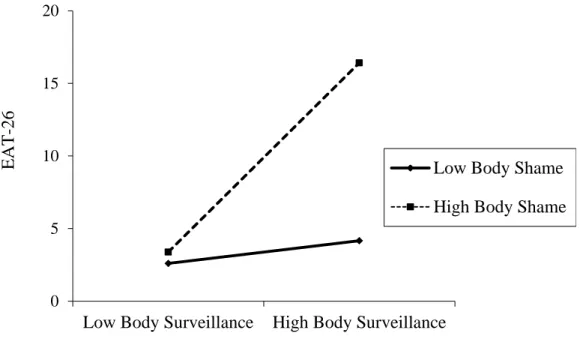
Body Shame. When examining EAT-26 scores, body surveillance interacted with
body shame such that among those with high body surveillance, higher levels of body shame were associated with greater disordered eating symptoms, t(373) = 9.29, ∆R2 = .10, p < .001 (see Table 3 and Figure 1; in all figures, high and low values of the independent variables are defined as plus or minus one standard deviation from the mean, respectively). Simple slope analyses, performed as directed by Aiken and West (1991), indicated that body surveillance was significantly associated with disordered eating symptoms at high levels of body shame (1 SD above the mean), β = .67, t(373) = 12.77, p < .001, but not at low levels of body shame (1 SD below the mean), β = .08, t(373) = 1.60, p = .111.
When examining number of episodes of binge eating in the past 28 days, no
significant two-way interaction emerged involving body surveillance and body shame, t(414) = .95, ∆R2 = .00, p = .345; see Table 3.
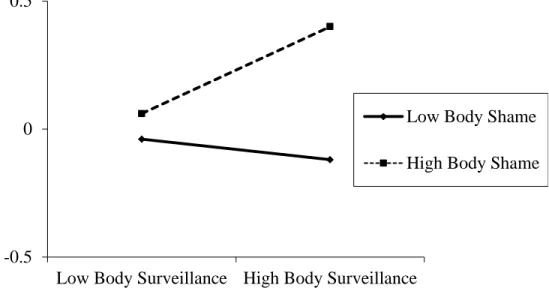
When examining number of episodes of vomiting in the past 28 days, body
surveillance interacted with body shame such that among those with high body surveillance, higher levels of body shame were associated with more vomiting, t(418) = 5.09, ∆R2 = .06, p < .001; see Table 3 and Figure 2. Simple slope analyses indicated that body surveillance was
1 Self-reported BMI was significantly positively correlated with body shame and most of the
19
significantly associated with vomiting frequency at high levels of body shame, β = .29, t(418) = 3.97, p < .001, as well as at low levels of body shame, albeit not as strongly and in the opposite direction, β = -.15, t(418) = -2.30, p = .022. 2
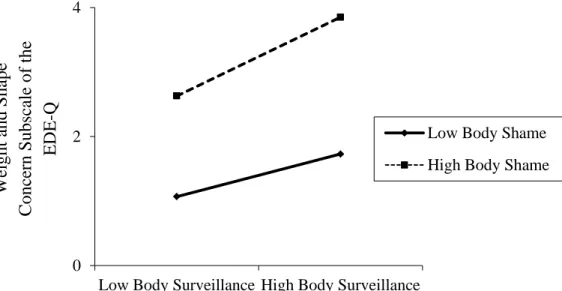
When examining weight and shape concern, body surveillance interacted with body shame such that among those with high body surveillance, higher levels of body shame were associated with greater weight and shape concern, t(419) = 3.08, ∆R2 = .01, p < .01; see Table 3 and Figure 3. Simple slope analyses indicated that body surveillance was
significantly associated with weight and shape concern at high levels of body shame, β = .38, t(419) = 8.10, p < .001, as well as at low levels of body shame, albeit not as strongly, β = .21, t(419) = 4.82, p < .001.
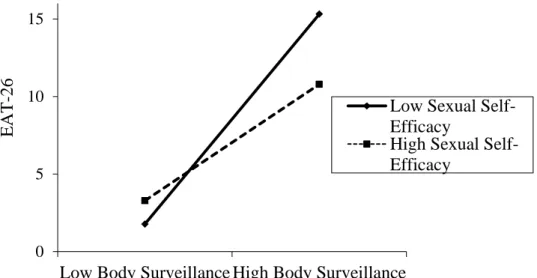
Sexual Self-Efficacy. When examining EAT-26 scores, body surveillance interacted with sexual self-efficacy such that among those with high body surveillance, lower levels of sexual self-efficacy were associated with greater disordered eating symptoms, t(385) = -3.48,
∆R2
= .02, p < .001; see Table 4 and Figure 4. Simple slope analyses revealed that body surveillance was significantly associated with disordered eating symptoms at low sexual self-efficacy, β = .72, t(385) = 10.83, p < .001, as well as at high sexual self-efficacy, albeit not as strongly, β = .40, t(385) = 6.81, p < .001.
When examining number of episodes of binge eating in the past 28 days, no significant two-way interaction emerged involving body surveillance and sexual self-efficacy, t(431) = .13, ∆R2 = .00, p = .894; see Table 4.
2
Figures of moderator models involving vomiting frequency used high and low values of ± ½ a standard deviation of the independent variables. This was done because with a full
20
When examining number of episodes of vomiting in the past 28 days, body surveillance interacted with sexual self-efficacy such that among those with high body surveillance, lower levels of sexual self-efficacy were associated with more vomiting, t(435) = -5.13, ∆R2 = .05, p < .001; see Table 4 and Figure 5. Furthermore, simple slope analyses revealed that body surveillance was significantly associated with vomiting frequency at low sexual self-efficacy, β = .41, t(435) = 5.58, p < .001, but not at high sexual self-efficacy, β = -.11, t(435) = -1.72, p = .086.
When examining weight and shape concern no significant two-way interaction emerged involving body surveillance and sexual self-efficacy, t(436) = -1.39, ∆R2 = .00, p = .165; see Table 4.
Comparing the moderators of body shame and sexual self-efficacy. Body shame was a significant moderator for three models (dependent variables of EAT-26, vomiting frequency, and weight and shape concern), while sexual self-efficacy was only significant in two models (dependent variables of EAT-26 and vomiting frequency) providing initial support for body shame being the more robust moderator. Considering relative strength, in the two models where both moderators were significant, more variance was accounted for by body shame than sexual self-efficacy when examining EAT-26 score as the dependent variable (10% for body shame, 2% for sexual self-efficacy), but for the interactive model with vomiting frequency as the dependent variable, similar amounts of variance were accounted for by the interactive effect (6% for body shame, 5% for sexual self-efficacy). Self-Objectification and Disordered Eating Mediation Analyses
Body Shame. When examining EAT-26 scores, the bootstrap results indicated that
21
significant, with a standardized point estimate of 0.21 (p < .001) and a 95% BC
(bias-corrected) bootstrap confidence interval (CI) of 0.17 to 0.26. Body shame partially mediated the relation between body surveillance and EAT-26 scores.
When examining binge eating frequency in the past 28 days, the bootstrap results indicated that the indirect effect of body surveillance on binge eating frequency through body shame was significant, with a standardized point estimate of 0.13 (p < .001) and a 95% BC CI of 0.06 to 0.19. Body shame partially mediated the relation between body surveillance and binge eating frequency.
When examining vomiting frequency in the past 28 days, the bootstrap results indicated that the indirect effect of body surveillance on vomiting frequency through body shame was significant, with a standardized point estimate of 0.11 (p < .001) and a 95% BC CI of 0.06 to 0.16. Body shame fully mediated the relation between body surveillance and vomiting frequency.
When examining weight and shape concern, the bootstrap results indicated that the indirect effect of body surveillance on weight and shape concern through body shame was significant, with a standardized point estimate of 0.31 (p < .001) and a 95% BC CI of 0.26 to 0.36. Body shame partially mediated the relation between body surveillance and weight and shape concern.
Sexual Self-Efficacy. When examining the EAT-26 scores, the bootstrap results
22
When examining binge eating frequency, the bootstrap results indicated that the indirect effect of body surveillance on binge eating frequency through sexual self-efficacy was not significant, with a standardized point estimate of 0.01 (p = .399) and a 95% BC CI of -0.02 to 0.04. Sexual self-efficacy did not mediate the relation between body surveillance and binge eating frequency.
When examining vomiting frequency, the bootstrap results indicated that the indirect effect of body surveillance on vomiting frequency through sexual self-efficacy was not significant, with a standardized point estimate of 0.03 (p = .078) and a 95% BC CI of -0.003 to 0.07. Sexual self-efficacy did not mediate the relation between body surveillance and vomiting frequency.
When examining weight and shape concern, the bootstrap results indicated that the indirect effect of body surveillance on weight and shape concern through sexual self-efficacy was significant, with a standardized point estimate of 0.03 (p < .05) and a 95% BC CI of 0.01 to 0.05. Sexual self-efficacy partially mediated the relation between body surveillance and weight and shape concern.
Comparing the mediators of body shame and sexual self-efficacy. From a count perspective, body shame was clearly the more consistent mediator than sexual self-efficacy in the body surveillance/disordered eating relations. Since we can empirically test relative strengths of mediators using path analysis, the following lays out those findings.
When examining body shame and sexual self-efficacy together as mediators in relation to EAT-26 scores, the bootstrap results indicated that the total indirect effect of body surveillance on EAT-26 scores through this set of mediators was significant, with a
23
shame and sexual self-efficacy partially mediated the relation between body surveillance and EAT-26 scores. The specific indirect effects of each mediator showed that body shame was a unique and significant mediator, with a standardized point estimate of 0.21 (p < .001) and a 95% BC CI of 0.16 to 0.25. However, sexual self-efficacy did not add significantly to the model, with a standardized point estimate of 0.01 (p = .280) and a 95% BC CI of -0.01 to 0.03. A contrast confirmed that the indirect effect of body shame in the body
surveillance/EAT-26 relation was significantly stronger (p < .001) than the indirect effect of sexual self-efficacy (see Figure 6 for the full meditational model).
When examining body shame and sexual self-efficacy together as mediators in relation to binge eating in the past 28 days, the bootstrap results indicated that the total indirect effect of body surveillance on binge eating frequency through this set of mediators was significant, with a standardized point estimate of 0.13 (p < .001) and a 95% BC CI of 0.06 to 0.20. Thus, body shame and sexual self-efficacy partially mediated the relation between body surveillance and binge eating frequency. The specific indirect effects of each mediator showed that body shame was a unique and significant mediator, with a standardized point estimate of 0.13 (p < .001) and a 95% BC CI of 0.07 to 0.18. However, sexual self-efficacy did not add significantly to the model, with a standardized point estimate of 0.00 (p = .757) and a 95% BC CI of -0.02 to 0.03. A contrast confirmed that the indirect effect of body shame in the body surveillance/binge eating relation was significantly stronger (p < .001) than the indirect effect of sexual self-efficacy (see Figure 7 for the full meditational model).
24
that the total indirect effect of body surveillance on vomiting frequency through this set of mediators was significant, with a standardized point estimate of 0.12 (p < .001) and a 95% BC CI of 0.06 to 0.17. Thus, body shame and sexual self-efficacy partially mediated the relation between body surveillance and vomiting frequency. The specific indirect effects of each mediator showed that body shame was a unique and significant mediator, with a standardized point estimate of 0.09 (p < .001) and a 95% BC CI of 0.04 to 0.14. However, sexual self-efficacy did not add significantly to the model, with a standardized point estimate of 0.03 (p = .138) and a 95% BC CI of -0.01 to 0.06. A contrast indicated that the indirect effect of body shame in the body surveillance/vomiting relation was not significantly stronger (p = .141) than the indirect effect of sexual self-efficacy (see Figure 8 for the full meditational model).
25
(p < .001) than the indirect effect of sexual self-efficacy (see Figure 9 for the full meditational model).
Self-Objectification and Risky Sexual Behavior Moderation Analyses
Body Shame. When examining the number of sexual partners in the past year and
use of protection against pregnancy during sexual intercourse, no significant two-way interactions emerged involving body surveillance and body shame (see Table 5).
Sexual Self-Efficacy. When examining number of sexual partners in the past year,
body surveillance interacted with sexual self-efficacy such that among those with high body surveillance, lower levels of sexual self-efficacy were associated with more sexual partners in the past year, t(207) = -3.51, ∆R2 = .05, p < .001; see Table 6 and Figure 10. Further, simple slope analyses revealed that body surveillance was significantly associated with number of sexual partners at low sexual self-efficacy, β = .42, t(207) = 4.69, p < .001, but not at high sexual self-efficacy, β = -.04, t(207) = -.43, p = .671.
When examining use of protection against pregnancy during sexual intercourse, no significant two-way interaction emerged involving body surveillance and sexual self-efficacy, t(205) = .26, ∆R2 = .00, p = .759; see Table 6.
Self-Objectification and Risky Sexual Behaviors Mediation Analyses
26
When examining frequency of use of protection against pregnancy, the bootstrap results indicated that the indirect effect of body surveillance on frequency of use of protection through body shame was not significant, with a standardized point estimate of -0.03 (p = .523) and a 95% BC CI of -0.13 to 0.06. Body shame did not mediate the relation between body surveillance and frequency of use of protection.
Sexual Self-Efficacy. When examining number of sexual partners in the past year, the bootstrap results indicated that the indirect effect of body surveillance on number of partners through sexual self-efficacy was significant, with a standardized point estimate of 0.05 (p < .01) and a 95% BC CI of 0.02 to 0.09. Sexual self-efficacy partially mediated the relation between body surveillance and number of sexual partners.
When examining frequency of use of protection against pregnancy, the bootstrap results indicated that the indirect effect of body surveillance on frequency of use of
protection through sexual self-efficacy was significant, with a standardized point estimate of -0.04 (p < .05) and a 95% BC CI of -0.07 to -0.01. Sexual self-efficacy fully mediated the relation between body surveillance and frequency of use of protection.
Comparing the mediators of body shame and sexual self-efficacy. From a count perspective, sexual self-efficacy was clearly the more consistent mediator than body shame in the body surveillance/risky sexual behavior relations. The relative strengths of these mediators were tested using path analysis; the following lays out those findings.
27
95% BC CI of -.10 to 0.12. Thus, body shame and sexual self-efficacy as a set did not mediate the relation between body surveillance and number of sexual partners. The specific indirect effects of each mediator showed that sexual self-efficacy was a unique and
significant mediator, with a standardized point estimate of 0.06 (p < .01) and a 95% BC CI of 0.02 to 0.10. However, body shame did not add significantly to the model, with a
standardized point estimate of -0.05 (p = .406) and a 95% BC CI of -0.16 to 0.07. A contrast indicated that the indirect effect of sexual self-efficacy in the body surveillance/number of sexual partners relation was not significantly stronger (p = .136) than the indirect effect of body shame (see Figure 11 for the full meditational model).
28
use of protection relation was not significantly stronger (p = .361) than the indirect effect of body shame (see Figure 12 for the full meditational model).3
3
CHAPTER 4 DISCUSSION
Contrary to what was proposed, body shame and sexual self-efficacy did not moderate all of the relationships involving self-objectification and the disordered eating variables. Body shame moderated the relationship between self-objectification and almost all of the disordered eating variables (excluding binge frequency), while sexual self-efficacy only moderated the relationships between self-objectification and EAT-26 scores and vomiting frequency. Furthermore, body shame was the stronger moderator when compared with sexual self-efficacy in relation to the broad measure of eating pathology (i.e., EAT-26).
Additionally, not all of the hypotheses regarding body shame and sexual self-efficacy as moderators of the relationship between self-objectification and risky sexual behaviors were supported. Body shame did not moderate either of the relationships between self-objectification and risky sexual behaviors, while sexual self-efficacy moderated the relationship between self-objectification and number of sexual partners in the past year.
30
multiple measures of disordered eating, especially those focused on body and eating attitudes. The failure of body shame to act as a significant moderator for binge eating
frequency may be due to the fact that the combination of self-objectification and body shame pulls more for body concern and restrictive behaviors. That is, theoretically, women who are accustomed to viewing their body as others see it and who are ashamed that they are not meeting cultural standards would be motivated to engage in disordered eating behaviors revolving around weight loss, such as more anorectic behaviors (captured by the EAT-26) and purging behaviors (captured by vomiting). Since binge eating does not help them accomplish their goal of looking like the thin ideal (and reduce the shame associated with their bodies), it makes sense that the combination of high body surveillance and high body shame might not be associated with heightened binge eating frequency. However, one could argue that from an escape theory model (Heatherton & Baumeister, 1991) the negative affect generated by high body surveillance and high body shame may motivate binge eating as an escape, though this pattern of results was not found in our study.
31
less clearly self-harm behaviors. It appears that women who are comfortable and confident in their abilities to mutually engage in healthy sexual practices with their partners are also more confident and willing to abstain from particularly harmful disordered eating, even if they report high levels of self-objectification. These women may want to change their appearances to conform to cultural standards, but may feel efficacious that they can reach these goals through healthy (e.g., moderate exercise and healthy diet) versus unhealthy (e.g., starvation or self-induced vomiting) means. Although we did not assess efficacy related to appearance or fitness, it could be that the sexual self-efficacy measure taps into a broader elevated sense of self-efficacy.
Turning to the mediation models, body shame and sexual self-efficacy did not mediate all of the relationships involving self-objectification and disordered eating, contrary to hypotheses. Body shame was a partial mediator of all of the self-objectification/disordered eating relationships (except for vomiting, for which it was a full mediator); sexual
self-efficacy partially mediated only the self-objectification/weight and shape concern
relationship. When performing path analysis on the self-objectification/disordered eating relationships with body shame and sexual self-efficacy as a set of mediators, all of the relationships were significantly mediated by this set of mediators, with body shame being a unique significant mediator and significantly stronger than sexual self-efficacy when examining the outcome variables of EAT-26 scores, binge eating, and weight and shape concern. This was not the case for vomiting frequency, in which the two mediators
32
The reverse pattern of mediation findings was observed when investigating risky sexual behaviors. Body shame did not mediate the relationships between self-objectification and number of sexual partners in the past year or frequency of use of protection against pregnancy. Sexual efficacy, on the other hand, partially mediated the
objectification/number of sexual partners relationship, and fully mediated the
self-objectification/frequency of use of protection relationship. That is, it appears that those who view themselves as objects tend to exhibit decreased confidence in relation to sexual
behaviors and this low level of self-efficacy is, in turn, associated with the risky sexual behaviors of a higher number of sexual partners and a lower frequency of use of protection. From path analysis, the set of mediators did not significantly mediate the relationships involving either risky sexual behavior. Within the context of the set, while sexual self-efficacy was a significant and unique mediator of both the self-objectification/number of sexual partners relationship and the self-objectification/frequency of use of protection relationship, it was not significantly stronger than body shame.
33
intercourse will also have better attitudes/more respect toward her body (i.e., weight and shape) more generally.
Another incongruity emerged when considering the self-objectification/vomiting relation. When body shame and sexual self-efficacy were examined as a set of mediators, this set significantly mediated the relationship between self-objectification and vomiting frequency, with body shame as a significant specific mediator, but not significantly stronger than sexual self-efficacy. Although the fact that the two acted as a significant set of
mediators is not surprising given past research on related constructs (Calogero & Thompson, 2009), the fact that body shame was not a significantly stronger mediator is. In their 2008 article, Preacher and Hayes state that this pattern of results can emerge when one of the specific mediators (in this case, body shame) is not “sufficiently far from zero” when
conducting the contrast, which compares the two mediators to one another. Thus, although body shame was acting as a significant specific mediator, its effect was not strong enough to set it apart from the non-significant specific mediator of sexual self-efficacy. This finding, along with the fact that body shame only partially mediated the self-objectification/binge eating relationship, points to a need for identification of additional pathways that describe how a person would progress from self-objectification to binge eating. It is clear that other mediators besides body shame and sexual efficacy play a role in linking
self-objectification and binge eating. These mediators need to be discovered in order to gain a better understanding of how self-objectification and binge eating are connected.
self-34
objectification/disordered eating relationships, while sexual self-efficacy was not found to be a mediator of these relationships (with the exception of weight and shape concern). This is in contrast to the moderation findings, in which there was more overlap, with both body shame and sexual self-efficacy acting as moderators of some of the self-objectification/disordered eating and self-objectification/risky sexual behavior relations.
There are several strengths of this study, one being the large sample size, which enabled us to discover significant moderator findings involving self-objectification, body shame, and disordered eating when there had not been previous support for this relationship. Additionally, this study is novel in that it investigated and found links between
self-objectification and body shame and variables in the domain of risky sexual behaviors, and self-objectification and sexual self-efficacy and variables in the domain of disordered eating, further providing support for the linkage between disordered eating and risky sexual
behaviors. This study also employed multiple ways of looking at disordered eating
constructs, including both behavioral (e.g., binging and vomiting frequencies) and attitudinal (i.e., weight and shape concern). Finally, the online aspect allowed participants to complete the survey in the comfort of their homes; this may have lead to more honest responding to sensitive topics, especially those regarding risky sexual behaviors (Joinson, 2001).
35
convince a partner to wear a condom during sexual intercourse) she may overestimate or underestimate her efficacy in that situation. Thus, future studies should attempt to recruit a more sexually experienced sample in order for sexual efficacy reports to capture self-efficacy based on experiences rather than speculations.
Another limitation with having a sexually inexperienced sample is that the analyses regarding sexual behaviors (i.e., use of protection against pregnancy and number of sexual partners in the past year) only included those participants who indicated that they had been sexually active in the past year—this means that our sample size was significantly reduced for these analyses. With a larger sample size we would have had more power and thus a greater chance of uncovering small effects between our constructs. Generalizability of our findings is also a limitation. Participants were all relatively young, primarily Caucasian undergraduate women; we do not know whether these same findings would apply to women of other ages and races/ethnicities, males, a clinical eating disordered sample, or persons who engage in high sexual risk behaviors.
36
binging and vomiting or having unprotected sexual intercourse or a large number of sexual partners. A 2005 study conducted by Culbert and Klump found that among a sample of 500 undergraduate women, impulsivity functioned as a third variable, helping to partially explain the relationship between compensatory behaviors and increased sexual activity.
Future research should go beyond risky sexual behaviors to measure maladaptive sexual attitudes as well. Women who do not have a lot of sexual experience may have maladaptive sexual attitudes which are important in their own right as a topic of research and which likely will influence subsequent sexual behaviors. Additionally, future research should investigate sexual self-efficacy in a broader sense. The measure included in the study focused on refusal self-efficacy, and it would be interesting to see if the same associations are found with a more general sexual self-efficacy measure. Finally, use of protection during sexual intercourse was limited to protection to prevent pregnancy, which includes birth control that does not necessarily require a discussion with a partner (e.g., the pill,
spermicide). Perhaps by assessing use of protection against sexually transmitted infections (STIs), we would have been able to tap into the mutuality of engaging in safe sexual behaviors through condom use, which is something both partners know about and
(presumably) agree to engage in. Relatedly, future work should ask about behaviors intended to protect against STIs since asking about protecting one’s body against STIs in particular might serve as a better proxy for risky sexual behaviors and respect for one’s body more generally.
37
body shame (or low levels of sexual self-efficacy) they may be more likely to inquire about disordered eating and risky sexual behaviors. Being informed of the possible interrelatedness of these two seemingly disparate behaviors, they may be more likely to inquire about risky sexual experiences for disordered eating clients, or vice versa. Additionally, finding these significant interactions allows identification of different points of intervention. For example, if longitudinal data support causal relations, one could choose to focus on lowering self-objectification practices or boosting body acceptance or sexual self-efficacy to decrease risky behaviors. In regards to the mediation findings, the significant models aid clinicians in understanding the way self-objectification, the mediator (or set of mediators: body shame and sexual self-efficacy) and the dependent variable of either disordered eating or risky sexual behaviors are connected. Of note, in almost every case, the mediators partially mediated the self-objectification/dependent variable relations, which support the need for identifying additional explanatory pathways.
In sum, the moderators/mediators generally adhered most closely to the dependent variables of related content (i.e., body shame with disordered eating, sexual self-efficacy with risky sexual behaviors). The moderation models showed more crossover, whereas the
Table 1
Means and Standard Deviations of Primary Measures
Measure M SD Range
OBCS-Body Surveillance 4.80 .98 1 – 7
OBCS-Body Shame 3.31 1.19 1 – 7
Sexual Self-Efficacy 8.94 1.60 1 – 10
Eating Attitudes Test-26 8.27 9.44 0 – 78
EDE-Q-Binge Eating Frequency 1.86 4.70 0 – 60
EDE-Q Vomiting Frequency .28 1.92 0 – 29
EDE-Q-Weight Concern and Shape Concern 2.33 1.59 0 – 6
SEQ-Number of Different Sexual Partners in the Past Year 1.95 1.61 1 – 11
SEQ-Frequency of Use of Protection Against Pregnancy
During Sexual Intercourse 4.56 .96 1 – 5
Note. OBCS = Objectified Body Consciousness Scale. EDE-Q = Eating Disorder Examination Questionnaire. SEQ = Sexual
Experiences Questionnaire. Binge eating and vomiting frequencies refer to the number of episodes of the behavior in the past 28 days. The SEQ questions about number of sexual partners and use of protection were only asked of individuals who endorsed having
consensual sexual intercourse in the past year. For all measures, higher scores indicate higher levels of the construct.
Table 2
Correlations among primary constructs
1 2 3 4 5 6 7 8 9 10
1. BMI - 2. Body surveillance
.07 -
3. Body Shame .31*** .51*** -
4. Sexual Self- Efficacy
-.07 -.20*** -.26*** -
5. EAT-26 .11* .56*** .60*** -.23*** -
6. Frequency of Binge Eating
.12* .23*** .30*** -.10* .36*** -
7. Frequency of Vomiting
.01 .15** .23*** -.18*** .38*** .25*** -
8. Weight & Shape Concern
.38*** .59*** .75*** -.24*** .70*** .40*** .24*** -
9. Number of Sexual Partners
.05 .27*** .14* -.36*** .30*** -.01 -.01 .22** -
10. Protection Against Pregnancy
-.03 -.04 -.07 .23** -.05 .03 -.11 -.07 -.08 -
Note. Variables are continuous, with higher values reflecting higher levels of the construct. *p < .05. **p < .01. ***p < .001.
3
Table 3
Hierarchical Multiple Regression Analyses of the Interaction of Body Surveillance and Body Shame with Disordered Eating as Dependent Variables
Step and predictors B SE B β t (dfs) ΔR2
Step 1 DV=EAT-26
Body Surveillance 3.52 .44 .36*** 8.01 (2,374)
Body Shame 3.33 .36 .42*** 9.34 (2,374) .45***
Step 2
Body Surveillance x Body Shame 2.45 .26 .33*** 9.29 (1,373) .10***
Step 1 DV=Binge Eating Frequency
Body Surveillance .48 .27 .10 1.81 (2,415)
Body Shame 1.01 .22 .25*** 4.64 (2,415) .10***
Step 2
Body Surveillance x Body Shame .17 .18 .05 .95 (1,414) .00
Step 1 DV=Vomiting Frequency
Body Surveillance .09 .11 .04 .77 (2,419)
Body Shame .35 .09 .21*** 3.83 (2,419) .06***
Step 2
Body Surveillance x Body Shame .37 .07 .24*** 5.09 (1,418) .06***
Step 1 DV=Weight & Shape Concern
Body Surveillance .46 .06 .28*** 8.02 (2,420)
Body Shame .80 .05 .60*** 17.04 (2,420) .61***
Step 2
Body Surveillance x Body Shame .12 .04 .09** 3.08 (1,419) .01**
Note. ** p < .01. *** p < .001.
Table 4
Hierarchical Multiple Regression Analyses of the Interaction of Body Surveillance and Sexual Self-Efficacy with Disordered Eating as Dependent Variables
Step and predictors B SE B β t (dfs) ΔR2
Step 1 DV=EAT-26
Body Surveillance 5.17 .41 .54*** 12.70 (2,386)
Sexual Self-Efficacy -.74 .25 -.13** -2.94 (2,386) .33***
Step 2
Body Surveillance x Sexual Self-Efficacy -.96 .28 -.15*** -3.48 (1,385) .02*** Step 1 DV=Binge Eating Frequency
Body Surveillance 1.03 .23 .22*** 4.54 (2,432)
Sexual Self-Efficacy -.18 .14 -.06 -1.26 (2,432) .06***
Step 2
Body Surveillance x Sexual Self-Efficacy .02 .16 .01 .13 (1,431) .00 Step 1 DV=Vomiting Frequency
Body Surveillance .23 .09 .12* 2.48 (2,436)
Sexual Self-Efficacy -.19 .06 -.16*** -3.34 (2,436) .05***
Step 2
Body Surveillance x Sexual Self-Efficacy -.32 .06 -.25*** -5.13 (1,435) .05*** Step 1 DV=Weight & Shape Concern
Body Surveillance .92 .06 .57*** 14.66 (2,437)
Sexual Self-Efficacy -.13 .04 -.13*** -3.41 (2,437) .37***
Step 2
Body Surveillance x Sexual Self-Efficacy -.06 .04 -.06 -1.39 (1,436) .00 Note. * p < .05.** p < .01. *** p < .001.
Table 5
Hierarchical Multiple Regression Analyses of the Interaction of Body Surveillance and Body Shame with Risky Sexual Behaviors as Dependent Variables
Step and predictors B SE B β t (dfs) ΔR2
Step 1 DV=Number of Sexual Partners
Body Surveillance .45 .13 .27*** 3.44 (2,200)
Body Shame .00 .11 .00 0.00 (2,200) .08***
Step 2
Body Surveillance x Body Shame .02 .09 .02 .25 (1,199) .00
Step 1 DV=Use of Protection Against Pregnancy
Body Surveillance -.03 .08 -.03 -.35 (2,198)
Body Shame -.04 .06 -.05 -.65 (2,198) .01
Step 2
Body Surveillance x Body Shame .02 .06 .02 .31 (1,197) .00
Note. Only those participants who endorsed having had sexual intercourse in the past year were asked to report on their number of
sexual partners and use of protection against pregnancy*** p < .001.
Table 6
Hierarchical Multiple Regression Analyses of the Interaction of Body Surveillance and Sexual Self-Efficacy with Risky Sexual Behaviors as Dependent Variables
Step and predictors B SE B β t (dfs) ΔR2
Step 1 DV=Number of Sexual Partners
Body Surveillance .32 .11 .20** 3.05 (2,208)
Sexual Self-Efficacy -.27 .06 -.31*** -4.77 (2,208) .16***
Step 2
Body Surveillance x Sexual Self-Efficacy -.24 .07 -.25*** -3.51 (1,207) .05*** Step 1 DV=Use of Protection Against Pregnancy
Body Surveillance .01 .07 .01 .16 (2,206)
Sexual Self-Efficacy .12 .04 .24*** 3.39 (2,206) .05**
Step 2
Body Surveillance x Sexual Self-Efficacy .01 .04 .02 .26 (1,205) .00
Note. Only those participants who endorsed having had sexual intercourse in the past year were asked to report on their number of
sexual partners and use of protection against pregnancy.** p < .01. *** p < .001.
44
Figure 1. Interaction between body surveillance and body shame with the dependent variable of
the EAT-26 scores.
0 5 10 15 20
Low Body Surveillance High Body Surveillance
Low Body Shame High Body Shame
EA
T
45
Figure 2. Interaction between body surveillance and body shame with the dependent variable of
vomiting frequency. -0.5
0 0.5
Low Body Surveillance High Body Surveillance
Low Body Shame
High Body Shame
Vomit
ing
F
re
que
nc
46
Figure 3. Interaction between body surveillance and body shame with the dependent variable of
the combined Weight and Shape Concern subscales of the EDE-Q.
0 2 4
Low Body Surveillance High Body Surveillance
Low Body Shame
High Body Shame
W
eight
a
nd S
ha
pe
C
onc
ern Subsca
le
of
the
EDE
47
Figure 4. Interaction between body surveillance and sexual self-efficacy with the dependent
variable of EAT-26 scores.
0 5 10 15
Low Body Surveillance High Body Surveillance
Low Sexual Self-Efficacy
High Sexual Self-Efficacy
EAT
48
Figure 5. Interaction between body surveillance and sexual self-efficacy with the dependent
variable of vomiting frequency.
-0.25 0 0.25 0.5 0.75
Low Body Surveillance High Body Surveillance
Low Sexual Self-Efficacy
High Sexual Self-Efficacy
Vomit
ing F
re
que
nc
49
Figure 6. Body shame and sexual self-efficacy as mediators of the relation between body surveillance and
EAT-26 scores. Path values represent standardized regression coefficients. ***p < .001.
Body Shame
Sexual Self-Efficacy
EAT-26 .34***
.51***
-.20***
.41***
-.06 Body
50
Figure 7. Body shame and sexual self-efficacy as mediators of the relation between body surveillance and
binge eating frequency. Path values represent standardized regression coefficients. * p < .05. *** p <
.001.
Body Shame
Sexual Self-Efficacy
Binge Eating Frequency .10*
.52***
-.20***
.25***
-.02 Body
51
Figure 8. Body shame and sexual self-efficacy as mediators of the relation between body surveillance and
vomiting frequency. Path values represent standardized regression coefficients. *** p < .001.
Body Shame
Sexual Self-Efficacy
Vomiting Frequency .03
.52***
-.20***
.18
-.13 Body
52
Figure 9. Body shame and sexual self-efficacy as mediators of the relation between body surveillance and
weight and shape concern. Path values represent standardized regression coefficients. *** p < .001.
Body Shame
Sexual Self-Efficacy
Weight and Shape Concern .28***
.52***
-.20***
.59***
-.03 Body
53
Figure 10. Interaction between body surveillance and sexual self-efficacy with the dependent
variable of number of sexual partners in the past year.
0 1 2 3
Low Body Surveillance High Body Surveillance
Low Sexual Self-Efficacy
High Sexual Self-Efficacy
Numbe
r of
S
exua
l
P
artne
rs in the Past Ye
54
Figure 11. Body shame and sexual self-efficacy as mediators of the relation between body surveillance
and number of sexual partners in the past year. Path values represent standardized regression coefficients.
* p < .05. ** p < .01. *** p < .001.
Body Shame
Sexual Self-Efficacy
Number of Sexual Partners .25*
.52***
-.20***
-.09
-.29** Body
55
Figure 12. Body shame and sexual self-efficacy as mediators of the relation between body surveillance
and frequency of use of protection against pregnancy. Path values represent standardized regression
coefficients. ** p < .01. *** p < .001.
Body Shame
Sexual Self-Efficacy
Frequency of Use of Protection .01
.52***
-.20***
.01
.21** Body